
• Enter your email address to subscribe to this blog and receive notifications of new posts by email.

    Join 241 other subscribers
  • Noshing on

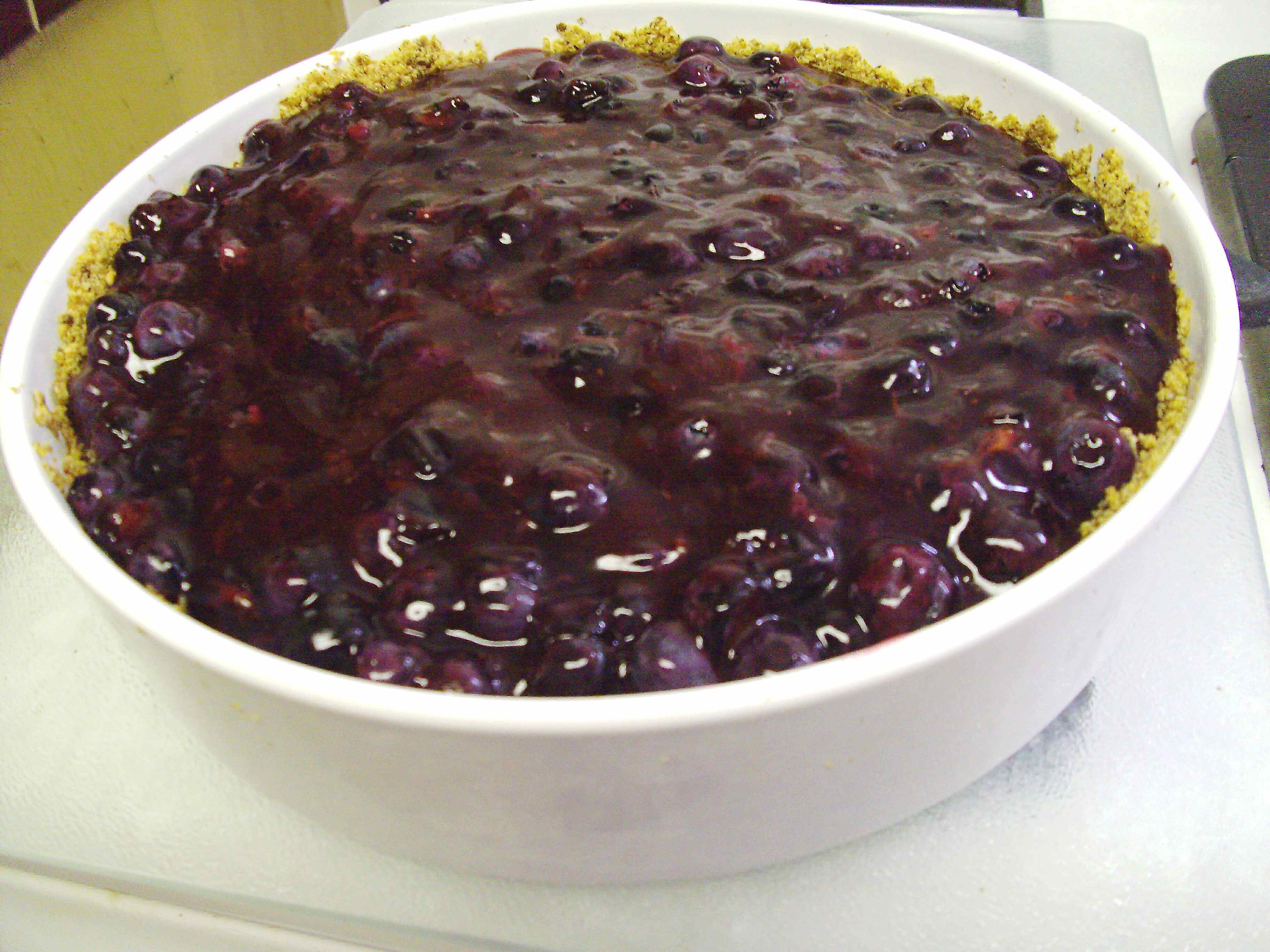
    raw blueberry pie with microwaveable filling and graham cracker crust

    This mostly-raw blueberry pie is a snap to make and very versatile--the filling microwaves in a few minutes, and you don't even have to bake the zippy gingered graham cracker crust--perfect for a hot Fourth of July and all summer long.

  • Recent Posts

  • Contents

  • Archives

  • Now Reading

  • See also my Book Reviews

  • Copyright 2008-2024Slow Food Fast. All writing and images on this blog unless otherwise attributed or set in quotes are the sole property of Slow Food Fast. Please contact DebbieN via the comments form for permissions before reprinting or reproducing any of the material on this blog.

  • ADS AND AFFILIATE LINKS

  • I may post affiliate links to books and movies that I personally review and recommend. Currently I favor Alibris and Vroman's, our terrific and venerable (now past the century mark!) independent bookstore in Pasadena. Or go to your local library--and make sure to support them with actual donations, not just overdue fines (ahem!), because your state probably has cut their budget and hours. Again.

  • In keeping with the disclaimer below, I DO NOT endorse, profit from, or recommend any medications, health treatments, commercial diet plans, supplements or any other such products.

  • DISCLAIMER

  • SlowFoodFast sometimes addresses general public health topics related to nutrition, heart disease, blood pressure, and diabetes. Because this is a blog with a personal point of view, my health and food politics entries often include my opinions on the trends I see, and I try to be as blatant as possible about that. None of these articles should be construed as specific medical advice for an individual case. I do try to keep to findings from well-vetted research sources and large, well-controlled studies, and I try not to sensationalize the science (though if they actually come up with a real cure for Type I diabetes in the next couple of years, I'm gonna be dancing in the streets with a hat that would put Carmen Miranda to shame. Consider yourself warned).

Spice Mix Rx

Sunset magazine surprised me this month with a big feature on complex spice mixtures that have found their way into big-name restaurant food in the past few years–panch phoran, garam masala, baharat, za’atar, ras el hanout, quatre épices, Chinese 5-spice and berbere. Sunset tends to focus on California and southwestern US travel, home decor and food styles, so it was good to see something a little more world beat and exciting…right up until I started looking at the recipes.

The opening spread showed glossy pictures of the various whole spices included in generic versions of each mixture, but the author then blithely left all of these spice mixes and their proportions out of the recipe section!

Her reasoning, if I have it right, was that these spice mixes are getting popular enough that you can find them all premade at your local supermarket. Well…not in mine. And I live in an area with a lot of Indian, Arab, Armenian and Chinese neighbors–the only ones I’m missing are French. You can get Chinese 5-spice powder next to the double shelf of soy sauces, and you can usually get a jar of unsalted generic curry powder (which Indians don’t use but North Africans occasionally do) or some Colonel Sharwood’s and Patak’s curry pastes, and occasionally some garam masala in a jar. Who knows how close they are to real, but they’re highly salted and in jars or packets, so not exactly fresh-made.

Online commenters at the Sunset web site say that the recipes the spices are supposed to be used for are good…if you can find the spice mixes in your area, which many of them can’t. Which is why I’ve done yet another longish post…I’ve decided to dig around and post general recipes for most of the spice mixes myself. Some I’ve tried personally, but most I haven’t made at home, yet, so I’ve tried to find reliable and knowledgeable cookbook authors and where I can I crosscheck with another appropriate author’s recipes–these days it’s so easy for restaurant chefs to publish recipes they can barely pronounce and claim expertise without ever having traveled to India or Morocco or Turkey, or only the tourist routes, much less lived in a village and learned to cook a traditional cuisine for any length of time.

My local favorite family-owned Armenian greengrocer’s caters to most of the Silk Road cuisines, from Morocco to Turkmenistan and even further east. The store carries a couple of brands of premixed za’atar and its own (unfortunately salted) curry powder as well as shawarma and seven spice blends, but for me the great value is that it offers bulk pricing–loads cheaper than supermarket spices–for all the whole and ground individual spices in the mixtures that the October Sunset article mentioned. And the informality of buying spices in tubs rather than little jars encourages you to use them more often, experiment a bit, and improve on what you find in all the new Turkish, Middle Eastern, Indian and Moroccan cookbooks that have come out in the past few years.

Storing spices

Freshness counts even with dried spices. One thing I really appreciate about my corner grocer is that their tubs of spices are labeled with packing dates so you know how fresh the spices are–very important especially for preground spices. I heartily wish McCormick’s and all the store brands (Kroger, Inter-American, etc.) would do the same.

From my own experience, coriander seed and green cardamom in particular should both be left whole and ground as needed at home, preferably just before using them. Both seem to lose their oomph in ground form a lot quicker than cumin or caraway or fennel, at least in my kitchen. Perhaps it’s just that Pasadena is so dry most of the year, but ground coriander can go lifeless and flavorless in a matter of a week or less here, its delicate volatile oils evaporate so quickly, and what a waste.

If you’re going to make your own blends, cloves and allspice are also better left whole, assuming you can get them at a good price, and so is nutmeg–get a ~ $4 lemon zester to grate it with and keep it in a bag with your whole nutmegs. Then just watch your knuckles.

Powdered cinnamon and ginger are usually fine for a longer time, but of course they will weaken a bit. Always, always use whole black peppercorns, not the preground rubber-flavored stuff. And hot pepper flakes? I never realized how much flavor they lose over time–not just heat but the aromatic green edge as well, so don’t buy them in huge cafeteria-scale quantities (live and learn from my mistaken enthusiasm over a $3 quart-sized container…) or your hot mixtures and salsas will be disappointingly bland.

Even some whole spices are vulnerable to flavor loss–or rancidity. Nigella seed, which tends to get used only in small pinches because its flavor expands and permeates stews and curries as they rest overnight in the fridge, should definitely be stored double-wrapped in the freezer so it doesn’t lose all its taste before you can use it up. Poppy and sesame seeds should always be stored well-sealed in the freezer–so should most raw nuts, and so should washed fresh herbs if you can’t use them up within a few days.

Anyway, here are some tested versions of the spice mixes mentioned in the Sunset article. All of them are adapted from their source cookbooks (i.e., the proportions and ingredients are the same, but with my comments, mostly in italics).

The first two are from Manju Malhi’s India with Passion: Modern Regional Home Food, which includes directions on how to use these mixtures and in what approximate amounts for a dish of 4 servings.

Panch Phoran (adapted from Manju Malhi)

Bengali 5-spice mix; good for lentil, bean or potato dishes, samosas, etc.

Malhi’s recipe says this makes 7 teaspoons of spice mix. I’m not sure how she counts that, given that there’s a total of 5 teaspoons of individual dry whole spices in the recipe. However, she says 1 teaspoon of the mix is enough to use in a recipe for 4 servings, and the whole or ground spices can be mixed to a wet paste with 2 teaspoons of water, vinegar or yogurt per teaspoon of spice mix, then tempered in hot oil or ghee (clarified butter) before adding the other ingredients in the dish.

1 t. each (or if more, then even proportions of all five spices):

  • fenugreek seeds
  • cumin seeds
  • fennel seeds
  • brown mustard seeds
  • nigella seeds

Mix the seeds together and store in an airtight container in a dark place for up to 6 months.

Alternate version: Raghavan Iyer’s 660 Curries specifies two parts fennel seed per one part each of the other spices. Continue reading

Why All the Mealy Peaches?

A lot of recent visitors to this site have come in desperate need of ways to redeem the disappointing peaches that are all you can find in the supermarkets these days. Even in peach season. The best I can tell them is that you can microwave the fruit with a little sugar and lemon juice to bring back some of the flavor, but of course it’ll be cooked, not raw. For a couple of suggestions on how to do it and what to use it for, see my original post.

I decided to take this topic up again because the idea of microwave peach jam as your only option is probably not what most of you were hoping for. Me either, frankly. I want great, aromatic, incredibly juicy height-of-season peaches, and I want to be able to eat them with no further ado. Cooking them runs a distant second as far as I’m concerned (though the jam and compote weren’t bad, to tell you the truth–and I just made another batch in about 5 minutes yesterday with some much better peaches from my father-in-law’s backyard trees).

But back to the more usual reality for a moment:

I really don’t think you can get a crummy, mealy unripenable peach to be juicy and fabulous and still raw by nuking it–though I might be wrong; I haven’t tried the lower-power settings or “defrost” yet, and I haven’t tried a shorter time than 3-5 minutes. If you’re determined to try one of these, at least take the poisonous pit out first–you really don’t want to risk infusing the flesh (the peach’s or your own!) with cyanide.

But all that begs the real question–

Why all these @#$*Q#R&*@F….etc. etc…. mealy peaches at the height of summer in the first place?

OK, I know that’s not a dignified way to phrase it, but it calms me down without actually specifying swear words for a situation that clearly deserves it. (And I do have some decent enough swear words beginning with “R” and “F”, but “Q” is going to be a challenge. I’ll have to work on it–get out the Scrabble Cussword Dictionary; it’s probably going to be something in Latin.)

The reason I get so upset about this is I remember looking forward to peaches every summer as a kid–you couldn’t get them in winter (for that matter, it’s debatable that what you get in winter now actually qualifies as peaches). They were so good, so reliably good when they did arrive that my mother once assured my younger brother, who was little enough at the time to worry about the fuzzy peel, that they tasted “like heaven”. She was right. You wouldn’t hear angels or anything insipid like that when you bit into one. You’d get a stream of juice down your chin and flavor so intense you wanted to take it somewhere private to eat so you wouldn’t embarrass yourself.

But things have changed. My post on microwaving unripenable peaches came out last summer, when I bought what turned out to be mealy peaches so many times in a row I started wondering if it was just me or were the peaches really a lot worse than I remembered in childhood. Maybe it was just a one-year blip, a bad crop, some kind of exception in the history of peach-harvesting.

Turns out, probably not. Crummy peaches are back in stock this year–judging from the visitors’ log, my experience, pretty much everyone’s. Even here in California where they do grow peaches.

So blithely scouting the web for answers I come up with two possibles:

Either all the good peaches are being shipped overseas for astronomical prices and our supermarkets are buying the good-looking but deceptive dregs and we’re allowing it by not returning the unacceptable goods and demanding refunds

OR

All the big supermarket chains are buying imported peaches from South America and the combination of long distance storage requirements and import quarantine protocols is ruining the peaches’ ability to ripen.

Of the two, I think the idea that all our domestic peach growers are sending their entire stock of acceptably good produce overseas is unlikely. We do export some fruit but the countries that were likeliest to buy from us ten years ago (Japan and Russia come to mind) have fallen on harder times and there’s more competition from sources that are geographically closer.

On the other hand, there’s a good bit of evidence to suggest the supermarket chains have been cheaping out by importing most of their summer fruit from Argentina and Chile even when it’s summer here–and winter down there. The stores have gotten used to importing all kinds of stone fruits from Chile when it’s winter here, and they may have decided to issue longer term contracts with their distributors. It’s probably cheaper than domestic fruit even after transportation and quarantine.

And that brings us to the main find: Continue reading

Is Extra-Virgin Just a Fancy Label?

The UC-Davis Olive Center has just released a report of its chemical and sensory tests on 10 California and 14 imported brands of supposedly “extra-virgin” olive oil. It concluded that many of the nationally available brands don’t meet the International Olive Council’s or the USDA’s quality standards for extra-virgin status.

The research team also reported that some newer chemical markers of fat oxidation being used in Germany and Australia matched sensory measures of low quality (fusty or rancid smell and taste) better than the standard IOC methods. It was a result almost guaranteed to raise hackles abroad.

The researchers compared the accepted IOC/USDA tests for oxidation and breakdown products with sensory panel evaluations (smell/taste/look/texture) and with a couple of new chemical assays from Germany’s and Australia’s government food quality labs. They had an Australian lab accredited for IOC tests conduct some of their assays.

Nine of the 10 California olive oils were evaluated as authentic extra-virgin oils by the sensory panels and had corresponding assay stats to confirm it.

Almost 70% or about 10 of the 14 international brands, most at least nominally Italian, failed the sensory panel evaluation and had some assay stats outside the acceptable limits for extra-virgin olive oil. Major brands that were deemed lower than extra-virgin quality in at least 2 of 3 sensory panel tests included:

Bertolli, Filippo Berio, Carapelli, Pompeiian, Colavita, Mezzetta, Mazola, Rachael Ray, Newman’s Own Organics, Safeway Select, and Whole Foods’ 365 house brand.

Surprisingly enough, Star and Kirkland Organics fared pretty well. No word yet on Trader Joe’s “Trader Giotto” olive oil–at those prices, though, I’m not holding my breath.

The producers of brands exposed by the report, along with the IOC itself, which was created by the UN in 1959 and is based in Spain, protested the research team’s methodology. Mostly they claimed that too few samples were tested to get statistically significant results, and that IOC tests find only 1% of more than 200 brands they test each year fall below extra-virgin standards. But the brands tested represent most of the common offerings for olive oil in American supermarkets, and results were reported separately for samples of each brand acquired in several cities apiece.

I don’t think, at least on a cursory glance, that the test parameters set for the study or the interpretation of assay results have been skewed purposely to favor Californian olive oils over Italian ones. Results for both were mixed and the researchers reported variations in results within the same brand–for example, some olive oils showed lowered quality in the Sacramento sample but not the San Francisco or Los Angeles ones.

What the researchers at UC-Davis found was not so much evidence of tampering (adulteration with cheaper oils like canola, though there might have been tampering with lower-grade olive oil), but rather higher than acceptable fat oxidation and rancidity due to aging, light exposure, poor (high-temperature) storage and shipping conditions, and possibly poor quality olives to start with.

What I would object to if I were going to find fault is that the study was funded by several members of California’s olive oil industry. Certainly if this were a clinical trial for a new drug instead of a food quality study, the fact that two of the study sponsors are also the producers of brands being studied would make me look twice at favorable results.

Where I think the study favors California olive oils over Italian ones is in the purchasing itself. It should be no great surprise if the imports on American shelves have been sitting there longer and were shipped under more damaging conditions and at higher cost than the California olive oils. It would also be no great surprise if many of them tested in better condition in the European labs before export than at UC-Davis’ labs months (or even longer) after they’d arrived in the US.

If the researchers had express-shipped pre-import samples of this year’s production from Europe to their labs at UC-Davis and their partners in Australia, and tested those results against similarly fresh California oils, the results might have been more to the IOC’s liking–or perhaps not. EU labeling rules allow Italy to claim that olive oil was produced there even if the olives or olive oil lots were acquired from other countries such as Tunisia or Morocco. I’m not knocking North African olives except to observe that they’re probably a lot cheaper than those grown in Italy. But even if they’re of equal quality, each delay in pressing or processing a harvest–not to mention repeat exposure to heat and light during shipping and warehousing from country to country–contributes to the breakdown of olive oil’s flavor components.

However, even if all the olive oil was pristine when tested in its country of origin, such a scrupulous comparison wouldn’t have reflected the real experience of California shoppers trying to get decent olive oil without having to drive out to an olive producer’s farm. Unfortunately, the California olive oils are not widely available in Los Angeles supermarkets (the researchers were stuck with Sacramento and San Fran for those) and most are not really being produced on a large enough scale to become national brands either. The imports are. If most of those really are losing quality through shipping and warehousing, should we be paying extra-virgin prices for them? Or should the companies ship and store them more carefully–and for less time?

Italian Impromptu: Not Bad for an Actor (and Son)

"Don't Fill up on the Antipasto" by Tony and Marc Danza on Amazon.comDon’t Fill Up On the Antipasto by Tony and Marc Danza (Scribners, 2008)

I wasn’t expecting very much from a celebrity cookbook–mostly schmooze, a few loosely slapped-together recipes. I wasn’t actually wrong, but aside from a little kitsch here and there, and a dopey, gushy foreword from Jackie Collins, Don’t Fill Up On the Antipasto is a better-written, more down-to-earth read than you might think. Instead of a prolonged bout of “Remember me? I used to play —- on Taxi!” drivel (though there is a little; practically obligatory in a celeb cookbook), it’s mostly a Brooklyn childhood memoir with old-style Italian recipes–a throwback to the 1950s and 1960s, but a version that didn’t make it on-air in all those 1970s sitcoms.

Although the book is co-written with his son, with a few asides to Marc for his “modern” Southern California-style recipes and confirmation of one or another family anecdote (and repeat photos and mentions of the all-important toddler grandson), most of the stories and recipes are Tony’s.

Danza’s stories of his childhood in Brooklyn are the real draw for this book. He grew up in the postwar generation, at a time when children were given a lot less privilege and a lot less stuff, spanked a lot more often (and not just by their parents–any family member had authorization), and expected to be much more self-reliant at younger ages than they are today. The uncles and aunts and grandparents all lived close enough to see each other every week, and their personalities (and recipes, and foibles, and jokes, and tempers) feature prominently in the book. The result is a look back into a simpler, more direct, and often warmer way of family life than the one most of us recognize today, even if we’re old enough to remember it.

Danza was not born into a down-and-out family, certainly not for the times right after World War II. His parents were working-class, first-generation American, and when his father came home from the war with a Bronze Star, he went to work as a city garbageman. Unlike today, it was a respected job that could support a family. Instead of jeering, the neighborhood kids envied Danza for getting to ride down the street in his father’s truck. The family sent him to a Catholic parochial school and expected him to work hard at his studies, stay out of fights and gangs, and go into a profession.

It was the typical pattern for immigrant families almost anywhere in New York at that time and very close to my parents’ childhoods. Right down to the Army photo of Danza’s father, which suddenly appeared in the middle of the book and startled the hell out of me. Except for the face and the specifics of his uniform, Matty Iadanza’s official Army portrait with its distinctive Continue reading

Prunes and Lentils III: The Lentil Variations

Today’s (and last week’s, and the week before’s) topic is STILL the lentils-and-prunes challenge.

Before I get on a roll about lentils, I should mention that the first Prunes and Lentils post was my 101st post for this blog. I don’t know if we should celebrate, but why not. Woo-hoo! Good enough. Consider it celebrated.

It’s taken me a full two weeks to put up this post because this is where the rubber meets the road, or at least where the lentils meet the prunes. The moment of courage. And I don’t know whether it’s going to be great or whether people will go back to wondering why anyone ever let me in a kitchen. (That’s easy: because no one wanted to do the cooking  themselves.)

Ordinary brownish-green lentils are kind of a workhorse ingredient in European, Mediterranean and Near East cooking (also in Indian and African cooking, though red lentils are better known). Unlike restaurant chain buffalo wings, lentils are actually rich in protein and iron, and they aren’t surreptitiously pumped up with sugar, salt and fat to entice you to overeat. The Center for Science in the Public Interest is not likely to sue, because a bag of lentils doesn’t come with a deceptive toy to con the kids. (See? we can be topical and up on the hot news of the moment even while discussing an arcane Slow Food subject like lentils).

And lentils are CHEAP–the whole point of starting this Prunes and Lentils challenge in the first place. Somehow even the big supermarkets that push shoppers to the middle aisles to buy boxes instead of actual food always carry dried store-brand lentils over near the bags of rice and split peas and kidney beans and such. It’s one of the few middle-aisle purchases that are worth it.

I don’t know if lentils have even kept up with inflation over the past 20 or 30 years, because they’re always something like $1-$1.25 for a one-pound bag. Same as when I was a student on a $20 a week food budget. And a pound makes 5-10 meals, not just one serving.

Actually, the recent agroeconomics of growing lentils in the US makes unexpectedly interesting behind-the-scenes reading for policy wonks like me. Lots of people are now clamoring for the US to change the crop subsidy laws to encourage more nutritious crops than corn, soy and wheat. Lentils are still a minor crop, but apparently the USDA introduced new marketing loans and other incentives for lentils, peas and chickpeas under the Farm Act revisions of 2002 and 2008, and exports for pulses have risen by about 45% in the last few years to India, Spain, the Philippines, and other major lentil and chickpea consumers. The rest are bought for animal feed and international food aid programs, especially those for sub-Saharan African nations.

That’s because lentils still fly under the radar here. The average annual consumption in the US is still just about a pound per person. Up from 0.8 pounds in 2008, so a 20 percent jump, but still. One pound per person in a year. If my continuation of the Prunes and Lentils Challenge posts has no other benefit to humankind, I would hope that it inspires you to buy and cook–and eat–at least one additional pound per year in a creative and satisfying way. Pass it on–Two pounds per year? At a cost of $2-3 total? We can but dream…

Of course, now that bean cuisine has become a point of pride for Meatless Mondays and other trends in eating green (if not eating local), lentils don’t just come dry in bags or bulk anymore–not glamorous enough, perhaps? If you’re upscale, you can get them precooked in little cans at your Whole Foods or steamed in vacuum packs at your Trader Joe’s, but those chic packages are much, much more expensive per meal and don’t taste as good. I frankly wouldn’t bother unless you’re on the road or camping or something and don’t have a kitchen at your disposal. Dried lentils don’t need a presoak to cook up within about half an hour even on the stove top, and they’re so easy to cook in a microwave (and avoid the watched-pot-never-boils problem) that the extra expense and time trying to find the precooked ones is usually not worth it. (And what about all that extra plastic and metal packaging? Be righteous–buy ’em dry.)

If you cook up a whole pound bag at once, you can use it throughout the week or (better, for a lot of people) freeze half of it with a bit of cooking liquid in a microwave container and save yourself some time the next time you want a batch. I keep thinking of that old “Cook Once, Eat Twice–That’s Italian!” lasagna ad (can’t remember if it was for noodles or sauce) from the 1970s. It’s a bit old-fashioned, but still a good idea for  when you’re too tired to cook for real.

In this post, I’ve got 3 or 4 main “strategic” ideas for the prunes and lentils challenge, along with more recipes and variations than should really go in a single post (and THREE more prune accompaniments as well), so just roll your eyes, bear with me, and if you decide never to let me in your kitchen, I’ll understand (plus I’ll never have to do the dishes–win/win!).

So first things first–gotta cook that bag of lentils (and recycle the bag). This recipe is probably longer than the actual process but it contains valuable Continue reading

Prunes and Lentils II: Prune Sauces for Savory Dishes

Following on from Sunday’s post (have you recovered yet? Should I be selling Tums futures?) I should add that NOWHERE in Karen Page and Andrew Dornenburg’s The Flavor Bible can a mention be found of prunes paired in any way, shape, or form with lentils. Don’t have the faintest why not. They do state that plain old green lentils have more flavor than red or brown.  They also pair prunes with olives, mushrooms, gorgonzola and walnuts as well as sweet spices and red wine. Somewhere in that crossroads there’s got to be some confluence of flavor, but wherever it is, they haven’t considered it.

Others have, however–notably Nathan Lyon of the Discovery Channel, ABC’s “Beat the Chef” show in Australia from a few years back, Hello! magazine (OK, copying straight from the California Prune Board’s UK division–wait a minute, they HAVE a UK division?!–and borrowing its press photo)…Oh well.

The benefit to considering prune sauces is that you can serve them with a lentil dish if you’re ready for that or to lift a more familiar savory dish with meat, fish or poultry.

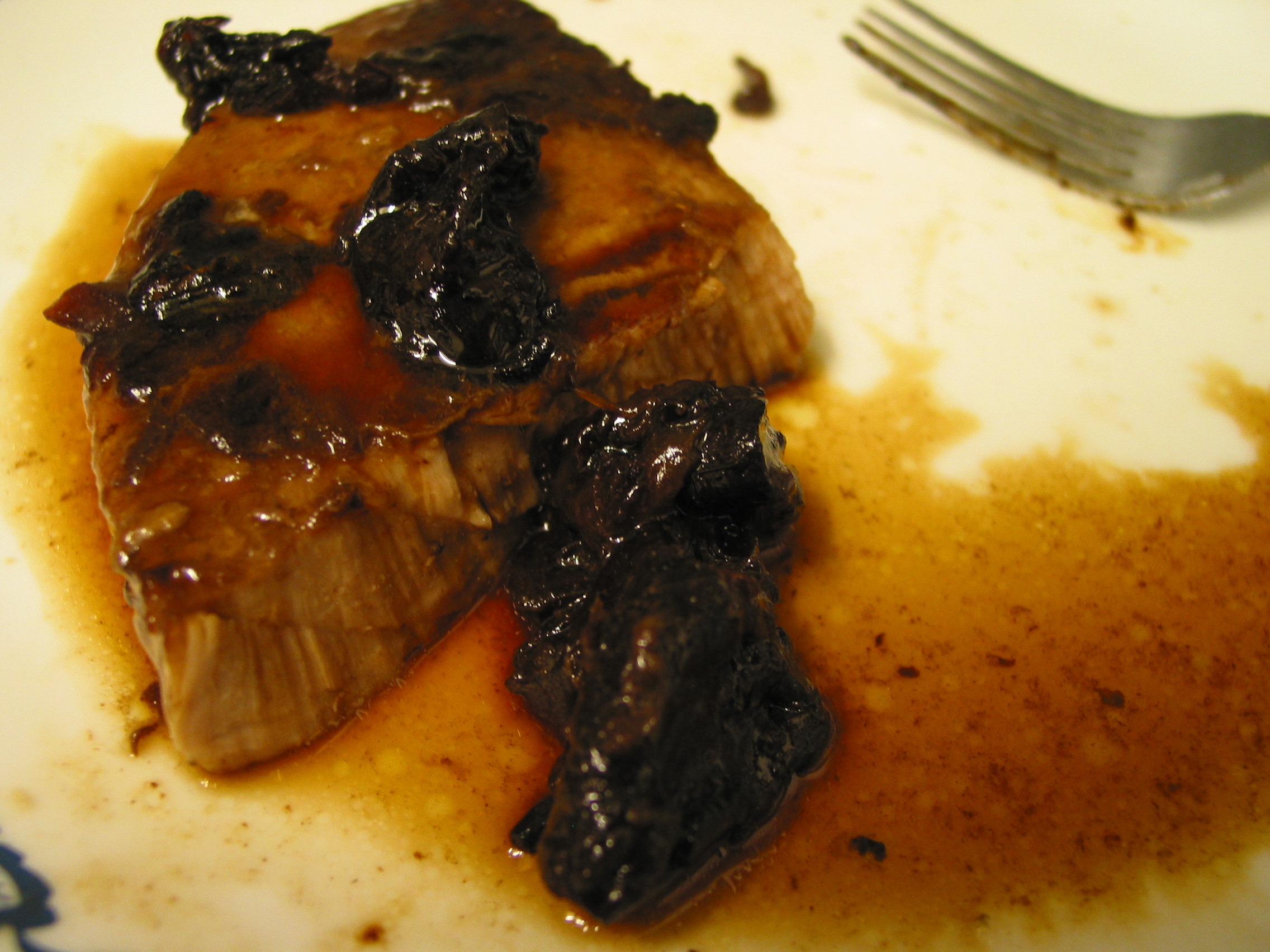
Pan-seared tuna steak with microwave prune and wine chutney

Pan-seared tuna steak with microwave prune and wine chutney

And yes, I said “lift”. Make of it what you will, but any one of the sauces below is better than whatever Hello! magazine has to offer, even if it were original.

Stéphane Reynaud’s Prune Sauce (excerpted for consideration from French Feasts, 2009)

This was designed to go with a simply pan-fried foie gras for six–probably 3-4 oz per person, which seems like a hefty kind of serving, even though I do like liver.  But the sauce–why 18 prunes? 3 per person? and it seems a heavy load of spice for a small amount of wine. Also he has you rest the stuff overnight at room temperature before finishing it. Not sure why–to thicken up, probably, like Elizabeth David’s recipe for peach jam, which also sits out overnight after the first boil-up before resuming.

  • 18 pitted prunes
  • 1 c red wine
  • 1 t ground cinnamon
  • 1 t quatre-épices
  • 2 star anise pods
  • 2 T light brown sugar
  • 2 1/2 T butter, chilled

Boil the prunes 5 min with the wine, spices and sugar, cover and leave O/N at RT. Remove the prunes and reduce the spiced wine to a syrupy sauce. Whisk in the butter, then return the prunes to the sauce.

Microwave Prune Chutney with Wine

My microwave version started out as Reynaud’s wine-based sauce and suddenly morphed, as I was grabbing things out of the fridge for it, with a half-remembered cranberry chutney recipe my mother-in-law served a number of years ago at Thanksgiving. This turns out to be a potent combination, aromatic and sharper, no doubt, than Reynaud’s sauce, with a definite suggestion of saltiness about it–but no actual salt. I don’t recommend eating it straight–too pungent for me, though it’s uncannily close to the relish my mother-in-law served and pretty decent with poultry and stuffing or rice and so on–but cooking 5 minutes or so extra in a saucepan over direct heat or with the food you’re saucing and some extra wine turns it into something pretty special. The whole cloves in particular (which you can take out before using the sauce) do something incredible for any meat or steaky fish you cook with this sauce. Like brisket but just…better, more sophisticated, elevated to the level of cuisine. In fact, put some of this prune sauce with cloves in your next brisket too. 

Makes about 1 cup

  • ½-1 c leftover dark red wine–syrah, aglianico, something inexpensive but rich
  • 8-10 pitted prunes, quartered
  • grating of fresh ginger (1/4 t)
  • grating of 1/2 decent-sized clove garlic or 1 small clove
  • 1/4 red onion, chopped
  • 1-2 t. wine vinegar
  • sprig of thyme
  • pinch of fennel seed
  • 4-5 whole cloves, loose if you can stand picking them out or else stuck through a scrap of onion

Toss the onions with the vinegar and let sit a few minutes while chopping the prunes into quarters–it cuts down on the bite. Mix the onions, prunes, and the rest of the ingredients except the cloves in a soup bowl with a microwaveable lid that can placed on with a gap for steam to escape. Poke the cloves into a larger scrap of onion and add that to the bowl so you can fish them back out easily after cooking. Microwave 1-2 minutes loosely covered on HIGH or until it’s boiling, let sit 5 minutes, stir, microwave again. The prunes will have taken up a lot of the liquid, the onions should be cooked through and garnet-colored, and the wine should be reduced and a bit syrupy.

.  .  .  .  .

From France to China, then:

One year I was determined to make a low-sodium substitute for fermented black bean sauce with roast salmon. I soaked some prunes in a little boiling water and mashed them to a paste, then dressed them up with garlic, ginger and a few other things. It turned out, to my surprise, like homemade hoisin–-dark, glossy, tart and aromatic, less sweet than the commercial stuff, a little smoky from the sesame oil and scallions, with the suggestion of salt Continue reading

Mahi Mahi with Artichoke Hearts

Mahi mahi with marinated artichoke heartsA lot of people seem to have reached Slow Food Fast recently by searching for mahi mahi with artichoke hearts, and all I had up about it was the picture above, so I thought I would post the actual recipe. Admittedly, it’s not very much of a recipe, what you see is what you get.

But the artichoke hearts aren’t just for decoration, they have lemon juice and olive oil as well as garlic, and they shield the top of the mahi to keep it moist and tender while it’s cooking–essential for any steaky fish that tends to dry out if you overcook it even slightly.

This recipe is pretty much just what it looks like in the picture, so I’m not going to give actual quantities–they just depend on how much fish you want to make. I do mine in the toaster oven (about 3 fillets or a little less than a pound) to keep from wasting huge amounts of heating (and in LA right now, cooling afterward). So maybe 15-20 pieces of marinated artichoke heart and a couple of chopped olives will cover things well enough.

For this I use my microwave-marinated artichoke hearts, which only take a few minutes start to finish and store well in the fridge. But if you’re doing mahi for a thousand, obviously you want to invest in the BIG  econobarrel jar of Cara Mia…

Mahi Mahi with Artichoke Hearts

  • Mahi mahi fillets, fresh or thawed frozen, rinsed gently under cold water
  • marinated artichoke hearts–enough to cover the fillets to your liking, not enough to break the bank
  • fresh sprigs of rosemary or thyme if possible; dried or frozen if that’s what you have
  • a few Kalamata, Alfonso, Gaeta or other good brined olives, pitted and quartered or chopped
  • decent olive oil for drizzling
  • squeeze of lemon juice
  • fresh-cracked black peppercorns optional

Preheat the oven to 375-400 F, or if you’re cooking in the toaster oven, figure 350F starting when you put the fish in, since it’s smaller and the heat’s closer to the fish.

Lay the rinsed fillets in a single layer in a foil-lined pan, and cover with a layer of marinated artichoke heart quarters. Scatter olive pieces and herbs evenly over the top, drizzle on olive oil and lemon juice, and grind pepper over the top if you like.  Cook uncovered for 15 minutes, check for doneness by cutting into one of the center fillets with the side of a fork or by trying to pierce one–if it’s still raw, it’ll resist, and if it’s cooked it’ll separate or flake. Try not to overcook, you want it cooked through but still juicy as it separates. If it’s only a little bit pink in the middle when you check, shut off the oven and leave the fish inside for another minute or so to finish in the residual heat.

Technique: How to Squeeze an Eggplant

Long ago, I threatened to post the unlovely but effective method of peeling cooked eggplants that I learned the hard way, in a kibbutz kitchen. We used to make baba ghanouj routinely for a thousand members–something like 50 to 75 baked eggplants went into it each time, mixed in a stand mixer the size of a wheelbarrow with a base that was cemented into the floor. You can’t be fooling around with spoons and forks when you’re working on that scale. Instead, we cooled the eggplants in a huge colander and then started squeezing them out as though they were pastry bags or tubes of toothpaste.

It takes a bit of practice…to say the least. But each eggplant only takes about half a minute to empty into the colander, and once you get the method down, the skin stays together and is just about completely clean inside. Very effective. Not very dignified, though, unless you do it enough to get good at it.

However, since I have no vanity whatsoever, I finally took some pictures (not easy to shoot while actually squeezing the eggplants, so don’t expect photogenic–eggplant is only pretty raw…) and have steeled myself to walk you through it. Wear goggles and a hairnet the first time if you’re afraid of flying goop, or make your little sister do it first. And don’t forget to rinse your hands (and arms) well right afterward, because the juice is still a bit caustic and will make them itch after awhile. Anyway, the following is for if your little sister refuses to take the bait.  Click directly on any of the pictures if you want a closer view.

How to Squeeze an Eggplant

First, microwave your eggplant(s) (best if you’re only doing up to 3; any more and it’s worth roasting them for a whole hour in the oven at 400F). Scrub them well, cut off the cap (watch out for thorns!), rub or sprinkle a little salt on the damp skins, and set them to microwave 10 minutes on HIGH, until they’re soft and collapsed.

whole eggplant before microwaving for baba ghanouj

Whole eggplant prepped to microwave for baba ghanouj

Eggplant after microwaving

After microwaving 10 minutes, the eggplant has collapsed

Next, let the eggplant cool enough to handle–this is probably the most important part. Trying to squeeze out a scalding eggplant leads to explosions of scalding eggplant goop, plus the peel usually toughens a little as it cools, which makes ruptures a little less likely.

–Am I making it sound good yet? No?–hang in there.

Poking the eggplant

The all-important poke

Set the cooling eggplant cut-end-down in a colander over a bowl to drain off some of the juices. If you have the asbestos-like fingers for it, you can poke a hole in the cut end while it’s still hot and earn yourself untold macho points as long as you only wince after you’ve slunk off to the bathroom. Never let ’em see you cry. If you’re not that brash, you’ll have to poke a hole in the cut end once it cools. That’s the easy part.

Once the eggplant’s cooled enough to wrap your hands around it, it’s showtime. Keep the cut end facing down.

Grab the eggplant like a pastry bag, cut end down

Grab the eggplant like a pastry bag, cut end down

Cup your hands around the fat round end at the top and very gradually push in and downward, closing your hands over the top, Continue reading

Oranges as a savory

Artichoke-Orange Salad

Oranges in a savory compote with artichoke hearts

A few weeks ago, I ran across a food article by Amanda Hesser, in which she recounted her recent experience of being served a green salad with red onions, Greek olives, and oranges in it. What struck me was the way she fumed at length over having missed out for so long on this simple culinary classic.

I grew up in a Jewish household in the early 1970s, at about the time when felafel and hummus and tabouleh started making their way west into American Jewish cooking. These, along with pita, tomato-cucumber-pepper type salads and eggplant everything, were part of the larger Jewish cultural revival after the Six-Day War. Jewish cookbooks started embracing the Lebanese, Sephardic, North African, and Persian influences on Israeli food as a complement to the more familiar Ashkenazi fare. Orange salads just seemed to fit in.

In any case, orange salads have been published in Jewish and Mediterranean-leaning cookbooks for at least 25 years–notably Paula Wolfert’s Couscous and Other Good Food from Morocco, one of my first cookbook purchases once I came back from my own year as a kibbutz volunteer.

Three orange salads

The simplest orange salad I make is a basic green salad with oranges rather than tomatoes, and it goes well with oil-and-vinegar or mustard vinaigrette. Another, more of a fruit salad, is orange and/or grapefruit segments or slices mixed with a dressing of a cup of yogurt, a spoonful of ordinary red wine vinegar, a spoonful of sugar, and curry powder to taste, maybe half a teaspoon or so, enough to make it yellow-orange and aromatic, not enough to be bitter.

Another more elegant take on the green salad is something I made a few times in my early cooking days for buffet lunches at my synagogue–orange slices sprinkled sparingly with orange blossom water and a grinding of cardamom, laid down in overlapping rows on a bed of vinaigrette-dressed romaine in a tray, and red onion rings, sliced Kalamata olives, red bell pepper rings, crumbled feta, and chopped fresh basil strewn over the oranges. It was a bit much for serving at home, but it made a beautiful buffet dish, and it always got eaten.

So oranges can serve quite nicely in fresh salads, but what about in hot dishes? There’s the rub.

Orange peel I have no trouble imagining in hot savories–a number of Chinese classics use it (beef with orange peel, etc.), and so does duck à l’orange. Cooked oranges, on the other hand, always disappoint me–somehow the structure collapses, the color fades, and so does the bright acidity. They end up pulpy and stringy and less than half as good as fresh raw pieces would have been. But people persist in cooking with them–so I thought I would give a different Paula Wolfert cookbook a try.

The Slow Mediterranean Kitchen: Recipes for the Passionate Cook
(2003) features one really unusual orange-based savory: an Algerian Jewish sweet-and-sour compote of artichoke hearts and orange sections glazed in orange juice. With garlic and olive oil. Hard to imagine–does garlic go with oranges?–but so close to my standard marinated artichoke hearts, at least theoretically, that I decided to chance it and see. Continue reading

For recipe sodium counts, better do your own math

Another Martha Rose Shulman recipe for a peanut sauce to go with soba and other noodles appears in today’s NY Times “Recipes for Health” column. Which would be fine but the nutrition counts below it don’t add up–at least for sodium. She’s specified unsalted peanut butter–but has 1 or 2 tablespoons of regular, not low-sodium, soy sauce at 1200-2400 mg sodium, and not low-sodium but regular or unspecified vegetable or chicken broth, both of which are pretty loaded, so anything from 150-750 mg per cup. If you look down to the nutrition counts, though, each of 4-6 servings is supposed to be 150 mg of sodium. How? In my daughter’s 4th grade math text, ~3000 mg for the total recipe at the higher options (650-750 mg broth, 2400 for 2 T soy sauce)  would give you 500 mg for 6 servings. For 4 servings, it would be 750. The best you could do would be the lower-sodium options for 1350ish in the total recipe, so about 350 mg. per serving.

On her own web site, Shulman claims not to care about sodium counts when she creates new recipes or adapts old ones (not clear how she can claim that makes them recipes for health), so perhaps this is one column to take with(out) a grain of salt.