
• Enter your email address to subscribe to this blog and receive notifications of new posts by email.

    Join 241 other subscribers
  • Noshing on

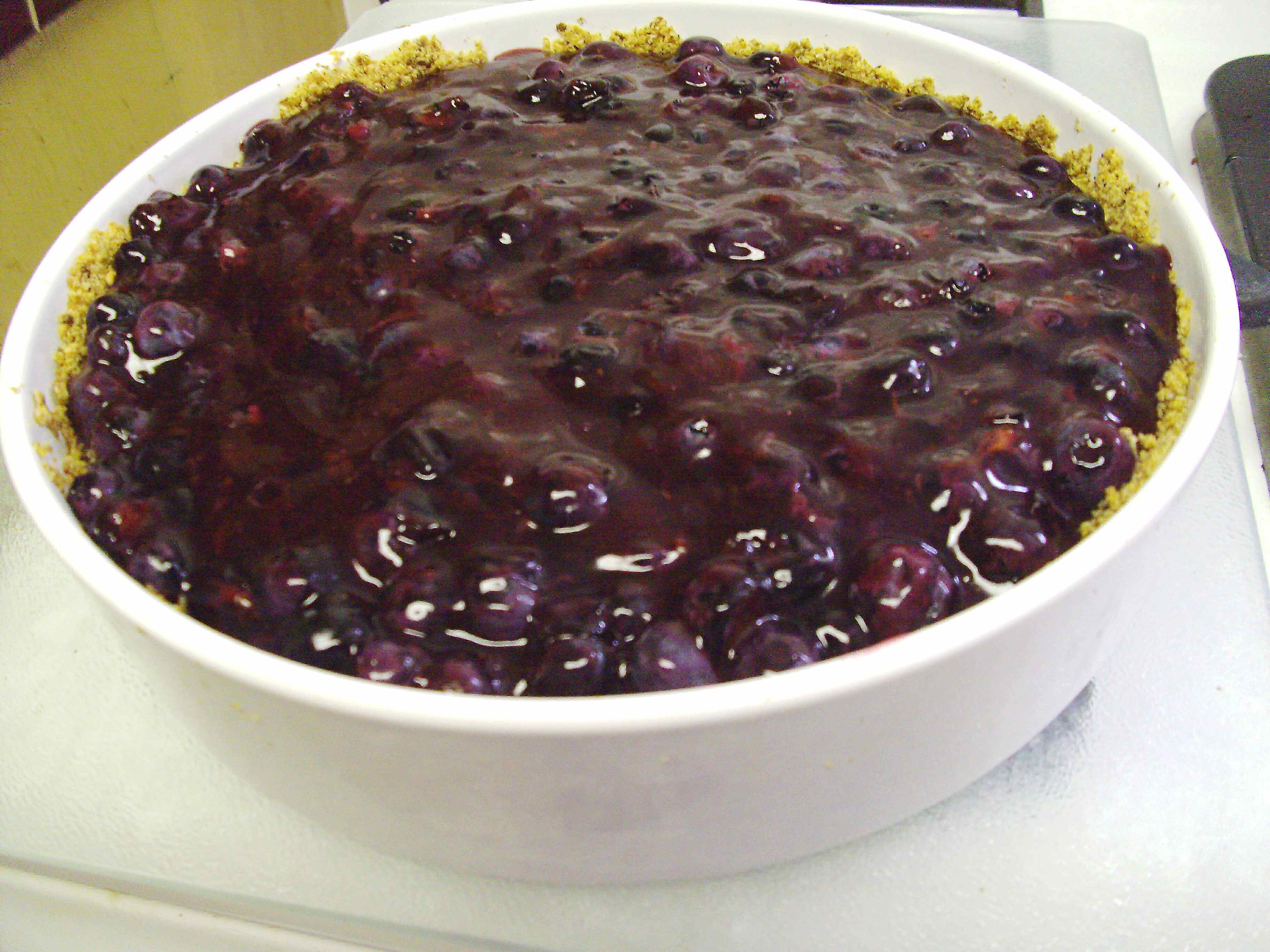
    raw blueberry pie with microwaveable filling and graham cracker crust

    This mostly-raw blueberry pie is a snap to make and very versatile--the filling microwaves in a few minutes, and you don't even have to bake the zippy gingered graham cracker crust--perfect for a hot Fourth of July and all summer long.

  • Recent Posts

  • Contents

  • Archives

  • Now Reading

  • See also my Book Reviews

  • Copyright 2008-2024Slow Food Fast. All writing and images on this blog unless otherwise attributed or set in quotes are the sole property of Slow Food Fast. Please contact DebbieN via the comments form for permissions before reprinting or reproducing any of the material on this blog.

  • ADS AND AFFILIATE LINKS

  • I may post affiliate links to books and movies that I personally review and recommend. Currently I favor Alibris and Vroman's, our terrific and venerable (now past the century mark!) independent bookstore in Pasadena. Or go to your local library--and make sure to support them with actual donations, not just overdue fines (ahem!), because your state probably has cut their budget and hours. Again.

  • In keeping with the disclaimer below, I DO NOT endorse, profit from, or recommend any medications, health treatments, commercial diet plans, supplements or any other such products.

  • DISCLAIMER

  • SlowFoodFast sometimes addresses general public health topics related to nutrition, heart disease, blood pressure, and diabetes. Because this is a blog with a personal point of view, my health and food politics entries often include my opinions on the trends I see, and I try to be as blatant as possible about that. None of these articles should be construed as specific medical advice for an individual case. I do try to keep to findings from well-vetted research sources and large, well-controlled studies, and I try not to sensationalize the science (though if they actually come up with a real cure for Type I diabetes in the next couple of years, I'm gonna be dancing in the streets with a hat that would put Carmen Miranda to shame. Consider yourself warned).

Microwave Tricks: Brown Rice Resolution

Resolution #15 from my last post was to figure out a decent “quick” method for cooking tougher grains like brown rice and pearl barley. These grains still have the skin on, which forms a barrier to quick absorption, so they take 45-50 minutes to cook on the stovetop, which is simply too much for me to babysit. Apparently I’m not alone on this–I see vacuum-packed packets of precooked brown rice at the Trader Joe’s (and similar bowls in the freezer both there and at Whole Foods).

To say the least, this is not the right way to go if you’re earnest about spending less on staples while going a little bit greener in the new year (think of all the freezer energy cost and coolant leaks, the cooking energy expended, the plastic packaging, etc.)

According to Nina Shen Rastogi of Slate.com, microwaving can be the greener cooking option as long as you don’t leave your microwave plugged in when you’re not using it–apparently the little digital clock display thingy takes up a surprising amount of energy (and do you really need a microwave to tell you the time? Hang a battery-operated clock in view of the kitchen and you’ve got it…)

So microwaving should be the way to go with brown rice, as it is for pasta (plain or whole-grain) and white rice. But unfortunately, microwaving brown rice, with its tough outer skin, really doesn’t work well at all if you just dump the raw rice into some water and try to nuke it straight up, the way you can with these quicker-soaking grains. Certainly not in 3-5 minutes of cooking time. Not without babysitting and worrying about boilover. Feh.

And it’s never a good idea to nuke something starchy more than a few minutes at a time, at least not without a lot of water in it–you could end up with plastic (think about what happens to bagels if you microwave them for more than 15-20 seconds).

But you know I don’t like to give up once I decide something should work. So–I thought about something I posted a couple of years ago on nuking oatmeal successfully and decided to try the presoak idea that had worked for steelcut oats. Only who wants to presoak rice overnight if they don’t have to? Steelcut oats–you know you’re going to make them for the next morning’s brunch (only do it on a weekend). Stick ’em in a bowl with water and a lid, let it sit overnight, nuke a few minutes in the morning and you’ve got it. It’s perfect.

Rice? I never know what I’m making for supper until about an hour before.

But a hot presoak worked pretty well to get things started, and it only took about 15 minutes (because I was impatient). The whole thing still took about an hour–well, maybe less in the strict sense, I wasn’t paying attention Continue reading

Getting Mead-ieval

(plus 2 era-appropriate desserts to go with it)

Chaucer's Mead shelftalker label

Chaucer's Mead new 2010 label. Diehard homebrewers aren't as enthusiastic as Wine Enthusiast, but most of them seem young and clearly weren't expecting a dessert wine.

A couple of years ago my husband was rooting around our dwindling wine rack selection on a Halloween eve, right before the trick-or-treat crowd came by. It was actually starting to get genuinely chilly outside in the evenings…

“Hey, Deb–what is this stuff? Chaucer’s Mead?!” [squints at label] “Says you’re supposed to serve it fresh. How old is it?”

“I dunno. Last year? I forgot it was there.”

“Are you sure it’s still good?”

I started typing away to find out. “One of the Renaissance Faire bloggers says it’s really gross fresh and you’re supposed to let it age, but it looks like they mean the kind you make at home.”

Clearly neither of us was an expert.

Mead, of course, is a drink made by fermenting honey. I’d been vaguely aware of it ever since I was eight or nine years old and my dad handed me a copy of Howard Pyle’s The Merry Adventures of Robin Hood. (Quick, everybody, picture Errol Flynn or Kevin Costner, your preference, dressed up more or less as Kermit the Frog in a pointy hat and feather, leaping up onto a dead log with arms akimbo to shout “Ha-Ha-Ha-Ha!” at his fellows in a gratingly cheerful tone…)

I like reading about medieval and renaissance Europe, but I’ve never favored the Renaissance Faire approach–especially because you have to sew your own costume AND know all the names of the pieces AND how to lace them all together. A lot of participants get very snotty about each other’s authenticity. Which is fun, clearly, but I’d be the one they were getting snotty with. Also I’ve never wanted to be addressed as “wench” unless I had a huge frying pan handy to teach the knave who tried it some manners.

Also, after seeing my ex-brother-in-law’s home beer brewing setup (very successful, but then he’s English and knows his stout) I always thought that brewing mead at home would also involve big trash cans with burp valves (I mean, gas traps, though on reflection that’s actually no politer), attract a guaranteed parade of ants even in January (this being Pasadena), and that the stuff would come out cloudy and greenish and a little too authentically medieval for enjoyment.

So all in all, it wasn’t until I stumbled on a bottle at the Trader Joe’s while looking for a gift bottle of more conventional port that I ever considered tasting mead. It was enough of a novelty and the price was right–about $10. Then, of course, I put it in the wine rack and forgot about it for an entire year…which, it turns out, is the right thing to do.

Back at the kitchen counter my husband had finished squinting at the fine print, decided it probably wouldn’t kill or blind both of us at the same time, and was already opening the bottle to pour  a sip into each of two glasses. It looked and smelled like a white dessert wine–light, clear, not at all the cloudy, beerily fermenting syrup I’d been imagining. So we decided to risk it on the count of three.

Even though it looked fine, I’m not crazy about sweet dessert wines and my husband is, so I was still prepared to wince. But whatever I was expecting, it certainly wasn’t this.

It didn’t taste like honey at all–it tasted like all the flowers the honey had been made from. Somehow the brewing and aging had unlocked all the delicate nectary flavors that had been trapped inside the honey, and the flavor kept changing and shifting with every sip. A sherry glass was plenty–it was a bit rich, another surprise, because sherry hovers around 18% alcohol, and this mead was only 10%. But it was intense and fascinating.

Just then, of course, my husband spotted the little packet of spices, like a teabag, that had been hanging around the neck of the bottle and decided he really ought to mull some of the mead with them. In five minutes, the whole downstairs smelled of nutmeg. It was too cloying for me, but he liked it. (Chorus: because he’s a boy) See, though, you can get away with that for a $10 bottle, and your wife doesn’t have to get mad at you. And there was enough left to have a little unsullied mead over the next couple of days.

What to serve with it, though?  I want to keep the contrast between the mead and the food, which is going to have to be either an appetizer or a Continue reading

Adventures with Cheese

A year or so ago, I saw a show on PBS about how PR consultants test and choose keywords to influence public opinion on everything from political campaigns to new foods. Most memorable–other than the use of a statistics-wielding ad consultant for the Swiftboat smear campaign–was a French marketing expert in his late 60s who discussed the key difference he’d found in food attitude focus groups between Americans and French:

“In America,” he declared, “Cheese is dead. I can assure you of that.” The key positive words that arose in his group discussions about cheese were “sterile” and “safe”. That is, as long as the cheese was processed, uniform, free of visible mold, refrigerated, odor-free, pasteurized and–most important–wrapped in plastic so nothing could possibly escape, cheese was okay.

Otherwise, he said–you could hardly miss the sneer–Americans considered cheese unsafe. They–we–were culturally afraid of it.

In France, he maintained, “Cheese is alive.” The French focus groups brought out  words like culture, flavor, and the names of many, many specific types of regional cheeses that were their personal favorites. The French still buy much of their cheese at small local shops whose owners’ main job is to present their cheeses for sale at the optimum point of ripeness. The customers take home a wedge or small round of cheese and keep it on the counter or a dedicated shelf in the fridge, depending on the type, and they have their own fixed ideas and traditions for storing it so as not to ruin its flavor or texture–two words that did not really come up in the American discussions as much as “Velveeta”.

Are we Americans really that ignorant about cheese? The food my husband brought home from the aforementioned brunch included three or four stacks of precut sliced cheese–yellow-orange, whitish with an orange edge, and whitish again with tiny flecks of red and green throughout. Cheddar, muenster, and pepper jack? I looked at them, wondering were they real or processed–hard to say by looks alone, so I peeled off a corner of a slice on each of them to try them. They all tasted exactly alike. Although the one with the flecks was a little bit spicy, the basic flavor was Velveeta: salt, starch or gum, cooking oil. Something stale–maybe milk solids–but no culture, no tang, no fresh dairy flavor. There wasn’t even much of a smell. The French guy was right.

I started to toss the packets in the trash and my daughter asked why–so I let her taste them. “They’re not that bad,” she said. “They’re not that good,” I replied, and handed her a small chunk of sharp cheddar we had in the house for comparison. “Which would you rather eat?” ‘Nuff said.

I bring this up because I really do have a thing for cheese (damn my cholesterol-packin’ genes), but good artisan-type cheeses are often pretty expensive–$15 and up per pound–and the more affordable varieties of things like brie or gorgonzola usually lack something in the way of flavor, especially if they’re made in Canada or the U.S. Plus I have a thing for playing with my food.

For the last couple of years I’ve been playing around with the idea of taking a fresh cheese and culturing it further to get to something approaching the aged artisanal cheeses. We have lots of generic chèvre and feta and ricotta and so on these days–as well as increasingly easy-to-find inexpensive (but bland) brie and bleu cheeses made with cows’ milk. And that’s sometimes the problem: we don’t have a lot of goat’s or sheep’s milk available to ordinary consumers in the U.S., and the French-style cheeses we do have are kind of bland, maybe even oversterilized, even though as a former biochemist I’m a big fan of pasteurization, especially for any dairy that has scaled-up production. To that end, READ THE SAFETY NOTE AT THE BOTTOM OF THIS POST if you’re going to give this a try.  Continue reading

Spaghetti Squash Too Many Ways

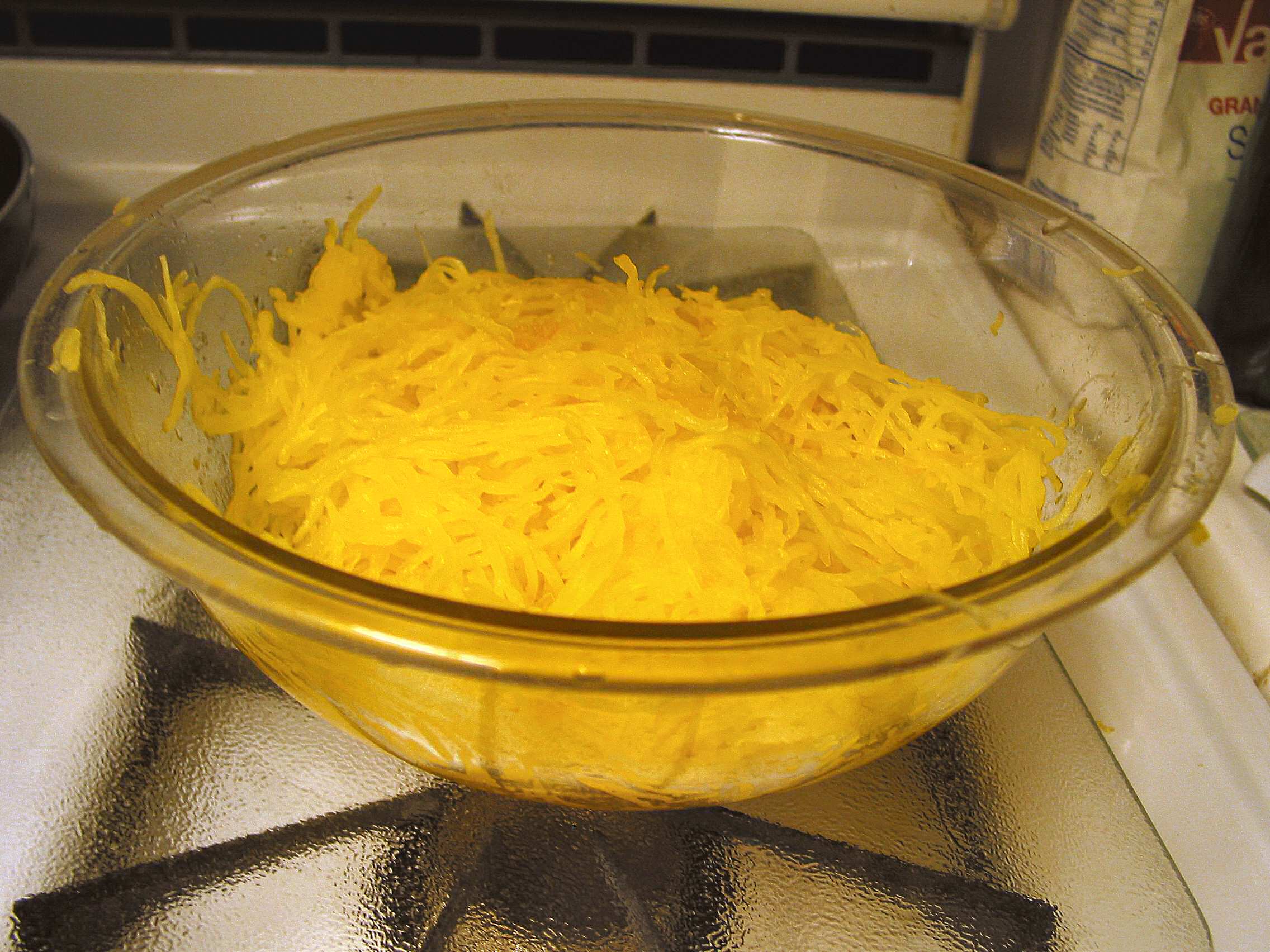
Just half of a microwaved spaghetti squash makes 5 or 6 cups

Just half of a microwaved spaghetti squash makes 5 or 6 cups!

This week my local Trader Joe’s had crates of beautiful–and hefty–spaghetti and butternut squash for less than $2 apiece–on the order of 30 to 50 cents/lb. So of course I got two of each and wobbled out of the store unsure which bag was pulling me down further. And then came the task of cooking them.

One spaghetti squash–a good-sized 5-6 lb. beast–will feed a lot more people than you’d think. It’s got some serious advantages over standard pasta: more fiber, no sodium, some vitamin A and potassium, perhaps fewer calories and carbohydrates per ounce. And it’s incredibly versatile. And you can cook it in the microwave in about 10 minutes rather than spend an hour baking it and heating up the house.

But there’s one big disadvantage–if you cook the whole thing, you have to eat the whole thing. Cooked spaghetti squash doesn’t hold up in the freezer–the strings go flat and shrivelly. And reheating too long can make it wilt as well. So can very acidic dressings.

So the choices are (for a small, moderately but only moderately tolerant family unit):

  • Cook half at a time and store the other half raw and wrapped in the fridge for a few days
  • Cook both halves, use one right away, and store the other half in the fridge for a few days, either wrapped in its shell or else scooped out into a container  (recommended)
  • Give the other half to a friend–but not too good a friend…
  • Cook it all and make it for a big potluck. Maybe people will think it’s innovative and exotic…depends on what you do with it (I don’t so much recommend marinara for this if you’re looking to impress–maybe a peanut-curry sauce or an Alfredo-style sauce with lemon peel, or something involving oyster mushrooms)
  • Cook it all and serve it a couple of different ways over the course of the week
  • Make a couple of the variations ones that taste good cold and eat the leftovers for lunch (recommended)

One important tip (learned the hard way):

The strands grow crosswise inside the spaghetti squash, not lengthwise. If you cut the squash in half the way you would a watermelon, you’ll be cutting the strands into shorter bits–not what you want. Cut the spaghetti squash in half across the middle of the SHORT side, NOT from the stem to the flower end.

If you have kids, let them count the seeds in each half of the squash–it’s a good lesson in plant survival strategies. My daughter and I counted about 80-90 seeds per half and decided to wash, dry and save them for her school’s garden. At this rate, they’ll have spaghetti squash for several years. Note of caution: out of 10 that we thought had been lost down the sink but actually got caught in the drainer, a full 9 germinated, so be careful what you wish for… even commercially grown, these things are very, very determined. But we’re not ready to name any of them “Audrey II”–yet. Continue reading