
• Enter your email address to subscribe to this blog and receive notifications of new posts by email.

    Join 241 other subscribers
  • Noshing on

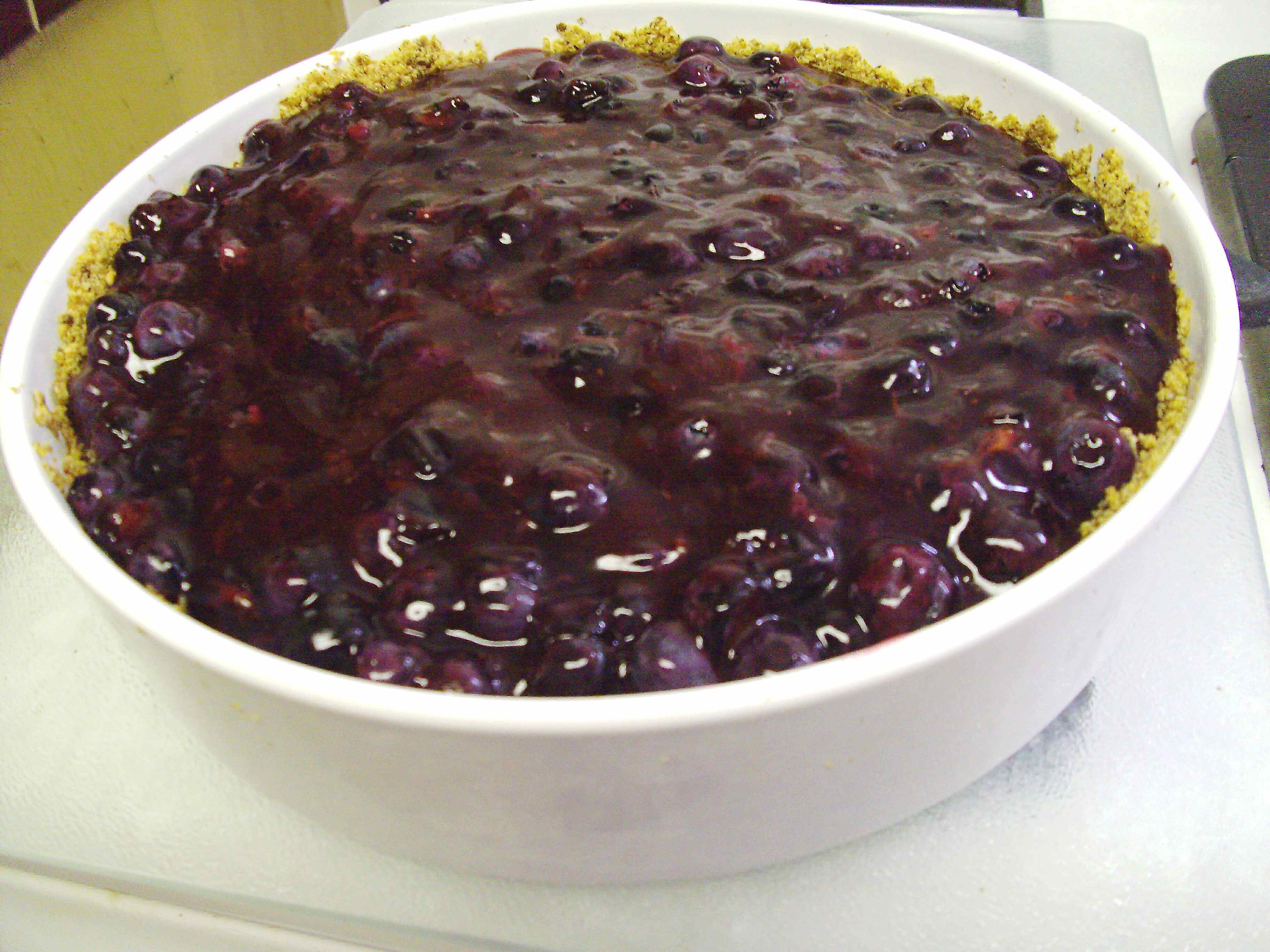
    raw blueberry pie with microwaveable filling and graham cracker crust

    This mostly-raw blueberry pie is a snap to make and very versatile--the filling microwaves in a few minutes, and you don't even have to bake the zippy gingered graham cracker crust--perfect for a hot Fourth of July and all summer long.

  • Recent Posts

  • Contents

  • Archives

  • Now Reading

  • See also my Book Reviews

  • Copyright 2008-2024Slow Food Fast. All writing and images on this blog unless otherwise attributed or set in quotes are the sole property of Slow Food Fast. Please contact DebbieN via the comments form for permissions before reprinting or reproducing any of the material on this blog.

  • ADS AND AFFILIATE LINKS

  • I may post affiliate links to books and movies that I personally review and recommend. Currently I favor Alibris and Vroman's, our terrific and venerable (now past the century mark!) independent bookstore in Pasadena. Or go to your local library--and make sure to support them with actual donations, not just overdue fines (ahem!), because your state probably has cut their budget and hours. Again.

  • In keeping with the disclaimer below, I DO NOT endorse, profit from, or recommend any medications, health treatments, commercial diet plans, supplements or any other such products.

  • DISCLAIMER

  • SlowFoodFast sometimes addresses general public health topics related to nutrition, heart disease, blood pressure, and diabetes. Because this is a blog with a personal point of view, my health and food politics entries often include my opinions on the trends I see, and I try to be as blatant as possible about that. None of these articles should be construed as specific medical advice for an individual case. I do try to keep to findings from well-vetted research sources and large, well-controlled studies, and I try not to sensationalize the science (though if they actually come up with a real cure for Type I diabetes in the next couple of years, I'm gonna be dancing in the streets with a hat that would put Carmen Miranda to shame. Consider yourself warned).

Leftover Logic

Two weeks ago The Guardian‘s business section published the following salvo against glam-food waste: “Food’s latest hot trend: leftovers”. Some of the interviewed chefs, who grew up eating leftovers in the ’70s, have apparently joined forces with the Women’s Institute in York (shades of “Calendar Girls” and Helen Mirren’s shaky attempt at a Yorkshire accent) for a project to reduce food waste as supermarket prices continue to rise and rise.

Some interesting quotes in the article, and interesting questions on frugality–the columnist claims household food waste is down about 13 percent in the UK since last year, which is pretty telling about the economy. She and the people she quotes attribute the current lack of knowledge on how to use leftovers to a sharp decline in cooking skills that coincides with the surging popularity of perfect, coffee-table-worthy food fantasy cookbooks.

Is it really the fault of photo-heavy cookbooks, food magazines, blogs and tv cooking shows that only perfect produce makes the cut, and everything with a blemish on it must automatically be thrown out? Possibly…but the article also cites another trend–the heavy push of boxed microwave-meals-for-one that leads so many people to fear cooking and believe they could never be talented enough to cook from scratch.

Of course, if you never touch an uncooked bulk vegetable or a piece of raw meat, you never risk making a mistake in the kitchen. But the other side of the coin is that the produce in the magazines will never show up on your table. Because the frozen tv dinners really don’t come out looking or tasting as good as the pictures in the magazines.

If you do cook, the idea of using up what you have in the fridge can be nearly as daunting as having to pay for fabulous (and expensive) first-rate pre-sorted extra-polished pre-cut vegetables. In a branded bag. Can you eat less-than-perfect-condition food mag-quality decorator vegetables and still be safe?

Yes, you can. Obviously, when you go to buy vegetables, you want the best and freshest ones you can get for a reasonable price. Nothing you buy should be leaking or moldy or worm-ridden or otherwise clearly spoiled. But short of that, quite a lot of produce can be eaten just fine without having to be picture-perfect.

No one in the professional or amateur food enthusiast world ever talks about how to handle imperfect, wrinkled or slightly old vegetables, but they should. Because no matter how they look when you buy them, if you actually buy enough vegetables and enough variety for a week, some of your produce is going to start drying out or going a little less crisp or whatever in the later days. And you don’t necessarily need to throw it out because of that. Most of it you can probably still use and it will still be fine.

Local corner greengrocers often sell the oversized, undersized, riper or otherwise less-perfect-looking vegetables for a fraction of what they go for in big chain supermarkets. Customers at my local Armenian grocery routinely stagger out with huge bags of red peppers, onions, green beans, cabbages, eggplants, zucchini…all at a dollar a pound or less. Probably most of those vegetables are less than shiny-perfect. It doesn’t matter. The customers who lug them home are going to cook them up in large batches and short of actual spoilage, they’ll use them up.

And I myself did it today–foraged around in the fridge for the eggplants I bought last week. They were just starting to show brown dimples at the flower end. Not lovely but not a disaster. Then I found the less-than-great winter Roma tomatoes, a few of which were already starting to show little smudges of black at the stem ends because I’d had to store them in the fridge–no room on the counter, and I had them in a plastic bag that kept the moisture in more than was really good for them. Damn! I weeded out two that were clearly beyond saving–cracked and leaking slightly, not good–and took the others out to inspect. How bad were they?

Now the eggplants were only a little bruised or dimpled in a few places. Peeling off a little of the skin at those points revealed that the flesh inside was still okay. No worse than a bruised apple. Cut them up, microwave them, drain off the juices and fry them for eggplant-and-chickpea stew, and they’re just fine.

The tomatoes are a little scarier, no question. No one wants mold on their vegetables. But except for showing the tiny beginnings of mold at the stem ends, the six tomatoes I had left seemed fine and firm, dry and uncracked. Throw out six tomatoes at this time of year? I decided not to. I washed them carefully on the theory that the peel, if it’s unbroken, is working hard to seal out dirt and contamination and any mold spores on the surface can therefore be washed off. I sliced off the tops about half an inch below the stem ends–giving them a margin of safety at least in my mind.  Then I dared to taste a bit of the tomato below that. Also fine–or as fine as winter tomatoes get, anyhow. No sight, smell or taste of bitterness anywhere, and not mushy or discolored, and they tasted reasonably fresh. So I cut up the tomatoes and put them in the stew.

And everything was fine, and no one got sick or started convulsing (or screeching at the top of their larynxes) like Robert Plant at the height of his Led Zep days. This was fortunate, because we don’t yet have the larynxes back in shape after Losangelitis week, not to mention the stomach muscles, the tight jeans (well, the jeans are a little tight but not on purpose–we’re workin’ on it! hate those sit-ups) or the massive and tossable hairdo. Then again, neither does Robert Plant these days. So I don’t feel that bad about it. And neither should you.

Microwave tricks–When the peach doesn’t ripen

What if you’re stuck with supermarket peaches or nectarines that looked good, were on an incredible discount, smelled like they had potential if you left them out on a counter for a couple of days, and then when you did, they somehow never really ripened? Just turned mushy or the texture of a pale yellow sponge inside, with a lackluster taste to match, and developed an ugly, gelatinous brown layer near the pit? And to make it worse, you’d enthusiastically bought five or more?

Spongy peaches in need of rescue

Spongy peaches in need of rescue

I’ve discovered–the hard way–that all is not lost. As long as they’re only blah, not actually mildewed or spoiled, even failed peaches like these can be rescued and put to work.

Sugaring before microwaving p

Sugaring lightly before microwaving

Sugaring fruit and letting it stand is an age-old trick for bringing out fuller flavor–strawberries are the classic, but it works for peaches and nectarines too. It wasn’t enough on its own to make the peaches edible raw, but I figured if I nuked them the flavor might come up in the cooking, and the texture might be fixed too. So I tried it a couple of ways, one just the peaches on their own, and two other versions mixed with other more flavorful fruit.

[update ~ 2017: I have tweaked the raw peach method here]

Microwave Peach (or Nectarine) Compote or Jam

The first thing to do is wash the peaches well and cut as much usable flesh off the pit as possible. Take a small sliver and taste it–if it’s just bland or spongy but still has at least a tinge of fruit flavor, you can use it.

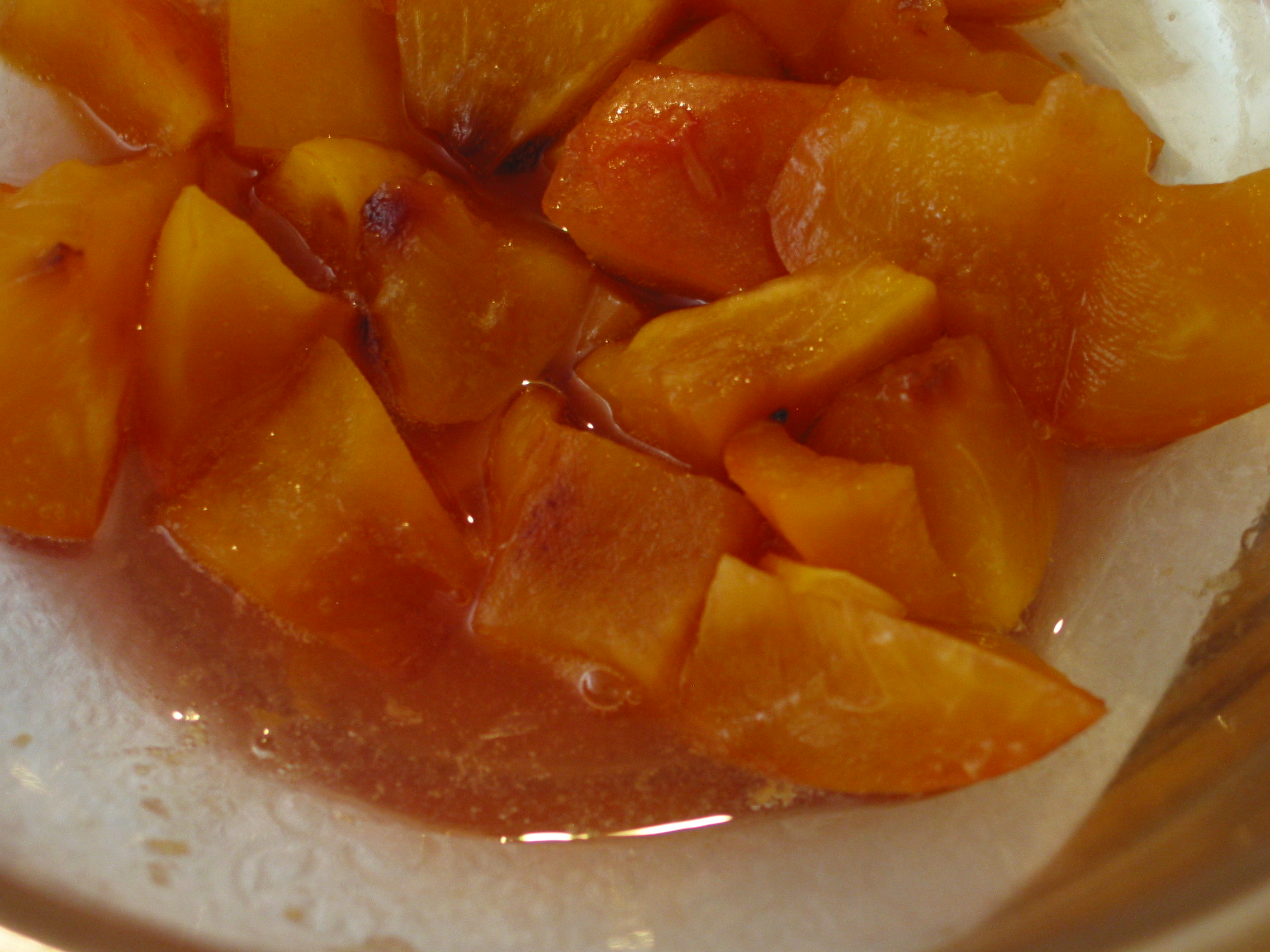
Chop up the peaches and put them in a pyrex bowl. Leave the skins on–this is where at least some of the flavor is going to come from. Sprinkle on a few spoonfuls of sugar and squeeze some lemon juice over them. Cover the bowl with a plate and microwave on high for a few minutes (3-4 min in a ~1100W oven). When you uncover the bowl, the fragrance should start coming up and the pieces will have turned translucent and produced a bit of pinkish-bronze juice. You can taste and see if that’s good enough for you, or cook another minute or so, perhaps with a sprinkle of cinnamon (very good) and/or a thin slice of fresh ginger. Maybe a star anise pod or a couple of cloves if you’re doing this as a compote and feeling really food glam that day, but I didn’t try these myself, so I can’t vouch for them. Cool, chill, and serve with yogurt or ice cream.

For jam, mash the peaches with a fork before the final minute in the microwave. Once it’s cooled, the mixture will thicken and the cinnamon and/or ginger will play off the peach flavor for a good chunky jam.

Microwave peach compote

Microwave peach compote

Mixed-Fruit Compote or Jam

The second compote/jam strategy calls for mixing the fresh peach or nectarine chunks with another fruit before microwaving. I have two  suggestions here that turned out reasonably successful–one is a handful of chopped dried apricots that have soaked up for about 1/2 hour in boiling water or orange juice, and the second choice, a bit odd perhaps, is sliced strawberries mixed in with the peach chunks.

In both cases I went extremely easy on sugar compared to what’s called for in traditional jam-making.  I wasn’t making a lot, it was going straight into the fridge and I was going to use it quickly. Plus I’d pretty much always rather eat a jam that’s more fruit and less sticky stuff. I know, I know, technically that makes it a “fruit spread” rather than proper jam, but do I care?

For the mixed jam with dried/soaked apricots, I microwaved a handful–15 or so–chopped apricots in water to cover for 2 minutes and let stand covered for half an hour, then put them in the food processor with large raw peach chunks — in my case, the peach was oversized, like a softball, so maybe two normal tennis-ball-sized ones would be about right–and a couple of spoonfuls of sugar and pulsed them just enough to blend fairly well without losing all the texture. Then I squeezed lemon juice on the mixture and poured it back into the pyrex bowl to microwave a few minutes as above. I poured the hot mixture into a very clean hot 1-lb jam jar and screwed down the lid–the lid did suck in as it cooled, but I wasn’t counting on that so I kept it in the fridge and ate it over the next week or so.

Another peach I cut up and microwaved straight with some strawberry slices mixed in because they were the last ones in the pint. Again I don’t think I added more than a tablespoonful or two of sugar and a squeeze of lemon, but what happened was the strawberries, instead of going slimy, gave the warm compote a baked comfort-food kind of taste that I hadn’t expected and looked nicer as well. I’d been thinking cooked strawberries would look as bad as they do in strawberry jam, but they didn’t, and without too much sugar (or corn syrup, in the commercial jams I hate) they kept some of their bright flavor too.

None of these ideas is as satisfying as biting into a perfectly ripe, exceedingly juicy peach (or nectarine) at the height of summer, but all of them are pretty good in their own right, they don’t take long, and they’re handy saves for fruit that turns out to be less than you expected.

The Meaning of “Tasty”

One very strange description crops up in nearly every expert’s take on processed food and the way it’s overtaken fresh and whole foods in the American diet. Everyone from food industry veteran Hank Cardello (see the Stuffed book review) to NYU nutrition professor Marion Nestle in What to Eat talks about fast food and junk food as “tasty”. David Kessler goes even further: in The End of Overeating, he adds “irresistible,” which he says is the problem he faced most of his life.

Moreover, “tasty” has become the important word in processed food advertising. Driving home from the post office today I even saw it on a billboard for Vitaminwater10, with the tagline:  “10 CALORIES. 4 NEW FLAVORS. TASTIER THAN EVER.”

Tasty. It’s the word of champions, the key, the adword to beat.

And for the life of me, I’m not sure why. Because the words I would have chosen for most of it include stodgy, greasy, cardboardy, screamingly salty, day-glo ™ orange, and “a lot like airplane food, only on the ground.” Am I the only one?

But “tasty”–specifically that word–is clearly the accepted description, even among these food experts, and that points to a host of disturbing assumptions. Either they mean they find processed food tasty or they mean they think everyone else finds it tasty and irresistible–even if there’s something better to eat. That’s kind of defeatist, isn’t it? If everyone “knows” fast food is tastier than fresh produce, what hope is there for mainstream Americans to eat healthier than they do today?

What do they actually mean by “tasty” in the case of processed food? They don’t mean fresh, as in fresh produce. They don’t mean tangy, as in yogurt or a tangerine, or sharp as in horseradish or cheddar. Certainly not aromatic, like dill or fennel or rosemary or sage. Or rich and funky and thought-provoking, like aged camembert or shiitakes or asparagus or toasted sesame oil. And they don’t mean complex and savory and surprising, as in a palak paneer punctuated by smoky black cardamom pods, Armenian string cheese with nigella seed, or a long-cooked carbonnade or daube of beef with some cloves thrown in on a whim.

They can’t possibly, honestly, mean “these fresh hazelnuts are so sweet you’ll plotz” or “one bite and you’d better take this nectarine somewhere private.”

Most of the food experts who’ve posited that processed food is “tasty” in their books and articles are older than I am by about 10 years, old enough to remember eating late-July nectarines that devastatingly fragrant, backyard tomatoes earthily ripe and pungent, foods utterly unlike what’s available even in the produce section of most chain supermarkets today.

So I can’t help thinking that their casual use of the word “tasty” reflects and even perpetuates the hopelessly tattered, stunted and inexperienced taste imagination of the masses of people who don’t cook for themselves anymore and have given over completely to packaged food, with its excesses of salt and its bland, stale cardboardy background flavor. The ugly assumption they’ve bought into is that people who eat mostly processed food can’t change, won’t change, and most importantly, wouldn’t like fresh food if they tasted it.

Can the surge of food blogs with their encouragement to try something new, visit local farmers’ markets, maybe even take a share in a community garden plot, change this trend? I hope so, even though I know the open air markets are not often very available in poor neighborhoods and they tend to be as expensive as supermarkets. But when they are made available in urban areas, all kinds of people from the neighborhood suddenly come flocking to them, Continue reading