• Enter your email address to subscribe to this blog and receive notifications of new posts by email.

    Join 241 other subscribers
  • Noshing on

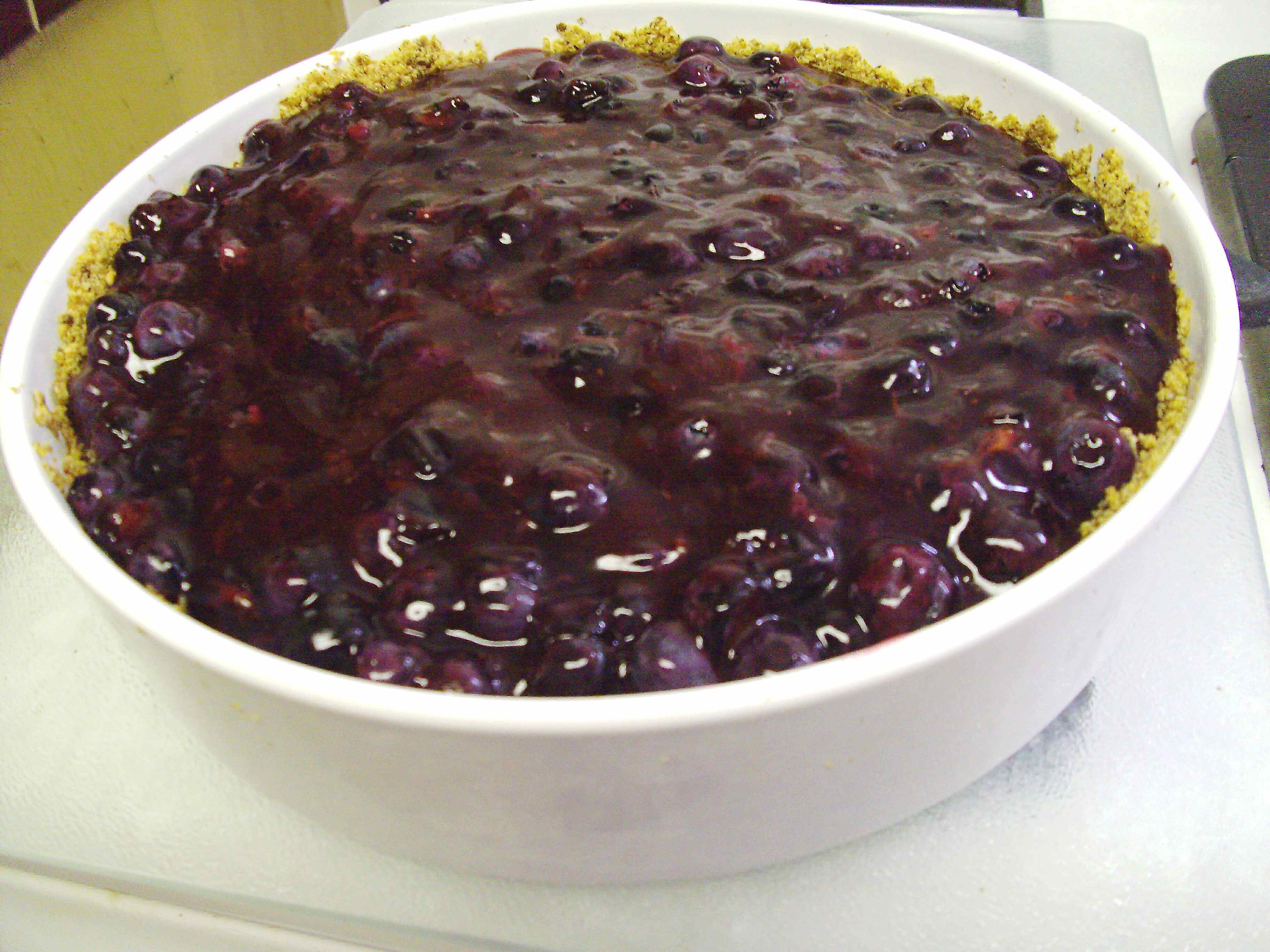
    raw blueberry pie with microwaveable filling and graham cracker crust

    This mostly-raw blueberry pie is a snap to make and very versatile--the filling microwaves in a few minutes, and you don't even have to bake the zippy gingered graham cracker crust--perfect for a hot Fourth of July and all summer long.

  • Recent Posts

  • Contents

  • Archives

  • Now Reading

  • See also my Book Reviews

  • Copyright 2008-2024Slow Food Fast. All writing and images on this blog unless otherwise attributed or set in quotes are the sole property of Slow Food Fast. Please contact DebbieN via the comments form for permissions before reprinting or reproducing any of the material on this blog.

  • ADS AND AFFILIATE LINKS

  • I may post affiliate links to books and movies that I personally review and recommend. Currently I favor Alibris and Vroman's, our terrific and venerable (now past the century mark!) independent bookstore in Pasadena. Or go to your local library--and make sure to support them with actual donations, not just overdue fines (ahem!), because your state probably has cut their budget and hours. Again.

  • In keeping with the disclaimer below, I DO NOT endorse, profit from, or recommend any medications, health treatments, commercial diet plans, supplements or any other such products.

  • DISCLAIMER

  • SlowFoodFast sometimes addresses general public health topics related to nutrition, heart disease, blood pressure, and diabetes. Because this is a blog with a personal point of view, my health and food politics entries often include my opinions on the trends I see, and I try to be as blatant as possible about that. None of these articles should be construed as specific medical advice for an individual case. I do try to keep to findings from well-vetted research sources and large, well-controlled studies, and I try not to sensationalize the science (though if they actually come up with a real cure for Type I diabetes in the next couple of years, I'm gonna be dancing in the streets with a hat that would put Carmen Miranda to shame. Consider yourself warned).

Microwave Tricks: Quick-Pickled Peppers

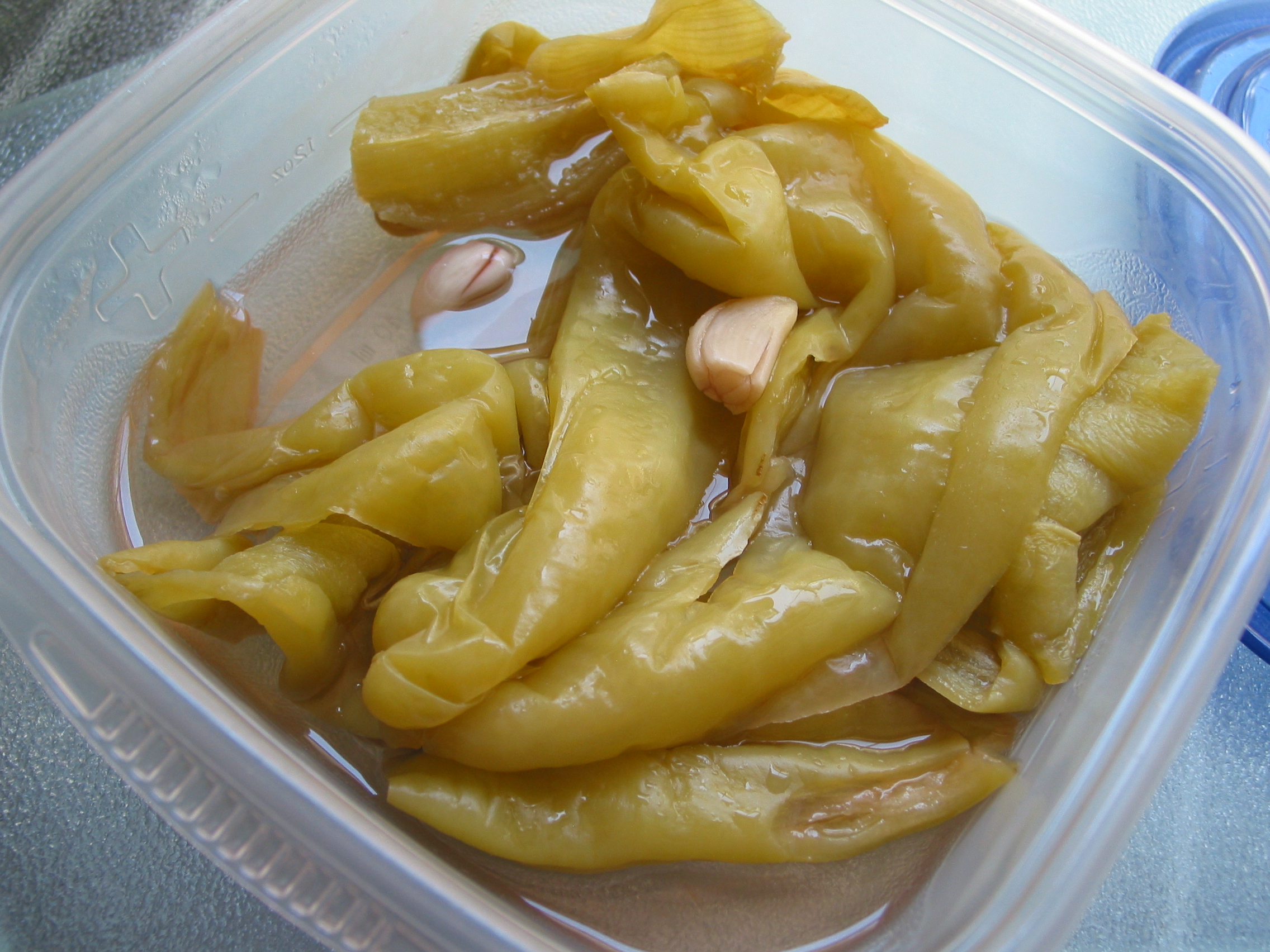
Microwave Hungarian pickled peppers

This is what happens when I get to the corner grocery or (more occasionally) the farmer’s market at the end of the day: I’ve already got a basket full of stuff, ripe, bursting with aromas it would take most supermarket produce days, weeks or forever to achieve. But there in the last-chance corner is a bag of very pale green, very contorted Hungarian peppers, about 10-15 of them for a last-chance dollar. They’re in good shape, maybe one or two has a couple of minor wrinkles, but that’s it. I can’t resist.

At first I thought I’d use them to stuff with corn kernels and feta and scallions, which I haven’t done for a while. But when I got them home, they were obviously too twisted to stuff, and very thin-walled at that. And unlike Anaheim or pasilla chiles, not really spicy enough to set off the corn. What then?

I’ve been feeling my nonexistent Italian and Greek roots lately, so I thought, pepperoncini? Well, why not? I did pickled green tomatoes last year, and it was incredibly easy (except for finding the green unripe tomatoes, which even my local Armenian corner store doesn’t provide often, and especially not at the height of the summer Fresno tomato frenzy).

But I didn’t want to wait two whole days for the peppers to ferment. And I didn’t want them quite as salty as actual pickles. So I decided to microwave-marinate them the way I make marinated artichoke hearts.

Yes, you can always just buy a jar of pepperoncini. My greengrocer definitely has them. But if you have the fresh peppers and they’re dirt cheap and you just want them right now, not necessarily every day for the next three months, microwaving them takes all of five minutes, and the result is surprisingly good.

It also brings out the full flavor of the peppers quickly–even a hint of spice, though they’re still not hot, and you can limit the salt to your own taste. Continue reading

Tehina goes with fish

tilapia pan-fried with tehina, hummus, onions and curry spices

Two large tilapia fillets pan-fried with a hummus, tehina and yogurt coating. The fillets pick up a lattice of browned onions and curry spices when you flip them over.

This is no great surprise if you like Middle Eastern food, I suppose, but tehina or sesame paste is not just for hummus, felafel and eggplant (or roast butternut squash, for fans of Yotam Ottolenghi). It’s also a great match for white-fleshed fishes such as sole, red snapper and tilapia, because it’s rich-tasting and smoky, goes really well with cumin-type spice combinations, and can be dressed up or down.

But despite its richness (it is an oily paste like peanut butter, after all) it has very little saturated fat, mostly mono- and poly-unsaturated fats (the heart-healthy kinds) and it has enough flavor that a little goes a long way. So if you like fish and have a jar of tehina handy and some garlic (a must) and a few basic spices like cumin on your shelf, you can take advantage a couple of different ways without a lot of work.

I’ve already tried Poopa Dweck’s recipe for cold whitefish salad (much like tuna salad, but made with lighter-textured cooked white fish) where tehina, lemon juice, cumin, paprika and garlic stand in for the more usual mayonnaise, sour cream or yogurt in conventional western versions. The basic version was very good, even though I cut the quantities severely for home use and didn’t bother making sliced-cucumber scales to lay out over the whitefish salad (because I’m not that arty just for us). Although maybe if I do a brunch sometime later this year I’ll “scale up” in both senses…

More often, though, I cook tilapia as a standard hot weeknight dinner. It’s relatively inexpensive for fish, lighter and much quicker to cook than chicken, can be served with dairy in kosher homes like mine, and it’s pretty adaptable. But as with skinless, boneless chicken breasts, it can get a little boring if you don’t do something new with it once in a while.

One of the dishes I recall fondly and still miss from the Pita!Pita! Lebanese restaurant when it was still on Fair Oaks in Old Town Pasadena (must be something like 10 years ago now!) was sole fillets baked under tehina sauce. May Bsisu gives a recipe for two similar dishes (samak harra b’tehina and tagen al-samak) in The Arab Table, which I highly recommend. I think I mentioned this book in passing in a post about making your own yogurt in the microwave, but it really deserves more attention.

I think the elegant casseroles of fish baked in tehina sauce are worth doing for a larger crowd and with more time than I usually have. But I’ve always thought the flavors would be good in a quick frying-pan version with tilapia too. The coating in this version is a mixture of  hummus and a thick Greek yogurt/tehina/garlic spread I had originally made for pita and vegetables (and uncooked, it’s pretty good  for that). Because of the hummus, the coating cooks to a breading on individual fillets rather than remaining saucy, but the flavors are really good and it takes maybe 20 minutes, including browning the onions well. I tried this twice last week and it was terrific both times. Continue reading

Microwave Tricks: 10-Minute Tofu

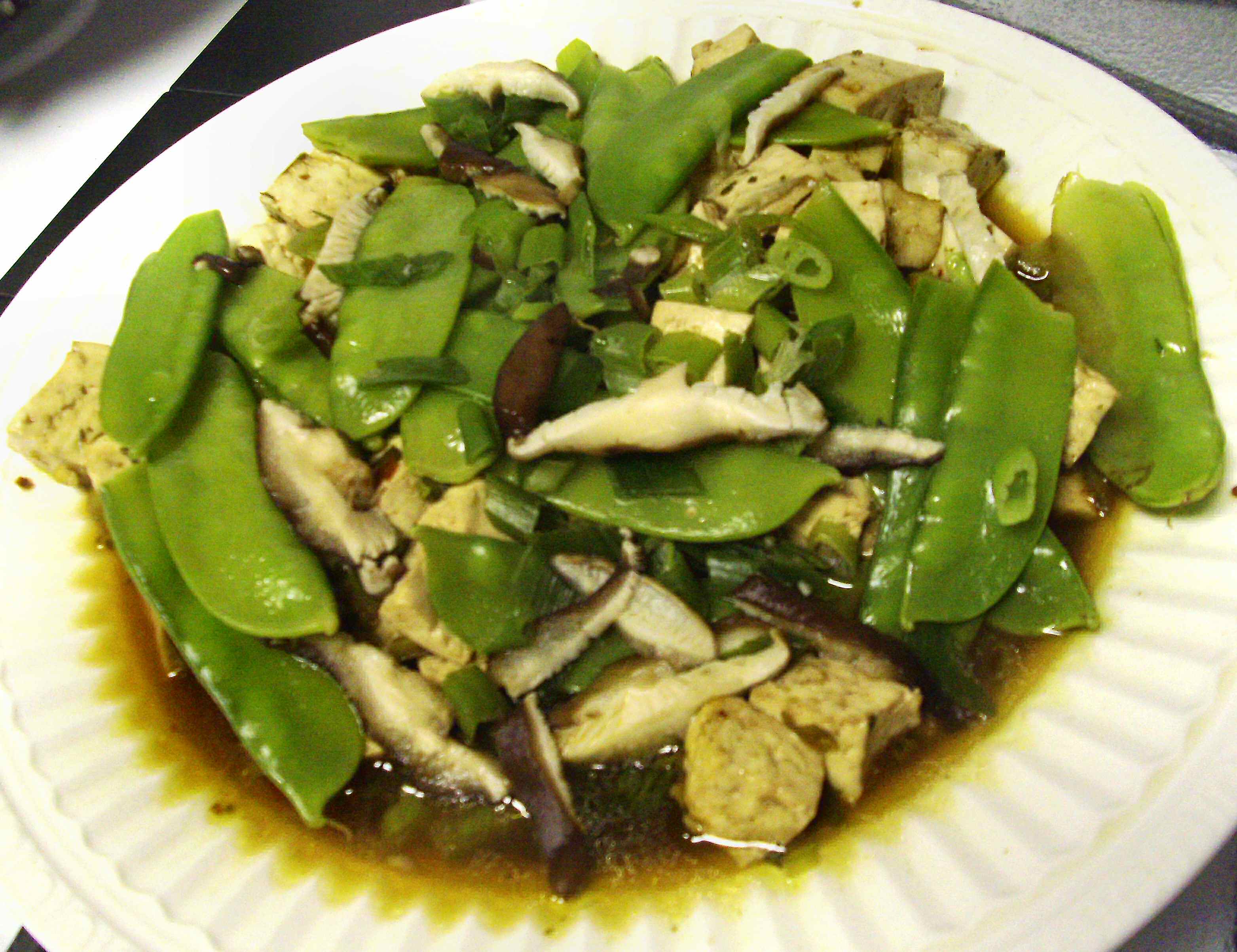
Microwaved platter of low-sodium tofu with snow peas

Microwaved tofu platter in minutes, minus the big oil and salt overload of takeout. I’ve used snow peas and shiitake mushrooms this time, but you could use any greens you like and mix them up–bok choy, broccoli, green beans. Frozen snow or sugar snap peas work too.

This is the recipe I meant to put in the last post about reducing sodium in Chinese food.

Tofu is, as everyone knows by now, extremely versatile. It’s vegetarian, it’s shapeable, it’s mild but satisfying in flavor, it comes in a variety of textures and thicknesses, and it’s quick to cook–fried, steamed, stuffed, crumbled–or to eat cold. It’s also low-fat, low-sodium, nearly carb-free, and relatively high in protein, with some iron and calcium too. And it’s very inexpensive–less than $2 for a 14-oz. pad of tofu at the supermarket, about three or four servings’ worth.

When it’s hideously hot out, as it was much of September here in Pasadena, you can marinate a sliced cold block of silken tofu by pouring a jao tze-style dipping sauce over it maybe half an hour, garnish with scallion shreds or crushed toasted nuts, and serve it as an appetizer. Or eat firm tofu plain and cold, if you like it. Or throw some tofu cubes into a salad with cabbage, lightly-steamed (or microwaved) fresh brussels sprouts, scallions and halved hard-boiled eggs, and drizzle peanut sauce over it.

Or you can decide there’s no way you’re going to stand over a stove with a frying pan, but you’d like a proper cooked dinner that resembles kung pao or ma po tofu with some greens, just not doused in heavy greasy oversalted sauce or requiring a run to your local takeout, and it would be nice if it were very quick. Very quick. Like five minutes tops. And that it didn’t involve the stove at all.

When my daughter decided she wanted to be vegetarian a couple of years ago, I discovered that you can “quick-press” tofu for Hunan tofu in about 4-5 minutes for a standard 14-19 oz. pad by cutting it up, standing the pieces on a microwaveable dinner plate, and microwaving, then draining off the liquid. Then it’s ready to stir-fry and it’ll brown decently. But I’ve done it so often in the past two years that my daughter’s kind of tired of it now (and has also gone back to eating fish and chicken once in a while). But we still like tofu. And with 100-degree days filling so much of September, there was just no way I was going to stand at the stove. So….

The entirely microwaveable tofu dish below is my daughter’s current preference, because the tofu cubes are softer, steamed in the microwave in a thin sauce rather than browned, and the scallions never scorch. And it’s not bad at all, and it takes, if not a literal 5 minutes, maybe about 10, start to finish.

This is more of a technique than a recipe, really, because you can use whatever cookable greens you have and like–fresh broccoli with the stalks, green beans, bok choy, etc. are pretty classic and generally not expensive per pound, but I’m not against using frozen unsalted (store brand; I’m cheap) sugar snap peas or green beans if the fresh ones are out of season. You’re microwaving; it’ll work out, and you won’t overcook the tofu. Continue reading

Testing salt reduction on a really large scale

Microwaved platter of low-sodium tofu with snow peas

This tofu dish with snow peas and shiitake mushrooms uses low-sodium dipping sauce ingredients as its base rather than soy sauce or oyster sauce. It’s also microwaveable from start to finish and takes about 10 minutes total.

If you have a big enough–and motivated–study population, even modest reductions in daily sodium intake can make a big difference in preventing strokes and heart attacks. Last month, cardiovascular researchers from Beijing and Sydney announced a new 5-year diet trial in Science to do just that (see the general overview article, “China tries to kick its salt habit”).

China’s northern rural poor eat an estimated 12 grams of salt a day on average, considerably more than Americans’ 9 grams a day (which is still over the top) and more than twice the WHO’s recommended 5 grams or less. An estimated 54%, more than half, of Chinese adults over 45 have high blood pressure these days, and the Chinese government is taking practical steps to provide antihypertensive medications and shift the tide back–but that’s an awful lot of prescriptions.

Given the cost of antihypertensive drugs for such a huge population, and the cost of dealing with side effects and consequences of untreated or undertreated high blood pressure, prevention seems the better way to go. The researchers project that reducing the national average by even 1 gram of salt a day would save 125,000 lives a year in China. So they’ve recruited 21,000 villagers so far in China and Tibet, and plan to provide test groups with nutrition counseling plus a lower-sodium salt substitute for cooking, then compare their sodium intakes and rates of heart attack and stroke with those for a control group.

Most Chinese still do their own cooking at home, especially outside the big cities.  If lowering the sodium content of the salt they use works, it has the potential to get an awful lot of people off daily hypertension medication and reverse a major health threat. But will people do it if they’re not in the trial, or once it ends? Will it catch on? And is it the right answer in the long run?

Salt substitutes, with potassium chloride replacing some of the usual sodium chloride, have been tried by heart patients in the US since the 1970s or so. They’re a little more expensive than table salt or kosher flake salt, at least in the US, but they’re not all that expensive. But they’ve never really caught on here with most consumers.

Similarly, a few decades ago, a big public health campaign in Japan to reduce the high rate of stroke led to the introduction of low-sodium soy sauces, with about half the sodium content per tablespoon of traditional ones.

Not much market research is available on how many people have been buying low-sodium vs. regular soy sauce in Japan since its introduction. From the few current market reports I could find–one of them an executive report from Kikkoman–it looks like low-sodium is still a smaller if steady fraction of their business in Japan, and that it’s more popular in Europe and the US than at home.

It’s important to have a low-sodium line for reasons of corporate responsibility and even prestige, but there was no mention of its percentage of total domestic or worldwide sales. Traditional soy sauces, which can range from 14-18% sodium concentration w/v, are still apparently preferred for taste, and the Kikkoman executives attribute much of their expected taste appeal to salt rather than the other flavors in each one’s profile.

That’s kind of discouraging to me. The Japanese are known for more refined and sensitive palates on average than Americans, and their range of soy sauces and tamaris for specific food combinations is much broader and more sophisticated. The higher-quality low-sodium soy sauces are produced by ion filtration to get sodium out rather than simply diluting them with water, so most of the flavor that’s actually flavor remains. I would have hoped the key flavor signature of each match was the actual flavor of the brewed soy sauces, not the saltiness.

It’s likely, though, that the Japanese are just as susceptible as the rest of the world to the sodium tolerance phenomenon–the more sodium you eat habitually each day, the more you expect and consider normal in your food, and you almost stop even noticing it as a separate flavor.

The overall Chinese market for soy sauce is currently estimated at $20 billion and grew about 23.4 percent over the past 5 years, mostly due to population growth. The stakes are pretty high for China, but the government has tighter control of its salt and soy sauce producers than other countries do, and the will to make a broad change seems to be present, at least at a government level, and if the new study is anything to go by, among ordinary villagers as well. So maybe this time it will catch on once the study’s over.

But obviously, if you’re starting out at a 12-gram-a-day salt habit, the best way to reduce sodium in home-cooked food would be to cut back hard on salt and salted items altogether. That takes time, practice, awareness and deciding that it’s worth going through that first couple of weeks until your palate readjusts to a lower-sodium diet (which it will, but it takes a couple of weeks and a little patience).

Can cutting the salt be done with Chinese food? Not American souped-up chain restaurant caricatures of Chinese dishes, which are hideously over-the-top and greasy as well, but actual home cooking? I’ve done low-sodium Continue reading

Instant Pickles, Hold the Salt

Fast-marinated cucumbers, half-sour kosher dill style

One of the things that kept me motivated for blogging SlowFoodFast after the first fine careless rapture was my indignation at how popular over-the-top salting was becoming in popular food magazines, cookbooks, blogs and TV shows as chefs became celebrities, and how dangerous I knew it was for most people to eat that way regularly. A large part of my career a couple of decades ago was exploring the history of dietary sodium in cardiovascular research and writing about the DASH Diet.

What I’ve missed the past few years is just how many people, particularly younger ones, are starting to take up the challenge of cooking low-sodium and blog about their trials and successes. There’s a whole community out there, and they’re cooking pretty well. It is definitely possible, and generally easy once you get past the “how do I read a label and cook from scratch” aspect.

I just ran into Sodium Girl (aka Jessica Goldman Foung)’s blog-based cookbook, “Sodium Girl’s Limitless Low-Sodium Cookbook”. Diagnosed with lupus and kidney failure in her early 20s, she turned around her diet by dropping her sodium intake drastically to give her kidneys a rest in the hope they’d regenerate, and it worked. She’s been innovating with low- and near-to-no-sodium versions of favorite foods ever since, working with the National Kidney Foundation and other organizations. Her book, like her blog, is attractively photographed, full of cheerful writing and surprise takes on favorite foods.

One of the substitutions she makes that I have to approve of is a molasses-and-vinegar-based “faux soy sauce”. So I wasn’t the only one!

Another of her successful experiments is pickles. She goes for sugar-and-vinegar-style pickles, which makes sense, since they have no added salt in them, but I can’t help it–I have always cringed at sweet pickled anything. If it’s supposed to be a pickle, for my money, it’s gotta be a half-sour kosher dill and nothing but (or else an Indian lime or mango achaar pickle, or Moroccan preserved lemons, but that’s another story and still pretty high-salt at this writing. I’m working on it, but not yet holding out a lot of hope…)

Anyway, looking through Foung’s book reminded me of a simple, hearty and low-to-very low sodium version of my favorite pickles in the world. Continue reading

Really? No, not really.

Reason for dismay at the top level restaurants:

(LA Times Food Section) “Three top chefs create more healthful versions of favorite dishes”

They cut down a little on the calories–as in, substituted olive oil for butter, or ricotta for mascarpone, or even ground chicken for ground pork. But only one of them cut down significantly on the sodium–and even then it was 1000 mg for the dish, down from about 1400 mg. Give Daniel Mattern credit where it’s due, but it’s still a lot. Josiah Citrin’s dish, which started out about 650 mg, not horrible for restaurant food, actually went up in the modified version.

In Susan Feniger’s case (and she was far from succeeding or even trying hard on the sodium reduction), the sodium count was more than a day’s worth in one dish–from 2100 mg or more to 1800-plus. Choke. She did skip marinating the ground chicken, but the “mabo” sauce, which she didn’t change at all, contains three different kinds of soy sauce AND fermented black beans. Because you really need a sauce that salty in fine food?

Couldn’t she have done a different sauce, more savory or spicy but less salted? That’s the first thing I would have targeted. I probably would have used my low-sodium prune-based Asian barbecue sauce instead of the black bean sauce–it’s different, but good, and it’s similar enough in texture and flavor density to substitute well.

In fact, none of the chefs tried to go radically different–they were all too fixated on whether diners could tell the difference between the originals and the modified dishes. Well, if they’d changed anything worth changing, I’m sure the diners would have been able to taste the difference. The real question is, would it have been a good dish and would they have liked it? I think the chefs could certainly have gone after bigger, more ambitious changes and made the dishes satisfying–perhaps even better–without choking the diners on salt.

The bad part of the article came at the end. All three chefs just gave an arrogant little shrug when the results were revealed at the end of the test (showing that they hadn’t done all that well). They all said grandly that it doesn’t really matter, because as Josiah Citrin put it, their customers come “to be blown away” by the food.

And so, just like the fast food kings, they put the blame on the diners for not demanding better, saner nutritional standards. Beats workin’.

Microwave tricks: Seitan without Simmering

My sisters-in-law from Oakland were planning a visit to us this summer now that we actually have a house and can host them. It fell through, but the prospect got me thinking about vegan food and what we might serve them. They’re both good cooks, but they eat a lot of commercially-prepared vegan meat substitutes along with their own fresh vegetables and grains and baked goods.

I’m not great on packaged foods in general, and unfortunately, vegan proteins other than plain fresh tofu and dried beans look an awful lot like vegetarian versions of Oscar Meyer sliced bologna and turkey loaf to me. Not just the appearance, but the cost per serving (really high–something like 4-6 bucks for a chic little package that serves two, ostensibly) and the salt (also really high–600 mg and up per serving). And the ingredients lists are always long and kind of mysterious-sounding, either in a surprisingly chemical way or in a Japanese-ingredient-names-as-authenticity way. Not that I’m not working to figure out exactly what kombu and dulse and Job’s tears are. Two seaweeds and a resin? I think, anyway.

There’s also a lot of yeast extract in some of these processed vegan proteins–sounds like between that and the salt, what they really did was dump in Vegemite or Marmite. Bleagh (my husband’s sister is kind of an Anglophile, but that doesn’t excuse either version to me).

On the other hand, some of the vegan cookbooks out now have do-it-yourself recipes for seitan, and so do Ellen’s Kitchen and FatFree Vegan Kitchen.

Seitan is basically wheat gluten dough cooked in stock. If you do it yourself at home, it may take an hour to simmer but really isn’t very expensive compared with the commercially prepared versions. A 5-lb bag of flour at about $2-3 or a few ounces out of a 22-oz bag of vital wheat gluten (about $6-8, depending where you buy it, and worth it for getting 100% gluten out of the bag and not having to wash the starches out of the dough since it’s already done for you) produces something like a pound or two of seitan at a go. That’s enough for a larger meal, maybe even for that elusive home-made vegetarian centerpiece dish

Why is this worth doing if you don’t eat vegan and aren’t actually having vegan guests in the house after all? (and now that I’ve schlepped the last of the moving boxes out of the living room, I’m really wondering).

I think back to my favorite Chinese restaurant back east, the Hunan Manor in Columbia, MD. Every time we fly back east we try to make a stop there.

One of the things that makes the Hunan Manor great is their willingness to experiment and invent. They serve a wide variety of vegetarian versions of standard banquet dishes using “vegetarian chicken”–basically seitan cut and fried as for meat. These dishes complement their masterful use of tofu with textures from nearly silken to deep-fried to pressed and diced for the vegetarian jao tse, which I’ve always thought looked better and probably tasted better than the pork-based meatball filling our nonkosher friends would get (though they raved about them, and I’ll take their word for it).

The last time we came east, the restaurant had added several new dishes using a different form of seitan with very finely layered rolls that were cut in bite sized pieces, coated and fried–a pretty close simulation for the layered flesh of chicken. It was really delicious in their orange “chicken” with perfectly cooked bright green broccoli. It was unexpectedly unsalty as well, so I don’t know whether they made it in-house or had bought the prepared seitan in an unflavored form.

Either way, the dish was a great argument for using seitan creatively, and I don’t think my sisters-in-law, competent cooks though they are, have eaten any seitan dishes that good using anything from a little Gardein package.

So I decided I’d like to try my hand at seitan at home and see if I can’t come up with something flavorful, chewy, satisfying and nutritious, without having it scream salt. After all, once you’ve got the finished loaf or pieces, you’re Continue reading

Political Pancakes, or, Why is Borders flogging so much lard?

Why Borders is not getting my business this week

Why Borders is not getting my business this week

I know–highly unappetizing. I don’t think even a full teaspoon of salt would help here. And I’m getting back to actual food as of today, I promise.

But I just had to “share” my inbox this morning before I get started. Borders has now closed its Pasadena store but keeps sending me these fabulous discounts in the pretty hope that I’ll schlep to Arcadia to check them out. What does it say when a huge business that’s trying to stay afloat after two decades of leading the field misses so blatantly in its one-to-one personalized marketing?

For that matter, what does it say (reading the tea leaves here) when Newt Gingrich looks like the most coherent and readable (and properly-dressed) selection? I mean, I was there–in 1995 I started working at NIH and promptly got caught in the federal furloughs when he lost his budget armtwisting attempt on Bill Clinton.

What does it say when the Gritch is allegedly trying to run for president and his soon-to-be-available tome is grouped with those of three other deeply discounted “authors” who have no actual public service background, just a penchant for loud titles and  army drag (of various centuries)? Where the hell did Laura Ingraham get that hat? No wonder she’s not keeping up with Patt Morrison. And I thought French food was a no-no for today’s discerning ultraconservative trougher?

I do also wonder at the significance of Ann Coulter’s latest effort being discounted just that six percent more than everyone else’s…maybe it’s the fact that she’s jumped (appropriately) on the vampire-empire bandwagon? Too bad there are no handsome devils on the cover (almost guaranteed there are none inside either). I’m sure they’d sell like hotcakes. Maybe she’s included an actual recipe for hotcakes (with blood sauce or fava beans or something)?–You never know.  Can she actually cook? Without fatback?

Given the deep and undoubtedly thorough marketing research Borders has done (by sending me of all people this fabulous selection of deals), I’m sure they’ve already figured out which way the wind is blowing. I can smell it from here.

In honor of this great selection, I’ve decided to pull out the stops and dig into the older of my cookbooks for an appropriate response.

Semi-Patriotic Pancakes–No Lard AND No Blood (well, at least no added salt)!

Makes about 16 3-4″ diameter pancakes, enough for 3-4 people

  • about 1 c. bread flour, whole wheat flour, matzah cake meal, buckwheat flour, or any mix of these as desired (to preserve our individual freedoms. Put that gun down, Jeb! We’re talking first amendment, not second!) Generally if you’re using buckwheat or whole wheat, it’s better to go half-and-half with regular flour so the pancakes aren’t too heavy or grainy
  • 2 large eggs, separated–I usually toss one of the yolks but keep both whites
  • dollop of plain milk-and-cultures-only yogurt (for that Mediterranean touch)
  • milk or buttermilk (depending how sour you are, and if you use buttermilk skip the yogurt)–about a cup, but might be more to make the batter consistency come out right
  • 1 T sugar (any color, even green if that’s all you’ve got and can stomach the results)
  • 1 capful vanilla extract AND/OR a shake or two of cinnamon (keep it small)
  • oil or butter –1 T for the batter, the rest for frying

Optional mix-ins: blueberries or raspberries (fresh are good, but if you have frozen ones leave them frozen to add when you fry the pancakes; otherwise make a sauce of defrosted ones to serve at the table instead), chopped peeled apples, pecans, chocolate chips, etc. etc. NO: liver, fava beans, or blood-anything!

1. In a large bowl mix the the flour, sugar, flavoring(s), egg yolks, the tablespoon of oil or butter, the dollop of yogurt if using,  and enough milk or buttermilk to make a thick but just-pourable batter. If you’ve got chopped apples, nuts or chocolate chips, you can mix them in now.

2. In a second bowl beat the egg whites to reasonably stiff peaks, then fold them gently into the batter to lighten it. Start frying as soon as you’ve got this done.

3. Fry 3-4″ dollops (about 2-3T each) of the batter in a large (preferably nonstick) frying pan over medium to medium-high heat. If you’re adding berries, add a few to each pancake as soon as you’ve spooned the batter into the pan, and let the pancake batter rise around and over the berries a bit before flipping to the other side.  You’ll know to start flipping the pancakes when you see the bottom edge start to look solid and a ring of small bubbles appears just above it–but I sometimes go a little longer to make sure because the leavening is egg whites-only, which makes a pretty delicate batter. You don’t want the pancakes to collapse completely.

4. “Stick a fork in ’em, they’re done.”–The late, great governor of Texas, Ann Richards, July 15, 1992, in an interview with David Letterman about the Republicans’ chances, and quoted on page 61 of my swiss-dot cookbook… Incidentally, she was wearing an outfit that puts any of Ann Coulter’s to shame–she had her very, very white hair up in a classic Texas beehive and she was wearing a hot pink miniskirt that she actually had the legs for. I miss her still.

Soupe à l’oignon gratinée (or not)
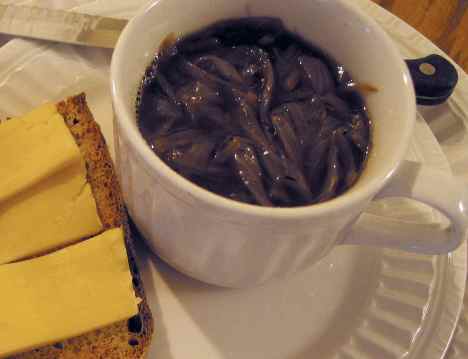
French onion soup without the gloppy gratin

Sometimes it pays to think out the recipes you read before you try them. For example…

I love and miss French onion soup from my pre-kosher days (that would be up to about age 19, long, long ago…) Can’t be helped, though–if you keep kosher, beef stock does not combine with Gruyère. And I’ve never actually tried making it at home before, because, if you go by a traditional, official kind of recipe like the one published in the LA Times below, it’s a 3-hour ordeal.

RECIPE: Soupe à l’oignon gratinée – Los Angeles Times.

Total time: 3 hours  Servings: 8  Note: Adapted from Comme Ca.

  • 8 large yellow onions, halved and sliced lengthwise into 1/4 -inch strips
  • 1/4 cup unsalted butter
  • Salt
  • 2 2/3 cups water, divided
  • 2/3 cup dry Sherry
  • 5 cups chicken broth (with as little sodium as possible)
  • 2 2/3 cups beef broth
  • 8 sprigs fresh thyme and one bay leaf, tied together
  • Fresh ground black pepper
  • 1 loaf French bread
  • 1 pound Gruyère, grated

Pretty onerous just on the ingredients (lot of salt in them thar vacuumpaks of stock), not to mention the bread. The Swiss cheese, oddly enough, is a lower-salt cheese than most, about 120-150 mg sodium per ounce as compared with, well, anything else at 180-210. It makes up for the lack of salt with a huge OD of saturated fat–and 2 ounces per person’s got to be a lot, really, just for melting on top of soup. It would be another matter if this were a legitimate fondue, or a sumptuous grilled cheese on really good toasted pain levain, and you were actually going to eat it all, but if I recall correctly, you aren’t.

Because I never had French onion soup at home, I never had to face the task of scrubbing baked-on cheese off the rims of the bowls afterward. Maybe 1/3 of what was sprinkled on ended up stuck like Swiss barnacles to the bowl, which seems like a waste, especially if you shell out for real Gruyère.  The rest turned into goop that sank to the bottom of the bowl and stretched up for yards on the spoon only to stick to the front of your teeth. Or blouse.

Plus at home there’s all the rooting around in the cabinets hoping your soup bowls are the kind that can survive the broiler and that your oven mitts (and guests) can Survive The Gruyère.

But the real cruncher here is time.

The LA Times instructions don’t even include the time it takes to sliver 8 very large onions, but you should, because it’s not trivial: 20-30 minutes, plus crying time. Heat the oven to 400 degrees (15-20 min, they also forgot this bit, but maybe while you’re crying over the onions). Stew onions with butter and 1/4 t salt in lidded casserole in the oven until the onions are softened and a light golden-brown, about 1.5 hrs, during which you’re supposed to stir every 15 minutes (!) Take the casserole out and cook further on the stove top until the onions are a deep golden-brown and just begin to stick to the bottom of the pot to form a crust (10 min? 15? 20? more?–from the experience below, I’d say at least 20, maybe even 30). Add half of the water and cook until the water has evaporated, about 8 minutes (so specific?). Add the sherry and keep stirring until it has evaporated, 3 to 5 minutes. Stir in the remaining water, broth and the thyme bundle, bring to simmer (5-10 min) and simmer 40 minutes (why 40? who knows?). Slice and toast the bread. Fill 8 oven-proof soup bowls, lay the toasts on top of the soup, sprinkle the grated Gruyère evenly over the tops and place the bowls under the broiler just until the cheese is bubbling and begins to brown in places (5 minutes?). Serve immediately.

TOTAL TIME: At least 3 hours, probably more like 3 1/2.

KLUTZ FACTOR: HIGH–lot of hot transfers of heavy casserole dish, finding and broiling ovenproof soup bowls, transferring to the table without spilling…not to mention serving “immediately”.

Then there’s…(you knew this was coming)

Nutrition per serving: 490 cal; 27 g protein; 36 g carb; 3 g fiber; 26 g fat (15 g sat); 78 mg. cholesterol; 808 mg. sodium.

Wow! Am I wrong in thinking that almost no soup should be this much of a labor of love, not to mention love handles? For this much time, fat and salt, I’d demand at LEAST grilled marinated lamb. Or a good runny camembert, a perfectly ripe pear, some excellent sourdough toast and a half-glass of something complex and interesting in the way of wine.

Maybe it’s as delicious as promised. But all those hours, all that stirring, not to mention all that fat and sodium and cholesterol, just for a bowl of onion soup and a slice of toast with melted cheese? Is it any wonder Lipton’s is popular?

Still…Can we do better with the onion soup itself? Maybe as in, vegetarian but still opulent, and furthermore without the heavy-duty time and calorie burden? Let’s try, anyway.

The first objections I have are eight huge onions and 8-10 cups of salted broth. Do I want to make anywhere near that much onion soup? Do I have that many takers in my house? Unfortunately not. One huge onion just for me, then. Maybe my husband and daughter, but only if it’s obviously fabulous. In which case, I won’t really want to share with them.

The main thing here is getting the flavor out of the onions–you want to caramelize them thoroughly and evenly without breaking down their aromaticity too badly. But I personally think baking them slowly in a big oven for an hour and a half just to start to do that is insane. Even if we’re talking about eight big onions.

My first attempt at shortening this recipe did not go badly, exactly, but it didn’t get me soupe à l’oignon either. Continue reading

Bok Choy Broth

Bok choy-based hot and sour soup

Bok choy-based hot and sour

Usually when I get home from traveling I’m in a state where I don’t really want to cook, but I want real food, and I’m sick of the bread-and-cheese-sticks-and-carrots-and-nuts we bring on the plane in self-defense.  The other thing I really want right away is vegetabalia–restaurants, particularly hotel restaurants, seem reluctant to put any on the plate. Microwaved fresh vegetable soup is an easy and satisfying answer–15 minutes and you don’t have to go shopping for anything fancy.

It’s also the answer when it’s cold and rainy and everyone in the house has been down with the crud (aka “Losangelitis”). Today, I wanted something with greens in it like minestrone, but tasting more like hot and sour soup, to cut through the fog that had condensed in my head, and I did NOT want to work hard (also because of said mental/temporal fog). I had the basics for a vegetable broth–an onion, some celery stalks, a handful or so of “baby cut” carrots  more usually reserved for my daughter’s school lunches. A fat clove of garlic. Half a bunch of bok choy that was still in decent shape from two days ago when I microwaved it as a side to stretch leftover Chinese takeout. And in the cupboard, miraculously, I still had three dried shiitake mushrooms in a plastic bag.

Bok choy is one of the Cheap Vegetables ™–usually below a dollar a pound, even in big-chain supermarkets. Not baby bok choy, which is cute and pretty and mild; stores charge three times as much for that. I like the full-grown, poetically dark-leaved, white-stalked bok choy, the kind sumi-e masters choose for their still lives.

Sometimes for a vegetable at dinner (as mentioned above) I just nuke a cleaned and trimmed head of bok choy whole for a couple of minutes in a longish lidded container with a little water in the bottom, cut it up and serve it as-is or drizzled with a little soy sauce and sesame oil. You don’t need anything else to dress it up (and of course, I have pretty low standards for presentation). Its fresh, radishy flavor mellows into something richer and more aromatic as it cooks down and produces its pale-green pot liquor. You don’t want to waste that; it’s a perfect addition to a vegetarian consommé, especially when you’re going light on salt or calories.

I sometimes even skip the onion-carrot-celery-garlic vegetable stock base and make a really simple broth by just microwaving the bok choy all by itself with water to cover–especially when my head and stomach aren’t cooperating with me or with anything else. But that’s a little on the purist side of things, when I’m feeling so miserable all I want is something hot, clean-tasting and fresh with no distractions. For better times, I want a real soup with a bit more richness and variety, and bok choy definitely plays well with others.

Back to the hot-and-sour scenario, for example:

Shiitake mushrooms are expensive fresh at your local Whole Foods, about $13/lb. But a package of 15 or so dried caps sells for $3.50 in the Asian or International Foods section of your local supermarket, and the dried mushrooms are so much better for infusing a broth with pungent richness. They’re easiest to soak up in a microwave–a few minutes rather than half an hour.

Between those and the carrot-onion-celery aromatics, plus of course garlic, you’re set. Especially if you have a little container of z’khug (hot pepper-garlic-cilantro paste) in the freezer and can saw off a chunk to spice up your soup. Toasted sesame oil, vinegar, and low-sodium soy sauce–all optional. Ginger? You could. Ginseng? According to a friend from a Cantonese family, only if your mother insists. Continue reading