
• Enter your email address to subscribe to this blog and receive notifications of new posts by email.

    Join 241 other subscribers
  • Noshing on

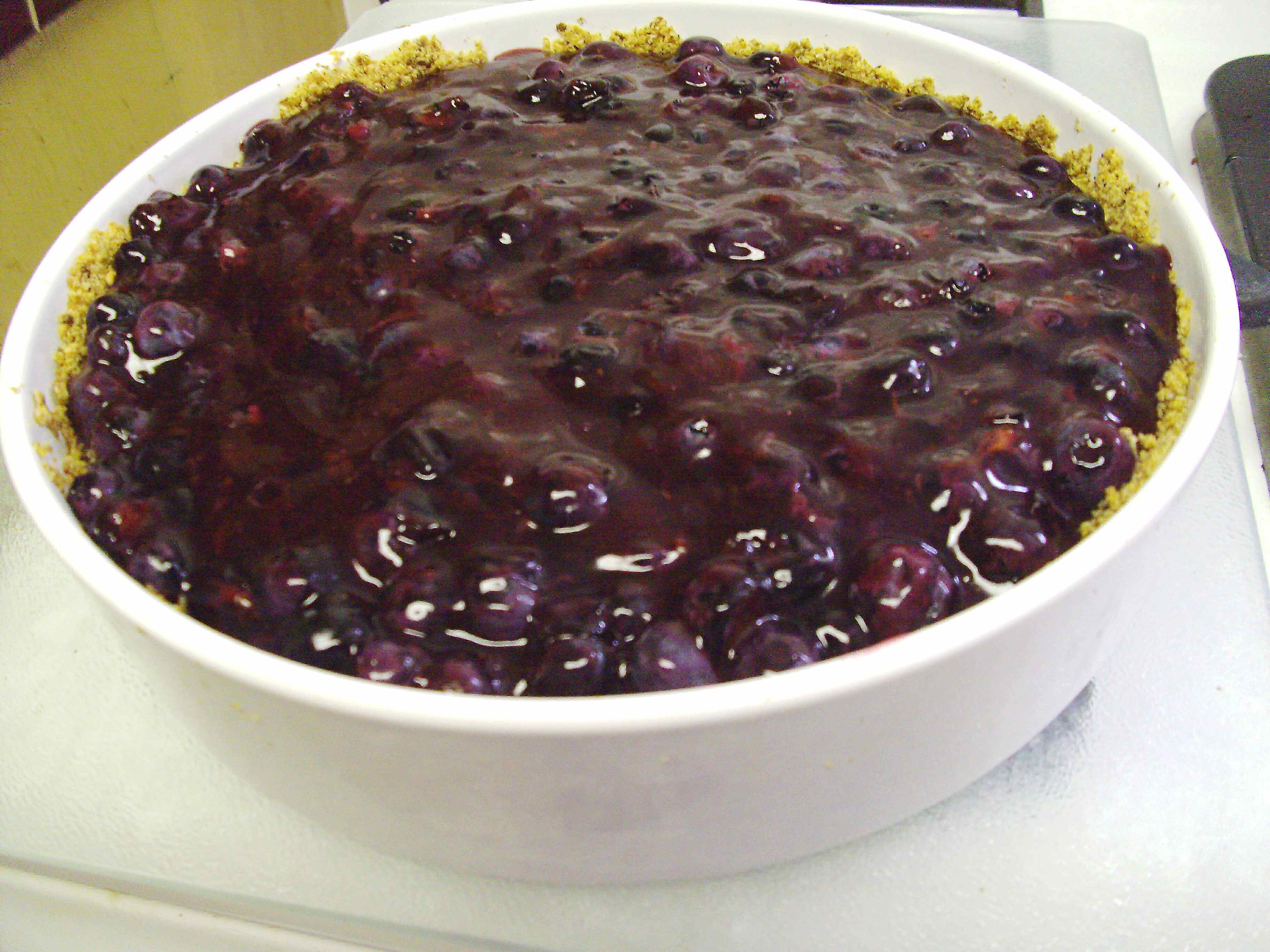
    raw blueberry pie with microwaveable filling and graham cracker crust

    This mostly-raw blueberry pie is a snap to make and very versatile--the filling microwaves in a few minutes, and you don't even have to bake the zippy gingered graham cracker crust--perfect for a hot Fourth of July and all summer long.

  • Recent Posts

  • Contents

  • Archives

  • Now Reading

  • See also my Book Reviews

  • Copyright 2008-2024Slow Food Fast. All writing and images on this blog unless otherwise attributed or set in quotes are the sole property of Slow Food Fast. Please contact DebbieN via the comments form for permissions before reprinting or reproducing any of the material on this blog.

  • ADS AND AFFILIATE LINKS

  • I may post affiliate links to books and movies that I personally review and recommend. Currently I favor Alibris and Vroman's, our terrific and venerable (now past the century mark!) independent bookstore in Pasadena. Or go to your local library--and make sure to support them with actual donations, not just overdue fines (ahem!), because your state probably has cut their budget and hours. Again.

  • In keeping with the disclaimer below, I DO NOT endorse, profit from, or recommend any medications, health treatments, commercial diet plans, supplements or any other such products.

  • DISCLAIMER

  • SlowFoodFast sometimes addresses general public health topics related to nutrition, heart disease, blood pressure, and diabetes. Because this is a blog with a personal point of view, my health and food politics entries often include my opinions on the trends I see, and I try to be as blatant as possible about that. None of these articles should be construed as specific medical advice for an individual case. I do try to keep to findings from well-vetted research sources and large, well-controlled studies, and I try not to sensationalize the science (though if they actually come up with a real cure for Type I diabetes in the next couple of years, I'm gonna be dancing in the streets with a hat that would put Carmen Miranda to shame. Consider yourself warned).

Lightening up homemade scones

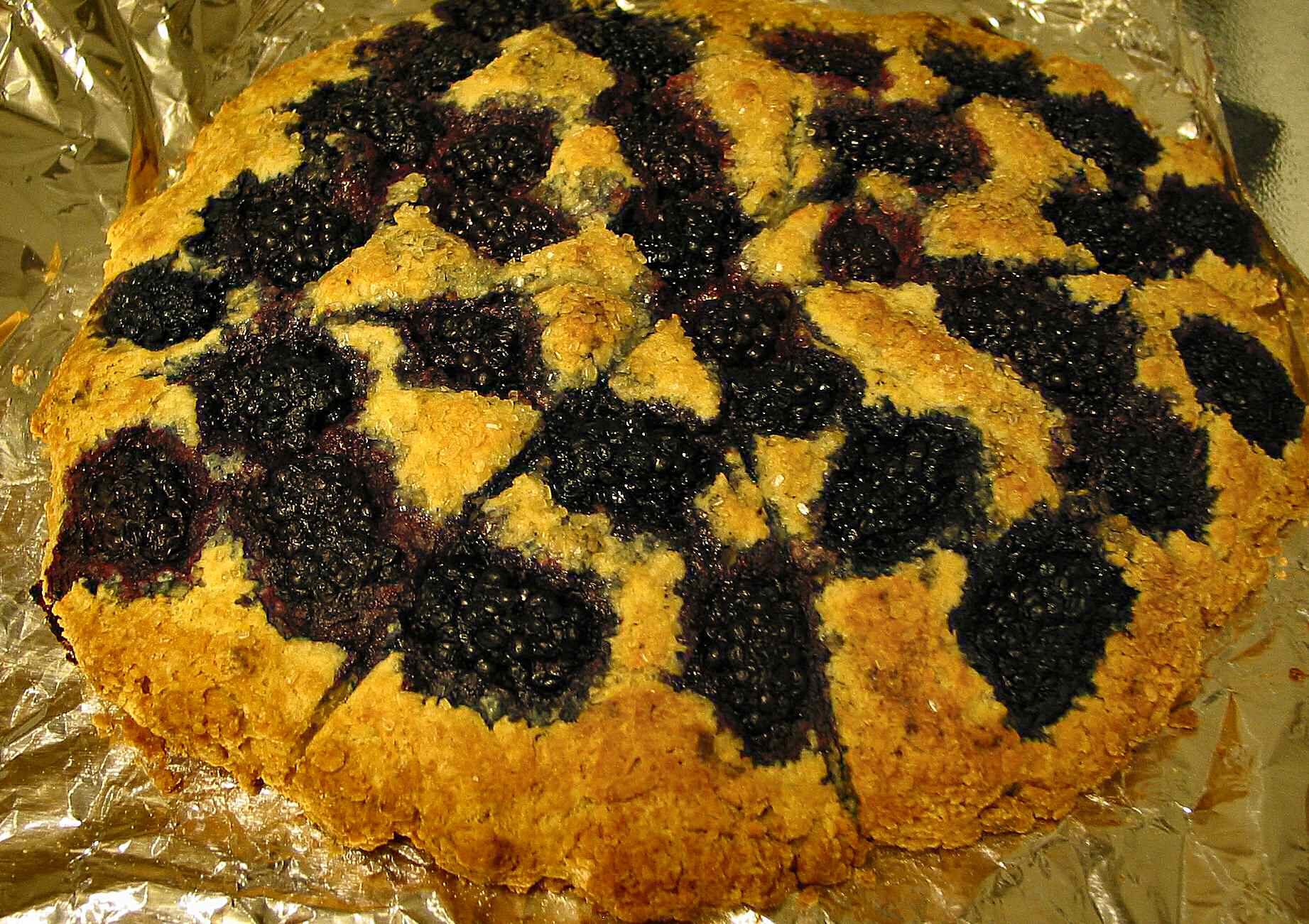
Blackberry scones for brunch

I’ve been wanting to post my favorite scone recipe for some time, but it seems to me that most food blogs start out with good intentions and end up maxing out on the desserts-and-starches end of the food spectrum.

The reason is pretty simple: if you’re a food blogger,  a baking recipe and a pretty picture (or any picture of an aggressively-frosted cupcake) will never put you wrong, even if the real result tastes kind of blah. I mean, cupcakes? Isn’t that what Duncan Hines is for? But if you do feature cupcakes, somebody’s sure to repost it or call it awesome, particularly if you figure out how to add bacon to it. Somehow people just don’t flock to posts about green beans in droves unless you’re redoing the Thanksgiving-straight-from-the-can classic, complete with canned fried onions.

There are way too many variations for every kind of baked good, none with a clear and permanent advantage, and people take them all literally (see under, my New Year’s apple pie insecurities).

So as I say, I’ve been reluctant to put up too many baking posts. Scones, though they’re not exactly the staff of life, are very easy to make and actually taste best when you make them from scratch–much better than buying them in a store and definitely not at your local Starbucks. The question I have is whether it’s a good idea to do it very often–I usually don’t, even on the weekend, but partly that’s because I live in southern California and heating the oven for more than five minutes in my little galley kitchen is often a Very Bad Idea. The other reason is that I keep remembering something Valerie Harper once said (maybe in the role of Rhoda Morgenstern; can’t remember): “I don’t know why I bother to eat this piece of chocolate cake. I should just apply it directly to my hips.”

Most quick breads (i.e., raised with baking soda or powder, or beaten egg whites, not yeast) do fine in a microwave as long as you don’t need them to brown. So lemon-poppyseed cake is okay, as is gingerbread. Scones, which to my mind require a deep and crunchy crust, need a regular oven to do well, but I make the sacrifice (90-degree weather makes it a genuine sacrifice) once in a while on Sunday mornings, because they taste terrific and they’re not exactly rocket science to make.

So if they’re that easy, should I really be posting about them–haven’t you already seen too many wide-eyed, “Look, Ma, I made SCONES!” kinds of posts?

Let’s face it. You can make great scones in a food processor from a very short list of ingredients for cheap, in about half an hour including baking time, and flavor them simply or exotically. Fruit or chocolate chips or chiles and herbs and cheese–all optional. I stick with berries and turbinado sugar, which makes the crust crunchy and glittery. Continue reading

Food Mags Rethinking Salt

For years, lobbyists and nutrition pundits have insisted–hopefully or despairingly–that government public health campaigns to cut sodium in processed and restaurant foods wouldn’t really do much good, that the public wouldn’t pay attention, that they wouldn’t care enough or that they’d resent the guidelines advice so much that they’d never change their habits.

But the past year has brought the brining of America into the headlines and people are starting to pay attention. Especially with state-led nutrition labeling laws for restaurant chains, large diet/health studies, and citizen/government coalitions to pressure the food industry to reformulate down to sane salt levels.

Gourmet-leaning media have been especially slow to come around from the enthusiasm of exotically named and sourced salts and imitation of the aggressive restaurant-style use (and overuse) of salt as a texturizing chemical rather than for flavor. As late as January, I was still seeing frequent “famous chef” defense commentaries, on food shows and in publications from Salon.com to the New York Times, on the absolute necessity of salting food at every turn.

I hope it’s not just a one-issue fluke, but a quick scan of the July issues of Bon Appétit and Saveur shows that both have cut out the insidious, automatic “1 teaspoon of salt” they used to list in most of their recipes. Sunset magazine doesn’t seem to have caught on yet, but Good Housekeeping appears to be ditching the extra salt, so maybe we’re on the cusp of a better trend. And maybe next year I’ll have nothing to kvetch about.

It could happen.

The Cheap Vegetables–Snack Edition

A food marketing study released findings a few days ago about the top 10 fastest growing snack food preferences for kids 2 to 17 years old. Yogurt came out as number one, then potato chips, then–very surprisingly to me–fresh fruit. The others down the rest of the list were a soggy but predictable mash of candy, chips, “donuts” [sic], and other junk foods, though I think cheese cubes were in there somewhere. If yogurt and fresh fruit are in the top three, though, the news must be good, right?

Um. Maybe. But both of them are sweet or sweetened (in the case of most flavored yogurts, very heavily sweetened compared with plain)–so they kind of fit in with the candy, donut, carb-carb-carb kinds of snacks in the rest of the list.

What’s missing from the top 10 list? Plain milk, pasta or beans, bread and jam, the simpler unpackaged, unprocessed, or unbranded stuff you could bring from home, are all missing. But most of those are hard to take to school, and none of them are crunchy, which is a big part of the pleasure of snack. Actually, few of the packaged snacks are crunchy any more either. It’s a sad state of affairs, but there is a simple way to restore the full joy of snacktime.

Because mostly what you don’t see on the marketing study list are vegetables. Raw, crunchy vegetables, low in calories, starches and sugars, fats and  sodium, are high in potassium and fiber and vitamins, easy to prepare (another chorus of “just wash and nosh”) and perfect for snack. A handful of red cabbage or a couple of carrot or celery sticks along with a piece of cheese or a few nuts will keep kids from hunger for a lot longer than the carb-laden snacks on that list, and they’re a lot less expensive–on your wallet or your kids’ waistline.

Parents at school complain all the time that vegetables are too expensive, too time-consuming, take too much preparation by hand, and are not convenient to deal with, and their kids “won’t eat them”. But I wonder if that’s true, because whenever I go at lunchtime, I see many of those same kids enjoying the vegetables that come out of the school garden. They aren’t whining and they don’t appear to be suffering, and nobody seems to be sneering at anyone else that their lunch has Brand A taco chips and all the other poor schlub’s mother packed was vegetables. They’re all waving broccoli or lettuce leaves around, holding them up for comparison, and using them as props for one or another comic performance before chomping into them with savage glee.

And I know an ordinary bunch of celery–even a head of cauliflower–is the same price or cheaper than an econo bag of Doritos. Even at the big brand supermarkets. Celery. Carrots. Red or green cabbage. Raw green beans or if you’ve got the extra cash, snow pea pods. Broccoli or cauliflower. Lettuce wedges. Tomatoes. Cucumber. Bell pepper. None of these are hideously expensive, all of them taste good raw, and all of them store well washed, dried gently, and kept in the fridge.

So what’s stopping the parents from packing vegetables as lunchbox fare? The fact that they have to wash them to get the dirt off? Get their hands wet doing it? Maybe peel some of the vegetables? Find a knife to cut them up with? Use them up within a week or so of buying them? I honestly don’t know, but a lot of the parents seem whinier than their kids. Maybe they should all learn to just wash and nosh.

It only takes a minute or two to deal with a full head of broccoli or cauliflower, or a bunch of celery, and it’ll last you several days’ worth of school and work snacks at a cost of under $2. The most prep required is for carrots, if you start with an actual bunch. Not that I’m advocating the prepacked “baby cut carrots” bags, which are more expensive, but if you really hate peeling and cutting up carrots, you could go this way and still do better than chips and snack packs and the like.

All I can tell you is, if the vegetables are fresh and crunchy, most kids will get into them as long as their friends are doing it too, and there’s no great way to overeat them (except maybe for carrots). And some vegetables are just plain fun–red cabbage in particular is handy for revealing secret invisible baking-soda messages, and if your kids eat it at recess they can compare purple tongues with their friends afterward.  Can’t do that with taco chips.

For recipe sodium counts, better do your own math

Another Martha Rose Shulman recipe for a peanut sauce to go with soba and other noodles appears in today’s NY Times “Recipes for Health” column. Which would be fine but the nutrition counts below it don’t add up–at least for sodium. She’s specified unsalted peanut butter–but has 1 or 2 tablespoons of regular, not low-sodium, soy sauce at 1200-2400 mg sodium, and not low-sodium but regular or unspecified vegetable or chicken broth, both of which are pretty loaded, so anything from 150-750 mg per cup. If you look down to the nutrition counts, though, each of 4-6 servings is supposed to be 150 mg of sodium. How? In my daughter’s 4th grade math text, ~3000 mg for the total recipe at the higher options (650-750 mg broth, 2400 for 2 T soy sauce)  would give you 500 mg for 6 servings. For 4 servings, it would be 750. The best you could do would be the lower-sodium options for 1350ish in the total recipe, so about 350 mg. per serving.

On her own web site, Shulman claims not to care about sodium counts when she creates new recipes or adapts old ones (not clear how she can claim that makes them recipes for health), so perhaps this is one column to take with(out) a grain of salt.

FDA Regulation–Too Slow on Salt?

The Washington Post carried a story today that the FDA is finally getting a move on and planning how to regulate salt in processed foods–after numerous and repeated failures of laissez-faire voluntary self-regulation attempts. It’s been a long time coming; the FDA has been petitioned repeatedly by the American Heart Association, the Center for Science in the Public Interest, and many other organizations, both private and governmental, and has always maintained up to this administration that salt was a “generally recognized as safe” ingredient.

So I’m glad that the FDA is finally making some effort to regulate sodium in food and drop the “generally recognized as safe” status. I’m unfortunately not amazed at all that they’re trying to drag it out to a 10-year process. People’s taste for salt can be downshifted significantly in two or three weeks on average, so there’s really no excuse for such a gradual decrease except for the manufacturer’s cost of reformulation. They seem to be pacifying the processed food manufacturers–all the classic  prechewed food industry claims about reduced customer satisfaction appear to be overtaking discussion and usurping the issue of health risk.

But what really gets me is the last quote in the article:

“Historically, consumers have found low-sodium products haven’t been of the quality that’s expected,” said Todd Abraham, senior vice president of research and nutrition for Kraft Foods. “We’re all trying to maintain the delicious quality of the product but one that consumers recognize as healthier.”

Tell the truth: Those foods aren’t really all that delicious now. It’s like admitting that heavy salt is the predominant flavoring (the other being cardboard).

Measuring when you have to be right

I’ve been cooking by hand for most of my adult life, and I cook by eye as well. This mostly comes out in the form of measuring by pouring things like baking soda or ginger into the palm of my hand rather than fishing around in the silverware drawer for a quarter-teaspoon or tablespoon. Too much fuss, I always thought, and it was a point of pride to be able to do without it.

It turns out a lot of people think measuring by hand is the mark of a chef: almost every one of the rising food stars who’ve broken into print insists in their “restaurant hints for home cooks” that you should measure salt “by feel” or the like while seasoning food in several stages during cooking.

But suddenly having to calculate in grams of carbohydrate per serving for my daughter has meant buying a new set of cup and spoon measures as well as an electronic food scale and really measuring, the official kind of measuring, instead of just eyeballing.

In making the comparison, I’ve discovered a number of unpleasant truths about the by-hand method. Most of which boil down to IT’S NOT ACCURATE. AT ALL. And I’m not talking a little 20 percent error here.

Try the following:

Cup your hand and pour a pre-measured level quarter-teaspoon of table salt into it. Go on and look hard, try to memorize how high it rises on your palm, what a quarter-teaspoon of salt looks like. Now dump it, wipe off your hand, Continue reading

Getting the Salt Out: NSRI and Voluntary Compliance, Again

In the wake of its city-wide diabetes reduction and restaurant nutrition labeling initiatives, the New York City Department of Health is leading yet another dietary health campaign, this time one that involves a national coalition of cities, states, and medical organizations. My hat’s off to them, even though I think the demands they intend to make of the food industry are much too light and much too toothless.

The National Salt Reduction Initiative, announced on Monday, will  encourage “voluntary compliance” from the processed food and restaurant industries to lower their sodium content by about 20% over the next 5 years. That’s pretty modest considering that both industries have doubled the standard sodium content of many common foods in the past 20-30 years, and that the national obesity epidemic seems to have coincided pretty nearly with that trend.

The UK’s national salt reduction campaign, which started in 2003 and serves as a model for NSRI, has government backing and its goal is 40% reduction of sodium in processed foods within 5 years, not 20%. They seem to be getting there, too.

NSRI’s coalition includes the Los Angeles Department of Health and a variety of medical organizations like the American Heart Association and the American College of Cardiology. What it doesn’t include this year, to my surprise–and, frankly, dismay–is involvement, funding or guidance from the National Heart, Lung and Blood Institute at NIH.

Ten years ago the NHLBI would have participated one way or another in encouraging this sort of initiative, but that was before the Bush years. NHLBI has been reorganized several times in the last decade. Two of its key diet-related outreach and education programs–the National Cholesterol Education Program and the National High Blood Pressure Education Program, which would have been the leading outreach proponent for NSRI–have receded from view, with perfunctory descriptions on the agency web site, no functioning links to current activities if there are any or to updated program pages, and no clear leadership or place in the agency’s organizational chart. But the need for them certainly hasn’t ended.

Voluntary compliance programs don’t have a great track record in the processed food industry. Look at the recent Smart Choices nutrition labeling program fiasco (see under, Froot Loops) from October.

Starting a national  program like this with voluntary compliance as a key component means the designers don’t think there’s much way to enforce the changes other than persuasion. It also means the government doesn’t have the tools, the money, or–and here is the crux of it–the will to enforce even modest limits on sodium content. Both the AHA and the AMA have been working on the FDA for years to get salt off the “generally harmless Continue reading

A Year of Artichoke Hearts

“Top 10 Recipes” lists are a big thing at the new year, a way to look back and figure out which dishes made a hit and which ones were just so-so. But sometimes, after an entire year, the top-10 judging criteria can get a little distorted. How do dining section editors compare five quasi-Asian stir-fried noodle-and-greens dishes, most of them mysteriously pumped up with bacon crumbles (2009’s star ingredient), and decide all five really belong in the top 10 for the year?

In one of my early posts, I was thinking about toasted cheese sandwiches (grilled cheese, hard to believe, was a Top 100 Dishes entry for Bon Appétit at that point). At the end, I threw in a quick little recipe for marinated artichoke hearts done in a microwave as an antidote to all the middle-American boredom. Yesterday I ran across an artichoke and potato salad from the LA Times‘s 2009 top-10 list and realized my artichoke hearts would probably make it better. Because they make everything better, or almost.

Marinating your own artichoke hearts takes five minutes, is less expensive than buying a jar of prepared ones, tastes fresher, and has a short list of real ingredients. A ~12-oz batch lasts more than a week in the fridge, where it’s  ready to serve as a pick-me-up for sandwiches, pasta, fish, omelets, salads, and hot vegetable dishes. I use these artichoke hearts so often that whenever I get to my Trader Joe’s and they’ve run completely out of bags of plain frozen artichoke hearts in the freezer and won’t get any in for weeks, I feel horrible and deprived, like someone who’s just been told not to talk with her hands.

That puts it in MY top 10.

You don’t need more than a dash of salt in this recipe to make the artichoke hearts taste intense and bright. The fresh lemon juice and garlic do it for you, and something about the artichokes themselves makes the combination work. Continue reading

Cutting the salt in Indian cuisine

India with Passion by Manju Malhi

Last week I got a Chanukah package in the mail from my sister. In it was India with Passion: Modern Regional Home Food by Manju Malhi, a British food writer with a popular UK cooking show, Simply Indian, on home-style cooking. One of my sister’s food-savvy friends had tried out the recipes and raved about it.

Indian food is becoming more popular in America and non-Indians like me are finally getting to taste a broader variety of regional cuisines (though I’ve yet to get down to Artesia, the “Little India” section of west LA, and really dig in). But learning to cook these dishes at home is another matter.

Yamuna Devi, Maddhur Jaffrey, and Julie Sahni were the first major Indian cookbook authors in the U.S. But their classic books and most of the ones published since then don’t give you a way to make sense of the laundry lists of spices given for each recipe. They give a rote answer as to why Indian cooks don’t use the standard yellow jar of generic curry powder that the supermarkets stock, but there’s no serious discussion on the balance of flavorings and how to vary it within a meal for any one particular regional cuisine. And perhaps there really is no great way to explain it. You really have to read through the book and see how the spices  and proportions change from one dish to another–something most Western readers aren’t used to noticing.

If I had my wish, I’d want general notes like “red lentil dal is better with twice as much cumin as coriander seed and a fair amount of both–we’re talking teaspoons to a tablespoon for 6 portions–but palak paneer should have much less of both–half-teaspoons– in equal amounts and include cardamom–preferably the black smoky kind–as the signature ingredient.” I want to know why you have onions cooked down to a paste in one dish but no garlic, and in another use fennel instead of cumin. What’s essential and what can I leave out if I don’t have it in the house? How can I vary the dish with the vegetables or beans that I have on hand at the moment and still have it come out tasting good? And what’s authentic and what’s modern?

A crop of recent cookbooks published in the US and UK attempt to deal with these problems a little more systematically–sometimes more for recent Indian emigrés and students than for the larger non-Indian community. Monica Bhide has simplified the spice lists in her recipes–sometimes to the point where you wonder if the food bears any resemblance to the original. Suvir Saran, lauded by Mark Bittman and the first Indian restaurant chef to join the American name-brand-chef pantheon, has also simplified ingredients lists and incorporated some American ingredients–like ketchup–with reasonable reasons (ketchup’s origins lie in British-controlled India of a century or so ago). And cooking teacher Raghavan Iyer has just come out this year with a big, bright paperback tome, 660 Curries, which logically ought to be more than you could or would want to cook in a couple of years.

One new trend is an attempt to make Indian food heart-healthier by cutting down on saturated fats,  substituting unsaturated vegetable oil for ghee and tofu for paneer cheese. What they haven’t yet done, and probably should, is cut back the salt as well. (So should everybody else, of course.)

Nearly every Indian cookbook I’ve ever seen uses screamingly high salt–rarely less than a teaspoon for a dish that serves 4-6, often a tablespoon or even more. Continue reading

Challah

Two nights ago I brought a couple of homemade loaves of challah to some friends’ house for Shabbat dinner, which was also the last night of Chanukah. Their mother, a fairly well-known kosher caterer, was there and my jaw dropped when she said she’d never learned how to make this classic bread. Challah looks beautiful once it’s baked even if you’re not a champion braider (I’m definitely not), but it’s not such a big deal.

Challah was the first bread I ever made. I was nearly eleven years old the summer Nixon resigned and a camp counselor asked me to help braid loaves from a huge bowl of dough in the kitchen one Friday afternoon. Later, I made all the challot for my bat mitzvah, baking and freezing them week after week. During my last two years at university, I made challah most Friday afternoons  and whenever I was baking I suddenly got proposals from other students along the lines of “Would you please be my mom?” (gee, thanks) Then I graduated, and I just stopped. I had no oven in Israel (a “WonderPot” doesn’t count), and when I came back I had a lab job with long hours. But every once in a while, for the High Holidays and at odd Fridays throughout the year, I still put my hand to the dough and lately it’s been coming out really well.

There are only a couple of smallish tricks to working with the egg-based dough. As long as you have the time to rise and bake the bread within a day or so of making the dough, the actual work time for a pair of two-foot loaves–kneading, braiding and glazing them with egg–is about half an hour altogether. Everything else is letting it sit and rise, or sit and bake. BUT you should figure about 3 hours for the first rise at room temperature (or overnight in the fridge if that’s handier, but I haven’t tried it personally for challah), and after the braiding, which takes maybe 20 minutes for 2 loaves, about another hour to rise covered and then a little less than an hour for baking.

This dough is not overtly sweet, not salty, and not too heavy on either eggs or oil. I find that the bread is lighter, more feathery, and less like a dried-out dish sponge the next day if you don’t exaggerate the rich stuff and just use water rather than more eggs or oil to make up the difference. So this is a lighter, more home-style challah than the kind you get at the bakery or in your grocery store, and less day-glo yellow too–they use turmeric, the cheats. Also much less expensive–I think the total cost is something like $2 for a pair of loaves, and the most expensive ingredient gram-for-gram is the yeast. Continue reading