

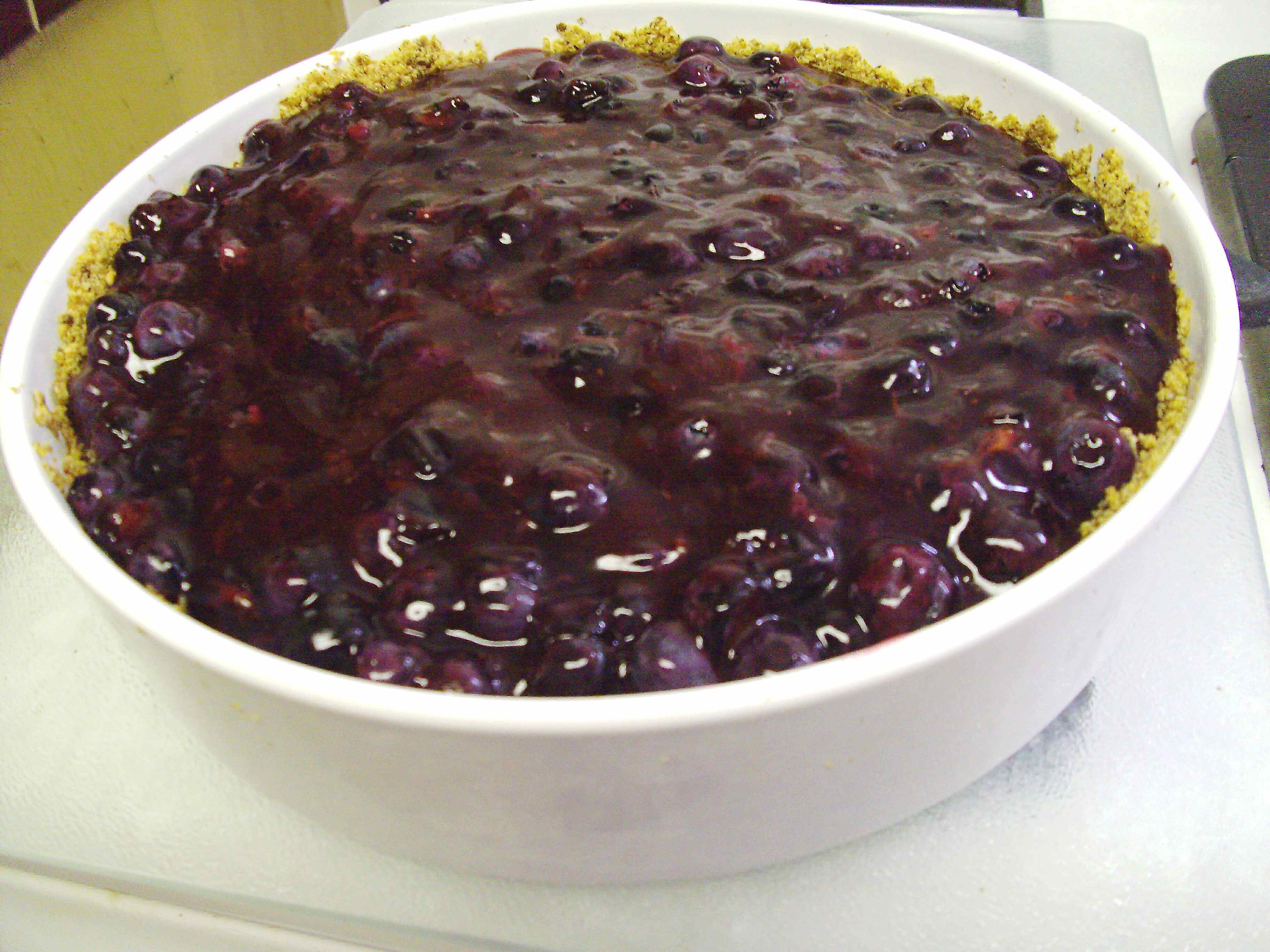

 This week we celebrated Shavuot, the feast of first fruits and giving of the Torah at Mt. Sinai. Shavuot has only two solid traditions I can remember from childhood: studying all night (three ultra-dedicated guys from my congregation would hang out and do it for the rest of us, kind of like the Jewish Scholarship Marathon), and eating cheesecake. Which is a pretty good tradition, actually.
I go for the serious New York-style tall, lemon-tinged cheesecakes that are rich and just dry enough to have a fluffy crumb to them. The only one of these I ever made myself was the glorious one from (once again) Joan Nathan’s The Jewish Holiday Kitchen. It was huge, it was beautiful, it took two whole hours of baking with the oven on and off, and I was just barely smart enough to wrap it tight in a double layer of heavy-duty tinfoil right before carrying it out to the car for a brunch setup. Because of course it took a nosedive onto the parking lot pavement–but the foil held up! And the cheesecake was only a little bashed! And we covered it pretty liberally in sour cherry jam, and everyone ate it happily, and no one kvetched. A miracle!
The story of how G-d gave the Torah law to the Jewish people on Mt. Sinai, is kind of hard to picture. Supposedly it was all so shockingly loud and bright people started to hear colors and see sounds (or else the lightning was so close it started to short out their neural circuits). But what is clear is that everyone was so awed and shocked they stopped arguing, at least for a few minutes.
So of course it has everything to do with today’s topic, which is still cheesecake. It’s an established fact–feed cheesecake to your people and you’ll get a few minutes of blessed silence. It’s quicker and cheaper than group electroshock therapy, too, and it tastes better.
So I’d wanted to make a cheesecake for Shavuot, but not take two hours about it, especially in May in Los Angeles. Also, cheesecake is a traditionally loaded food–one look and you can hear your gallbladder calling you. But it’s a real challenge to make a decent-tasting, genuinely low-fat version that isn’t just “use neufchâtel and cut out 3 calories!” Or else hideously tough or gelatinous or watery or flavorless or grainy or otherwise weird.
Drained nonfat yogurt–no. Tough, tangy AND watery after baking. Ricotta–not bad, especially for Roman-style cheesecake, but bland and a bit grainy. Gelatin’s out for me because it’s not a kosher ingredient. Fat-free cream cheese–I’m just not a fan, it’s too salty and processed-tasting somehow. Not fresh. And on the web I’ve seen everything from tofu to tehina (sesame paste)–I can’t imagine, but to each his or her own.
Still, I think with the microwave I’ve got the time thing solved in a way that will work for a number of different versions. A while back I discovered you can take pretty much any standard New York-style cheesecake recipe (eggs, flour, cream- or other suitable cheese, vanilla, lemon juice), put it in a microwaveable baking dish, cover and nuke it through in a couple of minutes without ruining the texture. It’s probably better without a crust, but if you prebake the crust then pour the filling, cover, and nuke while it’s still hot, it might prevent sogginess.
The only versions that might be really troublesome would be ones with yogurt, which is usually too thin and watery even when drained, or else cottage cheese, which works in a conventional oven but not the microwave. For some strange reason cottage cheese curd liquefies into a buttermilk-like mess in the microwave rather than setting up. Frustrating. But ricotta works pretty well, cream cheese–of course, labaneh–astoundingly perfect, and even…nonfat powdered dry milk (NFPD) with buttermilk. Odd but true. So it will work with a range of adaptations from full-fat to ultra-lean, and the rest is up to your tastebuds. Continue reading
Filed under: baking, cooking, Dairy, Desserts, holiday cooking, Microwave tricks, nutrition, Revised recipes | Tagged: baking, cheesecake, dairy dishes, holiday recipes, Jewish cooking, low-fat desserts, microwave cooking, Shavuot | 2 Comments »
 Slow Food Fast