
• Enter your email address to subscribe to this blog and receive notifications of new posts by email.

    Join 241 other subscribers
  • Noshing on

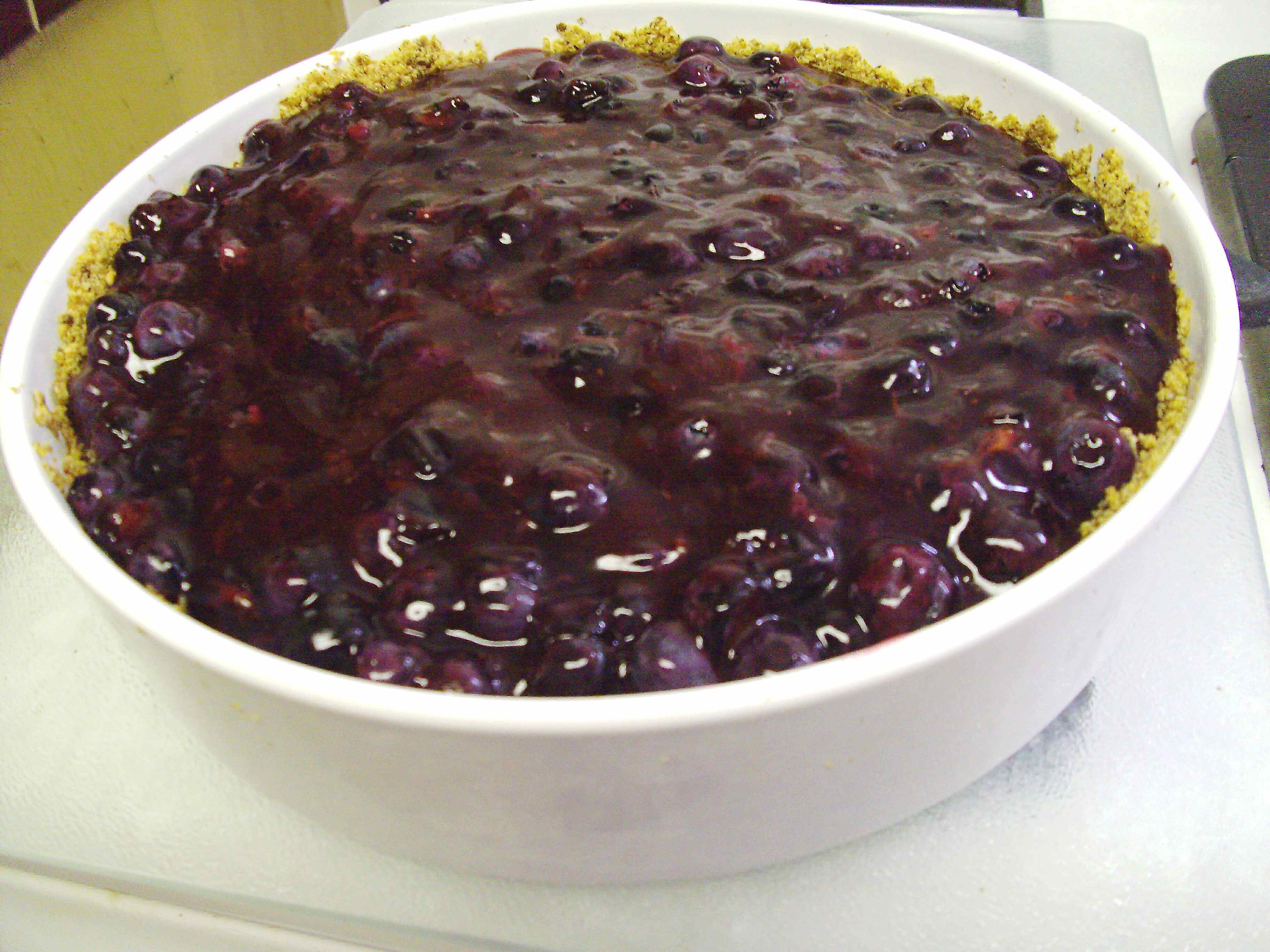
    raw blueberry pie with microwaveable filling and graham cracker crust

    This mostly-raw blueberry pie is a snap to make and very versatile--the filling microwaves in a few minutes, and you don't even have to bake the zippy gingered graham cracker crust--perfect for a hot Fourth of July and all summer long.

  • Recent Posts

  • Contents

  • Archives

  • Now Reading

  • See also my Book Reviews

  • Copyright 2008-2024Slow Food Fast. All writing and images on this blog unless otherwise attributed or set in quotes are the sole property of Slow Food Fast. Please contact DebbieN via the comments form for permissions before reprinting or reproducing any of the material on this blog.

  • ADS AND AFFILIATE LINKS

  • I may post affiliate links to books and movies that I personally review and recommend. Currently I favor Alibris and Vroman's, our terrific and venerable (now past the century mark!) independent bookstore in Pasadena. Or go to your local library--and make sure to support them with actual donations, not just overdue fines (ahem!), because your state probably has cut their budget and hours. Again.

  • In keeping with the disclaimer below, I DO NOT endorse, profit from, or recommend any medications, health treatments, commercial diet plans, supplements or any other such products.

  • DISCLAIMER

  • SlowFoodFast sometimes addresses general public health topics related to nutrition, heart disease, blood pressure, and diabetes. Because this is a blog with a personal point of view, my health and food politics entries often include my opinions on the trends I see, and I try to be as blatant as possible about that. None of these articles should be construed as specific medical advice for an individual case. I do try to keep to findings from well-vetted research sources and large, well-controlled studies, and I try not to sensationalize the science (though if they actually come up with a real cure for Type I diabetes in the next couple of years, I'm gonna be dancing in the streets with a hat that would put Carmen Miranda to shame. Consider yourself warned).

Frittata on the Rebound

Dr. Lustig’s “Teaching Breakfast” clinical teaching program for families with obese or diabetic children posed a question for me that I didn’t get a chance to test out until this morning. If something with balanced protein and vegetables–say, an omelet–is a better choice than most breakfast cereal, or poptarts, or doughnuts, or whatever most kids are eating before they go to school, how do you get that to be affordable and quick to prepare on a schoolday?

The easiest way to do eggs for several people at a time without overdoing the cholesterol is probably to do a big omelet or scramble and take out some of the yolks. But you might not have time  to do it at the optimal time for the gourmet–that is, right before you’re going to eat it. Not if you’re heading your kid(s) out the door with the daily litany to grab socks, shoes, homework and lunches and not to worry about what color lipstick (or hairstyle, or comic book, depending on age and taste) because you’re going to be late and come on, already.

We didn’t have this problem in my childhood; you either got out to the bus stop on time by yourself or you walked to school in disgrace, because my mother was not going to make our breakfast or lunch (for which we were immensely grateful), or do any big rescues for “emergencies” based on footdragging. And staying home was not an option we wanted to explore. My sister and I could count on the other one telling on us, not to mention the prospect of running into Mom if she came home early or picked up a phone call from the school attendance clerk. Motivation is everything…

But grownups have these dilemmas too. Who wants to be messing about with a frying pan and washing up when you’re trying to get to work? So many of my daughter’s teachers last year could be spotted out in the parking lot of the school right before the first bell, standing by their cars and bolting down an egg mcmuffin-type thing from a fast food drive-through (drive-thru? hate that commercial spelling) with a cup of coffee in the other hand. Quick, seemingly nutritious, but actually horribly high-salt-and-fat-and-calorie-for-what-it-is, and quite expensive too. Not a good daily habit. If you can do eggs and coffee from scratch at home, you’re bound to do them better and a lot cheaper. You could probably save up for a new tablet or pair of theater tickets within weeks, and you might even lose a bit of weight.

So eggs. A frittata has a lot more vegetation in it than a classic French-style omelet, and it’s more sturdy–look at the very solid, nearly stiff Spanish potato-filled version; always served at room temperature in cubes or wedge slices, almost as some kind of potato kugel.

Well, okay, you don’t want a potato frittata if you’re trying to get the nutrition up to snuff without tons of calories or grams of carb. You want some lighter but substantial vegetables so you don’t end up feeling like you swallowed a lead balloon for the rest of the day.

But the good news is that you don’t have to cook and serve it right on the spot. You can do it ahead and stick it in the fridge. If you do it the night before, you can cut it into wedges and microwave one on a plate for 15-30 seconds and you’re ready to go. Or, of course, you can serve it cold–kind of like the classic cold pizza for breakfast, only  better balanced. And most frittatas go well with salsa.

I am not a fan of the kind of isn’t-it-rustic-Italian-or-Provençal glossy magazine frittata instructions that call for frying first and then running under a broiler or what have you. That takes time and heats up the house ( bad in Los Angeles) and probably calls for expensive stovetop-to-oven-friendly cookware, which is usually not [sorry, forgot the “not” when I first posted this] nonstick. A lot of excess fuss for an effect you can perfectly well achieve in an ordinary nonstick frying pan in a couple of minutes on the stovetop, which is how most people who make frittatas at home “authentically” in tiny Italian or Provençal kitchens actually make them. Unless you’re doing a fancy brunch service for 20 diners at a time, in which case it might actually be quicker to do a baked eggs thing in a big casserole and skip the frying. But then I’d hope you were getting paid through the nose for that. Little chance of collecting caterer’s fees at home.

As for the vegetables, cauliflower and zucchini are both very good low-carb, low-calorie stand-ins for potato, and they’re pretty inexpensive and easy to prepare, especially if you have a microwave so you can parcook them on a plate for a minute or so before adding them to the frying pan. That gives you a chance to soften them through quickly and at the same time drain off some of the liquid–they’ll fry faster and won’t make the frittata soggy.

Cauliflower has more fiber, vitamin C and calcium than zucchini, and it’s a bit firmer as well. Zucchini is milder and easier for kids (or adults) who aren’t yet used to eating a variety of vegetables. A frittata like this is also the ideal way to use up that scary-big overgrown zucchini your enthusiastic gardening neighbor gifted you with. Or that someone anonymous parked on your doorstep in the middle of the night.

…It is getting to be the season for that sort of reverse larceny, now that I think about it. Someday I feel it would be right to invent a spring-loaded, siren-enhanced trap for stealth zucchini donors. Something involving on-the-spot forced acceptance of a large cafeteria-style green or orange jello mold with canned fruit cocktail floating in it, faded-pink “cherries” and all, as the price of escape…  Or maybe I’ve just been watching too much “Big Bang Theory” with my daughter this weekend and have started to channel my inner Sheldon. And really, I don’t mind stealth zucchini nearly as much as gifted Meyer lemons.

Okay. Back to the frittata–after all, if you already know how to make a basic omelet, this post is mostly just for entertainment, a mere vehicle for shocking photos of various vegetables that have been foisted off on us by well-meaning friends. It’s enough to make you feel like Wallace & Grommit in “The Curse of the Were-Rabbit”:
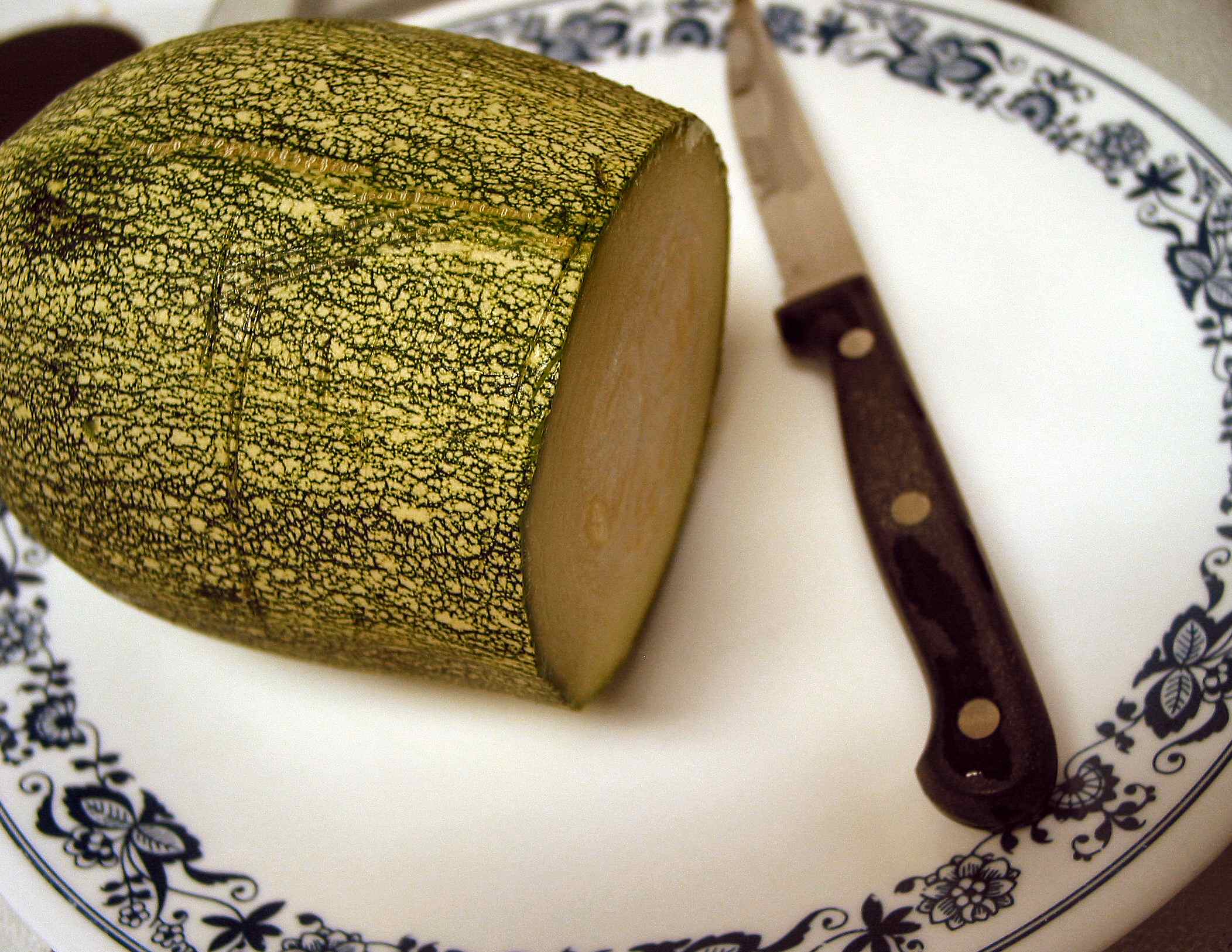
Monster zucchini half

Monster zucchini. This is a dinner plate and steak knife we’re talking about here. And only half the zucchini. The other half of which I’m sure is still stalking the neighborhood in the wee hours of the night.

IMG_8903

Breaking down a zucchini (well, how would YOU go about it? I didn’t have a wooden stake or silver bullet or anything) for a monster omelet.

Continue reading

Microwave Tricks: Shakshouka

IMG_0458

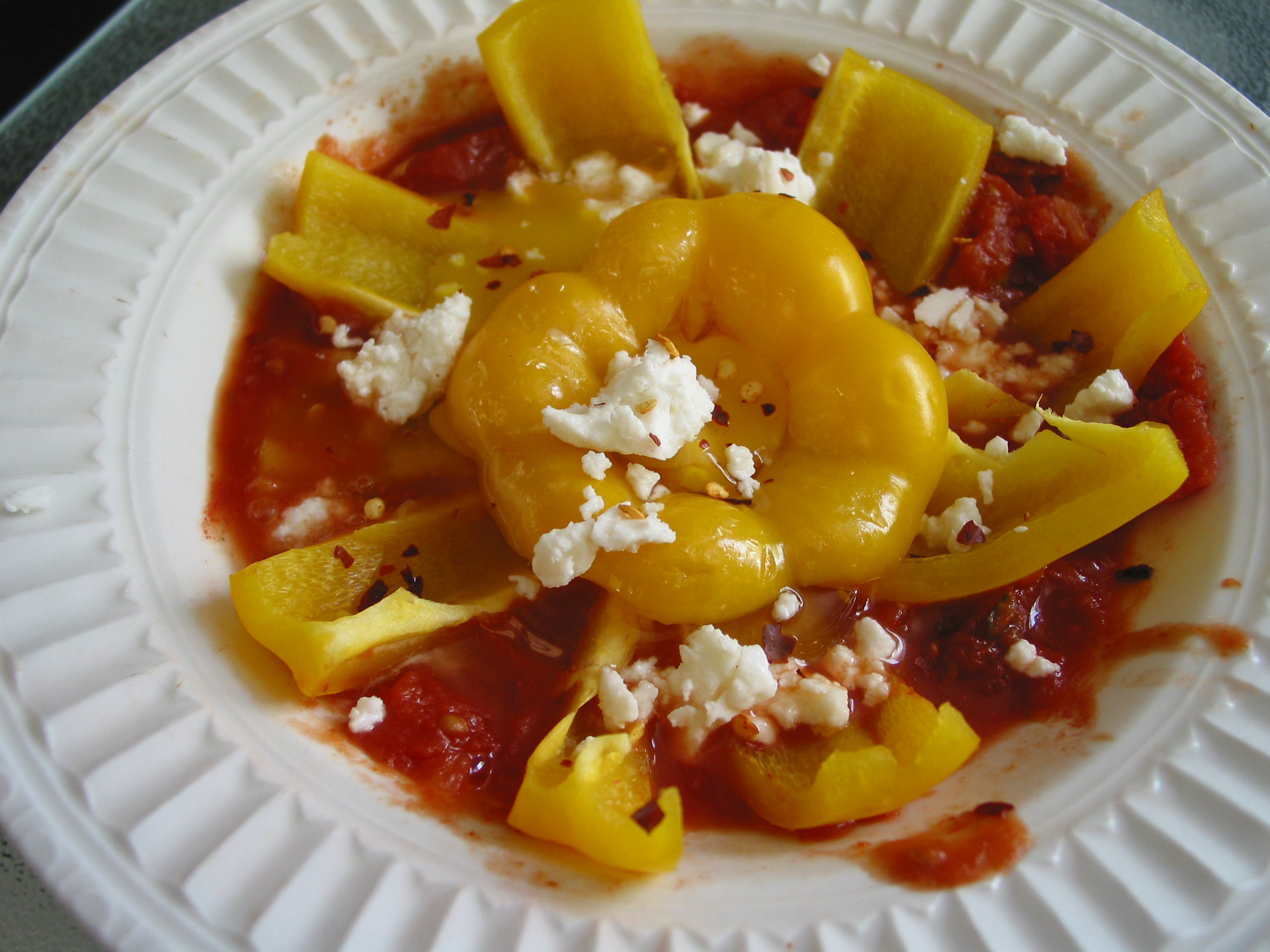
Marinara plus a pepper makes a good start.

Sometimes during Passover you just can’t take any more matzahnola. Or matzah with jam, or matzah brei. Or cake. Or macaroons. Anything for breakfast that doesn’t involve at least one vegetable (other than yourself, before coffee). Your tolerance for sweet stuff has been exhausted, and as for the leftover gefilte fish and hrein…no. We are not going there. No matter how much my husband insists it’s “perfectly good” (and I notice he hasn’t schlepped the rest of the jar with him to the office!)

Forget all that. There’s a pretty good cure for the Pesach blahs–you need some chile peppers and you need them now. Not in 20 minutes, no major cooking involved. You have a microwave, some cheap microwaveable soup bowls or the like, and you’re not afraid to use ’em for an increasingly popular Israeli brunch dish–shakshouka. Which is basically the Jewish version of huevos rancheros, only without beans or potatoes. Or lard.

Yotam Ottolenghi has made shakshouka popular and photogenic in at least one of his famous cookbooks, probably prettier than what I’ve got here. But it takes longer too, and I’m impatient.

To make shakshouka, you usually need a frying pan, olive oil, some tomatoes, peppers and onions, plus garlic, cumin, chile peppers, maybe a couple of oregano-or-thyme-and/or-cilantro-type herbs–sounds like the makings of salsa, no?–and some fresh eggs to crack into the resulting sauce. The sauce takes some 20-30 minutes to cook down, the eggs another 5-7 to cook more or less sunny-side-up in the middle of the sauce. That’s a lot of time for breakfast. I wanted a shortcut this morning.

Most jarred salsas are not kosher for Passover–it’s the distilled vinegar thing. That’s okay, because yesterday in a fit of domestic planning (uncharacteristic, I swear) I decided to make a batch of microwave marinara from some unsalted canned tomatoes. I don’t have a kosher-for-Passover food processor this year, though, so I decided, after trying to chop up some pretty tough Roma tomatoes (even with the skins off!) that I should just do as the Sicilians do and break them up with my hands as Tony Danza advises. A little chunkier than usual, but just fine. And actually ideal as a base for shakshouka–both its readiness for a mid-morning fridge scrounge and its rusticity made for a good start. A good dollop in a microwaveable soup bowl.

What else do you need? Maybe a bell or Anaheim-type pepper that needs to get used up. Cut it up (I got whimsical, you don’t have to potschky around with flower shapes). Add more onion if you feel like it; I didn’t. Stick it in the microwave for a minute or two to wilt the pepper and possible onion pieces.

IMG_0461

Then crack an egg or two into it, sprinkle on a bit of feta or panela or queso fresco as desired, maybe a pinch or so of chile pepper flakes or z’khug (I’d run out) and/or chopped cilantro as desired.

IMG_0463

Put another soup bowl on top as a lid, and microwave another minute or two until the eggs are cooked to your liking–check and add 30 seconds if you think it’s still got a raw spot somewhere, and/or leave the lid on for a few minutes and let it finish cooking in the residual heat of the sauce.

Obviously if you’re having people over for brunch, the standard frying pan method is better and quicker–more eggs and salsa means more time in the microwave, and no one wants to sit around as you microwave individual portions. But if it’s just you, or you and your partner, the microwave method works pretty well. Just add a little time (maybe another minute or so in 30-second increments) for four eggs as opposed to two.

IMG_0464

Hafla! (celebratory remark when there’s something good on the table and you didn’t have to wait an hour for it) Grab some matzah and a cup of hot coffee and b’te’avon (mangia bene/bon appétit/eat nice)!

Microwave tricks: 5-Minute Plum Jam for Fall

Italian prune or blue plums

These Italian prunes are some of the fresher, better-looking specimens from my greengrocer’s bin this week. But overripe plums work fine too.

Italian blue or prune plums are probably the last round of plums to appear at my local greengrocers for the year (well, until they start getting in carboys of plums and peaches from Chile). Prune plums aren’t much to look at–well, okay, they have a graceful enough elongated shape, but cut into one and you won’t be terribly impressed–the peel is thick and slightly bitter, the flesh is yellow-brownish, not very juicy, and a bit stickier and less brilliantly flavored than the red and black plums of summer, to say nothing of the gorgeous green and mottled dinosaur and Santa Rosa plums we can get here in LA. Many of the fresh prunes end up overripe and still untaken at the end of the day.

Which, I’ve discovered this week, is actually quite a shame. Because if you buy them early and firm, while there’s still a tint of reddish purple about them, they’re closer to regular plums–crisper, juicier and livelier tasting raw. Still not the ideal eating plum, but not bad.

And if you take the ones that are fully ripe and disappointing and bland and not too pretty, cut them up and microwave them, suddenly everything transforms. Italian prune plums make a gorgeous, rose-red, vibrantly flavored low-sugar jam. A lot like cranberry sauce in both color and flavor, but somehow a little mellower, with the bitter edge off, and a hint of spicy perfumed depth.

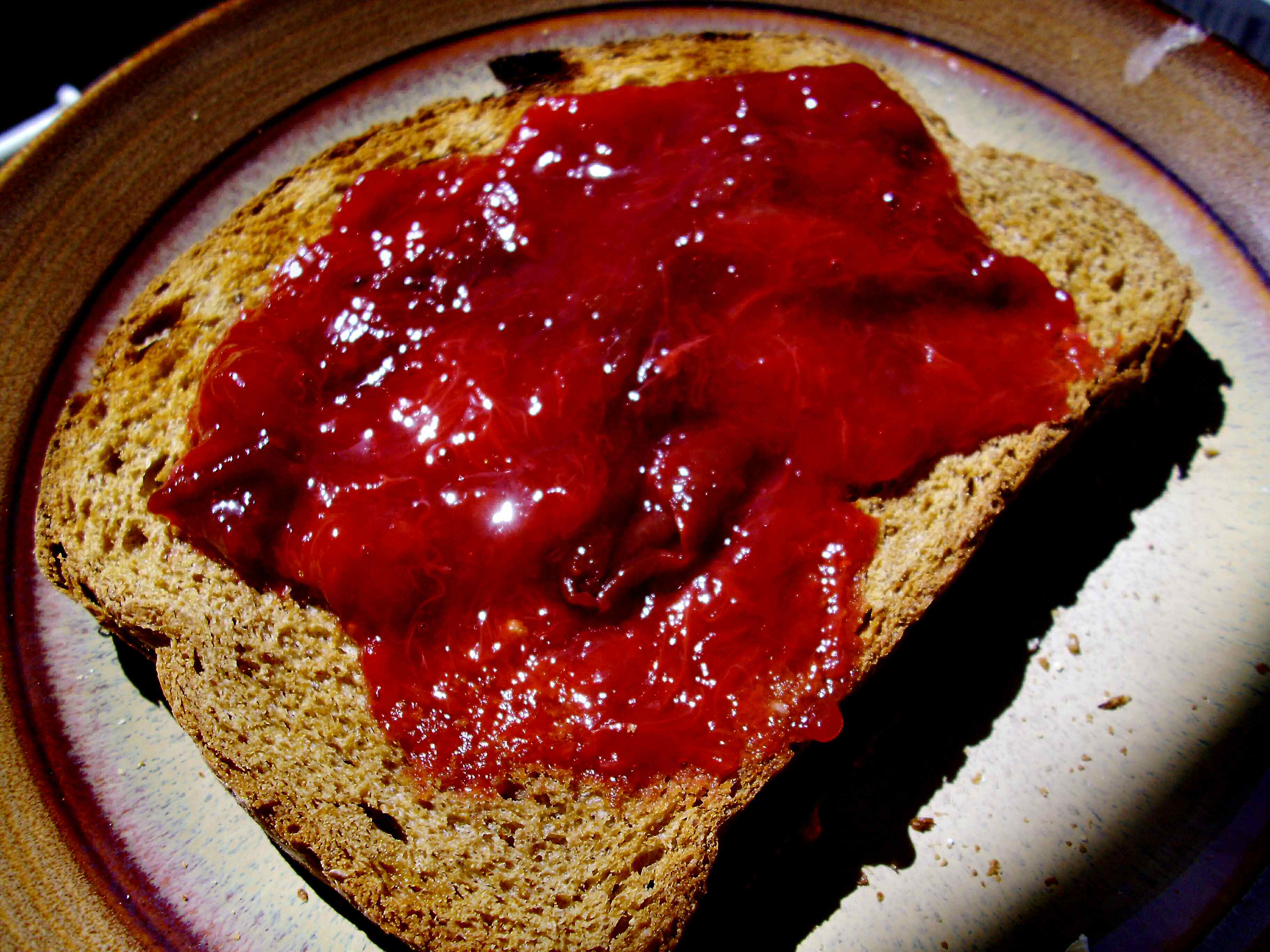
Microwave plum jam on wholewheat toast

Five minutes in the microwave, and everything changes.

Many stone fruits react this way to heat–sometimes sugar too, but mostly it’s the heat. Even very bland, mushy pale apricots seem to bloom into vibrant flavor and acidity when baked or simmered, and sour cherries go from slightly bitter and dull raw to world-famous classic pie filling with a strong almond aroma. I’ve rescued bland, spongy supermarket nectarines and peaches by microwaving them into fruit spreads with real flavor, but obviously good fruit makes even better jams and compotes. It’s just that when the fruit is good raw, I’d usually rather eat it raw, because the season is short.

The prune plums I bought this past week don’t provoke that dilemma of choice; they’re definitely better turned into a quick fruit spread, and maybe I’ll freeze a second batch for later. These plums would also make a great pie filling, like the zwetchgenkuchen that Joan Nathan first published as a traditional German Jewish dessert for Rosh Hashanah in The Jewish Holiday Kitchen. Baked conventionally, the quartered prune plums would probably hold their shape somewhat in the crust and look beautiful.

In the microwave, the plums quickly break down to a bubbling mass and gradually take on color from the peel–at first, bronze with a hint of pink, and after a minute or two the color spreads and deepens to cranberry red (as does the flavor). Sugar just to taste, a tiny squeeze of lemon, and a pinch each of clove and ginger balance out the tartness, and after a day in the fridge, the jam has mellowed and integrated beautifully.

The accents of brandy, cinnamon, nutmeg and lemon peel in Nathan’s recipe make me want to run back to the store and try it this instant, but after a week of baking challah for the high holidays and prospects for 100 degree temperatures yet again, I’m not sure today’s the day. Maybe for Sukkot, which starts later this week.

But the combination of plums with aromatic spices is right on, and if you’re adventurous you could always take this fruit spread one step further and add a small spoonful of brandy, a few shakes of cinnamon and an even tinier hint of nutmeg, even a little grated lemon peel. The simple version below is good on toast, delicious with Greek yogurt and plenty complex enough for me before or after the second cup of coffee.

However, the full-on dressed-up version would probably be a wonderful accent for goat cheese tartlets or a baked brie if you were doing swanky appetizers for a dinner party. I’d test-taste a small batch of the jam first just to make sure it wasn’t too rich with the brandy and nutmeg, because a little goes a long way, but otherwise, let ‘er rip. The plum-jam-with-cheese appetizers would also be an unexpectedly good accompaniment to mead, sherry or other apéritifs for fall.

5-Minute Microwave Plum Fruit Spread (makes about a cup)

  • 5-6 ripe Italian blue or prune plums (or any other plums), washed, pitted and cut up
  • 2-3 T sugar (or more to taste–I like mine less sweet, more fruit)
  • squeeze of lemon juice
  • pinch of cloves (maybe 1/8 t, probably a little less)
  • pinch of powdered ginger (a little less than 1/8 t)

Put all ingredients in a microwaveable ceramic bowl big enough to hold them with a couple of inches to spare, because the plum mixture will bubble up as it cooks. Remember to handle the edges of the bowl with a towel or oven mitt or something (folded paper sandwich bags also work okay in a pinch) because this will heat long enough for the bowl itself to get hot.

Microwave 1-2 minutes on HIGH (I have an 1100 W oven, so adjust times to whatever works for you if yours is older and lower power). The plums should be starting to break down and just starting to color pinkish. Stir the mixture and microwave another minute or so, stir again. If it’s not cooked as much as you think it should be, microwave another minute or so but be prepared to hit the stop button if you see it start to boil over. If it’s fully colored and broken down to a fruit spread, take a small spoonful, let it cool, and taste carefully. It will probably taste a lot like not-very-sweetened cranberry sauce. If it’s not sweet enough for you, add a little more sugar to taste, and maybe another squeeze of lemon, then let it cool all the way covered and refrigerate. It will thicken a little further and mellow overnight and taste more like plums, especially with the clove and ginger notes.

You can, obviously, also boil the ingredients a few minutes in a saucepan on the stovetop if you prefer. If you want it completely smooth, cool it and put it through a food mill or food processor.

This isn’t canned, so store it in the fridge for up to a week or freeze it for later. When you thaw it, taste it again–you might need to add another squeeze of lemon and/or reheat in the microwave just a minute or so to refresh it.

Breakfast without Matzah Overload

Last night we were very much in the spirit of Pesach–a total rush job at home, to the point where I realized I was supposed to have a boiled egg somewhere on the seder plate just as it was getting pretty far past sundown. Organization isn’t always our strong suit, especially on school nights. Last year I posted my Bart Simpson-style Passover Chalkboard Litany of kvetches and survival tips. This year: how to deal with matzah when they won’t sell you anything less than enough for 70 people for $2.99–such a deal! (well, okay, it is). You could feed nearly the whole Sanhedrin (because in our family, everyone argues about everything and I’m sure my 13-year-old is ready for law school as we speak. Good thing I can’t afford it yet!)

As with any style of food, too much of a good thing is still too much. I think I learn that the hard way every Passover. How to eat mostly vegetables and lean proteins and fresh fruit and yogurt…and not just sit there eating matzah like it’s going out of style? There’s more than enough matzah to go around–even in gefilte fish, especially in gefilte fish, which I’ve lost my taste for over the years since discovering how to cook regular fresh fish well, aka “not-gefilte”  (though I still buy a jar for my noncooking husband for lunches during the week.)

I don’t do matzah kugel, sweet or mushroom (a waste of mushrooms in my jaundiced opinion). I’m not a huge fan of matzah brei (exception: matzah brei “blintzes”), matzah lasagne, mina de espinaca, or any of the other matzah-plus-egg-heavy adaptations of regular food. Although I have seen one attractive-enough looking picture of a mina de espinaca, I’d still do it without the matzah sheets…

I try hard these days not to make matzah balls either, though this year I might make an exception–once–for my poor daughter who never gets any because she’s vegetarian and the “not-chicken” soup at Shabbaton this March didn’t have any flavor and there were no matzah balls in it like there were in the yes-chicken soup. Oy! Maybe it’ll be a weekend project to figure out a good from-scratch version–we have school and taxes this week. A lot of school and taxes.

My mother, who is famous for not cooking more than necessary, taught me how to make pretty-good fresh-tasting haroset Russian Jewish style (’cause that’s what we were). Apples, walnuts (though almond flakes are also just fine with me), cinnamon, sweet wine or grape juice, maybe or maybe not honey, chopped coarsely so it stays crunchy. But I’ve been to a couple of community seders out here in Pasadena where the haroset was mashed down like baby food and to add insult, had matzah meal in it. I know, matzah bits probably started out as a less expensive alternative to nuts, and I can’t blame anyone for that in their own homes. A professional caterer is quite another story. There’s really no excuse in California, where nuts are pretty plentiful (both the human and the arborial kind).

Well, anyway. Second seder is tonight, but what about the rest of the week–after taxes, as it were? Passover brings on a lot of nutritional challenges if you eat dairy or vegetarian. How not to eat too many eggs in a single week? How to stay away from the canned coconut macaroons and other assorted “Kosher for Passover” horror sweets my husband brings home because he thinks that the kashrut labeling makes up for the “nutrition” labeling (which really oughtta say, “WHAT nutrition?! This is pure sugar and potato starch, buddy! And palm oil! And artificial colors and flavors! Almost as good as Froot Loops!”) I’m pretty sure I’ve already mentioned this, but it’s because he’s a boy, and there’s nothing much to do about it except shudder, put the box of “goodies” in some inaccessible place on a low shelf, preferably behind the broccoli, which is merely green and mysterious or better yet, okra (which he fears more than taxes, and that’s saying something).

Note it down: ALL the packaged cake and cookie substitutes are a bad deal for anyone diabetic or even marginally thinking about becoming diabetic–very, very spiky, and almost never worth it. Also guaranteed to induce repetitive eating and the false sensation that you’re “starving” about three seconds after you eat them. And in the last 20 years, they’ve been faked-up further–even the kichel, a dry, stiff, barely-sweet puff halfway between an empty creampuff shell and a biscotti, has had artificial flavorings added recently–why bother?

Do we really even need such matzah-filled “delights”? Nowhere is this poverty of product more evident than in the kosher-for-Passover cake “mixes” (for which I always hear Julia Sweeney’s line “Where are yer mixes, hon?” from God said, Ha!). Last year’s example, which I’m not letting happen again: the Manischewitz Blueberry Pancake mix box my husband proudly brought home one day “on sale! it was 99 cents!” And naïvely suggested I could make for breakfast–this upon seeing that I’d just finished making cheese blintzes from scratch with real ingredients, and real raspberries. Don’t squint at me like that–he’s still breathing. I just decided his sudden brainfreeze in the wife department had been caused by jetlag, and contented myself with reading the ingredient box back to him.

The man is not a cook and is pretty happy not to be. Still, he does like to eat. And read. Somehow it never occurred to him to read in service of eating by checking what’s actually on and in that pancake mix box. It had 20 ingredients, no nutrition, and no blueberries. “Blueberry bits” contained–are you ready?–food coloring, sugar, artificial flavor, and sodium alginate. So suddenly you can’t tell the difference between berries and blue goo?

I had to go into extra innings with the cauliflower and broccoli and eggplant and asparagus and tomato/artichoke heart salads just to overcome the unusually high crap factor, even though I didn’t use the mix. Just reading it was enough to require emergency grapefruit. I was too ashamed to donate it to a food pantry, either.

So….real is definitely the best way to go with food for the week. Breakfasts can be tricky–matzah and jam, matzah and cream cheese, matzah and almond butter…it gets pretty tired pretty quick. And on the other hand, blintzes are for weekends only and frankly? I’m still annoyed about that pancake mix incident a year later! Nu…

Three relatively low-crap, moderately-low matzah alternative breakfasts that are (most important!) low-labor for those post-Seder mornings when you are Done and Off Duty to your nearest and dearest (except for coffee):

1. Matzah-nola, what it sounds like, ingredients straight from the cupboard or freezer. There is actually a product out commercially this year called “Matzahnola”; my version I invented a year or two ago out of desperation against the nutrition-free Passover version of Cheerios my husband brought home, but I didn’t think it was that good a name–who knew? Anyway, I’m not bitter (though the fresh-grated horseradish is still stinging my sinuses from last night).

2. The old-style Israeli breakfast, not the modern endless hotel breakfast buffets–more like the kibbutz specials where you’re expected to get out there and weed a cotton field right afterward. Which I have actually done in my less cynical youth.

3. The bonus “I can haz CAKE?” breakfast, a favorite of fridge-scrounging champions everywhere Continue reading

Starting with Breakfast

“The Well” blog at the New York Times has posted a new interview with pediatric endocrinologist Dr. Robert Lustig about his new book, the Fat Chance Cookbook, and about the possibilities for treating obesity in children with a better, less processed diet.

Two or three takeaways from the interview surprised me by echoing things I’ve either thought or written about here since my daughter became a Type I diabetic four years ago.

Almost always, we see an obese kid come in with an obese parent. And when the kid loses weight, the parent loses weight, because the parent actually changed what’s going on in the home.

We do something called “the teaching breakfast.” Every kid comes in fasting because we’re drawing blood. So they’re all hungry. They go to the teaching breakfast with their parents – it’s six families all at a communal table – and our dietitian spends an hour with them. The dietitian narrates exactly what’s on the table and teaches the parent and the kid at the same time….We make sure four things happen. No. 1, we show the parent the kid will eat the food. No. 2, we show the parent that they will eat the food. No. 3, we show the parent that other kids will eat the food, because they have other kids at home and they have to be able to buy stuff that they know other kids will eat. And No. 4, we show them the grocery bill, so they see that they can afford the food. If you don’t do all four of those, they won’t change.

Also, and I think this is my favorite:

…my wife is Norwegian… When she’s mad at me, she bakes…My wife has learned by experimenting that she can take any cookie recipe, any cake recipe, and reduce the amount of sugar by one third, and it actually tastes better…. And you can taste the chocolate, the nuts, the oatmeal, the macadamia – whatever is in it.

Right on!

Back to the top, though, I’ve got to say I love the idea of the teaching breakfast. My one concern is the reality of time cost for families with school-aged children, because eggs and vegetables, two of the (sometimes) inexpensive staples of the UCSF clinic’s teaching breakfast, take more time to prepare than a bowl of cereal, and require more cleanup. On weekdays, that might be a real challenge, especially for families with two working parents and/or long drives to school. A lot of the families I know in this situation (long drives and no school buses being a common problem in Southern California) are used to tossing their kids in the car with some kind of makeshift breakfast to eat on the way–often resorting to bagels, pop tarts, or bananas, none of which are great choices.

Perhaps if the dietician showed some simple microwaveable 5-minute meals like oatmeal or an easy vegetable-filled frittata (with some of the yolks left out) that can be made the night before and refrigerated? The plain yogurt with fresh fruit idea is also quick and simple but not especially cheap–these days a quart of plain non-Greek yogurt goes for $2.50 at Trader Joe’s, almost the same as a gallon of milk, and costs even more at the local Ralph’s (west coast Kroger affiliate), but it serves only 4 if each serving is a whole cup. Cereal with milk is a lot cheaper–but it could certainly be better cereal, high in fiber and low in sugar and salt, and measured by the cup or on a scale before pouring it into the bowl to make sure you don’t get more than you think you’re getting.

Cutting up fruit and vegetables takes time that parents usually feel they don’t have. And berries, which don’t need cutting up, are relatively expensive fruits, even when frozen. So showing parents a couple of “instantly grabbable” ways to serve the less expensive fresh (or fresh-frozen) fruits and vegetables instead of Froot Loops might be key.

A simple “just wash and nosh” approach would probably be a good start. I know I generally rail against buying precut, expensive little baggies of manicured (and dried out) vegetables in the supermarket, but the big bags of “baby carrots” that don’t require peeling and are finger-food size would be an okay starting point to get kids and parents to think about vegetables as a good snack or even breakfast choice. My daughter lived on them for lunches (along with a PBJ on whole wheat and an apple) for most of her grade school years, and even though she has (and will probably always have) a mean sweet tooth, she still seeks out raw green beans, wedges of red cabbage, roma tomatoes and broccoli or cauliflower branches to break off, rinse under the tap and nosh on after school.

Lightening up homemade scones

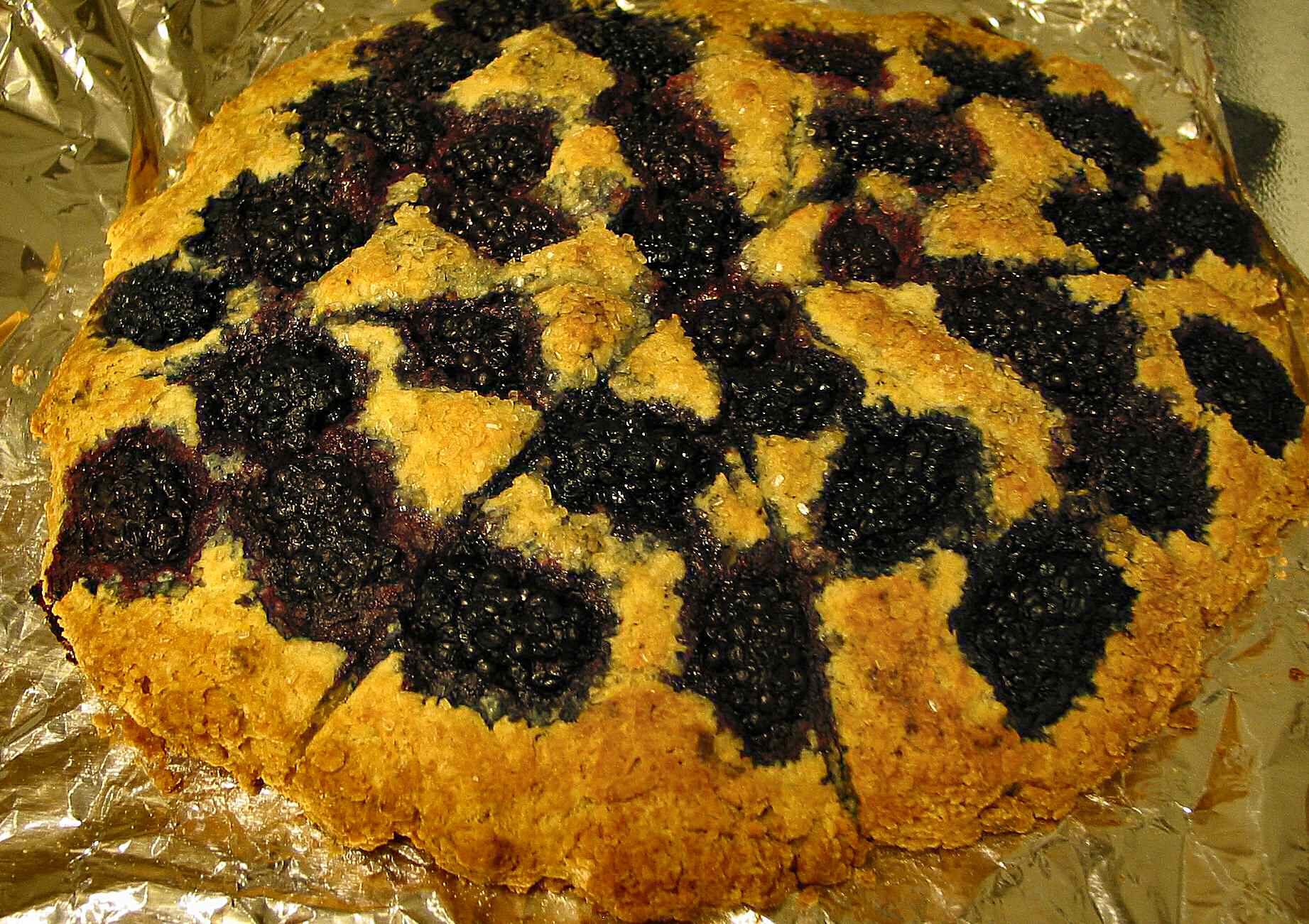
Blackberry scones for brunch

I’ve been wanting to post my favorite scone recipe for some time, but it seems to me that most food blogs start out with good intentions and end up maxing out on the desserts-and-starches end of the food spectrum.

The reason is pretty simple: if you’re a food blogger,  a baking recipe and a pretty picture (or any picture of an aggressively-frosted cupcake) will never put you wrong, even if the real result tastes kind of blah. I mean, cupcakes? Isn’t that what Duncan Hines is for? But if you do feature cupcakes, somebody’s sure to repost it or call it awesome, particularly if you figure out how to add bacon to it. Somehow people just don’t flock to posts about green beans in droves unless you’re redoing the Thanksgiving-straight-from-the-can classic, complete with canned fried onions.

There are way too many variations for every kind of baked good, none with a clear and permanent advantage, and people take them all literally (see under, my New Year’s apple pie insecurities).

So as I say, I’ve been reluctant to put up too many baking posts. Scones, though they’re not exactly the staff of life, are very easy to make and actually taste best when you make them from scratch–much better than buying them in a store and definitely not at your local Starbucks. The question I have is whether it’s a good idea to do it very often–I usually don’t, even on the weekend, but partly that’s because I live in southern California and heating the oven for more than five minutes in my little galley kitchen is often a Very Bad Idea. The other reason is that I keep remembering something Valerie Harper once said (maybe in the role of Rhoda Morgenstern; can’t remember): “I don’t know why I bother to eat this piece of chocolate cake. I should just apply it directly to my hips.”

Most quick breads (i.e., raised with baking soda or powder, or beaten egg whites, not yeast) do fine in a microwave as long as you don’t need them to brown. So lemon-poppyseed cake is okay, as is gingerbread. Scones, which to my mind require a deep and crunchy crust, need a regular oven to do well, but I make the sacrifice (90-degree weather makes it a genuine sacrifice) once in a while on Sunday mornings, because they taste terrific and they’re not exactly rocket science to make.

So if they’re that easy, should I really be posting about them–haven’t you already seen too many wide-eyed, “Look, Ma, I made SCONES!” kinds of posts?

Let’s face it. You can make great scones in a food processor from a very short list of ingredients for cheap, in about half an hour including baking time, and flavor them simply or exotically. Fruit or chocolate chips or chiles and herbs and cheese–all optional. I stick with berries and turbinado sugar, which makes the crust crunchy and glittery. Continue reading

Political Pancakes, or, Why is Borders flogging so much lard?

Why Borders is not getting my business this week

Why Borders is not getting my business this week

I know–highly unappetizing. I don’t think even a full teaspoon of salt would help here. And I’m getting back to actual food as of today, I promise.

But I just had to “share” my inbox this morning before I get started. Borders has now closed its Pasadena store but keeps sending me these fabulous discounts in the pretty hope that I’ll schlep to Arcadia to check them out. What does it say when a huge business that’s trying to stay afloat after two decades of leading the field misses so blatantly in its one-to-one personalized marketing?

For that matter, what does it say (reading the tea leaves here) when Newt Gingrich looks like the most coherent and readable (and properly-dressed) selection? I mean, I was there–in 1995 I started working at NIH and promptly got caught in the federal furloughs when he lost his budget armtwisting attempt on Bill Clinton.

What does it say when the Gritch is allegedly trying to run for president and his soon-to-be-available tome is grouped with those of three other deeply discounted “authors” who have no actual public service background, just a penchant for loud titles and  army drag (of various centuries)? Where the hell did Laura Ingraham get that hat? No wonder she’s not keeping up with Patt Morrison. And I thought French food was a no-no for today’s discerning ultraconservative trougher?

I do also wonder at the significance of Ann Coulter’s latest effort being discounted just that six percent more than everyone else’s…maybe it’s the fact that she’s jumped (appropriately) on the vampire-empire bandwagon? Too bad there are no handsome devils on the cover (almost guaranteed there are none inside either). I’m sure they’d sell like hotcakes. Maybe she’s included an actual recipe for hotcakes (with blood sauce or fava beans or something)?–You never know.  Can she actually cook? Without fatback?

Given the deep and undoubtedly thorough marketing research Borders has done (by sending me of all people this fabulous selection of deals), I’m sure they’ve already figured out which way the wind is blowing. I can smell it from here.

In honor of this great selection, I’ve decided to pull out the stops and dig into the older of my cookbooks for an appropriate response.

Semi-Patriotic Pancakes–No Lard AND No Blood (well, at least no added salt)!

Makes about 16 3-4″ diameter pancakes, enough for 3-4 people

  • about 1 c. bread flour, whole wheat flour, matzah cake meal, buckwheat flour, or any mix of these as desired (to preserve our individual freedoms. Put that gun down, Jeb! We’re talking first amendment, not second!) Generally if you’re using buckwheat or whole wheat, it’s better to go half-and-half with regular flour so the pancakes aren’t too heavy or grainy
  • 2 large eggs, separated–I usually toss one of the yolks but keep both whites
  • dollop of plain milk-and-cultures-only yogurt (for that Mediterranean touch)
  • milk or buttermilk (depending how sour you are, and if you use buttermilk skip the yogurt)–about a cup, but might be more to make the batter consistency come out right
  • 1 T sugar (any color, even green if that’s all you’ve got and can stomach the results)
  • 1 capful vanilla extract AND/OR a shake or two of cinnamon (keep it small)
  • oil or butter –1 T for the batter, the rest for frying

Optional mix-ins: blueberries or raspberries (fresh are good, but if you have frozen ones leave them frozen to add when you fry the pancakes; otherwise make a sauce of defrosted ones to serve at the table instead), chopped peeled apples, pecans, chocolate chips, etc. etc. NO: liver, fava beans, or blood-anything!

1. In a large bowl mix the the flour, sugar, flavoring(s), egg yolks, the tablespoon of oil or butter, the dollop of yogurt if using,  and enough milk or buttermilk to make a thick but just-pourable batter. If you’ve got chopped apples, nuts or chocolate chips, you can mix them in now.

2. In a second bowl beat the egg whites to reasonably stiff peaks, then fold them gently into the batter to lighten it. Start frying as soon as you’ve got this done.

3. Fry 3-4″ dollops (about 2-3T each) of the batter in a large (preferably nonstick) frying pan over medium to medium-high heat. If you’re adding berries, add a few to each pancake as soon as you’ve spooned the batter into the pan, and let the pancake batter rise around and over the berries a bit before flipping to the other side.  You’ll know to start flipping the pancakes when you see the bottom edge start to look solid and a ring of small bubbles appears just above it–but I sometimes go a little longer to make sure because the leavening is egg whites-only, which makes a pretty delicate batter. You don’t want the pancakes to collapse completely.

4. “Stick a fork in ’em, they’re done.”–The late, great governor of Texas, Ann Richards, July 15, 1992, in an interview with David Letterman about the Republicans’ chances, and quoted on page 61 of my swiss-dot cookbook… Incidentally, she was wearing an outfit that puts any of Ann Coulter’s to shame–she had her very, very white hair up in a classic Texas beehive and she was wearing a hot pink miniskirt that she actually had the legs for. I miss her still.

Sorry, Starbucks, no doughnut

On Sunday mornings, my daughter likes to drag her father out around the corner without me to the local Starbucks so he can buy himself coffee and get her some kind of small baked good that I’m not supposed to know about. Because I am, in fact, generally opposed to “doughnuts for breakfast” and both of them know it. It’s a ritual that had to be suspended for a while this spring, until we could figure out what kind of treat had how many grams of carbohydrate and how much of it she could eat and still eat something else more nutritious as the majority of breakfast.

Most of the pastries will never be what I consider top baking, but it’s not me who’s going to eat them. And my daughter wanted a doughnut, or part of a doughnut, if she could make it work out.

So–I went online to the Starbucks web site to try and hash out the vagaries of “petite” mini scones, mini doughnuts, coffee cake slices, and all the rest of it. Starbucks markets itself to the upscale, the midscale, and the would-be midscale of my town with all kinds of brochures about fair trade and global responsibility, and their web site is not much different. The do-right message is right up there with the latte of the week, and you’d expect the nutrition info to be present and helpful without the usual twisty chain-restaurant disguises and trickery.

Or would you? Starbucks got its tail caught several years ago when numerous commentators, among them its own employees, let the public know that some of the lattes and other mixed coffee drinks were topping out at over 700 calories per, with more fat than some burger chain offerings. Since then Starbucks has offered more health-conscious choices below the pastry case and taken a pro-active posture on nutrition and informing the customer and so on. But how do they really feel?

The nutrition info page falls under the “menus” navigation item at the top. OK. It’s readable, not a shrunken PDF file–good. You find a long scrolling list of each of the bakery items with calories, fat, carbs, and proteins. Doughnut, doughnut–old-fashioned glazed doughnut…440 calories, 21 grams of fat (10 saturated), 57 grams of carb…Ouch. Well, she could have half of one, I suppose, with a small bowl of oatmeal and some milk, and eat something better at lunch…but wait a minute. Where’s the sodium info?

All I could find about sodium was a little note about “healthy choices”, in which the Starbucks nutrition page asserts that such items have fewer than 10 grams of fat and fewer than 600 mg sodium. A stunner–that’s more than the classic 500-mg bowl of Campbell’s Tomato Soup that caused all the corporate protests against the NIH dietary salt guidelines in the 1980s. Who on earth would claim 600 mg sodium for a single snack or breakfast item was “healthy”–especially with the growing public and government concern over excessive salt in restaurant food?

And I still couldn’t find any specific sodium stats for doughnuts or mini scones or the other things my daughter was hoping for, much less an ingredients list. So I searched a variety of diet and nutrition web sites that catalog such things. The closest I could get to a current verified  standard nutrition label was from livestrong.com (accessed 5/3/10):

Starbucks Top Pot Old-Fashioned Glazed Doughnut

Serving Size: 1 Pastry (113g) Calories 480 Calories from Fat 210

  • Total Fat 23g 35%
  • Saturated Fat 9g 45%
  • Trans Fat 0g
  • Cholesterol 20mg 7%
  • Sodium 410mg 17%
  • Total Carbohydrate 64g 21%
  • Dietary Fiber 0.5g 2%
  • Sugars 39g
  • Protein 4g 8%
  • Vitamin A0%
  • Vitamin C 0%
  • Calcium 2%
  • Iron 10%

Est. Percent of Calories from: Fat 43.1% Carbs 53.3% Protein 3.3%

These stats are higher than what’s stated at the Starbucks page (see below). And the sodium in a single doughnut is pretty high. So’s the carb. So’s the fat. So’s the increase in size and calorie stats and so on from the glazed doughnuts they were offering in 2006, according to archived nutrition labels on a number of older diet web sites. Continue reading

Matzah Brei–blintzes?

Matzah Brei Blintzes

Thursday morning I broke down and decided to cook  breakfast for my daughter instead of leaving it at matzah, jam, yogurt and fruit. I’m not a big fan of matzah brei, a poor substitute for french toast in which the eggs never really seem to absorb very well and you’re left swallowing the hard corners of the matzah. Neither crisp nor soft, it always seems like a wrong turn to me.

On the other hand, I didn’t have any matzah meal in the house for pancakes (how much extra matzah product do you really need when you’re trying to eat less of it?) So I broke down and took a couple of sheets of the whole wheat matzah from the latest box and prepared to do battle.

I think I’ve mentioned once or twice that I hate waiting for water to boil. But a pyrex pie plate with half an inch of water in the bottom takes only 2 minutes to heat up fairly well in the microwave. And it has room for the matzah, which I broke up into halves. But whole wheat matzah doesn’t soak up all that well, even after several minutes in hot water. It’s the tougher bread of affliction. What now?

I fished out a dinner plate and covered the pie plate with it, stuck it all back in the microwave, and hit stun for another minute. To my surprise, it worked–really worked. The matzah didn’t fluff up or anything–but it was soft and pliable and even a bit elastic, something like just-cooked lasagne noodles. No hard corners. I drained off the hot water and poured on the egg-milk soak, which didn’t really soak in much even though the matzah was now soft. Sigh.

My daughter came around a corner, looked at me fishing one of these matzah halves out of the pie plate, and said, “I wish we could have blintzes” and I thought–well, these actually bend–could we? Why not?

Matzah brei blintz ready for frying

Matzah brei blintz, ready for frying

Continue reading