
• Enter your email address to subscribe to this blog and receive notifications of new posts by email.

    Join 241 other subscribers
  • Noshing on

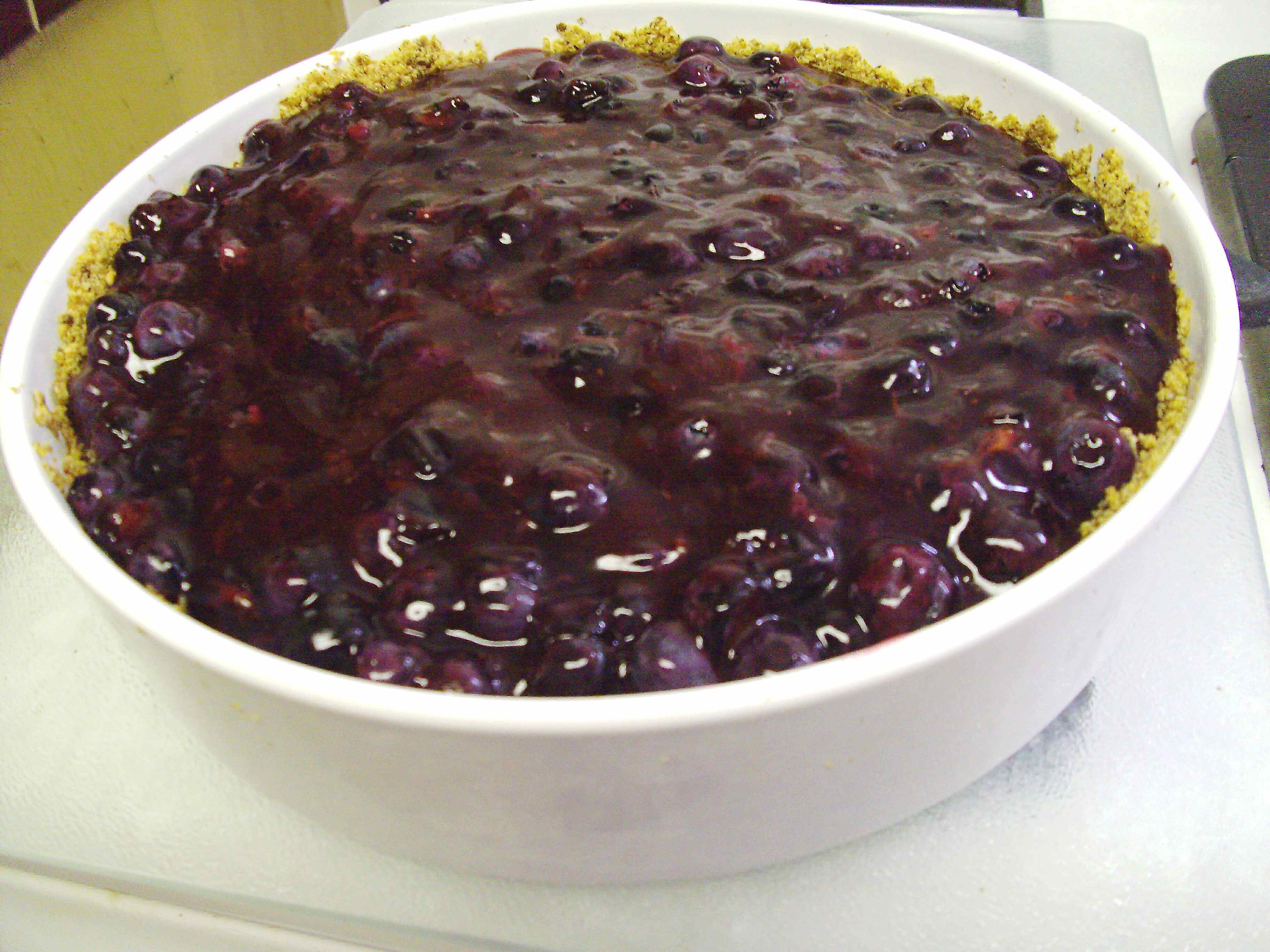
    raw blueberry pie with microwaveable filling and graham cracker crust

    This mostly-raw blueberry pie is a snap to make and very versatile--the filling microwaves in a few minutes, and you don't even have to bake the zippy gingered graham cracker crust--perfect for a hot Fourth of July and all summer long.

  • Recent Posts

  • Contents

  • Archives

  • Now Reading

  • See also my Book Reviews

  • Copyright 2008-2024Slow Food Fast. All writing and images on this blog unless otherwise attributed or set in quotes are the sole property of Slow Food Fast. Please contact DebbieN via the comments form for permissions before reprinting or reproducing any of the material on this blog.

  • ADS AND AFFILIATE LINKS

  • I may post affiliate links to books and movies that I personally review and recommend. Currently I favor Alibris and Vroman's, our terrific and venerable (now past the century mark!) independent bookstore in Pasadena. Or go to your local library--and make sure to support them with actual donations, not just overdue fines (ahem!), because your state probably has cut their budget and hours. Again.

  • In keeping with the disclaimer below, I DO NOT endorse, profit from, or recommend any medications, health treatments, commercial diet plans, supplements or any other such products.

  • DISCLAIMER

  • SlowFoodFast sometimes addresses general public health topics related to nutrition, heart disease, blood pressure, and diabetes. Because this is a blog with a personal point of view, my health and food politics entries often include my opinions on the trends I see, and I try to be as blatant as possible about that. None of these articles should be construed as specific medical advice for an individual case. I do try to keep to findings from well-vetted research sources and large, well-controlled studies, and I try not to sensationalize the science (though if they actually come up with a real cure for Type I diabetes in the next couple of years, I'm gonna be dancing in the streets with a hat that would put Carmen Miranda to shame. Consider yourself warned).

Sweet Potato Ravioli

A couple of posts ago I mentioned wanting to try making pumpkin tortelloni at home. For some reason, reasonably large butternut squash seem to be evading my usual grocers this season, and they’re fairly expensive. Similarly, no fresh pasta sheets under $5 a packet…and I didn’t know how to make my own very well or want to spend that kind of time. But yams are in, and some of them are nearly the size of footballs. And I found a packet of round gyoza (alternate spelling for jao tze?) wrappers next to the squares for wontons and eggrolls in the supermarket. With my usual impatience, I decided to go for it.

The result was pretty good–a bit simpler than Colosseo’s tortellini in saffron cream, and certainly a little less rich, but definitely good, and not too much work once I figured out what I wanted. From start to finish, including all the dithering, it took me about an hour to prepare and assemble everything. And I cooked it successfully in the microwave, always a plus in my book.

So here goes:

Sweet Potato Ravioli (or yam; everyone gets those mixed up, even the grocers, and it really doesn’t matter that much)—4 big servings or 6 small ones

Packet of Gyoza/Jao tse or won ton wrappers, or your own pasta dough cut in 2″ diameter circles or squares, as you prefer.

Filling:

  • 1 huge yam or two normal baked-potato-sized ones
  • 1/4 medium red or yellow onion, chopped reasonably fine
  • small clove of garlic, minced or grated
  • few sprigs of thyme or sage
  • grating of nutmeg and lemon peel (~ 1/8 to 1/4 t. each, or a bit more)
  • 2 T or so goat cheese, ricotta, or feta, optional

1. Scrub the yam(s). Peel and if not too hard to cut, cube the flesh. Place in a covered pyrex bowl or microwaveable container with 1/4″ water in the bottom. Microwave on high about 5 min. The yam(s) should be fork-tender. If they’re still tough, turn them, cover again, and give them another minute or so. Then drain off the water and mash them a bit.

2. Fry the chopped onion and herbs in a little olive oil to start browning them, add the garlic and the yam, and toss to brown a little more. Take off the heat, stir in the cheese if using, and grate nutmeg and a bit of lemon peel into the mixture.

Cheese Sauce:

  • 1 T (heaping) flour
  • 1 T olive oil
  • 1-2 c milk (I use skim, use what you have)
  • 1 clove garlic mashed, minced or grated
  • 1-2 T shredded basil
  • 2 oz lowfat mozzarella, in small pieces
  • grated nutmeg and lemon peel to taste

1. Make a roux with the flour and olive oil in a nonstick frying pan–stir them together while heating for a minute or so until the mixture bubbles slightly.

2. Turn off the heat and add the milk a very little at a time while mixing with a spatula to make a smooth paste that eventually thins out without lumps.

3. Reheat the pan, stirring in the mozzarella, basil, nutmeg and lemon rind. The mixture should thicken as it nears a boil and the cheese should melt and incorporate. Turn off the heat.

Assembly and cooking:

Have a pyrex pie plate or casserole with a microwaveable lid ready to hold the ravioli. Put water in a soupbowl and separate the wrappers out on a plate.

1. To stuff the wrappers, dip a wrapper in the bowl to wet it on one side, then place a heaping teaspoon of filling in the middle of the wet side and fold the wrapper into a half-moon, pinching the edges together to seal them and squeezing out any air as you go around. Set each filled ravioli with the curved, pinched edge standing up in the pie plate. Fill as many wrappers as you can–it might be about 20 ravioli or so–and arrange them as best possible in a single layer in the pie plate. Store any remaining wrappers in a plastic sandwich bag in the freezer.
2. To cook, carefully pour a scant 1/4″ of water into the bottom of the pie plate between the ravioli. Cover the pie plate with a microwaveable lid and microwave on high for 2 min. to steam the ravioli somewhat and prevent raw dough on the bottom–never a nice surprise. If your lid is thick pyrex, you might need a little extra time, but check first–the dough should be turning translucent and cooked-looking. If it needs more time, take a soupspoon and run it with a little water over the tops of the ravioli to prevent scorching before covering and microwaving another 30 seconds or so.
3. Then uncover and spread the thickened cheese sauce over the entire plateful of ravioli, filling in the cracks where possible. Cover again and microwave 5 min. on high.

A Bowl of Dough in the Fridge

If you have the room for it, keeping a bowl of basic Italian-style bread dough in the fridge allows you to make a wide variety of flavorful and very easy “slow food”-style breads fresh over the course of a week as you want them, without requiring a lot of work or day-long kneading-and-rising procedures each time.

Ingredients are simple and fairly cheap, mixing and kneading take a total of 5 minutes, and the equipment is very simple. All it takes is a Pyrex mixing/salad bowl (2.5 qt or liter), plastic wrap to cover it, a microwaveable coffee mug for heating the water, and a plastic sandwich baggie to go over your hand while you’re mixing the dough (a lot cleaner and less sticky and wasteful than the traditional method, and somewhat faster as a result.)

It’s nearly as quick and painless as using a food processor or a mixer with a dough hook, and there’s a LOT less washing-up–always a plus in my book.

This dough is somewhat wetter than an old-fashioned Joy of Cooking-style standard white bread recipe–more like (definitely like) pizza dough. You can use it to make anything from pita and pizza to herb breads, crusty rolls, ciabatta, calzone, even puff pastry or croissants. You can also keep the bowl going as a semi-sourdough for another couple of rounds before starting a completely new batch–see the notes at the end of the recipe.

Continue reading

London at the New Year

I am an extremely lucky woman in two or three senses, these days. I have gotten to visit London over the winter break when I would never have expected to go, thanks to a snap decision of my husband’s, and my husband and daughter actually enjoyed themselves. Despite the cold (it was colder than it had been in 10 years, people said). Despite the fact that even with the British pound down against the dollar, it still trades at $1.60 per when you get there, so you’d better be sparing with those restaurants. Despite the fact that many of the museums and restaurants were closed New Year’s Day and that we didn’t really leave the hotel room until nearly noon because we were jetlagged. There were a Waitrose grocery store (surprisingly good, with fruit and inexpensive serious breads and Greek yogurt and so on) and a Tube station on our block–and a French bakery. And a Starbucks, just in case.

On New Year’s Day we saw some pretty good paintings and lots of really silly gilt-trimmed furniture AND a diamond tiara with a huge purplish ruby in the Queen’s Gallery at Buckingham Palace–and the guards at the palace gates (and two policemen in lime green jackets and assault rifles pacing the grounds for backup). The Queen was in residence and scheduled to announce all the orders of the British empire and so on. I don’t think she heard us snickering at all the gilded couches.

We stayed longer than we expected to and then walked to St. James’ Square for no great reason except it was equipped with a Tube station. But we were starting to get hungry and had no clue where to eat. Nothing was open at 4 p.m. but a dismal-looking Pizza Express, or so it looked to us. Then I caught sight of the sign next door. It was an actual Italian restaurant, Colosseo, and it was full. A lot of the customers were Italian–somehow it seemed like a good sign. And it was.

They served us savory-sweet pumpkin-filled tortelloni in saffron cream and a slab of just-right grilled salmon on a bed of arugula with sautéed porcini and a small drizzle of truffle oil on top. And a cheese pizza which our daughter, who often leaves such things half-eaten, rolled up her sleeves to finish, declaring it better than any of the ones she’d eaten at home (Oh, lovely, I retorted. But it was probably true).

It was all wonderful, in fact, despite the fact that the olives in the salad were the rubbery flavorless black kind and the lettuce was iceberg. But you know, it was kind of homey that way–the kind of salad you would have gotten anywhere in the South when I was a kid. I don’t think we appreciate how deeply the food revolution has affected our expectations in America. And it made the quality of the main dishes stand out even more.

If it was odd to be eating supper at 4 p.m., we wrote it down to jetlag and an early sunset at such high latitudes. We were too full for dessert or coffee, so as we waited for our check–which only came to about 40 pounds with a tip, much much better than we would have expected for the quality of the food–we looked around us at what the other patrons were eating. One typical pair in hornrims and skinny jeans had a huge bowl of one of the 20 or so pasta dishes, the aforementioned wimpy salad, and on the side, a huge pizza with slabs of ham like playing cards baked into it for balance, and they showed no signs of stopping either their forks or their philosophical argument. We couldn’t blame them.

For my part, the time spent roaming around London and its museums every day meant I came home to another good surprise–five pounds down without really trying. And the dishes I’d left behind hadn’t actually scuttled away–not too far, anyhow.

Still. I would want to try making some of Colosseo’s food at home. The pumpkin tortelloni might be a challenge, unless you can find it ready-made someplace local to you. But the salmon is quite doable at home–though for my taste I’d leave off the truffle oil, which I find a little too cloyingly sulfurous (okay, cloying is the wrong word for a savory but still), and substitute a little toasted sesame oil or a drizzle of vinaigrette, something to cut the richness of the salmon. Hey, the dollar is still down against the euro.

Oatmeal Flat or Round

Oatmeal is one of those nutritional bargain foods, a simple grain so full of fiber (that’s much of what it is) that even the overprocessed brand-name instant flavored varieties can’t ruin it entirely, other than dumping in a bunch of salt and strangely spelled preservatives.

But why ruin it and pay so much extra for the privilege of ripping open an “individual serving packet”? Plain unprocessed oatmeal is cheap and easy enough to cook in a microwave–single portions or enough for several–that you don’t have to wait around and stir and wash big pots afterward, and you don’t have to load it with junk. Fruit and/or cinnamon and/or a spoonful of sugar will do. Flat or “rolled” oats are easiest, but you can also cook steel-cut (unflattened) oats in a microwave, and it can save your nerves if you don’t like to stand around stirring.

Microwaved oatmeal (rolled oat version)

Pour 1/4 cup dry rolled oats per serving into a pyrex mixing bowl (figure up to about 4-5 servings in a 2.5 qt. bowl to avoid boilover). Add water to cover by about 1 cm–maybe as much as 1/2 inch above the oats for 4-5 servings. Microwave on HIGH uncovered 4 minutes. Keep an eye on it–if it starts to edge up to the rim, stop it, open the door, stir, and continue. If it’s not as cooked as you like, stir and give it another minute (for the larger quantities). Once it’s cooked, add a bit of milk or yogurt. You can add raisins, chopped apple, dried cranberries or apricots, etc. to the raw oats before cooking, but you should stop the oven once or twice in the middle of the time to stir so everything cooks evenly. The bowl is a heck of a lot easier to clean afterward, especially if you rinse it out right away.

If you’re doing just one serving, you can do it in a microwaveable coffee mug for a minute or two, stirring between, but you have to keep a closer eye on it to avoid boilover. Don’t go nowhere (she said ungrammatically.)

Microwaving Steel-Cut Oats

This is where the time savings kind of kicks in. Steel-cut oats are terrific if you have guests in the winter and are making a big brunch and throwing all kinds of fixings on the table to go with the oatmeal. But normally, a pot of steel-cut oats on the stovetop costs 45 minutes and a lot of stirring and standing around. This can lead to frustration–not so great with guests in the house. Doing it in a microwave takes a little advance planning, because it won’t cook straight the way rolled oats will, but it works very well with a lot less pain and suffering for you, the chef.

The trick to microwaving steel-cut oats is to soak the grain overnight first–hence the advance planning. Put the amount of oats you need into a big pyrex bowl and cover by about an inch with water. Cover the bowl and let the oats soak overnight in the fridge or on your counter. In the morning, most of the water should be absorbed and the grain should be swollen and splitting. Add enough water to cover by half an inch and microwave on HIGH for 4 minutes covered–stir and let it sit a minute or two, then check the doneness,  and microwave another few minutes if it seems undercooked, adding more water or milk first if it seems too dry–it might take as much as 3-4 more minutes, but go by 1-minute intervals. Letting it sit a minute or two in between lets the hot oats absorb the liquid.

High-Speed Split Pea Soup

Split Pea Soup in the Microwave on SlowFoodFast

Microwave split pea soup, atop my current "blank book" cookbook (Sunflowers, by Vincent Van Gogh)

It’s November and even in Southern California, we’re starting to feel the season (there’s pretty much only one) change. It’s still sunny out, and sometimes near 100 degrees at midday, but by three or four in the afternoon, the temperature suddenly dips down into the 60s and people start complaining about it because they left their sweaters at home or in the car. And their hair is getting messed up. So even though you wouldn’t think it was necessary out here, split pea soup is on the menu.

There are two kinds of pea soup worth eating. Fresh (or fresh-frozen) peas make a sweet, delicate, beautifully green soup if you blend them with some water or milk and a little chive or onion or shallot and dill. Fresh pea soup also takes only five minutes to make, which is perfect for LA’s average springtime patience level. But that’s for spring–when the temperature suddenly hits an insistent 95 in mid-March and people start reaching for their waterbottles and sunglasses again. And declaring loudly, “Ah, it’s finally Spring!” when in reality we’ve had 80-degree days in December and January.

Split pea soup, the starchy thick heart of winter comfort eating, is another beast altogether. Most people either open a can of indifferent and hideously salty soup with mysterious lumps that claim to be carrot or–well, carrot, it’s the politest guess. Or else, if they actually cook, suffer a two-and-a-half-hour boiling-with-hamhocks-all-throughout-the-house kind of ordeal. Not that it doesn’t smell wonderful during that time, but with gas prices the way they are, and the sun still beckoning at midday, no one in their right mind wants to bother.

Doing it the old-fashioned way, it takes the full 2.5-3 hours for the peas to fall apart and make soup. And when you go to bed at night your pillow smells like split pea with hamhock…you really have to be dedicated to put up with that. Microwaving might just be the best solution. Mine is minus the hamhock, because this is a kosher-to-vegetarian kind of blog, but you can add a precooked piece of hamhock to yours if you’re serious about it–precooked for safety, because this soup may be too fast for a meat bone to cook all the way through the way it would if you boiled it to death on the stovetop.

High-Speed Microwave Split Pea Soup

  • 1/2 lb (half a 1-lb bag…) dried split peas (or a whole pound, see note #2)
  • water or low-sodium vegetable or chicken broth, about 2 qts.
  • 1/4 yellow onion
  • 1 fat clove of garlic, mashed, grated or minced
  • 1-3 t. curry powder, to taste
  • 1/2-1 t. each ground coriander and cumin
  • 1/4 t. ground caraway, optional
  • juice of 1 lemon
  • pinch or two of salt, to taste–don’t overdo it
  1. Rinse the split peas well in a colander, then scrape them into a 2.5 qt pyrex bowl, cover with water or broth (I prefer water, but your mileage may vary) by two inches at least, and cover the bowl with a lid or microwaveable plate.
  2. Nuke for 7 minutes on high and let it sit covered, not cooking, for maybe half an hour in the microwave. The peas will swell and take up most of the water.
  3. Scoop the peas into a food processor–leave the liquid behind in the bowl for now or you’ll get a lot of hot backsplash and the peas won’t puree well. Grind the softened peas down with the onion, garlic, lemon juice, and spices.
  4. As the peas grind down to a thickening mass, pour a little of the cooking liquid into the bowl in a slow stream.
  5. Once you have the consistency thick but pourable, add a little more water, put everything back into the bowl, stir well, and taste for salt. Don’t add more than a little–if it’s still not salty enough at the end, people can add their own at the table. Nuke the soup covered for 3 or 4 more minutes to reheat and cook the onion. The soup will probably thicken considerably, and you may have to stir in more water before serving.

Notes:

1. The flavor of lemon tends to weaken on reheating, so if you serve this soup throughout the week, reheat and then add a fresh squeeze of lemon.

2. You can make a whole pound at a time just about as easily–you may want to add another couple of minutes to the cooking times before blending if the peas aren’t done enough at the times listed above, but they may well be.

Pan-Fried Green Bananas

Fried Green Bananas on SlowFoodFast

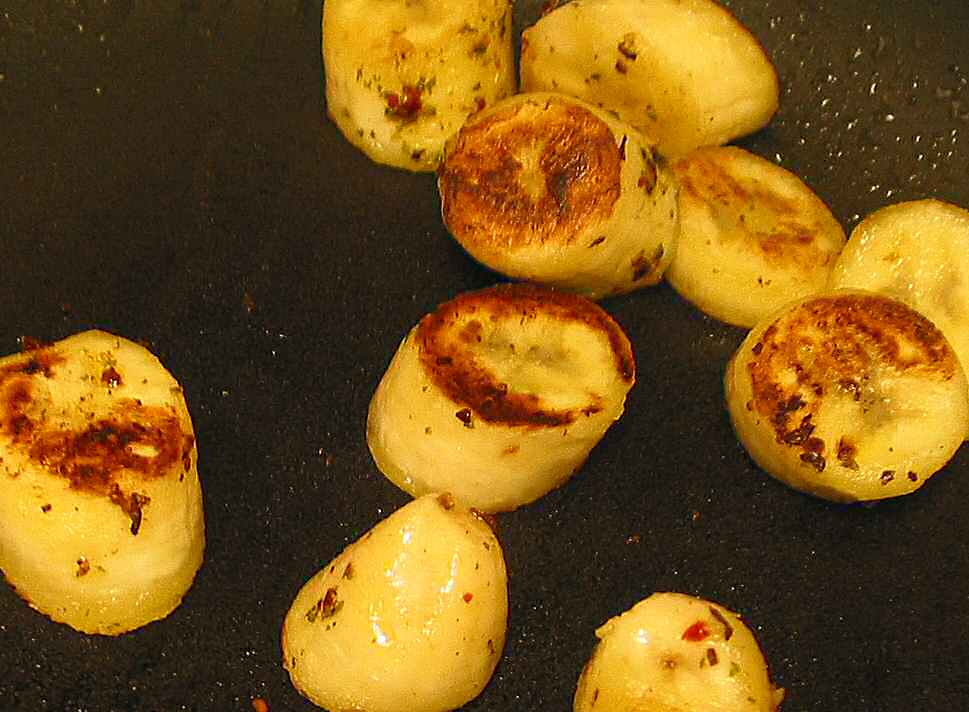
Green bananas frying in olive oil with hot pepper, cilantro and garlic

Even though we buy bananas every week and consider them a staple–for kid temper tantrum management as much as for grownup temper tantrum management–after a few days we often have brown speckled bananas sitting on top of the microwave in a state where no one will touch them. No matter how green they start out. I think it must be that I buy too many to start with, assuming that of course we’ll reach for them automatically as soon as they turn yellow.

So I started considering my options. I could buy fewer and run out of them. I could eat them speckled and funkily too sweet. Hmm. Or I could start at the beginning and find something nonsweet to do with them while they’re still green and fresh.

A friend of ours makes Bananas Foster as his signature dessert dish, frying and flaming bananas in cognac. They turn out gooey and sweet and rich, basically like cooked sweetened bananas, and I’m never sure the effort and the singed eyebrows are really worth it. So frying wasn’t the first thing I thought of. But I microwaved a piece of green banana for a minute to see whether it would hold up when cooked and it did. It also had an intriguing flavor–like cooked potato with a light   tartness about it, but none of the novocaine overripeness or mushiness I’d feared.

I was thinking about some of the Indonesian curries with basil–perhaps underripe bananas would be a good stirfry ingredient for those? Well, perhaps they still will be, but in the meantime, I felt lazy and decided on something simpler, quicker, and with fewer ingredients. It turned out much better than I’d expected.

Pan-Fried Green Bananas

  • Large green (underripe) bananas
  • dab or more of z’khug (chile/garlic/cilantro paste)
  • olive oil

Peel the bananas–you may need a knife if they’re really green. Be careful peeling them, because the green peel contains a drippy sap that will stain clothes badly like some tough kind of glue, and I still haven’t found a way to get it out of my favorite pants. In any case, cut the bananas in bite-sized chunks or larger pieces, as you prefer. Heat a spoonful or so of olive oil with a little z’khug in a nonstick frying pan and then pan-fry the banana pieces a few minutes until the outsides turn brown and crispy, like good french fries. A dab of pesto or a little curry powder and minced garlic and ginger and/or scallion in the frying oil would probably also work in place of the z’khug.

Hot Tomato: Microwave Marinara

Microwave Marinara on SlowFoodFastGreat tomato sauce was the backbone of a great Greek-owned, Italian food student diner in my hometown. You know, the kind with the red vinyl-covered banquets with the brass rivets that have seen better days. The formica tables in faux wood grain. And the waitresses who never bother to hand you a menu because they already know what you want. You want The Sauce.

The sauce was so good you didn’t care if the ravioli was bland. You didn’t care if the eggplant in the parmigiana was limp or crushed or gummy with too much breading. No. The sauce was the thing. You could smell it from way down the block, and it was as good the last time I ate it as the first. In all, that was probably several hundred dinners through the end of college and into my working life. If you were a student on a $25 a week food budget, you’d put 5 bucks aside for Saturday night dinner at that diner because you knew once you ate something with The Sauce, you’d never go hungry again.

I don’t pretend my marinara is as good as theirs. For one thing, my family doesn’t like fennel nearly as much as I do, so I have to leave it out of the main batch. For another, mine has no salt and takes five minutes. By most gourmet estimates and all traditional ones, both facts should mean it’s awful. But it ain’t.

My sauce is pretty d**n good, as it happens. And a lot less bland than all those souped-up sauces by the jar with the 450-700 mg sodium per serving. And it takes five minutes. And it gets better the next day. And it’s one of the simplest recipes I can think of.

Microwave Marinara

  • 1 28-oz or 2 x 15-oz cans no-salt plum tomatoes in their own juice (e.g., Trader Joe’s, Whole Foods, sometimes Ralph’s/Kroger/etc.)
  • 1 t. no-salt tomato paste if none was included in the canned tomatoes
  • 1/4 med. yellow or red onion
  • 1 FAT clove garlic, about 1″x3/4″, mashed or grated
  • Couple of shakes of red wine vinegar, maybe 1-2 t.
  • Sprig or two of fresh thyme or 1/2 t. dried-but-not-dead
  • couple of basil leaves if you have them
  • Pinch or two of fennel seed if you have it and like it

Blend everything in a food processor (or you could grate or chop everything by hand if you insist, and you’ll feel and look so much more whole wheat). Microwave in a 2.5 cup pyrex bowl with a loose cover on HIGH (1150 W oven) for 5 min. The sauce will have thickened slightly at the top and edges. Use some, then cool and refrigerate the rest in a covered microwaveable container. Reheat for 1-2 minutes on HIGH the next time. Serve on everything. Everywhere. With abandon.

Frugal Shopping List–Vegetables

Everyone has their own idea of what should be on a frugal grocery list. Mostly, whatever’s on it should be nutritious, inexpensive, AND something you’re actually going to eat within the week, so it doesn’t go to waste. The other obvious rule is that it should add up to enough food for a week’s worth of meals without busting the budget.

Fresh fruits and vegetables seem to be the hardest thing for most people to buy cheaply, but they do the most for your diet and your tastebuds if you treat them right. I live in the Los Angeles area and when I first moved here, I suffered horrible sticker shock–not just because rents were 50% higher than back east, but because fresh produce hovered at or above the $2/lb mark–just about double what I paid in Maryland. $2/lb for tomatoes? In California? Sad and inexplicable, but true.

It took me a while to realize supermarkets are the least good deal on fruits and vegetables here. The long-running supermarket checkers’ strike forced me to break out and change the way I shop. Farmers’ markets are fun, but they can be chi-chi expensive too. The best bet for me is at my local mom-and-pop Armenian corner grocery a few blocks away, or else the Latino market with the huge vegetable section in the next town over. Those stores buy their wholesale produce in smaller quantities and closer to ripe than the supermarkets do, so they pay less and sell it for less with quicker turnover. Sometimes the produce is either smaller or less beautiful and shiny than what you see in the big chains, but often there are great ingredients you can’t even find in the supermarkets. Sometimes the owners bring in vegetables from their own gardens. And when they overstock, they slash prices like crazy.

My best deals so far:

  • an entire flat of yellow tomatoes on the vine (about 50)–3 bucks.
  • Butternut squash, 9 cents/lb. Yes, I thought it was a typo too. I ate it for a month.
  • Navel oranges, 10 lb/$1.00 (in winter, when the orange harvest comes in)
  • Lemons and limes, 10-20/$1.00. I bought a bunch and froze most of them.

But regular fruit and vegetable shopping can yield good deals too. Continue reading

The 3800 Calorie Diet?

If anyone’s still wondering why Americans have gotten so fat on average, the mystery is over. According to a Reuters article published today,

Portion sizes in the United States not only exceed those in less-developed countries, but also in the developed world. In fact, Americans have the highest per capita daily consumption in the world, eating 3,770 calories a day, more than a Canadian at 3,590 calories or an Indian at 2,440, according to data from the U.N. Food and Agricultural Organization.

3800 calories? Per day??? Can that possibly be right? That’s about double the recommended healthy calorie intake for an adult–certainly for an adult woman under 6 feet tall. Double. And that’s supposedly the AVERAGE, not the maximum–I shudder to think about the calorie counts for the people who eat more than that. If the UN isn’t counting food wastage or otherwise misinterpreting the trends, then we are in Deep Trouble. Of course, so is Canada, but really.

The article goes on to relate American fast food consumption, and overstuffed restaurant portions, to the burgeoning world food crisis. It claims Americans eat out 6 times per week on average and consider that an important part of their lives. It’s not like they’re eating gourmet food, either. Most of it is from your standard 3 burger chains. I can’t imagine eating at those except if I were stranded along a highway with a broken-down car for more than four hours. Maybe six.

Our lunches tend to be a sandwich, some vegetables and an apple or orange. Maybe some soup. Dinners are usually something like a piece of fish, a large handful of broccoli or cauliflower, some sliced tomatoes or green beans or a salad. Not glamorous, but not bad. Maybe some rice or noodles or boiled potatoes or corn to go with it, but not as the majority of the food. Maybe a quarter of the plate. Maybe some fruit and/or–this is summer, after all–a cup of (ordinary, non-premium) ice cream for dessert. Is any of this so hard? Does any of it take more than half an hour total? Not really. Does it cost the earth? Not really–maybe 5-6 bucks for dinner for 3. A lot less if we have eggs or beans as the main protein instead.

But even with dessert, our dinners are rarely more than 600-700 calories, and we’re not exactly starving. Continue reading

The Tzatziki Variations

One of my favorite easy dips is tzatziki–a combination of yogurt, chopped or grated cucumbers, garlic, onion, and dill, maybe a little mint, some lemon juice…all blended together in whatever proportion tastes good to you–. Good with felafel, good with grilled fish, good with cold beans or cooked potatoes, good on a chopped salad, good with grilled vegetable salads, good with bread dipped into it, good (if a bit strong on garlic in my version) just as it is, by itself. Good scrambled into eggs, as well. Why not?

The other night I was trying to figure out what to do with a bunch of cilantro and thought about the pungent, fresh green cilantro-and-mint chutney my local Indian restaurant serves with its tandoori salmon kebabs. That too is one of my favorites.

I have no idea how they really make it; I can only tell you that this yogurt-based improvisation tastes pretty close to me. The preparation was completely parallel to tzatziki, or at least the way I would make tzatziki. The key here is to get the cilantro and mint ground down as finely as possible–to a soft green silt if you can manage it. That means processing it by itself, then throwing larger, harder ingredients (onion and zucchini) into the processor in several passes to grind down fully, and only then adding the lime juice and yogurt. The combination of savory herbs, tartness, and garlic make this a very satisfying (and if you add a fairly large clove of garlic, breath-defying) dip without any added salt.

  • 1/2 bunch cilantro leaves, washed, picked over, and lightly chopped
  • juice of 1 lime
  • 1 clove garlic, peeled and grated
  • 1/2-1 zucchini, washed, with the peel on if it’s organic.
  • 1/4 or a bit less–maybe 1/8–medium onion
  • sprig of mint if you have it
  • 1 c plain nonfat just-milk-and-cultures yogurt

Chop the cilantro and mint a little, then put in a food processor bowl with the onion. Process until the onion pieces are too small to grind the cilantro down any further. Add the zucchini in large chunks and the lime juice, and process until it’s a paste. Add the yogurt and the grated or mashed garlic and process again until it all comes together as a pale green sauce. Serve it with Indian dishes–dal, saag paneer, kormas, etc.–grilled fish, grilled vegetables, bread, fresh vegetable platters, etc.

Or make a sandwich with it: Good foccaccia, ciabatta, or other relatively flat Italian bread without too many holes, or a similar Armenian “finger bread,” sliced in half flatwise (I know, that’s not a real word; I mean “laterally”) and toasted, then the cut sides slathered in the cilantro sauce, with arugula and mozzarella or provolone and maybe tomato etc.