
• Enter your email address to subscribe to this blog and receive notifications of new posts by email.

    Join 241 other subscribers
  • Noshing on

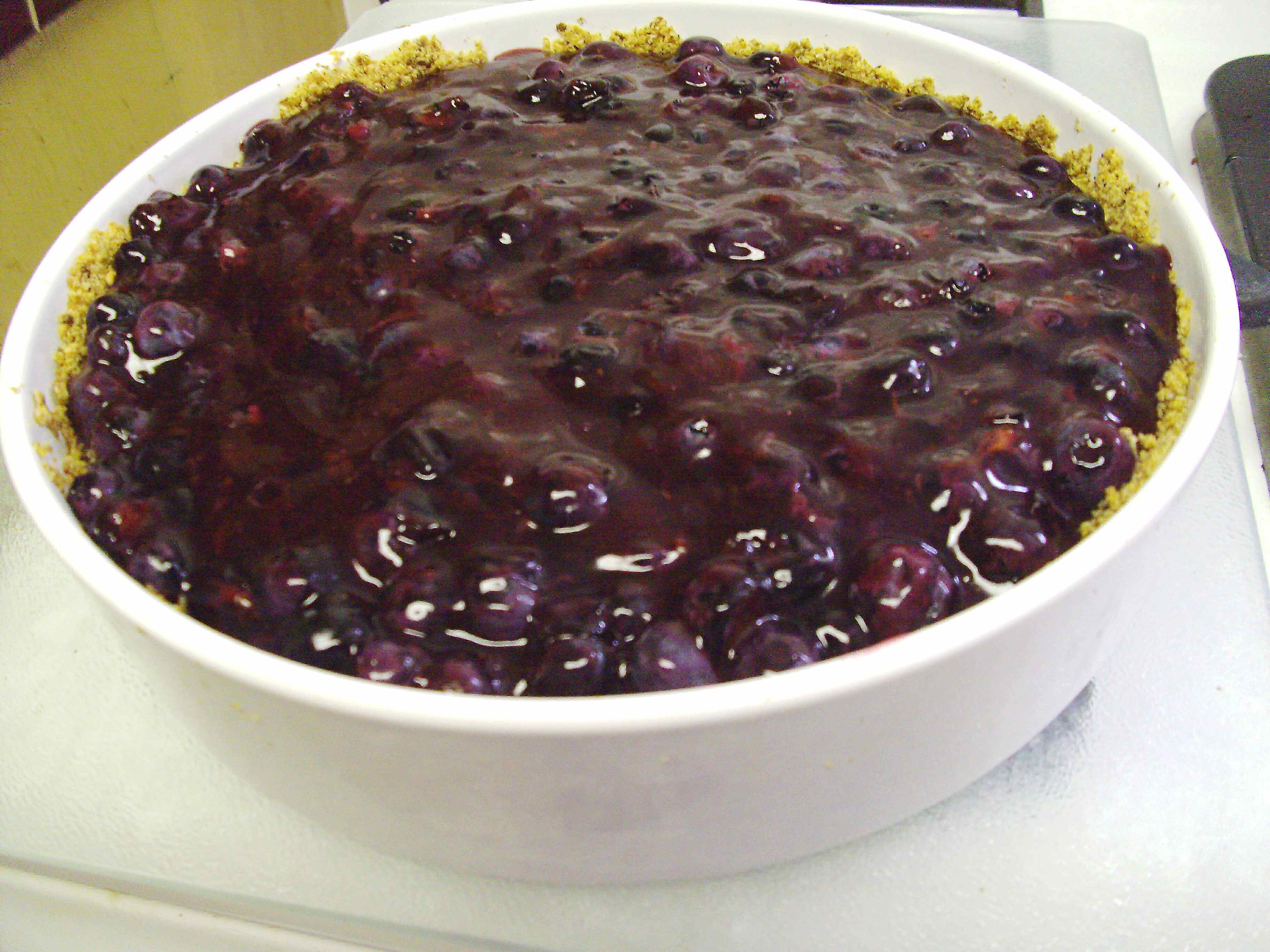
    raw blueberry pie with microwaveable filling and graham cracker crust

    This mostly-raw blueberry pie is a snap to make and very versatile--the filling microwaves in a few minutes, and you don't even have to bake the zippy gingered graham cracker crust--perfect for a hot Fourth of July and all summer long.

  • Recent Posts

  • Contents

  • Archives

  • Now Reading

  • See also my Book Reviews

  • Copyright 2008-2024Slow Food Fast. All writing and images on this blog unless otherwise attributed or set in quotes are the sole property of Slow Food Fast. Please contact DebbieN via the comments form for permissions before reprinting or reproducing any of the material on this blog.

  • ADS AND AFFILIATE LINKS

  • I may post affiliate links to books and movies that I personally review and recommend. Currently I favor Alibris and Vroman's, our terrific and venerable (now past the century mark!) independent bookstore in Pasadena. Or go to your local library--and make sure to support them with actual donations, not just overdue fines (ahem!), because your state probably has cut their budget and hours. Again.

  • In keeping with the disclaimer below, I DO NOT endorse, profit from, or recommend any medications, health treatments, commercial diet plans, supplements or any other such products.

  • DISCLAIMER

  • SlowFoodFast sometimes addresses general public health topics related to nutrition, heart disease, blood pressure, and diabetes. Because this is a blog with a personal point of view, my health and food politics entries often include my opinions on the trends I see, and I try to be as blatant as possible about that. None of these articles should be construed as specific medical advice for an individual case. I do try to keep to findings from well-vetted research sources and large, well-controlled studies, and I try not to sensationalize the science (though if they actually come up with a real cure for Type I diabetes in the next couple of years, I'm gonna be dancing in the streets with a hat that would put Carmen Miranda to shame. Consider yourself warned).

Maximum Flavor in a Minimal Broth

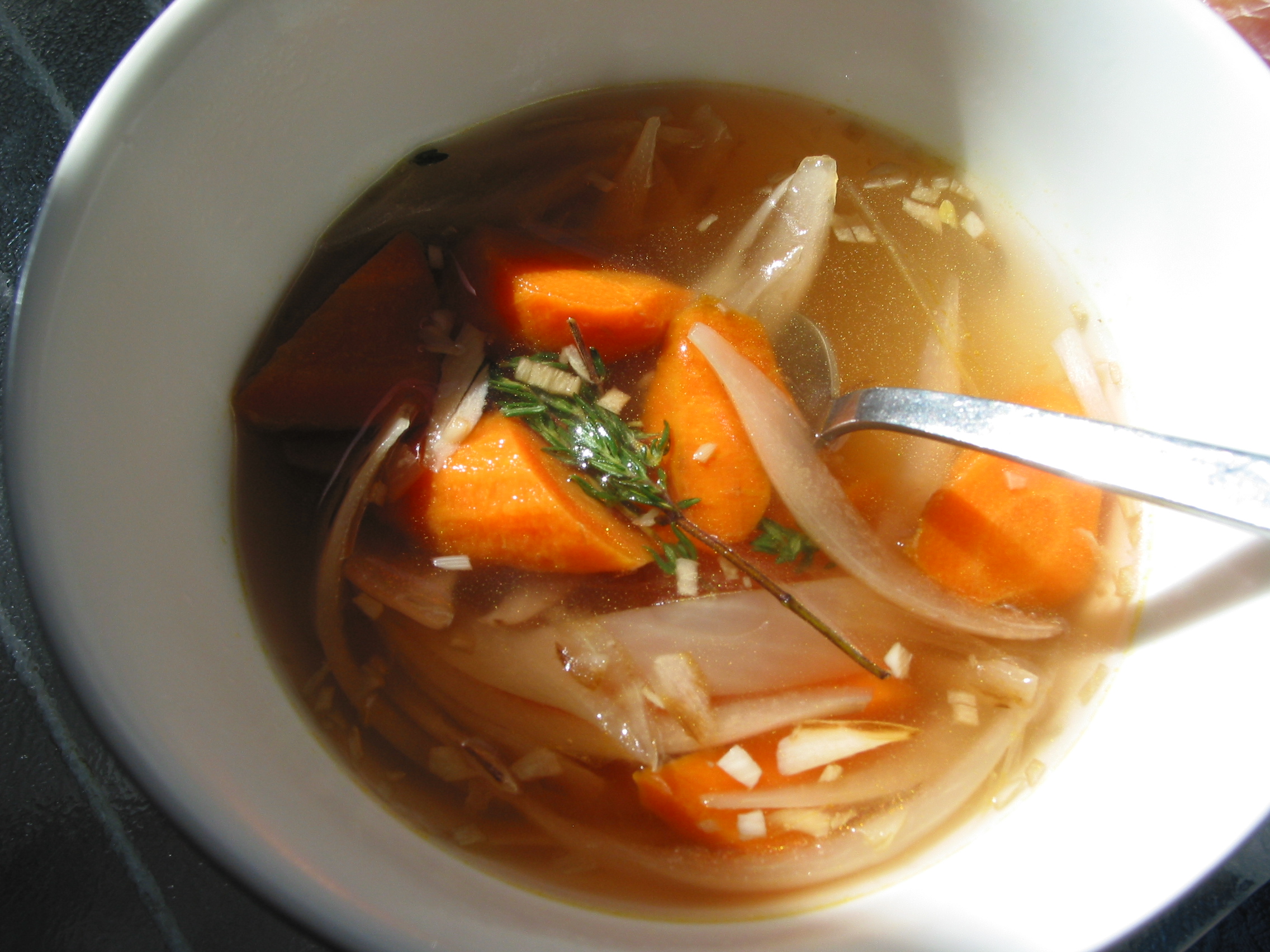
minimal carrot onion soup

My kid had the flu just in time for President’s Day (and both Friday and Monday off from school). How does this happen in a place where it actually hit 90 degrees one day??? How annoying! But her classmates had been catching it right and left all through January and coming back to school still iffy. She and I had both gotten the flu shot a couple of months before, achy arms and all. The prevention rate this year isn’t all that good; only about 23%. And people have naturally been grumbling if or when they catch the flu anyway.

But I’m still pro-vaccine, and here’s why: The minute she woke up with fever, I called and got an appointment with her pediatrician for that morning, no being palmed off on the advice nurse (or the muzak they put you on while waiting half an hour). When you’ve got a diabetic kid with flu, you take a deep breath, channel your Brooklyn-raised mother and elbow your way through to get seen before the kid has a chance to develop nausea and vomiting, which makes it trickier to manage food, insulin and so on safely. I mean, we’ve done it, it’s doable, and we’ll probably have to do it again at some point, but it’s a total pain.

Luckily for me, the pediatrician is also from Brooklyn and doesn’t take offense. She and the nurses had been run off their feet, and yet she was glad we got our act together early enough for Tamiflu to do some good, because the poor kid just ahead of us at the clinic was wobbling and actually fainted just as he got into the exam room. Five days his family waited and he had serious fluid in his lungs. So I stopped feeling selfish and stupid for bringing my kid in when she was mostly okay except for a fever. And I hope the other kid’s better by now.

So I wanted to pass this on: the doctor told us the best-bet recommendation is still to get a flu shot. Why? Because even though you might still catch flu, the severe hospital-level cases this year with pneumonia and worse, at least in Southern California, are turning out to be almost all unvaccinated patients. That’s a result you might not have expected. You need that insider perspective to see there’s a more serious benefit hidden behind the obvious numbers. And the serious cases are pretty bad. So if you haven’t gotten a flu shot yet, go get one now.

And my kid did indeed get better by the time school started up again, and my husband and I managed not to catch the flu from her, which was good, because with a snarky bored teen home on a 4-day weekend, the last thing either of us needed was to catch it from her just when she was finally back at school.

But we needed soup in a big way. And with a sick kid in the house I had less time to go shopping. I imagine (because we had the fluke 90-degree day, I have to imagine it or else talk to my poor mom in Boston) that people caught in the big snows back east also have these problems of limited shopping mobility, patience and scant last-ditch vegetabalia in the house. What did we have left that was soup-worthy?

Well…there’s always the can of tomato paste for nearly instant cream-of-tomato, which my daughter likes when she’s sick. The real cream-of-tomato, made with actual tomatoes, is more voluptuous but takes 45 minutes on the stove and involves baking soda to tame the acidity before you add cream, plus the use of a stick blender which I aspire to but don’t yet own. Tomato paste doesn’t have much acidity to start with, so you could just skip the baking soda and heat with milk instead of water if you wanted to. We generally leave milk and cream out and add a dash of vinegar to restore some semblance of tomato flavor.

–  –  –

Tomato Soup in the Microwave (AKA, “bonus” recipe for what it’s worth)

  • 1/2 can tomato paste (no recipe EVER specifies a whole can, as far as I can tell…must be some kind of culinary superstition, much like “the Scottish play”…so just scoop the rest into a ziplock baggie, squeeze the air out, and throw it in the freezer for next time…)
  • 1-2 c. water (enough to bring it up to the thickness you like best for soup)
  • small splash of vinegar, any kind
  • small clove of garlic, minced, mashed or grated
  • pinch of cumin or thyme, optional
  • salt to taste after cooking
  • splash of milk or half-and-half, if you like it

In a microwaveable bowl, use a whisk or fork to mix the water gradually into the tomato paste until it reaches the thick-but-not-too-thick consistency you prefer for cream-of-tomato soup. Add the garlic, vinegar, and cumin or thyme, cover the bowl lightly and microwave 2-3 minutes or until heated through. If you want to add a little milk or half-and-half afterward, you probably could, just don’t add it and then heat or it’ll curdle from the vinegar (or leave the vinegar out to start with if you want it bland).

–  –  –

But down to business with the “not-chicken” vegetable broth. I’ve already gone about as far as I can go with bok choy and shiitake broth, up to and including hot-and-sour soup. Plus we didn’t actually have any bok choy left. Feh.

So the usual carrot-onion-celery not-chicken broth should have been next…but no celery either. Double feh. And no fresh dill–dry we had, but you know fresh makes a world of improvement. So it wasn’t looking all that good in the clear soup department this week. And I needed some for me, even though I only had a head cold and a bad temper and a sassy, feverish bored teen at home watching cartoons.

(BTW: if you luck out with a fresh bunch of dill that’s too big to use up quickly, wash the rest well, twist off the stem ends, stuff the dill into a ziplock sandwich bag with the air squeezed out and freeze it–it’ll stay good for a couple of months minimum, and you can just quickly crumble a frozen bit into whatever dish you want, then toss the bag back in the freezer. Or in Boston, just leave it out on the porch and rediscover it sometime in April.)

Normally I’d say onion and carrots alone aren’t enough for a soup; you have to have something else in there or when you add garlic it’ll just be about the garlic. Which is fine for me, of course, because my motto still seems to be, “If there’s no garlic, is it really food?”

True, the Italians have acqua pazza (“crazy water”), which is basically garlic broth. I think both Spain and France have similar offerings. But normal people might want something a little more complex or at least balanced.

My usual MO for vegetable soup and bok choy broth is just to microwave the base vegetables to wilt them and then bring them up with a bit of water, add garlic, herbs, and any other appropriate flavorings, and heat again. Pretty basic, and very quick–5 minutes, maybe 10 for a couple of quarts that will last me a week. But with such a limited vegetable base as onion and carrot, I was going to need something more.

So I scrounged again in the fridge. Carrots and a red onion…and a clove of garlic. A sprig of thyme–well. A little leftover white wine. Yes. OK.

It would all be kind of blah and pale, though, if I just dumped it in a bowl with some water and hit the nuke button. When you have so few main ingredients and they’re both boring when simply boiled or nuked, you have to strategize a little to get the best out of them quickly. Continue reading

What happens when you age champagne?

A couple of weeks ago on a Friday evening, the week before our anniversary, my husband and I were scrambling to find a bottle of kosher wine in the house for the Shabbat blessings and coming up empty. We didn’t even have grape juice. I took one more look in the last-chance box and realized one of the bottles was kosher after all. It was a bottle of Yarden 2000 champagne I’d picked up on an after-Passover sale several years ago (our local Kroger affiliate supermarket has a not-quite-tuned-in approach toward Jewish holiday ordering; sometimes the matzah boxes arrive and disappear a week before Passover; sometimes they hang around for months, and sometimes they sell good wines at a fire-sale bargain because of the kosher label).

I’d saved that bottle for a special kosher-requiring occasion that never quite arrived. Vintage 2000–definitely the oldest bottle I’ve ever opened at home. As old as our daughter. Has it really been that long since 2000???

(OK, given the sorry yet predictable result of the mid-term elections, I have to say it hasn’t been long enough. But still.)

The bottle was QUITE dusty–almost a prerequisite for experimentation.

Neither my husband nor I are usually all that impressed with champagne–even the expensive mid-level ones, at $40-100 a bottle. Not that we’re usually in a position to sample those at home, but sometimes people splurge on them at Thanksgiving, New Year’s, etc., and we wonder why. They’re usually not as good as the cheaper Spanish cavas–if I had to buy champagne-style wine, I’d rather go with something like Freixenet, not to be cheap but because it’s closer to that bone-dry, yeasty, buttered-toast style I prefer to all the more acidic and flat-flavored mid-level champagnes out there. Taittinger and Moët et Chandon both come to mind as severe disappointments at the $45ish level. Their top-level champagnes might be quite different, but these just seem to be trading on the brand name and pricetag for the naive American market.

For that kind of money, I’d rather have a good, deeply-flavored still chardonnay than almost any of the usual fizzy lifting drinks, and you can get a pretty decent bottle of chard for under $20. Actually, most of the time I’d rather have a decent red.

And frankly nothing is as good as the (once-only) bottle of Dom Perignon my husband brought home 17 years ago, when we finally decided to get engaged after all those years of dodging family and friends, celebrating with some couples and outlasting others. After a lackluster and slightly glum Sunday afternoon discussion that ended with, “Well…okay,” we called each other at work the next morning and agreed we should probably do a little better than that. We were getting married, after all. Oy. We clearly needed some bolstering before we broke the news and faced the inevitable hocking from our families.

A really nutritious dinner consisting solely of Dom Perignon and a (smallish) box of Godiva truffles, each of which looked exactly like Miracle Max’s big chocolate pill from The Princess Bride, seemed to do the trick.

Of course, under the influence of the DP and chocolate, we decided we could do the parts of the wedding we liked (huppah, food, klezmer music, line dancing, ketubbah signing, friends and family, more food, more dancing) and just skip the stereotypical parts we found laughable, uncomfortable or downright detestable in other people’s weddings and wedding-themed tv ads (tux, white puffy dress, veil, speeches, first waltz, which neither of us knew how to do, tiered wedding cakes, arguing with either of our mothers over invitation fonts, color-coordination of any sort or description…)

We ended up having fun at our own wedding, which never really seems to be the primary goal somehow, we only decided where to go on our honeymoon the next morning while sitting around in our pjs, and I maintain that we’ve just kept getting weirder ever since.

Which brings us back to the Yarden 2000. To be fair, Yarden has been making some very decent kosher wines the last 10-20 years. But kosher or not, 14 years for any champagne below the DP level?

Champagne is supposed to be the only white wine that can age–maybe it’s all the trapped carbon dioxide fending off oxidation, but I’d never gotten close enough to try it out. The chemist in me has been waiting for another crack at mad scientist status for a couple of years now, so this was it. Plus it was getting after sunset already and we were hungry and there was no regular grape juice in the house.

Well…if we were daring enough risk our stomach linings and our eyesight by trying mead that had been sitting around for more than a year, we could probably risk a 14-year-old bottle of kosher champagne, once I got the major dust coat off it, anyhow. I found a deep enough pot to improvise an ice bucket but didn’t really have enough time or patience to chill the bottle well.

“Do you want a towel for the cork? It’s probably lost all its zuzz, you know,” my husband said.

Just in case it hadn’t, I opened the bottle carefully and with approved champagne-opening technique (the point-away-from-people-and-twist-the-bottle-gently-away-from-the-cork routine, not the find-the-Napoleonic-era-saber-up-in-the-attic version). The cork actually made a proper popping sound and the usual CO2 fumes rose up. It wasn’t dead after all! (“It was only mostly dead,” I hear you chime in. Stop digging around in that Godiva box already, willya? We already took the good ones.)

Then we poured it, and it foamed up–zuzz intact. So we made the blessing over the wine, and my husband very generously said he’d let me take the first sip. Which I did, but…

“You haven’t gone blind yet, have you?”

I glared at him. Or at what I thought was his general direction.

Continue reading

Breaking the Rules: Fish with Red Wine

tilapia fillets Veracruz-style, with smoky salsa, onions, garlic, alfonso olives, red wine and fresh za'atar or "wild thyme"

One way to cook fish well using red wine

Wine is something I drink mostly for taste, not volume–I can’t really hack a lot of alcohol at once, blame my ancestors–but I do like wine tastings, even though I have to limit myself to about three small sips per glass if I don’t want to wobble out the winery door. Focusing on the flavors in a wine, and comparing several side by side, sharpens your palate and makes you think very specifically about what you’re experiencing. It’s rewarding even for someone with my drinking limits.

I also like to cook with wine, maybe more often than I like to drink much of it. Decent wine has such a complex combination of flavors that when you figure out how to do it well, cooking with wine can make even rapidly cooked dishes come off like serious Slow Food.

We hear a lot about long-cooking stews and coq au vin and so on, but many simpler and less time-consuming dishes benefit from smaller amounts of wine. Adding a couple of spoonfuls of dry white wine to mustard vinaigrette tempers the sourness, the garlic and the mustard sharpness a little and gives the sauce a quiet depth. And if my experiment with giant favas marinated in rosé and rosemary was any indication, we should be thinking about wine a lot more often and a lot more creatively as a cooking ingredient.

So I’ve been on the lookout lately for clear and simple techniques for cooking with wine without wasting it, and for doing it in less than a three-hour stew, because to me that’s slow-food-slow in large crowd-feeding quantities, to be attempted a maximum of once a year. I want better, more sophisticated-tasting food fast, using at most half a cup to a cup of wine, not a whole bottle, and preferably without huge cleanup.

But these days, when so much of the cookbook aisle in your local independent bookstore is taken over by Food Network Channel collateral, cooking with wine is almost a lost art. Most of the popular TV chefs aren’t even doing it anymore. Everyone’s gone sorta-Asian (but without Martin Yan’s shaoxing wine-wielding expertise or sense of humor) or sorta-Middle Eastern or bacon-filled-Tex/Mex or wishful-thinking-Indian-or-Moroccan wannabe (if I hear the words “ras el hanout” mispronounced one more time by any TV chef, anywhere…)

Most of those cuisines don’t include wine as a regular ingredient because of religious restrictions against alcohol, which I fully respect, or, in the Tex/Mex case, because wine doesn’t go with football (the true religion of Texas, although if you see the documentary Somm, you might be surprised at how many American master sommeliers and exam candidates are former football players.)

The new vegan and vegetarian cookbooks don’t consider wine at all, as far as I can tell, even though there are plenty of  vegan-approved wines and organic wines touted throughout Whole Foods (and even a few at Trader Joe’s). And a number of seitan and bean or lentil dishes (and certainly Roman-style lentil soup) would probably do all the better for a tinge of red, white, or rosé, either in the sauce or as a marinade ingredient.

Even the French- and Italian-trained chefs don’t use wine on TV very much, and if they do they don’t really explain it–why they chose that particular type of wine, how much to use and why, how to get the best flavor out of it in the dish, what else you could make using the same technique. Or else they’re kind of wasteful about it, using a whole bottle of wine for a single dish. Most people cooking for themselves would balk at that. Should balk at that.

It bothers me that I don’t actually see a lot of solid advice about cooking with wine, or at least not specific techniques that make sense in a home kitchen with a standard family budget.

Where am I going to get this advice? Not from the churn-a-minute Food Network chefs, clearly. Not from Harold McGee, either. To my great surprise, he devotes a total of about three paragraphs to “cooking with alcohol” in his food science books. The most interesting thing he says, other than to make sure and boil out the alcohol (duh) is that tannins will concentrate unpleasantly if you boil down a tannic red wine, but adding a protein to pick them up will tame them.

But since most of my uses for wine so far are to do with fish, I guess I’m already doing that…

As you might expect from some of my odd microwave-centric ideas, I tend to cook fish with wine in ways that probably seem unorthodox to anyone professional. For one thing, I cook several kinds of fish with red wine (sound of Francophile traditionalists screaming, then fainting in shock). Continue reading

Pastry again: vinegar adds the tender touch

Most people, if faced with a quick baking dilemma, probably go to the supermarket and buy cookies or brownie bites or something.  And it makes sense, kind of, although with a food processor, you can make pretty good cookies and brownies in less time than it would take you to fight over holiday parking, much less elbow your way through the store.

The corresponding shortcut for most people who do bake would probably have to be pie crust–to say nothing of puff pastry dough. For years I’ve been looking for ways to make a pastry dough that is close to puff pastry–flaky and light and puffy–without being as heavy on saturated fats and calories. Not the easiest combination.

Fillo (purchased, I’m not enough of a DIYer to make my own yet and my kitchen’s too tiny for rolling and tossing a huge thin sail of dough the right way)–fillo is good for a lot of things, but it’s so obviously itself and not pie dough, tart dough or puff pastry. It’s also pretty salted–I always have to comparison-shop to remember which commercial version has the least sodium per ounce (they vary within brands, because some are intended for savories and the others for sweet pastries. I think the savory ones are much too salty and use the less-salted ones for spanakopita and so on as well as for baklava).

After having made a variety of pie doughs–standard flour-butter-salt-water, olive oil tart dough, rugelach butter-cream-cheese dough, and even a puff pastry recipe with about half the fat called for in the classics–plus croissants that I finally got right–I can say my latest experiment is something of an eye-opener for me.

All of these worked okay as doughs, but except for the olive oil tart dough, which I use routinely for quiche, none are really all that light-tasting or actually light in terms of fat content and overall calories. And rolling them thinner than the standard 3/8 inch (thinner equals less dough and fewer calories per serving…) sometimes leads to a tough pastry. The fact that I tend to use bread flour instead of all-purpose or cake flour is probably at fault as well, I’m sure, but I’m mostly a bread baker and not exactly a perfectionist, so how many different sacks of flour do I really want hanging around my cramped galley kitchen at any given time?

A week or two ago I checked out an older cookbook (late ’80s) on Armenian food and tried to puzzle out the Armenian, Lebanese, Turkish and Russian influences–it’s a real mix. I was looking for a recipe for bureka dough, and this book had one.

The recipe for spinach burekas had an accompanying (and aging, over-tinted ’80s-style) photo of a browned and flaky dough wrapped around a log of improbably-green spinach filling on a platter lined with too-green lettuce and too-orange tomato slices underneath. But other than the color enhancements, the spinach log, kind of like a spinach Wellington, looked pretty nice.

To my great surprise, the dough was quite similar to some of the ones Joan Nathan had in The Jewish Holiday Kitchen.  The key ingredient differences from my standard pie doughs are:

1. slightly more butter for the amount of flour than for standard pastry dough (to be expected–you want it flakier, you probably need more fat in the dough) though a lot less than for rugelach or puff pastry

2. a little vegetable oil as well

3. an egg. Nathan’s “muerbeteig” egg dough for a plum pie calls for a hard boiled egg yolk, of all things, but the one here is raw. I’m not sure what it’s for, exactly. Perhaps for leavening or some other structural purpose–maybe it helps the dough puff into layers and hold them better with less hard fat than puff pastry requires?

4. a quarter-cup of dry white wine–which I didn’t have, only red, which would have turned the dough gray…so I substituted half apple cider vinegar and half water–the vinegar because Nathan had used it in a dough with egg. Why wine or vinegar? I think–don’t quote me–it’s the acidity, which breaks down gluten a little and tenderizes the dough. Certainly it did in this case compared to my usual experience.

So anyway–this dough came out surprisingly well. It doesn’t puff anywhere near as much as puff pastry–at least not while rolled out as thin as possible, and I haven’t tried it thicker–but it’s light, crisp and tender at the same time and not heavy or greasy. It’s unsweetened and mostly unsalted and would be equally good for savory pastries, Wellingtons and other encased main-dish things (like pot pies, coulibiac of salmon, and spinach-type fillings) where it’s the top layer or a wraparound, and for sweet ones like the impromptu almond paste and apple tartlet at the bottom of this post. Continue reading

Movie Review: Family, fermented

The New York Times has a review today of a new French film in current release, You Will Be My Son, about an egotistical master vintner in Burgundy and the son whose winemaking instincts he scorns.

I’m thrilled this is going to be in theaters in the U.S., because I saw it last June on the plane home from Montreal, in French, and it was so well acted I thought the airline must have made a mistake–you know, putting in a good movie by accident instead of Alvin and the Chipmunks, various cheap CGI-driven “futuristic thrillers”, all the stuff that went straight to DVD and that you don’t really want to pay Netflix or Blockbuster an additional 5 bucks to see.

Much along those conventional lines, and starkly in contrast to You Will Be My Son, is a wine movie I highly recommend–skipping, that is, and which I also saw on a plane back from London several years ago. Believe me when I say that if Bottle Shock was the “hidden gem” of the selection as the in-flight magazine claimed, the rest of the movies available must have been just unwatchable.

Bottle Shock was supposed to be based on Judgment of Paris, George Taber’s nonfictional account of an upset between Californian and French premium wines in a 1976 blind tasting, but came out looking more like “Daisy Duke Does Napa”. With Alan Rickman thrown in (age 57ish then, and eating KFC onscreen, incompetently) in the role of the 29-year-old wine buff who set up the competition. And the late Dennis Farina, in a pink ascot, substituting for the wine buff’s 30-year-old female business partner. And Sam Rockwell’s ’70s longhair wig was like a bad toupee gone wild.

OK, do go find a clip or so of Bottle Shock (or is it Bottle Schlock?)  for those times when you’re punchy and want something that will give you that entertaining “clawing my eyes out” sense of superiority over an unbelievably putrid movie. With big-name movie stars ™.

No, really, don’t do it. Don’t do it. See You Will Be My Son instead. Part family drama, a little bit thrillerish, twisted and fascinating without any of the American movie must-have cliches, it will keep you on the hook long after you’ve left the theater. And the actors are subtle, intelligent, individual and believable. The whole thing is gripping and so different from the current insipid-explosive American style you’ll want to go raid the library for better-made oldies like All the President’s Men and The Manchurian Candidate.

Only one sour note: Skip the New York Times review itself. In his attempt at selling the appeal, which he didn’t really need to do, the reviewer stuck in a lot of the plot details, to the point where I feel the need for a spoiler alert. You Will Be My Son doesn’t need all that–it’s solidly made and it works well from the beginning. Go see it.

Sour grapes, aging grapes

Well, we never said they were Paul Masson, but really:

According to the LA Times last week,  a large Australian winemaker is ditching $35 million worth of their Napa-produced Beringer wines that have passed their “sell-by” date but haven’t been sold and distributed yet. Apparently they’re the exception on the US market, but it’s still pretty disconcerting to think of all that table wine going to smash.

Beringer is drinkable enough but supposedly doesn’t age like better-made wines, according to the parent company. I don’t see why not, unless it isn’t really wine–is that what they’re claiming? Can’t be. So in reality, it probably has enough tannins to age at least a little if you leave it alone in a decently cool dark corner unopened for 3 or 4 years. At least the cabernets and merlots, I would think. Might show a little improvement, if given a chance.

But the company is probably looking at the bottom line–they ain’t movin’, so why should we pay storage for another 3 years, because the supermarket chains won’t buy it that they’ve become better wines deserving of a higher price? And at the million-bottle level, I can see that argument. I can. Storage is expensive. And they can claim a business loss.

For home consumers, though, I’d say it’s worth taking a chance. One of the most interesting wine-tasting experiences I’ve ever had was the opening of 20-year-old bottles of California wines a friend had inherited from her late father. He’d been one of those early nuts–an enthusiast in Northern California in the 1960s and 1970s, when local winemaking was still in its infancy and not all that well thought of. Whenever he tasted something better than screwtop, he bought a case or so, opened up one or two bottles and put the others up to age in a part of the basement that had been dug into the side of a hill. The wines were okay to start with, maybe a bit better than that, and the makers became better known and better at their craft over time. But what started out as vin ordinaire did, after 5, 10, 15 years, transmogrify into something much more graceful, sophisticated, and  interesting in a number of cases.

Those wines have no match in the supermarket selection of 2- and 3-year-old bottles. So as an ordinary down-at-the-heels consumer without a fat trust fund, you probably can’t get anything like them without aging your own. Just because the wineries insist their wines are sold ready-to-drink-now doesn’t mean they have no further potential or that aging is a thing of the past. It just means the bigger companies don’t see much profit in it. But of course the small wineries up and down California always keep a few “library wines” for their customers to try–that’s how they end up selling a $15 or $20 bottle’s older cousin for $50, $150 or even more.

What for those of us living in apartments or lacking cooled hillside cave basements of worth? I’ve always been more ready than the average cook to play with my food and eat my mistakes as long as they don’t risk rampant botulism or salmonella. So this might seem tacky or harebrained: I’m not advocating those Continue reading

More “breathable foods” weirdness

A couple of days ago, Entertainment Tonight posted a new video tidbit on “breathable” food  from the same Harvard professor, David Edwards, who invented the AeroShot “breathable caffeine” cartridge that has drawn some serious FDA attention of the negative sort.

ET’s anchor breathlessly posed the  question, could this become The Next New Diet Fad in Southern California, when what the LeWhaf vaporizer was invented for was the “aesthetic experience” of breathing food flavors. This according to Edwards, whose Paris-based design lab, Le Laboratoire (names aren’t really his thing?) offers a number of vaporized cocktails at a small sit-down bar.

When I wrote about the first set of inventions, I said I thought it might be an interesting molecular gastronomy-style taste experiment (at least if the flavors were something more sophisticated than “lime,” the flavoring in the AeroShot cartridge), depending on what was being used to create and propel the vapor.

The ET video presents an interview with a young up-and-coming chef who’s offering cocktails of various kinds served in the Le Whaf vaporizers–to be inhaled through a special straw. The accompanying visual looks, frankly, like someone about to use a bong or snort a line of coke, but that could just be the way ET’s camera crew are used to shooting bar scenes…

The chef they interviewed doesn’t serve these vaporized cocktails, not all of which are standard drinks in the daily repertoire (some of them look like beef broth) as a low-cal diet offering but rather as a sideline to enhance some other dish. Very molecular gastronomy. Still he concedes, when pushed, that he can’t see how it would have calories.

(From his doubtful expression, they must have edited out the part where the Barbie Doll reporter shoved a mike in his face repeatedly and insisted with desperation that the vapor must make it calorie-free, it just MUST. She’s the one who tried the AeroShot caffeine spritzer on-camera in the studio to demonstrate the concept, and quickly uttered the dutiful “Mmmm”,  but the video jumped at that point, so I wonder if she really sampled it or not. At least she didn’t start coughing…unless they cut that part too…)

And yet I wonder if ET hasn’t hit on something here–no, not the diet fad. One can’t live on pâté-flavored air alone. One must also vaporize some champagne to go with it, preferably Krug. Could possibly clog the nozzles otherwise.

No. In the frenzy to discover the new French technology that magically removes all calories, ET seems to have let the chef describe the mechanism at the bottom of the vaporizer. Here you are, at a cocktail bar, leaning over the open mouth of a carafe, straw in mouth, ready to inhale cocktail-flavored vapor…produced, about 12 inches from your face, by three ultrasound probes at the bottom of the carafe. Continue reading

Frankenbeanies: Gigantes, take II

Giant favas or gigantes are really as big as they look

Giant favas or gigantes really are as big as they look.

No kidding. That’s a soup spoon on the right, up there in the photo. These giant fava beans are huge–which is part of the fun of cooking them.

Because I had so much trouble getting the nice-looking pre-peeled dried giant favas to cook last week (and the time before), I went and got the bulk giant favas with the brownish-greenish-pinkish peels left on this time. And I was right. Buying the ones with the peels still on means that the dried beans stay relatively fresh and cook up a lot better–and faster–than the pre-peeled ones.

To peel them, dump the washed and sorted beans into a big bowl of very hot-to-boiling water and let them sit about an hour. The peels will start to wrinkle around the edges and turn leathery-soft. A sharp little paring knife makes it easy to crack into them and pop them off. Then soak them overnight in cold water. (Or soak the beans first and then take the peels off. Whatever’s easier.)

These beans were clearly fresher than the pre-peeled ones–in the morning, the bean water smelled almost like fresh apple juice. Bizarre. Anyway.

Rinse and cover with fresh cold water. And then you can actually microwave them 10 minutes (for a pound of peeled gigantes in a bowl with water to cover by about an inch and a lid on top) and let sit half an hour and they’ll be about halfway there, then nuke again for 5-7 minutes once or maybe twice, with 20 minutes in between. Or you could simmer them on the stove about an hour.

Or of course you could buy them in cans, but where’s the fun in that?

Giant favas

Fresh fava beans are the province of spring. Dried ones–the ultra-large size favas–are pale gigantic beans with a flavor like roast chestnuts, only without the sweet. These are the ones for Greek-style winter stews (gigantes plaki) or, as a friend in Jerusalem makes on cold and rainy December weekends, a very slow-braised stew of giant favas with chicken and vegetables.

Here in Pasadena it’s still hovering in the 90s midday, long after Yom Kippur has come and gone. So there’s no incentive to cook anything for more than 15 minutes at a time if you can possibly help it. And gigantes or giant favas (I’m not absolutely sure they’re the same bean, so for reference–what I’m using are the peeled giant favas, about an inch across) take a very long time to cook through to tenderness, even after soaking overnight.  The challenge, actually, is to cook them enough without having them fall apart like overcooked potatoes. Oven-baking or crockpotting would probably work, but it’s hours of time.

So most of the dried-fava recipes I can find are for favas that have crumbled and been puréed for soup or hummus or paté. But the stewed favas–that’s what I wanted. Only I wanted them on their own, meatless, tomato-less, pure, as it were, because I had an idea of marinating them a little for a side dish and serving them room-temperature. Something like marinated artichoke hearts, but subtler.

There are few “slow food fast” shortcuts for this, unless a pressure cooker would work well enough without blasting them to bits. I might have to get one and try it–when everyone’s out of the house, just in case my purple thumb tendencies kick in.

You still need to soak them very thoroughly overnight, a minimum of 12 hours and maybe better, 24 hours (in the fridge) before starting to cook them, because at least two batches of Sadaf peeled giant favas have shown a distinct reluctance to take up water the way most reasonably fresh dried beans do, even though a lot of the beans were split in half. Were these two bags of favas just incredibly old and dried out? Are giant favas just naturally tough? I don’t know.  I don’t know. Maybe I have to go with the bags of unpeeled favas instead?–maybe those dry out a little less inside and cook up more tender once you get the peels off (after cold-soaking and before boiling). One can only hope.

And substituting giant lima beans that a lot of Greek cookbooks recommend as a substitute in plaki would obviously give more tender results, plus they don’t require laborious peeling, but the flavor would be pretty different. The giant favas are what I want, and no other.

Nevertheless–once the favas were soaked as best possible and rinsed again, I cooked them partially by microwaving 10 minutes in water to cover by an inch and letting them sit. I didn’t want to do it a second round, as I would for chickpeas, because they had the kind of tough obstinacy that reminded me that microwaving can actually make some cooked beans tougher–black beans in particular. At least the raw bean taste was gone, but they still required 2 hours of simmering gently and partially covered on the stovetop, to become something approaching tender. Frustrating.

Some of them broke up. I think it’s practically inevitable. But some of them were huge and very impressive. Once they were as done as they were going to be, I drained them most of the way.

The marinade I use for microwaved artichoke hearts is just lemon juice, garlic, salt and olive oil–the artichoke hearts donate enough juice as they cook to mellow out everything else a little. Favas–no. Plus I wanted something richer and less strident for the flavoring.

So I pulled a bottle of cheap but dry rosé (for want of chardonnay or the like, and rejecting the ever-present reds so as not to stain the beans) out of the fridge and poured some of it into a frying pan to boil off a little of the alcohol and pick up some of the other marinade flavors: a fat clove of garlic, the juice of a lemon, olive oil and a couple of sprigs of rosemary off the bush I’ve managed not to kill this year. I let this simmer together a few minutes to take the edge off the raw garlic and wine flavors and steep the rosemary a little, and then poured in the boiled-up fava beans and just a little of their broth to simmer a few more minutes before pouring the whole thing out to cool.

A little more olive oil would have been good if I’d had it (the bottle ran out after about a tablespoon)–I was actually hoping it would help soften the beans further but I didn’t really have enough for oil-stewing (the Greek cookbooks I have all recommend about half a cup in a batch of about a pound of dried beans) and I’d have had to stew the thing a lot longer to get anything resembling a silky texture, I suspect. But the flavors permeated the beans very nicely–rosemary has an irreplaceable perfume that even wild thyme doesn’t reach even though that would be pretty good too. Together, the rosemary and wine balance the surface brashness of garlic and lemon and bring out the unusual flavor of the giant favas without the need for salt. It’s good hot, but it’s even better the second day, hot or cooled.

Eat the City, Read the Book

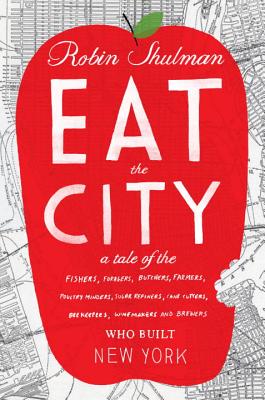
Robin Shulman's "Eat the City" bookcoverI’ve just received an advance copy of Robin Shulman‘s forthcoming book, Eat the City: A Tale of the Fishers, Foragers, Butchers, Farmers, Poultry Minders, Sugar Refiners, Cane Cutters, Beekeepers, Winemakers and Brewers Who Built New York.

[Or at least that’s the title on the cover art–the copyright info page version of the book title squeezes in even more food trades–what, or rather who, the heck are “hungers”? People who “curate” aged hanger steaks?]

Shulman, a well-known reporter who has worked for the New York Times, the Washington Post, the Los Angeles Times, Slate and other venues, has covered hard-news beats from city politics and urban blight to Middle East diplomacy. In Eat the City, Shulman explores the neighborhoods of New York, where she lives, and from hundreds of interviews, she harvests seven key stories to tell in depth: Honey, Vegetables, Meat, Sugar, Beer, Fish and Wine.

Each chapter, rich and multilayered, cuts across decades of urban history, whether development or decay, recounts conflicts and unexpected cooperation between would-be urban farmers and the neighborhood factories or city agencies they deal with, and uncovers the not-so-obvious ways these individual entrepreneurs bring a sense of connection and vitality to the city.

So we meet a man who after returning not entirely whole from a stint in Iraq, got enthusiastic about beekeeping when it was still illegal. In 2010, he rallied New York’s clandestine beekeepers to convince the city to rescind its ban on rooftop hives, and started training hundreds of apprentices. The retired numbers runner who farms vacant lots in Harlem–something he started as a cover for his gambling operations in the ’60s and turned into one of the first urban community garden projects–is still going strong in his 70s, but he’s seen several of his neighborhoods fall silent over the decades as buildings crumbled and the city neglected the people. The Manhattan ad exec risks her health and her freedom sneaking into taped-off areas to fish striped bass from the East River–she’s not sure it’s safe to eat, but she’s as hooked as her catch, and often announces her triumphs on Facebook. And somewhere toward the end of the book is the true and presumably unvarnished story of Manischewitz, the first big brand of kosher wine in America (and actually, probably anywhere, since before the 20th century most people made their own kosher wine at home).

Eat the City is due out in July, and all I can say is get out there and reserve yourself a copy, or clamor at the cash register of your local bookstore to order you one. Because this is the best book I’ve read in quite a while on the history and present fortunes of small independent food growers in one of America’s largest urban landscapes.

Like Michael Pollan’s books, it has depth and thoughtful analysis of the meaning of food in modern life. Unlike Pollan, Shulman isn’t advocating a lifestyle choice, she’s giving you a window on individuals as they elbow their way into a crowded city to make room for themselves.

Food is the medium here, but the impulse is universal, and the result is a better understanding of both food entrepreneurs and the meaning of city life itself. If you want to know what’s really happening beyond the wide-eyed grow-your-own-tomatoes-in-Brooklyn blogs, just pick a chapter and start digging in.