• Enter your email address to subscribe to this blog and receive notifications of new posts by email.

    Join 241 other subscribers
  • Noshing on

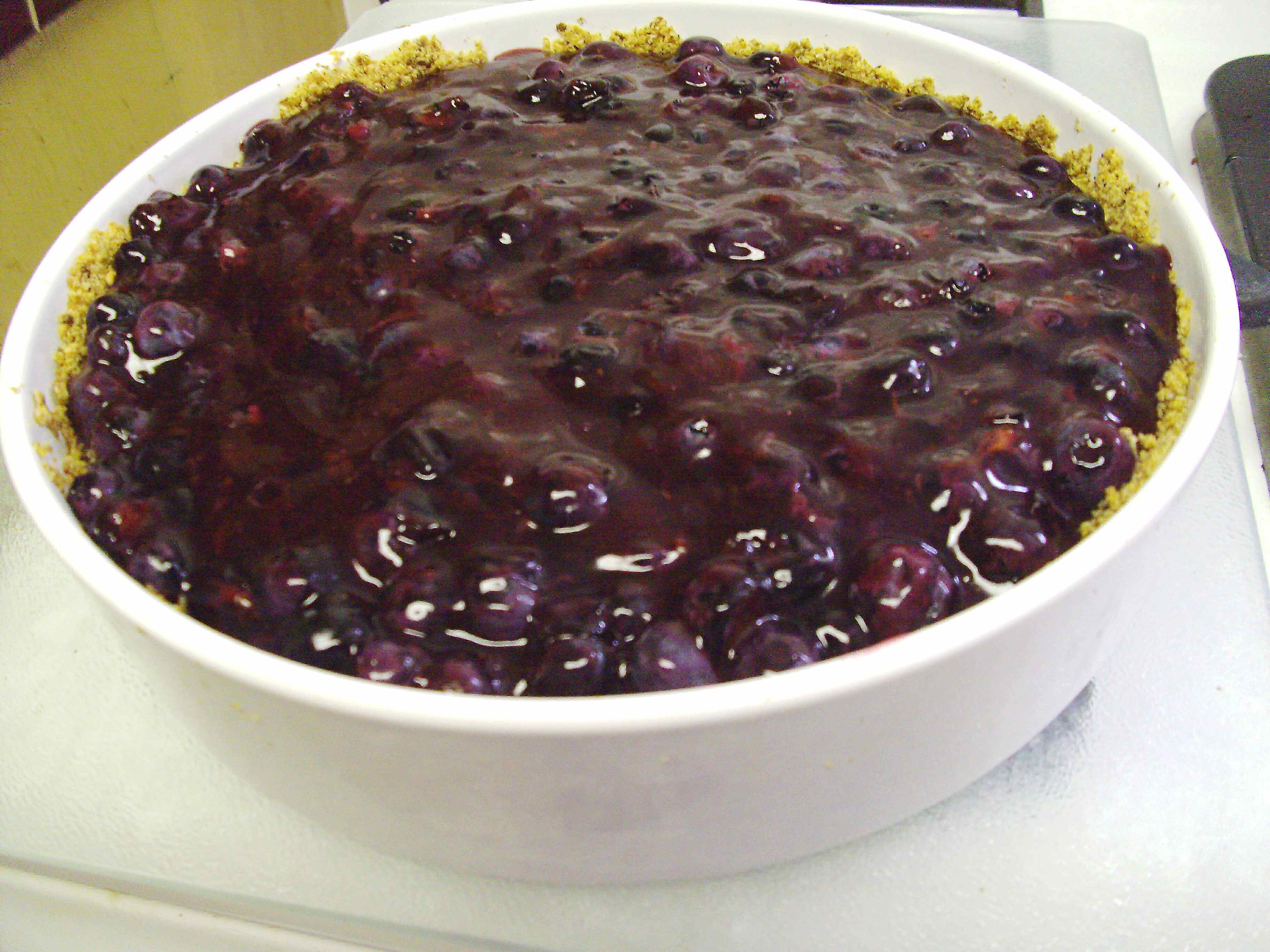
    raw blueberry pie with microwaveable filling and graham cracker crust

    This mostly-raw blueberry pie is a snap to make and very versatile--the filling microwaves in a few minutes, and you don't even have to bake the zippy gingered graham cracker crust--perfect for a hot Fourth of July and all summer long.

  • Recent Posts

  • Contents

  • Archives

  • Now Reading

  • See also my Book Reviews

  • Copyright 2008-2024Slow Food Fast. All writing and images on this blog unless otherwise attributed or set in quotes are the sole property of Slow Food Fast. Please contact DebbieN via the comments form for permissions before reprinting or reproducing any of the material on this blog.

  • ADS AND AFFILIATE LINKS

  • I may post affiliate links to books and movies that I personally review and recommend. Currently I favor Alibris and Vroman's, our terrific and venerable (now past the century mark!) independent bookstore in Pasadena. Or go to your local library--and make sure to support them with actual donations, not just overdue fines (ahem!), because your state probably has cut their budget and hours. Again.

  • In keeping with the disclaimer below, I DO NOT endorse, profit from, or recommend any medications, health treatments, commercial diet plans, supplements or any other such products.

  • DISCLAIMER

  • SlowFoodFast sometimes addresses general public health topics related to nutrition, heart disease, blood pressure, and diabetes. Because this is a blog with a personal point of view, my health and food politics entries often include my opinions on the trends I see, and I try to be as blatant as possible about that. None of these articles should be construed as specific medical advice for an individual case. I do try to keep to findings from well-vetted research sources and large, well-controlled studies, and I try not to sensationalize the science (though if they actually come up with a real cure for Type I diabetes in the next couple of years, I'm gonna be dancing in the streets with a hat that would put Carmen Miranda to shame. Consider yourself warned).

Why you shouldn’t buy precut veg

I know perfectly well that I’m preachy about buying bulk produce because it’s cheaper by far, the supposed “convenience” of precut amounts to less than a minute’s time difference in many cases, and the fiddly little precut plastic bags are a lot less fresh. But the current recall for a number of precut packaged veg products at Trader Joe’sand elsewhere reminded me of something my mother (who cooks reluctantly, very reluctantly) used to point out when I was a kid.

She would wash everything well under the tap and then (in a rare show of good lab technique) trim the cut ends off further because, as she pointed out, a lot of the produce is cut out in the field, where dirt and pesticides abound. People harvesting out in the field are not washing their hands or their knives every few minutes, nor are they in a position to wash the produce well before cutting it off the stalk or vine. It wouldn’t really improve things that much if they did.

The fancy precut veg producers are doing the washing and cutting up under less dusty conditions, but they’re actually creating more risk of contamination. Every time you cut into a vegetable, you’re exposing an inside surface. That’s usually fine when you’re cooking or serving it right afterward. But let it sit around, especially in a plastic bag, under dubious refrigeration, for several days, (how many more questionable conditions can I pile on here)–as the precut prepackaged veg does in the supermarket, and you’re pretty much begging for something to go wrong. The peel is there for a reason–it seals and filters out a lot of the bacteria and fungi that are always around in the soil, the air, the water, your hands.

Usually when fruit and vegetables are hand-harvested with a knife, it’s on an inedible stem or stalk, and if left in the open air, the cut will dry and more or less seal over–think how cauliflower and celery stumps look, or the dryish root ends of broccoli or cut asparagus. Not particularly appetizing, and generally that’s the bit you’d discard. The rest of the vegetable stays pretty fresh for several days–it’s essentially still alive (sometimes, as with bok choy, even still growing new shoots from the cut stump), so the plant’s own internal chemistry provides another natural hedge against outside bacteria.

But when it’s bagged and cut in small pieces, all the exposed surfaces provide a lot more opportunity for contamination and the plastic bag lets whatever moisture is lost collect on the outside of the pieces. Not good. So the less your vegetables and fruits are cut up before you buy them, the fewer chances to contaminate the inside parts of the vegetables.

Windfall deals in the produce section

A weekly haul from my greengrocer's comes in under $30 even with coffee, spices and special items.

I looked up and suddenly it was June–and I realized I haven’t posted for a full six months. Not because I no longer cook or have an interest in it. But with my daughter away at college, I was cooking just for my husband and myself, we were both working long hours on other things and I kept figuring I’d get back to posting regularly in a week or so.

It’s easy to get bogged down–do we need more recipes for things? what can we say that hasn’t been said, and what does it mean in the face of my growing sense of unease about both the political and physical climate changes in this country? The damage, especially at the detention centers near our border with Mexico and the brute squad ICE raid tactics in our cities, is ongoing.

It’s hard not to feel overwhelmed as an individual, and I have rarely felt less like celebrating the 4th. I’m not good with big crowds or protest marches, even though they can be effective in the short run. But there are some specific and effective things we can do to help repair the damage and they can help us feel less awful, isolated and helpless.

First and foremost is to take action to protect immigrants being persecuted at our borders and in our cities. Definitely write to your congressional reps and senators, local mayors and DAs. But also try and help directly, even if you’re far from the border or can only contribute a few dollars of financial support.

The long-established Hebrew Immigrant Aid Society, which my grandmother used to volunteer with in New York, is partnering in Southern California with Jewish Family Services of San Diego. JFS has opened an emergency shelter for immigrant families released from ICE detention under a recent court order and basically dumped on the streets of San Diego–no food, shelter, clothing or contacts, nothing. JFS’s San Diego Rapid Response Network shelter helps several hundred families a week. In addition to their direct donations page they’ve set up an Amazon wishlist registry for basics like underwear, coats, toiletries etc.

https://jfssd.org/our-services/refugees-immigration/migrant-family-shelter-sdrrn/

Several such havens are being set up around the country by both Jewish and non-Jewish volunteer organizations, so donate to this one or look for one in your area. The ACLU and SPLC both have significant programs for legal aid and restoration of families, as do some state and local governments like California’s.The HIAS website also has a wide variety of social justice programming recommendations and sample action plans for getting your congregation involved.

Another area of concern–and more directly about food–is the likely state of the national food supply in the coming year due to the huge shifts in global weather patterns and unseasonal storm damage this spring, to say nothing of the tariffs. A month ago, the USDA was estimating that the midwest floods would lose us about 1.5 percent of our agricultural production of staples next year in wheat, corn and soy. Now farmers are deciding not to plant at all in those zones near the Missouri River, and the latest estimate as of this week is up to 3.5-5 percent loss in total US staple crops for next year. I desperately hope I’m wrong, but at that rate, given how loss projections often escalate over time, the eventual loss totals could actually be a lot worse–maybe as much as 8-10 percent of total US production.

What will that mean for food prices and availability? Nutrition and agricultural scientists have been concerned for years about the loss of diversity in our national average diets and farm subsidy crops, and the chokehold fast food and processed food have had on the American public. So you can imagine a 10 percent cut in wheat, corn and soy would mean Trump might have to cut back on his Burger King habit next year, and you’re probably thinking “boo-hoo.”

But for everyone else, losing these staple crops is no joke. In food deserts, urban and rural areas with no grocery stores or access to fresh produce, it could mean having to pay significantly more for the only food they can get easily. This in a country that has no real excuses for the degree of poverty we already have.

More than that, these staples, especially the corn, are also key ingredients in chicken and cattle feed, which means we could well see significant shortages and price hikes in dairy products, eggs and meat next year too.

Aside from attempting to hoard, though, what can we as individuals do about it? We can push our congressional reps and senators on climate change policies, lower our personal carbon footprints, and so on, but we can’t control the weather through our food choices–can we? Well, maybe we can. We can’t make the Trump administration see reason but that’s no reason to abandon our own considerable power for change.

Contrary to what we usually believe, our individual choices definitely can make a difference in climate within a surprisingly short span of time. Certainly the pollution damage of any decade carries nearly immediate consequences, but it works the other way too. Consider the ozone layer–once we could actually see the disappearing heat shield from satellite photos, government policy  did the heavy lifting on banning chlorofluorocarbon emissions, forcing companies to find better refrigerants and ways to apply deodorant, and making hairspray a lot less popular. Did it work? Only a few decades later, the shocking ozone layer bald spot of the 1970s and ’80s has actually recovered, even if Final Net™ sales haven’t.

Or consider the California standards that led to the Clean Air and Water acts. We all take unleaded gas, catalytic convertors, hybrid vehicles and energy-efficient appliances as desirable standards these days partly because of those efforts. Do they make a difference? LA’s air alone improved so much in one generation that I can see 20-30 miles worth of the San Gabriel mountains just north of town. They’re literally walking distance from many neighborhoods in Pasadena, but they were completely masked by lead-lined smog in the ’60s when my parents lived here.

How then could we use our ordinary weekly food shopping to mitigate climate change on a scale that would come anywhere close to these successes and maybe make up for the crop shortfalls?

One possibility is to start diversifying what we eat–more beans and lentils; more bulk vegetables, less fast and processed food–to cut our overdependence on the top-three crops for most of our daily diet. Ironically? maybe not so ironically, this might push growers to diversify and plant more greens, which would use up some of the extra carbon dioxide in the atmosphere, and choose more legumes, which put nitrogen back in the soil as they grow.

We can also waste less food by using more of what’s already been grown and harvested. Ever since last May, when I wrote about food waste documentaries, I’ve been thinking more often about what goes to waste in my kitchen each week–not that much, actually, because I’m an undignified veg freak and a competitive cheapskate. But go to your local big-chain supermarket and you’ll see just how much still-good food gets culled every hour or so from the vegetable bins to maintain their corporate image as a guarantor of sterile, sanitized, pristinely packaged neatness. Only a tiny portion of it gets repackaged for a last-chance sale, even though most of it is probably still quite useable.

bargain-bin romano beans

Unpurchased fresh produce, I’ve decided, is an opportunity waiting to be recognized. Using more produce could not only save us a bunch of pocket money each week but also cut back the costs we pay for farm resources (many of which taxpayers subsidize pretty heavily), including gasoline and diesel, pesticides and water. Between all that and just not stuffing the landfills with methane-belching food waste, it’s certainly worth a try.

The supermarkets may have one or two bags of discount apples or peppers–almost indistinguishable from the new ones–somewhere in a corner at the back of the store, but you really have to hunt to find them. They and most of their customers, stuck on boxed and pre-made packaged food, and often afraid of getting their hands dirty with bulk produce, obviously think there’s some shame in it.

The ethnic neighborhood greengrocers have no such inhibitions or delusions. At my local Armenian greengrocer’s in a back corner of the store is a wire rack with large plastic bags of fruit and vegetables that are bruised, slightly wrinkled, or too ripe to last much longer, and a bag holding two or three pounds might be going for a dollar. They know their customers cook often and in quantity, and are generally careful of their food money. Vegetables and fruits are still a large part of traditional kitchens, and many of the customers will check the back bins for end-of-the-day bargains.

Why would you even look at these last-chance buys? What are they even good for?

First, it’s a couple of dollars to spare in my pocket and a couple of extra pounds of fresh produce every week for a pittance–so I don’t have to feel self-conscious about the cost of playing around. Second, buying them, even at a discount, gives a little back to my local smalltime greengrocers, who would otherwise take more of a loss and still have to pay for disposal. Third, whatever I can use (or compost, at a last resort), stays out of the municipal landfills.

This spring I’ve come out of the greengrocer’s several times with two or three loaded-down shopping bags full of my regular purchases to which I’ve added one or two extra bags of marked-down veg or fruit snagged from the back bin. It’s a small hedge against hard times, and a reminder not to waste food or just throw things away. As with our grandparents’ generation and all the ones before, we need to look ahead and develop some lost survival and innovation skills in this area.

It is not actually hard to do something good with a bargain bag of produce, and because it’s cheap, you get to exercise your creativity, your inventiveness and your willingness to take a chance on something you don’t already know how to do or do well. That is just as much of a lost skill and one we definitely could use more of. Continue reading

Passover mid-week: what’s for lunch?

With the best will in the world, there is only so much matzah anyone really wants to eat in a day. Even whole wheat. Yes, it’s crunchy. No, you don’t have to run the toaster oven. Yes, you should eat something else, and not just macaroons or gefilte fish from a jar. Or more hard-boiled eggs. Yeesh. Something lighter, please.

Salad

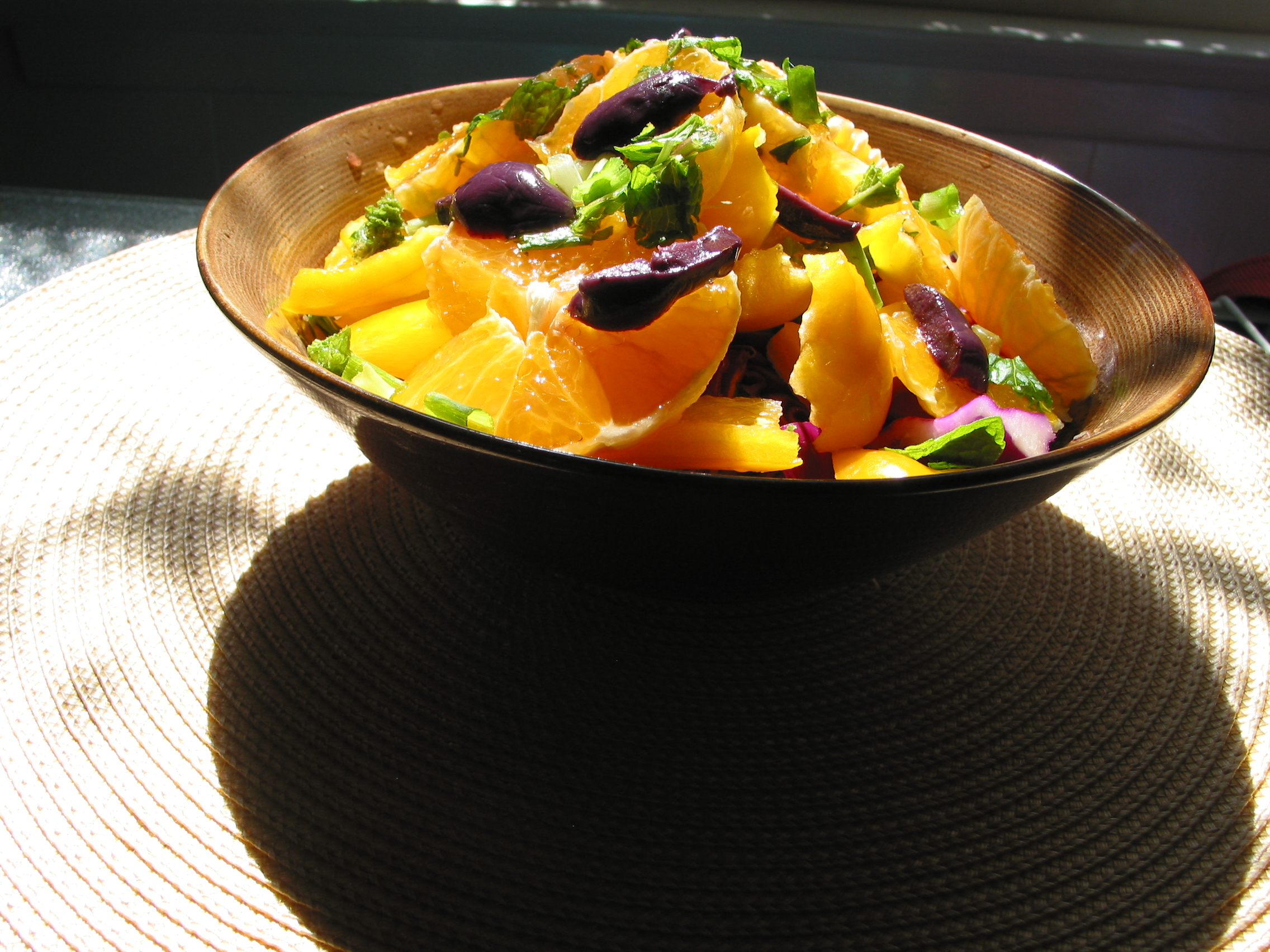
If you can get tomatoes of worth yet (it’s been a pretty long winter across much of the US), cut up some tomatoes and cucumbers, some red bell pepper, splash a bit of olive oil and vinegar on, maybe some Greek yogurt, some dill or basil, a bit of scallion and some feta or an olive, If good salad veg is scant but you can get cabbage, shred it and toss with some fresh or dried dill, thyme or oregano, maybe mint, oil and vinegar, a bit of lemon juice if you’ve got it, a couple of Greek-style olives. Or make a mix of oranges–slice them and serve with vinaigrette and lettuce or chopped cabbage, maybe a scallion and an olive or so, to brighten the last of winter and the first of spring.

Microwave melts and other vegetable and cheese combos

My standard eggplant microwave “melt” combo, with peppers and/or artichoke hearts and mozzarella/feta sandwiched between two slices of microwave-steamed eggplant. Salsa or shakshouka or even plain tomato sauce if you’ve got it, but jazz it up with hot pepper flakes and/or smoked paprika, or if you don’t have sauce then at least some hot pepper flakes, paprika, and basil or oregano–something.

Fish

Tuna salad is pretty classic, obviously, even though if you keep kosher it means scouting out kosher-for-Passover mayonnaise, making your own, or using plain yogurt instead (my current preference; my experience making mayo from scratch is more vast than I care to admit, and I don’t even like the stuff).

But if you have leftover cooked fish, especially tilapia or salmon, or you’re willing to cook a pound of it specifically for a batch of quick fake-smoked-whitefish-style fish spread, go ahead and microwave it a couple of minutes until cooked through, then drain off the liquid and mix with fat-free plain (!!!) Greek yogurt (add cautiously by spoonfuls so you don’t get too much and make it gloppy), plus or minus tehina if you eat it at Passover and like it, plus some lemon juice and grated or finely chopped onion or scallion, a bit of garlic and dill, and either a couple of drops of liquid smoke or a good dash of smoked paprika, with salt just to taste at the very end. Let it chill and it’ll solidify a bit overnight in the fridge. Good again with Greek olives and some salad (and okay, a little–but only a little–matzah). If you’re going for a meat meal and want to keep it nondairy, do a little more lemon juice and some olive oil as the binder and leave out the yogurt.

Fake-smoked tilapia salad on matzah

Fish Salad Rellenos?

But you can take it further, as I discovered. I’ve never actually loved gefilte fish, and even though Joan Nathan swears that fresh homemade gefilte fish is much better, I have chosen all these years not to believe her because it’s a big to-do and an even bigger mess, plus all the matzah meal and eggs mixed in–it’s basically a fish meatloaf full of stretchers. No. In my book, if you can get real fish, you should eat real fish as a main course and treat it with respect.

Leftovers, maybe, if you don’t just want to eat them straight–but not with yet more matzah and eggs. For crying out loud.

And all leftovers have to be good enough to eat on their own merits. Whatever you do to them should improve them or at least not degrade them.

I live in warm–sometimes way too warm–territory near Los Angeles, so the Armenian and Latino corner greengrocers always have good veg for cheap. Both are into peppers of varying shapes, sizes, colors and burn factor, a plus in my book. Passover can really use a hit of ta’am (flavor) and some vegetabalia to go with it.

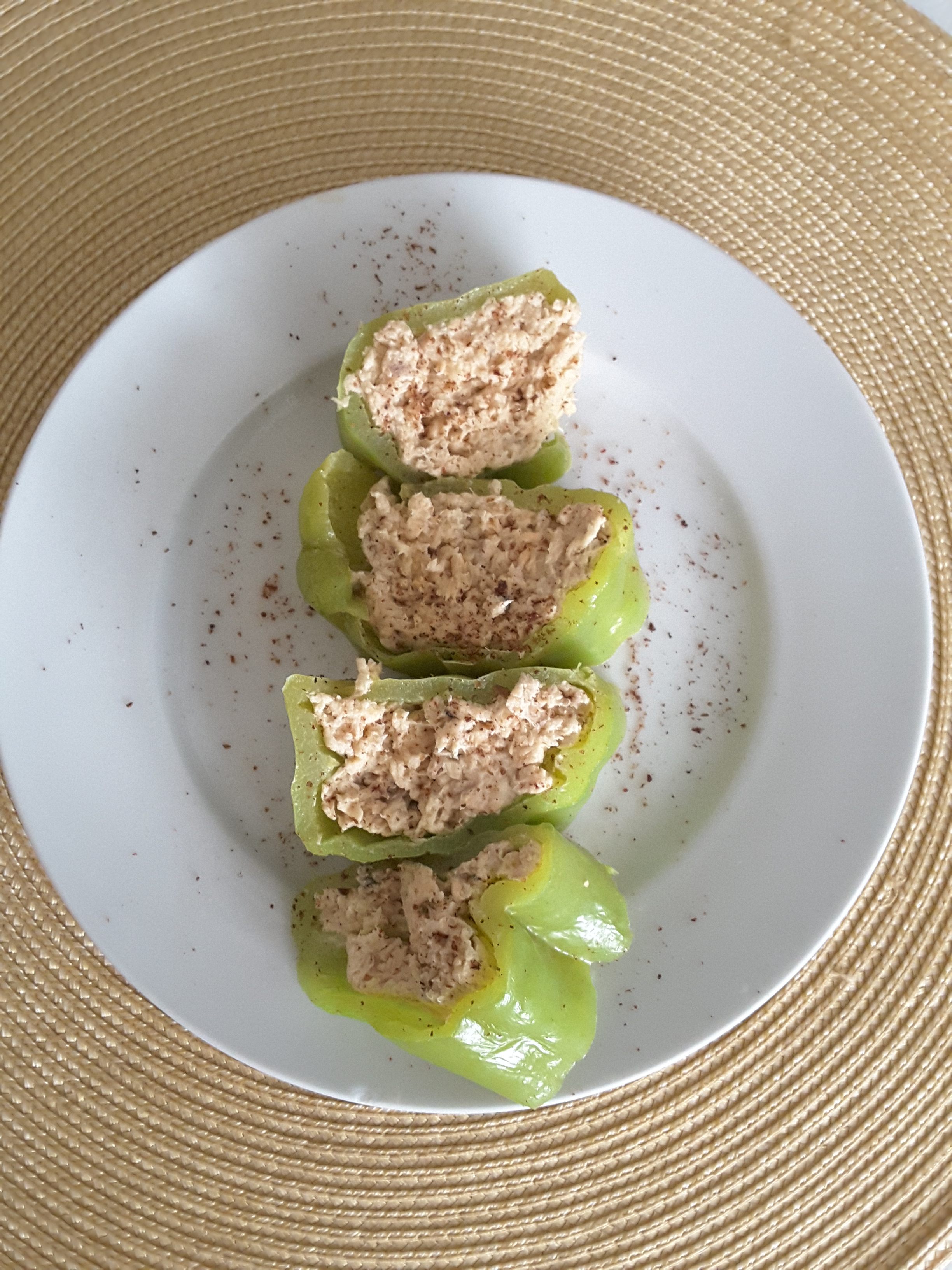
A bag of Hungarian peppers–pale green, mostly-mild, thin-walled, good for quick-pickling–was going for 50 cents a pound this week, and they’re long like Anaheims but nice and boxy at the stem end, not flat, so they’re easy to core and stuff without parcooking first. Fill them with the fish salad, I discovered, and you can microwave them a couple of minutes on an open plate or in a snaplock container with a lid until the peppers are cooked just to tenderness on both sides. I sliced one of them crosswise into inch-thick pieces and got this:

salmon-stuffed peppers

A decorative sprinkle of smoked paprika over it and not only was it good for a hot lunch, it would also be a quick and pretty southwestern take on gefilte fish as an appetizer, one or two slices per person, without all the traditional filler or grating and boiling and carp in the bathtub and so on, but with some actual flavor and freshness.

B’te’avon (bon appétit, mangia bene, eat nice) and Chag Sameach (happy Passover)!

A Microwaveable Passover, 5778 (2018) edition

Spinach matzah balls in the microwave

No matter how many times I vow I’m not going to work too hard this year, I always end up cleaning the fridge some time in the small hours the night before Passover, swearing creatively to get all the vegetable bins and shelving back in the way they came out. Between packing out the unkasherable dishes and appliances like the toaster oven, shopping for the week, and kashering the silverware, dishes and pots for Passover, it always ends up about 5 to 6 or so in the evening before I can actually cook.

Passover started Friday night, and it was just us at home this time around for the first seder. So I didn’t have to make a huge menu, which was good. Because I did have to kasher the kitchen–starting after a 3-hour stint at the DMV (my third this month) to help my kid finally get her learner’s permit. Type I diabetes throws a monkey wrench into the proceedings and requires extra time, paperwork, and hocking to make sure one office actually sends the other office the fax within your lifetime…so it was a bit on the late side that I actually got to start, and by the time sunset rolled around, I was kind of wiped and ready to skip it. Not a great frame of mind for experimenting in the kitchen, certainly not that night. Although the fridge IS still astonishingly clean and sparkly.

We don’t always get fully past the rush to the enjoyment of the seder, especially those of us who are doing the cooking. But the first bite of parsley dipped in saltwater always signals the start of the holiday for me, and the first bite of matzah tastes like freedom. (The thirty-fifth bite or so, perhaps not so much…)

By now I’ve played around enough to have quite a number of simple Passover-worthy dishes that can be microwaved, some of them start to finish. That can be handy when you’re either short on cooking time after getting home from work on Friday or just short on patience and yet you still want to do a simple–but still nice–small seder. It might even provide a save at least for the side dishes if you’re doing a bigger one.

Some things you can’t help cooking on the stove–hard-boiled eggs for the seder plate and for the table of hungry guests.  And some things like charoset take some hand work to chop if you don’t have a food processor around.

However.

Even if you’re serving something long-cooked like chicken or brisket as a main dish, a couple of easy microwaveable vegetable dishes, appetizers and desserts–even soup–might benefit from not having to compete for stovetop and oven space, particularly if a heat wave is headed your way. And microwaving reaps big benefits for reheating or supplementing leftovers quickly during the next several days if you keep kosher for Passover, or even if you don’t.

Vegetabalia

Fresh vegetables really matter for Passover. Salad, yes. It’s spring, after all (even though my mother said they were expecting another snowfall this week in Boston). And also cooked greens. I’m a big believer in microwaving them lightly and last-minute wherever possible, so that they’re just-cooked, fresh-tasting and still green when you serve them–at least, if they’re supposed to be green.

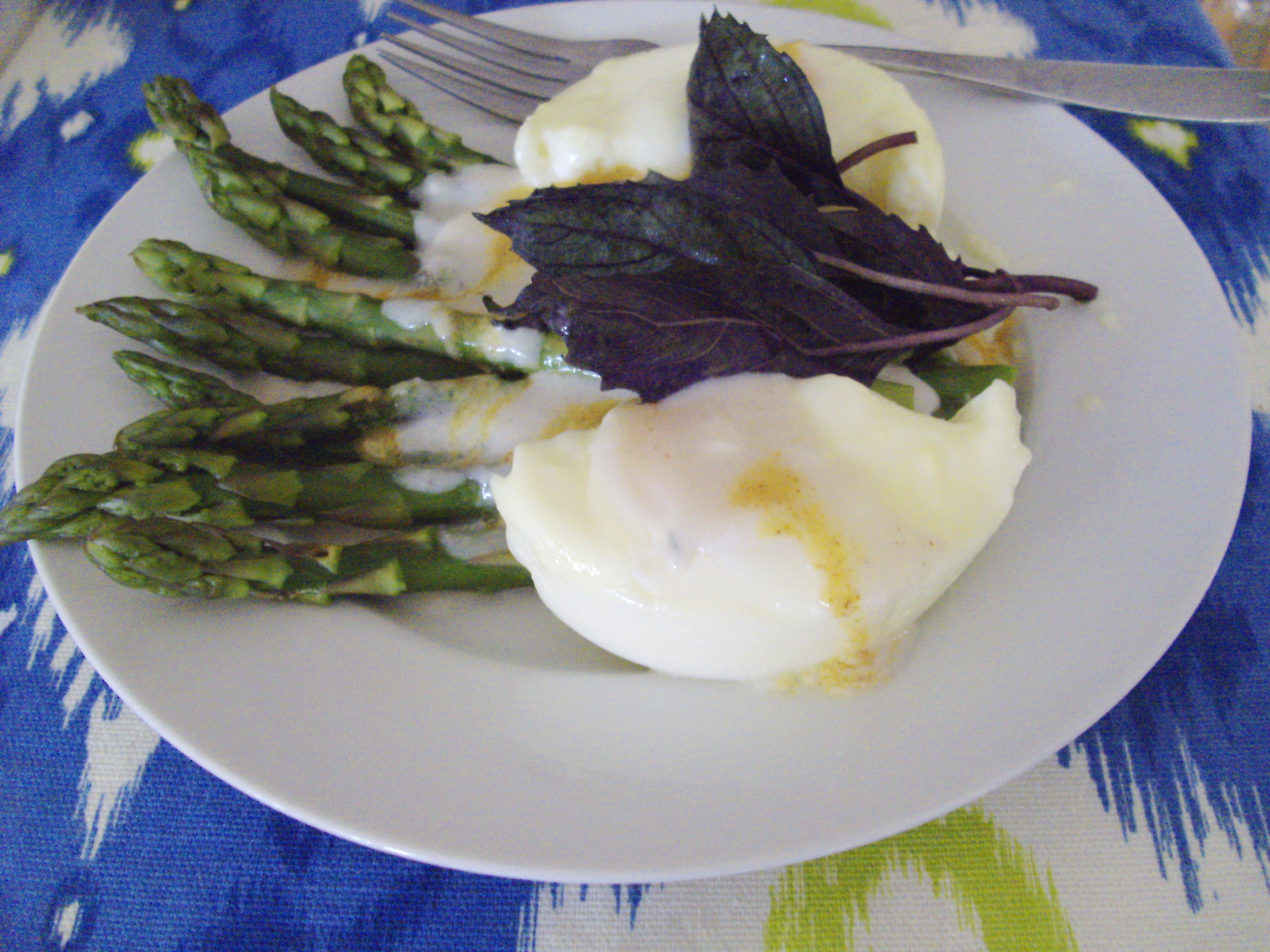
microwaved asparagus with a poached egg

Lightly-microwaved asparagus stays green even the next day. It’s good either cold or reheated with light vinaigrette and a poached egg (regular or microwaved) and some basil or other spring herbs.

Asparagus is traditional, and as long as you don’t abuse it the way my mother [probably] still does, by boiling the regulation seven minutes, shocking in ice water, and then letting it sit around in the cold water for ages until the stalks start shredding into floaty olive-green kelp-like bits, because she’s too busy with the soup, and dinner’s not for another whole hour…..skip all that and microwave the stalks instead for 2-3 minutes and you can be a winner.

Snaplock containers that are about the same size as the amount of vegetable you’re microwaving make it easy to prep ahead and store raw trimmed, washed asparagus, broccoli, brussels sprouts or other greens in the fridge, ready to nuke and go. When you’re ready for them, just add a drizzle of water, maybe a quarter-inch, to the container, put the lid back on, shake once or twice over the sink (in case of drips), and microwave them 2-3 minutes for a pound–you can let them sit a minute or so afterward and they’ll continue to steam. If you’re doing 2 pounds in one container, double the time, but stop and stir gently halfway through so the less-cooked ones on the bottom get moved to the top, and keep an eye on it the last minute or so–that is, stop the microwave again and check with a fork for doneness–so you don’t overcook.

Once the vegetables are just fork-tender and still green, drain them carefully and either serve right away or take the lid off and lay it back on loosely with an  air gap–you can probably get away with letting it sit this way for 10 minutes or so without it cooling too much, and the veg will stay green. But obviously, it’s best to serve it fairly quickly.

Vegetables you plan to roast or pan-brown can get a very quick head start in the microwave before tossing quickly with olive oil, garlic and rosemary in a frying pan or, if you’ve already got it going anyway, the oven. The precooking definitely cuts down the browning time. Brussels sprouts, fresh fennel, new potatoes, carrots, and red squashes are easy to microwave with just a bit of water in the bottom of a covered container to help steam them quickly.

Not-Chicken Soups

Microwaveable not-chicken soups, good for a vegetarian, vegan, or fish dinner,  can be made ahead in a couple of minutes (well, 5 to 15, including prep time) and reheated. They’re also good to have on hand if you’re doing a big meat dinner with the standard chicken soup in a stock pot but you also have a few vegetarian guests.

vegetables for microwaveable not-chicken soup

Basic not-chicken soup (about 2 1/2 quarts or 8-10 servings)

  • 3-4 full-sized carrots
  • medium or large onion
  • 4 long stalks of celery
  • drizzle/spoonful of olive oil
  • fat clove of garlic, minced, mashed or grated
  • handful of fresh dill or 1-2 T dry
  • 12-20 black peppercorns
  • lemon juice and salt to taste at the table

Fill up a 2.5 quart microwaveable bowl or container nearly to the top with chopped (bite-size pieces) vegetables. Stir in a spoonful of olive oil, and microwave-wilt the veg for 5 minutes on HIGH with the lid on. Add a fat minced or grated clove of garlic, a handful of dill and a few black peppercorns, plus water to cover and reheat another 5-6 minutes or until steaming hot, then let it sit with the lid on. Your soup will be pretty flavorful after letting it steep half an hour, if possibly a bit sweet (just one of those leftover mongo onions from last week’s “gifting” weighed a full pound on average). A squeeze of lemon and a dash of salt–not Campbell’s or Lipton’s level salting, salt-shaker-at-the-diner’s-discretion salting–and a grinding of pepper will work it out.

Pan-browned not-chicken soup

The pan-browned minimal carrot-onion soup is a little more hands-on, but very convincing and full-bodied. The basic setup is the same as for plain, but after wilting, pan brown the veg in a nonstick frying pan until you see actual browning, about 10 minutes. Add a grated or minced fat clove of garlic, a sprig of thyme, and a splash of white wine, and cook it down to dry. Put the veg back in the microwave container, swirl a bit of water around the empty pan to pick up the browning (i.e., deglaze), add it to the veg, fill the container up to the top with water, and microwave 5-6 minutes to heat, then let it steep.

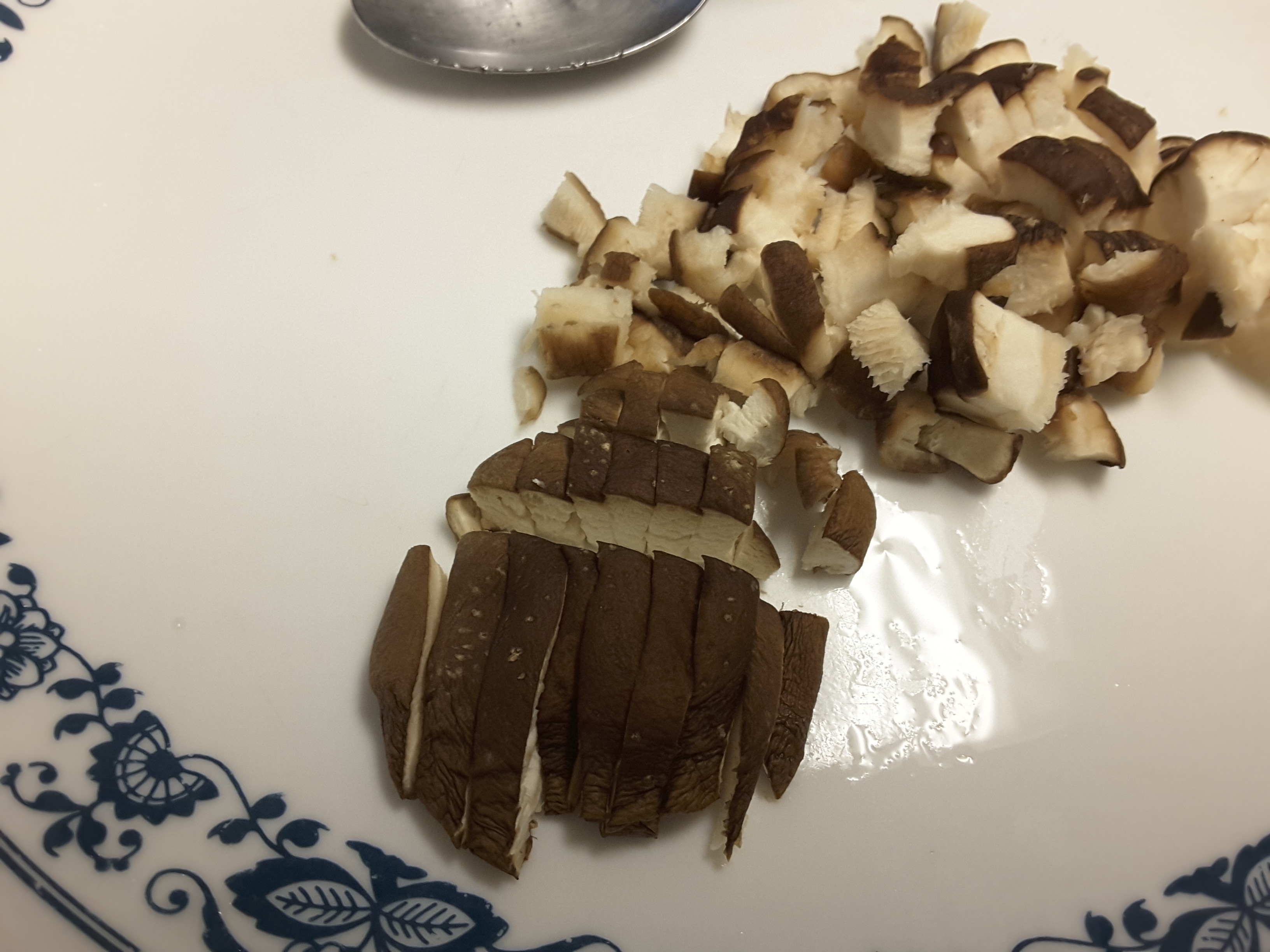
My current version (since I was gifted with celery as well last week) includes a couple of chopped stalks of celery with again, a very large onion. I also added in a bit of dill plus–chop ’em if you’ve got ’em–one or two finely-diced shiitake mushrooms, fresh or dried and soaked in half a cup of hot water,  for added not-chicken potency.

diced shiitake mushrooms

A squeeze of lemon and a dash of salt and fresh ground pepper at the table makes it even better than actual chicken soup. And you never have to skim any scum.

If you want to surprise people, go with bok choy broth but skip the soy sauce (contains wheat) and add extra shiitakes and fresh brown mushrooms, plus scallions, garlic and ginger. Use apple cider vinegar. We think sesame oil is fine for Passover but a lot of people don’t; it’s okay even without it.

Whatever soup you offer, keep the vegetables in. I never really understand the appeal of throwing out good veg just to have a 1950s-style “clear consommé”.

Microwave matzah balls?!

You can, actually, but not the conventional way, at least not in water to cover, mimicking the usual stovetop boiling. I tried it one afternoon last week just to see, using the classic back-of-box recipe just to be sure (I try these things so you don’t have to…). Continue reading

Color and Taste

We have a week and a half before Passover, and I’ve been experimenting a little with the foods I have to use up before then–flours, beans, lentils and spices.

I also–help! got “gifted” an awful lot of leftover vegetabalia from my daughter’s youth group director after last week’s major fundraiser, a huge Harry Potter-themed congregational dinner (Fantastic Feasts and Where to Find Them, still quite a popular title) that brought in nearly 200 diners and was frankly amazing.

bulk sacks of celery and onions

This is just the smaller bag of onions, along with way too much celery…

I managed to donate an entire 25-pound sack of onions to a local food pantry, but got another 10 pounds as a reward, along with two caterer’s packs of organic celery–that’s six full-sized heads–a huge box of organic mesclun that leaked horrible brown liquid in the shopping bag, so I composted it rather than trying to use any.

too much garlic

Worst of all….a 5-pound box of peeled garlic cloves. Which looked well-sealed and fine if ridiculous.

I looked squint-eyed at the youth director, who had such a hopeful wheedling expression on her face:  You like vegetables, you believe in garlic, could you please, please take it? Please?

Oy. By the end of a 10-minute ride home it was definitely reeking up my car. Why? Because the garlic cloves themselves were prepeeled, which always seems like such a bright idea to caterers and those who aspire to buy big. They were also machine-peeled, so some were cut into, hence the reek. And I mean, 5 pounds? I grabbed a modest handful of uncut cloves, rinsed them carefully, stuck them in a baggie and froze them. I had to toss out the rest of the box immediately. In the outside trash bin. Well wrapped.

In using the few cloves I kept, I’ve discovered I’m not wrong–looks really aren’t everything. The garlic itself, fresh or frozen, is impressive in size but very different from the usual small tight heads of garlic I buy for myself–harsher and yet less intense, lacking the warm flavors that make garlic garlic to me. So I’m going back to the real thing, peels and all.

In the meantime, I’ve been practicing my microwave not-chicken soup skills, along with testing the microwaveability of matzah balls–yes, you kind of can, they just won’t be spherical–which means we may all be sick of soup by the actual seder. Oh, no!

And while distracting myself from doing taxes, I’ve been looking for inspiration on another library cookbook binge. I drift by the New Books section and get caught by the new cookbooks with all the pretty colors–purple soup? red and yellow nasturtium blossoms on a salad? Bright green or pink or charcoal-gray (literally, as it turns out, using bamboo charcoal powder) shu mei wrappers?

As with the caterer’s box of garlic, though, looks can be deceiving.

I snatch up the books; I check them out, I lug them home and marvel at all the photographic bravura on my desk. Most of them are unexecutable in my kitchen because I don’t have a stick blender or enough counter space to do the fancy dim sum wraps justice. And some of them feature pork belly or crabmeat or other unkosher items.

Mostly, I look through the ingredients list and wonder mightily if they actually taste as impressive as the colors suggest, or if it’s all just for Instagram-worthy photos.

Love Italian Food (Maddalena Caruso, 2014) is a good case in point. Gorgeous photo of three technicolor puréed soups–cauliflower, broccoli, red cabbage with purple potato. I’m stunned by the purple velouté. But reading through I get cautious and skeptical. I want cream of red cabbage soup to taste amazing if it’s going to be that color and topped with a pale-jade romanesco floret. Caruso says it tastes peppery from the red cabbage; she adds purple potatoes for body and further color, some chicken broth, salt and pepper. She simmers the cabbage only 10 minutes or so before blending–hopefully that keeps it from going sulfurous. It might be good. It might be too subtle for me. I might have expected some lemon for the mild acidity that will keep the cabbage pigments from turning blueish-green. Or basil and garlic pesto. Maybe something smoky–smoked paprika? Or hot peppers and toasted sesame oil? Something.

I nuked a wedge of chopped red cabbage one recent afternoon to test the concept. It wouldn’t really blend smoothly in my food processor, and on its own, the purple mash smelled distinctly sour and a bit dank, lightly cooked as it was. It might combine well with other ingredients, but it wasn’t obvious that it would. Continue reading

Cauliflower pakoras, lightened up

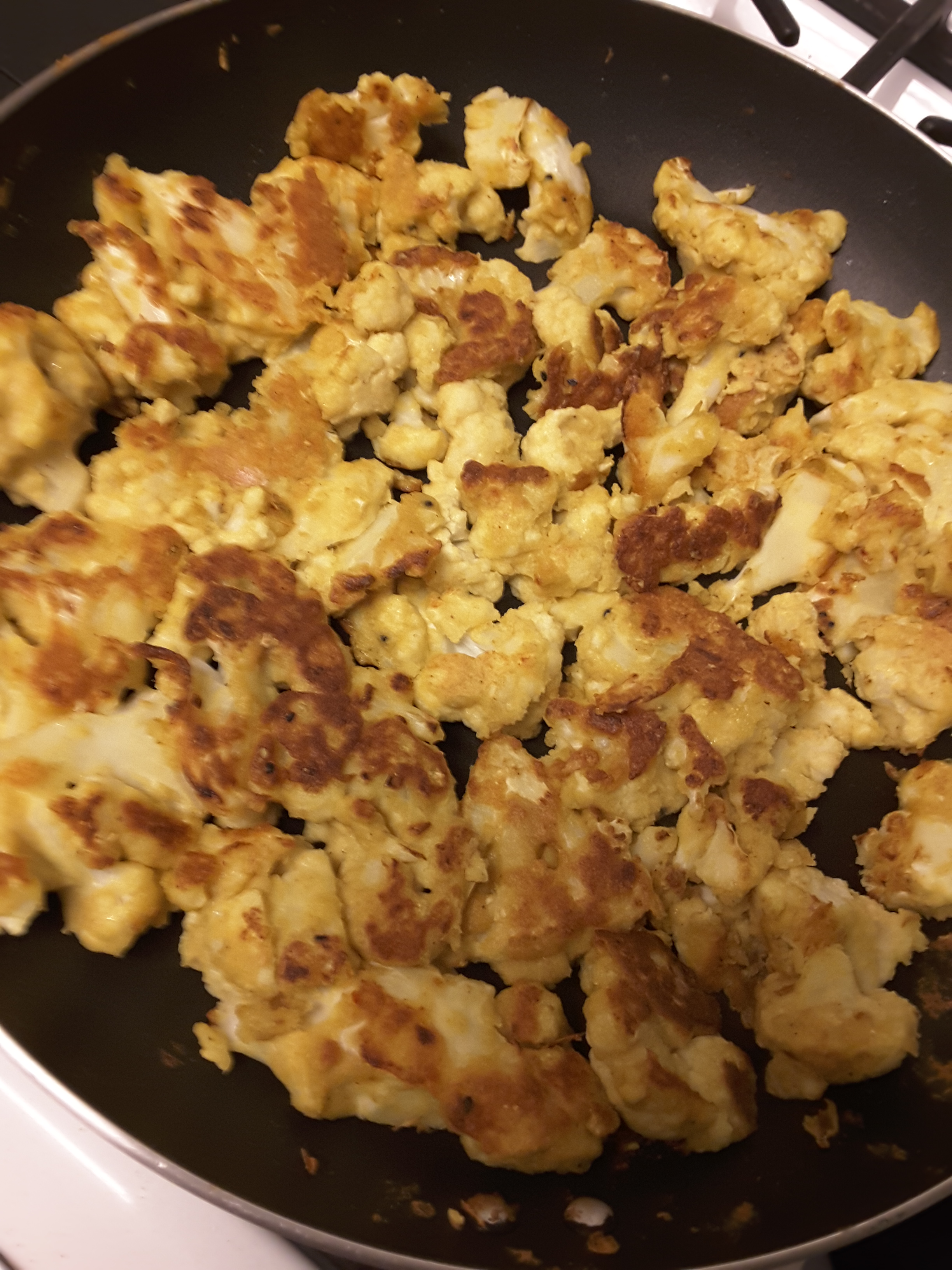
Cauliflower pakoras

Back at the beginning of Chanukah in mid-December, I was too busy to do much celebrating or posting. We were traveling more than usual and my daughter’s college application essays were still in rough shape and we were both a little panicked. My poor husband was working 13-hour days and trying to calm down the younger post-docs that this wasn’t ALWAYS how R&D goes–just sometimes. It’s the price you pay for doing rocket science.

And it was pretty hot and dry around Los Angeles–hence all those fires in the news. Makes it hard to feel safe breathing. Still, we did manage to celebrate modestly, even though the first night of Chanukah was during the nailbiter Alabama special election, whose results wouldn’t be in until after supper.

In any case, I’m posting this now because these are relatively quick and easy (and inexpensive) appetizers. They’re not super-svelte but not overloaded either, and they taste good, even after Chanukah is over (but please, make a fresh batch…)

I don’t do deep frying for Chanukah, particularly not with olive oil, which is expensive and wastes the oil and the calories (gotta save a few for the gelt–chocolate coins). And the cleanup. As my forebears did, I want to make a little olive oil last a longer time by using it sparingly with foods that deliver a slightly better svelte potential than potato latkes. Well–most of my forebears were more worried about getting enough food during the winter, not about eating too much, but let’s say my parents, who grew up in America with enough potatoes and enough oil to give you a gallbladder (and if that’s not a Jewish expression, I don’t know what is). In any case, frugality is warranted but so is enjoyment. How to balance the two?

I’m in love with gilded cauliflower–I think I’ve mentioned it a few (hundred) times. It’s quicker to prepare and probably even somewhat cheaper in salad bowl volumes than pasta or potato salad most of the year. Certainly more nutritious and sophisticated. And it contains garlic. I recently reinforced that view with my entire congregation when I brought a Sicilian (Roman? don’t exactly know) roasted cauliflower, pepper and artichoke salad to a brunch buffet after services. I was pleasantly surprised that by the end of the meal most of it was eaten and actually complimented on. I know, that’s not a true indicator in a lot of places, but Jews aren’t generally shy about telling each other what they really think, especially my congregation, and especially about food.

But I wasn’t totally in the mood for more of the same, even though I had about a third of a big head of cauliflower and some marinated artichokes left over from a frittata. Somewhere in the depths of my grains-and-beans drawer in the fridge (most people use it as a meat drawer; I use it to foil moths) I had stashed a bag of chickpea flour (Bob’s Red Mill; about $2-3 for a 16-ounce bag) because I thought I might make felafel (microwaved and pan-browned, still not deep-fried). But that seemed like a bit of work and kind of heavy.

When I went to pick up my daughter from school, I still hadn’t quite figured out how or what I was going to do quickly but semi-festively on a weeknight with homework and college applications looming. I knew I wasn’t even going to bother wrapping the presents I had for her and my husband, and I had to scrounge for enough candles to light the first night’s lights (note to self, get an extra box, one for next year).

As we passed a new Indian restaurant on the way home, though, it finally clicked.

“How about if I tried making some cauliflower pakoras?” I asked.

“That would be freaking delicious!”

OK, then. Continue reading

Surviving the holiday table

Yeah, yeah, I know. Last month every newspaper and online health magazine was brimming with handy top-10 tips to avoid stuffing yourself into a coma when you got over the river and through the woods to your in-laws’. Did it work? Did you try any of them? Was it even possible with the food available? MMMmmmph.

And…now we’ve started on the next round of holiday parties. And yes, I’m well aware, after last week’s “let the fools have their tartar sauce” tax subversion bill, that the tenor of my questions could equally apply to trickle-down economics, neocon “efficient” remote war management in Iraq and Afghanistan, “I am not a crook,” “too big to fail,” “No Collusion,” “FAKE NEWS,” and other fantasy favorites.

I don’t want to add to the burden of public speculation on the kinds of people who could genuinely fall for those slogans or excuse them in the face of the visible harm they do to all of us (okay, MOST of us. 99.9 percent of us). I’ve met some of these true believers, a few are actually friends, and they are otherwise decent, but really, stubbornly naïve is the kindest thing I can say. Tunnel vision, perhaps.

But back to holiday food–an even more fraught social topic. Because the same stubborn naïveté applies.

The trouble with most of the dutifully published top-10s for navigating party fare is how incredibly vague and trivial they are. They don’t give you a plate plan diagram like the ones for DASH/MyPlate balanced meals and the Idaho Plate™-style recommendations for Type II diabetes management. They don’t help you set a reasonable goal number for carb grams for the total meal including desserts and appetizers, and they don’t help you estimate anything or give you some sample sizes to go by.

Instead, they put the burden on you (or your kid) to select and use the fictitious ideal of self-control (more accurately known as “winging it”) in an environment that, to put it mildly, probably won’t support it. Oh, dear. JUST like the tax boondoggle.

There is also a big, big missing ingredient for most of these party suggestions: vegetables of worth. People don’t cook as much as they used to, chain restaurants and drive-thrus don’t really serve them, and the big food mags have almost dropped them from any party spread that isn’t for summer.

If there aren’t greens on the table, how do you fill half your plate with them as recommended by doctors and CDEs and RDs everywhere? If there’s one green vegetable dish and it’s breaded, panko’ed, crusted, dressed, nutted, topped, creamed or cream sauced, gratinéed, gravied, stuffed, sweetened, pancetta’ed, buttered or cheesed (I know, some of that litany is starting to sound a little obscene, as it should) to within an inch of its life, is it still worthwhile counting it as a green? Or is it actually mostly yet another starch with cheese, cream, butter, breadcrumbs, bacon bits and so on?

If you need to cover up any dish that thoroughly, it should tell you something pretty important about the recipe:

It is not exactly a taste explosion.*

Sorry, I WAS trying to get away from the obvious political metaphor, but it looks like it’s going to stick. (*And my thanks to the much-mourned Douglas Adams of The Hitchhiker’s Guide to the Galaxy series–and more specifically another of his books, Dirk Gently’s Holistic Detective Agency, for that line).

In any case, to survive the holidays and look good doing it, you need a winter holiday table that works better and tastes fresher and is actually lighter than the usual stuff and won’t leave you wishing for a sleigh to schlep your stomach home in after the party.

You need vegetabalia, ungunked. Some actual greens (or purples) on the table to lighten the load and redress the balance.

Actually, vegetabalia has always been a key part of classic dinner parties and it would be a shame to forget it, especially when you’re in the heart of winter. I don’t think I actually have ten ideas here, because as you may have seen in my previous attempts at top-10 lists, I tend to go a little overboard. Let’s see.

One way to do it without too much shock is to make the starch dishes a little smaller and the greens platters a little bigger and more numerous, colored, varied and–this is actually important, at least for a party–pretty.

Another is to add a green salad worthy of a celebration–keep it simple, elegant, just a couple of key and colorful ingredients that go together, not like something you scooped out of your local chain restaurant salad bar. See the big box of salad post for some inexpensive and winter-worthy vegetable selections that are easy to prep and store in the fridge for showtime and won’t look like “rabbit food.”

The third is to provide appetizers that are bigger on vegetabalia, ones that get beyond celery sticks, baby-cut carrots and bottled ranch dressing and are actually appetizing.

…Of course, the key element for avoiding idiots who take one look and say, “Oh. Rabbit food.” is not to invite them in the first place. The second strategy is surprise (in a good way, that is, not as in “celery with marshmallow fluff!”)

Good-looking vegetable appetizers that won’t bore people aren’t necessarily more expensive, especially if you buy bulk vegetables and wash and cut them up yourself. And some can actually be easier to make, and make look impressive, than lining up all those crackers and cheese slices neatly on a circular tray (my bane, I just don’t have the hostess/catering gene). The bonus: if you’re the host, you won’t have a load of crackers and cheese sitting around the house the next day, and you might have some fresh noshing vegetables left over, ready to grab and go.

Here are a couple of more specific (forgotten?) ways to make vegetabalia rock, cold and hot.

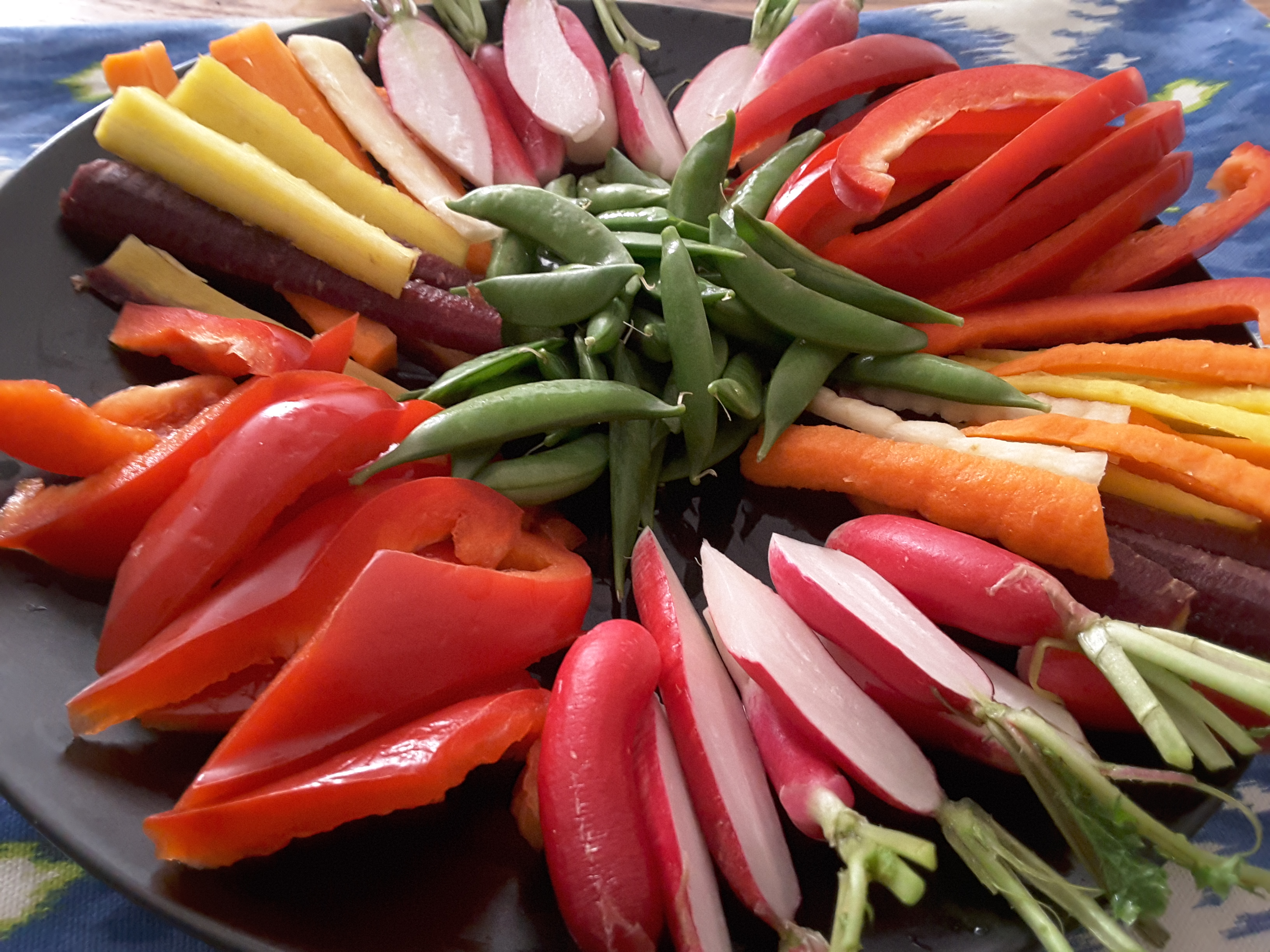
Crudités (#4)

The “just wash and nosh” scheme for raw vegetables is pretty easy and can even be elegant for a raw vegetable tray. You don’t need fancy chef-school knife skills or fancy expensive knife sets to make the magic happen, either.

You don’t have to do a massive tray or a zillion different expensive designer raw vegetables–three or four types on a medium platter with some contrast and a good fresh dip make a nice party display. At between $1 and $5-6 (for heirloom, top-end stuff or for portobello mushrooms) per pound, most noshing vegetables are also cheaper than many chips-and-dips junk foods, designer breads, cheeses, sliced deli meats, and premade party platters of just about any kind.

Do get away from the tedious carrots-and-celery-sticks-and-ranch-dressing version, even if you are doing carrots and/or celery. Celery and carrots are still good, mind you, but you might want to grow them up a bit, cut them differently, add one or two less common dipping vegetables for variety and something fresher and more interesting than ranch dressing for a dip or spread.

Usually I’m against “fashion vegetables,” heirloom everything and bagged, prewashed/pretrimmed veg because of the price markup compared to bulk. But if you’ve got access to something a little extra in an unexpected color (purple is good, so is bright yellow), like purple cauliflower or multicolored peppers, you might want to go for it just once in limited amounts and mix them up with the regular vegetables.

And there are non-designer vegetables with enough mix of color and flavor to do the pretty at a slightly lower price point.

  • Regular globe radishes are pretty bright and crunchy and eye-catching and peppery–lop off the thin root and most of the stem; wash them really well to get out any sand and keep them whole or slice them in half lengthwise. If you have a local farmer’s market that doesn’t slap on chichi markups in the price per pound, or you happen to see a bunch of longer or otherwise eye-catching radishes for about the same price in the produce section of your grocery store, go for it.
  • Fancy variety pods like sugar snap peas and snow peas–even raw green beans–are a nice choice too. You can get bulk snap and snow peas for about $3/lb. at the Ralph’s/Kroger’s and fresh green beans are sometimes on sale between Thanksgiving and New Year’s for under $1/lb. but usually about $2/lb.
  • Trader Joe’s sells 2-lb. bags of multicolored full-sized organic carrots for about $2 at this writing. White, deep purple with a gold core, bright yellow…pretty dramatic and they mix up nicely with the cheaper orange ones without being a lot more expensive.
  • If you can get colored full-sized bell peppers, maybe get one or two, and choose colors other than green. Sliced lengthwise they go pretty far in brightening up a vegetable tray.

Continue reading

And one more…

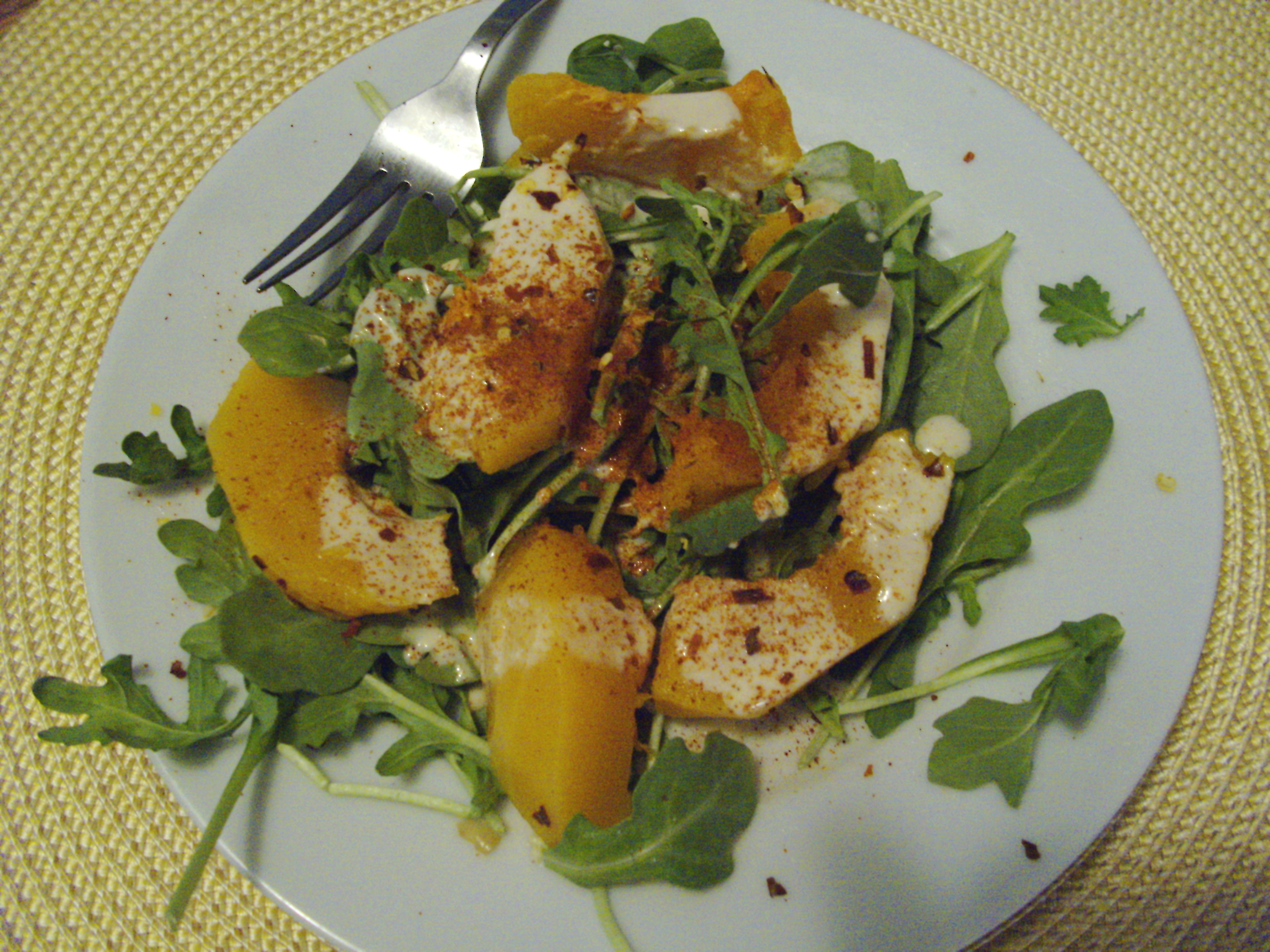
Butternut squash salad with tehina

Butternut, kabocha, red kuri, Hubbard, turban, pumpkin (and acorn, and delicata, and all the rest)–if you’re microwaving a large red squash, you may as well have another easy recipe in your back pocket.

This is one from my gourmet cousin up north, something she served us as a Friday-after lunch a couple of Thanksgivings ago, and it’s both beautiful and surprising with almost no effort.

Red Squash Slices on Arugula with Tehina

I know, I know. I’ll never get that chichi cookbook deal giving it away that fast. You wanted suspense. Obviously.

But really. If you have a couple of big chunks of leftover roast or preferably microwaved butternut squash, peel and slice it up–cold or hot, either is fine. Put down a bed of arugula or other salad greens, fan out the slices of butternut, mix up a little tehina (sesame paste) with lemon juice, a small clove of garlic and an optional pinch of salt, add just enough water to get it pourable and drizzle it over the squash.

[Note: if you’re making tehina sauce yourself, put a large dollop of the sesame paste in the bowl first, then add the juice of a lemon and stir slowly with a fork, then the garlic and salt, then water by spoonfuls. If you try to add tehina paste to water, you get murky, milky thin stuff that never really emulsifies and you waste your expensive ingredients. I learned this the hard way in a kibbutz kitchen while the two crazy ladies I worked for cackled at me and smoked inches of ash over the food, so take my advice to heart. I’d never want to put you through that humiliation.]

If you want color and glamour, go for the Trader Joe’s or similar smoked paprika and sprinkle it lightly over the platter. Roasted sunflower seeds (shelled, obviously) are nice too. As are hot pepper flakes if you like heat. Sumac (the purplish red sour spice, not the irritating weed) is also pretty if you can get it where you are, but smoked paprika really hits the spot.

If you’re being impressive at short notice and you have an organic kabocha squash, scrub it well, cut off the cap carefully with a very sharp knife and dig out all the seeds, put the cap back on, then stick it on a microwaveable plate (Corelle is probably the best) or in a microwave-safe casserole dish, with either Saran wrap or a big microwaveable bowl as a cover. Drizzle a quarter-inch or so of water around it on the plate, hit it for 8 minutes and see if it’s cooked through (depends on the size of the squash). Give it another 3-4 minutes if it’s not quite there, until you can poke a sharp knife through it easily at a thick point. Let it sit 10-15 more to steam further and/or cool a bit. The kabocha is thin-skinned enough to slice through and eat the skin if you want, and it’s a pretty contrast between the dryish, nutty orange flesh and the thin green skin. Drain and bring the whole thing to slice at the table if you feel like it, and pass the tehina sauce.

A different take on pumpkin “spice”

It’s just past Halloween and soon to be Thanksgiving. The pumpkin bins at the Trader Joe’s will probably disappear next Tuesday morning, very convenient. The worst of it is, the only edible-grade pumpkins they sell are the little pie pumpkins. The gorgeous Cinderella’s carriage ones, a dusky pale orange-gray, are a staple of Mediterranean cooking from soups to couscous to filled fillo spirals and beyond. Even candied pumpkin as a spoon sweet. But the ones the supermarkets here sell are grown for looks only with questionable water, fertilizers and pesticides, and are presumably just for decorating your lawn and attracting rodents.

It would be so nice if they sold edible larger pumpkins like the Cinderella kind–organic ones? even in wedges, as they do in European and North African farmers’ markets. It’s a shame to see so much food potential wasted like that.

Meanwhile, Starbucks, Cinnabon and other mall favorites will no doubt be assaulting the national palate once again with an overload of nutmeg and cinnamon extracts–the gastronomic equivalent of “Rockin’ Around the Xmas Tree” and “Feliz Navidad” played endlessly over the PA system wherever you go shopping. Taste is no object.

So my grumbling has resulted in a couple of searches for pumpkin with spices that don’t threaten anyone’s latte. I’ve been cruising my ever-growing collection of Mediterranean and Near Eastern cookbooks in search of good vegetarian and vegetable dishes that I can speed up with the help of a microwave without losing flavor.

Just by starting with a microwaved butternut or other whole red squash, you can cut the roasting, peeling and chopping time and effort (and danger of self-inflicted wounds) way down. Some decent savory recipe ideas can be done with ordinary cans of plain packed pumpkin too.

Then my preference is to go savory rather than sweet. It’s more interesting, for one thing, and it’s more versatile too. Finally, I look to see if I can make some of the recipes I find faster, svelter–and preferably both.

I see little benefit to using heavy cream, full sticks of butter, and extra egg yolks for “richness,” which mostly means as bulking ingredients more than for actual flavor. My head, my heart, my doctor and my hips are all in accord with me on this one. Besides, I’m a cheese freak. In my world, you need to save up your limited saturated fat allowance for stilton or chevre or camembert–something with funk and flash and that lightningy je ne sais quoi.

My lineup of adaptations so far:

Kolokithopita

Like spanakopita triangles or fillo rolls but instead of spinach and feta, use cooked and fairly dry pumpkin (or in this case butternut squash) mashed with feta, oregano and/or thyme (or fresh za’atar if you can get it), hot pepper flakes, a little tehina sauce or some garlic and lemon.

Butternut squash fryup–just add a little feta and some hot pepper flakes

If you’re only making 4-8 rolls or triangles, you can stick them on a length of foil that fits your toaster oven. Use a sandwich baggie over your hand to dab very sparing amounts of olive or expeller-pressed grapeseed oil or other light vegetable oil on each individual fillo sheet before folding in thirds, putting the filling on and rolling or folding. Brush the tops very lightly with a little more oil, turn down your toaster oven settings to about 400F and bake for about 10 minutes. When the tops are golden brown, turn the pastries over very gently and bake the whitish bottoms a little longer.

Pumpkin Gorgonzola Flans with Toasted Walnuts

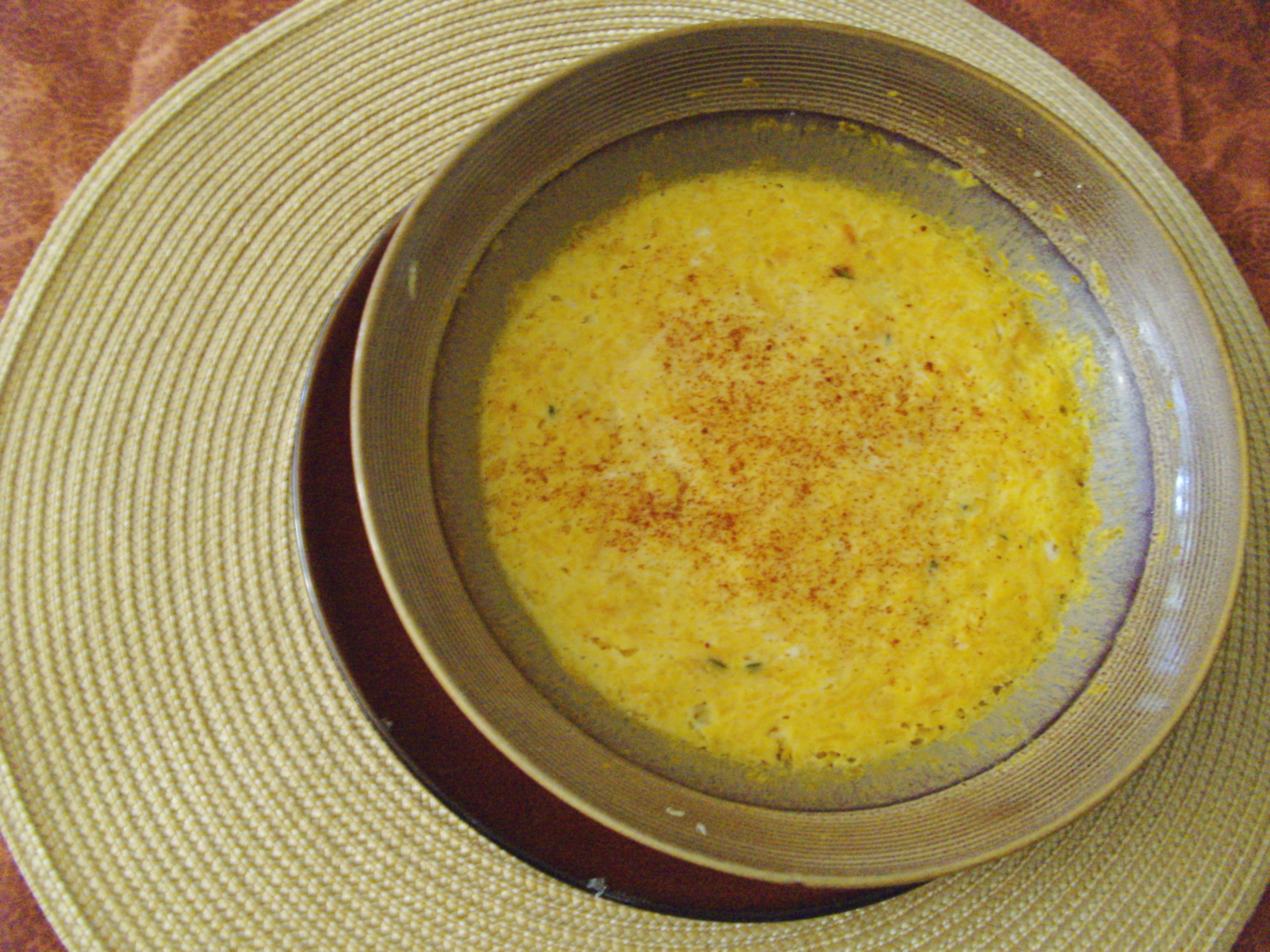
Butternut squash savory flan, slimmed down

adapted from Dorie Greenspan’s Around My French Table

This one has to be microwaveable–it’s a custard base, after all. It also, and I mean this, has to be svelte-able. Really. Greenspan uses 3 eggs plus 2 yolks and half a cup of heavy cream for only one 15-ounce can of packed pumpkin. That’s pretty obscenely rich, especially with 4 ounces or so of crumbled gorgonzola and some toasted walnuts sprinkled over the 6 individual ramekins before baking in a water bath in a conventional oven. And she suggests creme fraiche or sour cream as a garnish? Yikes.

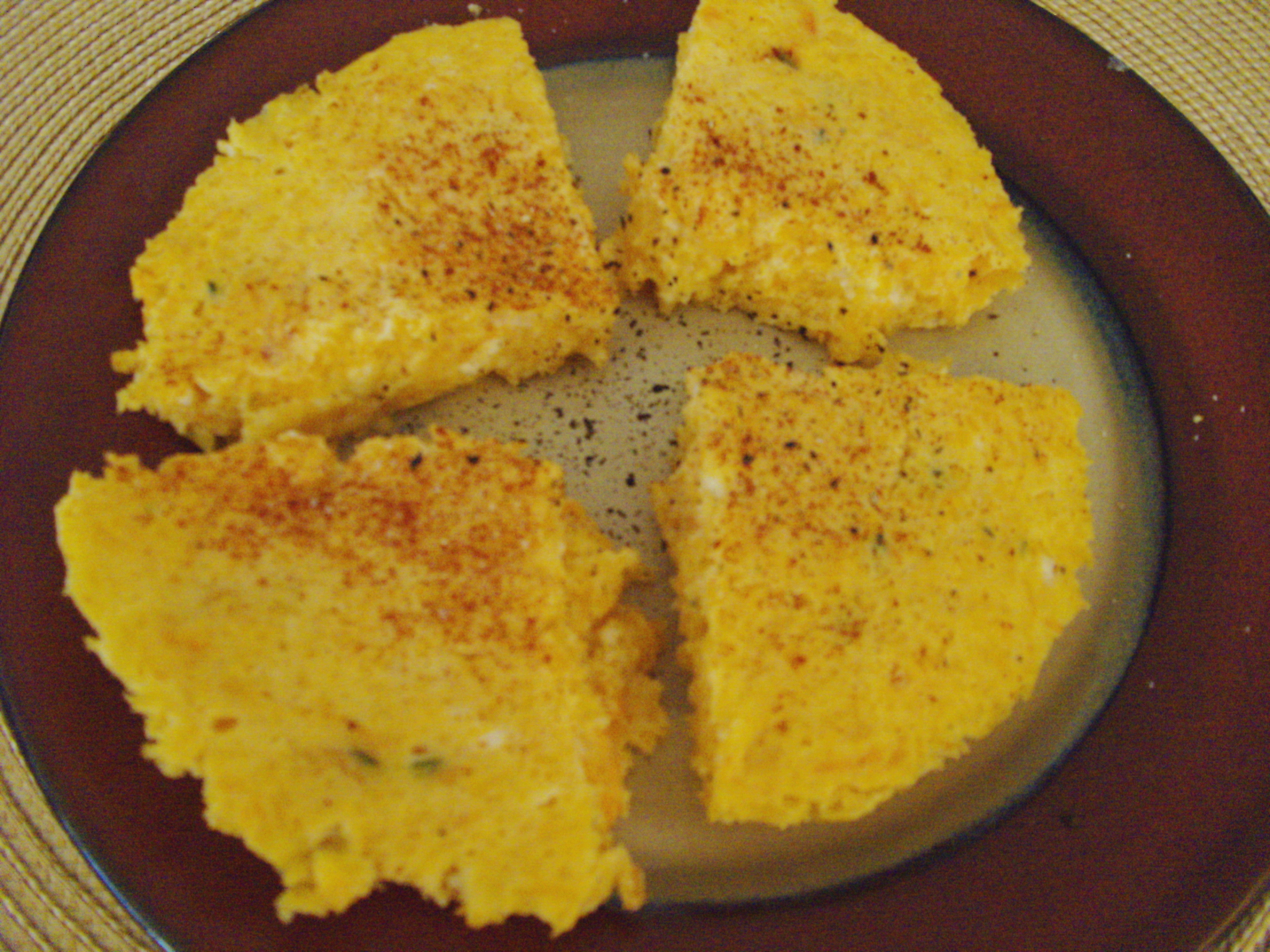
Flan in quarters

Microwave-safe ceramic ramekins are pretty inexpensive if you shop Ross for Less or Target.  I didn’t have gorgonzola or any kind of bleu on hand, so I winged it for concept with some feta.  I will say I’ve noticed that at least Stella gorgonzola melts into a runny sauce in a microwave–good if you want a smooth gorgonzola salad dressing, not so good for a recipe like this where you don’t want it to disappear into the flan. Maybe a more solid bleu like Stilton will melt and run but I’m hoping it stays together better.  Also, nuts in the microwave–maybe not a good idea, at least for big chunks. Even with the moisture from the flan taking the brunt of the energy, I kind of think you’re at risk of scorching them from the inside out, particularly if they’re on top of the flan. Better to roast them separately on a lowered heat in the toaster oven–200-250F for 5 minutes or so while the flan is going in the microwave, then sprinkle them on afterward as a garnish.

My half-recipe test came out pretty delicious on its own merits and I’m going to buy a small wedge of Stilton to try next. Because I mashed the butternut squash with a fork rather than using a purée, it’s a little rougher and less refined but the fresh taste is noticeable and lighter. Using plain nonfat yogurt in place of the heavy cream also made it obviously lighter and played up the tang that gorgonzola and bleu normally contribute. The acidic yogurt  may be counterintuitive if you’re thinking conventional cooking, but the small addition of flour plus the egg plus the starch and fiber in the squash prevent it from separating and curdling under heat.

Half-recipe pumpkin flan for lunch (serves 1-3 for lunch or an appetizer/side dish)

  • 6-7 oz/185 g chunk of cooked (microwaved, roasted, leftover) butternut or other red squash
  • 1 lg egg
  • 1/4 c or large heaping soupspoon of plain nonfat milk-and-cultures-only yogurt (not even Greek! just the cheap regular!)
  • small clove of garlic, mashed/minced/grated
  • pinch or stem worth of thyme
  • 1 t flour
  • 1 oz crumbled feta
  • sprinkle of smoked paprika, grind of black pepper to taste
  • toasted walnuts, optional

Mash everything up to the feta together in a microwaveable soup bowl, sprinkle on a little paprika and/or pepper, cover the bowl lightly with a lid or saucer, microwave 3 minutes on HIGH. Lift the lid carefully to check–it may still be liquidy in the center but cooked towards the outside rim. If the bowl’s very hot, let it sit covered another couple of minutes, jiggle again to see if the center’s cooked. If not, give it another 30 seconds and let sit again to cool down enough to handle. Cut into 3-4 pieces and serve–garnish as desired.

Microwave Tricks: Quick-Pickled Peppers

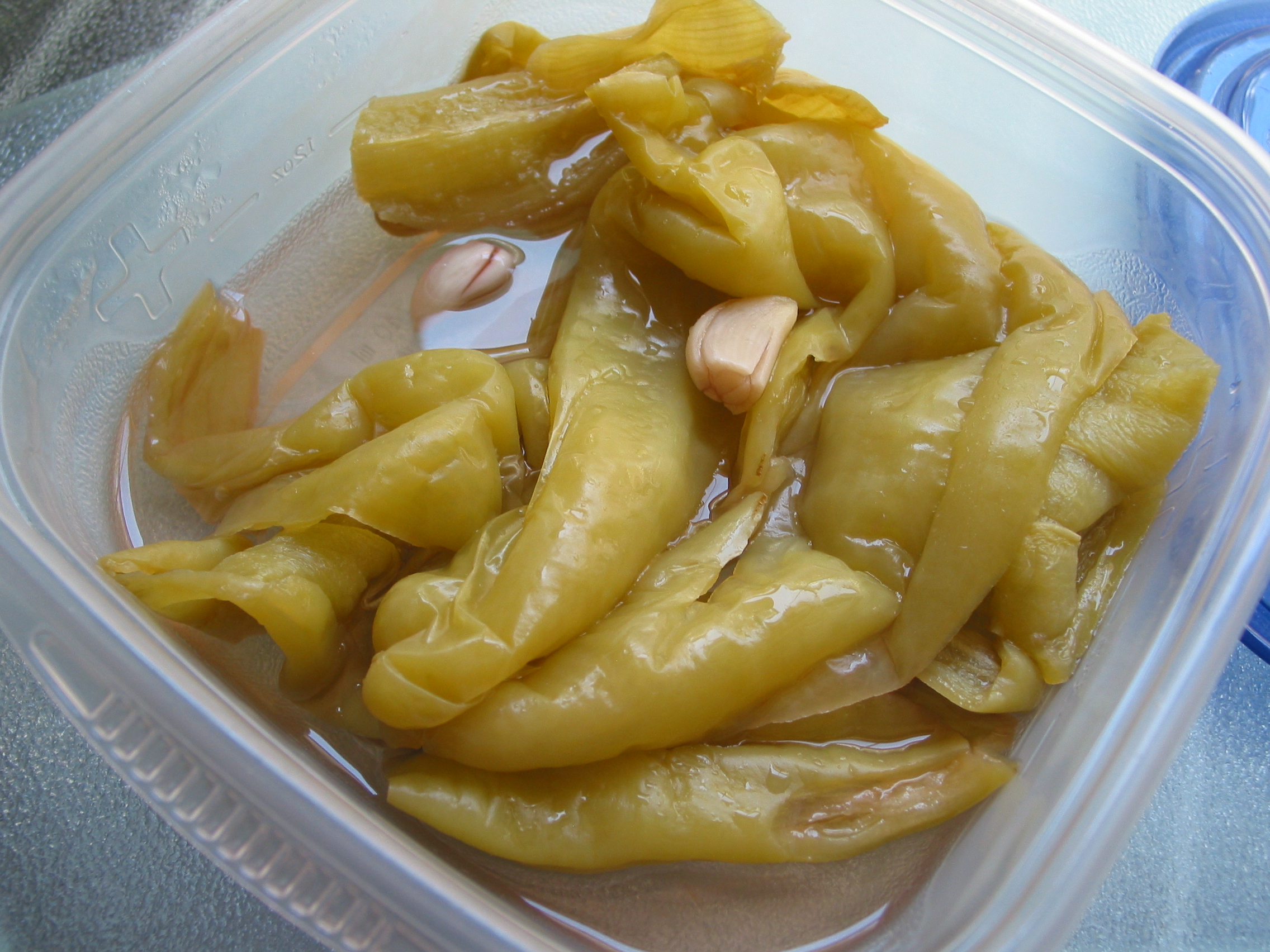
Microwave Hungarian pickled peppers

This is what happens when I get to the corner grocery or (more occasionally) the farmer’s market at the end of the day: I’ve already got a basket full of stuff, ripe, bursting with aromas it would take most supermarket produce days, weeks or forever to achieve. But there in the last-chance corner is a bag of very pale green, very contorted Hungarian peppers, about 10-15 of them for a last-chance dollar. They’re in good shape, maybe one or two has a couple of minor wrinkles, but that’s it. I can’t resist.

At first I thought I’d use them to stuff with corn kernels and feta and scallions, which I haven’t done for a while. But when I got them home, they were obviously too twisted to stuff, and very thin-walled at that. And unlike Anaheim or pasilla chiles, not really spicy enough to set off the corn. What then?

I’ve been feeling my nonexistent Italian and Greek roots lately, so I thought, pepperoncini? Well, why not? I did pickled green tomatoes last year, and it was incredibly easy (except for finding the green unripe tomatoes, which even my local Armenian corner store doesn’t provide often, and especially not at the height of the summer Fresno tomato frenzy).

But I didn’t want to wait two whole days for the peppers to ferment. And I didn’t want them quite as salty as actual pickles. So I decided to microwave-marinate them the way I make marinated artichoke hearts.

Yes, you can always just buy a jar of pepperoncini. My greengrocer definitely has them. But if you have the fresh peppers and they’re dirt cheap and you just want them right now, not necessarily every day for the next three months, microwaving them takes all of five minutes, and the result is surprisingly good.

It also brings out the full flavor of the peppers quickly–even a hint of spice, though they’re still not hot, and you can limit the salt to your own taste. Continue reading