
• Enter your email address to subscribe to this blog and receive notifications of new posts by email.

    Join 241 other subscribers
  • Noshing on

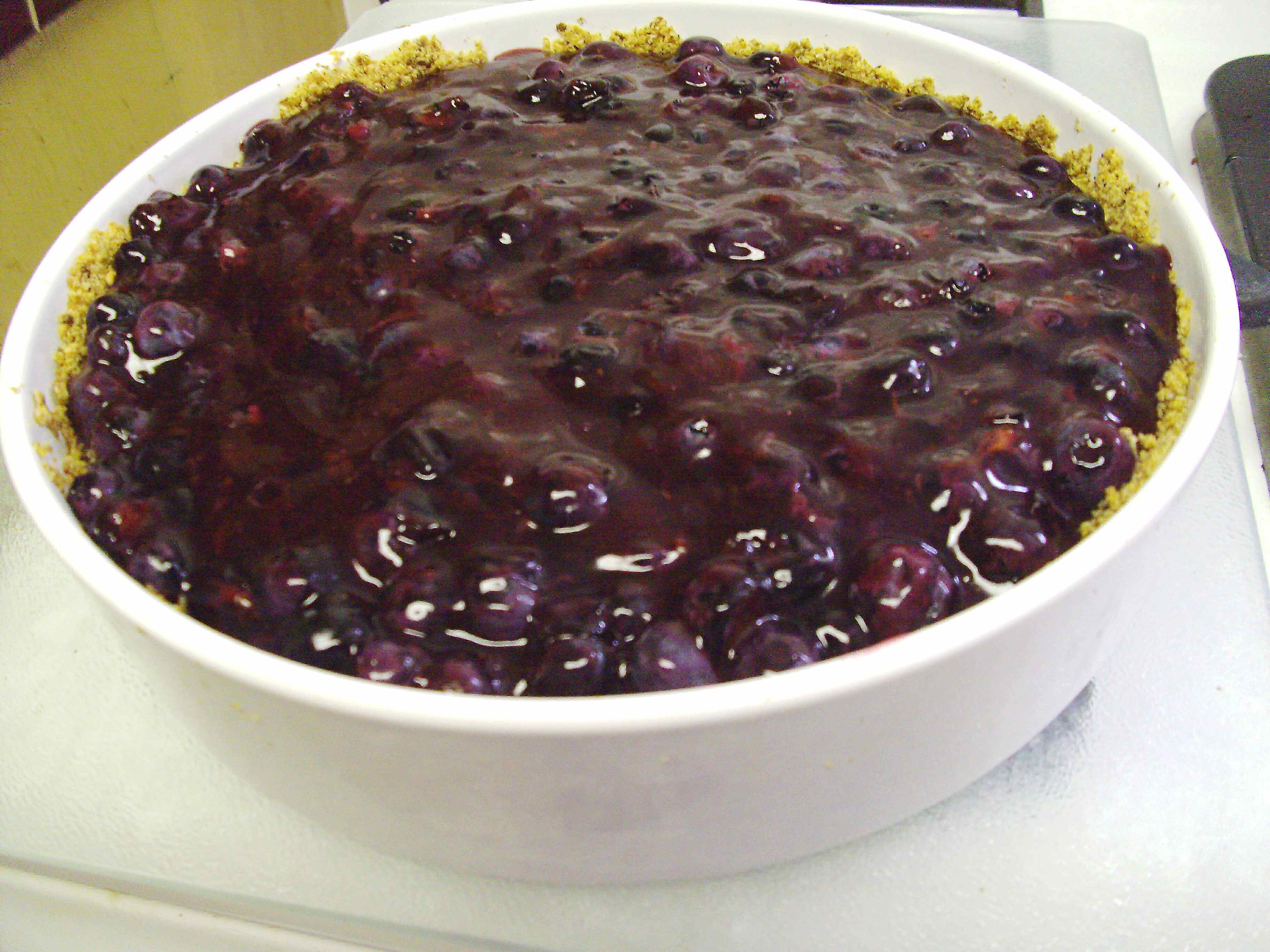
    raw blueberry pie with microwaveable filling and graham cracker crust

    This mostly-raw blueberry pie is a snap to make and very versatile--the filling microwaves in a few minutes, and you don't even have to bake the zippy gingered graham cracker crust--perfect for a hot Fourth of July and all summer long.

  • Recent Posts

  • Contents

  • Archives

  • Now Reading

  • See also my Book Reviews

  • Copyright 2008-2024Slow Food Fast. All writing and images on this blog unless otherwise attributed or set in quotes are the sole property of Slow Food Fast. Please contact DebbieN via the comments form for permissions before reprinting or reproducing any of the material on this blog.

  • ADS AND AFFILIATE LINKS

  • I may post affiliate links to books and movies that I personally review and recommend. Currently I favor Alibris and Vroman's, our terrific and venerable (now past the century mark!) independent bookstore in Pasadena. Or go to your local library--and make sure to support them with actual donations, not just overdue fines (ahem!), because your state probably has cut their budget and hours. Again.

  • In keeping with the disclaimer below, I DO NOT endorse, profit from, or recommend any medications, health treatments, commercial diet plans, supplements or any other such products.

  • DISCLAIMER

  • SlowFoodFast sometimes addresses general public health topics related to nutrition, heart disease, blood pressure, and diabetes. Because this is a blog with a personal point of view, my health and food politics entries often include my opinions on the trends I see, and I try to be as blatant as possible about that. None of these articles should be construed as specific medical advice for an individual case. I do try to keep to findings from well-vetted research sources and large, well-controlled studies, and I try not to sensationalize the science (though if they actually come up with a real cure for Type I diabetes in the next couple of years, I'm gonna be dancing in the streets with a hat that would put Carmen Miranda to shame. Consider yourself warned).

Microwave tricks: keeping cool and colorful

Cold salad vegetables, water and fruit are always a key part of my survival strategy once the weather gets hot–and by hot, I mean by Pasadena standards, 90-plus, which it’s finally started hitting–along with a very large part of the US this week. It’s normal here, even though we had an unusually cool and rainy spring, and up until last week we were just into the 70s most days. Obviously it’s not normal to be pushing 100 degrees over so much of the country.

Even the newspapers that tend to carry all-brown/all-beige food pics along with their recipes are remembering and recommending fewer heavy starches, more vegetables and fruit as a hot-weather strategy.

Most veg and fruit you can just wash and nosh, which is perfect in hot weather. You don’t have to run the dreaded stove, and biting into fresh salad vegetables–tomato, pepper, cucumber, lettuce or cabbage–will actually cool you down. On one road trip a few summers ago I got a lot of eyerolls from my nearest and dearest for packing cucumbers–small ones, but whole–along with the usual sandwiches and water bottles. But when we hit a rest stop halfway to San Jose, they really proved their worth. It was a pleasant surprise that my kid and my husband both said so…

In any case, just wash and nosh the vegetables you can get away with raw, and the ones that do need cooking can go in a microwave for a few minutes so you stay cool in the kitchen.

With that in mind, I have a couple of colorful, cheap and very simple microwaveable tricks for the moment.

Multicolor carrots, no colors touching
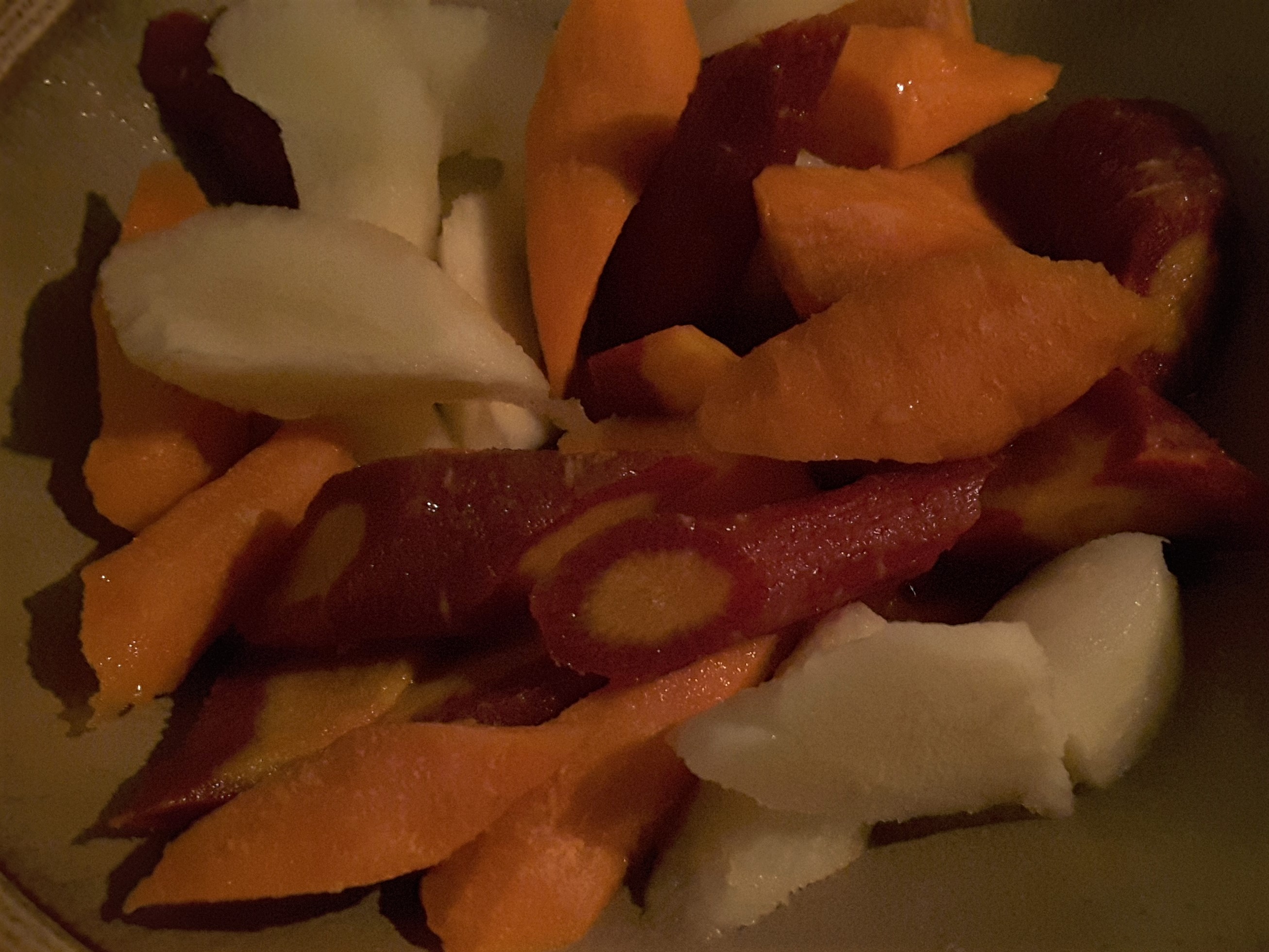
You can now get big 2-lb. bags of multicolor carrots, even organic, for nearly the same price as orange whole carrots even at the big chain supermarkets like Ralph’s/Kroger, so I do. I love the look of the purple-and-gold “black” carrots when I first slice into them, but how do you keep the purple from bleeding onto the white or yellow carrots beside them? I still haven’t figured out how to keep the purple completely purple once they cook, because any acid or heat will turn the purple part maroon, but I have found a way to keep it from bleeding.

Start by grouping each color of cut-up carrots in a separate pile on an open microwaveable dinner plate or casserole dish. Sprinkle lemon juice and a drizzle of olive oil, maybe a grating of ginger if you have some, on each pile and mix it in gently. Then nuke the plate with its different piles of carrots for a minute or two on HIGH to parcook. That sets the colors without cooking the carrots to death. You can cook the carrots longer if you want to, or keep them crisp-tender. Mix the carrot colors together right before serving–they’ll end up looking fun and not tasting overcooked.
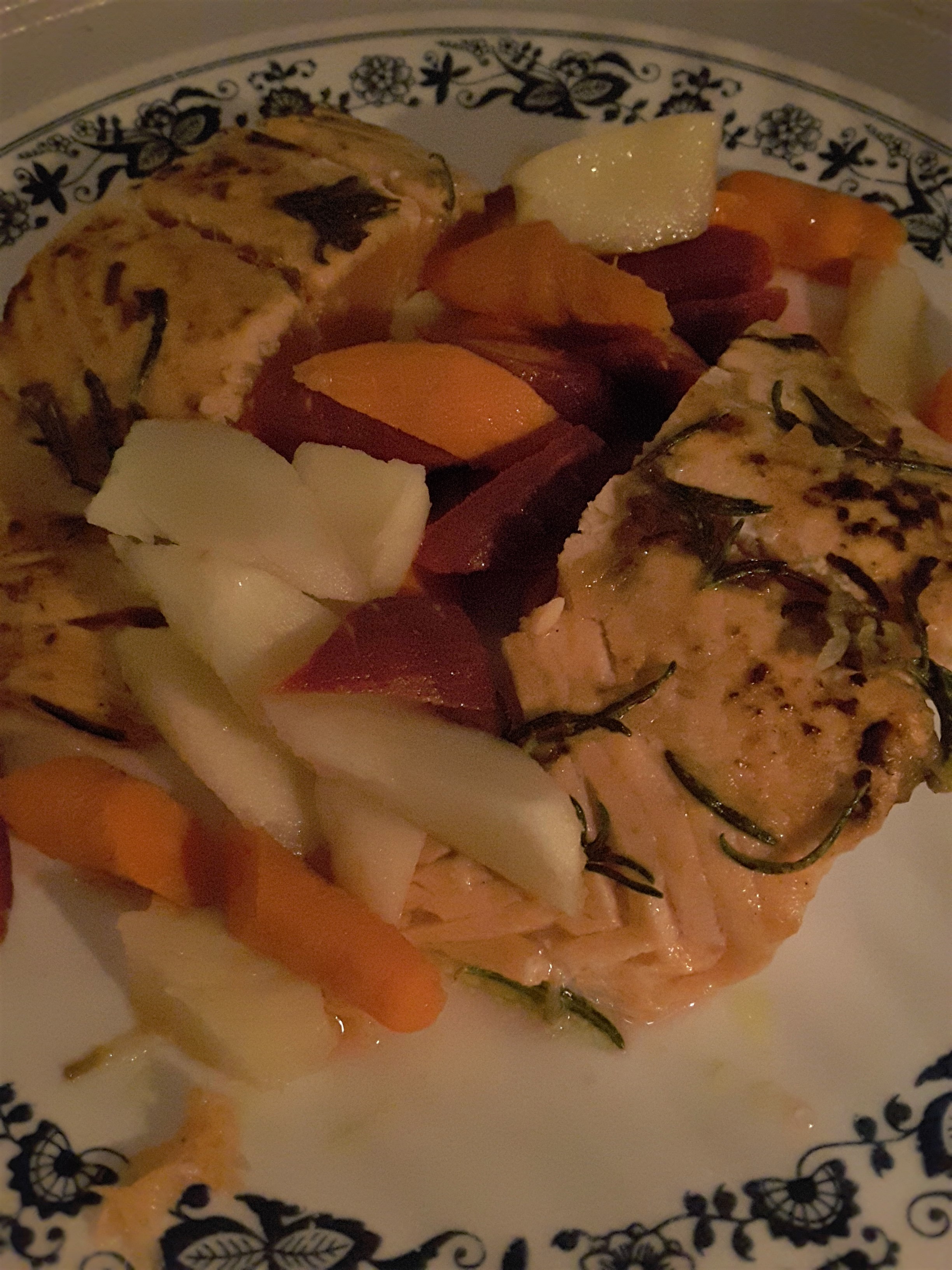
With seared salmon, these parcooked carrots are color-set and ready to finish in the microwave

Red Cabbage “Stir-Fry” Salad

Red cabbage, my relatively cheap perennial favorite useful vegetable (other than Fresno tomatoes and bok choy), is a little more cooperative about staying purple as long as you keep it with acidic ingredients. Usually I like red cabbage raw for salads, and occasionally in the winter I cook it in the microwave Swiss/German sweet-and-sour style, but I was in the mood for something more like a pan-browned stir-fry, only without actually bothering to stir-fry.

I had most of a head of red cabbage sitting in the fridge for more than a week, and I knew I had to use it up, probably cooked, though as lightly as I could get away with, because it was just starting to wilt and was no longer entirely crunchy. After seeing an article on charcoal grilling cabbage and romaine wedges as a dramatic 3-smoke-alarm barbecue side dish, I decided to cut it in thin wedges, cook it lightly in the microwave with a little acid to keep it purple and a little oil to keep it from being rubbery, and then decide whether I really wanted to pan-brown it or not.

…I decided to skip the pan-browning and just toss the microwaved cabbage with a few basic stirfry-type flavorings–vinegar, garlic, sesame oil, soy sauce, dab of molasses, hot pepper flakes, basically my version of a jao tze dipping sauce. I ended up with a surprisingly good impromptu hot salad that tastes something like the noodles from pad see ew or the chewy seaweed salad at a sushi restaurant. But bright vivid purple. In any case, it’s delicious, takes less than 5 minutes, and the leftovers are just as good–maybe even better–cold the next day.

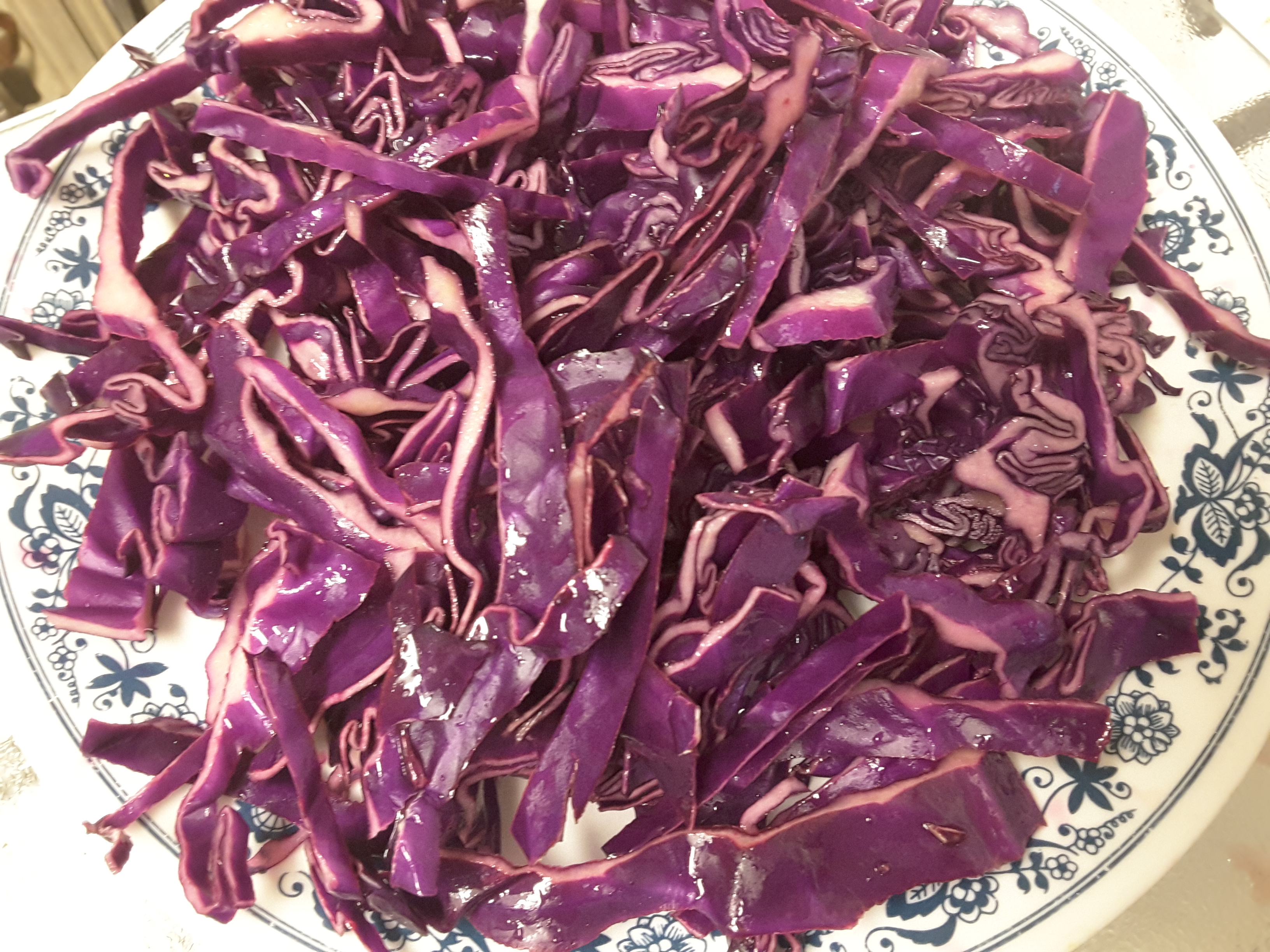
The trick for this dish is to keep both the color and the flavor bright while you keep the cabbage from going limp or rubbery. So just as with the multicolor carrots, it’s a two-step microwave. The lemon juice and/or vinegar go on with a little oil first, to keep the purple bright and the cabbage from going rubbery, you nuke it briefly just to set the color and parcook, then mix in the rest of the flavorings and nuke it again briefly to get it to the degree of cooked you prefer.

The amounts here are “use your best judgment”–you can use 1/4, 1/2 or the whole head of cabbage for this, depending how many servings you want to make. I did about 1/4 head of a medium cabbage for 2-3 servings, so the dressing amounts are for that but can stretch a little. Cooking times will vary a little by how much food you have, so if you make half a head or more at a time, check the doneness and stir up the cabbage so any undercooked shreds are on top for additional microwave time.

  • Head of red cabbage, rinsed, 2 outermost leaves peeled off and discarded, and cut in halves, you decide how much you want to chop for this recipe and wrap the rest tightly in plastic in the fridge for your next masterpiece.
  • A spoonful or so of cider or red wine vinegar and/or squeeze of lemon juice, or just enough to turn all the sliced cabbage magenta
  • A small drizzle of olive or salad oil, about 1 T

Flavorings for 1/4 head worth or so of salad (so scale up and adjust to taste)

  • 1/2 t toasted sesame oil
  • 1/2 t. dab of blackstrap molasses or a couple of pinches of sugar, brown or white
  • 1-2 t low-sodium soy sauce
  • small minced clove of garlic (or half a bigger clove)
  • pinch of hot pepper flakes or a few drops sriracha to taste
  • toasted peanuts and/or chopped scallion, optional

Slice the red cabbage into thin (quarter-inch) lengthwise wedges or crosswise shreds. Pile them on a microwaveable plate or bowl large enough to hold them and squeeze on some lemon juice and/or sprinkle on the vinegar, toss them to coat just so that all the purple starts turning brighter magenta. Drizzle on the olive or salad oil, toss again, then microwave uncovered 2-3 minutes (3-4 minutes if more than 1/4 head of cabbage), or until lightly cooked. Mix in everything else but the peanuts and scallions and toss, let sit a few minutes, taste and adjust, nuke 1-2 more minutes depending on your preferences for tender vs. chewy, and top with the peanuts and scallion as desired. Serve hot or cold.

For taste–I prefer mine balanced slightly toward the toasted sesame oil, with undertones from the garlic, vinegar, soy sauce and molasses and just a little latent heat from the chile flakes, but not overtly vinegary, sweet, salty or hot. Your mileage may vary; feel free.

This goes well with any proteins and other vegetables you’d stirfry, grill or dress with soy sauce-type dressings. Steamed or pan-browned tofu, pan-grilled tuna or salmon, chicken or seitan with bok choy, beef with broccoli, broccoli and ginger, etc. Toasted sesame seeds, sunflower seeds, walnuts or almonds would also work in place of peanuts. Thinly sliced raw or barely-nuked carrots too.

And if you run across some bargain-bin snow pea or sugarsnap pea pods, carrots of many colors, or any other vegetable you think goes, snag them, wash and trim them, nuke them very lightly and toss them in.

Be good, eat nice, and stay cool and colorful!

Quiche x Fillo = Yeah!

(…plus a few more cheap cheese tricks)

Cauliflower mushroom quiche wrapped in fillo pastry is crispy, elegant and light.

I had bought a packet of fillo dough a while back, in the thought that by now I’d have a couple of fun party-food ideas to suggest. But this week I’ve been feeling like I’d rather make and serve something nonsweet, nonfussy and not heavy–an easy main dish for summer, lighter and more serious at the same time, and something that could last more than one meal and reheat quickly.

This vegetable-filled quiche is a flexible dairy main dish with a Mediterranean vibe thanks to its fillo crust. It looks a little fancier than an ordinary quiche, but it’s not actually difficult to put together, and it’s also not a heart attack on a plate.

The only trick, other than needing to bake it in a conventional oven rather than attempting the microwave (so don’t do it during the heat of the day), is to control the temperature and moisture so you get the egg and cheese filling to cook through without letting the fillo casing scorch or, possibly worse, get soggy. It stores well in the fridge for next-day dinners, and you can reheat and recrisp individual pieces quickly in the toaster oven, especially if you microwave first for half a minute on an open plate just to warm them through, then slide onto foil and toast a few minutes at a baking temperature slightly below full-stun toasting so you don’t scorch the tops.

I’ve made two versions of this by winging it, essentially, and it’s worked nicely both times. The first was an open-faced spinach and ricotta fillo tart that went well at a Chanukah party back in December, and it led me to this second riff, a cauliflower-mushroom-smoked cheese filling, this time sandwiched between top and bottom fillo layers.

Before I get into the recipe and tips for working with fillo specifically, let’s talk a little about flexibility by highlighting one of my hobbies, getting cheap with cheese:

Continue reading

Persian-ish grill ideas for Purim

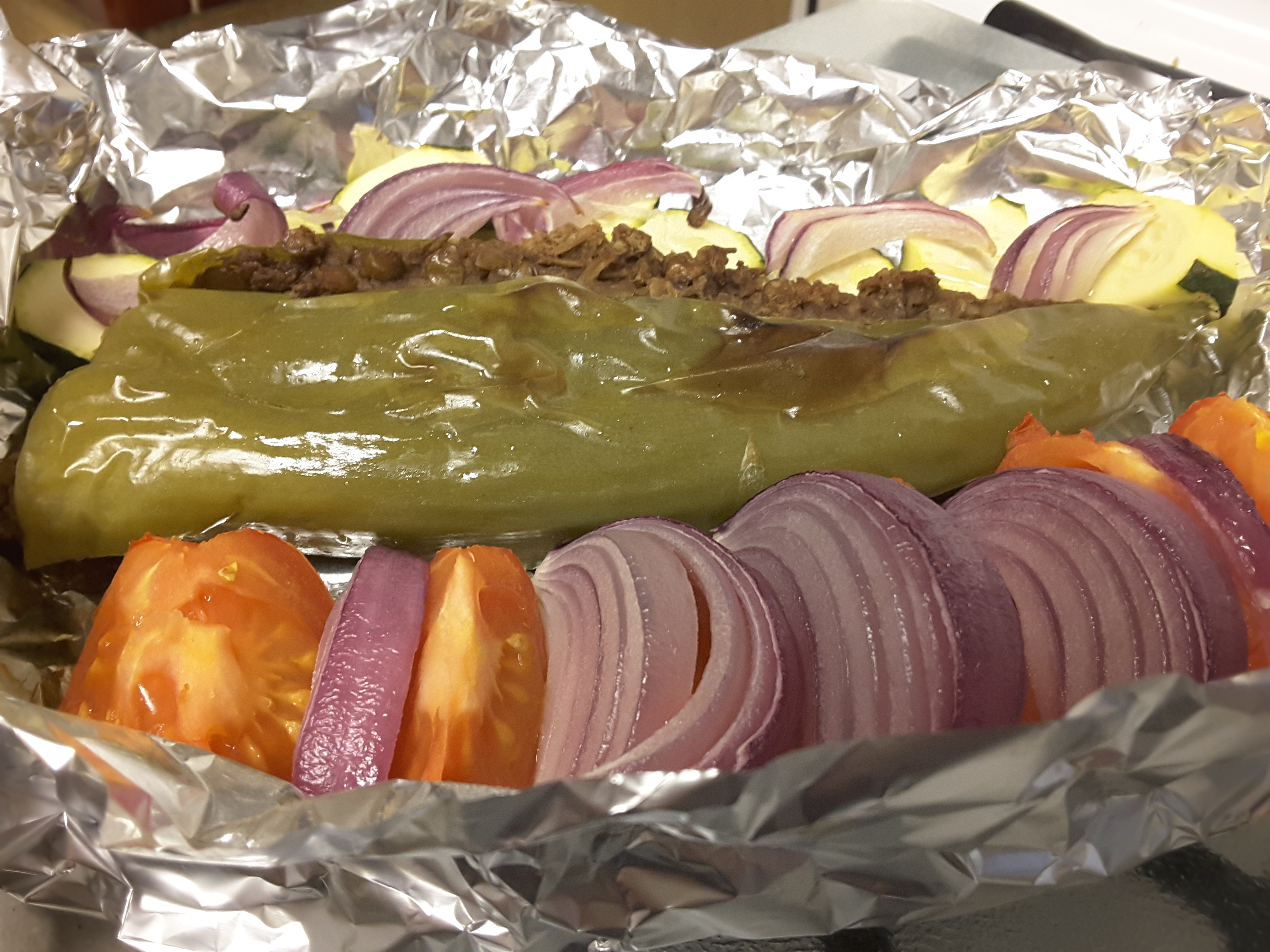
Lentil-stuffed Anaheim chile with zucchini, tomatoes and red onion in a Persian-style vegetarian platter grilled in the toaster oven.
Microwave-to-toaster-oven version

Last year our synagogue signed up for a catered Persian grill dinner (served takeout-style for pickup) from a restaurant on the West Side of LA, and this year they’re doing it again from a restaurant with kosher meat options. Last year, we weren’t sure so we went with a vegetarian option that turned out to be a little bleak–just grilled but dry unsauced vegetables, including some very-middle-American-style broccoli and babycut carrots that looked like they’d just been thrown in with the more traditional eggplant, pepper, zucchini, onion and tomato. The trays were filled out with huge heaps of bright-yellow basmati rice and a little tub of fesenjan sauce–toasted ground walnuts cooked down with grated onion and pomegranate molasses. No actual protein, though, so I pan-browned triangles of tofu to go with it. It was still all pretty bland, though, except for the charred tomato and pasilla pepper and onion.

Even though we’re going to have a meat version tonight–presumably better, I hope!–before the Megilla reading, the story of Queen Esther is very specific about one of her virtues. Unlike all the other girls who were hauled up to Ahashverosh’s palace for a year of preparation for a beauty contest (only, as with most, without a desirable prize). Most of the contestants dined on all the delicacies of the palace kitchen, but Esther refused any of the expensive meats and ate chickpeas instead. She didn’t tell anyone she was Jewish, but she didn’t eat the meat, claiming she was in mourning. It may have been a factor in why she was chosen as queen–she wasn’t being a glutton while the getting was good.

In Esther’s time, Ahashverosh had allowed his wicked vizier Haman to convince him to send out a decree allowing anyone to attack the Jews. But once Esther exposed Haman’s plot and her own Jewishness, he couldn’t cancel his own decree, so he sent out a second decree allowing the Jews to arm themselves in their own defense.

The celebration of Purim, while joyous and relieved, maybe a little exaggerated, is always mixed with acknowledgement of poverty and violence around us; this year most notably caused by the horror Putin has committed in Ukraine. The parallels are pretty harsh and very timely; there are always people like Haman and Ahashverosh willing to do harm or make excuses. So I have mixed feelings about meat vs. vegetarian for Purim, and about celebration in the midst of and despite the everpresent harsh realities.

The best I can do is to say that yes, especially now, we need to commemorate and to celebrate the triumph of good over evil–but without losing perspective or forgetting. May we have more people like Esther and Mordechai–be people more like them, people who step up. And in the meantime, remember to give tzedakah and g’milut hasadim–not charity, but the justice of providing for those in need. This is the season for that too.

Back to food and cooking:

One thing I’ve been thinking about since last Purim is how to make a somewhat better-tasting vegetarian Persian grill-style platter at home. I did like the restaurant’s grilled vegetables, just not the broccoli and carrot bits that were completely out of place or the tofu I made as a last-ditch effort.

If you have a microwave and a toaster oven or a nonstick frying pan with a lid, you can do something good and vegetarian fairly quickly and get some of the vibe without a lot of work. And grilling will improve winter tomatoes, onions, zucchini, (full-size, sliced) carrots, cauliflower, whatever you have where you are.

You can make a tray of quick-grilled vegetables as a side dish, or you can take the long, stuffable peppers and put in rice-and-tomato, as for dolmas (stuffed grape leaves), grillable white cheese like panela or queso fresco plus a sprinkle of nigella seed or thyme and some minced onion, or my personal and higher-protein/flavor choice, lentil hashu as for stuffed baby eggplants and mehshi basal (stuffed onions), which are Syrian Jewish, but adaptable and delicious and not too far off. The lentil and rice stuffing is flavored with allspice and cinnamon and it grills up nicely, especially in a nonstick pan with a bit of olive oil to create a light, crispy, char on the surface. It also makes light, delicate felafel-like fritters.

Continue reading

Happy 2022 from Pasadena!

The Rose Parade is something I’ve looked forward to seeing every year since I moved to Pasadena. Before we bought a house, we actually lived half a block from the parade route, so we could swing down to the street to see the floats and the marching bands with our neighbors, coffee mugs in hand and our kid still young enough to ride on our shoulders. Good times! I still miss that, even though I’m incredibly proud that she’s just graduated early from university. Something to celebrate, even though it’s shaping up to be another touch-and-go winter. We have a chance to turn things around and do better if we only will.

This year’s parade is the first since the pandemic began, and the weather turned sunny after a week of unusually hard rains. A good sign, generally. This one is not the best I ever saw (that would be the year our Jet Propulsion Lab had its own towering, animated “Rocketman” float à la Elton John; I think that year also featured a band costumed as Star Wars stormtroopers, but I’d have to dig back through my old photos to be sure). I haven’t gotten down to Colorado Boulevard to see things in person this time; maybe tomorrow I’ll walk down to the float display at Victory Park if it’s not too crowded for safety. But the point is this parade still brings a little hope. In the meantime, these pictures are just stills I snipped from KTLA-5‘s coverage, which you can see in its entirety at ktla.com or on its YouTube channel. Because there are still things I heartily approve:

2022 AIDS Foundation Rose Parade float, "Vaccinate Our World"
AIDS Foundation float “Vaccinate Our World”, credit for this and all following parade stills: KTLA-5

First, speaking of Elton, obviously, is the AIDS Foundation’s new emphasis on vaccinating the world against COVID-19 and getting vaccines to less-wealthy nations to end this thing. Two years into it, already, do we really want to see out a third full year? No. A message from a group that reminds us just how long pandemic threats can stick around if they’re politicized, profiteered and mismanaged to the degree this one has been.

But lip service and floats are not enough.

RoseParade2022-RoseQueen is wearing a facemask as she waves to the crowd.

It would have been nice if more of the crowd and float attendees had also been wearing masks, but at least the parade’s Rose Court all were.

Third, entertainment. Grand Marshal LeVar Burton, looking sharp, and (temporarily) unmasked singer Dionne Warwick waving from the Masked Singer float. The two of them were a more welcome sight to me than any of the featured singing acts, all of whom seemed a bit weak on both amperes and content by comparison to the legends.

The marching bands, on the other hand, were pretty good–two of them, count ’em, two, played slightly starched 4:4 marching-band arrangements of Journey’s “Don’t Stop Believing,” but another one delivered more swing by breaking into song in the middle of Margaret Cobb and Bruce Channel’s “Hey Baby, Will You Be My Girl,” and for one smalltown band, the whole thing was even more of an adventure–about 75% of its members had never flown before they came here.

There was also baton-twirling involved; it’s becoming a lost art except at PCC, whose campus is right on the parade route and whose band and dancers always deliver. Oh–and in a few outposts in Ohio; one of their drum majors did a nifty and improbable baton throw through his legs.

Continue reading

Microwave Tricks: Ungrilling Corn on the Cob

The last time I wrote about buying fresh corn more or less in season, my daughter was seven years old, green of hand and shin from a day camp project, and eager for me to do the handling so she could inspect each ear without touching them herself or turning them green. Now she’s a camp counselor at a nature center and almost done with college. So it’s been a while.

I wouldn’t normally think I had much to say about corn on the cob–I like it in a limited way, and actually I prefer to use the kernels for microwave chiles rellenos, but my husband and daughter both go for it, so usually when the price has finally dropped under 50 cents an ear (signalling “corn season” prices in the LA area) I buy it mostly for them, and I cook it as simply and quickly as possible, steaming it in the microwave. Because no matter what else may be true, when there’s corn in LA, it’s pretty hot out and the last thing I want to do is heat up my little galley kitchen.

Which turns out to be the deciding factor for this post. Temperatures around the southwest are edging up over 100–as expected; but at this point the northeast has also been in the 90s, and Portland, Oregon, has hit 116, hot enough to cook mussels in the harbor. It’s insane.

But microwaving corn isn’t just a survival tactic or a contingency plan.

My daughter was recently home for two weeks before going back to New York and lamented that my corn is “so much better” and tastes fresher than most of her friends and my in-laws make it. My in-laws are all hands-on denizens of Northern Califoodia, and a typical Fourth of July weekend sees barbecueing with many homemade sauces and bastes and corn roasted in the husk and so on.

So I was surprised–pleased, because my daughter has a better palate than I do, and she tends toward snark around me. But surprised, because she apparently meant it. Not being a huge corn fanatic, I think, “it’s just corn in the microwave, big deal.” Certainly, microwaving is much less glamorous and won’t result in attractive grill marks on the corn, much less the irreplaceable smokiness. So why would it be better?

My husband grew up for a while in Southern Illinois, corn country, and says the best corn he ever ate was when his family visited friends on a local farm. The hosts brought a stockpot of water out to the field between rows, set it boiling on a brazier, and instead of picking the corn, they just bent the nearest stalks directly into the pot for a few minutes, just enough so that the ears in the pot were cooked through and juicy, not enough to let them overcook with shriveled kernels or turn sicky-sweet and starchy like canned corn.

So that’s the ideal, rustic way to make perfect, exquisitely fresh corn on the cob. Ironically, a microwave can get you fairly close with supermarket corn that is obviously not still growing on the stalk for ultimate freshness, and you don’t have to visit southern Illinois farm country in the middle of the summer (which I have done, once, and it was really, really hot and stifling in my uncle’s childhood home). Or schlep pots of water out to the field in the middle of said summer and wait for them to boil.

Microwave-steaming is very different from stovetop methods like boiling, blanching or steaming. It’s not just the way it heats food–acting preferentially on the water molecules in or around the food–but how the food comes out as a result. If you do it right–just a little water, not a swamp, and put a lid on the container–a few minutes on high power will steam things like broccoli or asparagus to fork-tender while preserving the bright jewel green color and fresh taste you might expect from a stirfry that barely cooks the vegetables at all. Stovetop steaming to that color without going over into olivey, sulfurous territory would take longer and give you less tender broccoli as well, and boiling–don’t get me started. Moreover, you can keep the microwaved broccoli green and fresh-tasting longer if you microwave it just to the point you want or a little before and then pour off the drizzle of hot water and open the lid a bit. Even a head of broccoli that’s going bronzy-yellow after a week-plus in the fridge will generally perk up and be edible, not sulfurous-tasting, if you microwave-steam the florets instead of trying to deal with them some longer way.

Much the same can be said for corn on the cob. Microwave-steaming with only a little water and a lid cooks the cobs pretty fast, because the microwave energy heats the water inside the kernels as well as the water you added to the container, so it steams the corn from two directions at once.

Quantity and Layout

This method is pretty easy as long as you keep a couple of key factors in mind, namely how much food you’re trying to cook at once and how you lay it out in the container.

Raw corn cobs, shucked, rinsed and broken in half for microwaving

You wouldn’t want to try this for 20 ears of corn at a time, because the more food you microwave, the more energy and time it takes to get it all cooked, and it will cook less evenly and not be worth it. But for five or six people, you could probably do ok in one or two batches depending on what containers you have.

The other main thing about steaming ears of corn in the microwave is that you want them to cook as quickly and evenly as possible, just until they are cooked, which means you need to expose as much of the surface area of each cob as possible to the steam and, at the same time, to the microwave energy. So ideally you want them standing upright or at least diagonal, not lying flat on the bottom of the container or on each other if you can help it. You want the steam to circulate throughout the container, and you want the lid to keep it in and keep it focused on the corn.

A couple of ears left whole–lifting them up diagonally in the container helps them steam evenly.

For my containers, which tend to be 2.5 qt or liter snaplock boxes about 5 inches high, I break off the narrow “handle” and snap the ears in half after shucking them and rinsing off the last of the cornsilk threads. My hands are fairly strong so I just do it by hand, but you can also use a sharp knife to cut through the middle of each cob without too much sawing–the newer santoku-type knives or a microserrated paring knife would work pretty well. I can fit 3-4 ears’ worth of corn halves into one container, and I’ve done up to 8 ears of corn using two old-Pyrex mixing bowls, one over the other as a lid for a sort-of spherical container, so probably if I tried I could fit 6-7 whole ears into two large snaplocks, one used upside down as the lid. But I suppose your ability to try tall microwave containers and tall food in general depends on the size and height of your microwave.

The setup for 6 half-ears of corn

In any case, once you have the ears or half-ears arranged as best you can, you want to drizzle about 1/4 to 1/2 inch of water–no more–into the bottom of the container, and then put a lid on fairly well sealed so that when the microwave heats the water molecules, most of the steam stays in the container and doesn’t escape. If you’re resting one snaplock box on top of the other for a taller container, the seal won’t be tight but it should still keep most of the steam in where it can go to work on the corn.

For 3-4 ears’ worth of corn, I usually microwave on HIGH for 5-6 minutes and then let it sit a few more minutes to continue steaming inside the sealed container. Usually that’s enough to get it cooked all the way around the cob without starting to wilt or wrinkle the kernels. For more corn, you’ll need more time, maybe 8-9 minutes for 6-7 ears, whether broken into halves or kept whole. Obviously check progress after letting it steam on its own for a bit, and add a minute or two extra of microwave time if you need it. When the corn is just cooked, the cobs should be steaming hot (I hope this is obvious), the kernels should no longer be hard or opaque and chalky-looking, the way raw corn kernels are, but slightly translucent, and they should give a little when you press lightly against them with your finger.

If you have to lay the ears flat to fit a shallower container, the top part of each cob is going to cook more than the underside, and the underside will still be visibly raw after several minutes. Try to keep to one layer of corn so they don’t block each other from the microwave energy and make sure to stop the microwave in the middle of the cooking time and roll the ears over so the less-cooked bottom halves get some steam. Maybe also raise the container up off the turntable an inch or so by setting it on top of an overturned microwaveable saucer, bowl or shallow snaplock box to let more of the microwave radiation reach the bottom.

When the ears are done, carefully open a corner of the lid away from your face and drain the hot liquid out. Serve with whatever you like on corn–my current preference is a sprinkle of smoked paprika or chipotle salsa, ideally with a squeeze of fresh lime–all the best of barbecue without the grill, the grease, the heat, the wait, or the cleanup. You can reheat any leftover ears in the same microwave-steam setup but for just a minute or so, or cut the kernels off for a stir-fry with mushrooms and onions or as a stuffing for mild or slightly hot peppers–microwave all the way if it’s really hot out.

Mangia bene, b’te’avon, eat nice and keep as cool as you can.

microwave-steamed corn

Microwave-Pickled Eggplant for Felafel

What goes into a classic felafel pita? Tomato/cucumber diced salad, yes. Chopped or shredded cabbage or Greek-style lahanosalata–maybe. Hummus and tehina–of course.  Dab of z’khug, harissa, salat turqi and other medium-hot red pepper condiments, up to you. Olives? if Greek-style and not the black rubbery cheap flavorless American ones from a can. “Chipsim” (aka, chips or French fries)–not my thing but okay as long as they’re fresh and crisp, not soggy or lukewarm.  Hilbe–a sour fenugreek-based sauce something like mustard dressing.

And pickled eggplants. The true pickles for felafel, if you ask me. You can probably find them in cans in Arab and Armenian groceries or online, but they’re pretty full-on brined and have a lot of the same deficits of both commercial cucumber-type pickles and canned vegetables. Lot of salt, a bit metallic from the cans, and a little less than fresh. Plus with cans, you have to either use them up all in one go (at your huge felafel party) or else store the unused pickles in a fresh nonreactive container in the fridge. Which isn’t necessarily that big a sacrifice, if you’re really into them, have a lot of takers to share them with, and/or are planning to eat leftover felafel for the rest of the week (month?) But fresh-made eggplant pickles are a lot better if you just want them for a meal or two, or you want to control the salt level so you don’t wake up the next day with swollen ankles and fingers like cucumbers.

Classic pickles are made with the little finger-sized eggplants like the ones I used for Syrian stuffed eggplants a few years ago or else with long, thin eggplants sliced crosswise. But regular large ones will also work, cut into bite-size pieces.

If you have fresh eggplants of whatever size, you can pickle them in one of two ways, depending on your patience level. The first is your basic half-sour pickles fermented in a couple of days to a week in a mason or canning jar on a counter–much the same as for half-sour kosher dill pickles or pickled green tomatoes but maybe without the dill. When I lived in Israel back in the ’80s, I was surprised to see jars of eggplant fingers pickling on many people’s home kitchen counters. It seemed so Mediterranean-idyllic to me, coming straight out of a mainstream college town in the days before wholesale foodieism. For eggplant, as for the green tomatoes and cucumbers, use a standard salt and distilled vinegar brine that you’ve boiled and cooled, and pour it over the eggplant chunks and flavorings in the jar. Instead of dill, throw some well-scrubbed organic lemon slices and small whole dried hot peppers into the jar with the halved garlic cloves and whole coriander seed, pack the raw eggplant slices in tightly, and pour the brine over before capping the jar and letting it sit to ferment a couple of days. You’re not going to process these in a hot water bath, so keep them in the fridge and use them within a week or so.

However…there is a much faster way to get to pickled eggplant heaven in about 5 minutes–microwave marinating. If you just want a few right now, you want eggplant pickles that taste fresher and have lower salt, or you’ve never tasted them before and you’re not sure what you’ll think of them, a microwave will get you a reasonably small taster batch in about 5 minutes flat, and you can make them in a snaplock container that goes straight to the fridge once it’s cooled down. The taste and texture are both surprisingly authentic, based on my last two tries.

Why would you bother pickling an eggplant instead of cooking it, anyway? Well…I had a big eggplant that I hadn’t gotten around to using for a week. It was developing soft brown spots in places and I wasn’t sure was really going to make it much longer if I didn’t get on and do something with it, but I thought it was probably now too tough for straight eating–eggplants get tougher and sometimes more bitter inside as they age. So I cut off the spots on the peel and started slicing the rest into small wedges to see if I could do a quick version of eggplant pickles in the microwave and get somewhere close.

I’ve done it before with mild hot peppers (and occasionally, accidentally, with peppers that turned out not to be mild) and sometime this past year I tried it with a couple of green tomatoes too, despite having made pretty good deli-style pickled green tomatoes the official way a few years ago. The microwave tomatoes came out basically identical to the two-day jar-fermented version, which surprised me. So I can say with confidence that this microwave method seems mostly good.

But here’s the tricky bit.

When you microwave in a brine, you have to work out how soft or crisp you want the vegetables to be, and play around with the microwaving times and what you put in when so that you cook the vegetables just enough and let the brine penetrate, but not so much as to end up with limp mush. The hot vinegar and/or lemon juice will also “cook” and discolor some vegetables more than others. Commercial operations offset these and other problems by adding sodium metabisulfite, alum, and other tricky preservatives and texturizers at various stages, but they’re not easy to obtain for home use and can be dangerous if mishandled. I’m pretty sure they don’t actually improve the taste.

It’s both easier and a lot safer–not to mention cheaper–to play around a bit and figure out a microwave method that gets you where you want to be or at least close. Because you can. Of course you can.

Here are a couple of strategies for microwave-pickling depending on the kind of vegetable you have and what texture you’re aiming for, and then we’ll look at what I did with the eggplant slices.

Microwave Marinating Combinations

Do you want to microwave the veg and brine ingredients together, all in one step, and let the brine cook the vegetable? That works well for things like marinated artichoke hearts or sweet and sour red cabbage. You could do that as a first try and see if you like the texture, adding a bit of time if it’s not cooked enough for you or cutting back the next time if the veg is too soft. Easy enough.

But you can also adjust which part cooks more, the veg or the brine. You know at some point you’re going to have vegetables in a container with brine and a lid, but the order and degree of cooking are up to you.

Continue reading

No, I don’t know what I’m making for Thanksgiving either

–And it’s already after noon! So it’s going to have to be quick. I did manage to figure out a Zoom meeting for later with my family on both coasts–I have the odd feeling of joining the 21st century a beat or so late while they all roll their eyes, but still. They’re used to me being late to the table, and always last-minute. If you are too, I have some reasonable (and a few not-so-reasonable) microwaveable options below.

This year, we’ve watched the spectacle of the election and its many, many, many entertaining lawsuits attempt to distract us from the huge, unfortunately predictable third spike in pandemic numbers all across the nation, and we’re facing facts: our kid is not coming home until finals, our parents on both coasts are being cautious and hunkering down as are we. The upside–we’re not traveling for Thanksgiving, or being required to smile and praise anyone’s turkey or attempt the groaning board. The obvious downside is what the heck do you make when it’s just you?

It’s just me, my husband and the cat, plus all of our family expecting to hear from us remotely so we don’t all feel as isolated as we feel. Which means mostly that we’re going to have to figure out how to Zoom everyone and not get cranberry sauce stuck in the laptop keyboard. And, of course, not reveal the exact state of our livingroom if we can help it.

This is going to require reserves of stagecraft, because when you’re stuck home with your husband and the cat instead of getting to dress up, sip champagne and hug all the people you haven’t seen in a year, the last thing you really want to have to do, besides cook all day, is straighten the livingroom for company.

The most important things, the essential things about Thanksgiving that I actually look forward to have nothing to do with the menu and everything to do with the experience (once we’ve recovered from schlepping halfway up California anyhow).

First is the getting together with family and friends–we’re Zooming and calling today and tomorrow, best we can.

Second is the sense of celebration–but how do you do that for yourself at home? My favorite part of Thanksgiving at my in-laws’, who are great hosts and savvy party people, is the way they welcome everyone into the house mid-afternoon, a couple of hours before the late-afternoon dinner. They set out cheeses, crackers, olives and nuts, raw vegetables with dip, and glasses–and break open a bottle of champagne for toasting. Sparkling apple juice for the kids, if they’re not already running through the house to the backyard for games.

I do have a frozen kosher turkey breast somewhere at the back of the freezer, but for just us, without our daughter home, it’s going to be microwave-assisted pan-grilled salmon, which I admit is kind of prosaic but still, after much testing, clearly the best indoor way to make it.

On the other hand, having fish rather than meat allows me to think, I can haz cheese platter? (the cat approves).

We never really do appetizers or cheese boards just for ourselves at home; that would probably be a good way to feel like it’s at least slightly partyish and worth celebrating something. Get out a nice bottle of wine and some glasses–I think I actually have a decent under-$20 bottle of Piper Sonoma champagne somewhere in the wilds, good enough for toasting, even though I still usually prefer reds and still whites.

Actually, if you’re home alone or with just your immediate family, that’s probably going to be a better way to make it feel like Thanksgiving than all the huge big-cooking thing. And put some sunshine on the plate too–good green (and/or purple) salads, a bowl of tangerines and apples that people can snag, something fresh.

In any case, if you’re really stuck for ideas, check out my mostly-microwaveable Slow Food Fast Thanksgiving Guide.

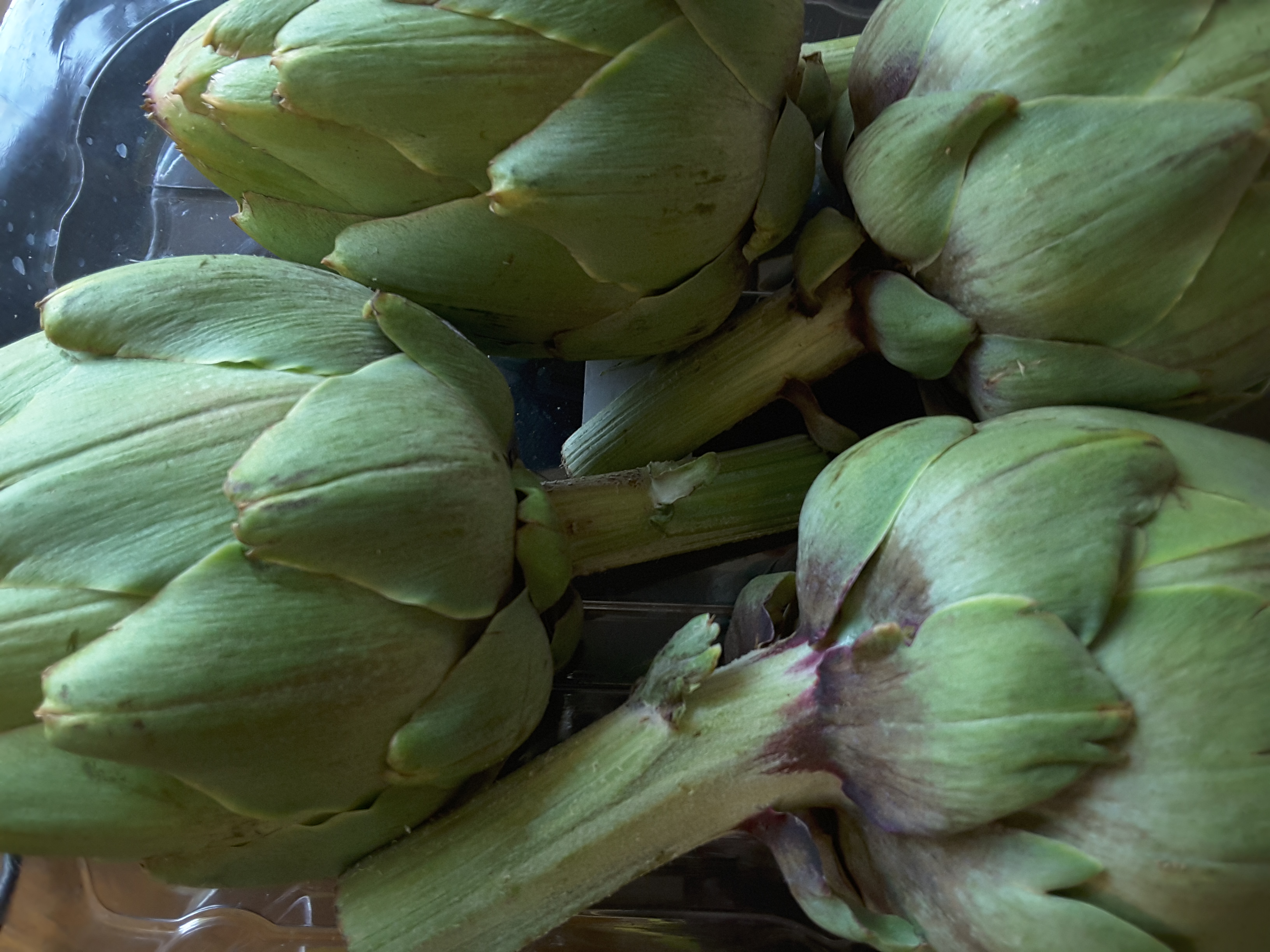
And I’d like to add two more mostly-microwaveable items to that list, because for just us, I’ve decided to snag a box of globe artichokes at my local Trader Joe’s and also a bag of wild rice for a pilaf with some chopped apple, onion, mushrooms and pecans or walnuts, and raisins or other dried fruit.

Artichokes I’ve already steamed successfully in the microwave in years past, but I don’t think I’ve ever posted the method here. It’s pretty straightforward and similar to my usual method for steaming broccoli or brussels sprouts or other cruciferous greens, just a few minutes longer per pound because they’re whole, they’re tough, and they contain less of their own water.

The wild rice I’m trying in a microwave for the first time–going by my brown rice experiments, I’m going to hot-soak it for a bit to crack the outer husks, then microwave it in earnest for a few minutes at a time, letting it sit and soak up the hot water for a while undisturbed before stirring and testing and deciding if it needs more time. Hopefully it won’t get mushy. It’s already after 1 pm so I’m going to break off with just this and then go microwave some cranberries, wash a few glasses, clean off the table (got to look better than it really is), and get dressed for company, at least sort of–I have a family to Zoom!

A toast to all of you–Happy Thanksgiving, make sure to give to your local food bank and homeless shelter this season, because even small amounts help, and may we all have a safe and better year.

Whole Artichokes in the Microwave

  1. Trim the thorny, tough outer leaves and the stems off a couple of large or a bowlful of baby whole artichokes. Open the centers carefully–there may still be a few thorns inside–and use a spoon to scoop out and discard all the dandelion-like fuzz and trim off any thorns at the top of the soft inner “heart” leaves.
  2. Squeeze some lemon juice on and inside, plop the artichokes in a microwaveable container with about 1/4-1/2 inch (~1 cm.) of water in the bottom, add the lemon half if it’s washed and organic, or just squeeze a little more juice into the water. Put on a lid and microwave on HIGH for about 7 minutes, then let sit a few minutes. 
  3. Test for doneness by pulling off one base leaf (should come away very easily) and/or poking gently through the bottom of one of them with a sharp knife to test if it’s tender enough. Add another minute or so if they’re not there yet.
  4. If you have more than one layer of artichokes in the bowl or container, the ones at the bottom may be less cooked than those at the top, so you may want to bring those up before adding any additional cooking time, or remove the fully cooked ones and then microwave the less-done ones a minute or so more with the lid on.

Serve with basic lemon-butter sauce that my husband prefers because his mother made it that way (melt a little butter, squeeze in some lemon juice, scoop out any seeds that fall in) or the more exciting tzatziki-type sauce I like better with artichokes: nonfat plain Greek yogurt, a dab of garlic, a drizzle of olive oil plus a squeeze of lemon juice, and a little thyme, dill and mint or basil chopped and mixed in, cracked black pepper optional.

The Afikomen Conundrum, plus a quiche for our times

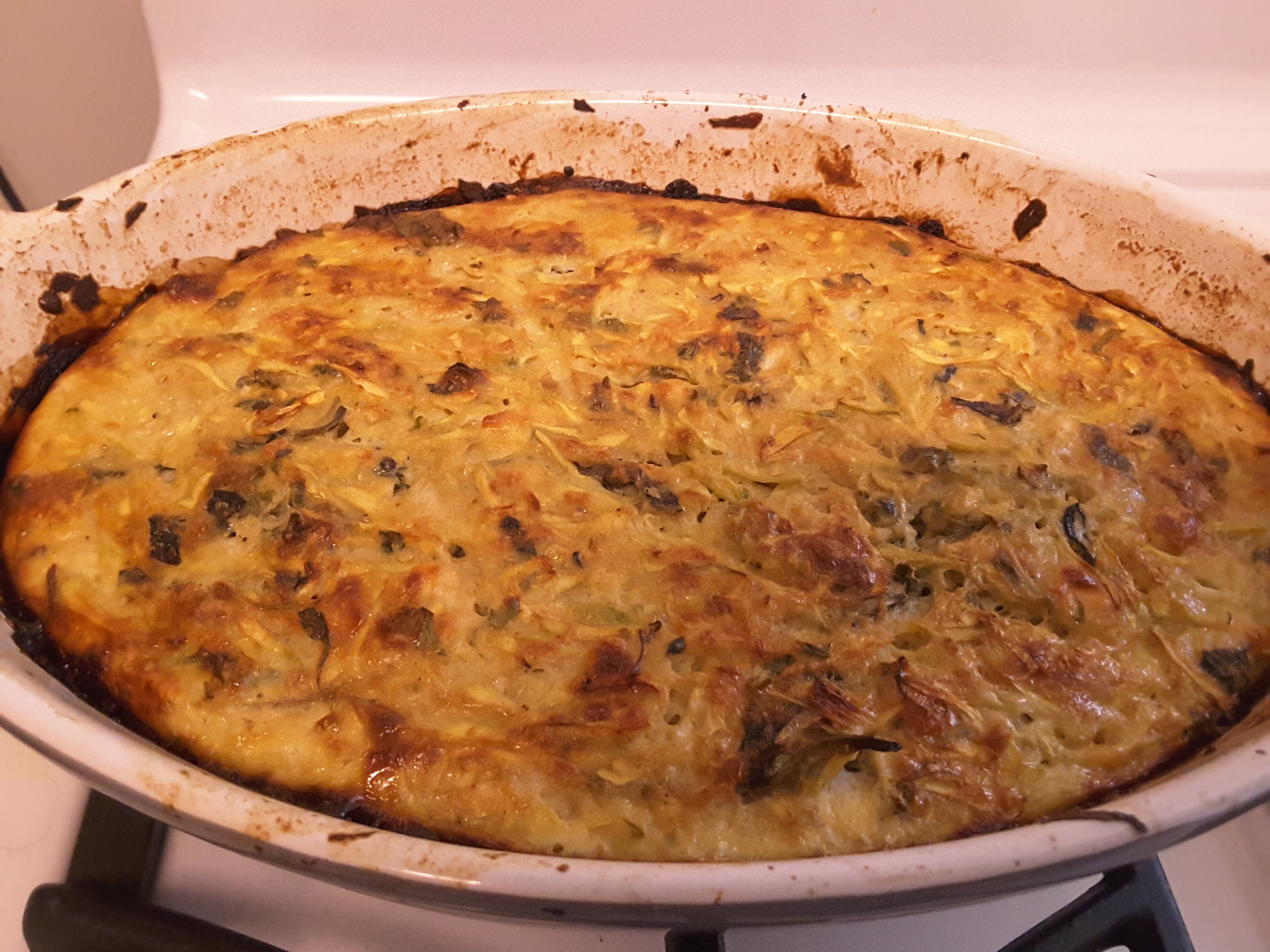
zucchini crustless quiche

On the lighter side of Passover, now that it’s the last day for anyone outside Israel, I did catch Terry Gross’s wonderful Fresh Air interview with Adam Sandler and the Safdie brothers on NPR back in December and was delighted to hear that the brothers included the first-ever mention of the afikomen in an English-language film. It’s about time! I mean, bagel and chopped liver references can only take you so far with Jewish culture. Afikomen is the real insider stuff.

Then, of course, Terry realized that all four of them, herself included, were talking inside matzah-ball or at least Aramaic amongst themselves on-air, and the uninitiated radio listenership who had never even been to a Passover seder might need some enlightenment on the subject of afikomen. Yes, it was exactly like having to explain a joke, and no, the great mass of society probably still didn’t get why a broken matzah is more important than a whole one, or why you’d bribe the kids to give the other half back once you’ve hidden it somewhere cleverly during the meal.

But Sandler and the Safdies ran with it and tried not to make it any more like explaining a joke than they had to. At least Terry didn’t pick the Hillel sandwich to riff on. (Partly because no matter what the Haggadah says about it, there really is no good logical or culinary explanation for eating a combination of apples, nuts and horseradish all together on matzah. It just is, you know? Tradition!)

Anyway, the interview was actually enlightening and smart, and the link is still up online, so go listen to it and donate to your local NPR station while you are wondering, as I am, where we go from here.

I look back to where we were only a month ago and realize that I am thankful my daughter is with us, that my mother and sister and their families and my in-laws are all well if a bit frustrated at home, especially the younger generations with young kids. Back then I  was starting to wonder if there was actually going to be matzah in the stores by the time we needed it or whether I would have to enlist my daughter for some not-quite-kosher-but-best-we-can-do homemade matzah from the leftover bag of flour that I couldn’t bring myself to throw away this year–it seems like more than a sin to throw away anything you could use later, anything you might need, or that someone else could use now.

I mentioned this to a friend back east when Governor Hogan of Maryland decided to declare a statewide a lockdown a week or so after California’s, and we were comparing notes about having college-age kids stuck at home for the duration. It was about a week before Passover started, and a few days later not only was there finally some matzah available at the store, just in the nick of time, but a big mystery box arrived at our door later the same day. When we opened it, we discovered she’d sent us two boxes of Streit’s matzah, just in case. She’s really something else!

As mentioned above, today is the last day of Pesach (Passover in English) if you live outside Israel. My husband is hoping for pizza tonight but since  the stores are closing before sundown, I somehow doubt it’s going to happen tonight. Plus we have two whole boxes of matzah left and a bunch of rice, which I cooked starting with the second night. Turns out many, many American Jews other than us have also decided this year to expand their Passover cooking options to Sefardic traditions that include rice.

I even have most of a packet of quinoa, which is so recent in the Jewish world that rabbis everywhere have declared it kosher for Passover. Somehow that declaration annoys me. Quinoa’s an expensive grain compared to rice and the major importers and cultivators probably paid someone off under the table to get this vegan-trendy chic grain declared ritually different from all other grains, cereals and seeds including rice. Call it Dizengoffia or Beverly Hills Syndrome, and yes, I’m really that much of a cynic, but put it this way–nobody’s bribing anyone about rice as far as I know. Rice is common, inexpensive and traditional, and it’s already approved for Sefardim and most Mizrahi Jews as well.

Small wonder a lot of us have decided to go Sefardi this year, and possibly every year from now on.

Anyway, since this is me, I made some of the quinoa last night in the microwave just to see how it would go–answer, not bad, and pleased my daughter, who along with her college housemates is more conversant with quinoa than I am. I think it’s twice or three times as expensive as rice; they’re still young and excited and into brandname olive oil, gourmet coffee, designer vinegars and  and vegan-chic ingredients because they’re all so new to cooking on their own and still a bit gullible.

It takes time, practice and ruining a few expensive buys on your own dime to realize that fancy-label ingredients won’t make you a great cook automatically. You can go online all you want–even here, if you have the patience to read through all my grumbling and occasional bouts of wild enthusiasm. The fact is there’s no substitute for trying it yourself and being willing to eat your mistakes as far as they’re edible and figure out from them how to fix them up now and do better next time.

But in any case, the quinoa, microwaved or not, is still quinoa, with an earthy, bitter edge similar to buckwheat (kasha).  So definitely squeeze on some lemon or mix in some vinaigrette; instant improvement. My kid agrees–there’s vegan chic and then there’s too chic. And if you’re going to buy it and try it anyhow, you need to be willing to work with it and make it good or else. At least not waste it.

More to the point of frugality, I have been trying mostly to practice what I preach and buy and use cheap vegetables plentifully this week instead of reaching for yet more matzah and cheese at every turn, or using up more eggs at once than is wise in a time when you’re limited to two cartons a customer when you can even get them, and where a lot of supermarkets are now stocking medium-sized eggs when they can’t get enough large ones.

My standard Israeli-style spinach and feta flan for Passover (or any other time) calls for 6 large eggs for a pound of squeezed-out spinach, but you can reduce the eggs to 3-4 and increase the milk to 1.5 c and/or add a bit of bread or flour (if you’re not cooking for Passover), rice, matzah meal, grated or mashed cooked potato etc. –the starch absorbs some of the excess liquid and acts as a binder. And you can use a different vegetable as the main ingredient.

Zucchini are some of the common inexpensive fresh vegetables being neglected most often at the Ralph’s (Kroger affiliate here in the west). I bought a bargain bag for a dollar on my last shop (still doing that where possible) and washed them carefully à la COVID-19 precautions (spritz with dilute dish soap along with all the other groceries, rinse well, airdry, hope for the best). Today I decided it was time to use them for the last Pesach lunch and that they were better to use up now for a crustless quiche than the bags of frozen spinach which cost twice to four times as much and can stay in the freezer. Continue reading

Rethinking “pantry staples”

Whenever I see the words, “pantry staples,” I immediately hear that line–the only one I can remember–from Saturday Night Live alumna Julia Sweeney’s one-woman show God said, Ha!, from the late 1980s or thereabouts. Sweeney’s midwestern mother comes to visit and pokes around in her New York City kitchen cabinets, then asks, “Where’re yer mixes, hon?” And Sweeney realizes how much living in New York has changed her–she no longer buys box mixes for anything because all her standards are higher.

Likewise, I’ve been thinking lately that it might be a good idea to redefine pantry staples as something more useful and better-suited to a heart-healthy, inexpensive and vegetabalia-filled diet than the usual stale set of dried-out spices, indestructible and tasteless boxes of mac ‘n’ cheese and Hamburger Helper,  bouillon cubes and Ritz crackers.

For people whose cooking experience and time are limited, or who grew up in the Pop-tart generation (what I’m calling most of my contemporaries from the ’70s and ’80s schoolyards), well, we’re all in our 50s and 60s now and our doctors are always telling us to lose weight, eat more vegetables,  get more fiber, cut back on takeout, etc. etc. And it’s now looking like we may get that extra incentive.

Food blog readers are a little more likely to shop like they mean it, but in practice, a lot of the otherwise bright and well-educated people I know are still either stuck in the where-are-your-mixes mindset or else buy unnecessarily expensive designer ingredients that aren’t flexible for day-to-day cooking–which in fact they don’t really do. Actually, none of them seem to cook much at all anymore.

The mixes crowd relies on drive-thrus for refueling on the way to the kids’ soccer practices. No veg. The foodies’ pantries contain 29 or so designer vinegars, but their actual dietary staples are Amy’s™ frozen vegetarian (but high-sodium) prepared meals and/or takeout containers from the Whole Foods deli counter, supplemented with wheatgrass-and-spirulina juice drinks, smart waters, kale chips, a snack baggie of dried goji berries, and those microwaveable frozen brown rice bowls-for-one that cost more than a two-pound bag of actual brown rice. Not much fresh veg there either.

To say this isn’t how we mean to eat is an understatement. But getting from our current conventions to a better daily diet is going to take some rethinking.

Or, of course, a crisis like the one we’ve got now.

If you’ve  been out panic-shopping for toilet paper this week anywhere in the US (and apparently in a lot of other countries as well) and come to a stunned halt at the sight of a completely empty aisle in the supermarket or big-box store, you’re hardly alone.

For the past week, panic has hit the US full-blast and people are trying to think ahead a little in case things don’t actually get better by next week. Last week I was still thinking “climate change” and how to reduce the amount of plastic we go through weekly and check the bargain bins as part of my weekly shopping to reduce food waste. The last few weeks have been full of good citrus finds–mandarins, grapefruit, a bag of cara cara oranges at a dollar apiece–a small, cheering upside to counter all the many, many downsides of the news.

And now this–my daughter just came home for spring break, her college is going online-only for the rest of the semester, she’s worked very hard for several months only to have everything suddenly upended, and she might be home with us more than for the expected week depending on how things continue. I might want her here rather than in upstate New York, just in case she’s got a better chance of getting food, supplies, and medical treatment. Even though the first day home was the usual vacation stake-out-the-exact-middle-of-the-couch-and-watch-movies.

So. Now it’s “what’s the best thing to stock up on if we needed to get through a couple of weeks without much available at the stores?” You can’t do a ton at once unless you have a big budget and a big storage area–an extra freezer?–but you can probably figure that most of us could make smarter choices if we have to.

I’m not sure the mother-daughter team just ahead of me at Trader Joe’s was doing that on Friday, even though they had corralled two extremely full shopping carts for the task (and mistakenly hijacked someone else’s cart for rebagging before they realized it wasn’t their stuff). A lot of frozen stuff, a lot of canned stuff, a lot of bottles of wine and several of something harder.

Maybe that’s a good way to cope, if you can drink? Priorities!

Me? about 5 pounds of frozen fish, two big cartons of plain yogurt, two cartons of eggs, 3 pounds of cheese, some for freezing for later, some spinach and a pound of almonds and two pounds of sunflower seeds. And tofu. And three big cans of unsalted tomatoes. Three pounds of carrots. Two pounds of whole-wheat spaghetti. And–mostly for encouragement–a big 17-oz bar of TJ’s 72% chocolate. Feel like it might be important, somehow. And it’s just hard enough to break up that we won’t scarf it. As I say, priorities.

I have dried lentils and chickpeas and rice; I already have a ton of cheap, hardy veg in the fridge, a big Kroger/Ralph’s bargain can of coffee that’s not bad if you grind it finer, and milk and so on.  And two bags of flour and one new bag of sugar. And two big cans of pumpkin. And spices and teabags and oil and wine. If we really have to, I suppose we could probably get through a couple of weeks if we’re careful. Now if I only felt safer.

Probably doesn’t help that it’s raining a lot and that I just did our taxes. And that our local NPR station has ditched its half-yearly fundraising campaign to the web so they can bring us uninterrupted wall-to-wall coverage of COVID-19 and All the Resident’s Follies (and follicles) at a 24/7 kind of level. All, and I do mean all, day long. All weekend long. I may ask them to return the donations I already gave them if they don’t give it a rest–or at least give me a rest.

I could only take a few minutes at a time while I was out running chores, and I barked horribly at my husband tonight to please, please spare me for at least 10 minutes and stop reading all the “latest” updates aloud from his smartphone while I was making dinner.

I could already recite every major news point myself without a TelePromptEr–unlike certain puffed-up White House windbags. So. Nothing new there.

I have officially hit my limit. At least for tonight.

I have shopped. I have cleaned. I have cooked. I have washed sheets and towels. I have called my sister and calmed my daughter and switched temporarily to cloth napkins in case we need to reserve the paper we have. I have skulked around the backlot of Target before they opened this morning to witness a line of at least 80 people hoping to snag the limited daily resupply of TP. The Stones couldn’t hope to do better this week–probably because their concerts are cancelled too.

So maybe it’s time to redefine pantry staples as reliable foods you keep on hand and use regularly to help you achieve a balanced real-food, DASH-style diet at home without a major production and daily shopping for specialty ingredients. To my mind, this means starting with the building blocks of the major food groups: lean and relatively unprocessed proteins, nonstarchy vegetables, starchy vegetables and whole grains, beans and legumes,  fruits and either low-fat dairy or calcium-containing nondairy equivalents.

Trying to set up your kitchen to follow a DASH-style diet without going broke  Whole Foods-style is a major shift for a lot of people–especially the call for eating more vegetables, which is the number one thing that seems to have gone missing. Everybody I know–including some dedicated vegetarians who don’t even blink at the prices for tiny packets of prepared seitan and tempeh meat substitutes–is used to protesting that buying fresh vegetables and cooking them every night would be too expensive and too much trouble.

But in fact, even at the major chain supermarkets, regular bulk vegetables are, pound for pound, cheaper than almost anything that comes in a box or jar or can, and they pack a lot more nutritional value without all the detriments of salt, fats, corn syrup, starch thickeners, artificial flavors and colors, preservatives and other unpronounceable additives.

And frankly, fresh veg and most ordinary fruit is still not out of stock at most supermarkets. It’s easy to find, reasonably easy to wash, cut up and microwave or steam or throw into a frying pan or stockpot or slow-cooker. It’s nutritious. It’s filling. It’s low-calorie and versatile. And it’s a good way to stretch the meat, the eggs, the beans and rice that have been snatched up ahead of it. And we have the time and the need for variety.

Be safe, be well, wash hands and do pick up some bulk veg and fruit if you’re shopping for food–and pick up one or two items to contribute to your local food pantry if you can. Check in on your neighbors and family.

Finally–if you have even a little time and room to try gardening, even in washed-out yogurt containers, it’s surprisingly satisfying to grow herbs and a few vegetables here and there. Save and plant a few seeds from things like peppers or beans or tomatoes or squash from the supermarket when you cook, and try peeling and potting the little shoots from the inner root stumps of bok choy and onions too. It’s a much better kind of thing to propagate than what we’re seeing in the headlines.


New Year, New Food: Cabbage Rolls with a Greco-Ottoman Twist

Cabbage rolls with giant fava beans and tehina sauce


I always have such good intentions–and end up writing about them much later than I should. Let’s face it, it’s almost Thanksgiving. But not quite yet.

In late September, at the start of the High Holidays, we were finally starting to feel fall weather in Pasadena–one week quite cool, the next hot again, but at least for a while we were generally out of the 90s, so it was time to experiment in the kitchen, doing things I’ve wanted to try out for years.

Only it’s been a surprisingly busy month or two, so I’m just getting back to posting now. We traveled several times this summer visiting family, taking our kid back to college on the east coast, and heading up to Portland for a wedding–very impressive hotel with actual good food (it is Portland, after all) and its own kitchen garden with massive tomato vines.

Then I came home to articles due and a life-changing decision to make: after 25 years with the last of the noncomputerized Corollas, which I loved with or without adequate suspension and shocks, it was finally time to get on it and buy a new(er) and hopefully more fuel-efficient hybrid at a reasonable price if at all possible.  (Note to the Resident: who in their right mind would want a new car that gets worse mileage? Get real.) But I’m going to miss the crank windows of my old car something fierce.

But on to new food for the New Year–this is still occasionally a food blog!

I had a 25-oz (1.5 lb or 700 g) bag of giant fava beans, gigantes in Greek, and decided, what the heck, it would be nice to have a large batch I can eat cold or hot during the week for lunch or a casual-elegant side with some salad at dinner. Once my kid was off at school, you know, I could count on supper leftovers to stay uneaten until I took them back out of the fridge. I like to cook but really, it’s been handy doing the “cook once, eat at least twice more” thing.

So I microwaved the whole thing in two batches, switching two snaplid containers in and out of the microwave for a couple of rounds, letting one cook a few minutes in water to cover while the previous one sat to let its beans absorb hot water. Once both were done and the beans were tender, I drained them and started pinching off the loose dark gray skins. Great–well, I had enough for two different recipes. One was going to be the marinated beans with rosemary and rosé. The other batch–well, I could freeze it for later. Or…

And then I thought about two striking recipes I’ve meant to try for years, both for cabbage rolls very different from the sweet-and-sour stuffed cabbage my great-aunts used to make, and which I don’t really like very much even now that I’m a supposed adult.

One version from Rena Salaman’s The Greek Cook: Simple Seasonal Food (Anness, 2001) has a chunky filling of smoked pork and an avgolemono sauce, which I’ve wanted to do a vegetarian or at least kosher riff on for years. Combining lemony sauce with a smoky filling is right in line with my love for Middle Eastern food…and speaking of,  the other cabbage rolls, the ones that first stopped me in my tracks, came from The Turkish Cookbook: Regional Recipes and Stories by Nur Ilkin and Sheilah Kaufman (Interlink Books, 2010) and were vegetarian to begin with.

What makes a cookbook worth trying are the foods and flavors you don’t already know. The first photograph I saw the first time I opened The Turkish Cookbook, from somewhere in the middle of the book and the region of Marmara, was a beautiful plate of vegetarian cabbage rolls so translucent you could see the filling–roasted chestnuts and rice. These were flavored with cinnamon and allspice, mint, parsley and dill, stewed in olive oil and served cold, like most dolmas, with lemon wedges. Quite a combination of flavors, and unexpectedly beautiful.

Here was something I’d never seen in another Turkish or Middle Eastern cookbook, but I could tell from the description that the flavors would work. My imagination started running away with me and when I first saw them, I thought…chestnuts? Can I get them? It is fall–maybe they’re in my greengrocer’s this week. If not, is there something a little less expensive that tastes similar–a little potatoey, tinged with sweet–how about those giant dried fava beans? But it took me more than five years to try it. Now (meaning, back in September) seemed a pretty good time.

Bridging the gap between the two versions–Greek and Turkish–I decided to make a fava filling and flavor it more or less as for the Turkish version, but add the lemon and smoke factors of Rena Salaman’s cabbage rolls by saucing mine with tehina and sprinkling with paprika and caraway seed.

And of course, I was going to do most and frankly all of it in the microwave. Except for the rolling–microwaves don’t make that step shorter! But steaming the cabbage leaves, cooking the beans (already done), and stewing the cabbage rolls in sauce–all nicely microwaveable.

The only thing I didn’t do was add rice or currants and pine nuts to the bean filling. The rice might have held the cabbage rolls together a bit better when trying to eat them. But they were pretty delicious hot or cold and lasted me a couple of days.

Cabbage Rolls with Giant Favas and Tehina

Loosely adapted from The Turkish Cookbook and The Greek Cook Simple, Seasonal Food as noted above. You might want to stir in a bit of cooked plain rice to help keep the rolls together.

Filling (flexible on amounts here, but let’s say for a couple of cups of cooked beans):

  • cooked, peeled giant fava beans
  • chopped onion
  • Allspice, cinnamon, coriander, fennel seed, black peppercorns, (salt)
  • Mint, dill–chopped fresh if possible, about a small handful each, 2-3 sprigs
  • Garlic–minced/mashed/grated, 1 fairly sizeable clove or to taste
  • Olive oil
  • Lemon juice

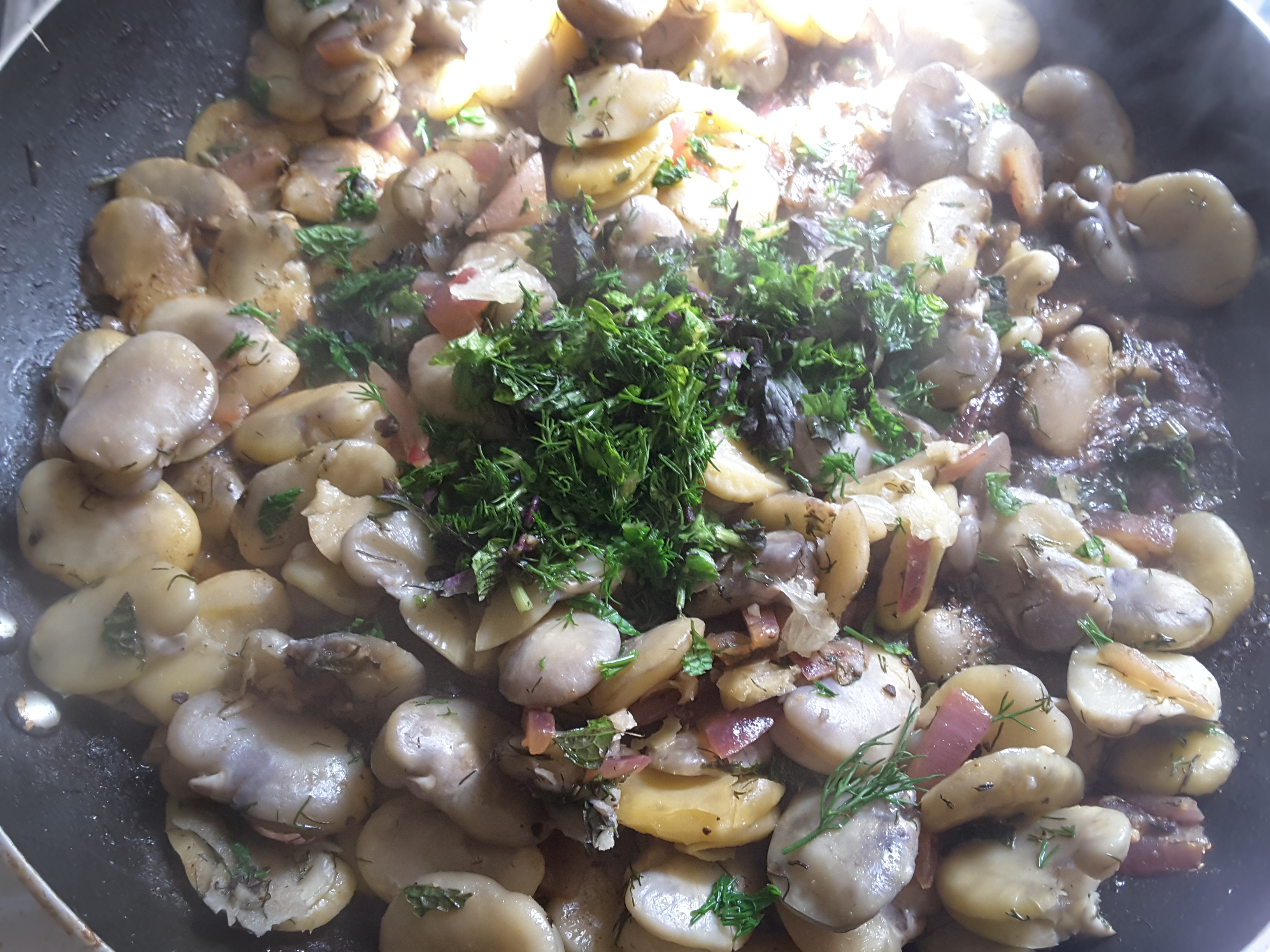
Heat a couple of tablespoons of olive oil in a nonstick pan with about half a chopped onion, a teaspoon each of ground allspice and cinnamon, half a teaspoon each of coriander and fennel seed and a good grinding of fresh-ground black pepper. Stir occasionally until the onion starts to brown. If needed, add a quarter-cup of water, stir, and let cook down to keep things from sticking and to get the onion cooked so it can start browning. Squeeze on a bit of lemon juice, then add the cooked, peeled favas and more juice and more olive oil. Add the garlic and the chopped fresh herbs and continue to stir/toss in the frying pan until the beans are coated but not swimming in liquid, and they’re quite tender–you can add bits of water once or twice and let it all cook down. Taste for salt before adding any. Continue reading