• Enter your email address to subscribe to this blog and receive notifications of new posts by email.

    Join 241 other subscribers
  • Noshing on

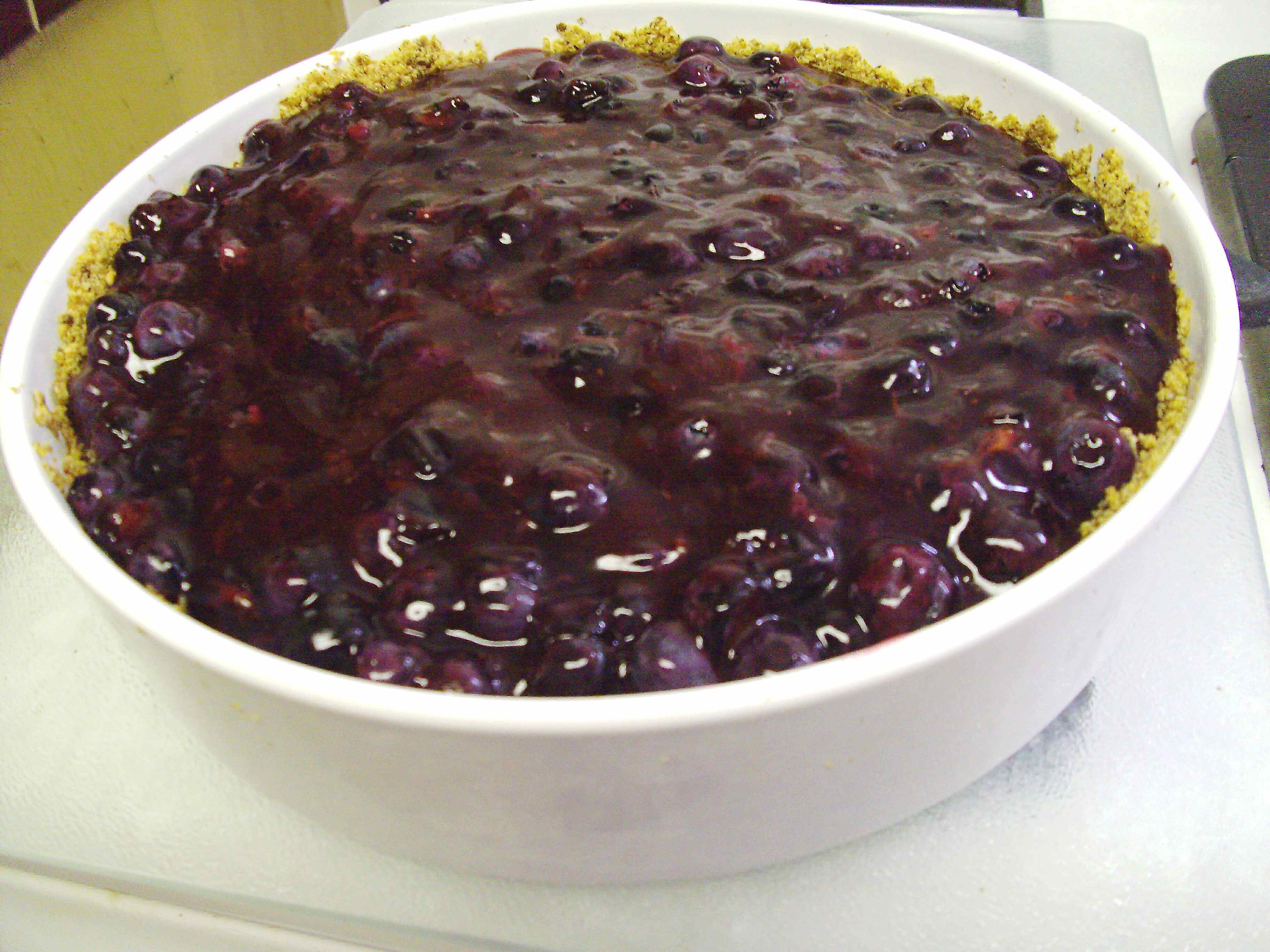
    raw blueberry pie with microwaveable filling and graham cracker crust

    This mostly-raw blueberry pie is a snap to make and very versatile--the filling microwaves in a few minutes, and you don't even have to bake the zippy gingered graham cracker crust--perfect for a hot Fourth of July and all summer long.

  • Recent Posts

  • Contents

  • Archives

  • Now Reading

  • See also my Book Reviews

  • Copyright 2008-2024Slow Food Fast. All writing and images on this blog unless otherwise attributed or set in quotes are the sole property of Slow Food Fast. Please contact DebbieN via the comments form for permissions before reprinting or reproducing any of the material on this blog.

  • ADS AND AFFILIATE LINKS

  • I may post affiliate links to books and movies that I personally review and recommend. Currently I favor Alibris and Vroman's, our terrific and venerable (now past the century mark!) independent bookstore in Pasadena. Or go to your local library--and make sure to support them with actual donations, not just overdue fines (ahem!), because your state probably has cut their budget and hours. Again.

  • In keeping with the disclaimer below, I DO NOT endorse, profit from, or recommend any medications, health treatments, commercial diet plans, supplements or any other such products.

  • DISCLAIMER

  • SlowFoodFast sometimes addresses general public health topics related to nutrition, heart disease, blood pressure, and diabetes. Because this is a blog with a personal point of view, my health and food politics entries often include my opinions on the trends I see, and I try to be as blatant as possible about that. None of these articles should be construed as specific medical advice for an individual case. I do try to keep to findings from well-vetted research sources and large, well-controlled studies, and I try not to sensationalize the science (though if they actually come up with a real cure for Type I diabetes in the next couple of years, I'm gonna be dancing in the streets with a hat that would put Carmen Miranda to shame. Consider yourself warned).

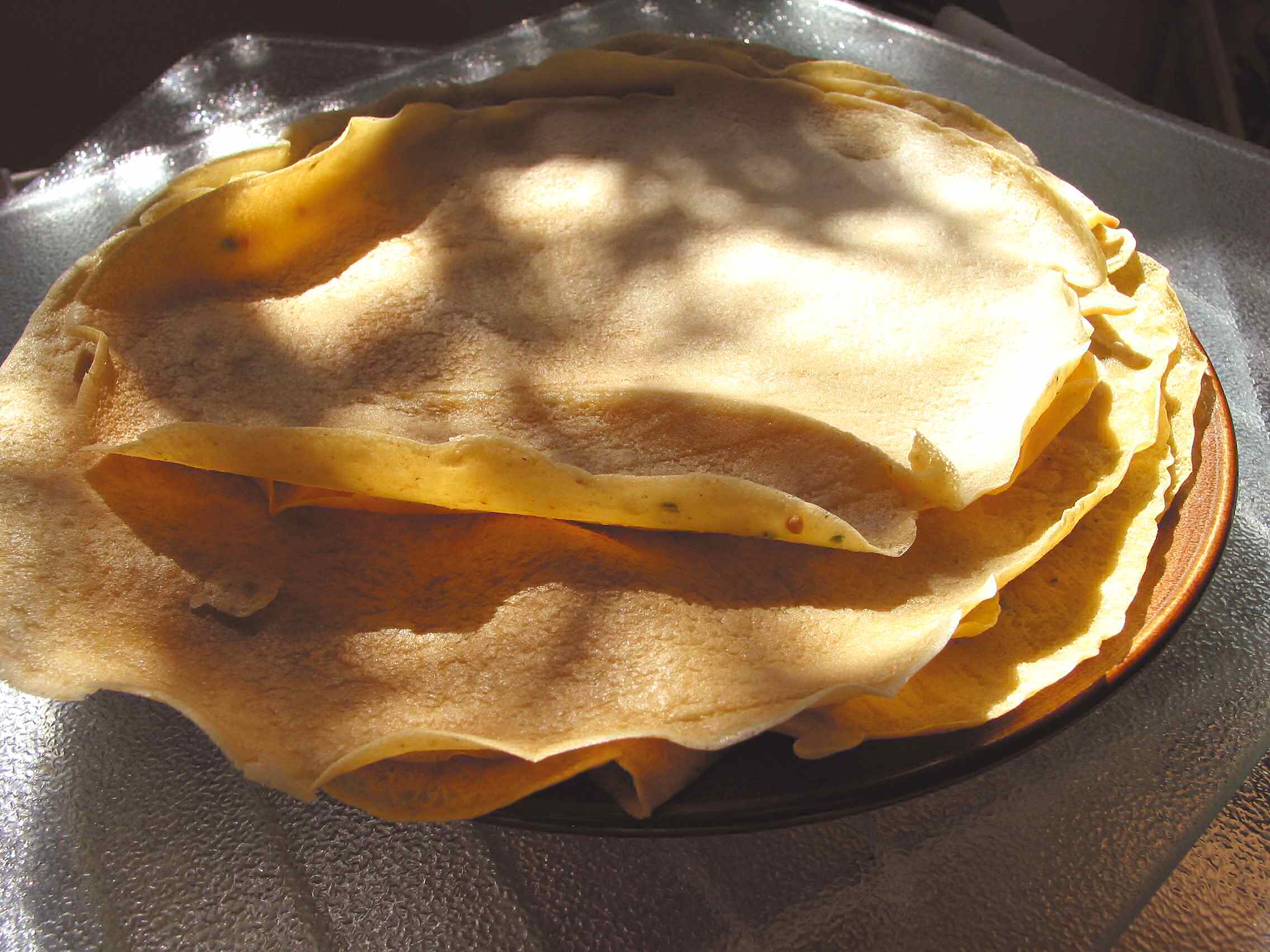
Chickpea Crêpes, Masala Dosa style

instant dosas with chickpea flour, ground rice and yogurt

Project 1 of Panic Week: “instant” dosas made with chickpea flour, rice and yogurt. The heavy dose of mustard seed and black pepper is surprisingly good.

Planning the cooking for Passover usually means thinking about the week itself, buying matzah and gefilte fish and horseradish and so on. But for me, it also means using up the open bags of flour, beans, rice and pasta, plus whatever yogurt, cheese and milk I have left, and yet not overdosing on starches. And I’ve just gotten the taxes done, so it’s time to look in the fridge and panic.

We’ve got just over a week to go before Passover, and there’s still a lot of chametz in the house…a pack of fillo (luckily only one), a pound each of dried chickpeas and red lentils, a bag of mung beans I don’t really know how to use, some rice, a bowl of dough…wonton wrappers. Chickpea flour! Rye flour! Why did I leave it all this long [breaks down and bangs head against wall for a second]?

I don’t usually want to cook or serve that much starch in a single week, but at least most of it is legumes with some fiber and protein. So I’ve been thinking about foods–both chametz and not-chametz–that don’t have to be devastating dietwise or empty your wallet or take forever and a half to cook.

Because even with snow on the ground all over the east coast, where my mom and my sister and most of my old friends are still shoveling it out of their driveways this late in March, Pesach is coming. And then maybe an actual spring with shorts weather? We can only hope! Time to lighten up in anticipation.

This week I’ve decided to post the chametz countdown (aka, “Panic Week”), and the next week or so, a couple of attempts at a Pesach week with mostly fresh, simple foods and a lot more vegetables, and without the usual total matzah-on-eggs-on-more-starch-and-potatoes-and-choke-cake-and-too-many-canned-macaroons kind of meal plan…can it be done? I think so. As long as I don’t let my husband do the shopping. Can it be done in a microwave? I’m counting on it.

Anyway–back to the Panic Week Project. First up, the chickpea flour and rice…as a batter for on-the-spot masala dosas. Continue reading

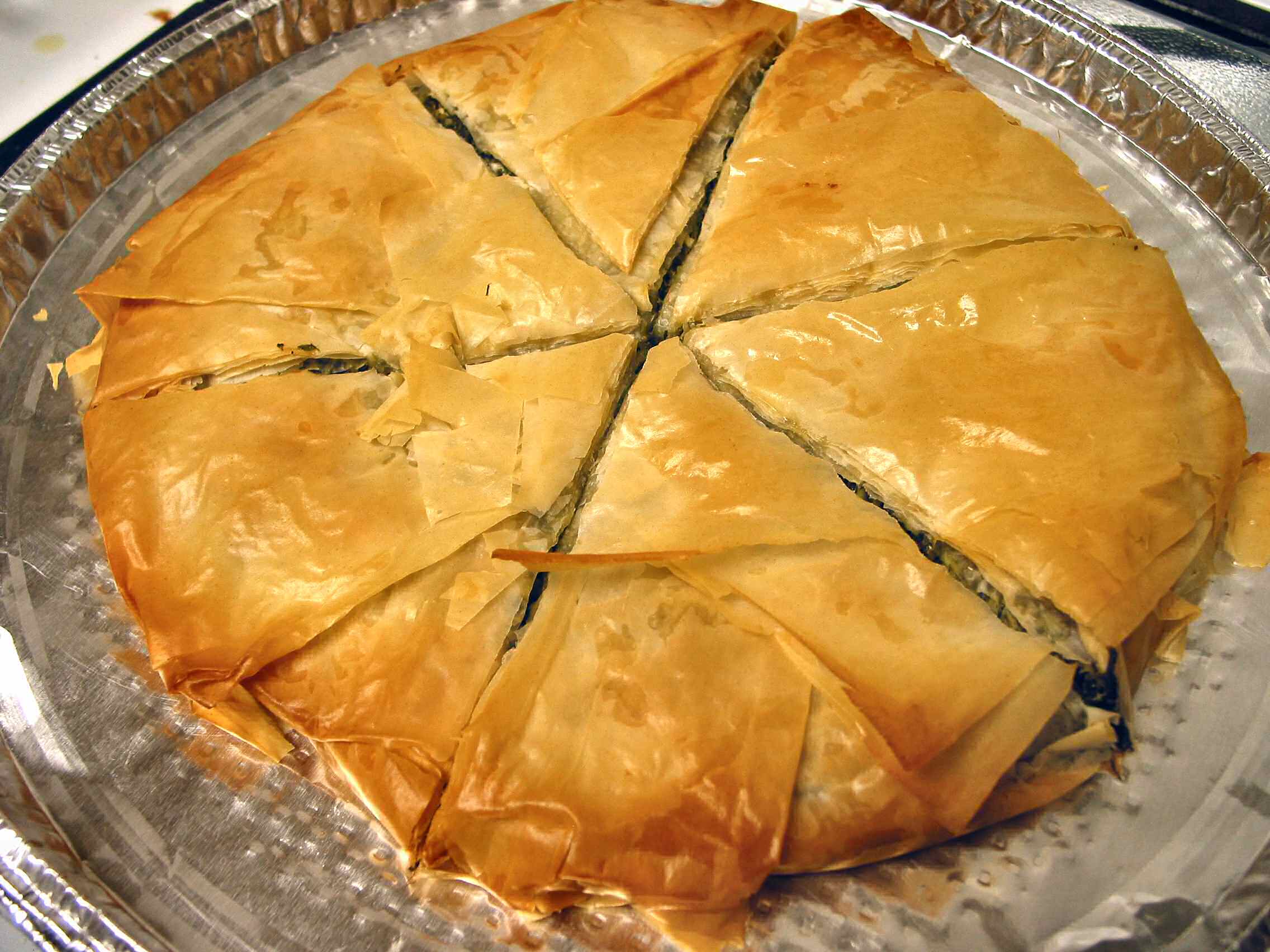
Artichoke-olive spanakopita for a party crowd

Artichoke and olive spanakopita tastes authentic even though it's completely nondairy. The party round is pretty quick to put together, too.

Artichoke and olive spanakopita tastes authentic,  even though it’s completely nondairy by request–which makes it a good vegan choice too. And it’s easy to put together.

Last night we went to a big New Year’s Eve party–a rarity for us; we’re usually with family one coast or the other. Of course, getting to go to a party means rushing around the house a few hours ahead to find an outfit that fits, is clean, looks about right, doesn’t require very high heels or an engineering degree to figure out how to put it on. Luckily most of our friends are low-key that way.

The party was potluck–the hosts provided a couple of solid main dishes and we and the other guests brought the side dishes and accoutrements. A pretty good division of labor, I think. So I offered to bring spanakopita, which is pretty easy. Or at least, I figured out an easier way last week to get the spinach squeezed out than by doing three pounds of spinach handful by painful handful, and it was pretty good for the Chanukah party, so why not do it again?

But our hosts’ family, all five of them, have a cluster of serious food allergies–primarily eggs and dairy, but a couple of other odd ones like cinnamon as well, and not all of the allergies match up from person to person. It’s a testament to their bravery and sociability (which I admire and wish I had greater stores of) that they throw big parties and let other people bring food.

I decided to do spanakopita anyway and just leave out the dairy–butter isn’t a big deal if you have olive oil for the fillo leaves, and I don’t make it with eggs in the filling. So far, so good. But what should I substitute for the feta? Feta’s usually a big part of the show.

Tofu might have been easy, and it’s a protein source, but one of the kids can’t do soy, and it doesn’t really taste right. Nuts–don’t know. Nondairy cheese substitutes–I haven’t tasted these myself and they have so many ingredients plus loads of salt that it wasn’t worth chancing without consulting the family.

My best options to add to the spinach came down to:

1. Greek olives, pitted and chopped–right on the saltiness, but maybe odd-looking. No one else I know has ever paired up spinach filling with olives.

2. Cooked and drained mushrooms–I would do this, but my daughter confesses she doesn’t like them when I make spinach quiche. And she does like my spanakopita. So…

3. Marinated artichoke hearts–they have a little saltiness, but mostly lemon and garlic, which is just about right. And artichoke hearts pair pretty nicely with spinach and are a familiar enough combination that most people will probably be okay with them. You just have to remember to drain them well so they don’t make everything soggy.

I thought I’d go with the artichoke hearts alone, but after tasting the spinach and artichoke heart filling, adding more lemon and garlic (because you can never have enough) and herbs and scallions, I decided what the heck and threw in a handful of Alfonso olives I had in the fridge–12 big purple, winy olives, pitted and slivered, did not look weird after all and they gave just enough distinctive tang and salt for the big salad bowl worth of filling to satisfy without overpowering it.

I figure, when you try something new or off-beat with a substitution, you have to test-taste to know if it’s worth doing again or recommending to anyone else. Maybe no one will agree with you, or maybe they will, but if you don’t like the result to start with, you’ll feel bad serving it up. Or maybe you’re made of tougher stuff than I am and it depends on who you’re serving it to and what have they done for you lately?

So anyway, if you can’t have feta or other dairy, this is definitely a good way to go. The olives and marinated artichoke hearts are authentically Greek enough not to taste or feel like fakey or second-rate substitutions. The spanakopita ended up tasting pretty good, and got eaten up amid some serious competition.

Also, I’ve decided this is also a good time for a slideshow. For a while now I’ve been meaning to do a step-by-step post on setting up a round tray of spanakopita or baklava, because I think it’s simpler and quicker than a plain rectangular casserole, and it looks more impressive and party-ready too. So I took some pictures as I went along (note to self: wipe olive oil thumbprints off camera grip), Continue reading

Microwave Tricks: 10-Minute Tofu

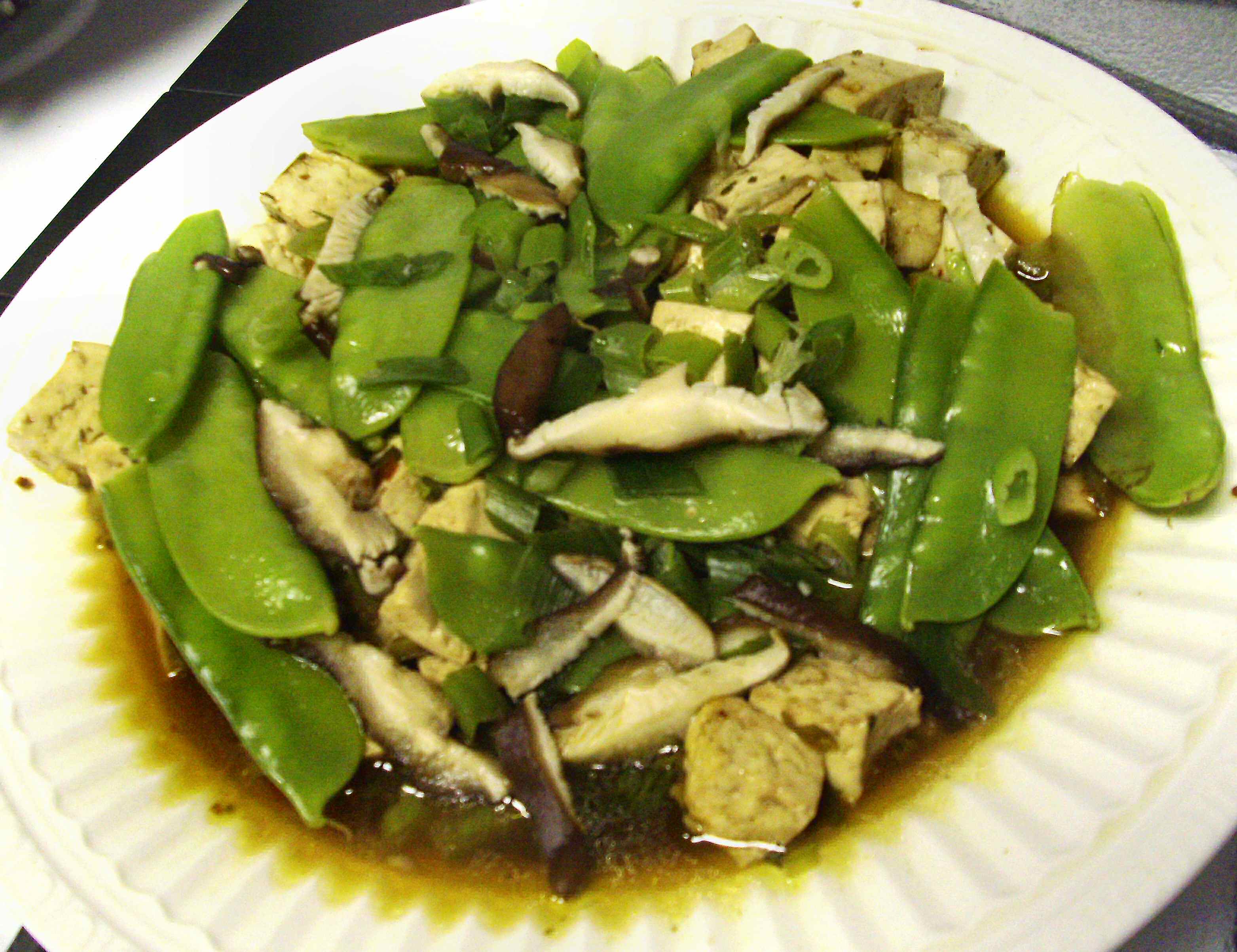
Microwaved platter of low-sodium tofu with snow peas

Microwaved tofu platter in minutes, minus the big oil and salt overload of takeout. I’ve used snow peas and shiitake mushrooms this time, but you could use any greens you like and mix them up–bok choy, broccoli, green beans. Frozen snow or sugar snap peas work too.

This is the recipe I meant to put in the last post about reducing sodium in Chinese food.

Tofu is, as everyone knows by now, extremely versatile. It’s vegetarian, it’s shapeable, it’s mild but satisfying in flavor, it comes in a variety of textures and thicknesses, and it’s quick to cook–fried, steamed, stuffed, crumbled–or to eat cold. It’s also low-fat, low-sodium, nearly carb-free, and relatively high in protein, with some iron and calcium too. And it’s very inexpensive–less than $2 for a 14-oz. pad of tofu at the supermarket, about three or four servings’ worth.

When it’s hideously hot out, as it was much of September here in Pasadena, you can marinate a sliced cold block of silken tofu by pouring a jao tze-style dipping sauce over it maybe half an hour, garnish with scallion shreds or crushed toasted nuts, and serve it as an appetizer. Or eat firm tofu plain and cold, if you like it. Or throw some tofu cubes into a salad with cabbage, lightly-steamed (or microwaved) fresh brussels sprouts, scallions and halved hard-boiled eggs, and drizzle peanut sauce over it.

Or you can decide there’s no way you’re going to stand over a stove with a frying pan, but you’d like a proper cooked dinner that resembles kung pao or ma po tofu with some greens, just not doused in heavy greasy oversalted sauce or requiring a run to your local takeout, and it would be nice if it were very quick. Very quick. Like five minutes tops. And that it didn’t involve the stove at all.

When my daughter decided she wanted to be vegetarian a couple of years ago, I discovered that you can “quick-press” tofu for Hunan tofu in about 4-5 minutes for a standard 14-19 oz. pad by cutting it up, standing the pieces on a microwaveable dinner plate, and microwaving, then draining off the liquid. Then it’s ready to stir-fry and it’ll brown decently. But I’ve done it so often in the past two years that my daughter’s kind of tired of it now (and has also gone back to eating fish and chicken once in a while). But we still like tofu. And with 100-degree days filling so much of September, there was just no way I was going to stand at the stove. So….

The entirely microwaveable tofu dish below is my daughter’s current preference, because the tofu cubes are softer, steamed in the microwave in a thin sauce rather than browned, and the scallions never scorch. And it’s not bad at all, and it takes, if not a literal 5 minutes, maybe about 10, start to finish.

This is more of a technique than a recipe, really, because you can use whatever cookable greens you have and like–fresh broccoli with the stalks, green beans, bok choy, etc. are pretty classic and generally not expensive per pound, but I’m not against using frozen unsalted (store brand; I’m cheap) sugar snap peas or green beans if the fresh ones are out of season. You’re microwaving; it’ll work out, and you won’t overcook the tofu. Continue reading

Testing salt reduction on a really large scale

Microwaved platter of low-sodium tofu with snow peas

This tofu dish with snow peas and shiitake mushrooms uses low-sodium dipping sauce ingredients as its base rather than soy sauce or oyster sauce. It’s also microwaveable from start to finish and takes about 10 minutes total.

If you have a big enough–and motivated–study population, even modest reductions in daily sodium intake can make a big difference in preventing strokes and heart attacks. Last month, cardiovascular researchers from Beijing and Sydney announced a new 5-year diet trial in Science to do just that (see the general overview article, “China tries to kick its salt habit”).

China’s northern rural poor eat an estimated 12 grams of salt a day on average, considerably more than Americans’ 9 grams a day (which is still over the top) and more than twice the WHO’s recommended 5 grams or less. An estimated 54%, more than half, of Chinese adults over 45 have high blood pressure these days, and the Chinese government is taking practical steps to provide antihypertensive medications and shift the tide back–but that’s an awful lot of prescriptions.

Given the cost of antihypertensive drugs for such a huge population, and the cost of dealing with side effects and consequences of untreated or undertreated high blood pressure, prevention seems the better way to go. The researchers project that reducing the national average by even 1 gram of salt a day would save 125,000 lives a year in China. So they’ve recruited 21,000 villagers so far in China and Tibet, and plan to provide test groups with nutrition counseling plus a lower-sodium salt substitute for cooking, then compare their sodium intakes and rates of heart attack and stroke with those for a control group.

Most Chinese still do their own cooking at home, especially outside the big cities.  If lowering the sodium content of the salt they use works, it has the potential to get an awful lot of people off daily hypertension medication and reverse a major health threat. But will people do it if they’re not in the trial, or once it ends? Will it catch on? And is it the right answer in the long run?

Salt substitutes, with potassium chloride replacing some of the usual sodium chloride, have been tried by heart patients in the US since the 1970s or so. They’re a little more expensive than table salt or kosher flake salt, at least in the US, but they’re not all that expensive. But they’ve never really caught on here with most consumers.

Similarly, a few decades ago, a big public health campaign in Japan to reduce the high rate of stroke led to the introduction of low-sodium soy sauces, with about half the sodium content per tablespoon of traditional ones.

Not much market research is available on how many people have been buying low-sodium vs. regular soy sauce in Japan since its introduction. From the few current market reports I could find–one of them an executive report from Kikkoman–it looks like low-sodium is still a smaller if steady fraction of their business in Japan, and that it’s more popular in Europe and the US than at home.

It’s important to have a low-sodium line for reasons of corporate responsibility and even prestige, but there was no mention of its percentage of total domestic or worldwide sales. Traditional soy sauces, which can range from 14-18% sodium concentration w/v, are still apparently preferred for taste, and the Kikkoman executives attribute much of their expected taste appeal to salt rather than the other flavors in each one’s profile.

That’s kind of discouraging to me. The Japanese are known for more refined and sensitive palates on average than Americans, and their range of soy sauces and tamaris for specific food combinations is much broader and more sophisticated. The higher-quality low-sodium soy sauces are produced by ion filtration to get sodium out rather than simply diluting them with water, so most of the flavor that’s actually flavor remains. I would have hoped the key flavor signature of each match was the actual flavor of the brewed soy sauces, not the saltiness.

It’s likely, though, that the Japanese are just as susceptible as the rest of the world to the sodium tolerance phenomenon–the more sodium you eat habitually each day, the more you expect and consider normal in your food, and you almost stop even noticing it as a separate flavor.

The overall Chinese market for soy sauce is currently estimated at $20 billion and grew about 23.4 percent over the past 5 years, mostly due to population growth. The stakes are pretty high for China, but the government has tighter control of its salt and soy sauce producers than other countries do, and the will to make a broad change seems to be present, at least at a government level, and if the new study is anything to go by, among ordinary villagers as well. So maybe this time it will catch on once the study’s over.

But obviously, if you’re starting out at a 12-gram-a-day salt habit, the best way to reduce sodium in home-cooked food would be to cut back hard on salt and salted items altogether. That takes time, practice, awareness and deciding that it’s worth going through that first couple of weeks until your palate readjusts to a lower-sodium diet (which it will, but it takes a couple of weeks and a little patience).

Can cutting the salt be done with Chinese food? Not American souped-up chain restaurant caricatures of Chinese dishes, which are hideously over-the-top and greasy as well, but actual home cooking? I’ve done low-sodium Continue reading

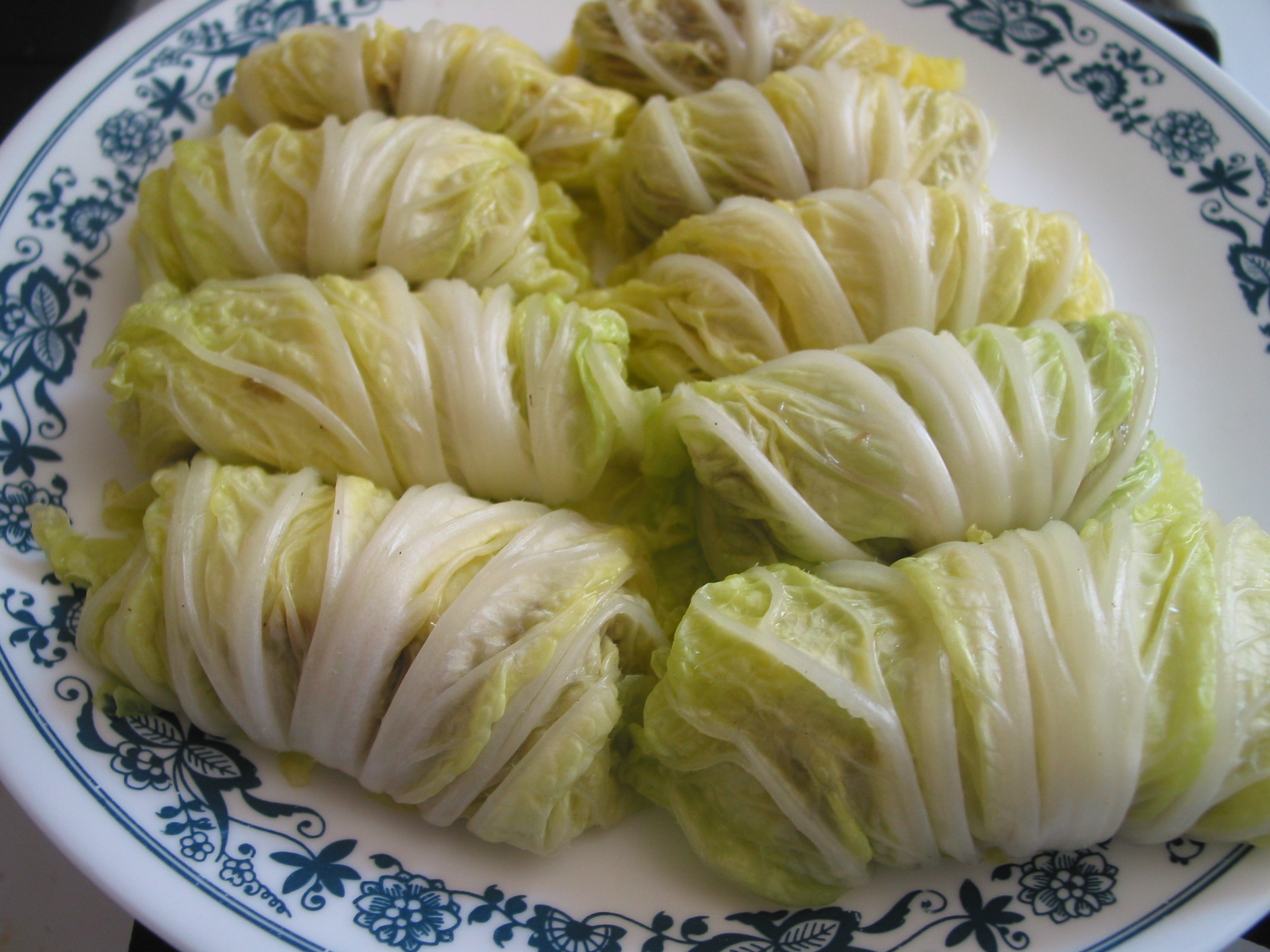
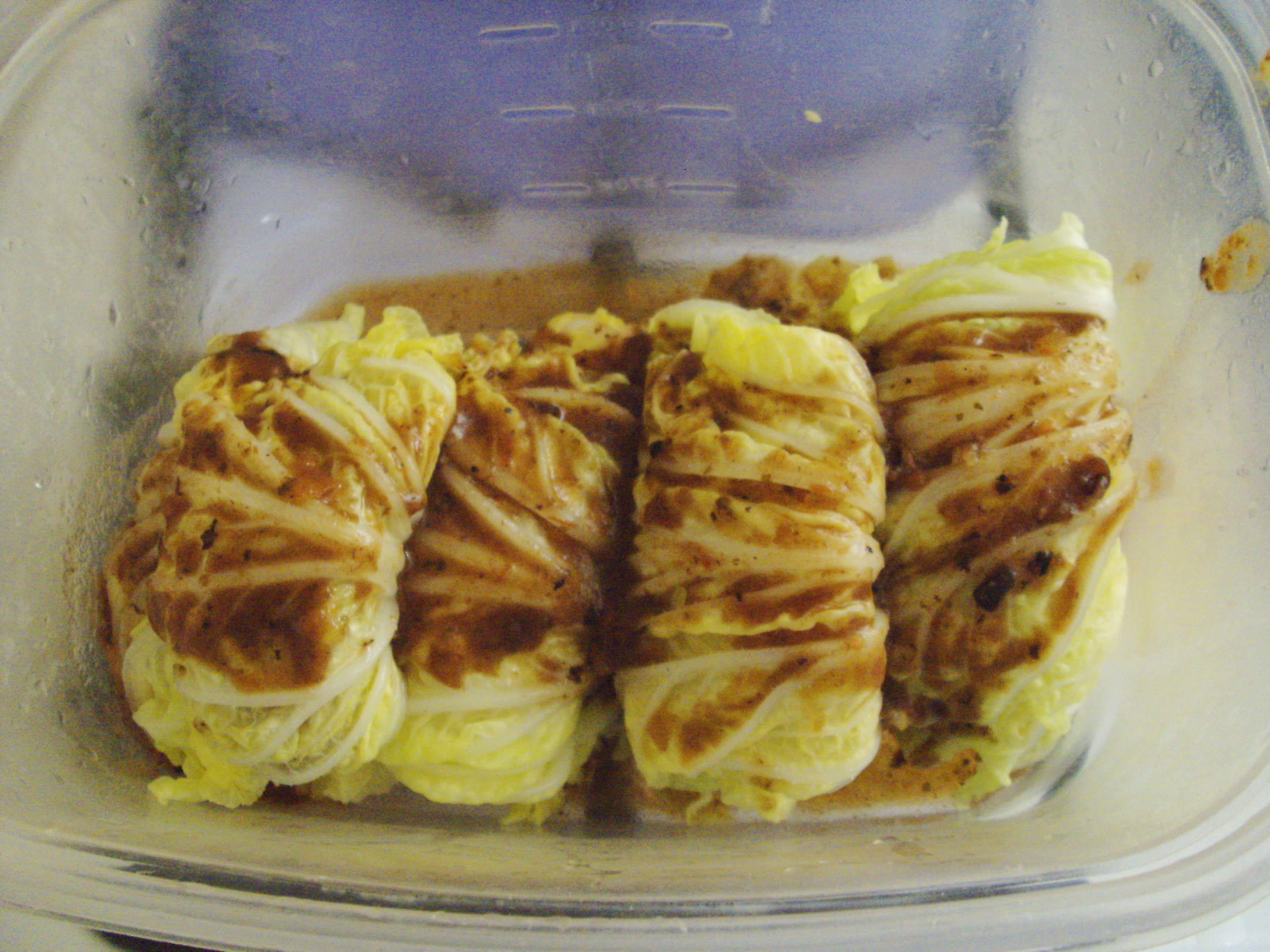
Stuffed cabbage in the microwave

stuffed Nappa cabbage rolls-unsauced

I was originally going to call this post “Nappa 9-1-1” because it’s about salvaging a cabbage quickly and semi-artfully from the back of my fridge, but realized how bad that would be once I read the recent earthquake damage assessments up in the real city of Napa from the 6.0 earthquake a couple of weeks ago. Things are still kind of rough up there. The Napa Valley Vintners association have donated an impressive amount–$10M–and have instructions on how to donate to the local community disaster relief fund. You can find a number of local funds to donate to online at norcalwine.com.

I love bringing home a bag (or more) of produce from my local greengrocer each week–especially in the summer, when Fresno tomatoes are in and brilliant red, green beans are green and snappy, apricots and plums and pluots are spilling ripely out of the bins at under a dollar a pound, and herbs like purple basil and tarragon and mint and za’atar are 75 cents a bunch. You can’t help but feel like you’re going to be a great cook that day, just by cutting up a few vegetables and sprinkling on some oil and vinegar and strewing herbs (and feta or Alfonso olives) on top.

I always mean to use up all my vegetables before they start showing their age, but occasionally I get caught with something unintended at the back of the fridge. This week it was a Nappa cabbage, which is longer and less sulfurous (when lightly cooked) than the more traditional green and Savoy cabbages. A little closer to bok choy. So I peeled back the rusted layers, hoping that some of the inner leaves could be salvaged, at least, and I got fairly lucky.

But what to do with them? Chop and eat raw as a salad? Always an option. But I’d bought the cabbage in the first place to try out a quick microwave version of stuffed cabbage that would fulfill a couple of challenges I’d posed myself:

1. Vegetarian (not a big beef fan, personally)–I’m using the lentil/rice stuffing I developed for stuffed eggplants and onions  three years ago (has it already been that long???), because I actually made stuffed onions again last week and had some leftover stuffing in the fridge.

2. Microwaveable in a few minutes (to combat cooked cabbage stench and do it as more fresh-tasting than long-cooked)

3. Non-stinky, and not drowning in cloying sweet-and-sour tomato sauce (my two overwhelming childhood objections to holishkes)

4. Bridges the cultural/culinary gap between European and Syrian Jewish versions of stuffed cabbage by spicing the filling AND adding garlic and onions. It can be done, and should. And yet, I’m not stewing it to death (actually, that means overturning both Euro and Syrian traditional cooking methods in equal measures).

5. Fulfills the Prunes and Lentils Challenge, or at least hints at what’s possible, since today I had (gasp) no prunes left and had to resort to leftover tamarind sauce from the aforementioned batch of stuffed onions… close enough for folk music.

Stuffed cabbage rolls, as I’ve noted before, are popular throughout at least eastern Europe and Syria. Most versions contain meat–beef for Jews, beef or lamb for Arabs, some mixture of pork and beef for European Christians. But I’ve also seen some really beautiful-looking vegetarian ones in Nur Ilkin’s The Turkish Cookbook, and those were stuffed–of all things–with whole cooked chestnuts.

Cabbage lends itself to enveloping stuffings almost as well as grape leaves, and it’s easier to work with, cheaper, and (big bonus) unbrined.

In addition to meat or lentil fillings, you could try something like curry-spiced or Mexican-style beans and/or vegetables, a mu shu or samosa filling, whole cooked grains like brown rice or bulgur with or without dried cranberries or raisins and sunflower seeds or chopped nuts, maybe even fish (though I’m shying away from Joan Nathan’s recommendation for wrapping up gefilte fish and giving them the stuffed cabbage treatment). Perhaps for fish I’d want smoked (fake or real) whitefish salad. Or sausage–real or vegetarian, smoky and spicy.

It seems to me for sauces you could go well beyond sweet-and-sour traditional: a garlicky tomato sauce, a mustard vinaigrette, a smoky salsa with or without tamarind sauce, a chili-paste or z’khug-laden soy/molasses/vinegar/sesame oil dipping sauce with ginger and scallions, a polished herb and wine-type tomato sauce with prunes or mushrooms and onions, even (maybe definitely?) Korean or Thai peanut dipping sauce, especially if you stuffed your Nappa cabbage leaves with a combination of pressed tofu and/or omelet strips, spinach leaves, maybe some sprouts and shiitake mushrooms.

Whatever version you do, this can either be a quick path to dinner (use the big leaves and more filling per leaf) or to a platter of appetizers (using the small inner leaves).

Microwaving doesn’t develop every possible flavor (in the case of cabbage, I’m childish enough to say that’s a good thing), but it’s a quick way to play around with a classic at least on a trial basis. You could always do the huge foil-covered pan in the oven thing if you decide to scale up and go old-school.

Stuffed Vegetarian Cabbage Rolls

  • 1 head Nappa cabbage, washed and with the core cut out
  • 1 lb (2 cups, more or less) of (in this case) allspice/cinnamon-spiced lentil hashu (made w/cooked rice or bulgur, not uncooked) OR peppery lentil mititei-style sausage filling (substituting 1/3 c. cooked rice for the wheat gluten), or your choice of savory/spicy filling, preferably one that includes some garlic….
  • 1/2 c. sauce–in this case, 1/4 c. tamarind sauce plus a tablespoon of chipotle salsa and a few tablespoons of water. OR–just tamarind sauce, or just smoky salsa, or tamarind with a bit of tomato paste and a spoonful of sugar, or peanut dipping sauce, or dim sum dipping sauce, or Asian-type prune sauce, or prune and wine sauce with some tomato paste mixed in. Or mustard/garlic vinaigrette (as a dipping sauce, not necessarily to cook with)…YEESH! too many choices…


Microwaved cabbage leaves, ready for rolling

Microwaved cabbage leaves, ready for rolling

1. Separate the cabbage leaves, put in a microwave container, drizzle on a quarter-inch of water and put on a lid. Microwave 2-3 minutes until the leaves are just tender enough to roll without snapping the center.

rolling stuffed cabbage

Start the cabbage roll with the filling at the stem end

2. Drain the leaves and lay them out on a plate for stuffing and rolling. Put a tablespoon of fairly stiff filling an inch or so from the stem end of the leaf and pack it into a little sausage shape. Roll the stem end over the filling gently but as tightly as you can manage, then tuck the side frills of the leaf over the ends and continue rolling toward the top of the leaf. Place seam-side down in a microwave container or casserole. Roll up all the leaves and pack them into the container fairly tightly.

stuffed cabbage rolls with tamarind sauce

3. If the filling is completely cooked already (the rice in the lentil stuffing is not raw or par-cooked), just drizzle a bit of your sauce of choice over the stuffed cabbage rolls, maybe with a tiny drizzle of water in the bottom of the container. Put a lid on and microwave another 2-3 minutes or until just cooked through and steaming hot. If the flavor is still too raw or radishy for you, obviously you can cook it further, going a minute or so at a time, until it smells and tastes right to you.

Drain and serve with a little more sauce on the side.

Breaking the Rules: Fish with Red Wine

tilapia fillets Veracruz-style, with smoky salsa, onions, garlic, alfonso olives, red wine and fresh za'atar or "wild thyme"

One way to cook fish well using red wine

Wine is something I drink mostly for taste, not volume–I can’t really hack a lot of alcohol at once, blame my ancestors–but I do like wine tastings, even though I have to limit myself to about three small sips per glass if I don’t want to wobble out the winery door. Focusing on the flavors in a wine, and comparing several side by side, sharpens your palate and makes you think very specifically about what you’re experiencing. It’s rewarding even for someone with my drinking limits.

I also like to cook with wine, maybe more often than I like to drink much of it. Decent wine has such a complex combination of flavors that when you figure out how to do it well, cooking with wine can make even rapidly cooked dishes come off like serious Slow Food.

We hear a lot about long-cooking stews and coq au vin and so on, but many simpler and less time-consuming dishes benefit from smaller amounts of wine. Adding a couple of spoonfuls of dry white wine to mustard vinaigrette tempers the sourness, the garlic and the mustard sharpness a little and gives the sauce a quiet depth. And if my experiment with giant favas marinated in rosé and rosemary was any indication, we should be thinking about wine a lot more often and a lot more creatively as a cooking ingredient.

So I’ve been on the lookout lately for clear and simple techniques for cooking with wine without wasting it, and for doing it in less than a three-hour stew, because to me that’s slow-food-slow in large crowd-feeding quantities, to be attempted a maximum of once a year. I want better, more sophisticated-tasting food fast, using at most half a cup to a cup of wine, not a whole bottle, and preferably without huge cleanup.

But these days, when so much of the cookbook aisle in your local independent bookstore is taken over by Food Network Channel collateral, cooking with wine is almost a lost art. Most of the popular TV chefs aren’t even doing it anymore. Everyone’s gone sorta-Asian (but without Martin Yan’s shaoxing wine-wielding expertise or sense of humor) or sorta-Middle Eastern or bacon-filled-Tex/Mex or wishful-thinking-Indian-or-Moroccan wannabe (if I hear the words “ras el hanout” mispronounced one more time by any TV chef, anywhere…)

Most of those cuisines don’t include wine as a regular ingredient because of religious restrictions against alcohol, which I fully respect, or, in the Tex/Mex case, because wine doesn’t go with football (the true religion of Texas, although if you see the documentary Somm, you might be surprised at how many American master sommeliers and exam candidates are former football players.)

The new vegan and vegetarian cookbooks don’t consider wine at all, as far as I can tell, even though there are plenty of  vegan-approved wines and organic wines touted throughout Whole Foods (and even a few at Trader Joe’s). And a number of seitan and bean or lentil dishes (and certainly Roman-style lentil soup) would probably do all the better for a tinge of red, white, or rosé, either in the sauce or as a marinade ingredient.

Even the French- and Italian-trained chefs don’t use wine on TV very much, and if they do they don’t really explain it–why they chose that particular type of wine, how much to use and why, how to get the best flavor out of it in the dish, what else you could make using the same technique. Or else they’re kind of wasteful about it, using a whole bottle of wine for a single dish. Most people cooking for themselves would balk at that. Should balk at that.

It bothers me that I don’t actually see a lot of solid advice about cooking with wine, or at least not specific techniques that make sense in a home kitchen with a standard family budget.

Where am I going to get this advice? Not from the churn-a-minute Food Network chefs, clearly. Not from Harold McGee, either. To my great surprise, he devotes a total of about three paragraphs to “cooking with alcohol” in his food science books. The most interesting thing he says, other than to make sure and boil out the alcohol (duh) is that tannins will concentrate unpleasantly if you boil down a tannic red wine, but adding a protein to pick them up will tame them.

But since most of my uses for wine so far are to do with fish, I guess I’m already doing that…

As you might expect from some of my odd microwave-centric ideas, I tend to cook fish with wine in ways that probably seem unorthodox to anyone professional. For one thing, I cook several kinds of fish with red wine (sound of Francophile traditionalists screaming, then fainting in shock). Continue reading

The Devil’s Food is in the Details

Melissa Clark has published an over-the-top cake recipe for the New York Times this week with two frostings and a demo video in her usual breezy style. The devil’s food cake, one of my favorite kinds, is pretty enough, and it looks like a fun idea, but… two homemade buttercream-type frostings? What kind of cake recipe is she using, and how does it compare with my usual (dare I say it) Duncan Hines?

I checked out the recipe itself and did a quick back-of-the-envelope calculation on the basic nutrition stats–carbs, fat, sodium, calories–then stared at it for a minute and wondered if I could possibly have been right.

Because the total I was coming up with was scary:  more than 1000 calories per serving for 10 servings. Half a day’s calories crammed into one piece of chocolate cake. It was about twice what I would have estimated looking at the photo. I mean it LOOKS pretty standard, if a little tall, on that cake stand. But 1000-plus calories per slice? Are you kidding? Had to be wrong.

So I went to the recipe nutrition calculator at myfitnesspal.com and tried it again. And it confirmed again that the recipe is indeed over-the-top, and over 1000 calories per tenth of the cake. What’s gone wrong here?

Here’s Clark’s recipe in the New York Times online for reference:

Devil’s Food Cake With Black Pepper Buttercream

and here’s what I saved off the nutrition calculator for everything–the cake plus both frostings:

Nutrition stats for Melissa Clark's 2-frosting devil's food cake for 10

Nutrition stats for Melissa Clark’s 2-frosting devil’s food cake for 10 people Calculated using myfitnesspal.com, 5/5/2014. Click the image to enlarge as needed, the numbers are still pretty scary.

My crude estimates, based on experience from having to calculate carbs in baked goods for a diabetic kid, were very close to the online calculator totals, within about 2o calories per serving and within 2-5% for each of the other stats.

And although it’s good to know my arithmetic and skepticism skills haven’t gotten rusty in the past month or so of trying hard not to bake, I think the nutrition chart above really tells you what’s going on in the world of popular recipe publishing today, particularly for American baking.

So let’s hit it over the head once more, because it’s still ridiculous: The first thing to think is, geeeeeeezzzzzz, over 1000 calories per serving.

How does Clark keep so thin? Did she actually eat a whole piece of this thing, or just pose for the photographer?

A 1/10th wedge of cake is a pretty big slice to begin with, and this cake is six layers tall–three full pans, cut crosswise in halves–for a standard-diameter round cake. In the accompanying demo video, Clark explains that the extra layers give you more room for frosting. “And isn’t that the best part?” she quips.

Well–I guess if you really like buttercream. She’s got both a vanilla-and-black-pepper buttercream AND a whipped chocolate ganache frosting. Does devil’s food cake really need so much dressing up to be good?

But here’s the added cost per serving: 111 grams of carb (about 2 meals’ worth), 86 grams of which are sugar. That’s 21 teaspoons of sugar per slice. A full day’s worth. 71 grams of mostly-saturated fat. Three full days’ worth.

Pro chefs excuse themselves for this kind of thing by calling their food “indulgent” or “decadent”. But this isn’t just excess, it’s mindless excess that doesn’t really add to the flavor or quality of the kind of dessert it’s supposed to be.

If you look at just the frosting ingredients, we’re talking 4 sticks of butter and 2 1/2 cups of sugar. The cake itself contains another stick-plus of butter and almost another two cups of sugar. So 5 sticks of butter and 4 1/2 cups of sugar total, or about half a stick of butter and half a cup of sugar per person, if you serve 1/10th cake as suggested. That puts it way into Paula Deen territory. Maybe even beyond Paula Deen.

I have to ask: Can’t we do a little better and still be decadent? Do we really need all that excess goo for it to be an okay cake?

It’s not that the frostings or even the cake are terrible-tasting or artificial or bland–she uses a whole real vanilla bean in the buttercream.  But it’s an awful lot of fat and sugar piled up with cake included merely as the excuse for the frosting.

That kind of tells you that the cake itself isn’t so hot. I’d rather have a smaller piece of a really good, really chocolate cake with more intense flavor per bite and no actual need to rely on frosting for interest. Something like Alice Medrich‘s revamped, lower fat Reine de Saba-style cakes (“Fallen Chocolate Soufflé Cake” and “Bittersweet Deception,” neither of which contain any butter) from Bittersweet, which she’s just reissued as Seriously Bittersweet. Or even David Lebovitz’s chocolate-butter-sugar-eggs flourless chocolate cake, which he’s dubbed “Chocolate Idiot Cake.”

If the cake’s just there as a frosting vehicle, why not be honest? I’d rather skip the cake and make dessert some intense ganache truffles to eat in smaller quantity with strong coffee. And even then I’d cut back on the fat and sugar so I could concentrate on the flavor.

If you are going to try and make some version of Melissa Clark’s cake, you really need to cut it down to size. In my two public performances exploring Continue reading

Breakfast without Matzah Overload

Last night we were very much in the spirit of Pesach–a total rush job at home, to the point where I realized I was supposed to have a boiled egg somewhere on the seder plate just as it was getting pretty far past sundown. Organization isn’t always our strong suit, especially on school nights. Last year I posted my Bart Simpson-style Passover Chalkboard Litany of kvetches and survival tips. This year: how to deal with matzah when they won’t sell you anything less than enough for 70 people for $2.99–such a deal! (well, okay, it is). You could feed nearly the whole Sanhedrin (because in our family, everyone argues about everything and I’m sure my 13-year-old is ready for law school as we speak. Good thing I can’t afford it yet!)

As with any style of food, too much of a good thing is still too much. I think I learn that the hard way every Passover. How to eat mostly vegetables and lean proteins and fresh fruit and yogurt…and not just sit there eating matzah like it’s going out of style? There’s more than enough matzah to go around–even in gefilte fish, especially in gefilte fish, which I’ve lost my taste for over the years since discovering how to cook regular fresh fish well, aka “not-gefilte”  (though I still buy a jar for my noncooking husband for lunches during the week.)

I don’t do matzah kugel, sweet or mushroom (a waste of mushrooms in my jaundiced opinion). I’m not a huge fan of matzah brei (exception: matzah brei “blintzes”), matzah lasagne, mina de espinaca, or any of the other matzah-plus-egg-heavy adaptations of regular food. Although I have seen one attractive-enough looking picture of a mina de espinaca, I’d still do it without the matzah sheets…

I try hard these days not to make matzah balls either, though this year I might make an exception–once–for my poor daughter who never gets any because she’s vegetarian and the “not-chicken” soup at Shabbaton this March didn’t have any flavor and there were no matzah balls in it like there were in the yes-chicken soup. Oy! Maybe it’ll be a weekend project to figure out a good from-scratch version–we have school and taxes this week. A lot of school and taxes.

My mother, who is famous for not cooking more than necessary, taught me how to make pretty-good fresh-tasting haroset Russian Jewish style (’cause that’s what we were). Apples, walnuts (though almond flakes are also just fine with me), cinnamon, sweet wine or grape juice, maybe or maybe not honey, chopped coarsely so it stays crunchy. But I’ve been to a couple of community seders out here in Pasadena where the haroset was mashed down like baby food and to add insult, had matzah meal in it. I know, matzah bits probably started out as a less expensive alternative to nuts, and I can’t blame anyone for that in their own homes. A professional caterer is quite another story. There’s really no excuse in California, where nuts are pretty plentiful (both the human and the arborial kind).

Well, anyway. Second seder is tonight, but what about the rest of the week–after taxes, as it were? Passover brings on a lot of nutritional challenges if you eat dairy or vegetarian. How not to eat too many eggs in a single week? How to stay away from the canned coconut macaroons and other assorted “Kosher for Passover” horror sweets my husband brings home because he thinks that the kashrut labeling makes up for the “nutrition” labeling (which really oughtta say, “WHAT nutrition?! This is pure sugar and potato starch, buddy! And palm oil! And artificial colors and flavors! Almost as good as Froot Loops!”) I’m pretty sure I’ve already mentioned this, but it’s because he’s a boy, and there’s nothing much to do about it except shudder, put the box of “goodies” in some inaccessible place on a low shelf, preferably behind the broccoli, which is merely green and mysterious or better yet, okra (which he fears more than taxes, and that’s saying something).

Note it down: ALL the packaged cake and cookie substitutes are a bad deal for anyone diabetic or even marginally thinking about becoming diabetic–very, very spiky, and almost never worth it. Also guaranteed to induce repetitive eating and the false sensation that you’re “starving” about three seconds after you eat them. And in the last 20 years, they’ve been faked-up further–even the kichel, a dry, stiff, barely-sweet puff halfway between an empty creampuff shell and a biscotti, has had artificial flavorings added recently–why bother?

Do we really even need such matzah-filled “delights”? Nowhere is this poverty of product more evident than in the kosher-for-Passover cake “mixes” (for which I always hear Julia Sweeney’s line “Where are yer mixes, hon?” from God said, Ha!). Last year’s example, which I’m not letting happen again: the Manischewitz Blueberry Pancake mix box my husband proudly brought home one day “on sale! it was 99 cents!” And naïvely suggested I could make for breakfast–this upon seeing that I’d just finished making cheese blintzes from scratch with real ingredients, and real raspberries. Don’t squint at me like that–he’s still breathing. I just decided his sudden brainfreeze in the wife department had been caused by jetlag, and contented myself with reading the ingredient box back to him.

The man is not a cook and is pretty happy not to be. Still, he does like to eat. And read. Somehow it never occurred to him to read in service of eating by checking what’s actually on and in that pancake mix box. It had 20 ingredients, no nutrition, and no blueberries. “Blueberry bits” contained–are you ready?–food coloring, sugar, artificial flavor, and sodium alginate. So suddenly you can’t tell the difference between berries and blue goo?

I had to go into extra innings with the cauliflower and broccoli and eggplant and asparagus and tomato/artichoke heart salads just to overcome the unusually high crap factor, even though I didn’t use the mix. Just reading it was enough to require emergency grapefruit. I was too ashamed to donate it to a food pantry, either.

So….real is definitely the best way to go with food for the week. Breakfasts can be tricky–matzah and jam, matzah and cream cheese, matzah and almond butter…it gets pretty tired pretty quick. And on the other hand, blintzes are for weekends only and frankly? I’m still annoyed about that pancake mix incident a year later! Nu…

Three relatively low-crap, moderately-low matzah alternative breakfasts that are (most important!) low-labor for those post-Seder mornings when you are Done and Off Duty to your nearest and dearest (except for coffee):

1. Matzah-nola, what it sounds like, ingredients straight from the cupboard or freezer. There is actually a product out commercially this year called “Matzahnola”; my version I invented a year or two ago out of desperation against the nutrition-free Passover version of Cheerios my husband brought home, but I didn’t think it was that good a name–who knew? Anyway, I’m not bitter (though the fresh-grated horseradish is still stinging my sinuses from last night).

2. The old-style Israeli breakfast, not the modern endless hotel breakfast buffets–more like the kibbutz specials where you’re expected to get out there and weed a cotton field right afterward. Which I have actually done in my less cynical youth.

3. The bonus “I can haz CAKE?” breakfast, a favorite of fridge-scrounging champions everywhere Continue reading

Purim options

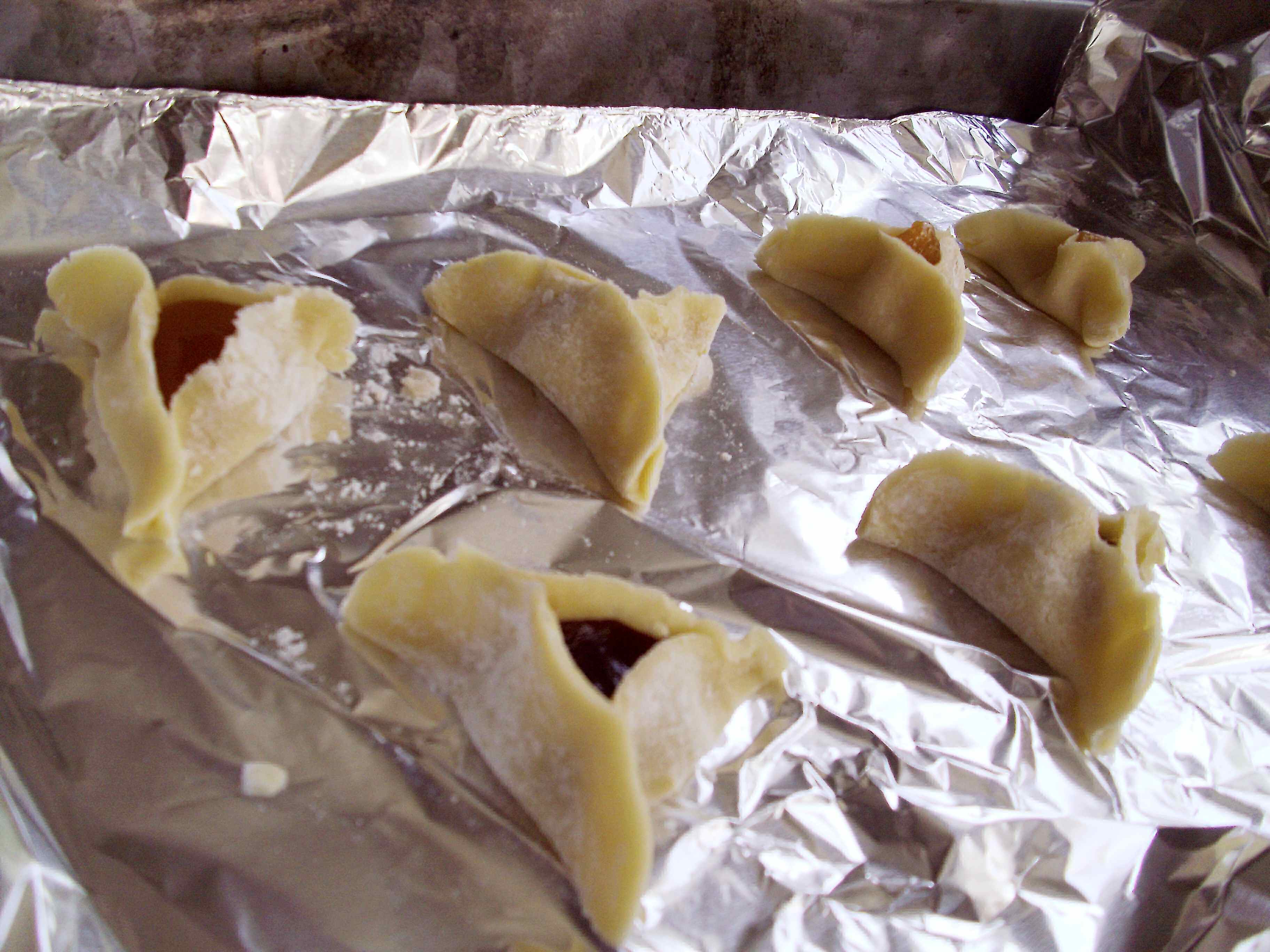
standard cookie-dough hamantaschen

Regular hamantaschen with prune lekvar

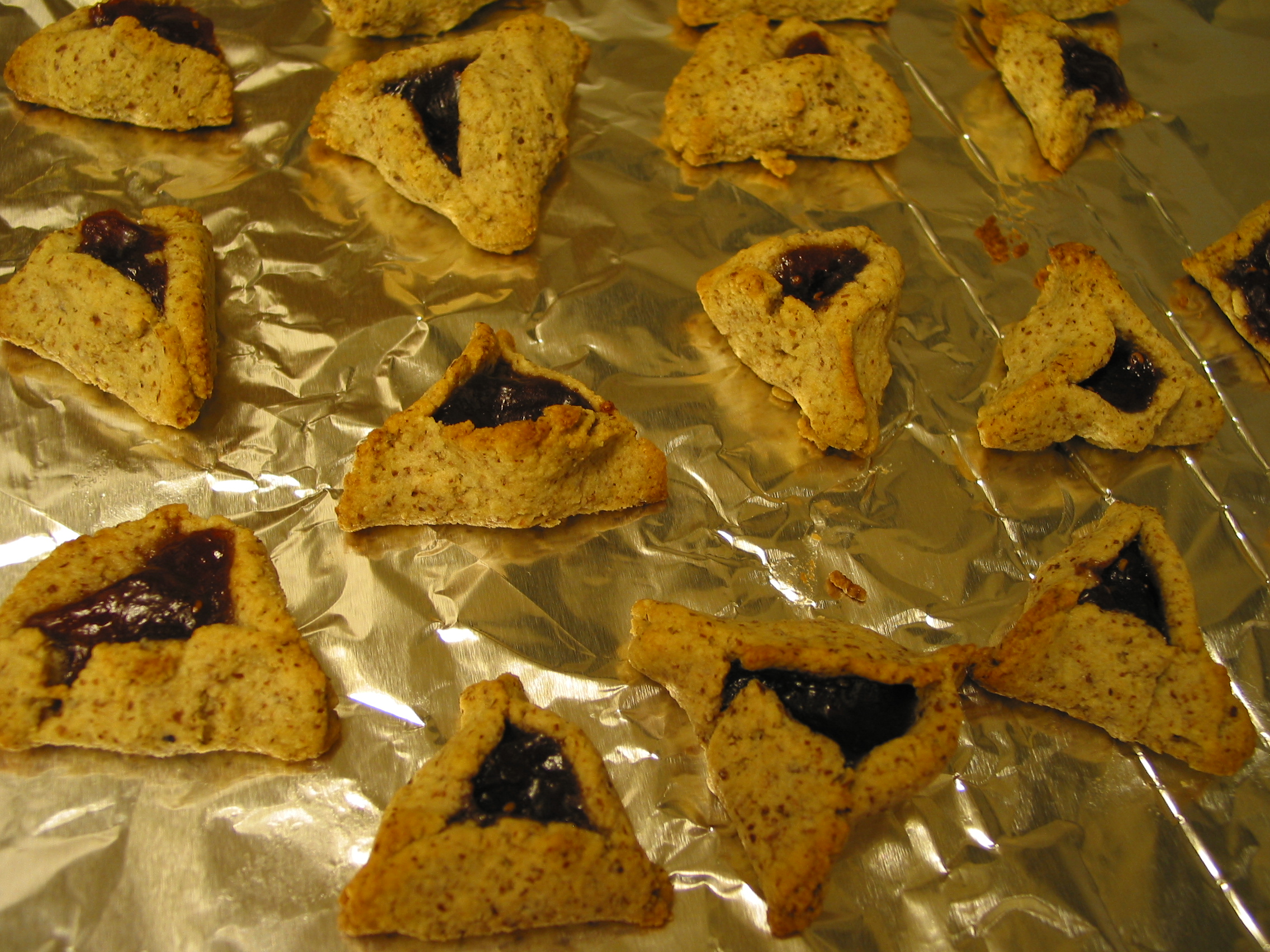
Almond meal-based low-carb hamantaschen

Almond meal-based low-carb hamantaschen

Purim is here tonight, a little late thanks to the “leap month” this year (drawbacks to a lunar holiday calendar) but none the worse for it–it’s over 80 degrees here, which means it’s almost time for Purim. Los Angeles is the only place I’ve ever been, including Israel, where people were slathering sunblock on their kids and gasping for water bottles at a Purim carnival well ahead of lining up for hamantaschen and games. It was 94 degrees that year. Fifteen years of this and I’m still not used to it.

Purim, of course, means manic baking, heat wave or no, because the adults’ reading of the Megillah (the Book of Esther) had…ummmm….last-minute planning and no one thought about hamantaschen as part of the refreshments until midweek. I think I’m the only one left in our  shul who still doesn’t care about having a fabulously original themed cocktail party for the adults afterward. Any kind of cocktail party is more drinking than I want to do, and I’m damned if I wanna dress up in full office battle array again after so many years sidestepping all the suits in my closet, just so I can fit in with the Mad Men theme. I’ve never even seen the show.

But I actually make hamantaschen at home once in a blue moon instead of schlepping over to the Valley to buy them from a kosher bakery.

So I did the stupid, crazy thing and volunteered. How many people? I asked–maybe 60. So I have SIX batches of dough sitting in my freezer relaxing. It took about half an hour, about 5 minutes apiece,  to do all the batches in the food processor, one after another and weighing out the ingredients so they’d be consistent. And yet…after all the excitement from two weeks ago, I’m just not all that geared up to roll it all out and bake it just this minute. Maybe when things cool down slightly–half an hour? Maybe?

Friday happens to have been Pi Day as well–and to my daughter, who was supposed to be my second-in-command for this delicate operation, and to her algebra teacher this morning, that meant Pie Day. They had about four different kinds of pie for all the math classes, and none of them had to calculate the areas or volumes of the wedges they sampled. My daughter, of course, was so elated that she ate two entire meals’ worth of carbohydrate in about fifteen minutes, and still came out with a pretty good blood glucose number an hour later–good on the calculated guesses, there–but at the cost of running through insulin that could have lasted her three or four more hours if she’d eaten an ordinary lunch. Teenagers! Mothers of teenagers!

Still, not to lose the spirit of things too much. It occurs to me that hamantaschen qualify as very small pies, only triangular. So we eventually started the process of inscribing a triangle inside a circle–240 times, if we can get through all the batches before showtime. Me, I’d settle for 3 or 4 batches and call it a week.

The raspberry jam filling–all that hard work for the first batch of rolling and filling–leaked all over the place. Too bad there isn’t still a vogue for vampire-everything; the first batch would have qualified! Too thin. You need a thick serious filling to stay in place during the baking.

So–time to nuke the prunes for lekvar and the figs for the heck of it (plus toast a small sampling of the poppyseeds in my freezer to see if they’re still okay to use for a filling, and to make sure I don’t pour in the bag of nigella seeds instead by mistake!). I rarely see these anymore, but I still believe in doing traditional fillings alongside the modern, newfangled apricot-jam-and-chocolate-chip ones. It’s true that if we keep skipping the prune filling, we might not turn into our own grandparents, and if we miss out on the poppy seed filling (known in Yiddish as mohn) we might pass the all-critical drug tests (à la Seinfeld) with no interferences, but then again we’d miss the ta’am, and what’s the joy of hamantaschen without a taste of the past?

Hamantaschen Recipes

Low-Carb Almond Meal-Based Hamantaschen

My version of Joan Nathan’s Hamantaschen, with four fillings: poppyseed, prune, apricot/chocolate, labaneh/cheesecake

Microwaveable dried fig and dried apricot fillings (originally for fillo pastries, but still good for this, and a lot less drippy than jam)

However–if you are feeling “Mad Men”, you might think of reconfiguring the hamantaschen motif for cocktail party fare instead. I was thinking about this Thursday but figured it would be too weird. Then I saw an article about it yesterday in one of the big three newspaper cooking sections–dammit! scooped again! In any case, if you’re feeling a little avantgarde, you could do a batch of savory hamantaschen if you feel like it. Use rugelach, bureka or olive oil tart dough instead of the standard sweet dough. Roll it out fairly thin, and fill with feta or bleu cheese mixed with labne or very thick sour cream, plus a little onion and some thyme, maybe a pecan or two. Or something with very cooked-down mushrooms and onions (so they don’t get soggy). Or pesto and cheese. Or spinach with cheese and nutmeg and lemon rind. Or tapenade. Etc.

Chickpeas of all sorts and descriptions

Since Esther supposedly refused meat and ate only chickpeas, chickpea recipes are also more or less relevant to Purim. Mine are not particularly traditional–look up Iranian Jewish recipes elsewhere on the web.

Chickpea crêpes  These can be savory or sweet, and they don’t require eggs or milk

The “other” moussaka–eggplant and chickpea stew

Hummus from scratch (aka how to nuke dried chickpeas)

Fast Hummus made with chickpea flour (microwaved)

There’s also the possible “nahit”–fry chickpeas in olive oil, drain and sprinkle with salt and pepper.

Or a cold chickpea salad with mint, scallion, garlic, olive oil and lemon juice or vinegar.

Or channa masala dal, something like the red lentil dal but with chickpeas (and not mashed)

Post-Kiddush: our leftovers are better than yours

Round spare spanakopita just for us after the big kiddush

Round spare pinwheel-style spanakopita just for us at home. The big ones for the brunch had three pounds of spinach apiece (and were cut in small diamonds), but they still went together pretty fast–except for squeezing all that spinach dry…

This weekend I did it again–I made the kiddush, or in common speech a lunch buffet, for my congregation’s Saturday morning service. My husband kind of volunteered us for this week and because he doesn’t cook, most or all of the cooking, shopping, chopping and schlepping landed on my shoulders.

Last time he volunteered us, it was for our anniversary, and  I was ready to skip ahead to the divorce until I got over it, because it’s a lot of work to cook for 60 or so people who like to eat. And kibbitz. Especially when the 60 suddenly turns into 80-plus and having to use the synagogue kitchen with the more complicated and confusing rules on only a week’s notice. As they did this time…..

Soooo….a two-day hell of shopping and then marathon cooking-and-juggling in my little galley kitchen. The microwave got a serious workout. So did the food processor and the oven. Sometimes all at once. And it was raining hard for three days, so bringing things over to the synagogue kitchen as I went got a little tricky. I triple-wrapped the chocolate cake and stuck it in a USPS Priority Mail box so it wouldn’t get left out in the rain. Same idea for the spanakopita trays.

A few hints about cooking big and real for a synagogue brunch, learned the hard way by moi and passed on for your edification and safety (and sanity):

1. You can buy a 6-lb can  of chickpeas for massive half-gallon batches of hummus (Mid-East brand, maybe Goya as well). Cost? about $5. But–as I found out, and I’m glad no one was filming the process–industrial-sized can equals industrial-strength steel. A dinky hand-operated can opener is no match for such an item. I got just far enough to be able to pry open a kind of spout but there were tears and long-fluent-repetitive-all-throughout-the-house swearing sessions involved.

Still….

2. If you have a good corner greengrocer, you can buy quantities of eggplant for cheap–eleven or twelve eggplants made for a large tray of roast eggplant and onion slices (with garlic slivers and za’atar sprigs and olive oil) plus a large vat of baba ghanouj. Only the five eggplants I nuked for the baba ghanouj didn’t feel like cooperating fully when it was time to peel them. Might have been easier to peel first, then nuke, since it was all going into the food processor eventually. Next time…

3. Whole smoked whitefish for whitefish salad comes two ways–cold-smoked or hot-smoked. What’s the difference? I asked the counter guy at my favorite Armenian grocery. “Cold-smoked is a little less hard,” he said. So I bought it, thinking he meant the hot-smoked was tough as shoeleather and twice as chewy. I was wrong. Cold-smoked actually means the fish is smoked raw, like lox, only a little drier and tougher. But you don’t necessarily want to put it in whitefish salad that way. Man, it still had the scales on too. I couldn’t get it off the bones for love or money, and there were a lot of bones.

However, the microwave came to the rescue. I cut the fish in half and Continue reading