
• Enter your email address to subscribe to this blog and receive notifications of new posts by email.

    Join 241 other subscribers
  • Noshing on

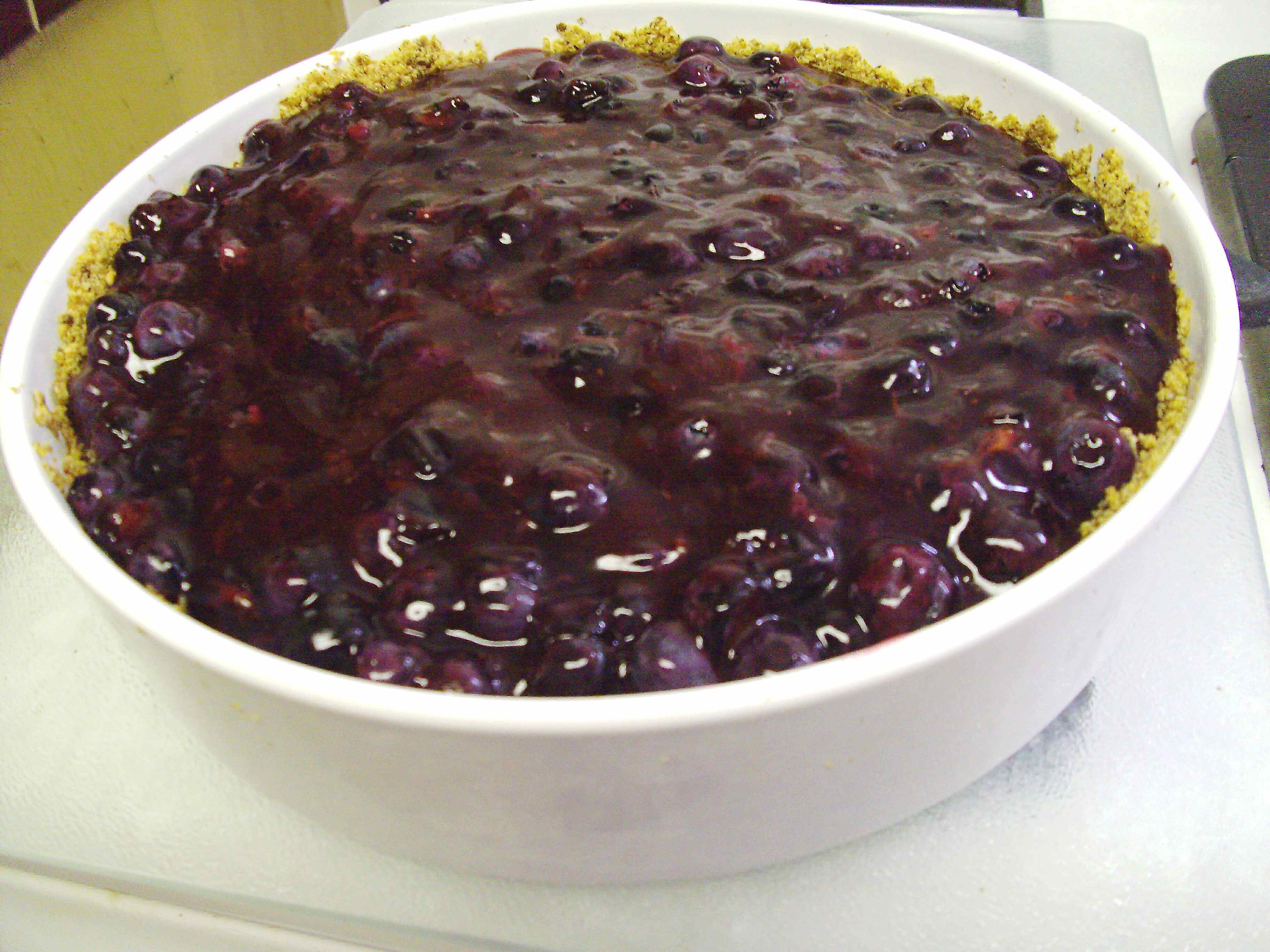
    raw blueberry pie with microwaveable filling and graham cracker crust

    This mostly-raw blueberry pie is a snap to make and very versatile--the filling microwaves in a few minutes, and you don't even have to bake the zippy gingered graham cracker crust--perfect for a hot Fourth of July and all summer long.

  • Recent Posts

  • Contents

  • Archives

  • Now Reading

  • See also my Book Reviews

  • Copyright 2008-2024Slow Food Fast. All writing and images on this blog unless otherwise attributed or set in quotes are the sole property of Slow Food Fast. Please contact DebbieN via the comments form for permissions before reprinting or reproducing any of the material on this blog.

  • ADS AND AFFILIATE LINKS

  • I may post affiliate links to books and movies that I personally review and recommend. Currently I favor Alibris and Vroman's, our terrific and venerable (now past the century mark!) independent bookstore in Pasadena. Or go to your local library--and make sure to support them with actual donations, not just overdue fines (ahem!), because your state probably has cut their budget and hours. Again.

  • In keeping with the disclaimer below, I DO NOT endorse, profit from, or recommend any medications, health treatments, commercial diet plans, supplements or any other such products.

  • DISCLAIMER

  • SlowFoodFast sometimes addresses general public health topics related to nutrition, heart disease, blood pressure, and diabetes. Because this is a blog with a personal point of view, my health and food politics entries often include my opinions on the trends I see, and I try to be as blatant as possible about that. None of these articles should be construed as specific medical advice for an individual case. I do try to keep to findings from well-vetted research sources and large, well-controlled studies, and I try not to sensationalize the science (though if they actually come up with a real cure for Type I diabetes in the next couple of years, I'm gonna be dancing in the streets with a hat that would put Carmen Miranda to shame. Consider yourself warned).

No, I don’t know what I’m making for Thanksgiving either
–And it’s already after noon! So it’s going to have to be quick. I did manage to figure out a Zoom meeting for later with my family on both coasts–I have the odd feeling of joining the 21st century a beat or so late while they all roll their eyes, but still. They’re used to me being late to the table, and always last-minute. If you are too, I have some reasonable (and a few not-so-reasonable) microwaveable options below.

This year, we’ve watched the spectacle of the election and its many, many, many entertaining lawsuits attempt to distract us from the huge, unfortunately predictable third spike in pandemic numbers all across the nation, and we’re facing facts: our kid is not coming home until finals, our parents on both coasts are being cautious and hunkering down as are we. The upside–we’re not traveling for Thanksgiving, or being required to smile and praise anyone’s turkey or attempt the groaning board. The obvious downside is what the heck do you make when it’s just you?

It’s just me, my husband and the cat, plus all of our family expecting to hear from us remotely so we don’t all feel as isolated as we feel. Which means mostly that we’re going to have to figure out how to Zoom everyone and not get cranberry sauce stuck in the laptop keyboard. And, of course, not reveal the exact state of our livingroom if we can help it.

This is going to require reserves of stagecraft, because when you’re stuck home with your husband and the cat instead of getting to dress up, sip champagne and hug all the people you haven’t seen in a year, the last thing you really want to have to do, besides cook all day, is straighten the livingroom for company.

The most important things, the essential things about Thanksgiving that I actually look forward to have nothing to do with the menu and everything to do with the experience (once we’ve recovered from schlepping halfway up California anyhow).

First is the getting together with family and friends–we’re Zooming and calling today and tomorrow, best we can.

Second is the sense of celebration–but how do you do that for yourself at home? My favorite part of Thanksgiving at my in-laws’, who are great hosts and savvy party people, is the way they welcome everyone into the house mid-afternoon, a couple of hours before the late-afternoon dinner. They set out cheeses, crackers, olives and nuts, raw vegetables with dip, and glasses–and break open a bottle of champagne for toasting. Sparkling apple juice for the kids, if they’re not already running through the house to the backyard for games.

I do have a frozen kosher turkey breast somewhere at the back of the freezer, but for just us, without our daughter home, it’s going to be microwave-assisted pan-grilled salmon, which I admit is kind of prosaic but still, after much testing, clearly the best indoor way to make it.

On the other hand, having fish rather than meat allows me to think, I can haz cheese platter? (the cat approves).

We never really do appetizers or cheese boards just for ourselves at home; that would probably be a good way to feel like it’s at least slightly partyish and worth celebrating something. Get out a nice bottle of wine and some glasses–I think I actually have a decent under-$20 bottle of Piper Sonoma champagne somewhere in the wilds, good enough for toasting, even though I still usually prefer reds and still whites.

Actually, if you’re home alone or with just your immediate family, that’s probably going to be a better way to make it feel like Thanksgiving than all the huge big-cooking thing. And put some sunshine on the plate too–good green (and/or purple) salads, a bowl of tangerines and apples that people can snag, something fresh.

In any case, if you’re really stuck for ideas, check out my mostly-microwaveable Slow Food Fast Thanksgiving Guide.

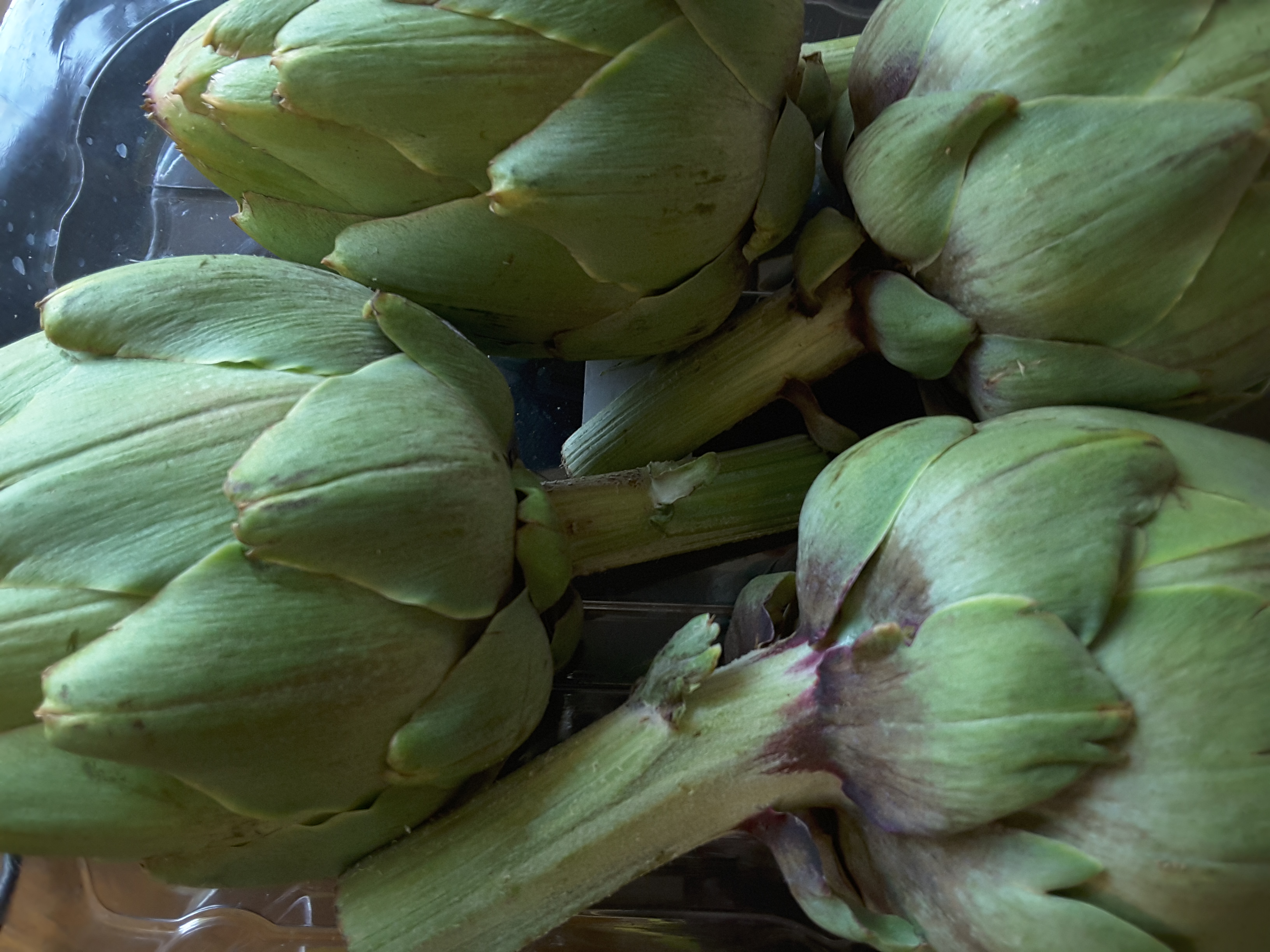
And I’d like to add two more mostly-microwaveable items to that list, because for just us, I’ve decided to snag a box of globe artichokes at my local Trader Joe’s and also a bag of wild rice for a pilaf with some chopped apple, onion, mushrooms and pecans or walnuts, and raisins or other dried fruit.

Artichokes I’ve already steamed successfully in the microwave in years past, but I don’t think I’ve ever posted the method here. It’s pretty straightforward and similar to my usual method for steaming broccoli or brussels sprouts or other cruciferous greens, just a few minutes longer per pound because they’re whole, they’re tough, and they contain less of their own water.

The wild rice I’m trying in a microwave for the first time–going by my brown rice experiments, I’m going to hot-soak it for a bit to crack the outer husks, then microwave it in earnest for a few minutes at a time, letting it sit and soak up the hot water for a while undisturbed before stirring and testing and deciding if it needs more time. Hopefully it won’t get mushy. It’s already after 1 pm so I’m going to break off with just this and then go microwave some cranberries, wash a few glasses, clean off the table (got to look better than it really is), and get dressed for company, at least sort of–I have a family to Zoom!

A toast to all of you–Happy Thanksgiving, make sure to give to your local food bank and homeless shelter this season, because even small amounts help, and may we all have a safe and better year.

Whole Artichokes in the Microwave

  1. Trim the thorny, tough outer leaves and the stems off a couple of large or a bowlful of baby whole artichokes. Open the centers carefully–there may still be a few thorns inside–and use a spoon to scoop out and discard all the dandelion-like fuzz and trim off any thorns at the top of the soft inner “heart” leaves.
  2. Squeeze some lemon juice on and inside, plop the artichokes in a microwaveable container with about 1/4-1/2 inch (~1 cm.) of water in the bottom, add the lemon half if it’s washed and organic, or just squeeze a little more juice into the water. Put on a lid and microwave on HIGH for about 7 minutes, then let sit a few minutes. 
  3. Test for doneness by pulling off one base leaf (should come away very easily) and/or poking gently through the bottom of one of them with a sharp knife to test if it’s tender enough. Add another minute or so if they’re not there yet.
  4. If you have more than one layer of artichokes in the bowl or container, the ones at the bottom may be less cooked than those at the top, so you may want to bring those up before adding any additional cooking time, or remove the fully cooked ones and then microwave the less-done ones a minute or so more with the lid on.

Serve with basic lemon-butter sauce that my husband prefers because his mother made it that way (melt a little butter, squeeze in some lemon juice, scoop out any seeds that fall in) or the more exciting tzatziki-type sauce I like better with artichokes: nonfat plain Greek yogurt, a dab of garlic, a drizzle of olive oil plus a squeeze of lemon juice, and a little thyme, dill and mint or basil chopped and mixed in, cracked black pepper optional.

Crème de X: Purslane and basil dress up a lighter velouté

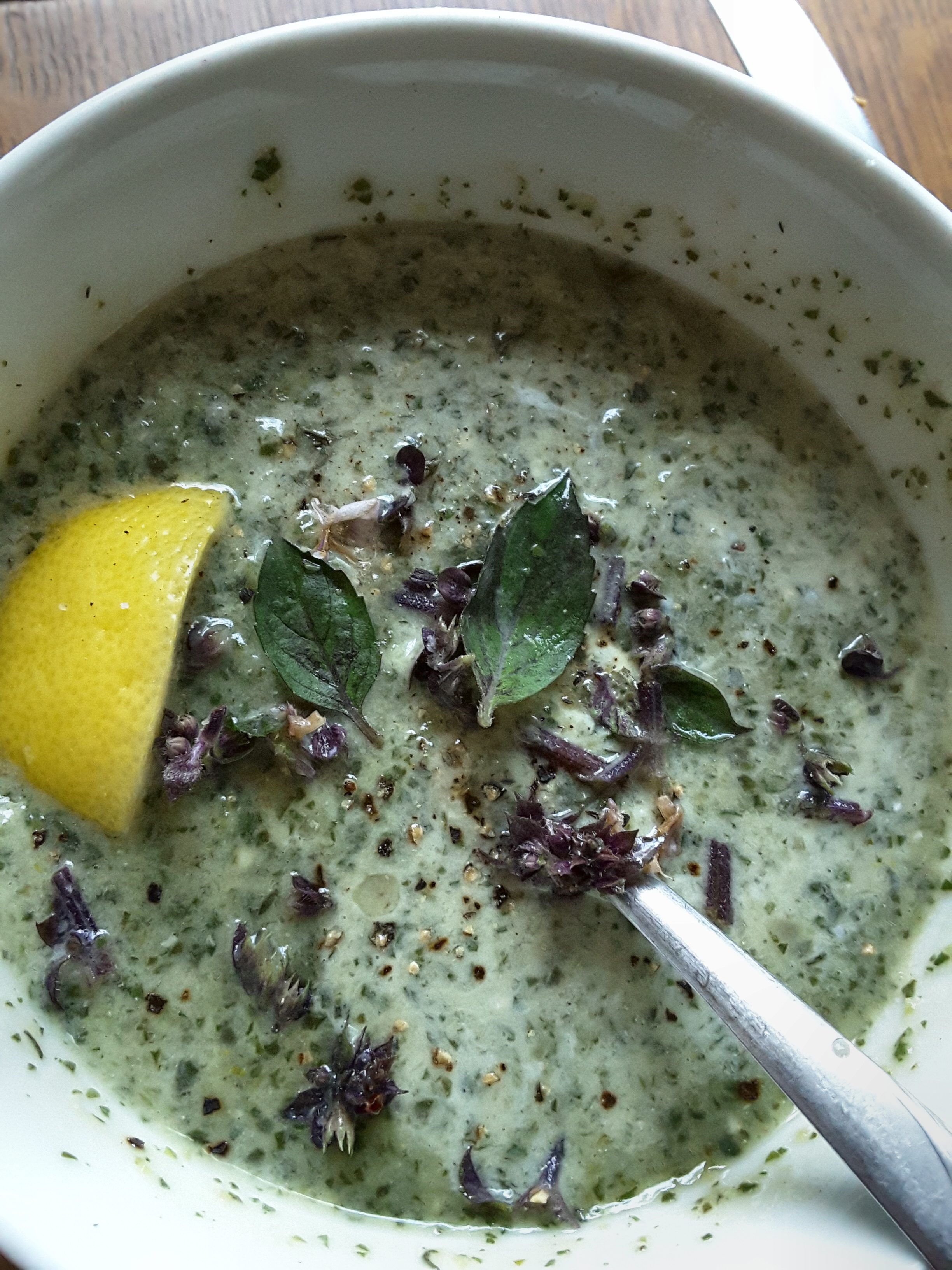
Purslane soup with purple basil garnish
Purslane plus purple basil flowers for that Crème-de-X factor

Sargent’s infamous ballroom portrait of Madame X is today’s inspiration for a soup that, like his subject, breaks a few stodgy rules and dares to produce an elegant but fresher, bolder, more nutritious–and certainly lighter–version of a classic French soup in a few minutes flat. It’s smooth but svelte. And it still keeps you in suspense.

So before we get to today’s featured mystery vegetable (herb? green? Let’s settle on green)–let’s talk about breaking the rules.

Most classic veloutés–vegetable-based cream soups–rely on thorough boiling-into-submission of the vegetables, generally mostly potatoes, to soften them for blending, which used to be done by hand through a mesh sieve back in Madame X’s and John Singer Sargent’s day. They also add a heavy dose of cream to mask any individual or strong flavors so nobody could possibly get upset that they can actually taste the vegetables.

All that cooking softens things but also breaks down most of the vitamins. Reliance on potatoes for bulk makes things starchier and blander as it crowds out the greens as the main ingredient. And I don’t have to tell you what I think about cream–you’re free to disagree but I take statins for a reason, and I’m an inveterate cheese freak. Also chocolate.

So I say save the high-ticket calories for something that packs a bigger punch tastewise even in small, expensive, memorable bites–goat cheese, bittersweet chocolate ganache. Not soup. Make it count.

Method counts too. The modernized French restaurant-approved cookbook methods for veloutés and blended soups in general are stupid, cumbersome and unsafe. There’s no good enough excuse anymore for telling inexperienced cooks–or any cooks–to boil up a vat of something and then try to pour it into a food processor or blender hot–very dangerous, and not the edge we’re seeking here. Scald marks are not chic. Nor is hot flying soup all over the kitchen walls.

In today’s world, you have a blender or food processor AND you probably have a microwave, no matter how many TV chefs may rail against it. You can do this smarter and safer and lighter and faster.

Common sense says blend your veg of choice first, then heat it. If it isn’t soft enough raw to blend smooth before cooking, steam it through first with minimal water and a lid in the microwave for a couple of minutes or, failing that, in a nonstick frying pan or stockpot with a drizzle of water, maybe a quarter-inch off the bottom of the container or pan, and a lid, also for a few minutes. Take it off the heat, pulse a few times in your blender or food processor without most of the liquid to get it started, then add cold liquid gradually as it blends further until it gets to the consistency you’re aiming for. You’re a lot less likely to generate big steam and pop the lid that way.

Then pour it into a microwaveable container with a lid to cook or reheat the soup in a few minutes without destroying every possible vitamin or losing all the color. You won’t scald yourself and you won’t be furious and frustrated and wishing you’d never heard of it before you even get to taste it (this does happen, you know, and cookbooks never mention it)… You’ll be fabulously unruffled (well…at least for this) and ready to dine when it’s ready to eat.

So, enough with the cooking hock-I-mean-hack. What’s with the purslane? What is purslane, anyway?

Fresh purslane in context

You’ve been wading patiently through my diatribe, and the suspense is killing you (but a nice distraction from worrying about the election totals, yeah?)

Purslane–slightly wilted but still worth cooking. I can sympathize.

Purslane, or verdolagas in Spanish, is a slightly tart fresh herb that tastes like a lemony version of watercress or spinach–sorrel? Texture- and looks-wise, it’s a cross between a fresh green herb like basil and a succulent like…like…well, like a jade plant (despite the fact that jade plants are not edible, I’m pretty sure). That is, the leaves are smallish but sort of fleshier than normal herbs. At least when they’re at their peak freshness. Most people who buy and eat purslane put it into a fresh salad and eat it raw. Some stirfry it or chop it and put it into spinach-type dishes. And it’s pretty nutritious–high in vitamins A and C, potassium and other minerals, surprisingly for a vegetable, highish in omega-3 fatty acids if you’re still into those. Grows pretty much throughout the world.

After a week in the fridge, though, it loses a little of its puff and starts to wilt a bit–is it going bad? can you still do something with it?

Continue reading

Saving Summer, 2020-style: Peaches and Pasta Yet Again

While I was stuck for what to post this summer without ranting too badly, I noticed readers are still searching for some of my inexplicably most popular older posts–how to ripen uncooperative peaches, and how to cook pasta in the microwave. I’m grateful you all are still out there, and I hope some of this helps or at the very least piques your imagination for what’s possible.

Usually I think these unconventional methods are mostly my own odd, quirky ideas about how to cook without turning on a hot stove in 100-degree heat and how not to throw out fresh produce if you can rescue it somehow.

These are no longer fringe questions now that the pandemic has hit so hard. We don’t want to waste money and food or make more shopping trips than we have to. And of course, the 100+ degree weather has suddenly hit hard in the West.  So for the first time in a while, I find I actually have a few new things to say about both pasta and peaches, before I move on to some slightly more warped but fun ideas in the next overdue post…

peaches ripening on counter


Peaches first (since it seems like the more upsetting food for most of us):

Well, I really thought I was going to post here that I have finally come up with a fast and easy way to “ripen” uncooperative, spongy or bland peaches to edibility without cooking them, but it turns out I already did it 3 years ago. Sometimes I post improvements to older posts and assume people can find them easily and tell that the revisions are better, but obviously not, so I’m going to have to go back to the original peach post from about 10 years ago, which suggested ways to cook peaches in a microwave, and point people forward to the method I use now, which sometimes improves blah peaches enough to be able to eat them raw and like them. It also works well for other kinds of mediocre fruit (see under, strawberries) that need a boost to taste like better versions of themselves.

For those of you who don’t want to poke around, this is basically it:

Peach fix 3.0

Wash, pit and cut up the peaches. Sprinkle on a spoonful of sugar and a small pinch or two (a little goes a long way) of citric acid powder and maybe a spoonful drizzle of water, stir a bit and let it sit for several minutes. They should taste better and be at least somewhat juicy and tart, and maybe start taking some rosy color and flavor from the skin as well.

Notes:

  • Citric acid is also called “sour salt” or “limon con sal” or “rock lemon” even though it’s not actually made from lemons, just tastes a little like them, and it doesn’t contain any salt. My Armenian corner grocery sells it along with other bags of bulk spices, and Rokeach brand citric acid shakers used to be available in the kosher food aisle of the supermarket. Don’t pay a lot for it, wherever you buy it–citric acid should be inexpensive and an ounce or two will go a pretty long way.
  • Lemon juice should also work if you can’t find citric acid powder locally or online.  But if you have it, citric acid keeps the peaches tasting like peaches, not like peaches with lemon added.
  • If you have a whole bag of such flavorless peaches to rescue, more than you can actually eat in one go once they’ve sat and macerated a while (“macerating” is just the sweet version of marinating), you can keep them in the fridge in a snaplock container for several days without worrying about spoilage because the citric acid is also a preservative.

Of course, while I was still dawdling over this post last month, wondering if this was more important than my other overdue ideas, the FDA suddenly issued a recall of bagged yellow peaches in at least 12 states for salmonella contamination, and I even got a robocall from the Ralph’s/Kroger supermarket chain offering a full refund if I’d bought their peaches lately (I hadn’t). So I don’t know if this is going to help a lot right now, but maybe the next time you’re in a quandary about bland, spongy peaches and they’re not under a recall, you’ll have at least one more trick up your sleeve. Might work for reviving frozen peaches too.

OK, now the pasta:

microwaving lasagne noodles  

Pasta 2020: Lasagne noodles in the microwave

Yes, I know. This is exactly what it looks like. But I finally figured this one out after how many years? too many. You can boil lasagne noodles in the microwave and keep them from sticking together horribly with a fairly simple trick–well, two. And incidentally, I also learned that lasagne, which is plural, refers to the noodles themselves, lasagna is singular and means the whole layered casserole…I’m still going to mix them up, I’m pretty sure of it. Continue reading

Wanted: cooler heads, warmer hearts

…and less inflammatory bloat.

Warning: This is kind of a long make-up post with 3-4 related recipes out of my experiments since April. They’ve been helpful and fairly fast for coping with hot weather and hot tempers, mostly my own.

It’s been a long spring and summer not posting and just trying to get through, and wondering what kind of food post could possibly make up for the mess we’ve seen unfolding in this country.

So my thinking has kept roiling around in the manner of the following rant (much cleaned up):

We have to do better. As a nation, as a people, as individuals and members of our communities, as responsible and worthwhile human beings.

The proof is in the pudding, they say. This is true of both government and cooking. Right now we’re learning the hard way that you get out of it what you put into it. So watch what you put into it, and don’t treat yourself or your country like a garbage can. Prepare to vote like it matters, and in the meantime contribute as best you can to your local public schools’ support organizations to get students in low-income families the food and tech they need during distance learning.

— — —

I can’t help but cook, and usually I like to experiment, but with my husband and daughter suddenly home 24/7 for the past half year (my kid just went back to university across the country), and with temperatures getting up to 100+ some days here, staying creative about food without a lot of excess shopping trips or extensive cooking has meant staying fairly simple and more about fresh produce than about artiness in the kitchen, and maybe just using more herbs–one of the few things I seem to be growing successfully in the backyard. We all could use some shoring up healthwise and flavorwise, with some trimming back after a stressful winter and spring. So I’ve been trying hard to make the veg and fresh fruit more prominent and easier to grab-and-go for self-made lunches, without any of us having to work too hard.

But I have been cooking, and some of it has been good, and a lot of it has been anti-bloat AND good, surprisingly enough.

And it has in fact worked, most impressively for our daughter before she went back east.

So this is worth passing on, especially now: forget the “stress-baking.” Go for basic vegetables and fruit. Seriously. It makes a difference, and it might help lower your health risk, and possibly your food expenses, as well. Maybe even help de-stress.

My daughter came home from university in March seriously stressed out from the shift to online and upended plans. She’d been suffering acid reflux badly enough to be on daily medication, and had to ask me for mild zucchini-type vegetables only for the first couple of weeks home, because tomatoes were too much, and so were the hot peppers she loves.

Being home with us during the shutdowns meant a lot less “student” food, aka greasy takeout with its oversized portions. More beans and lentils and fresh veg and fruit every day. More sleep, more water, more hanging out with friends online or by phone, more socially distanced walks to get a break from us parental units (yay!). By June, she was already in visibly better shape, needing less insulin per day to stay in range, had lost the “freshman 10” from last year without major effort, and possibly (probably?) as a result, she was able to stop taking the acid reflux meds. Just in time for Anaheim peppers and Fresno tomatoes. And Indian food.

(okay, back to food):

For my husband’s birthday this summer, I took requests and ordered celebratory takeout from our favorite restaurant, which has been in Pasadena for over 20 years and just keeps getting better. We’ve only done takeout anywhere a total of three times since the shutdowns, partly because it’s a splurge and partly because the logistics are more nerve-wracking now (were they wearing gloves? were you? do you wipe down the containers? should you nuke them?) You don’t want to know how it went on our first try back in April when the bad news was first ratcheting up. Not at all fun. I vowed to my still-beloveds afterward that we’d do it again and this time I’d be calmer, and just decide ahead how to handle the containers safely.

In any case, by my husband’s birthday, we’d finally got the hang of it enough for us, and there’s no denying that it was delicious. It also inspired a couple of microwave-friendly dishes I plan to pass on to my kid now that she’s back and cooking for herself. Two (well, three) of these dishes are hot, the other frozen, and all are cheap, fast, surprisingly easy and pretty good–they’re even fairly close to the dishes I was trying to imitate, but a bit lighter fat- and calorie-wise.

Which is good because today we’re in a massive heatwave in Southern California, and it’s so hot I decided to try hanging wet sheets out on an old clothesline I’ve never used. I think they were dry by the time I finished pinning them up 5 minutes later. I know I was.

Lightening up Makhni Paneer

Makhni paneer-style tofu with pumpkin sauce, plus added green beans and cooked chickpeas for a microwaveable next-day lunch. Or in this weather, just eat it cold.

One of the dishes we ordered from the All India was makhni paneer, which is cubes of fresh-pressed cheese submerged in a very rich tomato cream sauce. I’ve looked in a number of cookbooks and online–could be ghee and cream or full-fat yogurt in the sauce, could be coconut milk. Tasty but way, way, way too rich for my blood (cholesterol, that is). Way.

Still–the ideas started churning. The makhni paneer had a slight tang and a suggestion of sweet under all the obvious richness, and showcased the spices in a completely different way from the other dishes at the table.

How do you do that, but lighter, and possibly a little faster?

I love paneer but my daughter prefers tofu, at least for my home renditions of saag paneer. That actually fits a recent wave in US Indian communities of making heart-healthier substitutions–unsaturated vegetable oil for ghee, tofu instead of paneer, lower-fat yogurt where possible, and hopefully backing down a little on salt. Even the All India offers tofu as an alternative. So we obviously start there.

But the cream sauce is really the main challenge. The bhuna (browned-onion/spice flavor base) works fine with unsaturated vegetable oil instead of ghee. You can precook the chopped onion in the microwave for a minute or so to get it going a little faster when it hits the frying pan without the need for salt. But for the bulk of the sauce?

A large can of pumpkin sitting on the shelf for one of those just-in-case moments (why do we always seem to have them?) caught my eye, and it suddenly seemed right.

Pumpkin? right color, right substantial thickness, smooth, decent taste, likely to go well with everything else, easy to thin out just enough with milk or soymilk to get it a little more like the sauce I was going for, only without fat and with lots of vitamin A and fiber. Use enough of it to make a difference and it counts as a vegetable. Check.

Plus, I’d once used it successfully as the base for a fat- and egg-free eggnog back in my 20s, the early days of cooking for myself. Squashnog? That’s what I’d put in my little blank-book cookbook. Maybe it would work here too. Continue reading

Ice Cream Therapy

Chocolate Cherry frozen yogurt

Just in time for my daughter’s return last week from college in a part of the northeast where it was still snowing in May, Pasadena entered its first major heat wave of the year–and our AC broke down in honor of the occasion. Fun times!

Today’s topic, as last year and the year before, when I first started this post (and then got side-tracked with all the college application stuff and the very unpleasantly named FAFSA)… and every year at this time, once the heat starts hitting town, is ice cream. Well, ice cream and a couple of lighter, more flavorful and frugal home-brew variations because that’s what’s uppermost on my wishlist, other than cooler air here and cooler heads everywhere. So anyway, imagine it’s two summers ago, not now, for at least the next two parts of this adventure…

Gelato

It started with gelato.

Right before the fourth of July two years ago, I found out that I could take my daughter’s sharps containers to a local sheriff’s office for disposal instead of having to drive to the CleanLA site in west Glendale (not a nice area, and the guys in white hazmat suits make you stay in your car and pop the trunk. They’re not mean about it but it’s still unnerving). When I looked up the Altadena sheriff’s office online, the map showed an unexpected gem across the main street: Bulgarini Gelato, which in 12 or so years of operation and despite its tiny size has become nationally known in the food world.

A friend has been after me for years to visit and try their pistachio gelato, insisting that it’s the real thing because they use Sicilian pistachios and it’s all natural (you know the kind of friend who speaks in italics). Despite or possibly because of how holistic she made it sound, I’d never gotten over there.

It’s a shame, in a way, because Bulgarini is the living result of a rescue operation–the owners did an apprenticeship in Italy to learn the old-style from-scratch processes for making real gelato, just as all the old guys were retiring and all the gelato shops were going to factory-made, synthetically flavored powdered mixes.

My husband and I had been to Italy… 25? can it be? years ago for a conference (the only way we could have afforded it then), when real gelato was still available. We quickly figured out how to order anything at one of the bustling gelaterie in Florence: sharpen your elbows and your tongue, know which of the 30 or 40–or more–flavors you want (spinach? avocado? rose? fior di latte? kiwi? cassata?), get to the front of the throng and have your money ready, because it’s gonna cost you. But a tiny cup–at an outrageous 3000 lire (right before the Euro took over)–held two or three distinctive flavors you ate with a tiny spoon and that didn’t melt as fast as ice cream, so you had more time to keep tasting as you wandered around the city, taking in the sights.

Bulgarini was almost the opposite experience. At mid-afternoon on a hot July day, the whole shopping plaza was silent and dusty and it took some time to locate the gelato shop in a group of new indie businesses off to the side of the deserted RiteAid. The gelateria was dead quiet, just a few customers trickling in at a time, though steadily. No need for elbows or decisiveness. Leo Bulgarini, the owner and artisan gelato maker, stood to the side with his arms folded, not saying anything as he supervised the girl behind the counter, who spoke a tiny amount of English and was obviously pretty new. There were only ten or twelve flavors in the case, reasonable for handmade in such a small shop, and none of them spinach or avocado–also reasonable, since most customers here probably wouldn’t be ready to chance them.

As in Florence, the prices on the chalkboard were authentically astronomical–the smallest cup was $7 for up to two flavors, plus an extra dollar for the Sicilian pistachio. Which I got anyway because that was the mission, even though I kind of gulped as I forked over a twenty, and asked that the second flavor be nocciola–hazelnut. I figured the super-dark chocolate and the fruit flavors were things I already knew I liked, and they might clash or overwhelm the subtleties of pistachio. The hazelnut would be just different enough to be interesting as well as a test of truth in flavor, because chocolate and fruit are easier to be convincing about and because commercial hazelnut flavoring tends to be disappointing–oversweetened and often synthetic.

In any case, I tasted and was floored. Really floored, but too shy in that environment to say anything.

When the silence threatened to become extra-awkward, I ducked out into the shaded courtyard and tasted it again. The Oregon hazelnut was so clean, so crisp, so exactly and precisely hazelnut and nothing else–not faint, not sweet or faked with extracts or overdressed in any way–that it was actually more impressive and possibly more Italian than the Sicilian pistachio that followed. The texture was right too–slightly stretchy, not super-rich, and it didn’t melt right away, so there was time to eat it in small experimental tastes.

Was it worth seven or eight bucks for a 3-4-ounce serving? There’s no way I could make a habit of it–it really is too expensive for a snack. But for a special occasion, the real thing is worth a try. My husband was overscheduled for his birthday that year, and we were away the next, but he’s just going to have to clear his slate so I can drag him back before his next birthday. Maybe tomorrow, actually.

Ice cream parlor ice cream

A few weeks after the Bulgarini experience, we flew east to see my mom and do college tours in Boston and then hung out with my sister in Maine. After a day or so of dank heat we finally admitted it was more than we could handle–what can I say, we’ve gone soft since moving to the land of 10% humidity or less. We gave in to temptation that afternoon and sampled hand-cranked ice cream at a local ’50s-style ice cream parlor. There was an impressive list of flavors on the chalkboard–easily more than 40, including licorice, various berries and several different variations on chocolate, caramel and coffee. We all liked it well enough, but I was the only one who got something other than your basic oversized milk-chocolate-caramel-cappuccino.

I came away with an important realization: Ginger just isn’t as common as it should be, it’s a great flavor that really deserves a comeback. But it shouldn’t be stuck in sweet, bland basic vanilla superpremium ice cream that’s starting to drip before you even get out the door. Even after I told the girl at the counter to give me only half the softball-sized scoop she was aiming at my cone, and she complied, puzzled that anyone would ask for less instead of more, it was just way too much. My husband went for two flavors, two full scoops. I’m still not sure how he possibly managed it, and I was watching (queasily). Oy. Boys are just into stunt portions is how I explain it.

When we got back home to California, our cat was fine, the kitchen hadn’t crawled away, and reality sat waiting on the doorstep: school was only a couple of weeks down the road and it was hot here too–though not as humid, at least. I suggested ice cream (light, not Haagen-Daz)–and my daughter glared; after the excess version from Maine, she was trying not to, which was probably smart for all of us.

The skinny versions

If you can’t get to Altadena or Maine, and you’re not sure a $5+ pint of ersatz supermarket gelato is the real experience (it isn’t) or you want a flavor that’s not so predictable, you can make gelato yourself for not very much money. Cookbooks from the 1990s abound with recipes (though probably not the spinach or rose flavors), and you might be able to find a Brazilian recipe for avocado ice cream online.

The basic idea for gelato is to make an egg and milk custard and blend it with fruit, nut pastes or other flavorings before freezing. Some use cornstarch in addition to or as a substitute for some of the eggs, and that’s as traditional as all-eggs in some parts of Italy. The base ingredients are inexpensive either way. Continue reading

Saving summer

Between the continuous stream of political, humanitarian, economic and diplomatic firestorms set by the Trump administration and the actual forest fires here, it’s been a long, hard, hot summer in California and much more stressful than summer should be. I water cautiously, keep moving forward, and try to keep my family healthy and myself from letting it take over.

I’m also looking for an effective civil rights and humanitarian aid group to contribute to–the Southern Poverty Law Center is one; there are also several mothers’ groups raising funds for legal representation for immigrants separated from their children. As I discovered last year during hurricanes Harvey and Maria, making donations for humanitarian aid is an important way to help yourself as well–it’s something concrete you can do that will actually make a difference, and it makes you feel less overwhelmed and powerless as an individual.

Whenever I step back from the newspapers for a bit, though, I look around me and see the brighter side. I consider that my daughter has finished high school with both honors and friends, and for a change doesn’t have summer homework. She’s working in a job she loves, is learning to drive and is nearly on her way to college, which we are all looking forward to. She’s ready and I’m proud of her (although I’m still not quite ready to see Ladybird).

I’m working for a community book festival this fall that promises some fun and challenging authors, I have some interesting new freelance assignments, and my first e-book project is nearly ready for publication. And I’ve started experimenting again in the kitchen–something I really didn’t have the time or concentration for during graduation and its immediate aftermath.

The heat wave is a big factor in my cooking; Pasadena tends to get over 90 F most days of summer (and plenty of times from September to April too), and the past few weeks have seen temperatures in the 100s midday. So the freezer and microwave are essentials in my book. So is eating or preserving enough of the bounty of summer produce while it’s at its best to keep it from going to waste even in the fridge. Because I always tend to go overboard at the greengrocer’s–last year or the year before it was nectarines (this year too). This year it’s plums, strawberries, any other berries I can get at a good price.

Instant Frozen Yogurt

Most berries are good if you just wash and freeze them while they’re still in decent shape. Mix three or so ounces of frozen blueberries or blackberries with a 4-ounce/half-cup dollop of plain nonfat Greek yogurt and a teaspoon of sugar in a small plastic cup or snaplock container (the plastic is a better insulator than ceramic cups or glass) and you have nearly instant all-real and nicely purple frogurt–the small berries get the yogurt freezing the right way, right in the cup, within about 30 seconds as you stir.

But what if the berries are going a bit ugly and soft–like strawberries?

There’s nearly no point in trying for homemade strawberry frogurt or ice cream unless you really personally like it. Sorbet, I can definitely see, but for my money, strawberry ice cream is generally an insultingly pale pink, not terribly fresh, and tastes duller than plain vanilla. It would be a lot better to stick some actual fresh strawberries or a not-too-sweet fresh strawberry purée on the side of some good-quality plain vanilla because you’d have a real contrast between two actual flavors, not one mediocre pink in-between.

Well, what about jam?

Strawberries are one of my favorite fruits—fresh and raw or else frozen, unsweetened. But I actively dislike most strawberry jam—the cooked, oversweetened blandness bears no resemblance to the fresh, tart wild-tasting fruit I love.

Commercial strawberry jam is not only unbearably sticky-sweet and gluey but the fruit itself, when you encounter it, is usually a slimy dull gray lumpette with five o’clock shadow, something to pick out cautiously rather than savor. It’s not the best of the fruit to start with, and it’s now overcooked and showing it.

But there are still some really heavenly strawberries out there going overripe on the market produce shelves, and I had about half a pound left just a little too long in my fridge after a party. I discovered by fooling around that strawberry jam or at least compote that still tastes like strawberries is  possible to do at home if you microwave it lightly instead of cooking it to death. And I even liked it.


microwave fresh strawberry jam


Could I keep the tartness intact? Could I keep it lightly cooked enough to still taste fresh and like strawberries to me? Could I keep it from being slimy?

Based on a few of my other impromptu microwave fruit spreads (peach, plum, apricot, kumquat) and fruit-rescue attempts (faux sour cherry, nectarine sorbet) I decided I’d give it a quick try in the microwave Continue reading

Take two on pears

pear almond torte

When pears are good, at the peak of ripeness and aromaticity, they’re very very good, and biting into one will see the juice roll down your chin. When they’re not at their peak, or even when they’re frankly over the hill, you can still use them to advantage.

Slightly underripe pears slice thin and stay crisp in salads or on a cheese platter, something like jicama or underripe watermelon. They’re just barely sweet, not unctuous enough to upset the balance with a sharp vinaigrette or an aged cheese.

Ripe pears can substitute well in a variety of desserts for either apples (when still firm) or bananas (when very ripe, or even overripe and getting mushy).

And they lend a note of European sophistication to many desserts (and salads, and even main dishes) thanks to a dry aromatic twist to their sweetness–not exactly bitterness, more like something that plays well with the bitter notes of almonds, hazelnuts, bittersweet chocolate and dry red wine. These are flavors that don’t mesh as well with most apples due to their more overt sweetness and higher acidity, and probably not so well with bananas either due to the novocaine factor. (Although I’ve never actually tried to pair bananas with cabernet, I can just imagine it. Not promising.)

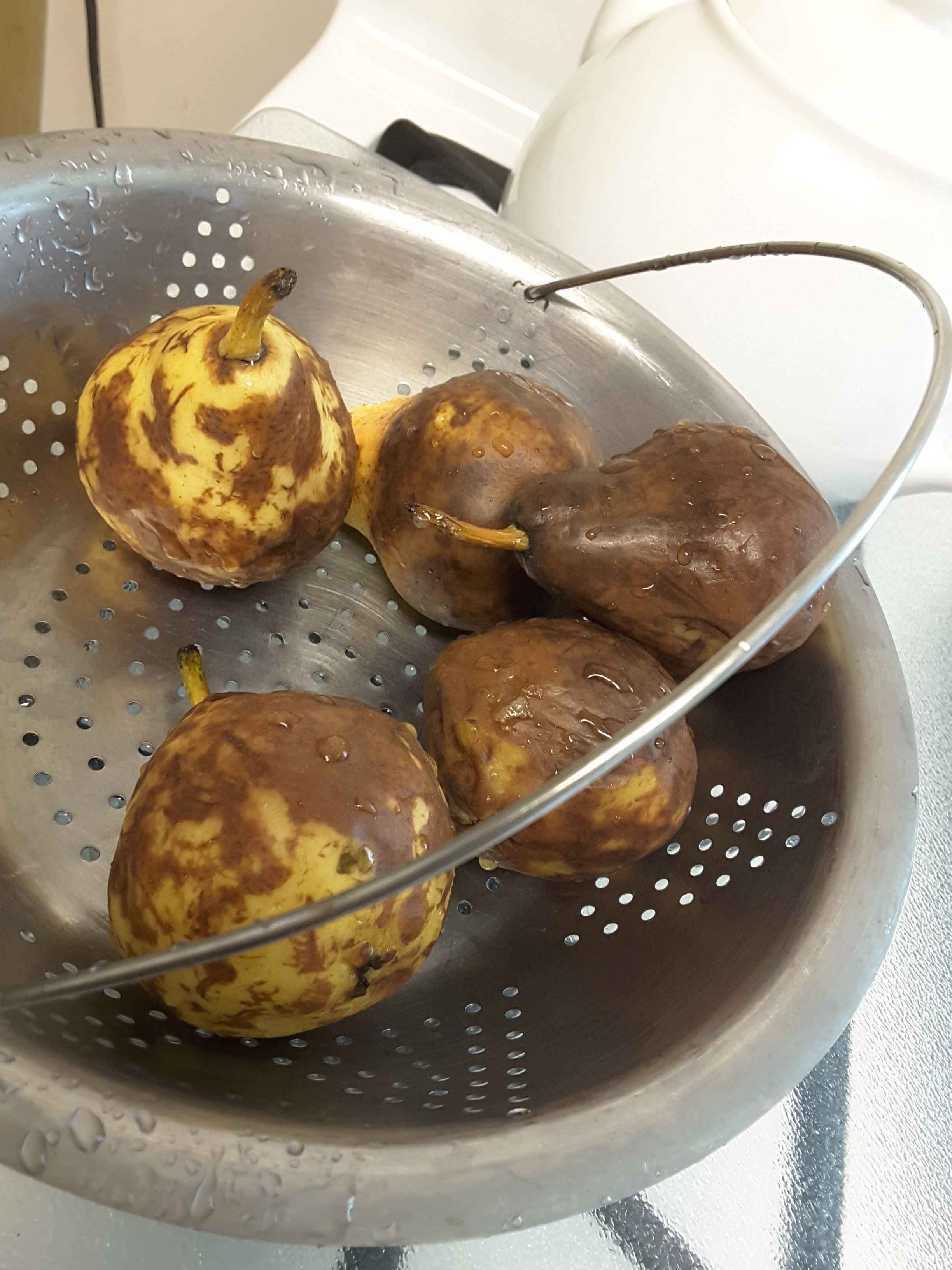
So even if you’re not a big fan of raw pears, the occasional bargain bag may be worth considering for desserts. If you can get them organic at a decent price, do, because pears are on the “dirty dozen” list for absorbing pesticides. Trader Joe’s sells bags of 6-8 small to medium (3.5-4 oz.) organic pears for about $3 at this writing. But what if, as happens occasionally, the child who insisted she wanted them instead of apples yet again has eaten two, and the rest have sat neglected in the fridge for long enough to turn?

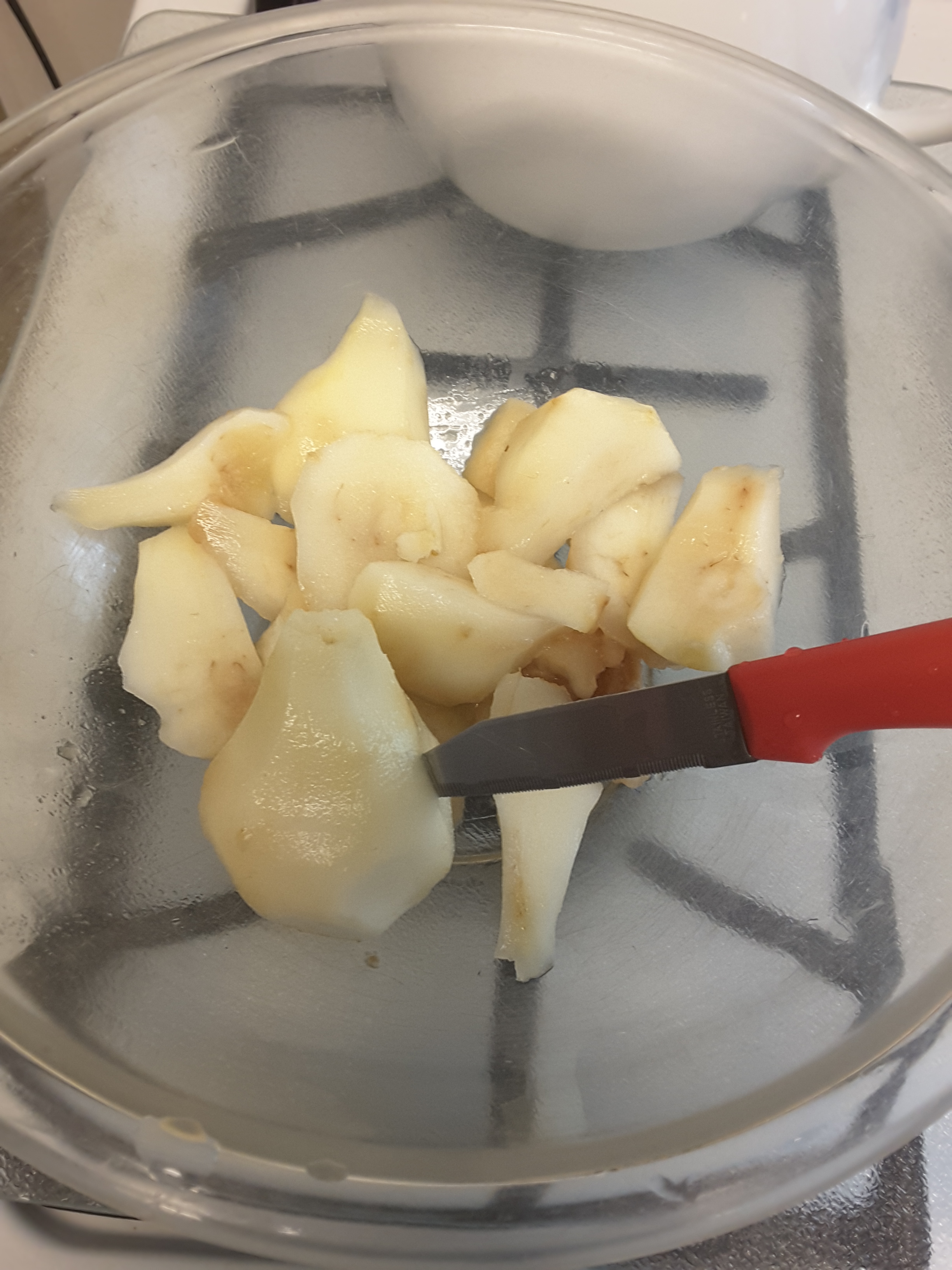
Overripe pears don’t look very nice on the outside and may have gone bland and/or brown, but they’ve still got what it takes if you peel them and cut away actual bad spots. If they’re only a little overripe and still flavorful, use them for a sorbet or microwave them for a minute or so to turn them “micro-poached.” If they’re really soft and going brown, peel and core them, remove all the brown bits and then mash or blend them as you would ripe bananas to give body and moisture to a cake or torte.

Here are two easy microwaveable desserts that use ripe to overripe pears and are Passover-worthy but can work anytime.

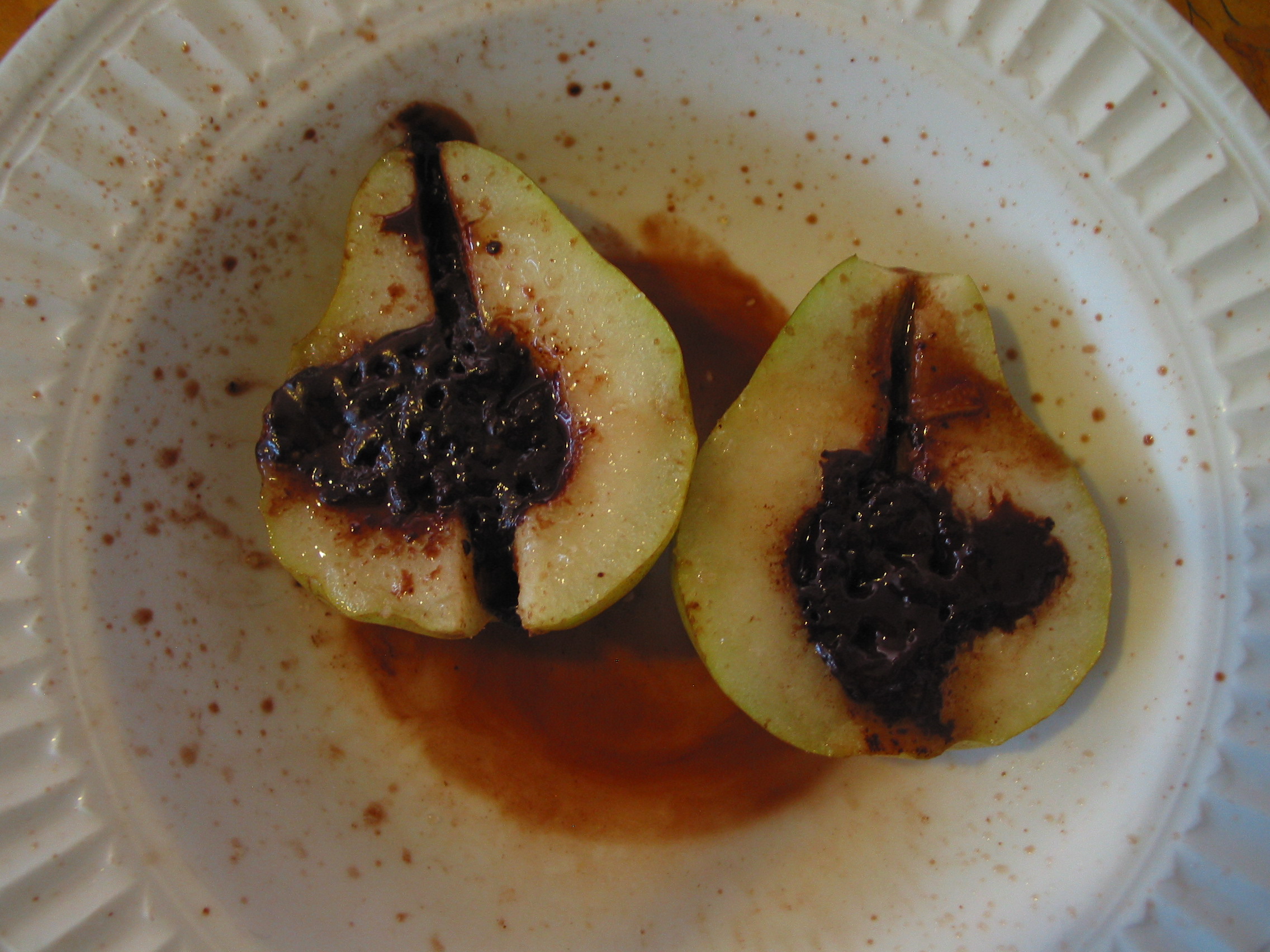
microwaved pear with chocolate

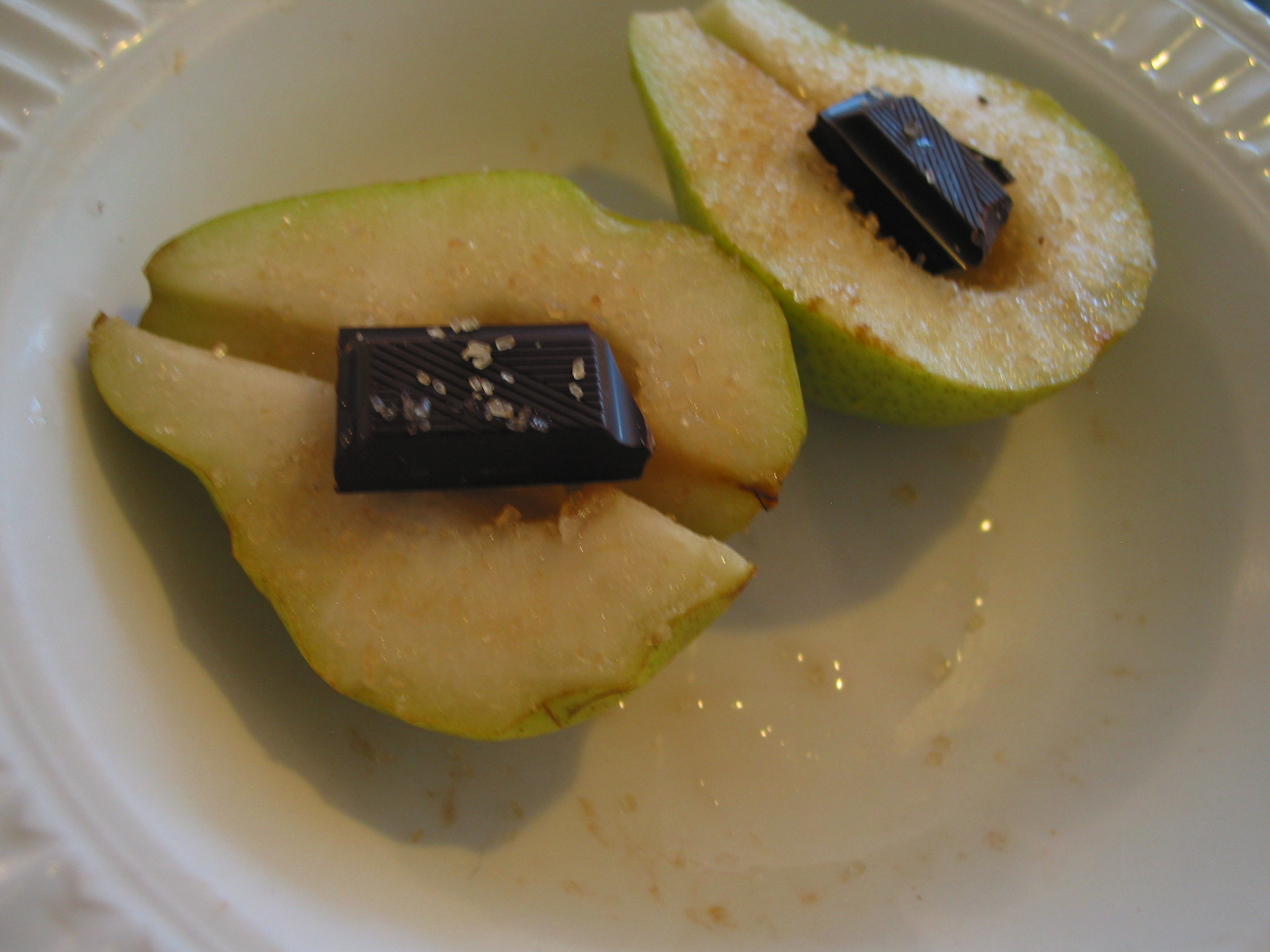
Micro-Poached Pears with Chocolate

This one’s very fast and impromptu–make just one pear or a few at a time and add a little time just as needed.

It can be hard to find chocolate that’s labeled kosher for Passover. Depending on your level of observance, consult the Orthodox Union’s Passover Guide, which changes year to year but  lists brands with kosher certification or acceptability even without a mark. If you eat kitniyot (beans, legumes, corn and peas, some spices, seeds and nuts) you can probably eat most chocolate that contains soy lecithin and vanilla. If not, look for the specially marked Elite chocolate bars that are kosher certified for Passover–for the Orthodox Union in the US, it’s the regular OU symbol (a capital U in a circle) but with a capital P superscript at the right. Other kosher certification at the Orthodox level is most likely to be the Hebrew letter kaf and/or a paragraph of Hebrew text naming the certifying rabbinical authority and location, sometimes with a circular seal containing the text (usually this is if it’s an Israeli product). There may be other certified or acceptable chocolates made with vanilla beans rather than extract (or without vanilla at all) and without lecithin–some of the high-end organic brands, for example.

  • Ripe to very ripe pears
  • Dark chocolate, your preference for cocoa percentage, brand, etc.
  • optional: turbinado or regular granulated sugar, cinnamon, powdered ginger etc. for sprinkling (check the OU site if you need to; regular granulated sugar is certified as-is but brown sugars aren’t always, and ground spices need to be certified for Passover)

Wash the pears, split in half and trim out the seed core and stem threads.

Lay the halves face up on a dish or plate that can go in the microwave. Place a square of chocolate on each half about where the core was.

Microwave 1-2 minutes per pear, just until the chocolate starts to melt and bubble and the pears are tender. Sprinkle with turbinado or other sugar and spices as desired before or after microwaving.

Eat with a knife and fork–add blackberries or a dollop of yogurt on the side if you want. Let it cool a little before digging in–I’m never that good and the roof of my mouth sometimes suffers for it.

Making the best of bad pears

The second recipe is yesterday’s riff on the Banana Ginger Almond Torte (from the I can haz cake?! Passover breakfast menu scheme…) crossed with my lightened-up version of Nigella Lawson’s “Damp Apple Almond Cake.”

five overripe pearstrimmed pears

Only, obviously, I had 5 small way-overripe pears to deal with. Brownish to quite brown on the outsides. But good enough inside to yield about 1 to 1 1/2 cups of pear once they were trimmed. And the result was seriously delicious.

pear almond torte slice

Continue reading

Passover mid-week: what’s for lunch?

With the best will in the world, there is only so much matzah anyone really wants to eat in a day. Even whole wheat. Yes, it’s crunchy. No, you don’t have to run the toaster oven. Yes, you should eat something else, and not just macaroons or gefilte fish from a jar. Or more hard-boiled eggs. Yeesh. Something lighter, please.

Salad

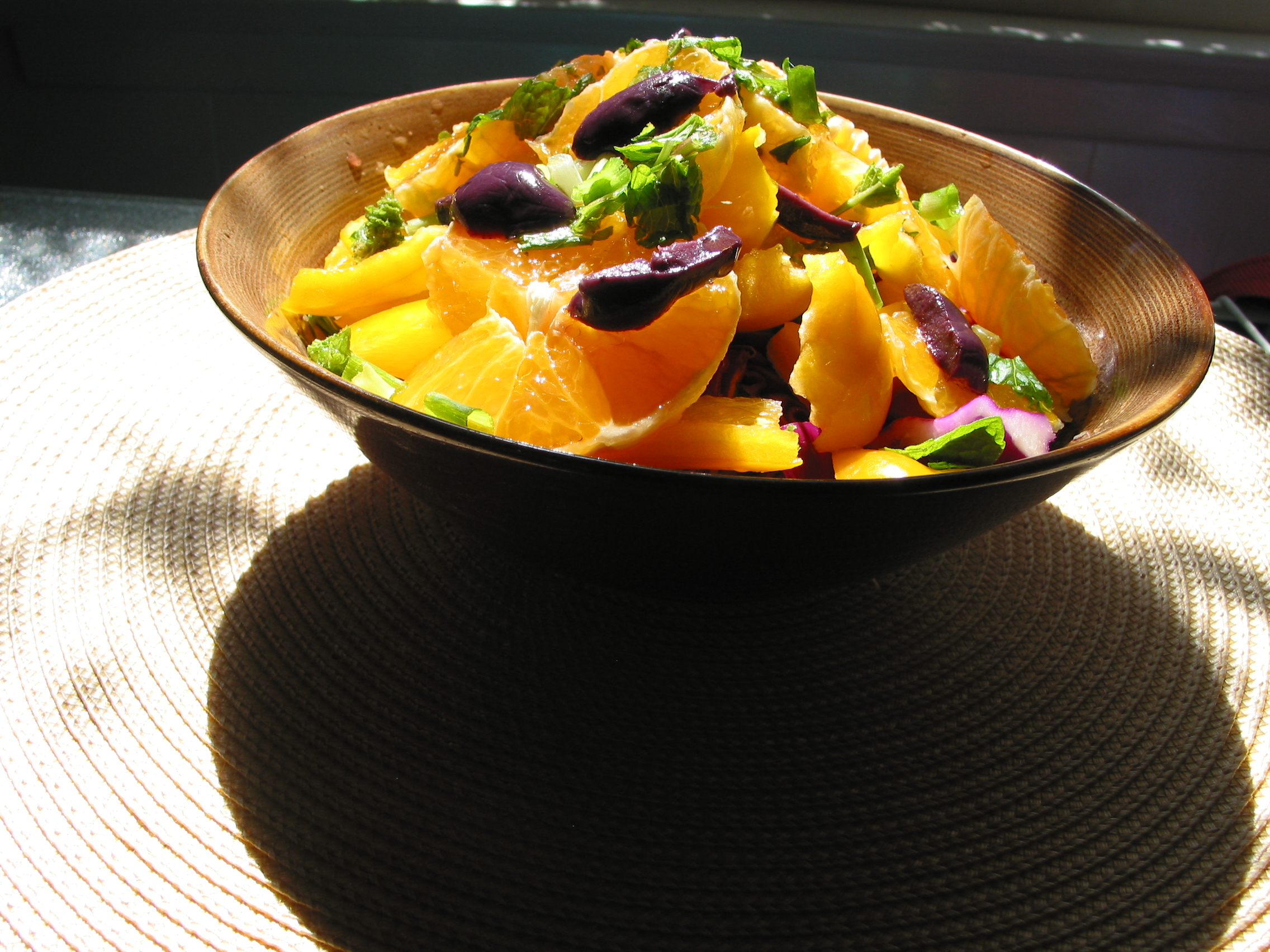
If you can get tomatoes of worth yet (it’s been a pretty long winter across much of the US), cut up some tomatoes and cucumbers, some red bell pepper, splash a bit of olive oil and vinegar on, maybe some Greek yogurt, some dill or basil, a bit of scallion and some feta or an olive, If good salad veg is scant but you can get cabbage, shred it and toss with some fresh or dried dill, thyme or oregano, maybe mint, oil and vinegar, a bit of lemon juice if you’ve got it, a couple of Greek-style olives. Or make a mix of oranges–slice them and serve with vinaigrette and lettuce or chopped cabbage, maybe a scallion and an olive or so, to brighten the last of winter and the first of spring.

Microwave melts and other vegetable and cheese combos

My standard eggplant microwave “melt” combo, with peppers and/or artichoke hearts and mozzarella/feta sandwiched between two slices of microwave-steamed eggplant. Salsa or shakshouka or even plain tomato sauce if you’ve got it, but jazz it up with hot pepper flakes and/or smoked paprika, or if you don’t have sauce then at least some hot pepper flakes, paprika, and basil or oregano–something.

Fish

Tuna salad is pretty classic, obviously, even though if you keep kosher it means scouting out kosher-for-Passover mayonnaise, making your own, or using plain yogurt instead (my current preference; my experience making mayo from scratch is more vast than I care to admit, and I don’t even like the stuff).

But if you have leftover cooked fish, especially tilapia or salmon, or you’re willing to cook a pound of it specifically for a batch of quick fake-smoked-whitefish-style fish spread, go ahead and microwave it a couple of minutes until cooked through, then drain off the liquid and mix with fat-free plain (!!!) Greek yogurt (add cautiously by spoonfuls so you don’t get too much and make it gloppy), plus or minus tehina if you eat it at Passover and like it, plus some lemon juice and grated or finely chopped onion or scallion, a bit of garlic and dill, and either a couple of drops of liquid smoke or a good dash of smoked paprika, with salt just to taste at the very end. Let it chill and it’ll solidify a bit overnight in the fridge. Good again with Greek olives and some salad (and okay, a little–but only a little–matzah). If you’re going for a meat meal and want to keep it nondairy, do a little more lemon juice and some olive oil as the binder and leave out the yogurt.

Fake-smoked tilapia salad on matzah

Fish Salad Rellenos?

But you can take it further, as I discovered. I’ve never actually loved gefilte fish, and even though Joan Nathan swears that fresh homemade gefilte fish is much better, I have chosen all these years not to believe her because it’s a big to-do and an even bigger mess, plus all the matzah meal and eggs mixed in–it’s basically a fish meatloaf full of stretchers. No. In my book, if you can get real fish, you should eat real fish as a main course and treat it with respect.

Leftovers, maybe, if you don’t just want to eat them straight–but not with yet more matzah and eggs. For crying out loud.

And all leftovers have to be good enough to eat on their own merits. Whatever you do to them should improve them or at least not degrade them.

I live in warm–sometimes way too warm–territory near Los Angeles, so the Armenian and Latino corner greengrocers always have good veg for cheap. Both are into peppers of varying shapes, sizes, colors and burn factor, a plus in my book. Passover can really use a hit of ta’am (flavor) and some vegetabalia to go with it.

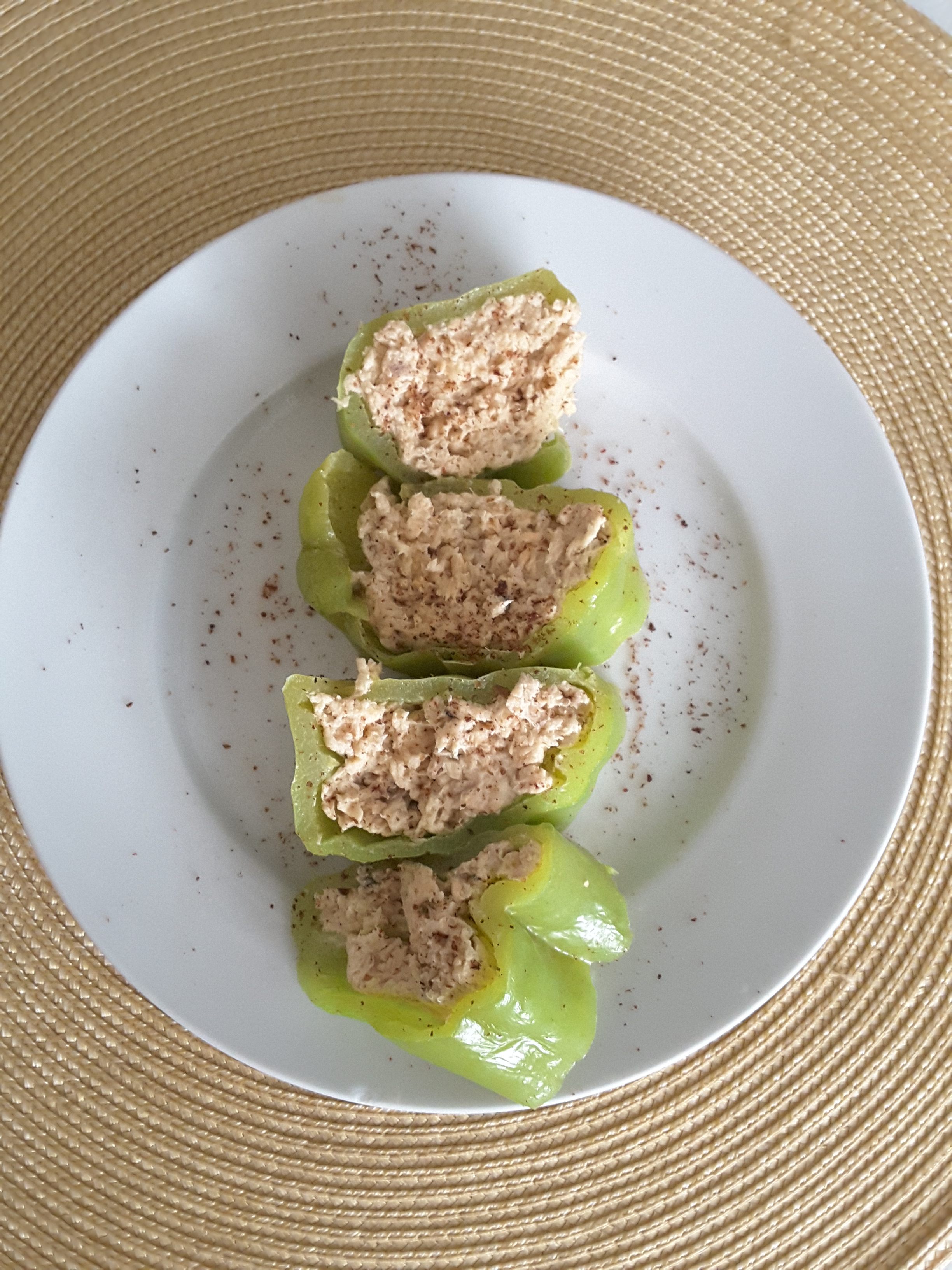
A bag of Hungarian peppers–pale green, mostly-mild, thin-walled, good for quick-pickling–was going for 50 cents a pound this week, and they’re long like Anaheims but nice and boxy at the stem end, not flat, so they’re easy to core and stuff without parcooking first. Fill them with the fish salad, I discovered, and you can microwave them a couple of minutes on an open plate or in a snaplock container with a lid until the peppers are cooked just to tenderness on both sides. I sliced one of them crosswise into inch-thick pieces and got this:

salmon-stuffed peppers

A decorative sprinkle of smoked paprika over it and not only was it good for a hot lunch, it would also be a quick and pretty southwestern take on gefilte fish as an appetizer, one or two slices per person, without all the traditional filler or grating and boiling and carp in the bathtub and so on, but with some actual flavor and freshness.

B’te’avon (bon appétit, mangia bene, eat nice) and Chag Sameach (happy Passover)!

A Microwaveable Passover, 5778 (2018) edition

Spinach matzah balls in the microwave

No matter how many times I vow I’m not going to work too hard this year, I always end up cleaning the fridge some time in the small hours the night before Passover, swearing creatively to get all the vegetable bins and shelving back in the way they came out. Between packing out the unkasherable dishes and appliances like the toaster oven, shopping for the week, and kashering the silverware, dishes and pots for Passover, it always ends up about 5 to 6 or so in the evening before I can actually cook.

Passover started Friday night, and it was just us at home this time around for the first seder. So I didn’t have to make a huge menu, which was good. Because I did have to kasher the kitchen–starting after a 3-hour stint at the DMV (my third this month) to help my kid finally get her learner’s permit. Type I diabetes throws a monkey wrench into the proceedings and requires extra time, paperwork, and hocking to make sure one office actually sends the other office the fax within your lifetime…so it was a bit on the late side that I actually got to start, and by the time sunset rolled around, I was kind of wiped and ready to skip it. Not a great frame of mind for experimenting in the kitchen, certainly not that night. Although the fridge IS still astonishingly clean and sparkly.

We don’t always get fully past the rush to the enjoyment of the seder, especially those of us who are doing the cooking. But the first bite of parsley dipped in saltwater always signals the start of the holiday for me, and the first bite of matzah tastes like freedom. (The thirty-fifth bite or so, perhaps not so much…)

By now I’ve played around enough to have quite a number of simple Passover-worthy dishes that can be microwaved, some of them start to finish. That can be handy when you’re either short on cooking time after getting home from work on Friday or just short on patience and yet you still want to do a simple–but still nice–small seder. It might even provide a save at least for the side dishes if you’re doing a bigger one.

Some things you can’t help cooking on the stove–hard-boiled eggs for the seder plate and for the table of hungry guests.  And some things like charoset take some hand work to chop if you don’t have a food processor around.

However.

Even if you’re serving something long-cooked like chicken or brisket as a main dish, a couple of easy microwaveable vegetable dishes, appetizers and desserts–even soup–might benefit from not having to compete for stovetop and oven space, particularly if a heat wave is headed your way. And microwaving reaps big benefits for reheating or supplementing leftovers quickly during the next several days if you keep kosher for Passover, or even if you don’t.

Vegetabalia

Fresh vegetables really matter for Passover. Salad, yes. It’s spring, after all (even though my mother said they were expecting another snowfall this week in Boston). And also cooked greens. I’m a big believer in microwaving them lightly and last-minute wherever possible, so that they’re just-cooked, fresh-tasting and still green when you serve them–at least, if they’re supposed to be green.

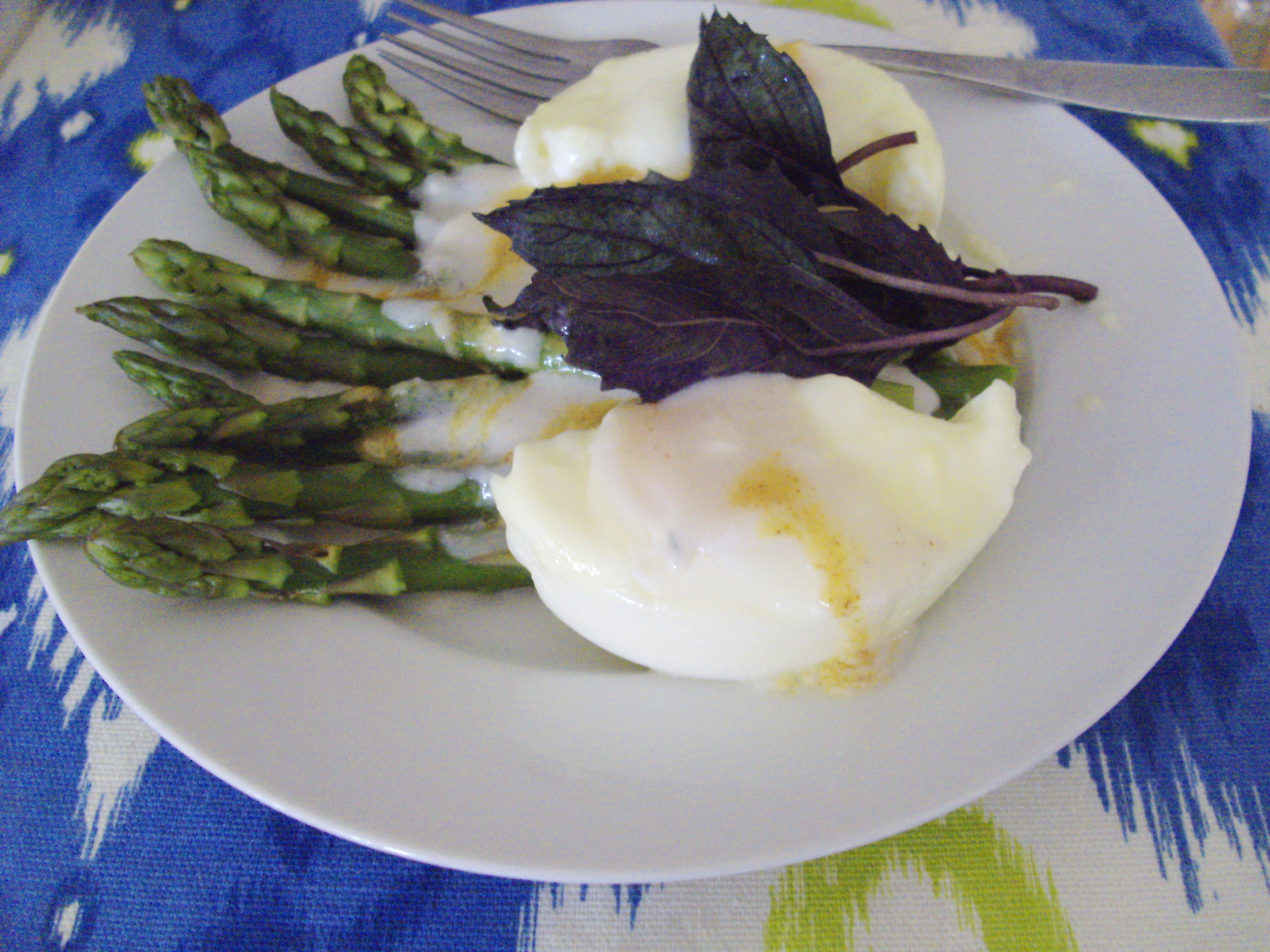
microwaved asparagus with a poached egg

Lightly-microwaved asparagus stays green even the next day. It’s good either cold or reheated with light vinaigrette and a poached egg (regular or microwaved) and some basil or other spring herbs.

Asparagus is traditional, and as long as you don’t abuse it the way my mother [probably] still does, by boiling the regulation seven minutes, shocking in ice water, and then letting it sit around in the cold water for ages until the stalks start shredding into floaty olive-green kelp-like bits, because she’s too busy with the soup, and dinner’s not for another whole hour…..skip all that and microwave the stalks instead for 2-3 minutes and you can be a winner.

Snaplock containers that are about the same size as the amount of vegetable you’re microwaving make it easy to prep ahead and store raw trimmed, washed asparagus, broccoli, brussels sprouts or other greens in the fridge, ready to nuke and go. When you’re ready for them, just add a drizzle of water, maybe a quarter-inch, to the container, put the lid back on, shake once or twice over the sink (in case of drips), and microwave them 2-3 minutes for a pound–you can let them sit a minute or so afterward and they’ll continue to steam. If you’re doing 2 pounds in one container, double the time, but stop and stir gently halfway through so the less-cooked ones on the bottom get moved to the top, and keep an eye on it the last minute or so–that is, stop the microwave again and check with a fork for doneness–so you don’t overcook.

Once the vegetables are just fork-tender and still green, drain them carefully and either serve right away or take the lid off and lay it back on loosely with an  air gap–you can probably get away with letting it sit this way for 10 minutes or so without it cooling too much, and the veg will stay green. But obviously, it’s best to serve it fairly quickly.

Vegetables you plan to roast or pan-brown can get a very quick head start in the microwave before tossing quickly with olive oil, garlic and rosemary in a frying pan or, if you’ve already got it going anyway, the oven. The precooking definitely cuts down the browning time. Brussels sprouts, fresh fennel, new potatoes, carrots, and red squashes are easy to microwave with just a bit of water in the bottom of a covered container to help steam them quickly.

Not-Chicken Soups

Microwaveable not-chicken soups, good for a vegetarian, vegan, or fish dinner,  can be made ahead in a couple of minutes (well, 5 to 15, including prep time) and reheated. They’re also good to have on hand if you’re doing a big meat dinner with the standard chicken soup in a stock pot but you also have a few vegetarian guests.

vegetables for microwaveable not-chicken soup

Basic not-chicken soup (about 2 1/2 quarts or 8-10 servings)

  • 3-4 full-sized carrots
  • medium or large onion
  • 4 long stalks of celery
  • drizzle/spoonful of olive oil
  • fat clove of garlic, minced, mashed or grated
  • handful of fresh dill or 1-2 T dry
  • 12-20 black peppercorns
  • lemon juice and salt to taste at the table

Fill up a 2.5 quart microwaveable bowl or container nearly to the top with chopped (bite-size pieces) vegetables. Stir in a spoonful of olive oil, and microwave-wilt the veg for 5 minutes on HIGH with the lid on. Add a fat minced or grated clove of garlic, a handful of dill and a few black peppercorns, plus water to cover and reheat another 5-6 minutes or until steaming hot, then let it sit with the lid on. Your soup will be pretty flavorful after letting it steep half an hour, if possibly a bit sweet (just one of those leftover mongo onions from last week’s “gifting” weighed a full pound on average). A squeeze of lemon and a dash of salt–not Campbell’s or Lipton’s level salting, salt-shaker-at-the-diner’s-discretion salting–and a grinding of pepper will work it out.

Pan-browned not-chicken soup

The pan-browned minimal carrot-onion soup is a little more hands-on, but very convincing and full-bodied. The basic setup is the same as for plain, but after wilting, pan brown the veg in a nonstick frying pan until you see actual browning, about 10 minutes. Add a grated or minced fat clove of garlic, a sprig of thyme, and a splash of white wine, and cook it down to dry. Put the veg back in the microwave container, swirl a bit of water around the empty pan to pick up the browning (i.e., deglaze), add it to the veg, fill the container up to the top with water, and microwave 5-6 minutes to heat, then let it steep.

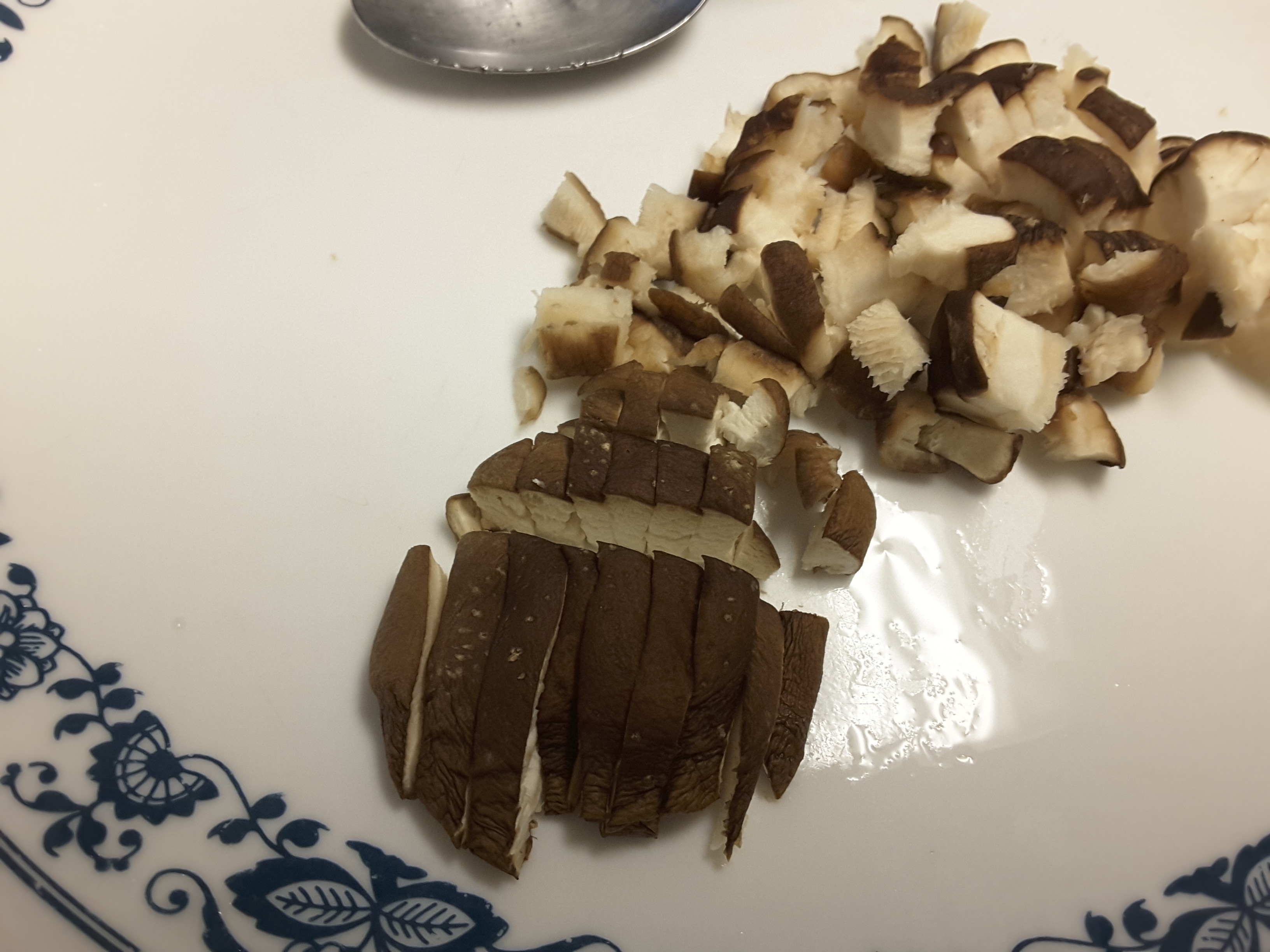
My current version (since I was gifted with celery as well last week) includes a couple of chopped stalks of celery with again, a very large onion. I also added in a bit of dill plus–chop ’em if you’ve got ’em–one or two finely-diced shiitake mushrooms, fresh or dried and soaked in half a cup of hot water,  for added not-chicken potency.

diced shiitake mushrooms

A squeeze of lemon and a dash of salt and fresh ground pepper at the table makes it even better than actual chicken soup. And you never have to skim any scum.

If you want to surprise people, go with bok choy broth but skip the soy sauce (contains wheat) and add extra shiitakes and fresh brown mushrooms, plus scallions, garlic and ginger. Use apple cider vinegar. We think sesame oil is fine for Passover but a lot of people don’t; it’s okay even without it.

Whatever soup you offer, keep the vegetables in. I never really understand the appeal of throwing out good veg just to have a 1950s-style “clear consommé”.

Microwave matzah balls?!

You can, actually, but not the conventional way, at least not in water to cover, mimicking the usual stovetop boiling. I tried it one afternoon last week just to see, using the classic back-of-box recipe just to be sure (I try these things so you don’t have to…). Continue reading

Color and Taste

We have a week and a half before Passover, and I’ve been experimenting a little with the foods I have to use up before then–flours, beans, lentils and spices.

I also–help! got “gifted” an awful lot of leftover vegetabalia from my daughter’s youth group director after last week’s major fundraiser, a huge Harry Potter-themed congregational dinner (Fantastic Feasts and Where to Find Them, still quite a popular title) that brought in nearly 200 diners and was frankly amazing.

bulk sacks of celery and onions

This is just the smaller bag of onions, along with way too much celery…

I managed to donate an entire 25-pound sack of onions to a local food pantry, but got another 10 pounds as a reward, along with two caterer’s packs of organic celery–that’s six full-sized heads–a huge box of organic mesclun that leaked horrible brown liquid in the shopping bag, so I composted it rather than trying to use any.

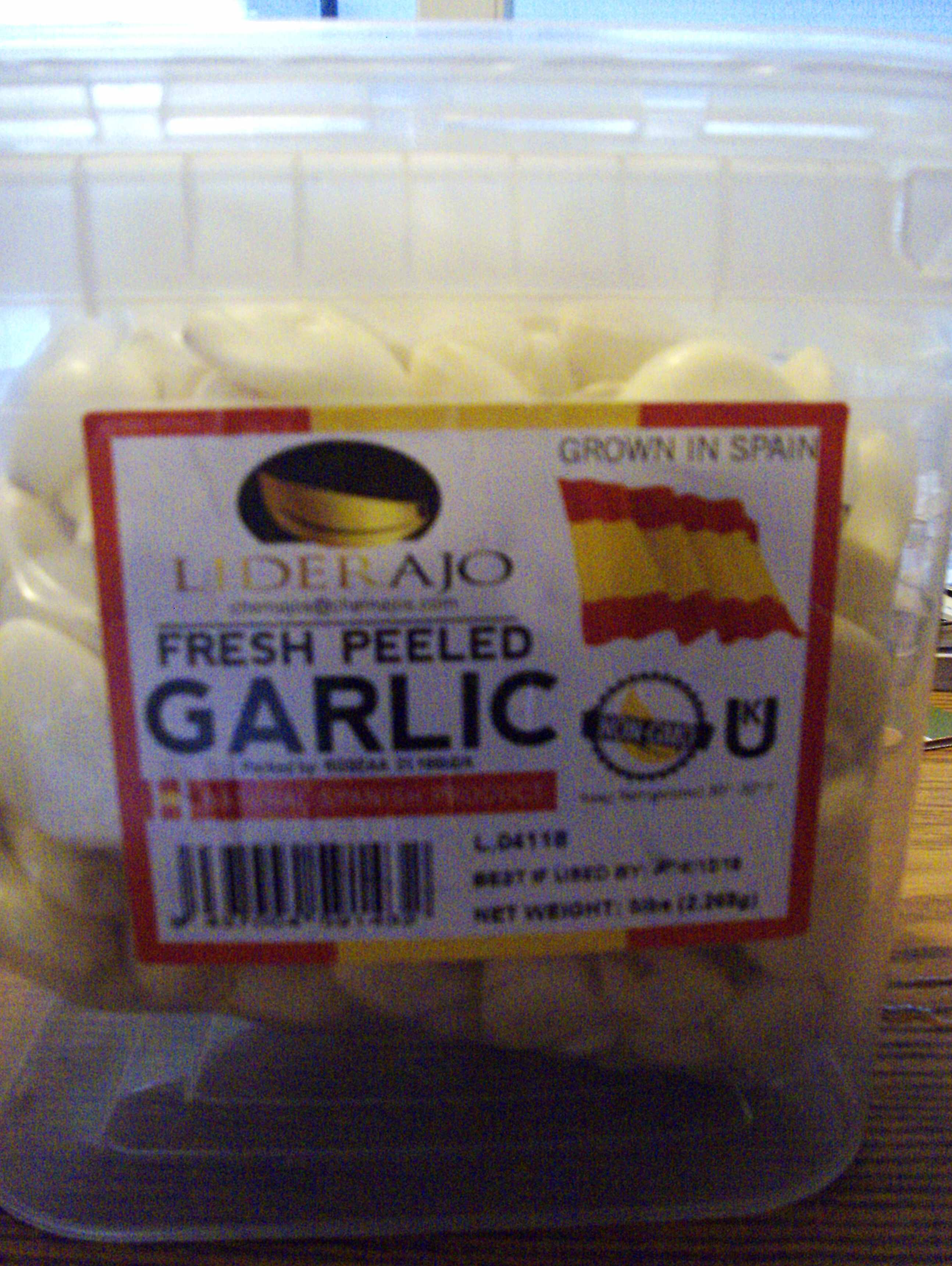
too much garlic

Worst of all….a 5-pound box of peeled garlic cloves. Which looked well-sealed and fine if ridiculous.

I looked squint-eyed at the youth director, who had such a hopeful wheedling expression on her face:  You like vegetables, you believe in garlic, could you please, please take it? Please?

Oy. By the end of a 10-minute ride home it was definitely reeking up my car. Why? Because the garlic cloves themselves were prepeeled, which always seems like such a bright idea to caterers and those who aspire to buy big. They were also machine-peeled, so some were cut into, hence the reek. And I mean, 5 pounds? I grabbed a modest handful of uncut cloves, rinsed them carefully, stuck them in a baggie and froze them. I had to toss out the rest of the box immediately. In the outside trash bin. Well wrapped.

In using the few cloves I kept, I’ve discovered I’m not wrong–looks really aren’t everything. The garlic itself, fresh or frozen, is impressive in size but very different from the usual small tight heads of garlic I buy for myself–harsher and yet less intense, lacking the warm flavors that make garlic garlic to me. So I’m going back to the real thing, peels and all.

In the meantime, I’ve been practicing my microwave not-chicken soup skills, along with testing the microwaveability of matzah balls–yes, you kind of can, they just won’t be spherical–which means we may all be sick of soup by the actual seder. Oh, no!

And while distracting myself from doing taxes, I’ve been looking for inspiration on another library cookbook binge. I drift by the New Books section and get caught by the new cookbooks with all the pretty colors–purple soup? red and yellow nasturtium blossoms on a salad? Bright green or pink or charcoal-gray (literally, as it turns out, using bamboo charcoal powder) shu mei wrappers?

As with the caterer’s box of garlic, though, looks can be deceiving.

I snatch up the books; I check them out, I lug them home and marvel at all the photographic bravura on my desk. Most of them are unexecutable in my kitchen because I don’t have a stick blender or enough counter space to do the fancy dim sum wraps justice. And some of them feature pork belly or crabmeat or other unkosher items.

Mostly, I look through the ingredients list and wonder mightily if they actually taste as impressive as the colors suggest, or if it’s all just for Instagram-worthy photos.

Love Italian Food (Maddalena Caruso, 2014) is a good case in point. Gorgeous photo of three technicolor puréed soups–cauliflower, broccoli, red cabbage with purple potato. I’m stunned by the purple velouté. But reading through I get cautious and skeptical. I want cream of red cabbage soup to taste amazing if it’s going to be that color and topped with a pale-jade romanesco floret. Caruso says it tastes peppery from the red cabbage; she adds purple potatoes for body and further color, some chicken broth, salt and pepper. She simmers the cabbage only 10 minutes or so before blending–hopefully that keeps it from going sulfurous. It might be good. It might be too subtle for me. I might have expected some lemon for the mild acidity that will keep the cabbage pigments from turning blueish-green. Or basil and garlic pesto. Maybe something smoky–smoked paprika? Or hot peppers and toasted sesame oil? Something.

I nuked a wedge of chopped red cabbage one recent afternoon to test the concept. It wouldn’t really blend smoothly in my food processor, and on its own, the purple mash smelled distinctly sour and a bit dank, lightly cooked as it was. It might combine well with other ingredients, but it wasn’t obvious that it would. Continue reading