
• Enter your email address to subscribe to this blog and receive notifications of new posts by email.

    Join 241 other subscribers
  • Noshing on

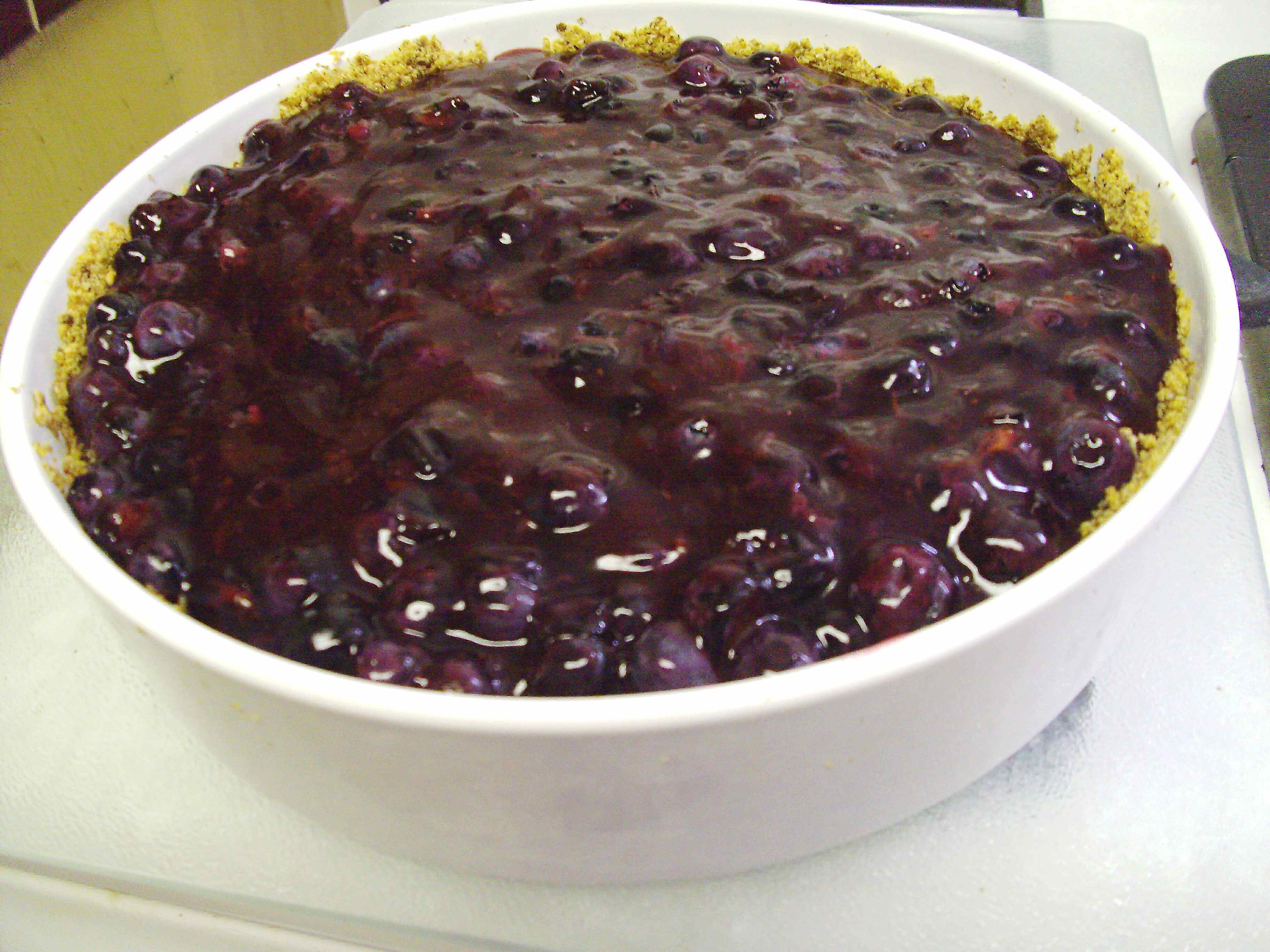
    raw blueberry pie with microwaveable filling and graham cracker crust

    This mostly-raw blueberry pie is a snap to make and very versatile--the filling microwaves in a few minutes, and you don't even have to bake the zippy gingered graham cracker crust--perfect for a hot Fourth of July and all summer long.

  • Recent Posts

  • Contents

  • Archives

  • Now Reading

  • See also my Book Reviews

  • Copyright 2008-2024Slow Food Fast. All writing and images on this blog unless otherwise attributed or set in quotes are the sole property of Slow Food Fast. Please contact DebbieN via the comments form for permissions before reprinting or reproducing any of the material on this blog.

  • ADS AND AFFILIATE LINKS

  • I may post affiliate links to books and movies that I personally review and recommend. Currently I favor Alibris and Vroman's, our terrific and venerable (now past the century mark!) independent bookstore in Pasadena. Or go to your local library--and make sure to support them with actual donations, not just overdue fines (ahem!), because your state probably has cut their budget and hours. Again.

  • In keeping with the disclaimer below, I DO NOT endorse, profit from, or recommend any medications, health treatments, commercial diet plans, supplements or any other such products.

  • DISCLAIMER

  • SlowFoodFast sometimes addresses general public health topics related to nutrition, heart disease, blood pressure, and diabetes. Because this is a blog with a personal point of view, my health and food politics entries often include my opinions on the trends I see, and I try to be as blatant as possible about that. None of these articles should be construed as specific medical advice for an individual case. I do try to keep to findings from well-vetted research sources and large, well-controlled studies, and I try not to sensationalize the science (though if they actually come up with a real cure for Type I diabetes in the next couple of years, I'm gonna be dancing in the streets with a hat that would put Carmen Miranda to shame. Consider yourself warned).

Microwave tricks–When the peach doesn’t ripen

What if you’re stuck with supermarket peaches or nectarines that looked good, were on an incredible discount, smelled like they had potential if you left them out on a counter for a couple of days, and then when you did, they somehow never really ripened? Just turned mushy or the texture of a pale yellow sponge inside, with a lackluster taste to match, and developed an ugly, gelatinous brown layer near the pit? And to make it worse, you’d enthusiastically bought five or more?

Spongy peaches in need of rescue

Spongy peaches in need of rescue

I’ve discovered–the hard way–that all is not lost. As long as they’re only blah, not actually mildewed or spoiled, even failed peaches like these can be rescued and put to work.

Sugaring before microwaving p

Sugaring lightly before microwaving

Sugaring fruit and letting it stand is an age-old trick for bringing out fuller flavor–strawberries are the classic, but it works for peaches and nectarines too. It wasn’t enough on its own to make the peaches edible raw, but I figured if I nuked them the flavor might come up in the cooking, and the texture might be fixed too. So I tried it a couple of ways, one just the peaches on their own, and two other versions mixed with other more flavorful fruit.

[update ~ 2017: I have tweaked the raw peach method here]

Microwave Peach (or Nectarine) Compote or Jam

The first thing to do is wash the peaches well and cut as much usable flesh off the pit as possible. Take a small sliver and taste it–if it’s just bland or spongy but still has at least a tinge of fruit flavor, you can use it.

Chop up the peaches and put them in a pyrex bowl. Leave the skins on–this is where at least some of the flavor is going to come from. Sprinkle on a few spoonfuls of sugar and squeeze some lemon juice over them. Cover the bowl with a plate and microwave on high for a few minutes (3-4 min in a ~1100W oven). When you uncover the bowl, the fragrance should start coming up and the pieces will have turned translucent and produced a bit of pinkish-bronze juice. You can taste and see if that’s good enough for you, or cook another minute or so, perhaps with a sprinkle of cinnamon (very good) and/or a thin slice of fresh ginger. Maybe a star anise pod or a couple of cloves if you’re doing this as a compote and feeling really food glam that day, but I didn’t try these myself, so I can’t vouch for them. Cool, chill, and serve with yogurt or ice cream.

For jam, mash the peaches with a fork before the final minute in the microwave. Once it’s cooled, the mixture will thicken and the cinnamon and/or ginger will play off the peach flavor for a good chunky jam.
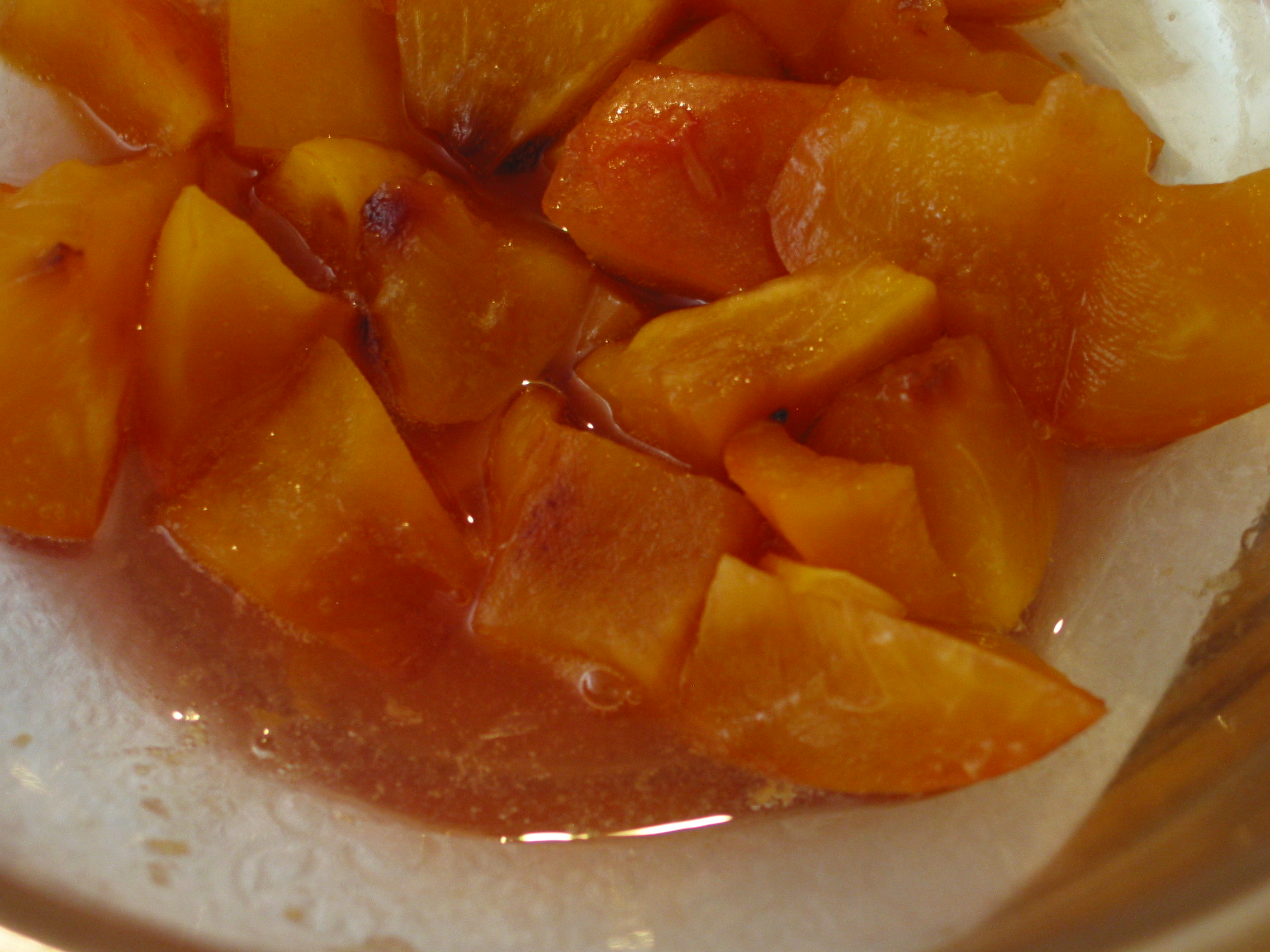
Microwave peach compote

Microwave peach compote

Mixed-Fruit Compote or Jam

The second compote/jam strategy calls for mixing the fresh peach or nectarine chunks with another fruit before microwaving. I have two  suggestions here that turned out reasonably successful–one is a handful of chopped dried apricots that have soaked up for about 1/2 hour in boiling water or orange juice, and the second choice, a bit odd perhaps, is sliced strawberries mixed in with the peach chunks.

In both cases I went extremely easy on sugar compared to what’s called for in traditional jam-making.  I wasn’t making a lot, it was going straight into the fridge and I was going to use it quickly. Plus I’d pretty much always rather eat a jam that’s more fruit and less sticky stuff. I know, I know, technically that makes it a “fruit spread” rather than proper jam, but do I care?

For the mixed jam with dried/soaked apricots, I microwaved a handful–15 or so–chopped apricots in water to cover for 2 minutes and let stand covered for half an hour, then put them in the food processor with large raw peach chunks — in my case, the peach was oversized, like a softball, so maybe two normal tennis-ball-sized ones would be about right–and a couple of spoonfuls of sugar and pulsed them just enough to blend fairly well without losing all the texture. Then I squeezed lemon juice on the mixture and poured it back into the pyrex bowl to microwave a few minutes as above. I poured the hot mixture into a very clean hot 1-lb jam jar and screwed down the lid–the lid did suck in as it cooled, but I wasn’t counting on that so I kept it in the fridge and ate it over the next week or so.

Another peach I cut up and microwaved straight with some strawberry slices mixed in because they were the last ones in the pint. Again I don’t think I added more than a tablespoonful or two of sugar and a squeeze of lemon, but what happened was the strawberries, instead of going slimy, gave the warm compote a baked comfort-food kind of taste that I hadn’t expected and looked nicer as well. I’d been thinking cooked strawberries would look as bad as they do in strawberry jam, but they didn’t, and without too much sugar (or corn syrup, in the commercial jams I hate) they kept some of their bright flavor too.

None of these ideas is as satisfying as biting into a perfectly ripe, exceedingly juicy peach (or nectarine) at the height of summer, but all of them are pretty good in their own right, they don’t take long, and they’re handy saves for fruit that turns out to be less than you expected.

Microwave Tricks: Poached Eggs, No Explosions

Microwave-poached eggs

Astonished. I should be elated, but I’m just–is flabbergasted too strong a word? In June, chef Wylie Dufresne of New York’s WD-50 did the unthinkable and moved his latest microwave oven out to the dining room for some elegant tableside egg poaching. Only it took him 29 minutes. With some sort of fancy tinfoil shield.

Now really. I can see it’s time to step in, because 29 minutes in a microwave is like three years in a regular oven. 29 minutes to poach an egg by any other method than LA sidewalk  (ours are reaching the 200-degree mark) is plain ridiculous. No matter how fabulous the chef. I’m tempted to send him the starter booklet that came with my Sharp Carousel.

Poaching eggs in a microwave doesn’t have to be such a production. You can do it in 2 or 3 minutes for a pair or even 4 soft-cooked eggs that look and taste nice. Not rubbery. Not chewy. Not raw. And not exploded. You don’t need any specially designed microware. You don’t need any toothpicks. Or vinegar. You don’t need anything other than a microwaveable soup bowl–the relatively rounded bottom is much better than the flat bottom of a mug for even heating and preventing explosions or boilover–and a microwaveable lid or saucer. You have those at home. I know you do.

Every food site from Chocolate & Zucchini to What’s Cooking America insists you need to prick the egg yolks with a fork or toothpick before nuking to prevent explosions, but that’s not actually so. All those recipes say to crack the eggs into cold water and then microwave it all at once. I’m not 100% sure, but I think that may be the key problem.

I’ve used the following method for years with no explosions and without the eggs turning to hockey pucks:

Poached Eggs in the Microwave

1. Heat a half-full soup bowl of water to a near-boil first–about 1.5 minutes on HIGH. Then crack in the eggs, let them sit a minute covered so the whites begin to film over, and then nuke again covered for 1 minute.

2. Take a big soup spoon, scoop under each egg and flip it gently in the water–the underside may appear near-raw even while the top is cooked, but once flipped it will quickly set in contact with the hot water, and you can finish by nuking 10-15 seconds more with the lid on and/or letting it sit covered for 20-30 seconds or so.

3. When the eggs are set the way you prefer, either scoop them gently out of the bowl or carefully drain the bowl with the lid and some potholders (be careful not to let the eggs slip out!) A little burgundy-and-mushroom reduction or mustard dressing (optional), a little mesclun, some toasted rosemary bread and you’ve got yourself a classy bistro dish. Bon appétit!

Yogurt in the microwave

Back in the early 1970s, when yogurt first started to become popular in the U.S. but wasn’t yet widely available in supermarkets, manufacturers like Salton started selling home yogurt machines that would run overnight with a temperature-controlled water bath and six or so individual-sized covered containers. Those machines are hard to find today but you don’t really need them to make your own yogurt.

You can make very good yogurt in the microwave without any special equipment, and it’s very easy. But although a few older, less fashionable shared recipe sources on the web still mention it, none of the current slow food mavens ever seem to go this route. I’m not sure why–microwaving works beautifully.

Traditional instructions have you heat up the milk to something under a boil and let it cool to just a little hotter than lukewarm–measured either by thermometer at about 118 degrees F, or by testing with a finger before you can stir in the yogurt. That takes a fair amount of time on the stove top, and you have to stand there and stir or risk scorching the bottom of the pan (which you have to scrub).  It’s probably a half hour of preparation just to get it going. Then you have to  insulate or keep it heating very slightly for 6-12 hours. The most common insulation schemes from the new-slow-food crowd involve all-night ovens kept at 100 degrees F, towels or blankets wrapped around the yogurt pot, hot water jugs surrounding multiple small yogurt pots in a beer chest, crockpots, and other hard-to-believe and hard-to-clean setups.

Just reading about it all–the jumble-sale setups, the 24-step “guides”, the incredible number of pots and things that need washing before, during and after–makes you want to run to the store and buy a tub of ready-made.

Microwaving is a much easier and dare I say better method. It requires a grand total of a microwave oven, a large pyrex bowl, a pyrex or ceramic pie or dinner plate, and a spoon. The milk heats in just a few minutes with no need for stirring and doesn’t scorch at all. Once you stir in the cultures, you let the yogurt sit covered in the microwave with the power off and the door shut. The oven’s a very good insulator, especially in combination with the pyrex bowl and lid. You already have it on your counter–no need to dig weird items out of closets or the garage. The yogurt stays warm for hours with no cockeyed, jury-rigged insulation schemes, and the washing up is, unsurprisingly, simple.

Unlike most microwaving, this is still a slow business–as in, overnight–because it’s the real thing. No matter how you set it up, it takes between 6 and 12 hours for a couple of quarts of warm-to-hot milk with a few spoonfuls of yogurt stirred in to sit and culture undisturbed in the microwave, minding their own business, before the new batch of yogurt is ready to eat.

So it’s not fast, per se, but it’s a perfect thing to set up after supper and revisit the next morning. When you open the microwave door at the end, you can jiggle the bowl gently and see that the milk has set as yogurt. Continue reading

Microwave Tricks: Indoor Grilling When the Heat’s On

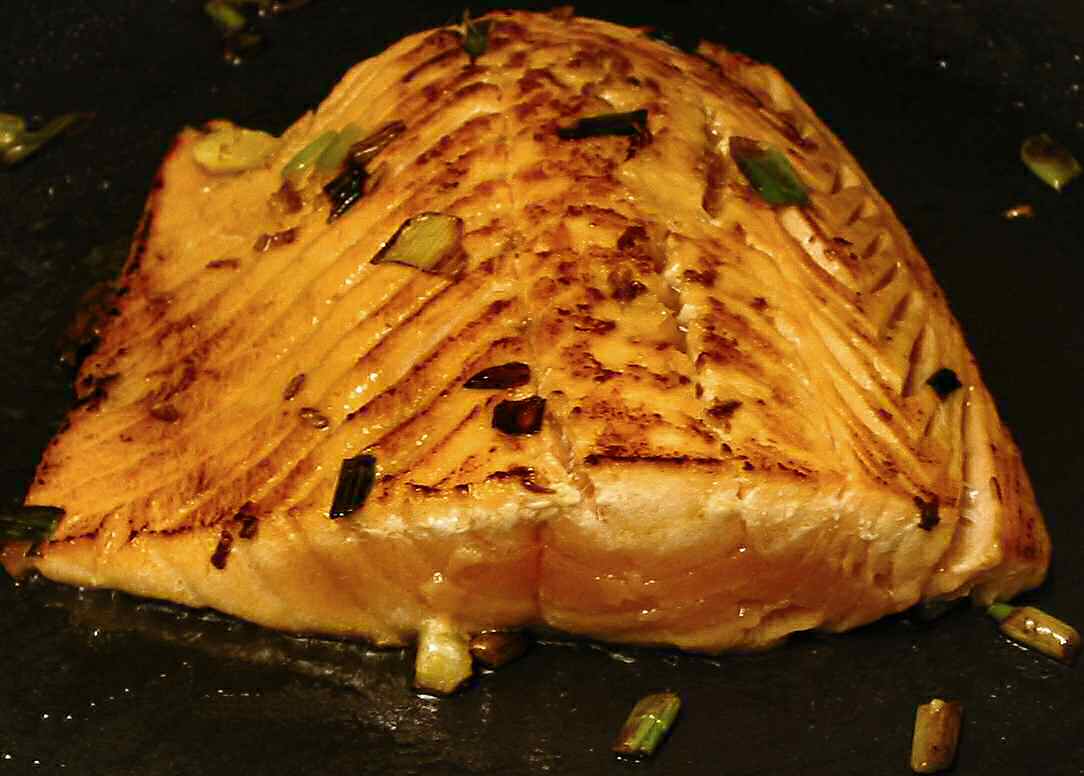
Pan-seared salmon, ready for the microwave

Pan-seared salmon, ready for the microwave

You almost never hear the words “microwave” and “slow food” in the same sentence unless someone’s casting the two as opposites with an easy sneer. The one and only time I’ve read anything about microwaving by a Real Restaurant Chef was Tony Bourdain in Kitchen Confidential when he mentioned something about hitting a plate gone cold with some “Radar Love” before sending it out. He meant it as a dirty back kitchen secret.

Gourmet cookbooks (other than Barbara Kafka’s Microwave Gourmet, a scarily extensive tome from 1987) never call for microwaving anything more exciting than butter or chocolate chips, and none of the Food Network shows do either. It’s a shame. Can you see Giada De Laurentiis microwaving? Mario Batali? No–it would probably zap the studio camera or melt Mario’s clogs or something. And it would ruin the vicarious glamor of slow cooking. But it would be fun while it lasted, wouldn’t it?

Some things, let’s face it, don’t do incredibly well in a microwave–deep fat frying (Kafka claims you can in small quantity, but I’m scared of sloshing hot oil around a small box), birthday cakes (though Kafka has found a reasonable way to do cake layers and her recipes get good reviews), an entire raw turkey (stuffed or un-)…. And fish? That may be the trickiest of all, since fish goes from almost cooked to shoe leather in 20 seconds if you’re not careful, and it still won’t brown nicely.

For example, take the lowly, farm-raised salmon fillet. Now I know it’s not wild, I know it’s not King or Sockeye, it’s not elegantly 2″ thick–but it’s also not $17.99/lb and up. And it can still be pretty good, especially grilled.

Only it’s summer in L.A., and the last thing I want to do in my townhouse with a distinct lack of outdoor grilling facilities is heat up the house or cook the salmon long enough under a broiler for the edge fat to start sending acrid smoke up the stairway.

But combine the microwave’s ability to cook things through with a quick browning technique like pan-searing, and suddenly you have a strategy for some nice main dishes that taste better than they should in a lot less time, and don’t heat up the house. Incidentally Kafka mentioned this method in passing while discussing the fact that microwaves don’t brown food. She then proceeded to ignore it completely, don’t ask me why.

Most restaurant chefs insist they can’t get a good sear on anything with a nonstick pan, but that’s not entirely true (plus I hate washing dishes any more than I have to, and I’m really determined, so nonstick it is). I’m borrowing from Martin Yan on this one–it’s a technique I saw him do for a stir-fried shrimp recipe on PBS, sometime way, way back in the 1980s, and it works surprisingly well here. Continue reading

Dolmas by microwave

When we first moved to Pasadena 10 years ago, one of my favorite places for Sunday dinners out was Pita! Pita!, a family-run Lebanese restaurant in the “Old Town” section of the city. One of the reasons I loved it was the usual reason to love middle eastern food: the mostly vegetarian mezze were wonderful, and the main dishes were knockouts. Long-cooked lamb, roast chicken, fish grilled or under tehina sauce, vegetable stews with a surprising bite of pineapple in them. Even though I couldn’t eat the meat dishes, I could certainly appreciate them by smell. Everything was modestly priced and generous along with it.

The other reason I loved it was that the family that ran it had made their restaurant the kind of place families went for an old-country kind of Sunday dinner with all the uncles and aunts. Pita! Pita! was housed in one of a row of narrow spaces along Fair Oaks, converted from what I think was once a schoolhouse. The narrowness didn’t stop them from putting a couple of large old-fashioned dining room tables in with the smaller ones for couples. They treated their customers like family, you could sit and eat at a leisurely pace and converse, and we never came away anything less than happy. And certainly never hungry.

Which is why I still miss the place. The family ended up realizing they couldn’t make a go of it without charging astronomical prices or wearing themselves out and decided instead to run a smaller, cafeteria-style lunch spot with fewer and simpler dishes on the main business street. And I can’t blame them at all. The food they serve now–more mezze and fast grilled items–is still as good, but the long-cooked family-style dishes and the leisurely Sunday nights I’ll keep having to miss.

I grew up with hummus, tehina, felafel and tabbouleh, which are Israeli standards too and popular among Jews in the U.S. My mother made them from the dried mixes and cans of prepared tehina when they finally became available in our supermarket. In Israel I learned to make them from scratch, but one thing I didn’t know how to make was stuffed grape leaves or dolmas. My sister had married someone who did and on one weekend visit she showed me the ropes.

I love dolmas but they are not quick to make, not at all. We rolled a loooooottt of grape leaves that afternoon (her husband had bought the econo-jar at a local Arab market), and stuck them tight in a pot, plated down so they didn’t float and unwind, and boiled them with lemon and olive oil for more than an hour. They were wonderful but you would never want to do it on a regular basis!

In the spirit of “what can you cook in a microwave instead of the regular way,” I have gone back and made dolmas at home–in a microwave. It works! You can cook them in a few minutes rather than an hour-plus of boiling and having to top up the water so nothing scorches, and they come out beautifully.

Unfortunately, the microwave, miracle machine though it be, will not help at all with the rolling, which is the hard part. The best I can do is say that microwaving lets you do a few at a time if you feel like it–say, 10-20 dolmas, not 50-100. What you do with the rest of the grape leaves in the econojar is up to you.

Grape leaves come brined in rolls of 20 or so, either a single roll in a skinny jar (Krinos) or a big pickle-jar with four rolls (Cortas, other brands). When you buy them, inspect the rolls and make sure there are no little fluorescent green or yellow spots on them–you’ll know if you see them; capers also get this sometimes. I’m not sure if it’s harmful or not, but I stay away from it. I’d keep the other rolls in the brine in the fridge and make sure to use them up within a month, or else take the rolls and freeze them in ziplock sandwich bags with the air squeezed out–and use them within a couple of months so they don’t get freezer burn.

Dolmas in the Microwave

  • Roll of brined grape leaves ~ 20-30
  • 1 c raw rice (not “minute rice” or parboiled) or bulgur (cracked wheat or tabbouleh grain, plain)
  • 1 med/big ripe tomato
  • 1/4 onion or 1-2 scallions
  • 1 T dill (a few good sprigs fresh is best if you have fresh)
  • several sprigs or small handful fresh curly parsley
  • juice of 1/2 lemon
  • olive oil and the other half lemon for cooking

1. Partially or almost-completely cook the rice or tabbouleh in the microwave: put it in a pyrex bowl or microwaveable container, cover with ~1/2-3/4 inch of water, microwave covered on HIGH for ~2-2.5 minutes, let sit and absorb the water several minutes until nearly done, drain excess moisture.

2. While the grain is cooking, rinse off the roll of grape leaves and then soak them in a big Pyrex bowl to get rid of some of the salt. Change the water once. [Note: traditional recipes say soak the grape leaves an hour in cold water. Some others say pour boiling water over them and let them soak. If you want to split the difference in a microwaveable way, you could rinse them, put them in the Pyrex bowl with water to cover, nuke 2-3 minutes on HIGH and then change the water.]

3. Blend the tomato, onion or scallion, herbs and lemon juice in a food processor and mix with the drained rice or bulgur–include the tomato juice. Let cool enough to handle.

4. Stuff the grape leaves–this is the hard part. Take a stack of grape leaves and drain them on a plate. Cut off the stems carefully without tearing the leaves. Lay out one leaf vein-side up and stem end toward you. Put a spoonful of the filling–not more–on the leaf right above where the stem joint was. Roll the leaf over it–tightly but carefully so you don’t tear–and tuck the side leaves over it halfway through, then keep rolling away from you. Place each stuffed grape leaf, flap edge down, in a tight layer in a  microwaveable container or dish.

5. When you’re done rolling (nothing says you have to do the whole thing in one go if you get sick of it after 10 or you just want 10, just put the leftover filling and the grape leaves in the fridge) pour a little water carefully over the layer of grape leaf rolls. Maybe a quarter-inch of water. Squeeze the other half lemon over the whole thing, and drizzle a little olive oil over it– maybe a couple of tablespoons worth. Cover the dish or container and microwave on high 2-3 minutes for 10, maybe 3-4 minutes for 20+. Check one for doneness–careful, it’ll be pretty hot–you want the leaves tender and the grain cooked through. Maybe go another minute if you need to.

Let them cool and chill in the fridge. Serve with tzatziki, raita, tehina, or other yogurt-based dip.

How to Nuke an Eggplant

Eggplant after microwaving

After microwaving 10 minutes, the eggplant has collapsed

Eggplant is one of those warm-climate foods. It’s big, cheap, and plentiful, it goes with everything from garlicky oregano-and-fennel laden tomato sauce to nutmeg-tinged custard or cumin/cinnamon-scented Greek and North African dishes, to curries and darkly soy-glazed Chinese and Thai dishes. You can deep-fry it, panfry it, grill it and serve it room-temperature under a glossy layer of olive oil, marinate it, wrap it around other fillings, stuff it, roast it, make spreads with it… There’s even a Greek eggplant “spoon sweet” and at least one eggplant “jam” from Morocco. To say nothing of pink-tinged sour eggplant pickles, one of my favorite additions at the Israeli felafel stands.

The only thing you don’t really want to do with eggplant is eat it raw.

I NEVER bother with the usual cookbook directions for eggplant. All of them slavishly recopy instructions from their predecessors–salt it, drain it, fry it in tons of expensive olive oil, which it will soak up mercilessly, bake it for an hour only to find it still has spongy raw spots… They never bother to update, or even retest, the traditional assumptions that make eggplant such a pain.

You can forget most of that if you just nuke your eggplants first. Most of the stuff people do to their eggplants comes of just trying to get it cooked through. The salt’s to get rid of some of the water; the fat’s to cook it hotter and let the juices steam inside the slices.

Microwaving takes care of both, needs neither fat nor salt, and it’s very quick–10 minutes on HIGH on a pyrex pie plate for 1 or 2 decent-sized eggplants and you’ve got either collapsed whole eggplant(s) ready for baba ghanouj or a fan of slices or a mountain of bite-sized cubes. All of them cooked through and ready to do something more interesting with.

I used to think I was alone in the wilderness on this one, because NO ethnic cookbook–or any other cookbook with eggplant recipes–ever considers the existence of microwaving, much less condones it for cooking actual food. Continue reading