• Enter your email address to subscribe to this blog and receive notifications of new posts by email.

    Join 241 other subscribers
  • Noshing on

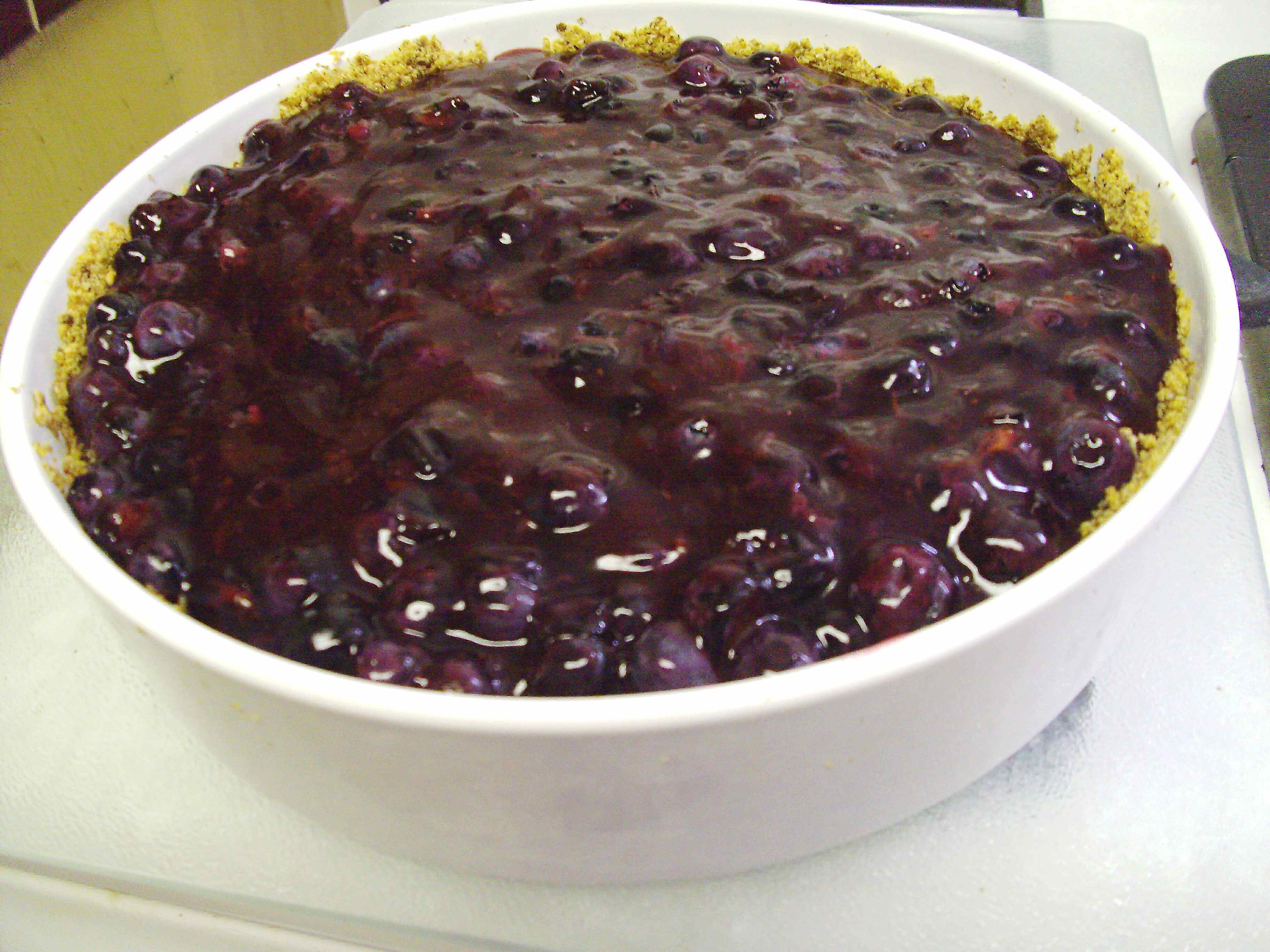
    raw blueberry pie with microwaveable filling and graham cracker crust

    This mostly-raw blueberry pie is a snap to make and very versatile--the filling microwaves in a few minutes, and you don't even have to bake the zippy gingered graham cracker crust--perfect for a hot Fourth of July and all summer long.

  • Recent Posts

  • Contents

  • Archives

  • Now Reading

  • See also my Book Reviews

  • Copyright 2008-2024Slow Food Fast. All writing and images on this blog unless otherwise attributed or set in quotes are the sole property of Slow Food Fast. Please contact DebbieN via the comments form for permissions before reprinting or reproducing any of the material on this blog.

  • ADS AND AFFILIATE LINKS

  • I may post affiliate links to books and movies that I personally review and recommend. Currently I favor Alibris and Vroman's, our terrific and venerable (now past the century mark!) independent bookstore in Pasadena. Or go to your local library--and make sure to support them with actual donations, not just overdue fines (ahem!), because your state probably has cut their budget and hours. Again.

  • In keeping with the disclaimer below, I DO NOT endorse, profit from, or recommend any medications, health treatments, commercial diet plans, supplements or any other such products.

  • DISCLAIMER

  • SlowFoodFast sometimes addresses general public health topics related to nutrition, heart disease, blood pressure, and diabetes. Because this is a blog with a personal point of view, my health and food politics entries often include my opinions on the trends I see, and I try to be as blatant as possible about that. None of these articles should be construed as specific medical advice for an individual case. I do try to keep to findings from well-vetted research sources and large, well-controlled studies, and I try not to sensationalize the science (though if they actually come up with a real cure for Type I diabetes in the next couple of years, I'm gonna be dancing in the streets with a hat that would put Carmen Miranda to shame. Consider yourself warned).

Persian-ish grill ideas for Purim

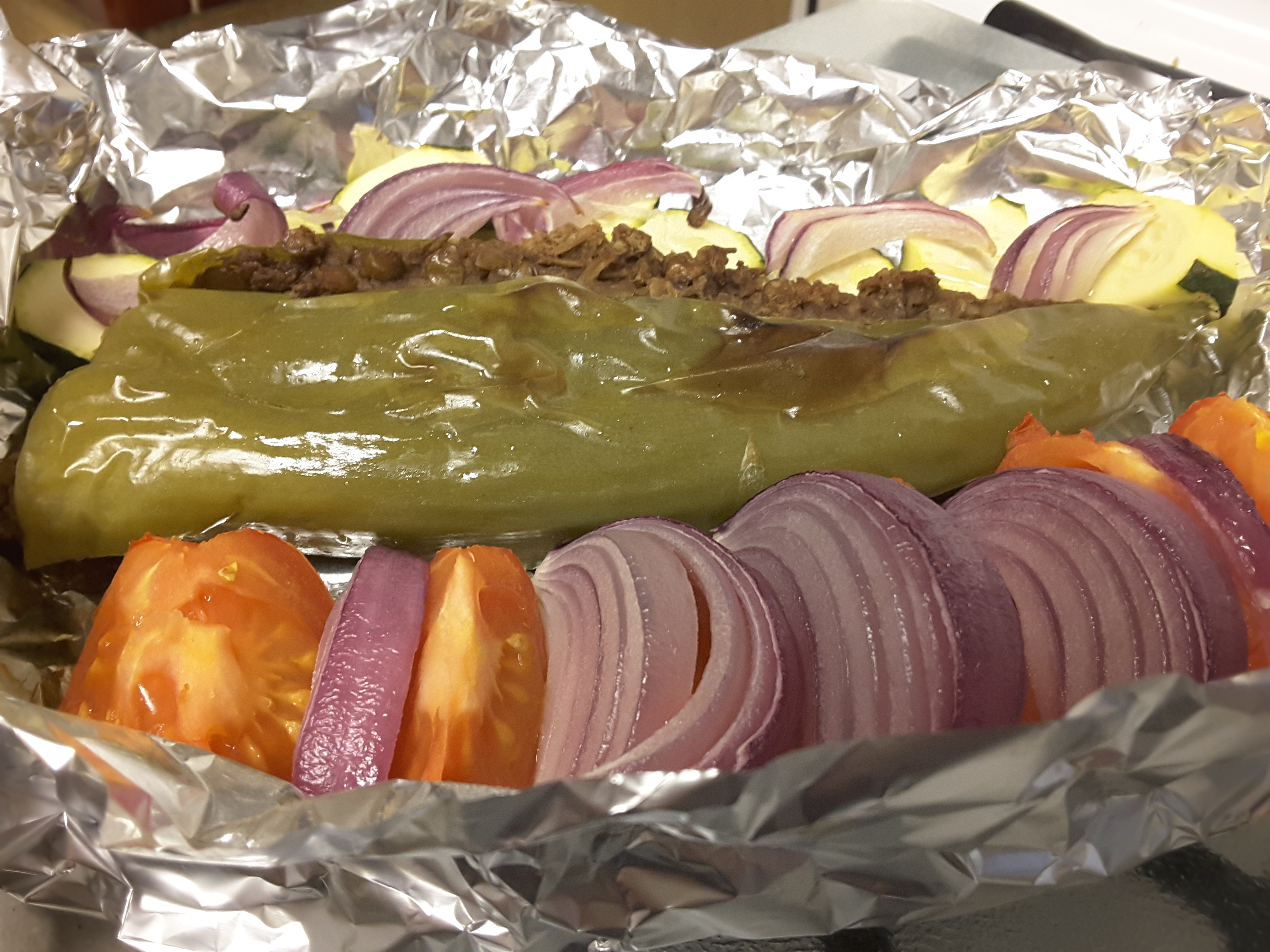
Lentil-stuffed Anaheim chile with zucchini, tomatoes and red onion in a Persian-style vegetarian platter grilled in the toaster oven.
Microwave-to-toaster-oven version

Last year our synagogue signed up for a catered Persian grill dinner (served takeout-style for pickup) from a restaurant on the West Side of LA, and this year they’re doing it again from a restaurant with kosher meat options. Last year, we weren’t sure so we went with a vegetarian option that turned out to be a little bleak–just grilled but dry unsauced vegetables, including some very-middle-American-style broccoli and babycut carrots that looked like they’d just been thrown in with the more traditional eggplant, pepper, zucchini, onion and tomato. The trays were filled out with huge heaps of bright-yellow basmati rice and a little tub of fesenjan sauce–toasted ground walnuts cooked down with grated onion and pomegranate molasses. No actual protein, though, so I pan-browned triangles of tofu to go with it. It was still all pretty bland, though, except for the charred tomato and pasilla pepper and onion.

Even though we’re going to have a meat version tonight–presumably better, I hope!–before the Megilla reading, the story of Queen Esther is very specific about one of her virtues. Unlike all the other girls who were hauled up to Ahashverosh’s palace for a year of preparation for a beauty contest (only, as with most, without a desirable prize). Most of the contestants dined on all the delicacies of the palace kitchen, but Esther refused any of the expensive meats and ate chickpeas instead. She didn’t tell anyone she was Jewish, but she didn’t eat the meat, claiming she was in mourning. It may have been a factor in why she was chosen as queen–she wasn’t being a glutton while the getting was good.

In Esther’s time, Ahashverosh had allowed his wicked vizier Haman to convince him to send out a decree allowing anyone to attack the Jews. But once Esther exposed Haman’s plot and her own Jewishness, he couldn’t cancel his own decree, so he sent out a second decree allowing the Jews to arm themselves in their own defense.

The celebration of Purim, while joyous and relieved, maybe a little exaggerated, is always mixed with acknowledgement of poverty and violence around us; this year most notably caused by the horror Putin has committed in Ukraine. The parallels are pretty harsh and very timely; there are always people like Haman and Ahashverosh willing to do harm or make excuses. So I have mixed feelings about meat vs. vegetarian for Purim, and about celebration in the midst of and despite the everpresent harsh realities.

The best I can do is to say that yes, especially now, we need to commemorate and to celebrate the triumph of good over evil–but without losing perspective or forgetting. May we have more people like Esther and Mordechai–be people more like them, people who step up. And in the meantime, remember to give tzedakah and g’milut hasadim–not charity, but the justice of providing for those in need. This is the season for that too.

Back to food and cooking:

One thing I’ve been thinking about since last Purim is how to make a somewhat better-tasting vegetarian Persian grill-style platter at home. I did like the restaurant’s grilled vegetables, just not the broccoli and carrot bits that were completely out of place or the tofu I made as a last-ditch effort.

If you have a microwave and a toaster oven or a nonstick frying pan with a lid, you can do something good and vegetarian fairly quickly and get some of the vibe without a lot of work. And grilling will improve winter tomatoes, onions, zucchini, (full-size, sliced) carrots, cauliflower, whatever you have where you are.

You can make a tray of quick-grilled vegetables as a side dish, or you can take the long, stuffable peppers and put in rice-and-tomato, as for dolmas (stuffed grape leaves), grillable white cheese like panela or queso fresco plus a sprinkle of nigella seed or thyme and some minced onion, or my personal and higher-protein/flavor choice, lentil hashu as for stuffed baby eggplants and mehshi basal (stuffed onions), which are Syrian Jewish, but adaptable and delicious and not too far off. The lentil and rice stuffing is flavored with allspice and cinnamon and it grills up nicely, especially in a nonstick pan with a bit of olive oil to create a light, crispy, char on the surface. It also makes light, delicate felafel-like fritters.

Continue reading

Heartsick for Ukraine

Sorry–this is not about food, and only marginally about trying to ensure food aid. Links to a few key aid organizations are toward the bottom of the post.

I have not slept well this week; I keep getting up and checking the headlines in the New York Times and the Washington Post and AP and Reuters, hoping that Ukraine will turn for the better, that people are surviving and that the Russian military will realize that Putin has frankly lost it, stop obeying his orders and cease fire, for everyone’s sake. I keep seeing people crowded into the underground metro stations and wondering how the hell aid workers can get food to them.

President Zelensky, who looks so much like my dad as a young man and like my mother’s cousin and mine, is holding on, and he has inspired us in a way no one really expected. He’s doing much more than most people would try to do for his people and he’s gone from zero to 60 doing what Putin could not, would not, for his own people. That is obvious.

What is more obvious, no one outside Ukraine wanted to help last year because it would mean dipping a toe in the water of war that was already visibly massed at the border. They tried to tiptoe and appease. And like Chamberlain–and then Churchill–they woke up to the fact that you can’t appease a bully and expect it to work. Bombs rained down on London in response to their concessions. That and not bravery ahead of time is what turned Churchill’s approach. By then, the world was actually at war. Could it have been stopped short?

President Biden has said–and Boris Johnson has too–that we will not send American troops to help fight in Ukraine because it would tip us into World War III if we fought Russia directly. And they are right not to escalate tensions unnecessarily.

But this is not unnecessarily, and we could hardly be escalating anything, it’s already well past “escalating” when a madman has attacked his neighbors and nobody stopped him. For a year. With missiles and cluster bombs and now possibly vacuum bombs, and is threatening nuclear war for anyone who dares intercede. An ounce of prevention or in this case early and hard military response could be worth a thousand pounds of war. On the heels of a miserable pandemic, in which Americans are STILL dying at a rate of nearly 2000 a day, post-peak.

If Barack Obama, for whom I voted and whose aims I generally supported, had not let Putin cow him into keeping the US from interceding early and hard to stop the massacre Assad committed on his own country, over years, where might Europe be today? In better shape, with fewer tragedies and migrant deaths and much lower cost in terms of immigration, closed borders, abusiveness toward refugees, the perceived permission to hard-right bigots elsewhere, from Rump to Xi, to commit even further human rights abuses and rattle sabers at their pacifist neighbors. Russia itself would be in a lot better shape. All these things have cost the world a lot already and should be cause for shame.

Obama understandably did not want to push America into another adventurist war like the one Bush, Cheney, Rumsfeld and Rove lied their way into in Iraq and Afghanistan to our extreme cost. But somehow he could not distinguish between that and a genuine and legitimate cause for military intervention. He wanted to keep his hands clean, and he let himself be afraid of Putin–and of American political backlash. There was no way to be safe if we went in. So he made dignified-sounding speeches and made some economic sanctions and essentially sat on those clean hands, as have we all, in despair.

And here we are again, with few options other than donating aid to organizations like HIAS (hias.org) and the American Jewish Joint Distribution Committee (jdc.org) and the International Red Cross (icrc.org), and worrying for our relatives, Jewish and non-Jewish, and watching the headlines hour after hour. That is essential aid, it makes us feel less helpless, and it is worth reaching into our pockets for. But it is probably not enough given the viciousness of Putin’s attack.

Biden is going to give a State of the Union address tonight. What will he say? What will we do?

If Volodymyr Zelensky can pull together an organized and surprisingly effective defensive action with such scant starting material as he has and rally worldwide support, even for these few days, certainly the US can be doing a lot more. And we had better do it fast. It is time to get brave again.


Three Films on Food and Memory

In the weeks before all the shutdowns and my daughter coming home from university for spring break–and now staying, to our relief–I decided to give myself a day’s mini-filmfest break as a reward for doing taxes. By the time I looked up from the 1040 checklist, though, nothing I really wanted to sit through was still playing at any of the theaters, and I’d missed both The Farewell and Uncut Gems. And now the theaters are closed.

Since I’m not on one of the streaming services, I took advantage of my local library DVD collections before the libraries, like everything else, decided to close. If you can stream these and you like thoughtful movies with food somewhere in the mix of topics and character sketches, they’re all worth watching.

First is Oscar-nominated foreign documentary Honeyland. I’d missed its limited run at my local independent theater only the week before (taxes, as mentioned), so when I spotted it at the library I snatched it up along with two others that were also surprising finds.

Honeyland follows Hatidze Muratova, possibly the last traditional wild beekeeper who, in her fifties, lives alone with her bedridden, elderly mother in a one-room stone hut, part of an abandoned village outside Skopje, Macedonia. She takes the regional bus into town on market days to sell the jars of honey she’s harvested from beehives in the rocks and gets a good price for them, but it’s still just enough to buy groceries with. Then a large, noisy family moves their cattle into the abandoned homestead next door and she makes friends with them, helping with the younger children. The father, ambitious to make a go of things, tries beekeeping himself, but ignores her advice for handling his box hives gently, gets a bad price at market and contracts bulk sales he can’t deliver to an aggressive and ruthless middleman. His hives start to fail, and the hungry bees attack her carefully fostered hives while his neglected cattle start dying. Eventually the family gives up and moves on, having squandered much of their own living as well as what she relied on–but not all.

Honeyland is fascinating just for its portrait of Hatidze, her resilience and her forthright, cheerful way of dealing with both bees and people. She and her mother live on the absolute brink, in a hut with a Franklin stove, a few cats, no other neighbors and very little food. Most of their daily diet is just cooked grain and yogurt or ayran and she still feeds the scraps to the cats. But she makes the most of everything she can.

When she goes to the city market she brings back some bananas and watermelon to tempt her mother to eat and enjoy a few bites of sweetness. She has just her one yellow dress and her kerchief, and no one to appreciate them, but while she’s in Skopje she spends two euros on a bottle of hair dye just for herself, and once home, she combs it through her hair with a sense of satisfaction, as though she were being pampered at a salon, while she chats with her mother about old times. Even at the end of the film, you get the feeling that Hatidze will find a way to prosper.

You do wonder a little how this documentary was achieved–they found room to fit a camera inside the tiny hut as she feeds her mother and helps her turn over on the bed, they filmed the bees stinging the neighbor’s children and his calves weakening and dying in the yard, they filmed the neighbor and the businessman raiding a nearby wild hive Hatidze relies on, just to supplement their jar count–how did the filmmakers get all that? What happened afterward?

Sometimes an extraordinary documentary like this weaves its way into your imagination more intriguingly than fiction, and sometimes the filmmaking unintentionally affects the subjects and becomes its own kind of quasi-fiction just by the nature of what it shows, what it doesn’t, and what’s behind the scenes. Did she stay or go? You have to ask, you have to wonder. The filmmakers do actually answer many of these questions on the Honeyland website, but you have to poke around and follow the press kit link to download the “press notes” PDF–a fascinating read.

The next film, Ramen Shop, is fiction and a bit slighter, but still with some pretty good moments. A young ramen chef working for his hard-as-nails father in Japan arrives at the shop one morning to learn that his father has died of a sudden heart attack. The son consults his uncle, who also works for the shop, about his childhood in Singapore with his Chinese mother, who died young, and the impossibility of recreating the soup she used to make him. Against his uncle’s advice, he decides to go back in search of the recipe and his mother’s family. Continue reading

Rethinking “pantry staples”

Whenever I see the words, “pantry staples,” I immediately hear that line–the only one I can remember–from Saturday Night Live alumna Julia Sweeney’s one-woman show God said, Ha!, from the late 1980s or thereabouts. Sweeney’s midwestern mother comes to visit and pokes around in her New York City kitchen cabinets, then asks, “Where’re yer mixes, hon?” And Sweeney realizes how much living in New York has changed her–she no longer buys box mixes for anything because all her standards are higher.

Likewise, I’ve been thinking lately that it might be a good idea to redefine pantry staples as something more useful and better-suited to a heart-healthy, inexpensive and vegetabalia-filled diet than the usual stale set of dried-out spices, indestructible and tasteless boxes of mac ‘n’ cheese and Hamburger Helper,  bouillon cubes and Ritz crackers.

For people whose cooking experience and time are limited, or who grew up in the Pop-tart generation (what I’m calling most of my contemporaries from the ’70s and ’80s schoolyards), well, we’re all in our 50s and 60s now and our doctors are always telling us to lose weight, eat more vegetables,  get more fiber, cut back on takeout, etc. etc. And it’s now looking like we may get that extra incentive.

Food blog readers are a little more likely to shop like they mean it, but in practice, a lot of the otherwise bright and well-educated people I know are still either stuck in the where-are-your-mixes mindset or else buy unnecessarily expensive designer ingredients that aren’t flexible for day-to-day cooking–which in fact they don’t really do. Actually, none of them seem to cook much at all anymore.

The mixes crowd relies on drive-thrus for refueling on the way to the kids’ soccer practices. No veg. The foodies’ pantries contain 29 or so designer vinegars, but their actual dietary staples are Amy’s™ frozen vegetarian (but high-sodium) prepared meals and/or takeout containers from the Whole Foods deli counter, supplemented with wheatgrass-and-spirulina juice drinks, smart waters, kale chips, a snack baggie of dried goji berries, and those microwaveable frozen brown rice bowls-for-one that cost more than a two-pound bag of actual brown rice. Not much fresh veg there either.

To say this isn’t how we mean to eat is an understatement. But getting from our current conventions to a better daily diet is going to take some rethinking.

Or, of course, a crisis like the one we’ve got now.

If you’ve  been out panic-shopping for toilet paper this week anywhere in the US (and apparently in a lot of other countries as well) and come to a stunned halt at the sight of a completely empty aisle in the supermarket or big-box store, you’re hardly alone.

For the past week, panic has hit the US full-blast and people are trying to think ahead a little in case things don’t actually get better by next week. Last week I was still thinking “climate change” and how to reduce the amount of plastic we go through weekly and check the bargain bins as part of my weekly shopping to reduce food waste. The last few weeks have been full of good citrus finds–mandarins, grapefruit, a bag of cara cara oranges at a dollar apiece–a small, cheering upside to counter all the many, many downsides of the news.

And now this–my daughter just came home for spring break, her college is going online-only for the rest of the semester, she’s worked very hard for several months only to have everything suddenly upended, and she might be home with us more than for the expected week depending on how things continue. I might want her here rather than in upstate New York, just in case she’s got a better chance of getting food, supplies, and medical treatment. Even though the first day home was the usual vacation stake-out-the-exact-middle-of-the-couch-and-watch-movies.

So. Now it’s “what’s the best thing to stock up on if we needed to get through a couple of weeks without much available at the stores?” You can’t do a ton at once unless you have a big budget and a big storage area–an extra freezer?–but you can probably figure that most of us could make smarter choices if we have to.

I’m not sure the mother-daughter team just ahead of me at Trader Joe’s was doing that on Friday, even though they had corralled two extremely full shopping carts for the task (and mistakenly hijacked someone else’s cart for rebagging before they realized it wasn’t their stuff). A lot of frozen stuff, a lot of canned stuff, a lot of bottles of wine and several of something harder.

Maybe that’s a good way to cope, if you can drink? Priorities!

Me? about 5 pounds of frozen fish, two big cartons of plain yogurt, two cartons of eggs, 3 pounds of cheese, some for freezing for later, some spinach and a pound of almonds and two pounds of sunflower seeds. And tofu. And three big cans of unsalted tomatoes. Three pounds of carrots. Two pounds of whole-wheat spaghetti. And–mostly for encouragement–a big 17-oz bar of TJ’s 72% chocolate. Feel like it might be important, somehow. And it’s just hard enough to break up that we won’t scarf it. As I say, priorities.

I have dried lentils and chickpeas and rice; I already have a ton of cheap, hardy veg in the fridge, a big Kroger/Ralph’s bargain can of coffee that’s not bad if you grind it finer, and milk and so on.  And two bags of flour and one new bag of sugar. And two big cans of pumpkin. And spices and teabags and oil and wine. If we really have to, I suppose we could probably get through a couple of weeks if we’re careful. Now if I only felt safer.

Probably doesn’t help that it’s raining a lot and that I just did our taxes. And that our local NPR station has ditched its half-yearly fundraising campaign to the web so they can bring us uninterrupted wall-to-wall coverage of COVID-19 and All the Resident’s Follies (and follicles) at a 24/7 kind of level. All, and I do mean all, day long. All weekend long. I may ask them to return the donations I already gave them if they don’t give it a rest–or at least give me a rest.

I could only take a few minutes at a time while I was out running chores, and I barked horribly at my husband tonight to please, please spare me for at least 10 minutes and stop reading all the “latest” updates aloud from his smartphone while I was making dinner.

I could already recite every major news point myself without a TelePromptEr–unlike certain puffed-up White House windbags. So. Nothing new there.

I have officially hit my limit. At least for tonight.

I have shopped. I have cleaned. I have cooked. I have washed sheets and towels. I have called my sister and calmed my daughter and switched temporarily to cloth napkins in case we need to reserve the paper we have. I have skulked around the backlot of Target before they opened this morning to witness a line of at least 80 people hoping to snag the limited daily resupply of TP. The Stones couldn’t hope to do better this week–probably because their concerts are cancelled too.

So maybe it’s time to redefine pantry staples as reliable foods you keep on hand and use regularly to help you achieve a balanced real-food, DASH-style diet at home without a major production and daily shopping for specialty ingredients. To my mind, this means starting with the building blocks of the major food groups: lean and relatively unprocessed proteins, nonstarchy vegetables, starchy vegetables and whole grains, beans and legumes,  fruits and either low-fat dairy or calcium-containing nondairy equivalents.

Trying to set up your kitchen to follow a DASH-style diet without going broke  Whole Foods-style is a major shift for a lot of people–especially the call for eating more vegetables, which is the number one thing that seems to have gone missing. Everybody I know–including some dedicated vegetarians who don’t even blink at the prices for tiny packets of prepared seitan and tempeh meat substitutes–is used to protesting that buying fresh vegetables and cooking them every night would be too expensive and too much trouble.

But in fact, even at the major chain supermarkets, regular bulk vegetables are, pound for pound, cheaper than almost anything that comes in a box or jar or can, and they pack a lot more nutritional value without all the detriments of salt, fats, corn syrup, starch thickeners, artificial flavors and colors, preservatives and other unpronounceable additives.

And frankly, fresh veg and most ordinary fruit is still not out of stock at most supermarkets. It’s easy to find, reasonably easy to wash, cut up and microwave or steam or throw into a frying pan or stockpot or slow-cooker. It’s nutritious. It’s filling. It’s low-calorie and versatile. And it’s a good way to stretch the meat, the eggs, the beans and rice that have been snatched up ahead of it. And we have the time and the need for variety.

Be safe, be well, wash hands and do pick up some bulk veg and fruit if you’re shopping for food–and pick up one or two items to contribute to your local food pantry if you can. Check in on your neighbors and family.

Finally–if you have even a little time and room to try gardening, even in washed-out yogurt containers, it’s surprisingly satisfying to grow herbs and a few vegetables here and there. Save and plant a few seeds from things like peppers or beans or tomatoes or squash from the supermarket when you cook, and try peeling and potting the little shoots from the inner root stumps of bok choy and onions too. It’s a much better kind of thing to propagate than what we’re seeing in the headlines.


Waste not: food documentaries, recycled

“Wasted” is an upcoming Huntington Library event that costs nearly $100 for members. They’ll be showing the 2017 Rockefeller Foundation-sponsored food waste/ecoresponsibility documentary of the same name (featuring executive producer Anthony Bourdain, with Dan Barber of Blue Hill, Danny Bowien, Mario Batali and various other chefly friends, though none of those guys are slated to show up in person at the event). Plus local/LA top chefs demonstrating gourmet-ish fun things to do with the parts of vegetables and herbs we normally throw away. A lot of them seem to involve cocktails.

I couldn’t quite put my finger on why that rang hollow, or at least kind of shallow. Much as I love the Huntington, I’m not going to be blowing a hundred bucks any day soon just to screen a Netflix doc from last year at a posh drinks event. I’m not a hipster, I’m barely capable of a glass of wine, so hard drinks are out, and my kid is heading off to college on the other coast in the fall, so I’m feeling poor-ish in anticipation.  But I was kind of curious to see what was in the film.

I went online and then to my local film-heavy libraries (this is the LA metro area) to see if I could screen Wasted in full for free. I tend to be crabby and skeptical of anything glib, or as Bourdain puts it, “smug.” But I was prepared to find something worthwhile in it–I enjoyed Kitchen Confidential when it came out. As much as I pick on him for gonzo style, I have liked various of Bourdain’s interviews and essays since for their attempt at consciousness-raising on life and food availability issues in other countries.

The issues raised in the movie itself are pretty serious: America discards about 40 percent of its total food production, 160-plus billion dollars a year worth, into landfills (and generating a lot of methane gas through anaerobic breakdown, which apparently doesn’t occur if you compost properly). At the same time, nearly 1/7th of the people in this country have food insecurity–they go hungry. And the causes aren’t even buying a head of broccoli with best intentions and letting it sit in the vegetable bin for too long. They’re mostly issues of transportation cost, supermarket dumping past the sell-by dates, fear of lawsuits if the food’s donated instead, and imperfect-looking produce. It’s a national shame. Shots of poverty around the world, a claim, possibly justified, linking our waste of grain products in America and Europe to shortages in India and elsewhere, literally taking food out of their mouths. So far, picturesque and righteously thought-provoking.

The film’s positive side also starts out promisingly enough: a Greek yogurt processing plant in Tennessee diverts the excess whey, which is full of sugars, to a fermentation vat where it produces methane gas in a closed-loop system. The methane generated powers the entire production line. Clever, frugal, reasonably clean energy, at least in this controlled context, keeps some of the waste out of the municipal wastewater, and it’s about Greek yogurt.

Leftover and discarded sandwich bread–an awful lot of it, primarily end pieces from loaves used in sandwich-packaging factories–is being reclaimed and used creatively in the UK as the base grain for “Toast” ale and a similar beer (perhaps the same brand?) is now available in the US at Whole Foods stores (of course). We quickly sense a theme here.

In fact, Wasted’s approach to a dirty and complicated topic is surprisingly clean-hands compared with most other films and books that address food waste and hunger.

The live coverage and interviews are shot in-studio, in the restaurants, in the high-level, high-tech, high-ideals startups. A lot of footage is devoted to what great, cool and innovative things you can do for high-end, gourmet niche products if you’re creative with vegetable trimmings and give the less-familiar “garbage” fish a fancy Latin name and a place on your menu alongside the tuna steaks and branzino.

The global poverty and waste discussions you expect to give the film its depth are nearly all voice-overs (mostly Bourdain’s) with statistics, animations, and quick flashes of exotic scenery for illustration. These are things you don’t notice right away, perhaps not until afterward. But this divide starts to explain why I felt such a disconnect between the supposed message and the actual focal points of the film. Continue reading

Vine and Fig: Charlottesville

fig tree

Charlottesville is my hometown. I grew up there from the age of seven, went to the public schools, was part of the active Jewish community as a kid, a UVA student, a young working adult. After last weekend’s events, I’m still struggling for what to say.

The Jewish recipe for fearlessness and a decent society is a lot different from the “blood and soil”,  “exercise your 2nd Amendment option” and other noxious fantasy slogans of the radical right, and it’s also different from the laissez-faire governmental and police attitudes that led to the violence in Charlottesville.

It’s  this:

“Everyone shall sit under his vine and fig and none shall make them afraid.”

Does it sound less believable than “blood and soil”? Less heroic? Which world would you rather live in?

Vine and fig sounds like a pretty simplistic recipe–only two ingredients, maybe three or four if you squint–vines, figs, sitting in your own garden without being disturbed or threatened.

Some people have confused the Vine and Fig model as passive, cowardly, sheltered, privileged. Not so. Ask anyone who grows grapes–or any food crop– for a living. To take it literally, growing plants for food successfully requires hard work. It takes looking ahead and choosing your actions today to improve your future–will you have plenty or will you have waste and starvation? Will you get to eat? If you forget to water–no crop. Overwater–rot at the roots. Plant at the wrong time of year, no crop. If you don’t transplant seedlings, your plants don’t grow and you get a late crop or none. You sure won’t get wine.

I’ve learned these things the hard way in the microcosm of my own backyard by trying them out.  I think they hold some lessons for society as well.

Everything that happened last weekend was magnified to national and international coverage one way and another. The news has been chewed and rechewed and comes down to the ugly fact that Virginia’s government, its laws and its court system failed all its residents badly, as did the federal judge who accepted the ACLU’s argument that out-of state white hate groups’ claims to first and second amendment rights and the right of free assembly should somehow outweigh the fundamental rights of local residents to be safe in their own community from threats of violence and harassment.

It’s not just the Confederate statues, which were the bald excuse. It’s not just the open-carry laws and the confusion of hate speech with free speech, for which the ACLU has taken one in the eye over the violence in Charlottesville and said they’re not going to continue defending hate groups for that in places like the Bay Area (where they’d have a lot less chance of winning, or is that by the bye?) Those arguments subverted the value of the first and second amendments as civil rights and turned them into excuses too.

It’s the favoritism and the vastly unequal application of the law. By any reasonable definition, the KKK, neo-Nazi and other white hate groups are gangs. They may not be running drugs or prostitution rings, but they’re certainly peddling open violence and amassing guns–plus explosives, plus caustic chemicals, plus plus plus. They’ve done most of their recruiting, paying, supplying and organizing online. It doesn’t sanitize them.

The white hate groups are not secretive about their aims to commit acts of violence and intimidation against minority groups and whole towns. Richard Spencer called on his online followers to harass and threaten a woman in his town in Montana a year or so ago because she’s Jewish. They’re gangs, and they should have been treated like gangs by the police, the city of Charlottesville, and the federal judge who I sincerely hope will have to account for his callousness in the ruling he gave.

Gangs do not get unfettered right of free assembly. They don’t get to amass weapons and carry guns anywhere they feel like and point them at whoever they feel like. They don’t get to throw caustic chemicals at people whose towns they invade or deface people’s property. They don’t get to run people over and  swarm around houses of worship during services, guns in hand.

Regional police and sheriff’s department networks typically collaborate extensively on gang-busting operations, often with state and federal help. Panting to participate–it’s pretty high-profile.

Unless the gangs are white, conservative, Christians, khaki-pant-wearers, perhaps? Unless the targeted victims are not?

Virginia gave the outside white hate groups a free ride and a red carpet, over the objections of Charlottesville residents, the University of Virginia and the city’s municipal government, until something bad enough actually happened. As it was bound to–who the hell couldn’t have predicted that white hate groups carrying guns and torches might actually commit acts of violence they’d been saying they wanted to commit? How else would it add up?

Last weekend, Charlottesville’s Jews were singled out by several of the out-of-town haters on Friday afternoon, before Friday night services and apparently in preparation for the march the next day. Three of them stood just outside the synagogue, sieg-heiling and waving semiautomatic weapons, pointing them at the doors several times. The synagogue had hired an armed guard, something they haven’t done regularly but which is standard for my congregation here in southern California, where Jewish community centers and synagogues have been attacked by gunmen in the past 20 years.

Saturday morning, Congregation Beth Israel had to usher its worshipers out a back exit away from the larger and riotous parade of the white hate groups, who were carrying even more guns openly as they swarmed through the downtown blocks and marched toward the synagogue’s front doors shouting death and destruction to Jews. The police were not visible on the scene. Yes, they were occupied elsewhere with active casualties, especially after Field drove his car into the crowd, but a token presence is one of the more effective tools our local police force lends us in Pasadena for as a deterrent. Even one or two police cars are an indication that the law is taking notice and that arrest is a possibility.

There appeared to be no major collaboration with other towns to send enough police to help handle the demonstrations. No significant restrictions on the permit terms. No other strategies that might have helped Charlottesville create a serious deterrent to violence. The police barriers were sufficient only to protect the rallyers, not the townspeople. That’s a really bad message to send.

If the out-of-state rallyers had been unarmed African Americans, or protesters demonstrating against violations of minority and women’s civil rights by the government, or taking away healthcare benefits, you know the state and federal response would have been a lot different. Protesters and reporters who confronted Republican congressmen or federal appointees earlier this year have been assaulted and arrested for “shouting,” asking questions at town hall meetings, even laughing.

This has been going on ever since–well, for a very long time in a wide variety of excuses and guises.  Open-carry gun laws and a long run of reactionary Republican leadership at the state and federal level have made it a lot worse, though.

I grieve for Heather Heyer and her family, and I’m grateful for hers, and her mother’s, forthright bravery. I grieve for the other local people who were injured by the rallyers last weekend, and I’m grateful for all the people who stepped forward to counter the white hate rally. They don’t deserve to have a bunch of out-of-town louts (or local ones) marching around brandishing guns and torches and harrassing them, using some generally ignored park statues as a poor excuse for the occasion.

However, the specific insult and harm that had already been done to the African American and Jewish communities in Charlottesville has gotten lost or ignored at the national level of op-eds and commentaries, and some of them have actually had the nerve to blame the African American residents and Charlottesville’s deputy mayor for the whole fracas because they dared to object to Confederate statues in their public parks. That’s shabby and fundamentally dishonest.

Last night’s Charlottesville city council meeting was disrupted by residents angry at how badly the city, the police and the mayor failed them. Police arrested three of them for disruption, but the protesters were numerous enough to insist they be released or they wouldn’t let the council meeting continue. The three were released. Mike Signer, the mayor, came in for the loudest blame, and shouted back that he tried, the city council tried, but the federal court made them allow the white hate rallyers in.

It’s true, technically. But they could have done more if they hadn’t been thinking so strictly along legal lines and had used some vine-and-fig strategies while the case was going forward. Continue reading

Rosh Hashanah DIY: Coming around again

Ashkenazi (eastern European) Jewish food goes through phases of trendiness in America, and it’s coming around again.

When I was about twelve, in the mid-1970s, The Jewish Catalog by Richard Siegel and Michael and Sharon Strassfeld sparked a renaissance of enthusiasm among younger and non-Orthodox Jews for everything from Israeli dance to Hebrew calligraphy to tying the knots correctly on the corners of a prayer shawl (the early 1970s was not just the “me decade,” it was also the era of macrame). Siegel and the Strassfelds took a DIY approach to creating a full Jewish life outside the shtetl. They made it hip, interesting and fun to observe Shabbat, understand the holidays, gather friends to plant trees, bless the sun and the new moon, cast bread on the waters, pen your own Hebrew inscriptions, and make–and of course blow–your own shofar. The book quickly became a top bar and bat mitzvah gift and influenced not only the way our synagogues practiced and our religious schools taught children but how young adults, affiliated or not, felt about being Jewish in public. Everything became more hands-on and more celebratory.

What would a Jewish DIY catalog be without food? The diagrams for how to braid challah in three, four or six strand loaves were unprecedented. So were the cartoons, which leavened everything but the homemade matzah. Cartoon matzah balls flirted at the edge of the bowl before diving in, one of them tipping his kreplach hat. A man up to his armpits in a garbage can full of grapes asks if this is really the way zaydeh (Grandpa) made his Shabbos wine, and another explains ruefully to his girlfriend that he thought more yeast would make the challah lighter, not more aggressive, as it overflows the bowl and oozes toward his foot.

The Catalog also introduced a lot of people to their first taste of Israeli and Sephardi food–felafel and hummus recipes were included alongside the chicken soup and cholent, even though they were admittedly limited to ingredients most people could find in a suburban supermarket in the mid-’70s.

All in all, The Jewish Catalog set a very high bar and is still something of a classic.

By the mid-1990s, though, bagels were mainstream American food and very different from the real, crackle-crusted deal. Rye bread was soft and bland and delis were dying. Meanwhile, Sephardi and Mizrahi food were becoming more familiar and more popular in the US and UK. Prepared hummus started appearing in supermarket refrigerated cases along with spinach-artichoke party dips. Hummus from scratch started requiring dried chickpeas, not canned.

In the past few years, delis have been making a comeback–though mostly not kosher ones–and so has traditional Ashkenazi baking, though mostly via cookbooks. Kosher and otherwise Jewish cookbooks of every culinary stripe have been churning out of the big publishing houses, and Jewish authors are prominent in vegetarian and vegan cooking as well. We’re in the midst of another DIY Jewish renaissance–though more foodie- than observance-oriented.

The Gefilte Manifesto is one of the newest and possibly best of the books from a new generation of Jewish food artisans and restaurateurs, and it manages to capture some of the spirit of The Jewish Catalog.

Authors Jeffrey Yoskowitz, a pickle maker and fermentation enthusiast, and Liz Alpern, a former aide to Joan Nathan, own and operate the Gefilteria, a millenial-style craft food business based on their gefilte fish and accompaniments. It currently combines a line of frozen gefilte fish loaves and jarred condiments with direct sales at farmer’s markets and pop-up catered events in several cities around the country.

This book is the product of that collaboration, and it’s remarkable this year not least because its authors actually respect the traditional Ashkenazi foodways they’re representing. There’s no braggadocio (eep! hints of 3 pounds of bologna on white bread! sorry!) and no slavishness toward food glam, or what the Los Angeles Jewish Journal likes to call “foodie-ism.” They keep the recipes kosher and avoid the temptation (such as it is) to add tired treyf tropes like bacon or shrimp (although they do have some kimchi-infused recipes). Instead, they refresh the classics by making them fresh, with real ingredients and good technique.

Gefilte fish becomes an elegant terrine with herbs or smoked whitefish (the authors’ limited-distribution frozen signature gefilte loaf,  featuring a whitefish base and a pink salmon top layer, is also pictured in a picnic shot but not given a recipe in the book). Horseradish gets a citrusy twist, and pickles range from classic half-sour dills to cardamom-spiked pickled grapes. Soups–mushroom barley, borscht for those who like it (I unfortunately never have, except for the color), chicken, blueberry, and an unusual one–zurek, an unusual Polish soup based on rye sour starter. Kreplach–Jewish ravioli–join pieroshki and include both meat and vegetarian fillings.

Yoskowitz and Alpern update cholent, brisket, chicken and tsimmes. They show you how to cure your own corned beef and pastrami, work out gribenes and knishes, and offer a selection of desserts both traditional–rugelach–and not so traditional, as in beet-chocolate ice cream.

DIY pantry items like homemade sour cream and farmer cheese, spicy mustard, wine vinegar and “everything” butter join fresh salads and breads and several varieties of pickled herring or trout. Drinks include beet kvass–there’s a general direction toward fermentation, one of Yoskowitz’s specialties–and flavored syrups for nostalgia sodas along the lines of Dr. Brown’s Cel-Ray and Cream sodas.

The book isn’t comprehensive but exploratory. Yoskowitz and Alpern trade cooking and tasting notes, childhood and family memories, and their experiences discovering and recreating Ashkenazi foods they didn’t necessarily grow up with. Along the way they adapt recipes and refer readers to a number of other Jewish cookbooks and authors whose ideas and food they’ve liked.

The results are attractive, modern, humorous and appetizing. Except perhaps for the shot of the two of them grating horseradish–and wearing safety goggles and kerchiefs soaked in vinegar or, as Alpern puts it, “classic protest gear.” Altogether, a Jewish Catalog-worthy production.

Yoskowitz and Alpern are touring the country this fall to promote The Gefilte Manifesto. Locally they’re staging a couple of tasting events across Los Angeles in early November and will appear at the San Diego Jewish Book Fair.


“The Dorito Effect”: Fervor over Flavor

So, the party’s over, the halftime show’s over, Denver won, a variety of pop stars are brushing off media criticism over what they wore, and a nation is figuring out how to deal with the caloric aftermath of buffalo wings and a variety of dips and chips. (My biggest excitement: locating the owner of a red Corvette with a leaking gas tank in time to deal with it and avoid a more dramatic spectacle. Luckily it was mid-afternoon and the owner was alert, sober, and not smoking. She  also wasn’t whining about having to go out to look at the car. As some of the male guests might have been, Corvette or no.)

Mark Schatzker’s recent book, The Dorito Effect, is an energizing read for those of us who aren’t really into the classics of Superbowl Sunday.

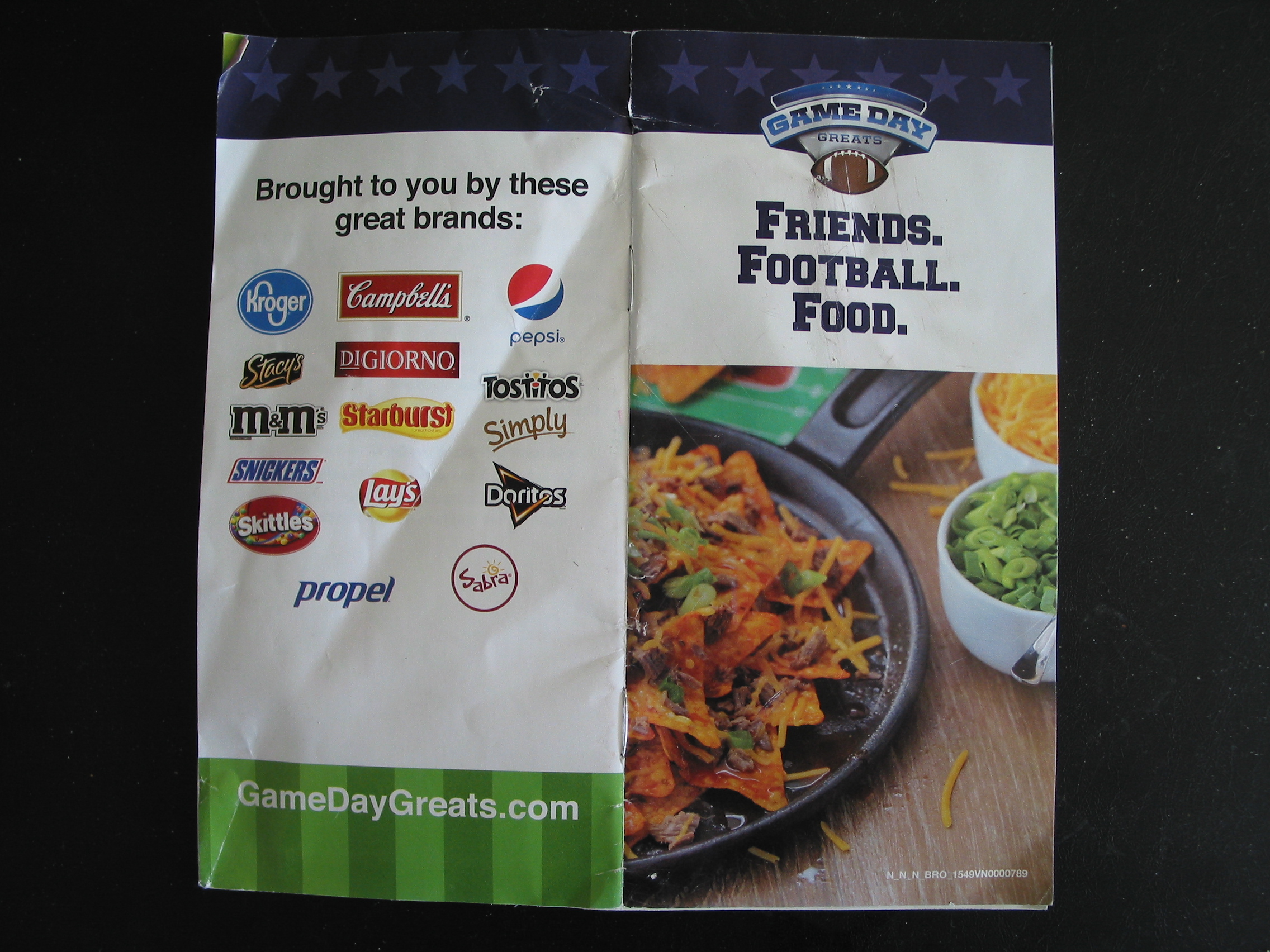
Kroger Superbowl recipe booklet

I’ll spare you the inside pages, but the closest to nutritious was Kroger’s own recipe for double-coated baked cauliflower “hot wings”–ingredients: a head of cauliflower, a little flour and water, garlic powder, Kroger’s store-brand hot sauce, and some melted butter to doll up the cauliflower florets before dipping in…ranch dressing. 

Not that it’s really so much about Doritos, but rather that it takes the 1960s invention of Doritos–a “taco-flavored” taco chip without any actual meat, cheese or salsa, just what has become known to all as orange cheez dust–as the first serious divorce between food and intrinsic flavor.

It isn’t really the first, of course, and Schatzker traces the history of post-WWII mass agriculture as the story of more food, grown quicker, with less and less flavor. Everything from tomatoes to chickens to broccoli to wheat comes under the microscope lens here. Yes, it’s another Michael Pollan-style examination of some familiar complaints about how and why nothing tastes the same anymore.

He collects reactions from champion kvetchers as diverse as Julia Child (she did it first, he claims, calling modern–1960s–American chicken tasteless and with the texture of “teddy bear stuffing”) to the Slow Food Movement (no relation, ahem!) to Michael Pollan himself, to a variety of old bickering couples who remember the flavor of old long-legged breeds of chickens now relegated to the remote gourmet sidelines of the vast factory-farming chicken industry…

Schatzker tells a fairly entertaining version of this tale–how Big Food and Big Agro convened with flavor chemists to alter the course of human gastronomy in the wake of WWII. As we breed livestock and produce to grow more, bigger, faster, he discovers, we lose not only flavor but nutrients and replace them with water and carbohydrate filler even in things like broccoli and tomatoes. And then we try to make up for that by dousing them in ranch dressing and orange cheez dust and artificial flavorings; hence the title of his book.

Coatings, dressings, artificial flavorings, salt, sugar and oils–these, he says, have become the substitute for intrinsic flavor in real foods, and a mainstay of the unsubstantial snack foods–starting with Doritos–that have pushed out bulk produce and unprocessed ingredients in the American diet.

Schatzker takes it a couple of steps further, though, presenting his theory that the loss of flavor in real foods is the key factor to blame for American overconsumption of calories, and that flavor is one criterion we should work to restore at a national level.

Yes, we’ve read much of this before elsewhere, but his interviews are still eye-opening. He interviews flavor chemists at McCormick, which does a lot more of its work behind the scenes of the restaurant and processed food world than you might think. Those little bottles of herbs and spices on supermarket shelves are just the tip of the iceberg.

Schatzker also profiles one of the original breeders of today’s heavy-breasted, fast-grown, efficient-feeding mass market chickens–though the man is still proud of that early work given the economic pressures on postwar America. He gets the inside story on the decline of flavor and nutrition in broccoli, kale, tomatoes, strawberries and other common produce, and learns why some top agriculture researchers eventually quit the corporate world to try and restore some of the diversity and quality that had been lost during the peak years of their careers. Continue reading

In search of good rye bread

I’ve been attempting rye bread and kornbroyt (Jewish sourdough whole wheat bread) on and off since about last Chanukah–almost a whole year! You would think this was unnecessary, since I live close enough to North Hollywood/Valley Village, the eastern hub of LA for Jewish bakeries and delis (the older western hub is “the Fairfax” neighborhood and the Pico/Robertson area). The rye bread you can get at these places isn’t terrible; my synagogue orders it regularly along with 6-braid challahs for big events, and it’s okay. It just isn’t much better than Arnold’s or Sara Lee, the lightweight commercial supermarket versions I grew up with in the south when we couldn’t get the real thing from New York more than once or twice a year.

Last spring I bought the big crusty half-boule loaves of wholewheat sourdough from Trader Joe’s to sub in for kornbroyt at a big synagogue brunch and they were wonderful–and also not screamingly high in sodium as most hard-crust sourdoughs are (Whole Foods, most bakeries, certainly La Brea and friends). Certainly less per serving than the French loaves and ciabattas and other items on the gourmet bread stand at TJs. The Pain Mich’ demi-boule was a very good deal all the way around, and I’ve bought it weekly for years.

But shortly afterward, TJs switched bakers and the new ones produced something that only looked similar. The crust was flabby and the crumb was like the stuffing of old office chairs–crumbly and weak, lacking flavor, not springy and full of moxie like the real thing. What could have happened to my favorite shortcut to the good life? They still haven’t fixed the problem. Which is probably at least partly due to an inferior use of sour culture. Or CUL-choo-ah as my mom says (Brooklyn accent hard to miss).

So I was going to have to figure it out for myself if I didn’t want to remain a deprived child.

For the past 30-40 years, according to Stan Ginsberg and Norm Berg in their book Inside the Jewish Bakery, the flavor and texture of commercial rye bread  have really been watered down as companies went national and American-style with it. It became paler and lighter in texture, with less rye flour and more additives–oils, conditioners, salt. And they used commercial dry yeast instead of sourdough culture, which takes too long and for a long time wasn’t generally considered reliable or controlled enough a process for mass production–probably not for FDA and local health inspectors either. So most commercial rye bread lacks the true rye sour starter flavor, and is no longer really chewy or dark. Or crusty. Which is how I want mine.

All of those lost characteristics from my childhood memories of real New York rye bread and kornbroyt, made by local union bakers and brought down to Virginia once or twice a year by my grandparents, have now regained popularity in the US foodie arena. Well, not rye bread as such, but “old world” artisan wholegrain sourdough breads that seek to copy Poilâne’s legendarily crusty round loaf. Enthusiasts bring up a lot of sinister-sounding bakers’ terms: levain, cloak, slash, hydration percentage, etc. And they’ve come respectably close. But they’re still lacking the sign of authenticity: the union label pasted on the endpiece!

One major American bakery to achieve similar cult status to Poilâne is Tartine. Complete with three lengthy baking manuals so far on how to build a sour, incorporate all kinds of grains and let the sour culture digest them for the right number of days until they’re ready to set up as loaves.

The books are filled with gorgeous, crusty loaves that cost a fortune at gourmet bakeries if you can find them at all in your town. But it’s like looking through the bakery window, hungry, with your nose pressed up against the glass. Most people don’t have the singlemindedness to follow all the steps at home more than once, much less for more than one or two varieties of more-expensive, Whole-Foods-only, alternate grain breads.

The books are also filled with testimony as to just how many years it took each baker on the team to fulfill his or her apprenticeship and perfect the technique.

Years, though. That’s a lot of time to get yourself a decent home-baked loaf of rye bread that tastes like it could stand up to corned beef. Which makes me wonder whether a mere cookbook can really teach it.

So why bother (except for the perverse curiosity that drives me to mad-scientist-like experiments that probably won’t win the Nobel this year, or any year)? Because once in a while you want good rye bread even if you live on the West Coast.

Looking at the pictures and even reading the instructions can’t give you the exact right sour or air temp or humidity or other conditions that make Tartine’s bread award-winning. Your yeast may vary. You may not have the same sensitivity in your hands or know exactly how moist or elastic or heavy or whatever the dough needs to feel like at each stage. You have to be willing to experiment and fail a couple of times and pay attention to how it looks, feels, smells, and be willing to fiddle around and adjust the next time.

That’s okay. Perfection is not a Jewish ideal, so much, and rye bread is not so hard to improve with practice. Our great-(great-etc.) grandmothers were making rye bread pretty often in the shtetls with whatever starters they had and could keep going throughout some pretty challenging winters. And every spring they’d have to get rid of their sour cultures right before Passover and start over from scratch as soon as it was over. In Russian-Polish spring weather. (My grandfather always said you knew it was spring when the first oxcart got stuck in the mud. It meant the ground had finally thawed.)

So you could probably figure that the women in the shtetls weren’t always overjoyed to have to throw away their sour cultures every spring, and the first loaves of bread in the shtetls after Passover ended might not have been a lot of good for a week or so extra. Or they could have turned out like my first one, especially if it took an extra week for the miller to supply new rye and wheat flour.

To tell you the truth: getting a rye sour started is no big deal–I seem to have done it on the first try, even while taking the onion shortcut (see the bottom of the post) and being much too casual with the flour and water proportions in Ginsberg and Berg’s rye bread instructions from Inside the Jewish Bakery. It’s just that getting the sour ready for baking takes a while–like 3 to 5 days. And then it gets more refined and hopefully consistent as you feed it sequentially over time. Professional bakers guard their established sours like gold.

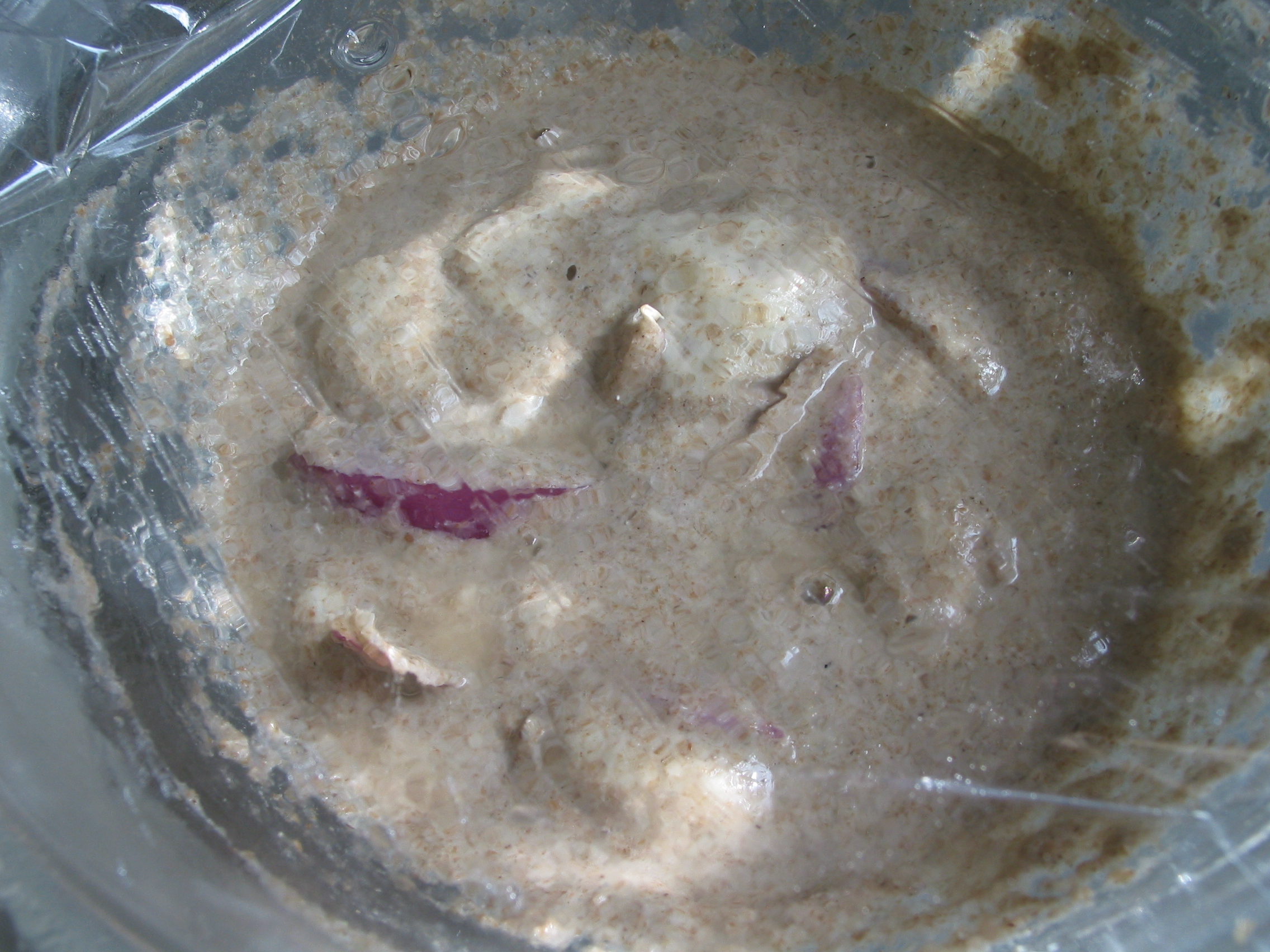
Rye sour getting started with raw onion

Rye sour getting started with raw onion

What went wrong on my first try, right before New Year’s, was that I didn’t put in quite enough wheat flour for the final dough. I was still thinking loose, elastic, relatively wet dough like my usual pizza dough or challah dough, and this needed to be stiffer to match the picture in the book, which showed an actual spherical ball of dough. I figured my usual dough would be a little moister and give nice, big ragged holes–however… Continue reading

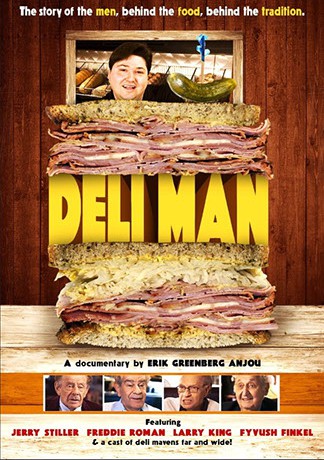
“Deli Man” is out on DVD

"Deli Man" DVD

Source: Cohen Media Group, delimanmovie.com

Well–that’s it, really. Need I say more? Actually, yes, there are a few new things to say other than to keep recommending that you see Deli Man by getting yourself a copy of it and screening it with all your favorite people who didn’t get to see it last spring.

In the half a year or so since it started showing up in theaters, David “Ziggy” Gruber (the deli owner whose story anchors the film) and director Erik Greenberg Anjou have done a lot of interviews together to promote it–they did one on Fox News Radio early on, and then more recently a long, in-depth interview on YouTube with Judith Gelman Myers, film critic for Hadassah Magazine.

Gruber in particular emerges in these interviews as an insightful observer on modern Jewish food and culture, its history and the history of the restaurant business as a whole. It’s an overtly intellectual and analytical side of him that wasn’t as apparent in the film.

Deli Man focused primarily on his daily life, the stresses and rewards of running a deli, his sense of humor and his gift for schmoozing with his customers. To provide a national context in the documentary, Anjou filmed and cut in interviews with the owners and customers of the historic big-name New York delis, and two or three of the younger generation of deli men from Toronto and San Francisco. Much of the historical perspective and big-picture analysis he assigned to David Sax, Michael Wex, and Jane Ziegler, three prominent authors on Jewish immigrant culture. But Anjou seems to recognize that if he hadn’t divided up the roles in service to the pace and emotional/informational balance of the film, Gruber could easily have taken a seat amongst the trained historians.

Like most of the other deli owners featured, Gruber is not an academic by inclination–too much personality and too little sitzfleisch. As he tells Myers, he knew from a very young age that he wanted to be a cook and from his high school grades he was not necessarily ever going to be college material. He’s underselling himself a little here (well–not in every respect; there are a few moments in the interview where he breaks out and guarantees the audience that if they try his blintzes they’ll be hooked for life, or words to that effect).

But when he gets serious, which is often, the interviews bring out his head for detail and his broad-based perspective on Jewish food culture and the restaurant industry as a whole. These are things he knows a great deal about, both intellectually and as an active participant, but didn’t always get a chance to voice in the film, and which weren’t brought out by the other commentators. You’re suddenly reminded that he did intensive training at one of the best culinary schools in Europe and worked in a Michelin-starred restaurant in France for several years before coming back to the US, and he’s been keeping a keen eye on market trends, business and people ever since.

So the interviews, which might otherwise have been standard pleasant-but-bland film recaps, become much more engaging and worth a listen even if you’ve already seen Deli Man. And doing them in tandem with Gruber is one of the smartest things Anjou could have done.