
• Enter your email address to subscribe to this blog and receive notifications of new posts by email.

    Join 241 other subscribers
  • Noshing on

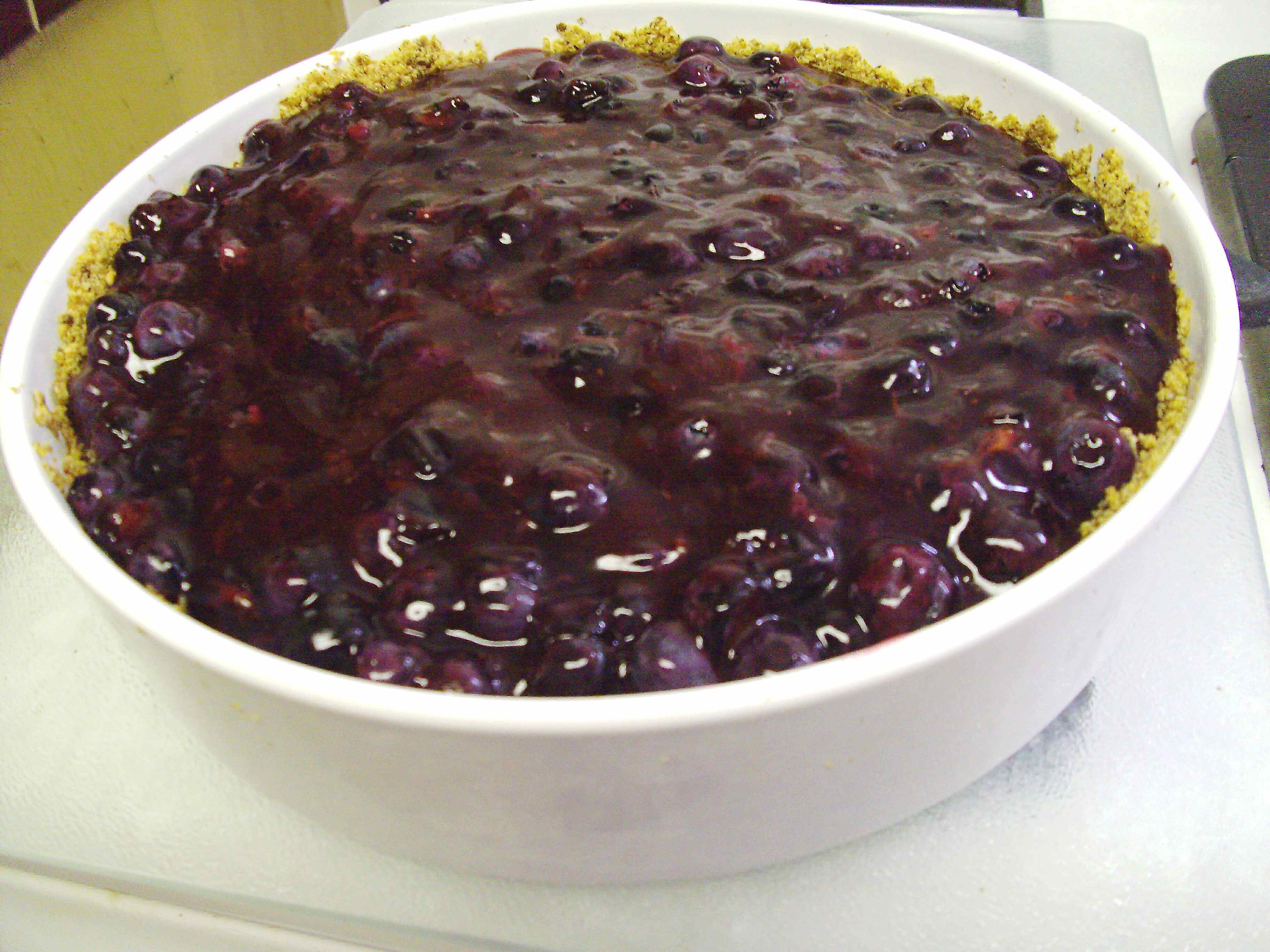
    raw blueberry pie with microwaveable filling and graham cracker crust

    This mostly-raw blueberry pie is a snap to make and very versatile--the filling microwaves in a few minutes, and you don't even have to bake the zippy gingered graham cracker crust--perfect for a hot Fourth of July and all summer long.

  • Recent Posts

  • Contents

  • Archives

  • Now Reading

  • See also my Book Reviews

  • Copyright 2008-2024Slow Food Fast. All writing and images on this blog unless otherwise attributed or set in quotes are the sole property of Slow Food Fast. Please contact DebbieN via the comments form for permissions before reprinting or reproducing any of the material on this blog.

  • ADS AND AFFILIATE LINKS

  • I may post affiliate links to books and movies that I personally review and recommend. Currently I favor Alibris and Vroman's, our terrific and venerable (now past the century mark!) independent bookstore in Pasadena. Or go to your local library--and make sure to support them with actual donations, not just overdue fines (ahem!), because your state probably has cut their budget and hours. Again.

  • In keeping with the disclaimer below, I DO NOT endorse, profit from, or recommend any medications, health treatments, commercial diet plans, supplements or any other such products.

  • DISCLAIMER

  • SlowFoodFast sometimes addresses general public health topics related to nutrition, heart disease, blood pressure, and diabetes. Because this is a blog with a personal point of view, my health and food politics entries often include my opinions on the trends I see, and I try to be as blatant as possible about that. None of these articles should be construed as specific medical advice for an individual case. I do try to keep to findings from well-vetted research sources and large, well-controlled studies, and I try not to sensationalize the science (though if they actually come up with a real cure for Type I diabetes in the next couple of years, I'm gonna be dancing in the streets with a hat that would put Carmen Miranda to shame. Consider yourself warned).

More things to fry in olive oil

Thanksgiving has barely ended and Hanukkah is already upon us–which means more food! This time with olive oil to commemorate the rededication of the Temple in Jerusalem after a war in which the Assyrian Greeks trashed and piggified it in hopes that we’d be so abashed we’d immediately convert and become a convenient tribute-paying way station for their marches around the edge of the Mediterranean to Carthage.

I know the official story credits Judah Maccabee, but really, it happened like this:

The Assyrian Greeks thought we’d be too frightened to complain when they marched through Israel, taking what they wanted and getting their muddy footprints everywhere. They hadn’t yet heard of chutzpah. They also hadn’t reckoned with a little-known secret force:  Jewish grandmothers. These bubbies could out-argue G-d. Weekly. And the lectures? …

“Carthage, schmarthage!” the grandma said. “Wipe your feet already, what are you, a Hannibal?”

Then she hefted a mighty frying pan at the intruders and that’s all she wrote.

So the real hero of this geschichte is clearly not Judah Maccabee, aka “The Hammer” — but Judith ha-Machvat, or “Judy with the Frying Pan Handy” — a woman who could really scare off the goniffs! And so in her memory, we fry up all kinds of goodies for Hanukkah and none of the calories stick to our hips at all. Really. It’s a miracle.

So…enough bubbe meises. Back to the present day.

Last night I made latkes without benefit of a food processor–after a slight kitchen drawer reorganization last spring, I forgot where I put the shredder disk. But for a smallish batch for the three of us–only two spuds and half an onion–it’s not so difficult to grate them by hand, as long as you use a fork to hold the stubs (of the potatoes, not your fingers, I hope) to avoid getting extra “proteins” in there…

The Obligatory Latkes (very basic, but tasty in a good way)–about 12 or so 2-3-inch latkes, enough for 3 people for supper, so scale up as needed

Carbs: 2 big potatoes weighed 480 g total on the food scale before peeling. An estimated 1/6th of the weight of nonsweet potatoes is carb–so about 80 g carb total for this recipe. A 4-latke serving would be about 20-25 g carb.

  • 2 big russet potatoes, scrubbed, peeled, shredded on large holes of grater/food processor blade
  • 1/2 medium onion, grated on fine holes into the same bowl OR chopped finely in the food processor BEFORE changing to the shredder blade and doing the potatoes on top of the onion
  • 2 eggs
  • spoonful of olive oil
  • 1-2 t. flour
  • pinch of salt
  • pinch of baking soda (which I completely forgot last night, so it’s optional)
  • olive or vegetable oil for frying

Grate the potatoes and onions by hand or food processor into a big bowl. The grated onions will help prevent discoloration in the potatoes. Take handfuls of the mixture and squeeze them nearly dry, and pour off most or all of the liquid that collected in the bottom of the bowl. Return the potatoes to the bowl, add the eggs, spoonful of olive oil, flour, salt and baking soda and stir until evenly mixed.

Heat several tablespoons of oil in a nonstick pan until shimmering and dollop soupspoonfuls of the latke mixture in, flattening them as they start to fry. Swirl the pan a little to get the oil touching each latke and maybe keep them from sticking to the pan. Wait until you see brown edges at the bottom of the latkes, then flip and fry the other side, swirling the oil a little or adding another spoonful in droplets where the pan seems to need it. You want these really brown and crisp on the outside, not pale yellow.

Drain on napkins or paper towels on a plate, and at the end, if no one’s snatched them as they cooked, you might want to reheat them all together in the pan or microwave them on the plate for half a minute on HIGH. Serve with applesauce and sour cream or labaneh or plain yogurt.

–  –  –  –  –

That’s the only recipe I’m giving here with set quantities–latkes are more like pancakes, everything below is like a stir-fry.

Non-Latke Options

Even with mechanical assistance in the form of a food processor, I’m a one-latke-night-per-year-is-enough kind of person. I want something other than potatoes if I’m going to be frying stuff in more than a spoonful or so of olive oil. Therefore I look for other maybe less starchy and more flavorful (one can always hope) things to fry:

Pre-nuked (microwaved) eggplant slices, fried in a couple of spoonfuls of olive oil after heating a little garlic and curry powder, maybe a dab of z’khug, for a few seconds first. Onion and red bell pepper are good in this mix too.

Marinated artichoke hearts, perhaps drained slightly and shaken in a plastic bag with a spoonful or so of flour or almond meal or chickpea flour and a little grated cheese and/or some oregano or thyme–no extra salt needed

Pre-nuked cauliflower, breaded as for the artichoke hearts

or–pre-nuked cauliflower, stirfried in a spoonful or so of olive oil with a dab of z’khug if you like things hot, with red bell peppers, onions, and another Continue reading

Couscous, its own fine self

Fine-grained couscous made directly from farina

When I’d just come back from a year in Israel after college, I read through Paula Wolfert’s Couscous and Other Good Food from Morocco several times. Her descriptions of the market stalls, the kitchens of the aristocrats, and the very down-to-earth cooks making tricky components like warka leaves for bistilla or rolling and sieving different sizes of couscous from farina and flour fascinated me. They filled in parts of the culture I hadn’t understood in the Moroccan Jewish community I’d just left.

Two of the dishes in the book, two only, have I actually made in all the time since. But if you get the right two, two is enough.

I first ate couscous in Ma’alot, up in the north of Israel in the western Galilee. On my first night in the volunteer program, my new roommates brought me to a tiny 4-table restaurant in the town center after a very miserable and cold trudge up to the top of the hill in a January downpour. The restaurant would have been a real hole-in-the-wall anywhere else, and even here it seemed to cater to the few single men who had neither hope nor prospect of a girlfriend, and whose mothers had finally nudged them out the door. Israel’s amenities–grocery stores and the like–are still often a grade or so down in appearance from what we’re used to in the US, and I’d been there half a year already, so I was used to ignoring it and discovering what was good. Still, even 25 years ago, most restaurants in the larger towns were not this dowdy. This was card tables and folding chairs. My heart sank. Where had I come to?

Not 5 minutes after we’d been seated, however, the lady who ran the kitchen fetched us out a huge platter mounded with couscous and chicken legs and vegetables, steaming hot and smelling incredible. The chicken was delicious (everybody sing; I’ve just been subjected to another showing of Sherlock Holmes’s Smarter Brother at our in-laws’ over Thanksgiving weekend) but the couscous itself was so light and fine it was like eating hot curried snowflakes. What was it? How do you do that? And in half a year of eating at Continue reading

Going retro for real croissants

I’m not really a follow-the-recipe-in-the-cookbook kind of person. But I love looking through cookbooks that have interesting techniques. Learning to cook means, for me, being willing to eat your mistakes or half-good attempts and try again with tweaks. It also means playing with your food until it works for you.

So croissants are one of those things I try out again every once in a while, because the dough is really not as much trouble to put together as it sounds. Most of the time is just letting the dough rest in the fridge.

Mostly I keep trying because I’d really like it to work well eventually, as opposed to half-right. It’s something about the baking that’s always giving me trouble–the outside will be hard and the inside will be steamed and still doughy. Or else the things will puff up  enormously but will be more like a popover with absolutely no layering inside because the butter layers melted away into the dough during the long rise. Or if I roll them and bake them right away straight out of the fridge they won’t rise at all in the oven and they’ll be tough. Or they’ll be gummy. Or flat tasting. Or even a little bitter.

None of this would be so bad if it were just my own fault for noodling around with a classic. But the last few times I’ve tried to follow Dorie Greenspan’s instructions from Baking with Julia more dutifully than usual, and it just hasn’t worked out right at all. Worse, in fact, than some of my offhand attempts a couple of years ago when I changed nearly everything there was to change, starting with cutting the fat in half and ending with an almond-flour attempt that actually didn’t come out so far off. Except, of course, for the gummy insides.

Julia Child, "The French Chef" DVD from PBSBut last week I stumbled across the elusive two-part The French Chef series of DVDs from…not PBS, which is probably still out of stock, but…my local library. The disks (2 and 3 disks, respectively) are a bit scratched up and tend to halt at awkward moments unless you fast-forward or skip or rewind or whatever tricks I could come up with.

But there was a croissant episode from the late 1960s in black-and-white, just as I remembered the show from when I was 4 or 5 years old. So I watched it, wondering how dated it was, whether the old recipe was anything like the one she lent her cachet to in the mid-1990s with all her guest expert bakers, and what the results would be like. At the time of this early show, she’d been home in the States less than 10 years, had just delivered Mastering the Art of French Cooking a few years before, and was still extremely rigorous about everything. Or was she?

For the croissant show, she discusses different flours, the toughening effect they might have on the dough and how to counteract it with a bit of salad oil or by mixing 2 parts pastry flour to 1 part all-purpose. But then she includes a frozen commercial bread and pizza dough as a possible alternative to making your own yeast dough. Not the tenderest choice, she says, but for someone who doesn’t yet feel at ease making their own, it’s an encouragement to try making croissants at all, and it works all right. She’s astoundingly practical in these early shows even though some aspects of her cooking aren’t (exaggeratedly rich sauces for sole, for example). And I remember that back in those days, you couldn’t get real croissants in American bakeries. If you wanted them, you had to make them at home.

Dorie Greenspan’s modern, supposedly streamlined, layering process calls for cutting the butter into cubes and mixing them into the dough before rolling out, doing six “turns” with three rests in the fridge, cutting, stretching and rolling the croissant triangles in an elaborate way with some extra scrap dough in the middle for shaping, rising them for 2 1/2 – 3 hours, gilding with egg wash and baking at 350 F for about 20 minutes.

Julia’s 1960s version is somewhat different–more aggressive, and probably much closer to classic boulangerie technique. It’s also simpler. She makes a very simple milk-based yeast dough in a bowl with her hand and kneads it a couple of minutes, picking it up and slapping hard on the work surface, all while talking flour grades (you could talk Yankees versus Red Sox if you want–she probably could have too, come to think of it).

She takes a stick of butter and bashes it into a softened flat mess with a big solid rolling pin, then scrapes it up and flattens it into a square and rechills it. She lets the dough rise until double on a heating pad, then chills the dough. Then she takes the butter and the dough out of the fridge, wraps the square of butter in the larger piece of dough and then rolls and folds and turns and chills for a full 2 hours each time, but only for a total of 4 turns–2 sets of 2–before rolling and cutting out the croissants.

She doesn’t put an extra lump of dough in the middle when she rolls the croissants. She doesn’t stretch them a lot. And she does let them rise in a relatively cool room, but only for an hour or hour and a half until just Continue reading

No-Furkey!

In the freezer case at Whole Foods this month you’ll find big boxes announcing Turtle Island’s Tofurky Feast, Field Roast’s Celebration Roast, and VegeUSA’s Vegan Whole Turkey –this last shaped and glazed brown like a large chicken, drumsticks and all. I’m not sure how I feel about this concept–I thought the idea of being vegetarian when you have enough money for a choice was not only not to eat meat, but not to want to be eating meat either.

Not that I’m against decent vegetarian meat substitutes for Thanksgiving or any other time of the year. As someone who’s kept kosher since my college years, and often in places where there was no kosher meat (or I didn’t have the budget for it), tofu or wheat gluten “mock chicken” have made eating in Chinese restaurants a lot more fun, and the good restaurants make their vegetarian dishes as serious and well-balanced as their meat dishes–sometimes better. But they generally don’t try to disguise them this far or process them this much.

Still, to each her own. But $42.99 for the big VegeUSA box at Whole Foods. The box states that it feeds 25 at 2.5 oz/serving, which is probably enough protein but only about half the volume most adults would expect. And it’s kind of expensive for something that looks very much like a well-browned rubber chicken. What’s in it? I scan the nutrition panel and don’t really notice anything but the sodium–everything else is low or moderate, especially for a holiday meal.

But the salt! 450 mg for the “turkey”–double it to 900 mg if 2.5 oz isn’t enough for you and you want seconds.  1400-plus mg for the stuffing–huh? a whole day’s worth of sodium for one serving of stuffing?  Is it that bad for conventional stuffing mix as well? You’d do better to make your own from scratch.

At this point I didn’t even look at the gravy.

Tofurky isn’t much different–650 mg sodium per serving, including stuffing. Field Roast–in the same range too. They also sell separate tubs of frozen “giblet” gravy.

Of course (full disclosure here), I’ve never actually liked gravy, and I doubt it would really go well with anything tofu, not even tofu in a rubber chicken costume.

Why do I think you could do a better and probably a lot cheaper and more festive vegetarian Thanksgiving with some kind of authentic, fresh-made main dish? Because very clearly you could. Do you want it to taste good? Or do you just want it to look like an imitation turkey?

Of course, the main thing about these frozen concoctions, even the simple cylindrical “roasts”,  is that they look like centerpiece dishes, and there’s really no knocking that desire to serve something impressive and festive and most of all, shareable at Thanksgiving. It’s important. Thanksgiving feasts demand a monument to plenty, and an inedible cornucopia with gourds and Indian corn doesn’t really cut it. Nor does a big pasta salad (although a timbale, as in Big Night…)

Surprisingly–sadly?–enough, very few vegetarian cookbooks, not even the big tomes like Mark Bittman’s How to Cook Everything Vegetarian or Veganomicon, really try for a vegetarian centerpiece dish that looks and feels like an important dish. Mollie Katzen’s title dish from The Enchanted Broccoli Forest is about the only intentionally designed centerpiece vegetarian dish I’ve ever seen. A very long time ago I actually was served this thing once at a friend’s house, with very sadly overcooked broccoli stalks stood upright in a flat casserole of brown rice. Oy, is all I can say. Not a moment of pride. Both Katzen’s and my friend’s cooking improved in later years.

None of the currently hot vegetarian cookbooks out there have an index listing for “Thanksgiving”–very telling. A lot of them have portions for 2 or 4 or just one person. Only vegetarian chili and pasta dishes are intended to serve a crowd of any size.

So vegetarian centerpiece dishes deserve some consideration. Tara Parker-Pope of the New York Times blog “The Well” has been edging around this topic for a week or so, but I don’t feel she’s really gotten to the heart of the matter–neither has anyone else. Perhaps it’s because she’s not thinking like a vegetarian?

What makes a dish a centerpiece dish? Think about the turkey, then, or a whole salmon, or a rack of lamb or the like. It’s big. It’s unified–one big item before you cut into it for serving. It’s elegant and impressive. It’s sliceable. It’s savory enough to draw people into the dining room with a sigh of Continue reading

Somewhat Scary Food

Today’s topic is particularly revolting, because it’s never too late to start considering what lies ahead at the end of this month I mean, tonight–and yes, we’re already late for the door. Yes, buying bags of generically sorta-chocolate Hershey’s and Mars brand mini candies is the accepted, sterile, utterly safe way to go on Halloween. But really, it’s not very interesting. Especially not for kids. And it’s gotten a lot more expensive in the last year, as far as I can tell.

(Though if you’re going that route–or your kid is going out trick-or-treating elsewhere–check out the Buzzle.com comprehensive candy carbs list if you need to know about that kind of thing in detail, or the little rule-of-thumb chart at the bottom of my Carb Counts page. If nothing else, it’ll keep you away from the communal candy dish at work.)

When I was a kid we went out trick-or-treating with the exhortation to touch nothing, TASTE NOTHING, until we got home and my mother could inspect it all for razor blades or dimes or other nasties that might unimaginably (except to my mom; dimes are not something most people will part with these days except for a venti with extra whipped cream and a cherry on top) be stuck in things like apples. It was an annual ritual of paranoia that lent that unnameable something–a hint of danger and excitement–to the otherwise blatantly fake costume horror. Because, of course, we were usually walked strategically to the homes of families our parents knew, just as they walked their kids to ours.

Then there was the time a friend invited me to her church’s haunted house–the activities mostly consisted of blindly sticking our hands in bowls of cold spaghetti or reaching out for something that turned out to be grapes with the skins peeled off. We were getting too old for it, really, and it was more icky than scary. But still. Somehow the innocent days of bobbing for apples and sticking your hand in cold spaghetti have gotten lost in the too-adult fear of sharing germs or getting pneumonia from having to plunge your head into a bowl of cold water.

Kids don’t get to help set up anything but the store-bought decorations anymore, and if they have any say in what treats to hand out, it’s through the universally accepted point-and-whine technique at the supermarket Halloween aisle. Reading the teeny-tiny fine print on the ingredient lists for all those mini candies, spooky and mysterious as the 4-syllable chemical names may be,  just doesn’t cut it for scariness or adventure. Nor do the huge blowup animatronic decorations–the creepy hand, the dancing skeleton, the vampire rising from the coffin to a boogie-woogie soundtrack like so many Halloween versions of the Singing Trout–is this Robert Pattinson’s future?

Most kids can’t even make their own toast these days. How are they supposed to cope with creating pickled porcupine quills or tarred hornet brittle?

Fortunately, a number of cookbooks (from before the sterilized-and-wrapped-for-your-protection era) are available from the ether or at your local library with answers to just these sorts of dilemmas. If you have a stove and a freezer and possibly a food processor or electric mixer, you stand a good chance of rescuing your young innocents from the debilitating descent into middle-aged indifference, incapacity and accountancy.

I refer here, first and foremost, to the slim but venomous contents of Roald Dahl’s culinary imagination (and that of his widow, Felicity Dahl, who unearthed these books and made sure they saw light of day). To be absolutely sure I’m doing it right, I’m starting with Volume II, Roald Dahl’s Even More Revolting Recipes (Penguin Putnam, 2001), because Volume I, Revolting Recipes, clearly wasn’t revolting enough. Only the best for my child!

What could such books possibly contain? Roald Dahl’s Even More Revolting Recipes is a fair mix of candies, sweet drinks, desserts and actual non-sweet food–this last is the real surprise. But no vegetables, unfortunately, other than a bit of decorative tomato and some oddly Martian-looking potatoes (I fervently hope they don’t sing).

In keeping with modern ideas about kids and cooking, a number of the recipes call for prefab products (the one for Tongue Rakers, a kind of onion-and-garlic-laced bread shaped like a pitchfork, calls for a “packet” of your favorite pizza dough mix rather than the basic flour-water-yeast-and-salt), and several involve the strategic use of food coloring (Hornets Stewed in Hot Tar, a black-dyed pumpkin- and other-seed brittle) or fluorescent paint Continue reading

Spice Mix Rx

Sunset magazine surprised me this month with a big feature on complex spice mixtures that have found their way into big-name restaurant food in the past few years–panch phoran, garam masala, baharat, za’atar, ras el hanout, quatre épices, Chinese 5-spice and berbere. Sunset tends to focus on California and southwestern US travel, home decor and food styles, so it was good to see something a little more world beat and exciting…right up until I started looking at the recipes.

The opening spread showed glossy pictures of the various whole spices included in generic versions of each mixture, but the author then blithely left all of these spice mixes and their proportions out of the recipe section!

Her reasoning, if I have it right, was that these spice mixes are getting popular enough that you can find them all premade at your local supermarket. Well…not in mine. And I live in an area with a lot of Indian, Arab, Armenian and Chinese neighbors–the only ones I’m missing are French. You can get Chinese 5-spice powder next to the double shelf of soy sauces, and you can usually get a jar of unsalted generic curry powder (which Indians don’t use but North Africans occasionally do) or some Colonel Sharwood’s and Patak’s curry pastes, and occasionally some garam masala in a jar. Who knows how close they are to real, but they’re highly salted and in jars or packets, so not exactly fresh-made.

Online commenters at the Sunset web site say that the recipes the spices are supposed to be used for are good…if you can find the spice mixes in your area, which many of them can’t. Which is why I’ve done yet another longish post…I’ve decided to dig around and post general recipes for most of the spice mixes myself. Some I’ve tried personally, but most I haven’t made at home, yet, so I’ve tried to find reliable and knowledgeable cookbook authors and where I can I crosscheck with another appropriate author’s recipes–these days it’s so easy for restaurant chefs to publish recipes they can barely pronounce and claim expertise without ever having traveled to India or Morocco or Turkey, or only the tourist routes, much less lived in a village and learned to cook a traditional cuisine for any length of time.

My local favorite family-owned Armenian greengrocer’s caters to most of the Silk Road cuisines, from Morocco to Turkmenistan and even further east. The store carries a couple of brands of premixed za’atar and its own (unfortunately salted) curry powder as well as shawarma and seven spice blends, but for me the great value is that it offers bulk pricing–loads cheaper than supermarket spices–for all the whole and ground individual spices in the mixtures that the October Sunset article mentioned. And the informality of buying spices in tubs rather than little jars encourages you to use them more often, experiment a bit, and improve on what you find in all the new Turkish, Middle Eastern, Indian and Moroccan cookbooks that have come out in the past few years.

Storing spices

Freshness counts even with dried spices. One thing I really appreciate about my corner grocer is that their tubs of spices are labeled with packing dates so you know how fresh the spices are–very important especially for preground spices. I heartily wish McCormick’s and all the store brands (Kroger, Inter-American, etc.) would do the same.

From my own experience, coriander seed and green cardamom in particular should both be left whole and ground as needed at home, preferably just before using them. Both seem to lose their oomph in ground form a lot quicker than cumin or caraway or fennel, at least in my kitchen. Perhaps it’s just that Pasadena is so dry most of the year, but ground coriander can go lifeless and flavorless in a matter of a week or less here, its delicate volatile oils evaporate so quickly, and what a waste.

If you’re going to make your own blends, cloves and allspice are also better left whole, assuming you can get them at a good price, and so is nutmeg–get a ~ $4 lemon zester to grate it with and keep it in a bag with your whole nutmegs. Then just watch your knuckles.

Powdered cinnamon and ginger are usually fine for a longer time, but of course they will weaken a bit. Always, always use whole black peppercorns, not the preground rubber-flavored stuff. And hot pepper flakes? I never realized how much flavor they lose over time–not just heat but the aromatic green edge as well, so don’t buy them in huge cafeteria-scale quantities (live and learn from my mistaken enthusiasm over a $3 quart-sized container…) or your hot mixtures and salsas will be disappointingly bland.

Even some whole spices are vulnerable to flavor loss–or rancidity. Nigella seed, which tends to get used only in small pinches because its flavor expands and permeates stews and curries as they rest overnight in the fridge, should definitely be stored double-wrapped in the freezer so it doesn’t lose all its taste before you can use it up. Poppy and sesame seeds should always be stored well-sealed in the freezer–so should most raw nuts, and so should washed fresh herbs if you can’t use them up within a few days.

Anyway, here are some tested versions of the spice mixes mentioned in the Sunset article. All of them are adapted from their source cookbooks (i.e., the proportions and ingredients are the same, but with my comments, mostly in italics).

The first two are from Manju Malhi’s India with Passion: Modern Regional Home Food, which includes directions on how to use these mixtures and in what approximate amounts for a dish of 4 servings.
Panch Phoran (adapted from Manju Malhi)

Bengali 5-spice mix; good for lentil, bean or potato dishes, samosas, etc.

Malhi’s recipe says this makes 7 teaspoons of spice mix. I’m not sure how she counts that, given that there’s a total of 5 teaspoons of individual dry whole spices in the recipe. However, she says 1 teaspoon of the mix is enough to use in a recipe for 4 servings, and the whole or ground spices can be mixed to a wet paste with 2 teaspoons of water, vinegar or yogurt per teaspoon of spice mix, then tempered in hot oil or ghee (clarified butter) before adding the other ingredients in the dish.

1 t. each (or if more, then even proportions of all five spices):

  • fenugreek seeds
  • cumin seeds
  • fennel seeds
  • brown mustard seeds
  • nigella seeds

Mix the seeds together and store in an airtight container in a dark place for up to 6 months.

Alternate version: Raghavan Iyer’s 660 Curries specifies two parts fennel seed per one part each of the other spices. Continue reading

The Altered Cheese Project

I know. It sounds like the name of a really, really bad ’80s art rock tribute band. Not that there’s anything wrong with that. (Well, actually there is; I survived the ’80s by stubbornly ignoring everything from the Talking Heads onward, especially after I went to one of their concerts and heard the drummer. Maybe it was just a bad night, but I thought only David Byrne was allowed to be that far off.)

Altering cheese also sounds like the ultimate DIY, grow-your-own, cure-your-own, grind-your-own, fill-in-the-blank foodie optimism project. Weird, more work than it’s worth, but a good experiment to try once (if you’re under 30) so you’ll appreciate the effort that goes into it all when you go back to buying the professionally made version.

You might have noticed that all the nicer cheeses that get newspaper and food magazine reviews cost upwards of $15/lb and even though I’m a cheese freak, I’m just not in that league more than once a year, perhaps on my birthday. I deserve nicer cheese than I can get at the supermarket, I just know I do.

So let me just say it: I’m nobody’s idea of a dedicated cheesemaker or affineur. Mostly because I can’t stand heating and clabbering and then pressing large amounts of milk just to get the starting curd. I also hate scrubbing everything to death before and after, and the idea of cleaning scorched milk off the bottom of a soup pot is my idea of wrong. I’m not authentic. And I don’t wanna be. Even clabbering by microwave is probably not my idea of a good time when it comes to anything more complicated than paneer or yogurt–I’m not sure it wouldn’t destroy the cultures for hard cheeses.

Last year I got the idea to start with something already in cheese form–a lot less waste of both milk and time. After all, standard bland goat cheese is pretty inexpensive–an 11-oz log is about $5, about a quarter of the price of the goats’ milk you’d need to produce it (4-5 quarts at about $4 each). So are other fresh white cheeses. And you can get inexpensive domestic brie and bleu cheeses in supermarkets and–my preference–Trader Joe’s. They’re not bad, they’re just bland compared with the European originals. But they have the requisite blue or white mold cultures you need to add flavor to other cheeses, if the cultures will take.

Last year’s achievements may give you some idea of where I’m going with this:

  • Bucheron (fresh chèvre log, bit of white mold rind from inexpensive, bland Trader Joe’s Canadian brie, sealed in a sandwich baggie with some air for about 2 months in the fridge until it ripened)
  • Bleu de chèvre or Goatgonzola (another fresh chèvre log, this time with some crumbled cheap gorgonzola in the baggie, also about 1-2 months in the fridge)

and the accidental but serendipitous

  • Marbled Feta (the byproduct of storing above-mentioned source gorgonzola next to ziplock bag containing a block of feta cheese)

But ever since I posted these first attempts at turning boring American supermarket cheese into something more flavorful and interesting, I’ve been haunted by the thought that I’d only scratched the creative surface of cheap cheese transmogrification. So I’ve been cheating with cheese yet again.

A Fungus Among Us

Goat cheese and feta are both fairly wet fresh cheeses that take mold pretty well if you do it on purpose. What about drier standard American varieties–cheddar, for instance, or brick mozzarella? These are bound to be more difficult to persuade, but if you have a bit of patience, it might be worth a try.


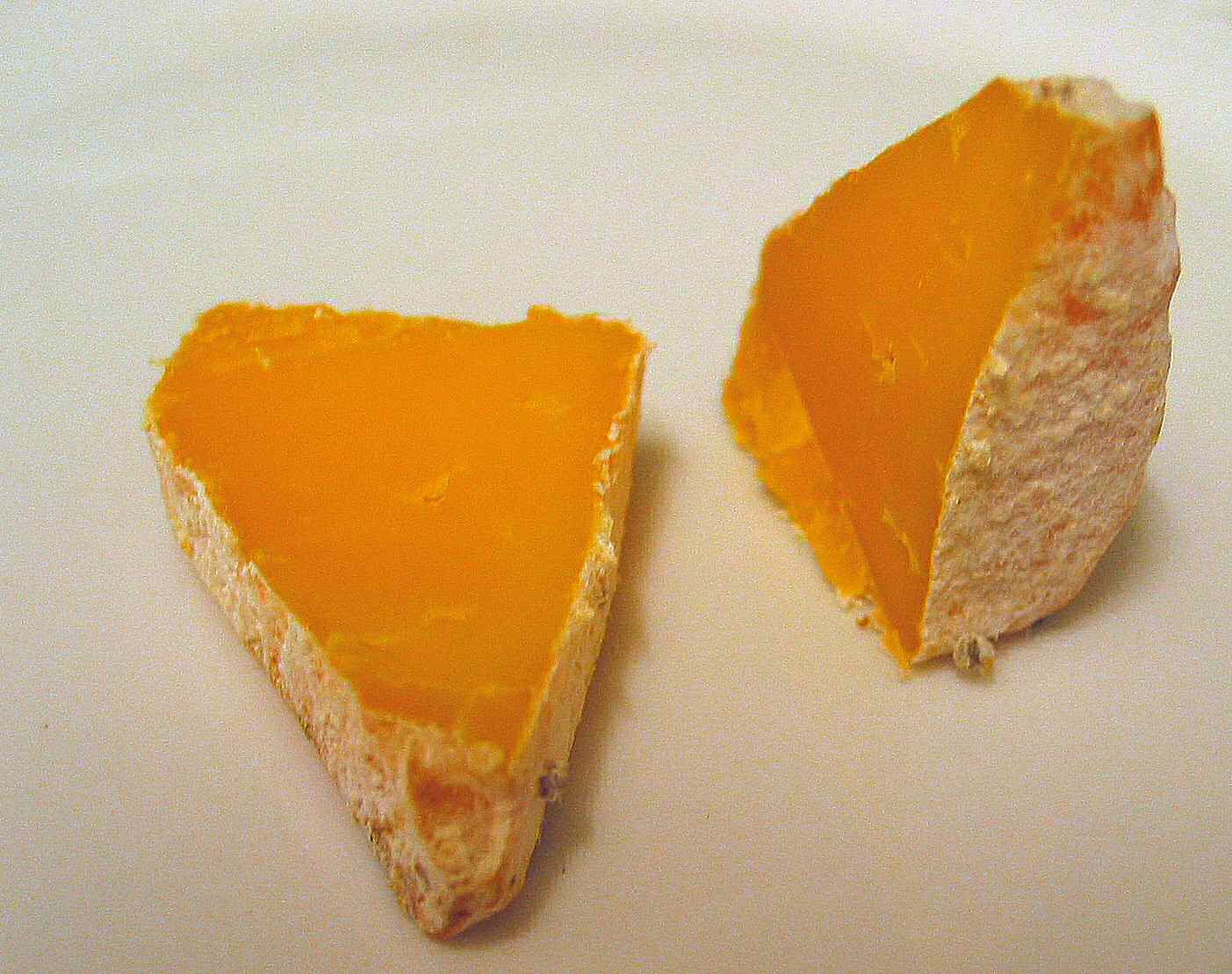
Cheddar after aging with bleu cheese mold

Cheddar after aging with gorgonzola starter


Now I know, normally you look to cut any developing mold spots off your cheddar–it’s what we’ve all been taught for decades. But the blue and white mold cultures are key to developing flavor and–I shouldn’t even be spelling this out–when it comes to flavor, America’s standard supermarket cheeses are in dire need of help.

Four or five weeks ago, I put a small end piece of Bel Gioioso gorgonzola in a ziplock bag with a couple of ounces from a brick of ordinary Trader Joe’s extra-sharp yellow Wisconsin cheddar and some air and kept it in an isolated part of the fridge to see what would happen. I’d actually diced the cheddar into bite-sized pieces to increase the surface area and maybe decrease the culturing time if the bleu mold managed to take.

Nothing much seemed to have happened except that the cheese looked a bit drier. No visible culturing going on at the surface. The gorgonzola crumbs had shrunk and dried out as well. But I took a cube out and cut into it with a knife, and the flavor had stopped being tangy standard cheddar and was moving toward Morbier or Emmenthal–something nuttier and more subtle. All I could think was that the cheddar was aging without actually culturing and growing the blue mold. But because the mold is a penicillium strain, what there was of it might have inhibited unwanted bacterial intrusion and helped steer the cheese toward a more nicely controlled aging process.

And then again, a week later, the mold had taken on the remaining cheddar cubes, and the taste, once I cut into it, was like a mild cheddar heading toward blue. Still not very potent, but encouraging. Continue reading

Is Extra-Virgin Just a Fancy Label?

The UC-Davis Olive Center has just released a report of its chemical and sensory tests on 10 California and 14 imported brands of supposedly “extra-virgin” olive oil. It concluded that many of the nationally available brands don’t meet the International Olive Council’s or the USDA’s quality standards for extra-virgin status.

The research team also reported that some newer chemical markers of fat oxidation being used in Germany and Australia matched sensory measures of low quality (fusty or rancid smell and taste) better than the standard IOC methods. It was a result almost guaranteed to raise hackles abroad.

The researchers compared the accepted IOC/USDA tests for oxidation and breakdown products with sensory panel evaluations (smell/taste/look/texture) and with a couple of new chemical assays from Germany’s and Australia’s government food quality labs. They had an Australian lab accredited for IOC tests conduct some of their assays.

Nine of the 10 California olive oils were evaluated as authentic extra-virgin oils by the sensory panels and had corresponding assay stats to confirm it.

Almost 70% or about 10 of the 14 international brands, most at least nominally Italian, failed the sensory panel evaluation and had some assay stats outside the acceptable limits for extra-virgin olive oil. Major brands that were deemed lower than extra-virgin quality in at least 2 of 3 sensory panel tests included:

Bertolli, Filippo Berio, Carapelli, Pompeiian, Colavita, Mezzetta, Mazola, Rachael Ray, Newman’s Own Organics, Safeway Select, and Whole Foods’ 365 house brand.

Surprisingly enough, Star and Kirkland Organics fared pretty well. No word yet on Trader Joe’s “Trader Giotto” olive oil–at those prices, though, I’m not holding my breath.

The producers of brands exposed by the report, along with the IOC itself, which was created by the UN in 1959 and is based in Spain, protested the research team’s methodology. Mostly they claimed that too few samples were tested to get statistically significant results, and that IOC tests find only 1% of more than 200 brands they test each year fall below extra-virgin standards. But the brands tested represent most of the common offerings for olive oil in American supermarkets, and results were reported separately for samples of each brand acquired in several cities apiece.

I don’t think, at least on a cursory glance, that the test parameters set for the study or the interpretation of assay results have been skewed purposely to favor Californian olive oils over Italian ones. Results for both were mixed and the researchers reported variations in results within the same brand–for example, some olive oils showed lowered quality in the Sacramento sample but not the San Francisco or Los Angeles ones.

What the researchers at UC-Davis found was not so much evidence of tampering (adulteration with cheaper oils like canola, though there might have been tampering with lower-grade olive oil), but rather higher than acceptable fat oxidation and rancidity due to aging, light exposure, poor (high-temperature) storage and shipping conditions, and possibly poor quality olives to start with.

What I would object to if I were going to find fault is that the study was funded by several members of California’s olive oil industry. Certainly if this were a clinical trial for a new drug instead of a food quality study, the fact that two of the study sponsors are also the producers of brands being studied would make me look twice at favorable results.

Where I think the study favors California olive oils over Italian ones is in the purchasing itself. It should be no great surprise if the imports on American shelves have been sitting there longer and were shipped under more damaging conditions and at higher cost than the California olive oils. It would also be no great surprise if many of them tested in better condition in the European labs before export than at UC-Davis’ labs months (or even longer) after they’d arrived in the US.

If the researchers had express-shipped pre-import samples of this year’s production from Europe to their labs at UC-Davis and their partners in Australia, and tested those results against similarly fresh California oils, the results might have been more to the IOC’s liking–or perhaps not. EU labeling rules allow Italy to claim that olive oil was produced there even if the olives or olive oil lots were acquired from other countries such as Tunisia or Morocco. I’m not knocking North African olives except to observe that they’re probably a lot cheaper than those grown in Italy. But even if they’re of equal quality, each delay in pressing or processing a harvest–not to mention repeat exposure to heat and light during shipping and warehousing from country to country–contributes to the breakdown of olive oil’s flavor components.

However, even if all the olive oil was pristine when tested in its country of origin, such a scrupulous comparison wouldn’t have reflected the real experience of California shoppers trying to get decent olive oil without having to drive out to an olive producer’s farm. Unfortunately, the California olive oils are not widely available in Los Angeles supermarkets (the researchers were stuck with Sacramento and San Fran for those) and most are not really being produced on a large enough scale to become national brands either. The imports are. If most of those really are losing quality through shipping and warehousing, should we be paying extra-virgin prices for them? Or should the companies ship and store them more carefully–and for less time?

Prunes and Lentils II: Prune Sauces for Savory Dishes

Following on from Sunday’s post (have you recovered yet? Should I be selling Tums futures?) I should add that NOWHERE in Karen Page and Andrew Dornenburg’s The Flavor Bible can a mention be found of prunes paired in any way, shape, or form with lentils. Don’t have the faintest why not. They do state that plain old green lentils have more flavor than red or brown.  They also pair prunes with olives, mushrooms, gorgonzola and walnuts as well as sweet spices and red wine. Somewhere in that crossroads there’s got to be some confluence of flavor, but wherever it is, they haven’t considered it.

Others have, however–notably Nathan Lyon of the Discovery Channel, ABC’s “Beat the Chef” show in Australia from a few years back, Hello! magazine (OK, copying straight from the California Prune Board’s UK division–wait a minute, they HAVE a UK division?!–and borrowing its press photo)…Oh well.

The benefit to considering prune sauces is that you can serve them with a lentil dish if you’re ready for that or to lift a more familiar savory dish with meat, fish or poultry.

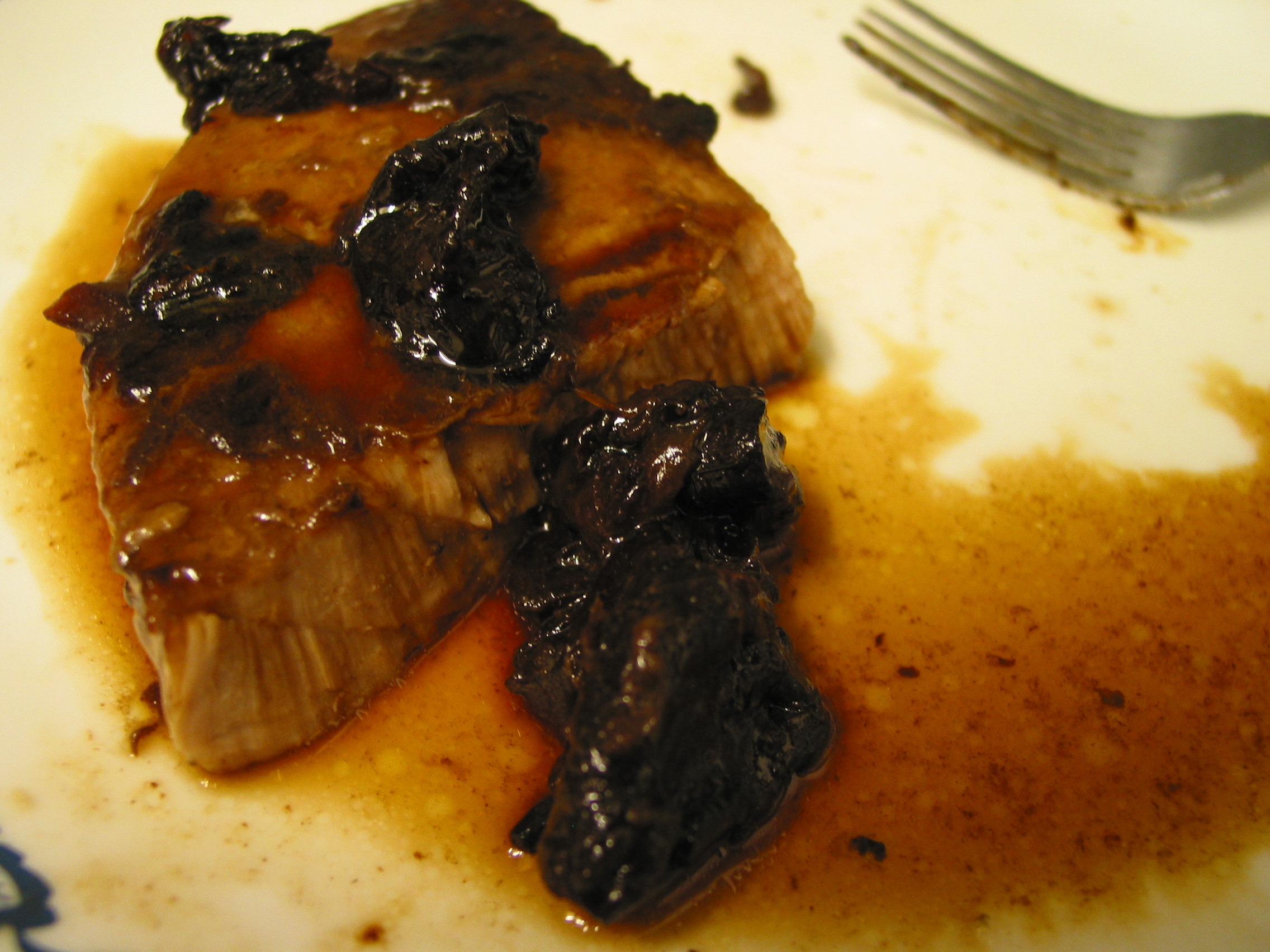
Pan-seared tuna steak with microwave prune and wine chutney

Pan-seared tuna steak with microwave prune and wine chutney

And yes, I said “lift”. Make of it what you will, but any one of the sauces below is better than whatever Hello! magazine has to offer, even if it were original.

Stéphane Reynaud’s Prune Sauce (excerpted for consideration from French Feasts, 2009)

This was designed to go with a simply pan-fried foie gras for six–probably 3-4 oz per person, which seems like a hefty kind of serving, even though I do like liver.  But the sauce–why 18 prunes? 3 per person? and it seems a heavy load of spice for a small amount of wine. Also he has you rest the stuff overnight at room temperature before finishing it. Not sure why–to thicken up, probably, like Elizabeth David’s recipe for peach jam, which also sits out overnight after the first boil-up before resuming.

  • 18 pitted prunes
  • 1 c red wine
  • 1 t ground cinnamon
  • 1 t quatre-épices
  • 2 star anise pods
  • 2 T light brown sugar
  • 2 1/2 T butter, chilled

Boil the prunes 5 min with the wine, spices and sugar, cover and leave O/N at RT. Remove the prunes and reduce the spiced wine to a syrupy sauce. Whisk in the butter, then return the prunes to the sauce.

Microwave Prune Chutney with Wine

My microwave version started out as Reynaud’s wine-based sauce and suddenly morphed, as I was grabbing things out of the fridge for it, with a half-remembered cranberry chutney recipe my mother-in-law served a number of years ago at Thanksgiving. This turns out to be a potent combination, aromatic and sharper, no doubt, than Reynaud’s sauce, with a definite suggestion of saltiness about it–but no actual salt. I don’t recommend eating it straight–too pungent for me, though it’s uncannily close to the relish my mother-in-law served and pretty decent with poultry and stuffing or rice and so on–but cooking 5 minutes or so extra in a saucepan over direct heat or with the food you’re saucing and some extra wine turns it into something pretty special. The whole cloves in particular (which you can take out before using the sauce) do something incredible for any meat or steaky fish you cook with this sauce. Like brisket but just…better, more sophisticated, elevated to the level of cuisine. In fact, put some of this prune sauce with cloves in your next brisket too. 

Makes about 1 cup

  • ½-1 c leftover dark red wine–syrah, aglianico, something inexpensive but rich
  • 8-10 pitted prunes, quartered
  • grating of fresh ginger (1/4 t)
  • grating of 1/2 decent-sized clove garlic or 1 small clove
  • 1/4 red onion, chopped
  • 1-2 t. wine vinegar
  • sprig of thyme
  • pinch of fennel seed
  • 4-5 whole cloves, loose if you can stand picking them out or else stuck through a scrap of onion

Toss the onions with the vinegar and let sit a few minutes while chopping the prunes into quarters–it cuts down on the bite. Mix the onions, prunes, and the rest of the ingredients except the cloves in a soup bowl with a microwaveable lid that can placed on with a gap for steam to escape. Poke the cloves into a larger scrap of onion and add that to the bowl so you can fish them back out easily after cooking. Microwave 1-2 minutes loosely covered on HIGH or until it’s boiling, let sit 5 minutes, stir, microwave again. The prunes will have taken up a lot of the liquid, the onions should be cooked through and garnet-colored, and the wine should be reduced and a bit syrupy.

.  .  .  .  .

From France to China, then:

One year I was determined to make a low-sodium substitute for fermented black bean sauce with roast salmon. I soaked some prunes in a little boiling water and mashed them to a paste, then dressed them up with garlic, ginger and a few other things. It turned out, to my surprise, like homemade hoisin–-dark, glossy, tart and aromatic, less sweet than the commercial stuff, a little smoky from the sesame oil and scallions, with the suggestion of salt Continue reading

Prunes, Lentils, and “Cookin’ Cheap”

When I was a kid, PBS, which had made a gourmet name for itself with The French Chef, decided that if one chef was good, six or seven had to be better. Suddenly the public and cable airwaves were  bursting with the Frugal Gourmet, the Galloping Gourmet, Yan Can Cook, Cookin’ Cajun, various shows with Pierre Franey and Jacques Pépin, and one…ummm…less glamorous show called Cookin’ Cheap.

This was hosted by Larry Bly and Earl “Laban” Johnson, Jr. out of Roanoke, VA–-not too far from where I grew up–and featured two viewer-submitted recipes per episode, which the guys bravely cooked and sampled on the air. At the end of each show, just like Julia Child, they sat down at the table for the tasting… and decided whose recipe had come off worse.

Now, Cookin’ Cheap was not for tenderfoots–if you couldn’t handle ingredient lists that included whole sticks of margarine and self-rising flour, or bring yourself to shop in one of the ordinary supermarket chains that had never heard of organic anything (this was the South in the ’80s), you would have done better not to watch. But if down-home cooking delivered with a touch of schadenfreude was your thing, it was a great little show.

Unfortunately, my favorite early episode doesn’t seem to be available anywhere on the ‘net. But the clip above, the Cookin’ Cheap 2.0 (YouTube) version of about a third of Episode #609, will give you some idea. (see copyright disclaimer below…)

In my actual favorite episode, Bly and Johnson hit their personal limit with a recipe that had them both making faces and apologizing to the audience that “there’s cheap… and then there’s too cheap.”

The dish in question was “Lentils ‘n’ Prunes” (you can guess the entire ingredient list). And it was indeed cheap. Unfortunately lentils, though incredibly cheap and nutritious, cook up kind of gray, especially on a semi-rural public TV station with early-’80s (i.e., yellow-ocher) set lighting. Trust me when I say the addition of mashed prunes did nothing for them aesthetically or otherwise. How on earth could they have put this on the air?

Of course, these guys didn’t have to take the blame for the recipe, and it was great entertainment to see some of the strange things your neighbors might be cooking at home and writing in to the show about with high hopes of being selected. I understand the Food Network is now copying Bly and Johnson’s reality-cooking formula shamelessly for the fall lineup…

[Actually, I didn’t realize the show had such a good run, but it started locally in 1981 and only ended its nationally syndicated run in 2002. Johnson passed away a few years before the end, but he managed to publish the Cookin’ Cheap Cookbook in 1988. Bly kept the show going with Johnson’s friend and successor Doug Patterson and has since made a couple of rescued episodes available on DVD. And the show still has fans on YouTube and — surprisingly just this March–in the New York Times.

Disclaimer: YouTube removed the first clip I linked to for copyright violation–so my apologies to Bly; the intent in linking here isn’t to rip anyone off but to highlight a too-little-known show. Because the original Roanoke station managers were too shortsighted to save the episodes (they apparently trashed them!), Bly was only able to rescue a couple of episodes for the DVD, and I think some of the others posted at this point were recorded at home from TV.]

Ah, well. Times change, horizons broaden, and we aim to challenge our palates in a sophisticated world beat kind of way even with limited cash and ingredients. The wolf may be at the door, we may be on the rice and beans yet again to make up for unreimbursed conference travel, but we are determined to do it in style–that means Indian, Moroccan, Mediterranean–French? Well, at least by not mixing plain lentils and prunes together in a hideous gray mash.

…I’m not actually sure how the French feel about lentils with prunes, or what they’d do about it if you suggested it. But I have a huge bowl of cooked lentils to deal with from a 1-lb. bag at $1.29. And a 1-lb. bag of non-sorbate pitted prunes at $2.99. Less than $5 total. And a number of ideas about how to deal with each of them, separately or together. Enough ideas that I’m probably going to have to split this post so it doesn’t turn into War and Prunes.

This, I think, is going to become my How to Cook a Wolf Challenge, 21st Century Edition.

Because I have fantasies (not many, and relatively tame though entertaining) of the Iron Chef America and Top Chef hosts announcing, for the next quickfire competition, a challenge to find three or four good ways to combine lentils and prunes in dishes where they’re the main ingredients and for which the total bill for the tasting menu comes to something like $10, including spices (prorated as used…) Can’t you just see the contestants’ faces? Take a moment to enjoy their obvious panic. The restaurant industry hasn’t trained them for this.

But seriously. What was actually behind this Cookin’ Cheap dealbreaker, other than the obvious frugality factor plus the even more obvious digestive humor that follows prunes and lentils wherever they roam?

Is there any way on earth that prunes and lentils could really go together?

Well…yes, as a matter of fact. You don’t run across prune and lentil recipes everyday, but good-tasting and intriguing variations, or at least the components of them, exist in a number of respected cuisines around the globe. Even French. For very little more than it cost the Cookin’ Cheap guys, Continue reading