
• Enter your email address to subscribe to this blog and receive notifications of new posts by email.

    Join 241 other subscribers
  • Noshing on

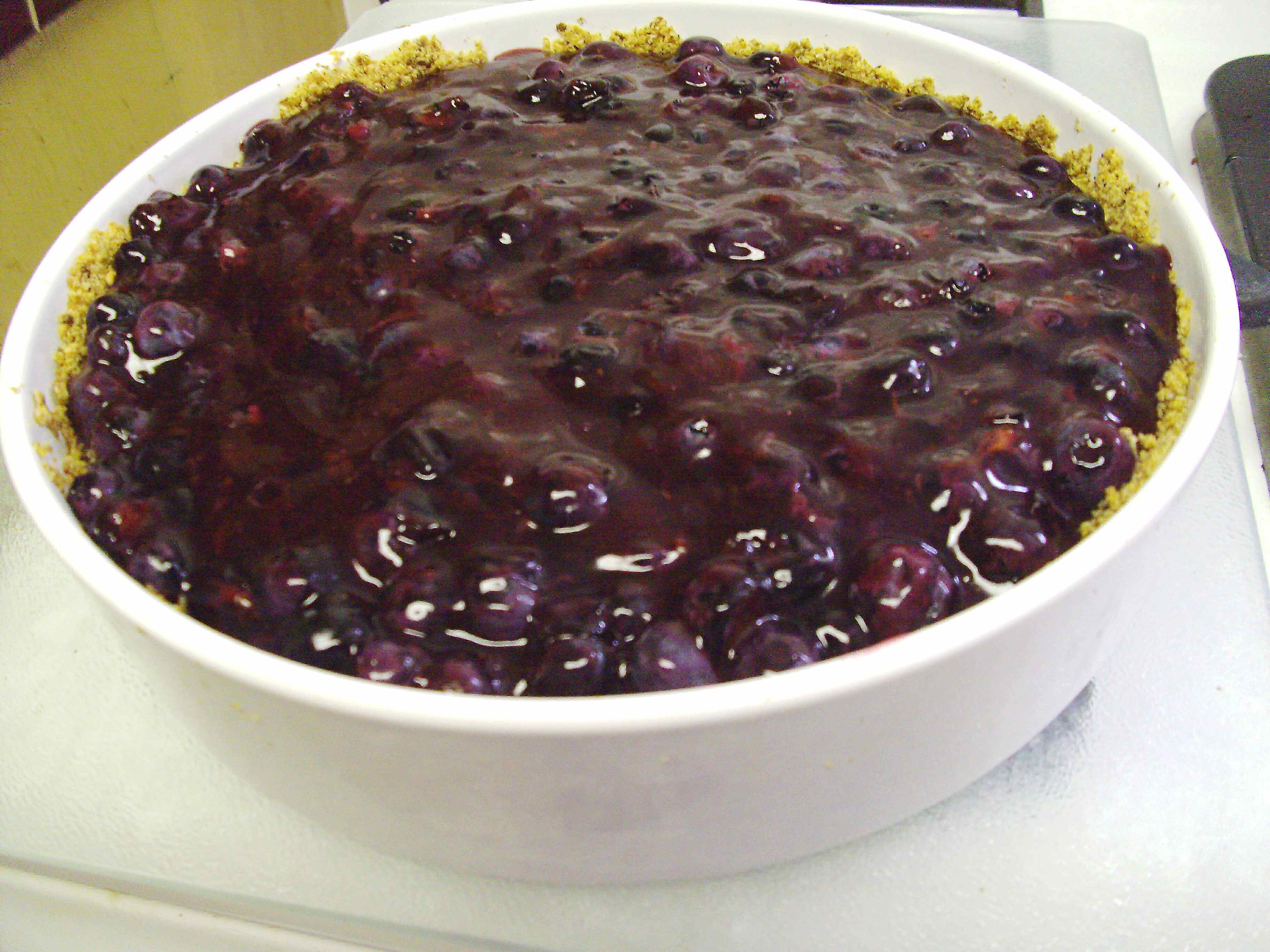
    raw blueberry pie with microwaveable filling and graham cracker crust

    This mostly-raw blueberry pie is a snap to make and very versatile--the filling microwaves in a few minutes, and you don't even have to bake the zippy gingered graham cracker crust--perfect for a hot Fourth of July and all summer long.

  • Recent Posts

  • Contents

  • Archives

  • Now Reading

  • See also my Book Reviews

  • Copyright 2008-2024Slow Food Fast. All writing and images on this blog unless otherwise attributed or set in quotes are the sole property of Slow Food Fast. Please contact DebbieN via the comments form for permissions before reprinting or reproducing any of the material on this blog.

  • ADS AND AFFILIATE LINKS

  • I may post affiliate links to books and movies that I personally review and recommend. Currently I favor Alibris and Vroman's, our terrific and venerable (now past the century mark!) independent bookstore in Pasadena. Or go to your local library--and make sure to support them with actual donations, not just overdue fines (ahem!), because your state probably has cut their budget and hours. Again.

  • In keeping with the disclaimer below, I DO NOT endorse, profit from, or recommend any medications, health treatments, commercial diet plans, supplements or any other such products.

  • DISCLAIMER

  • SlowFoodFast sometimes addresses general public health topics related to nutrition, heart disease, blood pressure, and diabetes. Because this is a blog with a personal point of view, my health and food politics entries often include my opinions on the trends I see, and I try to be as blatant as possible about that. None of these articles should be construed as specific medical advice for an individual case. I do try to keep to findings from well-vetted research sources and large, well-controlled studies, and I try not to sensationalize the science (though if they actually come up with a real cure for Type I diabetes in the next couple of years, I'm gonna be dancing in the streets with a hat that would put Carmen Miranda to shame. Consider yourself warned).

What happens when you age champagne?

A couple of weeks ago on a Friday evening, the week before our anniversary, my husband and I were scrambling to find a bottle of kosher wine in the house for the Shabbat blessings and coming up empty. We didn’t even have grape juice. I took one more look in the last-chance box and realized one of the bottles was kosher after all. It was a bottle of Yarden 2000 champagne I’d picked up on an after-Passover sale several years ago (our local Kroger affiliate supermarket has a not-quite-tuned-in approach toward Jewish holiday ordering; sometimes the matzah boxes arrive and disappear a week before Passover; sometimes they hang around for months, and sometimes they sell good wines at a fire-sale bargain because of the kosher label).

I’d saved that bottle for a special kosher-requiring occasion that never quite arrived. Vintage 2000–definitely the oldest bottle I’ve ever opened at home. As old as our daughter. Has it really been that long since 2000???

(OK, given the sorry yet predictable result of the mid-term elections, I have to say it hasn’t been long enough. But still.)

The bottle was QUITE dusty–almost a prerequisite for experimentation.

Neither my husband nor I are usually all that impressed with champagne–even the expensive mid-level ones, at $40-100 a bottle. Not that we’re usually in a position to sample those at home, but sometimes people splurge on them at Thanksgiving, New Year’s, etc., and we wonder why. They’re usually not as good as the cheaper Spanish cavas–if I had to buy champagne-style wine, I’d rather go with something like Freixenet, not to be cheap but because it’s closer to that bone-dry, yeasty, buttered-toast style I prefer to all the more acidic and flat-flavored mid-level champagnes out there. Taittinger and Moët et Chandon both come to mind as severe disappointments at the $45ish level. Their top-level champagnes might be quite different, but these just seem to be trading on the brand name and pricetag for the naive American market.

For that kind of money, I’d rather have a good, deeply-flavored still chardonnay than almost any of the usual fizzy lifting drinks, and you can get a pretty decent bottle of chard for under $20. Actually, most of the time I’d rather have a decent red.

And frankly nothing is as good as the (once-only) bottle of Dom Perignon my husband brought home 17 years ago, when we finally decided to get engaged after all those years of dodging family and friends, celebrating with some couples and outlasting others. After a lackluster and slightly glum Sunday afternoon discussion that ended with, “Well…okay,” we called each other at work the next morning and agreed we should probably do a little better than that. We were getting married, after all. Oy. We clearly needed some bolstering before we broke the news and faced the inevitable hocking from our families.

A really nutritious dinner consisting solely of Dom Perignon and a (smallish) box of Godiva truffles, each of which looked exactly like Miracle Max’s big chocolate pill from The Princess Bride, seemed to do the trick.

Of course, under the influence of the DP and chocolate, we decided we could do the parts of the wedding we liked (huppah, food, klezmer music, line dancing, ketubbah signing, friends and family, more food, more dancing) and just skip the stereotypical parts we found laughable, uncomfortable or downright detestable in other people’s weddings and wedding-themed tv ads (tux, white puffy dress, veil, speeches, first waltz, which neither of us knew how to do, tiered wedding cakes, arguing with either of our mothers over invitation fonts, color-coordination of any sort or description…)

We ended up having fun at our own wedding, which never really seems to be the primary goal somehow, we only decided where to go on our honeymoon the next morning while sitting around in our pjs, and I maintain that we’ve just kept getting weirder ever since.

Which brings us back to the Yarden 2000. To be fair, Yarden has been making some very decent kosher wines the last 10-20 years. But kosher or not, 14 years for any champagne below the DP level?

Champagne is supposed to be the only white wine that can age–maybe it’s all the trapped carbon dioxide fending off oxidation, but I’d never gotten close enough to try it out. The chemist in me has been waiting for another crack at mad scientist status for a couple of years now, so this was it. Plus it was getting after sunset already and we were hungry and there was no regular grape juice in the house.

Well…if we were daring enough risk our stomach linings and our eyesight by trying mead that had been sitting around for more than a year, we could probably risk a 14-year-old bottle of kosher champagne, once I got the major dust coat off it, anyhow. I found a deep enough pot to improvise an ice bucket but didn’t really have enough time or patience to chill the bottle well.

“Do you want a towel for the cork? It’s probably lost all its zuzz, you know,” my husband said.

Just in case it hadn’t, I opened the bottle carefully and with approved champagne-opening technique (the point-away-from-people-and-twist-the-bottle-gently-away-from-the-cork routine, not the find-the-Napoleonic-era-saber-up-in-the-attic version). The cork actually made a proper popping sound and the usual CO2 fumes rose up. It wasn’t dead after all! (“It was only mostly dead,” I hear you chime in. Stop digging around in that Godiva box already, willya? We already took the good ones.)

Then we poured it, and it foamed up–zuzz intact. So we made the blessing over the wine, and my husband very generously said he’d let me take the first sip. Which I did, but…

“You haven’t gone blind yet, have you?”

I glared at him. Or at what I thought was his general direction.

Continue reading

Fennel Mania

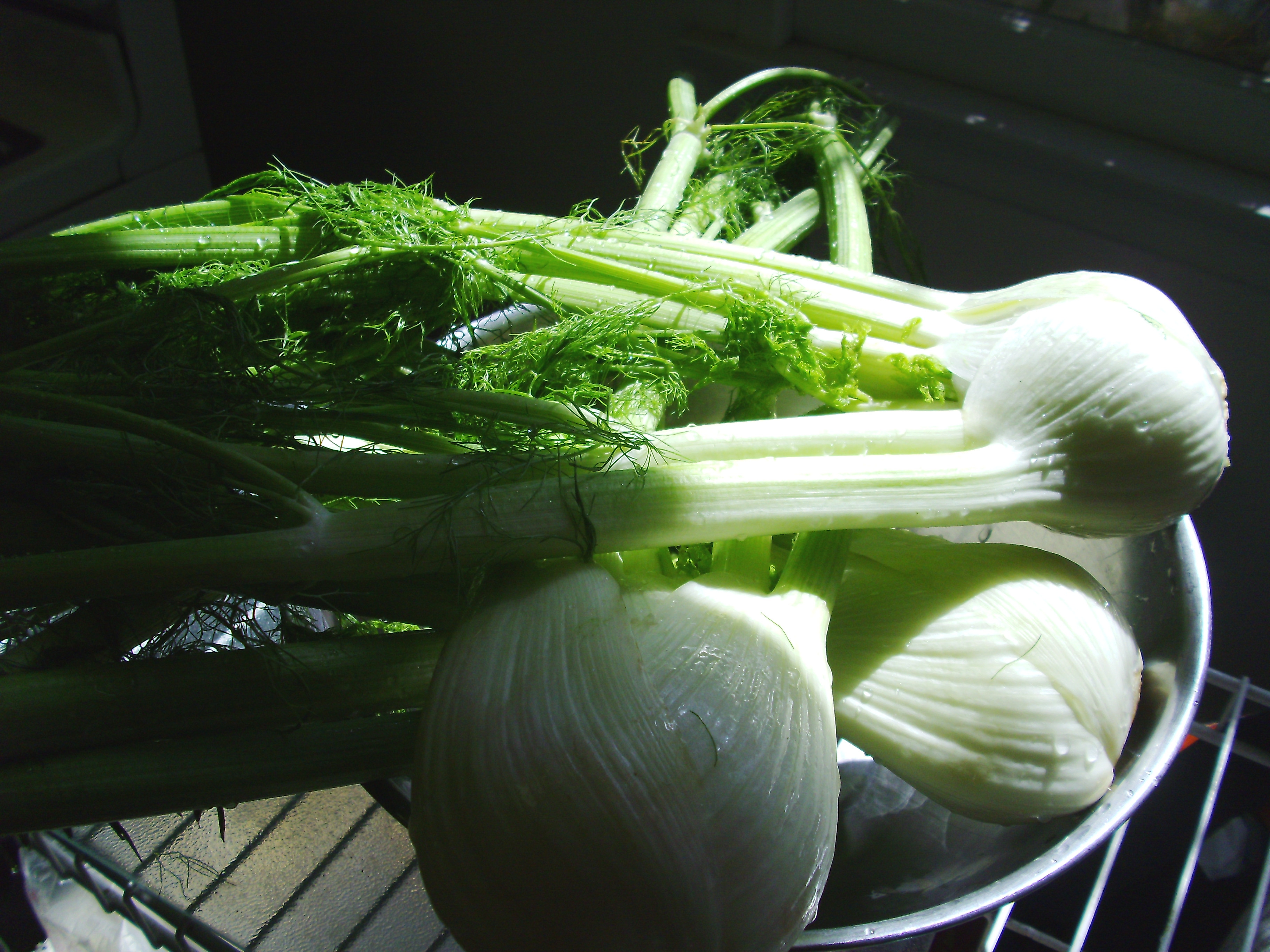
way too much fennel for one salad bowl

This much whole fennel kind of overwhelms my largest mixing bowl.
What was I thinking?

I hear a lot of complaints, among those of my friends and relatives who subscribe to CSAs, about weekly baskets arriving at the doorstep with surprise odd vegetables in unusually large amounts, and what the heck do you do with it all? I’ve never experienced that myself–I’m my own worst (or best) CSA challenge. So I can’t really blame this dilemma on anyone else, because I do my own shopping at my local greengrocer’s. And because the prices are low and the vegetables generally better than what I can get at the supermarket, I sometimes go a little overboard. Fresno tomatoes, when they’re in, are so good I end up with a 7 or 8 lb sack of them every week while I can. If I had more room in the fridge (oh, sacrilege! but they’re already so ripe it doesn’t hurt them), I’d buy even more. An overload of good tomatoes is no problem. However…

too much fennel from the greengrocer's

This week’s hot purchase: fresh fennel at a fabulous–too-fabulous?–price. Fifty cents apiece for large, clean-looking fennel bulbs with about two feet of stalk attached. They’re never less than two dollars apiece in the supermarket, and usually more like three.

So of course I couldn’t resist. I bought FOUR. Yeah. Two dollars total. For what turned out to be more than five pounds of useable produce, because if the fennel’s fresh, it’s all good eating. After washing and cutting it up into useable sections (only a 10-minute operation, surprisingly; fennel’s pretty cooperative for a big frondy vegetable), I actually weighed everything on our food scale.

Three pounds of bulbs for salads or grilling or whatever, two pounds of cleaned stalks chopped into celery-stick-length batons, and about six ounces of the cleaned chopped fronds to use as anise-to-dill-like herbs in tomato vegetable soup, fish, etc.

i1035 FW1.1

But how to use it all in a small household? We have only three people, and I’m the one who likes the anise-y taste of fennel most. Can I freeze some of it for later use (other than the fronds, which I did)? Are we going to be stuck eating it every day for weeks? How long before it starts going bad? What the heck was I thinking?

But it’s enough, and cheap enough, that I get to play around with it. Maybe I can find something good and even original to do with it that doesn’t require long roasting steps (Italian), stewing, or cheese-and-cream-filled gratin-type disguises (French) for the anise flavor, because really, for that you could have just bought celery.

The most obvious thing to do with fennel is slice it up and nosh on it raw. The first time I ever ate it was at the home of a large Moroccan Jewish family up in the  north of Israel. The mother, who invited me over for Shabbat lunch, started the meal with hraime, fish steaks (served cold, thank g-d) in a garlicky broth with enough evil birds’ eye chiles floating in it that the younger children (all the ones under 20, anyhow) started whimpering. “Only one pepper!” their mother replied, but none of them were fooled. I, the self-conscious guest just out of college, took the first bite and nearly fell off my chair as all the brothers and sisters laughed. Luckily the rest of the lunch was pretty unspiced–brisket, long-cooked eggs, farro with chickpeas, a lot of little cooked and raw vegetable salad dishes. I was still recovering from the “appetizer” though; I reached repeatedly for both water and the sliced fennel. Actually, I miss Esther’s hraime still, these many years later…

But mostly you don’t want to just gnaw on raw fennel for relief from the evil chiles. Fennel is pretty. Continue reading

Breaking the Rules: Fish with Red Wine

tilapia fillets Veracruz-style, with smoky salsa, onions, garlic, alfonso olives, red wine and fresh za'atar or "wild thyme"

One way to cook fish well using red wine

Wine is something I drink mostly for taste, not volume–I can’t really hack a lot of alcohol at once, blame my ancestors–but I do like wine tastings, even though I have to limit myself to about three small sips per glass if I don’t want to wobble out the winery door. Focusing on the flavors in a wine, and comparing several side by side, sharpens your palate and makes you think very specifically about what you’re experiencing. It’s rewarding even for someone with my drinking limits.

I also like to cook with wine, maybe more often than I like to drink much of it. Decent wine has such a complex combination of flavors that when you figure out how to do it well, cooking with wine can make even rapidly cooked dishes come off like serious Slow Food.

We hear a lot about long-cooking stews and coq au vin and so on, but many simpler and less time-consuming dishes benefit from smaller amounts of wine. Adding a couple of spoonfuls of dry white wine to mustard vinaigrette tempers the sourness, the garlic and the mustard sharpness a little and gives the sauce a quiet depth. And if my experiment with giant favas marinated in rosé and rosemary was any indication, we should be thinking about wine a lot more often and a lot more creatively as a cooking ingredient.

So I’ve been on the lookout lately for clear and simple techniques for cooking with wine without wasting it, and for doing it in less than a three-hour stew, because to me that’s slow-food-slow in large crowd-feeding quantities, to be attempted a maximum of once a year. I want better, more sophisticated-tasting food fast, using at most half a cup to a cup of wine, not a whole bottle, and preferably without huge cleanup.

But these days, when so much of the cookbook aisle in your local independent bookstore is taken over by Food Network Channel collateral, cooking with wine is almost a lost art. Most of the popular TV chefs aren’t even doing it anymore. Everyone’s gone sorta-Asian (but without Martin Yan’s shaoxing wine-wielding expertise or sense of humor) or sorta-Middle Eastern or bacon-filled-Tex/Mex or wishful-thinking-Indian-or-Moroccan wannabe (if I hear the words “ras el hanout” mispronounced one more time by any TV chef, anywhere…)

Most of those cuisines don’t include wine as a regular ingredient because of religious restrictions against alcohol, which I fully respect, or, in the Tex/Mex case, because wine doesn’t go with football (the true religion of Texas, although if you see the documentary Somm, you might be surprised at how many American master sommeliers and exam candidates are former football players.)

The new vegan and vegetarian cookbooks don’t consider wine at all, as far as I can tell, even though there are plenty of  vegan-approved wines and organic wines touted throughout Whole Foods (and even a few at Trader Joe’s). And a number of seitan and bean or lentil dishes (and certainly Roman-style lentil soup) would probably do all the better for a tinge of red, white, or rosé, either in the sauce or as a marinade ingredient.

Even the French- and Italian-trained chefs don’t use wine on TV very much, and if they do they don’t really explain it–why they chose that particular type of wine, how much to use and why, how to get the best flavor out of it in the dish, what else you could make using the same technique. Or else they’re kind of wasteful about it, using a whole bottle of wine for a single dish. Most people cooking for themselves would balk at that. Should balk at that.

It bothers me that I don’t actually see a lot of solid advice about cooking with wine, or at least not specific techniques that make sense in a home kitchen with a standard family budget.

Where am I going to get this advice? Not from the churn-a-minute Food Network chefs, clearly. Not from Harold McGee, either. To my great surprise, he devotes a total of about three paragraphs to “cooking with alcohol” in his food science books. The most interesting thing he says, other than to make sure and boil out the alcohol (duh) is that tannins will concentrate unpleasantly if you boil down a tannic red wine, but adding a protein to pick them up will tame them.

But since most of my uses for wine so far are to do with fish, I guess I’m already doing that…

As you might expect from some of my odd microwave-centric ideas, I tend to cook fish with wine in ways that probably seem unorthodox to anyone professional. For one thing, I cook several kinds of fish with red wine (sound of Francophile traditionalists screaming, then fainting in shock). Continue reading

An Appreciation of Lox

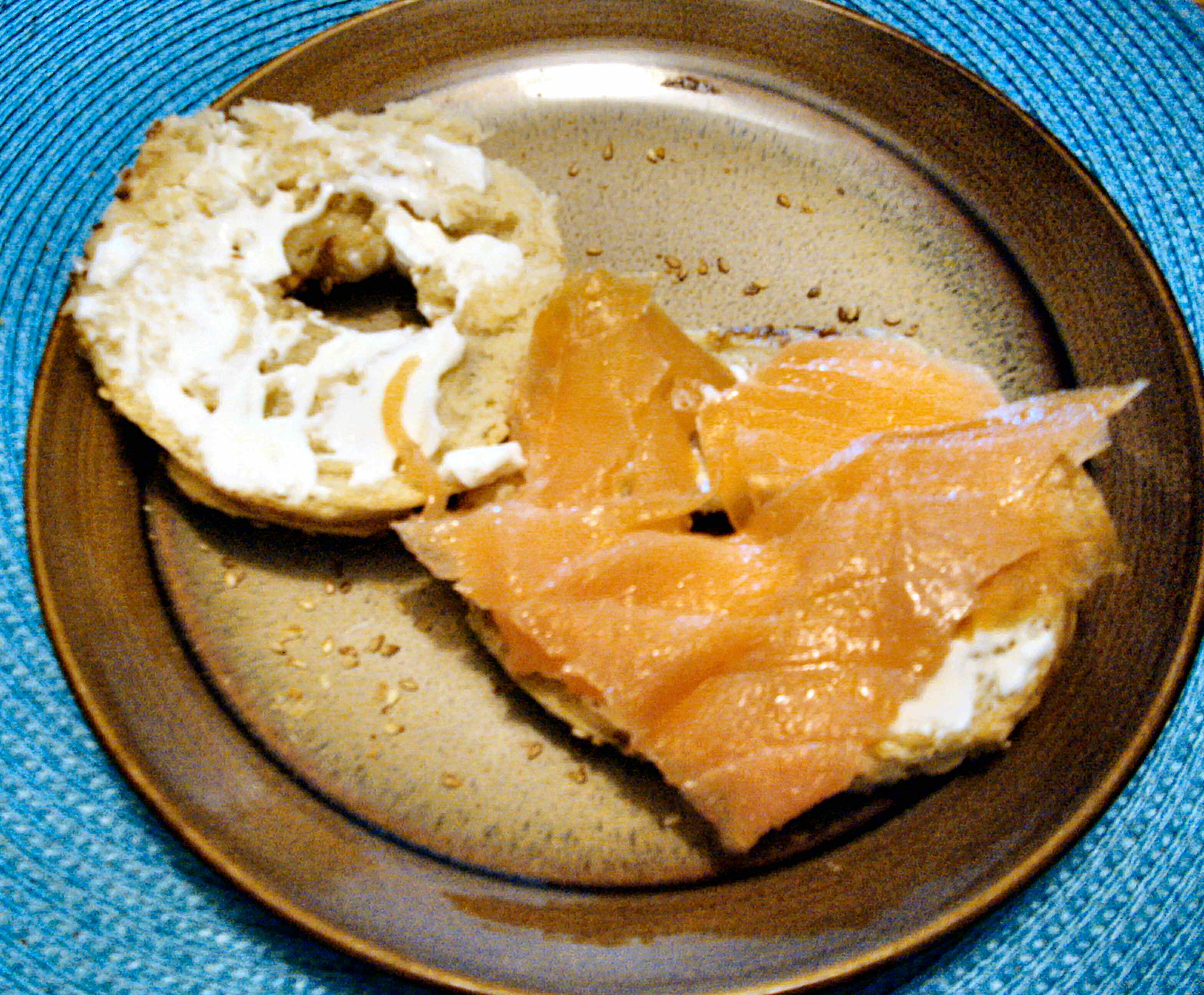
bagel with nova lox

Homemade bagel with nova from a local Los Angeles smoked fish company


For its annual Mother’s Day brunch, the Men’s Club at our synagogue always serves a surprisingly lavish spread with the woiks–lox, bagels, fruit salad, eggs and mimosas. Although I’m not a huge fan of big and slightly-kitschy gatherings featuring big and slightly-kitschy piano acts, I really deserved someone else making me a lox-and-eggs Sunday brunch right about then. But at the last minute I had to miss it in order to hock my kid about her last oversized ridiculous semester projects for 8th grade (due the next day, naturally). Better mothers complained to the principal, who just smiled nicely but did nothing useful. I just figured we’d get through it all so my daughter never had to be an 8th grader again. It worked–salutatorian, even–so, moving on but not required to give a speech: win/win.

But the lost lox! and the not having to cook or do dishes for Mother’s Day! Then I agreed to chaperone a school science camping trip the last week before graduation and  ended up with sand, grime, KP duty, outdoor showers, iffy Boy Scout Camp-style food, and not just one but 32 whole teenagers preoccupied with their hair and late to class.

So now that it’s all over I’m in serious need of payback.

My local Armenian greengrocer has locally-smoked nova lox (they have sable, too–I was tempted) and I had a bowl of dough in the fridge just sitting there waiting to be used up–so I made a few impromptu bagels the last Sunday morning of the school year, as soon as I’d gotten all the sand back out of everything and my kid was done with classes for the year. The bagels weren’t quite as dense as they ought to be because I used my standard pizza/pita/calzone dough instead of the genuine classic, but they did well enough because the dough was several days old, cold-proofed and straight from the fridge, and I boiled them before baking. And there was lox. Throw in a few once-over-medium eggs and some shmear and some fruit and hot coffee and you’ve got the ideal late-spring/early-summer breakfast, even if you have to make it yourself.

Now I know lox is a high-salt item–even the Nova. I anticipate it not for the salt, which I always think we could do with a little less of, but because it’s lox. A delicacy. Something to enjoy on the rare occasion when you get to celebrate. Something to treat with respect.

I’m not going to apologize for enjoying it, either. In the modern world of food publishing, people are forgetting how to do that. Even Jews. Maybe especially Jews, some of whom act as though our traditional deli and “appetizing” (bagels, cream cheese and smoked fish of all kinds) is suddenly something to shove under a rug or apologize for liking on the grounds that it’s not organic or locally sourced or Whole Foods or food-mag-trendy enough, and because it doesn’t include bacon or pancetta. Or kale.

The idea that enjoying lox simply because it’s lox isn’t cool enough anymore has gained a lot of traction in the past few years of foodieism. A couple of years ago, Martha Rose Shulman committed a serious travesty in the New York Times with “Lavash Pizza with Smoked Salmon” (she didn’t even call it lox). Toasted lavash is perfectly good for other things, but not for lox. Too fragile, and frankly too flavorless. I mean, why not rice cakes, as long as you’re being tasteless? But it wasn’t just the bread choice.

Somehow Shulman had abandoned the Joy of Lox. Shulman actually called her lox on lavash “a great way to work more salmon, rich in omega-3 fats, into your diet.” I have to ask, are most of us really having that much trouble “working in” more salmon? More to the point, does any lox fanatic really want to be thinking about fatty acids of any kind while eating it?

But at least she wasn’t agonizing over it as too Jewish. Mark Bittman pulled this inexplicable self-flagellation-in-print a few weeks ago in the New York Times, apologizing publicly for eating lox and bagels on a Sunday morning. In New York, yet. (Maybe it’s because he moved to Connecticut?) He’s kvetching about skipping his morning run, his usually-so-virtuous-but-betrayed-just-this-once-by-shameful-genetic-temptation stance on (gasp) farm-raised salmon, his devouring of shmear, which he says is too bland for the calories to like officially. He even had the nerve to blame his decision to eat it all on a sudden mental breakdown. And then he went further and called bagels and lox “comfort food.” As though it were in the same low-grade category as mac and cheese or mashed potatoes from a box.

Vey ist mir! I mean, come on. I’m pretty sure Woody Allen still eats lox without apologizing for it.

Bittman should be apologizing for being ashamed of enjoying lox (all the while glupping it). Along with apologizing for promoting pancetta and guanciale while professing a greener and more affordable diet. And for forgetting to add garlic to his recipes. That’s almost worse than deprecating lox.

More recently, Melissa Clark met with one of the scions of Russ & Daughters, which by now you’d think was the only serious lox and whitefish emporium left–it’s the subject of a documentary I just missed at the last LA Jewish film festival. The two laid out a spread for at least thirty or forty very lucky people, by my standards, but I think they were doing it mostly for a few family and friends–maybe 10-15 people–and posing it all on the table for the camera. It was beautiful but way too much. At least, though, she was both thrilled and nostalgic, the right way to be when faced with a complete beauty pageant of smoked fish.

Altogether, I could only think Shulman, Bittman and Clark all grew up in big cities with too much lox around. Because when I was a kid in the small-town South, we could only get lox twice a year when one or another set of grandparents came down from New York.

Other people’s grandparents bring toys. Ours brought pastrami, corned beef, half-sour kosher dills, pickled green tomatoes, real bagels, serious breads you just couldn’t get down South, and lox. All of them were special, not just to us but to our grandparents–real deli was part nostalgia, part roots, part pride, part simply great eats.

Pastrami and corned beef to go with the pickles and the tough, chewy pumpernickel and rye with the union label pasted on the end (you were supposed to fight for it)–these were the working people’s foods of their youth on the Lower East Side and the Bronx,  and they still loved them. And so did we.

My mother’s parents, born in the shtetls of Poland and Ukraine, came to America as children and, thank G-d [only instance of poverty being worthwhile], couldn’t afford to go back when their parents got homesick.

Fast forward to the ’70s: My Grandma Thel, short, plump but ladylike, coiffed, and wearing those pale oxford pumps I used to think of as librarian shoes, would step off the little regional plane in Charlottesville loaded down with huge grocery bags full of chewy, crackle-crusted bagels, Jewish kornbroyt or “corn bread” (a heavy European wholegrain sourdough; no actual cornmeal except what’s dusted on the baking sheets to keep the loaves from sticking), rye bread laced with bitter caraway seeds, sometimes a babka, and always, a huge half-wheel of her own light chocolate-flecked sponge cake (for which I’ve inherited the recipe but haven’t tried it yet–will post when I get it right). I hope the other passengers were smart enough to be jealous. The aromas alone should have clued them in. Grandpa Abe, of vishniak fame, was a lucky man.

On the drive home from the airport, Grandma Thel would tell me and my sister how she just managed to argue another customer at Andell’s or Goodman’s out of the last loaf of kornbroyt with seeds because she was bringing it down to her very special grandchildren so we would grow up knowing the real thing, and that the other lady Continue reading

Purim options

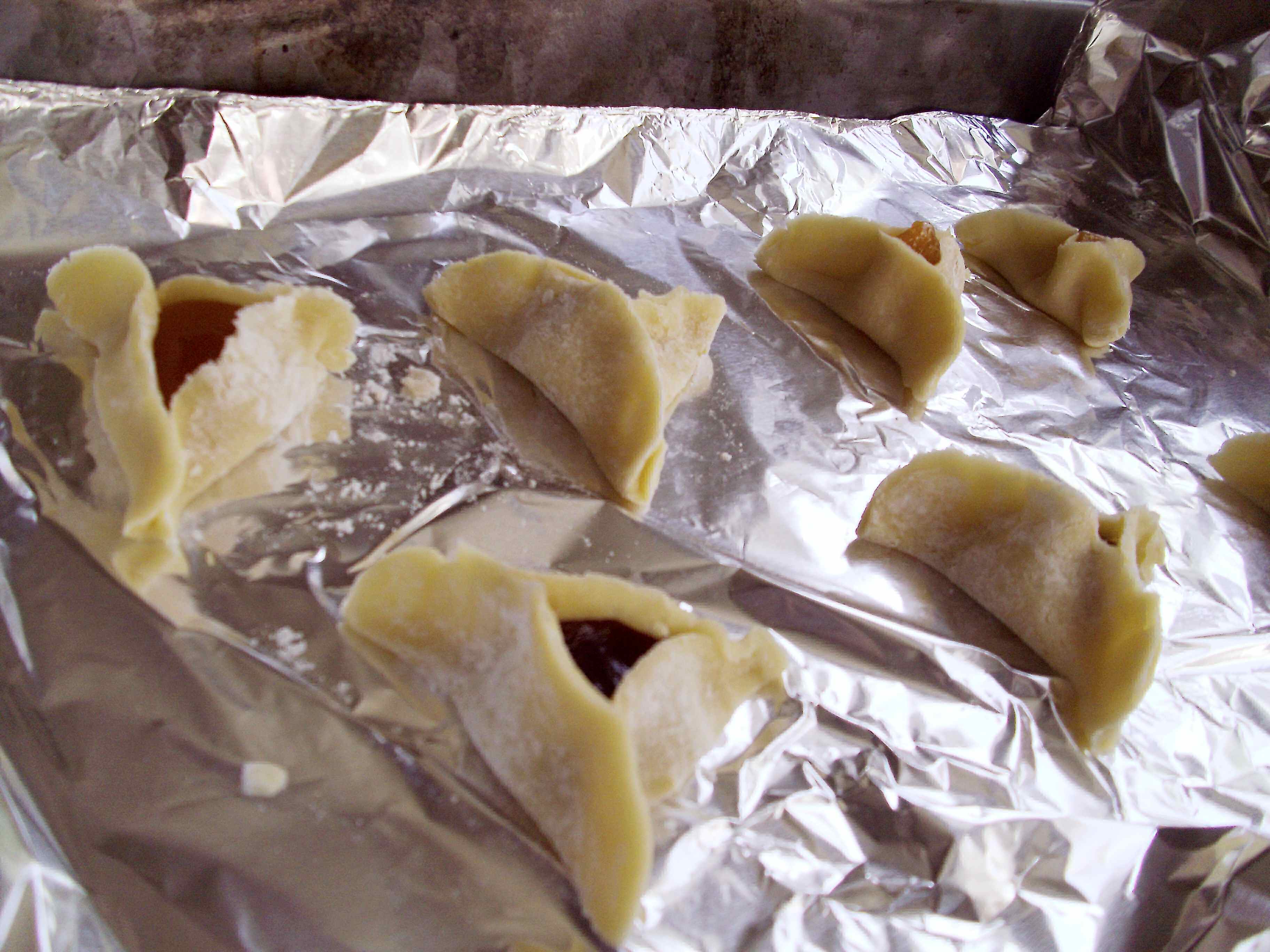
standard cookie-dough hamantaschen

Regular hamantaschen with prune lekvar

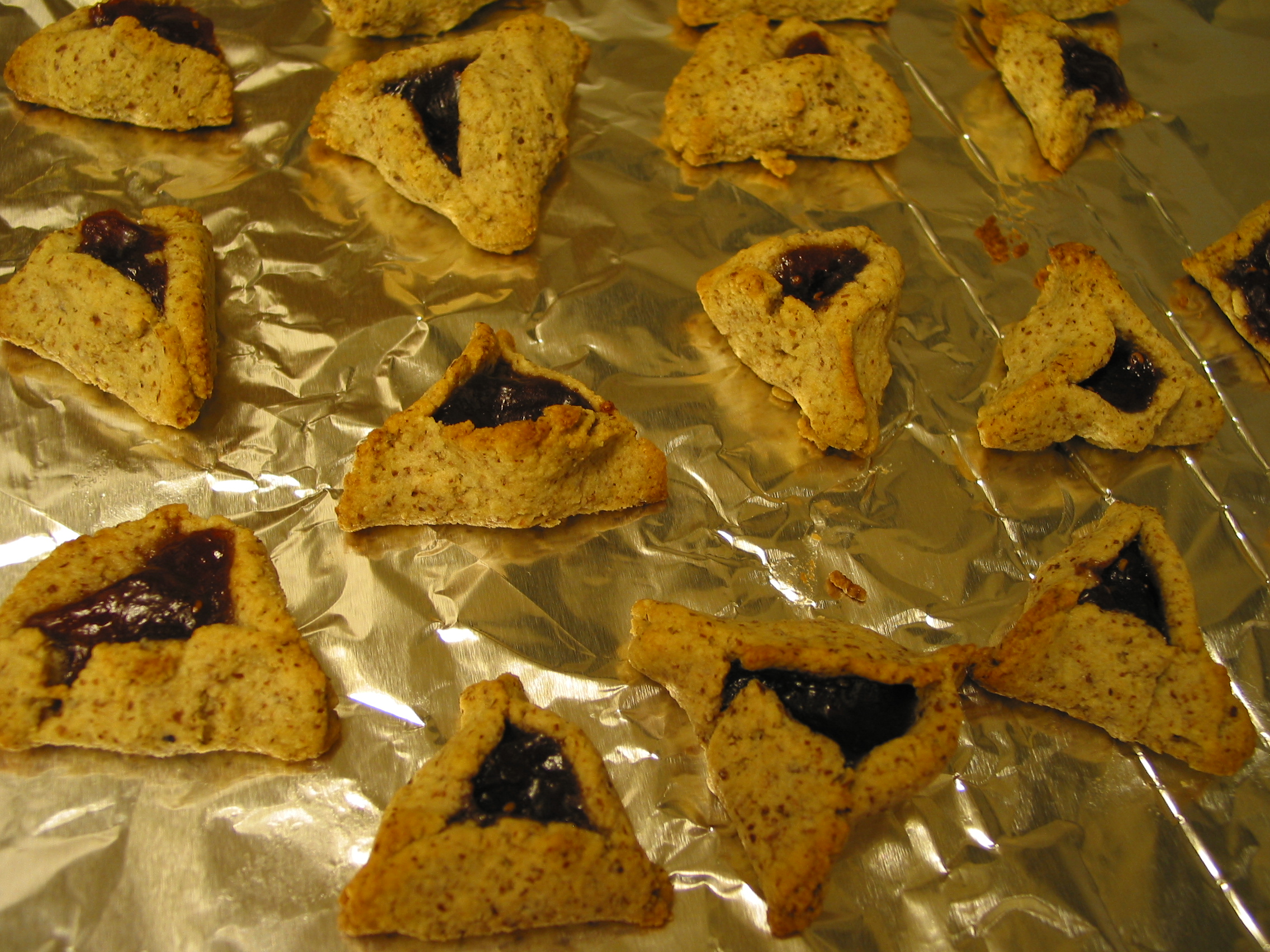
Almond meal-based low-carb hamantaschen

Almond meal-based low-carb hamantaschen

Purim is here tonight, a little late thanks to the “leap month” this year (drawbacks to a lunar holiday calendar) but none the worse for it–it’s over 80 degrees here, which means it’s almost time for Purim. Los Angeles is the only place I’ve ever been, including Israel, where people were slathering sunblock on their kids and gasping for water bottles at a Purim carnival well ahead of lining up for hamantaschen and games. It was 94 degrees that year. Fifteen years of this and I’m still not used to it.

Purim, of course, means manic baking, heat wave or no, because the adults’ reading of the Megillah (the Book of Esther) had…ummmm….last-minute planning and no one thought about hamantaschen as part of the refreshments until midweek. I think I’m the only one left in our  shul who still doesn’t care about having a fabulously original themed cocktail party for the adults afterward. Any kind of cocktail party is more drinking than I want to do, and I’m damned if I wanna dress up in full office battle array again after so many years sidestepping all the suits in my closet, just so I can fit in with the Mad Men theme. I’ve never even seen the show.

But I actually make hamantaschen at home once in a blue moon instead of schlepping over to the Valley to buy them from a kosher bakery.

So I did the stupid, crazy thing and volunteered. How many people? I asked–maybe 60. So I have SIX batches of dough sitting in my freezer relaxing. It took about half an hour, about 5 minutes apiece,  to do all the batches in the food processor, one after another and weighing out the ingredients so they’d be consistent. And yet…after all the excitement from two weeks ago, I’m just not all that geared up to roll it all out and bake it just this minute. Maybe when things cool down slightly–half an hour? Maybe?

Friday happens to have been Pi Day as well–and to my daughter, who was supposed to be my second-in-command for this delicate operation, and to her algebra teacher this morning, that meant Pie Day. They had about four different kinds of pie for all the math classes, and none of them had to calculate the areas or volumes of the wedges they sampled. My daughter, of course, was so elated that she ate two entire meals’ worth of carbohydrate in about fifteen minutes, and still came out with a pretty good blood glucose number an hour later–good on the calculated guesses, there–but at the cost of running through insulin that could have lasted her three or four more hours if she’d eaten an ordinary lunch. Teenagers! Mothers of teenagers!

Still, not to lose the spirit of things too much. It occurs to me that hamantaschen qualify as very small pies, only triangular. So we eventually started the process of inscribing a triangle inside a circle–240 times, if we can get through all the batches before showtime. Me, I’d settle for 3 or 4 batches and call it a week.

The raspberry jam filling–all that hard work for the first batch of rolling and filling–leaked all over the place. Too bad there isn’t still a vogue for vampire-everything; the first batch would have qualified! Too thin. You need a thick serious filling to stay in place during the baking.

So–time to nuke the prunes for lekvar and the figs for the heck of it (plus toast a small sampling of the poppyseeds in my freezer to see if they’re still okay to use for a filling, and to make sure I don’t pour in the bag of nigella seeds instead by mistake!). I rarely see these anymore, but I still believe in doing traditional fillings alongside the modern, newfangled apricot-jam-and-chocolate-chip ones. It’s true that if we keep skipping the prune filling, we might not turn into our own grandparents, and if we miss out on the poppy seed filling (known in Yiddish as mohn) we might pass the all-critical drug tests (à la Seinfeld) with no interferences, but then again we’d miss the ta’am, and what’s the joy of hamantaschen without a taste of the past?

Hamantaschen Recipes

Low-Carb Almond Meal-Based Hamantaschen

My version of Joan Nathan’s Hamantaschen, with four fillings: poppyseed, prune, apricot/chocolate, labaneh/cheesecake

Microwaveable dried fig and dried apricot fillings (originally for fillo pastries, but still good for this, and a lot less drippy than jam)

However–if you are feeling “Mad Men”, you might think of reconfiguring the hamantaschen motif for cocktail party fare instead. I was thinking about this Thursday but figured it would be too weird. Then I saw an article about it yesterday in one of the big three newspaper cooking sections–dammit! scooped again! In any case, if you’re feeling a little avantgarde, you could do a batch of savory hamantaschen if you feel like it. Use rugelach, bureka or olive oil tart dough instead of the standard sweet dough. Roll it out fairly thin, and fill with feta or bleu cheese mixed with labne or very thick sour cream, plus a little onion and some thyme, maybe a pecan or two. Or something with very cooked-down mushrooms and onions (so they don’t get soggy). Or pesto and cheese. Or spinach with cheese and nutmeg and lemon rind. Or tapenade. Etc.

Chickpeas of all sorts and descriptions

Since Esther supposedly refused meat and ate only chickpeas, chickpea recipes are also more or less relevant to Purim. Mine are not particularly traditional–look up Iranian Jewish recipes elsewhere on the web.

Chickpea crêpes  These can be savory or sweet, and they don’t require eggs or milk

The “other” moussaka–eggplant and chickpea stew

Hummus from scratch (aka how to nuke dried chickpeas)

Fast Hummus made with chickpea flour (microwaved)

There’s also the possible “nahit”–fry chickpeas in olive oil, drain and sprinkle with salt and pepper.

Or a cold chickpea salad with mint, scallion, garlic, olive oil and lemon juice or vinegar.

Or channa masala dal, something like the red lentil dal but with chickpeas (and not mashed)

Post-Kiddush: our leftovers are better than yours

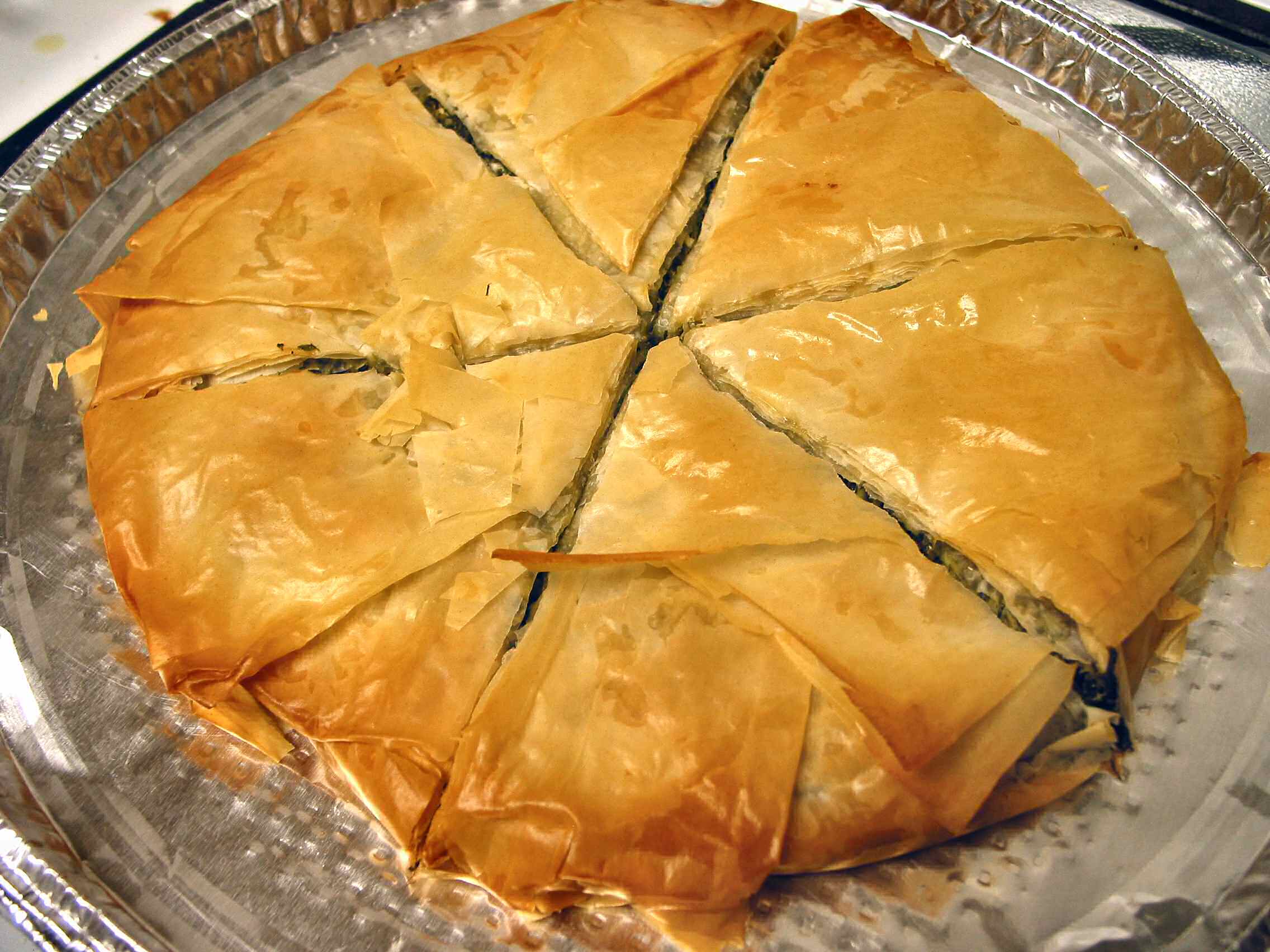
Round spare spanakopita just for us after the big kiddush

Round spare pinwheel-style spanakopita just for us at home. The big ones for the brunch had three pounds of spinach apiece (and were cut in small diamonds), but they still went together pretty fast–except for squeezing all that spinach dry…

This weekend I did it again–I made the kiddush, or in common speech a lunch buffet, for my congregation’s Saturday morning service. My husband kind of volunteered us for this week and because he doesn’t cook, most or all of the cooking, shopping, chopping and schlepping landed on my shoulders.

Last time he volunteered us, it was for our anniversary, and  I was ready to skip ahead to the divorce until I got over it, because it’s a lot of work to cook for 60 or so people who like to eat. And kibbitz. Especially when the 60 suddenly turns into 80-plus and having to use the synagogue kitchen with the more complicated and confusing rules on only a week’s notice. As they did this time…..

Soooo….a two-day hell of shopping and then marathon cooking-and-juggling in my little galley kitchen. The microwave got a serious workout. So did the food processor and the oven. Sometimes all at once. And it was raining hard for three days, so bringing things over to the synagogue kitchen as I went got a little tricky. I triple-wrapped the chocolate cake and stuck it in a USPS Priority Mail box so it wouldn’t get left out in the rain. Same idea for the spanakopita trays.

A few hints about cooking big and real for a synagogue brunch, learned the hard way by moi and passed on for your edification and safety (and sanity):

1. You can buy a 6-lb can  of chickpeas for massive half-gallon batches of hummus (Mid-East brand, maybe Goya as well). Cost? about $5. But–as I found out, and I’m glad no one was filming the process–industrial-sized can equals industrial-strength steel. A dinky hand-operated can opener is no match for such an item. I got just far enough to be able to pry open a kind of spout but there were tears and long-fluent-repetitive-all-throughout-the-house swearing sessions involved.

Still….

2. If you have a good corner greengrocer, you can buy quantities of eggplant for cheap–eleven or twelve eggplants made for a large tray of roast eggplant and onion slices (with garlic slivers and za’atar sprigs and olive oil) plus a large vat of baba ghanouj. Only the five eggplants I nuked for the baba ghanouj didn’t feel like cooperating fully when it was time to peel them. Might have been easier to peel first, then nuke, since it was all going into the food processor eventually. Next time…

3. Whole smoked whitefish for whitefish salad comes two ways–cold-smoked or hot-smoked. What’s the difference? I asked the counter guy at my favorite Armenian grocery. “Cold-smoked is a little less hard,” he said. So I bought it, thinking he meant the hot-smoked was tough as shoeleather and twice as chewy. I was wrong. Cold-smoked actually means the fish is smoked raw, like lox, only a little drier and tougher. But you don’t necessarily want to put it in whitefish salad that way. Man, it still had the scales on too. I couldn’t get it off the bones for love or money, and there were a lot of bones.

However, the microwave came to the rescue. I cut the fish in half and Continue reading

Ganache

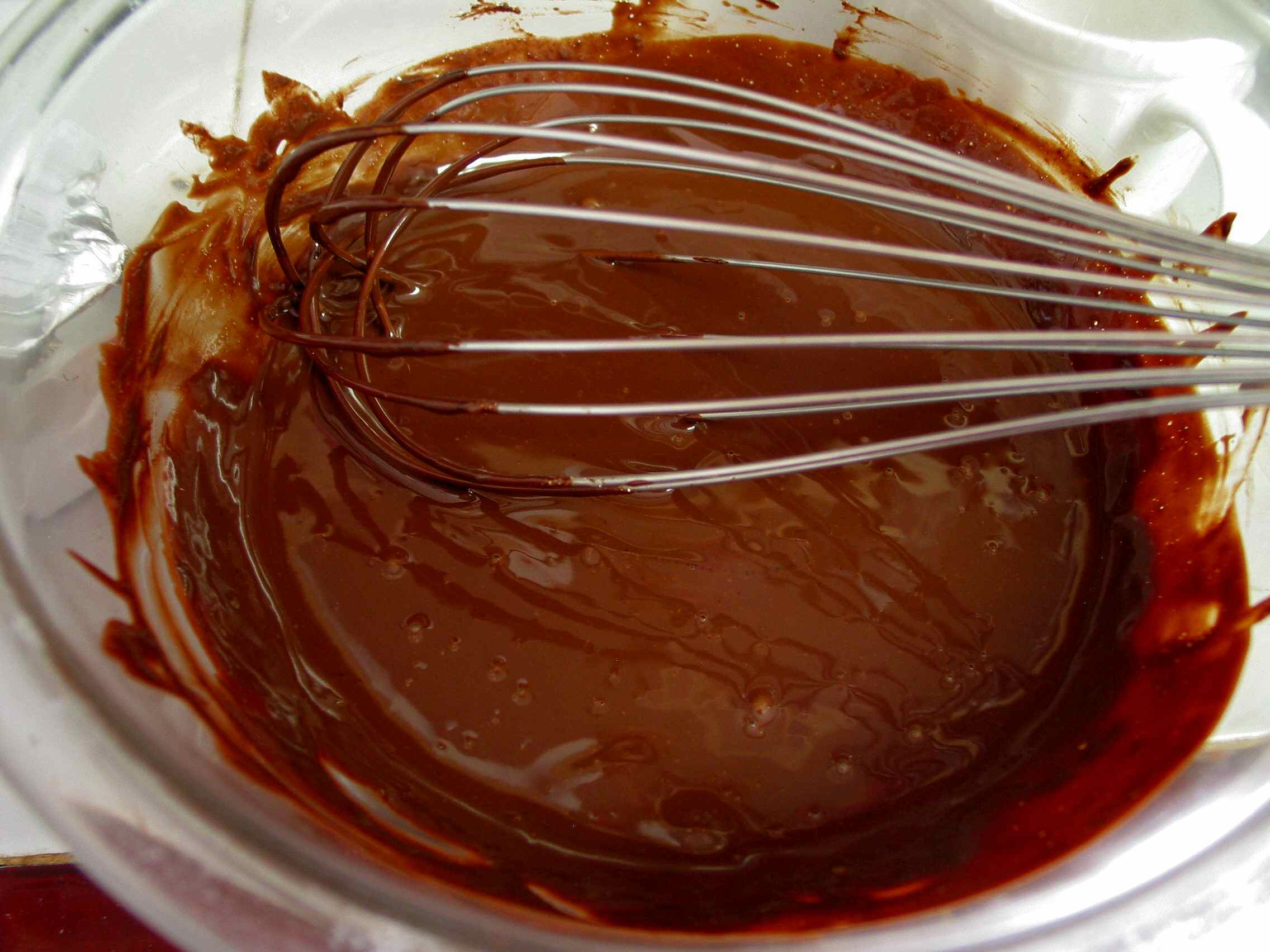
chocolate ganache

Ganache–the most versatile Valentine’s Day dessert in the world–takes about 5 minutes to make. If that.

This post started out being about Valentine’s Day 2013, if you can believe it,  and all the lame, anemic, inferior, chocolate-free pastries being touted in last year’s February food mags–Thomas Keller’s very, very plain beige custard tart without any decoration on it comes to mind as one of the worst offenders. He named it–get this–“Pomme d’Amour”. If you served me that as a Valentine’s date dessert, without so much as a raspberry or a mint leaf on the side, much less a caramelized-sugar top as for crème brulée, I’d be very unimpressed with it and probably with you. Especially at French Laundry prices. I’m not giving the link for it. If you’re genuinely hung up on Keller’s recipes, go away and don’t come back until you’ve convinced yourself that I’m right–a lot of fuss for so much bland. Because…..

Valentine’s was meant to be about chocolate. Or, if you’re very lucky, chocolate sauce. I don’t hear any dissent out there–except perhaps among the lovers of beige food. Takes all kinds…

So anyway, it should surprise no one that I’m late for this by an entire year. And dinner is tonight. In any case, you should know this post has morphed, thanks to time, tide, procrastination that knows no bounds, and my deep, deep love of chocolate ganache (because it is bitter and because it is my heart? Hell no: because it is unbelievably simple and quick and fun to play with and tastes damn good and impresses people who don’t know any better. Why else?)–Ahem! This post has morphed into a couple of ways to impress people who no longer cook. Including yourself if you’re one of those most of the time, and even if you’re not, because tonight you don’t want to spend a lot of time fussing over the food, you want to be taken out to dinner or else, if you’re snowed in, you want something delicious and very quick that takes only very simple, not too expensive ingredients you probably (hopefully) already have on hand somewhere at the back of the cupboard.

As I think I discussed in my post over the summer about the dangers of baking for one’s kid’s bat mitzvah (or other big celebration), many of these lost souls who never cook at all, to my great chagrin, can be counted among my close friends. To the point where making a cake of any kind, even from a box mix, is impressive.

Anyway, irritated by the selections I’d seen in all of last year’s February foodie magazines, I realized that most of my ideal recommendations, that is, the ones that I wasn’t seeing but wanted to, all relied on some form of chocolate ganache or fudge sauce–variants on a shockingly simple recipe. Even the French expert versions are just about this simple–mine’s better because I use a microwave and save washing a saucepan (always key), but the rest is history either way.

If you’re ready to mess around with the proportions until they feel and taste right, you’re my kinda cook. If you’re not, well, just consider that it’s “holiday season” (well, President’s Day, anyway, on Monday) and this is almost a free gift. Seriously, a five-minute (plus a little cooling time) recipe with two or at most five (fanciest variation) ingredients can win you a lot of unearned praise and maybe even a hot date.

All this is merely to point out that, if, like me, you have been tasked with dessert on short notice, you can skip the supermarket frosting horrors if you feel like it (and if your intended audience deserves it) and be amazed (and disturbed) as you flaunt instant and completely fictitious pastry “skills” that–and you don’t have to tell your heart’s desire or any of your friends this–rely almost entirely on some half-and-half and some dark chocolate chips or bars and a microwave. In short, I give you: Ganache.

. . .There is never a completely wrong time for chocolate ganache, except perhaps in the middle of a corned beef on rye with half-sour dills. OK, sorry I mentioned that. . .back to that romantic “cooking” thing. . .  Continue reading

Pastry again: vinegar adds the tender touch

Most people, if faced with a quick baking dilemma, probably go to the supermarket and buy cookies or brownie bites or something.  And it makes sense, kind of, although with a food processor, you can make pretty good cookies and brownies in less time than it would take you to fight over holiday parking, much less elbow your way through the store.

The corresponding shortcut for most people who do bake would probably have to be pie crust–to say nothing of puff pastry dough. For years I’ve been looking for ways to make a pastry dough that is close to puff pastry–flaky and light and puffy–without being as heavy on saturated fats and calories. Not the easiest combination.

Fillo (purchased, I’m not enough of a DIYer to make my own yet and my kitchen’s too tiny for rolling and tossing a huge thin sail of dough the right way)–fillo is good for a lot of things, but it’s so obviously itself and not pie dough, tart dough or puff pastry. It’s also pretty salted–I always have to comparison-shop to remember which commercial version has the least sodium per ounce (they vary within brands, because some are intended for savories and the others for sweet pastries. I think the savory ones are much too salty and use the less-salted ones for spanakopita and so on as well as for baklava).

After having made a variety of pie doughs–standard flour-butter-salt-water, olive oil tart dough, rugelach butter-cream-cheese dough, and even a puff pastry recipe with about half the fat called for in the classics–plus croissants that I finally got right–I can say my latest experiment is something of an eye-opener for me.

All of these worked okay as doughs, but except for the olive oil tart dough, which I use routinely for quiche, none are really all that light-tasting or actually light in terms of fat content and overall calories. And rolling them thinner than the standard 3/8 inch (thinner equals less dough and fewer calories per serving…) sometimes leads to a tough pastry. The fact that I tend to use bread flour instead of all-purpose or cake flour is probably at fault as well, I’m sure, but I’m mostly a bread baker and not exactly a perfectionist, so how many different sacks of flour do I really want hanging around my cramped galley kitchen at any given time?

A week or two ago I checked out an older cookbook (late ’80s) on Armenian food and tried to puzzle out the Armenian, Lebanese, Turkish and Russian influences–it’s a real mix. I was looking for a recipe for bureka dough, and this book had one.

The recipe for spinach burekas had an accompanying (and aging, over-tinted ’80s-style) photo of a browned and flaky dough wrapped around a log of improbably-green spinach filling on a platter lined with too-green lettuce and too-orange tomato slices underneath. But other than the color enhancements, the spinach log, kind of like a spinach Wellington, looked pretty nice.

To my great surprise, the dough was quite similar to some of the ones Joan Nathan had in The Jewish Holiday Kitchen.  The key ingredient differences from my standard pie doughs are:

1. slightly more butter for the amount of flour than for standard pastry dough (to be expected–you want it flakier, you probably need more fat in the dough) though a lot less than for rugelach or puff pastry

2. a little vegetable oil as well

3. an egg. Nathan’s “muerbeteig” egg dough for a plum pie calls for a hard boiled egg yolk, of all things, but the one here is raw. I’m not sure what it’s for, exactly. Perhaps for leavening or some other structural purpose–maybe it helps the dough puff into layers and hold them better with less hard fat than puff pastry requires?

4. a quarter-cup of dry white wine–which I didn’t have, only red, which would have turned the dough gray…so I substituted half apple cider vinegar and half water–the vinegar because Nathan had used it in a dough with egg. Why wine or vinegar? I think–don’t quote me–it’s the acidity, which breaks down gluten a little and tenderizes the dough. Certainly it did in this case compared to my usual experience.

So anyway–this dough came out surprisingly well. It doesn’t puff anywhere near as much as puff pastry–at least not while rolled out as thin as possible, and I haven’t tried it thicker–but it’s light, crisp and tender at the same time and not heavy or greasy. It’s unsweetened and mostly unsalted and would be equally good for savory pastries, Wellingtons and other encased main-dish things (like pot pies, coulibiac of salmon, and spinach-type fillings) where it’s the top layer or a wraparound, and for sweet ones like the impromptu almond paste and apple tartlet at the bottom of this post. Continue reading

Movie Review: Family, fermented

The New York Times has a review today of a new French film in current release, You Will Be My Son, about an egotistical master vintner in Burgundy and the son whose winemaking instincts he scorns.

I’m thrilled this is going to be in theaters in the U.S., because I saw it last June on the plane home from Montreal, in French, and it was so well acted I thought the airline must have made a mistake–you know, putting in a good movie by accident instead of Alvin and the Chipmunks, various cheap CGI-driven “futuristic thrillers”, all the stuff that went straight to DVD and that you don’t really want to pay Netflix or Blockbuster an additional 5 bucks to see.

Much along those conventional lines, and starkly in contrast to You Will Be My Son, is a wine movie I highly recommend–skipping, that is, and which I also saw on a plane back from London several years ago. Believe me when I say that if Bottle Shock was the “hidden gem” of the selection as the in-flight magazine claimed, the rest of the movies available must have been just unwatchable.

Bottle Shock was supposed to be based on Judgment of Paris, George Taber’s nonfictional account of an upset between Californian and French premium wines in a 1976 blind tasting, but came out looking more like “Daisy Duke Does Napa”. With Alan Rickman thrown in (age 57ish then, and eating KFC onscreen, incompetently) in the role of the 29-year-old wine buff who set up the competition. And the late Dennis Farina, in a pink ascot, substituting for the wine buff’s 30-year-old female business partner. And Sam Rockwell’s ’70s longhair wig was like a bad toupee gone wild.

OK, do go find a clip or so of Bottle Shock (or is it Bottle Schlock?)  for those times when you’re punchy and want something that will give you that entertaining “clawing my eyes out” sense of superiority over an unbelievably putrid movie. With big-name movie stars ™.

No, really, don’t do it. Don’t do it. See You Will Be My Son instead. Part family drama, a little bit thrillerish, twisted and fascinating without any of the American movie must-have cliches, it will keep you on the hook long after you’ve left the theater. And the actors are subtle, intelligent, individual and believable. The whole thing is gripping and so different from the current insipid-explosive American style you’ll want to go raid the library for better-made oldies like All the President’s Men and The Manchurian Candidate.

Only one sour note: Skip the New York Times review itself. In his attempt at selling the appeal, which he didn’t really need to do, the reviewer stuck in a lot of the plot details, to the point where I feel the need for a spoiler alert. You Will Be My Son doesn’t need all that–it’s solidly made and it works well from the beginning. Go see it.

Say “Celà n’est sûre[-gelée-]ment pas le cas”

Following on reports this spring that Polish (and probably other-sourced) horsemeat made it through France and into British frozen supermarket lasagne, now we get word of even more devious (and frankly depressing) culinary misdeeds in today’s Washington Post online:

French restaurants acknowledge serving factory-frozen food

A surprising number of cafés are apparently serving up microwaved meals instead of cooking them in-house. Even the éclair, which doesn’t take a lot of time to cobble together, even for an amateur like me, is no longer safe. The profit margin is too high on these items, and the savings in cooking staff are phenomenal. In a down market, what else would you expect?

But it’s a big embarrassment for a country that’s traded primarily on its gastronomic leadership for decades since WWII. No, WWI. No, wait–probably since the Napoleonic era. Or before the Revolution. Cyrano de Bergerac does a soliloquy based on cream horns and other such items, if I recall.

Well, to tell you the truth, though, I’m not sure whether I’m shocked or relieved. Judging from what my family and I were able to eat in 2006 in Paris, I’d say that in a few cases (cafés within walking distance of museum exits, chosen in part for meltdown-avoidance) frozen might even be a step up from one or two of the overpriced restaurant meals we had (a horrid, horrid “salade niçoise” featuring canned green beans comes to mind). Those few meals were, and I can be generous when I have to, mediocre in a way that would be excusable in suburban America on travel but which were much less than okay given that it was Paris.

Mostly we ate food that wasn’t (comparatively, anyhow) too expensive (we skipped the meat dishes, since we keep kosher) and couldn’t be frozen well enough to fool customers who know how to cook. So omelets cooked where we could see them, felafel served with freshly chopped red cabbage, open-faced sandwiches, breads from a bakery that smelled like yeast and flour, not like plastic bags, and so on. The frozen items tended to be ice cream, which is supposed to be frozen. But that was a year or so before the big bank crashes, the collapse of the housing bubble in America and “too big to fail” and even the Madoff scandal. And even then things weren’t quite as glam, at the moderate end, as we’d been primed for.

And on the other other hand, what does it mean that so many French restaurants have resorted to this kind of tactic, microwaving (and charging for) tuna steaks with ratatouille accompaniment, as in the article? What, other than money of course, and the effects of a deep recession that’s hit France pretty hard this past year.

What it means, in part, is that (also according to the article) flash-freezing techniques are now at a point, at least in France, where they can keep the food acceptable in quality and that the suburban factories where these dishes are put together and frozen are doing a pretty fair job, fair enough to fool even moderately experienced diners (not just tourists). And that the “restaurants”–who knows if they’ll get to keep that title now that they’ve been exposed–have figured out how to be at least marginally competent at microwaving so they don’t just ruin the food.

Better if they were cooking fresh. Or, from the perspective of an avid microwaver, better if they were using their microwaves for something more sophisticated than defrost-and-warm. Better, since so many of the younger working French no longer cook for themselves very much, if the restaurants, cafés and bistros took their role as gastronomic role-model and rallying point a little more to heart. Certainly they shouldn’t be pretending to cook from scratch and charging commensurate prices.

But I wonder–is the food they’re serving significantly better in quality than America’s mass-produced frozen meals-for-one? It might just be, since it’s a more recently introduced phenomenon in France, and it’s been designed to pass muster as though it were cooked fresh. For such a fraud to be successful, the flash-frozen food cannot be like American tv dinners. It just can’t. It might be that many of these factory-produced dishes are still a lot less processed than the miseries perpetrated by Swanson, Kraft, Stouffer’s and so on over here. So maybe we need to take another look at their techniques and demand better quality in the frozen food section here, foods that don’t have aroma of oversalted wet cardboard clinging to them once thawed.