• Enter your email address to subscribe to this blog and receive notifications of new posts by email.

    Join 241 other subscribers
  • Noshing on

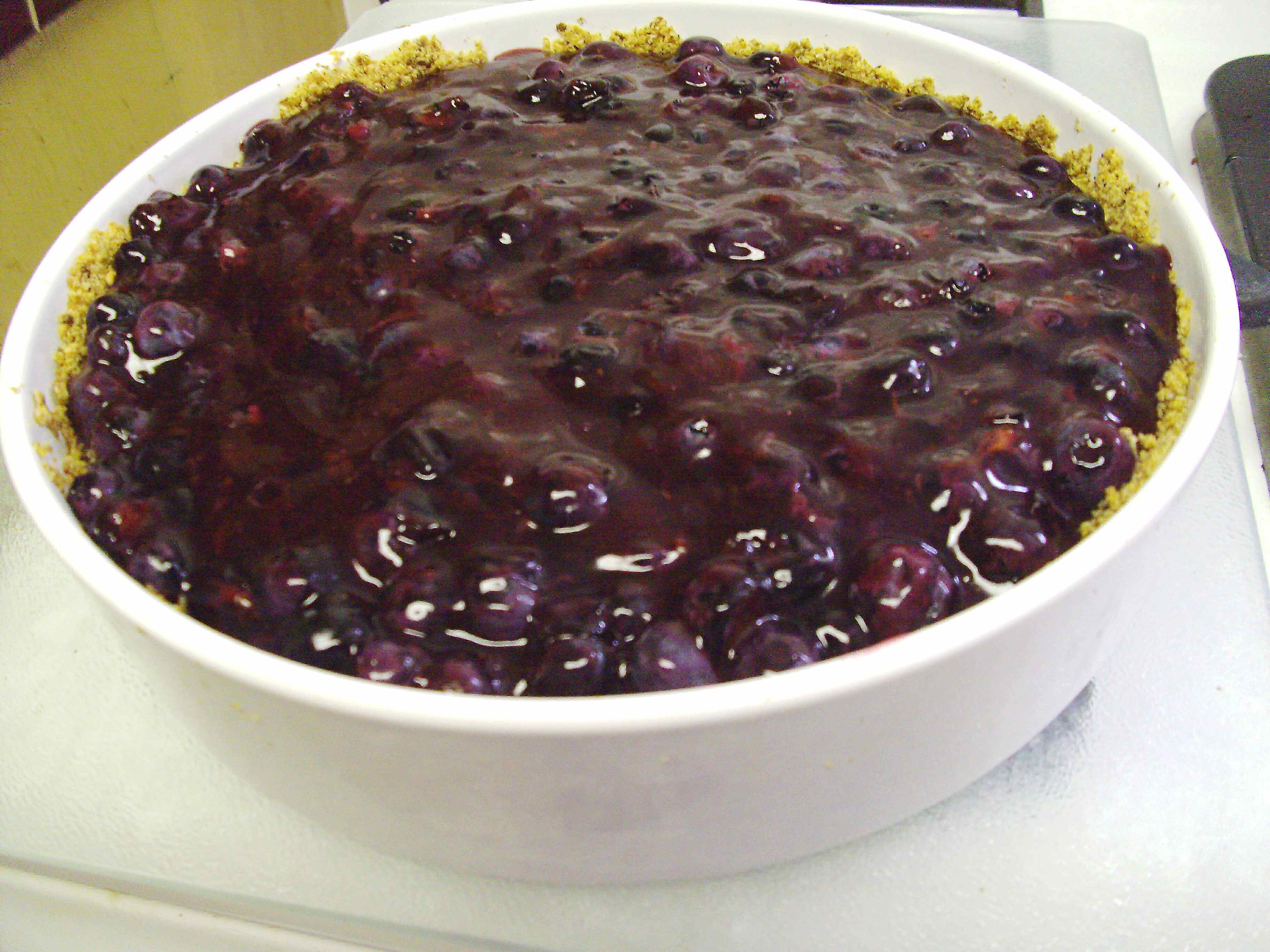
    raw blueberry pie with microwaveable filling and graham cracker crust

    This mostly-raw blueberry pie is a snap to make and very versatile--the filling microwaves in a few minutes, and you don't even have to bake the zippy gingered graham cracker crust--perfect for a hot Fourth of July and all summer long.

  • Recent Posts

  • Contents

  • Archives

  • Now Reading

  • See also my Book Reviews

  • Copyright 2008-2024Slow Food Fast. All writing and images on this blog unless otherwise attributed or set in quotes are the sole property of Slow Food Fast. Please contact DebbieN via the comments form for permissions before reprinting or reproducing any of the material on this blog.

  • ADS AND AFFILIATE LINKS

  • I may post affiliate links to books and movies that I personally review and recommend. Currently I favor Alibris and Vroman's, our terrific and venerable (now past the century mark!) independent bookstore in Pasadena. Or go to your local library--and make sure to support them with actual donations, not just overdue fines (ahem!), because your state probably has cut their budget and hours. Again.

  • In keeping with the disclaimer below, I DO NOT endorse, profit from, or recommend any medications, health treatments, commercial diet plans, supplements or any other such products.

  • DISCLAIMER

  • SlowFoodFast sometimes addresses general public health topics related to nutrition, heart disease, blood pressure, and diabetes. Because this is a blog with a personal point of view, my health and food politics entries often include my opinions on the trends I see, and I try to be as blatant as possible about that. None of these articles should be construed as specific medical advice for an individual case. I do try to keep to findings from well-vetted research sources and large, well-controlled studies, and I try not to sensationalize the science (though if they actually come up with a real cure for Type I diabetes in the next couple of years, I'm gonna be dancing in the streets with a hat that would put Carmen Miranda to shame. Consider yourself warned).

Irish Soda Bread, Lighter on the Soda

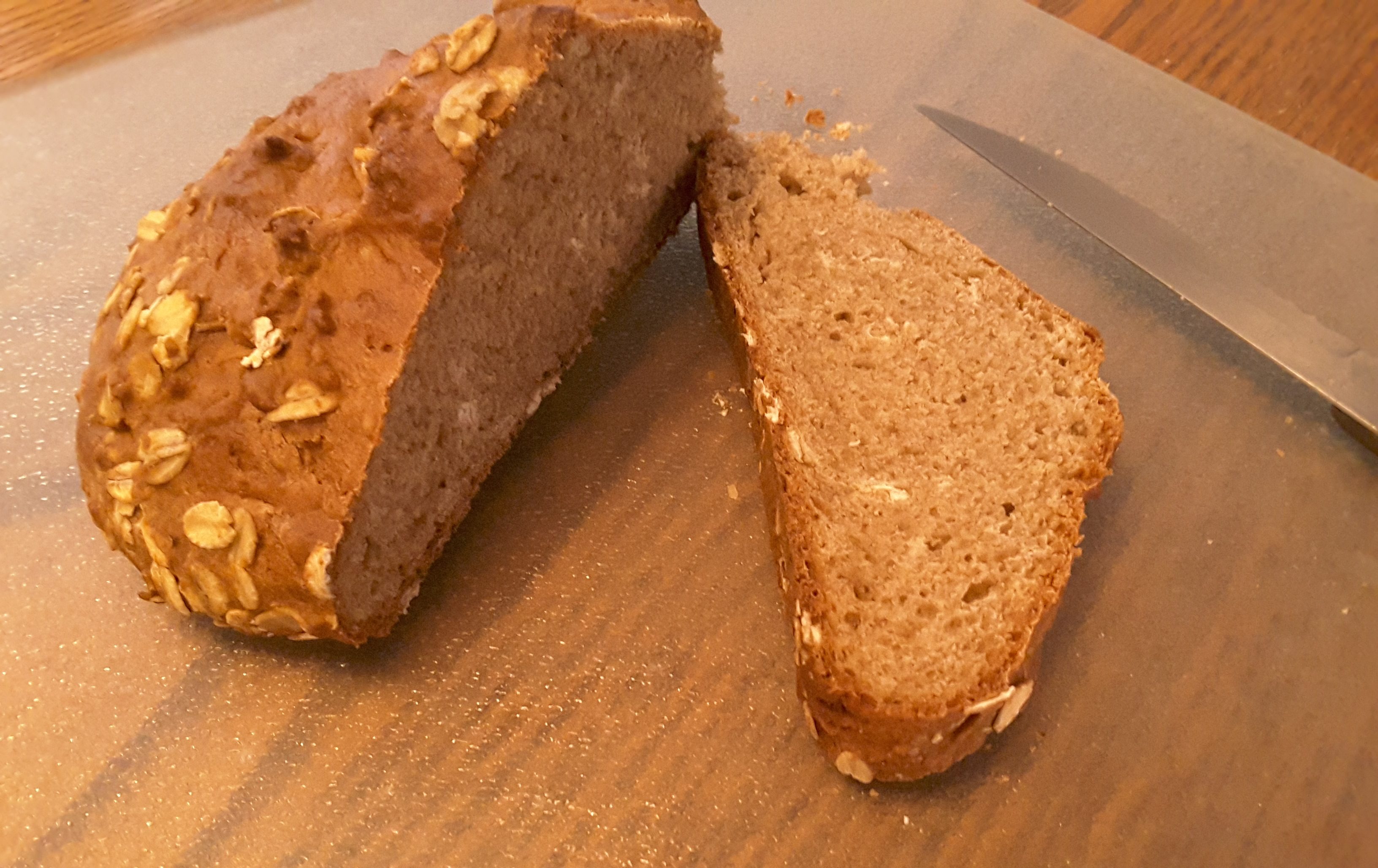
Irish soda bread with slice

Irish soda bread has a reputation—it’s quick and easy and yet rustic, but can be a bit rough on your stomach and supposedly goes heavy and rocklike within a day. Most people blame the whole wheat or the lack of yeast. I blame the soda.

This kind of quick bread was probably intended to be baked alongside the supper roast or casserole and eaten up at that meal—the loaves aren’t huge and there would probably be no leftovers to speak of. Time is of the essence when you’re making dinner for a hungry working family, and typical recipes I find call for a large tablespoon or more of baking soda for only two or three cups of flour. Then they cover the metallic/salt/soap flavor of the bicarbonate with extra spoonfuls of salt. The result is a high-sodium loaf that’s bound to irritate your stomach lining somewhat, even while fresh, and then will almost certainly end up pretty dry and hard, like the stereotypical box-mix Passover cakes, if you let it sit out at all.

I’m actually not sure whether the baking soda levels in today’s recipes are the same as or more exaggerated than classic ones. But considering some of the vintage recipes for similar quick breads, muffins, scones etc., from the 1930s or so, I suspect that the cheapness and novelty of baking soda and baking powder, which could replace eggs as well as yeast, made some of the recipe developers of the day more enthusiastic than they needed to be. Except, of course, if they were developing recipes for Arm&Hammer, Calumet or other brands…

Does it really need all that chemical leavening just to rise? As with tea breads, scones, and quick-mix oil- or applesauce-based cake layers, I find you can get away with a lot less than most recipes call for.  Half a teaspoon of baking soda is enough for two cups (8 oz. or 240 g by weight) of flour and the rise is just fine as long as you don’t wait around before sticking the mixed dough in the oven, and you have included an acidic ingredient like yogurt, buttermilk or vinegar to activate it. Then you don’t have to compensate the taste with excess salt either. The acidic ingredients and any dairy will tenderize the crumb as well.

In any case, these problems are easy to solve without doing your head in or spending a lot of cash on specific ingredients, because the beauty of Irish soda bread is its great adaptability to what you have on hand.

This is the adaptation I made a few times in March and April of 2020, when yeast was suddenly, inexplicably, sold out in the grocery stores, eggs were scarce and flour was being snatched off the shelves too.

Continue reading

Microwave Tricks: Passover Haste and Fresh Apple Sauce

(What? no pictures of apples? How could this be?!! Somehow I’ve never taken any during Passover–maybe Tuesday…)

I know, I know, it’s already Friday afternoon, Passover starts tomorrow night after sundown, and have I cleaned out my fridge? Have I found the all-important kosher-enough-for-me chocolate and kosher-enough-for-anyone cocoa powder? Um…no. I did just bake the remaining bowl of dough (why? why?) for dinner tonight and breakfast tomorrow. I kashered the oven afterward, if that’s any comfort. But really. I’ve been hating the idea of kashering for Passover this year more than usual, and that’s saying something. I hate it every year, especially the fridge. And all the boiling. And trying to remember which frying pan was going to be okay for dairy.

It’s just me and my husband this time, again, not even our daughter this year except by Zoom–and due to March Madness, she reports that the typical sports stupids on Syracuse’s campus have been partying maskless AGAIN, like it’s a big surprise that COVID is still around and still actually matters more than the coach’s son’s basketball talents. The distanced seder she was going to is not happening, or at least not for her. The lady in charge is sending her a Pesach kit so she can be a party of one at home–we’ll Zoom with her a couple of hours before we start and so she doesn’t have to be starting at 10 at night to be with us. But oy.

Passover ideas on this site

So I’m obviously not feeling all that brilliant and I don’t have a lot of new great ideas other than the ones I always have, to make best use of a microwave where you can–mostly for fresh vegetables–and to keep the matzah modest and out where you can identify it easily as matzah, not all kinds of dubious baked “treats.” More plain fruit than baked goods–citrus if you still can. Keep the vegetables in the soup, whether chicken or not-chicken. And mostly, don’t forget not to grate raw daikon radish and pour on any vinegar if you can’t find horseradish. That is sage advice, there, the actual one thing I would not do again, ever, so please learn from our hilarious but horrifying experience a few years ago!

I plan to honor my ancestors, including my grandfather whose memoir of escaping the Pale of Settlement I’m re-editing right now, by not wasting food if I can help it and not whining too much for things there just aren’t. Keep it simple, make do, try to make sure other people have food. Keep walking. Improvise.

If you want or need some ideas for microwaveable Passover stuff, look either in the Recipes tab at the top of the page or use the search to find “Passover”. Or in my fabulous “Microwaveable Passover/not-chicken” post from a coupla years ago, which has a roster of links you may or may not enjoy–sort of like second prize in a matzah-crunching competition…

And one more

Meanwhile, one quick, cheap microwaveable idea for the day: microwave applesauce from scratch.

Let’s say you have a couple of apples. Big ones. Maybe with a couple of bruises. And they’ve been sitting in your fridge or in your fruit bowl or (if you’re old-fashioned enough) apple barrel long enough to need using. What can you do with them that doesn’t take more effort than it’s worth? Actually, this is a good time to be using them up instead of tossing them and going back to the store before you really have to.

If you’re not interested in eating them as-is, then at least peel them, core them and cut them up–slices for microwave apple toaster pastry or an apple omelet, dice for throwing into microwave oatmeal, or just whole but peeled for grating…

Grating? yes. I mean, you could get out the food processor if you want, or if you have a lot of apples to do. But if you have a flat or box grater and only one or two apples to use up, it’s probably faster to do it by hand and you don’t have to wash as many utensils afterward. This is what I did on my one night of latke-making during Chanukah this year, because we had no applesauce in the house and I wasn’t about to dash out and buy some. Plus the grater was still handy. It was a seriously nice surprise that it wasn’t a flop.

Microwave Applesauce

Apple(s), washed and peeled–that’s it. Unless you want lemon juice or cinnamon or something–I’d say add that after microwaving, though, because cinnamon contains a compound that’s slightly hyperreactive in the microwave, and depending what and how much stuff you’re adding it to can result in unexpected boilover.

Make the applesauce:

Set the grater in or over a bowl, preferably microwaveable, and grate each peeled apple just about down to the core on one side, give it a quarter-turn and grate it down again, turn and grate the remaining sides and throw away or compost the core. Once you have the gratings in the bowl, stick the pulp in the microwave for about 1.5-2 minutes per cup, just enough to get it cooked through, and voilà! You have fresh (though hot) applesauce and nothing but. Obviously, if your grating bowl’s not microwave-friendly, transfer the stuff to a snaplock or other container that is before you nuke.

Or you could go the other way, especially if you’re making more than 1 or 2 apples’ worth of sauce. Peel and this time core the apples, quarter them, nuke them in a lidded container with a drizzle of water for a few minutes until they’re cooked, then mash them by hand or whiz them in a food processor.

Happy Passover, chag same’ach, stay safe, wear a mask, wash your hands, don’t poke yourself in the eye especially if you’ve been handling horseradish, and eat nice.

Crème de X: Purslane and basil dress up a lighter velouté

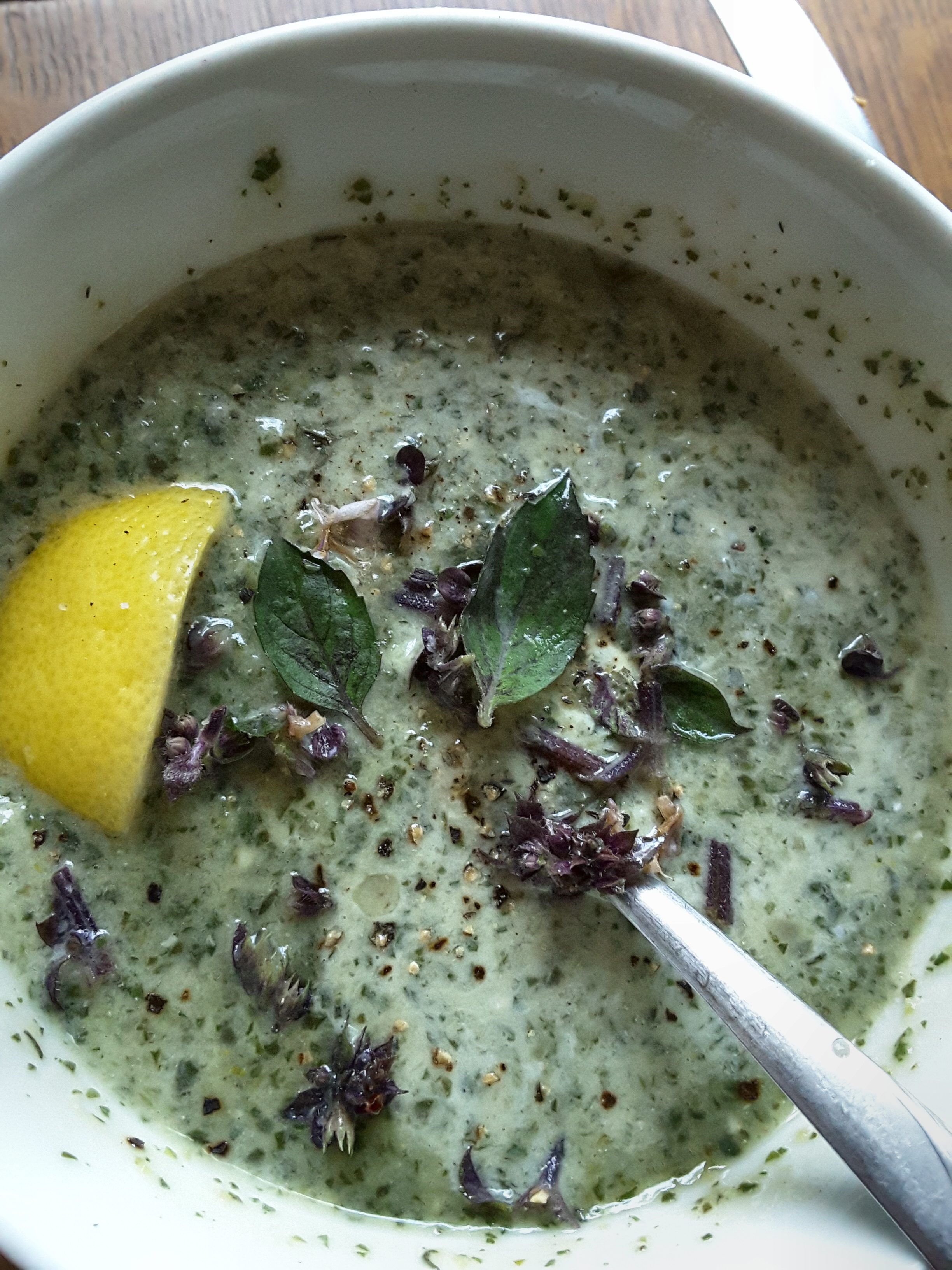
Purslane soup with purple basil garnish
Purslane plus purple basil flowers for that Crème-de-X factor

Sargent’s infamous ballroom portrait of Madame X is today’s inspiration for a soup that, like his subject, breaks a few stodgy rules and dares to produce an elegant but fresher, bolder, more nutritious–and certainly lighter–version of a classic French soup in a few minutes flat. It’s smooth but svelte. And it still keeps you in suspense.

So before we get to today’s featured mystery vegetable (herb? green? Let’s settle on green)–let’s talk about breaking the rules.

Most classic veloutés–vegetable-based cream soups–rely on thorough boiling-into-submission of the vegetables, generally mostly potatoes, to soften them for blending, which used to be done by hand through a mesh sieve back in Madame X’s and John Singer Sargent’s day. They also add a heavy dose of cream to mask any individual or strong flavors so nobody could possibly get upset that they can actually taste the vegetables.

All that cooking softens things but also breaks down most of the vitamins. Reliance on potatoes for bulk makes things starchier and blander as it crowds out the greens as the main ingredient. And I don’t have to tell you what I think about cream–you’re free to disagree but I take statins for a reason, and I’m an inveterate cheese freak. Also chocolate.

So I say save the high-ticket calories for something that packs a bigger punch tastewise even in small, expensive, memorable bites–goat cheese, bittersweet chocolate ganache. Not soup. Make it count.

Method counts too. The modernized French restaurant-approved cookbook methods for veloutés and blended soups in general are stupid, cumbersome and unsafe. There’s no good enough excuse anymore for telling inexperienced cooks–or any cooks–to boil up a vat of something and then try to pour it into a food processor or blender hot–very dangerous, and not the edge we’re seeking here. Scald marks are not chic. Nor is hot flying soup all over the kitchen walls.

In today’s world, you have a blender or food processor AND you probably have a microwave, no matter how many TV chefs may rail against it. You can do this smarter and safer and lighter and faster.

Common sense says blend your veg of choice first, then heat it. If it isn’t soft enough raw to blend smooth before cooking, steam it through first with minimal water and a lid in the microwave for a couple of minutes or, failing that, in a nonstick frying pan or stockpot with a drizzle of water, maybe a quarter-inch off the bottom of the container or pan, and a lid, also for a few minutes. Take it off the heat, pulse a few times in your blender or food processor without most of the liquid to get it started, then add cold liquid gradually as it blends further until it gets to the consistency you’re aiming for. You’re a lot less likely to generate big steam and pop the lid that way.

Then pour it into a microwaveable container with a lid to cook or reheat the soup in a few minutes without destroying every possible vitamin or losing all the color. You won’t scald yourself and you won’t be furious and frustrated and wishing you’d never heard of it before you even get to taste it (this does happen, you know, and cookbooks never mention it)… You’ll be fabulously unruffled (well…at least for this) and ready to dine when it’s ready to eat.

So, enough with the cooking hock-I-mean-hack. What’s with the purslane? What is purslane, anyway?

Fresh purslane in context

You’ve been wading patiently through my diatribe, and the suspense is killing you (but a nice distraction from worrying about the election totals, yeah?)

Purslane–slightly wilted but still worth cooking. I can sympathize.

Purslane, or verdolagas in Spanish, is a slightly tart fresh herb that tastes like a lemony version of watercress or spinach–sorrel? Texture- and looks-wise, it’s a cross between a fresh green herb like basil and a succulent like…like…well, like a jade plant (despite the fact that jade plants are not edible, I’m pretty sure). That is, the leaves are smallish but sort of fleshier than normal herbs. At least when they’re at their peak freshness. Most people who buy and eat purslane put it into a fresh salad and eat it raw. Some stirfry it or chop it and put it into spinach-type dishes. And it’s pretty nutritious–high in vitamins A and C, potassium and other minerals, surprisingly for a vegetable, highish in omega-3 fatty acids if you’re still into those. Grows pretty much throughout the world.

After a week in the fridge, though, it loses a little of its puff and starts to wilt a bit–is it going bad? can you still do something with it?

Continue reading

Oasis

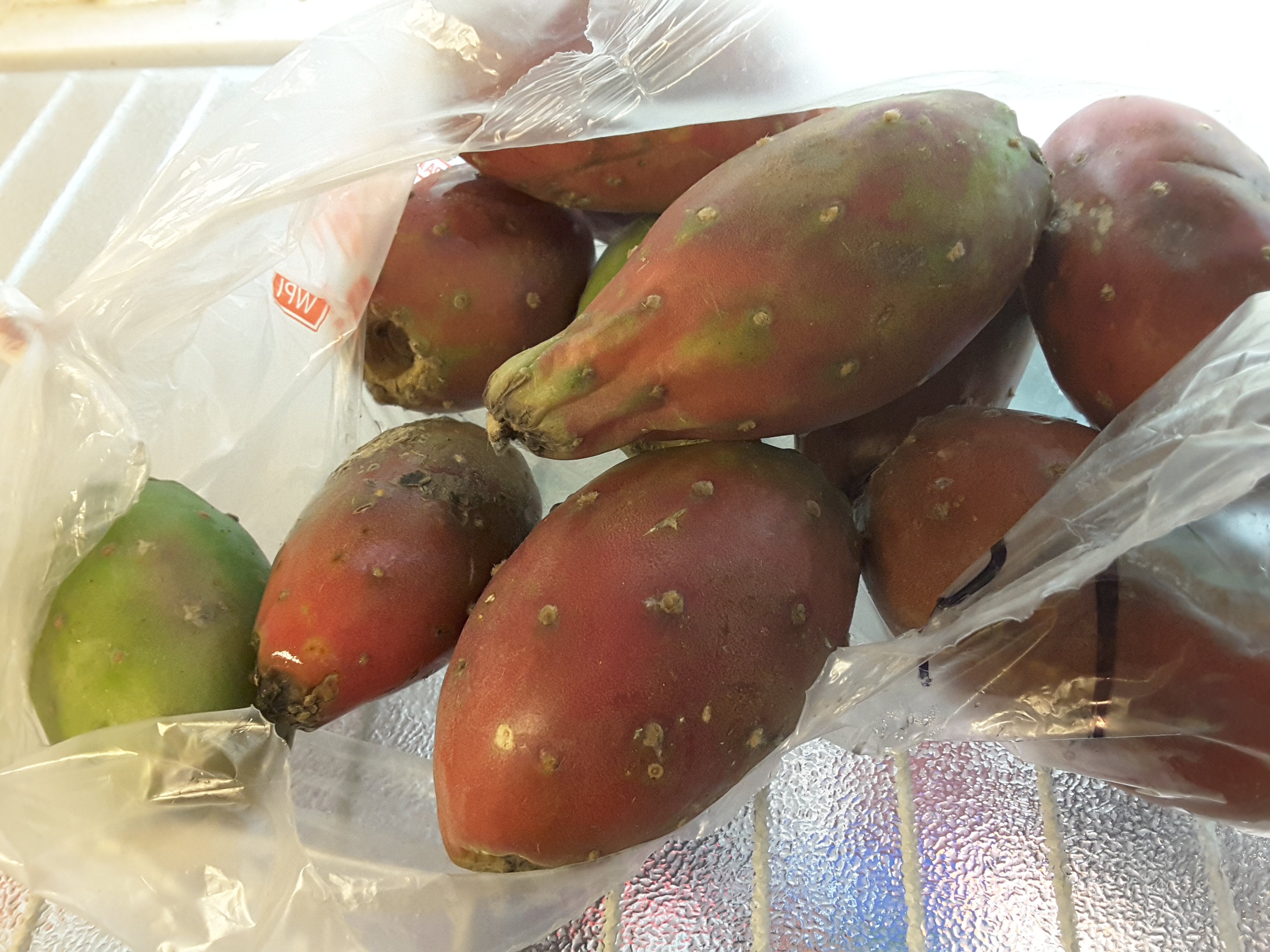
Cactus tunas (prickly pears) from the Armenian corner grocery

For the first time in the history of this blog, I’ve decided to delete a post. Last week I wrote about the nomination hearings for Judge Barrett, whom I definitely don’t want to see on the Supreme Court–not that I’m so thrilled by and large with any of the conservative justices already on the court.

I thought about that piece all week, though, and reconsidered, because every time I started to work on the next new post for things I was actually excited about, it bothered me to see it here, and I decided that meant something. I have voiced some fairly strong opinions in my time, here and elsewhere, and I generally stand by them in retrospect. One of my convictions, however, is that I don’t like signs that someone is cooking with bile, a chip on their shoulder, or is making blanket statements, and that includes myself. A difficult thing to balance because we live in the real world, and there’s a lot to be upset about right now.

As my daughter pointed out last week and as I’ve said myself to loved ones who wanted to dissect the headlines when I needed a break, we all have heard way too much to want to hear even more of it right now at the dinner table. We need an oasis of some kind. So I’ve reconsidered and decided it doesn’t need to be here.

SlowFoodFast is one of my own longer-lasting places of calm–well, usually calm, or at least calm-ish. Sometimes I have to remind myself of that, take a step back and a deep breath or two (with a mask on) and get on with things…because I’ve been waiting to spring a couple of ideas I’d rather have written about instead.

This is my place to rethink and experiment with cooking methods, share my ideas about getting more out of ordinary inexpensive ingredients and kitchen gadgets, explore unfamiliar techniques and foods, and generally do the grown-up equivalent of climbing a chair and sampling every jar or bottle in the spice cabinet just to see what they taste like (which, you are probably not surprised, I did pretty often as a kid. I never actually got caught, either, now that I think about it).

I’m still more or less that kid and the cabinet keeps getting taller and springing some interesting new items. As, for instance, cactus tunas (prickly pears), which are in at my local market and slightly ugly on the outside–often scarred or ashy-looking in spots. It wasn’t really obvious why there should be several bags of them in the last-chance bin because the fresh ones aren’t markedly different. And you’d think people would be grabbing them up. Here they are, spines trimmed off, no need to go out and harvest them yourself and take the risk of high-fiving any cacti.

When I saw the cactus tunas at the store, I remembered a story from last year in Atlas Obscura about a Sicilian liqueur, bright jewel-toned stuff, made from these cactus tunas steeped in strong alcohol plus sugar syrup and aged a bit as kind of a thick fruit brandy. Not that I was really going to put up a cactus cordial myself–I don’t really have the head for drink, and when I do, it has to prove its worth to me in a few sips. What if it were only kind of bland, like an alcohol/watermelon kind of thing?

But I still wanted a bag of them to take home. These are the kinds of fruits that grow on the paddle cacti the lonesome teenager in Cinema Paradiso cut to use for salad plates on his one picnic date with the elusive rich girl. Cue the music…

…It still took me a full week to dare to deal with them.

The tough leathery skins turn out to be no big deal, even the obviously blemished ones, as long as the spines are definitely off–some people recommend rubber gloves in case. You rinse the tunas and just peel them with a paring knife, and the skins slip off pretty easily. All of the ones in my bag were fine inside and unspoiled, no matter how blemished they were on the peel. Just inside the skins is a pale greenish-yellow-white layer–rather tart, like watermelon rind–and then the brilliant, multicolored fruit itself, also textured like watermelon, and with much the same kind of taste, maybe crossed with cucumber.

The fruit varies in color–one might be bright magenta, another a deep ruddy brick red, and some in the farmers’ markets are a sherbety pale orange, yellow or even honeydew green inside. My camera refused to believe what my eyes were seeing here in my kitchen or to give me an option partway between fluorescent and natural light, so the colors don’t really show up as bright in the picture as they actually are. Anyway, they’re pretty showy.

bowl of peeled cactus pears or "tunas"
Cactus tunas after peeling. The greenish layer is tart, like watermelon rind.
Continue reading

Saving Summer, 2020-style: Peaches and Pasta Yet Again

While I was stuck for what to post this summer without ranting too badly, I noticed readers are still searching for some of my inexplicably most popular older posts–how to ripen uncooperative peaches, and how to cook pasta in the microwave. I’m grateful you all are still out there, and I hope some of this helps or at the very least piques your imagination for what’s possible.

Usually I think these unconventional methods are mostly my own odd, quirky ideas about how to cook without turning on a hot stove in 100-degree heat and how not to throw out fresh produce if you can rescue it somehow.

These are no longer fringe questions now that the pandemic has hit so hard. We don’t want to waste money and food or make more shopping trips than we have to. And of course, the 100+ degree weather has suddenly hit hard in the West.  So for the first time in a while, I find I actually have a few new things to say about both pasta and peaches, before I move on to some slightly more warped but fun ideas in the next overdue post…

peaches ripening on counter


Peaches first (since it seems like the more upsetting food for most of us):

Well, I really thought I was going to post here that I have finally come up with a fast and easy way to “ripen” uncooperative, spongy or bland peaches to edibility without cooking them, but it turns out I already did it 3 years ago. Sometimes I post improvements to older posts and assume people can find them easily and tell that the revisions are better, but obviously not, so I’m going to have to go back to the original peach post from about 10 years ago, which suggested ways to cook peaches in a microwave, and point people forward to the method I use now, which sometimes improves blah peaches enough to be able to eat them raw and like them. It also works well for other kinds of mediocre fruit (see under, strawberries) that need a boost to taste like better versions of themselves.

For those of you who don’t want to poke around, this is basically it:

Peach fix 3.0

Wash, pit and cut up the peaches. Sprinkle on a spoonful of sugar and a small pinch or two (a little goes a long way) of citric acid powder and maybe a spoonful drizzle of water, stir a bit and let it sit for several minutes. They should taste better and be at least somewhat juicy and tart, and maybe start taking some rosy color and flavor from the skin as well.

Notes:

  • Citric acid is also called “sour salt” or “limon con sal” or “rock lemon” even though it’s not actually made from lemons, just tastes a little like them, and it doesn’t contain any salt. My Armenian corner grocery sells it along with other bags of bulk spices, and Rokeach brand citric acid shakers used to be available in the kosher food aisle of the supermarket. Don’t pay a lot for it, wherever you buy it–citric acid should be inexpensive and an ounce or two will go a pretty long way.
  • Lemon juice should also work if you can’t find citric acid powder locally or online.  But if you have it, citric acid keeps the peaches tasting like peaches, not like peaches with lemon added.
  • If you have a whole bag of such flavorless peaches to rescue, more than you can actually eat in one go once they’ve sat and macerated a while (“macerating” is just the sweet version of marinating), you can keep them in the fridge in a snaplock container for several days without worrying about spoilage because the citric acid is also a preservative.

Of course, while I was still dawdling over this post last month, wondering if this was more important than my other overdue ideas, the FDA suddenly issued a recall of bagged yellow peaches in at least 12 states for salmonella contamination, and I even got a robocall from the Ralph’s/Kroger supermarket chain offering a full refund if I’d bought their peaches lately (I hadn’t). So I don’t know if this is going to help a lot right now, but maybe the next time you’re in a quandary about bland, spongy peaches and they’re not under a recall, you’ll have at least one more trick up your sleeve. Might work for reviving frozen peaches too.

OK, now the pasta:

microwaving lasagne noodles  

Pasta 2020: Lasagne noodles in the microwave

Yes, I know. This is exactly what it looks like. But I finally figured this one out after how many years? too many. You can boil lasagne noodles in the microwave and keep them from sticking together horribly with a fairly simple trick–well, two. And incidentally, I also learned that lasagne, which is plural, refers to the noodles themselves, lasagna is singular and means the whole layered casserole…I’m still going to mix them up, I’m pretty sure of it. Continue reading

The Afikomen Conundrum, plus a quiche for our times

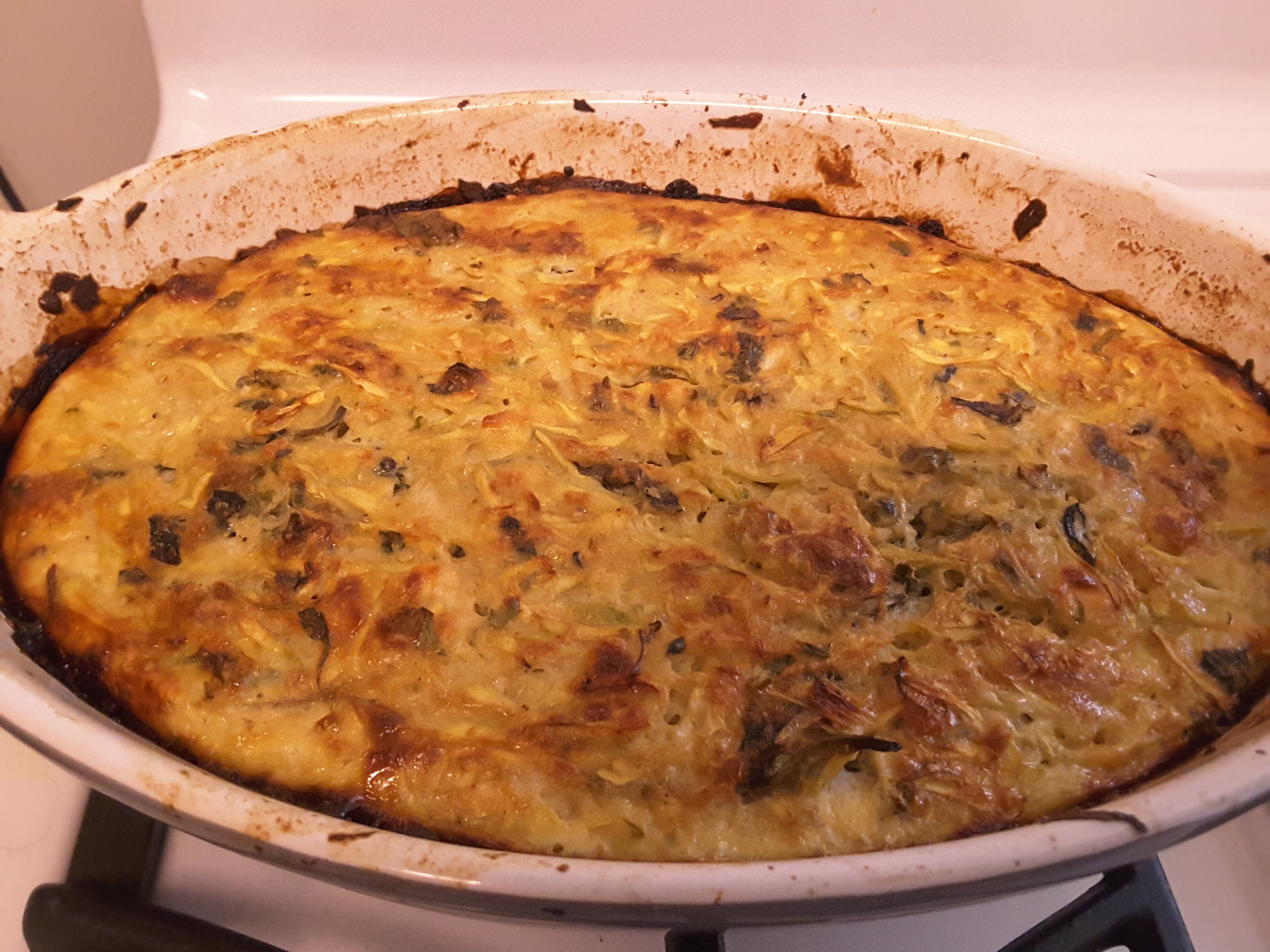
zucchini crustless quiche

On the lighter side of Passover, now that it’s the last day for anyone outside Israel, I did catch Terry Gross’s wonderful Fresh Air interview with Adam Sandler and the Safdie brothers on NPR back in December and was delighted to hear that the brothers included the first-ever mention of the afikomen in an English-language film. It’s about time! I mean, bagel and chopped liver references can only take you so far with Jewish culture. Afikomen is the real insider stuff.

Then, of course, Terry realized that all four of them, herself included, were talking inside matzah-ball or at least Aramaic amongst themselves on-air, and the uninitiated radio listenership who had never even been to a Passover seder might need some enlightenment on the subject of afikomen. Yes, it was exactly like having to explain a joke, and no, the great mass of society probably still didn’t get why a broken matzah is more important than a whole one, or why you’d bribe the kids to give the other half back once you’ve hidden it somewhere cleverly during the meal.

But Sandler and the Safdies ran with it and tried not to make it any more like explaining a joke than they had to. At least Terry didn’t pick the Hillel sandwich to riff on. (Partly because no matter what the Haggadah says about it, there really is no good logical or culinary explanation for eating a combination of apples, nuts and horseradish all together on matzah. It just is, you know? Tradition!)

Anyway, the interview was actually enlightening and smart, and the link is still up online, so go listen to it and donate to your local NPR station while you are wondering, as I am, where we go from here.

I look back to where we were only a month ago and realize that I am thankful my daughter is with us, that my mother and sister and their families and my in-laws are all well if a bit frustrated at home, especially the younger generations with young kids. Back then I  was starting to wonder if there was actually going to be matzah in the stores by the time we needed it or whether I would have to enlist my daughter for some not-quite-kosher-but-best-we-can-do homemade matzah from the leftover bag of flour that I couldn’t bring myself to throw away this year–it seems like more than a sin to throw away anything you could use later, anything you might need, or that someone else could use now.

I mentioned this to a friend back east when Governor Hogan of Maryland decided to declare a statewide a lockdown a week or so after California’s, and we were comparing notes about having college-age kids stuck at home for the duration. It was about a week before Passover started, and a few days later not only was there finally some matzah available at the store, just in the nick of time, but a big mystery box arrived at our door later the same day. When we opened it, we discovered she’d sent us two boxes of Streit’s matzah, just in case. She’s really something else!

As mentioned above, today is the last day of Pesach (Passover in English) if you live outside Israel. My husband is hoping for pizza tonight but since  the stores are closing before sundown, I somehow doubt it’s going to happen tonight. Plus we have two whole boxes of matzah left and a bunch of rice, which I cooked starting with the second night. Turns out many, many American Jews other than us have also decided this year to expand their Passover cooking options to Sefardic traditions that include rice.

I even have most of a packet of quinoa, which is so recent in the Jewish world that rabbis everywhere have declared it kosher for Passover. Somehow that declaration annoys me. Quinoa’s an expensive grain compared to rice and the major importers and cultivators probably paid someone off under the table to get this vegan-trendy chic grain declared ritually different from all other grains, cereals and seeds including rice. Call it Dizengoffia or Beverly Hills Syndrome, and yes, I’m really that much of a cynic, but put it this way–nobody’s bribing anyone about rice as far as I know. Rice is common, inexpensive and traditional, and it’s already approved for Sefardim and most Mizrahi Jews as well.

Small wonder a lot of us have decided to go Sefardi this year, and possibly every year from now on.

Anyway, since this is me, I made some of the quinoa last night in the microwave just to see how it would go–answer, not bad, and pleased my daughter, who along with her college housemates is more conversant with quinoa than I am. I think it’s twice or three times as expensive as rice; they’re still young and excited and into brandname olive oil, gourmet coffee, designer vinegars and  and vegan-chic ingredients because they’re all so new to cooking on their own and still a bit gullible.

It takes time, practice and ruining a few expensive buys on your own dime to realize that fancy-label ingredients won’t make you a great cook automatically. You can go online all you want–even here, if you have the patience to read through all my grumbling and occasional bouts of wild enthusiasm. The fact is there’s no substitute for trying it yourself and being willing to eat your mistakes as far as they’re edible and figure out from them how to fix them up now and do better next time.

But in any case, the quinoa, microwaved or not, is still quinoa, with an earthy, bitter edge similar to buckwheat (kasha).  So definitely squeeze on some lemon or mix in some vinaigrette; instant improvement. My kid agrees–there’s vegan chic and then there’s too chic. And if you’re going to buy it and try it anyhow, you need to be willing to work with it and make it good or else. At least not waste it.

More to the point of frugality, I have been trying mostly to practice what I preach and buy and use cheap vegetables plentifully this week instead of reaching for yet more matzah and cheese at every turn, or using up more eggs at once than is wise in a time when you’re limited to two cartons a customer when you can even get them, and where a lot of supermarkets are now stocking medium-sized eggs when they can’t get enough large ones.

My standard Israeli-style spinach and feta flan for Passover (or any other time) calls for 6 large eggs for a pound of squeezed-out spinach, but you can reduce the eggs to 3-4 and increase the milk to 1.5 c and/or add a bit of bread or flour (if you’re not cooking for Passover), rice, matzah meal, grated or mashed cooked potato etc. –the starch absorbs some of the excess liquid and acts as a binder. And you can use a different vegetable as the main ingredient.

Zucchini are some of the common inexpensive fresh vegetables being neglected most often at the Ralph’s (Kroger affiliate here in the west). I bought a bargain bag for a dollar on my last shop (still doing that where possible) and washed them carefully à la COVID-19 precautions (spritz with dilute dish soap along with all the other groceries, rinse well, airdry, hope for the best). Today I decided it was time to use them for the last Pesach lunch and that they were better to use up now for a crustless quiche than the bags of frozen spinach which cost twice to four times as much and can stay in the freezer. Continue reading

Rethinking “pantry staples”

Whenever I see the words, “pantry staples,” I immediately hear that line–the only one I can remember–from Saturday Night Live alumna Julia Sweeney’s one-woman show God said, Ha!, from the late 1980s or thereabouts. Sweeney’s midwestern mother comes to visit and pokes around in her New York City kitchen cabinets, then asks, “Where’re yer mixes, hon?” And Sweeney realizes how much living in New York has changed her–she no longer buys box mixes for anything because all her standards are higher.

Likewise, I’ve been thinking lately that it might be a good idea to redefine pantry staples as something more useful and better-suited to a heart-healthy, inexpensive and vegetabalia-filled diet than the usual stale set of dried-out spices, indestructible and tasteless boxes of mac ‘n’ cheese and Hamburger Helper,  bouillon cubes and Ritz crackers.

For people whose cooking experience and time are limited, or who grew up in the Pop-tart generation (what I’m calling most of my contemporaries from the ’70s and ’80s schoolyards), well, we’re all in our 50s and 60s now and our doctors are always telling us to lose weight, eat more vegetables,  get more fiber, cut back on takeout, etc. etc. And it’s now looking like we may get that extra incentive.

Food blog readers are a little more likely to shop like they mean it, but in practice, a lot of the otherwise bright and well-educated people I know are still either stuck in the where-are-your-mixes mindset or else buy unnecessarily expensive designer ingredients that aren’t flexible for day-to-day cooking–which in fact they don’t really do. Actually, none of them seem to cook much at all anymore.

The mixes crowd relies on drive-thrus for refueling on the way to the kids’ soccer practices. No veg. The foodies’ pantries contain 29 or so designer vinegars, but their actual dietary staples are Amy’s™ frozen vegetarian (but high-sodium) prepared meals and/or takeout containers from the Whole Foods deli counter, supplemented with wheatgrass-and-spirulina juice drinks, smart waters, kale chips, a snack baggie of dried goji berries, and those microwaveable frozen brown rice bowls-for-one that cost more than a two-pound bag of actual brown rice. Not much fresh veg there either.

To say this isn’t how we mean to eat is an understatement. But getting from our current conventions to a better daily diet is going to take some rethinking.

Or, of course, a crisis like the one we’ve got now.

If you’ve  been out panic-shopping for toilet paper this week anywhere in the US (and apparently in a lot of other countries as well) and come to a stunned halt at the sight of a completely empty aisle in the supermarket or big-box store, you’re hardly alone.

For the past week, panic has hit the US full-blast and people are trying to think ahead a little in case things don’t actually get better by next week. Last week I was still thinking “climate change” and how to reduce the amount of plastic we go through weekly and check the bargain bins as part of my weekly shopping to reduce food waste. The last few weeks have been full of good citrus finds–mandarins, grapefruit, a bag of cara cara oranges at a dollar apiece–a small, cheering upside to counter all the many, many downsides of the news.

And now this–my daughter just came home for spring break, her college is going online-only for the rest of the semester, she’s worked very hard for several months only to have everything suddenly upended, and she might be home with us more than for the expected week depending on how things continue. I might want her here rather than in upstate New York, just in case she’s got a better chance of getting food, supplies, and medical treatment. Even though the first day home was the usual vacation stake-out-the-exact-middle-of-the-couch-and-watch-movies.

So. Now it’s “what’s the best thing to stock up on if we needed to get through a couple of weeks without much available at the stores?” You can’t do a ton at once unless you have a big budget and a big storage area–an extra freezer?–but you can probably figure that most of us could make smarter choices if we have to.

I’m not sure the mother-daughter team just ahead of me at Trader Joe’s was doing that on Friday, even though they had corralled two extremely full shopping carts for the task (and mistakenly hijacked someone else’s cart for rebagging before they realized it wasn’t their stuff). A lot of frozen stuff, a lot of canned stuff, a lot of bottles of wine and several of something harder.

Maybe that’s a good way to cope, if you can drink? Priorities!

Me? about 5 pounds of frozen fish, two big cartons of plain yogurt, two cartons of eggs, 3 pounds of cheese, some for freezing for later, some spinach and a pound of almonds and two pounds of sunflower seeds. And tofu. And three big cans of unsalted tomatoes. Three pounds of carrots. Two pounds of whole-wheat spaghetti. And–mostly for encouragement–a big 17-oz bar of TJ’s 72% chocolate. Feel like it might be important, somehow. And it’s just hard enough to break up that we won’t scarf it. As I say, priorities.

I have dried lentils and chickpeas and rice; I already have a ton of cheap, hardy veg in the fridge, a big Kroger/Ralph’s bargain can of coffee that’s not bad if you grind it finer, and milk and so on.  And two bags of flour and one new bag of sugar. And two big cans of pumpkin. And spices and teabags and oil and wine. If we really have to, I suppose we could probably get through a couple of weeks if we’re careful. Now if I only felt safer.

Probably doesn’t help that it’s raining a lot and that I just did our taxes. And that our local NPR station has ditched its half-yearly fundraising campaign to the web so they can bring us uninterrupted wall-to-wall coverage of COVID-19 and All the Resident’s Follies (and follicles) at a 24/7 kind of level. All, and I do mean all, day long. All weekend long. I may ask them to return the donations I already gave them if they don’t give it a rest–or at least give me a rest.

I could only take a few minutes at a time while I was out running chores, and I barked horribly at my husband tonight to please, please spare me for at least 10 minutes and stop reading all the “latest” updates aloud from his smartphone while I was making dinner.

I could already recite every major news point myself without a TelePromptEr–unlike certain puffed-up White House windbags. So. Nothing new there.

I have officially hit my limit. At least for tonight.

I have shopped. I have cleaned. I have cooked. I have washed sheets and towels. I have called my sister and calmed my daughter and switched temporarily to cloth napkins in case we need to reserve the paper we have. I have skulked around the backlot of Target before they opened this morning to witness a line of at least 80 people hoping to snag the limited daily resupply of TP. The Stones couldn’t hope to do better this week–probably because their concerts are cancelled too.

So maybe it’s time to redefine pantry staples as reliable foods you keep on hand and use regularly to help you achieve a balanced real-food, DASH-style diet at home without a major production and daily shopping for specialty ingredients. To my mind, this means starting with the building blocks of the major food groups: lean and relatively unprocessed proteins, nonstarchy vegetables, starchy vegetables and whole grains, beans and legumes,  fruits and either low-fat dairy or calcium-containing nondairy equivalents.

Trying to set up your kitchen to follow a DASH-style diet without going broke  Whole Foods-style is a major shift for a lot of people–especially the call for eating more vegetables, which is the number one thing that seems to have gone missing. Everybody I know–including some dedicated vegetarians who don’t even blink at the prices for tiny packets of prepared seitan and tempeh meat substitutes–is used to protesting that buying fresh vegetables and cooking them every night would be too expensive and too much trouble.

But in fact, even at the major chain supermarkets, regular bulk vegetables are, pound for pound, cheaper than almost anything that comes in a box or jar or can, and they pack a lot more nutritional value without all the detriments of salt, fats, corn syrup, starch thickeners, artificial flavors and colors, preservatives and other unpronounceable additives.

And frankly, fresh veg and most ordinary fruit is still not out of stock at most supermarkets. It’s easy to find, reasonably easy to wash, cut up and microwave or steam or throw into a frying pan or stockpot or slow-cooker. It’s nutritious. It’s filling. It’s low-calorie and versatile. And it’s a good way to stretch the meat, the eggs, the beans and rice that have been snatched up ahead of it. And we have the time and the need for variety.

Be safe, be well, wash hands and do pick up some bulk veg and fruit if you’re shopping for food–and pick up one or two items to contribute to your local food pantry if you can. Check in on your neighbors and family.

Finally–if you have even a little time and room to try gardening, even in washed-out yogurt containers, it’s surprisingly satisfying to grow herbs and a few vegetables here and there. Save and plant a few seeds from things like peppers or beans or tomatoes or squash from the supermarket when you cook, and try peeling and potting the little shoots from the inner root stumps of bok choy and onions too. It’s a much better kind of thing to propagate than what we’re seeing in the headlines.


Bourekas, Pastry Crust…How Low Can You Go? A Lower-Fat Flake-Off

Borekita "flakeoff" tests two types of dough

I know bourekas aren’t health food, they’re party food, but it doesn’t stop me from wanting to make and eat good ones in (small, sane, occasional) quantities.

Key to the desire for bourekas of worth is my never-ending hunt for a pastry dough with all the right qualities–lighter, tenderer, massively flaky, and oh, while we’re at it, much less heart-stopping than puff pastry or most pie dough, but still capable of flaking and puffing up nicely. I almost had it a couple of years ago with an Armenian dough that calls for a little vegetable oil in with the butter, a bit of cider vinegar for tenderness and an egg to help out the puff. But with butter, there’s automatically a lot of saturated fat, plus it takes more work than I like.

Enter the nondairy, oil-based borekita dough. Israeli (Turkish, Bulgarian, Sephardic…) bourekas, nowadays usually made with commercial puff pastry and sold in characterless boxes or plastic-wrapped trays from the supermarket, are nonetheless wildly popular with almost everyone in The Land whether they voted for Bibi or Benny. The boureka is not in doubt.

Puff pastry is nice enough in most circumstances–after all, it is what I’m aiming toward, or would ideally like to be aiming toward, if I can get away with something lighter. But after a while the packaged versions of puff-pastry bourekas all start to taste the same–salted potatoey stuff, indistinguishable through the mouthful of flakes, and not exactly fresh.

Homestyle boureka dough is much less puffy, more like the dough for sausage rolls. But still–less rich, usually made with oil rather than butter, so it’s both nondairy, to go with meat meals if you keep kosher, and lower in saturated fat (unless you go big on cheese fillings, anyhow) and lower on fat percentage generally. It’s also more economical, more delicate and less oversalted, and it doesn’t overwhelm the fillings.

But the real tests of how low on fat you can go–how well does it flake? How does it taste?–require a head-to-head comparison of different doughs with different fat content. Since it’s down in the 80s I decided to do small batches of each type and see how they worked.

There are two common versions of this home-style boureka dough, a more-oil version and a more-water version.

More oil than water

Al HaShulchan (“On the Table,” the Israeli food magazine) editor Janna Gur‘s recipe on her English-language site is very simple especially if you weigh everything out on a digital food scale (easier and more accurate than trying to juggle dry vs. wet measuring cups and scooping and sweeping and sifting). By weight, it’s about 50% fat to flour–four parts flour, two parts salad oil, one part water, a little but not too much salt. Her recipe makes about 50 borekitas; I decided to quarter that for this test because I’m not stupid and I know myself, and what was I going to do with 50?

Janna Gur borekita dough with more oil than water

The dough for this version has the texture of shortbread or playdoh, very short, and oil will definitely coat your hands when you pinch off walnut-sized balls to roll out for the borekitas, but at least it’s polyunsaturated, not solid fats. Because it’s so oily and you handle it so lightly, there’s no gluten built up. The dough is a bit fragile and rolls out a little ragged as you can see above, but you can roll, fill and bake right away.

Less oil, more water

Bureka Boy, whose Is-that-my-bureka blog, with its wealth of Sephardic and other Jewish recipes, paused for posterity in 2009 (though recently it looks like he may have shifted to Facebook or Instagram or both), has a smoother dough with the proportions of oil and water reversed, so about 25% oil to flour by weight. The water is added very hot when you stir it in (much like jao tze dough), so the dough develops gluten and needs an hour’s rest after mixing and kneading. It’s still quite oily when you go to pinch off individual balls for the borekitas, but it’s more elastic, with a smooth surface and better strength to roll it thin without breaking. You can handle it more and get neater pinched edges on the seal.

BurekaBoy's borekita dough with more water added hot to build gluten


So…on to the Flake-Off! Continue reading

Ice Cream Therapy

Chocolate Cherry frozen yogurt

Just in time for my daughter’s return last week from college in a part of the northeast where it was still snowing in May, Pasadena entered its first major heat wave of the year–and our AC broke down in honor of the occasion. Fun times!

Today’s topic, as last year and the year before, when I first started this post (and then got side-tracked with all the college application stuff and the very unpleasantly named FAFSA)… and every year at this time, once the heat starts hitting town, is ice cream. Well, ice cream and a couple of lighter, more flavorful and frugal home-brew variations because that’s what’s uppermost on my wishlist, other than cooler air here and cooler heads everywhere. So anyway, imagine it’s two summers ago, not now, for at least the next two parts of this adventure…

Gelato

It started with gelato.

Right before the fourth of July two years ago, I found out that I could take my daughter’s sharps containers to a local sheriff’s office for disposal instead of having to drive to the CleanLA site in west Glendale (not a nice area, and the guys in white hazmat suits make you stay in your car and pop the trunk. They’re not mean about it but it’s still unnerving). When I looked up the Altadena sheriff’s office online, the map showed an unexpected gem across the main street: Bulgarini Gelato, which in 12 or so years of operation and despite its tiny size has become nationally known in the food world.

A friend has been after me for years to visit and try their pistachio gelato, insisting that it’s the real thing because they use Sicilian pistachios and it’s all natural (you know the kind of friend who speaks in italics). Despite or possibly because of how holistic she made it sound, I’d never gotten over there.

It’s a shame, in a way, because Bulgarini is the living result of a rescue operation–the owners did an apprenticeship in Italy to learn the old-style from-scratch processes for making real gelato, just as all the old guys were retiring and all the gelato shops were going to factory-made, synthetically flavored powdered mixes.

My husband and I had been to Italy… 25? can it be? years ago for a conference (the only way we could have afforded it then), when real gelato was still available. We quickly figured out how to order anything at one of the bustling gelaterie in Florence: sharpen your elbows and your tongue, know which of the 30 or 40–or more–flavors you want (spinach? avocado? rose? fior di latte? kiwi? cassata?), get to the front of the throng and have your money ready, because it’s gonna cost you. But a tiny cup–at an outrageous 3000 lire (right before the Euro took over)–held two or three distinctive flavors you ate with a tiny spoon and that didn’t melt as fast as ice cream, so you had more time to keep tasting as you wandered around the city, taking in the sights.

Bulgarini was almost the opposite experience. At mid-afternoon on a hot July day, the whole shopping plaza was silent and dusty and it took some time to locate the gelato shop in a group of new indie businesses off to the side of the deserted RiteAid. The gelateria was dead quiet, just a few customers trickling in at a time, though steadily. No need for elbows or decisiveness. Leo Bulgarini, the owner and artisan gelato maker, stood to the side with his arms folded, not saying anything as he supervised the girl behind the counter, who spoke a tiny amount of English and was obviously pretty new. There were only ten or twelve flavors in the case, reasonable for handmade in such a small shop, and none of them spinach or avocado–also reasonable, since most customers here probably wouldn’t be ready to chance them.

As in Florence, the prices on the chalkboard were authentically astronomical–the smallest cup was $7 for up to two flavors, plus an extra dollar for the Sicilian pistachio. Which I got anyway because that was the mission, even though I kind of gulped as I forked over a twenty, and asked that the second flavor be nocciola–hazelnut. I figured the super-dark chocolate and the fruit flavors were things I already knew I liked, and they might clash or overwhelm the subtleties of pistachio. The hazelnut would be just different enough to be interesting as well as a test of truth in flavor, because chocolate and fruit are easier to be convincing about and because commercial hazelnut flavoring tends to be disappointing–oversweetened and often synthetic.

In any case, I tasted and was floored. Really floored, but too shy in that environment to say anything.

When the silence threatened to become extra-awkward, I ducked out into the shaded courtyard and tasted it again. The Oregon hazelnut was so clean, so crisp, so exactly and precisely hazelnut and nothing else–not faint, not sweet or faked with extracts or overdressed in any way–that it was actually more impressive and possibly more Italian than the Sicilian pistachio that followed. The texture was right too–slightly stretchy, not super-rich, and it didn’t melt right away, so there was time to eat it in small experimental tastes.

Was it worth seven or eight bucks for a 3-4-ounce serving? There’s no way I could make a habit of it–it really is too expensive for a snack. But for a special occasion, the real thing is worth a try. My husband was overscheduled for his birthday that year, and we were away the next, but he’s just going to have to clear his slate so I can drag him back before his next birthday. Maybe tomorrow, actually.

Ice cream parlor ice cream

A few weeks after the Bulgarini experience, we flew east to see my mom and do college tours in Boston and then hung out with my sister in Maine. After a day or so of dank heat we finally admitted it was more than we could handle–what can I say, we’ve gone soft since moving to the land of 10% humidity or less. We gave in to temptation that afternoon and sampled hand-cranked ice cream at a local ’50s-style ice cream parlor. There was an impressive list of flavors on the chalkboard–easily more than 40, including licorice, various berries and several different variations on chocolate, caramel and coffee. We all liked it well enough, but I was the only one who got something other than your basic oversized milk-chocolate-caramel-cappuccino.

I came away with an important realization: Ginger just isn’t as common as it should be, it’s a great flavor that really deserves a comeback. But it shouldn’t be stuck in sweet, bland basic vanilla superpremium ice cream that’s starting to drip before you even get out the door. Even after I told the girl at the counter to give me only half the softball-sized scoop she was aiming at my cone, and she complied, puzzled that anyone would ask for less instead of more, it was just way too much. My husband went for two flavors, two full scoops. I’m still not sure how he possibly managed it, and I was watching (queasily). Oy. Boys are just into stunt portions is how I explain it.

When we got back home to California, our cat was fine, the kitchen hadn’t crawled away, and reality sat waiting on the doorstep: school was only a couple of weeks down the road and it was hot here too–though not as humid, at least. I suggested ice cream (light, not Haagen-Daz)–and my daughter glared; after the excess version from Maine, she was trying not to, which was probably smart for all of us.

The skinny versions

If you can’t get to Altadena or Maine, and you’re not sure a $5+ pint of ersatz supermarket gelato is the real experience (it isn’t) or you want a flavor that’s not so predictable, you can make gelato yourself for not very much money. Cookbooks from the 1990s abound with recipes (though probably not the spinach or rose flavors), and you might be able to find a Brazilian recipe for avocado ice cream online.

The basic idea for gelato is to make an egg and milk custard and blend it with fruit, nut pastes or other flavorings before freezing. Some use cornstarch in addition to or as a substitute for some of the eggs, and that’s as traditional as all-eggs in some parts of Italy. The base ingredients are inexpensive either way. Continue reading

Windfall deals in the produce section

A weekly haul from my greengrocer's comes in under $30 even with coffee, spices and special items.

I looked up and suddenly it was June–and I realized I haven’t posted for a full six months. Not because I no longer cook or have an interest in it. But with my daughter away at college, I was cooking just for my husband and myself, we were both working long hours on other things and I kept figuring I’d get back to posting regularly in a week or so.

It’s easy to get bogged down–do we need more recipes for things? what can we say that hasn’t been said, and what does it mean in the face of my growing sense of unease about both the political and physical climate changes in this country? The damage, especially at the detention centers near our border with Mexico and the brute squad ICE raid tactics in our cities, is ongoing.

It’s hard not to feel overwhelmed as an individual, and I have rarely felt less like celebrating the 4th. I’m not good with big crowds or protest marches, even though they can be effective in the short run. But there are some specific and effective things we can do to help repair the damage and they can help us feel less awful, isolated and helpless.

First and foremost is to take action to protect immigrants being persecuted at our borders and in our cities. Definitely write to your congressional reps and senators, local mayors and DAs. But also try and help directly, even if you’re far from the border or can only contribute a few dollars of financial support.

The long-established Hebrew Immigrant Aid Society, which my grandmother used to volunteer with in New York, is partnering in Southern California with Jewish Family Services of San Diego. JFS has opened an emergency shelter for immigrant families released from ICE detention under a recent court order and basically dumped on the streets of San Diego–no food, shelter, clothing or contacts, nothing. JFS’s San Diego Rapid Response Network shelter helps several hundred families a week. In addition to their direct donations page they’ve set up an Amazon wishlist registry for basics like underwear, coats, toiletries etc.

https://jfssd.org/our-services/refugees-immigration/migrant-family-shelter-sdrrn/

Several such havens are being set up around the country by both Jewish and non-Jewish volunteer organizations, so donate to this one or look for one in your area. The ACLU and SPLC both have significant programs for legal aid and restoration of families, as do some state and local governments like California’s.The HIAS website also has a wide variety of social justice programming recommendations and sample action plans for getting your congregation involved.

Another area of concern–and more directly about food–is the likely state of the national food supply in the coming year due to the huge shifts in global weather patterns and unseasonal storm damage this spring, to say nothing of the tariffs. A month ago, the USDA was estimating that the midwest floods would lose us about 1.5 percent of our agricultural production of staples next year in wheat, corn and soy. Now farmers are deciding not to plant at all in those zones near the Missouri River, and the latest estimate as of this week is up to 3.5-5 percent loss in total US staple crops for next year. I desperately hope I’m wrong, but at that rate, given how loss projections often escalate over time, the eventual loss totals could actually be a lot worse–maybe as much as 8-10 percent of total US production.

What will that mean for food prices and availability? Nutrition and agricultural scientists have been concerned for years about the loss of diversity in our national average diets and farm subsidy crops, and the chokehold fast food and processed food have had on the American public. So you can imagine a 10 percent cut in wheat, corn and soy would mean Trump might have to cut back on his Burger King habit next year, and you’re probably thinking “boo-hoo.”

But for everyone else, losing these staple crops is no joke. In food deserts, urban and rural areas with no grocery stores or access to fresh produce, it could mean having to pay significantly more for the only food they can get easily. This in a country that has no real excuses for the degree of poverty we already have.

More than that, these staples, especially the corn, are also key ingredients in chicken and cattle feed, which means we could well see significant shortages and price hikes in dairy products, eggs and meat next year too.

Aside from attempting to hoard, though, what can we as individuals do about it? We can push our congressional reps and senators on climate change policies, lower our personal carbon footprints, and so on, but we can’t control the weather through our food choices–can we? Well, maybe we can. We can’t make the Trump administration see reason but that’s no reason to abandon our own considerable power for change.

Contrary to what we usually believe, our individual choices definitely can make a difference in climate within a surprisingly short span of time. Certainly the pollution damage of any decade carries nearly immediate consequences, but it works the other way too. Consider the ozone layer–once we could actually see the disappearing heat shield from satellite photos, government policy  did the heavy lifting on banning chlorofluorocarbon emissions, forcing companies to find better refrigerants and ways to apply deodorant, and making hairspray a lot less popular. Did it work? Only a few decades later, the shocking ozone layer bald spot of the 1970s and ’80s has actually recovered, even if Final Net™ sales haven’t.

Or consider the California standards that led to the Clean Air and Water acts. We all take unleaded gas, catalytic convertors, hybrid vehicles and energy-efficient appliances as desirable standards these days partly because of those efforts. Do they make a difference? LA’s air alone improved so much in one generation that I can see 20-30 miles worth of the San Gabriel mountains just north of town. They’re literally walking distance from many neighborhoods in Pasadena, but they were completely masked by lead-lined smog in the ’60s when my parents lived here.

How then could we use our ordinary weekly food shopping to mitigate climate change on a scale that would come anywhere close to these successes and maybe make up for the crop shortfalls?

One possibility is to start diversifying what we eat–more beans and lentils; more bulk vegetables, less fast and processed food–to cut our overdependence on the top-three crops for most of our daily diet. Ironically? maybe not so ironically, this might push growers to diversify and plant more greens, which would use up some of the extra carbon dioxide in the atmosphere, and choose more legumes, which put nitrogen back in the soil as they grow.

We can also waste less food by using more of what’s already been grown and harvested. Ever since last May, when I wrote about food waste documentaries, I’ve been thinking more often about what goes to waste in my kitchen each week–not that much, actually, because I’m an undignified veg freak and a competitive cheapskate. But go to your local big-chain supermarket and you’ll see just how much still-good food gets culled every hour or so from the vegetable bins to maintain their corporate image as a guarantor of sterile, sanitized, pristinely packaged neatness. Only a tiny portion of it gets repackaged for a last-chance sale, even though most of it is probably still quite useable.

bargain-bin romano beans

Unpurchased fresh produce, I’ve decided, is an opportunity waiting to be recognized. Using more produce could not only save us a bunch of pocket money each week but also cut back the costs we pay for farm resources (many of which taxpayers subsidize pretty heavily), including gasoline and diesel, pesticides and water. Between all that and just not stuffing the landfills with methane-belching food waste, it’s certainly worth a try.

The supermarkets may have one or two bags of discount apples or peppers–almost indistinguishable from the new ones–somewhere in a corner at the back of the store, but you really have to hunt to find them. They and most of their customers, stuck on boxed and pre-made packaged food, and often afraid of getting their hands dirty with bulk produce, obviously think there’s some shame in it.

The ethnic neighborhood greengrocers have no such inhibitions or delusions. At my local Armenian greengrocer’s in a back corner of the store is a wire rack with large plastic bags of fruit and vegetables that are bruised, slightly wrinkled, or too ripe to last much longer, and a bag holding two or three pounds might be going for a dollar. They know their customers cook often and in quantity, and are generally careful of their food money. Vegetables and fruits are still a large part of traditional kitchens, and many of the customers will check the back bins for end-of-the-day bargains.

Why would you even look at these last-chance buys? What are they even good for?

First, it’s a couple of dollars to spare in my pocket and a couple of extra pounds of fresh produce every week for a pittance–so I don’t have to feel self-conscious about the cost of playing around. Second, buying them, even at a discount, gives a little back to my local smalltime greengrocers, who would otherwise take more of a loss and still have to pay for disposal. Third, whatever I can use (or compost, at a last resort), stays out of the municipal landfills.

This spring I’ve come out of the greengrocer’s several times with two or three loaded-down shopping bags full of my regular purchases to which I’ve added one or two extra bags of marked-down veg or fruit snagged from the back bin. It’s a small hedge against hard times, and a reminder not to waste food or just throw things away. As with our grandparents’ generation and all the ones before, we need to look ahead and develop some lost survival and innovation skills in this area.

It is not actually hard to do something good with a bargain bag of produce, and because it’s cheap, you get to exercise your creativity, your inventiveness and your willingness to take a chance on something you don’t already know how to do or do well. That is just as much of a lost skill and one we definitely could use more of. Continue reading