
• Enter your email address to subscribe to this blog and receive notifications of new posts by email.

    Join 241 other subscribers
  • Noshing on

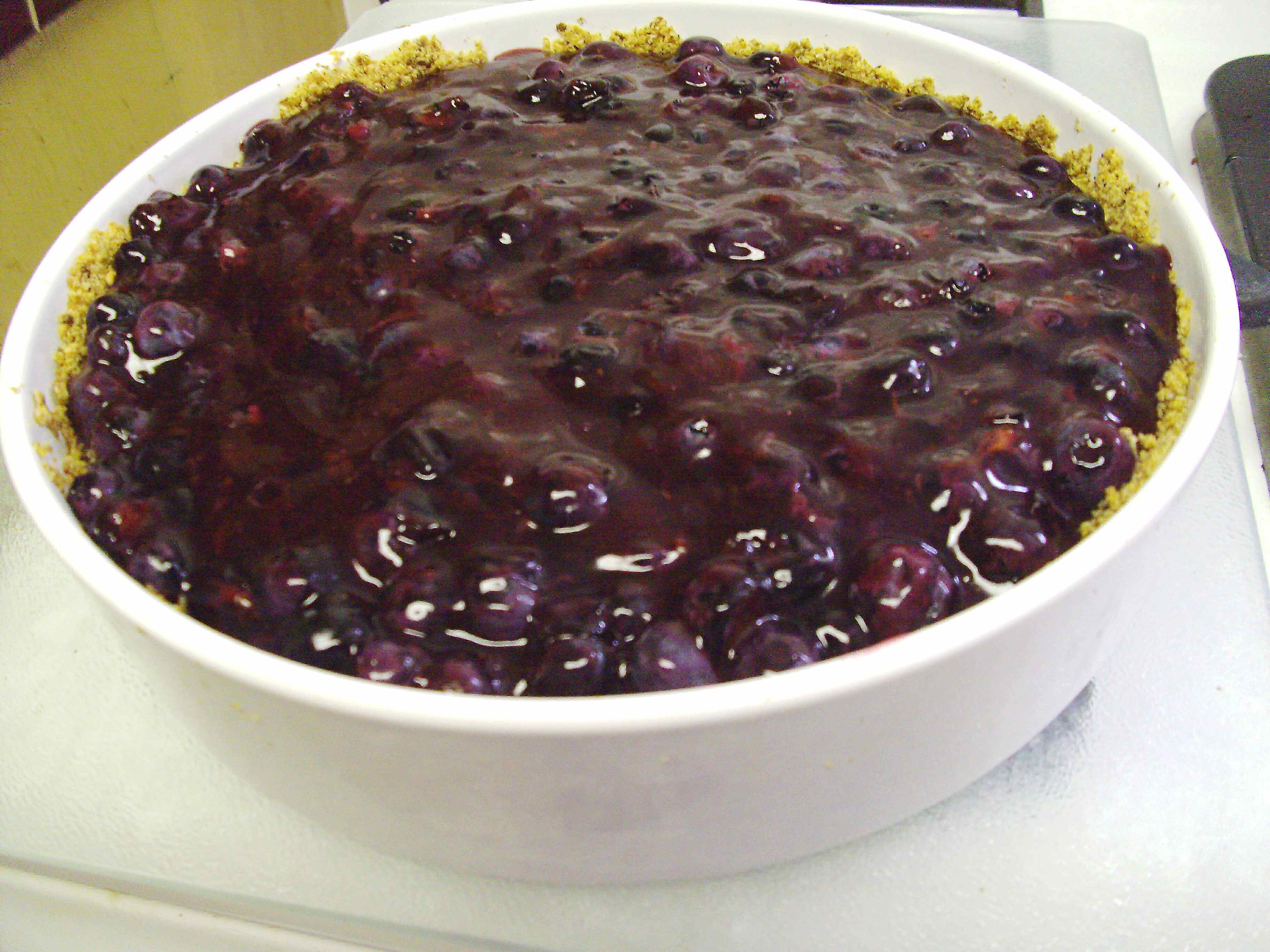
    raw blueberry pie with microwaveable filling and graham cracker crust

    This mostly-raw blueberry pie is a snap to make and very versatile--the filling microwaves in a few minutes, and you don't even have to bake the zippy gingered graham cracker crust--perfect for a hot Fourth of July and all summer long.

  • Recent Posts

  • Contents

  • Archives

  • Now Reading

  • See also my Book Reviews

  • Copyright 2008-2024Slow Food Fast. All writing and images on this blog unless otherwise attributed or set in quotes are the sole property of Slow Food Fast. Please contact DebbieN via the comments form for permissions before reprinting or reproducing any of the material on this blog.

  • ADS AND AFFILIATE LINKS

  • I may post affiliate links to books and movies that I personally review and recommend. Currently I favor Alibris and Vroman's, our terrific and venerable (now past the century mark!) independent bookstore in Pasadena. Or go to your local library--and make sure to support them with actual donations, not just overdue fines (ahem!), because your state probably has cut their budget and hours. Again.

  • In keeping with the disclaimer below, I DO NOT endorse, profit from, or recommend any medications, health treatments, commercial diet plans, supplements or any other such products.

  • DISCLAIMER

  • SlowFoodFast sometimes addresses general public health topics related to nutrition, heart disease, blood pressure, and diabetes. Because this is a blog with a personal point of view, my health and food politics entries often include my opinions on the trends I see, and I try to be as blatant as possible about that. None of these articles should be construed as specific medical advice for an individual case. I do try to keep to findings from well-vetted research sources and large, well-controlled studies, and I try not to sensationalize the science (though if they actually come up with a real cure for Type I diabetes in the next couple of years, I'm gonna be dancing in the streets with a hat that would put Carmen Miranda to shame. Consider yourself warned).

AbFab Mousse au Chocolat: lighter, faster, and still incredibly rich

The Daring Duo–back and brasher than ever in an Alexis Bittar jewelry ad from a couple of years ago. I don’t remember which mag I tore it out of, but who cares? It’s Valentine’s Day, Sweetie, so bling it on!

Preface: Usually I’m at least a couple of days late discussing anything related to New Year’s, Valentine’s Day, or pretty much any celebration involving dessert. Partly because the January and February months–and into maybe April–are always the ones where people struggle to recover from the big food holidays. And obviously it’s been harder on most of us to feel buoyant, celebratory or romantic these past two years. But I worked really hard all last fall writing interviews and moderating high-profile author events for a book festival, then doing and redoing flights for my daughter, who graduated early but her travel program fell through at the last minute. This much later I’m still feeling pretty chewed up and in need of a reward… And my husband has a badly mis-scheduled board meeting tonight and thinks he shouldn’t be the first to bail.

So I don’t know about you, but I’ve decided I could use a kick right about now, something uplifting and energizing and frankly decadent, but without having to work hard now or pay the piper afterward. Something like all the Valentine’s Day-themed chocolate mousse recipes everyone’s starting to trot out in food media, only a lot faster, less bloated and more chocolate-powered, and–of course!–made mostly in the microwave. If I get heart palpitations I want it to be from exhilaration, not indigestion or overwork.

Even though it’s already 3:37 pm here and probably too late to help you much if you’re stuck on a Valentine’s Deadline on the east coast. Go with plain 5-minute ganache instead–and some champagne for tonight, and save this one for the weekend instead–if it’s the real deal, your romance or at least the shopping hijinks you want to get up to will still be there.

I actually came up with this recipe way back in August, as a distraction from my book festival duties, but really–who wants to be thinking about chocolate mousse in August? So I decided to save it for now, when it will do the most good. Or bad, because I’ve been good way too long. And then I came across not only Season 1 but also a book of the published original AbFab scripts. It was practically kismet, I’m telling you! So–pardon my excess while I find some bling to get into character...
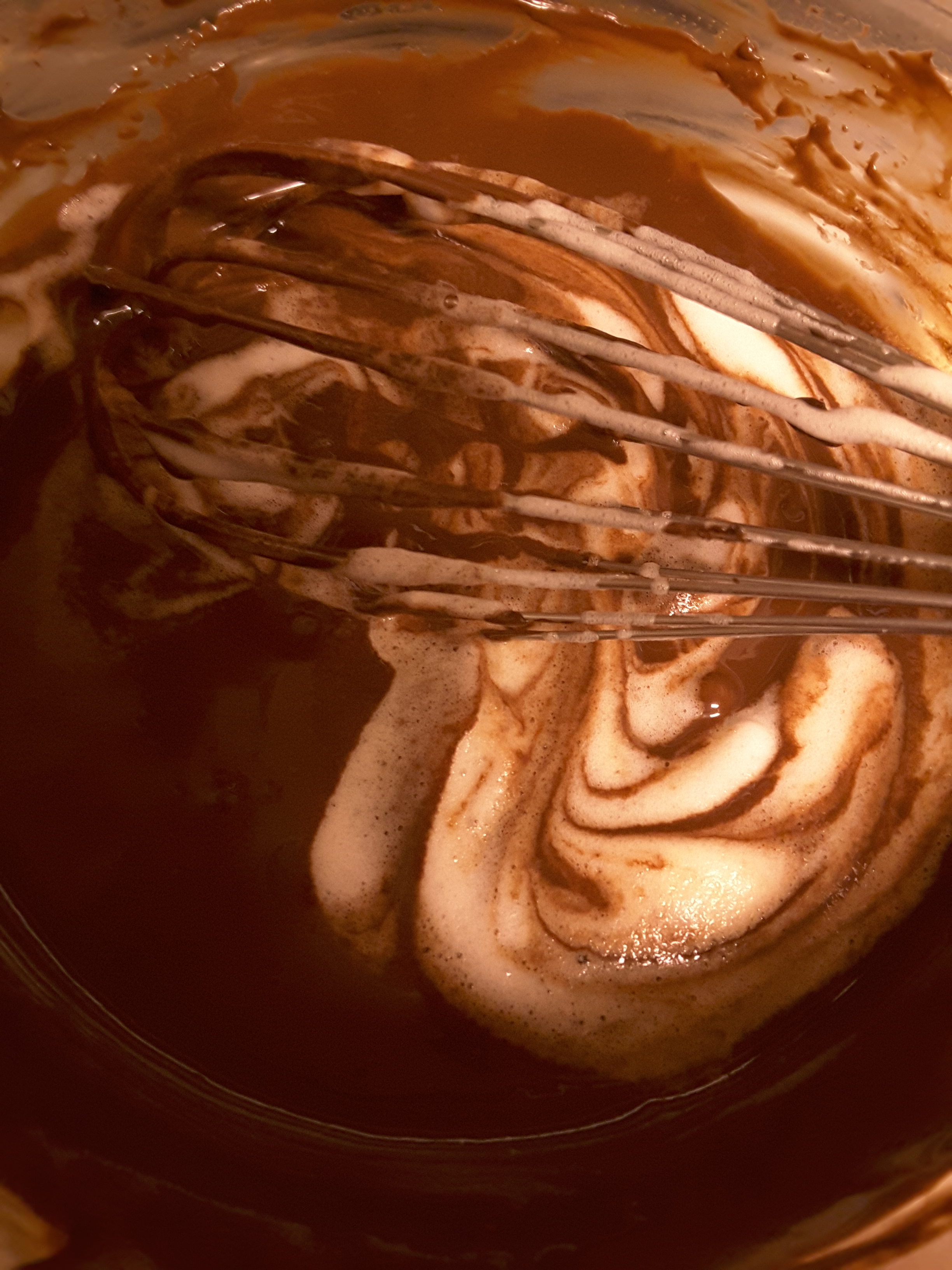
Folding beaten egg whites into the microwaved chocolate base for a lightened-up chocolate mousse.
Mousse au chocolat, Sweetie! It’s what microwaves are for!

THIS IS NOT your typical Meilleurs Oeuvriers de France high-concept mousse au chocolat. It’s not Hervé This, it’s not Pierre Hermé, it’s not Thomas Keller or Dominique Ancel. It’s not even the utter classic back-of-the-French-chocolate-bar-wrapper version that Dorie Greenspan quotes–and so, for that matter, does Alice Medrich. No name-dropping at all here (who, Moi?). Or at least no hyperlinks.

Just a tribute to a pair of troublemaking women who don’t cook at all, as far as I can tell, and a good thing too. But they aspire to everything this mousse is about–taste, time, fortune and fame, fashion superiority, basic naughtiness, and above all, a good time on a plate with no regrets the next morning.

So this is my take in honor of Absolutely Fabulous. It is very, VERY chocolate. And chic, despite my iffy photography and food styling abilities. And yet reasonably svelte. It will leave you quivering and swooning where you stand. This is what it’s all about, Sweetie.

Despite the fact that there’s no butter. No cream. And no crap. It’s not a heart attack in a tiny coupe (it only tastes like it, and maybe feels like it due to the high chocolate content). It’s not 450 calories and a day’s worth of saturated fat that goes right from your gallbladder to your hips, bypassing the heart as a lost cause.

You will not need to struggle into a larger pair of jeans [Season 1, Episode 2] after eating this, even if you manage to eat an entire quarter of it in one sitting without tottering to the couch and wishing you hadn’t and that you’d listened to me about Less being the New More.

This mousse au chocolat is so intense that even a spoonful or two is Almost a Religious Experience. At least if you’ve been fully vaccinated, you’ve been masking up (fashionably, as in, “LaCroix, Sweetie. La. Croix.“) instead of threatening your local chocolate purveyors and flight attendants, and thus your tastebuds still have their mojo. Because as everyone knows, breathing privileges and, just as important, flying privileges, are key to powershopping [Absolutely Special, aka AbFab in New York].

Once you recover from the chocolate rush, you will fan yourself, sip your bitter demitasse and your bottle of overpriced springwater, and leave the premises refreshed, overhyped and ready to shop for something sparkly as illustrated above–either completely garish, overpriced and pulled right from the runways with the tags still on…or, and we hope this is you, effortlessly elegant and sleek and elusively cool and yet still somehow totally rock ‘n’ roll, depending on whether you’re identifying with your inner Eddie or your inner Pats at the moment.

You will feel entitled, because the heady combination of making something like this mousse au chocolat mostly in the microwave, eating a petite portion in tiny refined bites and still being overwhelmed by the utter chocolatude of it all, without fearing the scale or the mirror the next morning, is the holy grail for those of us who worry secretly that we can’t really have it all.

Pardon me, I think Bvlgari is calling my name…

PS–EULA/legal disclaimer: the Management takes no responsibility for the shocking next-day surprise jewelry / footwear / custom marble courtyard sculpture bills you may have racked up in the heat of the moment. Or the return shipping and restock fees thereof.

PPS~~ ~~ THE ACTUAL FINE PRINT, ahem! ~~ ~~

Now…I did claim in the headline that this recipe is “faster” as well as lighter. And that’s…almost true. The key question is, compared to what? Because however you make chocolate mousse, you will have to give it several hours and preferably overnight in the fridge to set up properly. The only ones that set up in much less time contain either enough hard fats to solidify in an hour or so, which they will also do to your arteries, or else enough questionable fillers and thickeners to turn what should be an ethereal chocolate experience into dull, heavy American commercial chocolate pudding.

Part of the intrigue of chocolate mousse is the depth of flavor, but the other part is the texture. Getting it right is a little, though only a little, tricky to achieve with a significantly lighter reduced-fat, reduced-waistline version like this one.

My first attempt was almost right, and definitely fast, and really, really, really–I thought it would rock the first time out of the gate. It almost did. And of course I wish it had, because it would have been completely revolutionary.

I started with microwave ganache, amped up with cocoa powder to sub in for some of the bar chocolate–easy enough. Then I pivoted to microwave custard, easy and superfast, by dropping the egg yolks into the hot ganache and whisking and renuking immediately. So far, so good–thick, rich, smelling beautiful, and with the heat you’re reasonably well covered on the matter of egg safety. Do the same by folding in the beaten egg whites into the hot custard, I thought, waiting a minute and then rapid-cooling in an ice bath, and maybe you don’t have to use prepasteurized egg whites, which are more expensive, or else make a Swiss meringue. About five minutes from start to finish, no chaser, no waste, would be–Absolutely Fabulous. Wouldn’t it? and only two bowls plus the ice bath and a whisk.

I even went so far as to grate a bit of organic orange peel into the egg whites at the last. The dream and the taste–both divine.

The setup in the fridge wasn’t quite there, though, even the next day. It came out a little looser than I wanted, and the ethereal quality of chocolate mousse went slightly missing. Folding stiff egg whites into freshly hot custard had probably killed any risk of salmonella, but it also deflated the structure considerably after a while. It wasn’t completely stable in the fridge–so I froze it for a gelato, which was pretty good, actually, but it wasn’t mousse.

My second try was fussier–I did the near-Swiss meringue method Alice Medrich has used for pasteurizing egg whites, beating them with a spoonful of water and an extra tablespoon of sugar in a bowl over a skillet of simmering water to sterilize and stabilize them, and I also added a spoonful of cornstarch to the chocolate mixture–I know! not traditional!–but I had to test and find out. Would it work or would it end up tasting and textured like chocolate pudding?

This time the mousse stayed puffed beyond a doubt, and the next morning it had firmed up just enough to scoop and stay scooped. It was definitely chocolate mousse, though, not chocolate pudding–the bit of cornstarch hadn’t overdone it. A small test sample–the size of an egg, or maybe something you’d serve in shotglasses at a buffet–was really enough, too. Every millimeter of it was so intensely chocolate that it actually took me a few minutes to finish it in tiny, gelato spoon-style tastes, and I wasn’t automatically reaching for more. A little, or at least a little at a time, goes a very long way here–good news on the svelte front–and makes a big impression in a small cup, especially at the end of a meal.

Continue reading

Waste not: food documentaries, recycled

“Wasted” is an upcoming Huntington Library event that costs nearly $100 for members. They’ll be showing the 2017 Rockefeller Foundation-sponsored food waste/ecoresponsibility documentary of the same name (featuring executive producer Anthony Bourdain, with Dan Barber of Blue Hill, Danny Bowien, Mario Batali and various other chefly friends, though none of those guys are slated to show up in person at the event). Plus local/LA top chefs demonstrating gourmet-ish fun things to do with the parts of vegetables and herbs we normally throw away. A lot of them seem to involve cocktails.

I couldn’t quite put my finger on why that rang hollow, or at least kind of shallow. Much as I love the Huntington, I’m not going to be blowing a hundred bucks any day soon just to screen a Netflix doc from last year at a posh drinks event. I’m not a hipster, I’m barely capable of a glass of wine, so hard drinks are out, and my kid is heading off to college on the other coast in the fall, so I’m feeling poor-ish in anticipation.  But I was kind of curious to see what was in the film.

I went online and then to my local film-heavy libraries (this is the LA metro area) to see if I could screen Wasted in full for free. I tend to be crabby and skeptical of anything glib, or as Bourdain puts it, “smug.” But I was prepared to find something worthwhile in it–I enjoyed Kitchen Confidential when it came out. As much as I pick on him for gonzo style, I have liked various of Bourdain’s interviews and essays since for their attempt at consciousness-raising on life and food availability issues in other countries.

The issues raised in the movie itself are pretty serious: America discards about 40 percent of its total food production, 160-plus billion dollars a year worth, into landfills (and generating a lot of methane gas through anaerobic breakdown, which apparently doesn’t occur if you compost properly). At the same time, nearly 1/7th of the people in this country have food insecurity–they go hungry. And the causes aren’t even buying a head of broccoli with best intentions and letting it sit in the vegetable bin for too long. They’re mostly issues of transportation cost, supermarket dumping past the sell-by dates, fear of lawsuits if the food’s donated instead, and imperfect-looking produce. It’s a national shame. Shots of poverty around the world, a claim, possibly justified, linking our waste of grain products in America and Europe to shortages in India and elsewhere, literally taking food out of their mouths. So far, picturesque and righteously thought-provoking.

The film’s positive side also starts out promisingly enough: a Greek yogurt processing plant in Tennessee diverts the excess whey, which is full of sugars, to a fermentation vat where it produces methane gas in a closed-loop system. The methane generated powers the entire production line. Clever, frugal, reasonably clean energy, at least in this controlled context, keeps some of the waste out of the municipal wastewater, and it’s about Greek yogurt.

Leftover and discarded sandwich bread–an awful lot of it, primarily end pieces from loaves used in sandwich-packaging factories–is being reclaimed and used creatively in the UK as the base grain for “Toast” ale and a similar beer (perhaps the same brand?) is now available in the US at Whole Foods stores (of course). We quickly sense a theme here.

In fact, Wasted’s approach to a dirty and complicated topic is surprisingly clean-hands compared with most other films and books that address food waste and hunger.

The live coverage and interviews are shot in-studio, in the restaurants, in the high-level, high-tech, high-ideals startups. A lot of footage is devoted to what great, cool and innovative things you can do for high-end, gourmet niche products if you’re creative with vegetable trimmings and give the less-familiar “garbage” fish a fancy Latin name and a place on your menu alongside the tuna steaks and branzino.

The global poverty and waste discussions you expect to give the film its depth are nearly all voice-overs (mostly Bourdain’s) with statistics, animations, and quick flashes of exotic scenery for illustration. These are things you don’t notice right away, perhaps not until afterward. But this divide starts to explain why I felt such a disconnect between the supposed message and the actual focal points of the film. Continue reading

Breaking the Rules: Fish with Red Wine

tilapia fillets Veracruz-style, with smoky salsa, onions, garlic, alfonso olives, red wine and fresh za'atar or "wild thyme"

One way to cook fish well using red wine

Wine is something I drink mostly for taste, not volume–I can’t really hack a lot of alcohol at once, blame my ancestors–but I do like wine tastings, even though I have to limit myself to about three small sips per glass if I don’t want to wobble out the winery door. Focusing on the flavors in a wine, and comparing several side by side, sharpens your palate and makes you think very specifically about what you’re experiencing. It’s rewarding even for someone with my drinking limits.

I also like to cook with wine, maybe more often than I like to drink much of it. Decent wine has such a complex combination of flavors that when you figure out how to do it well, cooking with wine can make even rapidly cooked dishes come off like serious Slow Food.

We hear a lot about long-cooking stews and coq au vin and so on, but many simpler and less time-consuming dishes benefit from smaller amounts of wine. Adding a couple of spoonfuls of dry white wine to mustard vinaigrette tempers the sourness, the garlic and the mustard sharpness a little and gives the sauce a quiet depth. And if my experiment with giant favas marinated in rosé and rosemary was any indication, we should be thinking about wine a lot more often and a lot more creatively as a cooking ingredient.

So I’ve been on the lookout lately for clear and simple techniques for cooking with wine without wasting it, and for doing it in less than a three-hour stew, because to me that’s slow-food-slow in large crowd-feeding quantities, to be attempted a maximum of once a year. I want better, more sophisticated-tasting food fast, using at most half a cup to a cup of wine, not a whole bottle, and preferably without huge cleanup.

But these days, when so much of the cookbook aisle in your local independent bookstore is taken over by Food Network Channel collateral, cooking with wine is almost a lost art. Most of the popular TV chefs aren’t even doing it anymore. Everyone’s gone sorta-Asian (but without Martin Yan’s shaoxing wine-wielding expertise or sense of humor) or sorta-Middle Eastern or bacon-filled-Tex/Mex or wishful-thinking-Indian-or-Moroccan wannabe (if I hear the words “ras el hanout” mispronounced one more time by any TV chef, anywhere…)

Most of those cuisines don’t include wine as a regular ingredient because of religious restrictions against alcohol, which I fully respect, or, in the Tex/Mex case, because wine doesn’t go with football (the true religion of Texas, although if you see the documentary Somm, you might be surprised at how many American master sommeliers and exam candidates are former football players.)

The new vegan and vegetarian cookbooks don’t consider wine at all, as far as I can tell, even though there are plenty of  vegan-approved wines and organic wines touted throughout Whole Foods (and even a few at Trader Joe’s). And a number of seitan and bean or lentil dishes (and certainly Roman-style lentil soup) would probably do all the better for a tinge of red, white, or rosé, either in the sauce or as a marinade ingredient.

Even the French- and Italian-trained chefs don’t use wine on TV very much, and if they do they don’t really explain it–why they chose that particular type of wine, how much to use and why, how to get the best flavor out of it in the dish, what else you could make using the same technique. Or else they’re kind of wasteful about it, using a whole bottle of wine for a single dish. Most people cooking for themselves would balk at that. Should balk at that.

It bothers me that I don’t actually see a lot of solid advice about cooking with wine, or at least not specific techniques that make sense in a home kitchen with a standard family budget.

Where am I going to get this advice? Not from the churn-a-minute Food Network chefs, clearly. Not from Harold McGee, either. To my great surprise, he devotes a total of about three paragraphs to “cooking with alcohol” in his food science books. The most interesting thing he says, other than to make sure and boil out the alcohol (duh) is that tannins will concentrate unpleasantly if you boil down a tannic red wine, but adding a protein to pick them up will tame them.

But since most of my uses for wine so far are to do with fish, I guess I’m already doing that…

As you might expect from some of my odd microwave-centric ideas, I tend to cook fish with wine in ways that probably seem unorthodox to anyone professional. For one thing, I cook several kinds of fish with red wine (sound of Francophile traditionalists screaming, then fainting in shock). Continue reading

Instant Pickles, Hold the Salt

Fast-marinated cucumbers, half-sour kosher dill style

One of the things that kept me motivated for blogging SlowFoodFast after the first fine careless rapture was my indignation at how popular over-the-top salting was becoming in popular food magazines, cookbooks, blogs and TV shows as chefs became celebrities, and how dangerous I knew it was for most people to eat that way regularly. A large part of my career a couple of decades ago was exploring the history of dietary sodium in cardiovascular research and writing about the DASH Diet.

What I’ve missed the past few years is just how many people, particularly younger ones, are starting to take up the challenge of cooking low-sodium and blog about their trials and successes. There’s a whole community out there, and they’re cooking pretty well. It is definitely possible, and generally easy once you get past the “how do I read a label and cook from scratch” aspect.

I just ran into Sodium Girl (aka Jessica Goldman Foung)’s blog-based cookbook, “Sodium Girl’s Limitless Low-Sodium Cookbook”. Diagnosed with lupus and kidney failure in her early 20s, she turned around her diet by dropping her sodium intake drastically to give her kidneys a rest in the hope they’d regenerate, and it worked. She’s been innovating with low- and near-to-no-sodium versions of favorite foods ever since, working with the National Kidney Foundation and other organizations. Her book, like her blog, is attractively photographed, full of cheerful writing and surprise takes on favorite foods.

One of the substitutions she makes that I have to approve of is a molasses-and-vinegar-based “faux soy sauce”. So I wasn’t the only one!

Another of her successful experiments is pickles. She goes for sugar-and-vinegar-style pickles, which makes sense, since they have no added salt in them, but I can’t help it–I have always cringed at sweet pickled anything. If it’s supposed to be a pickle, for my money, it’s gotta be a half-sour kosher dill and nothing but (or else an Indian lime or mango achaar pickle, or Moroccan preserved lemons, but that’s another story and still pretty high-salt at this writing. I’m working on it, but not yet holding out a lot of hope…)

Anyway, looking through Foung’s book reminded me of a simple, hearty and low-to-very low sodium version of my favorite pickles in the world. Continue reading

Leftover Logic

Two weeks ago The Guardian‘s business section published the following salvo against glam-food waste: “Food’s latest hot trend: leftovers”. Some of the interviewed chefs, who grew up eating leftovers in the ’70s, have apparently joined forces with the Women’s Institute in York (shades of “Calendar Girls” and Helen Mirren’s shaky attempt at a Yorkshire accent) for a project to reduce food waste as supermarket prices continue to rise and rise.

Some interesting quotes in the article, and interesting questions on frugality–the columnist claims household food waste is down about 13 percent in the UK since last year, which is pretty telling about the economy. She and the people she quotes attribute the current lack of knowledge on how to use leftovers to a sharp decline in cooking skills that coincides with the surging popularity of perfect, coffee-table-worthy food fantasy cookbooks.

Is it really the fault of photo-heavy cookbooks, food magazines, blogs and tv cooking shows that only perfect produce makes the cut, and everything with a blemish on it must automatically be thrown out? Possibly…but the article also cites another trend–the heavy push of boxed microwave-meals-for-one that leads so many people to fear cooking and believe they could never be talented enough to cook from scratch.

Of course, if you never touch an uncooked bulk vegetable or a piece of raw meat, you never risk making a mistake in the kitchen. But the other side of the coin is that the produce in the magazines will never show up on your table. Because the frozen tv dinners really don’t come out looking or tasting as good as the pictures in the magazines.

If you do cook, the idea of using up what you have in the fridge can be nearly as daunting as having to pay for fabulous (and expensive) first-rate pre-sorted extra-polished pre-cut vegetables. In a branded bag. Can you eat less-than-perfect-condition food mag-quality decorator vegetables and still be safe?

Yes, you can. Obviously, when you go to buy vegetables, you want the best and freshest ones you can get for a reasonable price. Nothing you buy should be leaking or moldy or worm-ridden or otherwise clearly spoiled. But short of that, quite a lot of produce can be eaten just fine without having to be picture-perfect.

No one in the professional or amateur food enthusiast world ever talks about how to handle imperfect, wrinkled or slightly old vegetables, but they should. Because no matter how they look when you buy them, if you actually buy enough vegetables and enough variety for a week, some of your produce is going to start drying out or going a little less crisp or whatever in the later days. And you don’t necessarily need to throw it out because of that. Most of it you can probably still use and it will still be fine.

Local corner greengrocers often sell the oversized, undersized, riper or otherwise less-perfect-looking vegetables for a fraction of what they go for in big chain supermarkets. Customers at my local Armenian grocery routinely stagger out with huge bags of red peppers, onions, green beans, cabbages, eggplants, zucchini…all at a dollar a pound or less. Probably most of those vegetables are less than shiny-perfect. It doesn’t matter. The customers who lug them home are going to cook them up in large batches and short of actual spoilage, they’ll use them up.

And I myself did it today–foraged around in the fridge for the eggplants I bought last week. They were just starting to show brown dimples at the flower end. Not lovely but not a disaster. Then I found the less-than-great winter Roma tomatoes, a few of which were already starting to show little smudges of black at the stem ends because I’d had to store them in the fridge–no room on the counter, and I had them in a plastic bag that kept the moisture in more than was really good for them. Damn! I weeded out two that were clearly beyond saving–cracked and leaking slightly, not good–and took the others out to inspect. How bad were they?

Now the eggplants were only a little bruised or dimpled in a few places. Peeling off a little of the skin at those points revealed that the flesh inside was still okay. No worse than a bruised apple. Cut them up, microwave them, drain off the juices and fry them for eggplant-and-chickpea stew, and they’re just fine.

The tomatoes are a little scarier, no question. No one wants mold on their vegetables. But except for showing the tiny beginnings of mold at the stem ends, the six tomatoes I had left seemed fine and firm, dry and uncracked. Throw out six tomatoes at this time of year? I decided not to. I washed them carefully on the theory that the peel, if it’s unbroken, is working hard to seal out dirt and contamination and any mold spores on the surface can therefore be washed off. I sliced off the tops about half an inch below the stem ends–giving them a margin of safety at least in my mind.  Then I dared to taste a bit of the tomato below that. Also fine–or as fine as winter tomatoes get, anyhow. No sight, smell or taste of bitterness anywhere, and not mushy or discolored, and they tasted reasonably fresh. So I cut up the tomatoes and put them in the stew.

And everything was fine, and no one got sick or started convulsing (or screeching at the top of their larynxes) like Robert Plant at the height of his Led Zep days. This was fortunate, because we don’t yet have the larynxes back in shape after Losangelitis week, not to mention the stomach muscles, the tight jeans (well, the jeans are a little tight but not on purpose–we’re workin’ on it! hate those sit-ups) or the massive and tossable hairdo. Then again, neither does Robert Plant these days. So I don’t feel that bad about it. And neither should you.

What she said

I’m shocked, shocked I tell you. I’m about to admire and recommend an article by LV Anderson of Slate.com.

Against foodies: Alison Pearlman’s Smart Casual reviewed

Yes. LV Anderson, the Slate columnist/editor of “You’re Doing It Wrong” infamy, the one who so often makes unnecessary, fussy, time-consuming and sometimes even adverse recommendations for how to “fix” some fairly common and popular foods like chili or muffins. Or guacamole. I’ve disrespected quite a number of her columns over the past year or two, and so have many Slate readers.

But her review of local (LAish) professor Alison Pearlman’s new book on the shallowness of foodieism is really good. It’s thoughtful, sharp and thorough without being annoying.

Anderson has clearly been stuck in an awkward niche for a year or more; her cooking tips are not much to write home about but her book review is, so I’m doing it.

More “breathable foods” weirdness

A couple of days ago, Entertainment Tonight posted a new video tidbit on “breathable” food  from the same Harvard professor, David Edwards, who invented the AeroShot “breathable caffeine” cartridge that has drawn some serious FDA attention of the negative sort.

ET’s anchor breathlessly posed the  question, could this become The Next New Diet Fad in Southern California, when what the LeWhaf vaporizer was invented for was the “aesthetic experience” of breathing food flavors. This according to Edwards, whose Paris-based design lab, Le Laboratoire (names aren’t really his thing?) offers a number of vaporized cocktails at a small sit-down bar.

When I wrote about the first set of inventions, I said I thought it might be an interesting molecular gastronomy-style taste experiment (at least if the flavors were something more sophisticated than “lime,” the flavoring in the AeroShot cartridge), depending on what was being used to create and propel the vapor.

The ET video presents an interview with a young up-and-coming chef who’s offering cocktails of various kinds served in the Le Whaf vaporizers–to be inhaled through a special straw. The accompanying visual looks, frankly, like someone about to use a bong or snort a line of coke, but that could just be the way ET’s camera crew are used to shooting bar scenes…

The chef they interviewed doesn’t serve these vaporized cocktails, not all of which are standard drinks in the daily repertoire (some of them look like beef broth) as a low-cal diet offering but rather as a sideline to enhance some other dish. Very molecular gastronomy. Still he concedes, when pushed, that he can’t see how it would have calories.

(From his doubtful expression, they must have edited out the part where the Barbie Doll reporter shoved a mike in his face repeatedly and insisted with desperation that the vapor must make it calorie-free, it just MUST. She’s the one who tried the AeroShot caffeine spritzer on-camera in the studio to demonstrate the concept, and quickly uttered the dutiful “Mmmm”,  but the video jumped at that point, so I wonder if she really sampled it or not. At least she didn’t start coughing…unless they cut that part too…)

And yet I wonder if ET hasn’t hit on something here–no, not the diet fad. One can’t live on pâté-flavored air alone. One must also vaporize some champagne to go with it, preferably Krug. Could possibly clog the nozzles otherwise.

No. In the frenzy to discover the new French technology that magically removes all calories, ET seems to have let the chef describe the mechanism at the bottom of the vaporizer. Here you are, at a cocktail bar, leaning over the open mouth of a carafe, straw in mouth, ready to inhale cocktail-flavored vapor…produced, about 12 inches from your face, by three ultrasound probes at the bottom of the carafe. Continue reading

Paula Deen and the diet that bites you back

This week’s “revelation” that Paula Deen, “the Butter Queen” is now a Type II diabetic was a surprise to nearly nobody. Deen, who revealed a harrowing backstory in her memoir of a bootstrapped career in catering, has enjoyed a surprising rise to fame on television. Two weeks ago, following in Emeril Lagasse’s footsteps, she appeared as Grand Marshal for the Rose Parade right here in Pasadena.

Of course, her otherwise ordinary “Southern Cooking” has been exaggerated out of all recognition with extra excess butter and sugar and mayonnaise, and so for years now cads like Anthony Bourdain have called her a scourge on the culinary scene (well, actually, he called her a lot worse than that, but he’s Anthony Bourdain. I’m paraphrasing politely, even though I kind of agree, at least foodwise).

With the revelation that she’s Type II, which everyone knows and fears due to their own increasing girth, Deen is bound to be the butt of predictable jokes this week and next, or until the next big Kardashian “revelation” that newspaper readers apparently care deeply about, or at least they do according to the reality TV networks footing the ad bills. (Even the New York Times has wasted column inches on this kind of drivel this year. Journalistic standards are dropping all over the place, I tell ya.)

But tell the truth, y’all: she ain’t the only one responsible. Not by a long shot. Read any “major” chef’s cookbooks and magazine offerings, other than perhaps those of Nobu, who deals mainly in raw seafood unadorned by carbs or noticeable layers of fat, and you’ll quickly realize that MOST of them exaggerate the salt, sugar and fat content of their dishes well beyond reason. Very few of them deal out plain vegetables on the plate. Very few deal out meats or fish without big sauces.

The other big, big feature stories on food in the New York Times this week:

1. Mark Bittman doing a quasi-deep bankruptcy commentary on Hostess that manages to recount his entire childhood consumption of Twinkies and co. in loving, fine-grained detail. He still attempts to sound self-righteous about it by the end because the ingredients include “ultra-processed flour”.

2. David Tanis of Chez Panisse, waxing lyrical about French lentils (du Puy or Die) as a salad with vinaigrette, hard-boiled eggs (so far, so good), some lettuce and….big fatty slabs of pork belly on top. Five or six of them per plate.

3. “The Miracle of Bo Ssam”–which turns out to be David Chang of Momofuku’s recipe for pork shoulder slathered in salt and brown sugar–twice–and cooked down for six hours in the oven. Caramelized barbecue. In fact, “crack” barbecue, to match Momofuku Milk Bar’s world-famous (to bloggers, anyway) “crack” pie made with most of the same ingredients.

Now people. With all of that going on, with Thomas Keller still boiling his vegetables in brine and poaching his lobster bits in butter, with the Culinary Institute of America instructing its naive young students to salt, salt some more, and salt yet again to achieve that perfect degree of salting in each dish (Coronaries ‘R’ Us), and with Congress sucking its collective thumb about local schools’ move this year to exclude french fries and pizza from the “vegetable” categories in their cafeterias—–

Does anyone really think that Paula Deen is NOT a woman of her time?

She’s nowhere near the worst–she’s just not as fashionable as all the tatted-up young bucks who get picked for Top Chef. She’s also not dishy, like Nigella Lawson, whose cookbooks, which started out about 10-15 years ago emphasizing lighter fare like Vietnamese salads with chiles, have also drifted drastically in the direction of high-calorie “indulgence” foods–some of them utter unmitigated goo-fests (avocado, mayo, roquefort? peanut butter, corn syrup, marshmallow fluff, chocolate bars? puff-pastry chicken pot pies-for-one?). Lawson makes the national news, at least in the UK, when she comes back out in public looking svelte again after puffing up too far past the point where male reviewers are still drooling. Will her next book of recipes slim down commensurately?

Unlike the more fashionable TV chefs on her network, Paula Deen is middle-aged and looks it. She’s fat, she’s gray though beautifully coiffed, she’s politely made up and decently dressed–no orange signature clogs–and she smiles. Maybe a little dippily, but if you didn’t know who she was, Continue reading

DIY Pasta–no chic gadgets needed


handmade pasta, cut for ravioli

A few months ago I was surprised to read an interview with the British actress Emma Thompson–not about her acting, or producing, or screenwriting, or whatever, but about her having acquired a pasta machine so that she and her family could have fresh pasta at home.

What surprised me is that she called it a revelation, or revolutionary, can’t remember which. I think it came up in relation to a short dramatic interpretation of a poem called “Song of the Lunch” that she and Alan Rickman did for the BBC last year. It’s about 20 minutes long, posted on YouTube in sections but in its entirety, and it’s actually not bad, though not as funny about foodieism as “The Trip”. The main thing about it is that it takes place in an Italian restaurant in London. Hence the pasta issue.

Over the course of a misspent youth (which I’m still in, thank you very much) I have tried a number of times to make sheet pasta myself, with varying degrees of success.

  • Buckwheat noodles–grainy and dry. Try this soba recipe instead.
  • Jao tse dough made with flour, salt, and boiling water–a little thick but it worked well enough to boast about
  • Ravioli dough made with half egg, half water (this was a few weeks ago)–grainy, sticky, hard to roll evenly to the right thickness.
  • Yesterday’s classic pasta dough from Marcella Hazan, just flour and eggs–just right. In fact, the only right recipe there is, I’m now convinced.

So of course this post isn’t really revolutionary–I’m about 20 years behind the “Wow, you can make pasta at home” trend. And I refuse to call it “a revelation”, as fresh food that includes actual garlic always seems to be for the British. It’s just that it finally worked, came out pretty well, and wasn’t as hard or as time-consuming as I thought. Take it as read.

I should back up and say I never actually managed to pick up either a proper cranking pasta machine, even though you can sometimes find one at Ross for Less at under $20, or a proper long dowel-style rolling pin, which Hazan deems necessary for hand-rolling. This still worked very well.

Why no pasta crank for the crank? Why no artisan rolling pin? I’m not good about kitchen implements that are hard to store, particularly now that the drawers are out in the garage and the counter space is severely limited. I use an empty wine bottle, the tall hunch-shouldered kind with a long straight barrel and short neck. It stands up in a corner when not in use and doesn’t take up space. I also don’t roll any dough directly, but between two sheets of plastic wrap with a little flour or–my great new discovery, especially for this pasta dough–parchment paper. Works incredibly well, better than the plastic wrap, because it doesn’t wrinkle and stick.

In any case, the one kitchen gadget (other than the microwave, the toaster oven, or the coffee maker) that I’m always willing to give counter space to is my food processor (also not fancy–a $30 Hamilton Beach with a big work bowl, not a $200 Cuisinart).

Because although I’ve watched my share of “Make Your Own Pasta” cooking demos over the years where Mary Ann Esposito or the guest du jour on Julia Child cracks eggs into a well in a bowl of flour and “incorporates them” gradually, I know perfectly well from hard experience that kneading by hand is going to precede rolling out by hand, and that the food processor will make at least one of these ordeals a lot faster and less of a pain. It will also give me a better product. Pasta needs a lot of kneading–8-10 minutes!–to develop the gluten and get it to a smooth uniform texture that will hold when you roll and stretch it very thin.  I’m not that good or that patient. Or at least I wasn’t yesterday.

The rolling is the big thing–you have to get that dough thin enough to the point where you just begin to see through it. You don’t want it breaking, but it really Continue reading

Big Food mobilizes against child marketing guidelines

This Washington Post article isn’t the absolute clearest–looks like it was written as a last-minute rush piece, actually, but it’s worth getting to the end.

The basic idea is that in 2009 Congress demanded the CDC, FDA, USDA and FTC come up with a coherent set of voluntary nutrition guidelines for what the food industry can market directly to kids.

I’m not a big fan of voluntary nutrition or safety compliance guidelines for the food industry–mostly because industry players generally feel free to ignore or toy with them and then claim some kind of advertising advantage they haven’t earned. Voluntary guidelines also come with all kinds of soft landings and easy outs, and the proposed guidelines here are no great exception.

But in any case, now the four agencies have done it, and the food and restaurant industry is doing the predictable–throwing big lobbying bucks into a disinformation campaign-slash-tantrum.

How big? The campaign manager won’t say, but the preliminary guidelines report that US food industry marketing to kids 2-17 years old is currently something over $1 billion in three key categories (breakfast foods, restaurant chain food, and snacks).

So it probably won’t surprise you that companies like General Mills, Kellogg, and Pepsico have teamed up with ad-carrying media partners like Viacom (read: Nickelodeon) and Time Warner to try and quash the voluntary industry guidelines. Figure on the campaign to be spending in the mid-millions or more. They’d rather “salt and burn” instead of “cut the salt and learn.” And what a waste.

What will probably surprise you is just who this coalition–calling itself the “Sensible Food Policy Coalition”–?!!–hired to handle the campaign: Anita Dunn, a former Obama communications director whose husband, Robert Bauer, is  still White House counsel. Not a really lovely mashup, there.

Why she’s taking on the food industry campaign so they can keep protecting their ability to market garbage to the young and vulnerable is one question. Why the FDA and FTC, which have the power to decide what nutritional and medical claims, among other criteria, are valid and can be used in advertisements to adults, let alone kids and teens, are bothering with a voluntary measure instead of doing a proposed regulation to limit such marketing to youth is another.

In both cases, the answer is almost certainly money. The food and media industries have it, the federal agencies don’t.

[As it turns out, the FDA and FTC don’t have power to restrict Big Fo0d’s marketing to the under-17 crowd after all. They lost that specific ability in 1981–start of the Reagan administration… Reagan’s “ketchup is a vegetable” declaration was the beginning for drastically lowered nutritional standards and branded fast food concession contracts for public school lunches.]

So the right question under these circumstances is, where do you want to put YOUR money? How about this, if the federal agencies can’t get a decent result and the lobbies are buying off everyone else:

Boycott the Boxes. Hit ’em where it hurts.

Box 1–TV: If you have kids, limit their access to TV, and teach them to turn off the sound during the ads. Do it yourself. Treat the ads like the silly nuisance they are from the minute your kids are old enough to watch. Tell your kids the truth: most of the products advertised on kids’ shows are too shoddy–and overpriced–to market to grownups. The companies make them bright and loud and cheesy because they think kids can be fooled easier (your kids should be beautifully insulted at that if they’re about six or seven years old).  Go with PBS and videos you approve rather than commercial TV as much as you can.

Box 2–Packaged stuff parading as food: Skip almost everything that comes in a cardboard box or a plastic overwrap, or in a can. You can do this. You’ll save an awful lot of money by buying store brands only and cutting out the most pernicious items–sugared and high-salt packaged breakfast cereals, bags of starchy snack extras, and sodas, at least on an everyday basis. Save sodas and chips for parties, not for school lunch or part of dinner.

You’d do even better to go with fresh vegetables and whole fruits for most snacks and make a good habit for relatively cheap. They taste pretty good, don’t take long to fix, last at least a week in the fridge, and your kids won’t get sick overeating them.

There’s a reason the Pringle’s slogan is the very smug  “Betcha can’t eat just one.” No one says that about carrots or broccoli, or even about apples. Ever eaten too many of those in one sitting? Didn’t think so. Vegetables and whole fruits keep you satisfied longer, don’t hyperstimulate your appetite for snacks, and they don’t put on pounds that take a long time to work back off. They don’t promote cavities, either. Even nonsweet junk foods do–all that processed starchy stuff sticks to your molars like glue.