

• Enter your email address to subscribe to this blog and receive notifications of new posts by email.

    Join 241 other subscribers
  • Noshing on

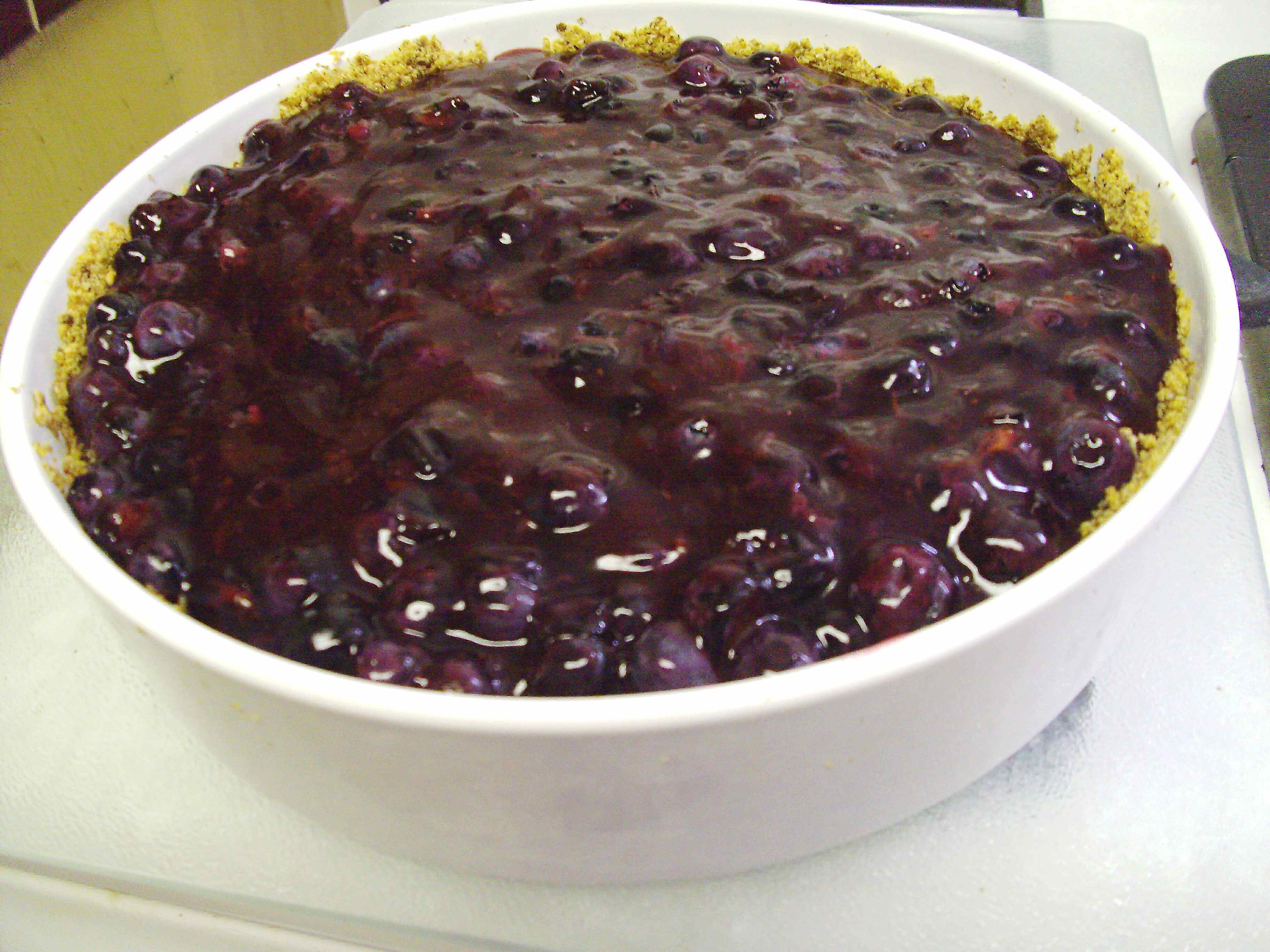
    raw blueberry pie with microwaveable filling and graham cracker crust

    This mostly-raw blueberry pie is a snap to make and very versatile--the filling microwaves in a few minutes, and you don't even have to bake the zippy gingered graham cracker crust--perfect for a hot Fourth of July and all summer long.

  • Recent Posts

  • Contents

  • Archives

  • Now Reading

  • See also my Book Reviews

  • Copyright 2008-2024Slow Food Fast. All writing and images on this blog unless otherwise attributed or set in quotes are the sole property of Slow Food Fast. Please contact DebbieN via the comments form for permissions before reprinting or reproducing any of the material on this blog.

  • ADS AND AFFILIATE LINKS

  • I may post affiliate links to books and movies that I personally review and recommend. Currently I favor Alibris and Vroman's, our terrific and venerable (now past the century mark!) independent bookstore in Pasadena. Or go to your local library--and make sure to support them with actual donations, not just overdue fines (ahem!), because your state probably has cut their budget and hours. Again.

  • In keeping with the disclaimer below, I DO NOT endorse, profit from, or recommend any medications, health treatments, commercial diet plans, supplements or any other such products.

  • DISCLAIMER

  • SlowFoodFast sometimes addresses general public health topics related to nutrition, heart disease, blood pressure, and diabetes. Because this is a blog with a personal point of view, my health and food politics entries often include my opinions on the trends I see, and I try to be as blatant as possible about that. None of these articles should be construed as specific medical advice for an individual case. I do try to keep to findings from well-vetted research sources and large, well-controlled studies, and I try not to sensationalize the science (though if they actually come up with a real cure for Type I diabetes in the next couple of years, I'm gonna be dancing in the streets with a hat that would put Carmen Miranda to shame. Consider yourself warned).

AbFab Mousse au Chocolat: lighter, faster, and still incredibly rich

The Daring Duo–back and brasher than ever in an Alexis Bittar jewelry ad from a couple of years ago. I don’t remember which mag I tore it out of, but who cares? It’s Valentine’s Day, Sweetie, so bling it on!

Preface: Usually I’m at least a couple of days late discussing anything related to New Year’s, Valentine’s Day, or pretty much any celebration involving dessert. Partly because the January and February months–and into maybe April–are always the ones where people struggle to recover from the big food holidays. And obviously it’s been harder on most of us to feel buoyant, celebratory or romantic these past two years. But I worked really hard all last fall writing interviews and moderating high-profile author events for a book festival, then doing and redoing flights for my daughter, who graduated early but her travel program fell through at the last minute. This much later I’m still feeling pretty chewed up and in need of a reward… And my husband has a badly mis-scheduled board meeting tonight and thinks he shouldn’t be the first to bail.

So I don’t know about you, but I’ve decided I could use a kick right about now, something uplifting and energizing and frankly decadent, but without having to work hard now or pay the piper afterward. Something like all the Valentine’s Day-themed chocolate mousse recipes everyone’s starting to trot out in food media, only a lot faster, less bloated and more chocolate-powered, and–of course!–made mostly in the microwave. If I get heart palpitations I want it to be from exhilaration, not indigestion or overwork.

Even though it’s already 3:37 pm here and probably too late to help you much if you’re stuck on a Valentine’s Deadline on the east coast. Go with plain 5-minute ganache instead–and some champagne for tonight, and save this one for the weekend instead–if it’s the real deal, your romance or at least the shopping hijinks you want to get up to will still be there.

I actually came up with this recipe way back in August, as a distraction from my book festival duties, but really–who wants to be thinking about chocolate mousse in August? So I decided to save it for now, when it will do the most good. Or bad, because I’ve been good way too long. And then I came across not only Season 1 but also a book of the published original AbFab scripts. It was practically kismet, I’m telling you! So–pardon my excess while I find some bling to get into character...
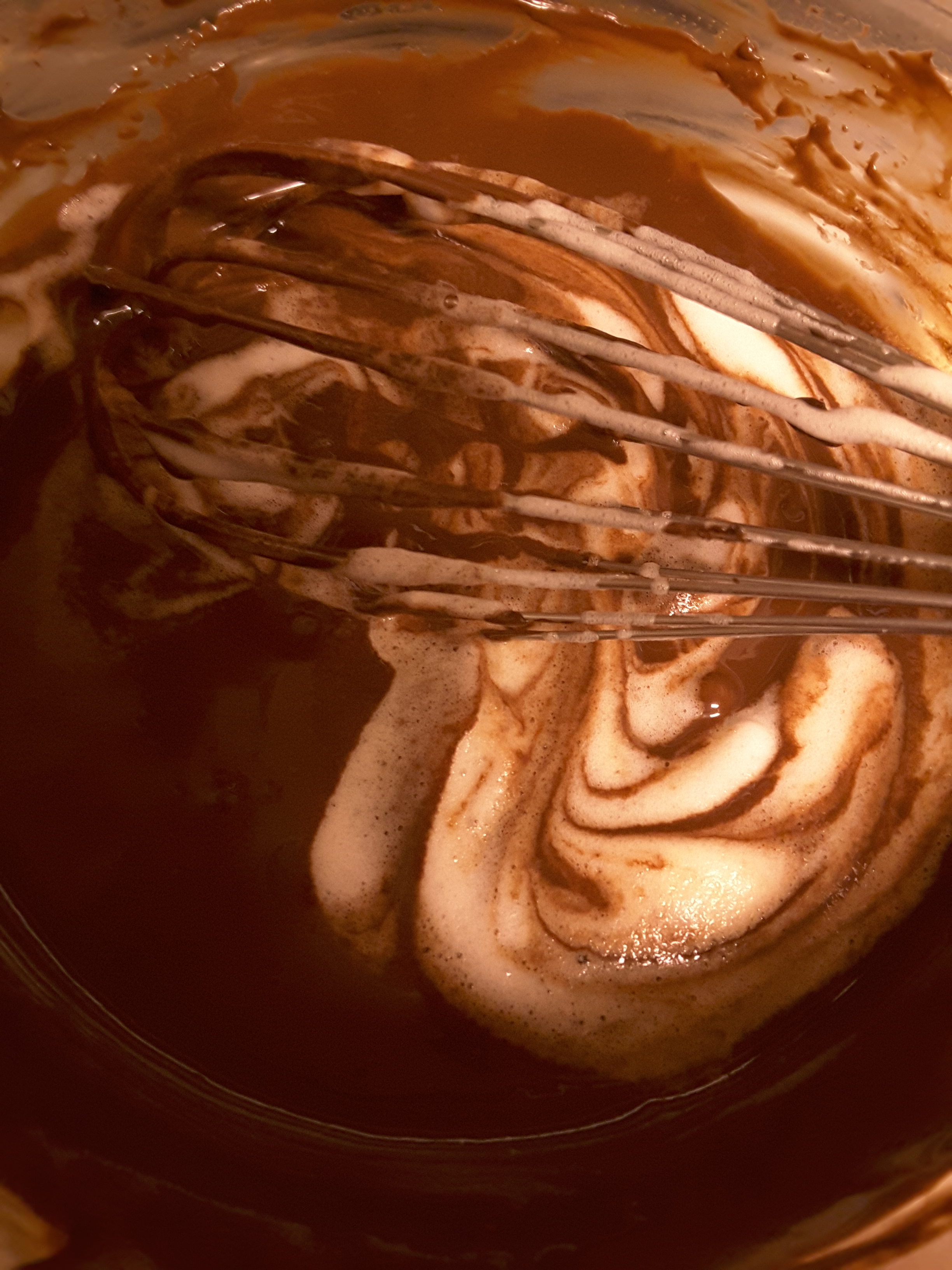
Folding beaten egg whites into the microwaved chocolate base for a lightened-up chocolate mousse.
Mousse au chocolat, Sweetie! It’s what microwaves are for!

THIS IS NOT your typical Meilleurs Oeuvriers de France high-concept mousse au chocolat. It’s not Hervé This, it’s not Pierre Hermé, it’s not Thomas Keller or Dominique Ancel. It’s not even the utter classic back-of-the-French-chocolate-bar-wrapper version that Dorie Greenspan quotes–and so, for that matter, does Alice Medrich. No name-dropping at all here (who, Moi?). Or at least no hyperlinks.

Just a tribute to a pair of troublemaking women who don’t cook at all, as far as I can tell, and a good thing too. But they aspire to everything this mousse is about–taste, time, fortune and fame, fashion superiority, basic naughtiness, and above all, a good time on a plate with no regrets the next morning.

So this is my take in honor of Absolutely Fabulous. It is very, VERY chocolate. And chic, despite my iffy photography and food styling abilities. And yet reasonably svelte. It will leave you quivering and swooning where you stand. This is what it’s all about, Sweetie.

Despite the fact that there’s no butter. No cream. And no crap. It’s not a heart attack in a tiny coupe (it only tastes like it, and maybe feels like it due to the high chocolate content). It’s not 450 calories and a day’s worth of saturated fat that goes right from your gallbladder to your hips, bypassing the heart as a lost cause.

You will not need to struggle into a larger pair of jeans [Season 1, Episode 2] after eating this, even if you manage to eat an entire quarter of it in one sitting without tottering to the couch and wishing you hadn’t and that you’d listened to me about Less being the New More.

This mousse au chocolat is so intense that even a spoonful or two is Almost a Religious Experience. At least if you’ve been fully vaccinated, you’ve been masking up (fashionably, as in, “LaCroix, Sweetie. La. Croix.“) instead of threatening your local chocolate purveyors and flight attendants, and thus your tastebuds still have their mojo. Because as everyone knows, breathing privileges and, just as important, flying privileges, are key to powershopping [Absolutely Special, aka AbFab in New York].

Once you recover from the chocolate rush, you will fan yourself, sip your bitter demitasse and your bottle of overpriced springwater, and leave the premises refreshed, overhyped and ready to shop for something sparkly as illustrated above–either completely garish, overpriced and pulled right from the runways with the tags still on…or, and we hope this is you, effortlessly elegant and sleek and elusively cool and yet still somehow totally rock ‘n’ roll, depending on whether you’re identifying with your inner Eddie or your inner Pats at the moment.

You will feel entitled, because the heady combination of making something like this mousse au chocolat mostly in the microwave, eating a petite portion in tiny refined bites and still being overwhelmed by the utter chocolatude of it all, without fearing the scale or the mirror the next morning, is the holy grail for those of us who worry secretly that we can’t really have it all.

Pardon me, I think Bvlgari is calling my name…

PS–EULA/legal disclaimer: the Management takes no responsibility for the shocking next-day surprise jewelry / footwear / custom marble courtyard sculpture bills you may have racked up in the heat of the moment. Or the return shipping and restock fees thereof.

PPS~~ ~~ THE ACTUAL FINE PRINT, ahem! ~~ ~~

Now…I did claim in the headline that this recipe is “faster” as well as lighter. And that’s…almost true. The key question is, compared to what? Because however you make chocolate mousse, you will have to give it several hours and preferably overnight in the fridge to set up properly. The only ones that set up in much less time contain either enough hard fats to solidify in an hour or so, which they will also do to your arteries, or else enough questionable fillers and thickeners to turn what should be an ethereal chocolate experience into dull, heavy American commercial chocolate pudding.

Part of the intrigue of chocolate mousse is the depth of flavor, but the other part is the texture. Getting it right is a little, though only a little, tricky to achieve with a significantly lighter reduced-fat, reduced-waistline version like this one.

My first attempt was almost right, and definitely fast, and really, really, really–I thought it would rock the first time out of the gate. It almost did. And of course I wish it had, because it would have been completely revolutionary.

I started with microwave ganache, amped up with cocoa powder to sub in for some of the bar chocolate–easy enough. Then I pivoted to microwave custard, easy and superfast, by dropping the egg yolks into the hot ganache and whisking and renuking immediately. So far, so good–thick, rich, smelling beautiful, and with the heat you’re reasonably well covered on the matter of egg safety. Do the same by folding in the beaten egg whites into the hot custard, I thought, waiting a minute and then rapid-cooling in an ice bath, and maybe you don’t have to use prepasteurized egg whites, which are more expensive, or else make a Swiss meringue. About five minutes from start to finish, no chaser, no waste, would be–Absolutely Fabulous. Wouldn’t it? and only two bowls plus the ice bath and a whisk.

I even went so far as to grate a bit of organic orange peel into the egg whites at the last. The dream and the taste–both divine.

The setup in the fridge wasn’t quite there, though, even the next day. It came out a little looser than I wanted, and the ethereal quality of chocolate mousse went slightly missing. Folding stiff egg whites into freshly hot custard had probably killed any risk of salmonella, but it also deflated the structure considerably after a while. It wasn’t completely stable in the fridge–so I froze it for a gelato, which was pretty good, actually, but it wasn’t mousse.

My second try was fussier–I did the near-Swiss meringue method Alice Medrich has used for pasteurizing egg whites, beating them with a spoonful of water and an extra tablespoon of sugar in a bowl over a skillet of simmering water to sterilize and stabilize them, and I also added a spoonful of cornstarch to the chocolate mixture–I know! not traditional!–but I had to test and find out. Would it work or would it end up tasting and textured like chocolate pudding?

This time the mousse stayed puffed beyond a doubt, and the next morning it had firmed up just enough to scoop and stay scooped. It was definitely chocolate mousse, though, not chocolate pudding–the bit of cornstarch hadn’t overdone it. A small test sample–the size of an egg, or maybe something you’d serve in shotglasses at a buffet–was really enough, too. Every millimeter of it was so intensely chocolate that it actually took me a few minutes to finish it in tiny, gelato spoon-style tastes, and I wasn’t automatically reaching for more. A little, or at least a little at a time, goes a very long way here–good news on the svelte front–and makes a big impression in a small cup, especially at the end of a meal.

Continue reading

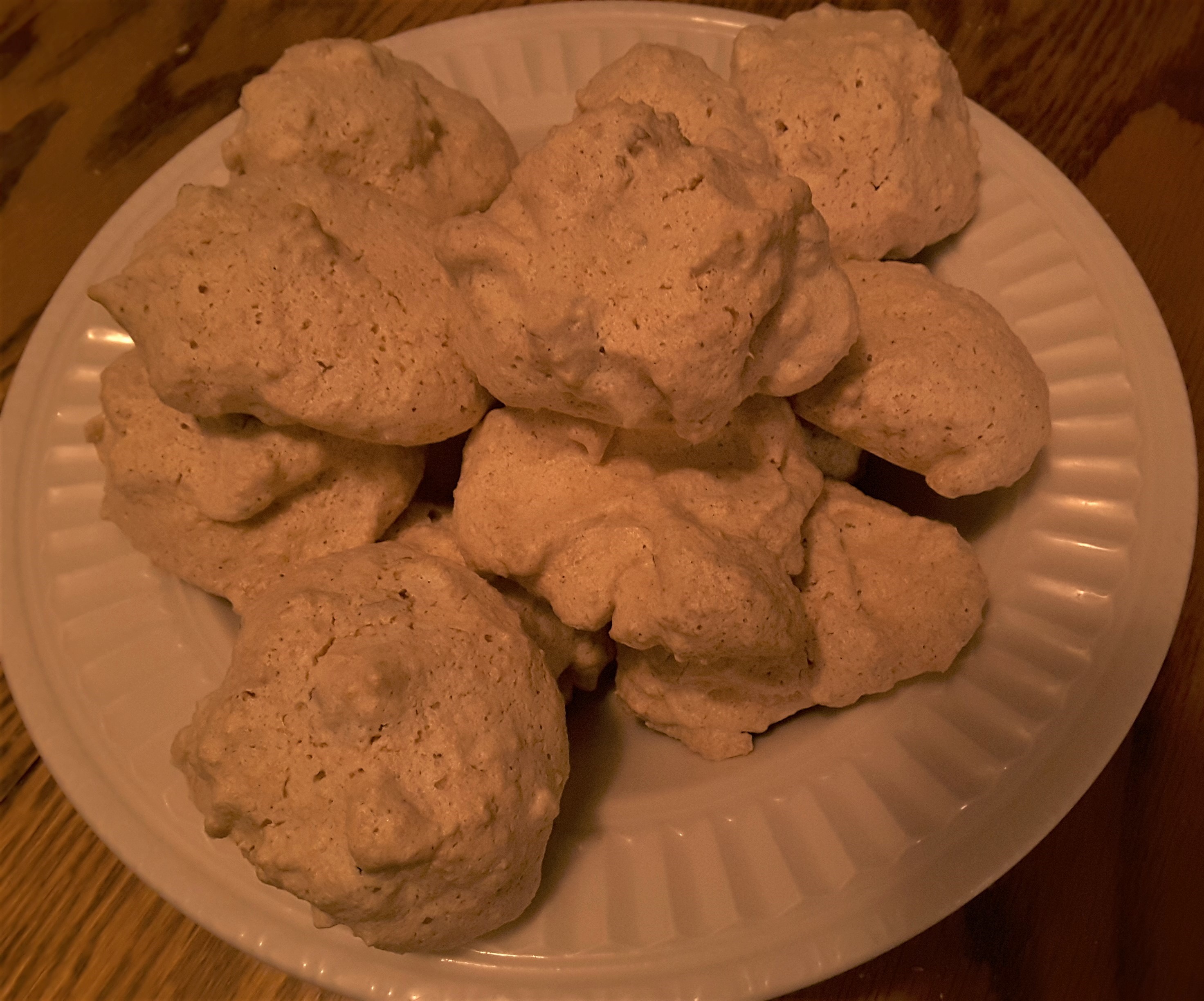
A Lighter Take on Coconut Macaroons

Not really macaroons–or even macarons. These are basically coconut-almond meringues.

Newsflash: I didn’t buy any macaroons this year for Passover. They’re…ok, in very limited quantities, preferably with actual fruit to lighten things up. But they’re so heavy and doughy and overly, throat-burningly sweet, and the cans from the major manufacturers–Manischewitz, Gefen, etc. etc.–all basically taste identical. Worse, they’re designed to feed a whole seder table with in-laws and more in a regular year. This year, with only two 3-D people at our table and not kibbitzing on Zoom, they would just hang around the table all week whether you really want any more or not.

I have made my own coconut macaroons once or twice before, and they came out lighter and better and different, not so packed-down. So this evening before supper I decided to try again. I needed something desserty and light and slightly impressive, at least to myself.

Why? Why in mid-Passover? Because.

Because I signed up for a COVID vaccine today. It’s April 1st, the first day I’ve become eligible in California…and within minutes, my HMO assigned me a slot for tomorrow. Tomorrow! My first reaction was “Ack! Tomorrow?! Wait, I just clicked to see what was listed on that date… I was hoping maybe next week or so, to give me a chance to get used to the idea!”

…I know perfectly well that I am lucky not to have to scramble for a shot, and that there is no real alternative if we want to get through this pandemic and end it. I also know perfectly well that I’m less nervous and more adamant about much less effective vaccines like the annual flu shot. Anything that’s 90+ percent effective is almost unheard-of and nearly a miracle. But a few minutes to get used to the idea would really help…well, I decided, that could start right after hocking my husband to get on and sign up quickly before all of next week’s spots get snatched up. And he did.

So once I calmed down again, because I knew I was being more apprehensive than the situation deserved, I decided to calm down further by trying to make something just tricky enough to keep me focused and not thinking about the shot. Also something that wouldn’t make huge amounts or take a lot of time.

And here’s what came of it–better than I expected. These lightened-up coconut…you can’t really call them macaroons. They’re closer to “macarons,” only with coconut instead of almond meal. Basically, coconut meringues.

Actually, I’ve seen an awful lot of meringues on Passover recipe rosters this year–pavlovas, coffee-tinged meringues, berry swirl meringues, plain ones…all kinds.

But I didn’t really think this was going to be one of them. The first time I made this kind of recipe, it came out like a slightly lighter, sweet-but-not-achingly-sweet version of a coconut macaroon with toasted almond chunks embedded in it. Pretty good, but it turned out tricky to reproduce. The last time I tried it, something weird happened when I folded the coconut into the beaten egg whites and they collapsed. I think it’s because I tried to rehydrate the coconut shreds before adding them. Or maybe I added the sugar all at once and then tried to beat it. Not certain…see, though, this is why this project was going to be slightly tricky and keep me occupied.

Continue reading

Wanted: cooler heads, warmer hearts

…and less inflammatory bloat.

Warning: This is kind of a long make-up post with 3-4 related recipes out of my experiments since April. They’ve been helpful and fairly fast for coping with hot weather and hot tempers, mostly my own.

It’s been a long spring and summer not posting and just trying to get through, and wondering what kind of food post could possibly make up for the mess we’ve seen unfolding in this country.

So my thinking has kept roiling around in the manner of the following rant (much cleaned up):

We have to do better. As a nation, as a people, as individuals and members of our communities, as responsible and worthwhile human beings.

The proof is in the pudding, they say. This is true of both government and cooking. Right now we’re learning the hard way that you get out of it what you put into it. So watch what you put into it, and don’t treat yourself or your country like a garbage can. Prepare to vote like it matters, and in the meantime contribute as best you can to your local public schools’ support organizations to get students in low-income families the food and tech they need during distance learning.

— — —

I can’t help but cook, and usually I like to experiment, but with my husband and daughter suddenly home 24/7 for the past half year (my kid just went back to university across the country), and with temperatures getting up to 100+ some days here, staying creative about food without a lot of excess shopping trips or extensive cooking has meant staying fairly simple and more about fresh produce than about artiness in the kitchen, and maybe just using more herbs–one of the few things I seem to be growing successfully in the backyard. We all could use some shoring up healthwise and flavorwise, with some trimming back after a stressful winter and spring. So I’ve been trying hard to make the veg and fresh fruit more prominent and easier to grab-and-go for self-made lunches, without any of us having to work too hard.

But I have been cooking, and some of it has been good, and a lot of it has been anti-bloat AND good, surprisingly enough.

And it has in fact worked, most impressively for our daughter before she went back east.

So this is worth passing on, especially now: forget the “stress-baking.” Go for basic vegetables and fruit. Seriously. It makes a difference, and it might help lower your health risk, and possibly your food expenses, as well. Maybe even help de-stress.

My daughter came home from university in March seriously stressed out from the shift to online and upended plans. She’d been suffering acid reflux badly enough to be on daily medication, and had to ask me for mild zucchini-type vegetables only for the first couple of weeks home, because tomatoes were too much, and so were the hot peppers she loves.

Being home with us during the shutdowns meant a lot less “student” food, aka greasy takeout with its oversized portions. More beans and lentils and fresh veg and fruit every day. More sleep, more water, more hanging out with friends online or by phone, more socially distanced walks to get a break from us parental units (yay!). By June, she was already in visibly better shape, needing less insulin per day to stay in range, had lost the “freshman 10” from last year without major effort, and possibly (probably?) as a result, she was able to stop taking the acid reflux meds. Just in time for Anaheim peppers and Fresno tomatoes. And Indian food.

(okay, back to food):

For my husband’s birthday this summer, I took requests and ordered celebratory takeout from our favorite restaurant, which has been in Pasadena for over 20 years and just keeps getting better. We’ve only done takeout anywhere a total of three times since the shutdowns, partly because it’s a splurge and partly because the logistics are more nerve-wracking now (were they wearing gloves? were you? do you wipe down the containers? should you nuke them?) You don’t want to know how it went on our first try back in April when the bad news was first ratcheting up. Not at all fun. I vowed to my still-beloveds afterward that we’d do it again and this time I’d be calmer, and just decide ahead how to handle the containers safely.

In any case, by my husband’s birthday, we’d finally got the hang of it enough for us, and there’s no denying that it was delicious. It also inspired a couple of microwave-friendly dishes I plan to pass on to my kid now that she’s back and cooking for herself. Two (well, three) of these dishes are hot, the other frozen, and all are cheap, fast, surprisingly easy and pretty good–they’re even fairly close to the dishes I was trying to imitate, but a bit lighter fat- and calorie-wise.

Which is good because today we’re in a massive heatwave in Southern California, and it’s so hot I decided to try hanging wet sheets out on an old clothesline I’ve never used. I think they were dry by the time I finished pinning them up 5 minutes later. I know I was.

Lightening up Makhni Paneer

Makhni paneer-style tofu with pumpkin sauce, plus added green beans and cooked chickpeas for a microwaveable next-day lunch. Or in this weather, just eat it cold.

One of the dishes we ordered from the All India was makhni paneer, which is cubes of fresh-pressed cheese submerged in a very rich tomato cream sauce. I’ve looked in a number of cookbooks and online–could be ghee and cream or full-fat yogurt in the sauce, could be coconut milk. Tasty but way, way, way too rich for my blood (cholesterol, that is). Way.

Still–the ideas started churning. The makhni paneer had a slight tang and a suggestion of sweet under all the obvious richness, and showcased the spices in a completely different way from the other dishes at the table.

How do you do that, but lighter, and possibly a little faster?

I love paneer but my daughter prefers tofu, at least for my home renditions of saag paneer. That actually fits a recent wave in US Indian communities of making heart-healthier substitutions–unsaturated vegetable oil for ghee, tofu instead of paneer, lower-fat yogurt where possible, and hopefully backing down a little on salt. Even the All India offers tofu as an alternative. So we obviously start there.

But the cream sauce is really the main challenge. The bhuna (browned-onion/spice flavor base) works fine with unsaturated vegetable oil instead of ghee. You can precook the chopped onion in the microwave for a minute or so to get it going a little faster when it hits the frying pan without the need for salt. But for the bulk of the sauce?

A large can of pumpkin sitting on the shelf for one of those just-in-case moments (why do we always seem to have them?) caught my eye, and it suddenly seemed right.

Pumpkin? right color, right substantial thickness, smooth, decent taste, likely to go well with everything else, easy to thin out just enough with milk or soymilk to get it a little more like the sauce I was going for, only without fat and with lots of vitamin A and fiber. Use enough of it to make a difference and it counts as a vegetable. Check.

Plus, I’d once used it successfully as the base for a fat- and egg-free eggnog back in my 20s, the early days of cooking for myself. Squashnog? That’s what I’d put in my little blank-book cookbook. Maybe it would work here too. Continue reading

Zwetchgenkuchen: a lighter holiday plum tart

Zwetchgenkuchen or plum pie with almond filling

In spite of the recent weather snarling Thanksgiving traffic a few weeks ago and the upcoming winter holidays this week (Oy! Chanukah starts tonight! gotta get candles!), we still have plums in the market in southern California even now that it’s late December. Which adds a strange twist to the dessert I was going to post about belatedly, because I realize that’s probably not true in the rest of the country, so what now?

I first meant to post this recipe for a svelter pastry way back in October, on the heels of the Jewish New Year, Rosh Hashanah, when plums are usually in season.

Zwetchgen, sometimes spelled zwetchken, or “quetches” in French, (could this possibly be the origin of the famed Yiddish word “kvetch”?–probably not, but it’s fun to think about it) are the elongated, blue-black Italian prune plums, which were in at my local Armenian corner grocery in September-October, along with the divine yellow-green sweet plums for eating raw. Unfortunately, most standard supermarket chains in the US don’t sell either fresh prunes or the yellow-green kind of plum in their produce sections, to say nothing of dinosaur plums (green and brown speckled outsides, variously pink and yellow insides, telltale dinosaur logo on the sticker) or Santa Rosa plums (pinkish-red outside, deep rose-pink insides), so it’s a good argument for seeking out your local mom-and-pop ethnic corner grocers wherever possible.

But my lightened-up method for a plum tart is still pretty adaptable to other fruits you probably do have–apples, pears, thickened berry jams or canned cherry filling, mincemeat,  or even, dare I suggest, canned pumpkin? (green tomatoes? even rarer than plums unless you garden, like my in-laws.)

So it’s not that you absolutely must have plums (only for a plum tart, it’s kind of required) nor that you should do the (nearly) unthinkable for a plum tart and use dried prunes somehow. Which, I promise, I am not doing here. Well, maybe they’d work in mincemeat, preferably a vegetarian version with no suet involved. Actually, someone back in the old days of the nursery rhyme probably was using prunes and it understandably fell out of favor when fresh fruits became available more widely during the winter months. Or when some bright young thing started selling premade mincemeat filling in jars…

This lightened-up European-style tart for a holiday or other party tastes good, makes the most of end-of-season fruit, and isn’t overwhelmingly rich or oversweetened. It’s got a thin, delicate crust, an almond filling, and tart, substantial wedges of fruit. The almond extract or amaretto (or you could use rum or brandy or kirsch, or orange liqueur, or orange blossom water if you’re going nonalcoholic) gives it something most American desserts these days sorely lack–not the alcohol, which quickly bakes out, but a depth and complexity of flavor that don’t depend on sugar or butter. Continue reading

Ice Cream Therapy

Chocolate Cherry frozen yogurt

Just in time for my daughter’s return last week from college in a part of the northeast where it was still snowing in May, Pasadena entered its first major heat wave of the year–and our AC broke down in honor of the occasion. Fun times!

Today’s topic, as last year and the year before, when I first started this post (and then got side-tracked with all the college application stuff and the very unpleasantly named FAFSA)… and every year at this time, once the heat starts hitting town, is ice cream. Well, ice cream and a couple of lighter, more flavorful and frugal home-brew variations because that’s what’s uppermost on my wishlist, other than cooler air here and cooler heads everywhere. So anyway, imagine it’s two summers ago, not now, for at least the next two parts of this adventure…

Gelato

It started with gelato.

Right before the fourth of July two years ago, I found out that I could take my daughter’s sharps containers to a local sheriff’s office for disposal instead of having to drive to the CleanLA site in west Glendale (not a nice area, and the guys in white hazmat suits make you stay in your car and pop the trunk. They’re not mean about it but it’s still unnerving). When I looked up the Altadena sheriff’s office online, the map showed an unexpected gem across the main street: Bulgarini Gelato, which in 12 or so years of operation and despite its tiny size has become nationally known in the food world.

A friend has been after me for years to visit and try their pistachio gelato, insisting that it’s the real thing because they use Sicilian pistachios and it’s all natural (you know the kind of friend who speaks in italics). Despite or possibly because of how holistic she made it sound, I’d never gotten over there.

It’s a shame, in a way, because Bulgarini is the living result of a rescue operation–the owners did an apprenticeship in Italy to learn the old-style from-scratch processes for making real gelato, just as all the old guys were retiring and all the gelato shops were going to factory-made, synthetically flavored powdered mixes.

My husband and I had been to Italy… 25? can it be? years ago for a conference (the only way we could have afforded it then), when real gelato was still available. We quickly figured out how to order anything at one of the bustling gelaterie in Florence: sharpen your elbows and your tongue, know which of the 30 or 40–or more–flavors you want (spinach? avocado? rose? fior di latte? kiwi? cassata?), get to the front of the throng and have your money ready, because it’s gonna cost you. But a tiny cup–at an outrageous 3000 lire (right before the Euro took over)–held two or three distinctive flavors you ate with a tiny spoon and that didn’t melt as fast as ice cream, so you had more time to keep tasting as you wandered around the city, taking in the sights.

Bulgarini was almost the opposite experience. At mid-afternoon on a hot July day, the whole shopping plaza was silent and dusty and it took some time to locate the gelato shop in a group of new indie businesses off to the side of the deserted RiteAid. The gelateria was dead quiet, just a few customers trickling in at a time, though steadily. No need for elbows or decisiveness. Leo Bulgarini, the owner and artisan gelato maker, stood to the side with his arms folded, not saying anything as he supervised the girl behind the counter, who spoke a tiny amount of English and was obviously pretty new. There were only ten or twelve flavors in the case, reasonable for handmade in such a small shop, and none of them spinach or avocado–also reasonable, since most customers here probably wouldn’t be ready to chance them.

As in Florence, the prices on the chalkboard were authentically astronomical–the smallest cup was $7 for up to two flavors, plus an extra dollar for the Sicilian pistachio. Which I got anyway because that was the mission, even though I kind of gulped as I forked over a twenty, and asked that the second flavor be nocciola–hazelnut. I figured the super-dark chocolate and the fruit flavors were things I already knew I liked, and they might clash or overwhelm the subtleties of pistachio. The hazelnut would be just different enough to be interesting as well as a test of truth in flavor, because chocolate and fruit are easier to be convincing about and because commercial hazelnut flavoring tends to be disappointing–oversweetened and often synthetic.

In any case, I tasted and was floored. Really floored, but too shy in that environment to say anything.

When the silence threatened to become extra-awkward, I ducked out into the shaded courtyard and tasted it again. The Oregon hazelnut was so clean, so crisp, so exactly and precisely hazelnut and nothing else–not faint, not sweet or faked with extracts or overdressed in any way–that it was actually more impressive and possibly more Italian than the Sicilian pistachio that followed. The texture was right too–slightly stretchy, not super-rich, and it didn’t melt right away, so there was time to eat it in small experimental tastes.

Was it worth seven or eight bucks for a 3-4-ounce serving? There’s no way I could make a habit of it–it really is too expensive for a snack. But for a special occasion, the real thing is worth a try. My husband was overscheduled for his birthday that year, and we were away the next, but he’s just going to have to clear his slate so I can drag him back before his next birthday. Maybe tomorrow, actually.

Ice cream parlor ice cream

A few weeks after the Bulgarini experience, we flew east to see my mom and do college tours in Boston and then hung out with my sister in Maine. After a day or so of dank heat we finally admitted it was more than we could handle–what can I say, we’ve gone soft since moving to the land of 10% humidity or less. We gave in to temptation that afternoon and sampled hand-cranked ice cream at a local ’50s-style ice cream parlor. There was an impressive list of flavors on the chalkboard–easily more than 40, including licorice, various berries and several different variations on chocolate, caramel and coffee. We all liked it well enough, but I was the only one who got something other than your basic oversized milk-chocolate-caramel-cappuccino.

I came away with an important realization: Ginger just isn’t as common as it should be, it’s a great flavor that really deserves a comeback. But it shouldn’t be stuck in sweet, bland basic vanilla superpremium ice cream that’s starting to drip before you even get out the door. Even after I told the girl at the counter to give me only half the softball-sized scoop she was aiming at my cone, and she complied, puzzled that anyone would ask for less instead of more, it was just way too much. My husband went for two flavors, two full scoops. I’m still not sure how he possibly managed it, and I was watching (queasily). Oy. Boys are just into stunt portions is how I explain it.

When we got back home to California, our cat was fine, the kitchen hadn’t crawled away, and reality sat waiting on the doorstep: school was only a couple of weeks down the road and it was hot here too–though not as humid, at least. I suggested ice cream (light, not Haagen-Daz)–and my daughter glared; after the excess version from Maine, she was trying not to, which was probably smart for all of us.

The skinny versions

If you can’t get to Altadena or Maine, and you’re not sure a $5+ pint of ersatz supermarket gelato is the real experience (it isn’t) or you want a flavor that’s not so predictable, you can make gelato yourself for not very much money. Cookbooks from the 1990s abound with recipes (though probably not the spinach or rose flavors), and you might be able to find a Brazilian recipe for avocado ice cream online.

The basic idea for gelato is to make an egg and milk custard and blend it with fruit, nut pastes or other flavorings before freezing. Some use cornstarch in addition to or as a substitute for some of the eggs, and that’s as traditional as all-eggs in some parts of Italy. The base ingredients are inexpensive either way. Continue reading

Days of watermelon and roses

frozen watermelon slices

We spent much of August getting my daughter ready for her first year of college in upstate New York, about as far away from Los Angeles as you can get and still be in the lower 48. Last-minute saves in the kitchen this time around included about a quarter of a small watermelon–5 or 6 inch-thick slices that I stuck in the freezer in a bag with the air squeezed out, hoping they wouldn’t be completely awful to use up somehow once we got home. I assumed it would be as hot when we came back as it was before we left, and that frozen watermelon in any form would be just about right.

Of course, today Pasadena is in the 80s and Boston and points north are in the 90s for a massive heatwave. Everything seems a bit topsy-turvy in this country to tell the truth, and as I’ve remarked more pointedly before, has for some time.

But at this moment, a world without Aretha Franklin in it– daring, flashy, cantankerous, exuberant, frank, funky, ambitious and endlessly talented–doesn’t seem right.

I have a treasure of hers that I picked up from the local Goodwill’s vinyl bins a couple of years ago: a red-labeled 45 whose B side was in perfect, untouched, glossy condition–“Prove It,” a number I only realized later that I had heard before, because honestly it was unremarkable even with her singing it.

The A side, on the other hand–scratched, worn down, dusty grooves, battle-hardened, loved to death and beyond, deservedly so. I quickly snatched it up for $1.99 and took it home, protected inside the cover of a hardback. Would it still play, was there any magic left? I stuck it on the turntable, nudged the needle arm over and lowered it as gently as possible.

Even though our speakers are o-l-d and not that great to begin with, the music just leaped out at me. Hearing the classic twang of the guitar intro and Aretha’s intricate runs on Chain of Fools puts shivers up my spine anyway, but this was the real thing. Vinyl, even old scratched vinyl from the ’60s, when I was three or four years old, is so much more evocative than the sound you can get from an mp3 it’s a sin.

Red is always how I’m going to think of Chain of Fools and Aretha Franklin, but looking back, she often chose a light pink for herself–one of her outfits on Soul Train for a live performance of Rock Steady, several of her later appearances too. I’ve never been a big fan of pale pink or Cadillacs, but I still love her exuberance and a song that full of juice and humor.

And that brings me back to the frozen slices of watermelon and what I did with them yesterday.

I knew that once it was frozen, the watermelon would probably have to stay frozen, because thawing it out would almost certainly cause it to collapse into limp mush, and what a shame (although I didn’t actually test that out, I would put good money on it).

snaplock container of watermelon sherbet

You can’t really buy watermelon ice cream or sorbet in this country, not at the supermarket anyhow, and I’ve never actually eaten any, not even as gelato in Italy, where (at least 25 years ago, when the artisanal gelaterie were still making it traditionally instead of from powdered mixes) they had just about everything you could put in gelato form and all the flavors came out really specific and vibrant and fresh.

I wasn’t sure a watermelon ice I could make at home would actually taste good on its own, and I had something a little more offbeat in mind for the flavor since watermelon is kind of subtle. But it’s popular world-wide, from Africa to east Asia as well as throughout the western hemisphere, which gave me a few ideas.

Right before we left for New York I’d interviewed someone who was born in Iran about his father’s legacy, and then while we were traveling I saw David Lebovitz‘s blog post on “booza”–the Lebanese version of Turkish dondurma or “stretchy” ice creams in exotic flavors. So I was thinking maybe rosewater and a pinch of clove with the watermelon. And maybe a dollop of yogurt in there somewhere for body so it wouldn’t be too much like a granità. And maybe…

Well, it could either be good, inedible or just plain strange–and it turned out something between good and a little strange, so I’m counting it as a good rough draft, and we’ll call it unusual, exotic, still a bit subtle but flavorful, specifically watermelon with rose. And pink.

My experimental ices tend to be low in sugar and fat, so the texture is a bit icy, sherbety or snow-cone-y rather than creamy. They’re still refreshing and I try not to let anything be cloying–rosewater can be, so I kept it to a teaspoon for what made about a quart in volume, and I added lemon juice, which helps a lot and keeps it from becoming “soapy.”

I don’t know–maybe this would be better as popsicles or paletas, but I like the snowiness, and the watermelon flesh definitely contributes that delicacy even without an ice cream maker.

And this one was pretty encouraging–cool, smooth, both down to earth and exotic, unexpected. Maybe a little like the Queen herself.


cup of watermelon rosewater sherbet

Watermelon Rosewater Sherbet

makes about 1 quart

  • 1-1 1/4 pounds (500ish grams) watermelon slices without rind or seeds, sliced and frozen all the way
  • 3-4 T sugar or to taste
  • squeeze of lemon juice and/or pinch of citric acid, sparingly, just to taste
  • 3-4 T nonfat milk-and-cultures only Greek yogurt
  • 1/2-1 c. skim milk, just as needed
  • 1 t. rosewater
  • pinch of ground cloves, optional–this was the part I’m not sure I’d repeat; it wasn’t bad but it wasn’t quite ideal either in combination with the watermelon, the rosewater and the tartness. So probably leave it out.
  • NOTE, a year later: I tried another batch with cardamom instead of cloves and it really freshened and complemented the watermelon and rose. I shouldn’t have been surprised–it’s traditional in both Iranian and Indian cooking to combine rosewater with cardamom. So if you’ve got it, flaunt it.

Microwave the frozen watermelon slices 30 seconds on an open plate, just enough to thaw a tiny bit so you can cut them into inch-or-so chunks for the blender or food processor and not break the blade. Add the lemon juice or citric acid, the sugar, the yogurt and rosewater (and pinch of clove? leave it out?) and a splash of milk, pulse to start it blending. Pour just enough extra milk through the processor spout to create a smooth thick icy milkshake-like blend, then pour the mixture into a 2.5 quart snaplock container with a lid and still-freeze, stirring briefly with a whisk after half an hour and returning it to the freezer.

If you want an actual sorbet with no dairy, make a simple syrup by boiling equal amounts of water and sugar for a few minutes to dissolve and thicken slightly, cool it to room temperature and blend it with the frozen watermelon and flavorings, leaving out the yogurt and milk and regular sugar. The usual sorbet proportions are about 3/4 cup of sugar (so about 3/4 c sugar, 3/4 c water, boiled up to a syrup and cooled) for a quart of finished sorbet. I find that a bit much sweet-wise and not as refreshing but it will deliver the kind of standard texture and cohesiveness you get in commercial sorbets.

Take two on pears

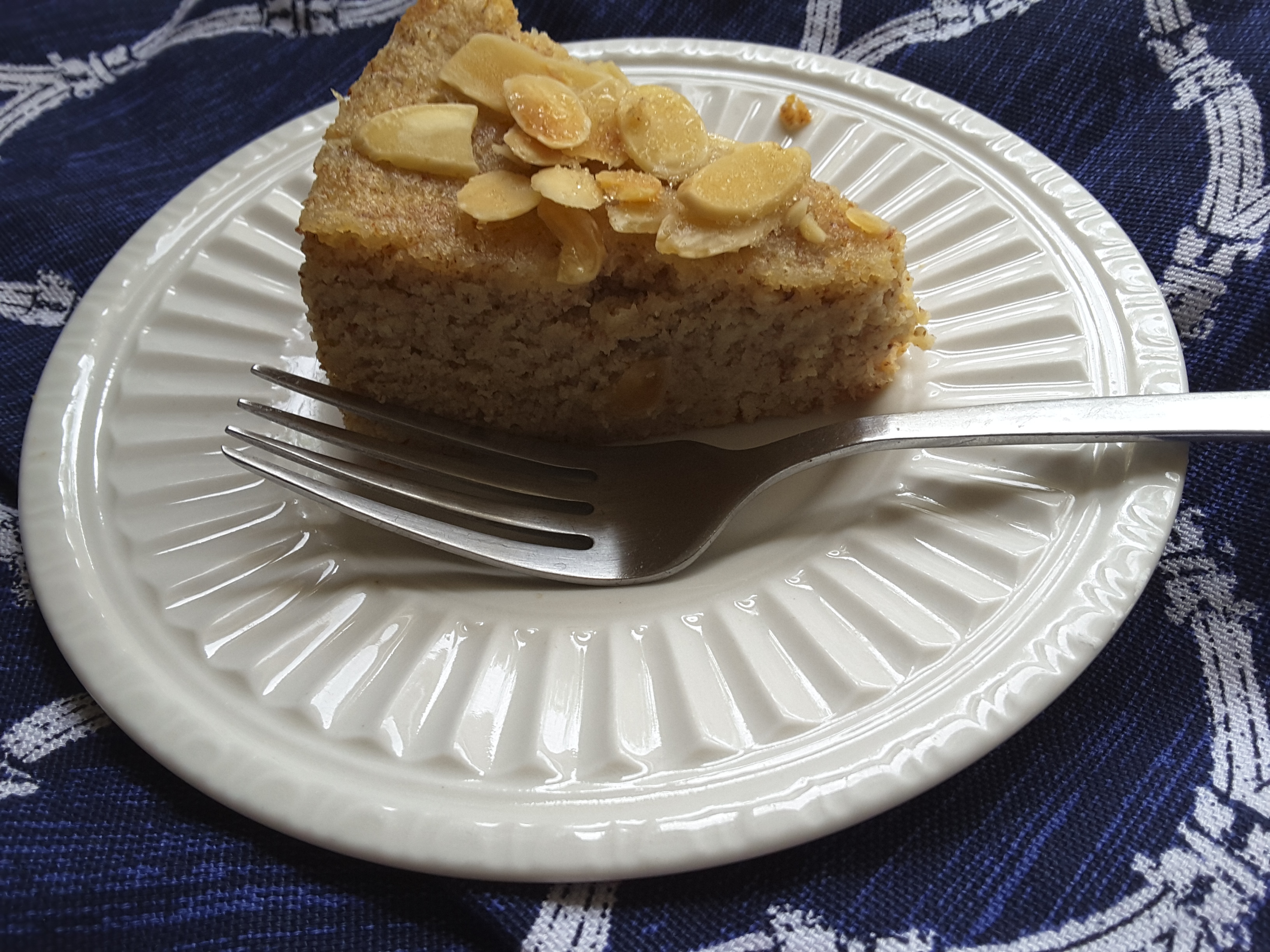
pear almond torte

When pears are good, at the peak of ripeness and aromaticity, they’re very very good, and biting into one will see the juice roll down your chin. When they’re not at their peak, or even when they’re frankly over the hill, you can still use them to advantage.

Slightly underripe pears slice thin and stay crisp in salads or on a cheese platter, something like jicama or underripe watermelon. They’re just barely sweet, not unctuous enough to upset the balance with a sharp vinaigrette or an aged cheese.

Ripe pears can substitute well in a variety of desserts for either apples (when still firm) or bananas (when very ripe, or even overripe and getting mushy).

And they lend a note of European sophistication to many desserts (and salads, and even main dishes) thanks to a dry aromatic twist to their sweetness–not exactly bitterness, more like something that plays well with the bitter notes of almonds, hazelnuts, bittersweet chocolate and dry red wine. These are flavors that don’t mesh as well with most apples due to their more overt sweetness and higher acidity, and probably not so well with bananas either due to the novocaine factor. (Although I’ve never actually tried to pair bananas with cabernet, I can just imagine it. Not promising.)

So even if you’re not a big fan of raw pears, the occasional bargain bag may be worth considering for desserts. If you can get them organic at a decent price, do, because pears are on the “dirty dozen” list for absorbing pesticides. Trader Joe’s sells bags of 6-8 small to medium (3.5-4 oz.) organic pears for about $3 at this writing. But what if, as happens occasionally, the child who insisted she wanted them instead of apples yet again has eaten two, and the rest have sat neglected in the fridge for long enough to turn?

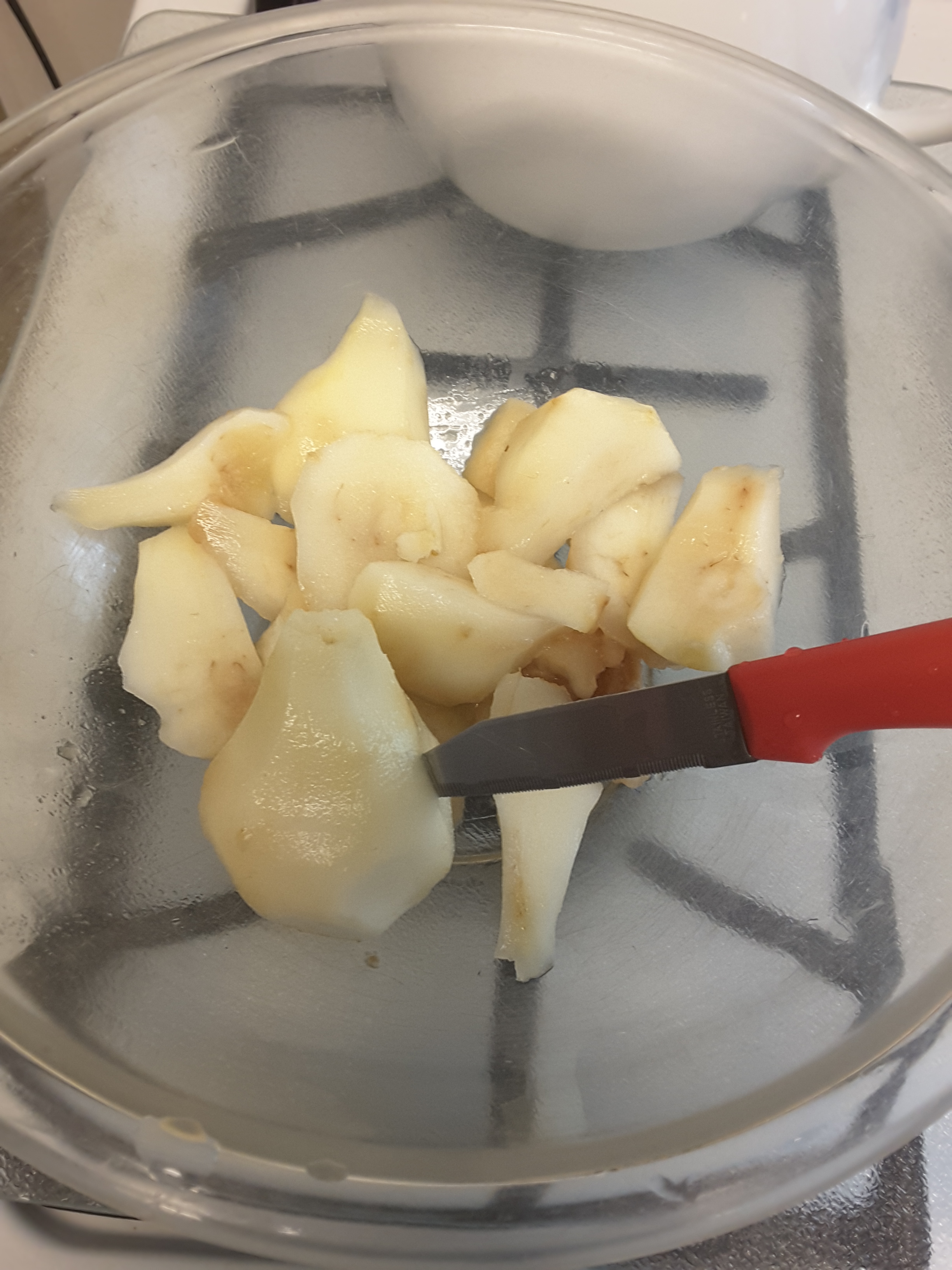
Overripe pears don’t look very nice on the outside and may have gone bland and/or brown, but they’ve still got what it takes if you peel them and cut away actual bad spots. If they’re only a little overripe and still flavorful, use them for a sorbet or microwave them for a minute or so to turn them “micro-poached.” If they’re really soft and going brown, peel and core them, remove all the brown bits and then mash or blend them as you would ripe bananas to give body and moisture to a cake or torte.

Here are two easy microwaveable desserts that use ripe to overripe pears and are Passover-worthy but can work anytime.

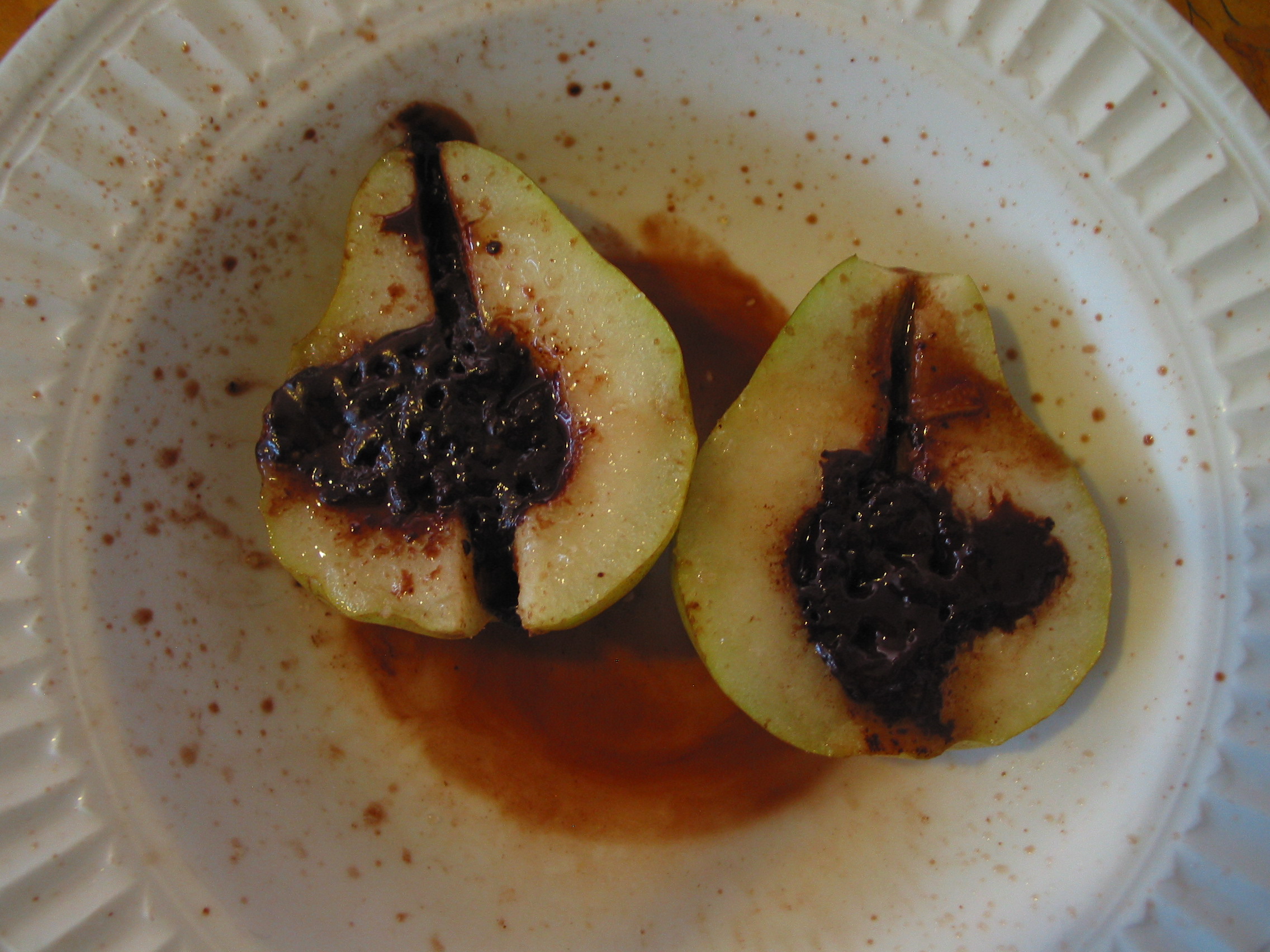
microwaved pear with chocolate

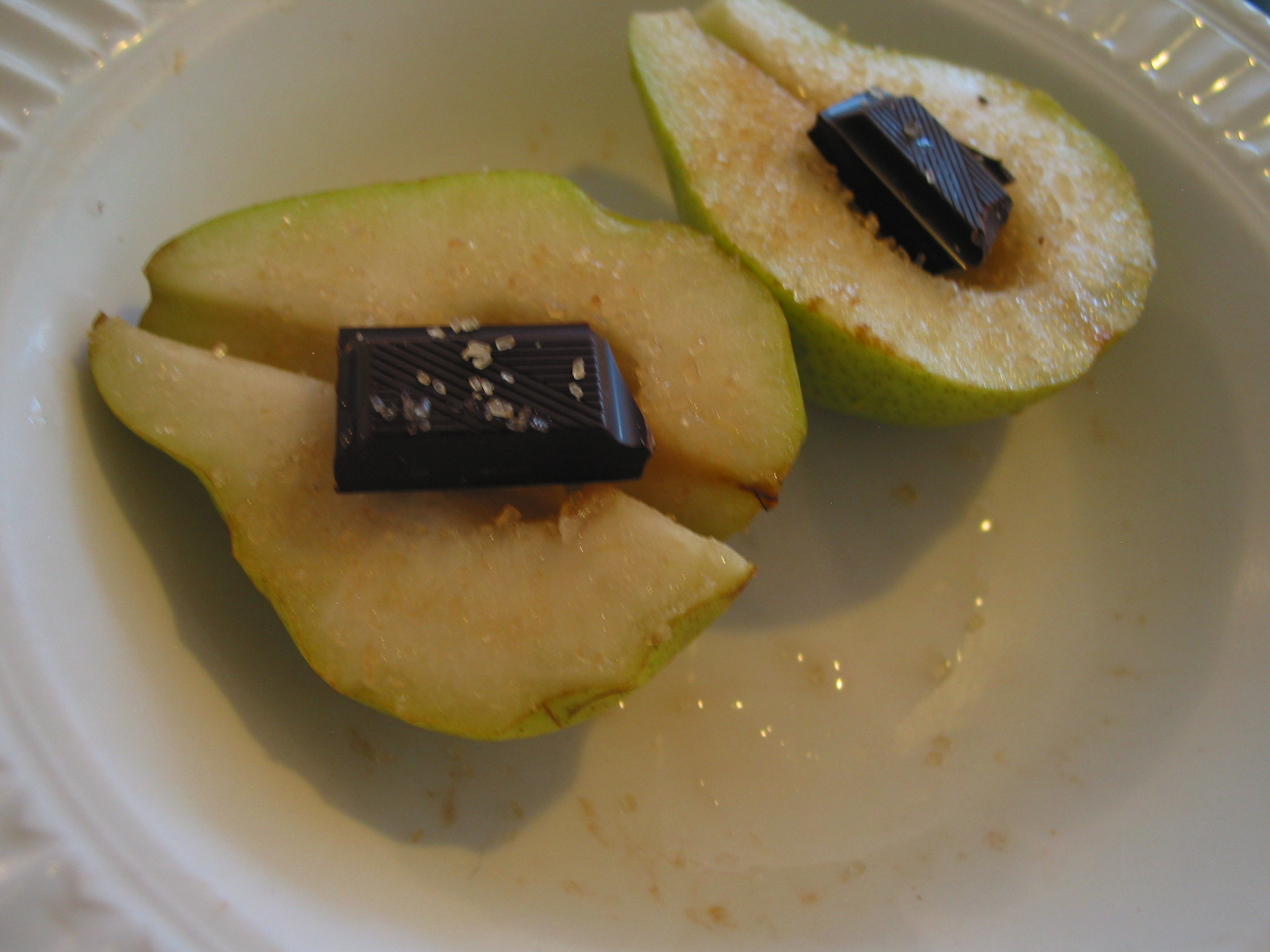
Micro-Poached Pears with Chocolate

This one’s very fast and impromptu–make just one pear or a few at a time and add a little time just as needed.

It can be hard to find chocolate that’s labeled kosher for Passover. Depending on your level of observance, consult the Orthodox Union’s Passover Guide, which changes year to year but  lists brands with kosher certification or acceptability even without a mark. If you eat kitniyot (beans, legumes, corn and peas, some spices, seeds and nuts) you can probably eat most chocolate that contains soy lecithin and vanilla. If not, look for the specially marked Elite chocolate bars that are kosher certified for Passover–for the Orthodox Union in the US, it’s the regular OU symbol (a capital U in a circle) but with a capital P superscript at the right. Other kosher certification at the Orthodox level is most likely to be the Hebrew letter kaf and/or a paragraph of Hebrew text naming the certifying rabbinical authority and location, sometimes with a circular seal containing the text (usually this is if it’s an Israeli product). There may be other certified or acceptable chocolates made with vanilla beans rather than extract (or without vanilla at all) and without lecithin–some of the high-end organic brands, for example.

  • Ripe to very ripe pears
  • Dark chocolate, your preference for cocoa percentage, brand, etc.
  • optional: turbinado or regular granulated sugar, cinnamon, powdered ginger etc. for sprinkling (check the OU site if you need to; regular granulated sugar is certified as-is but brown sugars aren’t always, and ground spices need to be certified for Passover)

Wash the pears, split in half and trim out the seed core and stem threads.

Lay the halves face up on a dish or plate that can go in the microwave. Place a square of chocolate on each half about where the core was.

Microwave 1-2 minutes per pear, just until the chocolate starts to melt and bubble and the pears are tender. Sprinkle with turbinado or other sugar and spices as desired before or after microwaving.

Eat with a knife and fork–add blackberries or a dollop of yogurt on the side if you want. Let it cool a little before digging in–I’m never that good and the roof of my mouth sometimes suffers for it.

Making the best of bad pears

The second recipe is yesterday’s riff on the Banana Ginger Almond Torte (from the I can haz cake?! Passover breakfast menu scheme…) crossed with my lightened-up version of Nigella Lawson’s “Damp Apple Almond Cake.”

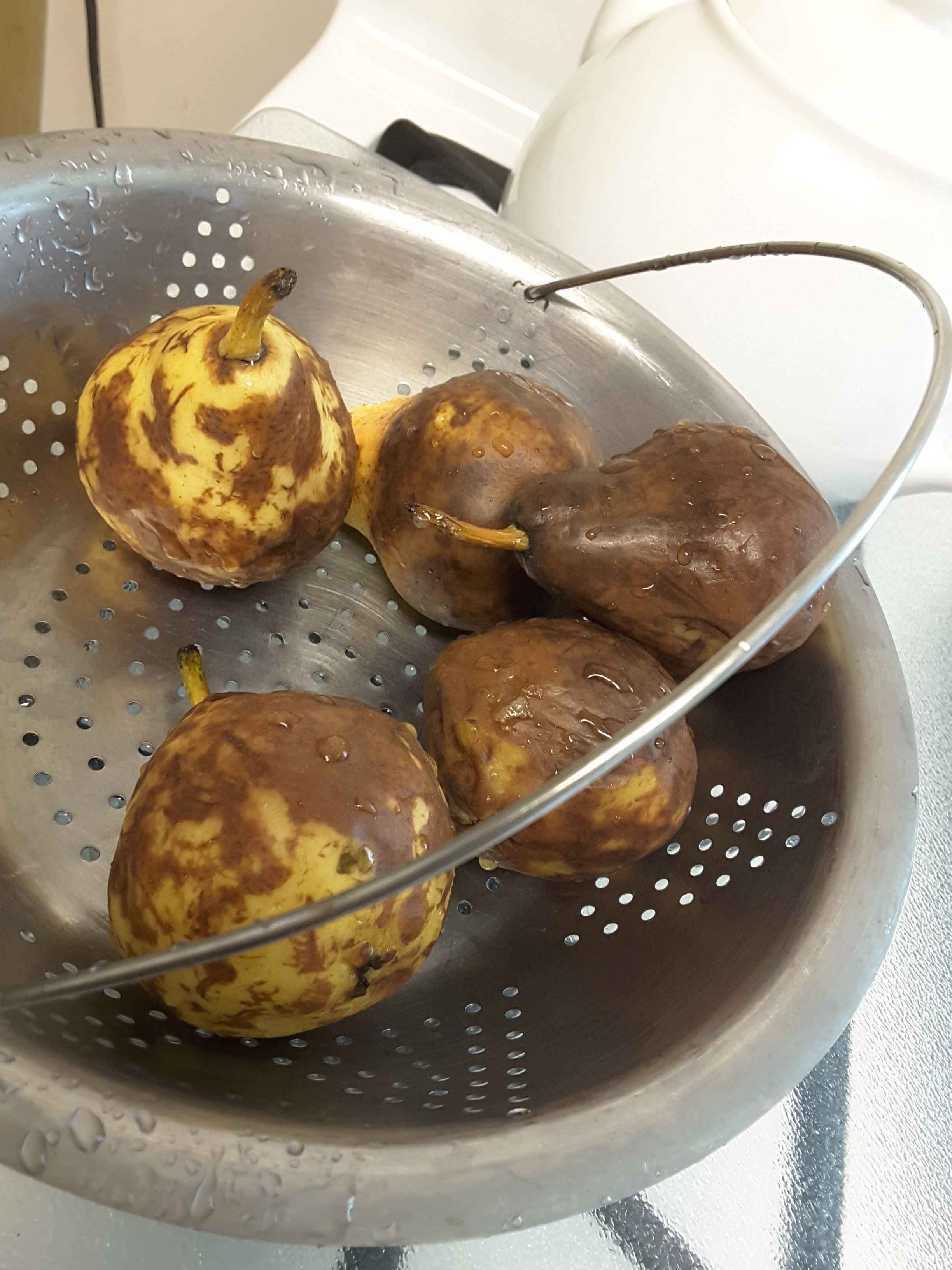
five overripe pearstrimmed pears

Only, obviously, I had 5 small way-overripe pears to deal with. Brownish to quite brown on the outsides. But good enough inside to yield about 1 to 1 1/2 cups of pear once they were trimmed. And the result was seriously delicious.

pear almond torte slice

Continue reading

Chocolate Quickie: Unromantic but Reliable

It’s Valentine’s Day again–midweek, busy, too many items still on the list from last week to want a lot of fuss–or even be able to guarantee that my husband and I will both get home a reasonable time for dinner in a reasonable frame of mind to celebrate romance by cooking, or eating, something fancy. Last night I spied way too many people at the Trader Joe’s heaving large bars of chocolate and multiple bouquets of hothouse roses toward the cash registers. That’s okay–I’m not raining on anyone’s actual romance, but I have to admit I’m not feelin’ the official holiday symbols this week. Chocolate is good, don’t get me wrong. Flowers are pretty but require a vase and a pair of shears–usually right when I’m trying to cook dinner.

Last year we actually managed éclairs, and it was fun if a bit much–even though I managed to strip it down considerably with the microwave. Microwaveable ganache truffles are also easy, quick and fun if you’ve got the time to feed them to someone you love.

But with a kid who’s now waiting for college acceptances (and us parents anxiously figuring out both taxes and how to get around the outrageous Estimated Family Contribution)–well, we could all use a smallish midweek-style treat that doesn’t involve even that much effort to make–or work off afterward.

Lately I’ve been digging around in my cooking “blank books” from the last couple of decades. Part diary, part notes to self with or without illustrations in scratchy pen and occasional bragging, political satire, or outright swearing as the situation demands–when you’re writing cooking instructions for yourself, why not? I started these books long before the era of the blog, and hunting through them takes me back to what I was doing at the time.

Half the recipes I came up with are from before I figured out how to work a microwave, but I seem to have gone overboard as soon as I got enough of an introduction. One of the more unusual finds that worked really well a couple of years ago in a birthday dessert emergency (why do I tend to have these?) was a small but rich-tasting dessert halfway between cheesecake and flourless chocolate cake. The best parts:

  1. A limited and very simple ingredient list and
  2. You microwave it in 3 minutes. Seriously. Also,
  3. It’s small, and there are no leftovers. Sometimes that’s a plus.

This would probably be a decent rescue option if you had to make dessert with whatever’s in the cupboard and the fridge, and you’d left things till the last minute…or even a little later than that. As slapdash as this quickie is, it’s got big, big advantages over anything storebought–time, taste AND chocolate. Also, modest calorie and carb counts.

Not everyone has a grocery that carries labaneh, which is kind of a Middle Eastern cross between sour cream and yogurt cheese. Nowadays, though, a lot of mainstream supermarkets are carrying plain Greek yogurt, which also works pretty well, even nonfat. And not every doctor approves of cheesecake in any quantity, much less huge. Damn, as I’ve said before, my cholesterol-packin’ genes (also jeans, but that’s another matter). The completely nonfat version of this dessert works fine and tastes good too, now that I’ve retried it, and all the ingredients are real.

So–whomp the ingredients together in a bowl, nuke it about 3 minutes, cool it, stick it in the fridge. Serve it with raspberries, peaches, cherries, whatever goes with chocolate in your book. Or jam (raspberry, apricot or sour cherry would be great on this, and so would marmalade…).

Chocolate Quickie

Serves 3-4 in smallish wedges if you don’t care how it looks–otherwise (probably smarter) pour it into small single-serving ceramic cups before microwaving. If you double the ingredients, it’ll need another minute or so in the microwave. Definitely serve with fruit.

  • 4 T cocoa powder (20 g by weight; 8 g carb)
  • 4 T sugar (60 g, all of it carb)
  • 1 lg egg
  • 1/2 c. (112 g by weight) labaneh, preferably 1/2 the fat, or else fat-free or 2% plain Greek yogurt. (about 3-5 g carb for any of them; about 7 g saturated fat and 10 g total fat for the full-fat labaneh, much less for the yogurt)
  • 1/4 c. water (yes, really. It’s 60 grams or mL if you’re weighing it out)

Whisk everything together until smooth in a microwaveable ceramic dish (big soupbowl is fine), or else mix and then pour into small microwaveable coffee or flan cups for individual servings (more attractive and probably less prone to serving mishaps where it falls apart when you cut it and lift it out). Microwave uncovered on HIGH 3 minutes for the big bowl, maybe 2 minutes for the individual cups, checking progress and adding extra time in 20-second increments just as needed so you don’t overdo it. When it’s done it’ll be a little dry around the edges and just pulling away from the bowl or edges of the cups. Cool to room temperature, cover and chill until it’s time to serve. Cut in wedges with a sharp knife if you went with the single bowl version. A pie server would probably help it keep its shape long enough to dish up.

Variations–add some grated orange peel or marmalade to the mixture; add a spoonful of almond extract, vanilla, amaretto, or hazelnut liqueur; add espresso instead of water…?

Carb counts: about 17 g apiece for 4 servings, 23 g each for 3 servings, all of it in the form of sugars.

Last-Minute Sweets for Rosh Hashanah

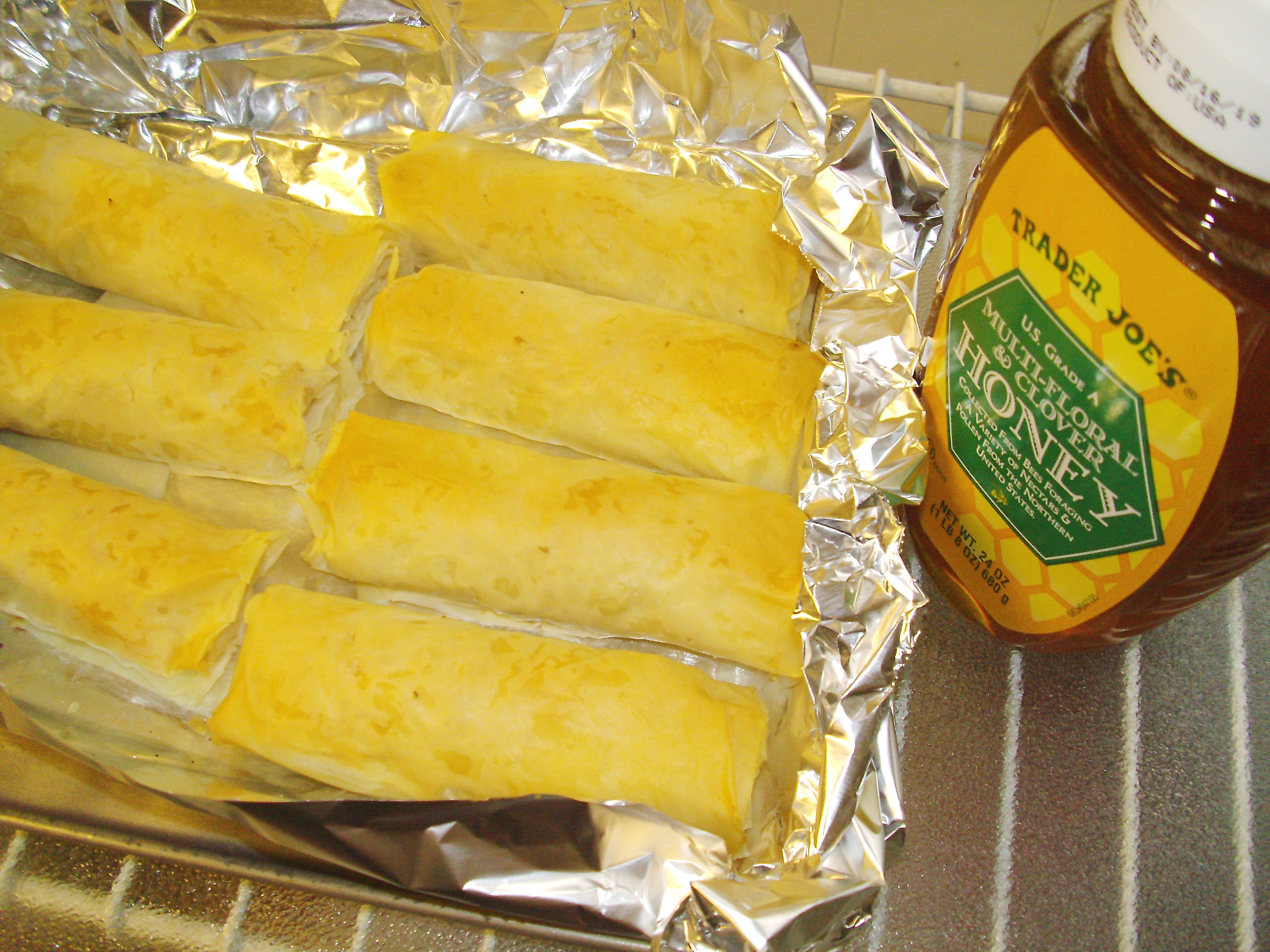
toaster oven baklava rolls with honey

A quick last-minute wish for peace and a sweet and prosperous New Year to everyone. I know it doesn’t look that likely, between the physical and political versions of “weather” in the news, but I try to remember that it begins with us in our own neighborhoods and that we can make a difference by our own actions. If you haven’t yet, please make an effort to donate aid–even a couple of bucks–to the victims of Hurricanes Harvey, Irma and Maria and to the victims of the earthquakes in Mexico. If you have neighbors and friends waiting to hear from loved ones caught in these disasters, do what you can to support them.

In the meantime, if you’re stuck for a last-minute dessert that works along the theme of “honey”–try baklava. I’m not actually kidding–if you have a toaster oven (for smaller amounts, 7-10 portions) and a microwave, and you have the makings of baklava (a roll of fillo, a bag of walnuts, some sugar and sweet spices and some butter or light-flavored vegetable oil), plus a bottle of honey, you’re in business. Of course, you could do apples instead of walnuts and make a strudel instead–also good and pretty easy. Peel and slice up or chop the apple (s), stick the pieces on a plate and microwave a minute or so to cook through and drain the juices before sprinkling on sugar, spices, and crushed nuts or breadcrumbs and/or raisins, and rolling up in fillo.

Toaster Oven Baklava Rolls

These are kind of like “ladies’ fingers” Moroccan fillo pastries, only with walnut filling rather than almond paste. Rolling individual fillo sheets is easy and a lot  quicker (and more fun, frankly) than layering several sheets flat and neat and then cutting pieces and baking and pouring a big jar of cold syrup over the hot pan. Plus the traditional syrup soak is a huge overload of sweet that’s admirable in its own odd way but very rich and hard to deal with–very sticky–right before you have to head off to synagogue. This is kind of a modular recipe–make just a few rolls if you feel like it, drizzle a bit of honey over the rolls at will.

  • roll of fillo dough , thawed (uses 1 sheet per roll; if you have extra left over, rewrap carefully and store in the fridge or freezer)
  • about 1 ounce walnuts per roll (I used about 6-7 ounces for 7 rolls)
  • 1 T sugar per 3-4 oz walnuts (I used 2T)
  • cinnamon or ground cardamom, about 1/2 t for 6-7 oz walnuts)
  • 1 t orange blossom water, optional, or orange or lemon juice or rind–you don’t want the mixture wet, this is for aromatic flavor
  • 2-3 T butter, melted, or vegetable oil, or a mixture, as needed
  • honey to drizzle over the top once baked, about 1/2-1 t per roll
  1. Slice the butter thin and melt in a ceramic or other microwaveable bowl, about 2 minutes.
  2. Put the walnuts in a plastic bag with some room and roll over them with a rolling pin or wine bottle to break them up fairly fine with a few 1/8th-1/4 inch bits, or if you feel like it, chop them in a food processor, not too fine. Add the sugar, spices and orange blossom water or juice to the bag and mix them into the nut meal.
  3. Unroll the fillo carefully onto a clean flat surface (lay down plastic wrap first as needed).
  4. Put a plastic sandwich baggie over your hand and dip it lightly into the melted butter. Dab on the top sheet of fillo.
  5. Fold the fillo sheet in thirds lengthwise. Grab a small handful of the nut mixture (2 T-ish), squeeze, and place at one end of the fillo strip. Tuck the side edges over it by 1/4-1/2 inch, then roll the end over and around the nut filling to enclose it. Dab a bit more butter on the rest of the strip and roll it up. Place on tin foil. Repeat with the rest of the fillo sheets until you run out of nut filling. If you run out of butter or oil, you can slice a bit more to melt quickly. You don’t need much per roll and the sandwich baggie should help spread it without absorbing any.
  6. When all the rolls are made, dab the last of the butter or oil on the tops, wait a minute to let it sink in a bit, and place the sheet in a toaster oven (or your regular oven preheated to 350F). For the toaster oven, set to bake on 350-400F, not “toast”, for about 8-10 minutes and keep an eye on it so nothing burns.
  7. Bake until the rolls are a deep golden brown and smelling baked. Remove from the oven, cool and squeeze on a drizzle of honey to taste–about half to one teaspoon per roll is enough for flavor without submerging it in syrup.

Baklava rolls browning in the toaster oven–don’t forget to set the temperature a little lower than for toasting so the tops don’t burn

L’Shanah Tova Tikatevu!

Finding heart

Right before the inauguration, a woman I didn’t know wished me a happy new year as we passed each other in the library. Something about the cautious way she said it made me wish it back to her with a wry twist we both acknowledged: neither of us felt we had much to look forward to in the coming administration, and both of us were worried for our families, our children, our community, ourselves. “We’ll keep on,” she said and I nodded. Both of us were a little grim.

And although it’s spring and Passover started Monday night, I am still a little grim and on standby. Every so often I feel a bit lighter in spite of the news, but to tell you the truth, I still often feel like hiding under a table. With a big tablecloth on it. In another, better, saner country. I kind of wonder if Iceland’s available. Are there Jews in Iceland? I hope so. Do they have enough matzah? I could lend them some…

But it’s spring. You can’t just hibernate for 4 years (or 2, hoping for a reversal in Congress in 2018 and a brain transplant for pretty much everyone in the White House, starting not with Trump–may not be possible–but perhaps Spicer? no, again, not possible–stick the oversized bunny suit back on him, make him hop around the WH lawn–would you be able to tell the difference?)

Ahem! As I was saying, you have to get back out there and see how your neighbors are faring and talk to them. If you’re not naturally extroverted and you work alone (double-ahem!), it’s even more important to take a breather and reconnect in the real world.

Despite my wariness about the immediate future of American government and my repeated incredulity at the daily headlines, there is reason for hope in this country. All kinds of people, business leaders and employee groups, religious leaders and congregations, public officials, judges, entertainers, and most of all, ordinary citizens have started speaking up and donating money and time to support the safety and rights of threatened and persecuted minority groups, whether their own or someone else’s. Citizen or not. Same religion or gender or race or not. California’s not the only place where this is happening. If it can happen in North Carolina, in Kansas, in Pennsylvania, in Texas–it can happen anywhere.

These surprising oases of sanity, civil contribution and decency give me heart that we can take steps in our own neighborhoods and states to protect the progress and community we’ve recovered since 2008.

But I do have to ask, is there really still room for a food blog like mine? Is this what I should be doing this year? Can I help anyone by talking about food and trying to seek pleasure in it when we’re all worried about bigger things? It’s taken me four five whole months to get to the point where I can say I think so.

A few weeks ago, still wondering, I went to Shabbat services for the first time in a while and tried hard to find heart and figure out what to do with it. And I did. I looked around at my neighbors and friends, I joined in the prayers and singing, sat with my husband, said kaddish for my brother and father and grandmother, whose yahrzeits all fall in the same week, got an aliyah, heard my daughter chanting the longest possible maftir in the book (usually we’re tawkin’ 3 verses at the end of the Torah reading, this time it was 20-plus). I found myself thinking both how proud I was of her, how beautifully she sang it, and how rusty my Hebrew reading had gotten through neglect these past months.

Being with my community and my family, seeking something not posted in the daily news headline deathspiral, put me in a more expansive frame of mind.

I decided not to let the current occupants of the White House and their make-America-hate-again tactics continue to ruin my or my neighbors’ life and drain all the color out of our days. I decided not to hide under the table–it was too much like duck-and-cover, and that’s only good for ducks, and only if it’s Wabbit Season.

We can be better and more powerful together than our current representatives in Washington think. Although I would personally like to thank MY congressional representatives, Judy Chu and Adam Schiff, as well as my senators Kamala Harris and Dianne Feinstein. Keep doing the right thing, and Chazak v’Amatz (strength and courage).

Living well and supporting each other is the best revenge.

(Chasing recalcitrant rightwing congressional reps down with pitchforks or at least cellphones at various town halls and telling them to do their jobs is starting to be tempting too, don’t get me wrong. Plus it’s aerobic.)

So anyway, back on track. Because Civility 101 demands community, and community includes good food. Even if it occasionally has to be served up with a pitchfork. And, as I mentioned somewhere up in the wilderness above, it’s Pesach. Time for a taste of freedom.

Passover Links

Passover Pareve, Eggless Chocolate Torte (Sacher Torte) with Dairy-free Ganache

Assorted Passover cakes (apple/almond, banana ginger) and breakfast schemes

Macaroons, mandelhorns and almendrados

Homemade Horseradish (but I’m not bitter)

Not gefilte–better fish options

Microwave shakshouka

Not-chicken soup

Israeli spinach-feta casserole