• Enter your email address to subscribe to this blog and receive notifications of new posts by email.

    Join 241 other subscribers
  • Noshing on

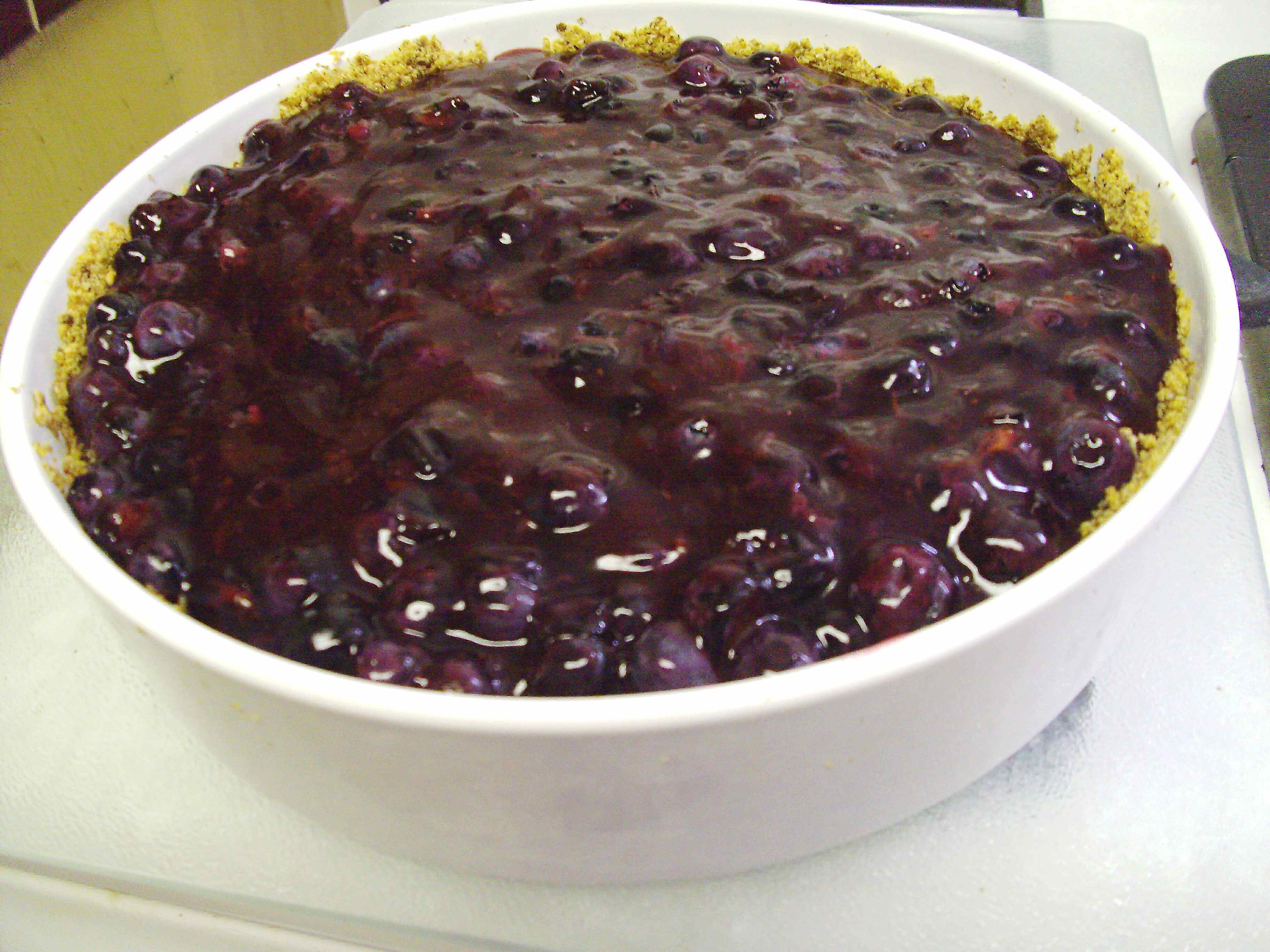
    raw blueberry pie with microwaveable filling and graham cracker crust

    This mostly-raw blueberry pie is a snap to make and very versatile--the filling microwaves in a few minutes, and you don't even have to bake the zippy gingered graham cracker crust--perfect for a hot Fourth of July and all summer long.

  • Recent Posts

  • Contents

  • Archives

  • Now Reading

  • See also my Book Reviews

  • Copyright 2008-2024Slow Food Fast. All writing and images on this blog unless otherwise attributed or set in quotes are the sole property of Slow Food Fast. Please contact DebbieN via the comments form for permissions before reprinting or reproducing any of the material on this blog.

  • ADS AND AFFILIATE LINKS

  • I may post affiliate links to books and movies that I personally review and recommend. Currently I favor Alibris and Vroman's, our terrific and venerable (now past the century mark!) independent bookstore in Pasadena. Or go to your local library--and make sure to support them with actual donations, not just overdue fines (ahem!), because your state probably has cut their budget and hours. Again.

  • In keeping with the disclaimer below, I DO NOT endorse, profit from, or recommend any medications, health treatments, commercial diet plans, supplements or any other such products.

  • DISCLAIMER

  • SlowFoodFast sometimes addresses general public health topics related to nutrition, heart disease, blood pressure, and diabetes. Because this is a blog with a personal point of view, my health and food politics entries often include my opinions on the trends I see, and I try to be as blatant as possible about that. None of these articles should be construed as specific medical advice for an individual case. I do try to keep to findings from well-vetted research sources and large, well-controlled studies, and I try not to sensationalize the science (though if they actually come up with a real cure for Type I diabetes in the next couple of years, I'm gonna be dancing in the streets with a hat that would put Carmen Miranda to shame. Consider yourself warned).

This always happens right before vacation…

Finally, finally, we are going to the East Coast. We’ve had to put off seeing my mom and my sister (and assorted boys) twice since December due to incessant snow, none of which hit Los Angeles in the slightest. So as soon as school lets out, we’re packing for an ungodly wake-up call the next morning and getting out of SoCal for a bit more than a week. The cat gets a hotel/spa vacation without all the schlepping around between Bahston and New Yawk. We get the do-we-have-enough-clean-undies-to-make-it version.

So good, already. But as in many of my tangled big-event preparation schemes, I have a slight problem with the fridge:

Stuffed fridge right before traveling

The problem, part I…Note the tomatoes: 10+, excessively ripe, and the invisible 6 or so red peppers behind them. Not to mention the huge bag with 7-8 bunches of fresh herbs…

fridgedoor

Part II, the door…Note the huge bag of nectarines, lower left, the chiles just behind the mushrooms and two bags of apricots at right, just because…

AAAgh…just a little insane. Suffice it to say, it’s been an enthusiastic week or so vegetable-shopping-wise because the Fresno tomatoes are back in my local greengrocer’s, along with a lot of other produce, and I’ve gone overboard on a number of items, not least of which are lemon basil, mint, dill and tarragon (which I haven’t even decided if I like). The market beckons, the low prices for herbs and vegetables even more so, and the sun’s finally come out again after a month of gray days. And I’m a purple thumb as a gardener, so the greengrocer’s wares beckon even more strongly. How could I not want it all? But a little thought for the calendar might not have gone amiss.

So I’m in trouble again. We leave in 4 days. There are a maximum of three humans in the house (depends how we’re behaving at any given moment). Nobody but me really gets into gazpacho the way they should–though they will go with salads (the coarse-cut version of gazpacho). And it’s a sorry day when you have to threaten people with apricots and nectarines three meals a day. We should be reveling in the produce section, not roiling in it. If we were staying here, this would be an ideal scenario for the next week and a half, Continue reading

Microwave Tricks: Shakshouka

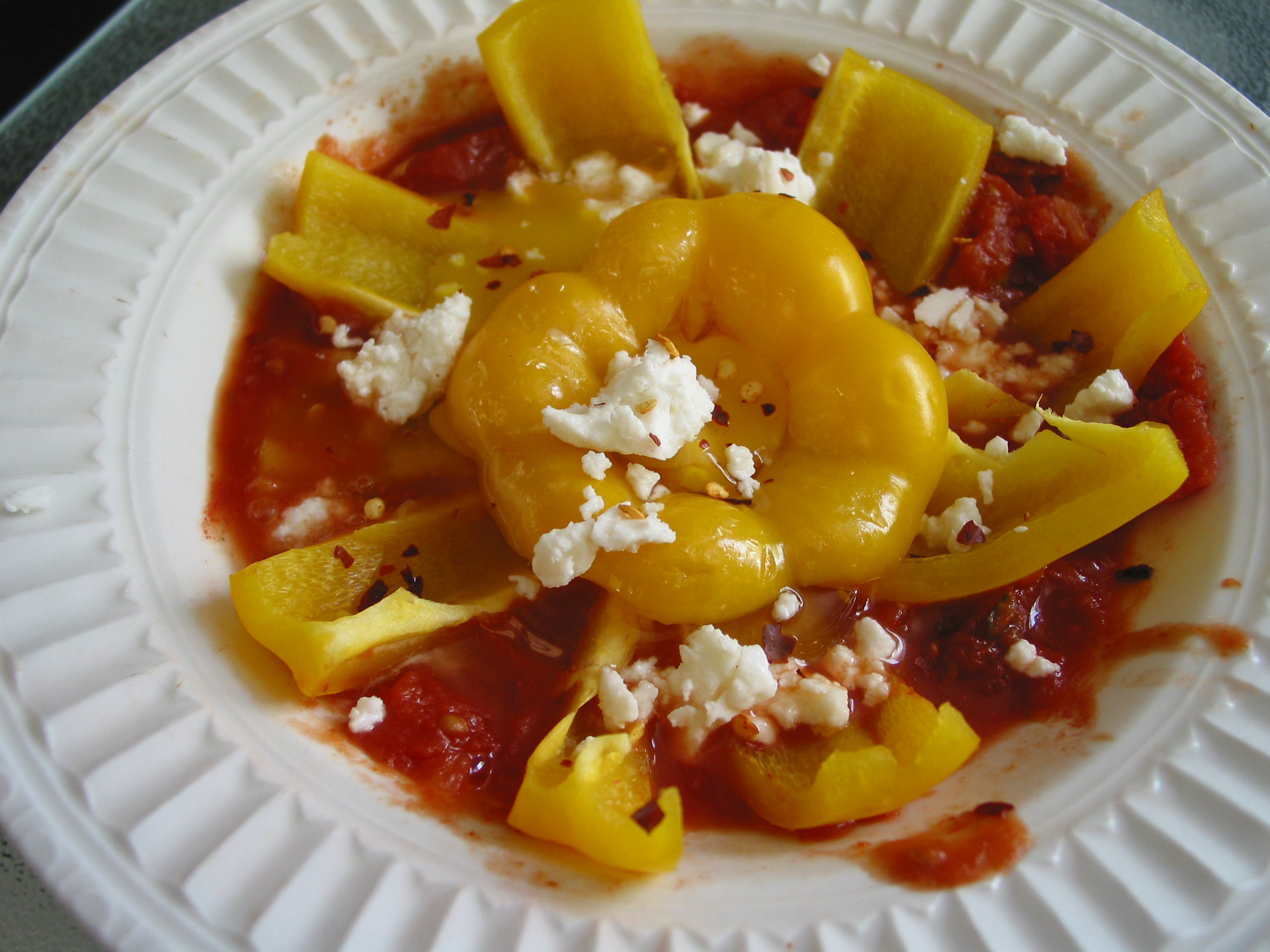
IMG_0458

Marinara plus a pepper makes a good start.

Sometimes during Passover you just can’t take any more matzahnola. Or matzah with jam, or matzah brei. Or cake. Or macaroons. Anything for breakfast that doesn’t involve at least one vegetable (other than yourself, before coffee). Your tolerance for sweet stuff has been exhausted, and as for the leftover gefilte fish and hrein…no. We are not going there. No matter how much my husband insists it’s “perfectly good” (and I notice he hasn’t schlepped the rest of the jar with him to the office!)

Forget all that. There’s a pretty good cure for the Pesach blahs–you need some chile peppers and you need them now. Not in 20 minutes, no major cooking involved. You have a microwave, some cheap microwaveable soup bowls or the like, and you’re not afraid to use ’em for an increasingly popular Israeli brunch dish–shakshouka. Which is basically the Jewish version of huevos rancheros, only without beans or potatoes. Or lard.

Yotam Ottolenghi has made shakshouka popular and photogenic in at least one of his famous cookbooks, probably prettier than what I’ve got here. But it takes longer too, and I’m impatient.

To make shakshouka, you usually need a frying pan, olive oil, some tomatoes, peppers and onions, plus garlic, cumin, chile peppers, maybe a couple of oregano-or-thyme-and/or-cilantro-type herbs–sounds like the makings of salsa, no?–and some fresh eggs to crack into the resulting sauce. The sauce takes some 20-30 minutes to cook down, the eggs another 5-7 to cook more or less sunny-side-up in the middle of the sauce. That’s a lot of time for breakfast. I wanted a shortcut this morning.

Most jarred salsas are not kosher for Passover–it’s the distilled vinegar thing. That’s okay, because yesterday in a fit of domestic planning (uncharacteristic, I swear) I decided to make a batch of microwave marinara from some unsalted canned tomatoes. I don’t have a kosher-for-Passover food processor this year, though, so I decided, after trying to chop up some pretty tough Roma tomatoes (even with the skins off!) that I should just do as the Sicilians do and break them up with my hands as Tony Danza advises. A little chunkier than usual, but just fine. And actually ideal as a base for shakshouka–both its readiness for a mid-morning fridge scrounge and its rusticity made for a good start. A good dollop in a microwaveable soup bowl.

What else do you need? Maybe a bell or Anaheim-type pepper that needs to get used up. Cut it up (I got whimsical, you don’t have to potschky around with flower shapes). Add more onion if you feel like it; I didn’t. Stick it in the microwave for a minute or two to wilt the pepper and possible onion pieces.

IMG_0461

Then crack an egg or two into it, sprinkle on a bit of feta or panela or queso fresco as desired, maybe a pinch or so of chile pepper flakes or z’khug (I’d run out) and/or chopped cilantro as desired.

IMG_0463

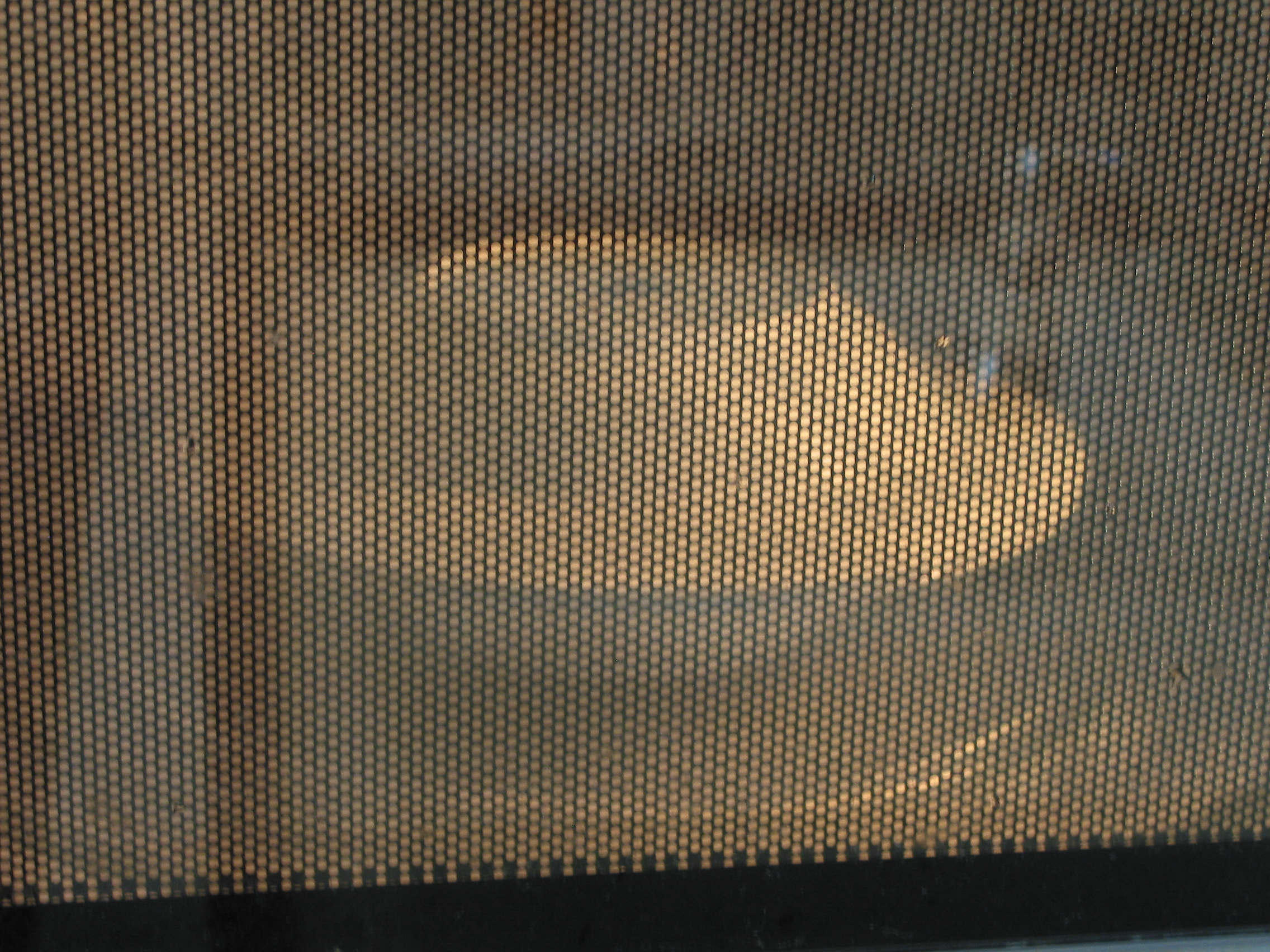
Put another soup bowl on top as a lid, and microwave another minute or two until the eggs are cooked to your liking–check and add 30 seconds if you think it’s still got a raw spot somewhere, and/or leave the lid on for a few minutes and let it finish cooking in the residual heat of the sauce.

Obviously if you’re having people over for brunch, the standard frying pan method is better and quicker–more eggs and salsa means more time in the microwave, and no one wants to sit around as you microwave individual portions. But if it’s just you, or you and your partner, the microwave method works pretty well. Just add a little time (maybe another minute or so in 30-second increments) for four eggs as opposed to two.

IMG_0464

Hafla! (celebratory remark when there’s something good on the table and you didn’t have to wait an hour for it) Grab some matzah and a cup of hot coffee and b’te’avon (mangia bene/bon appétit/eat nice)!

A salad in winter: counterintuitive comfort food

box of winter salad

If you skip the lettuce and choose more robust vegetables, you can make a big box of salad in minutes and keep it crisp several days in the fridge.

It’s gotten cold here. Ok, so no one else is pitying us; we had 80-plus degree weather only last week, but now there’s a very dry, sunny cold spell setting in, it’s in the 50s daytime, 40s at night, and Southern California doesn’t do insulation that well. Or ski jackets. Or wool.

On the upside, it’s been cold enough so that I can run the oven and bake–a rarity in Pasadena this year. [OK again: prepare for a couple of digressions from the main topic]

I made a big round spanakopita for a Chanukah party, quick pizzas for my daughter and her friends and calzones for me and my husband, rosemary and sesame bread, and rye bread–which is still in the attempt stage; I didn’t have a properly developed sour and wasn’t scrupulous about weighing out and getting the hydration and gluten ratios right and all that the first time around, and it collapsed in the oven…

I’m determined to get the sour and the rise textures right, so now I’m following the Inside the Jewish Bakery instructions more closely, having met and been impressed by one of the authors. It’s a matter of some urgency: my grandmothers are no longer alive to schlep good deli or bread out here on a visit, Trader Joe’s has broken ties with the really good bakery that made serious “pain miche” half-rounds that tasted like kornbroyt, none of the commercial rye breads in SoCal (or most of the country) are anything more than tanned white bread, and I’m desperate for the real thing–tough, chewy, tangy, caraway-laden, with a serious crust. Before my genes start going beige and I start deciding Bing Crosby was a really good singer.

[True unexpected fact here: a church choir director I know says that because of all the practice sessions, she and all her colleagues get serious carol fatigue by about two weeks before Christmas every year. I thought it was just me avoiding the mall, but no.]

In the meantime, I’ve been thinking about comfort food, because winter cold brings on the desire for heavier dishes–stews, starches, cheeses, meat and potatoes, and more starches, and the winter holidays bring their own calorie-laden version of cheer to the table with abundant puff pastry, eggnog, latkes (potato pancakes), sufganiot (jelly doughnuts), cookies, fruitcake, and all the rest of it.

Not too many people think about salad as a comfort food this time of year. Potato salad, maybe.

And yet…it’s really not very comfortable to find you’ve gained five or ten pounds in a month when you didn’t mean to, and New Year’s is coming with an actual dress-up-like-a-grownup-with-a-life party invitation. If I’ve managed not to succumb to the excess so far this year, it’s only because I’ve been cautious-to-paranoid about eating latkes and sufganiot last week and even my typical penchant for cheese and dark chocolate (not together!) has me thinking twice. I don’t know about you, but I can’t afford to regain the weight I lost last year–even though it was “only” ten pounds, it was hard enough, and like many people, I could use another ten down before spring without having to work too hard.

So salad is what I have in mind at the moment. Yes, there will also be stew–this week, spicy vegetarian eggplant and chickpea stew, because I made a vat of it and stuck it in the fridge. Very hearty, filling, warming, and all that winter-holiday-recipe-talk, yet not very devastating diet-wise, and doesn’t make you feel like you need another nap pronto. Plus once it’s made, it’s really fast to reheat in the microwave. As I discovered yesterday, a mug (nuked less than 2 minutes and eaten on the run) can power me through a rushed non-cook evening–something I don’t do often or well–of ferrying my kid to the movies at the mall with her friends. During the very unpleasant after-Christmas sales season. What can I say–when put to the test, it was faster than fast food and twice as effective.

If only salad were like that [finally back on topic]. I’m not generally a cook-for-the-month kind of person, but it seems to me that if a restaurant salad bar can get away with making blah bulk salads that sit out for hours, surely I can do a bulk salad that looks and tastes lively and stores nicely for a couple of days in the fridge without going bad. Chop once, eat twice, right? Continue reading

OK, Fried PLUS Dairy for Chanukah

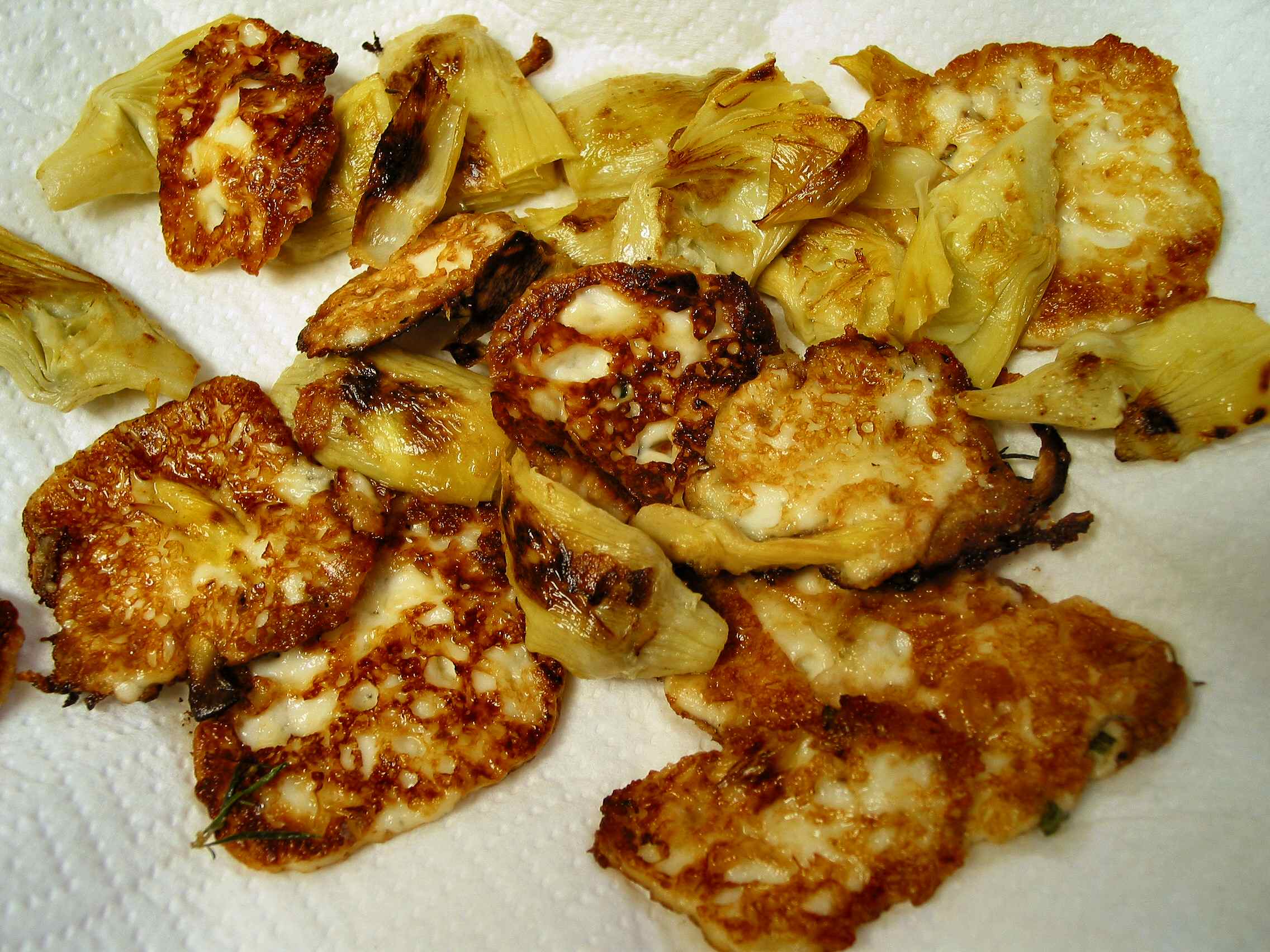
fried-panela-and-artichokes

Another good version from a previous fry-up: slices of panela browned with marinated artichoke hearts (bonus: a hit of garlic and lemon flavor from the artichoke marinade, plus the lemon juice increases the browning)

Well…I figured out something quick to fry for the first night of Chanukah: slices of panela cheese, a white rubbery fresh cheese that’s almost exactly like halloumi. Only it’s Mexican rather than Greek, so it’s a locally abundant variety (along with queso fresco) and about half the price per pound here in Pasadena.

I decided to do something a little different with it though. While the spoonful of olive oil was heating in the nonstick (very important) pan, I pressed the slices of panela into about a tablespoon mixture (not shown in above photograph; we ate these too quickly to take a picture of any worth) of pre-toasted sesame seeds, crumbled oregano, sumac, a pinch of ground caraway, and Aleppo pepper–essentially za’atar mix, only without added salt. It didn’t stick incredibly well to the cheese but I was able to press it in on both sides long enough to get it into the pan.

When I started frying the cheese, some of the whey immediately bubbled out into the oil, but although the slices softened up and started melting a little, they mostly kept their shape and I was able to flip them with a wide spatula to fry the other side. Halloumi firms up again as it cools–a little flatter, but pretty tasty, especially with the za’atar mix I improvised. I served it on top of our salad, but in restaurants it goes by itself, with its own bed of greens, maybe a bit of chopped tomato and onion, or with bread and olive oil. It’s only a few minutes of work for something unusual and delicious.

Microwave Tricks: 10-Minute Tofu

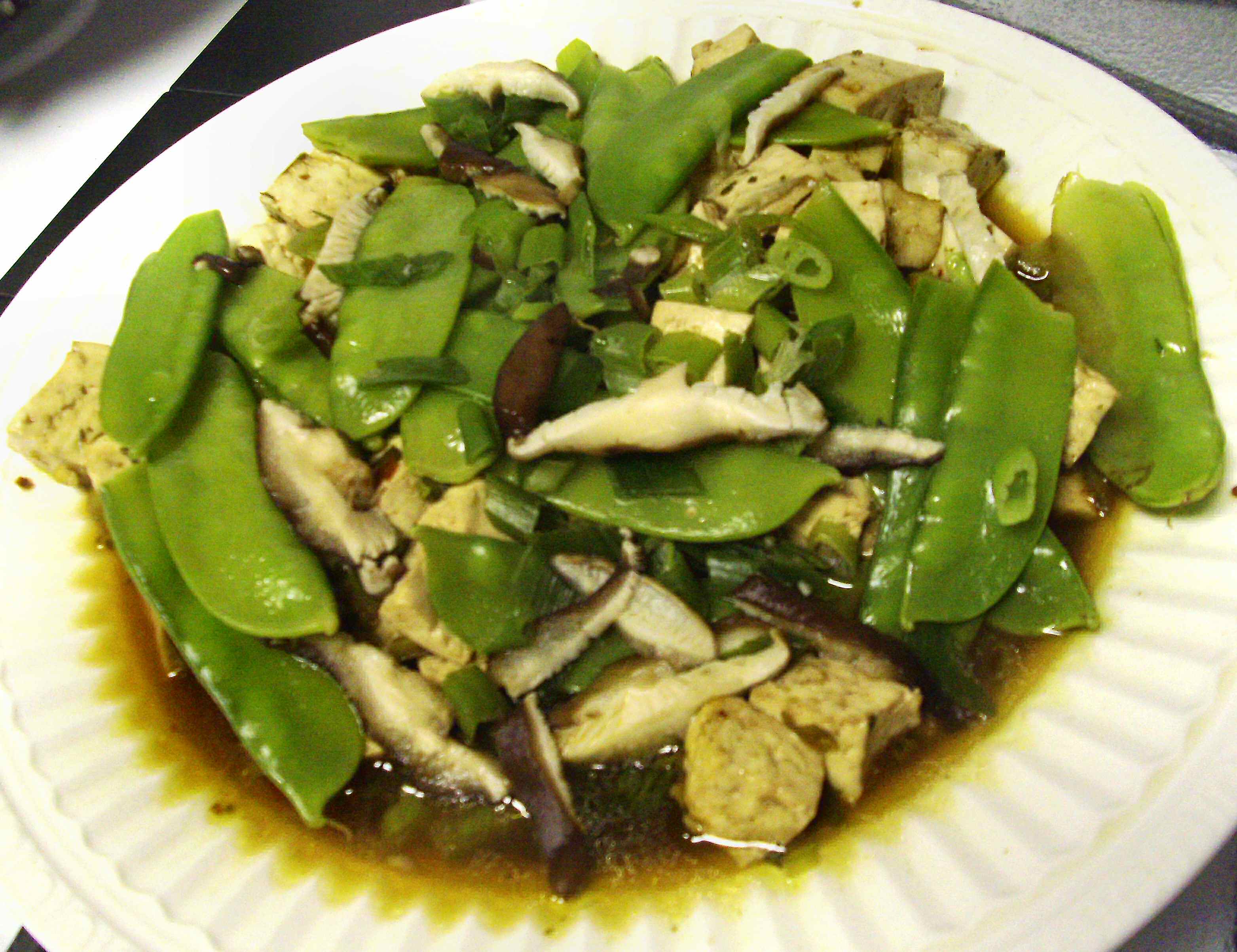
Microwaved platter of low-sodium tofu with snow peas

Microwaved tofu platter in minutes, minus the big oil and salt overload of takeout. I’ve used snow peas and shiitake mushrooms this time, but you could use any greens you like and mix them up–bok choy, broccoli, green beans. Frozen snow or sugar snap peas work too.

This is the recipe I meant to put in the last post about reducing sodium in Chinese food.

Tofu is, as everyone knows by now, extremely versatile. It’s vegetarian, it’s shapeable, it’s mild but satisfying in flavor, it comes in a variety of textures and thicknesses, and it’s quick to cook–fried, steamed, stuffed, crumbled–or to eat cold. It’s also low-fat, low-sodium, nearly carb-free, and relatively high in protein, with some iron and calcium too. And it’s very inexpensive–less than $2 for a 14-oz. pad of tofu at the supermarket, about three or four servings’ worth.

When it’s hideously hot out, as it was much of September here in Pasadena, you can marinate a sliced cold block of silken tofu by pouring a jao tze-style dipping sauce over it maybe half an hour, garnish with scallion shreds or crushed toasted nuts, and serve it as an appetizer. Or eat firm tofu plain and cold, if you like it. Or throw some tofu cubes into a salad with cabbage, lightly-steamed (or microwaved) fresh brussels sprouts, scallions and halved hard-boiled eggs, and drizzle peanut sauce over it.

Or you can decide there’s no way you’re going to stand over a stove with a frying pan, but you’d like a proper cooked dinner that resembles kung pao or ma po tofu with some greens, just not doused in heavy greasy oversalted sauce or requiring a run to your local takeout, and it would be nice if it were very quick. Very quick. Like five minutes tops. And that it didn’t involve the stove at all.

When my daughter decided she wanted to be vegetarian a couple of years ago, I discovered that you can “quick-press” tofu for Hunan tofu in about 4-5 minutes for a standard 14-19 oz. pad by cutting it up, standing the pieces on a microwaveable dinner plate, and microwaving, then draining off the liquid. Then it’s ready to stir-fry and it’ll brown decently. But I’ve done it so often in the past two years that my daughter’s kind of tired of it now (and has also gone back to eating fish and chicken once in a while). But we still like tofu. And with 100-degree days filling so much of September, there was just no way I was going to stand at the stove. So….

The entirely microwaveable tofu dish below is my daughter’s current preference, because the tofu cubes are softer, steamed in the microwave in a thin sauce rather than browned, and the scallions never scorch. And it’s not bad at all, and it takes, if not a literal 5 minutes, maybe about 10, start to finish.

This is more of a technique than a recipe, really, because you can use whatever cookable greens you have and like–fresh broccoli with the stalks, green beans, bok choy, etc. are pretty classic and generally not expensive per pound, but I’m not against using frozen unsalted (store brand; I’m cheap) sugar snap peas or green beans if the fresh ones are out of season. You’re microwaving; it’ll work out, and you won’t overcook the tofu. Continue reading

Testing salt reduction on a really large scale

Microwaved platter of low-sodium tofu with snow peas

This tofu dish with snow peas and shiitake mushrooms uses low-sodium dipping sauce ingredients as its base rather than soy sauce or oyster sauce. It’s also microwaveable from start to finish and takes about 10 minutes total.

If you have a big enough–and motivated–study population, even modest reductions in daily sodium intake can make a big difference in preventing strokes and heart attacks. Last month, cardiovascular researchers from Beijing and Sydney announced a new 5-year diet trial in Science to do just that (see the general overview article, “China tries to kick its salt habit”).

China’s northern rural poor eat an estimated 12 grams of salt a day on average, considerably more than Americans’ 9 grams a day (which is still over the top) and more than twice the WHO’s recommended 5 grams or less. An estimated 54%, more than half, of Chinese adults over 45 have high blood pressure these days, and the Chinese government is taking practical steps to provide antihypertensive medications and shift the tide back–but that’s an awful lot of prescriptions.

Given the cost of antihypertensive drugs for such a huge population, and the cost of dealing with side effects and consequences of untreated or undertreated high blood pressure, prevention seems the better way to go. The researchers project that reducing the national average by even 1 gram of salt a day would save 125,000 lives a year in China. So they’ve recruited 21,000 villagers so far in China and Tibet, and plan to provide test groups with nutrition counseling plus a lower-sodium salt substitute for cooking, then compare their sodium intakes and rates of heart attack and stroke with those for a control group.

Most Chinese still do their own cooking at home, especially outside the big cities.  If lowering the sodium content of the salt they use works, it has the potential to get an awful lot of people off daily hypertension medication and reverse a major health threat. But will people do it if they’re not in the trial, or once it ends? Will it catch on? And is it the right answer in the long run?

Salt substitutes, with potassium chloride replacing some of the usual sodium chloride, have been tried by heart patients in the US since the 1970s or so. They’re a little more expensive than table salt or kosher flake salt, at least in the US, but they’re not all that expensive. But they’ve never really caught on here with most consumers.

Similarly, a few decades ago, a big public health campaign in Japan to reduce the high rate of stroke led to the introduction of low-sodium soy sauces, with about half the sodium content per tablespoon of traditional ones.

Not much market research is available on how many people have been buying low-sodium vs. regular soy sauce in Japan since its introduction. From the few current market reports I could find–one of them an executive report from Kikkoman–it looks like low-sodium is still a smaller if steady fraction of their business in Japan, and that it’s more popular in Europe and the US than at home.

It’s important to have a low-sodium line for reasons of corporate responsibility and even prestige, but there was no mention of its percentage of total domestic or worldwide sales. Traditional soy sauces, which can range from 14-18% sodium concentration w/v, are still apparently preferred for taste, and the Kikkoman executives attribute much of their expected taste appeal to salt rather than the other flavors in each one’s profile.

That’s kind of discouraging to me. The Japanese are known for more refined and sensitive palates on average than Americans, and their range of soy sauces and tamaris for specific food combinations is much broader and more sophisticated. The higher-quality low-sodium soy sauces are produced by ion filtration to get sodium out rather than simply diluting them with water, so most of the flavor that’s actually flavor remains. I would have hoped the key flavor signature of each match was the actual flavor of the brewed soy sauces, not the saltiness.

It’s likely, though, that the Japanese are just as susceptible as the rest of the world to the sodium tolerance phenomenon–the more sodium you eat habitually each day, the more you expect and consider normal in your food, and you almost stop even noticing it as a separate flavor.

The overall Chinese market for soy sauce is currently estimated at $20 billion and grew about 23.4 percent over the past 5 years, mostly due to population growth. The stakes are pretty high for China, but the government has tighter control of its salt and soy sauce producers than other countries do, and the will to make a broad change seems to be present, at least at a government level, and if the new study is anything to go by, among ordinary villagers as well. So maybe this time it will catch on once the study’s over.

But obviously, if you’re starting out at a 12-gram-a-day salt habit, the best way to reduce sodium in home-cooked food would be to cut back hard on salt and salted items altogether. That takes time, practice, awareness and deciding that it’s worth going through that first couple of weeks until your palate readjusts to a lower-sodium diet (which it will, but it takes a couple of weeks and a little patience).

Can cutting the salt be done with Chinese food? Not American souped-up chain restaurant caricatures of Chinese dishes, which are hideously over-the-top and greasy as well, but actual home cooking? I’ve done low-sodium Continue reading

Stuffed cabbage in the microwave

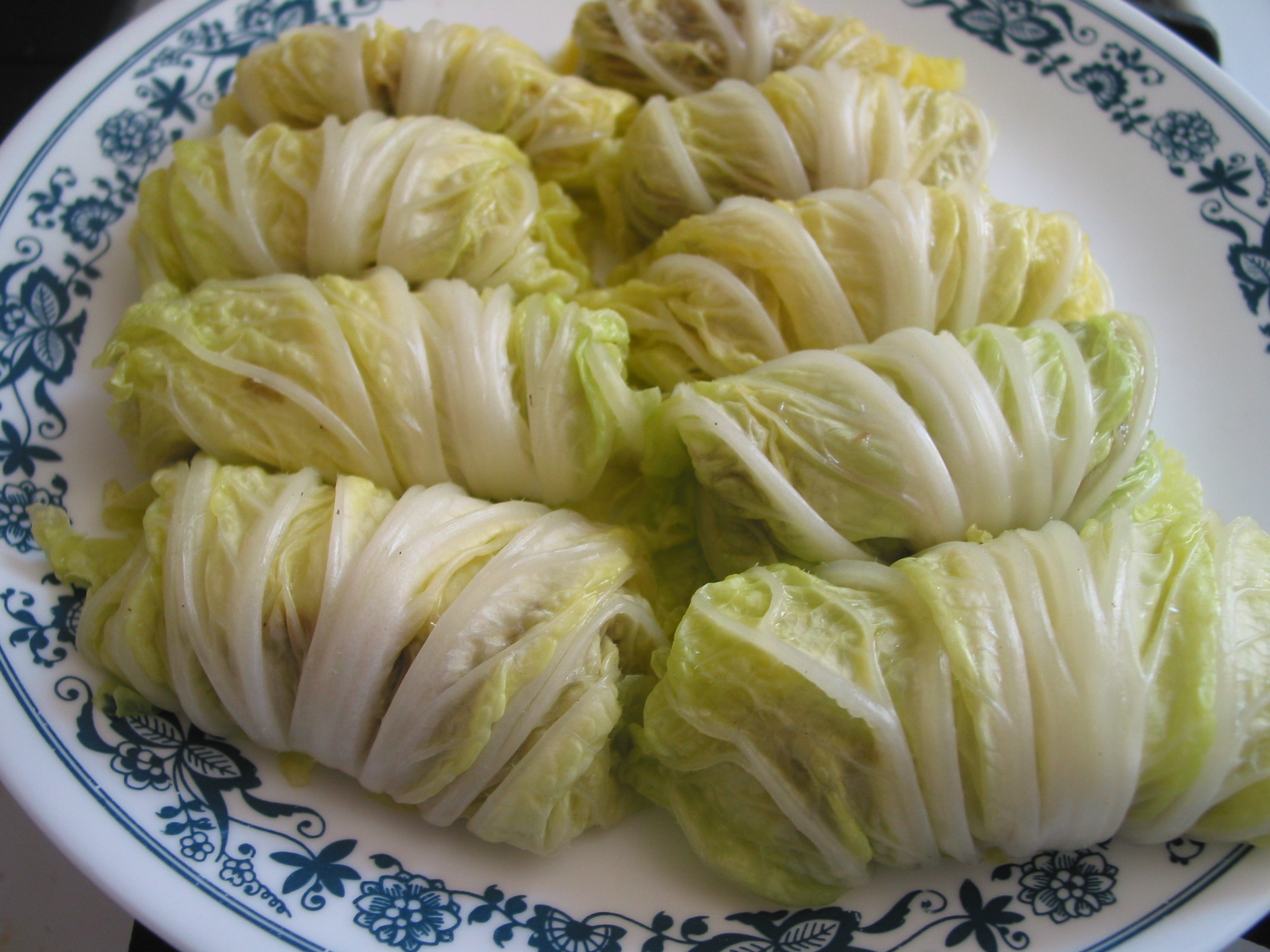
stuffed Nappa cabbage rolls-unsauced

I was originally going to call this post “Nappa 9-1-1” because it’s about salvaging a cabbage quickly and semi-artfully from the back of my fridge, but realized how bad that would be once I read the recent earthquake damage assessments up in the real city of Napa from the 6.0 earthquake a couple of weeks ago. Things are still kind of rough up there. The Napa Valley Vintners association have donated an impressive amount–$10M–and have instructions on how to donate to the local community disaster relief fund. You can find a number of local funds to donate to online at norcalwine.com.

I love bringing home a bag (or more) of produce from my local greengrocer each week–especially in the summer, when Fresno tomatoes are in and brilliant red, green beans are green and snappy, apricots and plums and pluots are spilling ripely out of the bins at under a dollar a pound, and herbs like purple basil and tarragon and mint and za’atar are 75 cents a bunch. You can’t help but feel like you’re going to be a great cook that day, just by cutting up a few vegetables and sprinkling on some oil and vinegar and strewing herbs (and feta or Alfonso olives) on top.

I always mean to use up all my vegetables before they start showing their age, but occasionally I get caught with something unintended at the back of the fridge. This week it was a Nappa cabbage, which is longer and less sulfurous (when lightly cooked) than the more traditional green and Savoy cabbages. A little closer to bok choy. So I peeled back the rusted layers, hoping that some of the inner leaves could be salvaged, at least, and I got fairly lucky.

But what to do with them? Chop and eat raw as a salad? Always an option. But I’d bought the cabbage in the first place to try out a quick microwave version of stuffed cabbage that would fulfill a couple of challenges I’d posed myself:

1. Vegetarian (not a big beef fan, personally)–I’m using the lentil/rice stuffing I developed for stuffed eggplants and onions  three years ago (has it already been that long???), because I actually made stuffed onions again last week and had some leftover stuffing in the fridge.

2. Microwaveable in a few minutes (to combat cooked cabbage stench and do it as more fresh-tasting than long-cooked)

3. Non-stinky, and not drowning in cloying sweet-and-sour tomato sauce (my two overwhelming childhood objections to holishkes)

4. Bridges the cultural/culinary gap between European and Syrian Jewish versions of stuffed cabbage by spicing the filling AND adding garlic and onions. It can be done, and should. And yet, I’m not stewing it to death (actually, that means overturning both Euro and Syrian traditional cooking methods in equal measures).

5. Fulfills the Prunes and Lentils Challenge, or at least hints at what’s possible, since today I had (gasp) no prunes left and had to resort to leftover tamarind sauce from the aforementioned batch of stuffed onions… close enough for folk music.

Stuffed cabbage rolls, as I’ve noted before, are popular throughout at least eastern Europe and Syria. Most versions contain meat–beef for Jews, beef or lamb for Arabs, some mixture of pork and beef for European Christians. But I’ve also seen some really beautiful-looking vegetarian ones in Nur Ilkin’s The Turkish Cookbook, and those were stuffed–of all things–with whole cooked chestnuts.

Cabbage lends itself to enveloping stuffings almost as well as grape leaves, and it’s easier to work with, cheaper, and (big bonus) unbrined.

In addition to meat or lentil fillings, you could try something like curry-spiced or Mexican-style beans and/or vegetables, a mu shu or samosa filling, whole cooked grains like brown rice or bulgur with or without dried cranberries or raisins and sunflower seeds or chopped nuts, maybe even fish (though I’m shying away from Joan Nathan’s recommendation for wrapping up gefilte fish and giving them the stuffed cabbage treatment). Perhaps for fish I’d want smoked (fake or real) whitefish salad. Or sausage–real or vegetarian, smoky and spicy.

It seems to me for sauces you could go well beyond sweet-and-sour traditional: a garlicky tomato sauce, a mustard vinaigrette, a smoky salsa with or without tamarind sauce, a chili-paste or z’khug-laden soy/molasses/vinegar/sesame oil dipping sauce with ginger and scallions, a polished herb and wine-type tomato sauce with prunes or mushrooms and onions, even (maybe definitely?) Korean or Thai peanut dipping sauce, especially if you stuffed your Nappa cabbage leaves with a combination of pressed tofu and/or omelet strips, spinach leaves, maybe some sprouts and shiitake mushrooms.

Whatever version you do, this can either be a quick path to dinner (use the big leaves and more filling per leaf) or to a platter of appetizers (using the small inner leaves).

Microwaving doesn’t develop every possible flavor (in the case of cabbage, I’m childish enough to say that’s a good thing), but it’s a quick way to play around with a classic at least on a trial basis. You could always do the huge foil-covered pan in the oven thing if you decide to scale up and go old-school.

Stuffed Vegetarian Cabbage Rolls

  • 1 head Nappa cabbage, washed and with the core cut out
  • 1 lb (2 cups, more or less) of (in this case) allspice/cinnamon-spiced lentil hashu (made w/cooked rice or bulgur, not uncooked) OR peppery lentil mititei-style sausage filling (substituting 1/3 c. cooked rice for the wheat gluten), or your choice of savory/spicy filling, preferably one that includes some garlic….
  • 1/2 c. sauce–in this case, 1/4 c. tamarind sauce plus a tablespoon of chipotle salsa and a few tablespoons of water. OR–just tamarind sauce, or just smoky salsa, or tamarind with a bit of tomato paste and a spoonful of sugar, or peanut dipping sauce, or dim sum dipping sauce, or Asian-type prune sauce, or prune and wine sauce with some tomato paste mixed in. Or mustard/garlic vinaigrette (as a dipping sauce, not necessarily to cook with)…YEESH! too many choices…


Microwaved cabbage leaves, ready for rolling

Microwaved cabbage leaves, ready for rolling

1. Separate the cabbage leaves, put in a microwave container, drizzle on a quarter-inch of water and put on a lid. Microwave 2-3 minutes until the leaves are just tender enough to roll without snapping the center.

rolling stuffed cabbage

Start the cabbage roll with the filling at the stem end

2. Drain the leaves and lay them out on a plate for stuffing and rolling. Put a tablespoon of fairly stiff filling an inch or so from the stem end of the leaf and pack it into a little sausage shape. Roll the stem end over the filling gently but as tightly as you can manage, then tuck the side frills of the leaf over the ends and continue rolling toward the top of the leaf. Place seam-side down in a microwave container or casserole. Roll up all the leaves and pack them into the container fairly tightly.

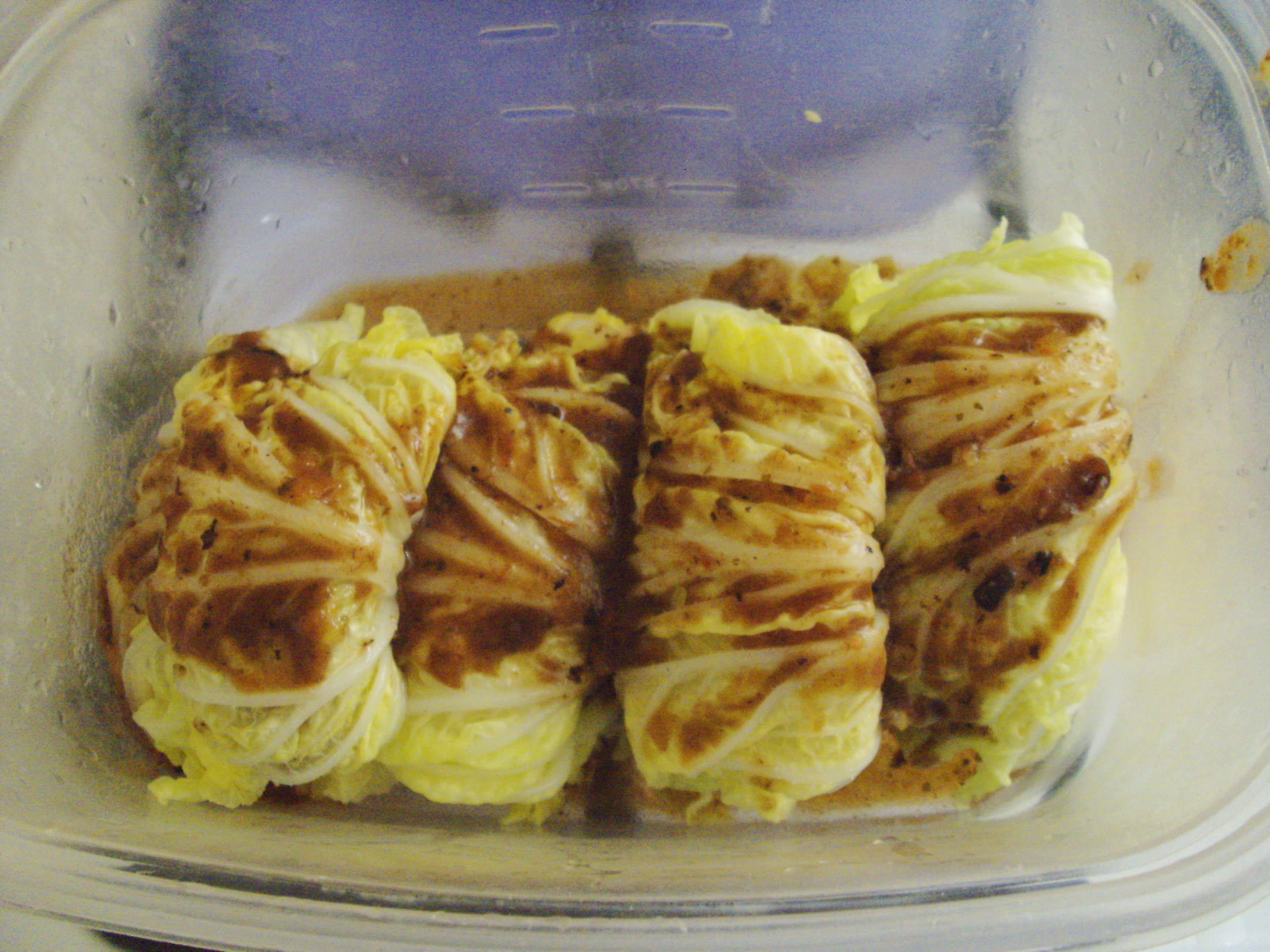
stuffed cabbage rolls with tamarind sauce

3. If the filling is completely cooked already (the rice in the lentil stuffing is not raw or par-cooked), just drizzle a bit of your sauce of choice over the stuffed cabbage rolls, maybe with a tiny drizzle of water in the bottom of the container. Put a lid on and microwave another 2-3 minutes or until just cooked through and steaming hot. If the flavor is still too raw or radishy for you, obviously you can cook it further, going a minute or so at a time, until it smells and tastes right to you.

Drain and serve with a little more sauce on the side.

Breaking the Rules: Fish with Red Wine

tilapia fillets Veracruz-style, with smoky salsa, onions, garlic, alfonso olives, red wine and fresh za'atar or "wild thyme"

One way to cook fish well using red wine

Wine is something I drink mostly for taste, not volume–I can’t really hack a lot of alcohol at once, blame my ancestors–but I do like wine tastings, even though I have to limit myself to about three small sips per glass if I don’t want to wobble out the winery door. Focusing on the flavors in a wine, and comparing several side by side, sharpens your palate and makes you think very specifically about what you’re experiencing. It’s rewarding even for someone with my drinking limits.

I also like to cook with wine, maybe more often than I like to drink much of it. Decent wine has such a complex combination of flavors that when you figure out how to do it well, cooking with wine can make even rapidly cooked dishes come off like serious Slow Food.

We hear a lot about long-cooking stews and coq au vin and so on, but many simpler and less time-consuming dishes benefit from smaller amounts of wine. Adding a couple of spoonfuls of dry white wine to mustard vinaigrette tempers the sourness, the garlic and the mustard sharpness a little and gives the sauce a quiet depth. And if my experiment with giant favas marinated in rosé and rosemary was any indication, we should be thinking about wine a lot more often and a lot more creatively as a cooking ingredient.

So I’ve been on the lookout lately for clear and simple techniques for cooking with wine without wasting it, and for doing it in less than a three-hour stew, because to me that’s slow-food-slow in large crowd-feeding quantities, to be attempted a maximum of once a year. I want better, more sophisticated-tasting food fast, using at most half a cup to a cup of wine, not a whole bottle, and preferably without huge cleanup.

But these days, when so much of the cookbook aisle in your local independent bookstore is taken over by Food Network Channel collateral, cooking with wine is almost a lost art. Most of the popular TV chefs aren’t even doing it anymore. Everyone’s gone sorta-Asian (but without Martin Yan’s shaoxing wine-wielding expertise or sense of humor) or sorta-Middle Eastern or bacon-filled-Tex/Mex or wishful-thinking-Indian-or-Moroccan wannabe (if I hear the words “ras el hanout” mispronounced one more time by any TV chef, anywhere…)

Most of those cuisines don’t include wine as a regular ingredient because of religious restrictions against alcohol, which I fully respect, or, in the Tex/Mex case, because wine doesn’t go with football (the true religion of Texas, although if you see the documentary Somm, you might be surprised at how many American master sommeliers and exam candidates are former football players.)

The new vegan and vegetarian cookbooks don’t consider wine at all, as far as I can tell, even though there are plenty of  vegan-approved wines and organic wines touted throughout Whole Foods (and even a few at Trader Joe’s). And a number of seitan and bean or lentil dishes (and certainly Roman-style lentil soup) would probably do all the better for a tinge of red, white, or rosé, either in the sauce or as a marinade ingredient.

Even the French- and Italian-trained chefs don’t use wine on TV very much, and if they do they don’t really explain it–why they chose that particular type of wine, how much to use and why, how to get the best flavor out of it in the dish, what else you could make using the same technique. Or else they’re kind of wasteful about it, using a whole bottle of wine for a single dish. Most people cooking for themselves would balk at that. Should balk at that.

It bothers me that I don’t actually see a lot of solid advice about cooking with wine, or at least not specific techniques that make sense in a home kitchen with a standard family budget.

Where am I going to get this advice? Not from the churn-a-minute Food Network chefs, clearly. Not from Harold McGee, either. To my great surprise, he devotes a total of about three paragraphs to “cooking with alcohol” in his food science books. The most interesting thing he says, other than to make sure and boil out the alcohol (duh) is that tannins will concentrate unpleasantly if you boil down a tannic red wine, but adding a protein to pick them up will tame them.

But since most of my uses for wine so far are to do with fish, I guess I’m already doing that…

As you might expect from some of my odd microwave-centric ideas, I tend to cook fish with wine in ways that probably seem unorthodox to anyone professional. For one thing, I cook several kinds of fish with red wine (sound of Francophile traditionalists screaming, then fainting in shock). Continue reading

The CDC tries defining “powerhouse” veggies

carrotsareveryhealthytom-ABS“Carrots are very healthy!” “Mmmhm, very healthy, Tom. Good for your eyes. Vitamin A I think.” A six-year-old’s view of carrots and nutrition, courtesy of my daughter from several years ago, and (obviously) influenced by the best of the cartoon world…

The Centers for Disease Control seems to have taken up the nutrition density scoring gauntlet to rate high-value fruits and vegetables for their “powerhouse” value. A research paper in this month’s Preventing Chronic Disease journal derives a nutrient density formula that’s not a million miles away from the ANDI scoring scheme Whole Foods was touting a couple of summers ago. The author presents a table of 41 plain, raw and unadorned fruits and vegetables that made the cut by delivering more than 10 percent of your recommended daily value of a combo of 17 major nutrients for 100 grams of raw weight and/or (this part wasn’t quite as clear) 100 kcal worth of food.

The fact that the CDC is now publishing this kind of study lends nutrient density scoring more legitimacy than perhaps it really deserves.

On the plus side:

  • The author, Jennifer Noia of William Paterson University in New Jersey, is an actual trained nutrition researcher with a Ph.D. in the field.
  • She’s not making a pitch or selling special dietary supplements. Her stated goal is to help the CDC develop practical guidelines for public health reduction of cancers and cardiovascular disease by rating vegetables and fruits for their general nutrition-worthiness.
  • She doesn’t bias her formula in favor or disfavor of her favorite name-dropping superfoods or taboos, as Joel Fuhrman and the admirers who started the ANDI scoring empire did.
  • Avocado doesn’t score big; it’s not even included (too caloric for what it delivers).
  • Noia does not include trendy components with questionable or untested nutritional value, things like  selenium, antioxidants (unspecified groups of) and phytochemicals (unspecified groups of) among the 17 well-tested nutrients she counts in for the composite formula.

So far, so good.

But the specific method she derives is still kind of muddled, and the logic behind the nutrient density comparisons is too.

First, are we going for 100 grams or 100 kcal (also known outside the lab as “100 calories”) as the standard amount of each food for comparison? The article switches back and forth without clarifying and the formula does not normalize to one or the other as a uniform standard.

Second, how does that amount, whichever one is in use, compare with a likely normal serving of the specific fruit or vegetable? Arugula’s way up near the top for nutrient density–but if you ate 100 grams of it, or worse yet 100 calories’ worth, at a sitting, you’d be trying to eat an entire plateful or maybe several platefuls of it. Very bitter. Most people include a small handful, maybe a quarter cup per serving, in a mixed salad for interest, or (as I do) on a sandwich. With mustard or vinaigrette and some other veggies.

Same for watercress. And both are expensive per serving compared with romaine, bok choy, Chinese cabbage, turnip greens…parsley??? Who’s going to eat 100 grams OR 100 calories’ worth of parsley? Scallions? Maybe if you grill them, but then again, 100 grams? 100 calories?

The list is also a little arbitrary and incomplete in terms of what’s included. Green beans make no appearance on the list, for good or ill. Maybe it’s because they don’t deliver a ton of vitamins per se, even though they have some fiber and potassium and are low in calories. Mostly, though, they don’t happen to fit into one of the four broad categories (cruciferous, leafy greens, citrus, and yellow/orange) included in the selected list. That’s not a nutrition criterion, it’s a plant classification criterion, even though it is based on some generalizations that those four categories are the most nutrient-dense of the common vegetables and fruits. But at least the author acknowledges that limitation in her study and isn’t saying green beans have no worth in one’s diet.

Of what is included in the list, the rankings by nutrient density score are a bit counterintuitive. Broccoli and cauliflower are, perhaps disappointingly, rated a lot lower on the scale than watercress–in the 20-25  range, not the 100 (maximum score). So are carrots and tomatoes.

One of the reasons for this is, as Dr. Noia writes, “As some foods are excellent sources of a particular nutrient but contain few other nutrients, percent DVs were capped at 100 so that any one nutrient would not contribute unduly to the total score.”

So the scoring formula is purposely handicapped toward well-rounded performers. Is that realistic or meaningful? Some of the foods that scored lower within each of the four broad categories  may provide large amounts of one critical nutrient–vitamin C or A, or fiber, or potassium, or iron–but perhaps not loads of B vitamins or calcium.

Well–that’s the way it is. Very few single vegetables–and almost no fruits–deliver so many different nutrients at high density in an edible portion. It’s why we eat a variety of vegetables and fruits and don’t just gravitate toward one impossible or hard-to-eat-exclusively jack-of-all-trades food.

And that’s the major flaw in this approach to defining nutrient-worthiness through a catch-all formula. The author of this study, the ANDI Score folks, Dr. Fuhrman and countless others really are looking for a magic bean. They want “AND”, not “OR”, a vegetable or fruit that delivers everything by itself. Even if they think they’re making it simpler for the average consumer to get better nutrition advice, they’re working from a false premise.

Still, at least Dr. Noia isn’t overreaching as much as the commercial popularizers of “superfoods” schemes. She admits the list is limited, and that the formula she’s derived from previously validated major studies is still preliminary. The correlation between her nutrient density score and established nutrients with some cardiovascular disease and/or cancer-prevention effect is predictably high–well, there’s a lot of overlap to begin with, so what it really tells you isn’t a great deal.

But there is some value in looking at the list of what scored at least a 10 out of 100. What can you really learn from this list?

First, “Bitter is Better.” Sort of, anyway. You wouldn’t want to make a whole dish of arugula or watercress, but you might want to throw a good handful or so into your salad or sandwich or pasta.

Notably, though, “More Expensive and Trendy isn’t Necessarily More Nutritious.” Kale isn’t as high up on the list as ordinary unglamorous spinach or turnip greens, or even darker leafy lettuces–isn’t that interesting?

Third, “Green is Good.” Darker greens are closer to the top of the list, and even between broccoli and cauliflower there’s a slight pan-nutrient decrease, though it’s not meaningful enough to start shunning cauliflower. Which I happen to like nearly as much as broccoli, and sometimes in combination with it. And although brussels sprouts are marginally more nutritious than cauliflower, they’re also more of a pain to peel and trim, and there’s a lot more waste.

The real Green Effect here has to do with calories. You notice that none of the citrus or berry fruits are up in the top 10 in the list. Apples and bananas don’t make the list at all, and melon is right out. So are summer stone fruits. Even apricots, which have a fair amount of vitamin A. That’s because the greens on the list are very low-calorie, with almost no carbohydrate or sugar. And because the nutrient density scoring formula accounts for nutrients per 100 calories (at least sometimes, when there are countable calories involved), fruits are naturally going to score lower.

From the perspective of diabetes prevention and weight control, this is a reasonable way of looking at how we get critical vitamins and minerals. The common phrase “fruits and vegetables” leads people to assume that fruits should be thought of first when you shop, and vegetables are kind of an afterthought. But it’s obvious from this kind of scoring that fruits should be considered dessert rather than the major source of vitamins and minerals.

However–given that citrus fruits, berries and stone fruits deliver large doses of vitamins C and A respectively, plus potassium and vitamin E and fiber on occasion, they shouldn’t be shunned for not “doing it all” and doing it carb-free. We need some carbohydrates, and if you eat an orange, a half a grapefruit, or even a nectarine at breakfast instead of a piece of coffeecake, so much the better. Just notice that you’re also eating some carbohydrate in the form of fruit and don’t eat three at a time. Or dump sugar and butter on it and still think it’s righteous because it’s nominally fruit.

I think we can all handle that. Even without calling anything a superfood.

Post-Kiddush: our leftovers are better than yours

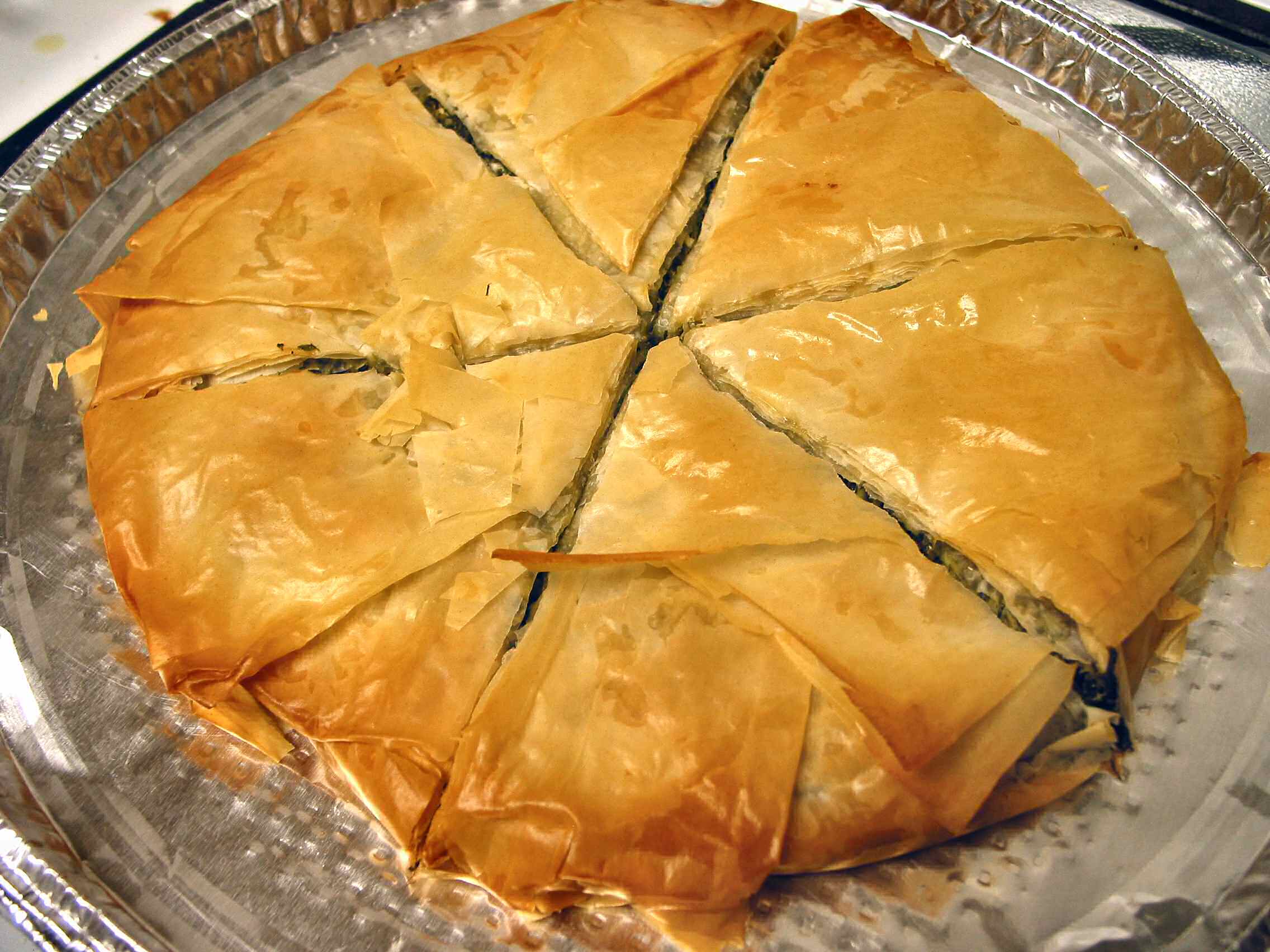
Round spare spanakopita just for us after the big kiddush

Round spare pinwheel-style spanakopita just for us at home. The big ones for the brunch had three pounds of spinach apiece (and were cut in small diamonds), but they still went together pretty fast–except for squeezing all that spinach dry…

This weekend I did it again–I made the kiddush, or in common speech a lunch buffet, for my congregation’s Saturday morning service. My husband kind of volunteered us for this week and because he doesn’t cook, most or all of the cooking, shopping, chopping and schlepping landed on my shoulders.

Last time he volunteered us, it was for our anniversary, and  I was ready to skip ahead to the divorce until I got over it, because it’s a lot of work to cook for 60 or so people who like to eat. And kibbitz. Especially when the 60 suddenly turns into 80-plus and having to use the synagogue kitchen with the more complicated and confusing rules on only a week’s notice. As they did this time…..

Soooo….a two-day hell of shopping and then marathon cooking-and-juggling in my little galley kitchen. The microwave got a serious workout. So did the food processor and the oven. Sometimes all at once. And it was raining hard for three days, so bringing things over to the synagogue kitchen as I went got a little tricky. I triple-wrapped the chocolate cake and stuck it in a USPS Priority Mail box so it wouldn’t get left out in the rain. Same idea for the spanakopita trays.

A few hints about cooking big and real for a synagogue brunch, learned the hard way by moi and passed on for your edification and safety (and sanity):

1. You can buy a 6-lb can  of chickpeas for massive half-gallon batches of hummus (Mid-East brand, maybe Goya as well). Cost? about $5. But–as I found out, and I’m glad no one was filming the process–industrial-sized can equals industrial-strength steel. A dinky hand-operated can opener is no match for such an item. I got just far enough to be able to pry open a kind of spout but there were tears and long-fluent-repetitive-all-throughout-the-house swearing sessions involved.

Still….

2. If you have a good corner greengrocer, you can buy quantities of eggplant for cheap–eleven or twelve eggplants made for a large tray of roast eggplant and onion slices (with garlic slivers and za’atar sprigs and olive oil) plus a large vat of baba ghanouj. Only the five eggplants I nuked for the baba ghanouj didn’t feel like cooperating fully when it was time to peel them. Might have been easier to peel first, then nuke, since it was all going into the food processor eventually. Next time…

3. Whole smoked whitefish for whitefish salad comes two ways–cold-smoked or hot-smoked. What’s the difference? I asked the counter guy at my favorite Armenian grocery. “Cold-smoked is a little less hard,” he said. So I bought it, thinking he meant the hot-smoked was tough as shoeleather and twice as chewy. I was wrong. Cold-smoked actually means the fish is smoked raw, like lox, only a little drier and tougher. But you don’t necessarily want to put it in whitefish salad that way. Man, it still had the scales on too. I couldn’t get it off the bones for love or money, and there were a lot of bones.

However, the microwave came to the rescue. I cut the fish in half and Continue reading