
• Enter your email address to subscribe to this blog and receive notifications of new posts by email.

    Join 241 other subscribers
  • Noshing on

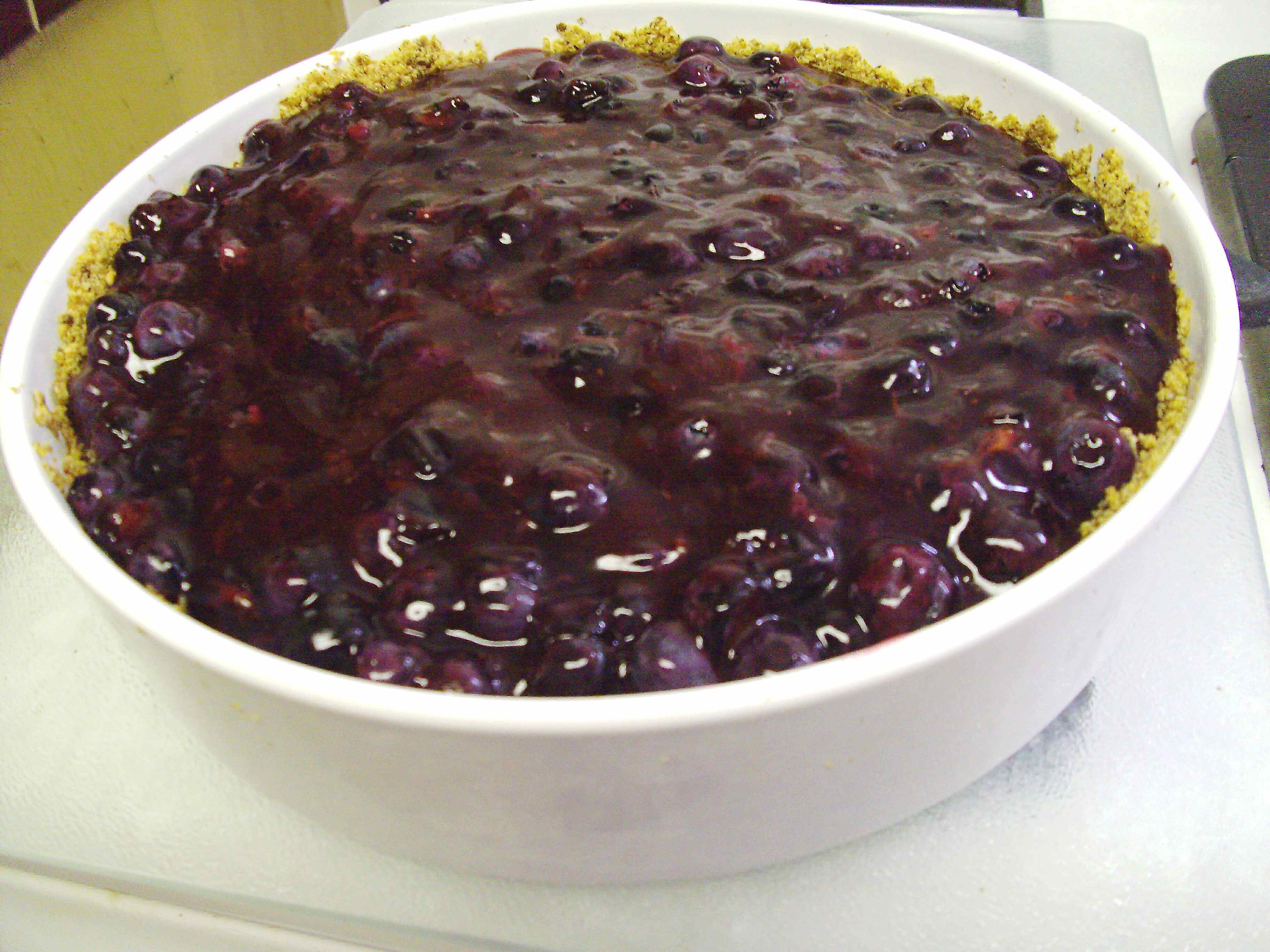
    raw blueberry pie with microwaveable filling and graham cracker crust

    This mostly-raw blueberry pie is a snap to make and very versatile--the filling microwaves in a few minutes, and you don't even have to bake the zippy gingered graham cracker crust--perfect for a hot Fourth of July and all summer long.

  • Recent Posts

  • Contents

  • Archives

  • Now Reading

  • See also my Book Reviews

  • Copyright 2008-2024Slow Food Fast. All writing and images on this blog unless otherwise attributed or set in quotes are the sole property of Slow Food Fast. Please contact DebbieN via the comments form for permissions before reprinting or reproducing any of the material on this blog.

  • ADS AND AFFILIATE LINKS

  • I may post affiliate links to books and movies that I personally review and recommend. Currently I favor Alibris and Vroman's, our terrific and venerable (now past the century mark!) independent bookstore in Pasadena. Or go to your local library--and make sure to support them with actual donations, not just overdue fines (ahem!), because your state probably has cut their budget and hours. Again.

  • In keeping with the disclaimer below, I DO NOT endorse, profit from, or recommend any medications, health treatments, commercial diet plans, supplements or any other such products.

  • DISCLAIMER

  • SlowFoodFast sometimes addresses general public health topics related to nutrition, heart disease, blood pressure, and diabetes. Because this is a blog with a personal point of view, my health and food politics entries often include my opinions on the trends I see, and I try to be as blatant as possible about that. None of these articles should be construed as specific medical advice for an individual case. I do try to keep to findings from well-vetted research sources and large, well-controlled studies, and I try not to sensationalize the science (though if they actually come up with a real cure for Type I diabetes in the next couple of years, I'm gonna be dancing in the streets with a hat that would put Carmen Miranda to shame. Consider yourself warned).

Another Reason to Make Your Own Salad Dressings
My husband came home this weekend loaded down with leftovers from a brunch he’d helped set up. Among the cartons of pasta salad and regular salad and dubious mass-market hummus and two–two? really?–homemade onion pies was a jug of something reddish. It turned out to be more than a quart of prepared raspberry vinaigrette, the kind of thing a caterer would pick up at a bulk commodities store. More than we would ever use in a year, but let it pass. He meant well.

So we found space for most of the stuff in the fridge, threw out the hummus because we didn’t know if it had been dipped into or not, and then there was this jug of vinaigrette hanging out on the counter. I took a look at the ingredients. Canola oil (boring but expected), sugar (enhhh–not a fan of sweet salad dressings, personally), salt, distilled vinegar, raspberry extract was somewhere down in the lower middle, more for color than flavor no doubt, paprika extractives (so much easier than actual paprika?)…yada yada yada…some kind of starch and emulsifiers to keep the oil and vinegar more or less together…polyethylene glycol…

Bleagggh. PEG? As my college lab partner once remarked, in a toney City Line (Philadelphia) accent, “It smells so….bio-laahhhgical.” And it does.

Not to mention the “nutrition” counts–and here I mean the sodium count per serving, which alone, minus any actual salad fixings, comes to 240 mg. It’s not so hard to see why chain restaurant salads typically hover above 500 mg sodium and frequently up to 900 mg.

So a couple of suggestions:

1. Make your own salad dressings–it’s quick and they’ll be fresher. You don’t need exact recipes, do you? Try a few of these.

2. Don’t automatically add salt–get the majority of your dressing flavors from the real ingredients. The satisfaction of a salad dressing comes from a combination of tart and savory ingredients to startle and intrigue the palate and make the freshness of the salad itself more apparent, so start with that. Flavor your dressing with garlic or shallots, lemon juice or vinegar, mustard or sharp cheese, olive or walnut oil, maybe yogurt or buttermilk, herbs, etc., but flavor it, don’t salt it. Real ingredients are also less likely to suffer flavor fatigue–salt’s a moving target that most people stop being able to taste when they eat a lot of it habitually (see the Salt Rant).

2b. If you’re following a recent cookbook or food magazine recipe, there’s sure to be a routine, unthinkingly added teaspoon of salt called for in just about every recipe. That’s much more than you really need to enhance a salad or make the dressing piquant. But those recipes are based on restaurant think, where salt is the cheap substitute for the expensive ingredients that need to be stretched. You don’t have that problem–you’re not making vats of bleu cheese dressing on a shoestring budget, you’re making dinner.

So leave out the salt, mix everything else together, and taste.

3. Time is your friend. You can make a basic vinaigrette right at the table–a dollop of mustard, a few spoonfuls of red wine vinegar or lemon juice, a pinch of salt if you must, and a couple or so spoonfuls of olive oil whisked in. Maybe a few herbs or a clove of garlic to boost it, and cracked black peppercorns over the top. Or nasturtiums.

But if the dressing–a yogurt or buttermilk-based one, say– is mostly about herbs, garlic, onion, shallot, scallions, bleu cheese or the like, let the dressing sit awhile to develop. If you make a yogurt/buttermilk/herb and garlic ranch-style dressing a day ahead, it’ll be much stronger and also more integrated after a night in the fridge. Right before serving, taste a bit of lettuce in the dressing and see what you think. If you still feel like salt is genuinely missing after you taste it in action, add a pinch or two. Not more. You can always add more to your own serving at the table if you’re craving salt for its own sake, and you’ll have the advantage of being able to taste it because the crystals will be on the surface of the food, where your tastebuds can get to them easily.

4. Unless it’s just olive oil and red wine vinegar, don’t toss the dressing in before serving, let people dress their own. Not everybody likes or can tolerate every dressing, and everyone’s got their own right amount. If you have to dress the salad ahead for a banquet setup, do it lightly. Less is more.

Spaghetti Squash Too Many Ways

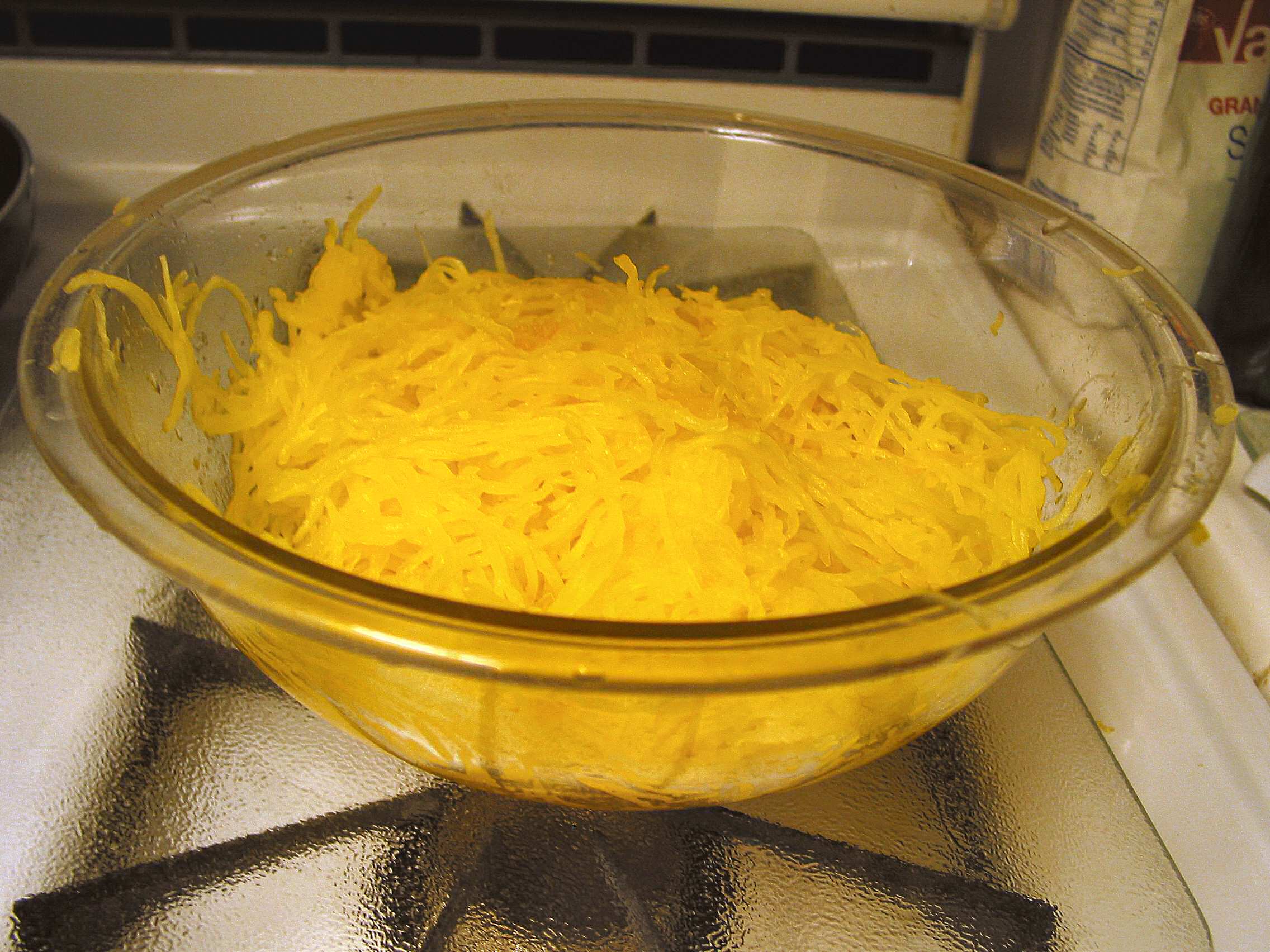
Just half of a microwaved spaghetti squash makes 5 or 6 cups

Just half of a microwaved spaghetti squash makes 5 or 6 cups!

This week my local Trader Joe’s had crates of beautiful–and hefty–spaghetti and butternut squash for less than $2 apiece–on the order of 30 to 50 cents/lb. So of course I got two of each and wobbled out of the store unsure which bag was pulling me down further. And then came the task of cooking them.

One spaghetti squash–a good-sized 5-6 lb. beast–will feed a lot more people than you’d think. It’s got some serious advantages over standard pasta: more fiber, no sodium, some vitamin A and potassium, perhaps fewer calories and carbohydrates per ounce. And it’s incredibly versatile. And you can cook it in the microwave in about 10 minutes rather than spend an hour baking it and heating up the house.

But there’s one big disadvantage–if you cook the whole thing, you have to eat the whole thing. Cooked spaghetti squash doesn’t hold up in the freezer–the strings go flat and shrivelly. And reheating too long can make it wilt as well. So can very acidic dressings.

So the choices are (for a small, moderately but only moderately tolerant family unit):

  • Cook half at a time and store the other half raw and wrapped in the fridge for a few days
  • Cook both halves, use one right away, and store the other half in the fridge for a few days, either wrapped in its shell or else scooped out into a container  (recommended)
  • Give the other half to a friend–but not too good a friend…
  • Cook it all and make it for a big potluck. Maybe people will think it’s innovative and exotic…depends on what you do with it (I don’t so much recommend marinara for this if you’re looking to impress–maybe a peanut-curry sauce or an Alfredo-style sauce with lemon peel, or something involving oyster mushrooms)
  • Cook it all and serve it a couple of different ways over the course of the week
  • Make a couple of the variations ones that taste good cold and eat the leftovers for lunch (recommended)

One important tip (learned the hard way):

The strands grow crosswise inside the spaghetti squash, not lengthwise. If you cut the squash in half the way you would a watermelon, you’ll be cutting the strands into shorter bits–not what you want. Cut the spaghetti squash in half across the middle of the SHORT side, NOT from the stem to the flower end.

If you have kids, let them count the seeds in each half of the squash–it’s a good lesson in plant survival strategies. My daughter and I counted about 80-90 seeds per half and decided to wash, dry and save them for her school’s garden. At this rate, they’ll have spaghetti squash for several years. Note of caution: out of 10 that we thought had been lost down the sink but actually got caught in the drainer, a full 9 germinated, so be careful what you wish for… even commercially grown, these things are very, very determined. But we’re not ready to name any of them “Audrey II”–yet. Continue reading

Canteloupe Ice or, I Conquer my Fridge

canteloupe-3

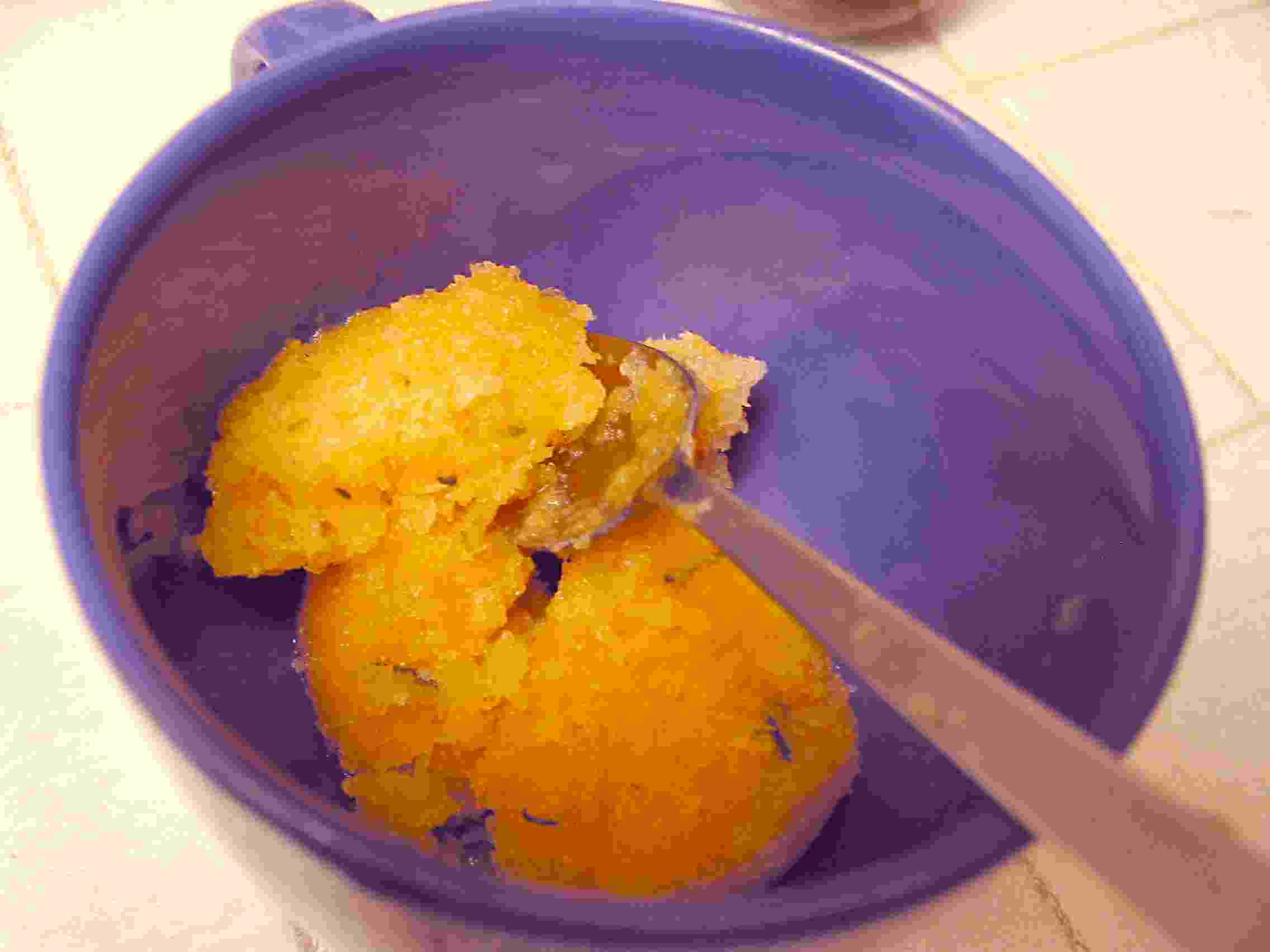
Don’t exactly know what to call this–it’s something between a sorbet and a granita, and it’s got only three ingredients–an extremely ripe canteloupe (no spoilage though) that had been sitting in my fridge for more than a week, the juice of a fairly large lime, and roughly chopped leaves from a sprig of rosemary. I scrubbed the canteloupe before cutting into it (old lab habits and new salmonella warnings combined, I guess), seeded it and puréed the flesh with the lime juice and rosemary in my food processor until it seemed pretty well smooth, then packed it into a 2-quart microwave container with a lid and still-froze it. I guess if I thawed it enough to break it back into chunks, I could regrind it finer in the food processor–I’ve done it with other still-frozen ices, but this time I didn’t bother. It did need thawing in the microwave to be able to scoop it out for serving–about 2 minutes on defrost.

That’s it. So it’s roughly 97 percent canteloupe with about 2 percent juice of a lime and 1 percent or less chopped fresh rosemary leaves. Can I say it’s made with 100% real fruit, then? No fake fruit involved (unless it was a franken-canteloupe–is that the northern equivalent to the chupacabras? It’s the right color for a new halloween monster, anyway)

And may I register a complaint about the interloper spelling that seems to have taken over since my youth–cantaloupe isn’t the same. It just isn’t.

But the canteloupe ice is nothing to complain about. Ginger would certainly also be good in place of the rosemary. Next year, maybe.

Pack your own lunch

It’s almost time to head back to school, and my daughter’s finally old enough to pack her own lunch. Not that she wasn’t actually old enough last year. But now she wants to.

When I was nine, I’d been making my own school lunches for at least a year, if only to save my sandwiches from my mother’s clutches and keep her from adding butter to the jam–something that did, and still does, make me absolutely nauseous. Emergency grossout prevention is the mother of lunch-making independence.

As many of my friends with same-age kids do, I worry that I haven’t been pushing my daughter hard enough toward independence by having her fix her own lunch. Is it too late to impart the mysteries of the toaster oven? But all is not lost–the other morning she figured out how to cut up her own apples (she has braces and our orthodontist “charges extra for stupidity-related bracket repairs”). She doesn’t appear to have lost any fingers. So we’re good to go!

Which is fortunate because lately I’ve been seeing a slew of new books on how to pack your kid’s lunch–they range from “here are all the vegan-friendly brand-names that look just like everyone else’s school lunch, only cooler” to Alice Waters insisting that the first step is growing your own school garden (which I’m actually in favor of, but not if it means waiting 6-8 weeks for your lunch to germinate).

Few of these fabulously sophisticated new books even consider the things I took to school every day as a kid–peanut butter and jelly, apple, carrots and celery. Or peanut butter and jelly, orange, carrots and celery. My mother was dull. My sister and I had no cool foods like Ho-Hos or Cheetos to distract us, and we usually ate at least some of the vegetables and the apple. Actually, so did most of the other kids in our school. It was that or suffer the cafeteria kale. And almost no one was fat. I’d like to point that out.

Hip mamas today (mostly those still in their 30s) look horrified at my daughter’s lunches because out there in hipland PBJ on whole wheat is so…so ’70s. It doesn’t contain any of the seventy-two essential nutritional supplement buzzwords (like selenium and phytoestrogens and antioxidant) they’re convinced all healthy food has to have (well, it’s true you have to have those things on the label to compete in the ads). And it has fat. And sugar!

But you know what? A decent peanut butter and jelly sandwich on whole wheat is a lot better deal nutritionally than most of the prepackaged, often self-righteously labeled, crap the hip kids bring to school these days. Much of it is along the lines of Kraft Foods’ “Lunchables”–a processed meat and cheese cracker kind of thing packed with some ersatz juice and faky side items like jello and  candies (not even, as I check belatedly, a tiny tin of applesauce–and check out the Lunchables nutrition and ingredient stats!). But you know how popular these things are–because they’re a kit. Buy five boxes, throw one  in your kid’s backpack each day. They stack neatly in the pantry.

Very few of these children ever bring a substantial serving of fresh vegetables or actual fruit–not even apples. Those require washing, peeling–maybe even cutting up. And sometimes the apples turn a little brown on the cut sides. Organic fair-trade labeling aside, any remotely fruit-like substances in the hip-kids’ lunch bags arrive in a rectangular cardboard box with a plastic overwrap, a plastic straw attached, and a sanitized-for-your-protection seal. No wonder they stare.

Anatomy of a PBJ:

Straight-up peanuts-only butter (no salt, no sugars, no mono- and diglycerides, no emulsifiers or BHT or “natural flavoring” or any of the rest of it) has about 16 grams of fat per 2 T (1 oz) serving. True. Absolutely true. But it’s not the same as the heart-stopping blubber you find on a piece of meat, so stop shrieking. Most of the oil in natural peanut butter is polyunsaturated (the “good fat” kind of fat). And it separates (because of the lack of fakery and emulsifiers) so you can pour off a good bit of it if you want to when you first open the jar.

Furthermore, the same peanuts-only peanut butter contains 8 g protein, 3 g fiber, almost no sodium, and about 210 mg potassium. And a little iron. It’s a pretty good deal for a kid’s lunch item at about 200 calories.

Two slices of whole wheat bread without too much sodium or garbage ingredients gives you another 200 calories–we’re up to 400, but only 3 g. saturated fat, another 3-7 g fiber, another 4-6 g protein, and with a little care preferably less than 400 mg sodium (all from the bread). Add a spoonful of all-fruit jam with 8 g sugar, at about 35 calories, and you have something that will get your kid through school without tears or big sugar highs and lows.

It doesn’t have big vitamin- and calcium-fortified labeling. It doesn’t have a label. It’s not supposed to do it all on its own. Your kid will eat about half, maybe the whole thing if he or she is growing fast or running around a lot that week. But he or she will get the vitamins and calcium from the other things in the lunchbox–some crunchy raw vegetables and an apple or orange and a thermos or carton of plain unsweetened milk. That’s it and that’s enough.

Do your kid a huge favor and leave out all the chips, chocolate, go-gurt (real milk-and-cultures yogurt is ok, not the fake tapioca- and gelatin-stretched stuff), cookies, jello, sorta-applesauce, and fluorescent boxes of juice. School is hard enough without sugar crashes or cavities, and they don’t need any of it to have a good day.

Oh yeah. And for crying out loud, please skip the sushi. Your kid does NOT need to be that hip in the school cafeteria. Or that sick, if the sushi doesn’t stay cold enough.

(Why yes, I live in Southern California. What gave it away?)

“High Protein Bran Muffin”–A good idea gone bad?

This is what’s wrong with American thinking today:

  1. That muffins are healthy, or as in the example below, “healthful”
  2. That bran muffins are really healthy and therefore can be eaten big
  3. That such healthy muffins should be eaten as a source of protein.
  4. That muffins this perfect can and perhaps even should be eaten as a substitute for meals.

Exhibit A, from a recent “Culinary SOS” recipe request column of the LA Times Food Section.

Dear SOS: Have you ever tasted the muffins at —–‘s Bakery? They are huge, delicious, healthful and so satisfying. There is a particular favorite of mine, a high protein muffin that, when eaten, makes one glow inside and feel healthy all day…
–Shirley

Dear Shirley: These generously sized muffins pack a medley of flavors and textures in every bite. A batch’ll go quickly — they make for a fun, quick breakfast or perfect snack.

Well. Can’t wait. Let’s take a look at the ingredients list as given in SOS.

High protein muffin
Total time: 45 minutes plus cooling time  Makes 14 muffins

1 (12-ounce) can frozen apple or white grape fruit juice concentrate
2 1/4 cups wheat bran
1 cup (4 1/4 ounces) flour
3 1/4 teaspoons baking soda
3 1/2 teaspoons baking powder
1 1/2 teaspoons salt
2 1/4 cups buttermilk
1 cup plus 2 tablespoons canola oil
4 eggs, lightly beaten
1/2 cup sesame seeds
1/2 cup shelled pumpkin seeds
1/2 cup flaxseeds
1/2 cup coconut
1 1/2 cups granola
2 cups raisins

I’ll skip the instructions–they’re involved and painful. All I’ll say is, the  recipe involves boiling down Ingredient #1 (and wasn’t that a shock in a health muffin recipe) and still throwing some of it out.

Now the nutrition. I have to say I’m tempted to use the ingredient list as a small practical quiz to see if anyone can ballpark the calories, fat, carbs and sodium per serving from it. Anyone? Anyone? No? OK, then. Fasten your seatbelt. Or perhaps just your belt.

Each muffin: 515 calories; 11 grams protein; 54 grams carbohydrates; 9 grams fiber; 32 grams fat; 5 grams saturated fat; 62 mg. cholesterol; 742 mg. sodium.

Now wait a minute. 500+ calories? for a muffin? 700+ mg sodium? 32 g fat? For that much fat and salt you could eat a chunk of cheddar almost the size of a deck of cards. Straight.

Anyway, this is clearly one overloaded muffin, with tons of expensive extras. Heavy too–or why the 7 teaspoons of leavening for a single batch? And the irony is, after all that stuff, it still only delivers 11 g protein per muffin. You could get that with a large glass of skim milk.

But you know what’s really sad about this muffin recipe? It’s not alone. Even the classic Weight Watchers Cookbook recipe for bran muffins still weighs in at 300-plus calories per and 500-plus mg. sodium.

What gives? Should we simply not eat muffins? Can a bran muffin recipe ever be actually delicious AND low-fat, low-salt, moderate-carb, and perhaps, dare we dream it, less than 200 calories per, so you don’t feel stupid not having asked for something a little more actively delicious for the same calories–maybe a croissant or a slice of flourless chocolate cake instead? With, obviously, raspberry coulis?

How would you go about it? Maybe it would be better to go with something like the cake-style gingerbread recipe in the Silver Palate Cookbook–makes 12 servings with a lot less starch (1 2/3 c. flour), no nuts and seeds and extras, only one egg, only 1 1/4 t. baking soda, a bunch of gingerbread spices, 1/2 c. oil you can skip in favor of applesauce with no problems at all and a huge cut in calories, half a cup each of sugar and molasses or honey, some boiling water right before baking, and that’s pretty much it. You can even microwave it for about 5-7 minutes at half power instead of baking it conventionally.

Now granted, it’s not bran–but it could be at least whole wheat without ruining the aesthetic. It’s not 500 calories a square either–by my reckoning more like 120 in the applesauce version, and something like 150-200 mg sodium. And no one expects it to substitute in for a meal’s worth of fiber and protein, but with raisins and whole wheat flour, it would probably have 4-5 g fiber and you could always serve it with skim milk.

If you’ve convinced yourself that nothing but a “high-protein” muffin will do, and simply drinking some milk with it isn’t glamorous enough, throw in a packet of nonfat powdered dry milk. But really, unless it’s your only meal of the day, you don’t actually need the added protein. Muffins weren’t made to be steak.

Finally, why make huge muffins? Unless you want to end up looking like a Mack Truck, make decent medium-sized or cupcake-sized muffins, and if you’re still hungry afterward, eat an apple. And drink a glass of milk.

Suing for Salt

The Center for Science in the Public Interest is supporting a New Jersey man’s class action lawsuit against Denny’s Restaurants after private talks apparently failed to convince the chain to lower the exaggeratedly high sodium content in its meals. Apparently CSPI combed through the nutrition data on the Denny’s web site. A couple of sample readings:

Denny’s double cheeseburger–3880 mg
Denny’s Meat Lover’s Scramble–5,690 mg
Denny’s “senior” menu scrambled eggs and cheddar cheese meal–2,060 mg
Spicy Buffalo Chicken Melt, and a side of seasoned fries–6700 mg sodium, 1700 calories

The lawsuit was filed in Superior Court of New Jersey in Middlesex County, and seeks to compel Denny’s to disclose on menus the amount of sodium in each of its meals and to place a notice on its menus warning about high sodium levels.

“But it’s organic! But it’s vegetarian!”

Vegetarian and organic foods are gaining popularity in supermarkets around the country–it’s been happening for at least a decade. Vegetarian- and organic-seeking customers assume they’re getting something closer to fresh if it’s labeled vegetarian or organic, and most of them also assume that vegetarian automatically means healthy. So, apparently, do nutrition researchers when they’re not really thinking hard enough.

The American Dietetic Association recently announced–again, updating from 1997–that vegetarian and vegan diets can be healthful at all stages of life from infancy onward and posted suggestions for getting started. Keyword here is “can”.

The idea of easing into a less-meat diet in stages by cooking familiar foods and familiar ingredients as far as possible is understandable. The Vegetarian Nutrition practice group of the ADA is trying to reach people they think are likely to panic at the suggestion of not eating meat. Unfortunately, the suggestions that top the list are mostly for processed meat substitutes, jarred pasta sauces, canned beans, boxed rice mixes and the like, rather than a dietary framework for eating fresh whole-ingredient vegetarian foods.

In the health section of the LA Times online, where I first read about the ADA’s statement last week,  many reader comments objected to this approach primarily because the major brands of veggie hot dogs and hamburgers tend to have long, improbable ingredient lists and very high salt. After a casual tour of the sauces-soups-and-rice-mixes section at my local Whole Foods, it’s an objection I second even more strongly.

For several years now I’ve had reservations about the processed food industry’s tendency to throw salt at anything and everything. Vegetarian and organic food is supposed to be better. Fresher, better-tasting, realer, more nutritious, healthier, more responsible for the planet, the animal world, and the customer. In a word, BETTER.

Nice intentions aside, most of the vegetarian and organic products companies these days seem to be trying as hard as they can to keep up with or even surpass the meat-eating Joneses–the big-brand pantry staples from Stouffer’s, Swanson’s, Kraft Foods, Campbell’s, and so on.  They’re still claiming the health and planet virtues of vegetarian and organic, but they’re actually processing the hell out of their foods, adding all kinds of laundry-list mystery ingredients, and salting them out of all reason. And health-and-planet-conscious consumers are flocking to them without bothering to look hard at the nutrition labels. How have we come to such a pass? Continue reading

How to Nuke an Eggplant

Eggplant after microwaving

After microwaving 10 minutes, the eggplant has collapsed

Eggplant is one of those warm-climate foods. It’s big, cheap, and plentiful, it goes with everything from garlicky oregano-and-fennel laden tomato sauce to nutmeg-tinged custard or cumin/cinnamon-scented Greek and North African dishes, to curries and darkly soy-glazed Chinese and Thai dishes. You can deep-fry it, panfry it, grill it and serve it room-temperature under a glossy layer of olive oil, marinate it, wrap it around other fillings, stuff it, roast it, make spreads with it… There’s even a Greek eggplant “spoon sweet” and at least one eggplant “jam” from Morocco. To say nothing of pink-tinged sour eggplant pickles, one of my favorite additions at the Israeli felafel stands.

The only thing you don’t really want to do with eggplant is eat it raw.

I NEVER bother with the usual cookbook directions for eggplant. All of them slavishly recopy instructions from their predecessors–salt it, drain it, fry it in tons of expensive olive oil, which it will soak up mercilessly, bake it for an hour only to find it still has spongy raw spots… They never bother to update, or even retest, the traditional assumptions that make eggplant such a pain.

You can forget most of that if you just nuke your eggplants first. Most of the stuff people do to their eggplants comes of just trying to get it cooked through. The salt’s to get rid of some of the water; the fat’s to cook it hotter and let the juices steam inside the slices.

Microwaving takes care of both, needs neither fat nor salt, and it’s very quick–10 minutes on HIGH on a pyrex pie plate for 1 or 2 decent-sized eggplants and you’ve got either collapsed whole eggplant(s) ready for baba ghanouj or a fan of slices or a mountain of bite-sized cubes. All of them cooked through and ready to do something more interesting with.

I used to think I was alone in the wilderness on this one, because NO ethnic cookbook–or any other cookbook with eggplant recipes–ever considers the existence of microwaving, much less condones it for cooking actual food. Continue reading

Naked Lunch: Nutrition labeling law in effect for California Chain Restaurants

California’s not the first state or municipality to require restaurants to declare their nutritional stats to customers, but as of today, the state will require chains with more than 20 in-state locations to post calories, carbs, sodium and fat information for each menu offering. The new law also bans sales of soda and junk foods to students at public schools–a big step toward reducing empty calories and sodium consumption among children and teens.

Patt Morrison of Pasadena-based public radio station KPCC interviewed the California Restaurant Association’s senior vice president for government affairs and the executive director of the California Center for Public Health Advocacy.

Surprisingly enough, the CRA’s representative said the association actually backs the legislation in its current form. When asked whether similar New York City legislation had had any effect so far, the CCPHA director said it had–chain restaurants had started reformulating popular high-calorie foods back downward. He also gave demographics: 89 percent of Democrats and 78 percent of Republicans polled said they were in favor of the new law. Most of the callers to the show also said they wanted or needed to know what was at the end of their forks.  A fascinating interview all the way around.

Buttermilk ices

Buttermilk is one of those underappreciated dairy foods, as is the even less well-loved nonfat powdered dry milk. Both are somewhat unappetizing taken straight. A glass of buttermilk, though it has its fans, can taste like liquid cottage cheese, and reconstituted NFPD never quite sheds its dank, sticky chalkiness, especially if you’re attempting to use it in the morning coffee (a desperate we’re-all-out-of-actual-milk substitute that has driven me to Starbucks more than once).

Cookbooks tend to ignore buttermilk and NFPD or else sweep them into baking recipes where they won’t matter much, won’t be recognizable, and certainly won’t dominate the taste. Given how much protein and calcium they contain and how inexpensive they are, that’s kind of a shame.

But treat them right and you get something light, versatile and delicious for dessert. Buttermilk’s actually a little easier to believe in an ice cream-like dessert than NFPD is. Foodie magazines feature lots of lemon buttermilk ice creams this time of year, but they include such odd and unnecessarily rich ingredients as cream cheese to simulate a superpremium ice cream’s texture. Not only is it extremely calorie-dense, it’s really, really expensive. Kind of defeats the purpose of using lowfat buttermilk in the first place.

My version of a lemon buttermilk ice uses NFPD instead of fat to create the microcrystalline structure that keeps it from turning into a huge popsicle. It won’t melt quite the same as ice cream, but it’s packed with flavor and a small portion feels like “enough”, especially with fresh fruit on the side.

NFPD’s stale chalkiness and crumbly texture are not so hard to fix, but I haven’t seen anyone presenting a method for it so I’m doing it here. There are two tricks, both of which can probably help for other NFPD recipes, even savory ones.

First is the taste–in this case, the lemon juice and rind seem to counter it quite successfully, and the juice also seems to help NFPD dissolve more smoothly. Orange juice seems to work also, so maybe it’s the tangy acidity that counteracts the stale milk taste. As long as you’re not heating it up, you don’t run the risk of curdling either.

Second is the clumpiness. There are a couple of Indian recipes where it’s actually a possible advantage–gulab jamun and burfi both seem to take advantage of NFPD’s doughiness when mixed with a scant amount of liquid. But for desserts where you want it to dissolve smoothly, just whiz the dry NFPD by itself in a food processor, or just with sugar, to get it to a fine dust before blending in any liquids.

Lemon Buttermilk Ice (makes about 8  1/3- to 1/2-cup servings)

  • 3.2 oz (91 g) packet nonfat powdered dry milk (or the amount specified on the package for a quart of reconstituted milk)
  • 1/2 c sugar
  • 2 c. lowfat buttermilk–drained a bit if it’s starting to separate
  • juice and grated peel of a lemon
  • 1/2 t. vanilla or to taste

Grind the NFPD and sugar together in a food processor until they form a very fine powder. Pour in the buttermilk and pulse to get the powder off the bottom of the food processor. Add the lemon juice and peel and the vanilla and blend again. Either pour into an ice cream maker for churning or into a freezer container with a sealable lid and freeze an hour or so. Scrape the frozen crystals off the sides, stir them into the still-liquid part of the buttermilk ice, cover again and refreeze. Do this once or twice more. Serve with fruit.