• Enter your email address to subscribe to this blog and receive notifications of new posts by email.

    Join 241 other subscribers
  • Noshing on

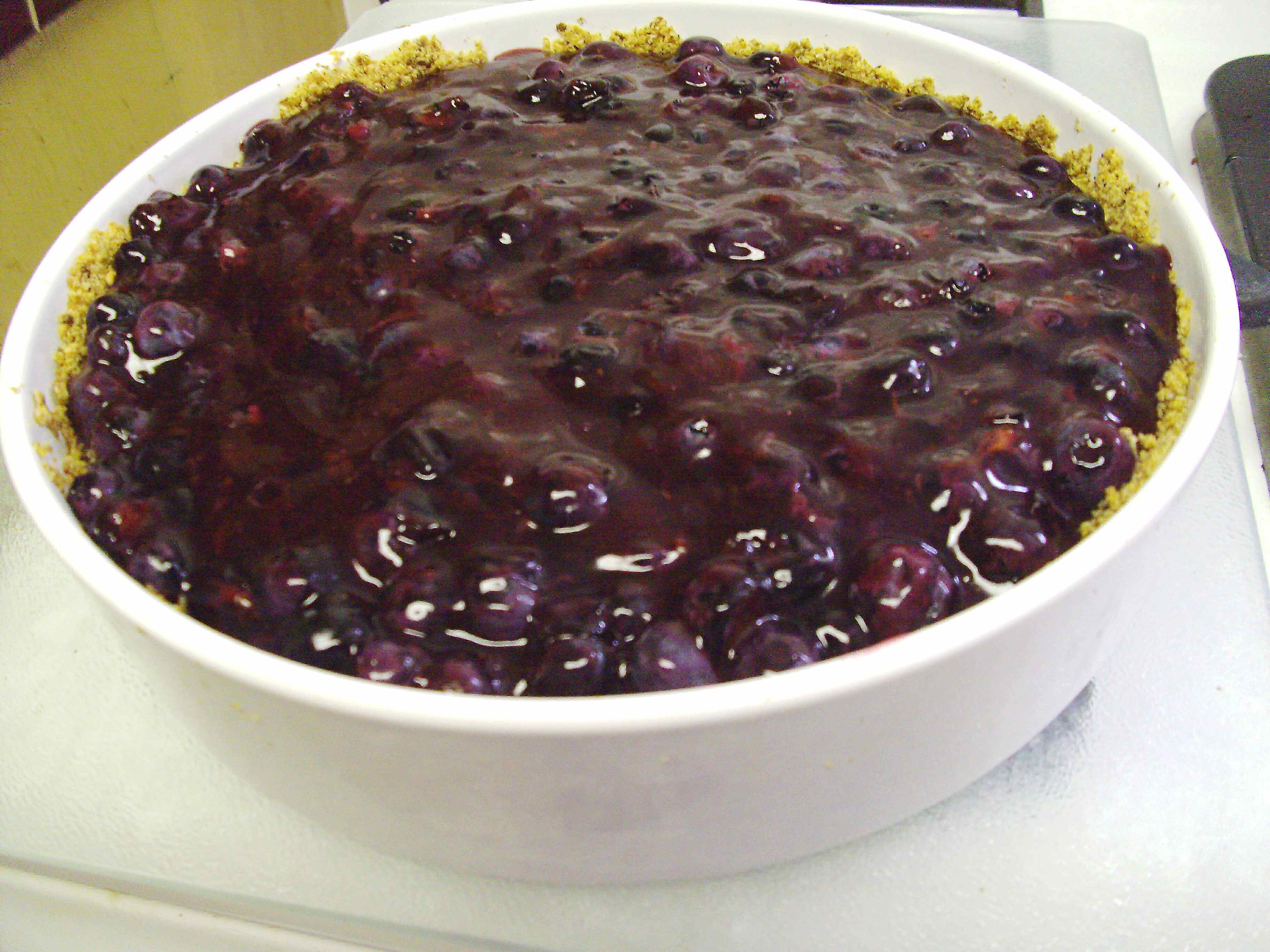
    raw blueberry pie with microwaveable filling and graham cracker crust

    This mostly-raw blueberry pie is a snap to make and very versatile--the filling microwaves in a few minutes, and you don't even have to bake the zippy gingered graham cracker crust--perfect for a hot Fourth of July and all summer long.

  • Recent Posts

  • Contents

  • Archives

  • Now Reading

  • See also my Book Reviews

  • Copyright 2008-2024Slow Food Fast. All writing and images on this blog unless otherwise attributed or set in quotes are the sole property of Slow Food Fast. Please contact DebbieN via the comments form for permissions before reprinting or reproducing any of the material on this blog.

  • ADS AND AFFILIATE LINKS

  • I may post affiliate links to books and movies that I personally review and recommend. Currently I favor Alibris and Vroman's, our terrific and venerable (now past the century mark!) independent bookstore in Pasadena. Or go to your local library--and make sure to support them with actual donations, not just overdue fines (ahem!), because your state probably has cut their budget and hours. Again.

  • In keeping with the disclaimer below, I DO NOT endorse, profit from, or recommend any medications, health treatments, commercial diet plans, supplements or any other such products.

  • DISCLAIMER

  • SlowFoodFast sometimes addresses general public health topics related to nutrition, heart disease, blood pressure, and diabetes. Because this is a blog with a personal point of view, my health and food politics entries often include my opinions on the trends I see, and I try to be as blatant as possible about that. None of these articles should be construed as specific medical advice for an individual case. I do try to keep to findings from well-vetted research sources and large, well-controlled studies, and I try not to sensationalize the science (though if they actually come up with a real cure for Type I diabetes in the next couple of years, I'm gonna be dancing in the streets with a hat that would put Carmen Miranda to shame. Consider yourself warned).

Matzah Brei–blintzes?

Matzah Brei Blintzes

Thursday morning I broke down and decided to cook  breakfast for my daughter instead of leaving it at matzah, jam, yogurt and fruit. I’m not a big fan of matzah brei, a poor substitute for french toast in which the eggs never really seem to absorb very well and you’re left swallowing the hard corners of the matzah. Neither crisp nor soft, it always seems like a wrong turn to me.

On the other hand, I didn’t have any matzah meal in the house for pancakes (how much extra matzah product do you really need when you’re trying to eat less of it?) So I broke down and took a couple of sheets of the whole wheat matzah from the latest box and prepared to do battle.

I think I’ve mentioned once or twice that I hate waiting for water to boil. But a pyrex pie plate with half an inch of water in the bottom takes only 2 minutes to heat up fairly well in the microwave. And it has room for the matzah, which I broke up into halves. But whole wheat matzah doesn’t soak up all that well, even after several minutes in hot water. It’s the tougher bread of affliction. What now?

I fished out a dinner plate and covered the pie plate with it, stuck it all back in the microwave, and hit stun for another minute. To my surprise, it worked–really worked. The matzah didn’t fluff up or anything–but it was soft and pliable and even a bit elastic, something like just-cooked lasagne noodles. No hard corners. I drained off the hot water and poured on the egg-milk soak, which didn’t really soak in much even though the matzah was now soft. Sigh.

My daughter came around a corner, looked at me fishing one of these matzah halves out of the pie plate, and said, “I wish we could have blintzes” and I thought–well, these actually bend–could we? Why not?

Matzah brei blintz ready for frying

Matzah brei blintz, ready for frying

Continue reading

Impatient for Orange Peels

Microwave Candied Orange PeelTonight is the first night of Chanukah, or as the next generation spells it, Hanukkah, and instead of blogging about latkes, which I’m not making tonight, in favor of a congregational dinner (yay, no cooking, no dishes, no family kvetches), I decided to pick something else I like more. Like candied orange peel, which is outrageously expensive if you buy it at a candy store. Chocolate plus oranges is the flavor of Sabra liqueur, an Israeli elixir from the days of my childhood which I think is now out of production. Of course, so’s my childhood, or at least my first childhood…

But the standard recipe for candied orange peels goes something like: “Boil some water. Blanch the de-pithed orange peel strips from a couple of oranges for two minutes. Throw out the water and do it again. Then simmer the peels in 4 cups of sugar and 4 cups of water for an hour or two. Then drain them. Then toss them separately in a bowl with fresh, dry sugar to coat and spread them out on a cookie tray to dry for another couple of hours.”

In all, that’s about 4 or 5 hours. Oy! My inner second childhood is whining already.

Following up from my microwaved kumquat marmalade experiment, which worked beautifully, I decided I could probably do something similar to candy orange peels. The final result was not perfect-perfect by professional confectioners’ standards and I wouldn’t be surprised if Martha Stewart disapproved, but it looked okay to me, was done in 15 minutes from peeling oranges to dredging-and-drying, and the taste is not bad, not bad at all. Makes you wonder.

The oranges I picked were a bit bland and nonacidic, and tangerine or clementine would be a bit livelier if you can find organic ones, but this is what I had. And as I discovered, the flavor seems to improve as the peels sit after being dredged in sugar and dried. Continue reading

Lentil Stew with…Pineapple?

Fresh pineapples are just coming on the market at a good price this week or so–$2 or $3 apiece. Meanwhile, tomatoes are…well, let’s say they’re not at their finest in December. So, some added incentive for trying something new.

Pineapple is the last thing that belongs in anything subtle or savory–or is it? Hawaiian pizza is practically a classic by now, despite the culinary clash of a pineapple-ham topping on the one hand and garlicky tomato sauce, mozzarella and oregano on the other. Of course, that (and all other glazed pineapple/pork product classics) seems more brash than subtle.

Given the usual culinary partners–ham, chicken, cottage cheese, spam and more spam–you’d think the rule for making pineapple work in something savory would be that the other main item has to be pretty salty to stand up to all that acidic tropical sweetness. But that’s not the only way to deal with it. Good thing too, since ham, ham, spam and ham are off my grocery list. (So’s spam.)

This curried lentil and vegetable stew, which I’ve based on a dish from my much-missed Lebanese former-restaurant-turned-lunch-spot, takes advantage of pineapple’s tang while mellowing out its jarring sweetness. It took me a couple of tries to achieve the taste I remembered from the restaurant, but I think this version works pretty well, even though it contains no salt at all.

Depending on the sweetness of your pineapple, you may need more or less to balance the flavors. The pineapple should be a subtle but surprising bite among the other vegetables and the rich lentil base. Don’t be afraid to tinker with the (rather loose) amounts of the various ingredients and taste as you go.

Curried Lentil Stew with Pineapple

  • 3-4 c. fully cooked green/brown lentils or half a pound dry (see step 1)
  • 1 T. curry powder
  • 1/2 t. ground cumin
  • 1/2 t. ground coriander seed if you have it
  • 1/2 t. brown mustard seeds if you have them
  • 2 medium onions, chopped
  • 1-2 medium tomatoes if you have them
  • juice of a lemon–plus another half to adjust taste as needed
  • 2  large or one really fat clove garlic, minced/mashed/grated
  • 2-3 half-inch rounds of fresh unsweetened pineapple in smallish chunks
  • 2-3 big carrots, peeled and chopped
  • 2-3 stalks celery, chopped
  • a good glug of dry red wine, cheap but decent, about 1/4 c.
  • olive oil

1. To cook the lentils in case you haven’t, wash and pick over half a pound of green/brown lentils and put them in a big pyrex bowl (2.5 qt/l) with enough water to cover by 2 inches. Put a microwaveable lid or dinner plate on top and microwave on HIGH for 7-8 minutes. Let sit in the closed oven another 20-30 minutes to soak up, add more water if there’s less than an inch above the lentils, then microwave again for another 7-8 minutes. Wait another 10-15 minutes and test for doneness. The lentils should be soft.

2. Meanwhile, sauté one of the onions with the spices in a little olive oil for a few minutes, add the chopped tomato and half the garlic and cook a few minutes, adding a drizzle of water if it starts to dry out.

3. When the lentils are done, pour them in with some of the cooking water, stir up, heat, and add the lemon juice and the pineapple. Cook a few more minutes until it starts to thicken.

3. Put the cooked lentils back into the pyrex bowl, add the remaining vegetables and the rest of the garlic, a little water, maybe a little more lemon juice, the wine, and a drizzle of olive oil. Cover at least partway (maybe with a small gap to let alcohol from the wine boil off) and microwave 5 minutes more or until the vegetables are tender.

Microwave tricks–When the peach doesn’t ripen

What if you’re stuck with supermarket peaches or nectarines that looked good, were on an incredible discount, smelled like they had potential if you left them out on a counter for a couple of days, and then when you did, they somehow never really ripened? Just turned mushy or the texture of a pale yellow sponge inside, with a lackluster taste to match, and developed an ugly, gelatinous brown layer near the pit? And to make it worse, you’d enthusiastically bought five or more?

Spongy peaches in need of rescue

Spongy peaches in need of rescue

I’ve discovered–the hard way–that all is not lost. As long as they’re only blah, not actually mildewed or spoiled, even failed peaches like these can be rescued and put to work.

Sugaring before microwaving p

Sugaring lightly before microwaving

Sugaring fruit and letting it stand is an age-old trick for bringing out fuller flavor–strawberries are the classic, but it works for peaches and nectarines too. It wasn’t enough on its own to make the peaches edible raw, but I figured if I nuked them the flavor might come up in the cooking, and the texture might be fixed too. So I tried it a couple of ways, one just the peaches on their own, and two other versions mixed with other more flavorful fruit.

[update ~ 2017: I have tweaked the raw peach method here]

Microwave Peach (or Nectarine) Compote or Jam

The first thing to do is wash the peaches well and cut as much usable flesh off the pit as possible. Take a small sliver and taste it–if it’s just bland or spongy but still has at least a tinge of fruit flavor, you can use it.

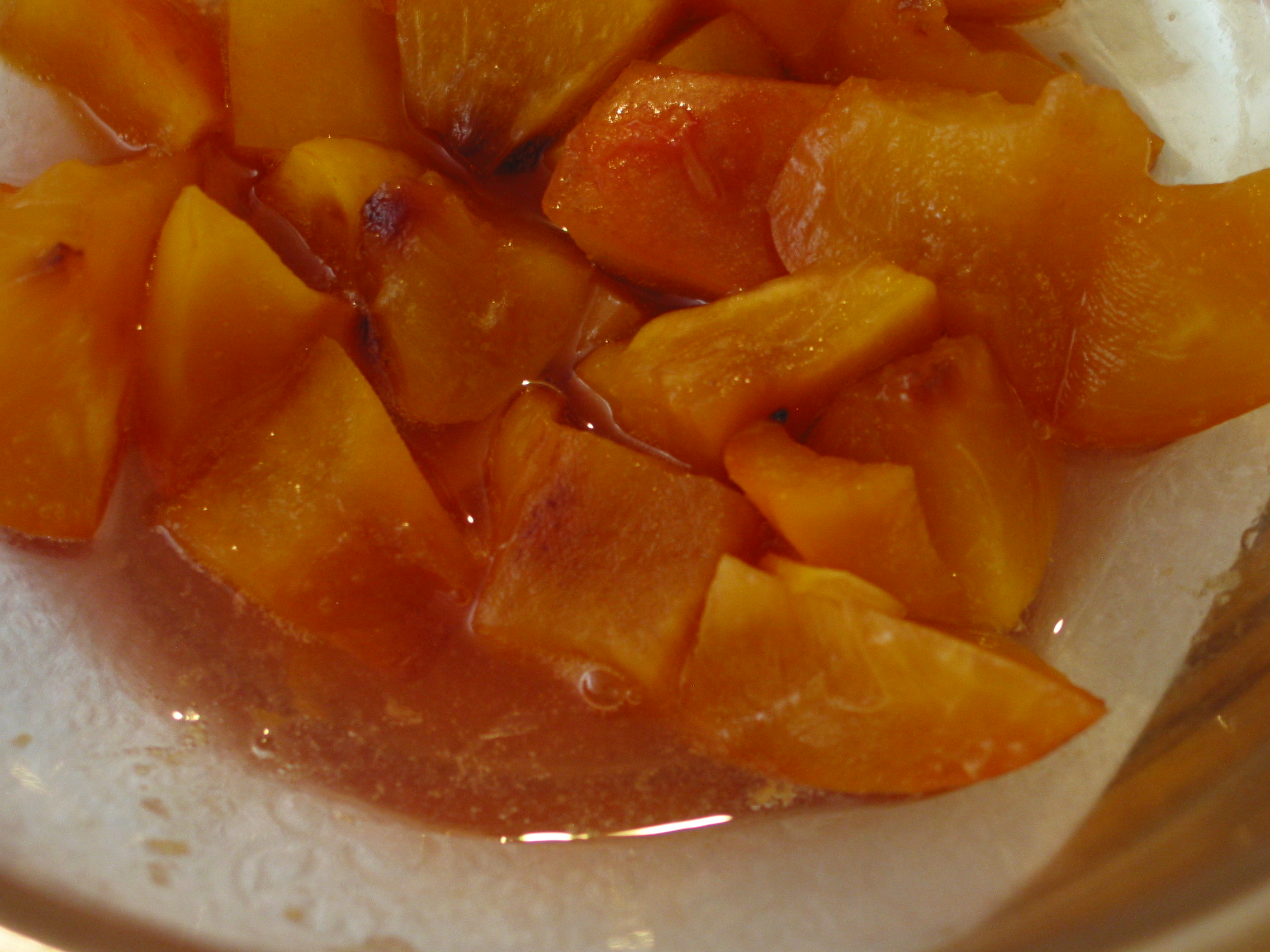
Chop up the peaches and put them in a pyrex bowl. Leave the skins on–this is where at least some of the flavor is going to come from. Sprinkle on a few spoonfuls of sugar and squeeze some lemon juice over them. Cover the bowl with a plate and microwave on high for a few minutes (3-4 min in a ~1100W oven). When you uncover the bowl, the fragrance should start coming up and the pieces will have turned translucent and produced a bit of pinkish-bronze juice. You can taste and see if that’s good enough for you, or cook another minute or so, perhaps with a sprinkle of cinnamon (very good) and/or a thin slice of fresh ginger. Maybe a star anise pod or a couple of cloves if you’re doing this as a compote and feeling really food glam that day, but I didn’t try these myself, so I can’t vouch for them. Cool, chill, and serve with yogurt or ice cream.

For jam, mash the peaches with a fork before the final minute in the microwave. Once it’s cooled, the mixture will thicken and the cinnamon and/or ginger will play off the peach flavor for a good chunky jam.

Microwave peach compote

Microwave peach compote

Mixed-Fruit Compote or Jam

The second compote/jam strategy calls for mixing the fresh peach or nectarine chunks with another fruit before microwaving. I have two  suggestions here that turned out reasonably successful–one is a handful of chopped dried apricots that have soaked up for about 1/2 hour in boiling water or orange juice, and the second choice, a bit odd perhaps, is sliced strawberries mixed in with the peach chunks.

In both cases I went extremely easy on sugar compared to what’s called for in traditional jam-making.  I wasn’t making a lot, it was going straight into the fridge and I was going to use it quickly. Plus I’d pretty much always rather eat a jam that’s more fruit and less sticky stuff. I know, I know, technically that makes it a “fruit spread” rather than proper jam, but do I care?

For the mixed jam with dried/soaked apricots, I microwaved a handful–15 or so–chopped apricots in water to cover for 2 minutes and let stand covered for half an hour, then put them in the food processor with large raw peach chunks — in my case, the peach was oversized, like a softball, so maybe two normal tennis-ball-sized ones would be about right–and a couple of spoonfuls of sugar and pulsed them just enough to blend fairly well without losing all the texture. Then I squeezed lemon juice on the mixture and poured it back into the pyrex bowl to microwave a few minutes as above. I poured the hot mixture into a very clean hot 1-lb jam jar and screwed down the lid–the lid did suck in as it cooled, but I wasn’t counting on that so I kept it in the fridge and ate it over the next week or so.

Another peach I cut up and microwaved straight with some strawberry slices mixed in because they were the last ones in the pint. Again I don’t think I added more than a tablespoonful or two of sugar and a squeeze of lemon, but what happened was the strawberries, instead of going slimy, gave the warm compote a baked comfort-food kind of taste that I hadn’t expected and looked nicer as well. I’d been thinking cooked strawberries would look as bad as they do in strawberry jam, but they didn’t, and without too much sugar (or corn syrup, in the commercial jams I hate) they kept some of their bright flavor too.

None of these ideas is as satisfying as biting into a perfectly ripe, exceedingly juicy peach (or nectarine) at the height of summer, but all of them are pretty good in their own right, they don’t take long, and they’re handy saves for fruit that turns out to be less than you expected.

Canteloupe Ice or, I Conquer my Fridge

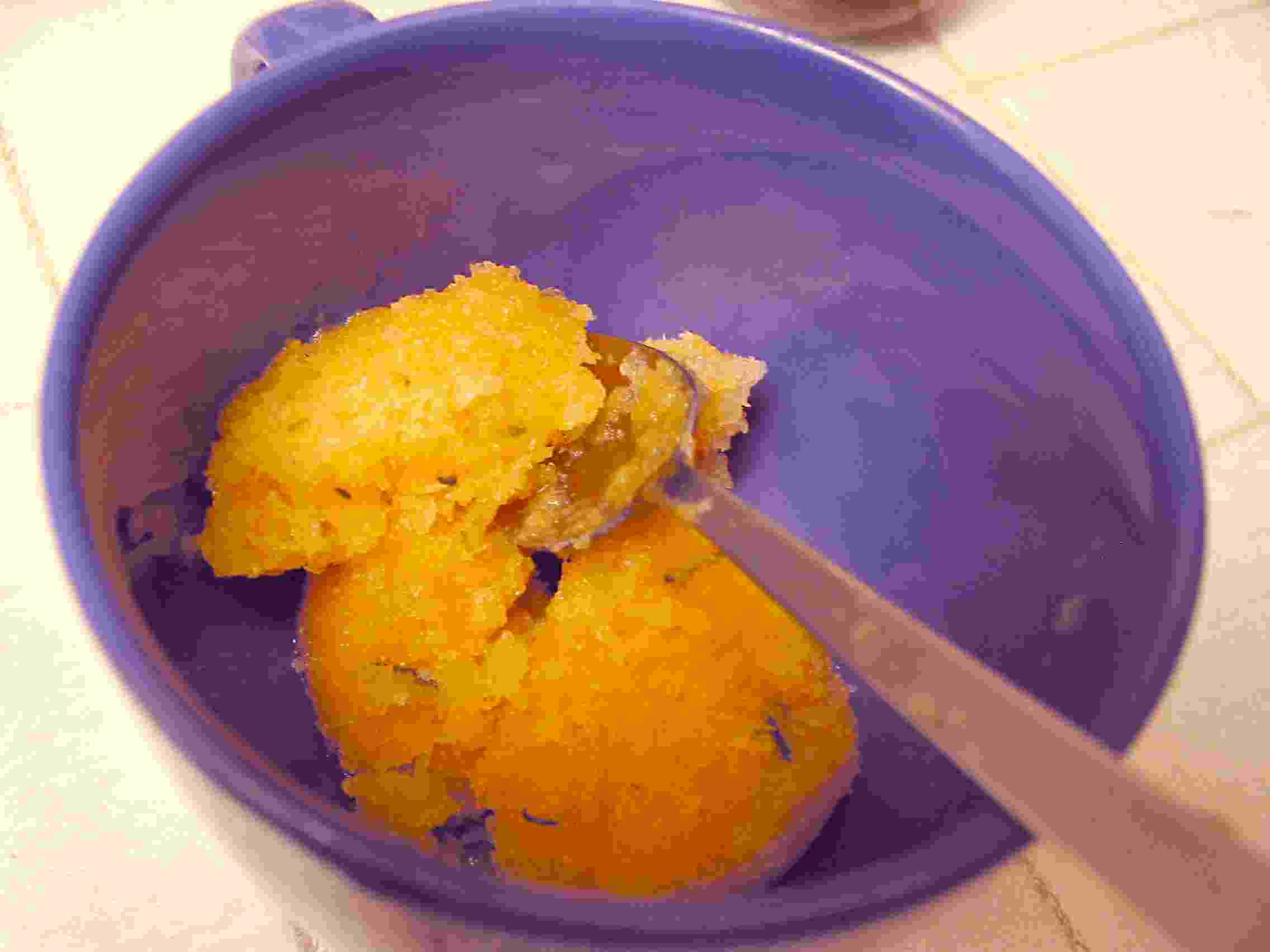
canteloupe-3

Don’t exactly know what to call this–it’s something between a sorbet and a granita, and it’s got only three ingredients–an extremely ripe canteloupe (no spoilage though) that had been sitting in my fridge for more than a week, the juice of a fairly large lime, and roughly chopped leaves from a sprig of rosemary. I scrubbed the canteloupe before cutting into it (old lab habits and new salmonella warnings combined, I guess), seeded it and puréed the flesh with the lime juice and rosemary in my food processor until it seemed pretty well smooth, then packed it into a 2-quart microwave container with a lid and still-froze it. I guess if I thawed it enough to break it back into chunks, I could regrind it finer in the food processor–I’ve done it with other still-frozen ices, but this time I didn’t bother. It did need thawing in the microwave to be able to scoop it out for serving–about 2 minutes on defrost.

That’s it. So it’s roughly 97 percent canteloupe with about 2 percent juice of a lime and 1 percent or less chopped fresh rosemary leaves. Can I say it’s made with 100% real fruit, then? No fake fruit involved (unless it was a franken-canteloupe–is that the northern equivalent to the chupacabras? It’s the right color for a new halloween monster, anyway)

And may I register a complaint about the interloper spelling that seems to have taken over since my youth–cantaloupe isn’t the same. It just isn’t.

But the canteloupe ice is nothing to complain about. Ginger would certainly also be good in place of the rosemary. Next year, maybe.

Fruit + Herbs = ?

Along the lines of my taste experiments in the last post, I wanted to share a couple of fruit-and-herb combinations I’ve come up with over the years. I hesitate to call them recipes, but they’re good, fast, and unusual. They make refreshing side dishes, especially for a light meal, because they’re not too sweet and they play the sweetness and sometimes tartness of the fruit against something woody, green, spicy or aromatic.

Food glam mags show a host of grilled peaches and nectarines, ditto salsas, and sometimes include thyme and fresh black pepper and sage and other herbs.

I should also mention I just finished drooling my way through David Tanis’s A Platter of Figs, which has a lot of very simple, good-looking fruit desserts and accompaniments (including roasted fresh figs with thyme). I didn’t lick any of the pictures (it was a library book, after all) but it’s really the recipe instructions that appeal to me–simple and informal, with interesting and helpful notes on what seem to be missing steps in other chefs’ cookbooks. My favorite example: steam or parcook fennel bulb slices before you grill them. Makes perfect sense and explains why so many upscale restaurants serve grilled fennel that’s tough and stringy and hard to get through without landing it on your blouse.

But to get to the point–fruit+herbs=intrigue.

So why not? Here are a few of mine.

Mango with Fresh Basil

I hate to say it, but that’s about it. Seriously.

I cut a large mango in half, run a paring knife CAREFULLY as close as possible to one side of the big flat hairy pit (yes you will feel cheated unless you buy at a good price in a Latino market), take the cut half of the mango and score the flesh into a tic-tac-toe pattern, and flip the peel inside-out to pop out the cubes (slicing close to the peel). I try my best with the other half, the half with the pit stuck to it–mostly it works. Sometimes I count to make sure I still have ten fingers afterward… Combine the cubes with torn or julienned fresh basil leaves and serve with grilled white fish or the like and a green salad with vinaigrette. Purple basil looks dramatic, and you can dress this up a bit more with a few dice of red onion and a squeeze of lime juice but you don’t have to.

Canteloupe with Rosemary

Canteloupe is cheap and nutritious and complex, but usually too funky and tropical for me to eat straight up. I always want lime juice or something. Even as a grownup, more’s the pity. One night I was wondering if there were anything that would possibly make me like canteloupe better–I had a canteloupe with best intentions lingering unused in my fridge as I got less and less enthusiastic about it–and something about rosemary clicked in my head. Mint and lime juice are the classics, but I like rosemary because it’s piney and aromatic without being bitter, and something about it undercuts the unctuousness of the canteloupe and makes it taste fresher to me. You wouldn’t believe how triumphant I was when I found out this actually worked. So I ground the whole thing up (well, minus the peel) and squeezed in some lime juice and froze it for a sorbet. Also good.

Prunes or Dried Figs with Anise or Fennel Seed

I tend to eat a few of these out of hand as a snack with a little of the anise or fennel sprinkled over the top for contrast, but I’ve also chopped dried figs with a couple of chopped dried apricots, microwaved them in a little bit of water to soften to a chunky paste, then mixed in a sprinkle of anise and maybe a bit of cinnamon and used it to fill filo pastry cigares. A similar idea…

Prune Log with Pistachios and Cardamom

There’s also a very nice Moroccan-Jewish High Holiday sweet–good for this time of year–that’s a lot like the fancy pressed date/walnut or fig/Marcona almond wheels from Spain–a small wedge from the Whole Foods cheese counter can run you $5 or more, but they’re delicious  sliced very thin. Anyway, this one’s a prune log with pistachios, and it’s a little more complex than the others but easy enough to make.

Simmer about a pound of pitted prunes in a little water or orange juice (you can nuke a few minutes if you prefer) and process to a very thick paste. Mix in freshly toasted pistachios and either aniseed or a good grinding of cardamom (the seeds inside, not the pods) or both, perhaps. Pack tight onto a length of plastic wrap and roll into a log, cool, and roll to coat in toasted sesame seeds. When cool and firm, slice the log very thin into rounds (it’ll be like pistachio-studded fruit leather, but a bit softer) and served on a doily-covered brass tray along with dried apricots stuffed with marzipan or walnuts and other delicacies. Mint tea, lots of it, goes with. B’te’avon! (good appetite!)

The Meaning of “Tasty”

One very strange description crops up in nearly every expert’s take on processed food and the way it’s overtaken fresh and whole foods in the American diet. Everyone from food industry veteran Hank Cardello (see the Stuffed book review) to NYU nutrition professor Marion Nestle in What to Eat talks about fast food and junk food as “tasty”. David Kessler goes even further: in The End of Overeating, he adds “irresistible,” which he says is the problem he faced most of his life.

Moreover, “tasty” has become the important word in processed food advertising. Driving home from the post office today I even saw it on a billboard for Vitaminwater10, with the tagline:  “10 CALORIES. 4 NEW FLAVORS. TASTIER THAN EVER.”

Tasty. It’s the word of champions, the key, the adword to beat.

And for the life of me, I’m not sure why. Because the words I would have chosen for most of it include stodgy, greasy, cardboardy, screamingly salty, day-glo ™ orange, and “a lot like airplane food, only on the ground.” Am I the only one?

But “tasty”–specifically that word–is clearly the accepted description, even among these food experts, and that points to a host of disturbing assumptions. Either they mean they find processed food tasty or they mean they think everyone else finds it tasty and irresistible–even if there’s something better to eat. That’s kind of defeatist, isn’t it? If everyone “knows” fast food is tastier than fresh produce, what hope is there for mainstream Americans to eat healthier than they do today?

What do they actually mean by “tasty” in the case of processed food? They don’t mean fresh, as in fresh produce. They don’t mean tangy, as in yogurt or a tangerine, or sharp as in horseradish or cheddar. Certainly not aromatic, like dill or fennel or rosemary or sage. Or rich and funky and thought-provoking, like aged camembert or shiitakes or asparagus or toasted sesame oil. And they don’t mean complex and savory and surprising, as in a palak paneer punctuated by smoky black cardamom pods, Armenian string cheese with nigella seed, or a long-cooked carbonnade or daube of beef with some cloves thrown in on a whim.

They can’t possibly, honestly, mean “these fresh hazelnuts are so sweet you’ll plotz” or “one bite and you’d better take this nectarine somewhere private.”

Most of the food experts who’ve posited that processed food is “tasty” in their books and articles are older than I am by about 10 years, old enough to remember eating late-July nectarines that devastatingly fragrant, backyard tomatoes earthily ripe and pungent, foods utterly unlike what’s available even in the produce section of most chain supermarkets today.

So I can’t help thinking that their casual use of the word “tasty” reflects and even perpetuates the hopelessly tattered, stunted and inexperienced taste imagination of the masses of people who don’t cook for themselves anymore and have given over completely to packaged food, with its excesses of salt and its bland, stale cardboardy background flavor. The ugly assumption they’ve bought into is that people who eat mostly processed food can’t change, won’t change, and most importantly, wouldn’t like fresh food if they tasted it.

Can the surge of food blogs with their encouragement to try something new, visit local farmers’ markets, maybe even take a share in a community garden plot, change this trend? I hope so, even though I know the open air markets are not often very available in poor neighborhoods and they tend to be as expensive as supermarkets. But when they are made available in urban areas, all kinds of people from the neighborhood suddenly come flocking to them, Continue reading

Pack your own lunch

It’s almost time to head back to school, and my daughter’s finally old enough to pack her own lunch. Not that she wasn’t actually old enough last year. But now she wants to.

When I was nine, I’d been making my own school lunches for at least a year, if only to save my sandwiches from my mother’s clutches and keep her from adding butter to the jam–something that did, and still does, make me absolutely nauseous. Emergency grossout prevention is the mother of lunch-making independence.

As many of my friends with same-age kids do, I worry that I haven’t been pushing my daughter hard enough toward independence by having her fix her own lunch. Is it too late to impart the mysteries of the toaster oven? But all is not lost–the other morning she figured out how to cut up her own apples (she has braces and our orthodontist “charges extra for stupidity-related bracket repairs”). She doesn’t appear to have lost any fingers. So we’re good to go!

Which is fortunate because lately I’ve been seeing a slew of new books on how to pack your kid’s lunch–they range from “here are all the vegan-friendly brand-names that look just like everyone else’s school lunch, only cooler” to Alice Waters insisting that the first step is growing your own school garden (which I’m actually in favor of, but not if it means waiting 6-8 weeks for your lunch to germinate).

Few of these fabulously sophisticated new books even consider the things I took to school every day as a kid–peanut butter and jelly, apple, carrots and celery. Or peanut butter and jelly, orange, carrots and celery. My mother was dull. My sister and I had no cool foods like Ho-Hos or Cheetos to distract us, and we usually ate at least some of the vegetables and the apple. Actually, so did most of the other kids in our school. It was that or suffer the cafeteria kale. And almost no one was fat. I’d like to point that out.

Hip mamas today (mostly those still in their 30s) look horrified at my daughter’s lunches because out there in hipland PBJ on whole wheat is so…so ’70s. It doesn’t contain any of the seventy-two essential nutritional supplement buzzwords (like selenium and phytoestrogens and antioxidant) they’re convinced all healthy food has to have (well, it’s true you have to have those things on the label to compete in the ads). And it has fat. And sugar!

But you know what? A decent peanut butter and jelly sandwich on whole wheat is a lot better deal nutritionally than most of the prepackaged, often self-righteously labeled, crap the hip kids bring to school these days. Much of it is along the lines of Kraft Foods’ “Lunchables”–a processed meat and cheese cracker kind of thing packed with some ersatz juice and faky side items like jello and  candies (not even, as I check belatedly, a tiny tin of applesauce–and check out the Lunchables nutrition and ingredient stats!). But you know how popular these things are–because they’re a kit. Buy five boxes, throw one  in your kid’s backpack each day. They stack neatly in the pantry.

Very few of these children ever bring a substantial serving of fresh vegetables or actual fruit–not even apples. Those require washing, peeling–maybe even cutting up. And sometimes the apples turn a little brown on the cut sides. Organic fair-trade labeling aside, any remotely fruit-like substances in the hip-kids’ lunch bags arrive in a rectangular cardboard box with a plastic overwrap, a plastic straw attached, and a sanitized-for-your-protection seal. No wonder they stare.

Anatomy of a PBJ:

Straight-up peanuts-only butter (no salt, no sugars, no mono- and diglycerides, no emulsifiers or BHT or “natural flavoring” or any of the rest of it) has about 16 grams of fat per 2 T (1 oz) serving. True. Absolutely true. But it’s not the same as the heart-stopping blubber you find on a piece of meat, so stop shrieking. Most of the oil in natural peanut butter is polyunsaturated (the “good fat” kind of fat). And it separates (because of the lack of fakery and emulsifiers) so you can pour off a good bit of it if you want to when you first open the jar.

Furthermore, the same peanuts-only peanut butter contains 8 g protein, 3 g fiber, almost no sodium, and about 210 mg potassium. And a little iron. It’s a pretty good deal for a kid’s lunch item at about 200 calories.

Two slices of whole wheat bread without too much sodium or garbage ingredients gives you another 200 calories–we’re up to 400, but only 3 g. saturated fat, another 3-7 g fiber, another 4-6 g protein, and with a little care preferably less than 400 mg sodium (all from the bread). Add a spoonful of all-fruit jam with 8 g sugar, at about 35 calories, and you have something that will get your kid through school without tears or big sugar highs and lows.

It doesn’t have big vitamin- and calcium-fortified labeling. It doesn’t have a label. It’s not supposed to do it all on its own. Your kid will eat about half, maybe the whole thing if he or she is growing fast or running around a lot that week. But he or she will get the vitamins and calcium from the other things in the lunchbox–some crunchy raw vegetables and an apple or orange and a thermos or carton of plain unsweetened milk. That’s it and that’s enough.

Do your kid a huge favor and leave out all the chips, chocolate, go-gurt (real milk-and-cultures yogurt is ok, not the fake tapioca- and gelatin-stretched stuff), cookies, jello, sorta-applesauce, and fluorescent boxes of juice. School is hard enough without sugar crashes or cavities, and they don’t need any of it to have a good day.

Oh yeah. And for crying out loud, please skip the sushi. Your kid does NOT need to be that hip in the school cafeteria. Or that sick, if the sushi doesn’t stay cold enough.

(Why yes, I live in Southern California. What gave it away?)

How to Eat Vegetables and Lose Weight and Save the Planet (Without Really Trying)

One of my favorite stops at the New York Times online is Mark Bittman’s “The Minimalist” column, a series of 5-minute videos in which he demonstrates simple but pretty good cooking with clear and manageable directions and an easy close-up view of the pots and pans in action.

I’d say he takes a no-nonsense approach to cooking, but that would be misleading. He takes a full-nonsense, marble rye approach to the patter while doing some very basic common sense things like cutting up, mixing, and sauteing. And he features vegetables prominently.

Bittman,  recently seen schmoozing around Spain in a top-down convertible,on PBS yet, with Gwyneth Paltrow and Michael Stipe and occasionally Mario Batali and trying to look interested in the food (which somehow got upstaged, can’t imagine how), is the author of several big yellow cookbooks, notably How to Cook Everything in both meat-eater and vegetarian editions.

This year he’s come out with a new, slimmer volume called Food Matters: A Guide to Conscious Eating* (and the asterisk leads to: *With More than 75 Recipes).

Unfortunately, we have to disregard the fact that Bittman’s title manages to evoke both Phil McGraw’s Self Matters and David Reuben, M.D.’s 1970s classic romp, Everything You Always Wanted to Know About Sex* … *But Were Afraid to Ask (or, more happily, Woody Allen’s movie send-up of same). This is a Serious Book. And like many Serious Books today (and anything at all with a “go green” theme), it’s a hybrid vehicle.

Between the asterisks on the cover sits a Granny Smith apple photoshopped with a map of the world and a red label, “Lose Weight, Heal the Planet.” The back blurb reads, “…the same lifestyle choice could help you lose weight, reduce your risk of many long-term or chronic diseases, save you real money, and help stop global warming…”

Food Matters is Bittman’s argument for getting the lard out and the greens in, for the sake of health, looks, and planet (quick, look holistic and place your hands reverently over your heart, if you can find it). The first half of the book is a set of essays reporting on the state of Big Food in the U.S., the state of obesity, the state of greenhouse gases and the global cost of raising a serving of beef as opposed to a serving of broccoli or tomatoes or whole grains.

Following Michael Pollan’s now-famous dictum “Eat food. Not too much. Mostly plants,” and citing him heavily, Bittman sets out to encourage readers to replace at least some of the earth-taxing meat and dairy in their daily eating with…plants. Which makes sense, of course.

The second half is a primer, with recipes, on how to eat more vegetation. Given that his pitch is geared at least partly to a male audience (he also writes a food column for Men’s Health, and the tone here is similar), you’d think his advice on the quickest route to getting vegetables into one’s diet would involve the least fuss: just wash and nosh. But no.

Bittman used to edit Cook’s magazine and the cookbooks he writes today do tend to feature recipes. It’s a common downfall, but what can you do? Continue reading

A Dream of…Marmalade?

For years I assumed that only the truly gifted home ec queens, most of them from the deep South, were qualified to make jam. I love to cook and I love to play with my–or anybody’s–food, but I knew instinctively that the combination of 1) me and 2) hot vats of boiling fruit and sugar was a recipe for disaster. Or hospitalization. Or outrageous cleaning bills. Or all three. So I stayed far, far away from pressure cookers, Ball ™ jelly jars, and anything involving bushels of fruit and all-day productions.

And yet…once in a while I’d walk by the produce section, see something unusual, and fantasize about making a new kind of jam they didn’t have in the store. The kind with just fruit and maybe sugar, but no corn syrup to cloud up the flavor. Something that didn’t cost $6 for a 10 oz. jar. Something that didn’t taste like all the freshness had been boiled out of it.

There’s nothing more disappointing to me than the difference between ripe strawberries and strawberry jam. It should be so good, and it just tastes so tinny, with all the life and brilliance cooked out of it. Oranges are, if possible, even worse cooked. And yet I do love marmalade, which seems even more mysterious than jam.

This week, I stopped by my neighborhood corner grocery and found a small cardboard box perched atop the large open bins of walnuts and almonds. In the box were a couple of pounds of kumquats for $2/lb. A decent price–but was I really going to do something with kumquats?

Since discovering the microwave, I’ve taken on an unwise and very brash attitude about tackling new challenges that basically boils down to “Just nuke it!” I realized if I microwaved the marmalade it would either succeed or fail, but at least it would do it quickly. Continue reading