
• Enter your email address to subscribe to this blog and receive notifications of new posts by email.

    Join 241 other subscribers
  • Noshing on

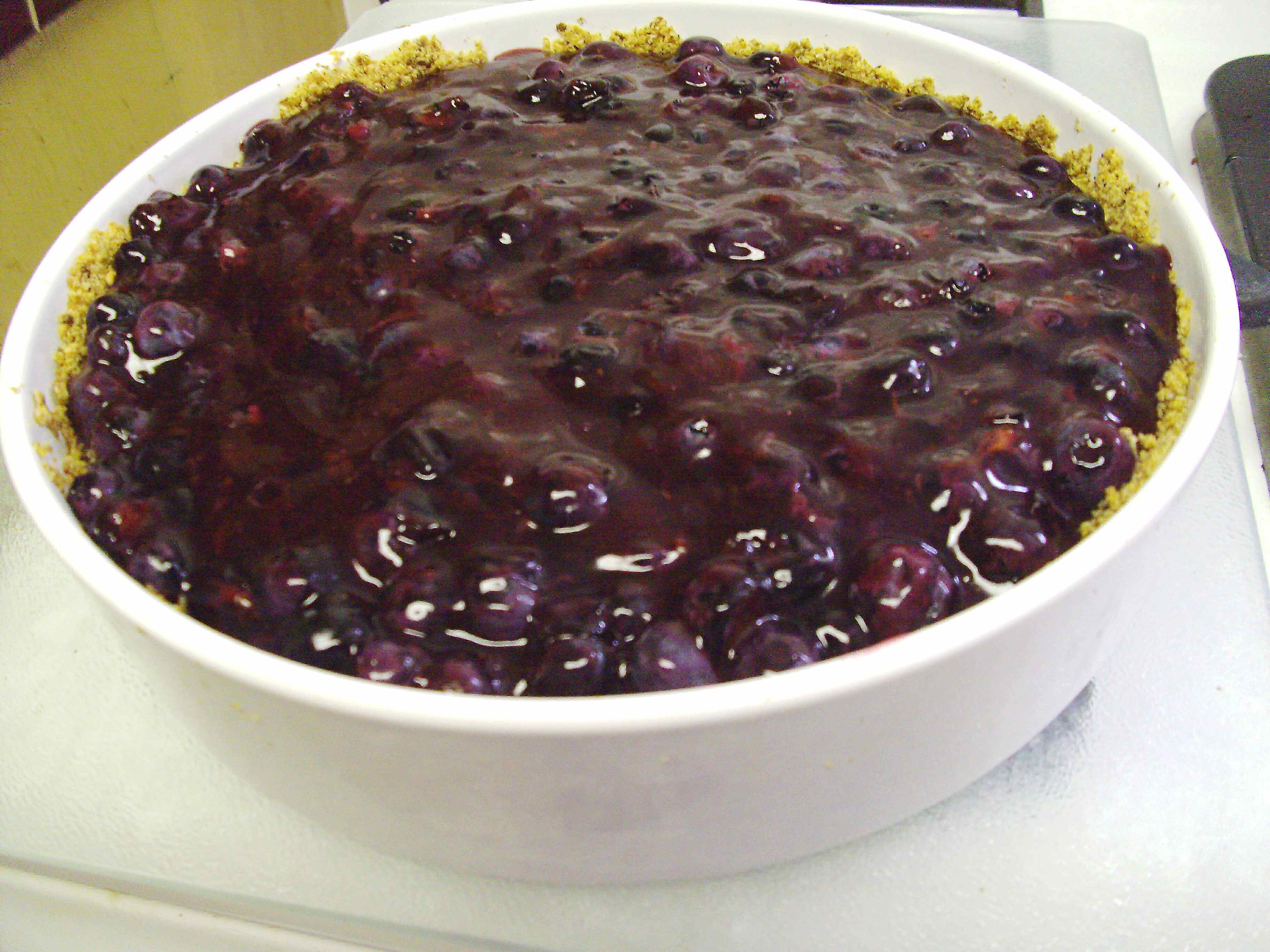
    raw blueberry pie with microwaveable filling and graham cracker crust

    This mostly-raw blueberry pie is a snap to make and very versatile--the filling microwaves in a few minutes, and you don't even have to bake the zippy gingered graham cracker crust--perfect for a hot Fourth of July and all summer long.

  • Recent Posts

  • Contents

  • Archives

  • Now Reading

  • See also my Book Reviews

  • Copyright 2008-2024Slow Food Fast. All writing and images on this blog unless otherwise attributed or set in quotes are the sole property of Slow Food Fast. Please contact DebbieN via the comments form for permissions before reprinting or reproducing any of the material on this blog.

  • ADS AND AFFILIATE LINKS

  • I may post affiliate links to books and movies that I personally review and recommend. Currently I favor Alibris and Vroman's, our terrific and venerable (now past the century mark!) independent bookstore in Pasadena. Or go to your local library--and make sure to support them with actual donations, not just overdue fines (ahem!), because your state probably has cut their budget and hours. Again.

  • In keeping with the disclaimer below, I DO NOT endorse, profit from, or recommend any medications, health treatments, commercial diet plans, supplements or any other such products.

  • DISCLAIMER

  • SlowFoodFast sometimes addresses general public health topics related to nutrition, heart disease, blood pressure, and diabetes. Because this is a blog with a personal point of view, my health and food politics entries often include my opinions on the trends I see, and I try to be as blatant as possible about that. None of these articles should be construed as specific medical advice for an individual case. I do try to keep to findings from well-vetted research sources and large, well-controlled studies, and I try not to sensationalize the science (though if they actually come up with a real cure for Type I diabetes in the next couple of years, I'm gonna be dancing in the streets with a hat that would put Carmen Miranda to shame. Consider yourself warned).

Cooking (and other important) Resolutions
(Of course)–I couldn’t leave 2010 on such a bitter note as the one in my last post, even though I think bitterness is a good, energizing, creative thing. Or as the great Eric Burdon once–or actually, quite any number of times–told an interviewer about his ordeal with getting paid for House of the Rising Sun, “I’m not bi’eh. I’m bi’ehsweet.” I have a thing for Burdon’s early stuff–voice like a hammer, great blues timing, pure nerve with a sense of humor, and clearly, a good appetite.

So I wish you all a Happy New Year, good eating, good cooking, good reading and good company, and thank everyone who’s visited and especially those who have taken the time to subscribe to Slow Food Fast. For myself, I’ve come up with about 11 new resolutions for 2011 (but as usual for me, it may will definitely run longer, since I’m terrible about following directions, even my own, whether cooking or resolving):

1. Learn the Dirty Dozen a little better and plan the weekly budget (see #3) to include buying these vegetables and fruits organic only. (I’ve got celery, potatoes, pears and strawberries down so far, but I know there’s gotta be at least 8 more, right?) Find places to buy them cheaper than Whole Foods.

1a. Learn to garden? Umm. Learn to schnorr backyard fruit from friends? More likely, ain’t it? Ok, ok, make more friends, schnorr backyard fruit and veg. And rosemary, which some people grow as a hedge here in Pasadena. Envy, envy, envy–turn it to a good purpose and offer to take some of the excess off their hands.

1b. Exercise basic civility towards other people’s food choices–your eat local is my eat kosher is his eat organic is her eat affordably. Everyone’s got different priorities, and you don’t know who is eating a particular way because they feel like it and who really needs to so they don’t end up in the hospital. Food shouldn’t be too huge a source of personal arguments. I mean, really, people, save some energy for the real issue–dark or milk chocolate?

2. Get the weekly food budget back down under $100 a week (holidays take it outta me). Make a list and (I cannot believe I’m saying this) check it twice. With a calculator. Include toilet paper and napkins and so on.

3. Use all the vegetables I buy sometime in the same week I buy them. This goes triple for any herbs. No brown broccoli (not usually a big problem in my house, actually) or rubbery carrots (didn’t mean to confess that). And NO cilantro or fresh dill left until it turns slimy while I dither over what to use it in… when in doubt, make soup (see #4), or with herbs, wash and freeze in baggies.

4. Make one big batch of soup each week (see #3 if necessary for motivation) and eat it.

5. Make one pound of beans each week and eat it in fabulously creative ways, or at least edible ones. Eat them as a substitute for, not addition to, fish or meat at least one dinner per week.

6. I’m stumped. Maybe I should make each of the previous resolutions count twice? Naaah. Put on some blues and think again.

The real #6: Eat vegetables at breakfast, Israeli-style.

7. Wash fewer dishes–make my kid do them! (oh, yeah, I’m rollin’ now!)

8. Reduce my dependence on oil–starting by using cocoa powder instead of a full-cocoa-butter chocolate fix…damn those holiday gift boxes. Hate See’s, hate it with a passion (unfortunately, not really)…

9. In the same vein–cut down to half-caf this week, decaf in two or three weeks. Start today. Too much hoppin’ around after midnight (or maybe just too much listening to Eric Burdon on YouTube–wait. Is there such a thing as too much, at least of his early stuff?).

10. Shop my neighborhood greengrocer’s first instead of the big box market. Buy and try a small amount of one new Silk Road ingredient each month (red pepper paste? knoug resin? green almonds? sea buckthorn nectar?)

11. Get a few new implements as long as they have a real multifarious use and a small kitchen footprint: stick blender? I hear it calling my name. Pasta machine? not so much–the box instructions say not to immerse in water. How are you supposed to wash it then? (see #7)

12. Make bread at home again.

13. Revamp a classic every so often, preferably with the intelligent use of a microwave to help speed things up where it will actually help. Like choux paste (at least for heating the liquid ingredients before adding the flour and eggs–that’s actually been done before, and not by me) or pretty-good fake-smoked whitefish salad (which is mine, see the end of this post). Continue reading

Prunes and Lentils II: Prune Sauces for Savory Dishes

Following on from Sunday’s post (have you recovered yet? Should I be selling Tums futures?) I should add that NOWHERE in Karen Page and Andrew Dornenburg’s The Flavor Bible can a mention be found of prunes paired in any way, shape, or form with lentils. Don’t have the faintest why not. They do state that plain old green lentils have more flavor than red or brown.  They also pair prunes with olives, mushrooms, gorgonzola and walnuts as well as sweet spices and red wine. Somewhere in that crossroads there’s got to be some confluence of flavor, but wherever it is, they haven’t considered it.

Others have, however–notably Nathan Lyon of the Discovery Channel, ABC’s “Beat the Chef” show in Australia from a few years back, Hello! magazine (OK, copying straight from the California Prune Board’s UK division–wait a minute, they HAVE a UK division?!–and borrowing its press photo)…Oh well.

The benefit to considering prune sauces is that you can serve them with a lentil dish if you’re ready for that or to lift a more familiar savory dish with meat, fish or poultry.

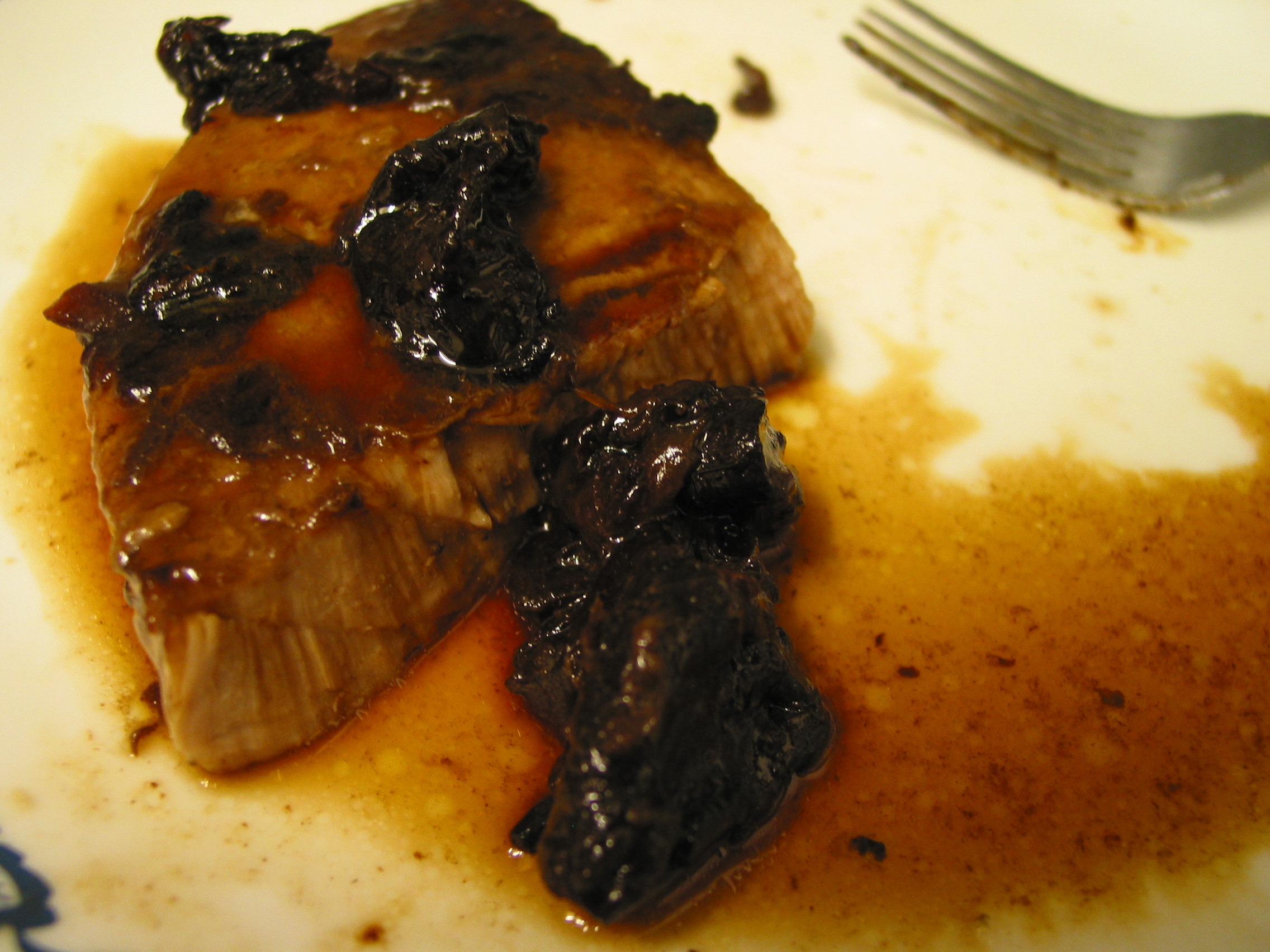
Pan-seared tuna steak with microwave prune and wine chutney

Pan-seared tuna steak with microwave prune and wine chutney

And yes, I said “lift”. Make of it what you will, but any one of the sauces below is better than whatever Hello! magazine has to offer, even if it were original.

Stéphane Reynaud’s Prune Sauce (excerpted for consideration from French Feasts, 2009)

This was designed to go with a simply pan-fried foie gras for six–probably 3-4 oz per person, which seems like a hefty kind of serving, even though I do like liver.  But the sauce–why 18 prunes? 3 per person? and it seems a heavy load of spice for a small amount of wine. Also he has you rest the stuff overnight at room temperature before finishing it. Not sure why–to thicken up, probably, like Elizabeth David’s recipe for peach jam, which also sits out overnight after the first boil-up before resuming.

  • 18 pitted prunes
  • 1 c red wine
  • 1 t ground cinnamon
  • 1 t quatre-épices
  • 2 star anise pods
  • 2 T light brown sugar
  • 2 1/2 T butter, chilled

Boil the prunes 5 min with the wine, spices and sugar, cover and leave O/N at RT. Remove the prunes and reduce the spiced wine to a syrupy sauce. Whisk in the butter, then return the prunes to the sauce.

Microwave Prune Chutney with Wine

My microwave version started out as Reynaud’s wine-based sauce and suddenly morphed, as I was grabbing things out of the fridge for it, with a half-remembered cranberry chutney recipe my mother-in-law served a number of years ago at Thanksgiving. This turns out to be a potent combination, aromatic and sharper, no doubt, than Reynaud’s sauce, with a definite suggestion of saltiness about it–but no actual salt. I don’t recommend eating it straight–too pungent for me, though it’s uncannily close to the relish my mother-in-law served and pretty decent with poultry and stuffing or rice and so on–but cooking 5 minutes or so extra in a saucepan over direct heat or with the food you’re saucing and some extra wine turns it into something pretty special. The whole cloves in particular (which you can take out before using the sauce) do something incredible for any meat or steaky fish you cook with this sauce. Like brisket but just…better, more sophisticated, elevated to the level of cuisine. In fact, put some of this prune sauce with cloves in your next brisket too. 

Makes about 1 cup

  • ½-1 c leftover dark red wine–syrah, aglianico, something inexpensive but rich
  • 8-10 pitted prunes, quartered
  • grating of fresh ginger (1/4 t)
  • grating of 1/2 decent-sized clove garlic or 1 small clove
  • 1/4 red onion, chopped
  • 1-2 t. wine vinegar
  • sprig of thyme
  • pinch of fennel seed
  • 4-5 whole cloves, loose if you can stand picking them out or else stuck through a scrap of onion

Toss the onions with the vinegar and let sit a few minutes while chopping the prunes into quarters–it cuts down on the bite. Mix the onions, prunes, and the rest of the ingredients except the cloves in a soup bowl with a microwaveable lid that can placed on with a gap for steam to escape. Poke the cloves into a larger scrap of onion and add that to the bowl so you can fish them back out easily after cooking. Microwave 1-2 minutes loosely covered on HIGH or until it’s boiling, let sit 5 minutes, stir, microwave again. The prunes will have taken up a lot of the liquid, the onions should be cooked through and garnet-colored, and the wine should be reduced and a bit syrupy.

.  .  .  .  .

From France to China, then:

One year I was determined to make a low-sodium substitute for fermented black bean sauce with roast salmon. I soaked some prunes in a little boiling water and mashed them to a paste, then dressed them up with garlic, ginger and a few other things. It turned out, to my surprise, like homemade hoisin–-dark, glossy, tart and aromatic, less sweet than the commercial stuff, a little smoky from the sesame oil and scallions, with the suggestion of salt Continue reading

Mahi Mahi with Artichoke Hearts

Mahi mahi with marinated artichoke heartsA lot of people seem to have reached Slow Food Fast recently by searching for mahi mahi with artichoke hearts, and all I had up about it was the picture above, so I thought I would post the actual recipe. Admittedly, it’s not very much of a recipe, what you see is what you get.

But the artichoke hearts aren’t just for decoration, they have lemon juice and olive oil as well as garlic, and they shield the top of the mahi to keep it moist and tender while it’s cooking–essential for any steaky fish that tends to dry out if you overcook it even slightly.

This recipe is pretty much just what it looks like in the picture, so I’m not going to give actual quantities–they just depend on how much fish you want to make. I do mine in the toaster oven (about 3 fillets or a little less than a pound) to keep from wasting huge amounts of heating (and in LA right now, cooling afterward). So maybe 15-20 pieces of marinated artichoke heart and a couple of chopped olives will cover things well enough.

For this I use my microwave-marinated artichoke hearts, which only take a few minutes start to finish and store well in the fridge. But if you’re doing mahi for a thousand, obviously you want to invest in the BIG  econobarrel jar of Cara Mia…

Mahi Mahi with Artichoke Hearts

  • Mahi mahi fillets, fresh or thawed frozen, rinsed gently under cold water
  • marinated artichoke hearts–enough to cover the fillets to your liking, not enough to break the bank
  • fresh sprigs of rosemary or thyme if possible; dried or frozen if that’s what you have
  • a few Kalamata, Alfonso, Gaeta or other good brined olives, pitted and quartered or chopped
  • decent olive oil for drizzling
  • squeeze of lemon juice
  • fresh-cracked black peppercorns optional

Preheat the oven to 375-400 F, or if you’re cooking in the toaster oven, figure 350F starting when you put the fish in, since it’s smaller and the heat’s closer to the fish.

Lay the rinsed fillets in a single layer in a foil-lined pan, and cover with a layer of marinated artichoke heart quarters. Scatter olive pieces and herbs evenly over the top, drizzle on olive oil and lemon juice, and grind pepper over the top if you like.  Cook uncovered for 15 minutes, check for doneness by cutting into one of the center fillets with the side of a fork or by trying to pierce one–if it’s still raw, it’ll resist, and if it’s cooked it’ll separate or flake. Try not to overcook, you want it cooked through but still juicy as it separates. If it’s only a little bit pink in the middle when you check, shut off the oven and leave the fish inside for another minute or so to finish in the residual heat.