
• Enter your email address to subscribe to this blog and receive notifications of new posts by email.

    Join 241 other subscribers
  • Noshing on

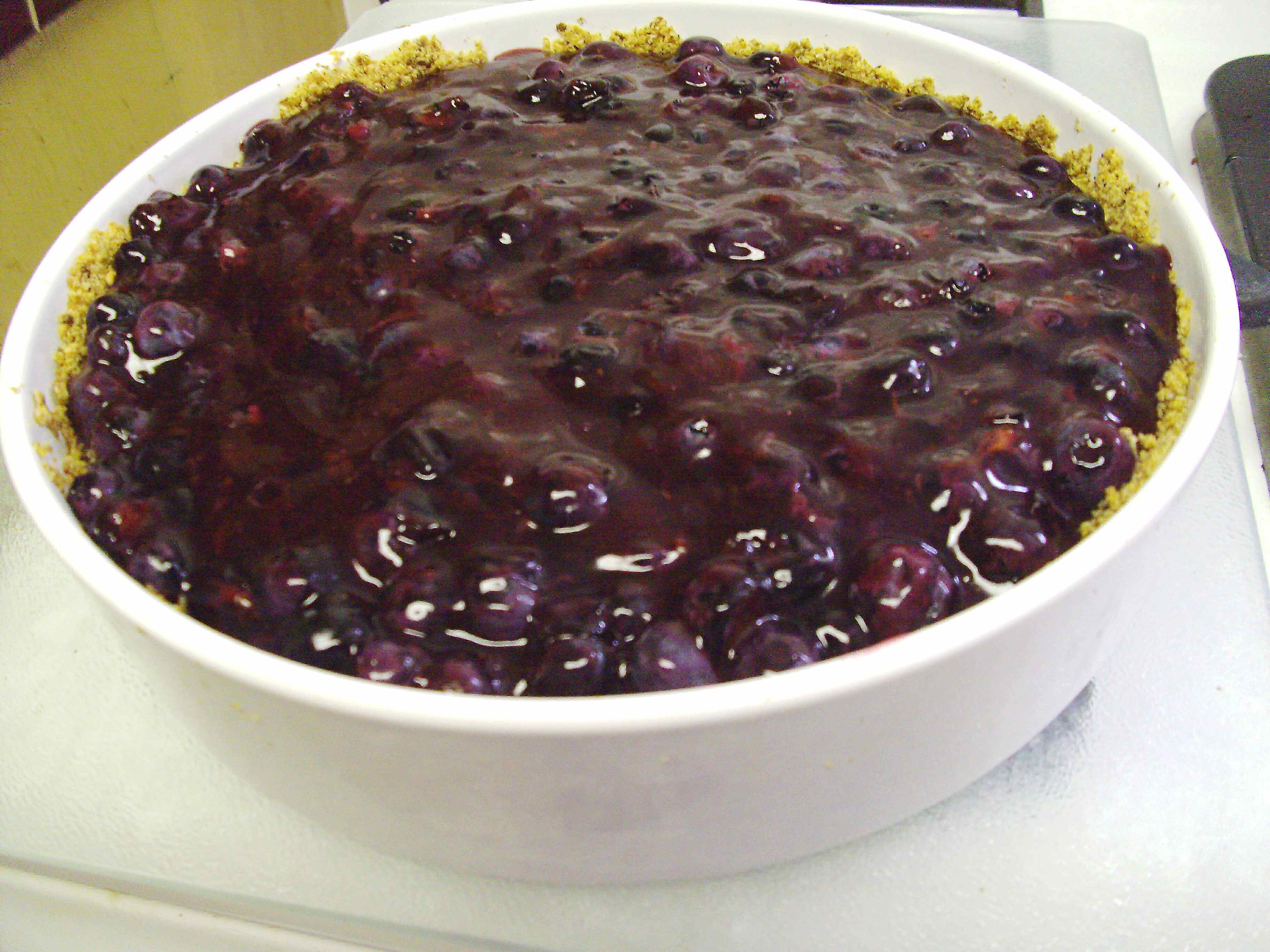
    raw blueberry pie with microwaveable filling and graham cracker crust

    This mostly-raw blueberry pie is a snap to make and very versatile--the filling microwaves in a few minutes, and you don't even have to bake the zippy gingered graham cracker crust--perfect for a hot Fourth of July and all summer long.

  • Recent Posts

  • Contents

  • Archives

  • Now Reading

  • See also my Book Reviews

  • Copyright 2008-2024Slow Food Fast. All writing and images on this blog unless otherwise attributed or set in quotes are the sole property of Slow Food Fast. Please contact DebbieN via the comments form for permissions before reprinting or reproducing any of the material on this blog.

  • ADS AND AFFILIATE LINKS

  • I may post affiliate links to books and movies that I personally review and recommend. Currently I favor Alibris and Vroman's, our terrific and venerable (now past the century mark!) independent bookstore in Pasadena. Or go to your local library--and make sure to support them with actual donations, not just overdue fines (ahem!), because your state probably has cut their budget and hours. Again.

  • In keeping with the disclaimer below, I DO NOT endorse, profit from, or recommend any medications, health treatments, commercial diet plans, supplements or any other such products.

  • DISCLAIMER

  • SlowFoodFast sometimes addresses general public health topics related to nutrition, heart disease, blood pressure, and diabetes. Because this is a blog with a personal point of view, my health and food politics entries often include my opinions on the trends I see, and I try to be as blatant as possible about that. None of these articles should be construed as specific medical advice for an individual case. I do try to keep to findings from well-vetted research sources and large, well-controlled studies, and I try not to sensationalize the science (though if they actually come up with a real cure for Type I diabetes in the next couple of years, I'm gonna be dancing in the streets with a hat that would put Carmen Miranda to shame. Consider yourself warned).

Movie and a Pickle: “Deli Man”

About a week ago, my husband and I decided we were finally grown up enough to take ourselves out to a movie (and leave our slightly attitudinal teenager home to watch some sort of awful teen tv series without us). We’d heard from friends about a documentary called Deli Man that was showing at reasonable hours downtown, and it sounded not bad. We found parking at the bookstore next to the theater, ignored most of the threatening new signs about being towed if we didn’t shop the bookstore and get back out within 90 minutes (it was a Sunday evening, and the bookstore was closing early), and walked into a sparsely attended theater.

Which (the sparseness, I mean) was a shame for the theater and everybody who wasn’t there more than it was for us, because Deli Man is terrific.

You’ll laugh, you’ll cry, you’ll wonder what a Cordon Bleu-trained chef is doing in Houston kibbitzing with his customers in a strip mall deli while sweating the details behind the counter and agonizing over the memory of his grandfather’s idyllic but lost gravy recipe as he serves up gargantuan matzah balls, stuffed chops, and sandwiches you need to be a python to get your jaws around. Cue Jerry Stiller, Fyvush Finkel, Larry King and other New Yawk old-timers, the local Jewish community fans in Houston, and some of the best–and hopefully not last–deli men in the business.

See the trailer on YouTube.com


In between the semi-humorous profile of David “Ziggy” Gruber, third-generation deli man and one of the last under 50, plus (of course) all the kibbitzing from family and friends who wonder when and if he’s ever going to be marriage material, you get interviews with the old hands who themselves are sons and grandsons of the original great deli owners.

Sarge’s, 2nd Avenue Deli, Stage Deli, Carnegie Deli, Ben’s Best–most of the guys who are still in business and some who aren’t. They’re famous, they’re well-established, they dress nice…they’re still working backbreaking hours themselves and pushing their kids to get out and go to law school or into engineering because it’s such a hands-on business and training juniors with the right attitude is so difficult. And attitude is what counts.

David Sax (Save the Deli), Jane Ziegelman (97 Orchard) and Michael Wex (Born to Kvetch and Just Say Nu) trace the roots of the deli through the waves of Jewish immigration on the Lower East Side, the move to Jewish-style as opposed to kosher, and the decline in our times of a great old-neighborhood tradition as the old urban neighborhoods changed hands and Jews struck out for the suburbs.

You get a chillingly clear picture of why the number of Jewish delis has shrunk from thousands in New York alone after WWII to only about 150 nationwide today. At the same time you see why the deli guys hang in there–and so do their customers.

Jewish delis, kosher or not, are not the usual kind of American casual restaurant. They’re extremely personal and familial, as Jews still tend to be with each other. The old-style Jewish waiters would argue a lot; sometimes they’d tell you rather than ask what you were going to eat, and it became a classic shtick. But as Gruber pointed out on Alan Colmes’ Fox News Radio interview (and no, I can’t believe I’m providing a link to anything Fox either, but it was a good interview), the days of the cranky waiter are more or less gone.

And on the other hand, delis still deliver more for the money than the nouveau-hip places with $50 plates and $18 drinkies. The regular customers expect more–not necessarily more food (though that’s an impression you might get from the outsized portions), but for the deli owners and waiters to know them, talk with them, argue even–and remember exactly how they like their food.

We come from a culture that thrives on argument as a form of intimacy. If you’re not arguing (lightly, not nastily) with your wife, husband, kids, friends, shul members, and pretty much everyone else you care about…how can they be sure you’re really paying attention? It’s become a lost art, though–even Jews of my generation cringe when we hear our parents bellowing cheerfully up and down the stairs at each other. I had to train my genteelly brought up husband that there’s a huge difference between yelling out to him from the far end of the house and yelling at him, and I expected him to just yell back the answer and not get mad or insulted. He’s almost got it by now…

That kind of personal is what makes the give and take between kvetchy customers and ebullient owners work so well and it adds ta’am, flavor, to the whole experience of going to a deli. They know you, and they pay attention whether you’re a CEO or an average Joe.  You can’t get that in a chain restaurant; you don’t get it at a three-star haute palace.

Delis have also, at their best, been the kinds of places where seemingly hard-nosed owners were known to sustain their neighborhoods in hard times, sometimes secretly comping a free meal if a customer was out of work.

Deli Man is deliberately and intelligently personal even as it traces the history, the economics, the fans among the Broadway stars, and the paradoxical Americanness of the Jewish deli. There are plenty of old black-and-white vintage photos, a bittersweet tour of the Lower East Side and its remnants, and klezmer music from one of the modern greats. Far from becoming a Ken Burns wannabe, though, it’s funny, wry, well-paced, modern–and most of all, it gets to the heart of what makes a deli matter. From start to finish, this is a documentary that cuts the mustard. In fact, my only serious kvetch is this: too much pastrami, not enough corned beef.

Or pickles. So in honor of this movie I’m trying out a long-planned jar of pickled green tomatoes, something I remember with fondness and bemusement from my childhood. Whenever my grandparents would come down to Virginia to visit us, they’d schlep bags stuffed with good tough breads, real bagels, packets of corned beef and pastrami. Along with precariously packed containers–were they plastic tubs, or were they, as I remember, merely stapled glassine Continue reading

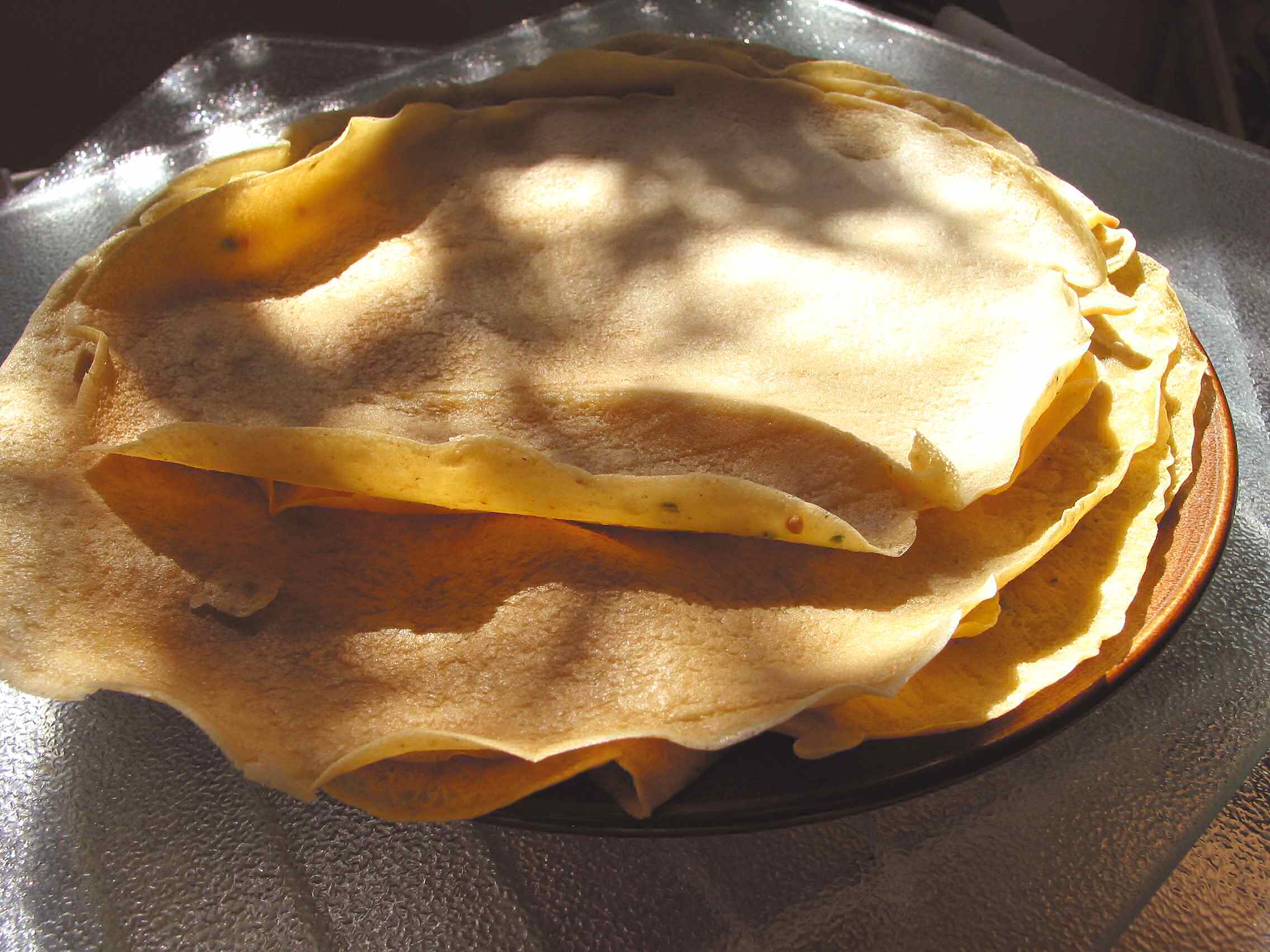
Chickpea Crêpes, Masala Dosa style

instant dosas with chickpea flour, ground rice and yogurt

Project 1 of Panic Week: “instant” dosas made with chickpea flour, rice and yogurt. The heavy dose of mustard seed and black pepper is surprisingly good.

Planning the cooking for Passover usually means thinking about the week itself, buying matzah and gefilte fish and horseradish and so on. But for me, it also means using up the open bags of flour, beans, rice and pasta, plus whatever yogurt, cheese and milk I have left, and yet not overdosing on starches. And I’ve just gotten the taxes done, so it’s time to look in the fridge and panic.

We’ve got just over a week to go before Passover, and there’s still a lot of chametz in the house…a pack of fillo (luckily only one), a pound each of dried chickpeas and red lentils, a bag of mung beans I don’t really know how to use, some rice, a bowl of dough…wonton wrappers. Chickpea flour! Rye flour! Why did I leave it all this long [breaks down and bangs head against wall for a second]?

I don’t usually want to cook or serve that much starch in a single week, but at least most of it is legumes with some fiber and protein. So I’ve been thinking about foods–both chametz and not-chametz–that don’t have to be devastating dietwise or empty your wallet or take forever and a half to cook.

Because even with snow on the ground all over the east coast, where my mom and my sister and most of my old friends are still shoveling it out of their driveways this late in March, Pesach is coming. And then maybe an actual spring with shorts weather? We can only hope! Time to lighten up in anticipation.

This week I’ve decided to post the chametz countdown (aka, “Panic Week”), and the next week or so, a couple of attempts at a Pesach week with mostly fresh, simple foods and a lot more vegetables, and without the usual total matzah-on-eggs-on-more-starch-and-potatoes-and-choke-cake-and-too-many-canned-macaroons kind of meal plan…can it be done? I think so. As long as I don’t let my husband do the shopping. Can it be done in a microwave? I’m counting on it.

Anyway–back to the Panic Week Project. First up, the chickpea flour and rice…as a batter for on-the-spot masala dosas. Continue reading

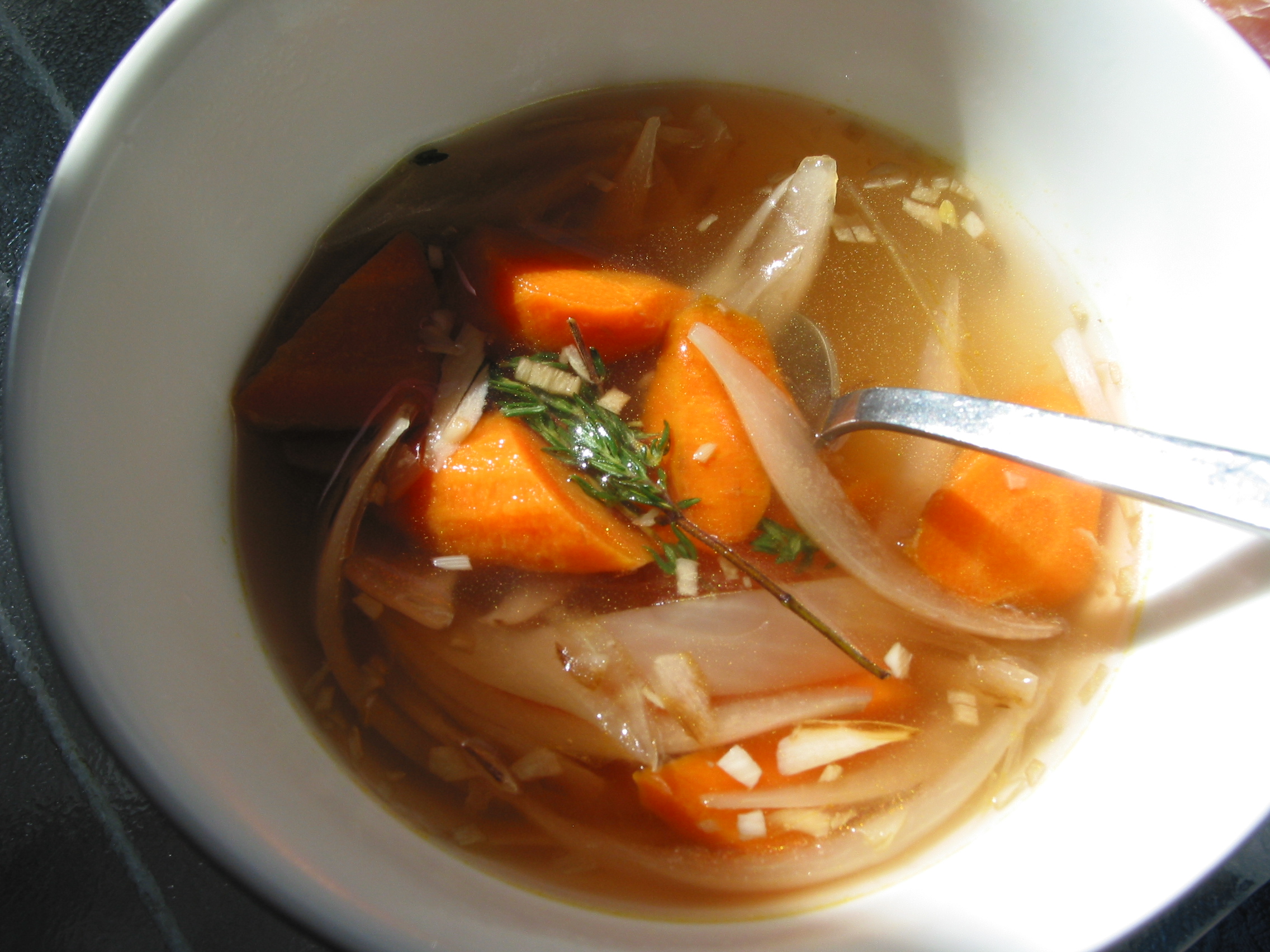
Maximum Flavor in a Minimal Broth

minimal carrot onion soup

My kid had the flu just in time for President’s Day (and both Friday and Monday off from school). How does this happen in a place where it actually hit 90 degrees one day??? How annoying! But her classmates had been catching it right and left all through January and coming back to school still iffy. She and I had both gotten the flu shot a couple of months before, achy arms and all. The prevention rate this year isn’t all that good; only about 23%. And people have naturally been grumbling if or when they catch the flu anyway.

But I’m still pro-vaccine, and here’s why: The minute she woke up with fever, I called and got an appointment with her pediatrician for that morning, no being palmed off on the advice nurse (or the muzak they put you on while waiting half an hour). When you’ve got a diabetic kid with flu, you take a deep breath, channel your Brooklyn-raised mother and elbow your way through to get seen before the kid has a chance to develop nausea and vomiting, which makes it trickier to manage food, insulin and so on safely. I mean, we’ve done it, it’s doable, and we’ll probably have to do it again at some point, but it’s a total pain.

Luckily for me, the pediatrician is also from Brooklyn and doesn’t take offense. She and the nurses had been run off their feet, and yet she was glad we got our act together early enough for Tamiflu to do some good, because the poor kid just ahead of us at the clinic was wobbling and actually fainted just as he got into the exam room. Five days his family waited and he had serious fluid in his lungs. So I stopped feeling selfish and stupid for bringing my kid in when she was mostly okay except for a fever. And I hope the other kid’s better by now.

So I wanted to pass this on: the doctor told us the best-bet recommendation is still to get a flu shot. Why? Because even though you might still catch flu, the severe hospital-level cases this year with pneumonia and worse, at least in Southern California, are turning out to be almost all unvaccinated patients. That’s a result you might not have expected. You need that insider perspective to see there’s a more serious benefit hidden behind the obvious numbers. And the serious cases are pretty bad. So if you haven’t gotten a flu shot yet, go get one now.

And my kid did indeed get better by the time school started up again, and my husband and I managed not to catch the flu from her, which was good, because with a snarky bored teen home on a 4-day weekend, the last thing either of us needed was to catch it from her just when she was finally back at school.

But we needed soup in a big way. And with a sick kid in the house I had less time to go shopping. I imagine (because we had the fluke 90-degree day, I have to imagine it or else talk to my poor mom in Boston) that people caught in the big snows back east also have these problems of limited shopping mobility, patience and scant last-ditch vegetabalia in the house. What did we have left that was soup-worthy?

Well…there’s always the can of tomato paste for nearly instant cream-of-tomato, which my daughter likes when she’s sick. The real cream-of-tomato, made with actual tomatoes, is more voluptuous but takes 45 minutes on the stove and involves baking soda to tame the acidity before you add cream, plus the use of a stick blender which I aspire to but don’t yet own. Tomato paste doesn’t have much acidity to start with, so you could just skip the baking soda and heat with milk instead of water if you wanted to. We generally leave milk and cream out and add a dash of vinegar to restore some semblance of tomato flavor.

–  –  –

Tomato Soup in the Microwave (AKA, “bonus” recipe for what it’s worth)

  • 1/2 can tomato paste (no recipe EVER specifies a whole can, as far as I can tell…must be some kind of culinary superstition, much like “the Scottish play”…so just scoop the rest into a ziplock baggie, squeeze the air out, and throw it in the freezer for next time…)
  • 1-2 c. water (enough to bring it up to the thickness you like best for soup)
  • small splash of vinegar, any kind
  • small clove of garlic, minced, mashed or grated
  • pinch of cumin or thyme, optional
  • salt to taste after cooking
  • splash of milk or half-and-half, if you like it

In a microwaveable bowl, use a whisk or fork to mix the water gradually into the tomato paste until it reaches the thick-but-not-too-thick consistency you prefer for cream-of-tomato soup. Add the garlic, vinegar, and cumin or thyme, cover the bowl lightly and microwave 2-3 minutes or until heated through. If you want to add a little milk or half-and-half afterward, you probably could, just don’t add it and then heat or it’ll curdle from the vinegar (or leave the vinegar out to start with if you want it bland).

–  –  –

But down to business with the “not-chicken” vegetable broth. I’ve already gone about as far as I can go with bok choy and shiitake broth, up to and including hot-and-sour soup. Plus we didn’t actually have any bok choy left. Feh.

So the usual carrot-onion-celery not-chicken broth should have been next…but no celery either. Double feh. And no fresh dill–dry we had, but you know fresh makes a world of improvement. So it wasn’t looking all that good in the clear soup department this week. And I needed some for me, even though I only had a head cold and a bad temper and a sassy, feverish bored teen at home watching cartoons.

(BTW: if you luck out with a fresh bunch of dill that’s too big to use up quickly, wash the rest well, twist off the stem ends, stuff the dill into a ziplock sandwich bag with the air squeezed out and freeze it–it’ll stay good for a couple of months minimum, and you can just quickly crumble a frozen bit into whatever dish you want, then toss the bag back in the freezer. Or in Boston, just leave it out on the porch and rediscover it sometime in April.)

Normally I’d say onion and carrots alone aren’t enough for a soup; you have to have something else in there or when you add garlic it’ll just be about the garlic. Which is fine for me, of course, because my motto still seems to be, “If there’s no garlic, is it really food?”

True, the Italians have acqua pazza (“crazy water”), which is basically garlic broth. I think both Spain and France have similar offerings. But normal people might want something a little more complex or at least balanced.

My usual MO for vegetable soup and bok choy broth is just to microwave the base vegetables to wilt them and then bring them up with a bit of water, add garlic, herbs, and any other appropriate flavorings, and heat again. Pretty basic, and very quick–5 minutes, maybe 10 for a couple of quarts that will last me a week. But with such a limited vegetable base as onion and carrot, I was going to need something more.

So I scrounged again in the fridge. Carrots and a red onion…and a clove of garlic. A sprig of thyme–well. A little leftover white wine. Yes. OK.

It would all be kind of blah and pale, though, if I just dumped it in a bowl with some water and hit the nuke button. When you have so few main ingredients and they’re both boring when simply boiled or nuked, you have to strategize a little to get the best out of them quickly. Continue reading

Purim: Poppyseed filling with a Persian-style twist

poppyseed filling with orange blossom water

Tonight is Purim, when we dress up in costume, make fun of dire villains and dull kings, cheer modest heroes and most of all praise a heroic woman, Esther, who risked everything to change the king’s addled mind and spare the Jews of the Persian empire.

In previous years, I’ve done the Hamantaschen thing–low carb, medium carb, all homemade, no pasty white horrors, praise of Joan Nathan’s basic recipe from her first cookbook…lots of non-Dayglo, non-candy fillings from figs, prunes, apricots, and so on…

Today I’m probably not going to get a chance to bake anything or even cook very much, because I decided to take a leaf out of Esther’s Megillah this year and read part of the fifth chapter, splitting it with my (much-wiser-than-Ahashverosh) husband. So about three days ago I decided I was going to go for it and learn the Purim cantillation (trope marks for chanting) system. Which takes more nerve than usual, because it’s tricky and somewhat deceptive, like the entire story. And it’s been almost two years, since my daughter’s bat mitzvah, since I’ve even chanted Torah. And, like I said, three days ago. Not brilliant.

Luckily there’s Youtube. And a number of synagogues post recordings by their hazzanim (cantors, male and female) for the cantillation marks and for the readings as a whole. Only there are so many versions for Purim! It’s a late holiday in our history, after a lot of us were living in the Persian empire, and the different melodies reflect our already dispersed community. One interesting version was by a Moroccan hazzan–his system actually had a couple of trope mark tunes that are nearly the same as ours for the regular weekly Torah and Haftarah readings. Maybe those are the oldest ones that everyone has more or less in common? Cool!

So–our daughter is chanting a few verses with her youth group for Chapter 7 tonight, and the director is bringing kosher Persian food from a restaurant on the West Side of LA, where the largest Iranian (and Iranian Jewish) community outside of Iran resides. I wish I were a kid tonight, for sure.

Still, in honor of the occasion and the roots, I did get around to making poppyseed filling for the hamantaschen I’ll make tomorrow.

I went to my local Armenian greengrocer yesterday morning for vegetables and picked up a new bag of poppyseeds, hoping they were fresh, really fresh enough to use. My previous latest bag in the freezer has puffed up suspiciously with air–suggests it’s no good and starting to release gases even though I didn’t open it before freezing, dammit.

I tasted the new poppyseeds raw–okay. But rancid sometimes only shows up when you toast them, so I poured a spoonful in a metal pan and swirled them around on the stove until the aroma came up. Then I test tasted those once they were cool enough. Still good, still lucky.

Poppyseed filling is quite an elaborate affair in my trusty 1984 spiralbound edition of Joan Nathan’s The Jewish Holiday Kitchen. Figs, apricot jam, brandy, egg whites? Oy. Ten or more ingredients. A production, and kind of expensive considering how many younger people don’t like poppyseed filling. Including my daughter, I’m sad to report (see below)…

But I do, which is the important thing, and my supermarket no longer carries those cans of Solo in the Jewish Foods section. So I decided it was fine to simplify. And while I was at it, to add a hidden Persian-style element or so for the occasion of Purim.

So this filling looks black…but holds the essence of early spring and orange blossom within it. And if anyone doubts that it’s completely effective in its ability to transform, at least temporarily, I should add that my daughter, who insisted she tells me every year she hates poppyseed filling with a hot hate, and that I never listen, took a tiny bite and looked surprised and pleased…at least for about five seconds, until the bitter toastiness of the poppyseeds came through like a bagel at rush hour, poor kid, and she pulled a Tom Hanks (from Big, the caviar scene). She even did the wiping-the-tongue-desperately-with-a-napkin bit. And no, I’m not sure I should be telling you this. Five seconds delay, though. From her, I’m gonna have to count that as a win. And it was pretty funny, another point to Purim.

Poppyseed Filling With a Persian Twist

  • 6 oz (172 g; it was the size of bag they sold) very fresh poppyseeds
  • 6 oz. sugar (again, 172 g, but anyway, the same amount as the poppyseeds)
  • 1/4 c (60 ml) water
  • juice of a lemon
  • orange part of the rind of an (organic, washed) orange or tangerine (in this case), grated or if that’s too much of a pain, shredded with a knife and ground in a coffee grinder or food processor with an additional spoonful or so of sugar
  • pinch each of ground cloves and cardamom (if you have it)
  • very tiny shake or grinding or pinch of nutmeg
  • up to another 1/2 c. water (see instructions and PS note at the bottom)
  • 1/2 t. vanilla
  • 1 t. orange blossom water (yes, this was my idea of the Persian twist, and it’s good, though probably it should have been rosewater for authenticity–I just wasn’t ready for that)

Taste-test the poppyseeds raw, then toast a spoonful in a dry steel saucepan on the stovetop until you start to smell their aroma. Cool and taste-test again before using to make sure there’s no funky, off, or rancid flavor to them.

ground poppyseeds

Then grind them a few pulses in a coffee grinder (in two batches) or in a food processor or blender.

In the steel saucepan, combine the sugar and water with a squeeze of lemon and let the sugar wet down all the way before turning on the burner to medium. Bring just to a slow simmer without stirring–the slurry should start to go clear as the sugar dissolves.

poppyseeds cooking in syrup

Add the ground poppyseeds and stir gently. It should be a thick dark-gray grainy mass. Keep the pot on a low heat so it bubbles gently but doesn’t spit for about 5 minutes, stirring occasionally but not hard or you might cause the syrup to seize. As it cooks add the lemon juice, spices, grated orange or tangerine rind and stir in, then [see the PS below] test-taste–if the seeds are still kind of hard, add 1/4 c. water, let simmer with a lid partway on for a few minutes, stir and do it again here until the seeds soften a bit and the raw-poppy edge is off. Add the vanilla and just before taking it off the heat, stir in the orange blossom water. Take a tiny bit and let it cool enough to taste and adjust any flavorings, then take off the heat and pour into a container to cool to room temperature. It will thicken further, especially after you put it in the fridge.

B’te’avon, bon appétit, and Chag HaPurim Same’ach!

PS…AKA, next-day “Do-over,” kind of. Because I wouldn’t want anyone to try this, be happy for a few minutes, and then kind of hate the result when they took a second taste. If it needs a fix, it needs a fix, and I felt this did…

The next day I took it out of the fridge for a taste test before deciding if I really wanted to bake…it was pretty grainy and the top was crusted sugar. I stirred it and realized the seeds were pretty hard still and kind of bitter–not rancid, just really raw-poppyseed. Very strong. I think I didn’t have enough liquid in the recipe compared with Joan Nathan’s, even without all the jams and things. She had “juice of an orange” in there somewhere next to the juice of a lemon, and I’d assumed it was mostly for flavor, but probably the extra liquid helped cook the poppyseeds too (hence, the “up to another 1/2 c. water” bit I’ve just added to the ingredients list).

Never one to look away from a challenge (oh yeah? I hear someone muttering sarcastically in the background)…I decided to reheat the filling in the microwave with some extra water and a lid for a minute or so and see if that would induce the poppy seeds to absorb some of the water and soften up a bit. I stirred in about 1/4 c. of water, which immediately went cloudy-white, kept stirring, and the filling thinned almost to pancake batter consistency. Put a lid on and heated 2-3 minutes in the microwave, let sit a few minutes to absorb. It was better as well as thicker, and a little of the poppyseed bitter edge was out as well. So I did it again with another 1/4 c. water, heated 2 minutes or so, let it sit again and it thickened back up but the seeds were definitely softer and a little more brown than black (although I admit it’s pretty hard to tell).

In any case, I’d do this the first time around while it’s still cooking on the stovetop. Add the extra water in bits after you’ve added the poppyseeds and spices, and before adding vanilla or orange blossom water (so you don’t evaporate them off). Expect to cook it down from about pancake batter looseness until it becomes very thick, a grainy paste. Then taste a little and feel to see if the seeds have softened and mellowed in flavor–add more water and cook longer or else do the microwave thing instead if you’re impatient, but I think it might only take maybe as much as 15-20 minutes on the stove rather than the 5 minutes I’d expected.

Safety: The only thing about heating syrups in the microwave (this is basically a syrup with seeds) is that they can get very, very hot. So 1. keep an eye on it while it’s heating and be ready to stop the microwave if it starts to boil over (this didn’t, either time, but you just don’t know) and 2. don’t use a plastic microwave container because the mixture could melt or scar plastics. Proper microwaveable ceramic or old-style borosilicate pyrex is ok if you still have some from 20 years ago or can find it in Europe and tote it home. (NOTE: “new Pyrex” that clanks and is made outside the US is made of soda lime glass and is not very heat-stable–see right sidebar warning).


Microwave Tricks: Rapid Red Cabbage

microwave sweet and sour braised red cabbage

When I was almost twelve, the year of All the President’s Men (go rent or borrow it from the library if you’ve never seen it), a classmate of mine came back from the weekend raving about a new restaurant his parents had taken him to.

Now, almost no one in my 7th grade math class, particularly not boys, either knew about or talked much about food above the pizza and burger level.

My friend’s family had spent the previous year in Italy–you could tell whenever he grumbled about real soccer with strategy vs. the weak substitute they were teaching us in PE that he was sorry they’d come back. Clearly it wasn’t the only thing he missed–this was the first “real” restaurant he’d been to in the US, and it was way out in the countryside.

The Bavarian Chef (which after 40 years is still open in Madison, VA, and now in Fredericksburg as well, I’m happy to see), had a menu like no other in the area: fondue, a magic word I’d never heard before and which my friend had trouble describing. One fondue with Emmenthal-type cheese for cubes of toasted bread, the other with a red sauce (tomato? redcurrant?) for spicy meatballs. Veal or maybe chicken Cordon Bleu (their current menu still has veal). The side dishes were distinctive as well, particularly the sweet and sour red cabbage…it was gourmet. European gourmet, the real kind, and possibly the first upscale restaurant in our part of Virginia.

In any case, my friend was enthusiastic enough about this place that (and I don’t remember this bit at all) I came home and said something to my parents, who were friends with his parents. The next thing you know, my folks schlepped me and my younger brother and sister out of town–half an hour’s drive and  into the next county–to try it out for my birthday. And my friend was right about all of it.

The cheese fondue was a completely new experience and a lot of fun. So was a glowing magenta side dish of sweet-and-sour red cabbage–it would have been fun for the color alone. Although that has not held true for me and beets, so maybe I shouldn’t say so. But luckily it, unlike beets, was  delicious. And so different from anything else I’d ever eaten that it impressed me even more than the chicken (or veal) with the ham and cheese in the middle, and I can’t remember anything at all about dessert.

Sweet and sour red cabbage, when you think about it, is completely contrary to American standard tastes, even those of 40 years ago when people still ate vegetables and cooked most dinners at home. If you had to describe it to someone at school–what would you even say? The ingredients–and the flavors–are pretty simple individually but surprising together: red cabbage, vinegar, sugar, cloves, salt, maybe black pepper. Maybe a bit of apple or onion in some versions. How could that go together? But it does, and I’ve loved it ever since.

And yet I never ever make it at home, because it takes up to 2 hours of simmering on the stovetop, depending on the recipe you have. The one time I made it, back in my 20s, when I was trying to recreate the experience, the whole apartment smelled really, really sulfurous. It reeked. Even though the cabbage did come out ok.

Too bad I didn’t even own a microwave until my mid-30s. But I’ve been rethinking it since last week, when I saw a picture of it in a Mario Batali cookbook from about 10 years ago. The combination of a German-style dish in an Italian cookbook reminded me of the whole prealgebra food debate and my friend’s unprecedented idea that good food was worth traveling for.

But you don’t have to travel far for this dish, and you certainly don’t have to spend 2-3 hours on it. There’s got to be a way, I decided (as usual). How hard could it be to microwave it?

Well,  it worked almost perfectly, at least as a test case: Continue reading