
• Enter your email address to subscribe to this blog and receive notifications of new posts by email.

    Join 241 other subscribers
  • Noshing on

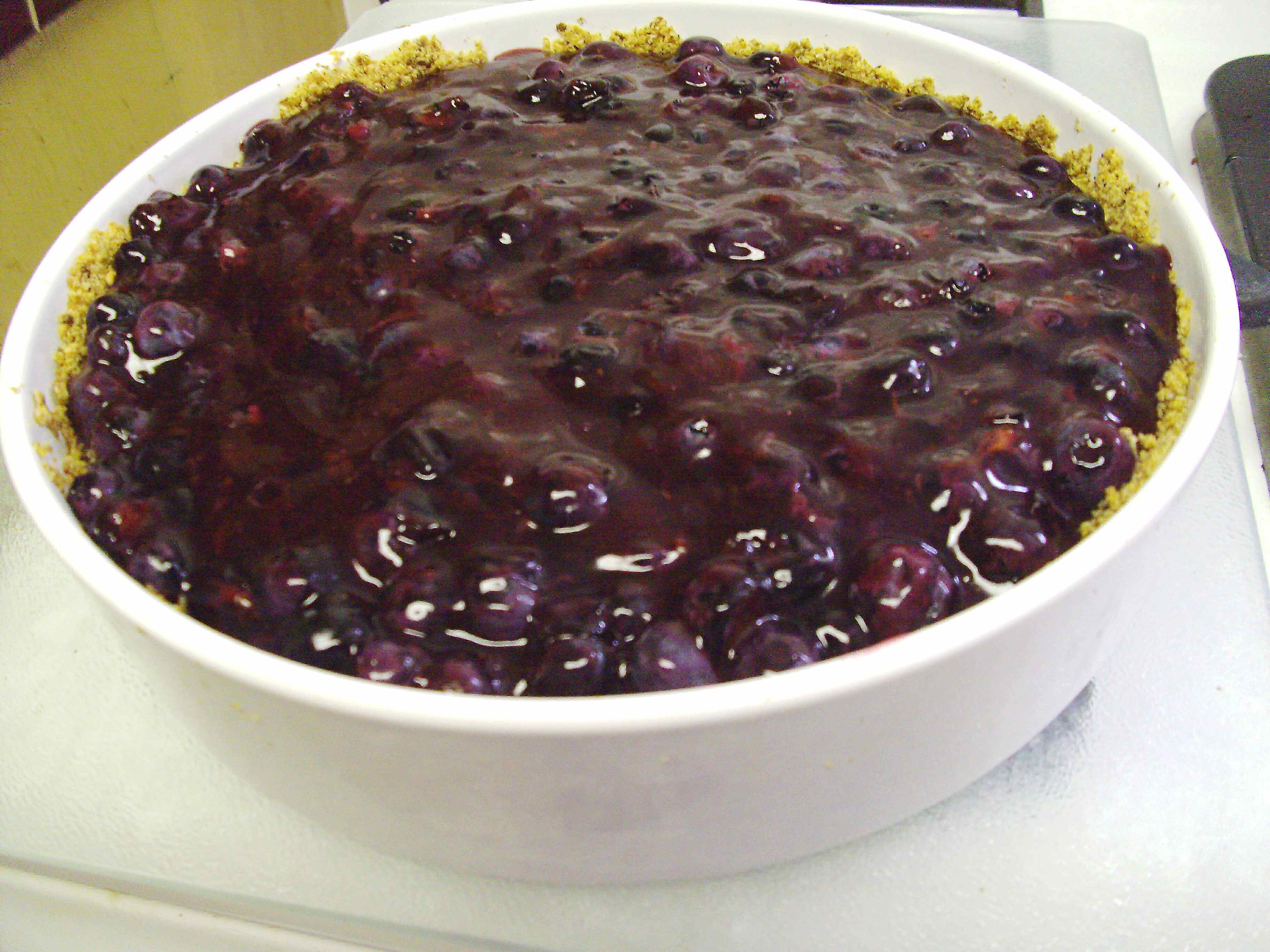
    raw blueberry pie with microwaveable filling and graham cracker crust

    This mostly-raw blueberry pie is a snap to make and very versatile--the filling microwaves in a few minutes, and you don't even have to bake the zippy gingered graham cracker crust--perfect for a hot Fourth of July and all summer long.

  • Recent Posts

  • Contents

  • Archives

  • Now Reading

  • See also my Book Reviews

  • Copyright 2008-2024Slow Food Fast. All writing and images on this blog unless otherwise attributed or set in quotes are the sole property of Slow Food Fast. Please contact DebbieN via the comments form for permissions before reprinting or reproducing any of the material on this blog.

  • ADS AND AFFILIATE LINKS

  • I may post affiliate links to books and movies that I personally review and recommend. Currently I favor Alibris and Vroman's, our terrific and venerable (now past the century mark!) independent bookstore in Pasadena. Or go to your local library--and make sure to support them with actual donations, not just overdue fines (ahem!), because your state probably has cut their budget and hours. Again.

  • In keeping with the disclaimer below, I DO NOT endorse, profit from, or recommend any medications, health treatments, commercial diet plans, supplements or any other such products.

  • DISCLAIMER

  • SlowFoodFast sometimes addresses general public health topics related to nutrition, heart disease, blood pressure, and diabetes. Because this is a blog with a personal point of view, my health and food politics entries often include my opinions on the trends I see, and I try to be as blatant as possible about that. None of these articles should be construed as specific medical advice for an individual case. I do try to keep to findings from well-vetted research sources and large, well-controlled studies, and I try not to sensationalize the science (though if they actually come up with a real cure for Type I diabetes in the next couple of years, I'm gonna be dancing in the streets with a hat that would put Carmen Miranda to shame. Consider yourself warned).

Microwave Tricks: Melts and other Hot Sandwiches
Microwaving the cheese and eggplant while the bread is toasting makes homemade panini a lot quicker

Microwaving the cheese and eggplant while the bread is toasting makes homemade panini a lot quicker--though not necessarily neater

Last year for his birthday my Italophile in-laws gave my husband the ultimate kitchen gadget. Because they loved theirs so much, they gave him…a panini press. I gawked. My husband is almost famous for not cooking. At all.

In more than 20 years of life together, I’ve rarely seen him make an actual sandwich for himself–does shmear on a bagel half count? I’m sure he believes in his heart that he still remembers how to flip one piece of bread on top of the other and seal the deal, but I’ve yet to see evidence of an attempt. Even without grilling.

Somehow I don’t in my heart of hearts believe this panini press is going to be removed from the box and used. Not by my husband, and not by me. It’s not that we’ve never been to Italy or eaten actual panini (we have, on both counts). It’s not that we hate panini or toasted sandwiches in general (we actually like them quite a bit).

It’s that the free-standing real, authentic, Michael Chiarello-approved-and-branded panini press weighs even more than the professional-grade waffle iron my in-laws gave us 10 years ago (and which we’ve used a total of 10 times since, because it’s such a pain to clean). The panini press also takes 3-4 times as long to preheat before you actually get to make the panini. Somehow a grilled cheese sandwich of whatever nationality just shouldn’t take 45 minutes to make. Which it did, when my in-laws, with all the innocent gadget-happy enthusiasm of Toad and his motorcar in Wind in the Willows, brought theirs out to demonstrate.

As a cheese-and-toast fanatic of some standing, I have a few very specific criteria for my grilled cheese sandwiches, grinders, melts, etc., etc.:

1. They have to be substantial and taste good–classic or adventurous, they have to be worth eating. That means the bread, the cheese, and any other fillings under consideration.

2. The toasted bread must be crisp. It must not crush, mush, squash, crumble or absorb tons of cheese grease. It must stand up to the fillings.

3. The cheese must have body and flavor even when melted–it shouldn’t run away, sink into the bread, turn into a pile of salty but otherwise flavorless grease, swamp everything else on the plate, or become a rubber eraser.

4. The whole sandwich must not take longer than about 7 minutes to put together and toast.

Normally you’d say panini fit the bill for an ideal toasted cheese sandwich, and I’d agree–if I were eating out and didn’t have to put up with preheating the grill. If you’re running a corner grill in a touristy Italian city, you’ve got a hot press at the ready and you’re turning out panini by the score for large crowds of passersby, an individual panino probably doesn’t take more than 5-10 minutes. At home, though, all you want is your d–n sandwich. You don’t want to heat an expensive and cluttersome gadget 45 whole minutes just to get there.

You’d also say that the standard white-bread-and-Velveeta fried cheez sandwich was out of the running. You’d be right there as well. No exceptions or passes.

However, in my kitchen, with its limited counterspace and my dislike of extra washing-up, waiting, or fussing, I sometimes get impatient even with the toaster oven classics of good bread, good cheese, and foil underneath to catch the drips.

A quesadilla is obviously no trouble in the toaster oven. Practically designed for it. Neither, really, is a simple sandwich-bread-and-cheddar grilled cheese. But for anything more complicated, or any thicker, more substantial filling, sometimes melting the cheese is the longest part of waiting, and in the meantime you’ve either pretoasted the bread so it stays crisp (in which case it burns around the edges waiting for the cheese to melt) or else you didn’t pretoast the bread and it remains too soft underneath the cheese (and maybe absorbs some of the grease while it’s doing that). Sometimes the other filling ingredients–tomatoes or tomato sauce, mushrooms, lentils, artichoke hearts, etc.–make the bread soggy while you’re trying to melt the cheese on top. Sometimes they don’t cook all the way through.

Here, surprisingly, the microwave comes to my rescue, particularly with fillings that aren’t just cheese but rather cheese melted onto vegetables or sauce or lentils or tuna or some combination. Continue reading

The Minimalist Makes His Exit – NYTimes.com

You’ve probably already seen this–Mark Bittman is stepping out of his role as The Minimalist at the New York Times.

The Minimalist Makes His Exit

I don’t agree with some of his recipes. Desserts with more butter than they really require to be good, expensive Italian hazerai (Yiddish for “that greasy pig stuff”) in a lot of the food, and too much reliance on salt as a flavoring, though he’s nowhere near restaurant-standard. To my mind, these could use a remake. I also don’t think Bittman always walks the walk when it comes to touting nonmeat meals and affordable, commonsense ingredients.

But you can’t fault his enthusiasm and you definitely can’t fault his sense of fun on video. I don’t really think he’ll be able to parlay his next NY Times gig, on food politics and the like, into personal parodies of Blue Man Group, The Thin Man’s Return (He Couldn’t Resist the Spaghetti), or Legend of the [you-name-it Kung Fu] Master.

But I could always be wrong. In the meantime, he’s given us more loose-jointed “101 variations” kinds of roundups for summer salads, Thanksgiving side dishes, etc. than almost anyone else and has written two gigantic tomes on How to Cook Everything –even though I’m not sure I’d really want to cook everything. I mean, everything? Too many dishes to wash. Makes me tired just thinking about it.

Fruit Rescue Redux: Re-tanging the “Cutie” Tangerine

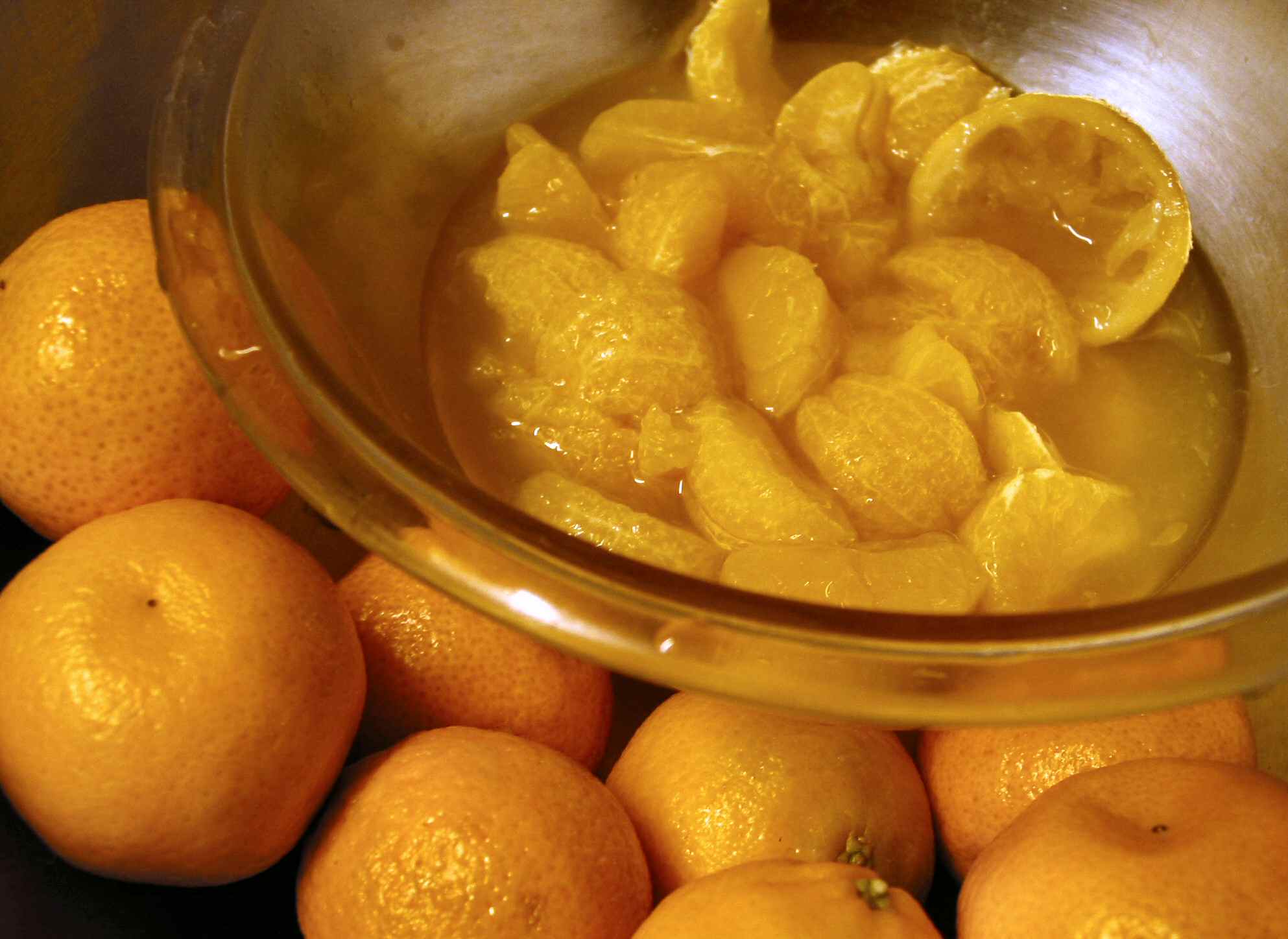
Putting the tang back in Cutie tangerines

Farmers’ markets aside, an awful lot of produce isn’t what it used to be–either for vitamins or flavor. Anytime you get to major mass production and long storage times, you know the result is going to be a product that looks like fresh fruit or vegetables but the smell, taste and texture are really missing. Kind of like the long-stemmed red roses bred to last for the Valentine’s Day bouquets–pretty, hardy as hell, but with almost no perfume at all.

Case in point: the Cutie ™ seedless tangerine. About two weeks ago I bought a 3-lb. bag of these things for a congregational hike and Tu Bi’Shevat ceremony in honor of the New Year of Trees, usually in January around the time when almond trees are in blossom in Israel (and California, though that’s a little less official).

The ceremony, other than the basic blessings for the gift of trees and their fruit, is kabbalistic in origin and involves celebrating the different kinds of fruit and tree nuts as a metaphor for different levels of openness and freedom in the soul. Some fruits have a hard stone at their core, others an inedible peel or shell, and the most open and enlightened are fully edible. A full-out Tu Bi’Shevat seder includes a selection of these fruits and nuts in progression from least to most edible, along with four cups of wine or grape juice mixed in four combinations from white to red (or is it the other way around?) to symbolize the approach of spring among other things. I’m not a kabbalist (my family were always “misnageders” or skeptics/rationalists rather than Hasidim) but I can appreciate the poetry of the Tu Bi’Shvat seder.

My family, skeptical or not, also always appreciated a good geschichte (shaggy dog story, preferably minus the actual dog and its hair). So I’m painfully aware you may not think you’ve been hearing enough about Cuties for the past few minutes to make this worth your while. I’m trying here.

My husband came back from the hike with at least half the bag of Cuties uneaten, so I put them in a bowl on the counter and started serving them, hoping to use them up before they went rotten. Because I’m not sure a seedless rotten tangerine is an improvement on the regular kind. Also because our neighbors with a satsuma tree (seeded) had just gifted my daughter with a bag of those. Out here in LA, tangerines are the winter version of zucchini.

Cuties are little and orange and shiny and really easy to peel. Perfect, right? The trouble was, the Cuties had almost no taste. At all. Continue reading

Souper

I’m a hardcore used book glutton–you can often find me squinting at the Friends of the Library Last Chance shelves for the 25 cent specials, wondering whether some of the offerings are really worth a quarter or not, and if not (as is often the case), how come the same book (Dan Brown’s DaVinci Code and Angels & Demons both come to mind here, as do any pseudo-psychology guru selections and Betty Crocker spiralbound works from the 1970s) in slightly better condition is going for two bucks upstairs in the Friends’ main room. But I rarely come away entirely disappointed, because the used book shelves tend to contain quirky and entertaining gems you can no longer find in the thinning selection of bestsellers at your local Borders if it’s still open.

Last spring, I picked up just such a gem at my synagogue’s library used book sale and have been suitably impressed with my bookhound instincts ever since.

The Soup Peddler's Slow & Difficult Soups by David AnselThe Soup Peddler’s Slow & Difficult Soups by David Ansel (Ten Speed Press, 2005) has sat on my desk for about six months, aging gracefully under a shifting pile of papers, notes, my camera, my blank book cooking diaries, and other detritus, and every once in a while I unbury it again, read a bit at random, thumb through it, and resolve that I really MUST review it here.

Ansel’s book is the story of how he became the Soup Peddler, a Baltimore-born Jew cooking, peddling and, I guess, pedaling homemade soups of all kinds to subscribing customers all over a small town in Texas.

It’s a little hard to describe. The Soup Peddler’s Slow & Difficult Soups is something in the vein of MFK Fisher’s A Long Time Ago in France or Frances Mayes’ Under the Tuscan Sun, but it’s even more in the vein of Garrison Keillor’s Lake Woebegon Days, John Berendt’s Midnight in the Garden of Good and Evil (only without the murder or most of the voodoo, I think–I haven’t finished Soups yet), Woody Allen’s Radio Days and almost any of the local asides in Kinky Friedman (another slightly more famous/infamous Texas Jew)–pick one of his earlier mysteries, I don’t know, but let’s say the one where he and his sister (both adults) are arguing and each tells the other they “mourn the fact” that the other one’s being an idiot. Only with soup recipes and the sometimes risqué, sometimes heartbreaking tales Ansel’s Soupies recount in their email orders.

Since I’ve only been thumbing through it, not reading straight from beginning to end, I can only give you a taster here:

I hopped on Old Yellow [his bike], coasted down Mary Street straight across the creek. … I found the Follicle Fondler on his front porch stropping his scissors.

“Sir,” he said.

“Yes sir,” I said. “I’m here to take you up on your offer to discuss the gumbo.”

He inflated his great lungs and, setting down his scissors, exhaled through his flaring nostrils. “Let’s go inside,” he said. He cleared off the kitchen table  and rummaged in the corner, pulling out a roll of maps. He laid them out on the table.

“I hope you’re prepared to go all the way,” he said.

He drew up his lower lip. I raised my eyebrows hopefully. “Good,” he said. “Where are you going to smoke the ducks?”

“The Smoked Salmon Man has promised his smoker.”

“Does he have access to an ample supply of mesquite?”

“Yes, he…”

“WRONG!!!” he boomed. I steadied myself against the kitchen counter. “Always use hickory.”

“Yes, hickory, got it.”

“So,” he said, narrowing his eyes and softening his voice, “will you be using okra?”

I inhaled and paused, my eyes darting back and forth across the kitchen for a clue. “Yes,” I said confidently, smiling.

“Good,” he said…”We need to talk about the roux. What are your plans for the roux?”

“Well, that’s kind of what I came here to talk about. I…”

“Son, this is not a time for tomfoolery.”

“I wasn’t…I just…”

“If you’re not serious about this, we can just roll up these maps right now and that will be that.”

“No sir. I’m serious. I’m totally serious.”

“Like, totally?”

“Totally.”

“Okay. You’re going to make a dark-brown roux. You’re going to stir it without stopping till it’s done. You’re going to take it to the edge of burning. You’re going to sweat. Don’t sweat into the roux. You’re going to get burnt. Don’t cry into the roux. You’re going to wear your arm in a splint the following week. A normal pot of roux lasts about three beers. Let’s see, you’re making (inaudible) gallons (inaudible) carry the five,” he mumbled, counting on his thick fingers. “Your roux should take about thirty beers.”

excerpted from The Soup Peddler’s Slow & Difficult Soups by David Ansel (Ten Speed Press, 2005)

Ansel’s business is still local, but he’s expanded enough to have a staff do some of the onion chopping and bicycle delivery for him. If you’re in his part of Texas, look up The Soup Peddler World Headquarters, which contains more anecdotes as well as ordering information if you want to become a Soupie yourself. If not, look for this book. I entirely wish it were available at Borders, front and center of the cookbook section, but it isn’t.

Meanwhile, I’m off to try Ansel’s version of Shorbat Rumman (yellow split pea soup with mint, spinach, parsley, cilantro, scallions, lime juice and pomegranate syrup), of which he writes:

Neither slow nor difficult…Dazzle even your most Republican friends with this soup, and when they ask, “What’s that taste?” just say casually, “Oh, that’s pomegranate syrup. We like to keep some around the house just in case we’re having Iraqi food for dinner, don’t you?”

Superfoods and Magic Beans

“Top 10 (or 7, or 5, or whatever) Superfoods” lists seem to be popping up on the covers of all the in magazines this month. If I didn’t get a headache every time I tried it, I’d be rolling my eyes.

The classic bloated diet article with the even more classic bloated promise of magic beanhood is nothing new, I realize. But “superfoods”…

The premise of calling something a superfood is that if you eat this one special food, or at least shop your way down the list of 5, or 10, or whatever’s in the article, you’ll be so much healthier than someone who eats a regular food. Right?

Usually the items on these lists of so-called superfoods turn out to be expensive exotics like dried acai berries and pomegranate juice. Both of which just happen to have heavyhitter funding and marketing efforts behind branded packaged versions of them, and the companies that have started branding and marketing them have both recently come under FDA scrutiny for overinflated and unsubstantiated health claims.

Of course you don’t have to go branded to run into wide-eyed, breathless claims about supposed superfoods. More mundane choices like the sunflower seeds, green peas and garlic touted in this LA Times food section article are also now being highlighted as the new great green hope for America.

But not for the reasons that make the most sense–that these foods are relatively unprocessed vegetables, fruits, whole grains, nuts and seeds (occasionally someone remembers to add something from the beans and pulses category too). All of this vegetation has almost disappeared from the current mostly-processed, mostly restaurant diet of the American public. The general categories now touted as superfoods contain protein, fiber, vitamins and minerals. They’re wholesome and varied if you buy them fresh (or dried) and cook them yourself. Some of them are green (and they’re supposed to be!)

That’s in stark contrast to the now-standard and really dreary burger, ketchup, fries and soda that are all made out of the same three or four overused industrial ingredients (wheat, soy, corn and salt, with a little beef scrap or so thrown in for the burger, some leftover tomato paste for the ketchup, and much less potato than you’d think in the fries). I understand how something that’s actually recognizably plant-based would seem exotic and ultrahealthy in comparison. I do. Because frankly, you could take your soy-based green crayons and color a piece of all-natural bamboo-fiber cardboard and eat that and it would be healthier than the fast food special.

But does that mean vegetables, fruits, whole grains and nuts and seeds are suddenly superfoods?

What are superfoods supposed to be, exactly? Look at the captions for what’s so great about each featured food Continue reading

Resolution 18–eat more fun vegetables

Raw fennel bulb

I dream of going, but this is for now

Fennel’s in season here and makes a great crunchy salad vegetable. Or just a great raw vegetable for noshing, period.

Local, organic and forgotten field hands

Darra Goldstein’s editorial in the Fall 2010 issue of Gastronomica calls out the schism between the “local, organic” righteousness of wineries and customers and the forgotten field workers they still exploit in the process. Worth a read, even though Goldstein doesn’t get quite far enough to suggest a solution or call for renewed political attention.

Gastronomica | Fall 2010 | Volume 10 Number 4.

Microwave Tricks: Brown Rice Resolution

Resolution #15 from my last post was to figure out a decent “quick” method for cooking tougher grains like brown rice and pearl barley. These grains still have the skin on, which forms a barrier to quick absorption, so they take 45-50 minutes to cook on the stovetop, which is simply too much for me to babysit. Apparently I’m not alone on this–I see vacuum-packed packets of precooked brown rice at the Trader Joe’s (and similar bowls in the freezer both there and at Whole Foods).

To say the least, this is not the right way to go if you’re earnest about spending less on staples while going a little bit greener in the new year (think of all the freezer energy cost and coolant leaks, the cooking energy expended, the plastic packaging, etc.)

According to Nina Shen Rastogi of Slate.com, microwaving can be the greener cooking option as long as you don’t leave your microwave plugged in when you’re not using it–apparently the little digital clock display thingy takes up a surprising amount of energy (and do you really need a microwave to tell you the time? Hang a battery-operated clock in view of the kitchen and you’ve got it…)

So microwaving should be the way to go with brown rice, as it is for pasta (plain or whole-grain) and white rice. But unfortunately, microwaving brown rice, with its tough outer skin, really doesn’t work well at all if you just dump the raw rice into some water and try to nuke it straight up, the way you can with these quicker-soaking grains. Certainly not in 3-5 minutes of cooking time. Not without babysitting and worrying about boilover. Feh.

And it’s never a good idea to nuke something starchy more than a few minutes at a time, at least not without a lot of water in it–you could end up with plastic (think about what happens to bagels if you microwave them for more than 15-20 seconds).

But you know I don’t like to give up once I decide something should work. So–I thought about something I posted a couple of years ago on nuking oatmeal successfully and decided to try the presoak idea that had worked for steelcut oats. Only who wants to presoak rice overnight if they don’t have to? Steelcut oats–you know you’re going to make them for the next morning’s brunch (only do it on a weekend). Stick ’em in a bowl with water and a lid, let it sit overnight, nuke a few minutes in the morning and you’ve got it. It’s perfect.

Rice? I never know what I’m making for supper until about an hour before.

But a hot presoak worked pretty well to get things started, and it only took about 15 minutes (because I was impatient). The whole thing still took about an hour–well, maybe less in the strict sense, I wasn’t paying attention Continue reading

Cooking (and other important) Resolutions

(Of course)–I couldn’t leave 2010 on such a bitter note as the one in my last post, even though I think bitterness is a good, energizing, creative thing. Or as the great Eric Burdon once–or actually, quite any number of times–told an interviewer about his ordeal with getting paid for House of the Rising Sun, “I’m not bi’eh. I’m bi’ehsweet.” I have a thing for Burdon’s early stuff–voice like a hammer, great blues timing, pure nerve with a sense of humor, and clearly, a good appetite.

So I wish you all a Happy New Year, good eating, good cooking, good reading and good company, and thank everyone who’s visited and especially those who have taken the time to subscribe to Slow Food Fast. For myself, I’ve come up with about 11 new resolutions for 2011 (but as usual for me, it may will definitely run longer, since I’m terrible about following directions, even my own, whether cooking or resolving):

1. Learn the Dirty Dozen a little better and plan the weekly budget (see #3) to include buying these vegetables and fruits organic only. (I’ve got celery, potatoes, pears and strawberries down so far, but I know there’s gotta be at least 8 more, right?) Find places to buy them cheaper than Whole Foods.

1a. Learn to garden? Umm. Learn to schnorr backyard fruit from friends? More likely, ain’t it? Ok, ok, make more friends, schnorr backyard fruit and veg. And rosemary, which some people grow as a hedge here in Pasadena. Envy, envy, envy–turn it to a good purpose and offer to take some of the excess off their hands.

1b. Exercise basic civility towards other people’s food choices–your eat local is my eat kosher is his eat organic is her eat affordably. Everyone’s got different priorities, and you don’t know who is eating a particular way because they feel like it and who really needs to so they don’t end up in the hospital. Food shouldn’t be too huge a source of personal arguments. I mean, really, people, save some energy for the real issue–dark or milk chocolate?

2. Get the weekly food budget back down under $100 a week (holidays take it outta me). Make a list and (I cannot believe I’m saying this) check it twice. With a calculator. Include toilet paper and napkins and so on.

3. Use all the vegetables I buy sometime in the same week I buy them. This goes triple for any herbs. No brown broccoli (not usually a big problem in my house, actually) or rubbery carrots (didn’t mean to confess that). And NO cilantro or fresh dill left until it turns slimy while I dither over what to use it in… when in doubt, make soup (see #4), or with herbs, wash and freeze in baggies.

4. Make one big batch of soup each week (see #3 if necessary for motivation) and eat it.

5. Make one pound of beans each week and eat it in fabulously creative ways, or at least edible ones. Eat them as a substitute for, not addition to, fish or meat at least one dinner per week.

6. I’m stumped. Maybe I should make each of the previous resolutions count twice? Naaah. Put on some blues and think again.

The real #6: Eat vegetables at breakfast, Israeli-style.

7. Wash fewer dishes–make my kid do them! (oh, yeah, I’m rollin’ now!)

8. Reduce my dependence on oil–starting by using cocoa powder instead of a full-cocoa-butter chocolate fix…damn those holiday gift boxes. Hate See’s, hate it with a passion (unfortunately, not really)…

9. In the same vein–cut down to half-caf this week, decaf in two or three weeks. Start today. Too much hoppin’ around after midnight (or maybe just too much listening to Eric Burdon on YouTube–wait. Is there such a thing as too much, at least of his early stuff?).

10. Shop my neighborhood greengrocer’s first instead of the big box market. Buy and try a small amount of one new Silk Road ingredient each month (red pepper paste? knoug resin? green almonds? sea buckthorn nectar?)

11. Get a few new implements as long as they have a real multifarious use and a small kitchen footprint: stick blender? I hear it calling my name. Pasta machine? not so much–the box instructions say not to immerse in water. How are you supposed to wash it then? (see #7)

12. Make bread at home again.

13. Revamp a classic every so often, preferably with the intelligent use of a microwave to help speed things up where it will actually help. Like choux paste (at least for heating the liquid ingredients before adding the flour and eggs–that’s actually been done before, and not by me) or pretty-good fake-smoked whitefish salad (which is mine, see the end of this post). Continue reading