
• Enter your email address to subscribe to this blog and receive notifications of new posts by email.

    Join 241 other subscribers
  • Noshing on

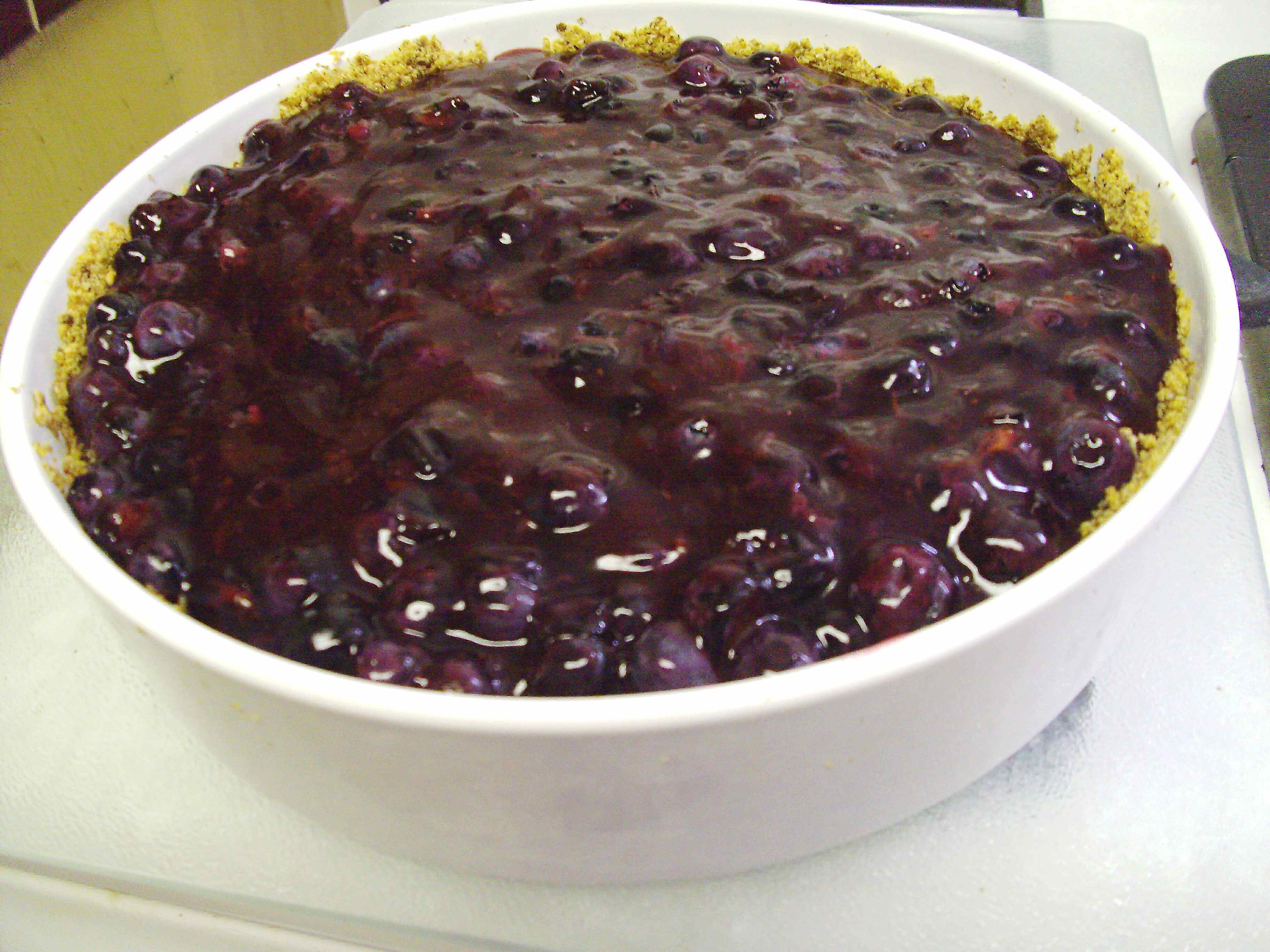
    raw blueberry pie with microwaveable filling and graham cracker crust

    This mostly-raw blueberry pie is a snap to make and very versatile--the filling microwaves in a few minutes, and you don't even have to bake the zippy gingered graham cracker crust--perfect for a hot Fourth of July and all summer long.

  • Recent Posts

  • Contents

  • Archives

  • Now Reading

  • See also my Book Reviews

  • Copyright 2008-2024Slow Food Fast. All writing and images on this blog unless otherwise attributed or set in quotes are the sole property of Slow Food Fast. Please contact DebbieN via the comments form for permissions before reprinting or reproducing any of the material on this blog.

  • ADS AND AFFILIATE LINKS

  • I may post affiliate links to books and movies that I personally review and recommend. Currently I favor Alibris and Vroman's, our terrific and venerable (now past the century mark!) independent bookstore in Pasadena. Or go to your local library--and make sure to support them with actual donations, not just overdue fines (ahem!), because your state probably has cut their budget and hours. Again.

  • In keeping with the disclaimer below, I DO NOT endorse, profit from, or recommend any medications, health treatments, commercial diet plans, supplements or any other such products.

  • DISCLAIMER

  • SlowFoodFast sometimes addresses general public health topics related to nutrition, heart disease, blood pressure, and diabetes. Because this is a blog with a personal point of view, my health and food politics entries often include my opinions on the trends I see, and I try to be as blatant as possible about that. None of these articles should be construed as specific medical advice for an individual case. I do try to keep to findings from well-vetted research sources and large, well-controlled studies, and I try not to sensationalize the science (though if they actually come up with a real cure for Type I diabetes in the next couple of years, I'm gonna be dancing in the streets with a hat that would put Carmen Miranda to shame. Consider yourself warned).

Spaghetti Squash Too Many Ways

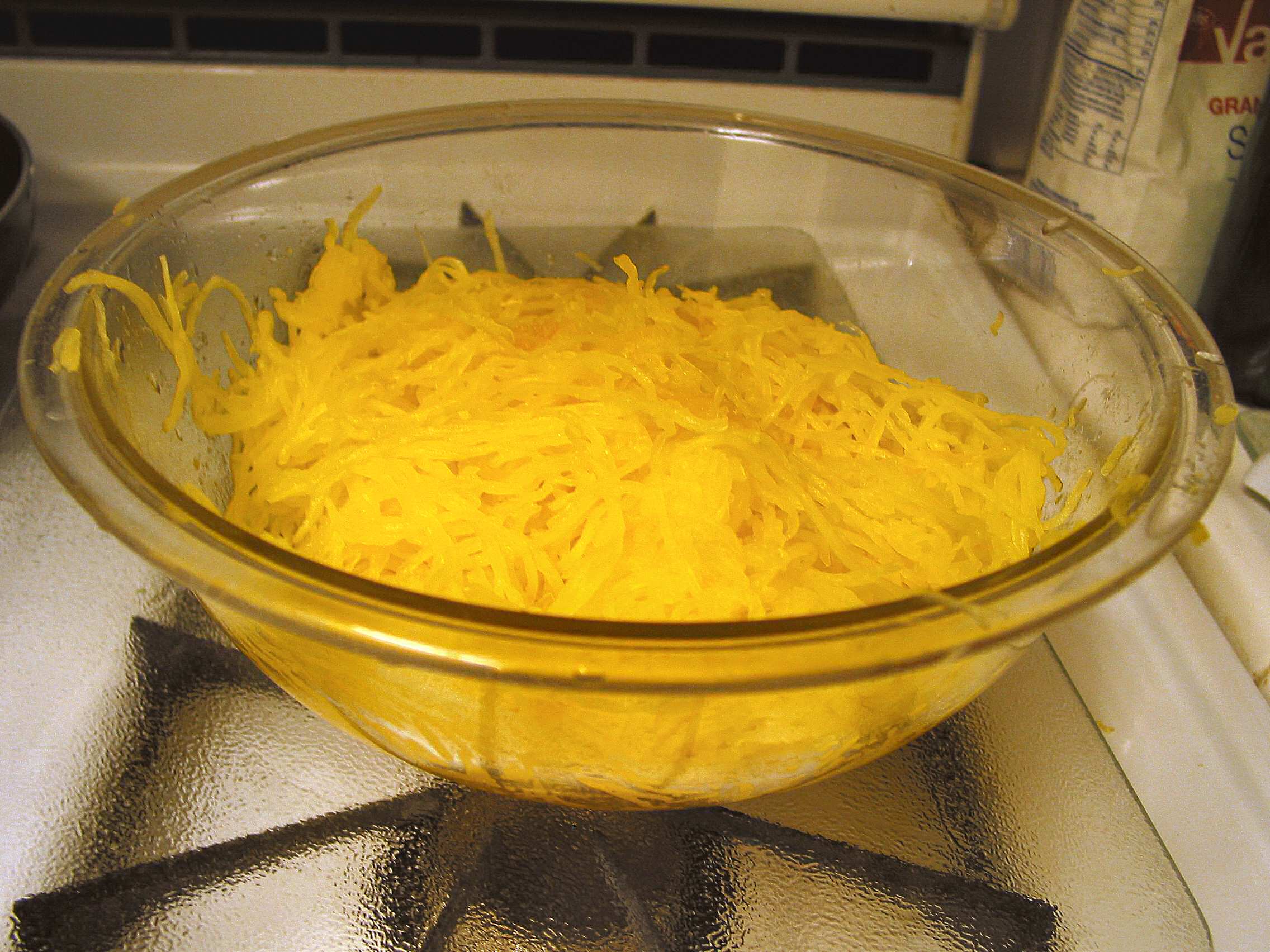
Just half of a microwaved spaghetti squash makes 5 or 6 cups

Just half of a microwaved spaghetti squash makes 5 or 6 cups!

This week my local Trader Joe’s had crates of beautiful–and hefty–spaghetti and butternut squash for less than $2 apiece–on the order of 30 to 50 cents/lb. So of course I got two of each and wobbled out of the store unsure which bag was pulling me down further. And then came the task of cooking them.

One spaghetti squash–a good-sized 5-6 lb. beast–will feed a lot more people than you’d think. It’s got some serious advantages over standard pasta: more fiber, no sodium, some vitamin A and potassium, perhaps fewer calories and carbohydrates per ounce. And it’s incredibly versatile. And you can cook it in the microwave in about 10 minutes rather than spend an hour baking it and heating up the house.

But there’s one big disadvantage–if you cook the whole thing, you have to eat the whole thing. Cooked spaghetti squash doesn’t hold up in the freezer–the strings go flat and shrivelly. And reheating too long can make it wilt as well. So can very acidic dressings.

So the choices are (for a small, moderately but only moderately tolerant family unit):

  • Cook half at a time and store the other half raw and wrapped in the fridge for a few days
  • Cook both halves, use one right away, and store the other half in the fridge for a few days, either wrapped in its shell or else scooped out into a container  (recommended)
  • Give the other half to a friend–but not too good a friend…
  • Cook it all and make it for a big potluck. Maybe people will think it’s innovative and exotic…depends on what you do with it (I don’t so much recommend marinara for this if you’re looking to impress–maybe a peanut-curry sauce or an Alfredo-style sauce with lemon peel, or something involving oyster mushrooms)
  • Cook it all and serve it a couple of different ways over the course of the week
  • Make a couple of the variations ones that taste good cold and eat the leftovers for lunch (recommended)

One important tip (learned the hard way):

The strands grow crosswise inside the spaghetti squash, not lengthwise. If you cut the squash in half the way you would a watermelon, you’ll be cutting the strands into shorter bits–not what you want. Cut the spaghetti squash in half across the middle of the SHORT side, NOT from the stem to the flower end.

If you have kids, let them count the seeds in each half of the squash–it’s a good lesson in plant survival strategies. My daughter and I counted about 80-90 seeds per half and decided to wash, dry and save them for her school’s garden. At this rate, they’ll have spaghetti squash for several years. Note of caution: out of 10 that we thought had been lost down the sink but actually got caught in the drainer, a full 9 germinated, so be careful what you wish for… even commercially grown, these things are very, very determined. But we’re not ready to name any of them “Audrey II”–yet. Continue reading

Can Better Nutrition Curb Violence?

In the news section of the journal Science this week comes word of a new UK diet study that may have significance for the general population. Researchers have set up a large double-blind study at a prison in Scotland to test the possible effect of nutritional supplementation — vitamins, minerals, and essential fatty acids — on lowering the frequency of violence. Listen to Science news correspondent John Bohannon’s podcast.

It’s not the first study of its kind–about 30 years of studies in both prisons and schools suggest that diet can affect antisocial behavior–but it’s the biggest and best-designed one to date. Because the study is double-blind, neither the researchers nor the prisoners participating know which ones are getting vitamin supplements and which are getting placebos.  The researchers are also conducting cognitive and behavioral tests and taking blood samples in the subjects both before and after the study so they can try to trace which of 12 essential vitamins, minerals, and essential fatty acids make some kind of a difference to behavior.

The researchers say that, at least anecdotally, incidents at the prison seem to have dropped from two per day to one per day in the few months since the study began, but it’s too soon to tell why or whether the new nutritional supplementation or the study as a whole has anything to do with it. Solid results from the study itself won’t be in until 2012.

If the study does show a real connection between malnutrition and violence in prisons, it may also have implications for school cafeteria food offerings and the fate of American civility under a massively processed diet (or am I reading in based on last week’s live and unscripted entertainments, all three or so, on national television?). It could also bolster current efforts to attract grocery stores to poor urban neighborhoods where fresh foods are scarce–such as the municipal zoning and tax incentives approved yesterday in New York City.

And that brings me to my reservation about this study–the researchers are studying improved nutrition, but they’re attempting to improve the prisoners’ nutrition with supplements–vitamin pills–and not with a better integrated diet.

The prison study is kind of bare-bones in that the outcome they’re looking to measure  is a drop in violent behavior. Certainly using vitamin supplements and placebo pills is a neat, controllable way to study nutritional supplementation–neater and more precise than testing whole-foods kinds of diets. I’m not saying it’s the wrong way to design this particular study, and if it’s a real improvement in nutrition over the usual prison diet, then it may actually work well enough. But it’s something that’s just begging for exploitation if it does work, because magic bullet-style remedies are so popular in the world of Big Food, government, and even the general public.

In poor neighborhoods, prisons, and other places where malnutrition is common, vitamin and other nutritional supplements may be the fastest, most efficient and inexpensive way to remedy the severe shortages of fresh unprocessed food. That’s what those pills were designed to do, back in the days when there wasn’t much junk food or fast food, and malnutrition walked with starvation, not obesity. And I would never begrudge anyone who needs them. But they shouldn’t become the end of the road.

I reject the idea that you can feed people any kind of processed slop, and as long as you dose it or them with vitamin pills, everything will be great. I know, I know, that’s partly because I like to cook actual food and think processed stuff tastes a lot more like the cardboard and styrofoam packaging it came in than the packaging itself.

I also know I’m out of step. The fact is that people have been eating this way for a generation or more. Vitamin pills have been around in both adult and children’s versions, heavily advertised on TV, since I was a kid. And they’re really cheap–cheaper than fresh food. And even so they’re very high-profit margin items.

In the larger context I would hope that for most people, the big take-home message from the study (if it proves a connection) doesn’t become, “Just add more processed vitamins to processed food–that’s eating twice as healthy!”

Outside of prison walls, I want to see vulnerable neighborhoods get grocery stores that sell fresh produce at affordable prices. Ironically, up to now, the only major grocery chain willing to take on America’s inner city neighborhoods (before the offer of zoning and tax incentives as far as I know) has been the UK’s Tesco, not an American chain.

Tesco has been trying to get its small-scale Fresh&Easy markets up to speed now for two years. In April, news tickers reported shortfalls for the Fresh&Easy stores, some of which were built, stocked, and then left shuttered–they’d expanded too quickly and US pundits at the time thought they hadn’t really tested their markets well enough ahead of opening.

But in fact since that time, most of the open ones have stayed open, and few have actually failed–maybe 15 percent. The new incentives should help attract American supermarkets, but so should the relative success of Tesco’s model in what everyone expects to be a high-fail zone. If they can hang on they might change the game and make inner city life more civilized and more livable. Who knows? Now Whole Foods is mulling it over.

Honeycake for a Sweet New Year

Rosh Hashanah starts this evening and we need a honeycake–it’s traditional, plus I like it. Right. But traditional recipes call for boiling the honey with strong coffee (which takes a while), cooling it (which takes even longer), triple-sifting flour and baking soda and sugar and spices of various kinds, and then alternating between adding dry stuff and the honey-coffee mixture to some beaten eggs and oil. This is much more of a pain than it sounds in so few words. Picture wax paper and bowls all over the counter and the kitchen table, and a huge stack of stuff to clean afterward. All for one or two loaves of what’s essentially a rich gingerbread.

One year I got smart–I think it was the year I bought both Silver Palate cookbooks and found their gingerbread recipe, which is incredibly simple and calls for molasses–surely it would work with honey? And it does.

Then I took things a step farther–having made a bunch of box-mix cakes in the era when Duncan Hines started recommending applesauce instead of oil for a lower-calorie cake, I knew that worked pretty well, and it does here too.

Then I really got weird and microwaved the cake–you can, and it works, but my daughter and her friend are doing it this afternoon as a project (I’m tarping the entire dining table and floor) so this year I’m sticking with tradition. Even though the temperatures are back up in the low 90s. Continue reading

Microwave tricks–When the peach doesn’t ripen

What if you’re stuck with supermarket peaches or nectarines that looked good, were on an incredible discount, smelled like they had potential if you left them out on a counter for a couple of days, and then when you did, they somehow never really ripened? Just turned mushy or the texture of a pale yellow sponge inside, with a lackluster taste to match, and developed an ugly, gelatinous brown layer near the pit? And to make it worse, you’d enthusiastically bought five or more?

Spongy peaches in need of rescue

Spongy peaches in need of rescue

I’ve discovered–the hard way–that all is not lost. As long as they’re only blah, not actually mildewed or spoiled, even failed peaches like these can be rescued and put to work.

Sugaring before microwaving p

Sugaring lightly before microwaving

Sugaring fruit and letting it stand is an age-old trick for bringing out fuller flavor–strawberries are the classic, but it works for peaches and nectarines too. It wasn’t enough on its own to make the peaches edible raw, but I figured if I nuked them the flavor might come up in the cooking, and the texture might be fixed too. So I tried it a couple of ways, one just the peaches on their own, and two other versions mixed with other more flavorful fruit.

[update ~ 2017: I have tweaked the raw peach method here]

Microwave Peach (or Nectarine) Compote or Jam

The first thing to do is wash the peaches well and cut as much usable flesh off the pit as possible. Take a small sliver and taste it–if it’s just bland or spongy but still has at least a tinge of fruit flavor, you can use it.

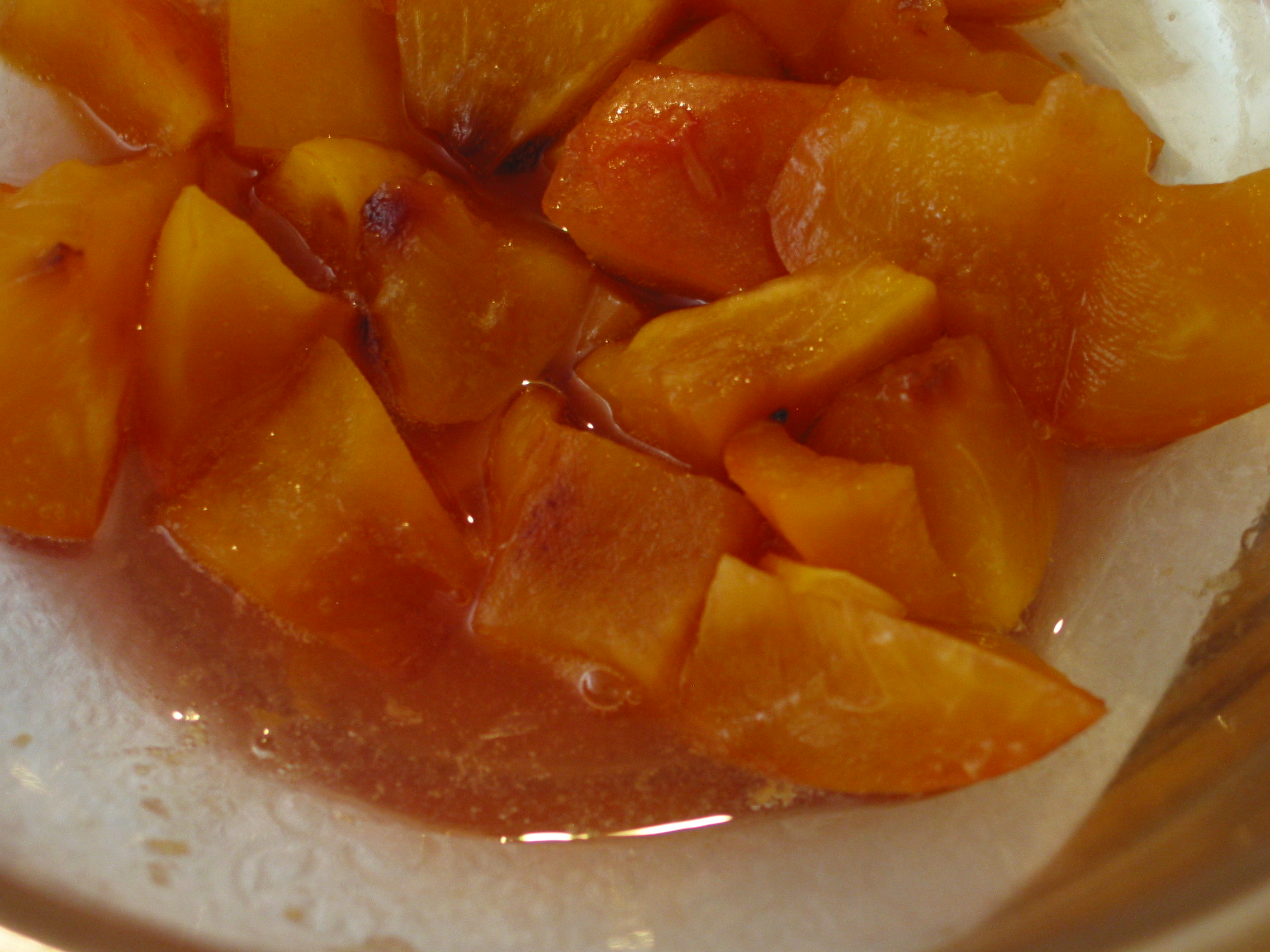
Chop up the peaches and put them in a pyrex bowl. Leave the skins on–this is where at least some of the flavor is going to come from. Sprinkle on a few spoonfuls of sugar and squeeze some lemon juice over them. Cover the bowl with a plate and microwave on high for a few minutes (3-4 min in a ~1100W oven). When you uncover the bowl, the fragrance should start coming up and the pieces will have turned translucent and produced a bit of pinkish-bronze juice. You can taste and see if that’s good enough for you, or cook another minute or so, perhaps with a sprinkle of cinnamon (very good) and/or a thin slice of fresh ginger. Maybe a star anise pod or a couple of cloves if you’re doing this as a compote and feeling really food glam that day, but I didn’t try these myself, so I can’t vouch for them. Cool, chill, and serve with yogurt or ice cream.

For jam, mash the peaches with a fork before the final minute in the microwave. Once it’s cooled, the mixture will thicken and the cinnamon and/or ginger will play off the peach flavor for a good chunky jam.

Microwave peach compote

Microwave peach compote

Mixed-Fruit Compote or Jam

The second compote/jam strategy calls for mixing the fresh peach or nectarine chunks with another fruit before microwaving. I have two  suggestions here that turned out reasonably successful–one is a handful of chopped dried apricots that have soaked up for about 1/2 hour in boiling water or orange juice, and the second choice, a bit odd perhaps, is sliced strawberries mixed in with the peach chunks.

In both cases I went extremely easy on sugar compared to what’s called for in traditional jam-making.  I wasn’t making a lot, it was going straight into the fridge and I was going to use it quickly. Plus I’d pretty much always rather eat a jam that’s more fruit and less sticky stuff. I know, I know, technically that makes it a “fruit spread” rather than proper jam, but do I care?

For the mixed jam with dried/soaked apricots, I microwaved a handful–15 or so–chopped apricots in water to cover for 2 minutes and let stand covered for half an hour, then put them in the food processor with large raw peach chunks — in my case, the peach was oversized, like a softball, so maybe two normal tennis-ball-sized ones would be about right–and a couple of spoonfuls of sugar and pulsed them just enough to blend fairly well without losing all the texture. Then I squeezed lemon juice on the mixture and poured it back into the pyrex bowl to microwave a few minutes as above. I poured the hot mixture into a very clean hot 1-lb jam jar and screwed down the lid–the lid did suck in as it cooled, but I wasn’t counting on that so I kept it in the fridge and ate it over the next week or so.

Another peach I cut up and microwaved straight with some strawberry slices mixed in because they were the last ones in the pint. Again I don’t think I added more than a tablespoonful or two of sugar and a squeeze of lemon, but what happened was the strawberries, instead of going slimy, gave the warm compote a baked comfort-food kind of taste that I hadn’t expected and looked nicer as well. I’d been thinking cooked strawberries would look as bad as they do in strawberry jam, but they didn’t, and without too much sugar (or corn syrup, in the commercial jams I hate) they kept some of their bright flavor too.

None of these ideas is as satisfying as biting into a perfectly ripe, exceedingly juicy peach (or nectarine) at the height of summer, but all of them are pretty good in their own right, they don’t take long, and they’re handy saves for fruit that turns out to be less than you expected.

Canteloupe Ice or, I Conquer my Fridge

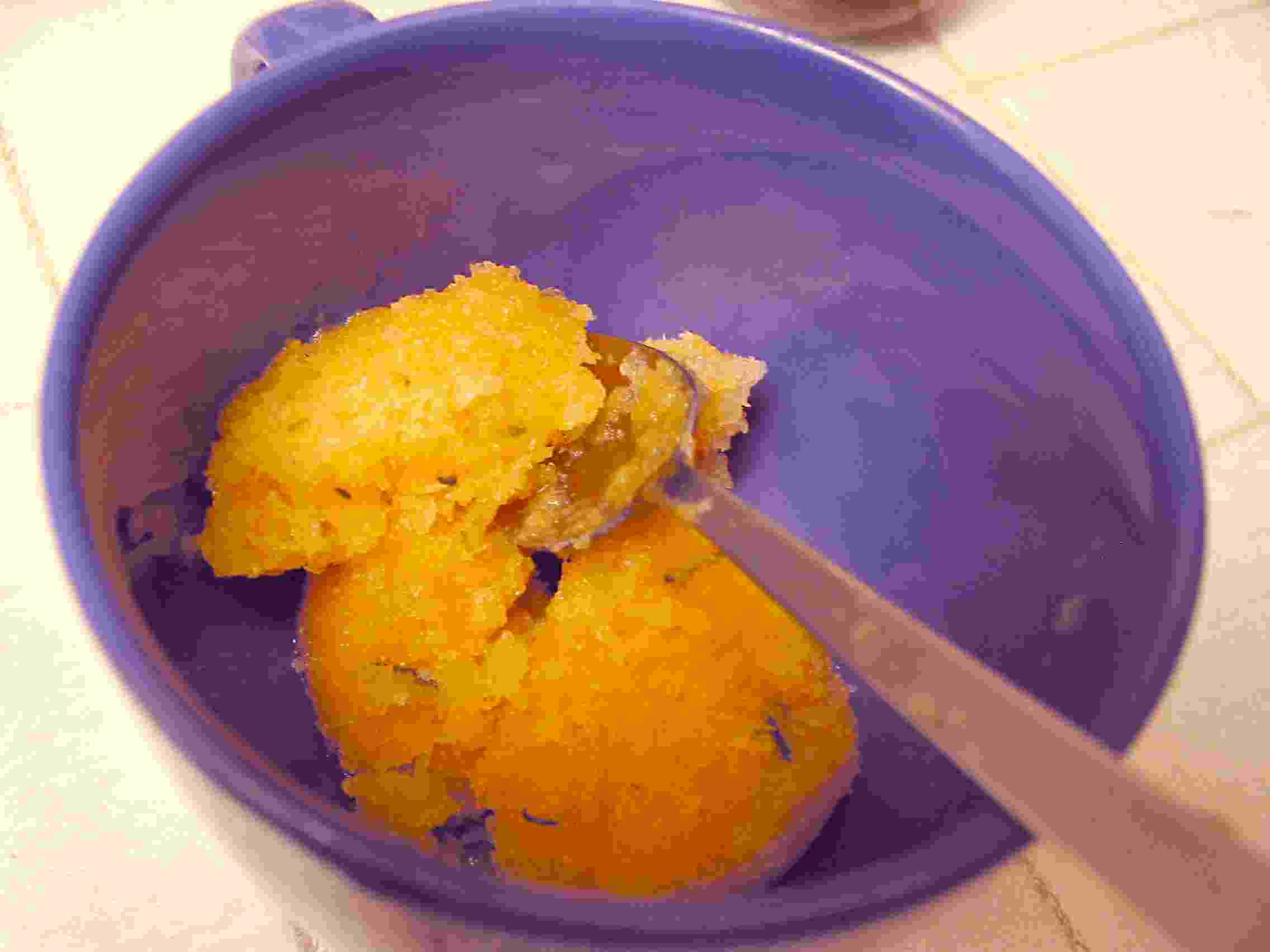
canteloupe-3

Don’t exactly know what to call this–it’s something between a sorbet and a granita, and it’s got only three ingredients–an extremely ripe canteloupe (no spoilage though) that had been sitting in my fridge for more than a week, the juice of a fairly large lime, and roughly chopped leaves from a sprig of rosemary. I scrubbed the canteloupe before cutting into it (old lab habits and new salmonella warnings combined, I guess), seeded it and puréed the flesh with the lime juice and rosemary in my food processor until it seemed pretty well smooth, then packed it into a 2-quart microwave container with a lid and still-froze it. I guess if I thawed it enough to break it back into chunks, I could regrind it finer in the food processor–I’ve done it with other still-frozen ices, but this time I didn’t bother. It did need thawing in the microwave to be able to scoop it out for serving–about 2 minutes on defrost.

That’s it. So it’s roughly 97 percent canteloupe with about 2 percent juice of a lime and 1 percent or less chopped fresh rosemary leaves. Can I say it’s made with 100% real fruit, then? No fake fruit involved (unless it was a franken-canteloupe–is that the northern equivalent to the chupacabras? It’s the right color for a new halloween monster, anyway)

And may I register a complaint about the interloper spelling that seems to have taken over since my youth–cantaloupe isn’t the same. It just isn’t.

But the canteloupe ice is nothing to complain about. Ginger would certainly also be good in place of the rosemary. Next year, maybe.

A Bowl of Dough in a Book

For anyone who’s read my previous post, A Bowl of Dough in the Fridge, a quick recommendation:

Artisan Bread in Five Minutes a Day, by Jeff Hertzberg and Zoë François, is gaining a big following among people who’ve tried out the recipes. This bread book, developed by an avid home baker and a professional pastry chef, uses the same basic strategy I do, but they’ve worked out quite a number of variations on a couple of master recipes, and they’ve come out with a general formula that works pretty well.

They have a basic white boule with a crunchy crust–something to shape a variety of classic ways, French through Italian, with or without olives or olive oil. They have several whole wheat and pumpernickel and rye versions with a thinner shiny crackled crust. They have challah AND brioche, and they have classic bagels AND Montreal sweet bagels. And they have chocolate babka. And they have demonstration photos and tips at the right points in the recipes to be helpful.

Among the differences between their basic white boule recipe and my typical  dough are much more yeast for the amount of flour and water–they use a packet and a half for 6 cups of flour and 3 of water–and a lot more salt as well–a tablespoon and a half. The initial rise is faster–about 2 hours instead of 5 or so–but I’m not sure what the true effect of the salt is other than taste and reflexive habit–François is CIA-trained, and that school tends to emphasize salt, judging from the chefs who’ve graduated from there and gotten into print.

The other factor that’s different is they don’t call for kneading at all–once you’ve stirred the flour into the liquids and everything’s more or less uniform, that part’s done. Rise and chill.

That’s solid enough for the chewy hard-crusted no-knead bread style of bread, but will it work for challah, which usually calls for extensive kneading to develop the classic long feathery crumb? Inquiring minds want to know.

So I’m going to try their white boule and their challah (though here I’ll cut the salt back for my own taste) and let you know how it goes. I’m looking forward especially to see if the challah crumb can really be achieved without the 10-minute knead and multiple rises.

Fruit + Herbs = ?

Along the lines of my taste experiments in the last post, I wanted to share a couple of fruit-and-herb combinations I’ve come up with over the years. I hesitate to call them recipes, but they’re good, fast, and unusual. They make refreshing side dishes, especially for a light meal, because they’re not too sweet and they play the sweetness and sometimes tartness of the fruit against something woody, green, spicy or aromatic.

Food glam mags show a host of grilled peaches and nectarines, ditto salsas, and sometimes include thyme and fresh black pepper and sage and other herbs.

I should also mention I just finished drooling my way through David Tanis’s A Platter of Figs, which has a lot of very simple, good-looking fruit desserts and accompaniments (including roasted fresh figs with thyme). I didn’t lick any of the pictures (it was a library book, after all) but it’s really the recipe instructions that appeal to me–simple and informal, with interesting and helpful notes on what seem to be missing steps in other chefs’ cookbooks. My favorite example: steam or parcook fennel bulb slices before you grill them. Makes perfect sense and explains why so many upscale restaurants serve grilled fennel that’s tough and stringy and hard to get through without landing it on your blouse.

But to get to the point–fruit+herbs=intrigue.

So why not? Here are a few of mine.

Mango with Fresh Basil

I hate to say it, but that’s about it. Seriously.

I cut a large mango in half, run a paring knife CAREFULLY as close as possible to one side of the big flat hairy pit (yes you will feel cheated unless you buy at a good price in a Latino market), take the cut half of the mango and score the flesh into a tic-tac-toe pattern, and flip the peel inside-out to pop out the cubes (slicing close to the peel). I try my best with the other half, the half with the pit stuck to it–mostly it works. Sometimes I count to make sure I still have ten fingers afterward… Combine the cubes with torn or julienned fresh basil leaves and serve with grilled white fish or the like and a green salad with vinaigrette. Purple basil looks dramatic, and you can dress this up a bit more with a few dice of red onion and a squeeze of lime juice but you don’t have to.

Canteloupe with Rosemary

Canteloupe is cheap and nutritious and complex, but usually too funky and tropical for me to eat straight up. I always want lime juice or something. Even as a grownup, more’s the pity. One night I was wondering if there were anything that would possibly make me like canteloupe better–I had a canteloupe with best intentions lingering unused in my fridge as I got less and less enthusiastic about it–and something about rosemary clicked in my head. Mint and lime juice are the classics, but I like rosemary because it’s piney and aromatic without being bitter, and something about it undercuts the unctuousness of the canteloupe and makes it taste fresher to me. You wouldn’t believe how triumphant I was when I found out this actually worked. So I ground the whole thing up (well, minus the peel) and squeezed in some lime juice and froze it for a sorbet. Also good.

Prunes or Dried Figs with Anise or Fennel Seed

I tend to eat a few of these out of hand as a snack with a little of the anise or fennel sprinkled over the top for contrast, but I’ve also chopped dried figs with a couple of chopped dried apricots, microwaved them in a little bit of water to soften to a chunky paste, then mixed in a sprinkle of anise and maybe a bit of cinnamon and used it to fill filo pastry cigares. A similar idea…

Prune Log with Pistachios and Cardamom

There’s also a very nice Moroccan-Jewish High Holiday sweet–good for this time of year–that’s a lot like the fancy pressed date/walnut or fig/Marcona almond wheels from Spain–a small wedge from the Whole Foods cheese counter can run you $5 or more, but they’re delicious  sliced very thin. Anyway, this one’s a prune log with pistachios, and it’s a little more complex than the others but easy enough to make.

Simmer about a pound of pitted prunes in a little water or orange juice (you can nuke a few minutes if you prefer) and process to a very thick paste. Mix in freshly toasted pistachios and either aniseed or a good grinding of cardamom (the seeds inside, not the pods) or both, perhaps. Pack tight onto a length of plastic wrap and roll into a log, cool, and roll to coat in toasted sesame seeds. When cool and firm, slice the log very thin into rounds (it’ll be like pistachio-studded fruit leather, but a bit softer) and served on a doily-covered brass tray along with dried apricots stuffed with marzipan or walnuts and other delicacies. Mint tea, lots of it, goes with. B’te’avon! (good appetite!)

The Meaning of “Tasty”

One very strange description crops up in nearly every expert’s take on processed food and the way it’s overtaken fresh and whole foods in the American diet. Everyone from food industry veteran Hank Cardello (see the Stuffed book review) to NYU nutrition professor Marion Nestle in What to Eat talks about fast food and junk food as “tasty”. David Kessler goes even further: in The End of Overeating, he adds “irresistible,” which he says is the problem he faced most of his life.

Moreover, “tasty” has become the important word in processed food advertising. Driving home from the post office today I even saw it on a billboard for Vitaminwater10, with the tagline:  “10 CALORIES. 4 NEW FLAVORS. TASTIER THAN EVER.”

Tasty. It’s the word of champions, the key, the adword to beat.

And for the life of me, I’m not sure why. Because the words I would have chosen for most of it include stodgy, greasy, cardboardy, screamingly salty, day-glo ™ orange, and “a lot like airplane food, only on the ground.” Am I the only one?

But “tasty”–specifically that word–is clearly the accepted description, even among these food experts, and that points to a host of disturbing assumptions. Either they mean they find processed food tasty or they mean they think everyone else finds it tasty and irresistible–even if there’s something better to eat. That’s kind of defeatist, isn’t it? If everyone “knows” fast food is tastier than fresh produce, what hope is there for mainstream Americans to eat healthier than they do today?

What do they actually mean by “tasty” in the case of processed food? They don’t mean fresh, as in fresh produce. They don’t mean tangy, as in yogurt or a tangerine, or sharp as in horseradish or cheddar. Certainly not aromatic, like dill or fennel or rosemary or sage. Or rich and funky and thought-provoking, like aged camembert or shiitakes or asparagus or toasted sesame oil. And they don’t mean complex and savory and surprising, as in a palak paneer punctuated by smoky black cardamom pods, Armenian string cheese with nigella seed, or a long-cooked carbonnade or daube of beef with some cloves thrown in on a whim.

They can’t possibly, honestly, mean “these fresh hazelnuts are so sweet you’ll plotz” or “one bite and you’d better take this nectarine somewhere private.”

Most of the food experts who’ve posited that processed food is “tasty” in their books and articles are older than I am by about 10 years, old enough to remember eating late-July nectarines that devastatingly fragrant, backyard tomatoes earthily ripe and pungent, foods utterly unlike what’s available even in the produce section of most chain supermarkets today.

So I can’t help thinking that their casual use of the word “tasty” reflects and even perpetuates the hopelessly tattered, stunted and inexperienced taste imagination of the masses of people who don’t cook for themselves anymore and have given over completely to packaged food, with its excesses of salt and its bland, stale cardboardy background flavor. The ugly assumption they’ve bought into is that people who eat mostly processed food can’t change, won’t change, and most importantly, wouldn’t like fresh food if they tasted it.

Can the surge of food blogs with their encouragement to try something new, visit local farmers’ markets, maybe even take a share in a community garden plot, change this trend? I hope so, even though I know the open air markets are not often very available in poor neighborhoods and they tend to be as expensive as supermarkets. But when they are made available in urban areas, all kinds of people from the neighborhood suddenly come flocking to them, Continue reading

You want fries with that?

You have no idea how much I’m looking forward to tomorrow at 8:35 a.m. That will be a good five minutes after the start of the parental summer relief program known best as Back to School. I’m counting down the minutes as we speak.

With the return to school, public debates over what children should eat and how parents should or shouldn’t step in have intensified. Obesity, the selling out of school cafeterias, new restrictions on sodas and junk food in said cafeterias, and the diet of choice at home are the topics of the day–all underlined with a sense of rising panic.

This year more than any other I can remember, reporters, bloggers, doctors, models, political figures, and just about everyone else has jumped on the bandwagon to report the ugly facts that were excused for years.

All the statistics are in–or pretty much so, and they boil down to this: We’re facing a tidal wave of blubber.

With it comes a tidal wave of early heart disease, diabetes, kidney disease, and more. How early? Physicians are seeing a rise in the diseases of middle age–something that, 20 years ago, had been successfully pushed back by an average of 10 years, from age 50 or so to age 60 and up for a first heart attack. We thought we were making progress. But for the past 10 to 15 years,  these diseases have started popping up in school children–Type II diabetes, kidney stones, high blood cholesterol and high blood pressure. No way should a 10-year-old be facing these threats.   No wonder parents and everyone else are panicked–the studies we have aren’t giving us a single, easy-to-deal-with  definitive  guide on how to stop the juggernaut. They mostly tell us that it keeps on rolling.

But the mystery of what to do really isn’t that mysterious. Take for example the responses to Frank Bruni’s recent article in the New York Times on feeding children. Some come from doctors on the front lines, others from nutritionists and fresh-food-in-schools activists, discussing different facets of the problem, but they come to a number of sensible recommendations you could probably have named yourself without much struggle.

The conclusions?

Sodas should be cut out altogether from children’s (and probably everyone’s) daily diet. Not just for calories (250ish for a 20-oz bottle–and why is it 20 0z these days? used to be 12 was the standard) but for sodium (about 100 mg per 12-oz can, whether full-cal or diet, 200+ for the 20-oz).

Fruit juices with a pretty picture on the box are nowhere near qualifying as actual fruit. Not even with added vitamin C.

And exercise time, including outdoor recess–something most schools have cut back in the past decades–makes a big difference that’s generally overlooked in the school lunch debates.

So far, no great surprises. But they do mention one more item, also no great surprise–fast food in the school cafeterias.  Nobody seems to have trouble zeroing in on french fries as the worst offender. Are they right or is this a replay of the cupcake wars? Is the french fry being unjustly accused, as the vendors claim?

Continue reading

Smart Choices Checkmarks–Corrupt Before They Ever Hit the Cereal Box?

William Neumann of the New York Times takes a hard look at “Smart Choices”, the new food industry-sponsored common nutrition labeling program, which makes its debut in supermarket packaged food aisles. The coveted green checkmark comes with a hefty license fee–toward the $100,000 mark per item–for food companies that want to qualify, but apparently qualifying is a little easier than you might expect. The new program, headed by a nutritionist with impressive enough credentials,  has awarded healthy choice status to heavily sugared cereals like Froot Loops because, as she explains, they’re a better breakfast choice than, say, doughnuts. For sure.

How could any reputable nutritionist blurt something like that out to a New York Times reporter? Does she really use doughnuts as a benchmark for comparison when the question is “what should I feed my kid for breakfast?”

More to the point, how could items like Froot Loops end up qualifying as a smart choice? Apparently, the FDA is wondering the same thing.

Take a look at the Smart Choices program nutrition criteria. Under the program, a given processed food product qualifies as a “smart choice” if:

1. Its nutrition stats fall within consensus-defined limits for carbs, added sugars, fats, cholesterol, and sodium. But the criteria are not particularly consistent about whether these nutrition stats count for a single serving or a meal, or perhaps multiple servings throughout the day, and the upper limits shift between categories of foods. And some of the criteria have been muted, dropped, or subordinated according to the preferences of food industry members over the protests of the nutrition scientists.

2. It contains at least one positive nutrient from an industry-accepted list of vitamins, minerals, fiber, and protein. The positive nutrient can be an additive, and it can be added to an otherwise nutritionally useless food product.

3. Alternatively to the positive nutrient criterion, the product can contain or represent some aspect of the category “food groups to encourage”: fruits, vegetables, whole grains and low fat or non-fat milk. How much of any of these ingredients must be present, what their original source is, and whether the final food product retains any reasonable or comparable amount of the nutrition found in an unprocessed fruit, vegetable, grain, or dairy item which it claims to include are all a bit vague. Processed cheese is technically considered dairy, for example, even though it may contain mostly vegetable oils, starches, and emulsifiers, not milk.

Not all food categories seem to require both nutrient-of-concern limits and positive characteristics.

Finally, the instructions to companies wishing to qualify a given food product state: “Qualifying your products for the Smart Choices Program is quick and simple. Product review is typically completed in 24 – 48 hours.”

Pretty much says it all. And doesn’t really support the “science-based, consistent, reliable” claims the program presents to consumers and the media.

For further mirth and bemusement, check out Marion Nestle’s account of her discussions with Neumann and with the Kellogg’s VP for global nutrition on her blog.