• Enter your email address to subscribe to this blog and receive notifications of new posts by email.

    Join 241 other subscribers
  • Noshing on

    raw blueberry pie with microwaveable filling and graham cracker crust

    This mostly-raw blueberry pie is a snap to make and very versatile--the filling microwaves in a few minutes, and you don't even have to bake the zippy gingered graham cracker crust--perfect for a hot Fourth of July and all summer long.

  • Recent Posts

  • Contents

  • Archives

  • Now Reading

  • See also my Book Reviews

  • Copyright 2008-2024Slow Food Fast. All writing and images on this blog unless otherwise attributed or set in quotes are the sole property of Slow Food Fast. Please contact DebbieN via the comments form for permissions before reprinting or reproducing any of the material on this blog.

  • ADS AND AFFILIATE LINKS

  • I may post affiliate links to books and movies that I personally review and recommend. Currently I favor Alibris and Vroman's, our terrific and venerable (now past the century mark!) independent bookstore in Pasadena. Or go to your local library--and make sure to support them with actual donations, not just overdue fines (ahem!), because your state probably has cut their budget and hours. Again.

  • In keeping with the disclaimer below, I DO NOT endorse, profit from, or recommend any medications, health treatments, commercial diet plans, supplements or any other such products.

  • DISCLAIMER

  • SlowFoodFast sometimes addresses general public health topics related to nutrition, heart disease, blood pressure, and diabetes. Because this is a blog with a personal point of view, my health and food politics entries often include my opinions on the trends I see, and I try to be as blatant as possible about that. None of these articles should be construed as specific medical advice for an individual case. I do try to keep to findings from well-vetted research sources and large, well-controlled studies, and I try not to sensationalize the science (though if they actually come up with a real cure for Type I diabetes in the next couple of years, I'm gonna be dancing in the streets with a hat that would put Carmen Miranda to shame. Consider yourself warned).

Portobello season–so good it’s a shame
Portobello mushrooms ready to broil with herbs, garlic and mozzarella

Giant portobello mushrooms ready to broil with herbs, garlic and mozzarella

My local supermarket surprised me this week with a half-price deal on giant portobello mushrooms–4 huge caps for $3, so of course I decided to get double that and just find odd spaces to tuck them all into the fridge. I love mushrooms but I haven’t bought them much in the past few years because they’ve gotten pricey and because my daughter didn’t start liking them until this year. Why make the kid the arbiter? No great reason, really, but it seems like a waste to make an expensive but not particularly nutritious treat as part of dinner and then have your kid turn her nose up at it. If I had to choose, broccoli or cauliflower or tomatoes were usually going to win out.

But this year my daughter’s finally old enough to appreciate mushrooms (and of course, so’s my husband). So when they came home for dinner after sunset at the end of Yom Kippur services, I took a pair of these hubcaps and threw together a quick appetizer–something I almost never bother with just for us, but I might be tempted to do it more often now, because it’s too simple to be so good.

Half a giant portobello cap should be a decent appetizer serving if you have to split, or serve a whole one per person as a side dish if you have enough. Smaller mushrooms would work too, but the big ones are meaty and impressive-looking. The grater gets a workout on this one unless you already have some pesto handy, but it’s still only about a minute’s worth of work.

Broiled Portobello Caps

  • 2-3 giant (or any sized) portobello mushroom caps, stem end trimmed, rinsed lightly all over to get any dirt off without peeling the skin or losing any gills
  • clove  of garlic (or more, if you need to scale up)
  • 1/8 or so red or yellow onion
  • ~1 t. butter
  • pinches of shredded fresh or crumbled dry Italian herbs–basil or thyme for preference, dill or marjoram or sage are ok too
  • ~1 oz. mozzarella or baby swiss cheese
  • grating or pinch of nutmeg

EASY OPTION: the mushrooms plus pesto plus the cheese and nutmeg

Wash and trim the mushroom caps and place them gill-side up on foil-lined tray (toaster oven works for this if you have only 2-3 caps). If you have the stems and want to do something with them, trim a thin slice off the cut end and either broil them alongside or chop them with some of the onion, then fry or nuke the mixture half a minute and add it to the caps before the cheese.

In a small bowl or saucer grate the garlic and about a spoonful of onion on the fine holes of a grater. Grate a spoonful or so of butter on top, add the herbs and mash together. Smear some of the mixture (or the pesto, if you’re using that) on the gills of each mushroom cap, then grate the cheese over each and finally sprinkle or grate a little pinch of nutmeg on each one (don’t overdo this, but a little is really good). Broil in a toaster oven or bake in a regular oven at about 350 for 10-15 minutes or until the caps are cooked through and rendering liquid.

*  *  *  *  *

There’s one other incredibly quick and simple thing to do with a big portobello mushroom–it makes a surprisingly good microwave soup-for-one with nothing but the sliced-up mushroom nuked for a minute in a bowl or mug to catch the juices, then some milk added to it and heated again. A scraping of nutmeg and garlic is worthwhile, so’s a tiny crumble of sage or marjoram.

But the mushrooms and milk are flavorful enough on their own, too, especially when it’s just you and you’re in the mood for simplicity and have decided you’ve earned it. It’s been a week like that, so I can only hope the supermarket special is still on.

Prunes and Lentils III: The Lentil Variations

Today’s (and last week’s, and the week before’s) topic is STILL the lentils-and-prunes challenge.

Before I get on a roll about lentils, I should mention that the first Prunes and Lentils post was my 101st post for this blog. I don’t know if we should celebrate, but why not. Woo-hoo! Good enough. Consider it celebrated.

It’s taken me a full two weeks to put up this post because this is where the rubber meets the road, or at least where the lentils meet the prunes. The moment of courage. And I don’t know whether it’s going to be great or whether people will go back to wondering why anyone ever let me in a kitchen. (That’s easy: because no one wanted to do the cooking  themselves.)

Ordinary brownish-green lentils are kind of a workhorse ingredient in European, Mediterranean and Near East cooking (also in Indian and African cooking, though red lentils are better known). Unlike restaurant chain buffalo wings, lentils are actually rich in protein and iron, and they aren’t surreptitiously pumped up with sugar, salt and fat to entice you to overeat. The Center for Science in the Public Interest is not likely to sue, because a bag of lentils doesn’t come with a deceptive toy to con the kids. (See? we can be topical and up on the hot news of the moment even while discussing an arcane Slow Food subject like lentils).

And lentils are CHEAP–the whole point of starting this Prunes and Lentils challenge in the first place. Somehow even the big supermarkets that push shoppers to the middle aisles to buy boxes instead of actual food always carry dried store-brand lentils over near the bags of rice and split peas and kidney beans and such. It’s one of the few middle-aisle purchases that are worth it.

I don’t know if lentils have even kept up with inflation over the past 20 or 30 years, because they’re always something like $1-$1.25 for a one-pound bag. Same as when I was a student on a $20 a week food budget. And a pound makes 5-10 meals, not just one serving.

Actually, the recent agroeconomics of growing lentils in the US makes unexpectedly interesting behind-the-scenes reading for policy wonks like me. Lots of people are now clamoring for the US to change the crop subsidy laws to encourage more nutritious crops than corn, soy and wheat. Lentils are still a minor crop, but apparently the USDA introduced new marketing loans and other incentives for lentils, peas and chickpeas under the Farm Act revisions of 2002 and 2008, and exports for pulses have risen by about 45% in the last few years to India, Spain, the Philippines, and other major lentil and chickpea consumers. The rest are bought for animal feed and international food aid programs, especially those for sub-Saharan African nations.

That’s because lentils still fly under the radar here. The average annual consumption in the US is still just about a pound per person. Up from 0.8 pounds in 2008, so a 20 percent jump, but still. One pound per person in a year. If my continuation of the Prunes and Lentils Challenge posts has no other benefit to humankind, I would hope that it inspires you to buy and cook–and eat–at least one additional pound per year in a creative and satisfying way. Pass it on–Two pounds per year? At a cost of $2-3 total? We can but dream…

Of course, now that bean cuisine has become a point of pride for Meatless Mondays and other trends in eating green (if not eating local), lentils don’t just come dry in bags or bulk anymore–not glamorous enough, perhaps? If you’re upscale, you can get them precooked in little cans at your Whole Foods or steamed in vacuum packs at your Trader Joe’s, but those chic packages are much, much more expensive per meal and don’t taste as good. I frankly wouldn’t bother unless you’re on the road or camping or something and don’t have a kitchen at your disposal. Dried lentils don’t need a presoak to cook up within about half an hour even on the stove top, and they’re so easy to cook in a microwave (and avoid the watched-pot-never-boils problem) that the extra expense and time trying to find the precooked ones is usually not worth it. (And what about all that extra plastic and metal packaging? Be righteous–buy ’em dry.)

If you cook up a whole pound bag at once, you can use it throughout the week or (better, for a lot of people) freeze half of it with a bit of cooking liquid in a microwave container and save yourself some time the next time you want a batch. I keep thinking of that old “Cook Once, Eat Twice–That’s Italian!” lasagna ad (can’t remember if it was for noodles or sauce) from the 1970s. It’s a bit old-fashioned, but still a good idea for  when you’re too tired to cook for real.

In this post, I’ve got 3 or 4 main “strategic” ideas for the prunes and lentils challenge, along with more recipes and variations than should really go in a single post (and THREE more prune accompaniments as well), so just roll your eyes, bear with me, and if you decide never to let me in your kitchen, I’ll understand (plus I’ll never have to do the dishes–win/win!).

So first things first–gotta cook that bag of lentils (and recycle the bag). This recipe is probably longer than the actual process but it contains valuable Continue reading

Prunes, Lentils, and “Cookin’ Cheap”

When I was a kid, PBS, which had made a gourmet name for itself with The French Chef, decided that if one chef was good, six or seven had to be better. Suddenly the public and cable airwaves were  bursting with the Frugal Gourmet, the Galloping Gourmet, Yan Can Cook, Cookin’ Cajun, various shows with Pierre Franey and Jacques Pépin, and one…ummm…less glamorous show called Cookin’ Cheap.

This was hosted by Larry Bly and Earl “Laban” Johnson, Jr. out of Roanoke, VA–-not too far from where I grew up–and featured two viewer-submitted recipes per episode, which the guys bravely cooked and sampled on the air. At the end of each show, just like Julia Child, they sat down at the table for the tasting… and decided whose recipe had come off worse.

Now, Cookin’ Cheap was not for tenderfoots–if you couldn’t handle ingredient lists that included whole sticks of margarine and self-rising flour, or bring yourself to shop in one of the ordinary supermarket chains that had never heard of organic anything (this was the South in the ’80s), you would have done better not to watch. But if down-home cooking delivered with a touch of schadenfreude was your thing, it was a great little show.

Unfortunately, my favorite early episode doesn’t seem to be available anywhere on the ‘net. But the clip above, the Cookin’ Cheap 2.0 (YouTube) version of about a third of Episode #609, will give you some idea. (see copyright disclaimer below…)

In my actual favorite episode, Bly and Johnson hit their personal limit with a recipe that had them both making faces and apologizing to the audience that “there’s cheap… and then there’s too cheap.”

The dish in question was “Lentils ‘n’ Prunes” (you can guess the entire ingredient list). And it was indeed cheap. Unfortunately lentils, though incredibly cheap and nutritious, cook up kind of gray, especially on a semi-rural public TV station with early-’80s (i.e., yellow-ocher) set lighting. Trust me when I say the addition of mashed prunes did nothing for them aesthetically or otherwise. How on earth could they have put this on the air?

Of course, these guys didn’t have to take the blame for the recipe, and it was great entertainment to see some of the strange things your neighbors might be cooking at home and writing in to the show about with high hopes of being selected. I understand the Food Network is now copying Bly and Johnson’s reality-cooking formula shamelessly for the fall lineup…

[Actually, I didn’t realize the show had such a good run, but it started locally in 1981 and only ended its nationally syndicated run in 2002. Johnson passed away a few years before the end, but he managed to publish the Cookin’ Cheap Cookbook in 1988. Bly kept the show going with Johnson’s friend and successor Doug Patterson and has since made a couple of rescued episodes available on DVD. And the show still has fans on YouTube and — surprisingly just this March–in the New York Times.

Disclaimer: YouTube removed the first clip I linked to for copyright violation–so my apologies to Bly; the intent in linking here isn’t to rip anyone off but to highlight a too-little-known show. Because the original Roanoke station managers were too shortsighted to save the episodes (they apparently trashed them!), Bly was only able to rescue a couple of episodes for the DVD, and I think some of the others posted at this point were recorded at home from TV.]

Ah, well. Times change, horizons broaden, and we aim to challenge our palates in a sophisticated world beat kind of way even with limited cash and ingredients. The wolf may be at the door, we may be on the rice and beans yet again to make up for unreimbursed conference travel, but we are determined to do it in style–that means Indian, Moroccan, Mediterranean–French? Well, at least by not mixing plain lentils and prunes together in a hideous gray mash.

…I’m not actually sure how the French feel about lentils with prunes, or what they’d do about it if you suggested it. But I have a huge bowl of cooked lentils to deal with from a 1-lb. bag at $1.29. And a 1-lb. bag of non-sorbate pitted prunes at $2.99. Less than $5 total. And a number of ideas about how to deal with each of them, separately or together. Enough ideas that I’m probably going to have to split this post so it doesn’t turn into War and Prunes.

This, I think, is going to become my How to Cook a Wolf Challenge, 21st Century Edition.

Because I have fantasies (not many, and relatively tame though entertaining) of the Iron Chef America and Top Chef hosts announcing, for the next quickfire competition, a challenge to find three or four good ways to combine lentils and prunes in dishes where they’re the main ingredients and for which the total bill for the tasting menu comes to something like $10, including spices (prorated as used…) Can’t you just see the contestants’ faces? Take a moment to enjoy their obvious panic. The restaurant industry hasn’t trained them for this.

But seriously. What was actually behind this Cookin’ Cheap dealbreaker, other than the obvious frugality factor plus the even more obvious digestive humor that follows prunes and lentils wherever they roam?

Is there any way on earth that prunes and lentils could really go together?

Well…yes, as a matter of fact. You don’t run across prune and lentil recipes everyday, but good-tasting and intriguing variations, or at least the components of them, exist in a number of respected cuisines around the globe. Even French. For very little more than it cost the Cookin’ Cheap guys, Continue reading

Adventures with Cheese, Part II: Paneer in the Microwave

Paneer is the fresh white curd cheese used in Indian dishes like saag or palak paneer, aloo mattar paneer, and so on. Panela or queso fresco are okay substitutes, if you can get them, and they taste a lot better than tofu.

But you can also make paneer very easily (if a bit messily) at home in a few minutes, if you have a pyrex bowl, a microwave, and a colander. If milk is going cheap in your neighborhood market this week or you have half a gallon that you really need to use up quickly before you go on vacation, making paneer isn’t a bad way to do it.

You’ll get about 5 oz fairly dry curd for a quart of milk, so not a great yield, but it’s pretty versatile. Whole milk makes a richer cheese than skim, obviously, but both work okay. Press the curd hard when you drain it and it’s sliceable. Press lightly and it’s spreadable. If you use a quart of buttermilk on its own rather than mostly milk, you can blend in a little garlic and some herbs and a drop of olive oil to the drained curd, and you’ve got something close to Rondelé cheese spread.

And don’t just toss out the whey–it still has a lot of soluble smaller proteins and calcium in it, so it’s worth keeping if you can use it within a day or so. You can use some of the warm whey instead of water to make a moist, chewy-textured Italian-type yeast bread (whey is extremely good for rosemary focaccia). Or puree the whey with some lightly cooked broccoli or cauliflower or canned pumpkin, a bit of onion or garlic, and some marjoram and/or thyme for a quick fresh cream-of-vegetable soup.

Paneer from scratch (makes about 5 oz, can scale up if you prefer)

  • A quart of milk
  • 1 cup of buttermilk if you have it
  • juice of a lemon

1. Pour everything into a 2.5 qt. pyrex mixing bowl, mix, and microwave on HIGH about 5 minutes, until the milk solids separate from the clear yellow whey. The solids should float in a mass and be pulling away from the sides of the bowl.

2. Take a colander or strainer over another large bowl, line it with a couple of layers of cheesecloth or 3-4 overlapping round paper coffee filters, whatever works for you. Carefully pour the whey over first, keeping the curd back in the bowl with a serving spoon or spatula for as long as possible, until you’ve poured most of the whey through (otherwise it takes forever to drain…). Then drain the curd on the filters and press it until it’s fairly firm and could be cut into cubes without crumbling apart.

Microwave tricks: Quiche in 15 minutes

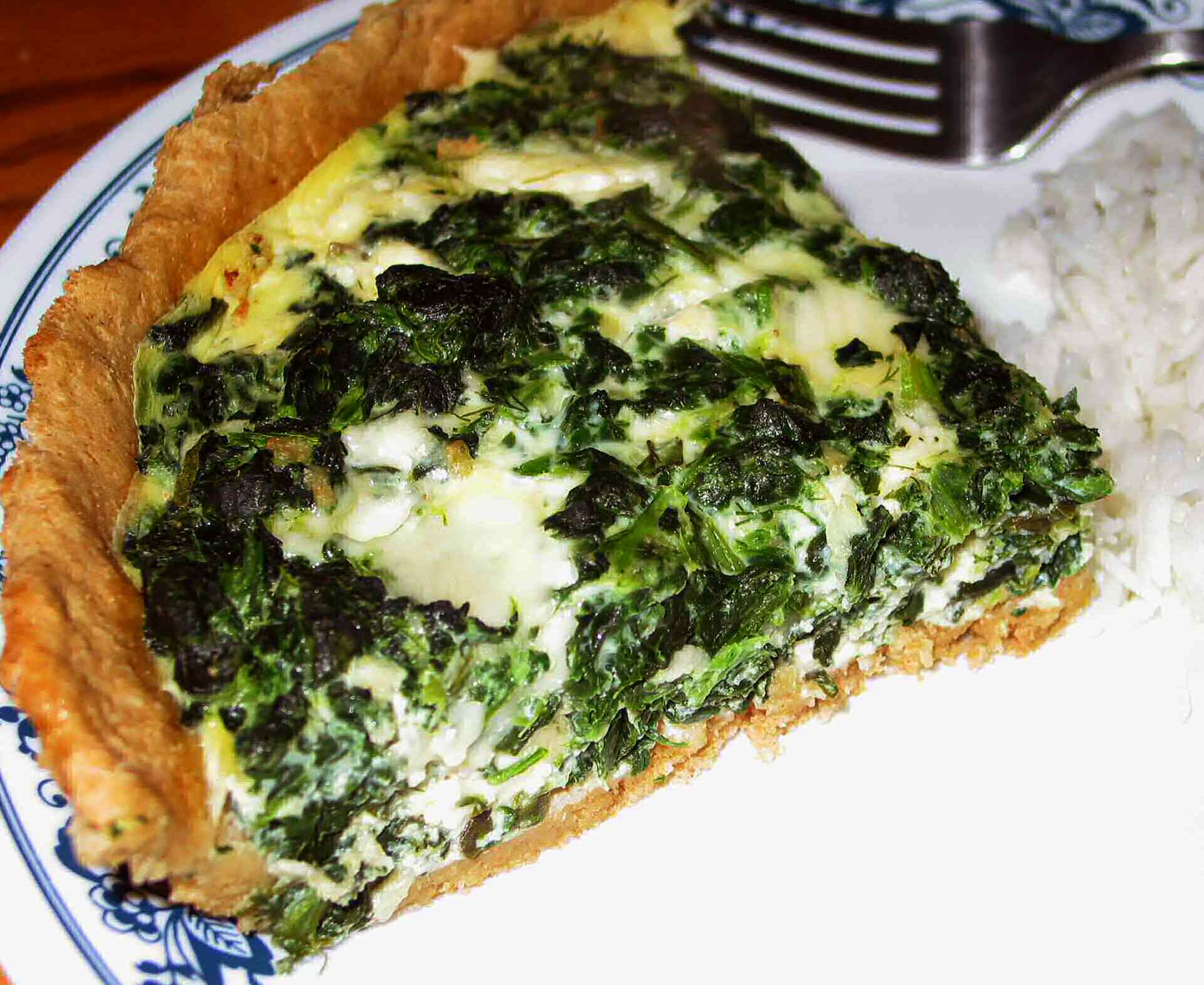
Spinach quiche in 15 minutesNo. Not kidding. Not even a little. This actually works, and comes out tasting much better than I ever expected. It rescued dinner last night, to tell you the truth.

I’ve made a lot of strange things with a microwave oven in my time. Honeycake, rice, taco chips (not recommended–it worked beautifully but I’m pretty sure that’s what shortened the life of my last microwave), pasta, dulce de leche, lasagne, baba ghanouj, beans, dolmas, flan, marmalade, rolls, even paneer from scratch. Sometimes I really need a quick method, sometimes I’m just fooling around to see what’s possible, but much of the time it actually works. Usually the first try is good enough that it’s worth either repeating as-is or fine-tuning to get it closer to what you want. This one I didn’t have to fiddle with at all–it just worked.

If you’ve got a reasonably modern microwave (1000 to 1200 W), a pyrex pie plate, a microwaveable dinner plate and the basic ingredients for quiche, you’re in business. All with real and very ordinary quiche ingredients, and no odd cooking methods other than the use of a microwave instead of a standard oven.

The olive-oil-based pie crust itself I made and parbaked in a regular oven for 10 minutes while I prepared the filling and custard. Continue reading

Real Soba

Happy New Year! The LA Times just published a feature on New Year celebrations in Japan. The  December 30th article on making your own soba or buckwheat noodles has instructions and demo pictures from a professional soba chef–and the traditional recipe contains…no salt. At all. Contrast that with any of the store-bought brands here in the U.S. It also has a lot more buckwheat than the store-bought types, using a ni-hachi (2:8) proportion of wheat to buckwheat, so it probably has a lot more buckwheat flavor. Worth a try, and if you’re not sure you know how to knead to the right texture by hand, you might be able to knead the dough in a food processor to get it very smooth and elastic before rolling it out.  Traditional Soba from the LA Times

The dipping sauce recipes that accompany the soba article are no bargain sodium-wise, and they contain a lot of sugar as well as a lot of soy sauce mixed in with the dashi stock, but at least the noodles themselves aren’t adding to the problem. You could use low-sodium soy sauce and less of it; you could also decide not to follow tradition and use a different dipping sauce with more substance and less reliance on salt and sugar for flavor. Here are two possibilities (quantities are loosely something like half a cup to a cup). Neither is Japanese but they both taste good with soba.

Dipping Sauce for Jao Tze (why not, it’s good with soba too)

  • 1/4 c. low-sodium soy sauce
  • 1/4 c. vinegar–red wine, apple cider, or rice vinegar
  • dollop (~1-2 T.) dark molasses–this takes some stirring to mix with the thinner liquids
  • ~1/2 t. grated ginger
  • 1 scallion fairly finely chopped
  • few drops toasted sesame oil
  • 1/4 t. dab of z’khug or a bit of minced garlic, some hot pepper flakes to taste, and a bit of chopped cilantro if you have it

Peanut Curry Sauce

Serve this sauce cold or at room temperature to avoid the yogurt breaking down. If you add some lightly nuked or steamed fresh brussels sprouts (they look nice cut in halves) or other cruciferous vegetables and some hard-boiled eggs or tofu on the side, you have a pretty substantial lunch or a light supper.

  • 1-2 T. chunky unsalted natural peanut butter (peanuts only)
  • 1/2-1 c. plain nonfat yogurt (milk and cultures only)
  • 1 t. curry powder (unsalted)
  • 1 clove garlic, mashed/grated/minced
  • 1/2 t. mashed or grated ginger
  • 1-2 T. low-sodium soy sauce
  • juice of half a lime (best), lemon (ok), or 1-2 T. vinegar to taste
  • hot pepper flakes to taste
  • optional additions: scallion, finely chopped; few drops toasted sesame oil; pinch or so of sugar

Lentil Stew with…Pineapple?

Fresh pineapples are just coming on the market at a good price this week or so–$2 or $3 apiece. Meanwhile, tomatoes are…well, let’s say they’re not at their finest in December. So, some added incentive for trying something new.

Pineapple is the last thing that belongs in anything subtle or savory–or is it? Hawaiian pizza is practically a classic by now, despite the culinary clash of a pineapple-ham topping on the one hand and garlicky tomato sauce, mozzarella and oregano on the other. Of course, that (and all other glazed pineapple/pork product classics) seems more brash than subtle.

Given the usual culinary partners–ham, chicken, cottage cheese, spam and more spam–you’d think the rule for making pineapple work in something savory would be that the other main item has to be pretty salty to stand up to all that acidic tropical sweetness. But that’s not the only way to deal with it. Good thing too, since ham, ham, spam and ham are off my grocery list. (So’s spam.)

This curried lentil and vegetable stew, which I’ve based on a dish from my much-missed Lebanese former-restaurant-turned-lunch-spot, takes advantage of pineapple’s tang while mellowing out its jarring sweetness. It took me a couple of tries to achieve the taste I remembered from the restaurant, but I think this version works pretty well, even though it contains no salt at all.

Depending on the sweetness of your pineapple, you may need more or less to balance the flavors. The pineapple should be a subtle but surprising bite among the other vegetables and the rich lentil base. Don’t be afraid to tinker with the (rather loose) amounts of the various ingredients and taste as you go.

Curried Lentil Stew with Pineapple

  • 3-4 c. fully cooked green/brown lentils or half a pound dry (see step 1)
  • 1 T. curry powder
  • 1/2 t. ground cumin
  • 1/2 t. ground coriander seed if you have it
  • 1/2 t. brown mustard seeds if you have them
  • 2 medium onions, chopped
  • 1-2 medium tomatoes if you have them
  • juice of a lemon–plus another half to adjust taste as needed
  • 2  large or one really fat clove garlic, minced/mashed/grated
  • 2-3 half-inch rounds of fresh unsweetened pineapple in smallish chunks
  • 2-3 big carrots, peeled and chopped
  • 2-3 stalks celery, chopped
  • a good glug of dry red wine, cheap but decent, about 1/4 c.
  • olive oil

1. To cook the lentils in case you haven’t, wash and pick over half a pound of green/brown lentils and put them in a big pyrex bowl (2.5 qt/l) with enough water to cover by 2 inches. Put a microwaveable lid or dinner plate on top and microwave on HIGH for 7-8 minutes. Let sit in the closed oven another 20-30 minutes to soak up, add more water if there’s less than an inch above the lentils, then microwave again for another 7-8 minutes. Wait another 10-15 minutes and test for doneness. The lentils should be soft.

2. Meanwhile, sauté one of the onions with the spices in a little olive oil for a few minutes, add the chopped tomato and half the garlic and cook a few minutes, adding a drizzle of water if it starts to dry out.

3. When the lentils are done, pour them in with some of the cooking water, stir up, heat, and add the lemon juice and the pineapple. Cook a few more minutes until it starts to thicken.

3. Put the cooked lentils back into the pyrex bowl, add the remaining vegetables and the rest of the garlic, a little water, maybe a little more lemon juice, the wine, and a drizzle of olive oil. Cover at least partway (maybe with a small gap to let alcohol from the wine boil off) and microwave 5 minutes more or until the vegetables are tender.

Thanksgiving Vegetariots, or, How Can You Have Any Pudding If You Won’t Eat the Meat?

Newspapers all over the country are sweating to include vegetarian main dishes in their annual Thanksgiving features. But they’re not doing all that well. This week the LA Times food section proudly listed a whole bunch of Thanksgiving vegetable side dishes as if to say, “See how much there is for you vegetarians to eat without your hostess making any changes just for your special status?” Only, as readers quickly pointed out,  1) none of the dishes contained any noticeable protein, 2) most of them were overloaded with butter and salt and 3) two of them contained chicken broth or pancetta. Someone had forgotten to re-edit them for a vegetarian audience.

I pick on my local paper because we’re talking Los Angeles, with great produce available all year round and a very large vegetarian population–and a lot of ethnic groups with significant roles for vegetarian dishes in their traditional cuisines. We have less excuse for this kind of simple ignorance than most cities.

But it isn’t simple ignorance. Running very close to the surface of most food publications’ features on vegetarian fare at the big showdown holidays is a distinct tone of hysteria. How can anyone not want to eat meat? Nothing tastes like turkey, and nothing sells like it either! We don’t know anything about vegetarian proteins! they panic. Do vegetarians eat Durkee Fried Onions or Empress Yams? Do they eat marshmallows? They don’t even like pancetta! What’s wrong with them?

These are home questions for newspapers and food mags, because you know the real survival question is, “How are we going to sell advertising for chickpeas and lentils, for chrissakes?” That probably goes double or more for food shows on tv. If they don’t advertise, they don’t stay on the air.

It’s not like tofu has a big marketing presence in the nation’s newspapers or brand recognition outside of local markets. There are only so many brushed-steel and cherrywood designer kitchens anyone is willing to buy in a down economy, especially once they discover how badly brushed steel shows fingerprints. And cooking mags don’t get a lot of help from PepsiCo and CocaCola, Ralston-Purina or the many cigarette and pharmaceutical companies.

What’s left? Bacon, turkey, and processed food companies featuring starches and microwaveable tv dinners. This might not be such a problem for food pubs if they’d found a way to keep their features a little more independent of their ad base. Bacon is showing up these days as suddenly gourmet in so many inappropriate dishes–ice cream? chocolate bars? popcorn?–precisely because it’s relatively inexpensive, widely available in supermarkets, and sold by a few recognizable national namebrand companies that still advertise reliably in a down market. Young food bloggers who go for it think it’s something new and daring, but you have to wonder whether they realize how hard the commercial food media are pushing it and why.

In any case, the November and December issues or episodes really need to push meat for all they’re worth because American bacon is basically the same everywhere and straight-up turkey isn’t all that popular the rest of the year, and the companies know it. Meanwhile, vegetarianism in all its variations, and with a growing political undercurrent, is gaining ground among younger Americans, or at least those not too obsessed with bacon. What to do?

Apparently the answer is, panic and get mad at the vegetarians for wanting non-meat dishes that are worth something, but try hard not to admit it in front of the camera. Continue reading

Spaghetti Squash Too Many Ways

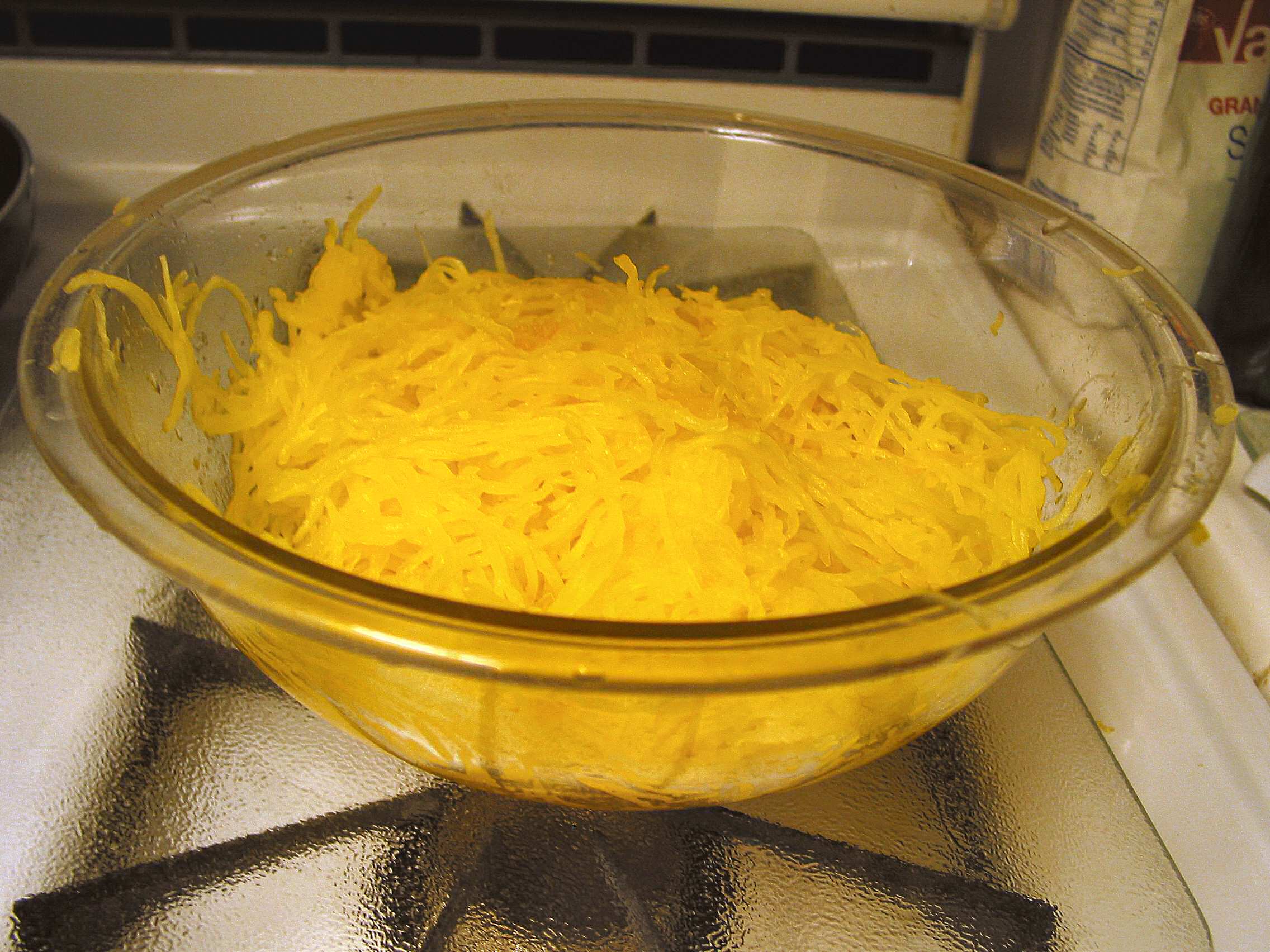
Just half of a microwaved spaghetti squash makes 5 or 6 cups

Just half of a microwaved spaghetti squash makes 5 or 6 cups!

This week my local Trader Joe’s had crates of beautiful–and hefty–spaghetti and butternut squash for less than $2 apiece–on the order of 30 to 50 cents/lb. So of course I got two of each and wobbled out of the store unsure which bag was pulling me down further. And then came the task of cooking them.

One spaghetti squash–a good-sized 5-6 lb. beast–will feed a lot more people than you’d think. It’s got some serious advantages over standard pasta: more fiber, no sodium, some vitamin A and potassium, perhaps fewer calories and carbohydrates per ounce. And it’s incredibly versatile. And you can cook it in the microwave in about 10 minutes rather than spend an hour baking it and heating up the house.

But there’s one big disadvantage–if you cook the whole thing, you have to eat the whole thing. Cooked spaghetti squash doesn’t hold up in the freezer–the strings go flat and shrivelly. And reheating too long can make it wilt as well. So can very acidic dressings.

So the choices are (for a small, moderately but only moderately tolerant family unit):

  • Cook half at a time and store the other half raw and wrapped in the fridge for a few days
  • Cook both halves, use one right away, and store the other half in the fridge for a few days, either wrapped in its shell or else scooped out into a container  (recommended)
  • Give the other half to a friend–but not too good a friend…
  • Cook it all and make it for a big potluck. Maybe people will think it’s innovative and exotic…depends on what you do with it (I don’t so much recommend marinara for this if you’re looking to impress–maybe a peanut-curry sauce or an Alfredo-style sauce with lemon peel, or something involving oyster mushrooms)
  • Cook it all and serve it a couple of different ways over the course of the week
  • Make a couple of the variations ones that taste good cold and eat the leftovers for lunch (recommended)

One important tip (learned the hard way):

The strands grow crosswise inside the spaghetti squash, not lengthwise. If you cut the squash in half the way you would a watermelon, you’ll be cutting the strands into shorter bits–not what you want. Cut the spaghetti squash in half across the middle of the SHORT side, NOT from the stem to the flower end.

If you have kids, let them count the seeds in each half of the squash–it’s a good lesson in plant survival strategies. My daughter and I counted about 80-90 seeds per half and decided to wash, dry and save them for her school’s garden. At this rate, they’ll have spaghetti squash for several years. Note of caution: out of 10 that we thought had been lost down the sink but actually got caught in the drainer, a full 9 germinated, so be careful what you wish for… even commercially grown, these things are very, very determined. But we’re not ready to name any of them “Audrey II”–yet. Continue reading

How to Nuke an Eggplant

Eggplant after microwaving

After microwaving 10 minutes, the eggplant has collapsed

Eggplant is one of those warm-climate foods. It’s big, cheap, and plentiful, it goes with everything from garlicky oregano-and-fennel laden tomato sauce to nutmeg-tinged custard or cumin/cinnamon-scented Greek and North African dishes, to curries and darkly soy-glazed Chinese and Thai dishes. You can deep-fry it, panfry it, grill it and serve it room-temperature under a glossy layer of olive oil, marinate it, wrap it around other fillings, stuff it, roast it, make spreads with it… There’s even a Greek eggplant “spoon sweet” and at least one eggplant “jam” from Morocco. To say nothing of pink-tinged sour eggplant pickles, one of my favorite additions at the Israeli felafel stands.

The only thing you don’t really want to do with eggplant is eat it raw.

I NEVER bother with the usual cookbook directions for eggplant. All of them slavishly recopy instructions from their predecessors–salt it, drain it, fry it in tons of expensive olive oil, which it will soak up mercilessly, bake it for an hour only to find it still has spongy raw spots… They never bother to update, or even retest, the traditional assumptions that make eggplant such a pain.

You can forget most of that if you just nuke your eggplants first. Most of the stuff people do to their eggplants comes of just trying to get it cooked through. The salt’s to get rid of some of the water; the fat’s to cook it hotter and let the juices steam inside the slices.

Microwaving takes care of both, needs neither fat nor salt, and it’s very quick–10 minutes on HIGH on a pyrex pie plate for 1 or 2 decent-sized eggplants and you’ve got either collapsed whole eggplant(s) ready for baba ghanouj or a fan of slices or a mountain of bite-sized cubes. All of them cooked through and ready to do something more interesting with.

I used to think I was alone in the wilderness on this one, because NO ethnic cookbook–or any other cookbook with eggplant recipes–ever considers the existence of microwaving, much less condones it for cooking actual food. Continue reading