
• Enter your email address to subscribe to this blog and receive notifications of new posts by email.

    Join 241 other subscribers
  • Noshing on

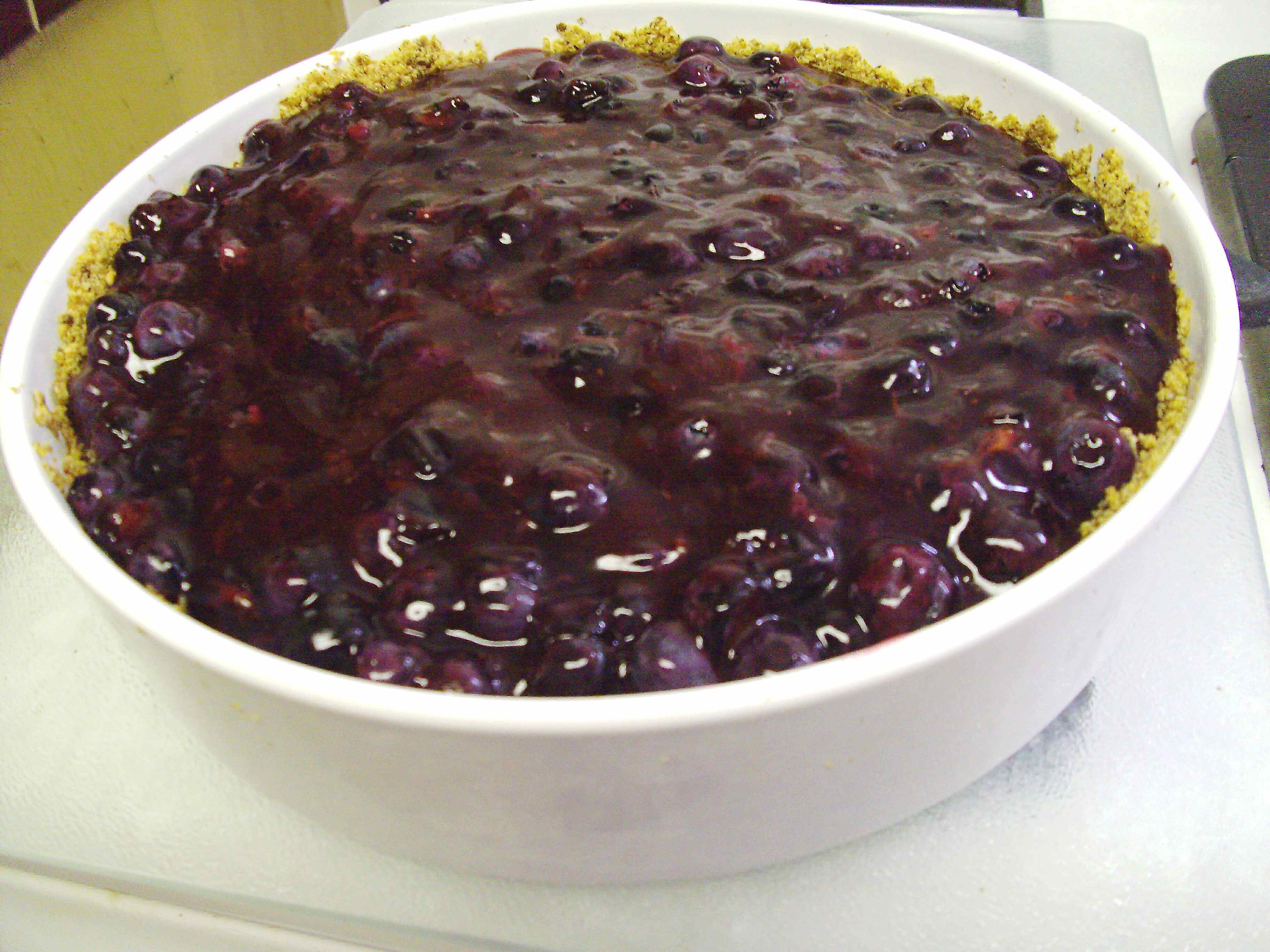
    raw blueberry pie with microwaveable filling and graham cracker crust

    This mostly-raw blueberry pie is a snap to make and very versatile--the filling microwaves in a few minutes, and you don't even have to bake the zippy gingered graham cracker crust--perfect for a hot Fourth of July and all summer long.

  • Recent Posts

  • Contents

  • Archives

  • Now Reading

  • See also my Book Reviews

  • Copyright 2008-2024Slow Food Fast. All writing and images on this blog unless otherwise attributed or set in quotes are the sole property of Slow Food Fast. Please contact DebbieN via the comments form for permissions before reprinting or reproducing any of the material on this blog.

  • ADS AND AFFILIATE LINKS

  • I may post affiliate links to books and movies that I personally review and recommend. Currently I favor Alibris and Vroman's, our terrific and venerable (now past the century mark!) independent bookstore in Pasadena. Or go to your local library--and make sure to support them with actual donations, not just overdue fines (ahem!), because your state probably has cut their budget and hours. Again.

  • In keeping with the disclaimer below, I DO NOT endorse, profit from, or recommend any medications, health treatments, commercial diet plans, supplements or any other such products.

  • DISCLAIMER

  • SlowFoodFast sometimes addresses general public health topics related to nutrition, heart disease, blood pressure, and diabetes. Because this is a blog with a personal point of view, my health and food politics entries often include my opinions on the trends I see, and I try to be as blatant as possible about that. None of these articles should be construed as specific medical advice for an individual case. I do try to keep to findings from well-vetted research sources and large, well-controlled studies, and I try not to sensationalize the science (though if they actually come up with a real cure for Type I diabetes in the next couple of years, I'm gonna be dancing in the streets with a hat that would put Carmen Miranda to shame. Consider yourself warned).

The “other” moussaka–eggplant and chickpea stew

It’s been a fuller month than I expected, with a lot of travel and the unlooked-for complications of Thanksgiving and Chanukah falling on the same week. Supposedly we don’t get to do that again for another 77,000 years or so.

Most of the food features about the “Thanksgivukkah” mashup this year have been bemused, amused, and imaginative only in the sense of suggesting (always) latkes and sufganiyot (doughnuts) for the Thanksgiving menu. Not in replacement of any other starches or desserts, you understand. They mean in addition to. Forgive me if I can’t dig it, but I don’t think either holiday really benefits from the “double your starches, double your fun” idea.

We had a great long weekend up with my in-laws and family in San Jose; and what was on the table? A pretty decent meal by any standards, traditional or California modern.

Thanksgiving 2013-Northern California style

At my in-laws’, 5 minutes before showtime. A lot more green on this table than I remember as a kid. It could only be an improvement, and believe it or not, most of the broccoli got snapped up with the fabulous mustard garlic dressing (not yet on the table)

Turkey (kosher, and cooked by accident upside down because my in-laws stuck it in three entire shopping bags and couldn’t tell which end was up–but it came out better than most of their other attempts, so they’re doing it again next year on purpose–I highly recommend it). A little stuffing and mashed potatoes and gravy for those who insisted, which wasn’t us; cranberry orange sauce, a stellar Georgia pecan pie among the desserts. But the rest of it was California-conscious; farro salad with chestnuts and mushrooms, a roasted red-squash-and-onion platter with whole cloves of roasted garlic strewn around, a big green spinach and fennel salad with endive and pomegranate seeds, and my contribution, an impressively large platter of very green, just-steamed broccoli with a spicy mustard garlic dressing that, and I may say so, rocked the Casbah and provided the necessary Jewish influence.

Not just because of the olive oil-at-Chanukah factor–which would have been enough for me and was plenty symbolic–but for the balance of a big blob of sharp spicy brown mustard with a big fat clove of garlic. Plus red wine vinegar, olive oil, and a little white wine. . . whisk and taste, whisk and taste. When it’s just sharp enough, still thick but can be drizzled, tastes good and has just the right degree of excessive garlic without going to Gilroy (which, btw, is only about half an hour outside of San Jose and holds a surprisingly popular garlic festival every summer), you know it’s done.

The broccoli itself was a little undercooked for me but others insisted it had to be still crunchy to avoid killing the little green vitamins–a new trend in Califoodian philosophy, at least northern Califoodia. It was in the San Jose Mercury News that week or something. But the garlic mustard dressing made up for all that nutritional selfrighteousness and helped the turkey no end as well. Cranberries are well and good and I love them, but they’re no substitute. I maintain [talmudically, in question form]: if there’s no garlic, is it really food?

But with a week of too much food and travel and lectures on nutritional trendiness aside, I find myself thinking, do I really need to be thinking so much about food? Southern California makes it easy to eat well with very little effort–even with very little money, as long as you shop at the local Armenian or Latino markets for vegetables and stick to the unbranded or store-brand and whole foods only.

However…although it was about 85 degrees out when we came home to Pasadena, the temps quickly dropped and have been in the 50s all week, with and without drizzle (yes, you can pity us sarcastically if you want to. They don’t sell coats of any worth better than a sweatshirt here, so to us it’s cold). I realized it was time for a stew. With, obviously, garlic.

Most people think of moussaka as the Greek eggplant-lamb casserole with béchamel topping. But a much simpler vegetarian eggplant stew with chickpeas, onion and tomatoes is also called moussaka (also found on the web as “musakk’ah”). It stems from Lebanon and is popular throughout the Middle East. Continue reading

Hunan Tofu, spare the salt (spoil the child)

tofu with broccoli

Last year my daughter kept hocking me that I never made enough meat. This year she’s going on twelve and decided, about a month before Passover, that she needed to be vegetarian because she has ambitions of becoming a veterinarian. Hard enough for anyone to deal with, but for a diabetic, it’s an added challenge, especially at Passover, which we got through with a lot of vegetables and a dispensation for tofu (though without soy sauce, which contains wheat) so she wouldn’t be stuck with only eggs and cheese and yogurt and nuts for protein. Next year, rice and beans are going back on the menu–I’m not stuck in Ashkenazi-think, and a lot of synagogues in the US are starting to reconsider the role of legumes, pulses and non-wheatlike grains at Passover. I’m all for it.

Still, we’re well past Passover now, and the issue today is tofu; see under: how to feed a vegetarian preteen some protein without overdosing her on sodium. One of our favorite Chinese restaurant dishes is tofu in black bean sauce, but no doubt about it, it’s loaded.

[Update Note, cue theme “Do the Math Yourself”: Check out the recent LA Times’ version of Hunan Tofu with Black Bean Sauce–looks wonderful, right? but the sodium stats at the bottom of the recipe are WAY off, even if Andrea Nguyen, the food writer, had been using low-sodium soy sauce. Perhaps the editors forgot to count the salt in the fermented black beans–which on its own is something like 850 mg per tablespoon, as far as I could find (it’s not listed in the USDA nutrient database). You really can’t rinse that kind of salt out, especially not if you’re using the rinse as a broth and adding it back into the dish. That plus 1/4 t. salt “or more” at 560 or so mg. and a couple of tablespoons of soy sauce–you’re looking at 750-1000 mg for each of 4 servings, or 1500-2000 each as “dinner for two”, or about an entire day’s worth of salt in a single dish–definitely not the 350 or so as stated in the article!]

Cooking at home is a lot cheaper in a number of ways (a 14-oz pack of firm tofu runs about $1.50 where we live), and we can figure out what to do about the sauce if we really want it. Invariably, the restaurant container is always swimming in sauce with a layer of oil on top, so I think just not doing that would be enough to improve the nutrition stats considerably.

Frying tofu at home won’t usually get you that crispy outside texture that you get in the Hunan tofu dishes from the restaurant–mostly, they’re shallow- or deep-frying the cubes or triangles in a lot more fat than you’d want to use at home for an ordinary dinner. A little less than that level of crispy is still okay by me. Getting any kind of brown on the outside would be a step up from the pale, flabby results I was used to achieving in the trusty nonstick pan.

So I started actually paying attention to the cookbooks I have on the shelf and to the techniques I invented for pan-browning things like salmon without salting the dickens out of them. I needed a (small amount of) sauce that tasted okay but wasn’t swamped with sodium. That means a little low-sodium soy sauce and a lot of ginger, garlic, maybe a bit of vinegar and sesame oil–and a surprise ingredient for browning and flavor depth: molasses.

Most syrups (agave included) run about 16 g. carb per tablespoon, a whisker more than a tablespoon of ordinary granulated sugar. Blackstrap molasses runs a bit less, at 11 g. per tablespoon. And it’s really thick, really strong-flavored, and really brownish-black. Also relatively inexpensive. Half a teaspoon will darken and thicken an ounce of sauce for frying tofu. It helps “stretch” the soy sauce–for looks as much as flavor and volume–without adding much sodium or carb to the dish. Even stranger (and better), molasses is a powerhouse source of potassium at 600 mg and iron at 20% of the RDA per tablespoon (not that we’re adding that much here, more like 1/6th tablespoon). The vinegar and sesame oil lend rich pungent flavor that doesn’t depend solely on the saltiness of the soy sauce, and ginger and garlic round out the combination.

So that’s the sauce. To get the tofu to brown in the frying pan, you have to get some of the extra water out of it first. There’s always the press-it-with-a-weighted-plate-on-top-for-30-minutes scheme, which always seems more of a pain than it’s worth. But I’m impatient.

There are two decent ways to press tofu other than the weighted plate setup. One requires thinking ahead (not my forte): slice the tofu and freeze the slices, then thaw them. The other–are you surprised yet?–is to slice and microwave the tofu on an open plate for a couple of minutes, say 4 minutes for a whole 14-oz. pad of firm tofu, or 2 minutes for half a pad. Then drain off the watery stuff that’s come out of the tofu (let it sit another few minutes and redrain), and pat the tofu dry.

To fry, heat a bit of olive or other vegetable oil in a nonstick pan. Brown some onion or scallion a few minutes. Make a frying sauce: 1-3 teaspoons of low-sodium soy sauce, depending on how much tofu you’re making, a minced clove of garlic, a teaspoon of fresh grated ginger, a few drops of sesame oil, a dash of vinegar and a pinch of brown sugar or better, a half-teaspoon of molasses. Hot pepper flakes or z’khug optional.

Pour the sauce into the hot pan and let bubble up a second or two. Then add the tofu cubes or triangles and toss a couple of times in the sauce. The sauce will be just enough to color the surfaces a little and get them started.  It’ll take another 5-10 minutes of stir-frying to get the tofu surfaces to brown nicely, but it does work. Serve atop microwaved broccoli and/or bok choy. Garnish at will with some chopped scallion, toasted almonds, fried mushrooms or slices of red bell pepper (or hot peppers and roasted peanuts for kung pao, if that’s your thing).

Sodium counts for this version:

If you figure the dish serves 3 people a decent meal-sized portion of protein, and the sodium is coming exclusively from the low-sodium soy sauce, a full tablespoon of soy sauce would be about 450-600 mg, so each serving is about 200 mg at the higher end. I don’t think I usually use quite that much for us, but even so it’s pretty reasonable. If you don’t mind doubling the sodium to about 400 mg per serving, you could make another dose of the frying sauce to drizzle the dish with at the last minute.

Stuffed onions in a hurry

Stuffed onions ready for steaming in the microwave

With a microwave and a frying pan, you can make stuffed vegetables like Mehshi Basal quickly, and they taste even better than with long roasting. These are just rolled and ready for a few minutes of steaming in the microwave.

Just after Rosh Hashanah I posted my first-ever attempt at an elaborate Syrian Jewish dish of sweet-and-sour stuffed eggplants with quince, and because I had more stuffing than I needed, I went for seconds with Aromas of Aleppo on the spot and tried out the Mehshi Basal, or stuffed onions with tamarind sauce, which was actually even better. It was easier to put together and I was patting myself on the back when we tasted the results.

Still, given that I was using a lentil stuffing in place of ground beef, I was a little dismayed at how long the traditional braising and roasting took to cook the onions all the way through–an hour and a half at least, and that was after stuffing them. A second attempt in November, this time exclusively with stuffed onions for a congregation brunch, did no better on time, and I came away thinking that roasting was an extremely inefficient way to cook these–might even have toughened them inadvertently.

Why, you have to ask, should I make such a big deal about stuffed onions–they’re a party trick, after all, not standard cooking. But we discovered we really liked them, and they’re a pretty good kind of party trick. They were a surprise hit at the brunch. If I hadn’t snuck myself one while setting up in the kitchen, I’d have missed out altogether.

Actually, I think they fascinated everyone as much for the magic trick as for the flavor. People who’d never tasted them before kept coming up to me–and even my daughter–to ask, “How do you get the filling into the onions???”

If they hadn’t been so time-consuming I could have made double the amount and they’d still have disappeared. Or I could throw them together easily just for us on the odd weeknight as a treat–but one with some iron and fiber in it–instead of the standard pasta or rice.

So in the time since, I’ve finally rethought the process and come up with something that requires no oven time and cuts the actual cooking after stuffing them down to about 20 minutes or so–as long as you already have some cooked lentils (microwaved to perfection in about 10 minutes of cooking time and 30-4o minutes of standing time) and tamarind sauce (or “mock tamarind” sauce, a 5-minute microwave-assisted blend of prunes and/or apricots with water and some lemon juice, plus-or-minus tomato paste, applesauce and other flourishes you don’t really need for this) to hand.

I know, you probably don’t have these things sitting around. But this recipe might change your mind. Lentils are good stuff even on their own, and the stuffing here is a knockout.

Even genuine tamarind sauce isn’t so bad anymore, assuming you don’t or can’t just buy a prepared concentrate. I’ve sped the process up from an hour-plus to a few minutes just by nuking it, pulsing in a food processor, and this time, neither filtering it quite so aggressively as I did back in September NOR bothering to boil the stuff down to a sticky residue. It’s so much less painful, and I think it even tastes better, with more of the fruit character left in. See my notes at the end of the post for how to do it the quickie way (in modest jam-jar quantities, not quarts).

Anyway, back to the stuffed onions. I’m actually proud of myself for this one, and I’ve tried it three times in a row so I can vouch for it–the last time, I put my daughter to work stuffing the onion layers, and she did a great job.

For this method all you need are a microwave oven, a frying pan and a food processor. Instead of boiling the onions for 20 minutes to separate the layers, you microwave them in a drizzle of water for 5. Instead of braising the stuffed Continue reading

The Birthday Project: New Year, New Food

I was born halfway between Rosh Hashanah and Yom Kippur, so on any given year, I could be stuck eating honeycake or none at all on my birthday. I think I’ve had maybe two actual birthday parties in my life. It’s a concept my daughter, born in June, doesn’t get.

But occasionally I luck out–and this year was one of the best. My husband asked what I wanted and I had a real answer–a cookbook I’ve been lusting after at the library and that costs only slightly more than my probable library fines if I don’t return it.

So this is it–feast your eyes, I’ll turn the pages:

Aromas of Aleppo by Poopa Dweck

And this is the project that sold me on it:

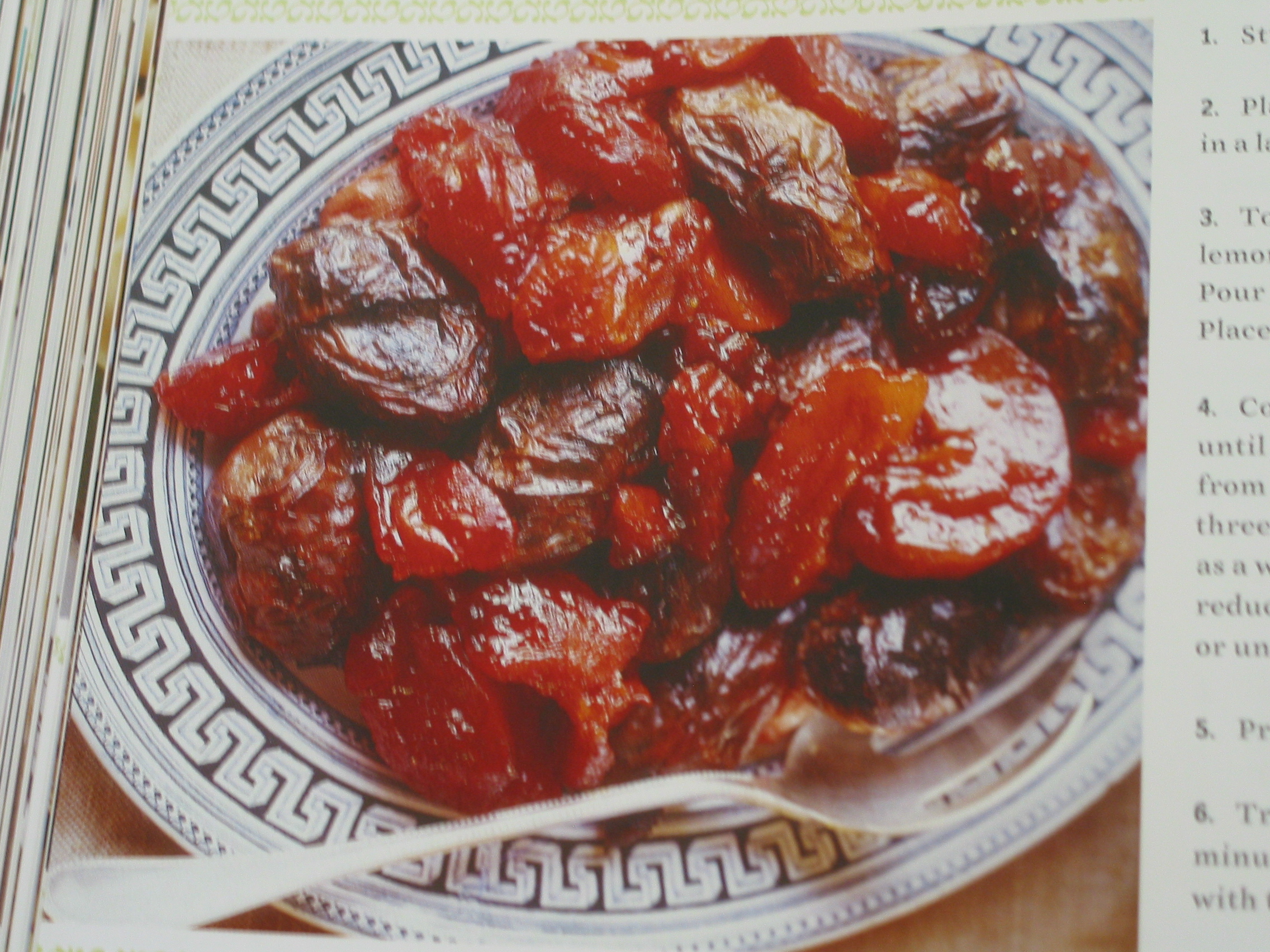
Stuffed Eggplant with Quince

Stuffed Eggplant with Quince

Poopa Dweck, a cousin by marriage to Claudia Roden, has edited the New York Syrian Jewish community’s version of a sisterhood cookbook (every synagogue in America’s sisterhood seems to have put out at least one of those) for something like 20 years, only people in her community actually used it frequently. My birthday gift is the 2007 culmination of Dweck’s experience, and it’s just a very beautiful cookbook to leaf through–visually but also for the possibility that when you try the dishes, they’re actually going to work.

It doesn’t take much reading for me to realize that despite the unfamiliarity of some of the flavors–allspice in meat stuffings, tamarind-based sauces–this is the best kind of traditional Jewish home cooking, the kind that has your favorite great-aunts outdoing each other for Pesach, Rosh Hashanah, and other big celebrations. So, somewhat exotic in flavoring but utterly familiar in spirit. (And actually, as I discovered in another Syrian Jewish cookbook, A Fistful of Lentils, by Jennifer Felicia Abadi, a few dishes, like stuffed cabbage with a sweet-and-sour sauce, and manti, a kind of ravioli, are pretty similar to Ashkenazi holishkes and kreplach.)

Like all Jewish great-aunt dishes for the holidays, this dish of stuffed eggplants and quinces comes with two required homework items: the beef and rice stuffing, and tamarind concentrate. The beef I’m not worried about–my first try on this is going to be vegetarian, because I’m not planning on heading out to the kosher butchers in the Valley. I can use a green lentil and rice filling that I already know will taste fine with those flavorings of allspice and cinnamon and onion. Maybe a hit of garlic too, and maybe a bit less salt than for the beef–as I discovered a few weeks ago, with the green lentil sausages, lentils don’t hide the salt flavor as much as beef might.

The other item, tamarind concentrate, turns out to be inexpensive but somewhat unlovely to make–though still something of an adventure. Especially for a blog called Slow Food Fast.

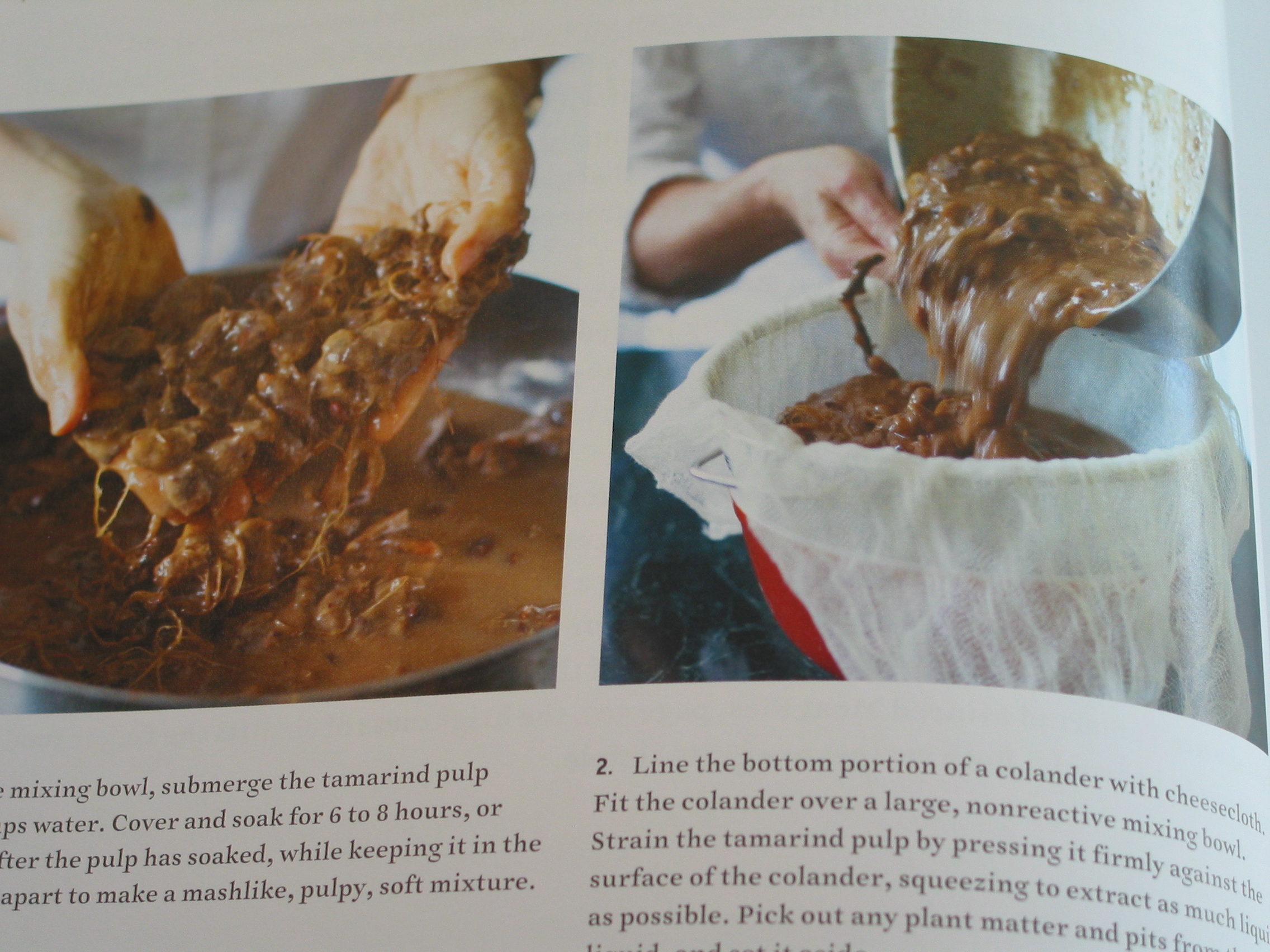
Here’s what’s on page 42 of Aromas of Aleppo for how to work the tamarind pulp into something that will give up its flavor to a sauce:

Poopa Dweck's Aromas of Aleppo--instructions for making tamarind concentrate

Working the tamarind pulp

Now, I’m not all that squeamish, but bleaaghhh. First ya gotta soak the stuff overnight, then ya gotta get in there and mish around–I dunno. I decided to speed it up where I could…

I thought about the little 1-lb. brick of pressed seedless tamarind pulp I’d bought from my Armenian greengrocers for this dish. It just seemed like a tougher version of dried prunes or apricots, which I usually soak up successfully enough in a few minutes by heating them with water in the microwave. Would it work here or would it ruin the flavor? I cut off a chunk, submerged it in water in a microwaveable bowl, and tried it.

Tamarind pulp rehydrated in the microwave

Five minutes of microwaving, covered, plus about 20 minutes sitting time–it was definitely done. And really, really incredibly tart, a surprise given tamarind’s distinctly plummy aroma. Success! But no wonder they call it “ouc” (pronounced OO-rgh, according to Dweck)–that was my immediate reaction when I tasted a tiny sip. It’s THAT sour. My second reaction was that I should probably say Shehekheyanu–the blessing for any new venture, especially for holidays and the first taste of a new fruit in the year.

I realized only afterward that I should have done the whole brick while I was at it–I was about to discover why Dweck calls for preparing three pounds of pulp at a time, not a couple of ounces.

Next step–squishing the pulp in the water to extract as much flavor as possible before filtering through cheesecloth and reextracting the pulp left behind in fresh water…no. Just no. I am not a cheesecloth girl–it never, never cuts neatly, even with Fiskars shears.

So, I was thinking, I have a microwave for a reason. I also decided I have a food processor for a reason, and this is definitely it. I stirred once with a fork first to make sure there really weren’t any pits in there, as advertised on the package front. Then I poured it all into the food processor, and gave it a whirl. That worked too. I seemed to be on a roll with the speed-it-up-immensely daydream.

Filtering the tamarind liquid

Filtration–I’ve used overlapping coffee filters in a colander whenever I make paneer in the microwave, and it worked pretty well here too–maybe better than Dweck’s photos, which show a cloudy filtrate coming through the cheesecloth. Mine was clear and amber–maybe too clear? Was it going to taste authentic without the silty stuff? I could only hope. It sure was sour, even dilute as it was. Continue reading

All Those Magazine Microwave Tips

I’m STILL working on a review of Joan Nathan’s Quiches, Kugels, and Couscous: My Search for Jewish Cooking in France. Reason–so far the stories are more engaging and attention-getting than the food itself. So deciding what I think about the food takes a reread and some comparative checking.

For now, I’ll note very briefly that Nathan actually recommends microwaving in several recipes. This is a big step forward in the top-tier cookbook world, even though Nathan’s few mentions are still pretty brief and simple uses for the microwave. They’re still commonsense, so I give her credit for not eschewing them.

But it brings up a sore point for me. A lot of food writers are starting to incorporate microwave tips in their publishing repertoires, but some of them don’t really know how to use a microwave for much or else they don’t do the important legwork and test out their suggestions under varying conditions so that readers won’t get burned.

Case in point: Melissa Clark in a recent article for Real Simple, 14 Who-Knew? Uses for Your Microwave. Clark’s article is an unfortunate object lesson on the need for caution, maybe even a bit of actual research and critical thinking on the bounty of quickie microwave tips the food and homemaker magazines love to dish up.

The “uses” in Clark’s list include sterilizing sponges and plastic cutting boards, juicing lemons, toasting nuts and coconut, heating up beauty products like gel masks and leg wax…

Not only are most of these nonfood uses unoriginal–did she just scour the ‘Net or did she try them out?–but some of them are actively dangerous, to say nothing of unappetizing. Some gel mask manufacturers even put a warning in their instructions not to microwave the mask by itself but rather in a bowl of water–you could end up overheating it and scalding your face. One reader commented that she’d tried the sponge-sterilizing trick and ended up with a houseful of black smoke and a ruined microwave. Very expensive and maybe even harmful, even without the risk of a house fire. Sponges and plastics give off volatiles when heated–do you want to breathe them? do you want to have them coating the inside of your microwave and then washing off into your food the next time you heat up a cup of coffee?

And do you really want to eat ANYTHING from your microwave after something like dirty sponges or a plastic cutting board has been heated up in it? To me it would be like eating off a table where someone’s just left their dirty socks.

SOOOO–Here are a few general (hard-earned, experience-based) notes on not abusing your microwave by following such tips unthinkingly. Because there will always be more articles like Clark’s than the kind I’d hoped for.

1. Don’t microwave nonfood items to clean them (or really, for any other nonfood reason…) At all. Your microwave is not a dishwasher, washing machine, or autoclave (and I have very unpleasant memories of the bio department autoclave and its smell when I was still a lab tech–wouldn’t exactly call it clean even if it did lyse the bacterial cell cultures…) The chemistry of microwaving is different from straight-up heating in an oven and may do something unpredictable or harmful if there’s no water present to absorb the energy, or occasionally even if there is. Think BPAs in plastic–there are loads of Continue reading

Chickpea Crepes: Protein Inside-Out

Ever since Thanksgiving I’ve been thinking about the challenge of coming up with a proper vegetarian centerpiece for major celebrations–one with a single, unified dish cut up to share, something with protein, not just vegetables or grains, something with great complex flavor and no artificial ingredients.

This is apparently a tall order. For months now I’ve scoured vegetarian and vegan cookbooks in hopes of some serious suggestions and come up nearly blank. Perhaps it’s because most vegetarian cooking in America is based on southeast Asian vegetarian cuisines, which don’t emphasize centerpiece or “main” dishes as much as assortments of several smaller ones, none of which necessarily take the lead. Or because a lot of the nondairy, non-egg vegetarian cooking consists of beans, rice, tofu, seitan and vegetables–not a bad thing, but not usually pretty or convincing as a centerpiece and occasionally incomplete on protein or complex flavor (there’s an awful lot of salt or soy sauce in some of these cookbooks). The few centerpiece dishes with a meatloaf-style filling wrapped in puff pastry or phyllo or potatoes seem to include premade seitan (high in salt) and/or things like mushrooms or eggplant or spinach and nuts with a fair amount of starch for binder, which means you’re repeating starches between the filling and the wrapper and not providing much protein.

One solution might be to put the protein, or at least some of it, in the wrapper itself, so the filling can be flavorful vegetables and so on but not have to come up to the concentrated protein level of meat.

Chickpea flour crêpes are one such possibility, and they’re very easy to make. A bit stronger in flavor than ones made with wheat flour, they hold together well in the frying pan and come out thin, springy and wrappable without the need for eggs. They also take well to a Continue reading

Microwave Tricks: Melts and other Hot Sandwiches

Microwaving the cheese and eggplant while the bread is toasting makes homemade panini a lot quicker

Microwaving the cheese and eggplant while the bread is toasting makes homemade panini a lot quicker--though not necessarily neater

Last year for his birthday my Italophile in-laws gave my husband the ultimate kitchen gadget. Because they loved theirs so much, they gave him…a panini press. I gawked. My husband is almost famous for not cooking. At all.

In more than 20 years of life together, I’ve rarely seen him make an actual sandwich for himself–does shmear on a bagel half count? I’m sure he believes in his heart that he still remembers how to flip one piece of bread on top of the other and seal the deal, but I’ve yet to see evidence of an attempt. Even without grilling.

Somehow I don’t in my heart of hearts believe this panini press is going to be removed from the box and used. Not by my husband, and not by me. It’s not that we’ve never been to Italy or eaten actual panini (we have, on both counts). It’s not that we hate panini or toasted sandwiches in general (we actually like them quite a bit).

It’s that the free-standing real, authentic, Michael Chiarello-approved-and-branded panini press weighs even more than the professional-grade waffle iron my in-laws gave us 10 years ago (and which we’ve used a total of 10 times since, because it’s such a pain to clean). The panini press also takes 3-4 times as long to preheat before you actually get to make the panini. Somehow a grilled cheese sandwich of whatever nationality just shouldn’t take 45 minutes to make. Which it did, when my in-laws, with all the innocent gadget-happy enthusiasm of Toad and his motorcar in Wind in the Willows, brought theirs out to demonstrate.

As a cheese-and-toast fanatic of some standing, I have a few very specific criteria for my grilled cheese sandwiches, grinders, melts, etc., etc.:

1. They have to be substantial and taste good–classic or adventurous, they have to be worth eating. That means the bread, the cheese, and any other fillings under consideration.

2. The toasted bread must be crisp. It must not crush, mush, squash, crumble or absorb tons of cheese grease. It must stand up to the fillings.

3. The cheese must have body and flavor even when melted–it shouldn’t run away, sink into the bread, turn into a pile of salty but otherwise flavorless grease, swamp everything else on the plate, or become a rubber eraser.

4. The whole sandwich must not take longer than about 7 minutes to put together and toast.

Normally you’d say panini fit the bill for an ideal toasted cheese sandwich, and I’d agree–if I were eating out and didn’t have to put up with preheating the grill. If you’re running a corner grill in a touristy Italian city, you’ve got a hot press at the ready and you’re turning out panini by the score for large crowds of passersby, an individual panino probably doesn’t take more than 5-10 minutes. At home, though, all you want is your d–n sandwich. You don’t want to heat an expensive and cluttersome gadget 45 whole minutes just to get there.

You’d also say that the standard white-bread-and-Velveeta fried cheez sandwich was out of the running. You’d be right there as well. No exceptions or passes.

However, in my kitchen, with its limited counterspace and my dislike of extra washing-up, waiting, or fussing, I sometimes get impatient even with the toaster oven classics of good bread, good cheese, and foil underneath to catch the drips.

A quesadilla is obviously no trouble in the toaster oven. Practically designed for it. Neither, really, is a simple sandwich-bread-and-cheddar grilled cheese. But for anything more complicated, or any thicker, more substantial filling, sometimes melting the cheese is the longest part of waiting, and in the meantime you’ve either pretoasted the bread so it stays crisp (in which case it burns around the edges waiting for the cheese to melt) or else you didn’t pretoast the bread and it remains too soft underneath the cheese (and maybe absorbs some of the grease while it’s doing that). Sometimes the other filling ingredients–tomatoes or tomato sauce, mushrooms, lentils, artichoke hearts, etc.–make the bread soggy while you’re trying to melt the cheese on top. Sometimes they don’t cook all the way through.

Here, surprisingly, the microwave comes to my rescue, particularly with fillings that aren’t just cheese but rather cheese melted onto vegetables or sauce or lentils or tuna or some combination. Continue reading

Microwave Tricks: Brown Rice Resolution

Resolution #15 from my last post was to figure out a decent “quick” method for cooking tougher grains like brown rice and pearl barley. These grains still have the skin on, which forms a barrier to quick absorption, so they take 45-50 minutes to cook on the stovetop, which is simply too much for me to babysit. Apparently I’m not alone on this–I see vacuum-packed packets of precooked brown rice at the Trader Joe’s (and similar bowls in the freezer both there and at Whole Foods).

To say the least, this is not the right way to go if you’re earnest about spending less on staples while going a little bit greener in the new year (think of all the freezer energy cost and coolant leaks, the cooking energy expended, the plastic packaging, etc.)

According to Nina Shen Rastogi of Slate.com, microwaving can be the greener cooking option as long as you don’t leave your microwave plugged in when you’re not using it–apparently the little digital clock display thingy takes up a surprising amount of energy (and do you really need a microwave to tell you the time? Hang a battery-operated clock in view of the kitchen and you’ve got it…)

So microwaving should be the way to go with brown rice, as it is for pasta (plain or whole-grain) and white rice. But unfortunately, microwaving brown rice, with its tough outer skin, really doesn’t work well at all if you just dump the raw rice into some water and try to nuke it straight up, the way you can with these quicker-soaking grains. Certainly not in 3-5 minutes of cooking time. Not without babysitting and worrying about boilover. Feh.

And it’s never a good idea to nuke something starchy more than a few minutes at a time, at least not without a lot of water in it–you could end up with plastic (think about what happens to bagels if you microwave them for more than 15-20 seconds).

But you know I don’t like to give up once I decide something should work. So–I thought about something I posted a couple of years ago on nuking oatmeal successfully and decided to try the presoak idea that had worked for steelcut oats. Only who wants to presoak rice overnight if they don’t have to? Steelcut oats–you know you’re going to make them for the next morning’s brunch (only do it on a weekend). Stick ’em in a bowl with water and a lid, let it sit overnight, nuke a few minutes in the morning and you’ve got it. It’s perfect.

Rice? I never know what I’m making for supper until about an hour before.

But a hot presoak worked pretty well to get things started, and it only took about 15 minutes (because I was impatient). The whole thing still took about an hour–well, maybe less in the strict sense, I wasn’t paying attention Continue reading

Bok Choy Broth

Bok choy-based hot and sour soup

Bok choy-based hot and sour

Usually when I get home from traveling I’m in a state where I don’t really want to cook, but I want real food, and I’m sick of the bread-and-cheese-sticks-and-carrots-and-nuts we bring on the plane in self-defense.  The other thing I really want right away is vegetabalia–restaurants, particularly hotel restaurants, seem reluctant to put any on the plate. Microwaved fresh vegetable soup is an easy and satisfying answer–15 minutes and you don’t have to go shopping for anything fancy.

It’s also the answer when it’s cold and rainy and everyone in the house has been down with the crud (aka “Losangelitis”). Today, I wanted something with greens in it like minestrone, but tasting more like hot and sour soup, to cut through the fog that had condensed in my head, and I did NOT want to work hard (also because of said mental/temporal fog). I had the basics for a vegetable broth–an onion, some celery stalks, a handful or so of “baby cut” carrots  more usually reserved for my daughter’s school lunches. A fat clove of garlic. Half a bunch of bok choy that was still in decent shape from two days ago when I microwaved it as a side to stretch leftover Chinese takeout. And in the cupboard, miraculously, I still had three dried shiitake mushrooms in a plastic bag.

Bok choy is one of the Cheap Vegetables ™–usually below a dollar a pound, even in big-chain supermarkets. Not baby bok choy, which is cute and pretty and mild; stores charge three times as much for that. I like the full-grown, poetically dark-leaved, white-stalked bok choy, the kind sumi-e masters choose for their still lives.

Sometimes for a vegetable at dinner (as mentioned above) I just nuke a cleaned and trimmed head of bok choy whole for a couple of minutes in a longish lidded container with a little water in the bottom, cut it up and serve it as-is or drizzled with a little soy sauce and sesame oil. You don’t need anything else to dress it up (and of course, I have pretty low standards for presentation). Its fresh, radishy flavor mellows into something richer and more aromatic as it cooks down and produces its pale-green pot liquor. You don’t want to waste that; it’s a perfect addition to a vegetarian consommé, especially when you’re going light on salt or calories.

I sometimes even skip the onion-carrot-celery-garlic vegetable stock base and make a really simple broth by just microwaving the bok choy all by itself with water to cover–especially when my head and stomach aren’t cooperating with me or with anything else. But that’s a little on the purist side of things, when I’m feeling so miserable all I want is something hot, clean-tasting and fresh with no distractions. For better times, I want a real soup with a bit more richness and variety, and bok choy definitely plays well with others.

Back to the hot-and-sour scenario, for example:

Shiitake mushrooms are expensive fresh at your local Whole Foods, about $13/lb. But a package of 15 or so dried caps sells for $3.50 in the Asian or International Foods section of your local supermarket, and the dried mushrooms are so much better for infusing a broth with pungent richness. They’re easiest to soak up in a microwave–a few minutes rather than half an hour.

Between those and the carrot-onion-celery aromatics, plus of course garlic, you’re set. Especially if you have a little container of z’khug (hot pepper-garlic-cilantro paste) in the freezer and can saw off a chunk to spice up your soup. Toasted sesame oil, vinegar, and low-sodium soy sauce–all optional. Ginger? You could. Ginseng? According to a friend from a Cantonese family, only if your mother insists. Continue reading

No-Furkey!

In the freezer case at Whole Foods this month you’ll find big boxes announcing Turtle Island’s Tofurky Feast, Field Roast’s Celebration Roast, and VegeUSA’s Vegan Whole Turkey –this last shaped and glazed brown like a large chicken, drumsticks and all. I’m not sure how I feel about this concept–I thought the idea of being vegetarian when you have enough money for a choice was not only not to eat meat, but not to want to be eating meat either.

Not that I’m against decent vegetarian meat substitutes for Thanksgiving or any other time of the year. As someone who’s kept kosher since my college years, and often in places where there was no kosher meat (or I didn’t have the budget for it), tofu or wheat gluten “mock chicken” have made eating in Chinese restaurants a lot more fun, and the good restaurants make their vegetarian dishes as serious and well-balanced as their meat dishes–sometimes better. But they generally don’t try to disguise them this far or process them this much.

Still, to each her own. But $42.99 for the big VegeUSA box at Whole Foods. The box states that it feeds 25 at 2.5 oz/serving, which is probably enough protein but only about half the volume most adults would expect. And it’s kind of expensive for something that looks very much like a well-browned rubber chicken. What’s in it? I scan the nutrition panel and don’t really notice anything but the sodium–everything else is low or moderate, especially for a holiday meal.

But the salt! 450 mg for the “turkey”–double it to 900 mg if 2.5 oz isn’t enough for you and you want seconds.  1400-plus mg for the stuffing–huh? a whole day’s worth of sodium for one serving of stuffing?  Is it that bad for conventional stuffing mix as well? You’d do better to make your own from scratch.

At this point I didn’t even look at the gravy.

Tofurky isn’t much different–650 mg sodium per serving, including stuffing. Field Roast–in the same range too. They also sell separate tubs of frozen “giblet” gravy.

Of course (full disclosure here), I’ve never actually liked gravy, and I doubt it would really go well with anything tofu, not even tofu in a rubber chicken costume.

Why do I think you could do a better and probably a lot cheaper and more festive vegetarian Thanksgiving with some kind of authentic, fresh-made main dish? Because very clearly you could. Do you want it to taste good? Or do you just want it to look like an imitation turkey?

Of course, the main thing about these frozen concoctions, even the simple cylindrical “roasts”,  is that they look like centerpiece dishes, and there’s really no knocking that desire to serve something impressive and festive and most of all, shareable at Thanksgiving. It’s important. Thanksgiving feasts demand a monument to plenty, and an inedible cornucopia with gourds and Indian corn doesn’t really cut it. Nor does a big pasta salad (although a timbale, as in Big Night…)

Surprisingly–sadly?–enough, very few vegetarian cookbooks, not even the big tomes like Mark Bittman’s How to Cook Everything Vegetarian or Veganomicon, really try for a vegetarian centerpiece dish that looks and feels like an important dish. Mollie Katzen’s title dish from The Enchanted Broccoli Forest is about the only intentionally designed centerpiece vegetarian dish I’ve ever seen. A very long time ago I actually was served this thing once at a friend’s house, with very sadly overcooked broccoli stalks stood upright in a flat casserole of brown rice. Oy, is all I can say. Not a moment of pride. Both Katzen’s and my friend’s cooking improved in later years.

None of the currently hot vegetarian cookbooks out there have an index listing for “Thanksgiving”–very telling. A lot of them have portions for 2 or 4 or just one person. Only vegetarian chili and pasta dishes are intended to serve a crowd of any size.

So vegetarian centerpiece dishes deserve some consideration. Tara Parker-Pope of the New York Times blog “The Well” has been edging around this topic for a week or so, but I don’t feel she’s really gotten to the heart of the matter–neither has anyone else. Perhaps it’s because she’s not thinking like a vegetarian?

What makes a dish a centerpiece dish? Think about the turkey, then, or a whole salmon, or a rack of lamb or the like. It’s big. It’s unified–one big item before you cut into it for serving. It’s elegant and impressive. It’s sliceable. It’s savory enough to draw people into the dining room with a sigh of Continue reading