
• Enter your email address to subscribe to this blog and receive notifications of new posts by email.

    Join 241 other subscribers
  • Noshing on

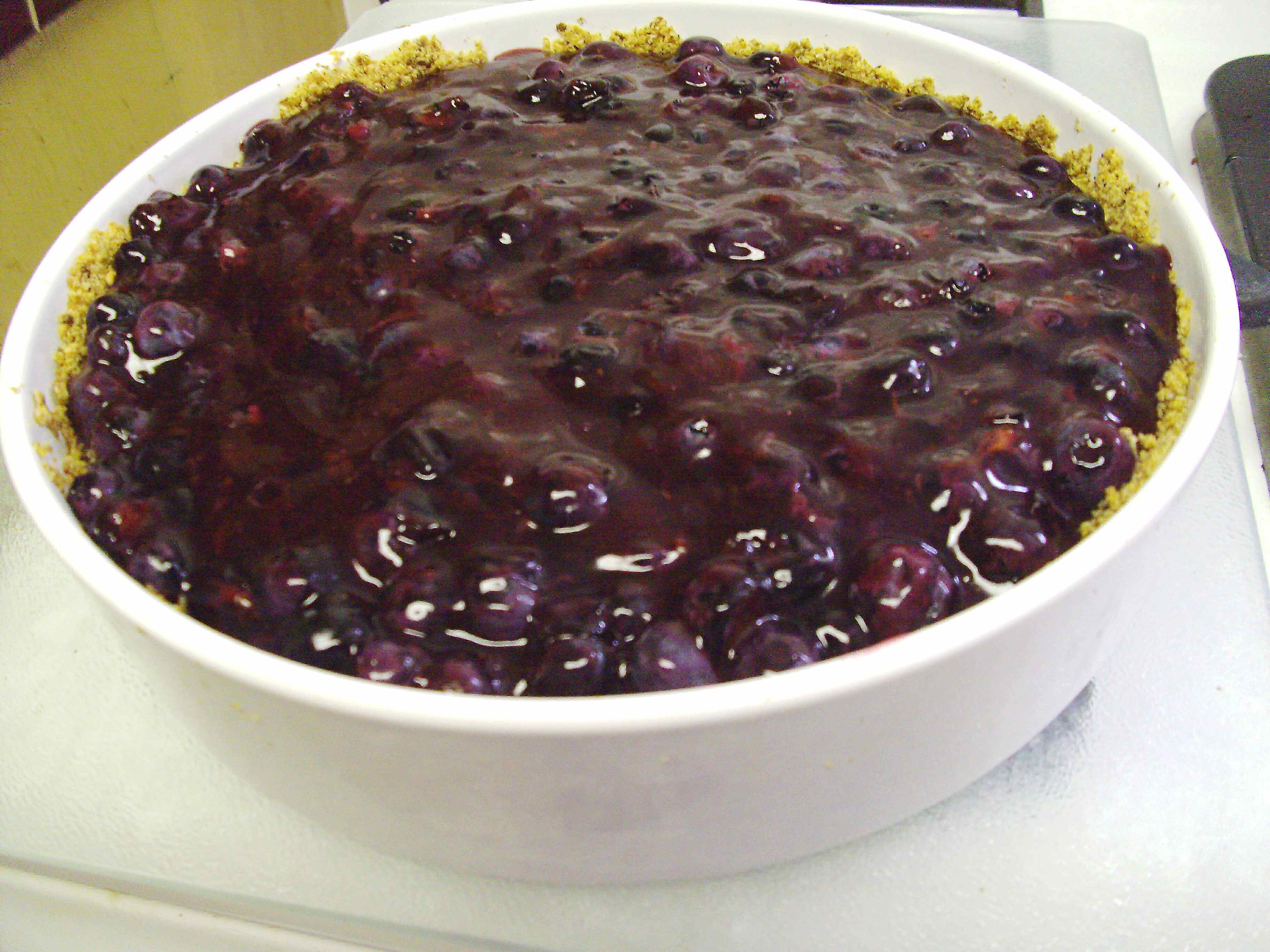
    raw blueberry pie with microwaveable filling and graham cracker crust

    This mostly-raw blueberry pie is a snap to make and very versatile--the filling microwaves in a few minutes, and you don't even have to bake the zippy gingered graham cracker crust--perfect for a hot Fourth of July and all summer long.

  • Recent Posts

  • Contents

  • Archives

  • Now Reading

  • See also my Book Reviews

  • Copyright 2008-2024Slow Food Fast. All writing and images on this blog unless otherwise attributed or set in quotes are the sole property of Slow Food Fast. Please contact DebbieN via the comments form for permissions before reprinting or reproducing any of the material on this blog.

  • ADS AND AFFILIATE LINKS

  • I may post affiliate links to books and movies that I personally review and recommend. Currently I favor Alibris and Vroman's, our terrific and venerable (now past the century mark!) independent bookstore in Pasadena. Or go to your local library--and make sure to support them with actual donations, not just overdue fines (ahem!), because your state probably has cut their budget and hours. Again.

  • In keeping with the disclaimer below, I DO NOT endorse, profit from, or recommend any medications, health treatments, commercial diet plans, supplements or any other such products.

  • DISCLAIMER

  • SlowFoodFast sometimes addresses general public health topics related to nutrition, heart disease, blood pressure, and diabetes. Because this is a blog with a personal point of view, my health and food politics entries often include my opinions on the trends I see, and I try to be as blatant as possible about that. None of these articles should be construed as specific medical advice for an individual case. I do try to keep to findings from well-vetted research sources and large, well-controlled studies, and I try not to sensationalize the science (though if they actually come up with a real cure for Type I diabetes in the next couple of years, I'm gonna be dancing in the streets with a hat that would put Carmen Miranda to shame. Consider yourself warned).

The Broccoli Bogeyman

choppin' broccoli

Appropriate material warning: In honor of the Supreme Court’s latest quagmire, off-color political comments and remarks on food preferences ahead. No actual body parts mentioned…well, not much. More implied than actually mentioned. Nor will you find much actual swearing, more’s the pity. Nobody, but nobody, gets called a dirty name such as the male equivalent of whatever might have been slung around on a certain talk show whose host contested female citizens’ rights to testify before Congressional committees. Or not much of a dirty name–though some might say it’s implied. And it is. To your healthcare!

Antonin Scalia–and I’m just saying it for what it’s worth, here–what an embarrassment to the United States.  First he squats instead of recusing himself in a case where he clearly has a conflict of interest, namely that he went hunting and dining with the defendant (then-Vice President Dick “New Heart” Cheney), then he blames broccoli for the faults of an imperfect but workable health care plant. I mean plan.

I know this commentary is coming about 2 weeks after the fact, but it’s taken me the full two weeks–one of them Passover–to decide that it really was up to me to fight back. Against Scalia, against broccoli abuse, and apparently against my computer’s quirks, one of which was to eat the camera card and spit out a coupla bent socket pins. Because for a proper rebuttal to the broccoli question, I need incriminating evidence in the form of photos. Exhibit A, as it were.

Whether you think health insurance and the Affordable Care Act should be available to everyone in this country or not, or whether or not you think you personally need health coverage that doesn’t inspect you down to your toenails before charging you extra, the true question here is, why is broccoli always the Republican go-to monster under the bed? Perhaps because their leaders faithfully follow George Bush père‘s overwhelmingly whitebread fear of vegetables, particularly the dreaded broccoli, while adopting his stated  preference for pork rinds?

Let’s put that under the microscope first, shall we? True story:

My first year at university,  two of my sarcastic and adventurous dorm mates bought a packet of pork rinds to try out as political investigation material. This was in 1981, when GHW Bush was the new veep for Reagan, and he’d announced both his loathing for broccoli and his love of pork rinds, as though any of us needed to know that. Eyewatering. Anyway, my friends decided they had an obligation to test out Bush’s aesthetics personally before condemning him. So…they moseyed on down to the university district’s 7-11 store and purchased some test samples. Then they came back to our suite and conducted the (not double-blind, which I’m sure they quickly regretted) taste test with all the rest of us as an audience. About 30 witnesses in all.

Beth and Bill faced each other across our suite’s livingroom floor. Somebody counted down, and they ripped open the pork rind baggie. Next countdown–reach into the bag and select a pork rind at random. They shuddered briefly–the aroma had reached them–but regrouped. This was for the record. For science. For Truth and the American Way. They braced themselves.

On the count of three they each bit into their pork rind of choice.  The reaction was instantaneous. The verdict unanimous.

“Wow, they really do taste exactly as fecal as they smell!” chirped Beth as her face went very, very red. It was clear she was trying not to skew the results by vomiting and giggling simultaneously. Bill didn’t hesitate to spit copiously into our trashcan for several minutes, and we couldn’t blame him. We just told him to take it with him and not leave the damning evidence with us. Chain of custody rules, you know.

Anyway, if Mr. Scalia’s broccophobic remarks are reflective of the officially sanctioned GOP line when it comes to vegetabalia and taste preferences, what our intrepid reporters discovered 31 years ago does suggest that we’d all be better off skipping their national convention banquet this summer.

Back to broccoli. What is so demonic here? It’s actually a popular vegetable these years (quirkily informative market statistic needed, desperately needed, because very, very few Food Network cookbooks contain any recipes for it).

Statistic, statistic, statistic–oh. Here! Average US per-person consumption of fresh broccoli has quadrupled since 1980.  Outpacing frozen by a lot. And the total US market is worth upwards of half a billion dollars a year. And we supply most of Canada’s and Japan’s broccoli. And yet we still import from Mexico, Equador and so on for frozen because the labor’s cheaper.  Demand for broccoli is actually pretty high.

So Scalia, and the rest of the GOP faithful, have really gotten hold of the wrong end of the stem with this broccoli blame game. And all the more surprising to wave it around like that since Scalia is Italian-American.

Somebody tell me when the Italians are supposed to have started fearing broccoli? Even its name is Italian–according to the agriculture info sites, they first brought it over to the States in 1923.

Maybe his parents were rotten cooks? Does he hate garlic too or something? The shame, the shame…

Anyway…

Broccoli–the regular, not the rabe–is, tell the truth and nothing but, easy to abuse culinarily. Mostly by overcooking and then dumping it on the dinner plates unflavored and unloved, graying, sulfurous, lukewarm. Foul color, worse odor, unbelievably bendy and dank. Not exactly a taste explosion.

But broccoli doesn’t have to taste like whatever you might remember from your high school cafeteria, if you’re old enough to remember when they actually served vegetables instead of pizza with a side of fries. And you don’t have to eat it raw either. You have choices. Options, as it were. Continue reading

School nutrition opinions and the state of things now

In today’s LA Times, David Just and Brian Wansink weigh in on the behavioral fallout of revamping school cafeteria food choices by eliminating commercial fast food and flavored milks. They contend that giving kids a choice of foods increases the chance that kids will choose healthy foods at least some of the time instead of tossing out the tray and sneaking pizza orders into school.

A few of their observations–that fresh fruit is more appealing and gets chosen more often when placed in an attractive bowl right by the cash register checkout–make sense. Cafeterias could do more to arrange the choices they have in keeping with the way restaurants from banquet-style buffets to the corner Starbucks have found effective. Put the fruit right by the cash register and that impulse-buy instinct will kick in. Now if only they had a better strategy for vegetables. Or at least a more nutritious and less dismal choice than carrots vs. celery.

But what really struck me in this article wasn’t the fact that Wansink, the author of Mindless Eating: Why We Eat More Than We Think, and his colleague David Just seem to be condoning the continued availability of fast food in public school cafeterias.

The most striking thing about this article on an overchewed topic was the picture at the top of the page: a high school cafeteria display with single-serving “Uncrustables” white-bread sandwiches (Smucker’s brand) on a shelf that was labeled “Fresh Apple Slices” (none in sight, but I bet they would have been branded in baggies as well) and little bags of baby carrots (couldn’t tell which brand, only that there was one).

I know the existence of carrots is an improvement. I know that sandwiches are generally less awful than pizza and fries. But the bagginess of the whole thing–wrapping something in plastic pouches at a factory makes it officially dead and stale. Not fresh.

The apples, if they actually exist at that school, are already cut into pieces that are either browning or have had to be treated with ascorbic acid (well, that would be the best option, and would sneak in a little vitamin C) or another anti-browning agent. The sandwiches on white gummy-looking bread have the crusts removed. It’s as though the kids in the cafeteria were four years old and couldn’t handle biting into a whole apple or peeling an orange or eating a sandwich on actual bread with crusts (and I mean really, what about all those hamburger buns?) It’s disheartening.

I realize a lot of school cafeterias got rid of their dishwashers as well as their full-function kitchens a generation ago. But they could be offering food that looks and tastes fresher and less like it had been sitting for ages in a vending machine.

If you’re going to offer sandwiches in the cafeteria, why not let the kids choose bread and fillings at a sandwich line? It would take a staff person to assemble them, most likely for reasons of discipline as well as hygiene, but the food would look fresher and probably be fresher, and the act of choosing and ordering a bespoke sandwich would probably make it more appealing than taking another soulless packet off the shelf. There’d be less plastic trash too.

The labor issue–there’s always a labor issue with hand-assembled sandwiches, assuming you’re not going to let the kids make their own. But you could, maybe as much as once a week, let different clubs at the school take turns running a sandwich line as a fundraiser, get a free lunch that day themselves and charge a nickel or so above the standard lunch price for their cause. Or do a school-wide chili cookoff event once a year with different teams competing. It would be a lot more fun than the dim “choice” of celery vs. carrots (and of course 89% of students will choose carrots over celery–carrots are faintly sweet, while celery is overtly bitter even though it’s a savory bitter).

If the school isn’t already shackled by a year-long exclusive contract with a food-packaging company like Smucker’s, offering a student-run sandwich line once in a while might actually come out less expensive and wasteful.

ANDI Scores, Whole Foods, and diet scheme cha-ching

If you’ve taken a walk through your local Whole Foods Market in the past year, you’ve probably seen a stand with purple and green information sheets listing foods in order of “ANDI Top 10 for Produce”, “ANDI Top 10 Super Foods” and so on. Coordinated recipe cards, a suggested shopping list, and an attractive-looking book round out the offering. And the produce and bulk bins sport matching ANDI score labels. It’s a whole system. But is it right, or just another fad?

What is the ANDI Score system, anyway, and who owns it?

ANDI stands for Eat Right America ™’s Aggregate Nutrient Density Index, a proprietary nutrients-per-calorie scoring system that rates for foods from kale to cooking oil and everything in between on a scale of 1 to 1000 points.

The ANDI scoring system started with Dr. Joel Fuhrman, the author of the diet book Eat to Live. On his home page, Fuhrman describes himself as a family physician and nutrition researcher.  His diet, which he calls “nutritarian” (and you can become a nutritarian too by signing up) is a highly prescriptive weight loss regimen that focuses on high-value vegetables and fruits and eliminates most meats, fats and carbohydrates. His evaluation of vegetables as high-scoring and processed foods, meats, starches and so on as low-scoring seems only common sense.

Fuhrman’s site claims hundreds of articles and interviews as well as numerous appearances as a nutrition expert on national TV. The site also prominently mentions his two US Nationals pairs figure skating wins back in the 1970s. Does he need to have that information on there if what he’s promoting is serious, science-based dietary advice? Altogether, the site has a very infomercial feel about it, with lots of testimonials from members who’ve lost over 75 pounds with before-and-after photos. Fuhrman himself looks very fit and tanned and taut-faced–maybe a little too much? Maybe it’s just the heavy pancake makeup that infomercial packagers are famous for plastering on their experts’ faces.

Eat to Live is a popular book. Fuhrman’s Kindle edition of Eat to Live is the #700-ranked download on Amazon.com. His web site has something on the order of 4000 subscribers, whose questionnaire responses he mines for some of his journal articles. According to one of the journal papers, his audience is about 65% female, 71% married, the largest proportion college-educated with household incomes over$100K.  (At this point, I thought, bingo, the perfect infomercial audience. This is clearly a commercial diet with legs. But wait, there’s more…)

Ahem! Enter Eat Right America, a company started by a businessman who became a fan of Dr. Fuhrman’s. The founder figured there must be a good way to automate the multi-nutrient density calculations for a wider variety of foods and developed a proprietary algorithm based on nutrient values in the USDA’s NAL database. What makes the ANDI algorithm attractive, the company says, is that they weight these calculations per calorie, not per serving. Finally, they claim, you’re getting the “right” comparison of nutrient density for the calories.

But a closer look at the the diet and menus offered on both the Eat Right America and Fuhrman web sites raises a few warning flags. Scan the ingredients list in the Eat Right America 3-day sample menu and you see frequent uses of high-priced fruits, vegetables and grains like quinoa (no surprise there about why Whole Foods might be happy with the shopping list) as well as some trendy and expensive ingredients that don’t sound all that nutritious. Dates? Avocado? Coconut?  Sun-dried tomatoes? Cashews–one of the lower-fiber and more expensive nuts, incidentally. Those are usually extras, snacks, not staples, even in a vegan diet.

More seriously, the menu designers seem to have a penchant for bottled carrot juice. They put 7 whole cups of it in a bean stew that feeds 10. Now, carrots, whole carrots, are fine raw or cooked into a stew. They have fiber and vitamin A and in whole form are relatively low-carb as well. But juice them, and you filter out the fiber. You concentrate the vitamin A and carotenoids about 3-4-fold, well beyond the RDA–risking vitamin A overdose–and you concentrate the sugars. What would ordinarily be a bean and vegetable soup with a reasonable amount of carb per serving–about 15 g per half cup or 30 g for a full cup–quickly rises, with the addition of a big 7-cup dose of carrot juice in the pot (NB also much more expensive than plain carrots) to 75 grams. That’s the amount of carb my diabetic daughter would figure for an entire holiday meal that includes a decent-sized slice of cake or pie.

Some of the Eat Right America recipe nutrition counts look like the ingredients as listed don’t quite account for them. The carb is high–occasionally the sodium doesn’t add up right either. And the overall protein is low. In the vegan versions on Fuhrman’s site, which prescribes a six-week starter regimen of a pound of vegetables a day, a pound of fruit, and a cup of beans, the protein is also incomplete or close to it. No grains, and no dairy or meat or fish. No tofu. Avocado and flax seed, two darlings of the vegan world, are recommended to supplement the caloric intake so you don’t lose too much weight (which I thought was the point, but maybe not for a whole six weeks at a time).

All these recommendations flow from the ANDI scores of the food and produce some logical puzzles. Somehow, you never see plain tofu or fish or cheese or yogurt. Apparently they don’t score as high as avocado. How is this possible? Isn’t avocado pulp high-fat and not too exciting as a vegetable?

So the next thing to check–is the ANDI food-rating method right? If you’re judging solely on the micronutrients list, which is what Eat Right America claims to be weighing into its ANDI scoring formula, no it isn’t. Continue reading

Bravo to LAUSD

Some actual good news on the school lunch front appeared in the LA Times  yesterday:

L.A. Unified removes flavored milk from menu

The Los Angeles public school district, one of the largest in the nation, had to vote its bigger contracts for things like milk early, so they made the announcement yesterday. They’ve also announced they’re going to drop breaded, fried wastes of space like chicken nuggets and offer more vegetarian options, more farm-to-school contracts for actual fresh produce, all the good things we’ve been waiting decades to see again.

This is all in deep contrast with the frosty reception Jamie Oliver’s “Food Revolution” show has received from actual LA schools in the past few months. And there’s a reason for it that you don’t have to dig too deep to get to. A lot of the fine upstanding revisions to the LAUSD school lunch menus and cafeteria revamps have not actually gone through for budget-crunch reasons. Some of the salad bars were never installed and implemented. As with many pieces of legislation, the intentions were good, or sounded good, but the money never showed up. Benefit: zero.

And a friend of ours who’s a school principal says the federal food subsidy program for poor students–there are an awful lot of them in his school, as in many of the LA area schools–is woefully underserving those kids. Some wouldn’t get a meal at all if they didn’t eat at school, and the food they get today is barely worth the name.

If the LAUSD can actually manage this year’s resolutions right, it’ll be a big step forward. The chocolate milk wars in the city board offices have been surprisingly intense–proponents of keeping the sugared chocolate and strawberry-flavored drinks argued that if they were pulled, most kids wouldn’t drink milk at all, 60 percent drink the flavored milks when available and that there’d be a big drop in milk consumption.

Proponents of going to plain (and Lactaid, and soy, to accommodate everyone, this is California after all) countered with the ugly fact that  the amount of sugar in the flavored milks puts them just about in the range of Coke, and argued that if fast food choices weren’t waved so constantly in the kids’ faces and the cafeterias offered real food instead, rather than alongside, the kids would eat more real food. And they’d get used to plain milk quickly enough.

I can attest to this phenomenon. We don’t keep fast food or junk food in the house, and I’ve been serving fresh vegetables and whole foods rather than prepared or processed things out of a box most of my adult life. I don’t get too many complaints, not only because my husband’s no cook, but because that’s what there is to eat and it’s the way we grew up eating at home.

Our daughter came along and started out with plain unsweetened yogurt, vegetables, bread and plain oatmeal or the lower-salt store brand versions of Cheerios. Also, for reasons that aren’t particularly clear even now, she had a thing for Indian food, spices and all. The maitre d’ at our favorite restaurant laughed when he saw this two-year-old kid tucking into a hot cauliflower dish and saag paneer. He remembered me coming in for a serious feast with my husband when I was very, very pregnant and hoping it would either induce labor or at least last me until I was in shape to come back. I’d never considered that she’d like to eat what I ate while pregnant–I’m still not sure it’s true, but I figure Indian families would have more experience with seeing how their kids develop a taste for vegetables and varied spices. Even now, she likes a wider variety of non-sweet flavors than her friends. I like to think it’s because she’s gotten to taste them, and because we like to experiment.

Part of the comparatively low-sugar diet for her was self defense–she was an up-like-the-rocket, down-like-the-stick kind of toddler if she ate many sweets at a time, even then. Years before, my sister’s older son had gotten stuck in a serious chocolate milk habit at that age, because my sister had given it first as a treat, then as a regular drink, then for comforting him or to appease temper tantrums, then to get him to do the things he should have been doing with or without milk. She had a hell of a time getting them both back out of the vicious cycle. I’m not as organized and can’t fool myself, so I took it as a warning.

My daughter got sweets occasionally, but mostly she was eating the kinds of foods we ate and now that she’s diabetic AND eleven at the same time (pity me!), I’m extremely grateful that she got the taste for nonsweet foods early in life. She only really wants junk foods if they’re right in front of her, or hungers out loud for what she knows are exaggeratedly high-carb items if her blood glucose is a bit high. When she’s in good shape, she goes for vegetables and fruits and cheese and Continue reading

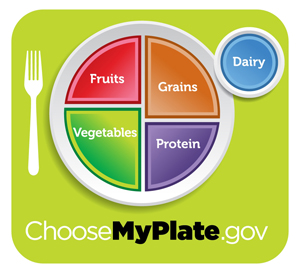
The new MyPlate icon–fantastic or plastic?

Everyone in the food press seems to be weighing in on the new replacement for the much-cursed USDA Food Pyramid in all (both?) its glorious confusion and obfuscation of real nutritional goals that might have (and should have) undermined the beef, corn, pork, corn, sugar, corn, and soy industries if they’d ever been presented honestly.

So where does that leave us? With ears of fresh corn that are more than 50 cents apiece in Los Angeles supermarkets, and the new…

USDA MyPlate logo

Already, the USDA’s MyPlate web site is in a certain amount of branding trouble (and of course, that’s what counts most in America): the Texas DMV had already bagged “MyPlates.com” for its vanity license plate division (highly unappetizing), and Livestrong.com already has its own well-established “MyPlate” food calculator and fan base. And those items come up first on Google searches. As in, the whole first page or more. The government site ranks way down the list and had to water down the impact of its original name choice with “choose” just to get a URL. Can it elbow out the competition just by bolding the “MyPlate” part?

What really counts are the food and nutrition opinion maker comments, though. And a lot of those are detracting in a nitpicking way that I think kind of misses the point.

The first thing they all have to say is that the plate looks dumbed down. Forgive me, but wasn’t the Food Pyramid’s unreadable and unusable design a large part of the problem? The MyPlate icon is simpler and more direct, and it names real food groups, not “Big Mac” or, on the haute side of things, any of Ferran Adrià’s foams. No wonder foodies and populists alike are wondering what it has to do with them.

A small sampling of the main arguments:

MyPlate: The Food Pyramid for dummies? (LA Times): Dr. Andrew Weil and others discuss what’s still wrong with the new icon. Weil says “fruits” could still include fruit juice, which is usually a useless sugar bomb in comparison with whole fruit, and he worries that the protein section, which comes with a guideline to eat 8 oz. of fish per week, might encourage unthinking people to increase their mercury intake since swordfish is on the guideline menu, as are some of the generally overfished popular species of fish. Weil’s not wrong about the fruit juice vs. actual fruit, but his hand-wringing about fish is really geared for well-off readers who can afford to eat much of it. All the fishes he names are Continue reading

Veg-phobia II: Summer Edition

My daughter is at camp for two weeks, the longest she’s been away from home, learning to deal with meals and insulin on her own (with the camp nurse’s help). After six months of calculating and eight weeks of giving herself shots, I know she’s ready to do it, and the nurse is ready, and her counselors are ready. And I overprepared and brought more supplies than she’ll need (my daughter has nicknamed this “Mom-anoia”).

I brought everything and a little bit more–including carrots and celery sticks and low-fat cheese sticks, and a loaf of whole wheat bread for activity carbs. I felt like I was turning into my grandmother, who used to bring shopping bags full of real bagels and corn rye on the plane with her from New York whenever she and Grandpa visited us in small-town Virginia.

But really. The nurse laughed at first when I asked a couple of weeks ago if the camp kitchen had vegetables as an option for campers who needed a non-junk snack (I’d looked at the sample menus online and they looked a bit Boy-Ar-Dee to me), but then she admitted the camp doesn’t really serve a lot of vegetables and suggested I bring them for her to store in the infirmary fridge. They don’t have anything whole wheat either. I think she stopped laughing and started sounding rueful about a third of the way through her reply. “We have fruit,” she said half-heartedly, knowing immediately that it wouldn’t really do for a diabetic.

The food at camp is a smack in the face with the wet rag of reality: this is how the rest of the country eats today. And don’t get me wrong, it’s a great camp in every other respect, with a long track record all over the Americas and people of my generation who still feel immensely grateful to have gone as kids. We were very fortunate to get a scholarship for it.

So what’s gone wrong with the food? It’s like school cafeteria food in the ’70s, but without the kale or the stewed tomatoes, the half-hearted iceberg lettuce salads or the lima beans. Take all that away and you have spaghetti, turkey burgers, the occasional chicken or tuna fish, grilled cheese, pizza, some form of potatoes or corn, and fruit. Some protein, a surprising amount of fat, hidden and otherwise, highish salt and a lot of starches on top of starches. It’s also “all you can eat.” But what are you really getting that’s worth seconds? No fiber. No vitamins. Few minerals. Nothing green. Per the Sylvia cartoons, “We feature all-white meals.”

Vegetables? Salad if you’re lucky. Broccoli? Nearly unheard of. Tomatoes? only occasionally. Red cabbage, carrots, celery or any other noshing vegetable of worth? Um, not this summer.

And it is summer. Best time of year for greens. This is when it’s all happening at the farmers’ markets all over the country, and your local newspaper is probably exhorting you to get out there and try it. And did I mention this is California, prime place for vegetabalia all year round?

How did this happen? To a well-educated, professional and middle-class part of the population, no less? The nurse tried to explain to me, “This is what they’re used to at home. The kitchen figures the kids won’t eat them.”

Disheartening in the extreme. But she’s right about the way families tend to eat these days. We saw it firsthand when some dear friends of ours came to visit Continue reading

The Dirty Roots of Veg-phobia

In one of my favorite Doonesbury cartoons, a very old one from the early 1970s when hippies still had a trace of hip about them, it’s Zonker’s turn to cook dinner, and he serves his housemates a big bowl of salad.

Mike Doonesbury peers into the bowl suspiciously and says, “Hey Zonker, the lettuce is dirty!”

“Yes, but it’s clean dirt! Ecologically pure dirt! No chemical additives–you’ll love it!”

Mike and Bernie opt for McDonald’s.

Somehow, though, the way they agree on it suggests the understanding of the early 1970s: McDonald’s was cheap, it was easy to find in your town, but it wasn’t really dinner, it was what you did when there was nothing decent in the fridge.

For decades now, government health agencies, the American Cancer Society, the American Heart Association, and whole parades of morning talk show guests have been advocating that Americans eat at least five servings of fruits and vegetables a day, and juices don’t count. The studio audience members, mostly soccer mom-looking women, only with impeccable makeup and pristinely unwrinkled clothes, bob their heads on cue at this wisdom.

But nobody’s gotten serious about how veg-phobic most people suddenly become when they actually approach the vegetable aisle in the supermarket, and no one’s taking enough pictures of what’s really in the fridge or on the cutting board most nights in most houses. All I can say is that many, many of them, if they buy vegetables at all, buy prepared or precut vegetables instead of bulk. Why?

Bulk vegetables–a whole head of cabbage or lettuce or broccoli or cauliflower, a bunch of celery or carrots–are bulky. Heavy. Hard to lift and hard to maneuver into those thin plastic produce bags.

They’re also round. They take up a lot of space in the refrigerator. They don’t stack neatly and they don’t necessarily fit into the shallow, measly vegetable drawer that comes with today’s Lean Cuisine-friendly slimline refrigerators.

They require washing, and here I wonder if we’re getting to the part people are most squeamish about. There’s…there’s (I can’t say it) … there’s DIRT on them!

Why washing it off scares people so much these days I have no idea, but maybe it’s all that liquid hand sanitizer and overly perfumed liquid hand soap that have poisoned the atmosphere this past 10 years or so. When your soap company can convince you to buy watered-down soap in a decorator squirt bottle, your friendly produce-packing plant can probably sell you overpriced broccoli florets in a small plastic bag.

A Year of Artichoke Hearts

“Top 10 Recipes” lists are a big thing at the new year, a way to look back and figure out which dishes made a hit and which ones were just so-so. But sometimes, after an entire year, the top-10 judging criteria can get a little distorted. How do dining section editors compare five quasi-Asian stir-fried noodle-and-greens dishes, most of them mysteriously pumped up with bacon crumbles (2009’s star ingredient), and decide all five really belong in the top 10 for the year?

In one of my early posts, I was thinking about toasted cheese sandwiches (grilled cheese, hard to believe, was a Top 100 Dishes entry for Bon Appétit at that point). At the end, I threw in a quick little recipe for marinated artichoke hearts done in a microwave as an antidote to all the middle-American boredom. Yesterday I ran across an artichoke and potato salad from the LA Times‘s 2009 top-10 list and realized my artichoke hearts would probably make it better. Because they make everything better, or almost.

Marinating your own artichoke hearts takes five minutes, is less expensive than buying a jar of prepared ones, tastes fresher, and has a short list of real ingredients. A ~12-oz batch lasts more than a week in the fridge, where it’s  ready to serve as a pick-me-up for sandwiches, pasta, fish, omelets, salads, and hot vegetable dishes. I use these artichoke hearts so often that whenever I get to my Trader Joe’s and they’ve run completely out of bags of plain frozen artichoke hearts in the freezer and won’t get any in for weeks, I feel horrible and deprived, like someone who’s just been told not to talk with her hands.

That puts it in MY top 10.

You don’t need more than a dash of salt in this recipe to make the artichoke hearts taste intense and bright. The fresh lemon juice and garlic do it for you, and something about the artichokes themselves makes the combination work. Continue reading

Jazzing up Creamed Spinach

Passing by the refrigerated prepared-foods shelves in the produce section of my local Whole Foods a few days ago, I couldn’t help noticing a 24-oz tub of creamed spinach…for $8.99. Six dollars a pound. Given that most of their deli and salad bar foods are about $8/lb., maybe that’s a comparative bargain, but still. You could buy six 1-lb. bags of frozen spinach from the Trader Joe’s for that. At my local Latino supermarket, you could get at least six and maybe twelve bunches of spinach, turnip greens, mustard greens, kale, maybe chard or beet greens too. Of course then you’d have to wash it all. And chop it, and cook it. But you’d also get to decide how.

Standard creamed spinach is one of the easier and frankly quicker side dishes to put together. If you want the plain-o, Norman Rockwell version, go to an older American cookbook such as Joy of Cooking or even the Victory Garden Cookbook. Basically you sauté fresh chopped or thawed frozen spinach in a little butter, stir in a spoonful or so of flour until the white flecks disappear, add cream or milk and heat it up until the flour thickens it. Sprinkle salt and pepper and maybe grate some nutmeg over it.

But gawd, is it bland. Rich maybe, but bland.

I’m not a huge butter-and-cream fan, more because I can’t really stomach large amounts of it personally than for any particular virtues of character. If I’m going to have calories, I want them to come from a knockout dessert, not the spinach. So rich isn’t enough. I want it to taste like something.

Of course, I’m also speaking from the perspective of someone who grew up wondering “If there’s no garlic, is it really food?” No, don’t just laugh at me–think about it: most of Nigella Lawson’s recipes work precisely because she adds a clove of garlic to old-standard British stodge. You know–garlic smashed potatoes. Magic! If just adding a clove of garlic to a batch of boiled potatoes was such a big revelation, it’s no wonder the Brits fell so hard for Indian food. And Italian. And Greek. Of course, I’ve fallen hard for them too.

So of course the first thing to add to spinach is garlic. To my mind the second necessity is lemon, and the third is herbs or spices. And possibly some kind of white fresh cheese. Here are a couple of possibilities that taste satisfying without relying on heavy cream or butter, and they can be done either on the stove or in a microwave. Continue reading

Spaghetti Squash Too Many Ways

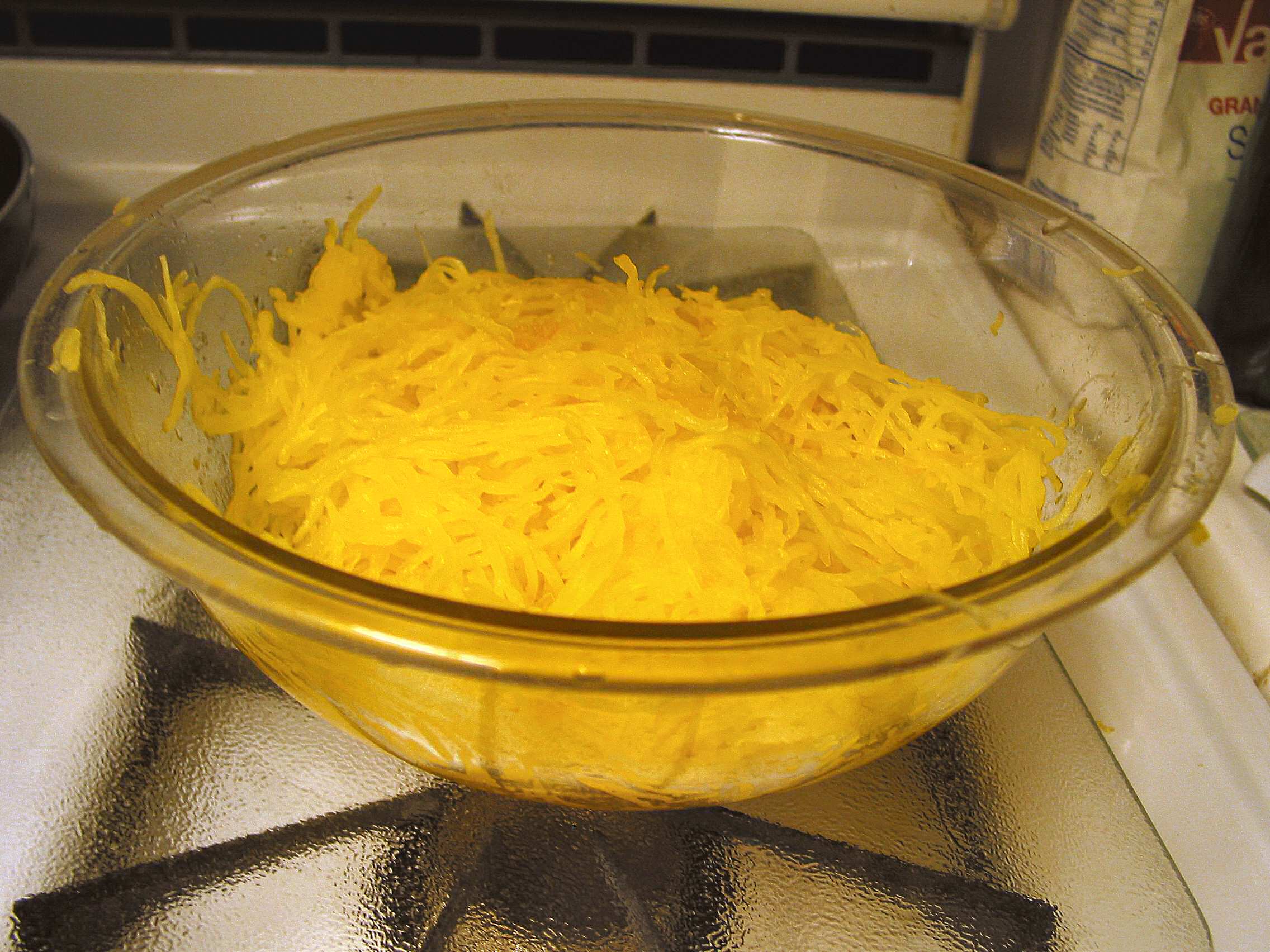
Just half of a microwaved spaghetti squash makes 5 or 6 cups

Just half of a microwaved spaghetti squash makes 5 or 6 cups!

This week my local Trader Joe’s had crates of beautiful–and hefty–spaghetti and butternut squash for less than $2 apiece–on the order of 30 to 50 cents/lb. So of course I got two of each and wobbled out of the store unsure which bag was pulling me down further. And then came the task of cooking them.

One spaghetti squash–a good-sized 5-6 lb. beast–will feed a lot more people than you’d think. It’s got some serious advantages over standard pasta: more fiber, no sodium, some vitamin A and potassium, perhaps fewer calories and carbohydrates per ounce. And it’s incredibly versatile. And you can cook it in the microwave in about 10 minutes rather than spend an hour baking it and heating up the house.

But there’s one big disadvantage–if you cook the whole thing, you have to eat the whole thing. Cooked spaghetti squash doesn’t hold up in the freezer–the strings go flat and shrivelly. And reheating too long can make it wilt as well. So can very acidic dressings.

So the choices are (for a small, moderately but only moderately tolerant family unit):

  • Cook half at a time and store the other half raw and wrapped in the fridge for a few days
  • Cook both halves, use one right away, and store the other half in the fridge for a few days, either wrapped in its shell or else scooped out into a container  (recommended)
  • Give the other half to a friend–but not too good a friend…
  • Cook it all and make it for a big potluck. Maybe people will think it’s innovative and exotic…depends on what you do with it (I don’t so much recommend marinara for this if you’re looking to impress–maybe a peanut-curry sauce or an Alfredo-style sauce with lemon peel, or something involving oyster mushrooms)
  • Cook it all and serve it a couple of different ways over the course of the week
  • Make a couple of the variations ones that taste good cold and eat the leftovers for lunch (recommended)

One important tip (learned the hard way):

The strands grow crosswise inside the spaghetti squash, not lengthwise. If you cut the squash in half the way you would a watermelon, you’ll be cutting the strands into shorter bits–not what you want. Cut the spaghetti squash in half across the middle of the SHORT side, NOT from the stem to the flower end.

If you have kids, let them count the seeds in each half of the squash–it’s a good lesson in plant survival strategies. My daughter and I counted about 80-90 seeds per half and decided to wash, dry and save them for her school’s garden. At this rate, they’ll have spaghetti squash for several years. Note of caution: out of 10 that we thought had been lost down the sink but actually got caught in the drainer, a full 9 germinated, so be careful what you wish for… even commercially grown, these things are very, very determined. But we’re not ready to name any of them “Audrey II”–yet. Continue reading