


 I know, Diana Kennedy (The Cuisines of Mexico, 1971, and onward) probably wouldn’t do it this way–or maybe she would, at home, for herself? Naaah. She’s still pretty particular. Eighty-seven years old, and doesn’t seem to have slowed down noticeably in her quest to rescue the disappearing dishes of Mexico. Her latest, Oaxaca al Gusto (2010) is a huge coffee table cookbook, beautiful and unfortunately for me, so full of rare Mexico-only ingredients, not to mention pork and lard, that I don’t know if there’s much I can really cook from it. I’m scouring it now for possibilities, but in the meantime…
Friday afternoon was vegetable-shopping day again, because we go through good tomatoes like a pack of sharks after a swimmer’s leg, and unfortunately our own backyard gardening adventure is turning out to be more like the $50 tomato kind of thing. To make up for packing our daughter out with my husband on his errands all afternoon instead of on mine (because I desperately needed some time off for bad behavior), I decided to do a little better than the usual dinner. Of course, they had a decent time, and so did I. Gotta do that more often.
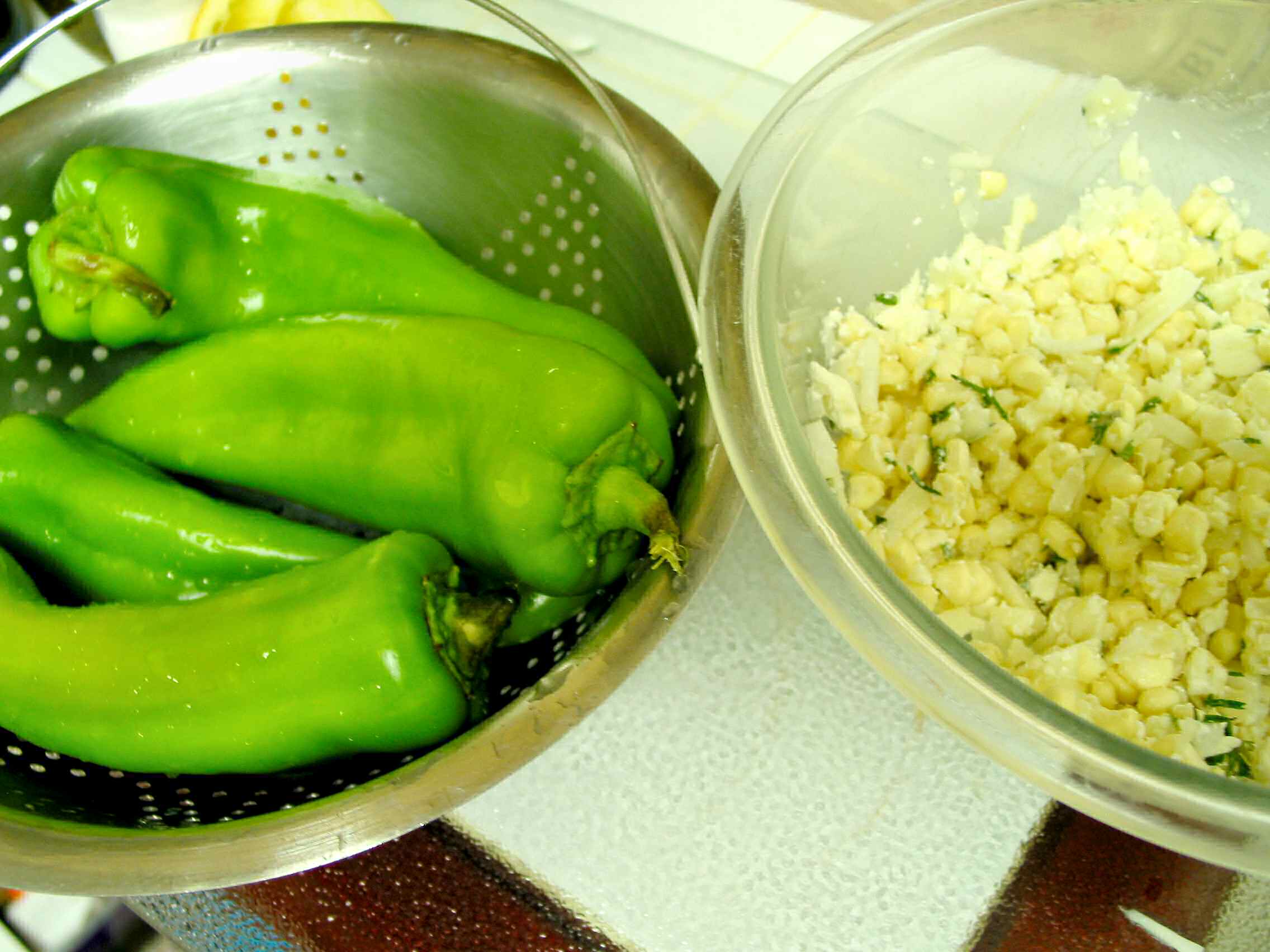
So while they were gone I stopped at my greengrocer and bought a ton of ripe tomatoes that actually have flavor at 99 cents a pound (we have one left), a couple of eggplants for 65 cents apiece, some tart green plums, and these Anaheim chiles, which were beautiful and at $1.19 a pound, cheaper than the bell peppers this time. If you’re not completely clued into eating with the seasons, sometimes the pricetag gives a gentle hint of how the growers are thinking about any given vegetable that week.
Normally I wouldn’t buy Anaheim chiles–they’re pretty mild, but still hotter than bell peppers, which we usually eat raw, and the chiles are really better cooked. But when I saw them, all I could think about was stuffing them with feta for a quick pick-me-up side dish to go with mahi mahi and rice.
Some stuffed chiles are authentically made with Anaheims, I was encouraged to find (thumbing through one of my two, count ’em, two copies of Kennedy’s first book). But the ones that make good-looking cookbook photos are made with pasilla or poblano chiles–darker green, plumper to hold more stuffing, and with thinner walls. Also a little hotter, and often soaked up from their dried form. Baked in tomato broth or else stuffed with meat picadillo, coated in egg, baked, and dressed with a walnut/sour cream sauce (chiles en nogado) with pomegranate seeds sprinkled on top–a Moroccan-origin dish, maybe, with that egg cloak and the pomegranate seeds?
The other thing Kennedy specifies is to char, bag-steam and peel the peppers before using them, which makes the egg cling a lot better and probably makes them a bit more digestible. Very classic, but let’s face it, with all this stuff, including the sauces: I’m not that good, and I’m kind of impatient. What I really wanted for supper was quick stuffed peppers, gooey on the inside but not so messy outside– so as to avoid wearing it. (A girl’s gotta know her limitations. Maybe next time, if I can find an oilcloth bib my size?)
I’m not so interested in long baking in tomato broth or soaking fresh walnuts in milk for the moment–maybe sometime when I want to get the whole dish together, because I’m sure it’s delicious, especially if someone else is making it and heating up their own kitchen in July. But right now, time is ticking, it’s nearly supper, and Beauty and the Beast are about to show up in the driveway (my husband is beautiful for taking on the Beast, even if he grumbles while doing it.)
So I’m definitely not about to char and peel the peppers–what a pain, plus to me it makes them kind of slimy and slithery and not what I want to eat. Unlike Tom Colicchio, who consistently makes a fuss about it on Top Chef, I don’t mind the fact that pepper skins have a little bitter alkaloid edge to them. It’s part of what makes them peppers, and it helps them keep their crunch.
And, of course, I’ve had the experience of walking into someone’s house when they’d just been charring peppers on the gas burner, and it smelled an awful lot like dope. Not lovely, and not at all like them.
So anyway, these are not proper chiles rellenos by any normal standard. They just taste good, they’re not slimy, and they don’t take more than 15 minutes tops. My kind of dish.
In addition to the usual feta and mozzarella, I still had a few half ears of leftover corn on the cob from my daughter’s birthday party last weekend. They were still good, but there weren’t enough to share out for supper, unless–well, corn and peppers also go together (usually as a soup, but why not here too?)
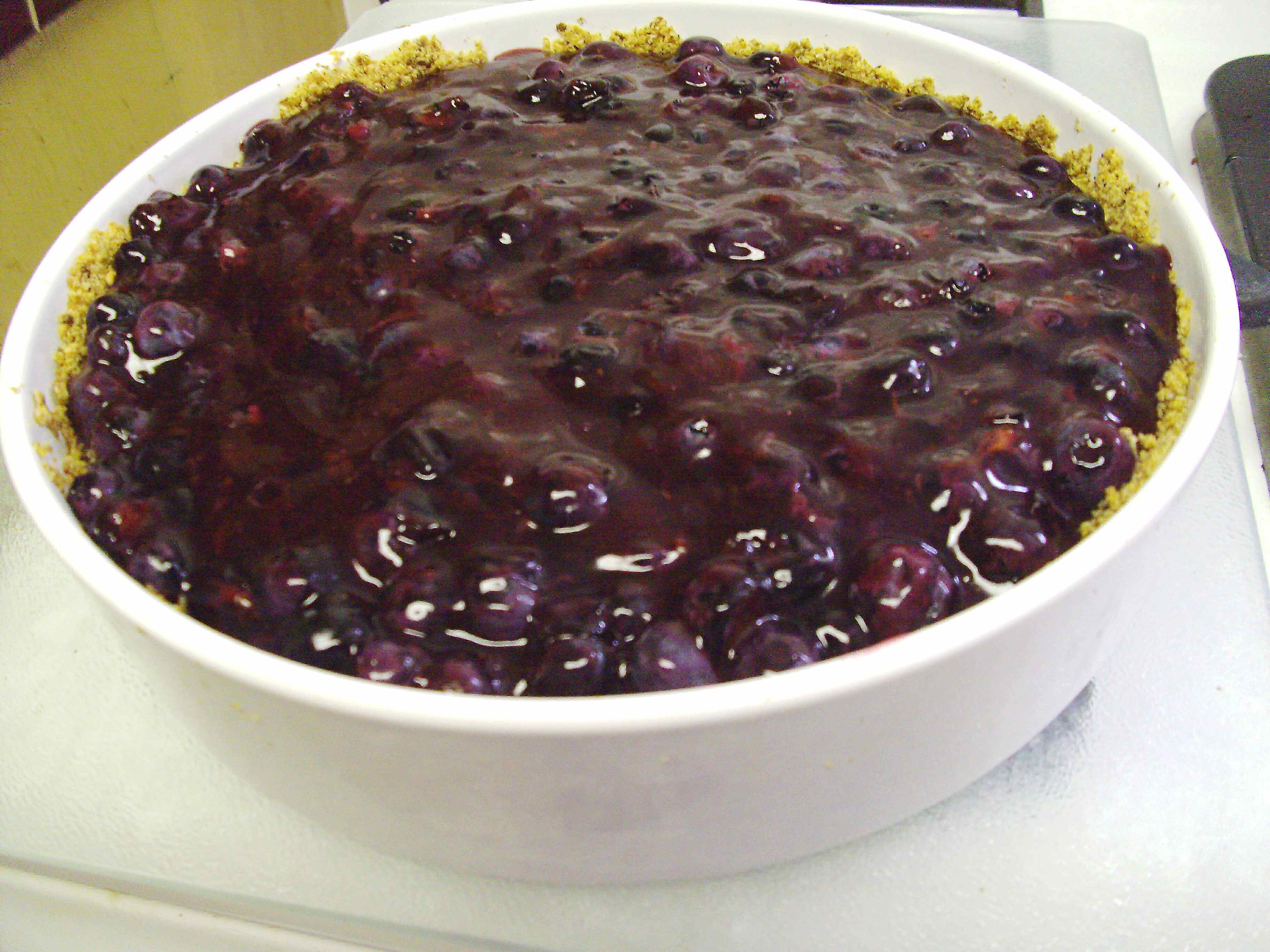
Aside: That was surprisingly one of the easiest celebration dinners I have ever put together in my life — pan-grilled salmon fillets, tomato/basil salad, raw vegetables with bleu cheese dip, and microwaved corn on the cob. I was going to make a cheesecake but decided at the last to buy a Trader Joe’s frozen one for expedience and served it with strawberries and blueberries. It was surprisingly good, inexpensive, and quite moderate on carbs and calories for commercial cheesecake. Of course, because my daughter’s friends are all about 11-13 years old, at least one couldn’t eat the corn due to braces but didn’t know how to shuck the kernels off with a knife, one immediately declared she wasn’t into vegetables (I was mellow enough to shrug and say it was fine), and one couldn’t hack cheesecake so I scrounged her up an impromptu dessert of chocolate bar and cinnamon grahams because we had literally nothing else in the house dessertwise. Oy. And they all stayed up till 4 am, but at least they were quiet and sneaky about it. My goals for a good sleepover.
So anyway, I had made 6 or 7 ears of corn, broken in halves, and steamed them in the microwave in a big pyrex bowl for about 8 minutes. The leftovers were fine reheated during the week with a drizzle of water on a plate in the microwave for 30 seconds or so. But I still had a couple and decided to use the kernels for the chile stuffing, and they were delicious.
Stuffed Anaheim Chiles with Cheese (specific amounts given for 3 chiles, because that’s what I made for us Friday and again on Sunday with new corn, so this actually works out, but you can and should scale up, obviously, and I wish I had made enough to serve them a second time without starting all over.)
- Anaheim chiles, 1 or 2 per person
- corn kernels (1 ear or about 1 c. kernels made enough for 3 chiles, generously stuffed)
- feta cheese, crumbled (1-2 oz)
- low-fat mozzarella, chopped fine (1 oz/stick)
- finely chopped onion (1/4 med yellow onion)
- garlic clove(s), grated/minced/mashed (1 med clove)
- za’atar (wild thyme), thyme, oregano or sage, chopped or crumbled in if dry (to taste; I used 1 t. or so chopped fresh za’atar–do what looks and tastes right for your quantities)
Wash the chiles, cut off the cap and remove the seed core as best possible without splitting the flesh (rinse with water to get out the seeds way down inside). It’s not really a disaster if the pepper splits–just wrap it around the stuffing and press it together, more or less, but it looks prettier and handles better if you keep the pepper whole.
Microwave the peppers on an open plate 3-4 minutes to start them cooking. Mix all the other ingredients together well with your hands–it’ll be pretty moist and crumbly, but you want the garlic and onion well distributed. Cool the chiles just enough to handle. Stuff the chiles with the mixture by hand, pressing it in with your thumbs as you go to make sure some filling reaches the tip end. Microwave again on HIGH on an open plate 3-4 minutes for 3 chiles, arranged with the tips toward the middle of the plate and the wide stem end toward the outside, or maybe 5-6 minutes for 6, or until the peppers are getting tender and the cheese has melted.
Don’t forget to wash your hands well with soap after handling the chiles–I find that even though the Anaheims are mild-tasting, my fingers still get a little of the classic burning sensation as an aftereffect when I handle them.
Filed under: appetizers, books, cooking, Dairy, DASH Diet, frugality, Microwave tricks, Revised recipes, Vegetabalia | Tagged: Anaheim chiles, chiles rellenos, corn, Diana Kennedy, feta cheese, Mexican cooking, microwave cooking, stuffed peppers, vegetarian recipes | Comments Off on Microwave Tricks: Stripped-Down Chiles Rellenos
 Slow Food Fast