• Enter your email address to subscribe to this blog and receive notifications of new posts by email.

    Join 241 other subscribers
  • Noshing on

    raw blueberry pie with microwaveable filling and graham cracker crust

    This mostly-raw blueberry pie is a snap to make and very versatile--the filling microwaves in a few minutes, and you don't even have to bake the zippy gingered graham cracker crust--perfect for a hot Fourth of July and all summer long.

  • Recent Posts

  • Contents

  • Archives

  • Now Reading

  • See also my Book Reviews

  • Copyright 2008-2024Slow Food Fast. All writing and images on this blog unless otherwise attributed or set in quotes are the sole property of Slow Food Fast. Please contact DebbieN via the comments form for permissions before reprinting or reproducing any of the material on this blog.

  • ADS AND AFFILIATE LINKS

  • I may post affiliate links to books and movies that I personally review and recommend. Currently I favor Alibris and Vroman's, our terrific and venerable (now past the century mark!) independent bookstore in Pasadena. Or go to your local library--and make sure to support them with actual donations, not just overdue fines (ahem!), because your state probably has cut their budget and hours. Again.

  • In keeping with the disclaimer below, I DO NOT endorse, profit from, or recommend any medications, health treatments, commercial diet plans, supplements or any other such products.

  • DISCLAIMER

  • SlowFoodFast sometimes addresses general public health topics related to nutrition, heart disease, blood pressure, and diabetes. Because this is a blog with a personal point of view, my health and food politics entries often include my opinions on the trends I see, and I try to be as blatant as possible about that. None of these articles should be construed as specific medical advice for an individual case. I do try to keep to findings from well-vetted research sources and large, well-controlled studies, and I try not to sensationalize the science (though if they actually come up with a real cure for Type I diabetes in the next couple of years, I'm gonna be dancing in the streets with a hat that would put Carmen Miranda to shame. Consider yourself warned).

Faster Roasted Tomato Soup

Yeah, I know, it’s early March, the winds and rain and snow and tornadoes are still doing their thing around much of the country and here in Pasadena the chill has set in…sort of, to about 75 degrees or so daytime. With actual rain last night.

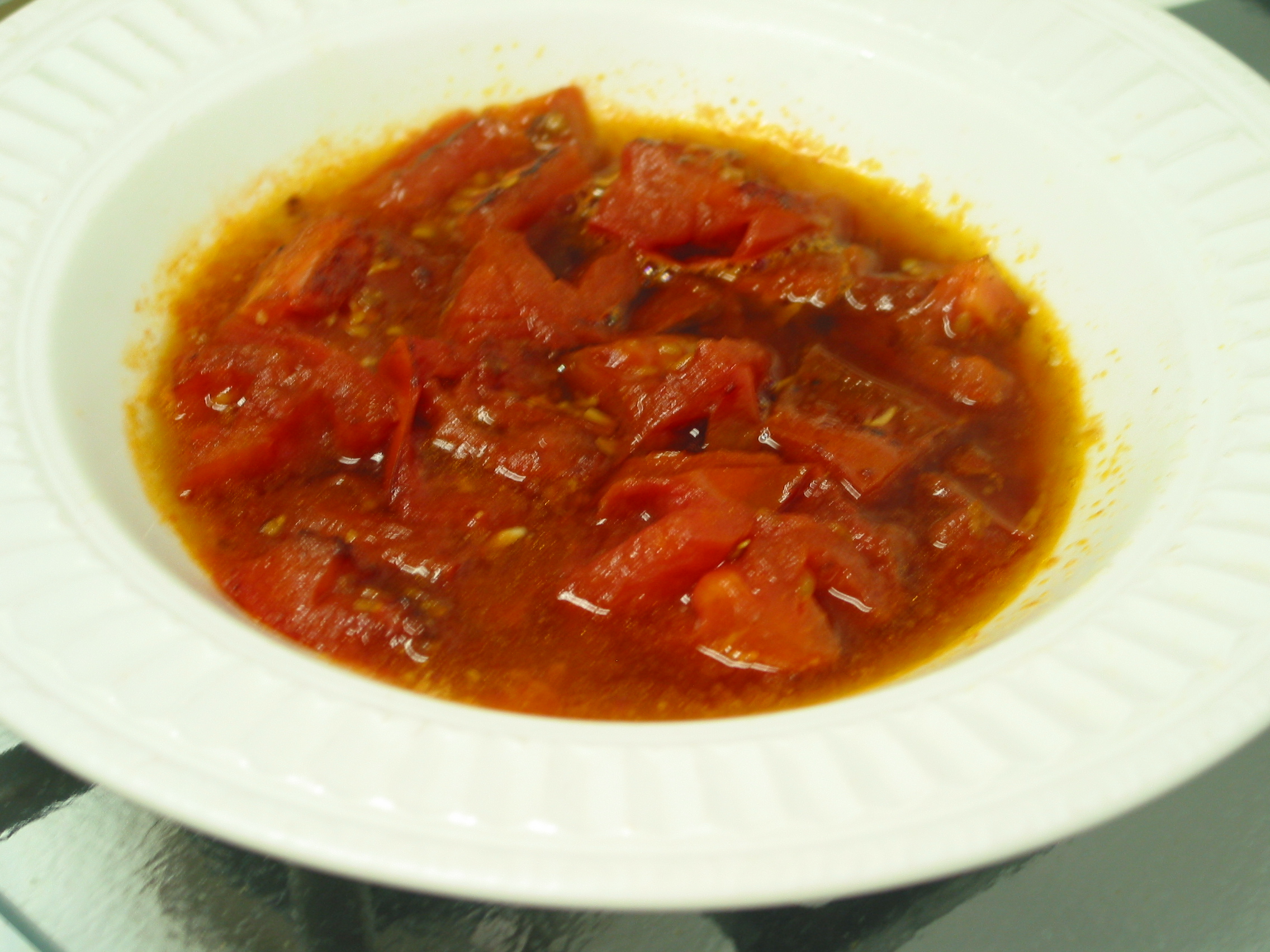
Chunky pan-roasted tomato soup

And it’s tax season.

So what we really need is something to brighten the last dregs of winter. I was thinking tomato soup, myself.

Why was I thinking it? Because so many food articles in the past couple of weeks have mentioned slow-roasted tomatoes, charred tomatoes, and so on to improve the obviously lacking flavor of winter tomatoes and avoid using canned ones. One  chef got flamed for suggesting in the New York Times food section that “local” is not the sane way to go with produce that simply isn’t producing in winter in the northeast, and that canned tomatoes are not the worst idea in the world after all. Shame! Shame!

Actually, I agree with her–and not just because I’m the original purple thumb when it comes to gardening. In a surreal reversal of my hideously lacking garden skills, I actually have three–count ’em, three–grape tomato plants in bloom and producing the occasional tomato-let as we speak. I even have basil and rosemary and mint and thyme that I haven’t killed through inattention and forgetting to water. But really, even so, there’s no way I’d set myself up as a homesteader on those flimsy credentials. We’d starve.

Tomatoes are one of those things–either you’ve got the Fresno specials (or something local and preferably from your own garden so you can brag) in the summer and they’re divine with nothing but a bit of olive oil and vinegar, or even just plain, or else it’s winter and you’ve got blah tomatoes that are kind of orange and grainy. Or you’ve got canned tomatoes, preferably no-salt Romas. Frankly, there’s nothing wrong with that in winter. Or any other time you’re making microwave marinara.

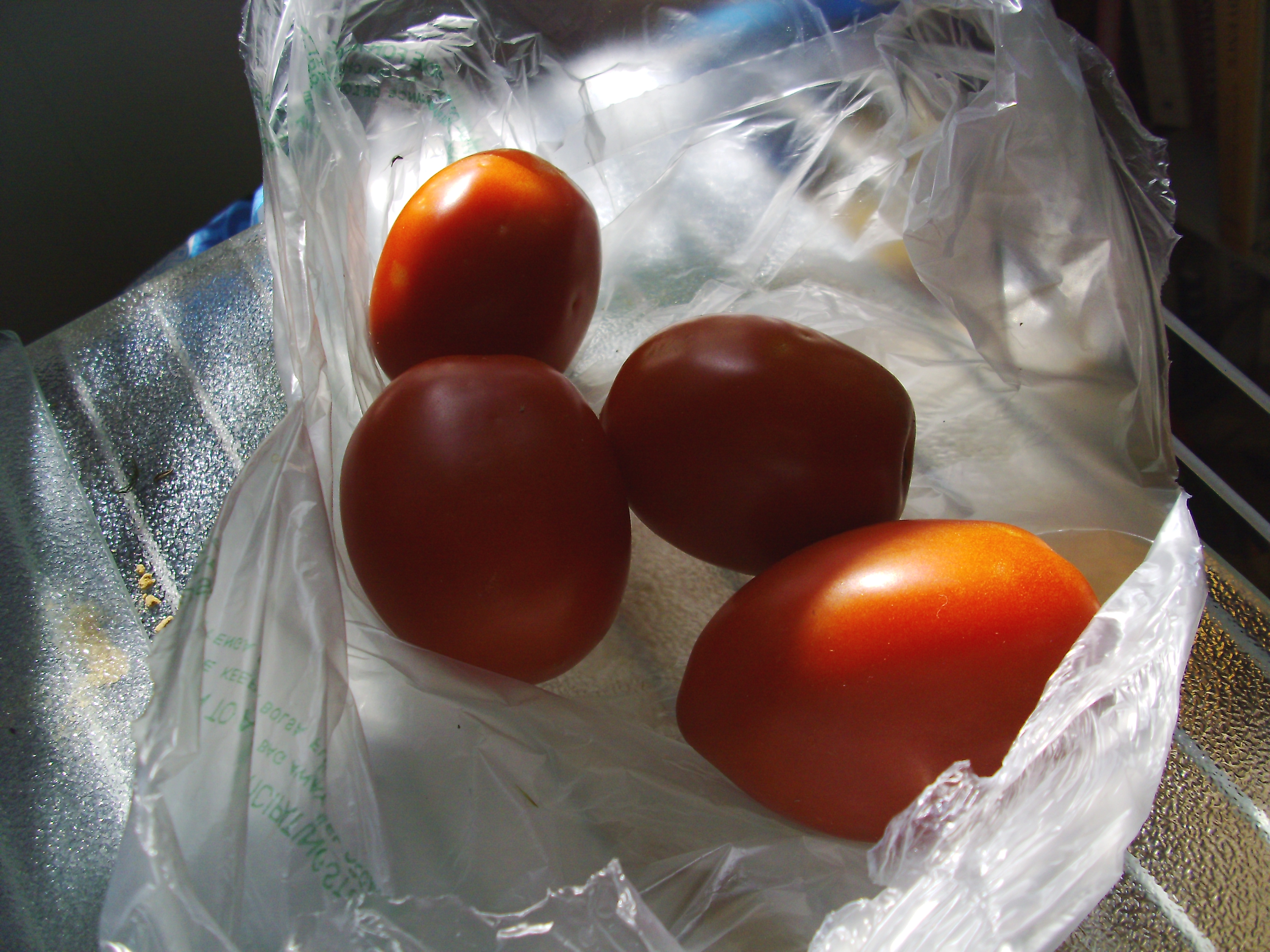
ripening roma tomatoes

However…If your supermarket tomatoes will consent to ripen on a counter near a window for a couple of days, you might be able to eke out some actual tomato flavor from them. They may still not be fantastic, and one or two may start to develop soft spots, but it’s still worth doing anyway. Keep turning them gently every day to minimize the risk of spoilage and use them. They should at least redden.

And as mentioned above in the numerous food section articles, you can do the slow-roast-on-parchment-in-the-oven thing to them and they’ll be a bit more flavorful for sauces and tomato soup. But it takes about 45 minutes to an hour. And I’m impatient.

So today I rescued a couple of aging Roma tomatoes from my countertop and decided to try pan-roasting them, as in frying pan. Would they take on a char? Would they taste better? Would they make soup worth eating?

Bear in mind this is an experiment more than a proper recipe with specific quantities, but yes, it worked, and it only took about 10 minutes from start to finish. Maybe the flavor’s not as glorious as if I’d oven-roasted them for an hour, but the lack of waiting makes it reasonably good, and the garlic makes up for the rest of it. Continue reading

The Carmen Maura special

(The gazpacho edition)
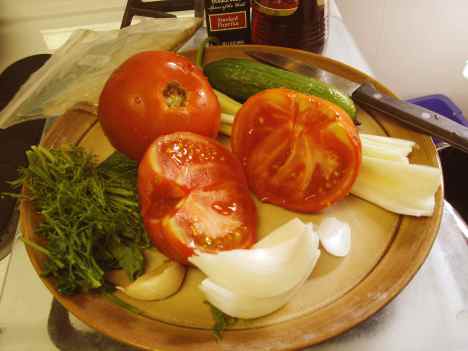
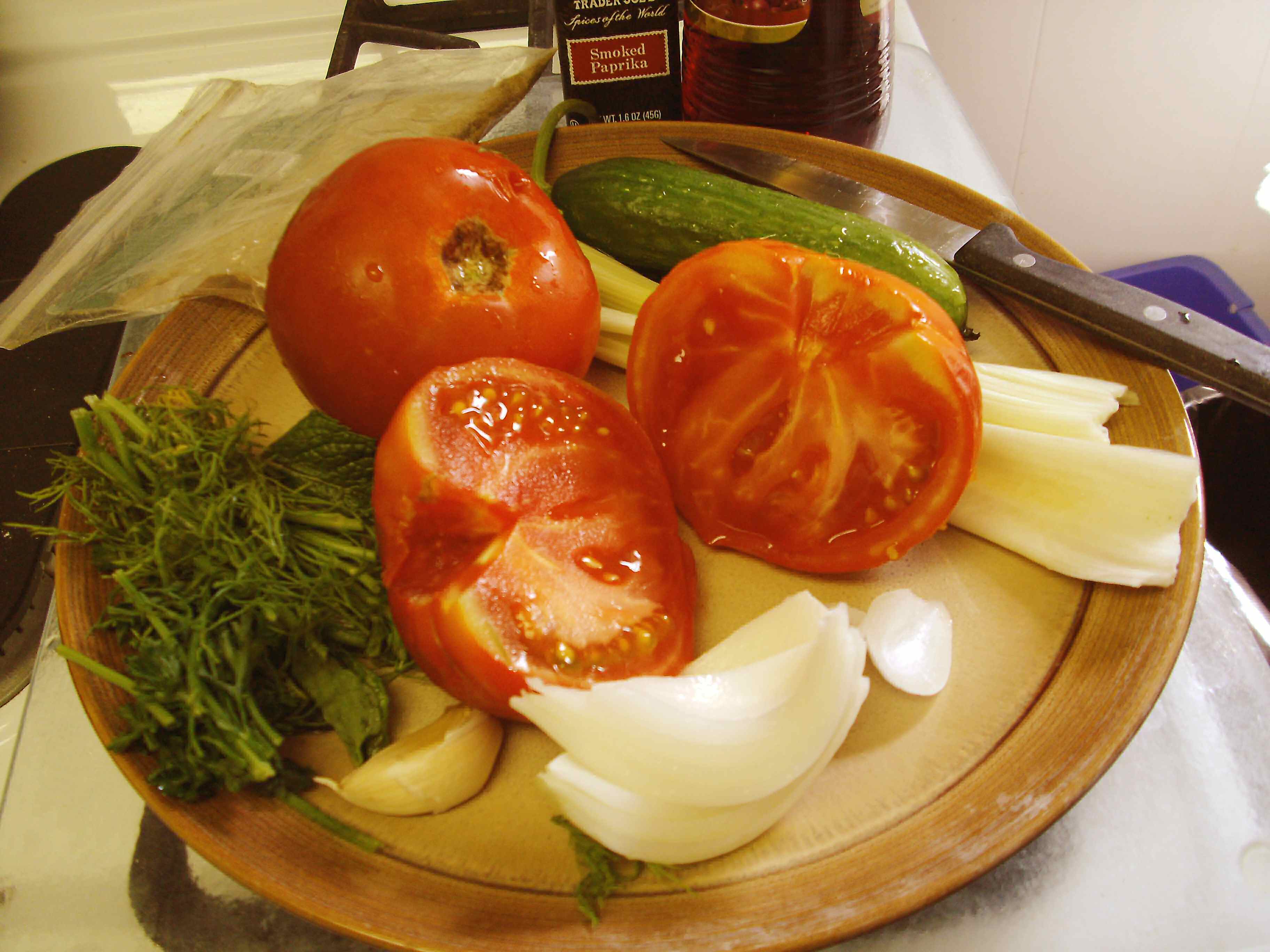
gazpachoingredients

My gazpacho has some extra ingredients like herbs and chile flakes–but nothing from the medicine cabinet!

So okay, five or six posts in a row–all summer long, in fact–with no recipes. Oy. I’m sure that says something about my summer between my daughter’s bat mitzvah in late June and the day she started back to school.

Contrary to the impression of no cooking, no cooking, especially in 100 degree heat (a sane approach to life if ever there were one) I have actually done some cooking, just not a lot of new dishes. So this post is just to catch up in summary form…

The bat mitzvah Saturday night dance party for instance–I made the cake for it, a huge monster of a Sacher torte. And yes, it was Duncan Hines devil’s food cake made with applesauce instead of oil for the layers, because it’s still better than from scratch, and a lot faster. None of my friends cook at all, I’m sorry to discover, and they were all bizarrely impressed that I didn’t get my cake from Costco, so despite how dismayed and embarrassed I was that they were fawning over a box mix cake, I took it as graciously as I could and didn’t tell them. It was actually a good cake, but huge. Four, count ’em four, boxes worth of DH for a very large 4-layer cake. Way too much. Apricot fruit spread between layers, killer chocolate ganache–from scratch, but easy–on top (another post will be dedicated to the shocking true story of ganache and its many creative uses, but it’ll have to wait until it cools down out here), plus a little creative decorating with strawberries and grapes by two friends when the upper layer split on the way to the forum, right before I could frost it, and I didn’t have the brains to just flip the whole thing over.

You know how that goes: you’ve rushed over to get there before the guests arrive, you’re wearing your grubbiest can-get-chocolate-frosting-on-and-no-one-notices black teeshirt and brown pants, you’ve forgotten your party clothes and your camera. Your friends see you looking harried and sweaty in the back kitchen, wielding a tub of ganache at a cracked cake and the chocolate fumes just get to them. They rush around sticking fruit on top like it’s kindergarten craft time again. They’re hard to stop once they get going, to tell you the truth. People really liked the cake anyway, and we had leftovers for the next 10 DAYS…still working it off.

TIP: don’t stick green grapes on top of chocolate ganache, they really don’t go all that well tastewise even if they looked fun at the time.

What else in the way of summer cooking? A bowl of dough in the fridge, turned into pitas and calzones (once the sun went down far enough that I could stand to turn the oven on for 20 minutes at a hop). Did that several times.

Frittatas–omelets for the three of us with mushrooms, onions, marinated artichoke hearts and feta, or spinach and feta, or just feta and feta…a lot of those, this summer, with about half the yolks removed and not missed at all. Makes a 10-minute supper, and you get your Julia Child mojo on when you go to flip it. You get to tell everybody to give you some room and keep the cat out of egg flippin’ range. Very impressive.

What else? Hummus–yet again, I know. Although I’ve made two batches this summer using chickpea flour instead of actual cooked chickpeas. Chickpea flour is raw, so you have to mix it up with water to a thick batter and then microwave it a couple of minutes, until it’s cooked through–it’ll be pretty thick, maybe even solid, but it’ll have lost the raw-bean taste when it’s done. Then I blended it in a food processor with water, garlic, lemon juice, cumin and tehina–which was fine, actually, and very smooth…until I packed it into the fridge and took it out the next day. It had set up like tofu, sliceable and slightly gelatinous! A little weird, no doubt about it. But still edible! and quick, dammit, very quick.

Other things–eggplant parmigiana, twice or three times, and really good. No apologies necessary.

Extra eggplant slices with a surprisingly good low-sodium chipotle salsa from Trader Joe’s and some low-fat mozzarella, microwaved and slid onto toasted ciabatta or fingerbread. Worth doing again, maybe even in casserole form–half salsa, half marinara, kind of a smoky parmigiana? Could be all right.

But it’s summer, you say. Where is all the fruit? You’re not wrong. Nectarines, plums of all shapes and colors, a few apricots, a few cherries, strawberries, and figs…all of them, eaten raw. But in the way of cooking (minimally, anyhow) I made a fantastic “raw blueberry pie” a week ago, cutting back a little on the sugar in the recipe I had from the San Jose Mercury News from years back, and using the microwave to cook the “jam” part (water, potato or cornstarch, sugar, 1 cup of blueberries, stirring madly every 30 seconds to avoid the starch turning into a rubber lump, and lime juice after the fact, once it thickened) before mixing in the other 3-4 cups of blueberries raw and sticking the whole thing in a graham cracker crust and chilling it.

But summer is mostly about tomatoes. Even in California, it is really, really HARD to get good tomatoes at the supermarkets, even in summertime (don’t even ask about corn, the prices are a disgrace to the nation). Unless you go to the Armenian corner grocery (where I’m headed yet again in about 5 minutes) to pick up bags and bags of huge, ripe Fresno tomatoes for salads. For about six or seven dollars, I can get ten or even more large beefsteak-style tomatoes…and these actually taste like something. They’re not the ones that go to the supermarket, because they just don’t last. They go to the small ethnic markets because they’re too ripe, and everyone knows that the regulars don’t shop small when it comes to tomatoes, peppers, eggplant and so on. They’ll get snatched up, no problem.

So what do you do when you get a couple of tomatoes that were pretty seriously ripe to begin with and are starting to split or get poked by the stems of the other tomatoes only a couple of days later?

I make gazpacho, because it’s a 5-second soup, it’s cold, it only takes what I have in the fridge, and I know I can eat half a cup at lunch every day this coming week and feel full for hours, especially in this heat. It’s the perfect diet food.

Well that, plus the fact that it makes me feel (momentarily, anyhow) like Carmen Maura in Women on the Verge of a Nervous Breakdown. It’s probably the most famous (mis-)use of gazpacho at the movies, and very funny. Continue reading

Not Stone Soup

Stone Soup Foodworks of Ottawa

Stone Soup Foodworks of Ottawa, which also uses the slogan "Slow Food. Fast"--what can you do?

If you’ve come to Slow Food Fast looking for the little green Ottawa soup truck, I have bad news and good–I’m not them. (Don’t know whether that’s good or bad, but I’m in Los Angeles, so it’d be a bit of a schlep.)

The good news is that I have found the link to Stone Soup Foodworks for the lost and hungry Canadians among you and it looks pretty good. Like David Ansel of The Soup Peddler in Austin, Texas, Stone Soup’s Jacqueline Jolliffe is getting on a roll with “soupscriptions” as well as on-the-spot takeout soups, salads, etc. made of real ingredients, mostly local and organic.

Why soup? Because soup made from real ingredients, not packets and cans, is more than most people want to tackle at home, I think. Good soup, as both Ansel and Jolliffe say, takes time to develop. And especially in winter, a cup of real soup at lunch helps you push aside the irritations of the day for awhile.

Both Ansel and Jolliffe are doing something entirely different from what I do here on Slow Food Fast–they cook complex and difficult soups in large batches and sell them to subscribing and loyal customers who only have to pay for takeout by the cup or heat up a delivered quart of soup to have something good. That’s their idea of “slow food, fast.”

My idea of slow food fast is to cook a week’s worth, say perhaps 8-10 servings’ worth, of decent, inexpensive, from-scratch vegetable or bean  soup in as little time as possible, preferably in less than 20 minutes all told, with as much help as a microwave oven can reasonably give (which turns out to be a surprising amount, so why not) and without relying on salt to build flavor. And I want it to taste good.

Mostly, I want you to be able to do that yourself at home without feeling like it’s too much work or time and too many steps to cook and eat fresh real food–particularly fresh, inexpensive bulk vegetables–on a regular basis.

If you like to cook slow (say, on the weekend), you can do the artisanal thing at the stovetop for an hour or two. But if you want to get done in a hurry without having to babysit your pots and pans, microwaving is a pretty good, mostly safe, and comparatively very energy-efficient way to go, if you play to its strengths. You can let the flavors develop overnight in the refrigerator (and they generally will) instead of cooking and cooking and cooking just to get to the point where the vegetables are cooked through and then cooking some more to get the flavors to meld.

Case in point: Jolliffe makes a Thai butternut squash soup for Stone Soup Foodworks that looks delicious on the newsroom interview–but she has to cook her onion base down for 40 minutes, and either roasts the butternut squash for an hour in a conventional oven or–this is what she did on camera–buys sacks of precooked and puréed organic winter squash from a local farm. Granted you can do that–in the US, we’d probably just open a can of packed pumpkin, which you can now get organic fairly cheaply in most places, especially after last year’s shortages at Libby’s.

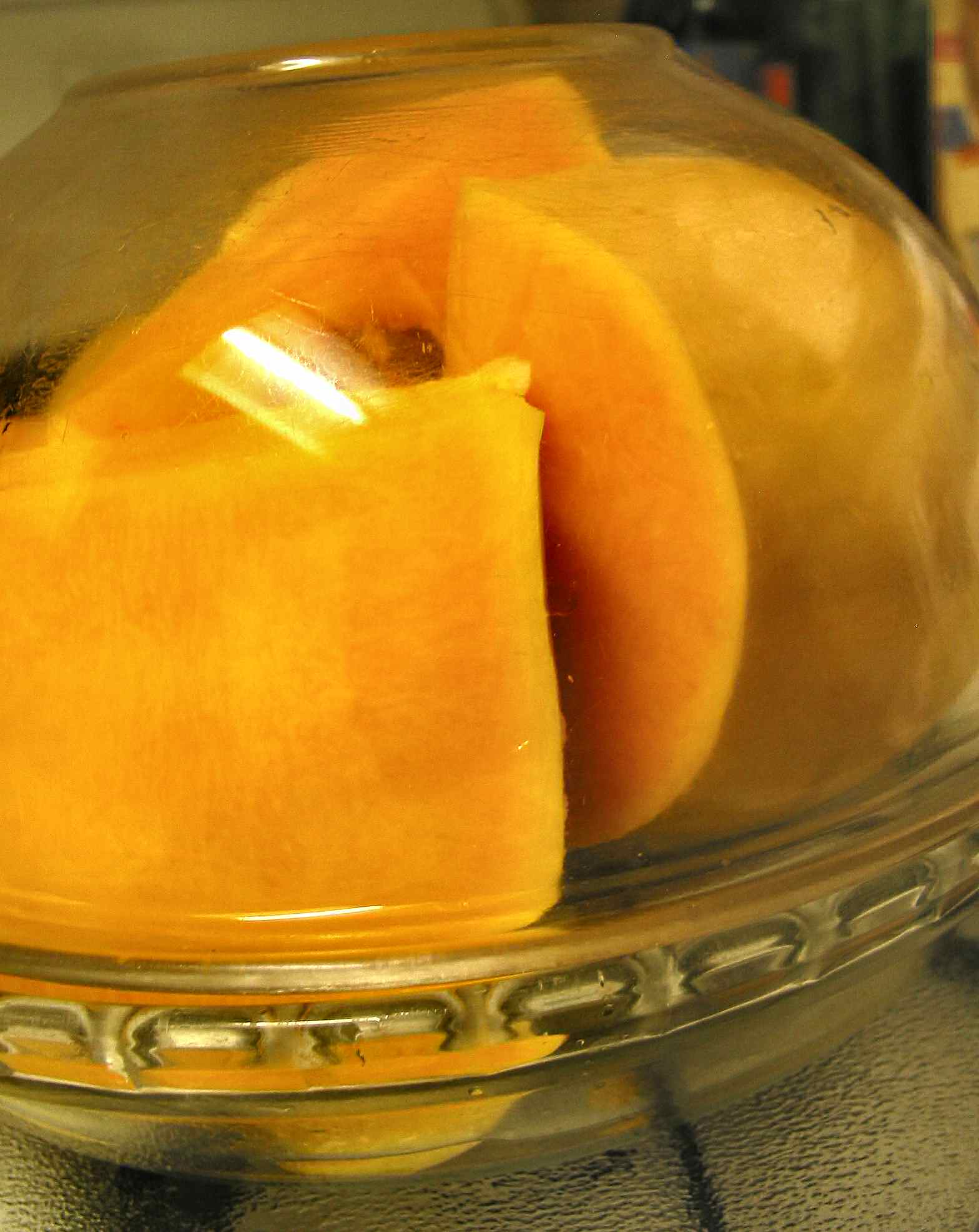
butternut squash ready to microwave

butternut squash ready to microwave

I guess the decision rests on her storage accommodations for the soup truck. But if she were to use a microwave, she could cook a fresh butternut squash–a big one–in about 10-12 minutes and then decide whether to purée or chunk the flesh for her soups, maybe pan-roast Continue reading

Soupe à l’oignon gratinée (or not)

French onion soup without the gloppy gratin

Sometimes it pays to think out the recipes you read before you try them. For example…

I love and miss French onion soup from my pre-kosher days (that would be up to about age 19, long, long ago…) Can’t be helped, though–if you keep kosher, beef stock does not combine with Gruyère. And I’ve never actually tried making it at home before, because, if you go by a traditional, official kind of recipe like the one published in the LA Times below, it’s a 3-hour ordeal.

RECIPE: Soupe à l’oignon gratinée – Los Angeles Times.

Total time: 3 hours  Servings: 8  Note: Adapted from Comme Ca.

  • 8 large yellow onions, halved and sliced lengthwise into 1/4 -inch strips
  • 1/4 cup unsalted butter
  • Salt
  • 2 2/3 cups water, divided
  • 2/3 cup dry Sherry
  • 5 cups chicken broth (with as little sodium as possible)
  • 2 2/3 cups beef broth
  • 8 sprigs fresh thyme and one bay leaf, tied together
  • Fresh ground black pepper
  • 1 loaf French bread
  • 1 pound Gruyère, grated

Pretty onerous just on the ingredients (lot of salt in them thar vacuumpaks of stock), not to mention the bread. The Swiss cheese, oddly enough, is a lower-salt cheese than most, about 120-150 mg sodium per ounce as compared with, well, anything else at 180-210. It makes up for the lack of salt with a huge OD of saturated fat–and 2 ounces per person’s got to be a lot, really, just for melting on top of soup. It would be another matter if this were a legitimate fondue, or a sumptuous grilled cheese on really good toasted pain levain, and you were actually going to eat it all, but if I recall correctly, you aren’t.

Because I never had French onion soup at home, I never had to face the task of scrubbing baked-on cheese off the rims of the bowls afterward. Maybe 1/3 of what was sprinkled on ended up stuck like Swiss barnacles to the bowl, which seems like a waste, especially if you shell out for real Gruyère.  The rest turned into goop that sank to the bottom of the bowl and stretched up for yards on the spoon only to stick to the front of your teeth. Or blouse.

Plus at home there’s all the rooting around in the cabinets hoping your soup bowls are the kind that can survive the broiler and that your oven mitts (and guests) can Survive The Gruyère.

But the real cruncher here is time.

The LA Times instructions don’t even include the time it takes to sliver 8 very large onions, but you should, because it’s not trivial: 20-30 minutes, plus crying time. Heat the oven to 400 degrees (15-20 min, they also forgot this bit, but maybe while you’re crying over the onions). Stew onions with butter and 1/4 t salt in lidded casserole in the oven until the onions are softened and a light golden-brown, about 1.5 hrs, during which you’re supposed to stir every 15 minutes (!) Take the casserole out and cook further on the stove top until the onions are a deep golden-brown and just begin to stick to the bottom of the pot to form a crust (10 min? 15? 20? more?–from the experience below, I’d say at least 20, maybe even 30). Add half of the water and cook until the water has evaporated, about 8 minutes (so specific?). Add the sherry and keep stirring until it has evaporated, 3 to 5 minutes. Stir in the remaining water, broth and the thyme bundle, bring to simmer (5-10 min) and simmer 40 minutes (why 40? who knows?). Slice and toast the bread. Fill 8 oven-proof soup bowls, lay the toasts on top of the soup, sprinkle the grated Gruyère evenly over the tops and place the bowls under the broiler just until the cheese is bubbling and begins to brown in places (5 minutes?). Serve immediately.

TOTAL TIME: At least 3 hours, probably more like 3 1/2.

KLUTZ FACTOR: HIGH–lot of hot transfers of heavy casserole dish, finding and broiling ovenproof soup bowls, transferring to the table without spilling…not to mention serving “immediately”.

Then there’s…(you knew this was coming)

Nutrition per serving: 490 cal; 27 g protein; 36 g carb; 3 g fiber; 26 g fat (15 g sat); 78 mg. cholesterol; 808 mg. sodium.

Wow! Am I wrong in thinking that almost no soup should be this much of a labor of love, not to mention love handles? For this much time, fat and salt, I’d demand at LEAST grilled marinated lamb. Or a good runny camembert, a perfectly ripe pear, some excellent sourdough toast and a half-glass of something complex and interesting in the way of wine.

Maybe it’s as delicious as promised. But all those hours, all that stirring, not to mention all that fat and sodium and cholesterol, just for a bowl of onion soup and a slice of toast with melted cheese? Is it any wonder Lipton’s is popular?

Still…Can we do better with the onion soup itself? Maybe as in, vegetarian but still opulent, and furthermore without the heavy-duty time and calorie burden? Let’s try, anyway.

The first objections I have are eight huge onions and 8-10 cups of salted broth. Do I want to make anywhere near that much onion soup? Do I have that many takers in my house? Unfortunately not. One huge onion just for me, then. Maybe my husband and daughter, but only if it’s obviously fabulous. In which case, I won’t really want to share with them.

The main thing here is getting the flavor out of the onions–you want to caramelize them thoroughly and evenly without breaking down their aromaticity too badly. But I personally think baking them slowly in a big oven for an hour and a half just to start to do that is insane. Even if we’re talking about eight big onions.

My first attempt at shortening this recipe did not go badly, exactly, but it didn’t get me soupe à l’oignon either. Continue reading

Bok Choy Broth

Bok choy-based hot and sour soup

Bok choy-based hot and sour

Usually when I get home from traveling I’m in a state where I don’t really want to cook, but I want real food, and I’m sick of the bread-and-cheese-sticks-and-carrots-and-nuts we bring on the plane in self-defense.  The other thing I really want right away is vegetabalia–restaurants, particularly hotel restaurants, seem reluctant to put any on the plate. Microwaved fresh vegetable soup is an easy and satisfying answer–15 minutes and you don’t have to go shopping for anything fancy.

It’s also the answer when it’s cold and rainy and everyone in the house has been down with the crud (aka “Losangelitis”). Today, I wanted something with greens in it like minestrone, but tasting more like hot and sour soup, to cut through the fog that had condensed in my head, and I did NOT want to work hard (also because of said mental/temporal fog). I had the basics for a vegetable broth–an onion, some celery stalks, a handful or so of “baby cut” carrots  more usually reserved for my daughter’s school lunches. A fat clove of garlic. Half a bunch of bok choy that was still in decent shape from two days ago when I microwaved it as a side to stretch leftover Chinese takeout. And in the cupboard, miraculously, I still had three dried shiitake mushrooms in a plastic bag.

Bok choy is one of the Cheap Vegetables ™–usually below a dollar a pound, even in big-chain supermarkets. Not baby bok choy, which is cute and pretty and mild; stores charge three times as much for that. I like the full-grown, poetically dark-leaved, white-stalked bok choy, the kind sumi-e masters choose for their still lives.

Sometimes for a vegetable at dinner (as mentioned above) I just nuke a cleaned and trimmed head of bok choy whole for a couple of minutes in a longish lidded container with a little water in the bottom, cut it up and serve it as-is or drizzled with a little soy sauce and sesame oil. You don’t need anything else to dress it up (and of course, I have pretty low standards for presentation). Its fresh, radishy flavor mellows into something richer and more aromatic as it cooks down and produces its pale-green pot liquor. You don’t want to waste that; it’s a perfect addition to a vegetarian consommé, especially when you’re going light on salt or calories.

I sometimes even skip the onion-carrot-celery-garlic vegetable stock base and make a really simple broth by just microwaving the bok choy all by itself with water to cover–especially when my head and stomach aren’t cooperating with me or with anything else. But that’s a little on the purist side of things, when I’m feeling so miserable all I want is something hot, clean-tasting and fresh with no distractions. For better times, I want a real soup with a bit more richness and variety, and bok choy definitely plays well with others.

Back to the hot-and-sour scenario, for example:

Shiitake mushrooms are expensive fresh at your local Whole Foods, about $13/lb. But a package of 15 or so dried caps sells for $3.50 in the Asian or International Foods section of your local supermarket, and the dried mushrooms are so much better for infusing a broth with pungent richness. They’re easiest to soak up in a microwave–a few minutes rather than half an hour.

Between those and the carrot-onion-celery aromatics, plus of course garlic, you’re set. Especially if you have a little container of z’khug (hot pepper-garlic-cilantro paste) in the freezer and can saw off a chunk to spice up your soup. Toasted sesame oil, vinegar, and low-sodium soy sauce–all optional. Ginger? You could. Ginseng? According to a friend from a Cantonese family, only if your mother insists. Continue reading

Jazzing up Creamed Spinach

Passing by the refrigerated prepared-foods shelves in the produce section of my local Whole Foods a few days ago, I couldn’t help noticing a 24-oz tub of creamed spinach…for $8.99. Six dollars a pound. Given that most of their deli and salad bar foods are about $8/lb., maybe that’s a comparative bargain, but still. You could buy six 1-lb. bags of frozen spinach from the Trader Joe’s for that. At my local Latino supermarket, you could get at least six and maybe twelve bunches of spinach, turnip greens, mustard greens, kale, maybe chard or beet greens too. Of course then you’d have to wash it all. And chop it, and cook it. But you’d also get to decide how.

Standard creamed spinach is one of the easier and frankly quicker side dishes to put together. If you want the plain-o, Norman Rockwell version, go to an older American cookbook such as Joy of Cooking or even the Victory Garden Cookbook. Basically you sauté fresh chopped or thawed frozen spinach in a little butter, stir in a spoonful or so of flour until the white flecks disappear, add cream or milk and heat it up until the flour thickens it. Sprinkle salt and pepper and maybe grate some nutmeg over it.

But gawd, is it bland. Rich maybe, but bland.

I’m not a huge butter-and-cream fan, more because I can’t really stomach large amounts of it personally than for any particular virtues of character. If I’m going to have calories, I want them to come from a knockout dessert, not the spinach. So rich isn’t enough. I want it to taste like something.

Of course, I’m also speaking from the perspective of someone who grew up wondering “If there’s no garlic, is it really food?” No, don’t just laugh at me–think about it: most of Nigella Lawson’s recipes work precisely because she adds a clove of garlic to old-standard British stodge. You know–garlic smashed potatoes. Magic! If just adding a clove of garlic to a batch of boiled potatoes was such a big revelation, it’s no wonder the Brits fell so hard for Indian food. And Italian. And Greek. Of course, I’ve fallen hard for them too.

So of course the first thing to add to spinach is garlic. To my mind the second necessity is lemon, and the third is herbs or spices. And possibly some kind of white fresh cheese. Here are a couple of possibilities that taste satisfying without relying on heavy cream or butter, and they can be done either on the stove or in a microwave. Continue reading

High-Speed Split Pea Soup

Split Pea Soup in the Microwave on SlowFoodFast

Microwave split pea soup, atop my current "blank book" cookbook (Sunflowers, by Vincent Van Gogh)

It’s November and even in Southern California, we’re starting to feel the season (there’s pretty much only one) change. It’s still sunny out, and sometimes near 100 degrees at midday, but by three or four in the afternoon, the temperature suddenly dips down into the 60s and people start complaining about it because they left their sweaters at home or in the car. And their hair is getting messed up. So even though you wouldn’t think it was necessary out here, split pea soup is on the menu.

There are two kinds of pea soup worth eating. Fresh (or fresh-frozen) peas make a sweet, delicate, beautifully green soup if you blend them with some water or milk and a little chive or onion or shallot and dill. Fresh pea soup also takes only five minutes to make, which is perfect for LA’s average springtime patience level. But that’s for spring–when the temperature suddenly hits an insistent 95 in mid-March and people start reaching for their waterbottles and sunglasses again. And declaring loudly, “Ah, it’s finally Spring!” when in reality we’ve had 80-degree days in December and January.

Split pea soup, the starchy thick heart of winter comfort eating, is another beast altogether. Most people either open a can of indifferent and hideously salty soup with mysterious lumps that claim to be carrot or–well, carrot, it’s the politest guess. Or else, if they actually cook, suffer a two-and-a-half-hour boiling-with-hamhocks-all-throughout-the-house kind of ordeal. Not that it doesn’t smell wonderful during that time, but with gas prices the way they are, and the sun still beckoning at midday, no one in their right mind wants to bother.

Doing it the old-fashioned way, it takes the full 2.5-3 hours for the peas to fall apart and make soup. And when you go to bed at night your pillow smells like split pea with hamhock…you really have to be dedicated to put up with that. Microwaving might just be the best solution. Mine is minus the hamhock, because this is a kosher-to-vegetarian kind of blog, but you can add a precooked piece of hamhock to yours if you’re serious about it–precooked for safety, because this soup may be too fast for a meat bone to cook all the way through the way it would if you boiled it to death on the stovetop.

High-Speed Microwave Split Pea Soup

  • 1/2 lb (half a 1-lb bag…) dried split peas (or a whole pound, see note #2)
  • water or low-sodium vegetable or chicken broth, about 2 qts.
  • 1/4 yellow onion
  • 1 fat clove of garlic, mashed, grated or minced
  • 1-3 t. curry powder, to taste
  • 1/2-1 t. each ground coriander and cumin
  • 1/4 t. ground caraway, optional
  • juice of 1 lemon
  • pinch or two of salt, to taste–don’t overdo it
  1. Rinse the split peas well in a colander, then scrape them into a 2.5 qt pyrex bowl, cover with water or broth (I prefer water, but your mileage may vary) by two inches at least, and cover the bowl with a lid or microwaveable plate.
  2. Nuke for 7 minutes on high and let it sit covered, not cooking, for maybe half an hour in the microwave. The peas will swell and take up most of the water.
  3. Scoop the peas into a food processor–leave the liquid behind in the bowl for now or you’ll get a lot of hot backsplash and the peas won’t puree well. Grind the softened peas down with the onion, garlic, lemon juice, and spices.
  4. As the peas grind down to a thickening mass, pour a little of the cooking liquid into the bowl in a slow stream.
  5. Once you have the consistency thick but pourable, add a little more water, put everything back into the bowl, stir well, and taste for salt. Don’t add more than a little–if it’s still not salty enough at the end, people can add their own at the table. Nuke the soup covered for 3 or 4 more minutes to reheat and cook the onion. The soup will probably thicken considerably, and you may have to stir in more water before serving.

Notes:

1. The flavor of lemon tends to weaken on reheating, so if you serve this soup throughout the week, reheat and then add a fresh squeeze of lemon.

2. You can make a whole pound at a time just about as easily–you may want to add another couple of minutes to the cooking times before blending if the peas aren’t done enough at the times listed above, but they may well be.