
• Enter your email address to subscribe to this blog and receive notifications of new posts by email.

    Join 241 other subscribers
  • Noshing on

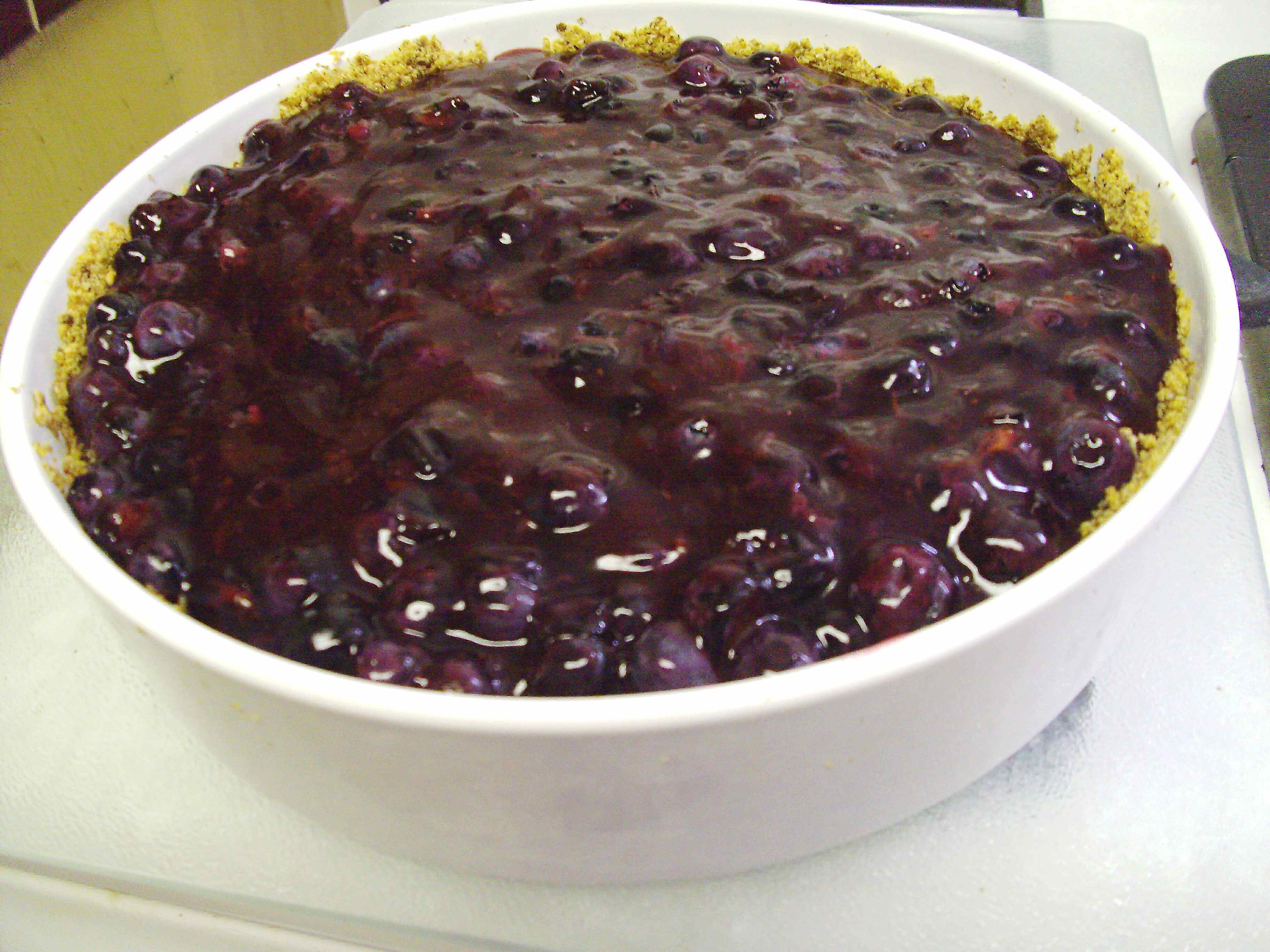
    raw blueberry pie with microwaveable filling and graham cracker crust

    This mostly-raw blueberry pie is a snap to make and very versatile--the filling microwaves in a few minutes, and you don't even have to bake the zippy gingered graham cracker crust--perfect for a hot Fourth of July and all summer long.

  • Recent Posts

  • Contents

  • Archives

  • Now Reading

  • See also my Book Reviews

  • Copyright 2008-2024Slow Food Fast. All writing and images on this blog unless otherwise attributed or set in quotes are the sole property of Slow Food Fast. Please contact DebbieN via the comments form for permissions before reprinting or reproducing any of the material on this blog.

  • ADS AND AFFILIATE LINKS

  • I may post affiliate links to books and movies that I personally review and recommend. Currently I favor Alibris and Vroman's, our terrific and venerable (now past the century mark!) independent bookstore in Pasadena. Or go to your local library--and make sure to support them with actual donations, not just overdue fines (ahem!), because your state probably has cut their budget and hours. Again.

  • In keeping with the disclaimer below, I DO NOT endorse, profit from, or recommend any medications, health treatments, commercial diet plans, supplements or any other such products.

  • DISCLAIMER

  • SlowFoodFast sometimes addresses general public health topics related to nutrition, heart disease, blood pressure, and diabetes. Because this is a blog with a personal point of view, my health and food politics entries often include my opinions on the trends I see, and I try to be as blatant as possible about that. None of these articles should be construed as specific medical advice for an individual case. I do try to keep to findings from well-vetted research sources and large, well-controlled studies, and I try not to sensationalize the science (though if they actually come up with a real cure for Type I diabetes in the next couple of years, I'm gonna be dancing in the streets with a hat that would put Carmen Miranda to shame. Consider yourself warned).

Another Greek salad

Greek cabbage saladWhen we think of Greek salads here in the US, it’s mostly horiatiki (a version of which is my current favorite lunch)–chopped tomato, cucumber, maybe peppers, some onion, feta and olives. Lahano salata, a shredded cabbage salad with lemon and olives, is less familiar and served, according to cookbook author Rena Salaman in The Greek Cook: Simple Seasonal Food, (Aquamarine/Anness Publishing, NYC ©2001), as a winter side dish–because you always have cabbage available, and lemons are a winter crop in the Mediterranean (and southern California). All you need to add are garlic, parsley, olives and olive oil and you’ve got it. Actually, that really sounds like a perfect summer thing to me.

I picked up a green cabbage today at my local greengrocer’s because it was there, it was cheap, I already had a red cabbage at home for other stuff, and besides, you can’t just hang around your local greengrocer’s picking up seven or eight pounds of fabulously ripe Fresno tomatoes all on their lonesome every couple of days. People will suspect you of becoming a tomatoholic. You need to branch out. And besides, I’d already made a tomato-cucumber-pepper salad pretty much every day for the past two weeks for lunch (as noted above). Not that I’m bored with it, but it gives me permission to do something else for dinner.

This Greek slivered cabbage salad is something I’d had in the back of my mind for half a year or so since paging through Salaman’s cookbook and its gorgeous food photos. But since it’s summertime, limiting the herbs to parsley seems like a missed opportunity when there are so many fresh herbs going wild in my fridge.

Dill, basil, mint, scallions–my current favorite mix for the lunch salad would probably also be good with shredded green cabbage. So I did a variation using those and foisted it on my unsuspecting nearest and dearest, who were both in need of something lighter than usual for supper. It went pretty well and we all agreed it would be a good filler for the salad part of a felafel pita.

I mixed this salad up about an hour before serving and stuck it in the fridge. I realized belatedly that the abundant lemon juice in the dressing would probably start wilting the cabbage, and it did slightly. It would have retained more crunch if I’d mixed it right as we were about to eat, but we still liked it and it wasn’t actually limp, just a little softened. I didn’t think the leftovers would hold up more than a day in the fridge but they did okay and didn’t wilt further overnight–perhaps because I poured off the excess liquid before storing the salad in a snaplock container.

One thing I like about cabbages is that they go a long way. You can take a quarter, wrap and refrigerate the rest and it should stay good for a couple of weeks. You might have to shave off any dried-out cut surfaces the next time (certainly for red cabbage, which also discolors a little at the dried surfaces) but the rest should stay pretty fresh.

Lahano Salata (Greek Green Cabbage Salad, Summer-style)

(Adapted from Rena Salaman’s The Greek Cook: Simple Seasonal Food; ingredient amounts are “use your best judgment”)–for 3-4 people as a side dish or pita filling as a bed for other stuff like felafel or kebabs. If you use a whole head of cabbage as in Salaman’s original recipe, increase everything by about 4-fold or to taste.)

  • 1/4 head of a washed green cabbage (the two outer leaves peeled and discarded, the rest rinsed under the tap)
  • small handful of herbs–a sprig or two each of dill, basil, and mint; parsley is okay too–finely chopped
  • 2 scallions, finely chopped
  • 3-4 pitted Greek-style olives (kalamata, Alfonso, Gaeta…), slivered
  • juice of a lemon or to taste–half a very large lemon was pretty lemony for just a quarter of a cabbage. For a medium or small lemon, taste and add a 3rd half if you think it needs more
  • 1-2 T olive oil

Shred the cabbage finely with a sharp knife and chop into manageable lengths unless you like the shreds long (Rena Salaman’s book had a pretty photo with very long straight shreds, almost like angel hair pasta. She mentions that the cabbages in Greece are different from standard American or northern European ones, so that may be part of it. Ours are curlier when shredded). Add the herbs, scallions and olive slivers, squeeze on the lemon and drizzle on the olive oil, then toss with two forks until everything’s well mixed. You can let the salad soften a little in the fridge for half an hour or so, or you can serve it straight up while it’s still a bit crunchy–it’s good either way.

This always happens right before vacation…

Finally, finally, we are going to the East Coast. We’ve had to put off seeing my mom and my sister (and assorted boys) twice since December due to incessant snow, none of which hit Los Angeles in the slightest. So as soon as school lets out, we’re packing for an ungodly wake-up call the next morning and getting out of SoCal for a bit more than a week. The cat gets a hotel/spa vacation without all the schlepping around between Bahston and New Yawk. We get the do-we-have-enough-clean-undies-to-make-it version.

So good, already. But as in many of my tangled big-event preparation schemes, I have a slight problem with the fridge:

Stuffed fridge right before traveling

The problem, part I…Note the tomatoes: 10+, excessively ripe, and the invisible 6 or so red peppers behind them. Not to mention the huge bag with 7-8 bunches of fresh herbs…

fridgedoor

Part II, the door…Note the huge bag of nectarines, lower left, the chiles just behind the mushrooms and two bags of apricots at right, just because…

AAAgh…just a little insane. Suffice it to say, it’s been an enthusiastic week or so vegetable-shopping-wise because the Fresno tomatoes are back in my local greengrocer’s, along with a lot of other produce, and I’ve gone overboard on a number of items, not least of which are lemon basil, mint, dill and tarragon (which I haven’t even decided if I like). The market beckons, the low prices for herbs and vegetables even more so, and the sun’s finally come out again after a month of gray days. And I’m a purple thumb as a gardener, so the greengrocer’s wares beckon even more strongly. How could I not want it all? But a little thought for the calendar might not have gone amiss.

So I’m in trouble again. We leave in 4 days. There are a maximum of three humans in the house (depends how we’re behaving at any given moment). Nobody but me really gets into gazpacho the way they should–though they will go with salads (the coarse-cut version of gazpacho). And it’s a sorry day when you have to threaten people with apricots and nectarines three meals a day. We should be reveling in the produce section, not roiling in it. If we were staying here, this would be an ideal scenario for the next week and a half, Continue reading

Fennel Mania

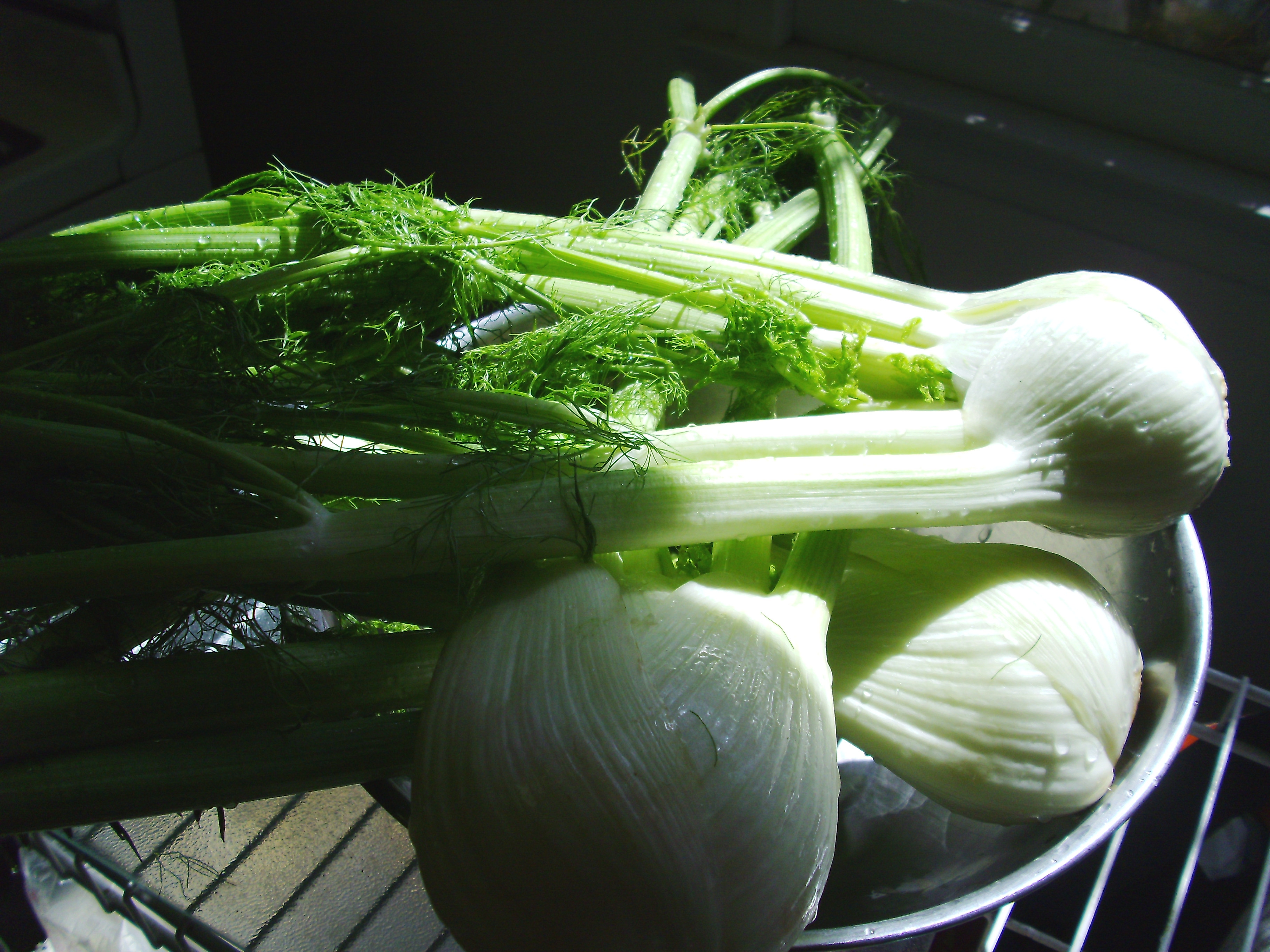
way too much fennel for one salad bowl

This much whole fennel kind of overwhelms my largest mixing bowl.
What was I thinking?

I hear a lot of complaints, among those of my friends and relatives who subscribe to CSAs, about weekly baskets arriving at the doorstep with surprise odd vegetables in unusually large amounts, and what the heck do you do with it all? I’ve never experienced that myself–I’m my own worst (or best) CSA challenge. So I can’t really blame this dilemma on anyone else, because I do my own shopping at my local greengrocer’s. And because the prices are low and the vegetables generally better than what I can get at the supermarket, I sometimes go a little overboard. Fresno tomatoes, when they’re in, are so good I end up with a 7 or 8 lb sack of them every week while I can. If I had more room in the fridge (oh, sacrilege! but they’re already so ripe it doesn’t hurt them), I’d buy even more. An overload of good tomatoes is no problem. However…

too much fennel from the greengrocer's

This week’s hot purchase: fresh fennel at a fabulous–too-fabulous?–price. Fifty cents apiece for large, clean-looking fennel bulbs with about two feet of stalk attached. They’re never less than two dollars apiece in the supermarket, and usually more like three.

So of course I couldn’t resist. I bought FOUR. Yeah. Two dollars total. For what turned out to be more than five pounds of useable produce, because if the fennel’s fresh, it’s all good eating. After washing and cutting it up into useable sections (only a 10-minute operation, surprisingly; fennel’s pretty cooperative for a big frondy vegetable), I actually weighed everything on our food scale.

Three pounds of bulbs for salads or grilling or whatever, two pounds of cleaned stalks chopped into celery-stick-length batons, and about six ounces of the cleaned chopped fronds to use as anise-to-dill-like herbs in tomato vegetable soup, fish, etc.

i1035 FW1.1

But how to use it all in a small household? We have only three people, and I’m the one who likes the anise-y taste of fennel most. Can I freeze some of it for later use (other than the fronds, which I did)? Are we going to be stuck eating it every day for weeks? How long before it starts going bad? What the heck was I thinking?

But it’s enough, and cheap enough, that I get to play around with it. Maybe I can find something good and even original to do with it that doesn’t require long roasting steps (Italian), stewing, or cheese-and-cream-filled gratin-type disguises (French) for the anise flavor, because really, for that you could have just bought celery.

The most obvious thing to do with fennel is slice it up and nosh on it raw. The first time I ever ate it was at the home of a large Moroccan Jewish family up in the  north of Israel. The mother, who invited me over for Shabbat lunch, started the meal with hraime, fish steaks (served cold, thank g-d) in a garlicky broth with enough evil birds’ eye chiles floating in it that the younger children (all the ones under 20, anyhow) started whimpering. “Only one pepper!” their mother replied, but none of them were fooled. I, the self-conscious guest just out of college, took the first bite and nearly fell off my chair as all the brothers and sisters laughed. Luckily the rest of the lunch was pretty unspiced–brisket, long-cooked eggs, farro with chickpeas, a lot of little cooked and raw vegetable salad dishes. I was still recovering from the “appetizer” though; I reached repeatedly for both water and the sliced fennel. Actually, I miss Esther’s hraime still, these many years later…

But mostly you don’t want to just gnaw on raw fennel for relief from the evil chiles. Fennel is pretty. Continue reading

Fruit Rescue Redux: Re-tanging the “Cutie” Tangerine

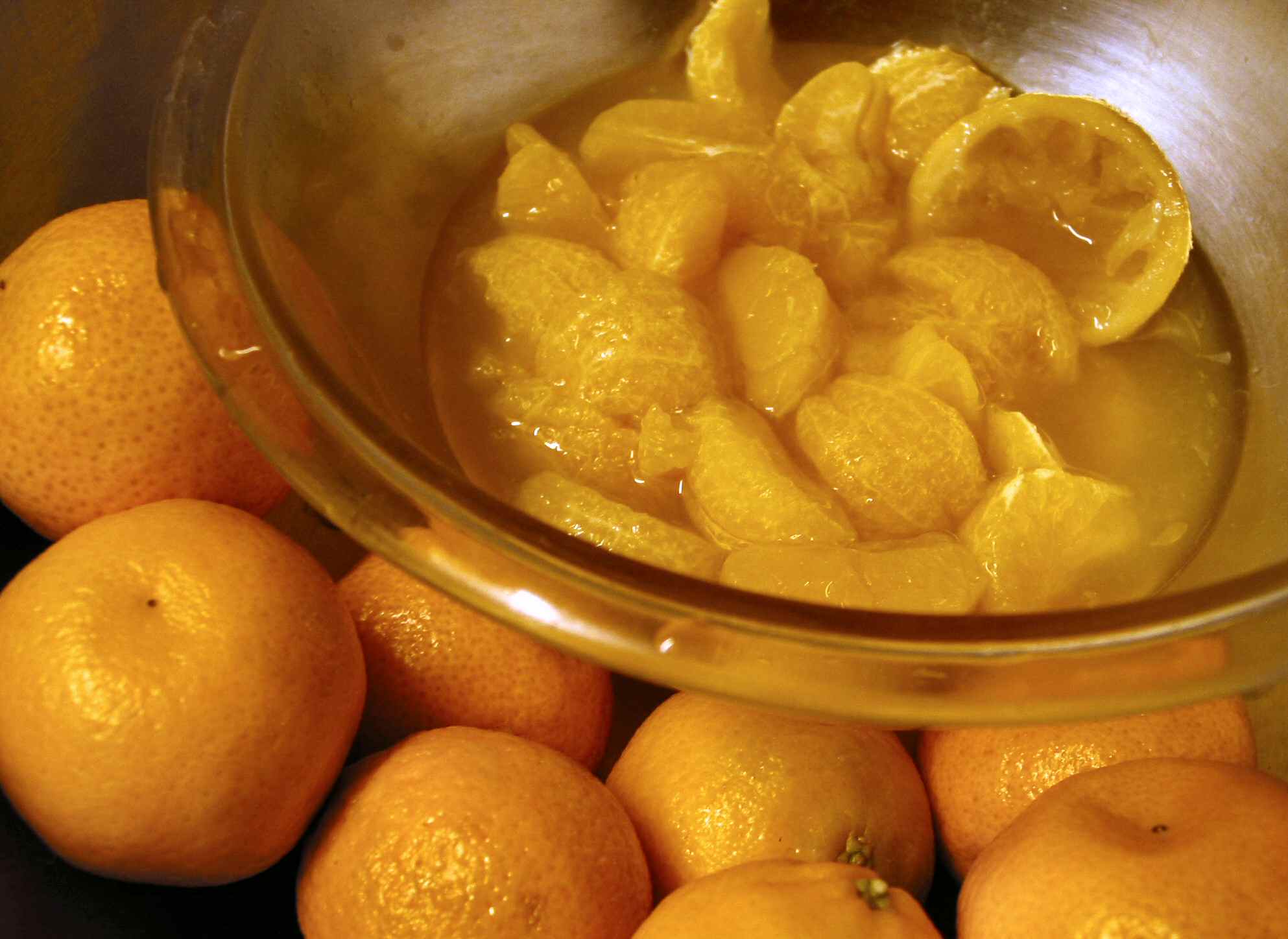
Putting the tang back in Cutie tangerines

Farmers’ markets aside, an awful lot of produce isn’t what it used to be–either for vitamins or flavor. Anytime you get to major mass production and long storage times, you know the result is going to be a product that looks like fresh fruit or vegetables but the smell, taste and texture are really missing. Kind of like the long-stemmed red roses bred to last for the Valentine’s Day bouquets–pretty, hardy as hell, but with almost no perfume at all.

Case in point: the Cutie ™ seedless tangerine. About two weeks ago I bought a 3-lb. bag of these things for a congregational hike and Tu Bi’Shevat ceremony in honor of the New Year of Trees, usually in January around the time when almond trees are in blossom in Israel (and California, though that’s a little less official).

The ceremony, other than the basic blessings for the gift of trees and their fruit, is kabbalistic in origin and involves celebrating the different kinds of fruit and tree nuts as a metaphor for different levels of openness and freedom in the soul. Some fruits have a hard stone at their core, others an inedible peel or shell, and the most open and enlightened are fully edible. A full-out Tu Bi’Shevat seder includes a selection of these fruits and nuts in progression from least to most edible, along with four cups of wine or grape juice mixed in four combinations from white to red (or is it the other way around?) to symbolize the approach of spring among other things. I’m not a kabbalist (my family were always “misnageders” or skeptics/rationalists rather than Hasidim) but I can appreciate the poetry of the Tu Bi’Shvat seder.

My family, skeptical or not, also always appreciated a good geschichte (shaggy dog story, preferably minus the actual dog and its hair). So I’m painfully aware you may not think you’ve been hearing enough about Cuties for the past few minutes to make this worth your while. I’m trying here.

My husband came back from the hike with at least half the bag of Cuties uneaten, so I put them in a bowl on the counter and started serving them, hoping to use them up before they went rotten. Because I’m not sure a seedless rotten tangerine is an improvement on the regular kind. Also because our neighbors with a satsuma tree (seeded) had just gifted my daughter with a bag of those. Out here in LA, tangerines are the winter version of zucchini.

Cuties are little and orange and shiny and really easy to peel. Perfect, right? The trouble was, the Cuties had almost no taste. At all. Continue reading

Resolution 18–eat more fun vegetables

Raw fennel bulb

I dream of going, but this is for now

Fennel’s in season here and makes a great crunchy salad vegetable. Or just a great raw vegetable for noshing, period.

A Year of Artichoke Hearts

“Top 10 Recipes” lists are a big thing at the new year, a way to look back and figure out which dishes made a hit and which ones were just so-so. But sometimes, after an entire year, the top-10 judging criteria can get a little distorted. How do dining section editors compare five quasi-Asian stir-fried noodle-and-greens dishes, most of them mysteriously pumped up with bacon crumbles (2009’s star ingredient), and decide all five really belong in the top 10 for the year?

In one of my early posts, I was thinking about toasted cheese sandwiches (grilled cheese, hard to believe, was a Top 100 Dishes entry for Bon Appétit at that point). At the end, I threw in a quick little recipe for marinated artichoke hearts done in a microwave as an antidote to all the middle-American boredom. Yesterday I ran across an artichoke and potato salad from the LA Times‘s 2009 top-10 list and realized my artichoke hearts would probably make it better. Because they make everything better, or almost.

Marinating your own artichoke hearts takes five minutes, is less expensive than buying a jar of prepared ones, tastes fresher, and has a short list of real ingredients. A ~12-oz batch lasts more than a week in the fridge, where it’s  ready to serve as a pick-me-up for sandwiches, pasta, fish, omelets, salads, and hot vegetable dishes. I use these artichoke hearts so often that whenever I get to my Trader Joe’s and they’ve run completely out of bags of plain frozen artichoke hearts in the freezer and won’t get any in for weeks, I feel horrible and deprived, like someone who’s just been told not to talk with her hands.

That puts it in MY top 10.

You don’t need more than a dash of salt in this recipe to make the artichoke hearts taste intense and bright. The fresh lemon juice and garlic do it for you, and something about the artichokes themselves makes the combination work. Continue reading

Unbranded Cabbage Salads

OK. Put my money where my mouth is–right. Red cabbage is a favorite vegetable for me because it’s cheap, substantial, cruciferous and crunchy, and it tastes good raw. Also, and this is key, you can do neat kitchen chemistry tricks with it, like use it for a pH indicator or to reveal secret invisible ink messages written in baking soda slurry. Amaze your friends! Baffle your enemies!

I like red cabbage as a salad vegetable–it’s bracingly radishy when mixed with sweeter lettuces, but sweet and crisp against romaine or arugula. I don’t shred it for a chopped salad–decent bite-sized pieces are more satisfying, crunch better, and stand up to all kinds of salad dressings. You can make it with the more usual tomatoes, but I like oranges because if there are leftovers, the next day, the juice from the red cabbage will have combined with the acidity from the oranges and turned them both a range of brilliant magentas–very cool.

Tie-Dyed Salad

Mix about equal quantities of:

  • Arugula or romaine
  • red cabbage, chopped in bite-sized pieces, ~1″ across
  • red or yellow (or green, your choice) bell pepper, in bite-sized pieces
  • orange (s), blood oranges or tangerines or etc. peeled, sliced crosswise, any seeds removed

Nice additions: Shred a few leaves of basil if you have it, chop or sliver a few Greek olives, toast some walnut pieces, crumble feta or goat cheese. Or gorgonzola.

Dress with any of these:

  • olive oil and red wine vinegar (few spoonfuls each), cracked black pepper–my usual weeknight preference
  • ordinary spicy brown mustard mixed half-and-half with plain yogurt
  • tehina (sesame) paste mixed 1:3 with plain yogurt
  • yogurt and/or buttermilk with minced garlic, chopped basil and dill, and a squeeze of lemon juice
  • yogurt and/or buttermilk with lemon juice and gorgonzola or bleu cheese crumbled in

Variation: In fall or winter, thin-sliced crisp pear or apple instead of oranges is very good, especially with goat cheese and the toasted walnuts, and with the mustard/yogurt dressing.

Slightly more dignified salad

Reasonably balanced mixture of:

  • red cabbage, chopped bite-sized
  • red or green leaf lettuce, washed and torn
  • good tomatoes sliced in wedges or chopped bite-sized
  • bell peppers chopped

Additions:

  • cucumber slices
  • chickpeas or kidney beans, or raw or lightly cooked green beans
  • scallion or a bit of diced or sliced red onion
  • any or all of: anchovies, optional, or capers, or olives, or marinated artichoke hearts, or flaked tuna, or hard boiled eggs cut in half