
• Enter your email address to subscribe to this blog and receive notifications of new posts by email.

    Join 241 other subscribers
  • Noshing on

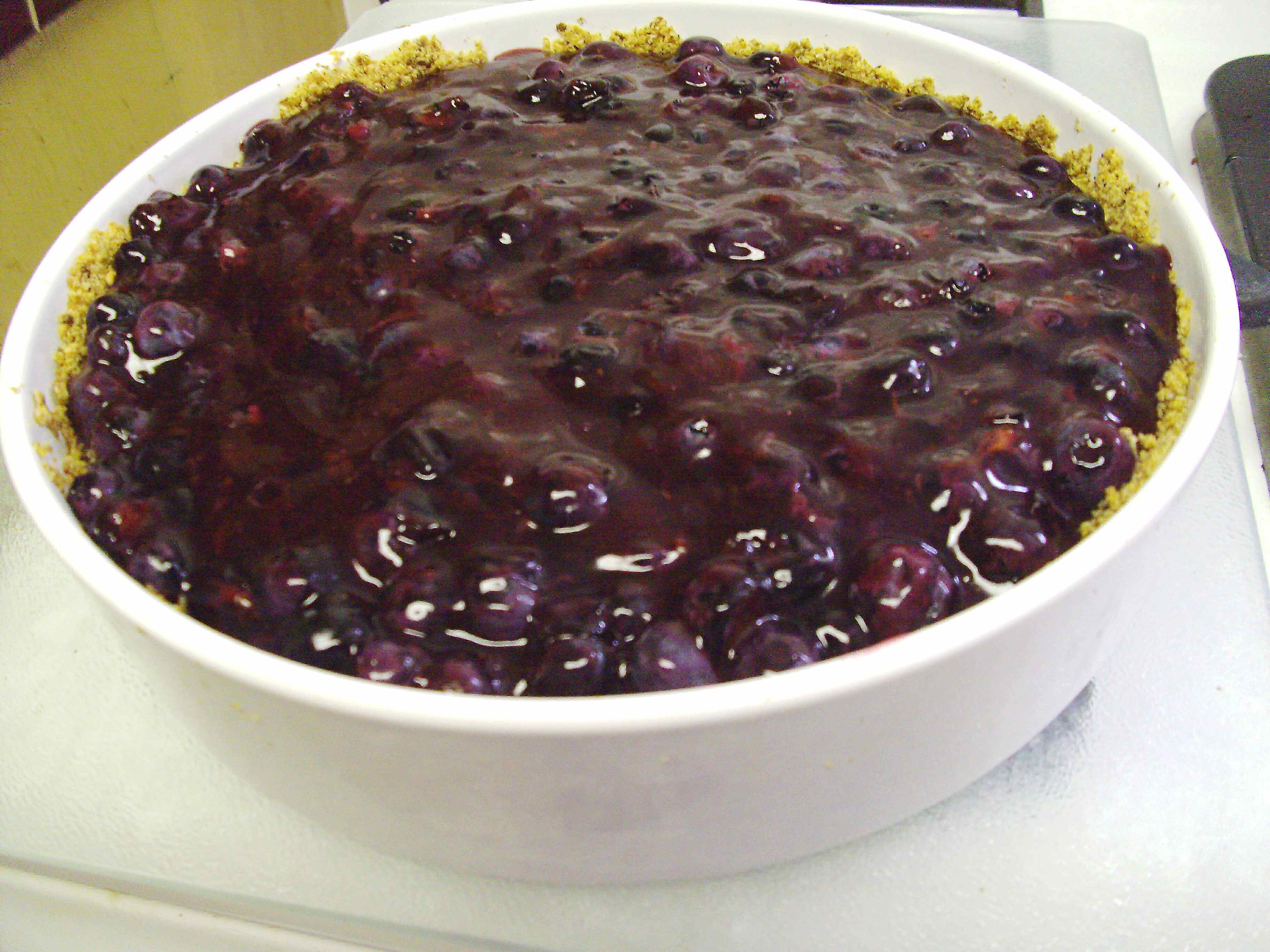
    raw blueberry pie with microwaveable filling and graham cracker crust

    This mostly-raw blueberry pie is a snap to make and very versatile--the filling microwaves in a few minutes, and you don't even have to bake the zippy gingered graham cracker crust--perfect for a hot Fourth of July and all summer long.

  • Recent Posts

  • Contents

  • Archives

  • Now Reading

  • See also my Book Reviews

  • Copyright 2008-2024Slow Food Fast. All writing and images on this blog unless otherwise attributed or set in quotes are the sole property of Slow Food Fast. Please contact DebbieN via the comments form for permissions before reprinting or reproducing any of the material on this blog.

  • ADS AND AFFILIATE LINKS

  • I may post affiliate links to books and movies that I personally review and recommend. Currently I favor Alibris and Vroman's, our terrific and venerable (now past the century mark!) independent bookstore in Pasadena. Or go to your local library--and make sure to support them with actual donations, not just overdue fines (ahem!), because your state probably has cut their budget and hours. Again.

  • In keeping with the disclaimer below, I DO NOT endorse, profit from, or recommend any medications, health treatments, commercial diet plans, supplements or any other such products.

  • DISCLAIMER

  • SlowFoodFast sometimes addresses general public health topics related to nutrition, heart disease, blood pressure, and diabetes. Because this is a blog with a personal point of view, my health and food politics entries often include my opinions on the trends I see, and I try to be as blatant as possible about that. None of these articles should be construed as specific medical advice for an individual case. I do try to keep to findings from well-vetted research sources and large, well-controlled studies, and I try not to sensationalize the science (though if they actually come up with a real cure for Type I diabetes in the next couple of years, I'm gonna be dancing in the streets with a hat that would put Carmen Miranda to shame. Consider yourself warned).

Stuffed Eggplants with Quince, A Vegetarian Odyssey

Stuffed Eggplant with Quince and Stuffed Onion Rolls

I did it. It was 90+ degrees outside yesterday afternoon and felt a lot hotter inside when I started cranking the oven to try this dish right away rather than wait for the weekend, but I’m just no good with delayed gratification.

If I have the mini-eggplants and I have the quinces and I have the tamarind concentrate (homemade! two days ago! it’s practically crying out to be used already!) and I have the “hashu” filling for the vegetables sitting in the fridge smelling wonderful, then it just doesn’t matter that Rosh Hashanah dinner is in what, maybe 3 hours, and I still haven’t braided the challot, to say nothing of baked them. Obviously I’ve gotta try this extra-credit dish out RIGHT NOW.

Actually, I figured the house was going to be heating up anyway once I started baking the challot, so why not get it all over with at once?

There was a more serious reason to try it. Today in services I was still thinking about Dweck’s book and her recounting of her parents’ horror in 1947, when, about to return from a vacation in Europe, they learned the government back home had started massacring whole Jewish communities in reaction to the announcement that the UN had accepted Israel as a Jewish state.

The Syrian Jewish community fled wherever they could–just as my family did under the pogroms in the Ukraine back in the 1880s and 1920s. Dweck maintains that the reception the Syrian Jews got in the US from those of us who were already here was so aloof–they didn’t speak Yiddish, they didn’t look the same, they did a few things differently for kashrut and prayers–that her community kept to themselves ever after.

I can believe it, unfortunately–the period right after World War II and the Holocaust was one of paranoia and circling the wagons for American Ashkenazim.

Eastern and Western Jews had similar discomfort with each other in postwar Europe. Reading between the lines a little in Claudia Roden’s and Colette Rossant’s memoirs, the two, who had just lost everything, thought their new Ashkenazi neighbors were cold and inhospitable and indifferent to their exile; the Ashkenazi neighbors and relatives, meanwhile, thought the wealthy young Egyptian arrivals were horribly spoiled and indifferent to the European disaster they had just missed. Altogether, the Ashkenazi, Sephardi, and Mizrahi communities were in closer touch before World War I than they were after the 1940s.

I can only hope that now, 60 or 70 years on, we have more in common and more regard for each other, no matter where we came from. Israel’s great mix of cultures has been a good influence, even though it originated in hardship, and perhaps today we are in better shape to appreciate what we have in common than we have been for nearly a century.

When I look through Dweck’s family’s photos, I see so many people who look astonishingly like several members of my family–my dad and my sister especially. The dignified lady presiding at the seder table on the front cover is a shockingly exact adult version of a girl I knew from my synagogue’s youth group–it’s the sturdy mouth and chin and the set of the eyes, certainly, but also the irrepressibly thick and curly hair (the 1920s formal chignon has it all over my friend’s 1970s braids, which took her hours to corral her hair into). The formal photographs of families in the 1920s, all the daughters dressed beautifully but in the same fabric the mother is wearing, sailor suits on the boys, stern dignified expressions all–I’m pretty sure each of my grandmothers had at least one of those in her collection. The 1930s-era engagement portrait with pearls and bobbed hair–so modern! Pin it up next to the one of my dad’s parents, who married in 1939 and looked so incredibly naive and young then. The family gatherings at Pesach, grandma presiding over the white lace tablecloth and all the seated cousins glancing behind them at the camera from over their shoulders–there’s probably one or two with my mother as a toddler on someone’s lap in Brooklyn and another of her as a teen, whipping her glasses off and blinking myopically for the photo. It could be any of our families. It could have been us in Syria and Egypt and Turkey, it could have been them in the Ukraine or Germany or Poland. We none of us have entirely safe histories, and none of us are entirely separate.

In any case, Dweck’s book is important to me not only for capturing her community’s traditions, tastes and history but for reaching out to the rest of us and giving us a chance to share it, compare it with our own, and reconsider what it means to be part of the Jewish world now.

So–and this is not to trivialize but to explain, since we sometimes live and remember through food, especially at the holidays–it was a great time to try out a challenging dish (challenging for me, anyway) from her book and serve it last night to my family for Erev Rosh Hashanah. I cook from scratch, I cook a lot, but I’ve never really done  the legendary great-aunts-at-Pesach kind of slow cooking where everyone groans in pleasure and declares “nobody does it like this anymore” when they taste it. I’ve only once cooked a whole turkey, and I’ve rarely tried anything else that took more than an hour and a half to cook. It’s a transformative experience, one that teaches me a lot about my great-aunts and great-grandmothers, both in the shtetls with the wood-fueled pripitschoks and communal ovens, and here in America with modern kitchens and big lace-covered tables. Trying this long-cooked dish gave me the chance to experience both my family’s past celebrations and Dweck’s at the same time.

To my very great pleasure, her recipe worked the way it was supposed to on the first try and tasted like the effort was worth it, even though her instructions are pretty simple and brief. That’s a huge achievement.

So–if you’re ready for this, keep reading–otherwise, glance at the pictures and skip to the bottom…

The “Stuffed Eggplants with Quince” Experience

First of all, let me just say that I LOVE my local Armenian corner grocers for a lot of reasons, but the fact that they have all the ingredients for Dweck’s dishes (other than kosher meat, that is) is a big, big plus.

I would have tried microwaving–and I still will–instead of a 2-hour braise, but I wasn’t sure how it was supposed to taste, whether microwaving would cook the raw rice in the filling well enough, and how the sauce was supposed to interact with the stuffing and the eggplants. I knew from a previous hard-luck experience that quinces don’t do especially well (or even well at all) in the microwave and really need long stewing under conventional heat to get tender and turn bronzy pink and sweet. So all in all, I decided following the directions in Aromas of Aleppo might be the wiser course for a first try. Even though, from my usual 15-minutes-tops perspective on conventional-heat cooking, Poopa Dweck’s method is glacially, almost outrageously, slow.

Basically, you core the baby eggplants, stuff them with hashu (beef-and-rice filling, rice and tomatoes, or in my case lentils-and-rice), and layer them in a saucepan with quince slices. Then you dilute some tamarind concentrate and add a bit of sugar and salt, pour the sauce over the pan and heat for 10 minutes on the stove until the eggplants start to sweat, add water to come about 3/4 of the way up , simmer half an hour to reduce the liquid and cook the rice in the filling, then transfer to the oven to braise covered for about 40 minutes and then uncovered for another 30. It’s a lot like making brisket, actually.

Dweck gives two allspice-laden recipes for the filling, one for ground beef with rice, the other a rice-and-tomato filling that’s close to what I use for dolmas. I opted to follow the ground beef recipe but substitute an equal weight of cooked green lentils for the meat and add a little garlic. It would work, I was pretty sure, and in fact it turned out to be the best, most delicious part of this recipe–which, skipping to the punchline, was pretty terrific and worthwhile, even for the work Continue reading

The Birthday Project: New Year, New Food

I was born halfway between Rosh Hashanah and Yom Kippur, so on any given year, I could be stuck eating honeycake or none at all on my birthday. I think I’ve had maybe two actual birthday parties in my life. It’s a concept my daughter, born in June, doesn’t get.

But occasionally I luck out–and this year was one of the best. My husband asked what I wanted and I had a real answer–a cookbook I’ve been lusting after at the library and that costs only slightly more than my probable library fines if I don’t return it.

So this is it–feast your eyes, I’ll turn the pages:

Aromas of Aleppo by Poopa Dweck

And this is the project that sold me on it:

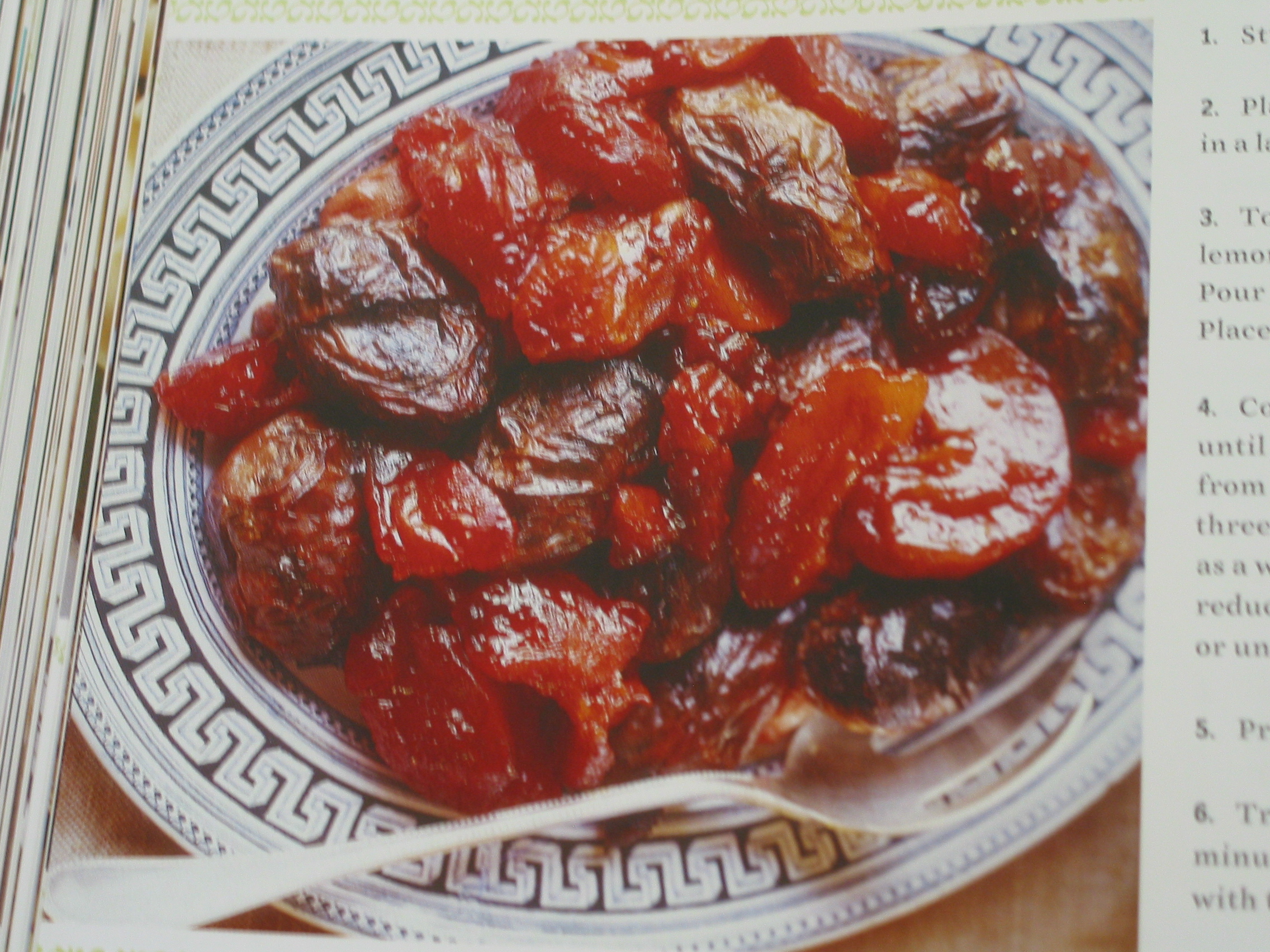
Stuffed Eggplant with Quince

Stuffed Eggplant with Quince

Poopa Dweck, a cousin by marriage to Claudia Roden, has edited the New York Syrian Jewish community’s version of a sisterhood cookbook (every synagogue in America’s sisterhood seems to have put out at least one of those) for something like 20 years, only people in her community actually used it frequently. My birthday gift is the 2007 culmination of Dweck’s experience, and it’s just a very beautiful cookbook to leaf through–visually but also for the possibility that when you try the dishes, they’re actually going to work.

It doesn’t take much reading for me to realize that despite the unfamiliarity of some of the flavors–allspice in meat stuffings, tamarind-based sauces–this is the best kind of traditional Jewish home cooking, the kind that has your favorite great-aunts outdoing each other for Pesach, Rosh Hashanah, and other big celebrations. So, somewhat exotic in flavoring but utterly familiar in spirit. (And actually, as I discovered in another Syrian Jewish cookbook, A Fistful of Lentils, by Jennifer Felicia Abadi, a few dishes, like stuffed cabbage with a sweet-and-sour sauce, and manti, a kind of ravioli, are pretty similar to Ashkenazi holishkes and kreplach.)

Like all Jewish great-aunt dishes for the holidays, this dish of stuffed eggplants and quinces comes with two required homework items: the beef and rice stuffing, and tamarind concentrate. The beef I’m not worried about–my first try on this is going to be vegetarian, because I’m not planning on heading out to the kosher butchers in the Valley. I can use a green lentil and rice filling that I already know will taste fine with those flavorings of allspice and cinnamon and onion. Maybe a hit of garlic too, and maybe a bit less salt than for the beef–as I discovered a few weeks ago, with the green lentil sausages, lentils don’t hide the salt flavor as much as beef might.

The other item, tamarind concentrate, turns out to be inexpensive but somewhat unlovely to make–though still something of an adventure. Especially for a blog called Slow Food Fast.

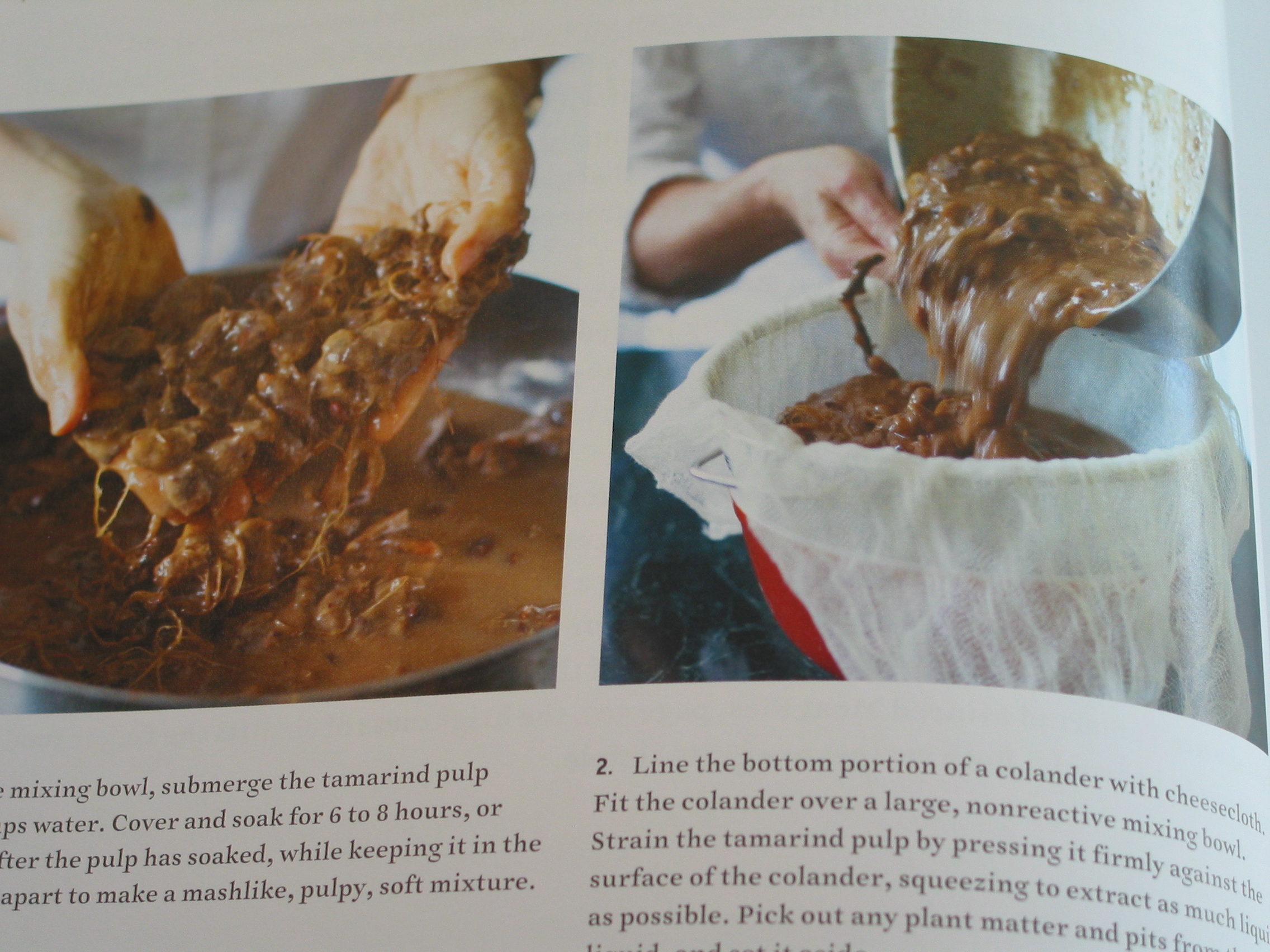
Here’s what’s on page 42 of Aromas of Aleppo for how to work the tamarind pulp into something that will give up its flavor to a sauce:

Poopa Dweck's Aromas of Aleppo--instructions for making tamarind concentrate

Working the tamarind pulp

Now, I’m not all that squeamish, but bleaaghhh. First ya gotta soak the stuff overnight, then ya gotta get in there and mish around–I dunno. I decided to speed it up where I could…

I thought about the little 1-lb. brick of pressed seedless tamarind pulp I’d bought from my Armenian greengrocers for this dish. It just seemed like a tougher version of dried prunes or apricots, which I usually soak up successfully enough in a few minutes by heating them with water in the microwave. Would it work here or would it ruin the flavor? I cut off a chunk, submerged it in water in a microwaveable bowl, and tried it.

Tamarind pulp rehydrated in the microwave

Five minutes of microwaving, covered, plus about 20 minutes sitting time–it was definitely done. And really, really incredibly tart, a surprise given tamarind’s distinctly plummy aroma. Success! But no wonder they call it “ouc” (pronounced OO-rgh, according to Dweck)–that was my immediate reaction when I tasted a tiny sip. It’s THAT sour. My second reaction was that I should probably say Shehekheyanu–the blessing for any new venture, especially for holidays and the first taste of a new fruit in the year.

I realized only afterward that I should have done the whole brick while I was at it–I was about to discover why Dweck calls for preparing three pounds of pulp at a time, not a couple of ounces.

Next step–squishing the pulp in the water to extract as much flavor as possible before filtering through cheesecloth and reextracting the pulp left behind in fresh water…no. Just no. I am not a cheesecloth girl–it never, never cuts neatly, even with Fiskars shears.

So, I was thinking, I have a microwave for a reason. I also decided I have a food processor for a reason, and this is definitely it. I stirred once with a fork first to make sure there really weren’t any pits in there, as advertised on the package front. Then I poured it all into the food processor, and gave it a whirl. That worked too. I seemed to be on a roll with the speed-it-up-immensely daydream.

Filtering the tamarind liquid

Filtration–I’ve used overlapping coffee filters in a colander whenever I make paneer in the microwave, and it worked pretty well here too–maybe better than Dweck’s photos, which show a cloudy filtrate coming through the cheesecloth. Mine was clear and amber–maybe too clear? Was it going to taste authentic without the silty stuff? I could only hope. It sure was sour, even dilute as it was. Continue reading

Rising Expectations for Rosh Hashanah

Just a quick word to say L’Shanah Tova U’metuka! May you have a good and sweet New Year!

Here’s what my daughter and I baked the afternoon before the start of Rosh Hashanah. You can find the basic recipe here.

Crown challah for Rosh Hashanah

Crown challah for Rosh Hashanah

It’s the first time I’ve baked bread since my daughter became diabetic in February, but by now, six months along, we both feel like we have the approximate carb counts down well enough. I tend not to make my challah very sweet anyway, but this year I also left out the raisins, which are about a gram of carb each, to make things a little easier until we were sure we knew how to figure portions. It still came out pretty and tasted good.

Without raisins, we figure, a baked piece of challah is like most other bread, about 50% carb by weight in grams, and it seems to work. Using a simple ratio like this is a lot easier (when we’re home and have a scale handy, anyway) than worrying about exactly how many cups or grams of flour I put in the dough and calculating exact portion carbs–something I still tend to do for desserts and treat foods like berry scones since they’re so variable. Or as our endocrinologist said, “Everyone guesses wrong for birthday cake.” Next time, we’ll try it with raisins and see how it goes.

Challah birds

One thing we like to do with the extra dough–I make sure there is some–is to let my daughter make challah birds. Usually we shape these by making a small 6-inch rope of spare challah dough and tying it into an overhand knot. You can press a raisin into one of the ends for an eye, and the other end becomes the tail, which you can leave alone, stretch out a bit, or score with a knife tip for “feathers”. This year, my daughter went free-form so the rolls came out looking more like bollilos, but she liked them, which is the important thing.

Mine: A lot of people make spiral challahs for Rosh Hashanah with a single thick rope curled around in a turban shape. Tunisians and some other North African and Mizrahi Jews shape the top end into a hand shape. I like to braid my round challahs into a crown, though I admit they’re not always the most even at the joined end. They still seem to even out as they rise to the occasion.

Braided crown challah rising in the oven for Rosh Hashanah

Braided crown challah rising in the oven for Rosh Hashanah

Challah dough is so easy to put together (2 minutes by food processor, plus cleaning, or 5-7 minutes by hand and letting it rise right in the mixing bowl) that if you get the dough ready in the morning and have a couple of hours in the afternoon free for braiding (10-15 minutes unless you’re having too much fun), the second rise (40ish) and baking (another 40ish), it’s a lot of fun and less expensive than store-bought, and more individual too.

B’te’avon! (bon appétit!)

Lightening Up Apple and Almond Cake

Since Nigella Lawson’s Feast came out a few years ago, her “Damp Apple and Almond Cake” has been praised by food bloggers, morning tv show hosts, and just about everyone else who’s tried making it.

Most of her dessert recipes are not for the health-conscious. In the past 10 years, most of her food has become if anything a lot heavier and gooeyer and richer, migrating from Thai and Vietnamese summer salads with sharp clean flavors to avocado AND bleu cheese AND sour cream WITH taco chips, or chocolate bar AND non-natural peanut butter AND whipping cream AND caramel as an ice cream sauce. Or chicken pot pie WITH a lot of bacon in it and no vegetables AND a store-bought puff pastry top (a whole sheet goes for a mere two servings). I can’t think how far she’ll take things next.

But the  “Damp Apple and Almond Cake”–despite the less appetizing connotation of “damp” in American speech (I think “moist” would probably be the equivalent word over here, or at least I hope so. It would at least conjure up fewer images of seeping rot under the stairwell)……….. okay, where was I with all the parentheses? Oh yeah.

What people have to say about this recipe is that it works as written, and it’s really good. No mean thing these days.

So okay. I have almond meal, I have apples, I have a fresh lemon, and I have some decent vanilla for a change (the Kroger stuff I bought for my daughter’s birthday cake back in mid-summer was shamefully weak). And I have eggs. That’s basically what you need to make this cake.

But it’s blazingly, disgustingly hot, 100+ Fahrenheit, yet again in Pasadena. And–AND–I look at the original recipe (serves 10-12) and realize that while the almond meal is a good move–much, much lower carb than flour–the recipe requires 8 eggs. Eight. E-I-G-H-T. Which puts it in the European spongecake class of baking. My grandmother made a similar thing, only with flour and chocolate chips, and probably 12 eggs, for a huge wheel of a cake.

And the directions call for simmering the apples down to a thick applesauce, then cooling and blending in the food processor with a huge, heavy amount of almond meal and a fairly high amount of sugar and all the eggs, and it’s a “dense” cake. No wonder.

Three and a quarter cups of almond meal. Dense. And almond meal tends to require a little less sugar than flour-based cakes to register sweetness–maybe that could be cut down too?

Those eggs–do you need all the yolks? Do you need all eight eggs for that matter? And while you’re at it, why not take advantage of what eggs do best, since it’s a European-style cake with no other leavening. Separate them and whip the whites to fold into the batter.

So here was what I came up with on a hot September pre-Rosh Hashanah afternoon.

Lightened-Up Apple Almond Cake

  • 3 fairly big Granny Smith apples, peeled and sliced or chopped (~23-25g carb each or ~75)
  • 2 c. almond meal (see Trader Joe’s for a decent-priced 1-lb bag at about $4) (20 g carb/cup or 40)
  • 2 T. flour or matzah cake meal (~10 g carb)
  • 1 c. sugar (200 g carb)
  • 3 yolks
  • 4 egg whites
  • 1 t. vanilla
  • juice of a lemon
  • 1-2 oz. orange juice (optional) (~3-5 g carb)
  • grated rind of half a lemon
  • grating of nutmeg
  1. Put the apple slices or chunks on a microwaveable dinner plate and microwave on HIGH 3 minutes.
  2. Blend the almond meal and sugar in a food processor until very fine (whiz several seconds, good enough)
  3. Add the yolks, apples, flour or matzah meal, lemon juice and rind, vanilla, orange juice and nutmeg and blend well.
  4. Whip the egg whites separately in another bowl large enough to pour in the batter from the food processor. When the whites are stiff (can be done easily enough by hand in only a minute or so with a big balloon whisk, just tip up the bowl and hold it at a slight angle in your other hand, or else use your method of choice), start pouring the batter into them a little at a time and folding with the whisk. I know this is backward from the usual method but it works out ok and saves a third bowl…
  5. Pour into a deep-sided microwaveable casserole or a deep dish pyrex pie plate (chancy, may spill over a bit).
  6. Set a microwaveable soupbowl upside down in the middle of the microwave turntable. Center the casserole or pie plate on top, and microwave uncovered 7 minutes on 70% (for an 1150ishW oven). Stop if it seems to be overflowing and wait a minute before continuing. When it stops rising and settles back in the plate, you might cover with a dinner plate and microwave another minute or so on HIGH until you’re convinced it’s cooked all the way down to the bottom.

Cool and slice–the total carb count is about 325 for the recipe, so 1/16th should be about 20 grams, 1/10th, if you can eat that much, is 33 grams, etc. It’s light, soft, substantial and rich-tasting, and 1/16th slice was pretty good tonight for all the testers at my table. And it only took 4 eggs and a cup and a quarter less almond meal. And about half the sugar of Nigella’s recipe but all the apples.

Lightened-up microwave version of Nigella Lawson's "Damp Apple and Almond Cake"

Not a looker in the microwaved version here, which doesn't brown the top, and I didn't decorate with slivered almonds or lemon slices, but the flavor's so intense and tangy that the 1/16th wedges here were perfect for a quick light dessert.

Verdict—Really, really good, and when I do it again maybe I’ll have cool enough weather to try out the oven so it’ll brown as well (about 25 minutes). I would probably go for a deep-sided casserole or even a soufflé dish. Then I could top it with slivered almonds as in Lawson’s version, and perhaps capture a little more of the rise from the egg whites without it collapsing down afterward.

In a regular oven it’s best to oil the pan and dust it with a little almond meal, but I didn’t have to for the microwave–probably for the same reasons it doesn’t brown on top, it also doesn’t cause a lot of sticking on the bottom.

Another change I might make next time would be to add just a couple of drops of almond extract–not enough to overpower the lemon and apples, just enough to play up the almond meal. This time around when I reached for the little bottle I discovered it was bone dry–hence the nutmeg, which actually worked out quite well.

But all in all, and despite the fact that it LOOKS like a typical Passover choke cake, it really isn’t. It’s very moist and even this way the flavor was wonderful and satisfying. So b’te’avon (bon appétit in Hebrew) and kudos to Nigella Lawson, and maybe this will encourage you (and her) to lighten up a little.

Honeycake for a Sweet New Year

Rosh Hashanah starts this evening and we need a honeycake–it’s traditional, plus I like it. Right. But traditional recipes call for boiling the honey with strong coffee (which takes a while), cooling it (which takes even longer), triple-sifting flour and baking soda and sugar and spices of various kinds, and then alternating between adding dry stuff and the honey-coffee mixture to some beaten eggs and oil. This is much more of a pain than it sounds in so few words. Picture wax paper and bowls all over the counter and the kitchen table, and a huge stack of stuff to clean afterward. All for one or two loaves of what’s essentially a rich gingerbread.

One year I got smart–I think it was the year I bought both Silver Palate cookbooks and found their gingerbread recipe, which is incredibly simple and calls for molasses–surely it would work with honey? And it does.

Then I took things a step farther–having made a bunch of box-mix cakes in the era when Duncan Hines started recommending applesauce instead of oil for a lower-calorie cake, I knew that worked pretty well, and it does here too.

Then I really got weird and microwaved the cake–you can, and it works, but my daughter and her friend are doing it this afternoon as a project (I’m tarping the entire dining table and floor) so this year I’m sticking with tradition. Even though the temperatures are back up in the low 90s. Continue reading