
• Enter your email address to subscribe to this blog and receive notifications of new posts by email.

    Join 241 other subscribers
  • Noshing on

    raw blueberry pie with microwaveable filling and graham cracker crust

    This mostly-raw blueberry pie is a snap to make and very versatile--the filling microwaves in a few minutes, and you don't even have to bake the zippy gingered graham cracker crust--perfect for a hot Fourth of July and all summer long.

  • Recent Posts

  • Contents

  • Archives

  • Now Reading

  • See also my Book Reviews

  • Copyright 2008-2024Slow Food Fast. All writing and images on this blog unless otherwise attributed or set in quotes are the sole property of Slow Food Fast. Please contact DebbieN via the comments form for permissions before reprinting or reproducing any of the material on this blog.

  • ADS AND AFFILIATE LINKS

  • I may post affiliate links to books and movies that I personally review and recommend. Currently I favor Alibris and Vroman's, our terrific and venerable (now past the century mark!) independent bookstore in Pasadena. Or go to your local library--and make sure to support them with actual donations, not just overdue fines (ahem!), because your state probably has cut their budget and hours. Again.

  • In keeping with the disclaimer below, I DO NOT endorse, profit from, or recommend any medications, health treatments, commercial diet plans, supplements or any other such products.

  • DISCLAIMER

  • SlowFoodFast sometimes addresses general public health topics related to nutrition, heart disease, blood pressure, and diabetes. Because this is a blog with a personal point of view, my health and food politics entries often include my opinions on the trends I see, and I try to be as blatant as possible about that. None of these articles should be construed as specific medical advice for an individual case. I do try to keep to findings from well-vetted research sources and large, well-controlled studies, and I try not to sensationalize the science (though if they actually come up with a real cure for Type I diabetes in the next couple of years, I'm gonna be dancing in the streets with a hat that would put Carmen Miranda to shame. Consider yourself warned).

Hot Air

The last two or three months of school seems to be getting more and more fraught every year–for parents, certainly. I’ve just woken up to the fact that I’ve been offline for something like three months now–March! yeesh! Not because I had nothing new to say about food, exactly, but because I had three or four competing ideas and no time to figure out pictures for the posts. And as everybody knows, if you didn’t take a picture of it, it practically didn’t happen. Just like all those tourists who used go to the Grand Canyon and (back in the day of actual film) had to wait for their pictures to be developed to see what it looked like…

And now that school’s out, it’s hot. 107 degrees twice this week in Pasadena, smoke in the air from the San Gabriel fire not too far away, and no desire to cook, walk during the day, or listen to anything resembling hot air.

Because the recent spate of presidential campaigning has become poised to take away almost any American’s appetite for a while.  Just read a newspaper online and look at the prominent photos and bombastic quotations and examples of rank cowardice.

I mean, yeah, I voted in the California primary two weeks ago, and I even researched all the local judges and assemblypeople for my district this time, hoping to make something count or at least not to commit any hideous mistakes.

Contrary to what you might think, reading the candidates’ own statements will actually give you a feel for what kind of people they are, whether they give a flying leap about their prospective constituents and whether they know how to tie their own shoes. Reading through about fifteen last-minute write-in candidate statements for various assembly-and-county-supervisor-type posts was pretty entertaining, actually–most of the hopefuls (you could guess which parties) stated their qualifications as “I believe in God.” Seriously. Sum total.

Nationalistic and bigoted fervor seem to be going around, though. To wit, “Brexit”, which actually won the vote today. Not that I don’t understand Britain’s–and everyone else’s–frustration with the EU administration, but the vote results and the resulting–utterly predictable–mess announced this morning are really disheartening.

Some are calling it a shot in the dark; to me it looks like a solid a shoot-yourself-in-the-foot-why-don’t-you move. It’ll take at least two years to execute, cost an immediate fortune in lost business and one-downmanship, and probably cost a lot more time, money and headache than previously suspected to resolve with the EU countries. Let’s face it; if Trump (king of the gold-tone hot air vent) thinks that it’s a great idea, you know you’ve gone wrong somewhere. Scotland, where his fabled floundering golf courses are located, went solidly for “remain,” by the way…

So is it any wonder I feel like taking a major break from my computer, my kitchen, and possibly your kitchen as well? If only to soothe your eyeballs and your rapidly developing ulcer, for which I apologize profoundly. Oy.

Now that that’s over, I guess I have no more excuses. What was I going to post all this time, anyway?

Harking back to early April, it looks like I made a couple of tries at something about microwaveable side dishes for Passover seders. Yes, it’s now too late to care where I hid the afikoman, but I maintain that the ability to microwave greens like asparagus or broccoli to perfection in a couple of minutes at the drop of a hat can save a meal–Passover or not–and some heat in the kitchen. If you’re vegetarian or leaning toward it, some of the not-chicken microwaveable soups can also be kind of handy and quick to nuke and store in those big snaplock containers in the fridge and free up your stove.

I didn’t go so far as to try any microwave matzah balls. No idea whether that would be a great idea or a terrible one, I was too not-chicken to try it. What can I say–be relieved. Be very relieved.

However, a crustless Israeli-style spinach and feta casserole, basically a quiche but more rustic in texture, was a hit both conventionally baked and browned for a Saturday congregation lunch during Passover and later for us at home via the quickie microwave method (minus the crust, so you don’t need the oven at all). It’s less glamorous-looking, more get-it-on-the-table-and-don’t-heat-up-the-house.

Israeli-style spinach, feta and egg casserole

Unfortunately for the spinach and feta thing, it turns out there are a gazillion of these posts all over the web, especially on low-carber fitness sites. Which takes away some of the charm of posting about it. But it’s still a good and very simple dish.

Israeli Spinach and Feta Crustless Quiche

Per casserole dish:

  • 6 eggs
  • 1 c. milk (skim is fine)
  • 1 lb. thawed and squeezed-out frozen spinach
  • 1 lg clove garlic, minced/mashed/grated
  • 2-3 chopped scallions
  • handful of chopped dill or 1-2 T dried
  • 6-8 oz. crumbled feta

Toss the spinach, herbs and feta lightly in the casserole dish so there are visible clumps of cheese (i.e., don’t blend it too fine), mix the eggs and milk together and pour them over. Optional–grate or sprinkle a pinch of nutmeg on top. Either bake about 35-45 minutes at 350F, which makes it all pretty, puffed and browned on top, or (as I see it, the better option for Pasadena weather), just nuke it covered in a microwaveable stoneware casserole for about 7-8 minutes until puffed and cooked through to keep your kitchen from sweltering.

…Are we sensing a theme here? I hope so–because yes, it’s actually been 107 degrees this week in Pasadena. I’m not that good at keeping my cool or not cooking at all (don’t ask about the sourdough I “rescued” by baking around midnight with all the doors and windows open when the temperature dropped below 90…) But I’m trying hard not to cook.

When it’s this hot, dinner becomes a pastiche of sort-of-niçoise salads with beans or canned tuna added, maybe some cold hard-boiled or medium-boiled eggs. I’m also not above making a dinner of wedges of leftover cauliflower omelet reheated (or not) in the microwave, and either tomato-cucumber salad or some sliced tomatoes with vinegar, olive oil, maybe basil flowers from the struggling plant outside.

box of winter salad

The big box of grab-and-go salad vegetables is still looking like a good strategy too–veg that doesn’t wilt in an instant is as valuable in summer as in winter. As is shredded Greek cabbage salad. Cold raw or microwave-blanched green beans, romano beans, cauliflower or broccoli with mustard dressing, Italian-type vinaigrette, or a yogurt-based dip is also a relief.

Here are a few other hot weather ideas dragged from the depths of my blank-book cookbooks, which I now realize I’ve been keeping more than half my life.

Cold marinated tofu

Tofu is actually pretty handy to have in hot weather–either nuked with vegetables instead of stir-frying if you can stand to eat it hot, or else sliced cold and marinated for ~ half an hour with jao tze dipping sauce ingredients poured over it. Continue reading

Faster Roasted Tomato Soup

Yeah, I know, it’s early March, the winds and rain and snow and tornadoes are still doing their thing around much of the country and here in Pasadena the chill has set in…sort of, to about 75 degrees or so daytime. With actual rain last night.

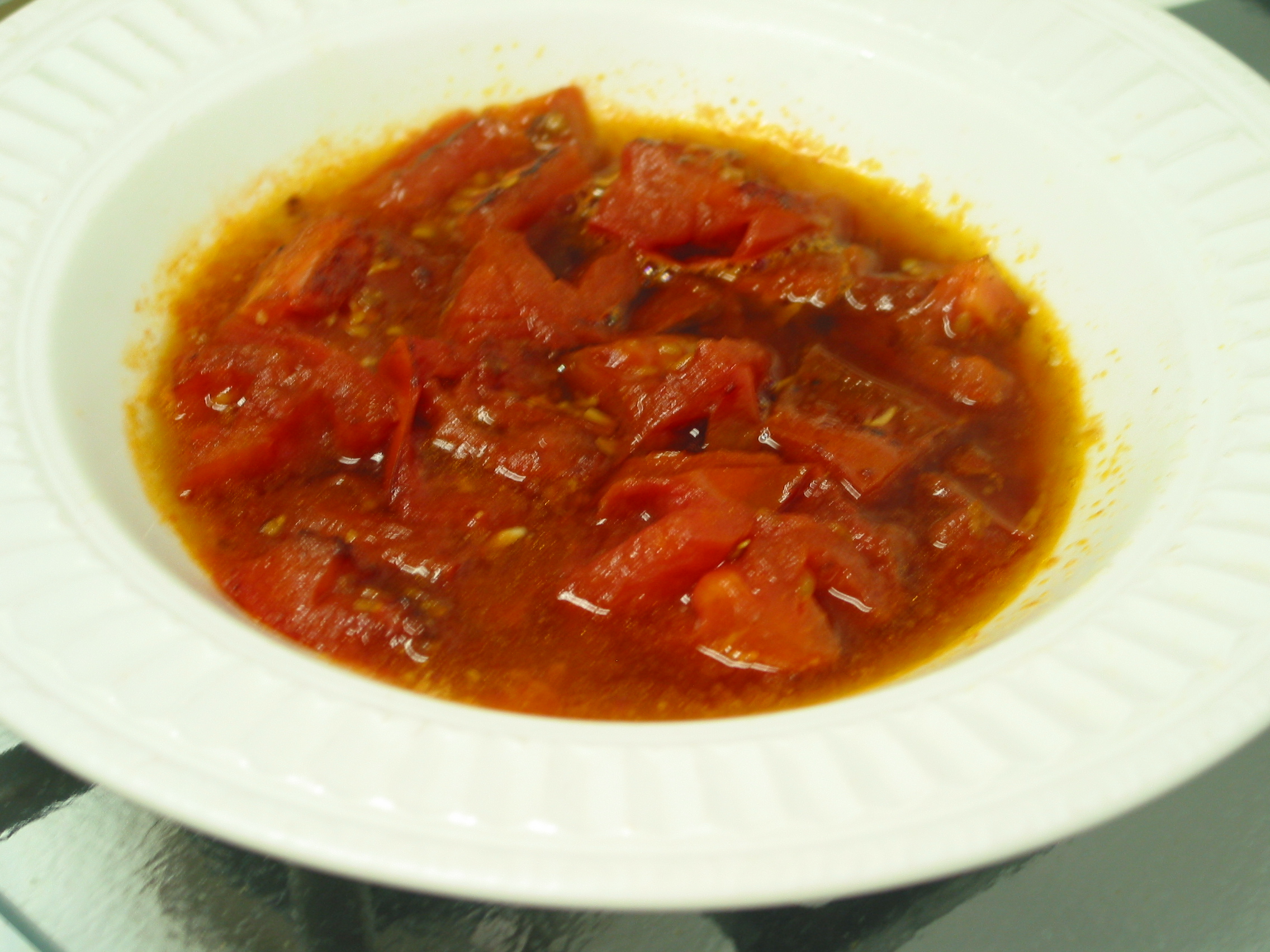
Chunky pan-roasted tomato soup

And it’s tax season.

So what we really need is something to brighten the last dregs of winter. I was thinking tomato soup, myself.

Why was I thinking it? Because so many food articles in the past couple of weeks have mentioned slow-roasted tomatoes, charred tomatoes, and so on to improve the obviously lacking flavor of winter tomatoes and avoid using canned ones. One  chef got flamed for suggesting in the New York Times food section that “local” is not the sane way to go with produce that simply isn’t producing in winter in the northeast, and that canned tomatoes are not the worst idea in the world after all. Shame! Shame!

Actually, I agree with her–and not just because I’m the original purple thumb when it comes to gardening. In a surreal reversal of my hideously lacking garden skills, I actually have three–count ’em, three–grape tomato plants in bloom and producing the occasional tomato-let as we speak. I even have basil and rosemary and mint and thyme that I haven’t killed through inattention and forgetting to water. But really, even so, there’s no way I’d set myself up as a homesteader on those flimsy credentials. We’d starve.

Tomatoes are one of those things–either you’ve got the Fresno specials (or something local and preferably from your own garden so you can brag) in the summer and they’re divine with nothing but a bit of olive oil and vinegar, or even just plain, or else it’s winter and you’ve got blah tomatoes that are kind of orange and grainy. Or you’ve got canned tomatoes, preferably no-salt Romas. Frankly, there’s nothing wrong with that in winter. Or any other time you’re making microwave marinara.

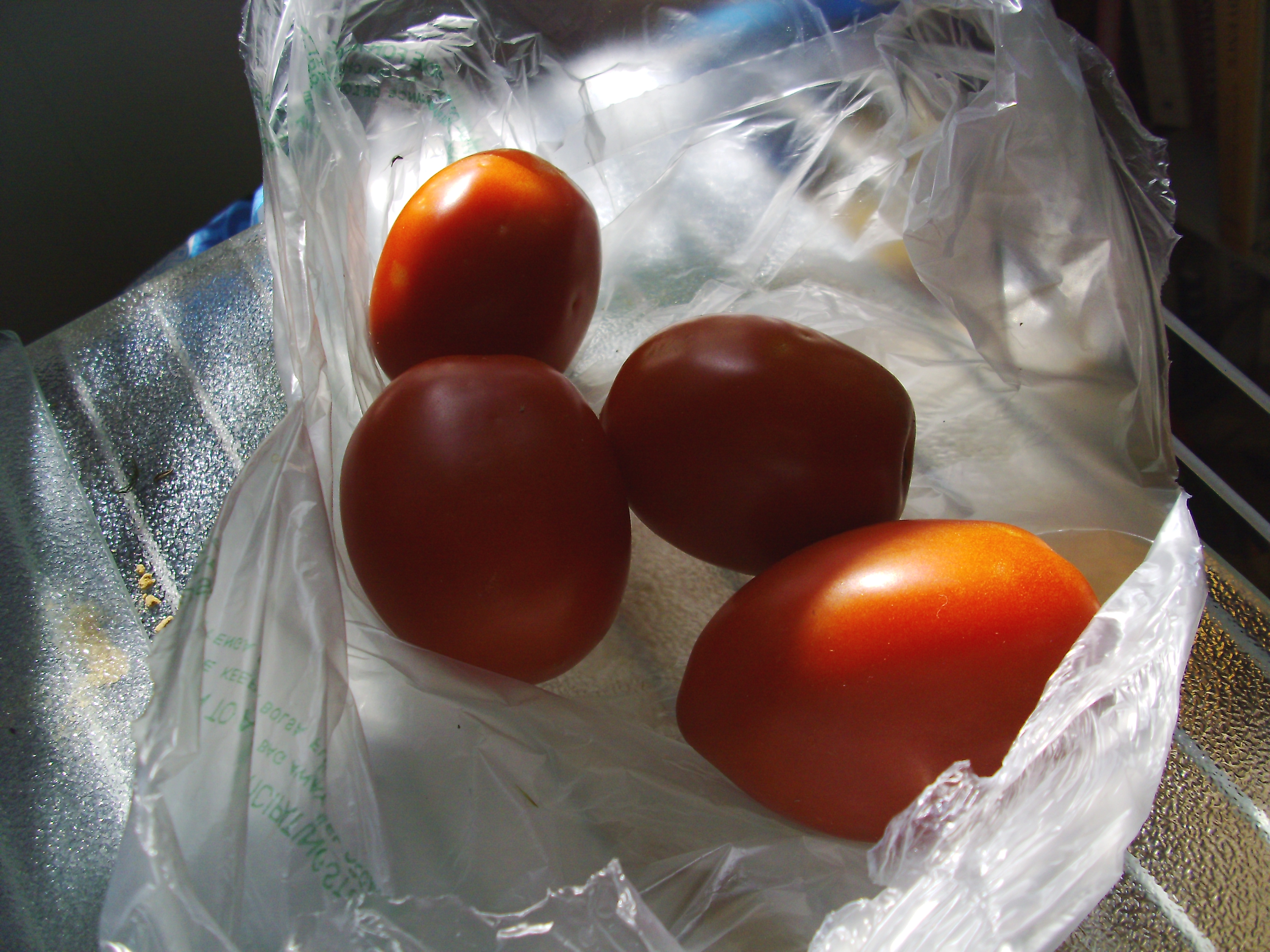
ripening roma tomatoes

However…If your supermarket tomatoes will consent to ripen on a counter near a window for a couple of days, you might be able to eke out some actual tomato flavor from them. They may still not be fantastic, and one or two may start to develop soft spots, but it’s still worth doing anyway. Keep turning them gently every day to minimize the risk of spoilage and use them. They should at least redden.

And as mentioned above in the numerous food section articles, you can do the slow-roast-on-parchment-in-the-oven thing to them and they’ll be a bit more flavorful for sauces and tomato soup. But it takes about 45 minutes to an hour. And I’m impatient.

So today I rescued a couple of aging Roma tomatoes from my countertop and decided to try pan-roasting them, as in frying pan. Would they take on a char? Would they taste better? Would they make soup worth eating?

Bear in mind this is an experiment more than a proper recipe with specific quantities, but yes, it worked, and it only took about 10 minutes from start to finish. Maybe the flavor’s not as glorious as if I’d oven-roasted them for an hour, but the lack of waiting makes it reasonably good, and the garlic makes up for the rest of it. Continue reading

Emergency Éclairs 2.0, Even More Microwaved


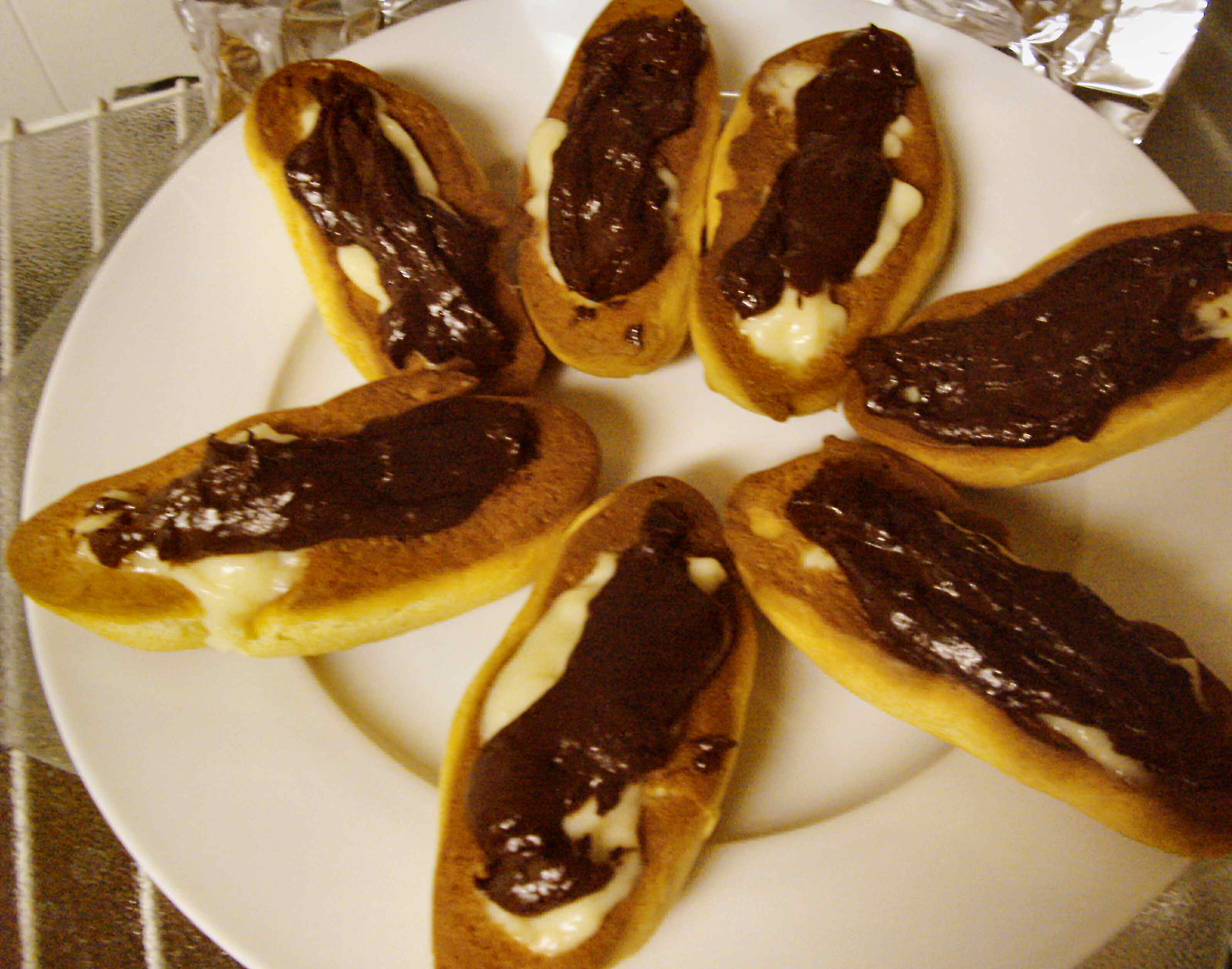
plate of eclairs

All the components of an éclair are at least partly microwaveable, flavorful and pretty forgiving. Even if you have to serve them upside down.

Here we go again, because it’s been Valentine’s Day this past weekend and I have pretty loose time standards for such things…I did actually make these before dinner on the 14th, so it counts. Not that you really need VDay as an excuse.

Éclairs are a lot simpler than they look in the pastry shops, and a lot cheaper than you’d think to make at home–in fact, cheaper than almost any American-style dessert in terms of calories, sugar, fat, salt… A surprisingly small amount of ordinary pantry staple ingredients goes a very long way and makes a bigger show than if you tried making brownies.

If you have a microwave, they can also be a lot quicker than most cookbook recipe specs, even though there are three separate parts to prepare and assemble–the filling, the shell, and the chocolate topping–rather than the usual American one-bowl dump-mix-and-bake scheme.

Éclairs don’t hit you over the head with sweet–they rely on the contrast of textures and flavors between the mostly unsweet pastry shell, the delicately sweet pastry cream, and the deep chocolate (or other flavor, but it has to be an actual flavor to be good, not the typical flavorless, oversweetened canned cake frosting) topping.

Éclairs have also become something of a canvas for artistic expression in Parisian bakeries; David Lebovitz has some great photos of ones with reproductions of paintings screened onto the tops, woodland scenes in colored icing and fondant and flavored marshmallows, fruit fantasias, and I don’t know what else, not to mention the fillings. They’re gorgeous to look at in the glass pastry cases but you couldn’t walk down the street, find a park bench, and just eat them with your fingers. You’d end up wearing them.

So the classic chocolate-topped, pastry cream-filled éclairs are still my favorite, partly because you can’t find them in most of the bakeries here.

Baking the dough is the one part you can’t really do in the microwave, more’s the pity (although you can do it in the toaster oven for a small batch). But otherwise, I can say it was worth it and–although I needed to step on a scale Monday morning to be certain–not that devastating dietwise…or even diabetes-wise. But, as with rugelach, you probably shouldn’t do this too often. Holidays and sharing are a pretty good idea. Leftovers are not. Limit the dietary badness.

Unromantic morning-after nutrition stat check: At the medium-small size I made, they weigh in at about 22 grams of carbohydrate, 160 calories, 6 grams of fat (mostly saturated, from the butter and chocolate plus egg yolks) and maybe 40-50 mg max of sodium apiece. Verdict: Not too shabby for a French dessert. Could be worse and often is. Stick to one apiece, plus some fruit, and eat it with a light supper that includes a green salad and you should be reasonably fine. Also svelte, happy, and able to sing «Non…je ne régrette rien…» the next morning. But please don’t. Not before coffee.

Even if you eat two at a time after supper because you’re not sure how long you can store the extras in the fridge so they don’t go all soggy the next day, it shouldn’t hit you like a ton of lead…well, not too much like a ton of lead. At least they weren’t full sized; they were pretty filling. Afterward, when we were lying in a daze on the couch recovering, my husband suggested just freezing any extras next time. He had a point.

About halving a recipe

I was in a hurry and couldn’t find the lower-saturated-fat recipe I’d used successfully for “Emergency éclairs 1.0” so I went with the recipes for choux paste shells and pastry cream in the “basics” back section of the white Silver Palate Cookbook. The dough and pastry cream worked fine in the microwave, as I think almost any standard recipes would.

Since there are only myself, my husband and our daughter here for dinner and eligible for éclairs (plus the cat, who is miffed that we didn’t count her), I cut both recipes in half–I repeat, limit the dietary badness…

The pastry cream was fine, but I hadn’t read all the instructions for the choux pastry, or I’d have known that the 3rd egg was for a completely unnecessary egg yolk glaze. When I halved the recipe I used an extra egg white as the “half egg,” and when the puffs puffed, they left nothing behind, no base, just a hollow, once I peeled them off the foil. The result was still fine for us but a little awkward for presentation–I had to sit them upside down like boats to fill them, and then cover the filling with the ganache. So definitely go back to the right proportions for the choux recipe (repeated below).

The ganache…is always very chocolate, very microwaveable, very forgiving of awkwardness and therefore perfection itself. It covers a lot of sins and makes you feel much better about them.

Mostly Microwaveable Éclairs

This is half-recipes all the way: it makes 6-7 half-size éclairs, 3″ rather than the standard 6″ monsters at the bakery. We each had two after supper and were completely stuffed.

Timing: If you’re doing the whole thing in one go, start by preheating the (regular) oven to 400 F, then make the pastry cream, which is really fast, and chill and stick it in the fridge, then do the choux paste, because as soon as you make that you need to dollop it out and bake it right away. If you use the microwave for the pastry cream, and you should, the choux will be ready to go just about when the oven beeps. Continue reading

Green Beans Get Serious

If you’ve gone to the supermarket the last couple of weeks, and seen huge haystacks of green beans on sale for under a dollar a pound, you might be wondering to yourself how much green bean casserole can any one family take? Pretty bad that Thanksgiving only has one sanctioned green bean recipe, and that no one can think of anything better to do with them over the holidays.

Not that I’m against plain and simple green beans, as long as they’re actually still green. Fresh, lightly steamed or microwaved or stir-fried, not boiled to death. Although frankly, I often prefer them raw and fresh as something to just wash and nosh, like carrot sticks or celery.

Even frozen green beans are fine if you treat them gently and cook them a bit less than you would fresh ones–the freezing and thawing break down all vegetables slightly, and you don’t want them to go to mush or turn brown.

Just not the dank, slimy brown horrors that emerged from a can every once in a while when I was a kid, and which my mother insisted, against all reason, had once been something living. Canned green beans are the zombies of the green bean world.

But with a bounty of cheap greens in winter, what to do with them is a pretty good question, and one that begs a three-minute solution, especially when most green vegetables are getting harder to come by. You want to stock up but you don’t want to be eating the same old, same old for a month.

My best solution for a quick green bean dish–other than the grab-and-go raw snack vegetable business above–is of course to wash and trim the tough ends from a bunch of green beans (I usually grab about a pound at a time). Stick them in a covered container or between two microwaveable stoneware or Corelle dinner plates with a drizzle of water (anything from a couple of tablespoons up to about a quarter-inch in depth) .

Three minutes on HIGH should cook a pound of rinsed and trimmed green beans to that crisp-tender ideal where they’re still green and just cooked but still have a bit of bite to them. Basically like blanched or steamed, but without the big stockpot of boiling water (which I hate to wait for and which seems a waste), the strainer, or the ice water bath (another wasted bowl).

And you can do it right before dinner as a last-minute thought, just enough for that meal so they stay green. Drain and serve them ASAP for best results. Don’t give ’em a chance to go brown.

If you want to keep them green for later, microwave them a little less, maybe 1.5-2.5 minutes per pound, just until they begin to turn jewel green, rinse them under a cold tap as soon as they’re done, drain and chill. Do not add anything acidic to them until just before you serve them so they don’t turn olive-brown.

Yes, it’s pretty plain–which is handy if you want it versatile. You can serve them hot with a mustard garlic vinaigrette or other salad-type dressing to dip into or drizzle over them. Or the richer (but not saturated-fat) sauces, tehina with lemon and garlic (and either water or plain yogurt), or Asian peanut sauce with chile, garlic and ginger are also good.

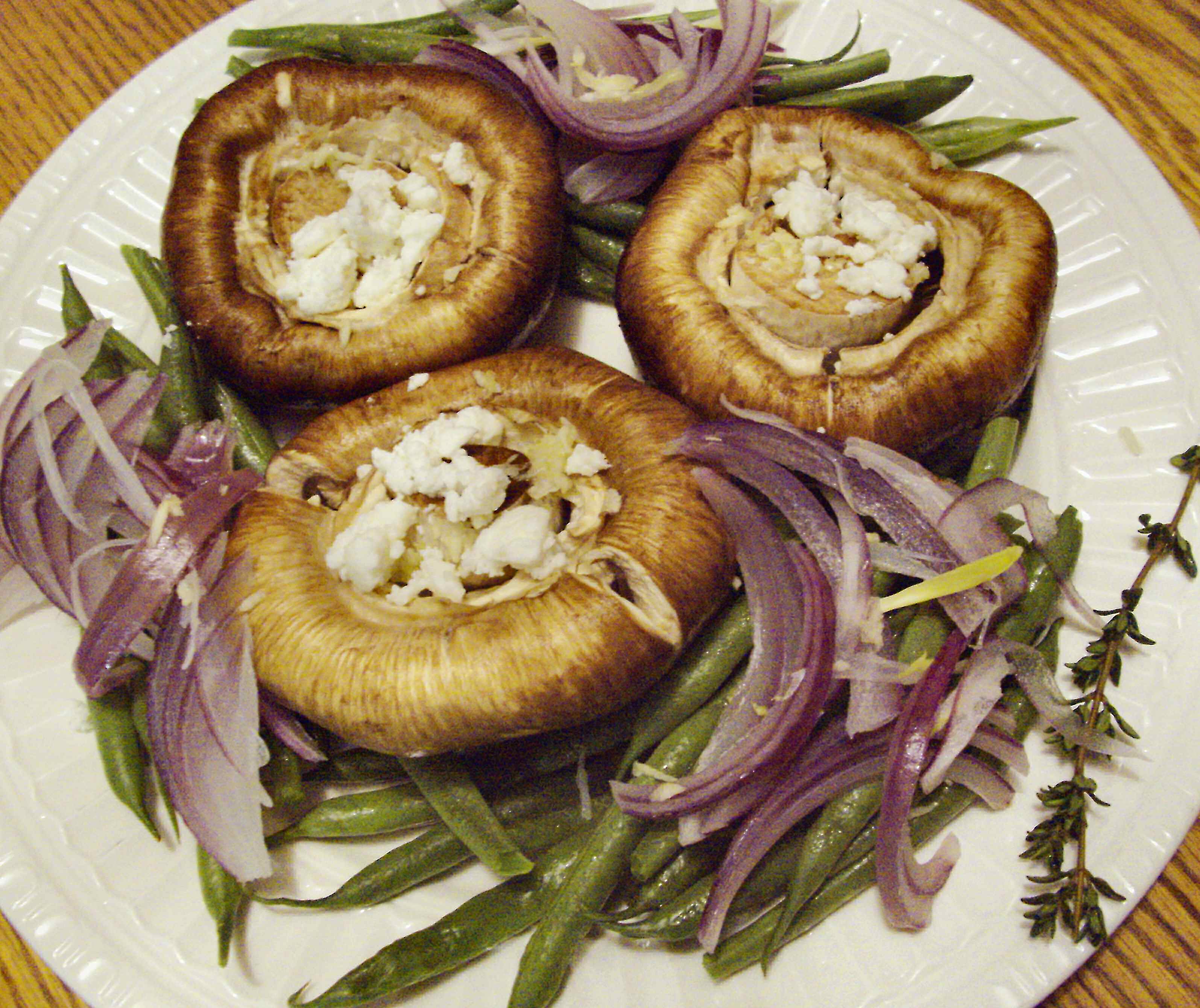
If you want something a little fancier-looking and vaguely French (we’re going for “day in Monet’s Garden,” not “tacky tourist café with haricots verts side dish that turns out to be nothing more than buttered overcooked green beans”) you can arrange the green beans in a covered stoneware platter or bowl, with thinly sliced onions and a bit of thyme and minced garlic strewn around to get a fairly nice-looking and savory microwave-to-table kind of dish that still only takes a few minutes to throw together and zap to perfection.

greenbeanswithstuffedcriminimushrooms

Slice some mushrooms over the green beans or nestle mushroom Continue reading

How to fly with a pie

Happy Chanukah–tonight was the first night–and as per usual, a belated Happy Thanksgiving too. I hope everyone ate nice, had fun, enjoyed and helped do the dishes wherever you gathered.

Now that it’s over, I have a few more additions to the list of things I’ve learned–good or bad–about How To Travel With Food ™. Because my in-laws, who usually host Thanksgiving, are traveling in Africa (!!!–think elephants coming up to their cabin porch), my ex-brother-in-law invited all the rest of us to join him for the weekend instead. In Sonoma. At what turned out to be not a cabin with or without elephants, but a luxurious private residence he’d booked for the group as a vacation rental. And it was out and out marvelous. If a little weird and unsettling in its own way.

Sonoma-Kenwood.jpg

When we were still deciding how to reach Sonoma from Pasadena, we realized with dismay that it’s about 10 or 11 hours by car at the best of times, and Thanksgiving week is not the best of times. When we lived on the east coast, a trip like that would have us thinking airplane automatically, but out here we usually just suffer. My niece and her boyfriend drove up from San Luis Obispo, usually 4 hours north of us, and it took them 9 hours instead of 5 or 6. So I was really grateful to my husband for finding affordable plane tickets for an hour’s flight into Oakland. So far, so good, and it took a lot of the strain out.

But all those airline rules. And we were the ones bringing pumpkin pie. In carry-on. My ex-BIL offered to pick up a couple of big stalks of brussels sprouts for me up there (I don’t think we even had any more at down here by this time; Trader Joe’s was out of them by weeks) as well as a green cabbage for Greek cabbage salad. These are big heavy scary-looking items you just don’t want to schlep on a plane unless you’re auditioning for the live version of Shrek. As the shopping list got longer, I decided to just bake the pies at home, cool them, freeze them as far as possible, and take them in a stiff box with some ice packs stuffed in the corners and hope for the best.

Continue reading

In search of good rye bread

I’ve been attempting rye bread and kornbroyt (Jewish sourdough whole wheat bread) on and off since about last Chanukah–almost a whole year! You would think this was unnecessary, since I live close enough to North Hollywood/Valley Village, the eastern hub of LA for Jewish bakeries and delis (the older western hub is “the Fairfax” neighborhood and the Pico/Robertson area). The rye bread you can get at these places isn’t terrible; my synagogue orders it regularly along with 6-braid challahs for big events, and it’s okay. It just isn’t much better than Arnold’s or Sara Lee, the lightweight commercial supermarket versions I grew up with in the south when we couldn’t get the real thing from New York more than once or twice a year.

Last spring I bought the big crusty half-boule loaves of wholewheat sourdough from Trader Joe’s to sub in for kornbroyt at a big synagogue brunch and they were wonderful–and also not screamingly high in sodium as most hard-crust sourdoughs are (Whole Foods, most bakeries, certainly La Brea and friends). Certainly less per serving than the French loaves and ciabattas and other items on the gourmet bread stand at TJs. The Pain Mich’ demi-boule was a very good deal all the way around, and I’ve bought it weekly for years.

But shortly afterward, TJs switched bakers and the new ones produced something that only looked similar. The crust was flabby and the crumb was like the stuffing of old office chairs–crumbly and weak, lacking flavor, not springy and full of moxie like the real thing. What could have happened to my favorite shortcut to the good life? They still haven’t fixed the problem. Which is probably at least partly due to an inferior use of sour culture. Or CUL-choo-ah as my mom says (Brooklyn accent hard to miss).

So I was going to have to figure it out for myself if I didn’t want to remain a deprived child.

For the past 30-40 years, according to Stan Ginsberg and Norm Berg in their book Inside the Jewish Bakery, the flavor and texture of commercial rye bread  have really been watered down as companies went national and American-style with it. It became paler and lighter in texture, with less rye flour and more additives–oils, conditioners, salt. And they used commercial dry yeast instead of sourdough culture, which takes too long and for a long time wasn’t generally considered reliable or controlled enough a process for mass production–probably not for FDA and local health inspectors either. So most commercial rye bread lacks the true rye sour starter flavor, and is no longer really chewy or dark. Or crusty. Which is how I want mine.

All of those lost characteristics from my childhood memories of real New York rye bread and kornbroyt, made by local union bakers and brought down to Virginia once or twice a year by my grandparents, have now regained popularity in the US foodie arena. Well, not rye bread as such, but “old world” artisan wholegrain sourdough breads that seek to copy Poilâne’s legendarily crusty round loaf. Enthusiasts bring up a lot of sinister-sounding bakers’ terms: levain, cloak, slash, hydration percentage, etc. And they’ve come respectably close. But they’re still lacking the sign of authenticity: the union label pasted on the endpiece!

One major American bakery to achieve similar cult status to Poilâne is Tartine. Complete with three lengthy baking manuals so far on how to build a sour, incorporate all kinds of grains and let the sour culture digest them for the right number of days until they’re ready to set up as loaves.

The books are filled with gorgeous, crusty loaves that cost a fortune at gourmet bakeries if you can find them at all in your town. But it’s like looking through the bakery window, hungry, with your nose pressed up against the glass. Most people don’t have the singlemindedness to follow all the steps at home more than once, much less for more than one or two varieties of more-expensive, Whole-Foods-only, alternate grain breads.

The books are also filled with testimony as to just how many years it took each baker on the team to fulfill his or her apprenticeship and perfect the technique.

Years, though. That’s a lot of time to get yourself a decent home-baked loaf of rye bread that tastes like it could stand up to corned beef. Which makes me wonder whether a mere cookbook can really teach it.

So why bother (except for the perverse curiosity that drives me to mad-scientist-like experiments that probably won’t win the Nobel this year, or any year)? Because once in a while you want good rye bread even if you live on the West Coast.

Looking at the pictures and even reading the instructions can’t give you the exact right sour or air temp or humidity or other conditions that make Tartine’s bread award-winning. Your yeast may vary. You may not have the same sensitivity in your hands or know exactly how moist or elastic or heavy or whatever the dough needs to feel like at each stage. You have to be willing to experiment and fail a couple of times and pay attention to how it looks, feels, smells, and be willing to fiddle around and adjust the next time.

That’s okay. Perfection is not a Jewish ideal, so much, and rye bread is not so hard to improve with practice. Our great-(great-etc.) grandmothers were making rye bread pretty often in the shtetls with whatever starters they had and could keep going throughout some pretty challenging winters. And every spring they’d have to get rid of their sour cultures right before Passover and start over from scratch as soon as it was over. In Russian-Polish spring weather. (My grandfather always said you knew it was spring when the first oxcart got stuck in the mud. It meant the ground had finally thawed.)

So you could probably figure that the women in the shtetls weren’t always overjoyed to have to throw away their sour cultures every spring, and the first loaves of bread in the shtetls after Passover ended might not have been a lot of good for a week or so extra. Or they could have turned out like my first one, especially if it took an extra week for the miller to supply new rye and wheat flour.

To tell you the truth: getting a rye sour started is no big deal–I seem to have done it on the first try, even while taking the onion shortcut (see the bottom of the post) and being much too casual with the flour and water proportions in Ginsberg and Berg’s rye bread instructions from Inside the Jewish Bakery. It’s just that getting the sour ready for baking takes a while–like 3 to 5 days. And then it gets more refined and hopefully consistent as you feed it sequentially over time. Professional bakers guard their established sours like gold.

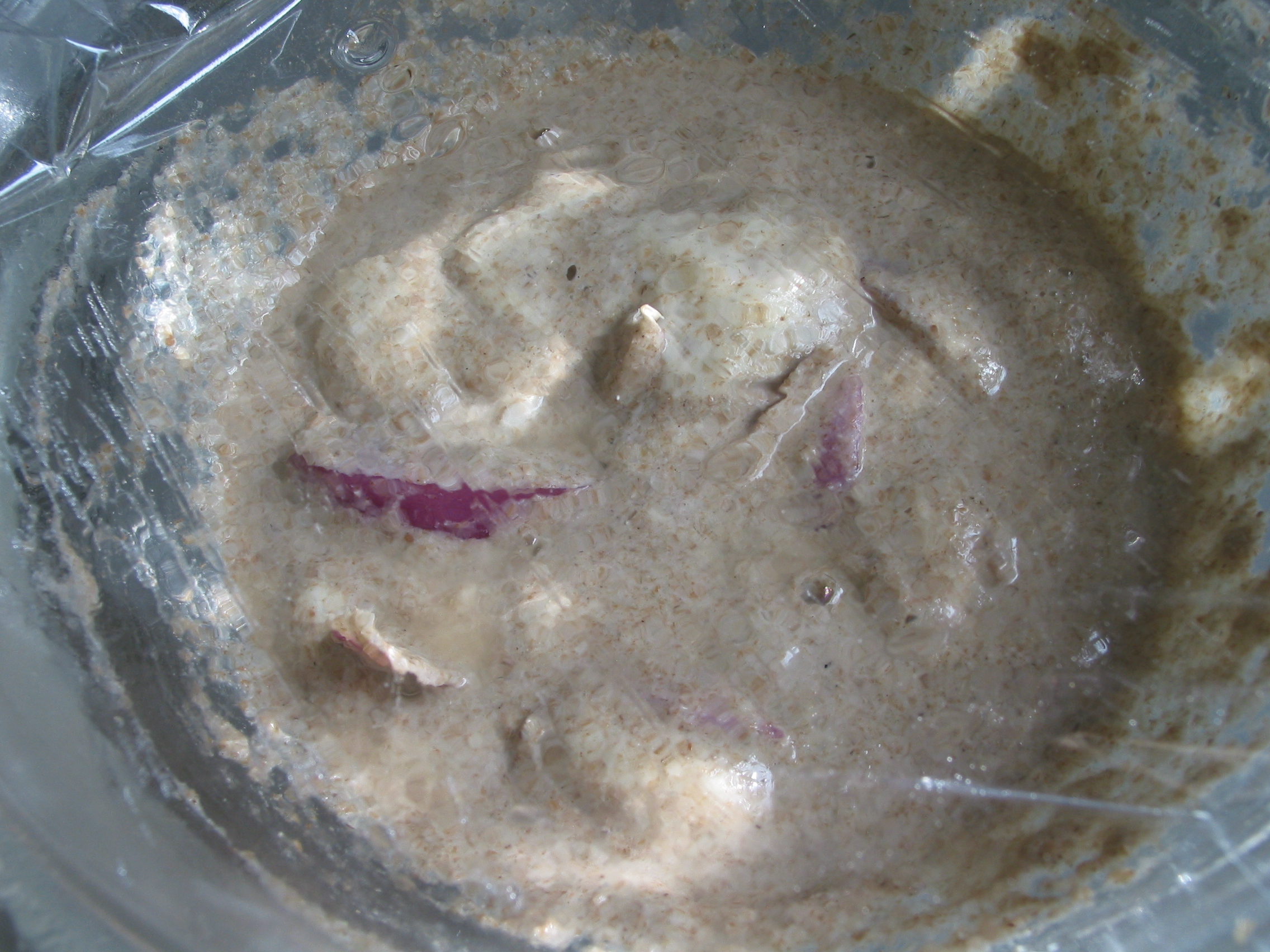
Rye sour getting started with raw onion

Rye sour getting started with raw onion

What went wrong on my first try, right before New Year’s, was that I didn’t put in quite enough wheat flour for the final dough. I was still thinking loose, elastic, relatively wet dough like my usual pizza dough or challah dough, and this needed to be stiffer to match the picture in the book, which showed an actual spherical ball of dough. I figured my usual dough would be a little moister and give nice, big ragged holes–however… Continue reading

Another Greek salad

Greek cabbage saladWhen we think of Greek salads here in the US, it’s mostly horiatiki (a version of which is my current favorite lunch)–chopped tomato, cucumber, maybe peppers, some onion, feta and olives. Lahano salata, a shredded cabbage salad with lemon and olives, is less familiar and served, according to cookbook author Rena Salaman in The Greek Cook: Simple Seasonal Food, (Aquamarine/Anness Publishing, NYC ©2001), as a winter side dish–because you always have cabbage available, and lemons are a winter crop in the Mediterranean (and southern California). All you need to add are garlic, parsley, olives and olive oil and you’ve got it. Actually, that really sounds like a perfect summer thing to me.

I picked up a green cabbage today at my local greengrocer’s because it was there, it was cheap, I already had a red cabbage at home for other stuff, and besides, you can’t just hang around your local greengrocer’s picking up seven or eight pounds of fabulously ripe Fresno tomatoes all on their lonesome every couple of days. People will suspect you of becoming a tomatoholic. You need to branch out. And besides, I’d already made a tomato-cucumber-pepper salad pretty much every day for the past two weeks for lunch (as noted above). Not that I’m bored with it, but it gives me permission to do something else for dinner.

This Greek slivered cabbage salad is something I’d had in the back of my mind for half a year or so since paging through Salaman’s cookbook and its gorgeous food photos. But since it’s summertime, limiting the herbs to parsley seems like a missed opportunity when there are so many fresh herbs going wild in my fridge.

Dill, basil, mint, scallions–my current favorite mix for the lunch salad would probably also be good with shredded green cabbage. So I did a variation using those and foisted it on my unsuspecting nearest and dearest, who were both in need of something lighter than usual for supper. It went pretty well and we all agreed it would be a good filler for the salad part of a felafel pita.

I mixed this salad up about an hour before serving and stuck it in the fridge. I realized belatedly that the abundant lemon juice in the dressing would probably start wilting the cabbage, and it did slightly. It would have retained more crunch if I’d mixed it right as we were about to eat, but we still liked it and it wasn’t actually limp, just a little softened. I didn’t think the leftovers would hold up more than a day in the fridge but they did okay and didn’t wilt further overnight–perhaps because I poured off the excess liquid before storing the salad in a snaplock container.

One thing I like about cabbages is that they go a long way. You can take a quarter, wrap and refrigerate the rest and it should stay good for a couple of weeks. You might have to shave off any dried-out cut surfaces the next time (certainly for red cabbage, which also discolors a little at the dried surfaces) but the rest should stay pretty fresh.

Lahano Salata (Greek Green Cabbage Salad, Summer-style)

(Adapted from Rena Salaman’s The Greek Cook: Simple Seasonal Food; ingredient amounts are “use your best judgment”)–for 3-4 people as a side dish or pita filling as a bed for other stuff like felafel or kebabs. If you use a whole head of cabbage as in Salaman’s original recipe, increase everything by about 4-fold or to taste.)

  • 1/4 head of a washed green cabbage (the two outer leaves peeled and discarded, the rest rinsed under the tap)
  • small handful of herbs–a sprig or two each of dill, basil, and mint; parsley is okay too–finely chopped
  • 2 scallions, finely chopped
  • 3-4 pitted Greek-style olives (kalamata, Alfonso, Gaeta…), slivered
  • juice of a lemon or to taste–half a very large lemon was pretty lemony for just a quarter of a cabbage. For a medium or small lemon, taste and add a 3rd half if you think it needs more
  • 1-2 T olive oil

Shred the cabbage finely with a sharp knife and chop into manageable lengths unless you like the shreds long (Rena Salaman’s book had a pretty photo with very long straight shreds, almost like angel hair pasta. She mentions that the cabbages in Greece are different from standard American or northern European ones, so that may be part of it. Ours are curlier when shredded). Add the herbs, scallions and olive slivers, squeeze on the lemon and drizzle on the olive oil, then toss with two forks until everything’s well mixed. You can let the salad soften a little in the fridge for half an hour or so, or you can serve it straight up while it’s still a bit crunchy–it’s good either way.

Frittata on the Rebound

Dr. Lustig’s “Teaching Breakfast” clinical teaching program for families with obese or diabetic children posed a question for me that I didn’t get a chance to test out until this morning. If something with balanced protein and vegetables–say, an omelet–is a better choice than most breakfast cereal, or poptarts, or doughnuts, or whatever most kids are eating before they go to school, how do you get that to be affordable and quick to prepare on a schoolday?

The easiest way to do eggs for several people at a time without overdoing the cholesterol is probably to do a big omelet or scramble and take out some of the yolks. But you might not have time  to do it at the optimal time for the gourmet–that is, right before you’re going to eat it. Not if you’re heading your kid(s) out the door with the daily litany to grab socks, shoes, homework and lunches and not to worry about what color lipstick (or hairstyle, or comic book, depending on age and taste) because you’re going to be late and come on, already.

We didn’t have this problem in my childhood; you either got out to the bus stop on time by yourself or you walked to school in disgrace, because my mother was not going to make our breakfast or lunch (for which we were immensely grateful), or do any big rescues for “emergencies” based on footdragging. And staying home was not an option we wanted to explore. My sister and I could count on the other one telling on us, not to mention the prospect of running into Mom if she came home early or picked up a phone call from the school attendance clerk. Motivation is everything…

But grownups have these dilemmas too. Who wants to be messing about with a frying pan and washing up when you’re trying to get to work? So many of my daughter’s teachers last year could be spotted out in the parking lot of the school right before the first bell, standing by their cars and bolting down an egg mcmuffin-type thing from a fast food drive-through (drive-thru? hate that commercial spelling) with a cup of coffee in the other hand. Quick, seemingly nutritious, but actually horribly high-salt-and-fat-and-calorie-for-what-it-is, and quite expensive too. Not a good daily habit. If you can do eggs and coffee from scratch at home, you’re bound to do them better and a lot cheaper. You could probably save up for a new tablet or pair of theater tickets within weeks, and you might even lose a bit of weight.

So eggs. A frittata has a lot more vegetation in it than a classic French-style omelet, and it’s more sturdy–look at the very solid, nearly stiff Spanish potato-filled version; always served at room temperature in cubes or wedge slices, almost as some kind of potato kugel.

Well, okay, you don’t want a potato frittata if you’re trying to get the nutrition up to snuff without tons of calories or grams of carb. You want some lighter but substantial vegetables so you don’t end up feeling like you swallowed a lead balloon for the rest of the day.

But the good news is that you don’t have to cook and serve it right on the spot. You can do it ahead and stick it in the fridge. If you do it the night before, you can cut it into wedges and microwave one on a plate for 15-30 seconds and you’re ready to go. Or, of course, you can serve it cold–kind of like the classic cold pizza for breakfast, only  better balanced. And most frittatas go well with salsa.

I am not a fan of the kind of isn’t-it-rustic-Italian-or-Provençal glossy magazine frittata instructions that call for frying first and then running under a broiler or what have you. That takes time and heats up the house ( bad in Los Angeles) and probably calls for expensive stovetop-to-oven-friendly cookware, which is usually not [sorry, forgot the “not” when I first posted this] nonstick. A lot of excess fuss for an effect you can perfectly well achieve in an ordinary nonstick frying pan in a couple of minutes on the stovetop, which is how most people who make frittatas at home “authentically” in tiny Italian or Provençal kitchens actually make them. Unless you’re doing a fancy brunch service for 20 diners at a time, in which case it might actually be quicker to do a baked eggs thing in a big casserole and skip the frying. But then I’d hope you were getting paid through the nose for that. Little chance of collecting caterer’s fees at home.

As for the vegetables, cauliflower and zucchini are both very good low-carb, low-calorie stand-ins for potato, and they’re pretty inexpensive and easy to prepare, especially if you have a microwave so you can parcook them on a plate for a minute or so before adding them to the frying pan. That gives you a chance to soften them through quickly and at the same time drain off some of the liquid–they’ll fry faster and won’t make the frittata soggy.

Cauliflower has more fiber, vitamin C and calcium than zucchini, and it’s a bit firmer as well. Zucchini is milder and easier for kids (or adults) who aren’t yet used to eating a variety of vegetables. A frittata like this is also the ideal way to use up that scary-big overgrown zucchini your enthusiastic gardening neighbor gifted you with. Or that someone anonymous parked on your doorstep in the middle of the night.

…It is getting to be the season for that sort of reverse larceny, now that I think about it. Someday I feel it would be right to invent a spring-loaded, siren-enhanced trap for stealth zucchini donors. Something involving on-the-spot forced acceptance of a large cafeteria-style green or orange jello mold with canned fruit cocktail floating in it, faded-pink “cherries” and all, as the price of escape…  Or maybe I’ve just been watching too much “Big Bang Theory” with my daughter this weekend and have started to channel my inner Sheldon. And really, I don’t mind stealth zucchini nearly as much as gifted Meyer lemons.

Okay. Back to the frittata–after all, if you already know how to make a basic omelet, this post is mostly just for entertainment, a mere vehicle for shocking photos of various vegetables that have been foisted off on us by well-meaning friends. It’s enough to make you feel like Wallace & Grommit in “The Curse of the Were-Rabbit”:

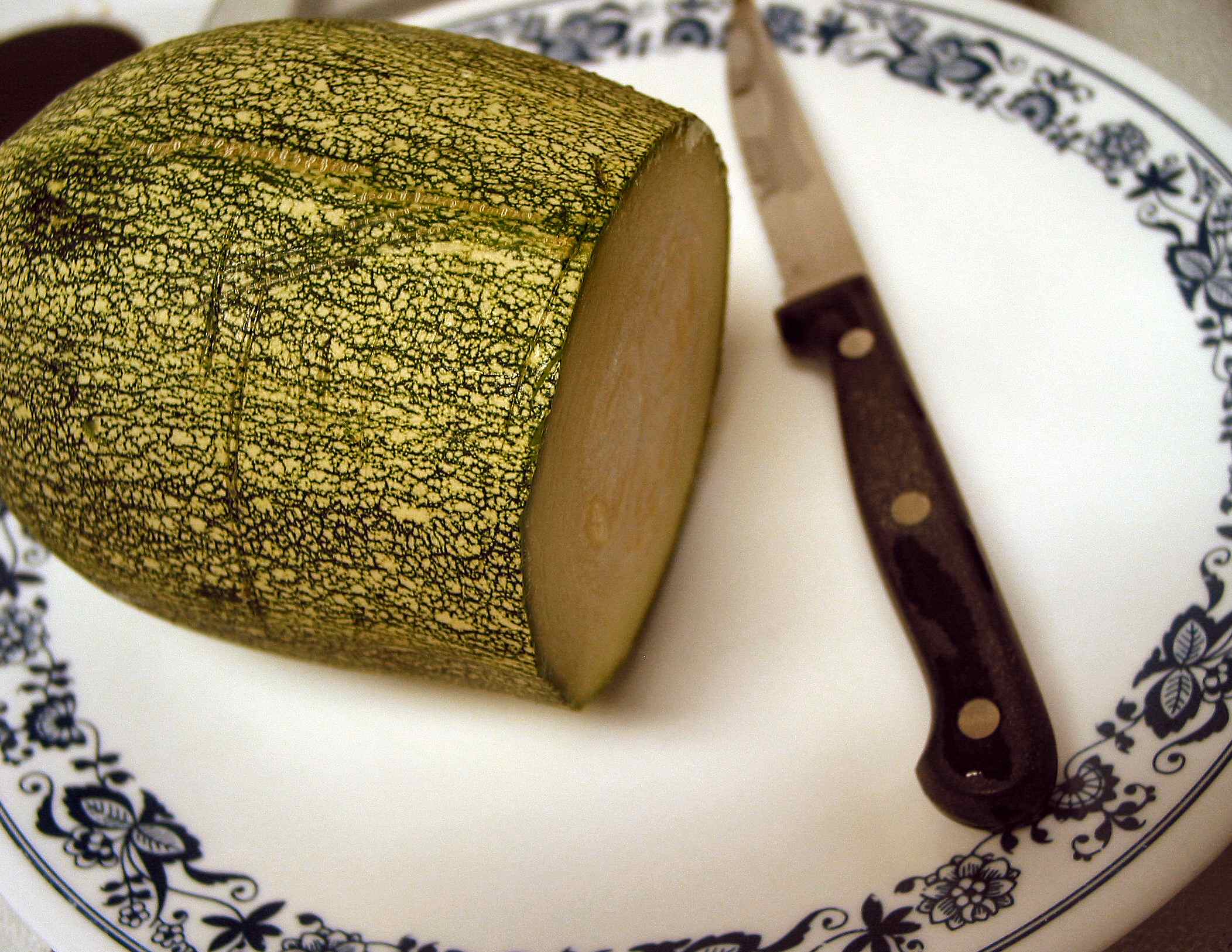
Monster zucchini half

Monster zucchini. This is a dinner plate and steak knife we’re talking about here. And only half the zucchini. The other half of which I’m sure is still stalking the neighborhood in the wee hours of the night.

IMG_8903

Breaking down a zucchini (well, how would YOU go about it? I didn’t have a wooden stake or silver bullet or anything) for a monster omelet.

Continue reading

Happy 4th!

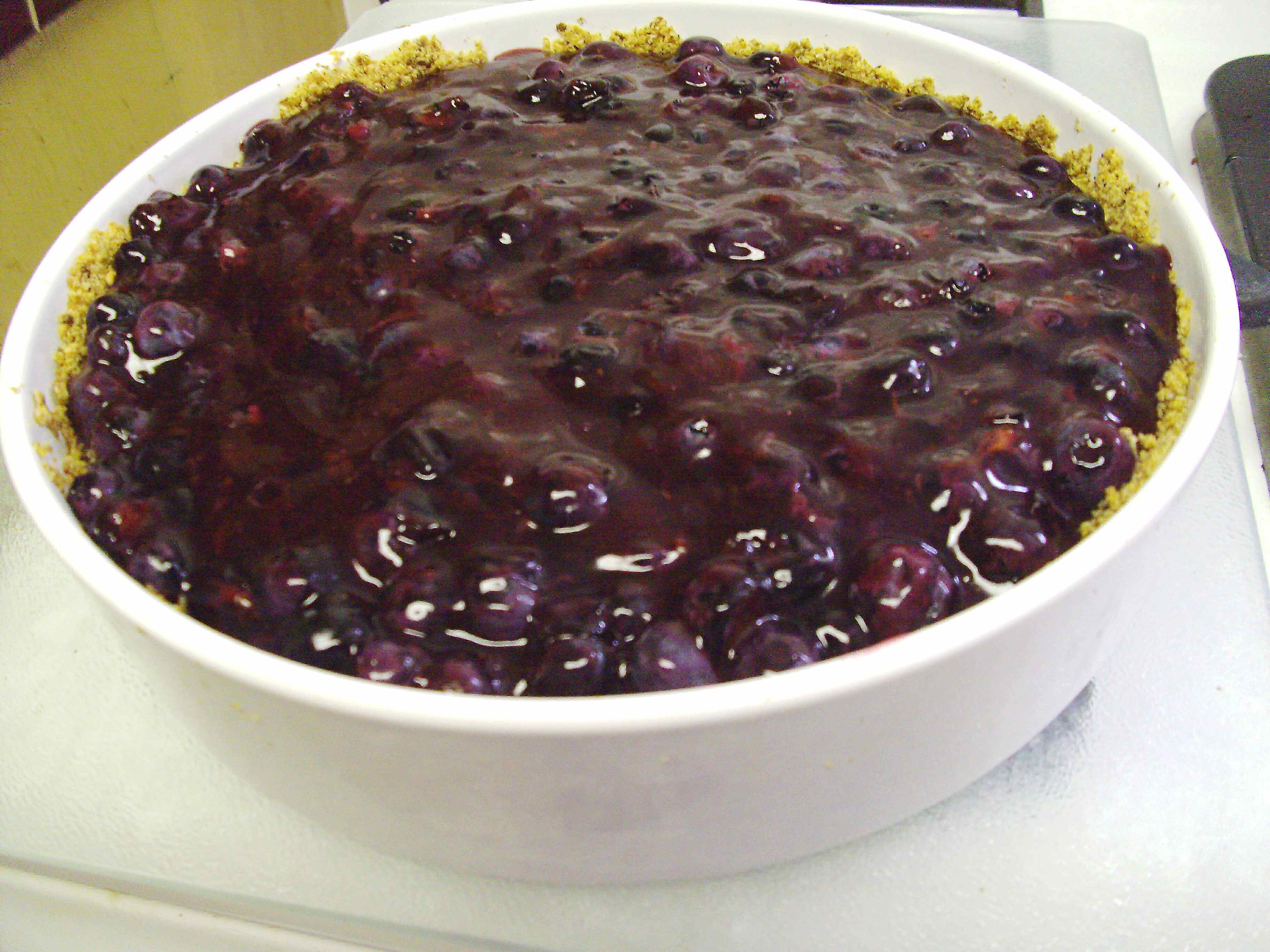
rawblueberrypie-2pounder-med

The raw blueberry pie right before we cut into it.

If you have to do a pie in the middle of summer, say, if you’re bringing something to a Fourth of July outing, this might be the kind you want. It only takes a few minutes to put together (other than picking over the blueberries to make sure you’re not leaving any stems in). And Trader Joe’s is selling two-pound containers of blueberries for a moderate price, about $6, at least in southern California. That’s enough for a pretty big pie. So I got two boxes for my daughter’s birthday party last week and discovered that just one box was about a third more than my old newspaper recipe called for. Well…we can always use a few blueberries around the house! And the pie ingredients are so simple it’s not hard to scale up a bit and still have it work out nicely. Very nicely, in fact.

The syrup you start the filling with can be boiled up in a minute or so in the microwave, so you don’t have to heat up your house or stand over a stove. Then you just stir in the starch slurry and some lime juice to thicken it, and start folding in the raw berries. When they’re all in, you pour it into the crust and let it cool until set.

And I’m not sure you actually have to run an oven for a graham cracker crust, although I did for about 10 minutes–I think it makes the sugars melt a bit with the butter, so the resulting caramel, if you can call it that, binds the crumbs together and then hardens slightly when it cools and the crust stays crisp a little longer. But maybe that’s just fantasy. If you want to keep the oven off, you’ve got my vote. If you want to buy a frozen graham cracker crust-lined pie tin (or two; with this amount of filling you could probably do 2 standard smaller pies), that’s your call too.

I don’t usually buy graham crackers at all, but for this I think it’s worth doing the crust at home–it takes maybe 2-3 minutes to grind up enough for a crust and press it into a pan, and it’s a little more versatile than the commercial versions. I can put in a bit less sugar and butter than the standard crust recipes do, skip the salt, throw in a little almond meal if I feel like it, and add a couple of pinches of cinnamon and ginger to spice things up. Leftover crackers are handy for making impromptu ice cream sandwiches, if you can keep your kids away from them until you’re ready to do that.

Here’s my scaled-up version for a two-pound box (909 g. approximately) of fresh blueberries. That’s about 300 grams more blueberries than the old 4-cup recipe I copied from my mother-in-law, so it needs somewhat more in the way of crust and sugar, but not actually that much more–go by taste and be conservative. This version is sweet but fresh, which is the joy of keeping most of the blueberries raw. It won’t make you feel like you’ve just eaten half a jar of jam. Continue reading

This always happens right before vacation…

Finally, finally, we are going to the East Coast. We’ve had to put off seeing my mom and my sister (and assorted boys) twice since December due to incessant snow, none of which hit Los Angeles in the slightest. So as soon as school lets out, we’re packing for an ungodly wake-up call the next morning and getting out of SoCal for a bit more than a week. The cat gets a hotel/spa vacation without all the schlepping around between Bahston and New Yawk. We get the do-we-have-enough-clean-undies-to-make-it version.

So good, already. But as in many of my tangled big-event preparation schemes, I have a slight problem with the fridge:

Stuffed fridge right before traveling

The problem, part I…Note the tomatoes: 10+, excessively ripe, and the invisible 6 or so red peppers behind them. Not to mention the huge bag with 7-8 bunches of fresh herbs…

fridgedoor

Part II, the door…Note the huge bag of nectarines, lower left, the chiles just behind the mushrooms and two bags of apricots at right, just because…

AAAgh…just a little insane. Suffice it to say, it’s been an enthusiastic week or so vegetable-shopping-wise because the Fresno tomatoes are back in my local greengrocer’s, along with a lot of other produce, and I’ve gone overboard on a number of items, not least of which are lemon basil, mint, dill and tarragon (which I haven’t even decided if I like). The market beckons, the low prices for herbs and vegetables even more so, and the sun’s finally come out again after a month of gray days. And I’m a purple thumb as a gardener, so the greengrocer’s wares beckon even more strongly. How could I not want it all? But a little thought for the calendar might not have gone amiss.

So I’m in trouble again. We leave in 4 days. There are a maximum of three humans in the house (depends how we’re behaving at any given moment). Nobody but me really gets into gazpacho the way they should–though they will go with salads (the coarse-cut version of gazpacho). And it’s a sorry day when you have to threaten people with apricots and nectarines three meals a day. We should be reveling in the produce section, not roiling in it. If we were staying here, this would be an ideal scenario for the next week and a half, Continue reading