
• Enter your email address to subscribe to this blog and receive notifications of new posts by email.

    Join 241 other subscribers
  • Noshing on

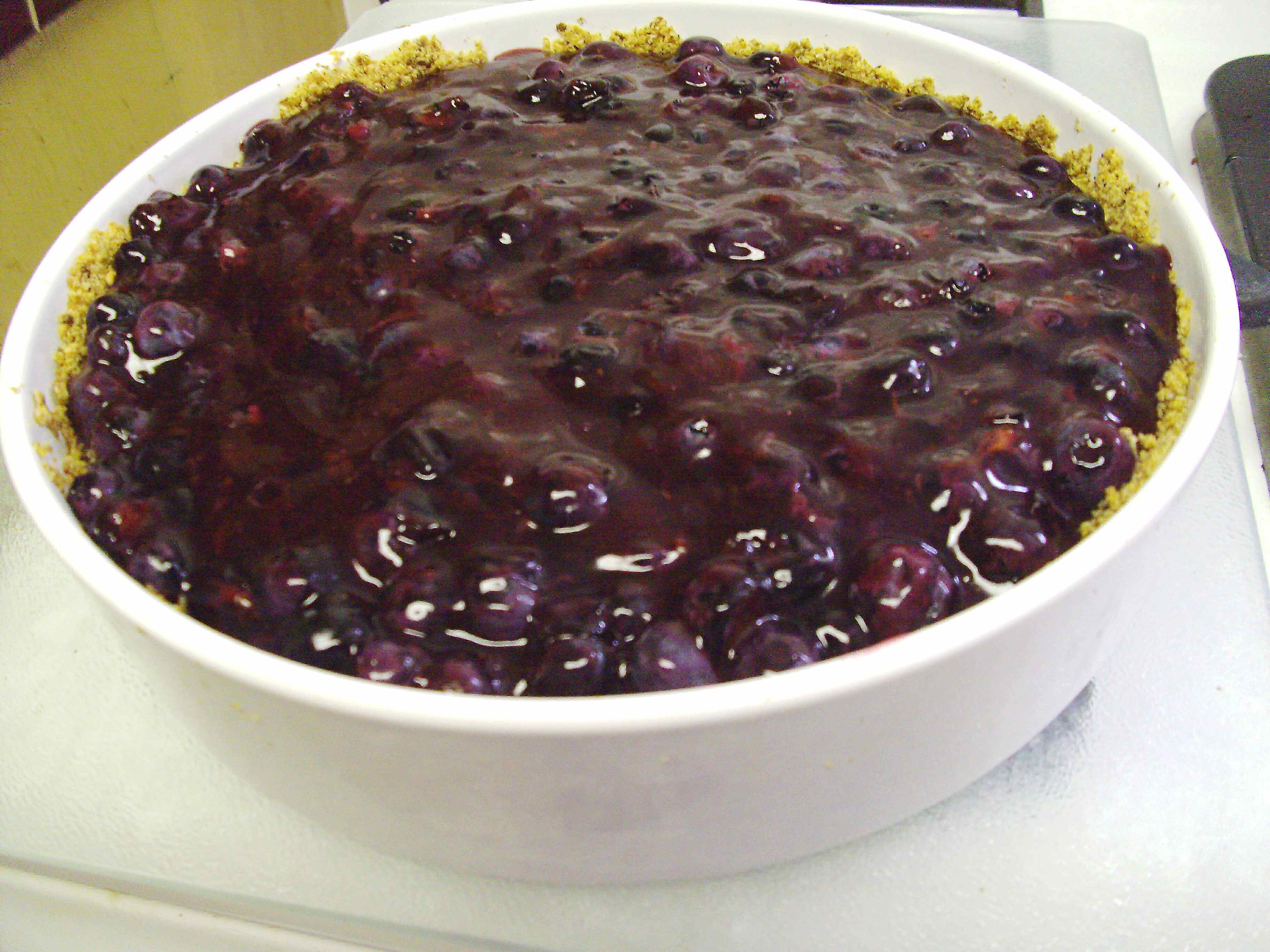
    raw blueberry pie with microwaveable filling and graham cracker crust

    This mostly-raw blueberry pie is a snap to make and very versatile--the filling microwaves in a few minutes, and you don't even have to bake the zippy gingered graham cracker crust--perfect for a hot Fourth of July and all summer long.

  • Recent Posts

  • Contents

  • Archives

  • Now Reading

  • See also my Book Reviews

  • Copyright 2008-2024Slow Food Fast. All writing and images on this blog unless otherwise attributed or set in quotes are the sole property of Slow Food Fast. Please contact DebbieN via the comments form for permissions before reprinting or reproducing any of the material on this blog.

  • ADS AND AFFILIATE LINKS

  • I may post affiliate links to books and movies that I personally review and recommend. Currently I favor Alibris and Vroman's, our terrific and venerable (now past the century mark!) independent bookstore in Pasadena. Or go to your local library--and make sure to support them with actual donations, not just overdue fines (ahem!), because your state probably has cut their budget and hours. Again.

  • In keeping with the disclaimer below, I DO NOT endorse, profit from, or recommend any medications, health treatments, commercial diet plans, supplements or any other such products.

  • DISCLAIMER

  • SlowFoodFast sometimes addresses general public health topics related to nutrition, heart disease, blood pressure, and diabetes. Because this is a blog with a personal point of view, my health and food politics entries often include my opinions on the trends I see, and I try to be as blatant as possible about that. None of these articles should be construed as specific medical advice for an individual case. I do try to keep to findings from well-vetted research sources and large, well-controlled studies, and I try not to sensationalize the science (though if they actually come up with a real cure for Type I diabetes in the next couple of years, I'm gonna be dancing in the streets with a hat that would put Carmen Miranda to shame. Consider yourself warned).

Three nonsense words

That I don’t really want to hear about food or nutrition, pretty much ever, and certainly not as a way to welcome in 2018. Courtesy of the New York Times’ T Magazine this week:

To usher in the new year, we asked creative people to share the homemade recipes they count on to detox, cleanse — and refresh.

Please. When you start describing breakfast in terms better suited to a moist towelette, and when the breakfast product itself comes out looking…well, let’s not even go there. I mean, check out the before and after food photos and tell me I’m wrong.

The fashion-slash-yoga world tends to be convinced that cleanses and detox schemes are legitimate. Physiologists, internists and RDs with board certifications tend to disagree.

Juicing, while obviously ultra-fashionable (still? boggles the mind), actually removes all the fiber, concentrates the sugars, and makes you wonder, given the thinness and the (frankly hideous) color of the stuff in the goblet in the right-hand “after” photo, whether it wouldn’t have been more genuinely nutritious, tastier, satisfying and visually appealing at the same time just to make some chunky vegetable soup–with garlic and herbs, not this sweet swill–and just wash and eat the apple with the peel. Because of course it would.

Another article in the series shows the breakfast for a conceptual artist who includes “human bacteria” and Teva sandals in her exhibitions (why? and I mean, are you really tempted to follow her food conceits after reading that?)–a bowl with about 10 hazelnuts and a dusting of chia seeds, not exactly a meal, and on the side a shotglass of something that is admittedly a much better green than the first interviewee’s due to dark leafy greens rather than celery and carrots, but would still be better left unjuiced, lightly cooked in stirfry or soup form, and without any sweet stuff in it. And preferably with a hit of garlic.

No major calories in this kind of breakfast, and perhaps we should be grateful that they don’t throw in any bacon or its variants with the veg, but really. Those breakfasts look pretty bleak and cold and less balanced than they ought to be, whether green or not-such-a-good-green.

Why the “detox” label? Why the crash-style diet drinkies? Why an article series–not even just one ill-judged gush piece–on food that doesn’t really look or taste all that good or deliver that much actual nutrition as given in the recipes, and frankly isn’t necessary if you actually eat things like vegetable soup or broccoli and other greens as part of your regular meals? Is the NYT readership really that into these things? Are they in it for the post-holiday self-castigation value?

None of the women interviewed (and of course they are all women, at least so far) are  particularly unfit or overweight or heavily broken out or anything, and none of them look ill or hung over. Raises the question: just how badly did these people really eat during the holidays?

You’d think from the tone of the articles that these artists had all been rolling around in crappy green and red sugar cookies of increasing staleness and chugging quarts of full-on eggnog all December just for something to do.  It’s the only way the articles even begin to justify themselves.

“Healthy” breakfast muffins? Miscalculated.

Julia Moskin’s latest “Recipe Lab” in the New York Times food section revisits one of my (cranky, irascible) pet peeves: the “healthy” muffin. She claims her version, filled with an expensive and lengthy list of the latest buzzword ingredients and yet supposedly lighter-textured than most bakery offerings, is healthy, always a warning sign, especially when paired with the instruction to make sure it’s well-leavened and to use “unprocessed” oils. These are code words for a heavy dose of baking soda and baking powder on the one hand and coconut oil, the newest darling of the hipster food world, on the other.

But–benefit of the doubt–I looked at the recipe and scrolled down to mouse over the nutrition stats. They’re provided in a popup link you can’t copy, with a very faint “i-in-a-circle” watermarked icon below the ingredient list. Not a good sign, generally: hiding the nutrition stats signals that they’re kinda suspish, or at least unflattering. But okay, at least they’re posted here.

Edamam provides the analysis–and per average muffin, 20 to the batch, claims the following stats:

318 cal, 16 g total fat, 1 g saturated fat, 0 trans, 9 g monounsaturated, 4 g polyunsaturated, 39 g carbohydrate, 2 g fiber, 19 g sugars, 4 g protein, 38 mg cholesterol,260 mg sodium

Something didn’t sit quite right with that. I looked up at the ingredient list.

Sure enough, the fat was provided by 1 1/3 cup of coconut oil. Yick. But never mind. The point here is that Edamam lists the saturated fat at a very improbable 1 gram per muffin.

There is–being kind about it–no way this is correct. The only thing I can think of is that Edamam used the soybean or canola oil option for the calculation, but why would that be? Coconut oil is listed as the much-preferred fat. And it’s got more saturated fat per gram than lard. About 82% saturated fat by weight, if you check the most reliable lab analysis at the USDA National Agricultural Library’s nutrient database. And actually, the mono and poly stats suggest something closer to olive oil than soybean or canola.

The correct calculation for 315 ml of coconut oil is 260 grams of saturated fat for the recipe. For 20 muffins, that’s almost 14 grams of saturated fat per muffin, not 1. And 14 grams is pushing the recommended daily max of 20 grams of sat fat for a 2000 calorie-per-day diet. Just for a muffin.

Given the nice way the New York Times provided the grams as well as cups and spoons measures in the recipe, here’s what I came up with, direct from the USDA NAL database and averaging a bit for the different options between apples and carrots and between walnuts and pecans.

  • Total calories for the recipe: 7213, per 1/20th (1 muffin): 361
  • Total saturated fat: 273 g,  per muffin: 13.7 g
  • Total monounsaturated fat: ~50 g, per muffin: 2.5 g
  • Total polyunsaturated fat: ~50 g, per muffin: 2.5 g
  • Total cholesterol: 744 mg, per muffin: 37 mg
  • Total carb for the recipe: 699 g, per muffin: 35 g
  • Total sugars: 390 g, per muffin: 19.5 g
  • Total fiber: 49 g, per muffin, 2.5 g
  • Total sodium: ~4670 mg, per muffin, 234 mg.

And yes, it’s kind of a pain to navigate all the USDA data chart by chart, ingredient by ingredient, put in the actual amounts in grams, have it recalculate the whole chart, add the totals up nutrient by nutrient, and then divide by 20. It would be so nice to find an accurate and complete free recipe-style app to pull all the relevant data and stick it in a single spreadsheet. The myfitnesspal.com recipe calculator is about the best I’ve found so far, but it’s not as complete, and neither unfortunately is the USDA’s Supertracker calculator, as far as I can tell.

How did Edamam and the New York Times Food Section do? The sodium, though a bit much for a single bready item (4 t. baking powder, 1 t baking soda and half a teaspoon of salt on top of that, plus whatever’s in the buttermilk), came out about right at 260 mg (I got 234 per muffin). The carbs are about right too, if kind of a lot. Sugar at 19 grams is about half the total carb and makes it no great bargain (not to mention, brown sugar plus maple syrup? cha-ching, and the maple flavor probably disappears with all the other stuff. Kind of a waste.). This is still a pretty cakey item, despite Moskin’s protestations to the contrary and all the grated carrot and blueberries and multigrain ethos. Edamam’s calorie estimate is a bit low by 40 cal per muffin. You could probably live with that.

But you shouldn’t. Because with the trendy, expensive coconut oil option, the published saturated fat estimate is way, way, way off. Way off. Bizarrely off.

I visited Edamam’s web site to see if I could figure out how they calculated this–whether their own calculator would give me the right result if I input “315 ml. coconut oil,” or whether their API, which features natural language processing, somehow makes  errors this big when it parses a recipe and does the lookup in the USDA database. Did it pull the wrong ingredient, or did the NY Times staff type the wrong thing into their recipe submission? Or what? Continue reading

BMI criticized again…by psychologists?

The International Journal of Obesity has just released a short article by Janet Tomiyama (UCLA) and Jeffrey Hunger (UC-Santa Barbara) et al–a team of psychologists. They analyzed NHANES data from 2005-2012 for about 75,000 individuals, and concluded that BMI status doesn’t correlate well with six concrete markers of cardiovascular and metabolic health–blood pressure, blood triglycerides and cholesterol, blood glucose, insulin resistance, and C-reactive protein. Extrapolating a bit from the NHANES study participant numbers, they conclude that millions of Americans–54 million–have been misclassified as unhealthy due solely to their BMI numbers.

According to their analysis, 47% of the overweight people in the study had healthy status (0-1 of 6 markers) other than their weight. About 30% of obese and even 16% of morbidly obese people had healthy status according to their protocol, whereas about 30% of those in the healthy BMI range had more than one actual cardiovascular or metabolic disease marker that would be ignored if only BMI is considered.

Is this really the death-knell for public concern over weight? Should it be?

Here’s how the UCLA press release puts it (with my emphases in italics):

But a new study led by UCLA psychologists has found that using BMI to gauge health incorrectly labels more than 54 million Americans as “unhealthy,” even though they are not.  […]

“Many people see obesity as a death sentence,” said A. Janet Tomiyama, an assistant professor of psychology in the UCLA College and the study’s lead author. “But the data show there are tens of millions of people who are overweight and obese and are perfectly healthy.”

Incorrectly labels? Perfectly healthy?

The definition for “healthy” used in this study is 0 to 1 known risk factor for CVD and diabetes. But clinically, one risk factor is often enough to be of acute concern, especially if it’s untreated high blood pressure or blood glucose. Those generally need treatment sooner rather than later.

Furthermore, the study as posted on Hunger’s web page excludes obesity and overweight a priori from that count of risk factors for CVD and diabetes. I don’t know the absolute latest research consensus, other than what was in the Dietary Guidelines for Americans Advisory Committee’s report last February, but my general understanding is that weight does show some statistically independent influence on CVD at least. That picture may be changing as we learn more about its interactions with other risk factors, but if it’s still valid, weight should have been counted as one of the existing “known risk factors” along with the other markers and that would have skewed Tomiyama and Hunger’s analysis considerably.

Even without those considerations, the different weight groups classified by BMI cutpoints do in fact show a significant increase in health risk from one category to the next. Turn Hunger and Tomiyama’s percentages around and you see that 70% of people in the 18.5-24.9 healthy BMI range have 0-1 risk marker other than weight; 53% in the 24.9-29.9 overweight range have more than 1 marker, 70% in the 30-35 range have more than 1 marker, and 84% in the 35 and over BMI range have more than one marker other than weight.

Plot those crude percentages and you’ll see a very sharp rise in risk incidence between the healthy and overweight categories, a reversal of fortune from “most people healthy” to “more than half at risk,” with further solidification of “most people at risk” as you venture further into obese and morbidly obese. There’s really no debating that trend, even given the narrow way this team has defined “healthy.” To say nothing of “perfectly healthy.”

Researchers in biomedicine (i.e., physical as opposed to psychological medicine) have recently reexamined whether the current BMI cutpoints defining healthy, overweight, obese and morbidly obese are in the right places to describe most people’s 10-year risk of overt CVD events (heart attacks and stroke), diabetes, or all-causes mortality, or whether BMI is just a continuous gradient of increased risk without definable cutpoints. At last count, the conclusion was that the current statistical best-fit cutpoints are pretty much correct, even though the data for individuals have a pretty big spread (and that each BMI step or number still has incrementally higher risk than the one below).

The upshot: BMI categories are still a pretty good marker of the overall health status of Americans when you’re talking about trends. Crude, yes. Exceptions for athletes with much more muscle than fat, yes. But the numbers are still strongly in favor of using BMI as a general warning flag to check for more specific cardiovascular and metabolic disease markers in individuals.

It’s very odd to see a paper like this coming from a team of behavioral psychologists, which Tomiyama and Hunger are. They’re at least nominally outside their field here, doing a statistical analysis on physical health data, and the paper’s methodology and definitions (along with some of their position statements in the American Journal of Public Health and elsewhere) show a specific agenda toward deconsecrating BMI and downplaying overweight and Continue reading

“The Dorito Effect”: Fervor over Flavor

So, the party’s over, the halftime show’s over, Denver won, a variety of pop stars are brushing off media criticism over what they wore, and a nation is figuring out how to deal with the caloric aftermath of buffalo wings and a variety of dips and chips. (My biggest excitement: locating the owner of a red Corvette with a leaking gas tank in time to deal with it and avoid a more dramatic spectacle. Luckily it was mid-afternoon and the owner was alert, sober, and not smoking. She  also wasn’t whining about having to go out to look at the car. As some of the male guests might have been, Corvette or no.)

Mark Schatzker’s recent book, The Dorito Effect, is an energizing read for those of us who aren’t really into the classics of Superbowl Sunday.

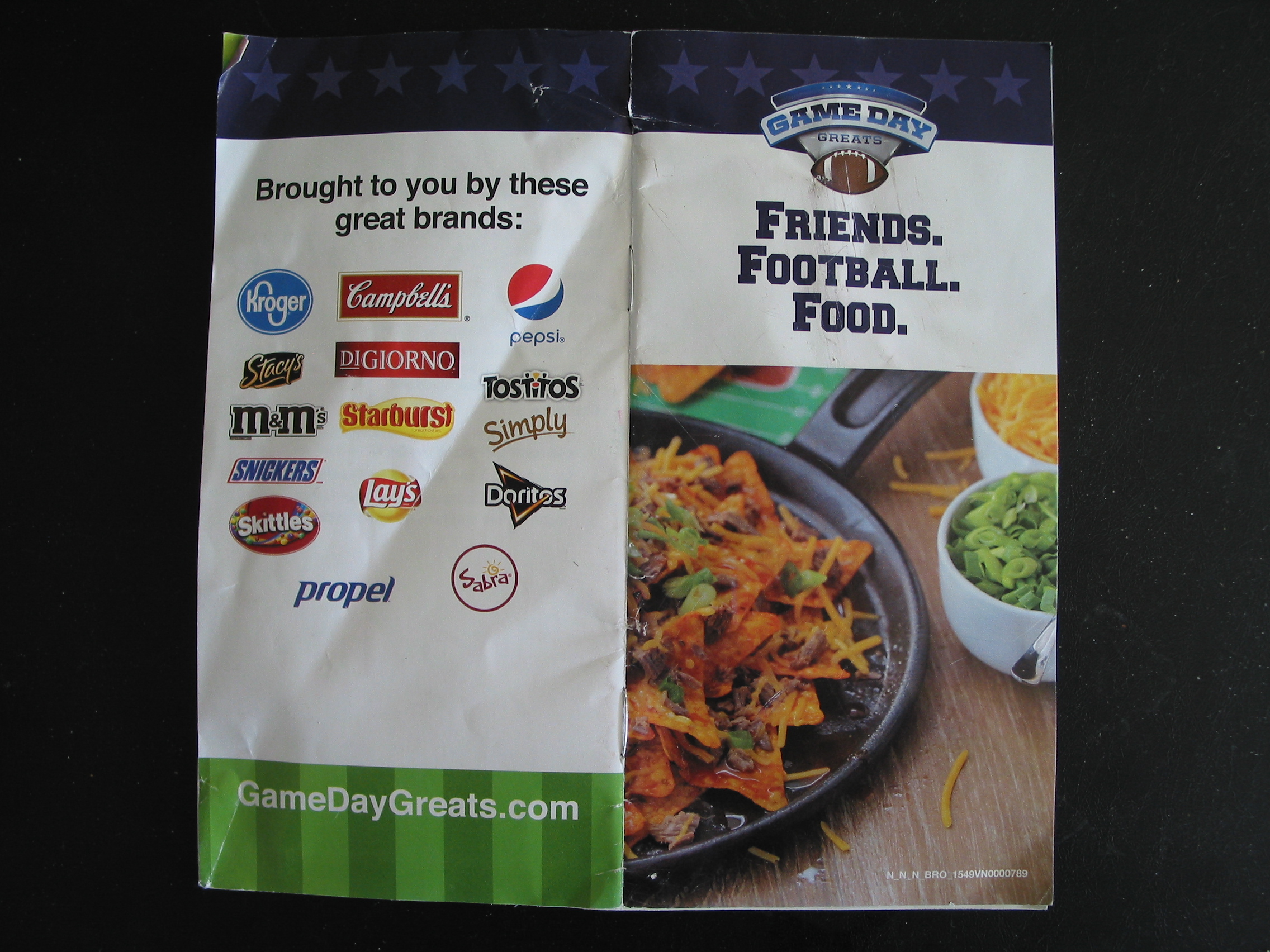
Kroger Superbowl recipe booklet

I’ll spare you the inside pages, but the closest to nutritious was Kroger’s own recipe for double-coated baked cauliflower “hot wings”–ingredients: a head of cauliflower, a little flour and water, garlic powder, Kroger’s store-brand hot sauce, and some melted butter to doll up the cauliflower florets before dipping in…ranch dressing. 

Not that it’s really so much about Doritos, but rather that it takes the 1960s invention of Doritos–a “taco-flavored” taco chip without any actual meat, cheese or salsa, just what has become known to all as orange cheez dust–as the first serious divorce between food and intrinsic flavor.

It isn’t really the first, of course, and Schatzker traces the history of post-WWII mass agriculture as the story of more food, grown quicker, with less and less flavor. Everything from tomatoes to chickens to broccoli to wheat comes under the microscope lens here. Yes, it’s another Michael Pollan-style examination of some familiar complaints about how and why nothing tastes the same anymore.

He collects reactions from champion kvetchers as diverse as Julia Child (she did it first, he claims, calling modern–1960s–American chicken tasteless and with the texture of “teddy bear stuffing”) to the Slow Food Movement (no relation, ahem!) to Michael Pollan himself, to a variety of old bickering couples who remember the flavor of old long-legged breeds of chickens now relegated to the remote gourmet sidelines of the vast factory-farming chicken industry…

Schatzker tells a fairly entertaining version of this tale–how Big Food and Big Agro convened with flavor chemists to alter the course of human gastronomy in the wake of WWII. As we breed livestock and produce to grow more, bigger, faster, he discovers, we lose not only flavor but nutrients and replace them with water and carbohydrate filler even in things like broccoli and tomatoes. And then we try to make up for that by dousing them in ranch dressing and orange cheez dust and artificial flavorings; hence the title of his book.

Coatings, dressings, artificial flavorings, salt, sugar and oils–these, he says, have become the substitute for intrinsic flavor in real foods, and a mainstay of the unsubstantial snack foods–starting with Doritos–that have pushed out bulk produce and unprocessed ingredients in the American diet.

Schatzker takes it a couple of steps further, though, presenting his theory that the loss of flavor in real foods is the key factor to blame for American overconsumption of calories, and that flavor is one criterion we should work to restore at a national level.

Yes, we’ve read much of this before elsewhere, but his interviews are still eye-opening. He interviews flavor chemists at McCormick, which does a lot more of its work behind the scenes of the restaurant and processed food world than you might think. Those little bottles of herbs and spices on supermarket shelves are just the tip of the iceberg.

Schatzker also profiles one of the original breeders of today’s heavy-breasted, fast-grown, efficient-feeding mass market chickens–though the man is still proud of that early work given the economic pressures on postwar America. He gets the inside story on the decline of flavor and nutrition in broccoli, kale, tomatoes, strawberries and other common produce, and learns why some top agriculture researchers eventually quit the corporate world to try and restore some of the diversity and quality that had been lost during the peak years of their careers. Continue reading

Thanks

I want to give a quick thanks to Dr. Marion Nestle, who took the time to let her readers and colleagues know about Sunday’s Dietary Guidelines post in her Twitter feed and on her blog, foodpolitics.com, which I’ve read with interest ever since starting this blog. The response has been overwhelmingly positive and I appreciate it very much.

USDA Dietary Guidelines released…a full year later

The Dietary Guidelines Advisory Committee’s scientific report, essentially the major draft of the USDA “Dietary Guidelines for Americans” guidelines, was finished last February. The Dietary Guidelines for Americans, 2015-2020 has finally been released in its official form to the public–but it’s only available online at health.gov as of this week, with promises of an eventual PDF.

To that end, because the Health.gov site doesn’t yet have a downloadable version, I’ve pulled the text and images of the final “Dietary Guidelines for Americans 2015-2020” into a quick-and-dirty two PDFs you can download below for free. It’s not perfect–the pages don’t all flow with gorgeous layout and some of the graphics were so oversized I had to kind of select-cut-and-paste them in sections to get the charts to fit. I think I’ve got it all in there, though, including most of the helpful nutrition and diet charts in the appendices (with notes where I didn’t catch on that there was more to a chart than first appeared).

What can I say–“Enjoy.” Ummm….well, anyhow, here they are:

Dietary Guidelines for Americans, 2015-2020–this includes the Table of Contents, Intro, Executive Summary, and body of the report (Chapters 1-3).

USDA DGA 2015-20 Final-IntroandChapters (PDF, 3.4 MB)

Appendices (14 of them) for the Dietary Guidelines –I couldn’t get Adobe to stick this on the end of the document nicely, so it’s separate but useful.

USDA DGA 2015-20 Final Appendices (PDF, 263 KB)

The original Dietary Guidelines Advisory Committee Scientific Report from last February is available here.

What was the holdup? What are the differences from the health-basis-only recommendations of the DG Advisory Committee’s version last year?

Given the shoddy job major media gave the advisory committee’s scientific report last winter and spring, perhaps the best thing to do this time around is skip the media coverage hyperbole and compare the two reports directly and see what gives.

Professor Marion Nestle digs in with dissatisfaction as to some of the likely buyoffs this time around–she deems that the big meat, egg, sugar, etc. producing industries have won some victories in what wasn’t said. She also complains, as I do, that the online version is full of stupid bells and whistles. It’s hard to navigate, there are a lot of windows and figures that are actually slide shows and you have to know to click on them to get the rest of the information. Hopefully the PDFs above will be more readable.

Nestle’s take is more political than mine (for a change? not really). She notices more of the inconsistencies with naming food categories only when they’re favorable, and using nutrient names (sugar, saturated fat, sodium) as substitutes for the big-business food categories that are poor nutritionally.

I’m less incensed about most of that– and ironically a little more optimistic about what was included. Continue reading

Fish Tale: Omega-3s and Greenland’s shores

Well…another shining example of “magic bean” and “superfoods” wishful thinking has bitten the dust, thanks to more careful research. It may be a good thing.

In recent years, several reassessments of the heart health benefits of popular fish oil supplements have failed to find a significant protective effect from omega-3 fatty acids. A new genetic study of the Inuit in Greenland revisits the old 1970s finding that started the whole fish oil phenomenon (and salmon farming) and explains a lot of that failure. The researchers found a specific gene variant in almost all the participants but not in other populations.

The gene in question helps package fatty acids from the Inuits’ traditional all-fish-whale-and-seal-meat diet more efficiently to keep blood lipid levels down. Researchers noted another striking effect: participants who have two copies of this particular gene variant are also significantly shorter and ten pounds lighter on average than those without it. And although this gene variant is very common among people of mostly-Inuit descent (today a lot of Greenlanders have mixed Inuit and Danish heritage), the ethnic and racial group with the next highest concentration of this gene variant, as far as it’s been tested, appears to be the Chinese, but only about 25 percent of them have it. People of European descent mostly don’t have this variant.

What does this mean for omega-3s and fish oil supplements in North American popular culture? The New York Times article didn’t go that far, but the implication should be clear: Unless you’re Inuit, you probably don’t have the specific gene variant that helps your body deal with omega-3s, so for you, omega-3s are like most other animal-derived fatty acids–adding more to your diet is just adding more to your blood lipid burden. Rich fish like salmon may taste nice, but lipids are lipids, and calories are calories. Given the likelihood that they’re really not cardioprotective after all, overeating them doesn’t make sense, especially for a population as overweight as ours has become.

Fish oil supplements are probably even less of a good idea, and they don’t even taste good. They won’t really protect your health as claimed, not for omega-3s, anyway (cod liver oil is still probably good for vitamin D, if you can still find it, but most people would probably prefer a mercifully flavorless vitamin pill).  So save your shekels, buy actual salmon once in a while, and enjoy it–but sparingly.

Parsley Doesn’t Count

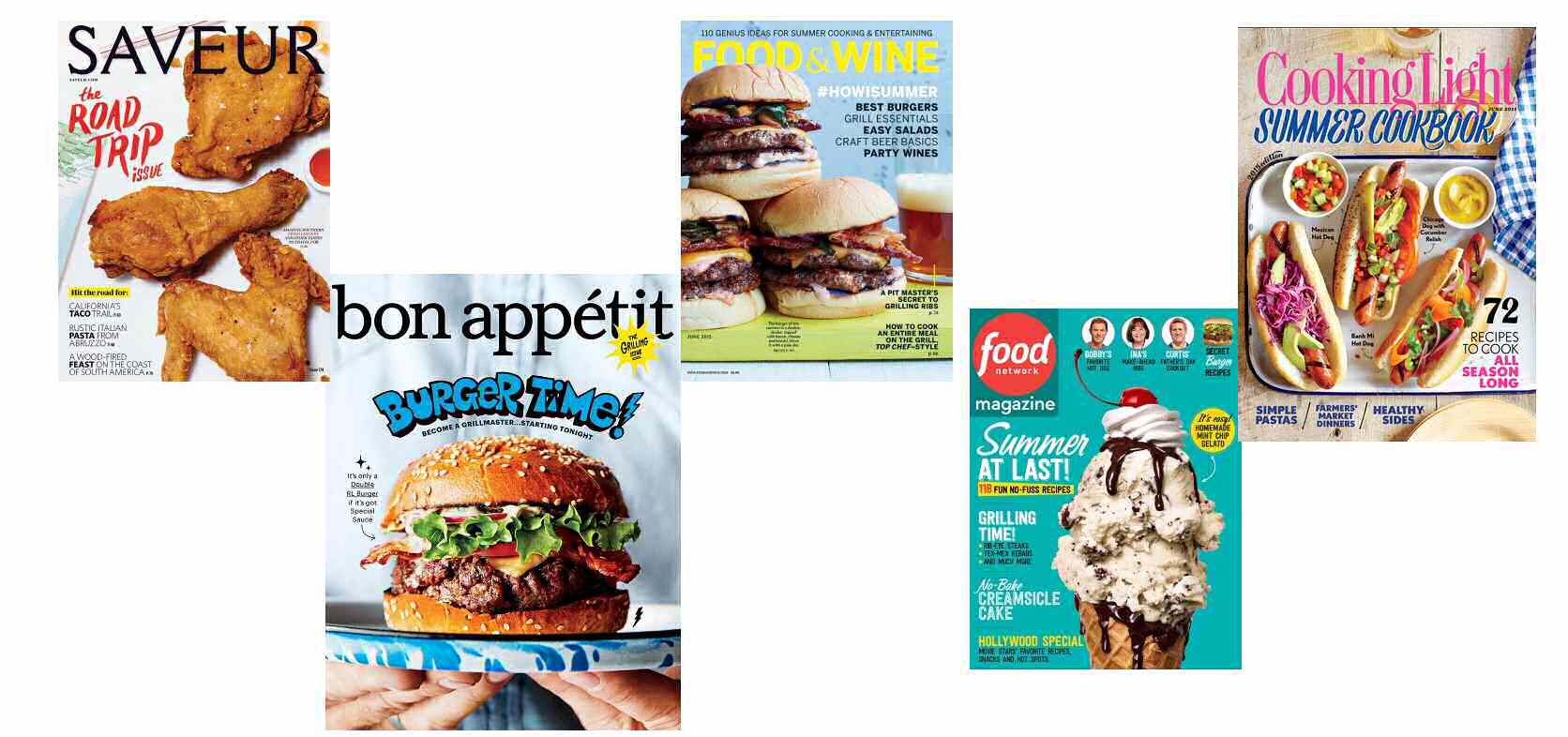
It’s nearly June, the big northeast snowfest that lasted into April is pretty much over, and all the May and June issues of the big food magazines are showing…almost no fresh vegetables on the covers. Or inside. Oh, you do see some green–but it’s garnish. Flat-leaf parsley, a little cilantro, a sprig of basil maybe, chopped or torn over the cover dish to make it pretty. But very few actual vegetables–take a little walk with me down the newsstand for a sec.

magcovers

All magazine cover thumbnails shown have been lifted shamelessly–they’re not mine, they’re the property of their respective publishers–and pasted together here solely for parody value and critical review of the food literature.

Saveur? Fried chicken. Seriously. Cooking Light? Hotdog special–one with a slice of pickle and tomato, another with avocado, to represent Vietnamese and Mexican, respectively.  Whoo-don’t you feel like a world traveler now. Food and Wine? Burgers by Bobby Flay. Bon Appétit? Another burger. Food Network? They don’t even pretend. Ice cream cone. With whipped cream and a cherry on top. On a cone.

The women’s mags are leaning toward desserts: Martha Stewart–cake. Southern Living, Allrecipes–pie. Better Homes & Gardens and BHG Diabetic Living both feature watermelon and ice cream or sorbet assortments. All of it very pink.

Eating Well cover Vegetarian Times cover

But even EatingWell and Vegetarian Times aren’t doing all that much vegetabalia on their green-looking covers. EW has a vegetable serving platter with a nice looking bunch of raw green beans and tomatoes at the bottom, but more than half of the platter is canned  beans or dip. Not that I’m against those, but they really aren’t fresh veg.  VT has a grilled veg and quinoa salad platter that looks wholesome enough, but if you zoom in for a closer look you realize it’s not mostly veg either. If you took a quarter of it for yourself, you’d only get 3 or 4 thin slices of pepper and zucchini on your plate along with the grain. Most of the green you see in the picture is a token sprinkling of arugula and basil sprigs strewn over the top–a strategy that’s being used and abused in the less veg-forward pubs to make steak or pork loin or mac ‘n’ cheese look like they have something fresh and healthy about them.

Lucky Peach and Cook’s Illustrated both go for graphics rather than photos. LP has a cartoony poster graphic of garden lushness for “The Plant Issue”–do they really have vegetabalia inside? Cook’s Illustrated has a pastel of radishes.

It’s as though they all decided to try to look summery without  including actual bulk greens–the signature of summer (well, other than watermelon). I’ve complained about this before, I know, but back then I was talking about friends who don’t cook much and are somewhat veg-phobic, not about upscale food media. For years the food glam world has been touting local sourcing, farmers’ markets, heirloom this and that, Provençal and Spanish and Italian and Middle Eastern cuisines, which are full of vegetables one way and another. But they really are no longer practicing what they preach. They’ve shrunk their focus down to the meager American fast food paradigm while pretending otherwise. And charging you between 4 and 10 dollars an issue.

But vegetables are so easy to ruin, you say. The green ones turn brownish olive if you hold them too long after cooking. If you’re going to hang around a whole hour waiting for the photographer to get the right shot, you’re going to have to cook a couple of batches in a row. Strewing a couple of sprigs of cilantro or parsley over something is so much easier!

The other reason we’re not seeing vegetables on the magazine covers: editorial production lag. Monthly magazines typically take anything from 2-6 months to produce from start to finish, so they work ahead. The May and June issues probably went to press two months ago, when it had barely stopped snowing in the northeast (per my mother and sister). Summer vegetables are not bountiful in March and April under those conditions–at least not in New York and Boston. But the editors could have put together something decent and thematic for the covers if they wanted to–I’m pretty sure I could have sent them a likely looking CARE package from my local greengrocer’s if they’d only asked and were willing to foot the overnight shipping.

A weekly haul from my greengrocer's comes in under $30 even with coffee, spices and special items.

Eat your heart out, foodie magazines! Time to gloat. A typical weekly haul from my greengrocer comes in at under $30 even with a pound of coffee or tehina or yogurt (not shown, obviously), bagged spices, dried beans, and  specials on fruit or nuts. When the tomatoes are better I stagger out the door with 5-10 lbs. at a time, but on the other hand the snow peas were a serious bargain this time around.

There are plenty of good vegetables around. Fresno tomatoes are back in my Armenian grocery (for which, oh! be joyful), we have green and romano beans, we have lettuces and purslane and bunches of fresh basil and dill and mint and za’atar (and yes, parsley, Continue reading

Starting with Breakfast

“The Well” blog at the New York Times has posted a new interview with pediatric endocrinologist Dr. Robert Lustig about his new book, the Fat Chance Cookbook, and about the possibilities for treating obesity in children with a better, less processed diet.

Two or three takeaways from the interview surprised me by echoing things I’ve either thought or written about here since my daughter became a Type I diabetic four years ago.

Almost always, we see an obese kid come in with an obese parent. And when the kid loses weight, the parent loses weight, because the parent actually changed what’s going on in the home.

We do something called “the teaching breakfast.” Every kid comes in fasting because we’re drawing blood. So they’re all hungry. They go to the teaching breakfast with their parents – it’s six families all at a communal table – and our dietitian spends an hour with them. The dietitian narrates exactly what’s on the table and teaches the parent and the kid at the same time….We make sure four things happen. No. 1, we show the parent the kid will eat the food. No. 2, we show the parent that they will eat the food. No. 3, we show the parent that other kids will eat the food, because they have other kids at home and they have to be able to buy stuff that they know other kids will eat. And No. 4, we show them the grocery bill, so they see that they can afford the food. If you don’t do all four of those, they won’t change.

Also, and I think this is my favorite:

…my wife is Norwegian… When she’s mad at me, she bakes…My wife has learned by experimenting that she can take any cookie recipe, any cake recipe, and reduce the amount of sugar by one third, and it actually tastes better…. And you can taste the chocolate, the nuts, the oatmeal, the macadamia – whatever is in it.

Right on!

Back to the top, though, I’ve got to say I love the idea of the teaching breakfast. My one concern is the reality of time cost for families with school-aged children, because eggs and vegetables, two of the (sometimes) inexpensive staples of the UCSF clinic’s teaching breakfast, take more time to prepare than a bowl of cereal, and require more cleanup. On weekdays, that might be a real challenge, especially for families with two working parents and/or long drives to school. A lot of the families I know in this situation (long drives and no school buses being a common problem in Southern California) are used to tossing their kids in the car with some kind of makeshift breakfast to eat on the way–often resorting to bagels, pop tarts, or bananas, none of which are great choices.

Perhaps if the dietician showed some simple microwaveable 5-minute meals like oatmeal or an easy vegetable-filled frittata (with some of the yolks left out) that can be made the night before and refrigerated? The plain yogurt with fresh fruit idea is also quick and simple but not especially cheap–these days a quart of plain non-Greek yogurt goes for $2.50 at Trader Joe’s, almost the same as a gallon of milk, and costs even more at the local Ralph’s (west coast Kroger affiliate), but it serves only 4 if each serving is a whole cup. Cereal with milk is a lot cheaper–but it could certainly be better cereal, high in fiber and low in sugar and salt, and measured by the cup or on a scale before pouring it into the bowl to make sure you don’t get more than you think you’re getting.

Cutting up fruit and vegetables takes time that parents usually feel they don’t have. And berries, which don’t need cutting up, are relatively expensive fruits, even when frozen. So showing parents a couple of “instantly grabbable” ways to serve the less expensive fresh (or fresh-frozen) fruits and vegetables instead of Froot Loops might be key.

A simple “just wash and nosh” approach would probably be a good start. I know I generally rail against buying precut, expensive little baggies of manicured (and dried out) vegetables in the supermarket, but the big bags of “baby carrots” that don’t require peeling and are finger-food size would be an okay starting point to get kids and parents to think about vegetables as a good snack or even breakfast choice. My daughter lived on them for lunches (along with a PBJ on whole wheat and an apple) for most of her grade school years, and even though she has (and will probably always have) a mean sweet tooth, she still seeks out raw green beans, wedges of red cabbage, roma tomatoes and broccoli or cauliflower branches to break off, rinse under the tap and nosh on after school.

DASH is US News & World Report’s “Best Overall Diet”

US News & World Report asked a panel of nationally recognized nutrition, diet, cardiovascular health and diabetes prevention experts to rank 32 popular diets. DASH (Dietary Approaches to Stop Hypertension) topped out as the overall best, including for long-term weight loss and maintenance.

The article and rankings online: Best Diets 2014 | US News & World Report

Where the experts complained–sort of–was that following it requires eating more real food and fewer boxed processed meals. So it’s technically “harder” to do than Lean Cuisine, Jenny Craig, and so on. They also said that buying produce is more expensive than eating out at fast food restaurants all the time. I’m not sure where they’re shopping or how they’re counting. But from my experience and checking out current fast food prices for a family of three, shopping relatively smart and unchic and sticking with the cheap nutritious bulk vegetables rather than the fashionable or precut, prebagged ones in the foodie magazines that cost three times as much–I’d have to say no, it really isn’t more expensive for what you get. Especially if you count the extra gasoline per trip to the fast food joints on a daily basis.

And I’m not happy that a nationally acclaimed panel of nutritionists–or the editorial staff, I’m not sure–seem more than a little veg-phobic. Buried somewhere in the blather–I mean, expanded description of the DASH Diet and how they ranked it–is the distinct suggestion that it’s too much work and too unrealistic to expect people to prepare and eat–you know–fresh unprocessed vegetables and fruits themselves. They actually put in the phrase that it’s too much “gruntwork” unless you can hire a private chef to do your cooking for you. Makes you wonder how they were raised–probably on a steady diet of Pop-Tarts.