• Enter your email address to subscribe to this blog and receive notifications of new posts by email.

    Join 241 other subscribers
  • Noshing on

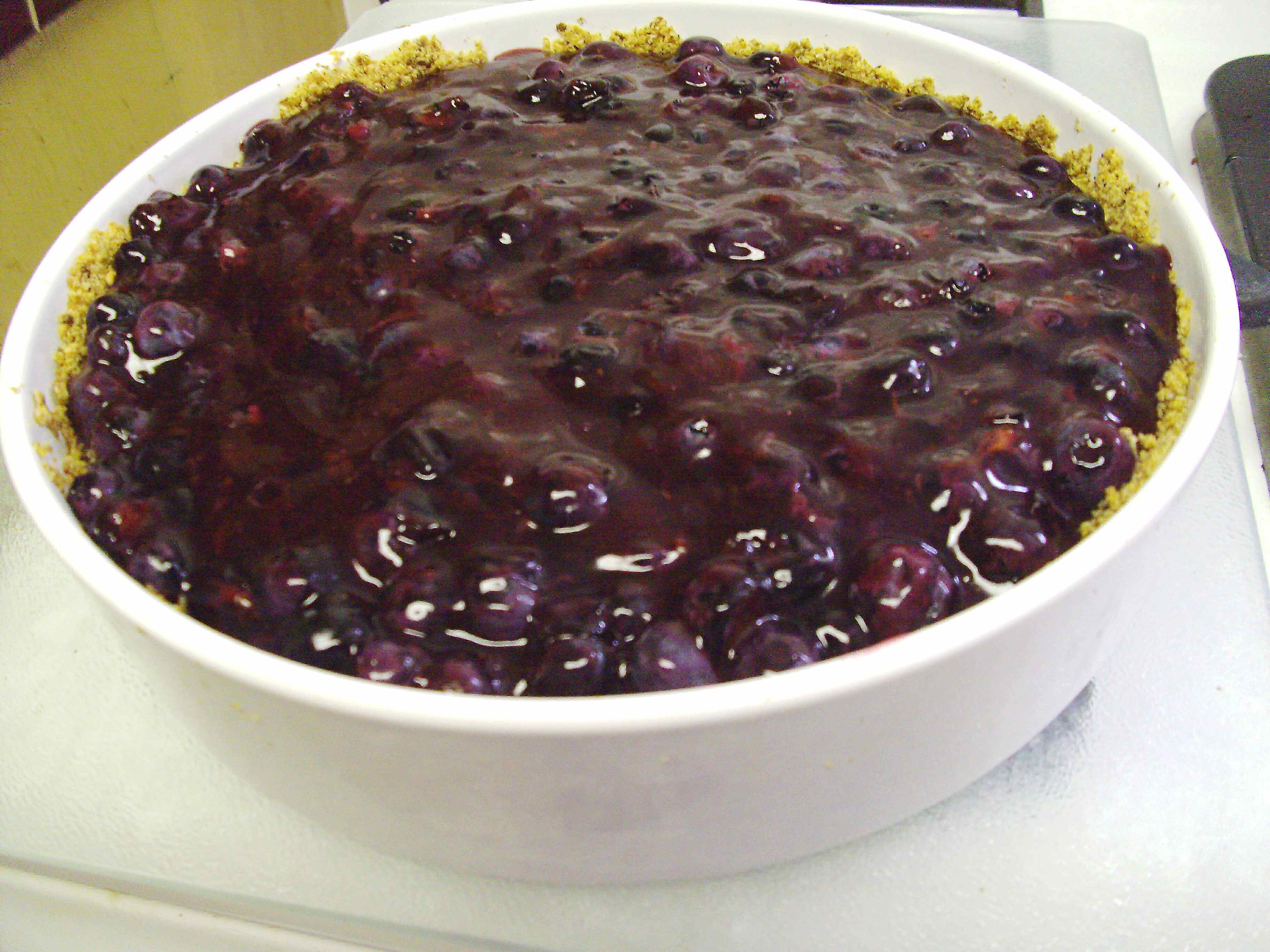
    raw blueberry pie with microwaveable filling and graham cracker crust

    This mostly-raw blueberry pie is a snap to make and very versatile--the filling microwaves in a few minutes, and you don't even have to bake the zippy gingered graham cracker crust--perfect for a hot Fourth of July and all summer long.

  • Recent Posts

  • Contents

  • Archives

  • Now Reading

  • See also my Book Reviews

  • Copyright 2008-2024Slow Food Fast. All writing and images on this blog unless otherwise attributed or set in quotes are the sole property of Slow Food Fast. Please contact DebbieN via the comments form for permissions before reprinting or reproducing any of the material on this blog.

  • ADS AND AFFILIATE LINKS

  • I may post affiliate links to books and movies that I personally review and recommend. Currently I favor Alibris and Vroman's, our terrific and venerable (now past the century mark!) independent bookstore in Pasadena. Or go to your local library--and make sure to support them with actual donations, not just overdue fines (ahem!), because your state probably has cut their budget and hours. Again.

  • In keeping with the disclaimer below, I DO NOT endorse, profit from, or recommend any medications, health treatments, commercial diet plans, supplements or any other such products.

  • DISCLAIMER

  • SlowFoodFast sometimes addresses general public health topics related to nutrition, heart disease, blood pressure, and diabetes. Because this is a blog with a personal point of view, my health and food politics entries often include my opinions on the trends I see, and I try to be as blatant as possible about that. None of these articles should be construed as specific medical advice for an individual case. I do try to keep to findings from well-vetted research sources and large, well-controlled studies, and I try not to sensationalize the science (though if they actually come up with a real cure for Type I diabetes in the next couple of years, I'm gonna be dancing in the streets with a hat that would put Carmen Miranda to shame. Consider yourself warned).

Three Films on Food and Memory

In the weeks before all the shutdowns and my daughter coming home from university for spring break–and now staying, to our relief–I decided to give myself a day’s mini-filmfest break as a reward for doing taxes. By the time I looked up from the 1040 checklist, though, nothing I really wanted to sit through was still playing at any of the theaters, and I’d missed both The Farewell and Uncut Gems. And now the theaters are closed.

Since I’m not on one of the streaming services, I took advantage of my local library DVD collections before the libraries, like everything else, decided to close. If you can stream these and you like thoughtful movies with food somewhere in the mix of topics and character sketches, they’re all worth watching.

First is Oscar-nominated foreign documentary Honeyland. I’d missed its limited run at my local independent theater only the week before (taxes, as mentioned), so when I spotted it at the library I snatched it up along with two others that were also surprising finds.

Honeyland follows Hatidze Muratova, possibly the last traditional wild beekeeper who, in her fifties, lives alone with her bedridden, elderly mother in a one-room stone hut, part of an abandoned village outside Skopje, Macedonia. She takes the regional bus into town on market days to sell the jars of honey she’s harvested from beehives in the rocks and gets a good price for them, but it’s still just enough to buy groceries with. Then a large, noisy family moves their cattle into the abandoned homestead next door and she makes friends with them, helping with the younger children. The father, ambitious to make a go of things, tries beekeeping himself, but ignores her advice for handling his box hives gently, gets a bad price at market and contracts bulk sales he can’t deliver to an aggressive and ruthless middleman. His hives start to fail, and the hungry bees attack her carefully fostered hives while his neglected cattle start dying. Eventually the family gives up and moves on, having squandered much of their own living as well as what she relied on–but not all.

Honeyland is fascinating just for its portrait of Hatidze, her resilience and her forthright, cheerful way of dealing with both bees and people. She and her mother live on the absolute brink, in a hut with a Franklin stove, a few cats, no other neighbors and very little food. Most of their daily diet is just cooked grain and yogurt or ayran and she still feeds the scraps to the cats. But she makes the most of everything she can.

When she goes to the city market she brings back some bananas and watermelon to tempt her mother to eat and enjoy a few bites of sweetness. She has just her one yellow dress and her kerchief, and no one to appreciate them, but while she’s in Skopje she spends two euros on a bottle of hair dye just for herself, and once home, she combs it through her hair with a sense of satisfaction, as though she were being pampered at a salon, while she chats with her mother about old times. Even at the end of the film, you get the feeling that Hatidze will find a way to prosper.

You do wonder a little how this documentary was achieved–they found room to fit a camera inside the tiny hut as she feeds her mother and helps her turn over on the bed, they filmed the bees stinging the neighbor’s children and his calves weakening and dying in the yard, they filmed the neighbor and the businessman raiding a nearby wild hive Hatidze relies on, just to supplement their jar count–how did the filmmakers get all that? What happened afterward?

Sometimes an extraordinary documentary like this weaves its way into your imagination more intriguingly than fiction, and sometimes the filmmaking unintentionally affects the subjects and becomes its own kind of quasi-fiction just by the nature of what it shows, what it doesn’t, and what’s behind the scenes. Did she stay or go? You have to ask, you have to wonder. The filmmakers do actually answer many of these questions on the Honeyland website, but you have to poke around and follow the press kit link to download the “press notes” PDF–a fascinating read.

The next film, Ramen Shop, is fiction and a bit slighter, but still with some pretty good moments. A young ramen chef working for his hard-as-nails father in Japan arrives at the shop one morning to learn that his father has died of a sudden heart attack. The son consults his uncle, who also works for the shop, about his childhood in Singapore with his Chinese mother, who died young, and the impossibility of recreating the soup she used to make him. Against his uncle’s advice, he decides to go back in search of the recipe and his mother’s family. Continue reading

Waste not: food documentaries, recycled

“Wasted” is an upcoming Huntington Library event that costs nearly $100 for members. They’ll be showing the 2017 Rockefeller Foundation-sponsored food waste/ecoresponsibility documentary of the same name (featuring executive producer Anthony Bourdain, with Dan Barber of Blue Hill, Danny Bowien, Mario Batali and various other chefly friends, though none of those guys are slated to show up in person at the event). Plus local/LA top chefs demonstrating gourmet-ish fun things to do with the parts of vegetables and herbs we normally throw away. A lot of them seem to involve cocktails.

I couldn’t quite put my finger on why that rang hollow, or at least kind of shallow. Much as I love the Huntington, I’m not going to be blowing a hundred bucks any day soon just to screen a Netflix doc from last year at a posh drinks event. I’m not a hipster, I’m barely capable of a glass of wine, so hard drinks are out, and my kid is heading off to college on the other coast in the fall, so I’m feeling poor-ish in anticipation.  But I was kind of curious to see what was in the film.

I went online and then to my local film-heavy libraries (this is the LA metro area) to see if I could screen Wasted in full for free. I tend to be crabby and skeptical of anything glib, or as Bourdain puts it, “smug.” But I was prepared to find something worthwhile in it–I enjoyed Kitchen Confidential when it came out. As much as I pick on him for gonzo style, I have liked various of Bourdain’s interviews and essays since for their attempt at consciousness-raising on life and food availability issues in other countries.

The issues raised in the movie itself are pretty serious: America discards about 40 percent of its total food production, 160-plus billion dollars a year worth, into landfills (and generating a lot of methane gas through anaerobic breakdown, which apparently doesn’t occur if you compost properly). At the same time, nearly 1/7th of the people in this country have food insecurity–they go hungry. And the causes aren’t even buying a head of broccoli with best intentions and letting it sit in the vegetable bin for too long. They’re mostly issues of transportation cost, supermarket dumping past the sell-by dates, fear of lawsuits if the food’s donated instead, and imperfect-looking produce. It’s a national shame. Shots of poverty around the world, a claim, possibly justified, linking our waste of grain products in America and Europe to shortages in India and elsewhere, literally taking food out of their mouths. So far, picturesque and righteously thought-provoking.

The film’s positive side also starts out promisingly enough: a Greek yogurt processing plant in Tennessee diverts the excess whey, which is full of sugars, to a fermentation vat where it produces methane gas in a closed-loop system. The methane generated powers the entire production line. Clever, frugal, reasonably clean energy, at least in this controlled context, keeps some of the waste out of the municipal wastewater, and it’s about Greek yogurt.

Leftover and discarded sandwich bread–an awful lot of it, primarily end pieces from loaves used in sandwich-packaging factories–is being reclaimed and used creatively in the UK as the base grain for “Toast” ale and a similar beer (perhaps the same brand?) is now available in the US at Whole Foods stores (of course). We quickly sense a theme here.

In fact, Wasted’s approach to a dirty and complicated topic is surprisingly clean-hands compared with most other films and books that address food waste and hunger.

The live coverage and interviews are shot in-studio, in the restaurants, in the high-level, high-tech, high-ideals startups. A lot of footage is devoted to what great, cool and innovative things you can do for high-end, gourmet niche products if you’re creative with vegetable trimmings and give the less-familiar “garbage” fish a fancy Latin name and a place on your menu alongside the tuna steaks and branzino.

The global poverty and waste discussions you expect to give the film its depth are nearly all voice-overs (mostly Bourdain’s) with statistics, animations, and quick flashes of exotic scenery for illustration. These are things you don’t notice right away, perhaps not until afterward. But this divide starts to explain why I felt such a disconnect between the supposed message and the actual focal points of the film. Continue reading

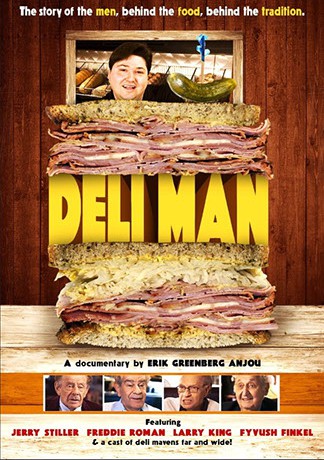
“Deli Man” is out on DVD

"Deli Man" DVD

Source: Cohen Media Group, delimanmovie.com

Well–that’s it, really. Need I say more? Actually, yes, there are a few new things to say other than to keep recommending that you see Deli Man by getting yourself a copy of it and screening it with all your favorite people who didn’t get to see it last spring.

In the half a year or so since it started showing up in theaters, David “Ziggy” Gruber (the deli owner whose story anchors the film) and director Erik Greenberg Anjou have done a lot of interviews together to promote it–they did one on Fox News Radio early on, and then more recently a long, in-depth interview on YouTube with Judith Gelman Myers, film critic for Hadassah Magazine.

Gruber in particular emerges in these interviews as an insightful observer on modern Jewish food and culture, its history and the history of the restaurant business as a whole. It’s an overtly intellectual and analytical side of him that wasn’t as apparent in the film.

Deli Man focused primarily on his daily life, the stresses and rewards of running a deli, his sense of humor and his gift for schmoozing with his customers. To provide a national context in the documentary, Anjou filmed and cut in interviews with the owners and customers of the historic big-name New York delis, and two or three of the younger generation of deli men from Toronto and San Francisco. Much of the historical perspective and big-picture analysis he assigned to David Sax, Michael Wex, and Jane Ziegler, three prominent authors on Jewish immigrant culture. But Anjou seems to recognize that if he hadn’t divided up the roles in service to the pace and emotional/informational balance of the film, Gruber could easily have taken a seat amongst the trained historians.

Like most of the other deli owners featured, Gruber is not an academic by inclination–too much personality and too little sitzfleisch. As he tells Myers, he knew from a very young age that he wanted to be a cook and from his high school grades he was not necessarily ever going to be college material. He’s underselling himself a little here (well–not in every respect; there are a few moments in the interview where he breaks out and guarantees the audience that if they try his blintzes they’ll be hooked for life, or words to that effect).

But when he gets serious, which is often, the interviews bring out his head for detail and his broad-based perspective on Jewish food culture and the restaurant industry as a whole. These are things he knows a great deal about, both intellectually and as an active participant, but didn’t always get a chance to voice in the film, and which weren’t brought out by the other commentators. You’re suddenly reminded that he did intensive training at one of the best culinary schools in Europe and worked in a Michelin-starred restaurant in France for several years before coming back to the US, and he’s been keeping a keen eye on market trends, business and people ever since.

So the interviews, which might otherwise have been standard pleasant-but-bland film recaps, become much more engaging and worth a listen even if you’ve already seen Deli Man. And doing them in tandem with Gruber is one of the smartest things Anjou could have done.

Not Your Parents’ Mom & Pop

Mom & pop stores–the little independent family-run corner grocery, hardware store, café, bakery, or barber shop–are, like local farmers’ markets, neighborhood gems just waiting to be rediscovered by a new generation. Some are the old-fashioned kind, limping along in the recession but fostering a friendly atmosphere and clientèle. Others mix old-fashioned personal service with cutting-edge specialties. Within five minutes of my house are five worth spending time in.

The bike shop at the other end of my block sells and fixes everything from used kids’ bikes with training wheels (which they’ll adjust for you) to the fancy $4000-plus professional racing bikes (ditto). Around the corner, beyond the Starbuck’s, is a young-chic type all-day café with arty rectangular plates, pretty good coffee–and outlets for every patron’s laptop. Down the street is a British pub owned by the chef and his wife, with the world’s crispest, most astonishing fish & chips and dozens of artisan beers on tap. No outlets here, but you can play darts on the bar side of the pub. The coffee shop across from my daughter’s school hosts tutoring sessions and keeps a frequent customer card file for regulars as well as a shelf of books  you can buy or just borrow while catching a break. And the fifth, my personal favorite, is an Armenian corner grocery with great deals, lots of unusual ingredients and spices, actual ripe tomatoes and one or another family member always willing to discuss the best way to cook something–or debate the merits of the latest Rose Parade.

These businesses are always under siege from the chain restaurants and big box price cutters, which pop up and then close suddenly whenever something better comes along for the long-distance investors, undercut the locals while they’re here, and leave a trail of mistreated minimum-wage employees and other forms of exploitation in their wake.  And yet often the mom & pop stores offer a better deal, unique merchandise, and certainly better service.

Most important is the way local shops change the way we interact when we come in to buy something. The owners treat everyone like a neighbor or a member of their congregation (in the case of the corner grocery, they usually are). The staff are usually the sons and daughters and grandchildren of the owners. Even shy customers come in ready to say hello, ask questions, compliment the new light fixtures, complain about the state budget cuts or the new parking meters near the center of town and generally catch up on the latest. They don’t ignore or avoid the staff the way everyone does at the big box stores, and they don’t feel ignored or pestered either. Kibbitzing and schmoozing are almost lost arts everywhere else, but the better mom & pop businesses have a way of restoring that sense of belonging to neighborhood shoppers.

So it’s with pleasure that I recommend two fairly recent books on the mom & pop phenomenon, with a side dish of a newly released French film.

Dough (2006), by Mort Zachter, is a well-told cautionary tale about working for family, especially if that family’s roots are in the Great Depression. Zachter, a former tax lawyer, learned the hard way that his uncles’ family bread business wasn’t exactly what he’d assumed as a kid. One day a phone call from his uncles’ stockbroker revealed that while his uncles almost never closed the shop, lived together like paupers in a dingy run-down tenement apartment, and certainly never paid Zachter’s mother anything for helping out, they had been sitting on a multimillion dollar account balance for decades. How they came by such wealth and why they never used it to better their lives or anyone else’s in the family is the riddle Zachter works to solve. Although there’s a bitter line of frustration Continue reading