
• Enter your email address to subscribe to this blog and receive notifications of new posts by email.

    Join 241 other subscribers
  • Noshing on

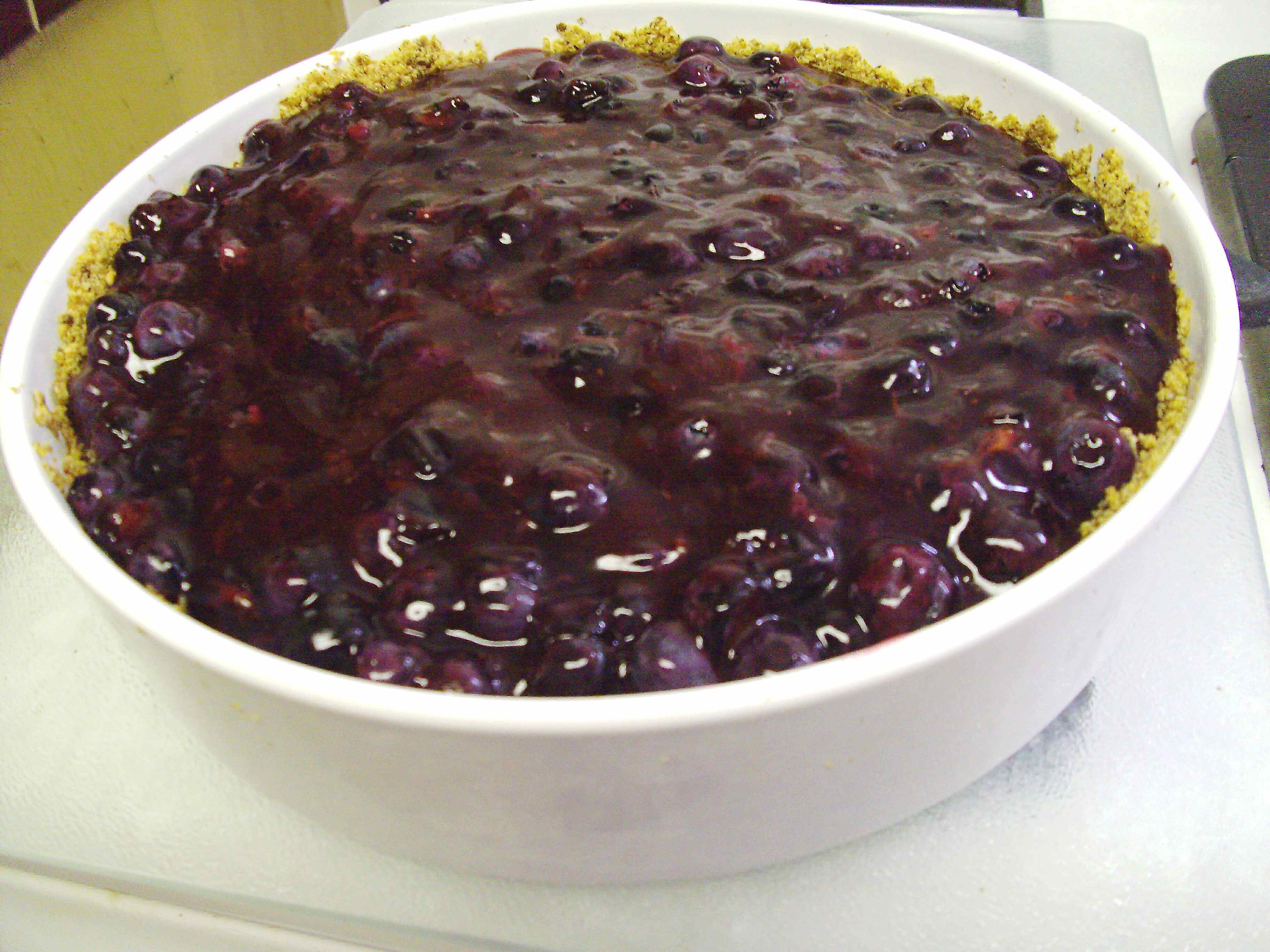
    raw blueberry pie with microwaveable filling and graham cracker crust

    This mostly-raw blueberry pie is a snap to make and very versatile--the filling microwaves in a few minutes, and you don't even have to bake the zippy gingered graham cracker crust--perfect for a hot Fourth of July and all summer long.

  • Recent Posts

  • Contents

  • Archives

  • Now Reading

  • See also my Book Reviews

  • Copyright 2008-2024Slow Food Fast. All writing and images on this blog unless otherwise attributed or set in quotes are the sole property of Slow Food Fast. Please contact DebbieN via the comments form for permissions before reprinting or reproducing any of the material on this blog.

  • ADS AND AFFILIATE LINKS

  • I may post affiliate links to books and movies that I personally review and recommend. Currently I favor Alibris and Vroman's, our terrific and venerable (now past the century mark!) independent bookstore in Pasadena. Or go to your local library--and make sure to support them with actual donations, not just overdue fines (ahem!), because your state probably has cut their budget and hours. Again.

  • In keeping with the disclaimer below, I DO NOT endorse, profit from, or recommend any medications, health treatments, commercial diet plans, supplements or any other such products.

  • DISCLAIMER

  • SlowFoodFast sometimes addresses general public health topics related to nutrition, heart disease, blood pressure, and diabetes. Because this is a blog with a personal point of view, my health and food politics entries often include my opinions on the trends I see, and I try to be as blatant as possible about that. None of these articles should be construed as specific medical advice for an individual case. I do try to keep to findings from well-vetted research sources and large, well-controlled studies, and I try not to sensationalize the science (though if they actually come up with a real cure for Type I diabetes in the next couple of years, I'm gonna be dancing in the streets with a hat that would put Carmen Miranda to shame. Consider yourself warned).

Fennel Mania

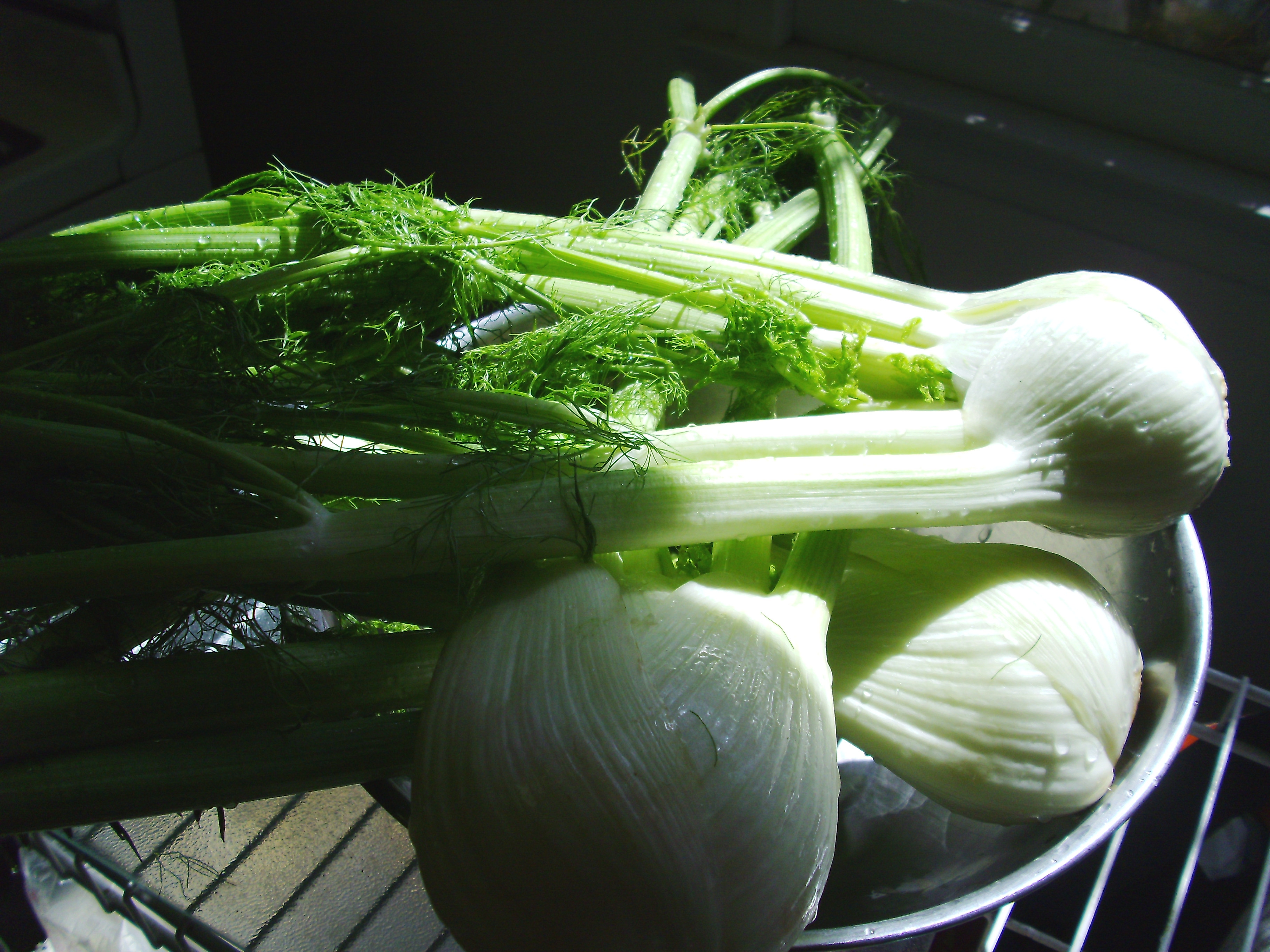
way too much fennel for one salad bowl

This much whole fennel kind of overwhelms my largest mixing bowl.
What was I thinking?

I hear a lot of complaints, among those of my friends and relatives who subscribe to CSAs, about weekly baskets arriving at the doorstep with surprise odd vegetables in unusually large amounts, and what the heck do you do with it all? I’ve never experienced that myself–I’m my own worst (or best) CSA challenge. So I can’t really blame this dilemma on anyone else, because I do my own shopping at my local greengrocer’s. And because the prices are low and the vegetables generally better than what I can get at the supermarket, I sometimes go a little overboard. Fresno tomatoes, when they’re in, are so good I end up with a 7 or 8 lb sack of them every week while I can. If I had more room in the fridge (oh, sacrilege! but they’re already so ripe it doesn’t hurt them), I’d buy even more. An overload of good tomatoes is no problem. However…

too much fennel from the greengrocer's

This week’s hot purchase: fresh fennel at a fabulous–too-fabulous?–price. Fifty cents apiece for large, clean-looking fennel bulbs with about two feet of stalk attached. They’re never less than two dollars apiece in the supermarket, and usually more like three.

So of course I couldn’t resist. I bought FOUR. Yeah. Two dollars total. For what turned out to be more than five pounds of useable produce, because if the fennel’s fresh, it’s all good eating. After washing and cutting it up into useable sections (only a 10-minute operation, surprisingly; fennel’s pretty cooperative for a big frondy vegetable), I actually weighed everything on our food scale.

Three pounds of bulbs for salads or grilling or whatever, two pounds of cleaned stalks chopped into celery-stick-length batons, and about six ounces of the cleaned chopped fronds to use as anise-to-dill-like herbs in tomato vegetable soup, fish, etc.

i1035 FW1.1

But how to use it all in a small household? We have only three people, and I’m the one who likes the anise-y taste of fennel most. Can I freeze some of it for later use (other than the fronds, which I did)? Are we going to be stuck eating it every day for weeks? How long before it starts going bad? What the heck was I thinking?

But it’s enough, and cheap enough, that I get to play around with it. Maybe I can find something good and even original to do with it that doesn’t require long roasting steps (Italian), stewing, or cheese-and-cream-filled gratin-type disguises (French) for the anise flavor, because really, for that you could have just bought celery.

The most obvious thing to do with fennel is slice it up and nosh on it raw. The first time I ever ate it was at the home of a large Moroccan Jewish family up in the  north of Israel. The mother, who invited me over for Shabbat lunch, started the meal with hraime, fish steaks (served cold, thank g-d) in a garlicky broth with enough evil birds’ eye chiles floating in it that the younger children (all the ones under 20, anyhow) started whimpering. “Only one pepper!” their mother replied, but none of them were fooled. I, the self-conscious guest just out of college, took the first bite and nearly fell off my chair as all the brothers and sisters laughed. Luckily the rest of the lunch was pretty unspiced–brisket, long-cooked eggs, farro with chickpeas, a lot of little cooked and raw vegetable salad dishes. I was still recovering from the “appetizer” though; I reached repeatedly for both water and the sliced fennel. Actually, I miss Esther’s hraime still, these many years later…

But mostly you don’t want to just gnaw on raw fennel for relief from the evil chiles. Fennel is pretty. Continue reading

All Those Magazine Microwave Tips

I’m STILL working on a review of Joan Nathan’s Quiches, Kugels, and Couscous: My Search for Jewish Cooking in France. Reason–so far the stories are more engaging and attention-getting than the food itself. So deciding what I think about the food takes a reread and some comparative checking.

For now, I’ll note very briefly that Nathan actually recommends microwaving in several recipes. This is a big step forward in the top-tier cookbook world, even though Nathan’s few mentions are still pretty brief and simple uses for the microwave. They’re still commonsense, so I give her credit for not eschewing them.

But it brings up a sore point for me. A lot of food writers are starting to incorporate microwave tips in their publishing repertoires, but some of them don’t really know how to use a microwave for much or else they don’t do the important legwork and test out their suggestions under varying conditions so that readers won’t get burned.

Case in point: Melissa Clark in a recent article for Real Simple, 14 Who-Knew? Uses for Your Microwave. Clark’s article is an unfortunate object lesson on the need for caution, maybe even a bit of actual research and critical thinking on the bounty of quickie microwave tips the food and homemaker magazines love to dish up.

The “uses” in Clark’s list include sterilizing sponges and plastic cutting boards, juicing lemons, toasting nuts and coconut, heating up beauty products like gel masks and leg wax…

Not only are most of these nonfood uses unoriginal–did she just scour the ‘Net or did she try them out?–but some of them are actively dangerous, to say nothing of unappetizing. Some gel mask manufacturers even put a warning in their instructions not to microwave the mask by itself but rather in a bowl of water–you could end up overheating it and scalding your face. One reader commented that she’d tried the sponge-sterilizing trick and ended up with a houseful of black smoke and a ruined microwave. Very expensive and maybe even harmful, even without the risk of a house fire. Sponges and plastics give off volatiles when heated–do you want to breathe them? do you want to have them coating the inside of your microwave and then washing off into your food the next time you heat up a cup of coffee?

And do you really want to eat ANYTHING from your microwave after something like dirty sponges or a plastic cutting board has been heated up in it? To me it would be like eating off a table where someone’s just left their dirty socks.

SOOOO–Here are a few general (hard-earned, experience-based) notes on not abusing your microwave by following such tips unthinkingly. Because there will always be more articles like Clark’s than the kind I’d hoped for.

1. Don’t microwave nonfood items to clean them (or really, for any other nonfood reason…) At all. Your microwave is not a dishwasher, washing machine, or autoclave (and I have very unpleasant memories of the bio department autoclave and its smell when I was still a lab tech–wouldn’t exactly call it clean even if it did lyse the bacterial cell cultures…) The chemistry of microwaving is different from straight-up heating in an oven and may do something unpredictable or harmful if there’s no water present to absorb the energy, or occasionally even if there is. Think BPAs in plastic–there are loads of Continue reading