• Enter your email address to subscribe to this blog and receive notifications of new posts by email.

    Join 241 other subscribers
  • Noshing on

    raw blueberry pie with microwaveable filling and graham cracker crust

    This mostly-raw blueberry pie is a snap to make and very versatile--the filling microwaves in a few minutes, and you don't even have to bake the zippy gingered graham cracker crust--perfect for a hot Fourth of July and all summer long.

  • Recent Posts

  • Contents

  • Archives

  • Now Reading

  • See also my Book Reviews

  • Copyright 2008-2024Slow Food Fast. All writing and images on this blog unless otherwise attributed or set in quotes are the sole property of Slow Food Fast. Please contact DebbieN via the comments form for permissions before reprinting or reproducing any of the material on this blog.

  • ADS AND AFFILIATE LINKS

  • I may post affiliate links to books and movies that I personally review and recommend. Currently I favor Alibris and Vroman's, our terrific and venerable (now past the century mark!) independent bookstore in Pasadena. Or go to your local library--and make sure to support them with actual donations, not just overdue fines (ahem!), because your state probably has cut their budget and hours. Again.

  • In keeping with the disclaimer below, I DO NOT endorse, profit from, or recommend any medications, health treatments, commercial diet plans, supplements or any other such products.

  • DISCLAIMER

  • SlowFoodFast sometimes addresses general public health topics related to nutrition, heart disease, blood pressure, and diabetes. Because this is a blog with a personal point of view, my health and food politics entries often include my opinions on the trends I see, and I try to be as blatant as possible about that. None of these articles should be construed as specific medical advice for an individual case. I do try to keep to findings from well-vetted research sources and large, well-controlled studies, and I try not to sensationalize the science (though if they actually come up with a real cure for Type I diabetes in the next couple of years, I'm gonna be dancing in the streets with a hat that would put Carmen Miranda to shame. Consider yourself warned).

Soupe à l’oignon gratinée (or not)
French onion soup without the gloppy gratin

Sometimes it pays to think out the recipes you read before you try them. For example…

I love and miss French onion soup from my pre-kosher days (that would be up to about age 19, long, long ago…) Can’t be helped, though–if you keep kosher, beef stock does not combine with Gruyère. And I’ve never actually tried making it at home before, because, if you go by a traditional, official kind of recipe like the one published in the LA Times below, it’s a 3-hour ordeal.

RECIPE: Soupe à l’oignon gratinée – Los Angeles Times.

Total time: 3 hours  Servings: 8  Note: Adapted from Comme Ca.

  • 8 large yellow onions, halved and sliced lengthwise into 1/4 -inch strips
  • 1/4 cup unsalted butter
  • Salt
  • 2 2/3 cups water, divided
  • 2/3 cup dry Sherry
  • 5 cups chicken broth (with as little sodium as possible)
  • 2 2/3 cups beef broth
  • 8 sprigs fresh thyme and one bay leaf, tied together
  • Fresh ground black pepper
  • 1 loaf French bread
  • 1 pound Gruyère, grated

Pretty onerous just on the ingredients (lot of salt in them thar vacuumpaks of stock), not to mention the bread. The Swiss cheese, oddly enough, is a lower-salt cheese than most, about 120-150 mg sodium per ounce as compared with, well, anything else at 180-210. It makes up for the lack of salt with a huge OD of saturated fat–and 2 ounces per person’s got to be a lot, really, just for melting on top of soup. It would be another matter if this were a legitimate fondue, or a sumptuous grilled cheese on really good toasted pain levain, and you were actually going to eat it all, but if I recall correctly, you aren’t.

Because I never had French onion soup at home, I never had to face the task of scrubbing baked-on cheese off the rims of the bowls afterward. Maybe 1/3 of what was sprinkled on ended up stuck like Swiss barnacles to the bowl, which seems like a waste, especially if you shell out for real Gruyère.  The rest turned into goop that sank to the bottom of the bowl and stretched up for yards on the spoon only to stick to the front of your teeth. Or blouse.

Plus at home there’s all the rooting around in the cabinets hoping your soup bowls are the kind that can survive the broiler and that your oven mitts (and guests) can Survive The Gruyère.

But the real cruncher here is time.

The LA Times instructions don’t even include the time it takes to sliver 8 very large onions, but you should, because it’s not trivial: 20-30 minutes, plus crying time. Heat the oven to 400 degrees (15-20 min, they also forgot this bit, but maybe while you’re crying over the onions). Stew onions with butter and 1/4 t salt in lidded casserole in the oven until the onions are softened and a light golden-brown, about 1.5 hrs, during which you’re supposed to stir every 15 minutes (!) Take the casserole out and cook further on the stove top until the onions are a deep golden-brown and just begin to stick to the bottom of the pot to form a crust (10 min? 15? 20? more?–from the experience below, I’d say at least 20, maybe even 30). Add half of the water and cook until the water has evaporated, about 8 minutes (so specific?). Add the sherry and keep stirring until it has evaporated, 3 to 5 minutes. Stir in the remaining water, broth and the thyme bundle, bring to simmer (5-10 min) and simmer 40 minutes (why 40? who knows?). Slice and toast the bread. Fill 8 oven-proof soup bowls, lay the toasts on top of the soup, sprinkle the grated Gruyère evenly over the tops and place the bowls under the broiler just until the cheese is bubbling and begins to brown in places (5 minutes?). Serve immediately.

TOTAL TIME: At least 3 hours, probably more like 3 1/2.

KLUTZ FACTOR: HIGH–lot of hot transfers of heavy casserole dish, finding and broiling ovenproof soup bowls, transferring to the table without spilling…not to mention serving “immediately”.

Then there’s…(you knew this was coming)

Nutrition per serving: 490 cal; 27 g protein; 36 g carb; 3 g fiber; 26 g fat (15 g sat); 78 mg. cholesterol; 808 mg. sodium.

Wow! Am I wrong in thinking that almost no soup should be this much of a labor of love, not to mention love handles? For this much time, fat and salt, I’d demand at LEAST grilled marinated lamb. Or a good runny camembert, a perfectly ripe pear, some excellent sourdough toast and a half-glass of something complex and interesting in the way of wine.

Maybe it’s as delicious as promised. But all those hours, all that stirring, not to mention all that fat and sodium and cholesterol, just for a bowl of onion soup and a slice of toast with melted cheese? Is it any wonder Lipton’s is popular?

Still…Can we do better with the onion soup itself? Maybe as in, vegetarian but still opulent, and furthermore without the heavy-duty time and calorie burden? Let’s try, anyway.

The first objections I have are eight huge onions and 8-10 cups of salted broth. Do I want to make anywhere near that much onion soup? Do I have that many takers in my house? Unfortunately not. One huge onion just for me, then. Maybe my husband and daughter, but only if it’s obviously fabulous. In which case, I won’t really want to share with them.

The main thing here is getting the flavor out of the onions–you want to caramelize them thoroughly and evenly without breaking down their aromaticity too badly. But I personally think baking them slowly in a big oven for an hour and a half just to start to do that is insane. Even if we’re talking about eight big onions.

My first attempt at shortening this recipe did not go badly, exactly, but it didn’t get me soupe à l’oignon either. Continue reading

Getting Mead-ieval

(plus 2 era-appropriate desserts to go with it)

Chaucer's Mead shelftalker label

Chaucer's Mead new 2010 label. Diehard homebrewers aren't as enthusiastic as Wine Enthusiast, but most of them seem young and clearly weren't expecting a dessert wine.

A couple of years ago my husband was rooting around our dwindling wine rack selection on a Halloween eve, right before the trick-or-treat crowd came by. It was actually starting to get genuinely chilly outside in the evenings…

“Hey, Deb–what is this stuff? Chaucer’s Mead?!” [squints at label] “Says you’re supposed to serve it fresh. How old is it?”

“I dunno. Last year? I forgot it was there.”

“Are you sure it’s still good?”

I started typing away to find out. “One of the Renaissance Faire bloggers says it’s really gross fresh and you’re supposed to let it age, but it looks like they mean the kind you make at home.”

Clearly neither of us was an expert.

Mead, of course, is a drink made by fermenting honey. I’d been vaguely aware of it ever since I was eight or nine years old and my dad handed me a copy of Howard Pyle’s The Merry Adventures of Robin Hood. (Quick, everybody, picture Errol Flynn or Kevin Costner, your preference, dressed up more or less as Kermit the Frog in a pointy hat and feather, leaping up onto a dead log with arms akimbo to shout “Ha-Ha-Ha-Ha!” at his fellows in a gratingly cheerful tone…)

I like reading about medieval and renaissance Europe, but I’ve never favored the Renaissance Faire approach–especially because you have to sew your own costume AND know all the names of the pieces AND how to lace them all together. A lot of participants get very snotty about each other’s authenticity. Which is fun, clearly, but I’d be the one they were getting snotty with. Also I’ve never wanted to be addressed as “wench” unless I had a huge frying pan handy to teach the knave who tried it some manners.

Also, after seeing my ex-brother-in-law’s home beer brewing setup (very successful, but then he’s English and knows his stout) I always thought that brewing mead at home would also involve big trash cans with burp valves (I mean, gas traps, though on reflection that’s actually no politer), attract a guaranteed parade of ants even in January (this being Pasadena), and that the stuff would come out cloudy and greenish and a little too authentically medieval for enjoyment.

So all in all, it wasn’t until I stumbled on a bottle at the Trader Joe’s while looking for a gift bottle of more conventional port that I ever considered tasting mead. It was enough of a novelty and the price was right–about $10. Then, of course, I put it in the wine rack and forgot about it for an entire year…which, it turns out, is the right thing to do.

Back at the kitchen counter my husband had finished squinting at the fine print, decided it probably wouldn’t kill or blind both of us at the same time, and was already opening the bottle to pour  a sip into each of two glasses. It looked and smelled like a white dessert wine–light, clear, not at all the cloudy, beerily fermenting syrup I’d been imagining. So we decided to risk it on the count of three.

Even though it looked fine, I’m not crazy about sweet dessert wines and my husband is, so I was still prepared to wince. But whatever I was expecting, it certainly wasn’t this.

It didn’t taste like honey at all–it tasted like all the flowers the honey had been made from. Somehow the brewing and aging had unlocked all the delicate nectary flavors that had been trapped inside the honey, and the flavor kept changing and shifting with every sip. A sherry glass was plenty–it was a bit rich, another surprise, because sherry hovers around 18% alcohol, and this mead was only 10%. But it was intense and fascinating.

Just then, of course, my husband spotted the little packet of spices, like a teabag, that had been hanging around the neck of the bottle and decided he really ought to mull some of the mead with them. In five minutes, the whole downstairs smelled of nutmeg. It was too cloying for me, but he liked it. (Chorus: because he’s a boy) See, though, you can get away with that for a $10 bottle, and your wife doesn’t have to get mad at you. And there was enough left to have a little unsullied mead over the next couple of days.

What to serve with it, though?  I want to keep the contrast between the mead and the food, which is going to have to be either an appetizer or a Continue reading

Bok Choy Broth

Bok choy-based hot and sour soup

Bok choy-based hot and sour

Usually when I get home from traveling I’m in a state where I don’t really want to cook, but I want real food, and I’m sick of the bread-and-cheese-sticks-and-carrots-and-nuts we bring on the plane in self-defense.  The other thing I really want right away is vegetabalia–restaurants, particularly hotel restaurants, seem reluctant to put any on the plate. Microwaved fresh vegetable soup is an easy and satisfying answer–15 minutes and you don’t have to go shopping for anything fancy.

It’s also the answer when it’s cold and rainy and everyone in the house has been down with the crud (aka “Losangelitis”). Today, I wanted something with greens in it like minestrone, but tasting more like hot and sour soup, to cut through the fog that had condensed in my head, and I did NOT want to work hard (also because of said mental/temporal fog). I had the basics for a vegetable broth–an onion, some celery stalks, a handful or so of “baby cut” carrots  more usually reserved for my daughter’s school lunches. A fat clove of garlic. Half a bunch of bok choy that was still in decent shape from two days ago when I microwaved it as a side to stretch leftover Chinese takeout. And in the cupboard, miraculously, I still had three dried shiitake mushrooms in a plastic bag.

Bok choy is one of the Cheap Vegetables ™–usually below a dollar a pound, even in big-chain supermarkets. Not baby bok choy, which is cute and pretty and mild; stores charge three times as much for that. I like the full-grown, poetically dark-leaved, white-stalked bok choy, the kind sumi-e masters choose for their still lives.

Sometimes for a vegetable at dinner (as mentioned above) I just nuke a cleaned and trimmed head of bok choy whole for a couple of minutes in a longish lidded container with a little water in the bottom, cut it up and serve it as-is or drizzled with a little soy sauce and sesame oil. You don’t need anything else to dress it up (and of course, I have pretty low standards for presentation). Its fresh, radishy flavor mellows into something richer and more aromatic as it cooks down and produces its pale-green pot liquor. You don’t want to waste that; it’s a perfect addition to a vegetarian consommé, especially when you’re going light on salt or calories.

I sometimes even skip the onion-carrot-celery-garlic vegetable stock base and make a really simple broth by just microwaving the bok choy all by itself with water to cover–especially when my head and stomach aren’t cooperating with me or with anything else. But that’s a little on the purist side of things, when I’m feeling so miserable all I want is something hot, clean-tasting and fresh with no distractions. For better times, I want a real soup with a bit more richness and variety, and bok choy definitely plays well with others.

Back to the hot-and-sour scenario, for example:

Shiitake mushrooms are expensive fresh at your local Whole Foods, about $13/lb. But a package of 15 or so dried caps sells for $3.50 in the Asian or International Foods section of your local supermarket, and the dried mushrooms are so much better for infusing a broth with pungent richness. They’re easiest to soak up in a microwave–a few minutes rather than half an hour.

Between those and the carrot-onion-celery aromatics, plus of course garlic, you’re set. Especially if you have a little container of z’khug (hot pepper-garlic-cilantro paste) in the freezer and can saw off a chunk to spice up your soup. Toasted sesame oil, vinegar, and low-sodium soy sauce–all optional. Ginger? You could. Ginseng? According to a friend from a Cantonese family, only if your mother insists. Continue reading

Speeding up Eggplant Parmigiana

On the last night of Hanukkah, I fried some more–but only a little this time.

When my daughter and I went vegetable shopping at my favorite corner grocery that day after school, we found a bin of eggplants on sale for 25 cents apiece. And they were pretty good, so I bought four of the firmest ones and we lugged them home.

The moment I spied the eggplants at the store, I was already thinking about eggplant parmigiana, or at least about involtini (cheese-filled eggplant rolls with tomato sauce), which comes to much the same thing. It’s mostly a geometrical difference at that point–rolled eggplant versus flat, crosswise rounds versus loopy lengthwise slices.

I’ve loved eggplant parmigiana since I was a kid and my parents would take us to a local Italian diner run by a friend of my mother’s. A different Italian diner, this one during my student days, served it either screamingly hot in a fresh-from-the-oven baking dish with so much incendiary mozzarella on top that you were guaranteed to scorch the roof of your mouth, or else sandwiched into a grinder roll with the best tomato sauce in the universe. I loved them both.

But there’s no denying the fact: the traditional parmigiana is one heavy kind of dinner. It’s designed to remind you (an hour or so after eating it, or perhaps again in the middle of the night) that suffering is all around us and wants us to share, so be humble and don’t forget the Tums.

Why is it so heavy? The eggplant, the tomato sauce, the garlic, even the cheese filling–all fine. I decided the main problems with eggplant parmigiana come down to two things: 1) frying the eggplant slices to cook them, because that takes a lot of time and a lot of oil, and 2) breading the eggplant with eggs and flour or breadcrumbs.

In the kibbutz kitchen where I worked after college, I did more than my share of slicing and breading eggplants and dipping them in eggs and redredging and frying, the whole works, enough for several hundred people (the other several hundred were smart enough not to eat them unless they happened to be hanging around the kitchen side room where the fryer was going and could snag a slice fresh off the cooling rack).

It’s more than ok to eat breaded eggplant hot off the press, as it were. Almost essential, in fact. But let the slices wait around at all, layer them with cheese and tomato sauce and bake for half an hour or so under foil, and what started out as fried eggplant, deliciously crunchy with a creamy texture inside, ends up shriveled and spongy or stringy between no-longer-crisp layers of bready gunk, and more than that, the frying oil is starting to make itself known again. Continue reading

Fastest Pie in Town

Pumpkin pie in the microwave

On the energy downswing from a departed sleepover guest, my daughter suddenly declared she wanted pumpkin pie, we had two cans of it and I’d said I would make it soon and I still hadn’t, why wasn’t I making it, it wasn’t fair, she hadn’t had any all year and it was past October so it was in season. This last argument was just for good measure, given the pumpkin was in a can, but still, give her points for it–it’s a new crop after all those shortages.

With ears ringing, I said, but it’s already 5:30. “So? I can help!” You’ve been there, I’m sure.

Pumpkin pie is a slow-food-slow kind of dish–not much way around it. Even with a premade crust and a can of “pumpkin pie mix” rather than just packed steamed pumpkin, the filling needs 45 minutes to an hour to bake. Then it needs another hour or more to cool enough to eat. And if you’ve got a tiny kitchen and your kid is helping, the elbows factor is bound to add some time and confusion.

Also, normally, with a diabetic kid, you don’t just think, “Hey! Let’s make pie for dessert!” Especially since the filling calls for 3/4 cup of sugar per pie.  But pumpkin pie, if it’s made from scratch and isn’t just a frozen ready-made version, is kind of reasonable on carbohydrates for a dessert–about 25 grams for 1/6 of an 8″ shallow pie, according to the ADA guidebook, or in our case, 35 grams for 1/8 of a standard 9.5″ deep-dish pie (calculated from the ingredients). And pumpkin may be a fruit and not a vegetable, but it’s still got a respectable serving of vitamin A and fiber. And I also like it, which helps.

Still, the time is a killer. But I had such a surprise success with spinach quiche in the microwave a while back that I started thinking. The standard filling for pumpkin pie is also based on a custard, more or less–a couple of eggs, a cup and a half of milk per deep dish pie. It’s half the eggs of a quiche, but it might well still work in a microwave. That part would take something like 5-7 minutes and leave enough time for the pie to cool while we got dinner together.

Actually, I’d wanted to try this for a while, and not with company in tow, just in case it flopped. The weather here was 97 degrees most of the week but dropped to the low 70s today and was promising an actual chill for evening. So doing the crust in the regular oven for 15 minutes or so wouldn’t actually make life miserable.

It was almost looking like a decent idea considering the fact that it was and still is totally nuts to make an entire pumpkin pie from scratch right before dinner (or at least everything from scratch short of hacking up a raw pumpkin and dealing with the seeds). So I decided to go for it, and I made my daughter deal with the filling while I made the crust and parbaked it. We just about managed not to step on each other or crowd into the same corner at the same time, but both parts went well. And then the real test came–time to nuke. Continue reading

The Hummus Debate

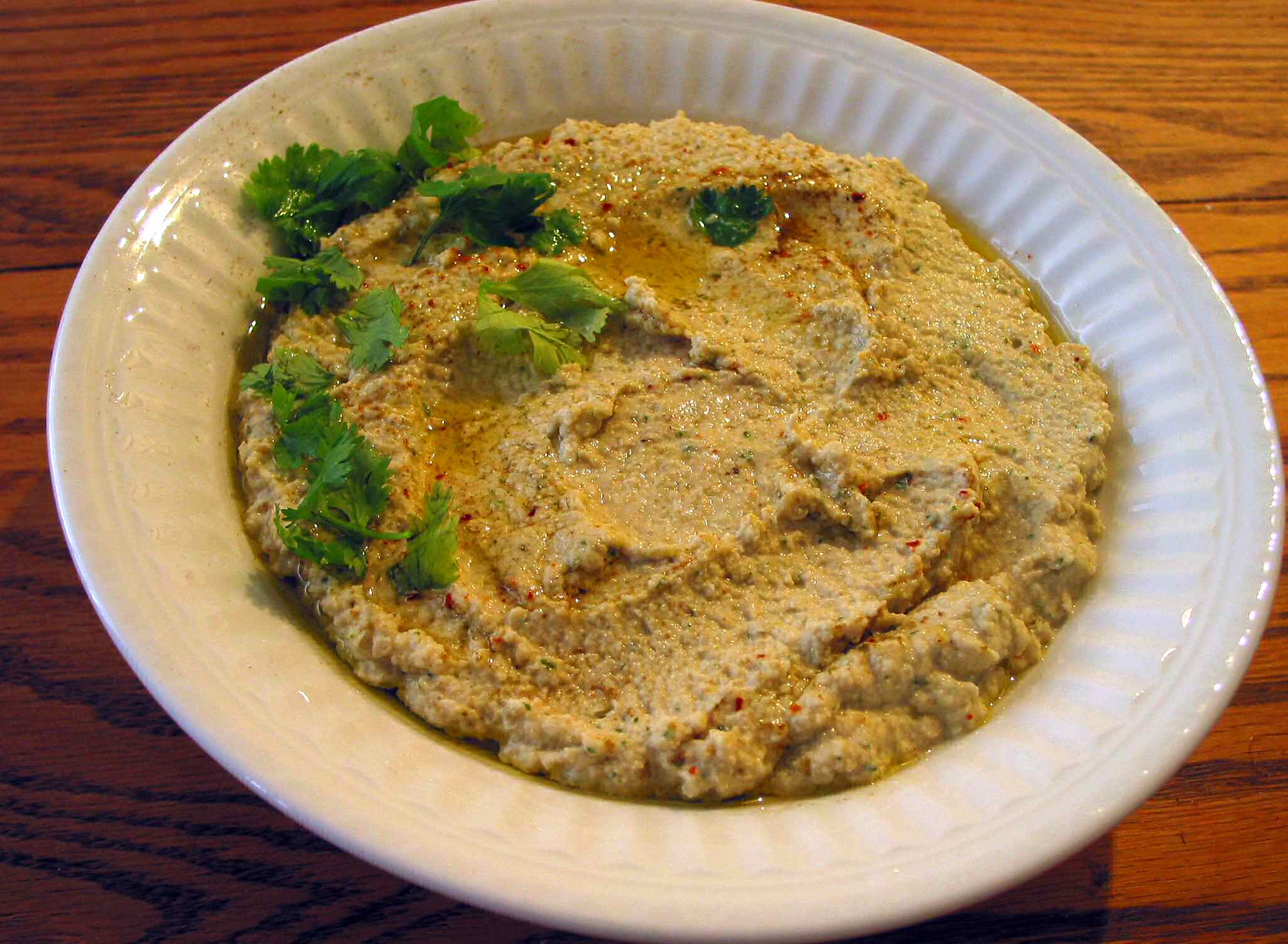
Hummus from scratchHummus is a highly politicized food these days, a situation most eaters outside Lebanon, and at a guess, most inside as well, consider slightly ridiculous. “Owning” hummus has become a point of national pride for a few higher-ups in Lebanon, which has in the past year or two followed Greece’s feta-labeling strategy and tried to appropriate sole credit for authentic hummus. At its more light-hearted, this struggle for hummus supremacy takes the form of an annual stunt in which chefs produce a hummus bowl almost the size of an Olympic swimming pool (or at least an Olympic-sized wading pool) and the triumphal photo makes the international news. But those who really take the Lebanese official origin issue seriously and grimace whenever hummus is served somewhere else are, as far as I can see, only hurting themselves.

The trouble with demanding official status is that both feta and hummus long predate the borders of the countries trying to claim them. Both are simple enough to make and so consistent from batch to batch that they don’t really exhibit much in the way of “terroir” the way aged cheeses, wines, vinegars and so on might. Feta–equally good, equally real, equally part of the native fare–is made in a lot of places neighboring modern-day Greece. Places like Bulgaria, which don’t have as much political clout in either the EU or the Slow Food organizations, and which don’t get half the international tourism. Also places further away, notably Denmark and France, which still have reasonably large sheep’s milk production. Greece may actually have succeeded for the moment in the food labeling tug-of-war, but it’s made the country look somewhat silly and petulant, unwilling to face the fact that they’ve closed the barn door at least a century after the sheep got out. Will they profit from the exclusive labeling? doubtful–and it might have been better ambassadorship to claim credit for spreading feta’s popularity and offer more recipes and products made with it.

Much to the chagrin of whoever decided in the past couple of years that hummus should be exclusively Lebanese, this simple spread is made and eaten in lots of other countries. In Egypt, it’s made with a half-and-half mixture of favas and chickpeas. And Israel, which is probably the “other country” being targeted most directly by the Lebanese hummus campaign, has eaten, breathed, and slept a more or less chickpeas-only version of hummus as an essential food (along with felafel) for longer than the state has been independent.

Unlike the partisanry in Lebanon (not that Israel has no partisanry of its own), when it comes to food, everyone in Israel–Jewish, Muslim, Christian or Druse–gives credit with a certain degree of pride that hummus is Arab food, especially if they’ve made it themselves rather than trotting down to the corner grocery to buy the bland ready-made version from a vat in the deli at the back.

That’s because everyone likes to eat it. It’s also because being a good host is really important and something of a formal habit and a chance to show off just a little–actually, I think that’s still true all throughout the Middle East. Everyone expects friends and neighbors and friends-of-friends to drop by at a moment’s notice, without invitation, especially on the weekend. The least you can do is have a bag of roasted sunflower or pumpkin seeds and a pot of hideously sweet mint tea to bring out if they show up to schmooze after supper, but in the afternoon, better if you can bring out a platter of pita, vegetables, and a bowl of hummus.

Hummus is simple Arab fare at its best–humble, nutritious, appetizing, and (now that we have food processors) easy to make a lot of so you can bring out a wide platter of it for your guests and drizzle a little olive oil and some za’atar or sumac or cumin or paprika over it for the finishing touch–right before everyone tears pita and dips in. The ceremonial thing is what makes it good hosting and is part of the fun.

Here in the US, most people buy their hummus in little plastic containers at the supermarket–not elegant at all, and a lot of money for what you get. Kind of depressing, even. Look at the ingredient list and it’s as long and discouraging as any other processed food–that’s so it can be shipped nationally and stored for a week or two in case it doesn’t all sell out the first day. Look at the nutrition label and you see highish salt, lowish protein and fiber. It’s been fluffed out with canola oil to stretch the expensive ingredient, tehina (sesame paste), and there’s not so much in the way of chickpeas even though they’re supposed to be the base.

While I’m not so much against the fluffy smooth stuff (it tastes ok, if all you’re expecting is a spoonful or two of party dip), I prefer homemade because it’s denser and more nutritious, with more iron and protein from the chickpeas, something you could eat packed in half a pita for lunch and not be starving within an hour. Continue reading

Prunes and Lentils III: The Lentil Variations

Today’s (and last week’s, and the week before’s) topic is STILL the lentils-and-prunes challenge.

Before I get on a roll about lentils, I should mention that the first Prunes and Lentils post was my 101st post for this blog. I don’t know if we should celebrate, but why not. Woo-hoo! Good enough. Consider it celebrated.

It’s taken me a full two weeks to put up this post because this is where the rubber meets the road, or at least where the lentils meet the prunes. The moment of courage. And I don’t know whether it’s going to be great or whether people will go back to wondering why anyone ever let me in a kitchen. (That’s easy: because no one wanted to do the cooking  themselves.)

Ordinary brownish-green lentils are kind of a workhorse ingredient in European, Mediterranean and Near East cooking (also in Indian and African cooking, though red lentils are better known). Unlike restaurant chain buffalo wings, lentils are actually rich in protein and iron, and they aren’t surreptitiously pumped up with sugar, salt and fat to entice you to overeat. The Center for Science in the Public Interest is not likely to sue, because a bag of lentils doesn’t come with a deceptive toy to con the kids. (See? we can be topical and up on the hot news of the moment even while discussing an arcane Slow Food subject like lentils).

And lentils are CHEAP–the whole point of starting this Prunes and Lentils challenge in the first place. Somehow even the big supermarkets that push shoppers to the middle aisles to buy boxes instead of actual food always carry dried store-brand lentils over near the bags of rice and split peas and kidney beans and such. It’s one of the few middle-aisle purchases that are worth it.

I don’t know if lentils have even kept up with inflation over the past 20 or 30 years, because they’re always something like $1-$1.25 for a one-pound bag. Same as when I was a student on a $20 a week food budget. And a pound makes 5-10 meals, not just one serving.

Actually, the recent agroeconomics of growing lentils in the US makes unexpectedly interesting behind-the-scenes reading for policy wonks like me. Lots of people are now clamoring for the US to change the crop subsidy laws to encourage more nutritious crops than corn, soy and wheat. Lentils are still a minor crop, but apparently the USDA introduced new marketing loans and other incentives for lentils, peas and chickpeas under the Farm Act revisions of 2002 and 2008, and exports for pulses have risen by about 45% in the last few years to India, Spain, the Philippines, and other major lentil and chickpea consumers. The rest are bought for animal feed and international food aid programs, especially those for sub-Saharan African nations.

That’s because lentils still fly under the radar here. The average annual consumption in the US is still just about a pound per person. Up from 0.8 pounds in 2008, so a 20 percent jump, but still. One pound per person in a year. If my continuation of the Prunes and Lentils Challenge posts has no other benefit to humankind, I would hope that it inspires you to buy and cook–and eat–at least one additional pound per year in a creative and satisfying way. Pass it on–Two pounds per year? At a cost of $2-3 total? We can but dream…

Of course, now that bean cuisine has become a point of pride for Meatless Mondays and other trends in eating green (if not eating local), lentils don’t just come dry in bags or bulk anymore–not glamorous enough, perhaps? If you’re upscale, you can get them precooked in little cans at your Whole Foods or steamed in vacuum packs at your Trader Joe’s, but those chic packages are much, much more expensive per meal and don’t taste as good. I frankly wouldn’t bother unless you’re on the road or camping or something and don’t have a kitchen at your disposal. Dried lentils don’t need a presoak to cook up within about half an hour even on the stove top, and they’re so easy to cook in a microwave (and avoid the watched-pot-never-boils problem) that the extra expense and time trying to find the precooked ones is usually not worth it. (And what about all that extra plastic and metal packaging? Be righteous–buy ’em dry.)

If you cook up a whole pound bag at once, you can use it throughout the week or (better, for a lot of people) freeze half of it with a bit of cooking liquid in a microwave container and save yourself some time the next time you want a batch. I keep thinking of that old “Cook Once, Eat Twice–That’s Italian!” lasagna ad (can’t remember if it was for noodles or sauce) from the 1970s. It’s a bit old-fashioned, but still a good idea for  when you’re too tired to cook for real.

In this post, I’ve got 3 or 4 main “strategic” ideas for the prunes and lentils challenge, along with more recipes and variations than should really go in a single post (and THREE more prune accompaniments as well), so just roll your eyes, bear with me, and if you decide never to let me in your kitchen, I’ll understand (plus I’ll never have to do the dishes–win/win!).

So first things first–gotta cook that bag of lentils (and recycle the bag). This recipe is probably longer than the actual process but it contains valuable Continue reading

Prunes and Lentils II: Prune Sauces for Savory Dishes

Following on from Sunday’s post (have you recovered yet? Should I be selling Tums futures?) I should add that NOWHERE in Karen Page and Andrew Dornenburg’s The Flavor Bible can a mention be found of prunes paired in any way, shape, or form with lentils. Don’t have the faintest why not. They do state that plain old green lentils have more flavor than red or brown.  They also pair prunes with olives, mushrooms, gorgonzola and walnuts as well as sweet spices and red wine. Somewhere in that crossroads there’s got to be some confluence of flavor, but wherever it is, they haven’t considered it.

Others have, however–notably Nathan Lyon of the Discovery Channel, ABC’s “Beat the Chef” show in Australia from a few years back, Hello! magazine (OK, copying straight from the California Prune Board’s UK division–wait a minute, they HAVE a UK division?!–and borrowing its press photo)…Oh well.

The benefit to considering prune sauces is that you can serve them with a lentil dish if you’re ready for that or to lift a more familiar savory dish with meat, fish or poultry.

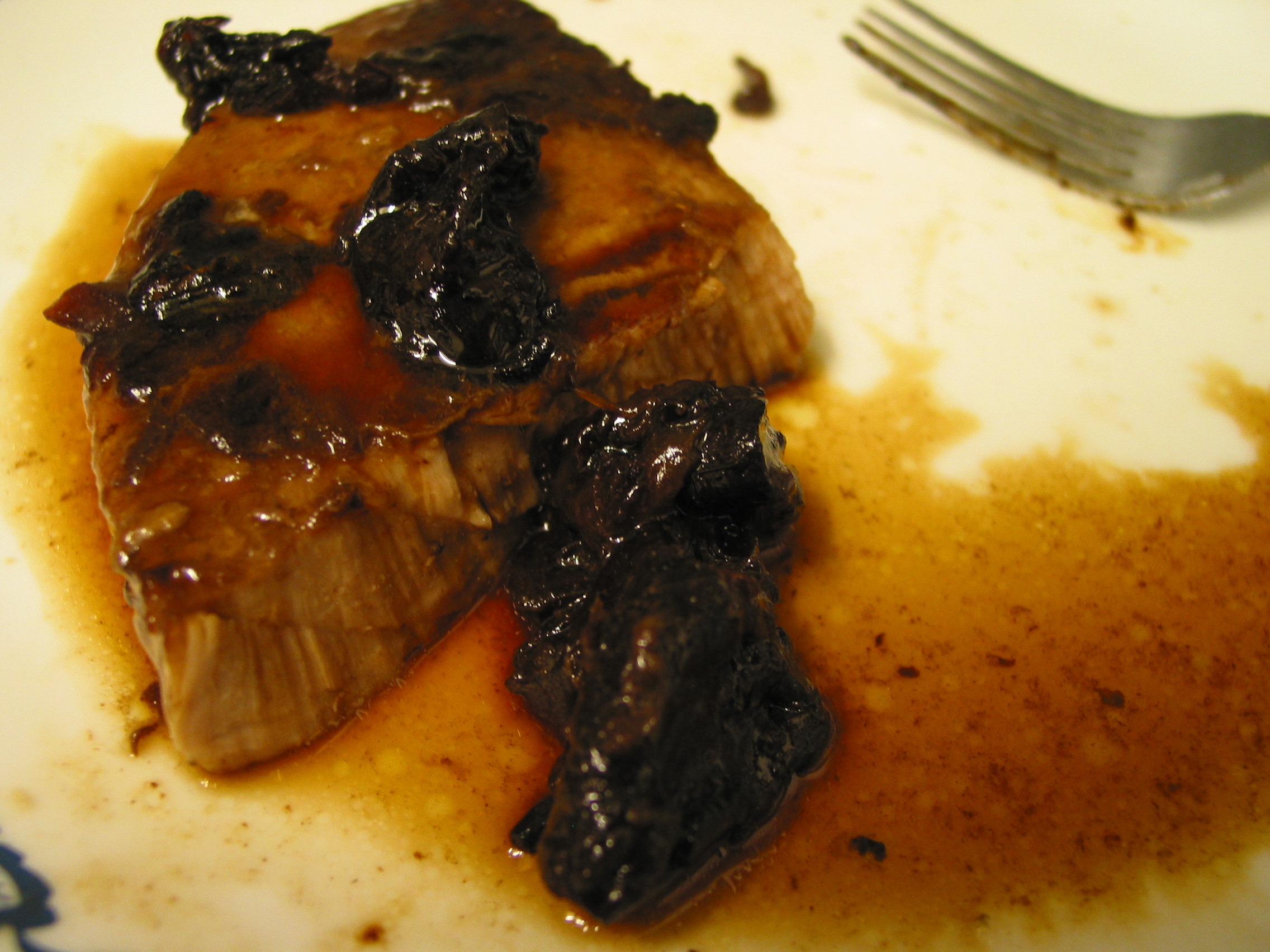
Pan-seared tuna steak with microwave prune and wine chutney

Pan-seared tuna steak with microwave prune and wine chutney

And yes, I said “lift”. Make of it what you will, but any one of the sauces below is better than whatever Hello! magazine has to offer, even if it were original.

Stéphane Reynaud’s Prune Sauce (excerpted for consideration from French Feasts, 2009)

This was designed to go with a simply pan-fried foie gras for six–probably 3-4 oz per person, which seems like a hefty kind of serving, even though I do like liver.  But the sauce–why 18 prunes? 3 per person? and it seems a heavy load of spice for a small amount of wine. Also he has you rest the stuff overnight at room temperature before finishing it. Not sure why–to thicken up, probably, like Elizabeth David’s recipe for peach jam, which also sits out overnight after the first boil-up before resuming.

  • 18 pitted prunes
  • 1 c red wine
  • 1 t ground cinnamon
  • 1 t quatre-épices
  • 2 star anise pods
  • 2 T light brown sugar
  • 2 1/2 T butter, chilled

Boil the prunes 5 min with the wine, spices and sugar, cover and leave O/N at RT. Remove the prunes and reduce the spiced wine to a syrupy sauce. Whisk in the butter, then return the prunes to the sauce.

Microwave Prune Chutney with Wine

My microwave version started out as Reynaud’s wine-based sauce and suddenly morphed, as I was grabbing things out of the fridge for it, with a half-remembered cranberry chutney recipe my mother-in-law served a number of years ago at Thanksgiving. This turns out to be a potent combination, aromatic and sharper, no doubt, than Reynaud’s sauce, with a definite suggestion of saltiness about it–but no actual salt. I don’t recommend eating it straight–too pungent for me, though it’s uncannily close to the relish my mother-in-law served and pretty decent with poultry and stuffing or rice and so on–but cooking 5 minutes or so extra in a saucepan over direct heat or with the food you’re saucing and some extra wine turns it into something pretty special. The whole cloves in particular (which you can take out before using the sauce) do something incredible for any meat or steaky fish you cook with this sauce. Like brisket but just…better, more sophisticated, elevated to the level of cuisine. In fact, put some of this prune sauce with cloves in your next brisket too. 

Makes about 1 cup

  • ½-1 c leftover dark red wine–syrah, aglianico, something inexpensive but rich
  • 8-10 pitted prunes, quartered
  • grating of fresh ginger (1/4 t)
  • grating of 1/2 decent-sized clove garlic or 1 small clove
  • 1/4 red onion, chopped
  • 1-2 t. wine vinegar
  • sprig of thyme
  • pinch of fennel seed
  • 4-5 whole cloves, loose if you can stand picking them out or else stuck through a scrap of onion

Toss the onions with the vinegar and let sit a few minutes while chopping the prunes into quarters–it cuts down on the bite. Mix the onions, prunes, and the rest of the ingredients except the cloves in a soup bowl with a microwaveable lid that can placed on with a gap for steam to escape. Poke the cloves into a larger scrap of onion and add that to the bowl so you can fish them back out easily after cooking. Microwave 1-2 minutes loosely covered on HIGH or until it’s boiling, let sit 5 minutes, stir, microwave again. The prunes will have taken up a lot of the liquid, the onions should be cooked through and garnet-colored, and the wine should be reduced and a bit syrupy.

.  .  .  .  .

From France to China, then:

One year I was determined to make a low-sodium substitute for fermented black bean sauce with roast salmon. I soaked some prunes in a little boiling water and mashed them to a paste, then dressed them up with garlic, ginger and a few other things. It turned out, to my surprise, like homemade hoisin–-dark, glossy, tart and aromatic, less sweet than the commercial stuff, a little smoky from the sesame oil and scallions, with the suggestion of salt Continue reading

Microwave Cheesecakes

Microwave cheesecakeThis week we celebrated Shavuot, the feast of first fruits and giving of the Torah at Mt. Sinai. Shavuot has only two solid traditions I can remember from childhood: studying all night (three ultra-dedicated guys from my congregation would hang out and do it for the rest of us, kind of like the Jewish Scholarship Marathon), and eating cheesecake. Which is a pretty good tradition, actually.

I go for the serious New York-style tall, lemon-tinged cheesecakes that are rich and just dry enough to have a fluffy crumb to them. The only one of these I ever made myself was the glorious one from (once again) Joan Nathan’s The Jewish Holiday Kitchen. It was huge, it was beautiful, it took two whole hours of baking with the oven on and off, and I was just barely smart enough to wrap it tight in a double layer of heavy-duty tinfoil  right before carrying it out to the car for a brunch setup. Because of course it took a nosedive onto the parking lot pavement–but the foil held up! And the cheesecake was only a little bashed! And we covered it pretty liberally in sour cherry jam, and everyone ate it happily, and no one kvetched. A miracle!

The story of how G-d gave the Torah law to the Jewish people on Mt. Sinai, is kind of hard to picture. Supposedly it was all so shockingly loud and bright people started to hear colors and see sounds (or else the lightning was so close it started to short out their neural circuits). But what is clear is that  everyone was so awed and shocked they stopped arguing, at least for a few minutes.

So of course it has everything to do with today’s topic, which is still cheesecake. It’s an established fact–feed cheesecake to your people and you’ll get a few minutes of blessed silence. It’s quicker and cheaper than group electroshock therapy, too, and it tastes better.

So I’d wanted to make a cheesecake for Shavuot, but not take two hours about it, especially in May in Los Angeles. Also, cheesecake is  a traditionally loaded food–one look and you can hear your gallbladder calling you.  But it’s a real challenge to make a decent-tasting, genuinely low-fat version that isn’t just “use neufchâtel and cut out 3 calories!” Or else hideously tough or gelatinous or watery or flavorless or grainy or otherwise weird.

Drained nonfat yogurt–no. Tough, tangy AND watery after baking. Ricotta–not bad, especially for Roman-style cheesecake, but bland and a bit grainy. Gelatin’s out for me because it’s not a kosher ingredient. Fat-free cream cheese–I’m just not a fan, it’s too salty and processed-tasting somehow. Not fresh. And on the web I’ve seen everything from tofu to tehina (sesame paste)–I can’t imagine, but to each his or her own.

Still, I think with the microwave I’ve got the time thing solved in a way that will work for a number of different versions. A while back I discovered you can take pretty much any standard New York-style cheesecake recipe (eggs, flour, cream- or other suitable cheese, vanilla, lemon juice), put it in a microwaveable baking dish, cover and nuke it through in a couple of minutes without ruining the texture. It’s probably better without a crust, but if you prebake the crust then pour the filling, cover, and nuke while it’s still hot, it might prevent sogginess.

The only versions that might be really troublesome would be ones with yogurt, which is usually too thin and watery even when drained, or else cottage cheese, which works in a conventional oven but not the microwave. For some strange reason cottage cheese curd liquefies into a buttermilk-like mess in the microwave rather than setting up. Frustrating. But ricotta works pretty well, cream cheese–of course, labaneh–astoundingly perfect, and even…nonfat powdered dry milk (NFPD) with buttermilk. Odd but true. So it will work with a range of adaptations from full-fat to ultra-lean, and the rest is up to your tastebuds. Continue reading

Adventures with Cheese, Part II: Paneer in the Microwave

Paneer is the fresh white curd cheese used in Indian dishes like saag or palak paneer, aloo mattar paneer, and so on. Panela or queso fresco are okay substitutes, if you can get them, and they taste a lot better than tofu.

But you can also make paneer very easily (if a bit messily) at home in a few minutes, if you have a pyrex bowl, a microwave, and a colander. If milk is going cheap in your neighborhood market this week or you have half a gallon that you really need to use up quickly before you go on vacation, making paneer isn’t a bad way to do it.

You’ll get about 5 oz fairly dry curd for a quart of milk, so not a great yield, but it’s pretty versatile. Whole milk makes a richer cheese than skim, obviously, but both work okay. Press the curd hard when you drain it and it’s sliceable. Press lightly and it’s spreadable. If you use a quart of buttermilk on its own rather than mostly milk, you can blend in a little garlic and some herbs and a drop of olive oil to the drained curd, and you’ve got something close to Rondelé cheese spread.

And don’t just toss out the whey–it still has a lot of soluble smaller proteins and calcium in it, so it’s worth keeping if you can use it within a day or so. You can use some of the warm whey instead of water to make a moist, chewy-textured Italian-type yeast bread (whey is extremely good for rosemary focaccia). Or puree the whey with some lightly cooked broccoli or cauliflower or canned pumpkin, a bit of onion or garlic, and some marjoram and/or thyme for a quick fresh cream-of-vegetable soup.

Paneer from scratch (makes about 5 oz, can scale up if you prefer)

  • A quart of milk
  • 1 cup of buttermilk if you have it
  • juice of a lemon

1. Pour everything into a 2.5 qt. pyrex mixing bowl, mix, and microwave on HIGH about 5 minutes, until the milk solids separate from the clear yellow whey. The solids should float in a mass and be pulling away from the sides of the bowl.

2. Take a colander or strainer over another large bowl, line it with a couple of layers of cheesecloth or 3-4 overlapping round paper coffee filters, whatever works for you. Carefully pour the whey over first, keeping the curd back in the bowl with a serving spoon or spatula for as long as possible, until you’ve poured most of the whey through (otherwise it takes forever to drain…). Then drain the curd on the filters and press it until it’s fairly firm and could be cut into cubes without crumbling apart.