• Enter your email address to subscribe to this blog and receive notifications of new posts by email.

    Join 241 other subscribers
  • Noshing on

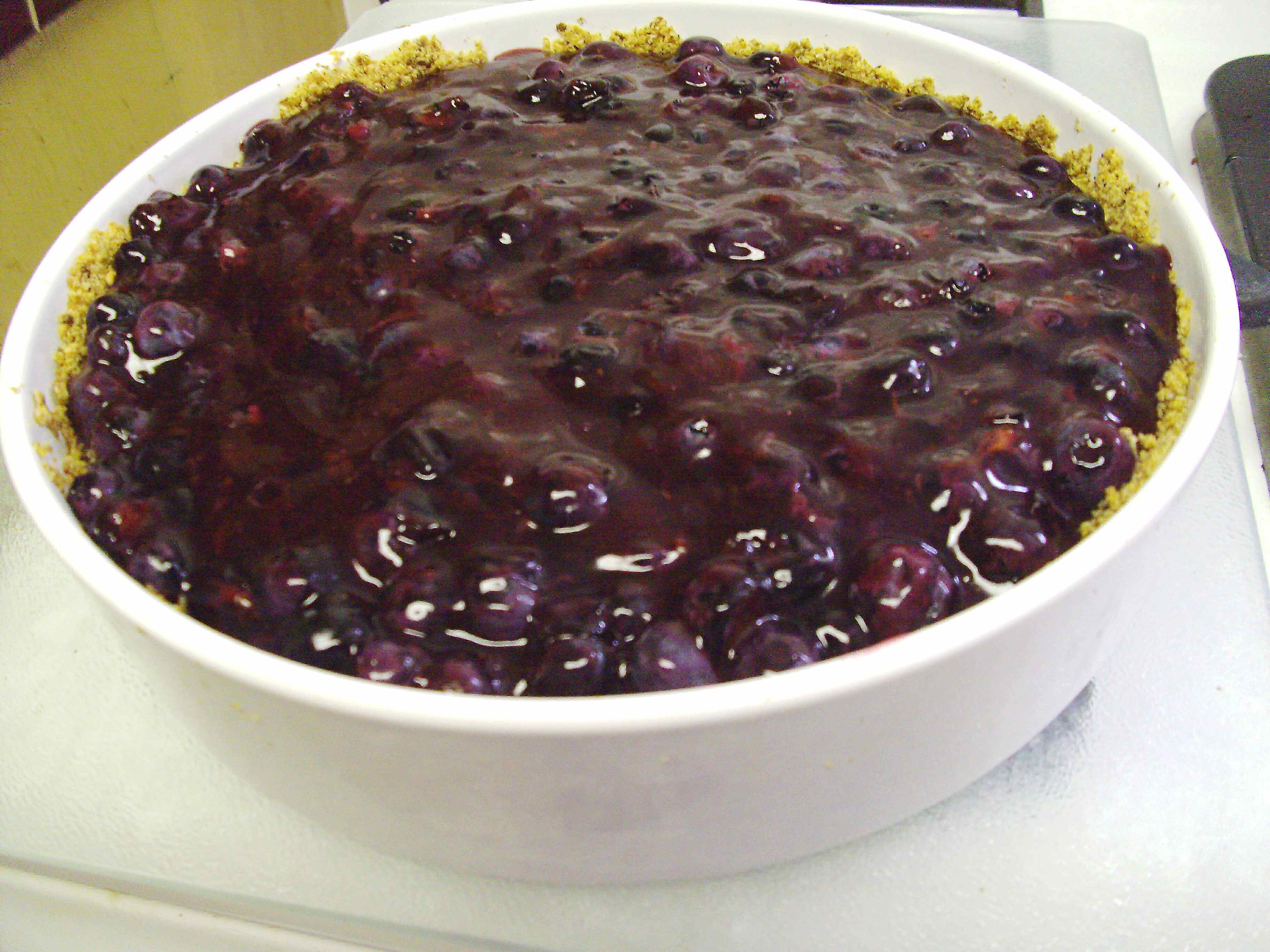
    raw blueberry pie with microwaveable filling and graham cracker crust

    This mostly-raw blueberry pie is a snap to make and very versatile--the filling microwaves in a few minutes, and you don't even have to bake the zippy gingered graham cracker crust--perfect for a hot Fourth of July and all summer long.

  • Recent Posts

  • Contents

  • Archives

  • Now Reading

  • See also my Book Reviews

  • Copyright 2008-2024Slow Food Fast. All writing and images on this blog unless otherwise attributed or set in quotes are the sole property of Slow Food Fast. Please contact DebbieN via the comments form for permissions before reprinting or reproducing any of the material on this blog.

  • ADS AND AFFILIATE LINKS

  • I may post affiliate links to books and movies that I personally review and recommend. Currently I favor Alibris and Vroman's, our terrific and venerable (now past the century mark!) independent bookstore in Pasadena. Or go to your local library--and make sure to support them with actual donations, not just overdue fines (ahem!), because your state probably has cut their budget and hours. Again.

  • In keeping with the disclaimer below, I DO NOT endorse, profit from, or recommend any medications, health treatments, commercial diet plans, supplements or any other such products.

  • DISCLAIMER

  • SlowFoodFast sometimes addresses general public health topics related to nutrition, heart disease, blood pressure, and diabetes. Because this is a blog with a personal point of view, my health and food politics entries often include my opinions on the trends I see, and I try to be as blatant as possible about that. None of these articles should be construed as specific medical advice for an individual case. I do try to keep to findings from well-vetted research sources and large, well-controlled studies, and I try not to sensationalize the science (though if they actually come up with a real cure for Type I diabetes in the next couple of years, I'm gonna be dancing in the streets with a hat that would put Carmen Miranda to shame. Consider yourself warned).

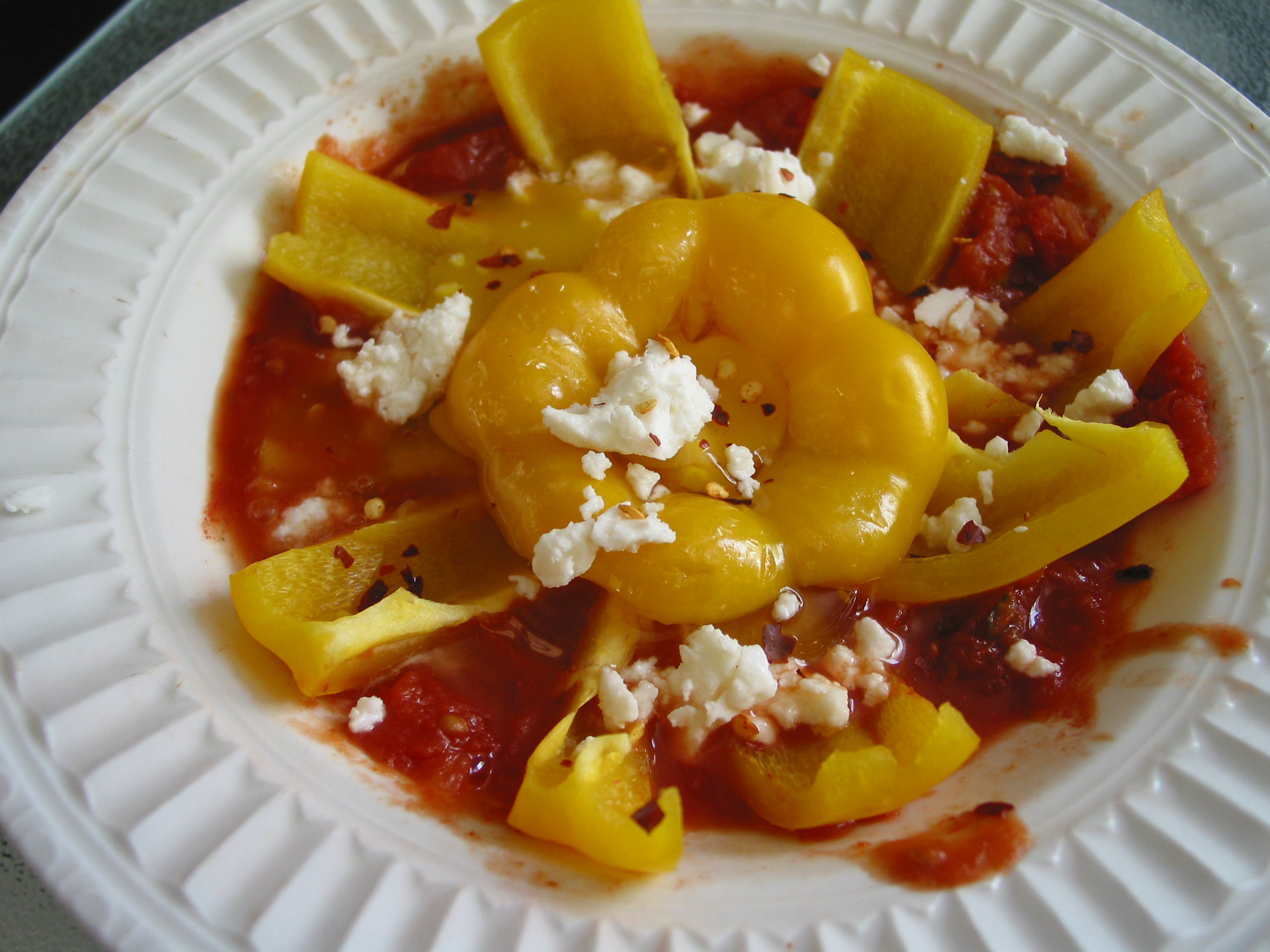
Microwave Tricks: Shakshouka

IMG_0458

Marinara plus a pepper makes a good start.

Sometimes during Passover you just can’t take any more matzahnola. Or matzah with jam, or matzah brei. Or cake. Or macaroons. Anything for breakfast that doesn’t involve at least one vegetable (other than yourself, before coffee). Your tolerance for sweet stuff has been exhausted, and as for the leftover gefilte fish and hrein…no. We are not going there. No matter how much my husband insists it’s “perfectly good” (and I notice he hasn’t schlepped the rest of the jar with him to the office!)

Forget all that. There’s a pretty good cure for the Pesach blahs–you need some chile peppers and you need them now. Not in 20 minutes, no major cooking involved. You have a microwave, some cheap microwaveable soup bowls or the like, and you’re not afraid to use ’em for an increasingly popular Israeli brunch dish–shakshouka. Which is basically the Jewish version of huevos rancheros, only without beans or potatoes. Or lard.

Yotam Ottolenghi has made shakshouka popular and photogenic in at least one of his famous cookbooks, probably prettier than what I’ve got here. But it takes longer too, and I’m impatient.

To make shakshouka, you usually need a frying pan, olive oil, some tomatoes, peppers and onions, plus garlic, cumin, chile peppers, maybe a couple of oregano-or-thyme-and/or-cilantro-type herbs–sounds like the makings of salsa, no?–and some fresh eggs to crack into the resulting sauce. The sauce takes some 20-30 minutes to cook down, the eggs another 5-7 to cook more or less sunny-side-up in the middle of the sauce. That’s a lot of time for breakfast. I wanted a shortcut this morning.

Most jarred salsas are not kosher for Passover–it’s the distilled vinegar thing. That’s okay, because yesterday in a fit of domestic planning (uncharacteristic, I swear) I decided to make a batch of microwave marinara from some unsalted canned tomatoes. I don’t have a kosher-for-Passover food processor this year, though, so I decided, after trying to chop up some pretty tough Roma tomatoes (even with the skins off!) that I should just do as the Sicilians do and break them up with my hands as Tony Danza advises. A little chunkier than usual, but just fine. And actually ideal as a base for shakshouka–both its readiness for a mid-morning fridge scrounge and its rusticity made for a good start. A good dollop in a microwaveable soup bowl.

What else do you need? Maybe a bell or Anaheim-type pepper that needs to get used up. Cut it up (I got whimsical, you don’t have to potschky around with flower shapes). Add more onion if you feel like it; I didn’t. Stick it in the microwave for a minute or two to wilt the pepper and possible onion pieces.

IMG_0461

Then crack an egg or two into it, sprinkle on a bit of feta or panela or queso fresco as desired, maybe a pinch or so of chile pepper flakes or z’khug (I’d run out) and/or chopped cilantro as desired.

IMG_0463

Put another soup bowl on top as a lid, and microwave another minute or two until the eggs are cooked to your liking–check and add 30 seconds if you think it’s still got a raw spot somewhere, and/or leave the lid on for a few minutes and let it finish cooking in the residual heat of the sauce.

Obviously if you’re having people over for brunch, the standard frying pan method is better and quicker–more eggs and salsa means more time in the microwave, and no one wants to sit around as you microwave individual portions. But if it’s just you, or you and your partner, the microwave method works pretty well. Just add a little time (maybe another minute or so in 30-second increments) for four eggs as opposed to two.

IMG_0464

Hafla! (celebratory remark when there’s something good on the table and you didn’t have to wait an hour for it) Grab some matzah and a cup of hot coffee and b’te’avon (mangia bene/bon appétit/eat nice)!

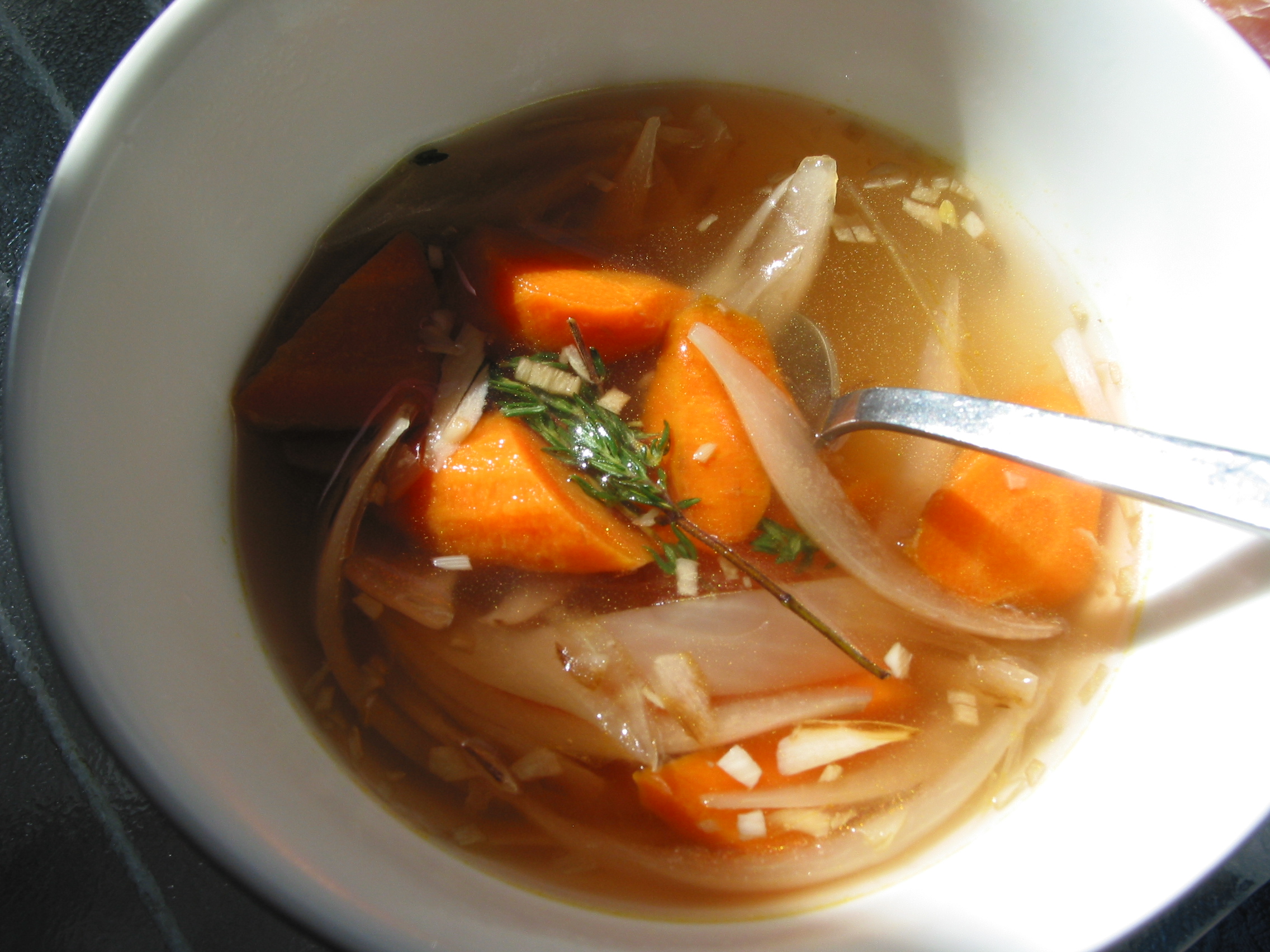
Maximum Flavor in a Minimal Broth

minimal carrot onion soup

My kid had the flu just in time for President’s Day (and both Friday and Monday off from school). How does this happen in a place where it actually hit 90 degrees one day??? How annoying! But her classmates had been catching it right and left all through January and coming back to school still iffy. She and I had both gotten the flu shot a couple of months before, achy arms and all. The prevention rate this year isn’t all that good; only about 23%. And people have naturally been grumbling if or when they catch the flu anyway.

But I’m still pro-vaccine, and here’s why: The minute she woke up with fever, I called and got an appointment with her pediatrician for that morning, no being palmed off on the advice nurse (or the muzak they put you on while waiting half an hour). When you’ve got a diabetic kid with flu, you take a deep breath, channel your Brooklyn-raised mother and elbow your way through to get seen before the kid has a chance to develop nausea and vomiting, which makes it trickier to manage food, insulin and so on safely. I mean, we’ve done it, it’s doable, and we’ll probably have to do it again at some point, but it’s a total pain.

Luckily for me, the pediatrician is also from Brooklyn and doesn’t take offense. She and the nurses had been run off their feet, and yet she was glad we got our act together early enough for Tamiflu to do some good, because the poor kid just ahead of us at the clinic was wobbling and actually fainted just as he got into the exam room. Five days his family waited and he had serious fluid in his lungs. So I stopped feeling selfish and stupid for bringing my kid in when she was mostly okay except for a fever. And I hope the other kid’s better by now.

So I wanted to pass this on: the doctor told us the best-bet recommendation is still to get a flu shot. Why? Because even though you might still catch flu, the severe hospital-level cases this year with pneumonia and worse, at least in Southern California, are turning out to be almost all unvaccinated patients. That’s a result you might not have expected. You need that insider perspective to see there’s a more serious benefit hidden behind the obvious numbers. And the serious cases are pretty bad. So if you haven’t gotten a flu shot yet, go get one now.

And my kid did indeed get better by the time school started up again, and my husband and I managed not to catch the flu from her, which was good, because with a snarky bored teen home on a 4-day weekend, the last thing either of us needed was to catch it from her just when she was finally back at school.

But we needed soup in a big way. And with a sick kid in the house I had less time to go shopping. I imagine (because we had the fluke 90-degree day, I have to imagine it or else talk to my poor mom in Boston) that people caught in the big snows back east also have these problems of limited shopping mobility, patience and scant last-ditch vegetabalia in the house. What did we have left that was soup-worthy?

Well…there’s always the can of tomato paste for nearly instant cream-of-tomato, which my daughter likes when she’s sick. The real cream-of-tomato, made with actual tomatoes, is more voluptuous but takes 45 minutes on the stove and involves baking soda to tame the acidity before you add cream, plus the use of a stick blender which I aspire to but don’t yet own. Tomato paste doesn’t have much acidity to start with, so you could just skip the baking soda and heat with milk instead of water if you wanted to. We generally leave milk and cream out and add a dash of vinegar to restore some semblance of tomato flavor.

–  –  –

Tomato Soup in the Microwave (AKA, “bonus” recipe for what it’s worth)

  • 1/2 can tomato paste (no recipe EVER specifies a whole can, as far as I can tell…must be some kind of culinary superstition, much like “the Scottish play”…so just scoop the rest into a ziplock baggie, squeeze the air out, and throw it in the freezer for next time…)
  • 1-2 c. water (enough to bring it up to the thickness you like best for soup)
  • small splash of vinegar, any kind
  • small clove of garlic, minced, mashed or grated
  • pinch of cumin or thyme, optional
  • salt to taste after cooking
  • splash of milk or half-and-half, if you like it

In a microwaveable bowl, use a whisk or fork to mix the water gradually into the tomato paste until it reaches the thick-but-not-too-thick consistency you prefer for cream-of-tomato soup. Add the garlic, vinegar, and cumin or thyme, cover the bowl lightly and microwave 2-3 minutes or until heated through. If you want to add a little milk or half-and-half afterward, you probably could, just don’t add it and then heat or it’ll curdle from the vinegar (or leave the vinegar out to start with if you want it bland).

–  –  –

But down to business with the “not-chicken” vegetable broth. I’ve already gone about as far as I can go with bok choy and shiitake broth, up to and including hot-and-sour soup. Plus we didn’t actually have any bok choy left. Feh.

So the usual carrot-onion-celery not-chicken broth should have been next…but no celery either. Double feh. And no fresh dill–dry we had, but you know fresh makes a world of improvement. So it wasn’t looking all that good in the clear soup department this week. And I needed some for me, even though I only had a head cold and a bad temper and a sassy, feverish bored teen at home watching cartoons.

(BTW: if you luck out with a fresh bunch of dill that’s too big to use up quickly, wash the rest well, twist off the stem ends, stuff the dill into a ziplock sandwich bag with the air squeezed out and freeze it–it’ll stay good for a couple of months minimum, and you can just quickly crumble a frozen bit into whatever dish you want, then toss the bag back in the freezer. Or in Boston, just leave it out on the porch and rediscover it sometime in April.)

Normally I’d say onion and carrots alone aren’t enough for a soup; you have to have something else in there or when you add garlic it’ll just be about the garlic. Which is fine for me, of course, because my motto still seems to be, “If there’s no garlic, is it really food?”

True, the Italians have acqua pazza (“crazy water”), which is basically garlic broth. I think both Spain and France have similar offerings. But normal people might want something a little more complex or at least balanced.

My usual MO for vegetable soup and bok choy broth is just to microwave the base vegetables to wilt them and then bring them up with a bit of water, add garlic, herbs, and any other appropriate flavorings, and heat again. Pretty basic, and very quick–5 minutes, maybe 10 for a couple of quarts that will last me a week. But with such a limited vegetable base as onion and carrot, I was going to need something more.

So I scrounged again in the fridge. Carrots and a red onion…and a clove of garlic. A sprig of thyme–well. A little leftover white wine. Yes. OK.

It would all be kind of blah and pale, though, if I just dumped it in a bowl with some water and hit the nuke button. When you have so few main ingredients and they’re both boring when simply boiled or nuked, you have to strategize a little to get the best out of them quickly. Continue reading

Post-Kiddush: our leftovers are better than yours

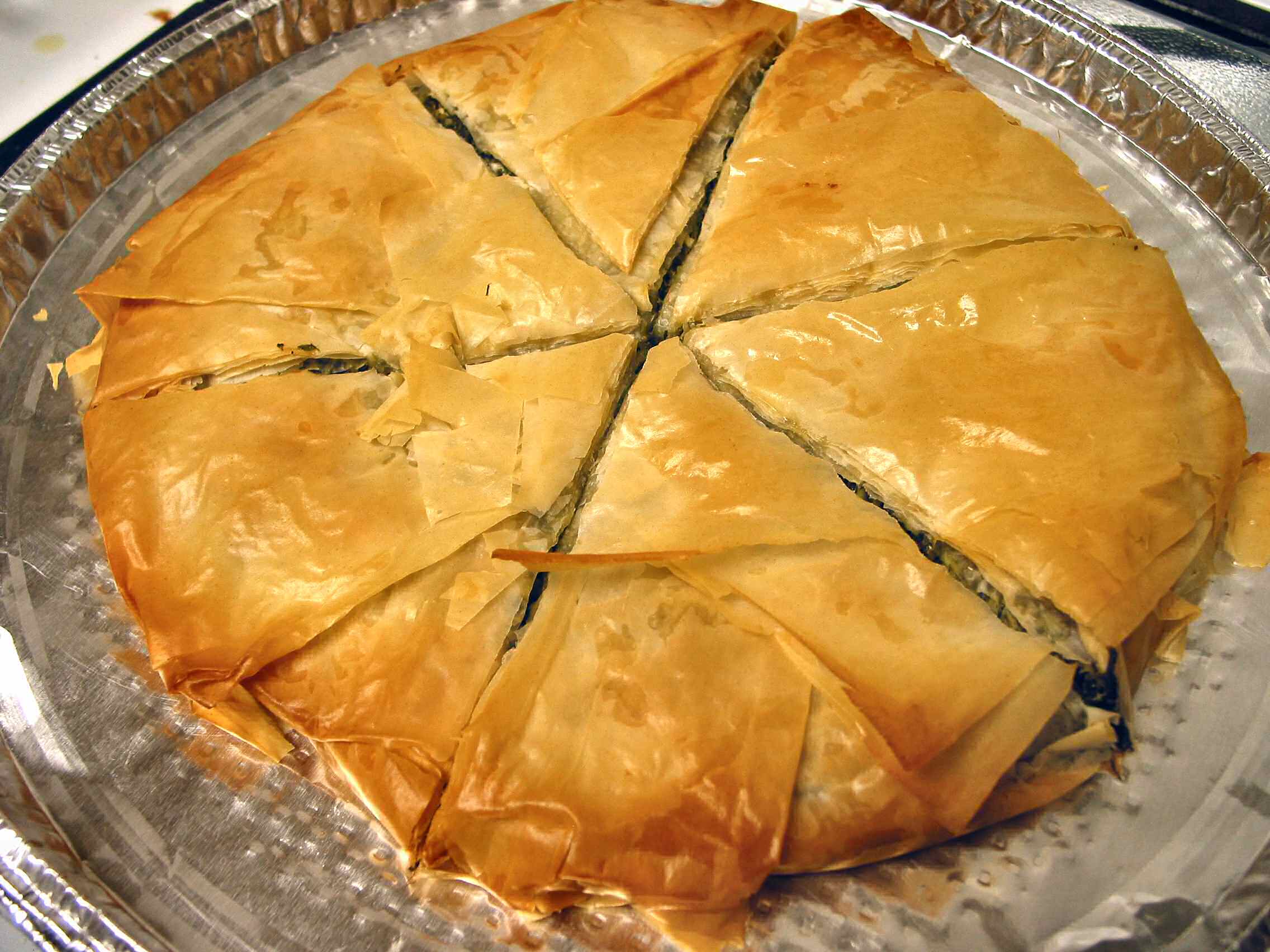
Round spare spanakopita just for us after the big kiddush

Round spare pinwheel-style spanakopita just for us at home. The big ones for the brunch had three pounds of spinach apiece (and were cut in small diamonds), but they still went together pretty fast–except for squeezing all that spinach dry…

This weekend I did it again–I made the kiddush, or in common speech a lunch buffet, for my congregation’s Saturday morning service. My husband kind of volunteered us for this week and because he doesn’t cook, most or all of the cooking, shopping, chopping and schlepping landed on my shoulders.

Last time he volunteered us, it was for our anniversary, and  I was ready to skip ahead to the divorce until I got over it, because it’s a lot of work to cook for 60 or so people who like to eat. And kibbitz. Especially when the 60 suddenly turns into 80-plus and having to use the synagogue kitchen with the more complicated and confusing rules on only a week’s notice. As they did this time…..

Soooo….a two-day hell of shopping and then marathon cooking-and-juggling in my little galley kitchen. The microwave got a serious workout. So did the food processor and the oven. Sometimes all at once. And it was raining hard for three days, so bringing things over to the synagogue kitchen as I went got a little tricky. I triple-wrapped the chocolate cake and stuck it in a USPS Priority Mail box so it wouldn’t get left out in the rain. Same idea for the spanakopita trays.

A few hints about cooking big and real for a synagogue brunch, learned the hard way by moi and passed on for your edification and safety (and sanity):

1. You can buy a 6-lb can  of chickpeas for massive half-gallon batches of hummus (Mid-East brand, maybe Goya as well). Cost? about $5. But–as I found out, and I’m glad no one was filming the process–industrial-sized can equals industrial-strength steel. A dinky hand-operated can opener is no match for such an item. I got just far enough to be able to pry open a kind of spout but there were tears and long-fluent-repetitive-all-throughout-the-house swearing sessions involved.

Still….

2. If you have a good corner greengrocer, you can buy quantities of eggplant for cheap–eleven or twelve eggplants made for a large tray of roast eggplant and onion slices (with garlic slivers and za’atar sprigs and olive oil) plus a large vat of baba ghanouj. Only the five eggplants I nuked for the baba ghanouj didn’t feel like cooperating fully when it was time to peel them. Might have been easier to peel first, then nuke, since it was all going into the food processor eventually. Next time…

3. Whole smoked whitefish for whitefish salad comes two ways–cold-smoked or hot-smoked. What’s the difference? I asked the counter guy at my favorite Armenian grocery. “Cold-smoked is a little less hard,” he said. So I bought it, thinking he meant the hot-smoked was tough as shoeleather and twice as chewy. I was wrong. Cold-smoked actually means the fish is smoked raw, like lox, only a little drier and tougher. But you don’t necessarily want to put it in whitefish salad that way. Man, it still had the scales on too. I couldn’t get it off the bones for love or money, and there were a lot of bones.

However, the microwave came to the rescue. I cut the fish in half and Continue reading

Hunan Tofu, spare the salt (spoil the child)

tofu with broccoli

Last year my daughter kept hocking me that I never made enough meat. This year she’s going on twelve and decided, about a month before Passover, that she needed to be vegetarian because she has ambitions of becoming a veterinarian. Hard enough for anyone to deal with, but for a diabetic, it’s an added challenge, especially at Passover, which we got through with a lot of vegetables and a dispensation for tofu (though without soy sauce, which contains wheat) so she wouldn’t be stuck with only eggs and cheese and yogurt and nuts for protein. Next year, rice and beans are going back on the menu–I’m not stuck in Ashkenazi-think, and a lot of synagogues in the US are starting to reconsider the role of legumes, pulses and non-wheatlike grains at Passover. I’m all for it.

Still, we’re well past Passover now, and the issue today is tofu; see under: how to feed a vegetarian preteen some protein without overdosing her on sodium. One of our favorite Chinese restaurant dishes is tofu in black bean sauce, but no doubt about it, it’s loaded.

[Update Note, cue theme “Do the Math Yourself”: Check out the recent LA Times’ version of Hunan Tofu with Black Bean Sauce–looks wonderful, right? but the sodium stats at the bottom of the recipe are WAY off, even if Andrea Nguyen, the food writer, had been using low-sodium soy sauce. Perhaps the editors forgot to count the salt in the fermented black beans–which on its own is something like 850 mg per tablespoon, as far as I could find (it’s not listed in the USDA nutrient database). You really can’t rinse that kind of salt out, especially not if you’re using the rinse as a broth and adding it back into the dish. That plus 1/4 t. salt “or more” at 560 or so mg. and a couple of tablespoons of soy sauce–you’re looking at 750-1000 mg for each of 4 servings, or 1500-2000 each as “dinner for two”, or about an entire day’s worth of salt in a single dish–definitely not the 350 or so as stated in the article!]

Cooking at home is a lot cheaper in a number of ways (a 14-oz pack of firm tofu runs about $1.50 where we live), and we can figure out what to do about the sauce if we really want it. Invariably, the restaurant container is always swimming in sauce with a layer of oil on top, so I think just not doing that would be enough to improve the nutrition stats considerably.

Frying tofu at home won’t usually get you that crispy outside texture that you get in the Hunan tofu dishes from the restaurant–mostly, they’re shallow- or deep-frying the cubes or triangles in a lot more fat than you’d want to use at home for an ordinary dinner. A little less than that level of crispy is still okay by me. Getting any kind of brown on the outside would be a step up from the pale, flabby results I was used to achieving in the trusty nonstick pan.

So I started actually paying attention to the cookbooks I have on the shelf and to the techniques I invented for pan-browning things like salmon without salting the dickens out of them. I needed a (small amount of) sauce that tasted okay but wasn’t swamped with sodium. That means a little low-sodium soy sauce and a lot of ginger, garlic, maybe a bit of vinegar and sesame oil–and a surprise ingredient for browning and flavor depth: molasses.

Most syrups (agave included) run about 16 g. carb per tablespoon, a whisker more than a tablespoon of ordinary granulated sugar. Blackstrap molasses runs a bit less, at 11 g. per tablespoon. And it’s really thick, really strong-flavored, and really brownish-black. Also relatively inexpensive. Half a teaspoon will darken and thicken an ounce of sauce for frying tofu. It helps “stretch” the soy sauce–for looks as much as flavor and volume–without adding much sodium or carb to the dish. Even stranger (and better), molasses is a powerhouse source of potassium at 600 mg and iron at 20% of the RDA per tablespoon (not that we’re adding that much here, more like 1/6th tablespoon). The vinegar and sesame oil lend rich pungent flavor that doesn’t depend solely on the saltiness of the soy sauce, and ginger and garlic round out the combination.

So that’s the sauce. To get the tofu to brown in the frying pan, you have to get some of the extra water out of it first. There’s always the press-it-with-a-weighted-plate-on-top-for-30-minutes scheme, which always seems more of a pain than it’s worth. But I’m impatient.

There are two decent ways to press tofu other than the weighted plate setup. One requires thinking ahead (not my forte): slice the tofu and freeze the slices, then thaw them. The other–are you surprised yet?–is to slice and microwave the tofu on an open plate for a couple of minutes, say 4 minutes for a whole 14-oz. pad of firm tofu, or 2 minutes for half a pad. Then drain off the watery stuff that’s come out of the tofu (let it sit another few minutes and redrain), and pat the tofu dry.

To fry, heat a bit of olive or other vegetable oil in a nonstick pan. Brown some onion or scallion a few minutes. Make a frying sauce: 1-3 teaspoons of low-sodium soy sauce, depending on how much tofu you’re making, a minced clove of garlic, a teaspoon of fresh grated ginger, a few drops of sesame oil, a dash of vinegar and a pinch of brown sugar or better, a half-teaspoon of molasses. Hot pepper flakes or z’khug optional.

Pour the sauce into the hot pan and let bubble up a second or two. Then add the tofu cubes or triangles and toss a couple of times in the sauce. The sauce will be just enough to color the surfaces a little and get them started.  It’ll take another 5-10 minutes of stir-frying to get the tofu surfaces to brown nicely, but it does work. Serve atop microwaved broccoli and/or bok choy. Garnish at will with some chopped scallion, toasted almonds, fried mushrooms or slices of red bell pepper (or hot peppers and roasted peanuts for kung pao, if that’s your thing).

Sodium counts for this version:

If you figure the dish serves 3 people a decent meal-sized portion of protein, and the sodium is coming exclusively from the low-sodium soy sauce, a full tablespoon of soy sauce would be about 450-600 mg, so each serving is about 200 mg at the higher end. I don’t think I usually use quite that much for us, but even so it’s pretty reasonable. If you don’t mind doubling the sodium to about 400 mg per serving, you could make another dose of the frying sauce to drizzle the dish with at the last minute.

Stuffed onions in a hurry

Stuffed onions ready for steaming in the microwave

With a microwave and a frying pan, you can make stuffed vegetables like Mehshi Basal quickly, and they taste even better than with long roasting. These are just rolled and ready for a few minutes of steaming in the microwave.

Just after Rosh Hashanah I posted my first-ever attempt at an elaborate Syrian Jewish dish of sweet-and-sour stuffed eggplants with quince, and because I had more stuffing than I needed, I went for seconds with Aromas of Aleppo on the spot and tried out the Mehshi Basal, or stuffed onions with tamarind sauce, which was actually even better. It was easier to put together and I was patting myself on the back when we tasted the results.

Still, given that I was using a lentil stuffing in place of ground beef, I was a little dismayed at how long the traditional braising and roasting took to cook the onions all the way through–an hour and a half at least, and that was after stuffing them. A second attempt in November, this time exclusively with stuffed onions for a congregation brunch, did no better on time, and I came away thinking that roasting was an extremely inefficient way to cook these–might even have toughened them inadvertently.

Why, you have to ask, should I make such a big deal about stuffed onions–they’re a party trick, after all, not standard cooking. But we discovered we really liked them, and they’re a pretty good kind of party trick. They were a surprise hit at the brunch. If I hadn’t snuck myself one while setting up in the kitchen, I’d have missed out altogether.

Actually, I think they fascinated everyone as much for the magic trick as for the flavor. People who’d never tasted them before kept coming up to me–and even my daughter–to ask, “How do you get the filling into the onions???”

If they hadn’t been so time-consuming I could have made double the amount and they’d still have disappeared. Or I could throw them together easily just for us on the odd weeknight as a treat–but one with some iron and fiber in it–instead of the standard pasta or rice.

So in the time since, I’ve finally rethought the process and come up with something that requires no oven time and cuts the actual cooking after stuffing them down to about 20 minutes or so–as long as you already have some cooked lentils (microwaved to perfection in about 10 minutes of cooking time and 30-4o minutes of standing time) and tamarind sauce (or “mock tamarind” sauce, a 5-minute microwave-assisted blend of prunes and/or apricots with water and some lemon juice, plus-or-minus tomato paste, applesauce and other flourishes you don’t really need for this) to hand.

I know, you probably don’t have these things sitting around. But this recipe might change your mind. Lentils are good stuff even on their own, and the stuffing here is a knockout.

Even genuine tamarind sauce isn’t so bad anymore, assuming you don’t or can’t just buy a prepared concentrate. I’ve sped the process up from an hour-plus to a few minutes just by nuking it, pulsing in a food processor, and this time, neither filtering it quite so aggressively as I did back in September NOR bothering to boil the stuff down to a sticky residue. It’s so much less painful, and I think it even tastes better, with more of the fruit character left in. See my notes at the end of the post for how to do it the quickie way (in modest jam-jar quantities, not quarts).

Anyway, back to the stuffed onions. I’m actually proud of myself for this one, and I’ve tried it three times in a row so I can vouch for it–the last time, I put my daughter to work stuffing the onion layers, and she did a great job.

For this method all you need are a microwave oven, a frying pan and a food processor. Instead of boiling the onions for 20 minutes to separate the layers, you microwave them in a drizzle of water for 5. Instead of braising the stuffed Continue reading

A Slow Food Fast Thanksgiving

Pumpkin pie in the microwave

I’m not sure how to take all the following good news–it’s been such a strained year that the sudden release of pressure is going to make me zip around the room, once the coffee kicks in.

1. My mother-in-law has threatened to favor the brand-new kosher butcher in her town this holiday season so that we can eat the turkey too this year (and maybe not fight about it). She promised not to smear said turkey with butter. We’ll cross our fingers. But at least we won’t have to cook. I’m keeping that firmly in mind.

2. As of this week, my daughter’s finally on an insulin pump and fairly thrilled about it, so she can navigate dinner AND dessert at my in-laws’ without breaking down and crying that she only gets two tablespoons of pie for a reasonable serving. We are still encouraging her to count carbs and not go hog-wild or she’ll be zipping around the room until midnight.

3. The school concert’s in less than two hours. Is that really enough time to do everything, or at least something? Naaaah. Well, maybe coffee and something other than the news.

4. We still have to schlep up Interstate 5 for about 6 hours tomorrow, starting “early” (i.e., an hour and a half after the time my husband announces this evening as the absolute latest), passing the Harris Ranch and its attendant aromas, which can be more than slightly offputting if you’re not an avid horticulturist. But at least when we get to my in-laws’ we don’t have to cook. As I said, I’m keeping that firmly in mind. I know I already said it, but it’s so important I figured it was worth saying twice.

Despite my firm resolve after last week’s marathon kiddush that I will strive Not To Cook (could I possibly be Peg Bracken’s unacknowledged lovechild? Unfortunately, no. However, my mother was a devotee of the Don’t Cook Too Much school of thought, and I’m starting to appreciate that. Really I am.)…where was I? Oh yeah…I will probably bring at least two lemons, some thyme and rosemary, a head of garlic and a couple of bags of fresh cranberries with us on the road. Call it flavor insurance. For whatever reason, my in-laws, who have developed what can only be called fanatical devotion to Italian food of every possible kind (having both grown up in white bread country), always run out of these basic essentials about halfway through, and my mother-in-law tends to tell my father-in-law to go back out and pick up extras just as the stores are closing…

The cranberries, I’m well aware, aren’t Italian. They’re for making 5-minute microwave cranberry sauce with about half the sugar of regular. My mother-in-law tends to try out her fancier cranberry chutneys and relishes every year, and every year they contain things like chardonnay–which is fine for the grownups but I’m no grownup. Her chutneys have more than 10 ingredients and sit stirring on the stovetop for at least 45 minutes. I don’t know how she does it–I’d go stir-crazy. I’m just not that good.

So anyway–I wish you all a great Thanksgiving at somebody else’s house, so you don’t have to cook or do the dishes. My idea of heaven.

But if you absolutely have to cook, here are a couple of posts for speeding up a few of the obligatory or not-so-obligatory Thanksgiving items–most can go in a microwave (I always, always think that’s worthwhile. Well, usually). A few of these are dairy, so use your discretion.

5-Minute Cranberry Sauce

Microwave Pumpkin Pie

Basic instructions for microwaving green beans, brussels sprouts and other vegetables

Creamed Spinach Variations

“Marbella”-style cooked vegetable relish with artichoke hearts, olives, tomatoes and prunes

Turkey Breast with Ta’am (flavor) –not microwaved, not a whole bird, but it is a lot quicker and tastes unusually good if you have a small crowd. DO keep it covered in the oven to prevent it drying out.

Some options for vegetarian centerpiece dishes… (ideas more than recipes)

Spice mixes because sometimes you want to liven up the party…

Syrian Jewish stuffed vegetables (baby eggplants and onions) with an incredible lentil filling (NOTE–this one is “not exactly quick”; well, maybe for the eggplants microwaving would be enough, but the onions still take some serious roasting even after microwave assistance.  However, it is delicious and impressive.)

Microwave gingerbread and microwave flan (and a recommendation for mead…)


DIY Pasta–no chic gadgets needed


handmade pasta, cut for ravioli

A few months ago I was surprised to read an interview with the British actress Emma Thompson–not about her acting, or producing, or screenwriting, or whatever, but about her having acquired a pasta machine so that she and her family could have fresh pasta at home.

What surprised me is that she called it a revelation, or revolutionary, can’t remember which. I think it came up in relation to a short dramatic interpretation of a poem called “Song of the Lunch” that she and Alan Rickman did for the BBC last year. It’s about 20 minutes long, posted on YouTube in sections but in its entirety, and it’s actually not bad, though not as funny about foodieism as “The Trip”. The main thing about it is that it takes place in an Italian restaurant in London. Hence the pasta issue.

Over the course of a misspent youth (which I’m still in, thank you very much) I have tried a number of times to make sheet pasta myself, with varying degrees of success.

  • Buckwheat noodles–grainy and dry. Try this soba recipe instead.
  • Jao tse dough made with flour, salt, and boiling water–a little thick but it worked well enough to boast about
  • Ravioli dough made with half egg, half water (this was a few weeks ago)–grainy, sticky, hard to roll evenly to the right thickness.
  • Yesterday’s classic pasta dough from Marcella Hazan, just flour and eggs–just right. In fact, the only right recipe there is, I’m now convinced.

So of course this post isn’t really revolutionary–I’m about 20 years behind the “Wow, you can make pasta at home” trend. And I refuse to call it “a revelation”, as fresh food that includes actual garlic always seems to be for the British. It’s just that it finally worked, came out pretty well, and wasn’t as hard or as time-consuming as I thought. Take it as read.

I should back up and say I never actually managed to pick up either a proper cranking pasta machine, even though you can sometimes find one at Ross for Less at under $20, or a proper long dowel-style rolling pin, which Hazan deems necessary for hand-rolling. This still worked very well.

Why no pasta crank for the crank? Why no artisan rolling pin? I’m not good about kitchen implements that are hard to store, particularly now that the drawers are out in the garage and the counter space is severely limited. I use an empty wine bottle, the tall hunch-shouldered kind with a long straight barrel and short neck. It stands up in a corner when not in use and doesn’t take up space. I also don’t roll any dough directly, but between two sheets of plastic wrap with a little flour or–my great new discovery, especially for this pasta dough–parchment paper. Works incredibly well, better than the plastic wrap, because it doesn’t wrinkle and stick.

In any case, the one kitchen gadget (other than the microwave, the toaster oven, or the coffee maker) that I’m always willing to give counter space to is my food processor (also not fancy–a $30 Hamilton Beach with a big work bowl, not a $200 Cuisinart).

Because although I’ve watched my share of “Make Your Own Pasta” cooking demos over the years where Mary Ann Esposito or the guest du jour on Julia Child cracks eggs into a well in a bowl of flour and “incorporates them” gradually, I know perfectly well from hard experience that kneading by hand is going to precede rolling out by hand, and that the food processor will make at least one of these ordeals a lot faster and less of a pain. It will also give me a better product. Pasta needs a lot of kneading–8-10 minutes!–to develop the gluten and get it to a smooth uniform texture that will hold when you roll and stretch it very thin.  I’m not that good or that patient. Or at least I wasn’t yesterday.

The rolling is the big thing–you have to get that dough thin enough to the point where you just begin to see through it. You don’t want it breaking, but it really Continue reading

Tabbouleh vs. me

Exhausted. Yesterday I brought enough lunch food for 65 or so people at services because (get this) my husband signed us up to prepare the kiddush in celebration of our anniversary. Which is coming up in a couple of days. Ok. But I still have a tiny galley kitchen and all the drawers are still out in the garage awaiting some kind of decision on their fate–they have been that way since before we moved in, because they’re so chewed up I didn’t really want them back and haven’t decided what to replace them with yet.

And I think we (meaning I) did pretty well for costs by not doing the usual buy-salad-in-a-bag-for-thirty-bucks  and buy-a-big-commercial-sheet-cake and buy-a-vat-of-decorator-hummus.

But let me explain something I learned the hard way about making things from scratch. There’s a reason the boxes of commercial just-pour-boiling-water-on-it-and-wait tabbouleh are so tiny.

It’s not just all about profiteering–as you’d think I was going to say. Even I thought I was going to say that. But no.

At my local Armenian greengrocer’s I bought a 2.5 lb bag of #2 bulgur (the number denotes size of the cracked wheat grains) for $2.52 and a couple of bunches of parsley and lemons and a bunch of scallions and thought I was clearly way ahead of the Near East and Sadaf-purchasing folks. And yes, bulgur is microwaveable if you have a good-sized container. Just add water to cover by about an inch, put on a lid, and microwave 3-5 minutes, or enough to get the water to about boiling temperature, and let it stand about 15 minutes to absorb the boiling water. Then drain it and add lemon juice, olive oil, chopped parsley and scallion (and mint if you like it) and a bit of salt. More parsley than grain if you’re Lebanese and being authentic. Less green than grain if you’re doing what I grew up with.

What I didn’t take into account was exactly HOW MUCH tabbouleh one innocent-looking little pound of dry bulgur, or about 2 cups, actually makes.

Let’s just quietly admit it was considerably more than a salad bowl’s worth. So the expensive boxes you see in the Whole Foods, the little 4-6 oz. boxes, are probably just right for a family of less than 14.

I ended up freezing half of the grain in bags. I don’t think I’ll bother telling my in-laws before I bring it up for Thanksgiving. Wouldn’t want them to find themselves a pair of plane tickets just in the nick of time…


Microwave Tricks: Getting more chocolate power from cocoa

Chocolate pot from the movie "Chocolat"

The infamous chocolate cauldron, image © Miramax

In the movie Chocolat, the riverboat captain tells the chocolatier that his favorite of all her confections is none other than the prosaic cauldron of hot chocolate she keeps on the hob to thaw out her customers. When she pours out a cup, it’s so thick it’s like hot molten chocolate bars. Hard to imagine how anyone could swallow more than a spoonful of it in reality, but you immediately believe it’s superior to the thin, miserly stuff that’s been passed off as hot chocolate in your childhood. And you’re right.

And on the other hand, how could anyone in their right mind want to down a cup of melted chocolate bars? Too rich, and for me, much too fatty. And with much too much cleanup–the last image that stuck in my mind from Chocolat was actually not the hot chocolate Juliette Binoche handed Johnny Depp and Judi Dench but the thickly encrusted cauldron that had been cooking chocolate all day long. Scary, and what a waste of chocolate for one scene!

So I don’t go for that myself, or at least not on such a grand scale. Though if you want that kind of recipe–go to David Lebovitz’s blog and look for Parisian (or worse yet, with even more chocolate, Belgian) hot chocolate. He’s got two kinds of Mexican hot chocolate drinks too.

Cocoa powder, the ordinary day-to-day stuff of American hot chocolate mixes, seems so much less potent and chocolaty than all the fancy recherché chocolate bars with the cocoa solids percentages, the exotic Latin American or African source names, the single-source, fair-trade, wine-label-styled descriptions. Cocoa powder is so prosaic (unless it’s Scharffen-Berger or Valrhona or another premium brand). How could it possibly be good enough for a high-class, French-style cup of hot chocolate?

Granted, cocoa powder–dutched, natural, either way–it’s pure cocoa solids. But it doesn’t really give you the full chocolate experience if you just mix it into things. Something’s missing.

Most professional chefs and chocolatiers will probably tell you it’s the cocoa butter that’s missing. And they’re not entirely wrong–fat does carry flavor and keeps the more volatile, delicate aromas in the chocolate from evaporating off too quickly or breaking down under heat.

But if that were the entire reason, cocoa powder, stripped of all its fat and stored in warehouses and supermarket shelves for months at a time, would be flavorless and dead by the time you got it home from the store, and we know that’s not the case.

When you make brownies or chocolate cake with cocoa powder, there comes a point in the baking when you suddenly smell the chocolate wherever you are in the house at that moment. Before you even realize you’re smelling it, before any Continue reading

Stuffed Eggplants with Quince, A Vegetarian Odyssey

Stuffed Eggplant with Quince and Stuffed Onion Rolls

I did it. It was 90+ degrees outside yesterday afternoon and felt a lot hotter inside when I started cranking the oven to try this dish right away rather than wait for the weekend, but I’m just no good with delayed gratification.

If I have the mini-eggplants and I have the quinces and I have the tamarind concentrate (homemade! two days ago! it’s practically crying out to be used already!) and I have the “hashu” filling for the vegetables sitting in the fridge smelling wonderful, then it just doesn’t matter that Rosh Hashanah dinner is in what, maybe 3 hours, and I still haven’t braided the challot, to say nothing of baked them. Obviously I’ve gotta try this extra-credit dish out RIGHT NOW.

Actually, I figured the house was going to be heating up anyway once I started baking the challot, so why not get it all over with at once?

There was a more serious reason to try it. Today in services I was still thinking about Dweck’s book and her recounting of her parents’ horror in 1947, when, about to return from a vacation in Europe, they learned the government back home had started massacring whole Jewish communities in reaction to the announcement that the UN had accepted Israel as a Jewish state.

The Syrian Jewish community fled wherever they could–just as my family did under the pogroms in the Ukraine back in the 1880s and 1920s. Dweck maintains that the reception the Syrian Jews got in the US from those of us who were already here was so aloof–they didn’t speak Yiddish, they didn’t look the same, they did a few things differently for kashrut and prayers–that her community kept to themselves ever after.

I can believe it, unfortunately–the period right after World War II and the Holocaust was one of paranoia and circling the wagons for American Ashkenazim.

Eastern and Western Jews had similar discomfort with each other in postwar Europe. Reading between the lines a little in Claudia Roden’s and Colette Rossant’s memoirs, the two, who had just lost everything, thought their new Ashkenazi neighbors were cold and inhospitable and indifferent to their exile; the Ashkenazi neighbors and relatives, meanwhile, thought the wealthy young Egyptian arrivals were horribly spoiled and indifferent to the European disaster they had just missed. Altogether, the Ashkenazi, Sephardi, and Mizrahi communities were in closer touch before World War I than they were after the 1940s.

I can only hope that now, 60 or 70 years on, we have more in common and more regard for each other, no matter where we came from. Israel’s great mix of cultures has been a good influence, even though it originated in hardship, and perhaps today we are in better shape to appreciate what we have in common than we have been for nearly a century.

When I look through Dweck’s family’s photos, I see so many people who look astonishingly like several members of my family–my dad and my sister especially. The dignified lady presiding at the seder table on the front cover is a shockingly exact adult version of a girl I knew from my synagogue’s youth group–it’s the sturdy mouth and chin and the set of the eyes, certainly, but also the irrepressibly thick and curly hair (the 1920s formal chignon has it all over my friend’s 1970s braids, which took her hours to corral her hair into). The formal photographs of families in the 1920s, all the daughters dressed beautifully but in the same fabric the mother is wearing, sailor suits on the boys, stern dignified expressions all–I’m pretty sure each of my grandmothers had at least one of those in her collection. The 1930s-era engagement portrait with pearls and bobbed hair–so modern! Pin it up next to the one of my dad’s parents, who married in 1939 and looked so incredibly naive and young then. The family gatherings at Pesach, grandma presiding over the white lace tablecloth and all the seated cousins glancing behind them at the camera from over their shoulders–there’s probably one or two with my mother as a toddler on someone’s lap in Brooklyn and another of her as a teen, whipping her glasses off and blinking myopically for the photo. It could be any of our families. It could have been us in Syria and Egypt and Turkey, it could have been them in the Ukraine or Germany or Poland. We none of us have entirely safe histories, and none of us are entirely separate.

In any case, Dweck’s book is important to me not only for capturing her community’s traditions, tastes and history but for reaching out to the rest of us and giving us a chance to share it, compare it with our own, and reconsider what it means to be part of the Jewish world now.

So–and this is not to trivialize but to explain, since we sometimes live and remember through food, especially at the holidays–it was a great time to try out a challenging dish (challenging for me, anyway) from her book and serve it last night to my family for Erev Rosh Hashanah. I cook from scratch, I cook a lot, but I’ve never really done  the legendary great-aunts-at-Pesach kind of slow cooking where everyone groans in pleasure and declares “nobody does it like this anymore” when they taste it. I’ve only once cooked a whole turkey, and I’ve rarely tried anything else that took more than an hour and a half to cook. It’s a transformative experience, one that teaches me a lot about my great-aunts and great-grandmothers, both in the shtetls with the wood-fueled pripitschoks and communal ovens, and here in America with modern kitchens and big lace-covered tables. Trying this long-cooked dish gave me the chance to experience both my family’s past celebrations and Dweck’s at the same time.

To my very great pleasure, her recipe worked the way it was supposed to on the first try and tasted like the effort was worth it, even though her instructions are pretty simple and brief. That’s a huge achievement.

So–if you’re ready for this, keep reading–otherwise, glance at the pictures and skip to the bottom…

The “Stuffed Eggplants with Quince” Experience

First of all, let me just say that I LOVE my local Armenian corner grocers for a lot of reasons, but the fact that they have all the ingredients for Dweck’s dishes (other than kosher meat, that is) is a big, big plus.

I would have tried microwaving–and I still will–instead of a 2-hour braise, but I wasn’t sure how it was supposed to taste, whether microwaving would cook the raw rice in the filling well enough, and how the sauce was supposed to interact with the stuffing and the eggplants. I knew from a previous hard-luck experience that quinces don’t do especially well (or even well at all) in the microwave and really need long stewing under conventional heat to get tender and turn bronzy pink and sweet. So all in all, I decided following the directions in Aromas of Aleppo might be the wiser course for a first try. Even though, from my usual 15-minutes-tops perspective on conventional-heat cooking, Poopa Dweck’s method is glacially, almost outrageously, slow.

Basically, you core the baby eggplants, stuff them with hashu (beef-and-rice filling, rice and tomatoes, or in my case lentils-and-rice), and layer them in a saucepan with quince slices. Then you dilute some tamarind concentrate and add a bit of sugar and salt, pour the sauce over the pan and heat for 10 minutes on the stove until the eggplants start to sweat, add water to come about 3/4 of the way up , simmer half an hour to reduce the liquid and cook the rice in the filling, then transfer to the oven to braise covered for about 40 minutes and then uncovered for another 30. It’s a lot like making brisket, actually.

Dweck gives two allspice-laden recipes for the filling, one for ground beef with rice, the other a rice-and-tomato filling that’s close to what I use for dolmas. I opted to follow the ground beef recipe but substitute an equal weight of cooked green lentils for the meat and add a little garlic. It would work, I was pretty sure, and in fact it turned out to be the best, most delicious part of this recipe–which, skipping to the punchline, was pretty terrific and worthwhile, even for the work Continue reading