
• Enter your email address to subscribe to this blog and receive notifications of new posts by email.

    Join 241 other subscribers
  • Noshing on

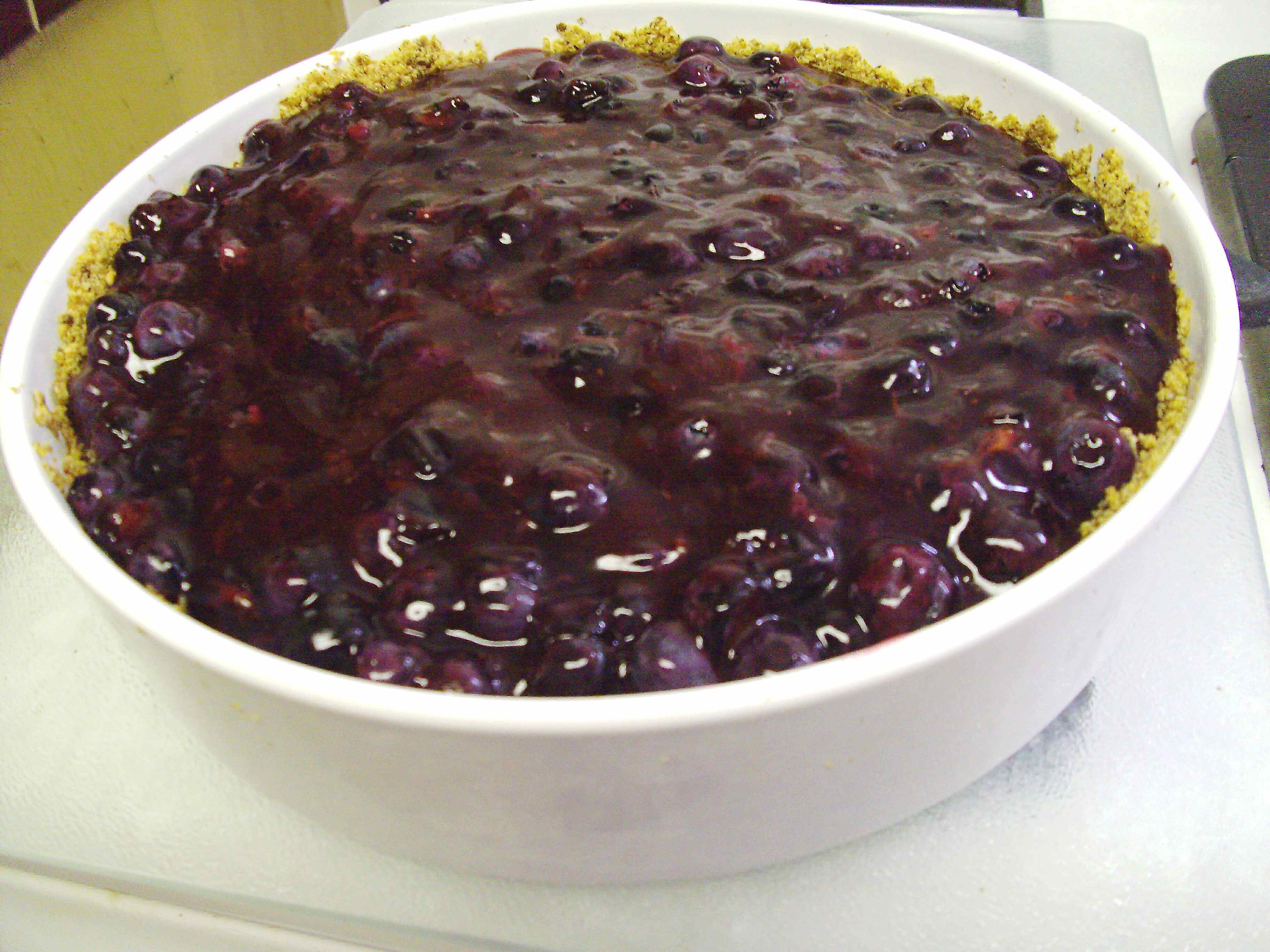
    raw blueberry pie with microwaveable filling and graham cracker crust

    This mostly-raw blueberry pie is a snap to make and very versatile--the filling microwaves in a few minutes, and you don't even have to bake the zippy gingered graham cracker crust--perfect for a hot Fourth of July and all summer long.

  • Recent Posts

  • Contents

  • Archives

  • Now Reading

  • See also my Book Reviews

  • Copyright 2008-2024Slow Food Fast. All writing and images on this blog unless otherwise attributed or set in quotes are the sole property of Slow Food Fast. Please contact DebbieN via the comments form for permissions before reprinting or reproducing any of the material on this blog.

  • ADS AND AFFILIATE LINKS

  • I may post affiliate links to books and movies that I personally review and recommend. Currently I favor Alibris and Vroman's, our terrific and venerable (now past the century mark!) independent bookstore in Pasadena. Or go to your local library--and make sure to support them with actual donations, not just overdue fines (ahem!), because your state probably has cut their budget and hours. Again.

  • In keeping with the disclaimer below, I DO NOT endorse, profit from, or recommend any medications, health treatments, commercial diet plans, supplements or any other such products.

  • DISCLAIMER

  • SlowFoodFast sometimes addresses general public health topics related to nutrition, heart disease, blood pressure, and diabetes. Because this is a blog with a personal point of view, my health and food politics entries often include my opinions on the trends I see, and I try to be as blatant as possible about that. None of these articles should be construed as specific medical advice for an individual case. I do try to keep to findings from well-vetted research sources and large, well-controlled studies, and I try not to sensationalize the science (though if they actually come up with a real cure for Type I diabetes in the next couple of years, I'm gonna be dancing in the streets with a hat that would put Carmen Miranda to shame. Consider yourself warned).

Chocolate Quickie: Unromantic but Reliable
It’s Valentine’s Day again–midweek, busy, too many items still on the list from last week to want a lot of fuss–or even be able to guarantee that my husband and I will both get home a reasonable time for dinner in a reasonable frame of mind to celebrate romance by cooking, or eating, something fancy. Last night I spied way too many people at the Trader Joe’s heaving large bars of chocolate and multiple bouquets of hothouse roses toward the cash registers. That’s okay–I’m not raining on anyone’s actual romance, but I have to admit I’m not feelin’ the official holiday symbols this week. Chocolate is good, don’t get me wrong. Flowers are pretty but require a vase and a pair of shears–usually right when I’m trying to cook dinner.

Last year we actually managed éclairs, and it was fun if a bit much–even though I managed to strip it down considerably with the microwave. Microwaveable ganache truffles are also easy, quick and fun if you’ve got the time to feed them to someone you love.

But with a kid who’s now waiting for college acceptances (and us parents anxiously figuring out both taxes and how to get around the outrageous Estimated Family Contribution)–well, we could all use a smallish midweek-style treat that doesn’t involve even that much effort to make–or work off afterward.

Lately I’ve been digging around in my cooking “blank books” from the last couple of decades. Part diary, part notes to self with or without illustrations in scratchy pen and occasional bragging, political satire, or outright swearing as the situation demands–when you’re writing cooking instructions for yourself, why not? I started these books long before the era of the blog, and hunting through them takes me back to what I was doing at the time.

Half the recipes I came up with are from before I figured out how to work a microwave, but I seem to have gone overboard as soon as I got enough of an introduction. One of the more unusual finds that worked really well a couple of years ago in a birthday dessert emergency (why do I tend to have these?) was a small but rich-tasting dessert halfway between cheesecake and flourless chocolate cake. The best parts:

  1. A limited and very simple ingredient list and
  2. You microwave it in 3 minutes. Seriously. Also,
  3. It’s small, and there are no leftovers. Sometimes that’s a plus.

This would probably be a decent rescue option if you had to make dessert with whatever’s in the cupboard and the fridge, and you’d left things till the last minute…or even a little later than that. As slapdash as this quickie is, it’s got big, big advantages over anything storebought–time, taste AND chocolate. Also, modest calorie and carb counts.

Not everyone has a grocery that carries labaneh, which is kind of a Middle Eastern cross between sour cream and yogurt cheese. Nowadays, though, a lot of mainstream supermarkets are carrying plain Greek yogurt, which also works pretty well, even nonfat. And not every doctor approves of cheesecake in any quantity, much less huge. Damn, as I’ve said before, my cholesterol-packin’ genes (also jeans, but that’s another matter). The completely nonfat version of this dessert works fine and tastes good too, now that I’ve retried it, and all the ingredients are real.

So–whomp the ingredients together in a bowl, nuke it about 3 minutes, cool it, stick it in the fridge. Serve it with raspberries, peaches, cherries, whatever goes with chocolate in your book. Or jam (raspberry, apricot or sour cherry would be great on this, and so would marmalade…).

Chocolate Quickie

Serves 3-4 in smallish wedges if you don’t care how it looks–otherwise (probably smarter) pour it into small single-serving ceramic cups before microwaving. If you double the ingredients, it’ll need another minute or so in the microwave. Definitely serve with fruit.

  • 4 T cocoa powder (20 g by weight; 8 g carb)
  • 4 T sugar (60 g, all of it carb)
  • 1 lg egg
  • 1/2 c. (112 g by weight) labaneh, preferably 1/2 the fat, or else fat-free or 2% plain Greek yogurt. (about 3-5 g carb for any of them; about 7 g saturated fat and 10 g total fat for the full-fat labaneh, much less for the yogurt)
  • 1/4 c. water (yes, really. It’s 60 grams or mL if you’re weighing it out)

Whisk everything together until smooth in a microwaveable ceramic dish (big soupbowl is fine), or else mix and then pour into small microwaveable coffee or flan cups for individual servings (more attractive and probably less prone to serving mishaps where it falls apart when you cut it and lift it out). Microwave uncovered on HIGH 3 minutes for the big bowl, maybe 2 minutes for the individual cups, checking progress and adding extra time in 20-second increments just as needed so you don’t overdo it. When it’s done it’ll be a little dry around the edges and just pulling away from the bowl or edges of the cups. Cool to room temperature, cover and chill until it’s time to serve. Cut in wedges with a sharp knife if you went with the single bowl version. A pie server would probably help it keep its shape long enough to dish up.

Variations–add some grated orange peel or marmalade to the mixture; add a spoonful of almond extract, vanilla, amaretto, or hazelnut liqueur; add espresso instead of water…?

Carb counts: about 17 g apiece for 4 servings, 23 g each for 3 servings, all of it in the form of sugars.

Pinned for Purim!

Thanks to Yael Shuval for choosing my Low-Carb Hamantaschen for her board at Pinterest.com.

Three years ago I developed almond-meal based hamantaschen for my daughter, who had been diagnosed with Type I diabetes only a couple of weeks earlier and needed something that was low enough in carb that (at the time, anyway) she could actually have one or two when all the other kids were having theirs and without having to get an extra shot of insulin.

Almond meal has only about one-fourth as much carbohydrate per cup  as wheat flour, so it seemed like a good substitute. To our surprise, although the dough was a little finicky to work with, the hamantaschen came out tasting pretty good, and they were indeed pretty low carb, about 4-5 grams per mini-hamantaschen. Granted, they were also pretty small, but it was a symbolic triumph in the first few weeks and made us all feel like being diabetic wasn’t going to be the end of having fun.

Now that my daughter is on an insulin pump, getting an extra shot is no big deal, though in our experience the pitfall is that it’s now just a little too easy, especially for a preteen, to “eat anything you want, at any time, without thinking about it, as long as you program the insulin for it” which is one of the less responsible marketing messages in Medtronic’s brochure for teenagers (note: the pump itself is pretty good, but it still doesn’t mean you don’t have to be careful about what you’re eating). Those sour gummy heart candies the teacher handed out for snack earlier this week and left on my daughter’s desk, for instance….well, candy never seems like as much food as it really is, and I think my daughter gained a valuable lesson when she added up what she’d really eaten…she wouldn’t be the first one.

It’s always good to have a general plan in place for holiday eating so you don’t overdo the treats or eat an entire meal’s worth of carb in just a few cookies or candies or whatever…what can I say, we’re working on it.

Still. In the last year or two I’ve mostly gone back to making standard hamantaschen based on Joan Nathan’s classic cookie-dough recipe, which I like a lot and which looks and tastes much, much better than the dry, pasty-white horrors at the annual Purim carnival.

hamantaschen1

What I like about the standard flour-based recipe, other than that it tastes and looks good and is easy to work with, is that I can roll the dough out very thin and get crisp, delicate hamantaschen that are a decent cookie size but still hold together nicely and are not extravagantly carb-laden, particularly if the fillings are reasonable and you don’t eat ten at a time (the big challenge). They’re not as low-carb as the almond meal ones, but they still work out okay–about 7 grams apiece for a 1.5-2″ cookie. They taste good even made with pareve (nondairy) margarine instead of butter.

The LA-area idea of hamantaschen usually involves M&Ms, colored sprinkles, anything completely artificial. I bet gummy sour hearts (this afternoon’s culprit) would be a huge hit too. I don’t think they’ve heard of either prune or poppyseed out here in at least a generation.

Traditional fruit or nut fillings are a much more decent bet for carb, and they taste better (and look nicer too, because I’m not 6 years old and don’t insist on rainbow colors anymore). They’re also easy to make from scratch in a microwave or on the stove top so that you can decide how much sugar to put in them. Continue reading

Pistachio madness two ways

(plus a handful of other frozen yogurt ideas)

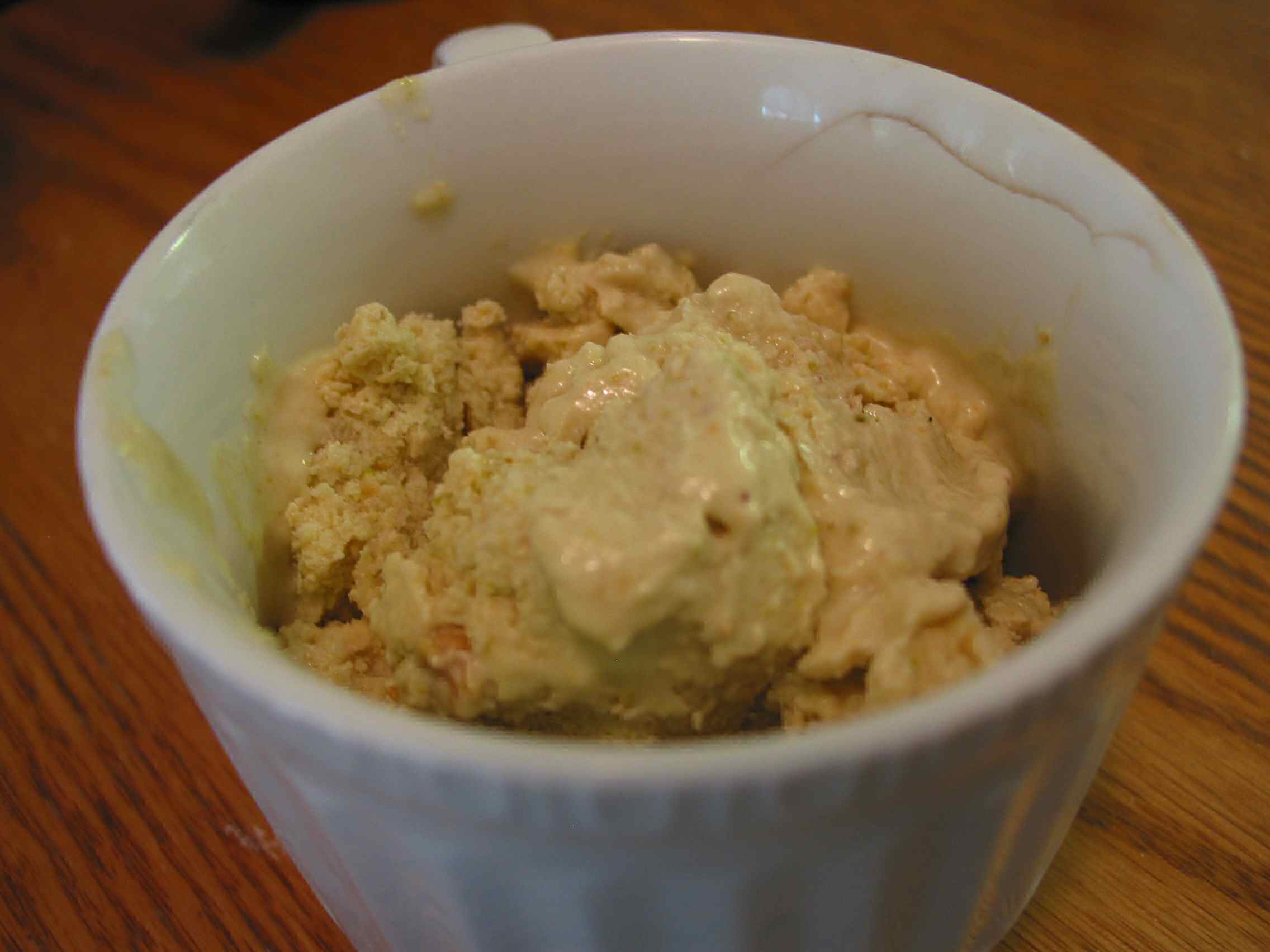
Homemade pistachio frozen yogurt, very low carb

It’s over 90 degrees most of the day in Pasadena, and I’ve gotten tired of looking at the limited selection of Dreyer’s (Edy’s east of the Rockies), Breyers, Haagen Daz, and Private Selection flavors with my daughter. It’s starting to get tedious, and they’ve dropped many of the classics for the cheapest possible quality candy-plus-ersatz-vanilla (note: their real vanillas are better). The forgotten classics were better-tasting, less dependent on goo and sweetened brown wax parading as chocolate or (if salted) peanut butter.

No supermarket ice cream brand in the non-superpremium range today offers rum raisin or pistachio worth considering anymore. It’s easy enough to doctor your own version with storebought vanilla ice cream and the aforementioned rum and raisins, but pistachio?

Pistachio used to be a standard ice cream flavor, didn’t it? Maybe I’m just getting old? Naah. Even in the ’70s when I was a kid, most of the “pistachio” ice cream around was already fake. I want the real thing, not the artificially green, mostly-vanilla-with-a-tinge-of-synthetic-almond kind.

And I want it low-fat for me and my husband and low-carb for my daughter (and us too, why not?) And I want it to taste delicious despite all that. Tall order? Actually, it’s easier than you’d think.

David Lebovitz has a Sicilian pistachio paste-based gelato in The Perfect Scoop, and he blogged about it a couple of years ago as well. He made it sound delicious, but also expensive and hard to find the ingredients for. Not that I’m against a trip to Sicily, except in July when it’s about as searing as LA (been there, done that, got the sunburn and the Fellini moments combined with heat exhaustion).

About the same time, a local gelateria owner in my area took much the same position on the utter superiority of Sicilian pistachios versus California ones for an interview in the LA Times. Which is lovely if you have a good source of Sicilian pistachios or pistachio paste at a decent price, but what if you don’t?

Most of the home-brew pistachio ice cream recipes I’ve seen in magazines, blogs and cookbooks call for adding significant amounts of heavy cream. Or else they involve large amounts of sugar. Or both. Yes, those recipes will give ice cream-like results, but they’re completely offtrack for what I need.

In my universe, good taste on a hot day shouldn’t mean losing your svelte, your cool or your wallet.

The nuts themselves are okay–pistachios, like most nuts and seeds, are very low carb and though high in calories from total fat, most of that is unsaturated. If I can keep the rest of the ingredients low fat and low carb and the stuff still tastes good, I’ll have it. Right?

So okay. I’ve been playing around with California pistachios and–not gelato, that requires making an egg-based custard and blending it with flavorings. Done it once or twice, and it worked, but it’s more work than I want to do most days. Or it used to be. Nowadays I’ve got the microwave moxie to make custard without so much work, but it’s still not what I want today. I want easy.

Frozen yogurt made with real yogurt is too tart to work with anything much but fruit unless you mix in some milk–and then it’s icier and freezes harder.

However, this summer I’ve been playing around with fat-free Greek yogurt as the base for a couple of different ices in small quantities. Greek yogurt varies a bit in nutritional stats from brand to brand, and it’s expensive, which is why I took so long to try it out. But the cheapest all-real (no gelatin) stuff–Trader Joe’s O% fat plain version–while still twice as expensive as the regular plain nonfat yogurt ($5 vs. $2.50 a quart), has considerably less carb, maybe only 7 grams of carb per cup as opposed to 17 for regular. And it has about twice the protein–22 grams per cup. It’s a lot thicker and less acidic, so I’m assuming they drained out a lot of the carb in the whey. And it makes really easy frozen yogurts that taste like something and aren’t overwhelmingly tart.

Just mix in your flavoring of choice (preferably not too watery) with some sugar, and you can still-freeze it within an hour or two. If you think the tang needs to be tamed further, a little milk mixed in works okay and it stays thick enough to freeze fairly gracefully.

The texture is never going to be like ice cream, not entirely. It still mixes up pretty hard and a little icy if you still-freeze it, but once you’ve got it thawed out to the point where you can dig out a serving, it tastes good and changes to a creamy texture as you eat it, something like khulfi. Higher-fat yogurt would break the iciness up a bit but would defeat my purpose of lowering the saturated fat to something I can handle.

And the heavy fats and sugars mask any delicate flavorings. Think Italian gelato (the real kind you get on the street in Florence, not the overpriced stuff you get in pints in the supermarket here) and you know that a lighter base allows you things like rose or ricotta or apricot or kiwi, or hazelnut, or four different highly refined grades of chocolate. If you want to taste anything delicate in your ice cream, you have to get the fats and sugars down enough not to overwhelm it.

Not that I’m entirely subtle. My favorite icier-textured frogurt for when it’s broiling out is mint–Greek yogurt, a couple of drops of mint extract, if that’s strong enough without tasting like postage stamps, and a tablespoon or so of sugar. Divvy it up into 2-4 paper cups or popsicle makers (small is okay for this), freeze. On a searingly hot day it’s pretty good, intensely flavored and refreshing, and its popsicle-style texture is fine with me.

For something like coffee frogurt, I really do want a creamier texture if I can get it. I finally figured I should just brew a little bit of triple-strength coffee so I can mix just a few spoonfuls into a cup of Greek yogurt, maybe with a few spoonfuls of milk, and still get strong enough flavor.

A spoonful or two of alcohol-based flavorings like rum, amaretto, even just vanilla extract can soften the hard-freeze effect, since the alcohol freezing point is lower than that for water.

Or you can add something protein or starch to the mix–egg custards and cornstarch are the usual route for gelati and standard commercial ice cream, but silken tofu and nonfat powdered dry milk also work to break up the ice crystals. Greek yogurt is providing most of the protein here and little water, and the carb is a lot less than for the powdered dry milk.

The last thing on my list, and it sounds either weird or completely obvious, is to add a fat–but I want something unsaturated. Oil? Yuck (though I have seen some olive oil ice creams flavored with basil or the like). But what about nut butters? Those, don’t laugh too hard, work pretty well and give the frozen yogurt a richness that feels like ice cream, only without big saturated fats or modifiers or xanthan gum or corn syrup solids or whatever. Plus they’re interesting flavors.

Halvah: I started with my trusty jar of tehina–sesame paste. It’s got almost all its fat in polyunsaturated form. A tablespoon in a cup of Greek yogurt, plus a tablespoon of sugar, stir, freeze, dig out a chunk–not so hard! And the flavor–kind of like frozen halvah. Very rich, though. Maybe I could get away with less tehina or more yogurt?

Chocolate halvah: I tried a chocolate version–also not bad–by adding two tablespoons of cocoa powder and an additional spoonful of sugar to the tehina/yogurt mix. Pretty good, but the tehina taste was definitely still there alongside the chocolate. Like chocolate marble halvah. You have to be a fan.

Peanut butter? Probably more Americans would like it than the tehina version. Go easy on the peanut butter; a good-tasting mix I once made with half a cup got way, way way too rich very quickly once it was frozen. Stick with a tablespoon or so per cup of yogurt. I’d use natural peanuts-only peanut butter, preferably the crunchy one, for the purest taste, limit the sugar and add a pinch of salt.

But really. I started out wanting pistachio, and that’s where I’m still going with this. Because I ended up with two, count ’em TWO, really good, really different variations on pistachio, and both of them were really easy, really low in saturated fat, and REALLY low-carb. And actively delicious, which is definitely the point.

California pistachios may not be the Sicilian ideal, but they taste pretty good for what they are.  TJ’s sells 8 oz of roasted unsalted ones for about 5 bucks. Not exactly cheap. Still, the shelling’s been done, and for a pint of finished frogurt, you only need an ounce of pistachios. Will that be enough to taste like something? Oh, yes. Continue reading

Artificial sweeteners–false promise for lower carb counts?

Last Saturday night my family visited a couple from our congregation and had dinner in their sukkah. When we broached the question of what there would be for dinner so my daughter could get an idea of how much insulin to take, the husband announced that he too was diabetic–Type II, for several years. What followed was a bit of a culture clash.

I’m sure he meant to be encouraging as he declared that through a combination of self-discipline and exercise and not eating more than a very limited number of carbs per day (and they really were about half of what our daughter is supposed to eat) that his A1C tests were down in the normal range and he only had to test his blood sugar twice a week. Which of course is fine and nearly ideal for a Type II diabetic if it actually works.

I’m not entirely sure how my daughter took all of this, but he went on to dismiss another Type I diabetic we know as “paranoid and overdoing it” because she tests 6 or 7 times a day, which he assumed was unnecessary since he didn’t need to do that.

He had the shining confidence of someone for whom not much had ever gone awry and, having no idea how lucky he was, assumed it was down to his own skill rather than the fact that he had a working pancreas, wasn’t growing anymore, and wasn’t a girl. All big factors for blood glucose control. Clearly he’d never had a bad low with shakes from an overdose or hormonal surge, or a really sharp unexpected high from a shot that just didn’t get where it was supposed to go.

I was more tactful than I’ve ever been in my life when I pointed these things out. You wouldn’t have recognized me, I swear!

Oddest of all was his insistence that the real secret was his use of artificial sweetener, which let him enjoy all kinds of great desserts. I was puzzled–baked apples sprinkled with xylitol? Surely the apples themselves were pretty carby–as well as pretty sweet on their own. The carb difference between using artificial sweetener, a tablespoon–or even two–of table sugar for the pan, or just leaving the apples to bake without sweetener, would be pretty minimal per serving.

And indeed our host only took two wedges for himself.

The other dessert–and it did taste decent–was chocolate ice cream sweetened with xylitol. Given that the ice cream in question was a plain flavor from my usual brand, I was able to compare it with the ordinary version for carb with reasonable confidence.

It was plenty sweet–maybe sweeter than normal, for that matter. But for carbs?

There was no difference. 17 grams per 1/2 cup serving, xylitol or no.

Which brings up a sobering question: why use artificial sweeteners if they don’t lower the carb count significantly? Continue reading

Lightening Up Apple and Almond Cake

Since Nigella Lawson’s Feast came out a few years ago, her “Damp Apple and Almond Cake” has been praised by food bloggers, morning tv show hosts, and just about everyone else who’s tried making it.

Most of her dessert recipes are not for the health-conscious. In the past 10 years, most of her food has become if anything a lot heavier and gooeyer and richer, migrating from Thai and Vietnamese summer salads with sharp clean flavors to avocado AND bleu cheese AND sour cream WITH taco chips, or chocolate bar AND non-natural peanut butter AND whipping cream AND caramel as an ice cream sauce. Or chicken pot pie WITH a lot of bacon in it and no vegetables AND a store-bought puff pastry top (a whole sheet goes for a mere two servings). I can’t think how far she’ll take things next.

But the  “Damp Apple and Almond Cake”–despite the less appetizing connotation of “damp” in American speech (I think “moist” would probably be the equivalent word over here, or at least I hope so. It would at least conjure up fewer images of seeping rot under the stairwell)……….. okay, where was I with all the parentheses? Oh yeah.

What people have to say about this recipe is that it works as written, and it’s really good. No mean thing these days.

So okay. I have almond meal, I have apples, I have a fresh lemon, and I have some decent vanilla for a change (the Kroger stuff I bought for my daughter’s birthday cake back in mid-summer was shamefully weak). And I have eggs. That’s basically what you need to make this cake.

But it’s blazingly, disgustingly hot, 100+ Fahrenheit, yet again in Pasadena. And–AND–I look at the original recipe (serves 10-12) and realize that while the almond meal is a good move–much, much lower carb than flour–the recipe requires 8 eggs. Eight. E-I-G-H-T. Which puts it in the European spongecake class of baking. My grandmother made a similar thing, only with flour and chocolate chips, and probably 12 eggs, for a huge wheel of a cake.

And the directions call for simmering the apples down to a thick applesauce, then cooling and blending in the food processor with a huge, heavy amount of almond meal and a fairly high amount of sugar and all the eggs, and it’s a “dense” cake. No wonder.

Three and a quarter cups of almond meal. Dense. And almond meal tends to require a little less sugar than flour-based cakes to register sweetness–maybe that could be cut down too?

Those eggs–do you need all the yolks? Do you need all eight eggs for that matter? And while you’re at it, why not take advantage of what eggs do best, since it’s a European-style cake with no other leavening. Separate them and whip the whites to fold into the batter.

So here was what I came up with on a hot September pre-Rosh Hashanah afternoon.

Lightened-Up Apple Almond Cake

  • 3 fairly big Granny Smith apples, peeled and sliced or chopped (~23-25g carb each or ~75)
  • 2 c. almond meal (see Trader Joe’s for a decent-priced 1-lb bag at about $4) (20 g carb/cup or 40)
  • 2 T. flour or matzah cake meal (~10 g carb)
  • 1 c. sugar (200 g carb)
  • 3 yolks
  • 4 egg whites
  • 1 t. vanilla
  • juice of a lemon
  • 1-2 oz. orange juice (optional) (~3-5 g carb)
  • grated rind of half a lemon
  • grating of nutmeg
  1. Put the apple slices or chunks on a microwaveable dinner plate and microwave on HIGH 3 minutes.
  2. Blend the almond meal and sugar in a food processor until very fine (whiz several seconds, good enough)
  3. Add the yolks, apples, flour or matzah meal, lemon juice and rind, vanilla, orange juice and nutmeg and blend well.
  4. Whip the egg whites separately in another bowl large enough to pour in the batter from the food processor. When the whites are stiff (can be done easily enough by hand in only a minute or so with a big balloon whisk, just tip up the bowl and hold it at a slight angle in your other hand, or else use your method of choice), start pouring the batter into them a little at a time and folding with the whisk. I know this is backward from the usual method but it works out ok and saves a third bowl…
  5. Pour into a deep-sided microwaveable casserole or a deep dish pyrex pie plate (chancy, may spill over a bit).
  6. Set a microwaveable soupbowl upside down in the middle of the microwave turntable. Center the casserole or pie plate on top, and microwave uncovered 7 minutes on 70% (for an 1150ishW oven). Stop if it seems to be overflowing and wait a minute before continuing. When it stops rising and settles back in the plate, you might cover with a dinner plate and microwave another minute or so on HIGH until you’re convinced it’s cooked all the way down to the bottom.

Cool and slice–the total carb count is about 325 for the recipe, so 1/16th should be about 20 grams, 1/10th, if you can eat that much, is 33 grams, etc. It’s light, soft, substantial and rich-tasting, and 1/16th slice was pretty good tonight for all the testers at my table. And it only took 4 eggs and a cup and a quarter less almond meal. And about half the sugar of Nigella’s recipe but all the apples.

Lightened-up microwave version of Nigella Lawson's "Damp Apple and Almond Cake"

Not a looker in the microwaved version here, which doesn't brown the top, and I didn't decorate with slivered almonds or lemon slices, but the flavor's so intense and tangy that the 1/16th wedges here were perfect for a quick light dessert.

Verdict—Really, really good, and when I do it again maybe I’ll have cool enough weather to try out the oven so it’ll brown as well (about 25 minutes). I would probably go for a deep-sided casserole or even a soufflé dish. Then I could top it with slivered almonds as in Lawson’s version, and perhaps capture a little more of the rise from the egg whites without it collapsing down afterward.

In a regular oven it’s best to oil the pan and dust it with a little almond meal, but I didn’t have to for the microwave–probably for the same reasons it doesn’t brown on top, it also doesn’t cause a lot of sticking on the bottom.

Another change I might make next time would be to add just a couple of drops of almond extract–not enough to overpower the lemon and apples, just enough to play up the almond meal. This time around when I reached for the little bottle I discovered it was bone dry–hence the nutmeg, which actually worked out quite well.

But all in all, and despite the fact that it LOOKS like a typical Passover choke cake, it really isn’t. It’s very moist and even this way the flavor was wonderful and satisfying. So b’te’avon (bon appétit in Hebrew) and kudos to Nigella Lawson, and maybe this will encourage you (and her) to lighten up a little.

Matzah Brei–blintzes?

Matzah Brei Blintzes

Thursday morning I broke down and decided to cook  breakfast for my daughter instead of leaving it at matzah, jam, yogurt and fruit. I’m not a big fan of matzah brei, a poor substitute for french toast in which the eggs never really seem to absorb very well and you’re left swallowing the hard corners of the matzah. Neither crisp nor soft, it always seems like a wrong turn to me.

On the other hand, I didn’t have any matzah meal in the house for pancakes (how much extra matzah product do you really need when you’re trying to eat less of it?) So I broke down and took a couple of sheets of the whole wheat matzah from the latest box and prepared to do battle.

I think I’ve mentioned once or twice that I hate waiting for water to boil. But a pyrex pie plate with half an inch of water in the bottom takes only 2 minutes to heat up fairly well in the microwave. And it has room for the matzah, which I broke up into halves. But whole wheat matzah doesn’t soak up all that well, even after several minutes in hot water. It’s the tougher bread of affliction. What now?

I fished out a dinner plate and covered the pie plate with it, stuck it all back in the microwave, and hit stun for another minute. To my surprise, it worked–really worked. The matzah didn’t fluff up or anything–but it was soft and pliable and even a bit elastic, something like just-cooked lasagne noodles. No hard corners. I drained off the hot water and poured on the egg-milk soak, which didn’t really soak in much even though the matzah was now soft. Sigh.

My daughter came around a corner, looked at me fishing one of these matzah halves out of the pie plate, and said, “I wish we could have blintzes” and I thought–well, these actually bend–could we? Why not?

Matzah brei blintz ready for frying

Matzah brei blintz, ready for frying

Continue reading

Low-Carb Hamantaschen Without Artificial Sweeteners

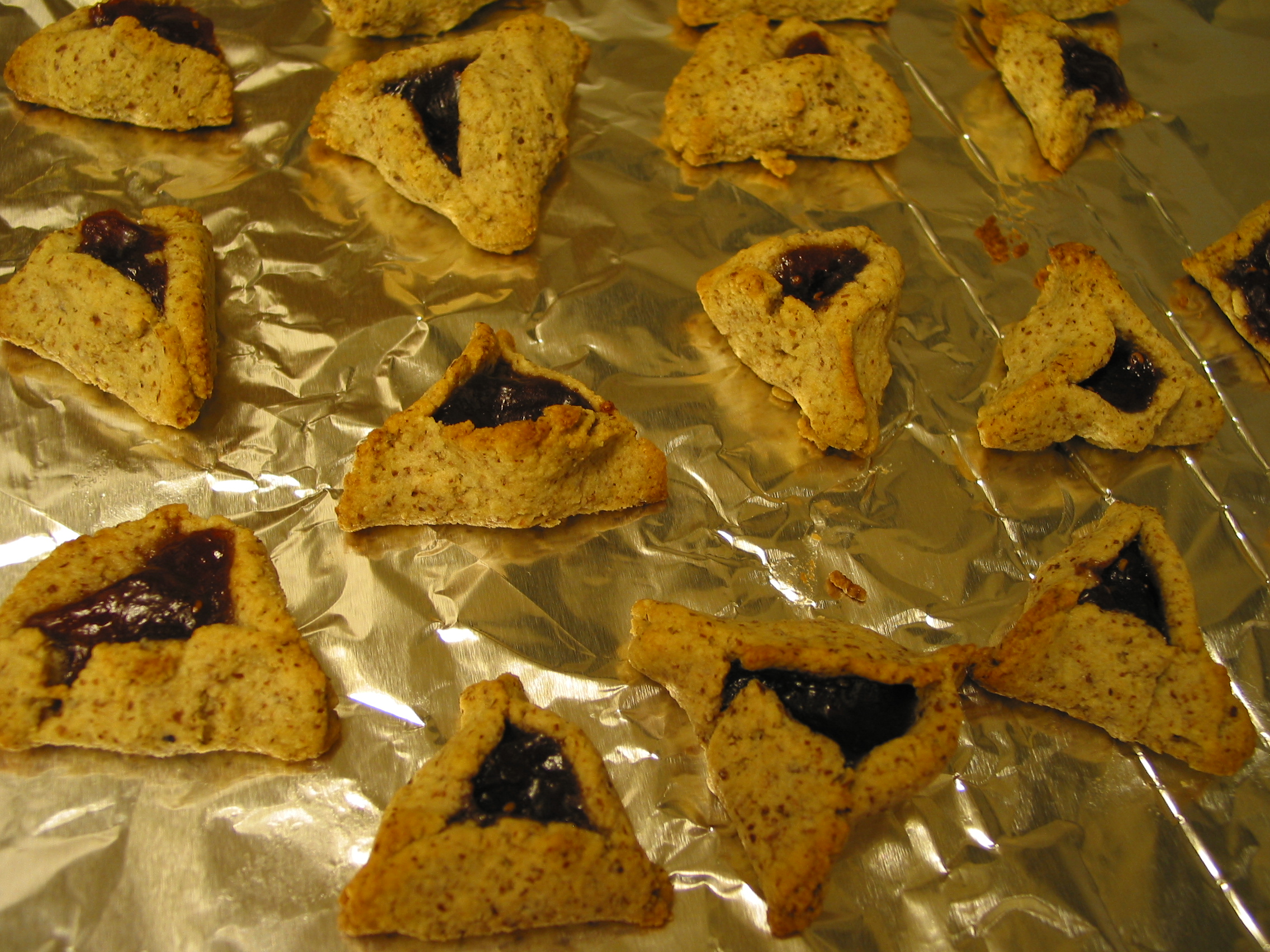
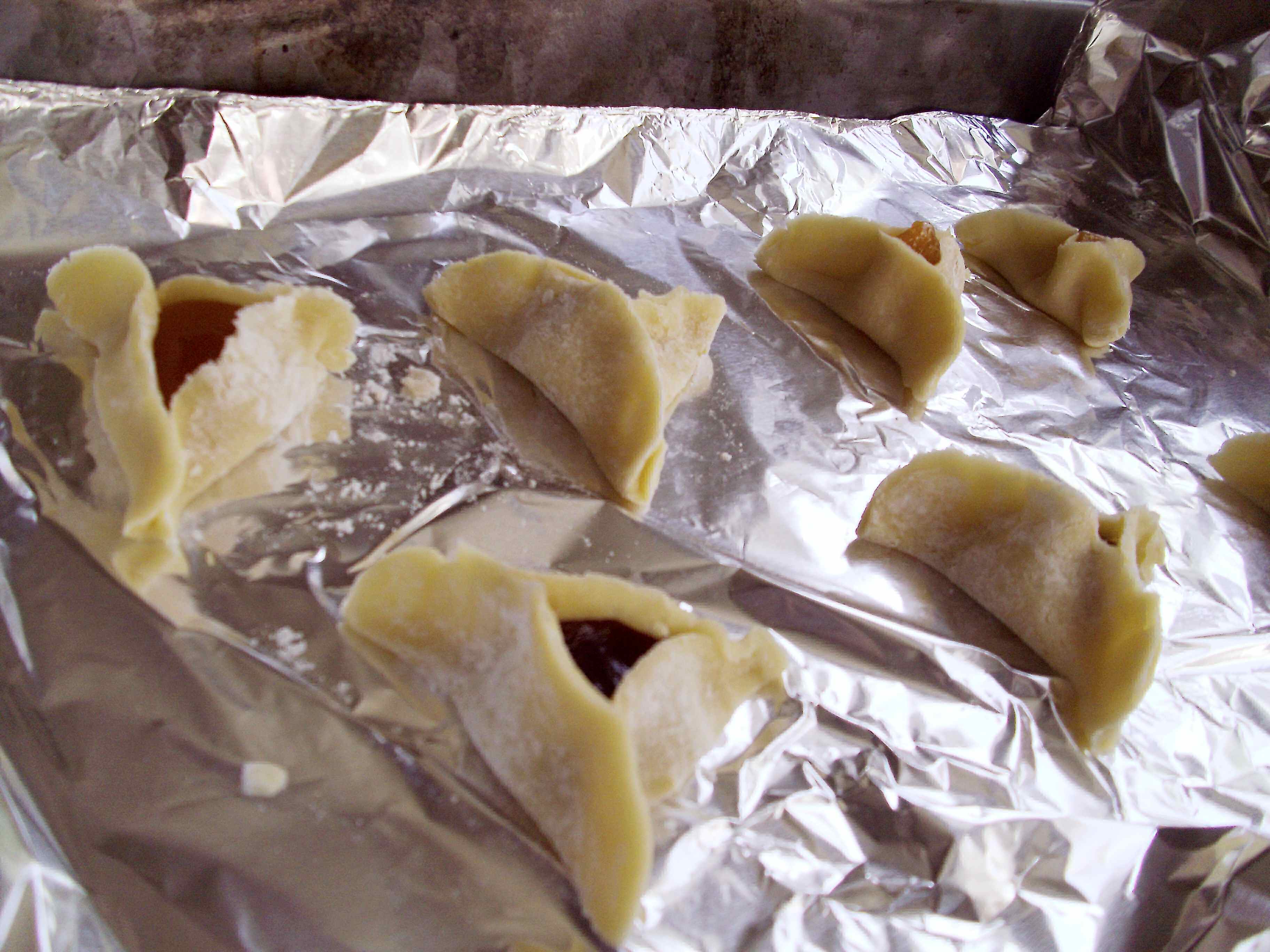
Almond meal-based low-carb hamantaschen

The first batch didn't roll out so easily, but these coin-sized minis tasted pretty good. The next batch rolled out thinner and held together better for a larger cookie with a delicate crust.

Baked goods are a big part of Jewish holidays at this time of year. Purim, being celebrated this weekend, is the last big baking bash before Passover, and hamantaschen (named for the hat, ears or purse of Haman, the villain of the story of Esther) are the cookie of choice. But with a diabetic kid in the house, the usual prospect of baking them takes on a bitter edge.

Hamantaschen–in fact, most cookies–have enough grams of carbohydrate that just two medium-sized cookies contain about half of what she’s supposed to have in any given large meal, twice what’s recommended for a snack, and they don’t have enough fiber or protein to slow down the sugars and avoid a spike in blood glucose. In short, not high-quality nutrition (not that we expect cookies to be). A grownup would have trouble dealing with the prospect of leaving them alone when everyone else gets to have them, but a kid faced with Purim celebrations at school or synagogue is bound for a certain degree of heartbreak.

It’s made me rethink our whole attitude toward things like Girl Scout cookies (this is also the season for that), chips, M&Ms, in fact any casual snack food that gets handed out innocently at school (our current woe–apparently my daughter’s teacher does this kind of thing at least weekly). The snack habit–anytime, anywhere, any or no reason–has become so ingrained in daily life we hardly think about whether it’s appropriate or not. Certainly the handouts are happening more and more frequently in class than I remember when I was a kid–did teachers even hand out treats back then? Not in my elementary school. It’s especially hard for a kid to “just say no” (and we already know how well that advice works in other contexts) when everyone else is taking a cookie or some M&Ms as a reward for answering a question (can they even keep their minds on the subject)? And even worse when it’s the teacher handing them out, because the teacher’s supposed to know whether it’s ok to eat or not.

Maybe we shouldn’t be handing these things out so casually or so often? Because while most people can handle surprise extras like these, they’re probably not all that good for anyone to eat indiscriminately at just any time of day. If they’re spiking a diabetic kid’s blood sugar, you can be sure they’re doing the same thing to your kid’s blood sugar too, only his or her body is responding with extra insulin to cover it. We get to see the results directly every couple of hours with our daughter–complete with sudden attacks of giddiness or tears if things peak and crash too quickly. But the same kind of thing happens to some degree to a lot of kids who aren’t diabetic, and they probably get reprimanded for it. Probably happens to a lot of adults, too.

Still, it’s the holiday, and total deprivation from treats is not really my aim today. So I’ve been trying to figure out a revised recipe for hamantaschen with a more manageable carb count, and preferably one without artificial sweeteners since my kid is still a kid. And neither of us wants it to taste like chalk. Very important.

I start most years with Joan Nathan’s cookie-dough hamantaschen recipe from The Jewish Holiday Kitchen because it’s the best dough I’ve ever tasted for these, even though it’s pareve (non-dairy, non-meat) and doesn’t have butter or cream cheese or the like. It’s not too sweet or too dry, and it doesn’t look or taste chalky or pasty like some of the dead-white offerings at the Purim carnivals. It tastes like a pretty good cookie, and it works really well for rolling out.

Looking at the carb count breakdown for that recipe, at about 12-15 g each, it might not be so bad to do regular hamantaschen, but my daughter would need to eat one or at most two with something protein or fiber, and she’d need insulin for it, so she couldn’t just grab one in between the planned meals. Kind of a pain, no doubt about it.

I was hoping for something closer to carb-free so she could eat hers with impunity when everyone else is eating theirs. This year I scanned the web for low-carb hamantaschen recipes and found only one Continue reading