• Enter your email address to subscribe to this blog and receive notifications of new posts by email.

    Join 241 other subscribers
  • Noshing on

    raw blueberry pie with microwaveable filling and graham cracker crust

    This mostly-raw blueberry pie is a snap to make and very versatile--the filling microwaves in a few minutes, and you don't even have to bake the zippy gingered graham cracker crust--perfect for a hot Fourth of July and all summer long.

  • Recent Posts

  • Contents

  • Archives

  • Now Reading

  • See also my Book Reviews

  • Copyright 2008-2024Slow Food Fast. All writing and images on this blog unless otherwise attributed or set in quotes are the sole property of Slow Food Fast. Please contact DebbieN via the comments form for permissions before reprinting or reproducing any of the material on this blog.

  • ADS AND AFFILIATE LINKS

  • I may post affiliate links to books and movies that I personally review and recommend. Currently I favor Alibris and Vroman's, our terrific and venerable (now past the century mark!) independent bookstore in Pasadena. Or go to your local library--and make sure to support them with actual donations, not just overdue fines (ahem!), because your state probably has cut their budget and hours. Again.

  • In keeping with the disclaimer below, I DO NOT endorse, profit from, or recommend any medications, health treatments, commercial diet plans, supplements or any other such products.

  • DISCLAIMER

  • SlowFoodFast sometimes addresses general public health topics related to nutrition, heart disease, blood pressure, and diabetes. Because this is a blog with a personal point of view, my health and food politics entries often include my opinions on the trends I see, and I try to be as blatant as possible about that. None of these articles should be construed as specific medical advice for an individual case. I do try to keep to findings from well-vetted research sources and large, well-controlled studies, and I try not to sensationalize the science (though if they actually come up with a real cure for Type I diabetes in the next couple of years, I'm gonna be dancing in the streets with a hat that would put Carmen Miranda to shame. Consider yourself warned).

Stuffed cabbage in the microwave

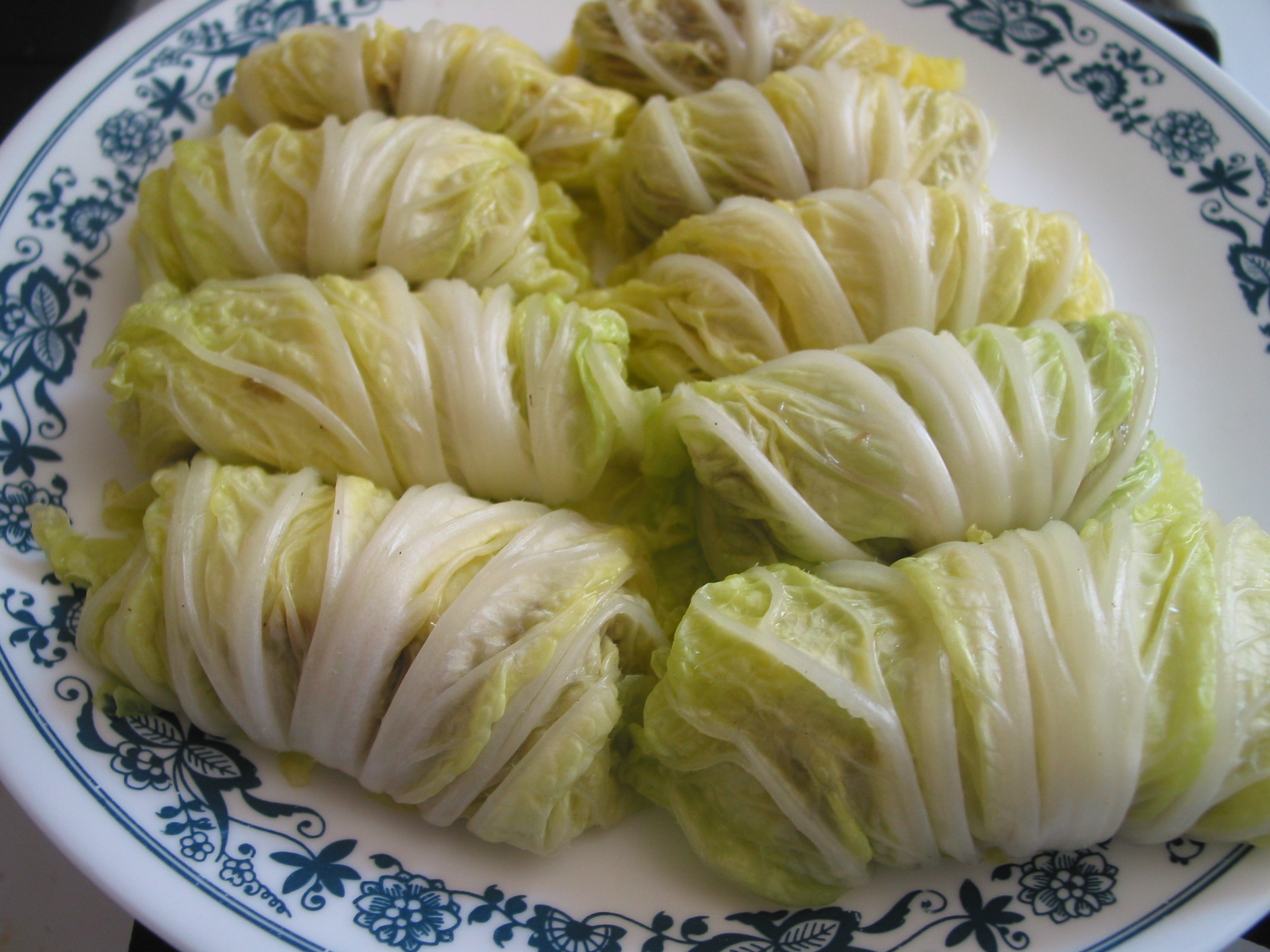
stuffed Nappa cabbage rolls-unsauced

I was originally going to call this post “Nappa 9-1-1” because it’s about salvaging a cabbage quickly and semi-artfully from the back of my fridge, but realized how bad that would be once I read the recent earthquake damage assessments up in the real city of Napa from the 6.0 earthquake a couple of weeks ago. Things are still kind of rough up there. The Napa Valley Vintners association have donated an impressive amount–$10M–and have instructions on how to donate to the local community disaster relief fund. You can find a number of local funds to donate to online at norcalwine.com.

I love bringing home a bag (or more) of produce from my local greengrocer each week–especially in the summer, when Fresno tomatoes are in and brilliant red, green beans are green and snappy, apricots and plums and pluots are spilling ripely out of the bins at under a dollar a pound, and herbs like purple basil and tarragon and mint and za’atar are 75 cents a bunch. You can’t help but feel like you’re going to be a great cook that day, just by cutting up a few vegetables and sprinkling on some oil and vinegar and strewing herbs (and feta or Alfonso olives) on top.

I always mean to use up all my vegetables before they start showing their age, but occasionally I get caught with something unintended at the back of the fridge. This week it was a Nappa cabbage, which is longer and less sulfurous (when lightly cooked) than the more traditional green and Savoy cabbages. A little closer to bok choy. So I peeled back the rusted layers, hoping that some of the inner leaves could be salvaged, at least, and I got fairly lucky.

But what to do with them? Chop and eat raw as a salad? Always an option. But I’d bought the cabbage in the first place to try out a quick microwave version of stuffed cabbage that would fulfill a couple of challenges I’d posed myself:

1. Vegetarian (not a big beef fan, personally)–I’m using the lentil/rice stuffing I developed for stuffed eggplants and onions  three years ago (has it already been that long???), because I actually made stuffed onions again last week and had some leftover stuffing in the fridge.

2. Microwaveable in a few minutes (to combat cooked cabbage stench and do it as more fresh-tasting than long-cooked)

3. Non-stinky, and not drowning in cloying sweet-and-sour tomato sauce (my two overwhelming childhood objections to holishkes)

4. Bridges the cultural/culinary gap between European and Syrian Jewish versions of stuffed cabbage by spicing the filling AND adding garlic and onions. It can be done, and should. And yet, I’m not stewing it to death (actually, that means overturning both Euro and Syrian traditional cooking methods in equal measures).

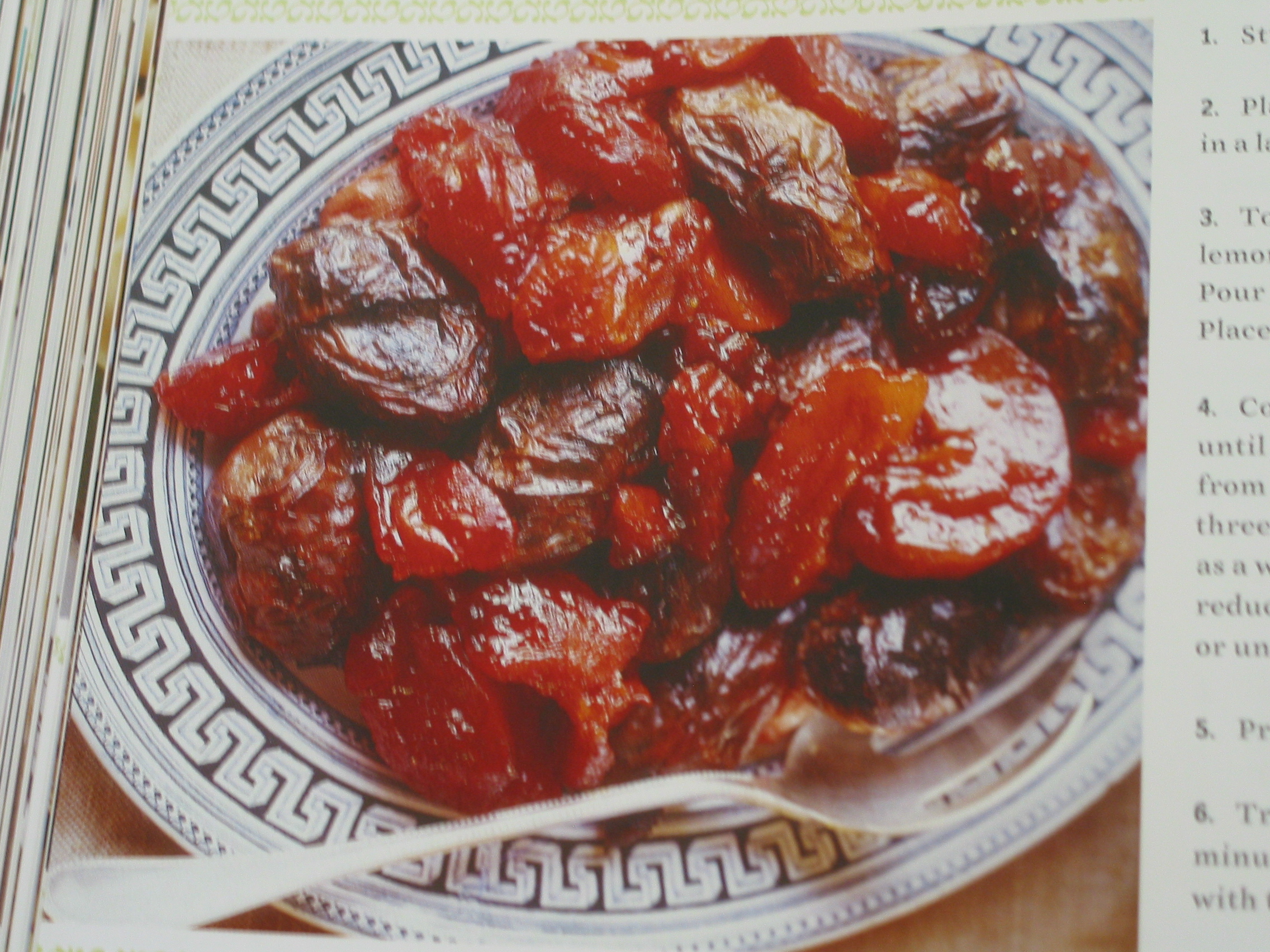
5. Fulfills the Prunes and Lentils Challenge, or at least hints at what’s possible, since today I had (gasp) no prunes left and had to resort to leftover tamarind sauce from the aforementioned batch of stuffed onions… close enough for folk music.

Stuffed cabbage rolls, as I’ve noted before, are popular throughout at least eastern Europe and Syria. Most versions contain meat–beef for Jews, beef or lamb for Arabs, some mixture of pork and beef for European Christians. But I’ve also seen some really beautiful-looking vegetarian ones in Nur Ilkin’s The Turkish Cookbook, and those were stuffed–of all things–with whole cooked chestnuts.

Cabbage lends itself to enveloping stuffings almost as well as grape leaves, and it’s easier to work with, cheaper, and (big bonus) unbrined.

In addition to meat or lentil fillings, you could try something like curry-spiced or Mexican-style beans and/or vegetables, a mu shu or samosa filling, whole cooked grains like brown rice or bulgur with or without dried cranberries or raisins and sunflower seeds or chopped nuts, maybe even fish (though I’m shying away from Joan Nathan’s recommendation for wrapping up gefilte fish and giving them the stuffed cabbage treatment). Perhaps for fish I’d want smoked (fake or real) whitefish salad. Or sausage–real or vegetarian, smoky and spicy.

It seems to me for sauces you could go well beyond sweet-and-sour traditional: a garlicky tomato sauce, a mustard vinaigrette, a smoky salsa with or without tamarind sauce, a chili-paste or z’khug-laden soy/molasses/vinegar/sesame oil dipping sauce with ginger and scallions, a polished herb and wine-type tomato sauce with prunes or mushrooms and onions, even (maybe definitely?) Korean or Thai peanut dipping sauce, especially if you stuffed your Nappa cabbage leaves with a combination of pressed tofu and/or omelet strips, spinach leaves, maybe some sprouts and shiitake mushrooms.

Whatever version you do, this can either be a quick path to dinner (use the big leaves and more filling per leaf) or to a platter of appetizers (using the small inner leaves).

Microwaving doesn’t develop every possible flavor (in the case of cabbage, I’m childish enough to say that’s a good thing), but it’s a quick way to play around with a classic at least on a trial basis. You could always do the huge foil-covered pan in the oven thing if you decide to scale up and go old-school.

Stuffed Vegetarian Cabbage Rolls

  • 1 head Nappa cabbage, washed and with the core cut out
  • 1 lb (2 cups, more or less) of (in this case) allspice/cinnamon-spiced lentil hashu (made w/cooked rice or bulgur, not uncooked) OR peppery lentil mititei-style sausage filling (substituting 1/3 c. cooked rice for the wheat gluten), or your choice of savory/spicy filling, preferably one that includes some garlic….
  • 1/2 c. sauce–in this case, 1/4 c. tamarind sauce plus a tablespoon of chipotle salsa and a few tablespoons of water. OR–just tamarind sauce, or just smoky salsa, or tamarind with a bit of tomato paste and a spoonful of sugar, or peanut dipping sauce, or dim sum dipping sauce, or Asian-type prune sauce, or prune and wine sauce with some tomato paste mixed in. Or mustard/garlic vinaigrette (as a dipping sauce, not necessarily to cook with)…YEESH! too many choices…


Microwaved cabbage leaves, ready for rolling

Microwaved cabbage leaves, ready for rolling

1. Separate the cabbage leaves, put in a microwave container, drizzle on a quarter-inch of water and put on a lid. Microwave 2-3 minutes until the leaves are just tender enough to roll without snapping the center.

rolling stuffed cabbage

Start the cabbage roll with the filling at the stem end

2. Drain the leaves and lay them out on a plate for stuffing and rolling. Put a tablespoon of fairly stiff filling an inch or so from the stem end of the leaf and pack it into a little sausage shape. Roll the stem end over the filling gently but as tightly as you can manage, then tuck the side frills of the leaf over the ends and continue rolling toward the top of the leaf. Place seam-side down in a microwave container or casserole. Roll up all the leaves and pack them into the container fairly tightly.
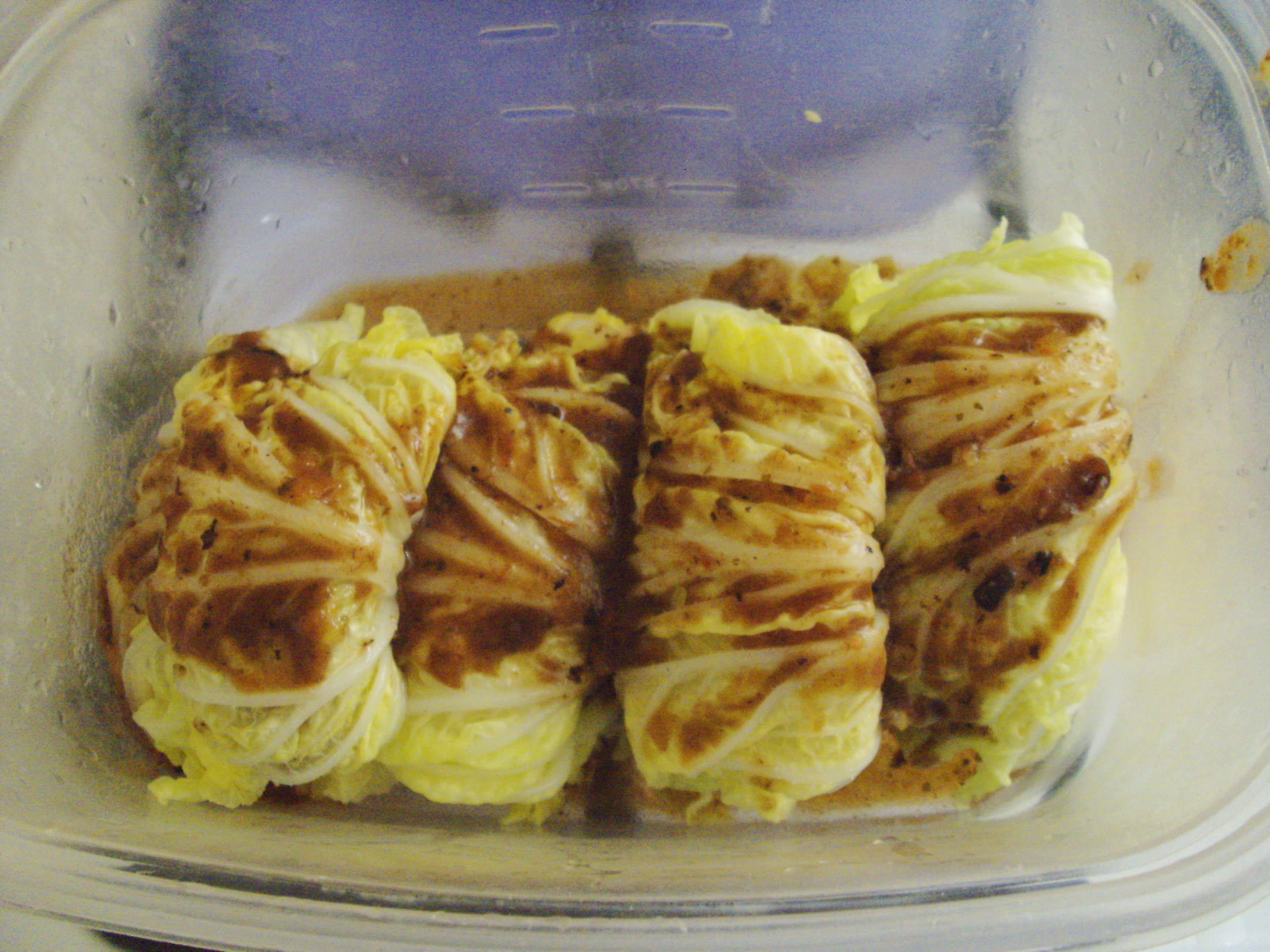
stuffed cabbage rolls with tamarind sauce

3. If the filling is completely cooked already (the rice in the lentil stuffing is not raw or par-cooked), just drizzle a bit of your sauce of choice over the stuffed cabbage rolls, maybe with a tiny drizzle of water in the bottom of the container. Put a lid on and microwave another 2-3 minutes or until just cooked through and steaming hot. If the flavor is still too raw or radishy for you, obviously you can cook it further, going a minute or so at a time, until it smells and tastes right to you.

Drain and serve with a little more sauce on the side.

Stuffed onions in a hurry

Stuffed onions ready for steaming in the microwave

With a microwave and a frying pan, you can make stuffed vegetables like Mehshi Basal quickly, and they taste even better than with long roasting. These are just rolled and ready for a few minutes of steaming in the microwave.

Just after Rosh Hashanah I posted my first-ever attempt at an elaborate Syrian Jewish dish of sweet-and-sour stuffed eggplants with quince, and because I had more stuffing than I needed, I went for seconds with Aromas of Aleppo on the spot and tried out the Mehshi Basal, or stuffed onions with tamarind sauce, which was actually even better. It was easier to put together and I was patting myself on the back when we tasted the results.

Still, given that I was using a lentil stuffing in place of ground beef, I was a little dismayed at how long the traditional braising and roasting took to cook the onions all the way through–an hour and a half at least, and that was after stuffing them. A second attempt in November, this time exclusively with stuffed onions for a congregation brunch, did no better on time, and I came away thinking that roasting was an extremely inefficient way to cook these–might even have toughened them inadvertently.

Why, you have to ask, should I make such a big deal about stuffed onions–they’re a party trick, after all, not standard cooking. But we discovered we really liked them, and they’re a pretty good kind of party trick. They were a surprise hit at the brunch. If I hadn’t snuck myself one while setting up in the kitchen, I’d have missed out altogether.

Actually, I think they fascinated everyone as much for the magic trick as for the flavor. People who’d never tasted them before kept coming up to me–and even my daughter–to ask, “How do you get the filling into the onions???”

If they hadn’t been so time-consuming I could have made double the amount and they’d still have disappeared. Or I could throw them together easily just for us on the odd weeknight as a treat–but one with some iron and fiber in it–instead of the standard pasta or rice.

So in the time since, I’ve finally rethought the process and come up with something that requires no oven time and cuts the actual cooking after stuffing them down to about 20 minutes or so–as long as you already have some cooked lentils (microwaved to perfection in about 10 minutes of cooking time and 30-4o minutes of standing time) and tamarind sauce (or “mock tamarind” sauce, a 5-minute microwave-assisted blend of prunes and/or apricots with water and some lemon juice, plus-or-minus tomato paste, applesauce and other flourishes you don’t really need for this) to hand.

I know, you probably don’t have these things sitting around. But this recipe might change your mind. Lentils are good stuff even on their own, and the stuffing here is a knockout.

Even genuine tamarind sauce isn’t so bad anymore, assuming you don’t or can’t just buy a prepared concentrate. I’ve sped the process up from an hour-plus to a few minutes just by nuking it, pulsing in a food processor, and this time, neither filtering it quite so aggressively as I did back in September NOR bothering to boil the stuff down to a sticky residue. It’s so much less painful, and I think it even tastes better, with more of the fruit character left in. See my notes at the end of the post for how to do it the quickie way (in modest jam-jar quantities, not quarts).

Anyway, back to the stuffed onions. I’m actually proud of myself for this one, and I’ve tried it three times in a row so I can vouch for it–the last time, I put my daughter to work stuffing the onion layers, and she did a great job.

For this method all you need are a microwave oven, a frying pan and a food processor. Instead of boiling the onions for 20 minutes to separate the layers, you microwave them in a drizzle of water for 5. Instead of braising the stuffed Continue reading

A Slow Food Fast Thanksgiving

Pumpkin pie in the microwave

I’m not sure how to take all the following good news–it’s been such a strained year that the sudden release of pressure is going to make me zip around the room, once the coffee kicks in.

1. My mother-in-law has threatened to favor the brand-new kosher butcher in her town this holiday season so that we can eat the turkey too this year (and maybe not fight about it). She promised not to smear said turkey with butter. We’ll cross our fingers. But at least we won’t have to cook. I’m keeping that firmly in mind.

2. As of this week, my daughter’s finally on an insulin pump and fairly thrilled about it, so she can navigate dinner AND dessert at my in-laws’ without breaking down and crying that she only gets two tablespoons of pie for a reasonable serving. We are still encouraging her to count carbs and not go hog-wild or she’ll be zipping around the room until midnight.

3. The school concert’s in less than two hours. Is that really enough time to do everything, or at least something? Naaaah. Well, maybe coffee and something other than the news.

4. We still have to schlep up Interstate 5 for about 6 hours tomorrow, starting “early” (i.e., an hour and a half after the time my husband announces this evening as the absolute latest), passing the Harris Ranch and its attendant aromas, which can be more than slightly offputting if you’re not an avid horticulturist. But at least when we get to my in-laws’ we don’t have to cook. As I said, I’m keeping that firmly in mind. I know I already said it, but it’s so important I figured it was worth saying twice.

Despite my firm resolve after last week’s marathon kiddush that I will strive Not To Cook (could I possibly be Peg Bracken’s unacknowledged lovechild? Unfortunately, no. However, my mother was a devotee of the Don’t Cook Too Much school of thought, and I’m starting to appreciate that. Really I am.)…where was I? Oh yeah…I will probably bring at least two lemons, some thyme and rosemary, a head of garlic and a couple of bags of fresh cranberries with us on the road. Call it flavor insurance. For whatever reason, my in-laws, who have developed what can only be called fanatical devotion to Italian food of every possible kind (having both grown up in white bread country), always run out of these basic essentials about halfway through, and my mother-in-law tends to tell my father-in-law to go back out and pick up extras just as the stores are closing…

The cranberries, I’m well aware, aren’t Italian. They’re for making 5-minute microwave cranberry sauce with about half the sugar of regular. My mother-in-law tends to try out her fancier cranberry chutneys and relishes every year, and every year they contain things like chardonnay–which is fine for the grownups but I’m no grownup. Her chutneys have more than 10 ingredients and sit stirring on the stovetop for at least 45 minutes. I don’t know how she does it–I’d go stir-crazy. I’m just not that good.

So anyway–I wish you all a great Thanksgiving at somebody else’s house, so you don’t have to cook or do the dishes. My idea of heaven.

But if you absolutely have to cook, here are a couple of posts for speeding up a few of the obligatory or not-so-obligatory Thanksgiving items–most can go in a microwave (I always, always think that’s worthwhile. Well, usually). A few of these are dairy, so use your discretion.

5-Minute Cranberry Sauce

Microwave Pumpkin Pie

Basic instructions for microwaving green beans, brussels sprouts and other vegetables

Creamed Spinach Variations

“Marbella”-style cooked vegetable relish with artichoke hearts, olives, tomatoes and prunes

Turkey Breast with Ta’am (flavor) –not microwaved, not a whole bird, but it is a lot quicker and tastes unusually good if you have a small crowd. DO keep it covered in the oven to prevent it drying out.

Some options for vegetarian centerpiece dishes… (ideas more than recipes)

Spice mixes because sometimes you want to liven up the party…

Syrian Jewish stuffed vegetables (baby eggplants and onions) with an incredible lentil filling (NOTE–this one is “not exactly quick”; well, maybe for the eggplants microwaving would be enough, but the onions still take some serious roasting even after microwave assistance.  However, it is delicious and impressive.)

Microwave gingerbread and microwave flan (and a recommendation for mead…)


Stuffed Eggplants with Quince, A Vegetarian Odyssey

Stuffed Eggplant with Quince and Stuffed Onion Rolls

I did it. It was 90+ degrees outside yesterday afternoon and felt a lot hotter inside when I started cranking the oven to try this dish right away rather than wait for the weekend, but I’m just no good with delayed gratification.

If I have the mini-eggplants and I have the quinces and I have the tamarind concentrate (homemade! two days ago! it’s practically crying out to be used already!) and I have the “hashu” filling for the vegetables sitting in the fridge smelling wonderful, then it just doesn’t matter that Rosh Hashanah dinner is in what, maybe 3 hours, and I still haven’t braided the challot, to say nothing of baked them. Obviously I’ve gotta try this extra-credit dish out RIGHT NOW.

Actually, I figured the house was going to be heating up anyway once I started baking the challot, so why not get it all over with at once?

There was a more serious reason to try it. Today in services I was still thinking about Dweck’s book and her recounting of her parents’ horror in 1947, when, about to return from a vacation in Europe, they learned the government back home had started massacring whole Jewish communities in reaction to the announcement that the UN had accepted Israel as a Jewish state.

The Syrian Jewish community fled wherever they could–just as my family did under the pogroms in the Ukraine back in the 1880s and 1920s. Dweck maintains that the reception the Syrian Jews got in the US from those of us who were already here was so aloof–they didn’t speak Yiddish, they didn’t look the same, they did a few things differently for kashrut and prayers–that her community kept to themselves ever after.

I can believe it, unfortunately–the period right after World War II and the Holocaust was one of paranoia and circling the wagons for American Ashkenazim.

Eastern and Western Jews had similar discomfort with each other in postwar Europe. Reading between the lines a little in Claudia Roden’s and Colette Rossant’s memoirs, the two, who had just lost everything, thought their new Ashkenazi neighbors were cold and inhospitable and indifferent to their exile; the Ashkenazi neighbors and relatives, meanwhile, thought the wealthy young Egyptian arrivals were horribly spoiled and indifferent to the European disaster they had just missed. Altogether, the Ashkenazi, Sephardi, and Mizrahi communities were in closer touch before World War I than they were after the 1940s.

I can only hope that now, 60 or 70 years on, we have more in common and more regard for each other, no matter where we came from. Israel’s great mix of cultures has been a good influence, even though it originated in hardship, and perhaps today we are in better shape to appreciate what we have in common than we have been for nearly a century.

When I look through Dweck’s family’s photos, I see so many people who look astonishingly like several members of my family–my dad and my sister especially. The dignified lady presiding at the seder table on the front cover is a shockingly exact adult version of a girl I knew from my synagogue’s youth group–it’s the sturdy mouth and chin and the set of the eyes, certainly, but also the irrepressibly thick and curly hair (the 1920s formal chignon has it all over my friend’s 1970s braids, which took her hours to corral her hair into). The formal photographs of families in the 1920s, all the daughters dressed beautifully but in the same fabric the mother is wearing, sailor suits on the boys, stern dignified expressions all–I’m pretty sure each of my grandmothers had at least one of those in her collection. The 1930s-era engagement portrait with pearls and bobbed hair–so modern! Pin it up next to the one of my dad’s parents, who married in 1939 and looked so incredibly naive and young then. The family gatherings at Pesach, grandma presiding over the white lace tablecloth and all the seated cousins glancing behind them at the camera from over their shoulders–there’s probably one or two with my mother as a toddler on someone’s lap in Brooklyn and another of her as a teen, whipping her glasses off and blinking myopically for the photo. It could be any of our families. It could have been us in Syria and Egypt and Turkey, it could have been them in the Ukraine or Germany or Poland. We none of us have entirely safe histories, and none of us are entirely separate.

In any case, Dweck’s book is important to me not only for capturing her community’s traditions, tastes and history but for reaching out to the rest of us and giving us a chance to share it, compare it with our own, and reconsider what it means to be part of the Jewish world now.

So–and this is not to trivialize but to explain, since we sometimes live and remember through food, especially at the holidays–it was a great time to try out a challenging dish (challenging for me, anyway) from her book and serve it last night to my family for Erev Rosh Hashanah. I cook from scratch, I cook a lot, but I’ve never really done  the legendary great-aunts-at-Pesach kind of slow cooking where everyone groans in pleasure and declares “nobody does it like this anymore” when they taste it. I’ve only once cooked a whole turkey, and I’ve rarely tried anything else that took more than an hour and a half to cook. It’s a transformative experience, one that teaches me a lot about my great-aunts and great-grandmothers, both in the shtetls with the wood-fueled pripitschoks and communal ovens, and here in America with modern kitchens and big lace-covered tables. Trying this long-cooked dish gave me the chance to experience both my family’s past celebrations and Dweck’s at the same time.

To my very great pleasure, her recipe worked the way it was supposed to on the first try and tasted like the effort was worth it, even though her instructions are pretty simple and brief. That’s a huge achievement.

So–if you’re ready for this, keep reading–otherwise, glance at the pictures and skip to the bottom…

The “Stuffed Eggplants with Quince” Experience

First of all, let me just say that I LOVE my local Armenian corner grocers for a lot of reasons, but the fact that they have all the ingredients for Dweck’s dishes (other than kosher meat, that is) is a big, big plus.

I would have tried microwaving–and I still will–instead of a 2-hour braise, but I wasn’t sure how it was supposed to taste, whether microwaving would cook the raw rice in the filling well enough, and how the sauce was supposed to interact with the stuffing and the eggplants. I knew from a previous hard-luck experience that quinces don’t do especially well (or even well at all) in the microwave and really need long stewing under conventional heat to get tender and turn bronzy pink and sweet. So all in all, I decided following the directions in Aromas of Aleppo might be the wiser course for a first try. Even though, from my usual 15-minutes-tops perspective on conventional-heat cooking, Poopa Dweck’s method is glacially, almost outrageously, slow.

Basically, you core the baby eggplants, stuff them with hashu (beef-and-rice filling, rice and tomatoes, or in my case lentils-and-rice), and layer them in a saucepan with quince slices. Then you dilute some tamarind concentrate and add a bit of sugar and salt, pour the sauce over the pan and heat for 10 minutes on the stove until the eggplants start to sweat, add water to come about 3/4 of the way up , simmer half an hour to reduce the liquid and cook the rice in the filling, then transfer to the oven to braise covered for about 40 minutes and then uncovered for another 30. It’s a lot like making brisket, actually.

Dweck gives two allspice-laden recipes for the filling, one for ground beef with rice, the other a rice-and-tomato filling that’s close to what I use for dolmas. I opted to follow the ground beef recipe but substitute an equal weight of cooked green lentils for the meat and add a little garlic. It would work, I was pretty sure, and in fact it turned out to be the best, most delicious part of this recipe–which, skipping to the punchline, was pretty terrific and worthwhile, even for the work Continue reading

The Birthday Project: New Year, New Food

I was born halfway between Rosh Hashanah and Yom Kippur, so on any given year, I could be stuck eating honeycake or none at all on my birthday. I think I’ve had maybe two actual birthday parties in my life. It’s a concept my daughter, born in June, doesn’t get.

But occasionally I luck out–and this year was one of the best. My husband asked what I wanted and I had a real answer–a cookbook I’ve been lusting after at the library and that costs only slightly more than my probable library fines if I don’t return it.

So this is it–feast your eyes, I’ll turn the pages:

Aromas of Aleppo by Poopa Dweck

And this is the project that sold me on it:

Stuffed Eggplant with Quince

Stuffed Eggplant with Quince

Poopa Dweck, a cousin by marriage to Claudia Roden, has edited the New York Syrian Jewish community’s version of a sisterhood cookbook (every synagogue in America’s sisterhood seems to have put out at least one of those) for something like 20 years, only people in her community actually used it frequently. My birthday gift is the 2007 culmination of Dweck’s experience, and it’s just a very beautiful cookbook to leaf through–visually but also for the possibility that when you try the dishes, they’re actually going to work.

It doesn’t take much reading for me to realize that despite the unfamiliarity of some of the flavors–allspice in meat stuffings, tamarind-based sauces–this is the best kind of traditional Jewish home cooking, the kind that has your favorite great-aunts outdoing each other for Pesach, Rosh Hashanah, and other big celebrations. So, somewhat exotic in flavoring but utterly familiar in spirit. (And actually, as I discovered in another Syrian Jewish cookbook, A Fistful of Lentils, by Jennifer Felicia Abadi, a few dishes, like stuffed cabbage with a sweet-and-sour sauce, and manti, a kind of ravioli, are pretty similar to Ashkenazi holishkes and kreplach.)

Like all Jewish great-aunt dishes for the holidays, this dish of stuffed eggplants and quinces comes with two required homework items: the beef and rice stuffing, and tamarind concentrate. The beef I’m not worried about–my first try on this is going to be vegetarian, because I’m not planning on heading out to the kosher butchers in the Valley. I can use a green lentil and rice filling that I already know will taste fine with those flavorings of allspice and cinnamon and onion. Maybe a hit of garlic too, and maybe a bit less salt than for the beef–as I discovered a few weeks ago, with the green lentil sausages, lentils don’t hide the salt flavor as much as beef might.

The other item, tamarind concentrate, turns out to be inexpensive but somewhat unlovely to make–though still something of an adventure. Especially for a blog called Slow Food Fast.

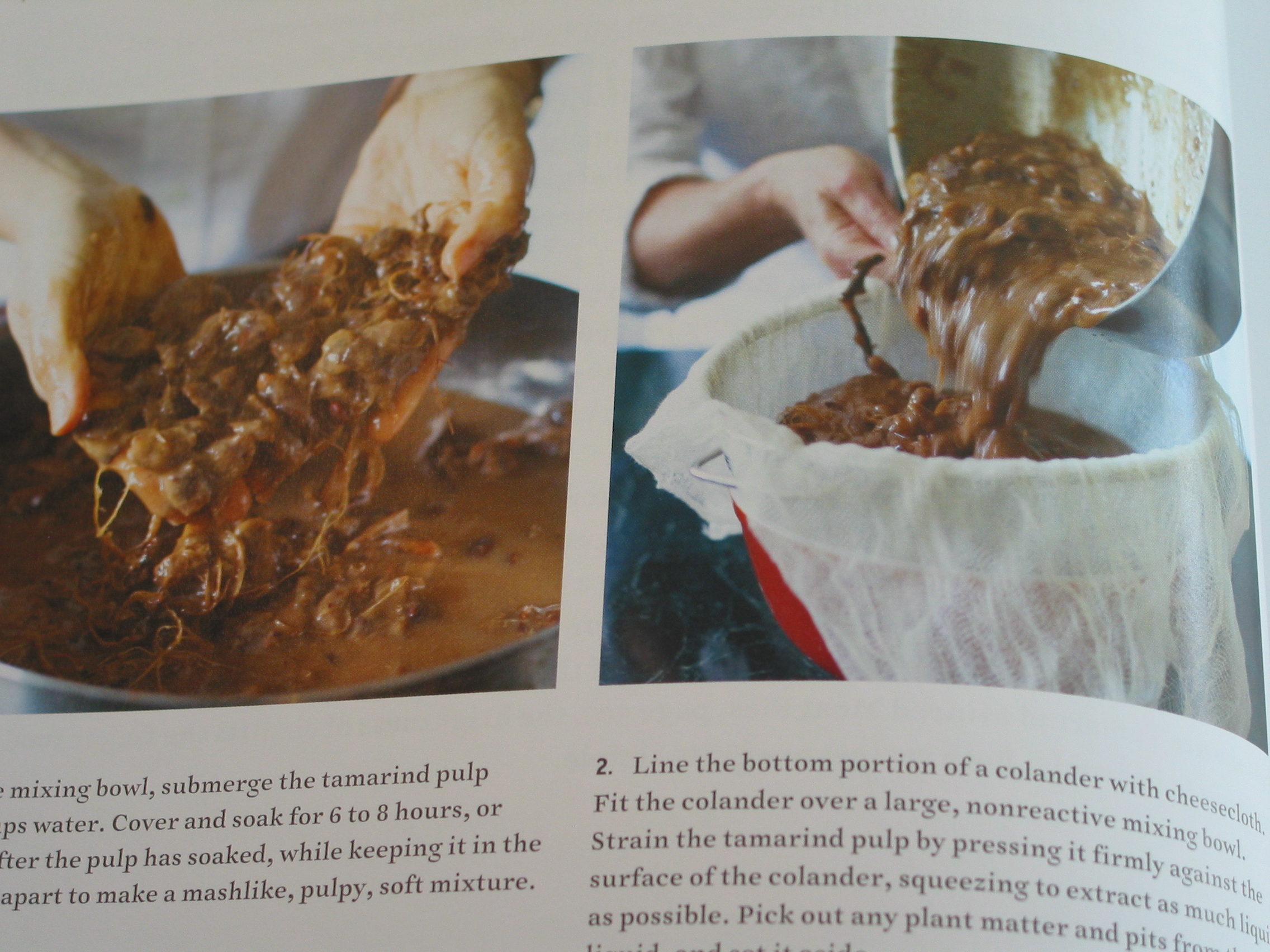
Here’s what’s on page 42 of Aromas of Aleppo for how to work the tamarind pulp into something that will give up its flavor to a sauce:

Poopa Dweck's Aromas of Aleppo--instructions for making tamarind concentrate

Working the tamarind pulp

Now, I’m not all that squeamish, but bleaaghhh. First ya gotta soak the stuff overnight, then ya gotta get in there and mish around–I dunno. I decided to speed it up where I could…

I thought about the little 1-lb. brick of pressed seedless tamarind pulp I’d bought from my Armenian greengrocers for this dish. It just seemed like a tougher version of dried prunes or apricots, which I usually soak up successfully enough in a few minutes by heating them with water in the microwave. Would it work here or would it ruin the flavor? I cut off a chunk, submerged it in water in a microwaveable bowl, and tried it.

Tamarind pulp rehydrated in the microwave

Five minutes of microwaving, covered, plus about 20 minutes sitting time–it was definitely done. And really, really incredibly tart, a surprise given tamarind’s distinctly plummy aroma. Success! But no wonder they call it “ouc” (pronounced OO-rgh, according to Dweck)–that was my immediate reaction when I tasted a tiny sip. It’s THAT sour. My second reaction was that I should probably say Shehekheyanu–the blessing for any new venture, especially for holidays and the first taste of a new fruit in the year.

I realized only afterward that I should have done the whole brick while I was at it–I was about to discover why Dweck calls for preparing three pounds of pulp at a time, not a couple of ounces.

Next step–squishing the pulp in the water to extract as much flavor as possible before filtering through cheesecloth and reextracting the pulp left behind in fresh water…no. Just no. I am not a cheesecloth girl–it never, never cuts neatly, even with Fiskars shears.

So, I was thinking, I have a microwave for a reason. I also decided I have a food processor for a reason, and this is definitely it. I stirred once with a fork first to make sure there really weren’t any pits in there, as advertised on the package front. Then I poured it all into the food processor, and gave it a whirl. That worked too. I seemed to be on a roll with the speed-it-up-immensely daydream.

Filtering the tamarind liquid

Filtration–I’ve used overlapping coffee filters in a colander whenever I make paneer in the microwave, and it worked pretty well here too–maybe better than Dweck’s photos, which show a cloudy filtrate coming through the cheesecloth. Mine was clear and amber–maybe too clear? Was it going to taste authentic without the silty stuff? I could only hope. It sure was sour, even dilute as it was. Continue reading

Green Lentil Sausages

A month or so ago I had been intrigued with a recipe on “Is This My Bureka?” (see sidebar for link) for Romanian mititei, a spicy cross between meatballs and sausages, and wondered whether I could make a vegetarian version with green lentils. Not because I can’t eat beef–I can if it’s kosher–but because I generally don’t like handling meat. (I don’t mind fish nearly as much; don’t ask about the logic, it’s just a preference.) All my meat dishes are still in storage, four months after the move. That’s not accidental–I hate switching over the dishes even more than I dislike handling meat.

So in any case, I tried it. Green lentils are on my list of easy-to-microwave, ultracheap nutritious staples. I cooked up about half a pound of dried lentils in water to substitute handily for a pound or pound and a half of ground beef. The mixture I made was heavy on garlic, pepper, and a variety of spices ground in the coffee mill. It was a lot lower on salt than BurekaBoy’s because I tasted it with a couple of pinches of salt–between 1/4 and 1/2 teaspoon–in the mix and that was more than plenty. Scared to think what a teaspoon and a half would have done. Maybe ground beef requires more, or maybe the lentils don’t absorb and hide the salt flavor as much.

The green lentil mixture was delicious even before cooking–with vegetarian sausage, burger or meatloaf recipes, unless you have raw eggs or uncooked flour in your mix, you can taste for seasonings pretty safely. If you do have eggs or raw flours in the mix or are making a sausage recipe with meat, poultry or fish, cook a spoonful first in the microwave and then do the taste test.

Unfortunately, though, the paste didn’t hang together as well as I’d hoped–cooking it didn’t help much. It was still delicious and spicy, but it just crumbled. And although I could live with it, I’ve been thinking about it ever since.

So my recent purchase of a bag of vital wheat gluten and my first foray into the mysterious world of seitan set me off. What if I added a little gluten to the lentil mix instead of the other way around? That way it would stick together and still be mostly lentils. The proteins would be balanced better by combining a pulse (lentils) with a grain (wheat). It would have loads of flavor without needing soy sauce or salty broth. It would be microwave-steamable, and probably fryable or grillable too. And I could still taste it safely before cooking to ensure there was the right amount of excessive garlic present.

And–half a cup of gluten wasn’t quite enough for the three or four cups of cooked lentils I used. Still kind of dry and crumbly when I made a few small patties and cooked it two ways (microwave and frying pan). I added a little more gluten to the rest of the uncooked mixture. Three-quarters of a cup of gluten per 3 or so cups of lentils was better–I could see the threads of gluten forming as I kneaded it together in the bowl.

The patties were still dryish and of course lentil gray-green, though this version hung together better when cooked. It still tasted good, very peppery and garlicky, with a hint of the allspice, fennel, coriander seed and other spices I’d put in. But because of the dryish texture I wasn’t sure I could recommend it fully–it was definitely a case of “Dance 10, Looks 3” at that point.

I cooked up the rest of the mix by microwave steaming, followed by a light pan fry in olive oil, and bagged them into the fridge. The next day, there they were–still a bit soft and crumbly, but hanging together better with a little more chewiness to them. Still not pretty but they tasted good. Waste not, want not, I thought. Pretty is for some other day. Continue reading

Microwave Tricks: Melts and other Hot Sandwiches

Microwaving the cheese and eggplant while the bread is toasting makes homemade panini a lot quicker

Microwaving the cheese and eggplant while the bread is toasting makes homemade panini a lot quicker--though not necessarily neater

Last year for his birthday my Italophile in-laws gave my husband the ultimate kitchen gadget. Because they loved theirs so much, they gave him…a panini press. I gawked. My husband is almost famous for not cooking. At all.

In more than 20 years of life together, I’ve rarely seen him make an actual sandwich for himself–does shmear on a bagel half count? I’m sure he believes in his heart that he still remembers how to flip one piece of bread on top of the other and seal the deal, but I’ve yet to see evidence of an attempt. Even without grilling.

Somehow I don’t in my heart of hearts believe this panini press is going to be removed from the box and used. Not by my husband, and not by me. It’s not that we’ve never been to Italy or eaten actual panini (we have, on both counts). It’s not that we hate panini or toasted sandwiches in general (we actually like them quite a bit).

It’s that the free-standing real, authentic, Michael Chiarello-approved-and-branded panini press weighs even more than the professional-grade waffle iron my in-laws gave us 10 years ago (and which we’ve used a total of 10 times since, because it’s such a pain to clean). The panini press also takes 3-4 times as long to preheat before you actually get to make the panini. Somehow a grilled cheese sandwich of whatever nationality just shouldn’t take 45 minutes to make. Which it did, when my in-laws, with all the innocent gadget-happy enthusiasm of Toad and his motorcar in Wind in the Willows, brought theirs out to demonstrate.

As a cheese-and-toast fanatic of some standing, I have a few very specific criteria for my grilled cheese sandwiches, grinders, melts, etc., etc.:

1. They have to be substantial and taste good–classic or adventurous, they have to be worth eating. That means the bread, the cheese, and any other fillings under consideration.

2. The toasted bread must be crisp. It must not crush, mush, squash, crumble or absorb tons of cheese grease. It must stand up to the fillings.

3. The cheese must have body and flavor even when melted–it shouldn’t run away, sink into the bread, turn into a pile of salty but otherwise flavorless grease, swamp everything else on the plate, or become a rubber eraser.

4. The whole sandwich must not take longer than about 7 minutes to put together and toast.

Normally you’d say panini fit the bill for an ideal toasted cheese sandwich, and I’d agree–if I were eating out and didn’t have to put up with preheating the grill. If you’re running a corner grill in a touristy Italian city, you’ve got a hot press at the ready and you’re turning out panini by the score for large crowds of passersby, an individual panino probably doesn’t take more than 5-10 minutes. At home, though, all you want is your d–n sandwich. You don’t want to heat an expensive and cluttersome gadget 45 whole minutes just to get there.

You’d also say that the standard white-bread-and-Velveeta fried cheez sandwich was out of the running. You’d be right there as well. No exceptions or passes.

However, in my kitchen, with its limited counterspace and my dislike of extra washing-up, waiting, or fussing, I sometimes get impatient even with the toaster oven classics of good bread, good cheese, and foil underneath to catch the drips.

A quesadilla is obviously no trouble in the toaster oven. Practically designed for it. Neither, really, is a simple sandwich-bread-and-cheddar grilled cheese. But for anything more complicated, or any thicker, more substantial filling, sometimes melting the cheese is the longest part of waiting, and in the meantime you’ve either pretoasted the bread so it stays crisp (in which case it burns around the edges waiting for the cheese to melt) or else you didn’t pretoast the bread and it remains too soft underneath the cheese (and maybe absorbs some of the grease while it’s doing that). Sometimes the other filling ingredients–tomatoes or tomato sauce, mushrooms, lentils, artichoke hearts, etc.–make the bread soggy while you’re trying to melt the cheese on top. Sometimes they don’t cook all the way through.

Here, surprisingly, the microwave comes to my rescue, particularly with fillings that aren’t just cheese but rather cheese melted onto vegetables or sauce or lentils or tuna or some combination. Continue reading

Prunes and Lentils III: The Lentil Variations

Today’s (and last week’s, and the week before’s) topic is STILL the lentils-and-prunes challenge.

Before I get on a roll about lentils, I should mention that the first Prunes and Lentils post was my 101st post for this blog. I don’t know if we should celebrate, but why not. Woo-hoo! Good enough. Consider it celebrated.

It’s taken me a full two weeks to put up this post because this is where the rubber meets the road, or at least where the lentils meet the prunes. The moment of courage. And I don’t know whether it’s going to be great or whether people will go back to wondering why anyone ever let me in a kitchen. (That’s easy: because no one wanted to do the cooking  themselves.)

Ordinary brownish-green lentils are kind of a workhorse ingredient in European, Mediterranean and Near East cooking (also in Indian and African cooking, though red lentils are better known). Unlike restaurant chain buffalo wings, lentils are actually rich in protein and iron, and they aren’t surreptitiously pumped up with sugar, salt and fat to entice you to overeat. The Center for Science in the Public Interest is not likely to sue, because a bag of lentils doesn’t come with a deceptive toy to con the kids. (See? we can be topical and up on the hot news of the moment even while discussing an arcane Slow Food subject like lentils).

And lentils are CHEAP–the whole point of starting this Prunes and Lentils challenge in the first place. Somehow even the big supermarkets that push shoppers to the middle aisles to buy boxes instead of actual food always carry dried store-brand lentils over near the bags of rice and split peas and kidney beans and such. It’s one of the few middle-aisle purchases that are worth it.

I don’t know if lentils have even kept up with inflation over the past 20 or 30 years, because they’re always something like $1-$1.25 for a one-pound bag. Same as when I was a student on a $20 a week food budget. And a pound makes 5-10 meals, not just one serving.

Actually, the recent agroeconomics of growing lentils in the US makes unexpectedly interesting behind-the-scenes reading for policy wonks like me. Lots of people are now clamoring for the US to change the crop subsidy laws to encourage more nutritious crops than corn, soy and wheat. Lentils are still a minor crop, but apparently the USDA introduced new marketing loans and other incentives for lentils, peas and chickpeas under the Farm Act revisions of 2002 and 2008, and exports for pulses have risen by about 45% in the last few years to India, Spain, the Philippines, and other major lentil and chickpea consumers. The rest are bought for animal feed and international food aid programs, especially those for sub-Saharan African nations.

That’s because lentils still fly under the radar here. The average annual consumption in the US is still just about a pound per person. Up from 0.8 pounds in 2008, so a 20 percent jump, but still. One pound per person in a year. If my continuation of the Prunes and Lentils Challenge posts has no other benefit to humankind, I would hope that it inspires you to buy and cook–and eat–at least one additional pound per year in a creative and satisfying way. Pass it on–Two pounds per year? At a cost of $2-3 total? We can but dream…

Of course, now that bean cuisine has become a point of pride for Meatless Mondays and other trends in eating green (if not eating local), lentils don’t just come dry in bags or bulk anymore–not glamorous enough, perhaps? If you’re upscale, you can get them precooked in little cans at your Whole Foods or steamed in vacuum packs at your Trader Joe’s, but those chic packages are much, much more expensive per meal and don’t taste as good. I frankly wouldn’t bother unless you’re on the road or camping or something and don’t have a kitchen at your disposal. Dried lentils don’t need a presoak to cook up within about half an hour even on the stove top, and they’re so easy to cook in a microwave (and avoid the watched-pot-never-boils problem) that the extra expense and time trying to find the precooked ones is usually not worth it. (And what about all that extra plastic and metal packaging? Be righteous–buy ’em dry.)

If you cook up a whole pound bag at once, you can use it throughout the week or (better, for a lot of people) freeze half of it with a bit of cooking liquid in a microwave container and save yourself some time the next time you want a batch. I keep thinking of that old “Cook Once, Eat Twice–That’s Italian!” lasagna ad (can’t remember if it was for noodles or sauce) from the 1970s. It’s a bit old-fashioned, but still a good idea for  when you’re too tired to cook for real.

In this post, I’ve got 3 or 4 main “strategic” ideas for the prunes and lentils challenge, along with more recipes and variations than should really go in a single post (and THREE more prune accompaniments as well), so just roll your eyes, bear with me, and if you decide never to let me in your kitchen, I’ll understand (plus I’ll never have to do the dishes–win/win!).

So first things first–gotta cook that bag of lentils (and recycle the bag). This recipe is probably longer than the actual process but it contains valuable Continue reading

Prunes and Lentils II: Prune Sauces for Savory Dishes

Following on from Sunday’s post (have you recovered yet? Should I be selling Tums futures?) I should add that NOWHERE in Karen Page and Andrew Dornenburg’s The Flavor Bible can a mention be found of prunes paired in any way, shape, or form with lentils. Don’t have the faintest why not. They do state that plain old green lentils have more flavor than red or brown.  They also pair prunes with olives, mushrooms, gorgonzola and walnuts as well as sweet spices and red wine. Somewhere in that crossroads there’s got to be some confluence of flavor, but wherever it is, they haven’t considered it.

Others have, however–notably Nathan Lyon of the Discovery Channel, ABC’s “Beat the Chef” show in Australia from a few years back, Hello! magazine (OK, copying straight from the California Prune Board’s UK division–wait a minute, they HAVE a UK division?!–and borrowing its press photo)…Oh well.

The benefit to considering prune sauces is that you can serve them with a lentil dish if you’re ready for that or to lift a more familiar savory dish with meat, fish or poultry.

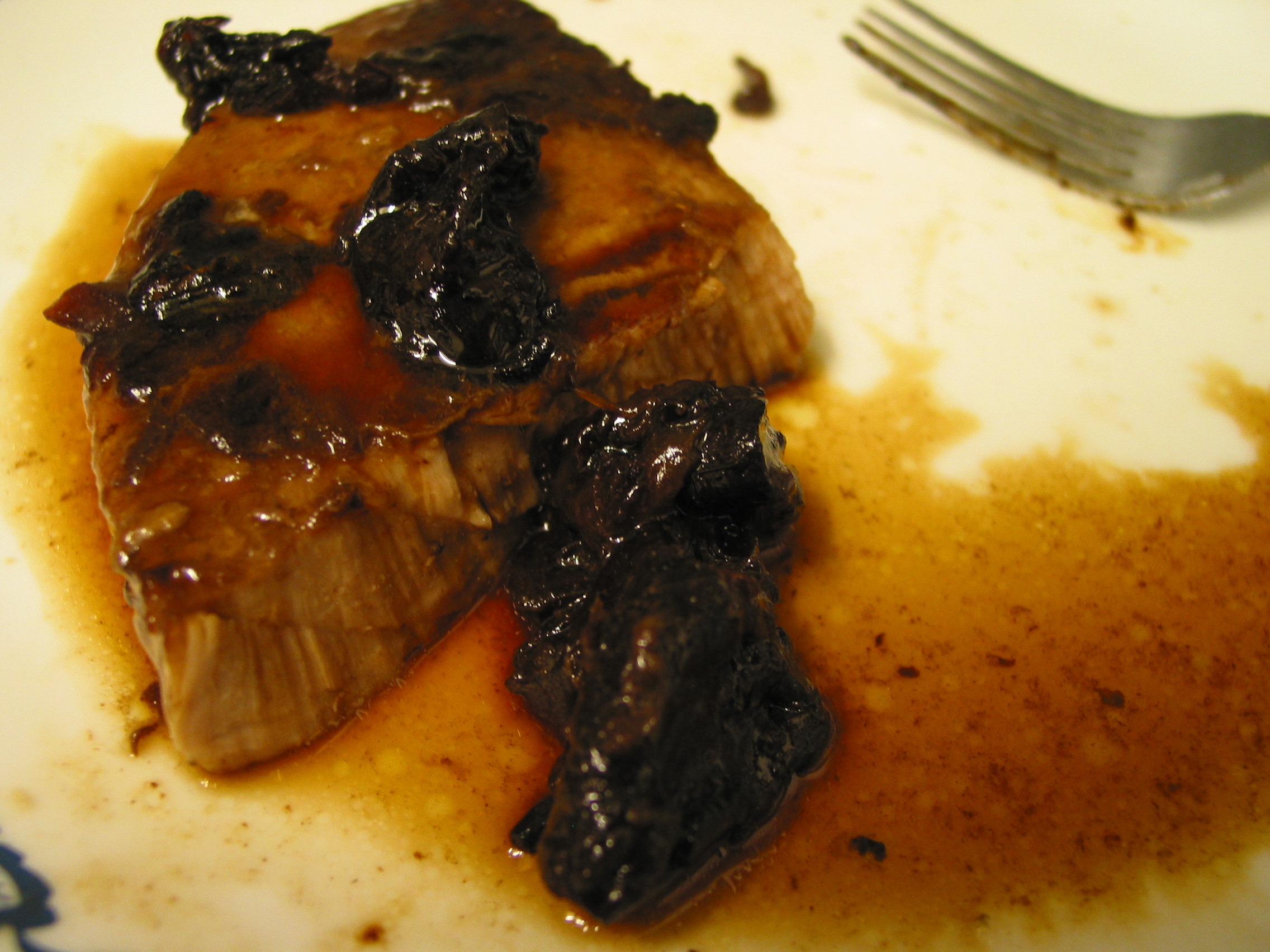
Pan-seared tuna steak with microwave prune and wine chutney

Pan-seared tuna steak with microwave prune and wine chutney

And yes, I said “lift”. Make of it what you will, but any one of the sauces below is better than whatever Hello! magazine has to offer, even if it were original.

Stéphane Reynaud’s Prune Sauce (excerpted for consideration from French Feasts, 2009)

This was designed to go with a simply pan-fried foie gras for six–probably 3-4 oz per person, which seems like a hefty kind of serving, even though I do like liver.  But the sauce–why 18 prunes? 3 per person? and it seems a heavy load of spice for a small amount of wine. Also he has you rest the stuff overnight at room temperature before finishing it. Not sure why–to thicken up, probably, like Elizabeth David’s recipe for peach jam, which also sits out overnight after the first boil-up before resuming.

  • 18 pitted prunes
  • 1 c red wine
  • 1 t ground cinnamon
  • 1 t quatre-épices
  • 2 star anise pods
  • 2 T light brown sugar
  • 2 1/2 T butter, chilled

Boil the prunes 5 min with the wine, spices and sugar, cover and leave O/N at RT. Remove the prunes and reduce the spiced wine to a syrupy sauce. Whisk in the butter, then return the prunes to the sauce.

Microwave Prune Chutney with Wine

My microwave version started out as Reynaud’s wine-based sauce and suddenly morphed, as I was grabbing things out of the fridge for it, with a half-remembered cranberry chutney recipe my mother-in-law served a number of years ago at Thanksgiving. This turns out to be a potent combination, aromatic and sharper, no doubt, than Reynaud’s sauce, with a definite suggestion of saltiness about it–but no actual salt. I don’t recommend eating it straight–too pungent for me, though it’s uncannily close to the relish my mother-in-law served and pretty decent with poultry and stuffing or rice and so on–but cooking 5 minutes or so extra in a saucepan over direct heat or with the food you’re saucing and some extra wine turns it into something pretty special. The whole cloves in particular (which you can take out before using the sauce) do something incredible for any meat or steaky fish you cook with this sauce. Like brisket but just…better, more sophisticated, elevated to the level of cuisine. In fact, put some of this prune sauce with cloves in your next brisket too. 

Makes about 1 cup

  • ½-1 c leftover dark red wine–syrah, aglianico, something inexpensive but rich
  • 8-10 pitted prunes, quartered
  • grating of fresh ginger (1/4 t)
  • grating of 1/2 decent-sized clove garlic or 1 small clove
  • 1/4 red onion, chopped
  • 1-2 t. wine vinegar
  • sprig of thyme
  • pinch of fennel seed
  • 4-5 whole cloves, loose if you can stand picking them out or else stuck through a scrap of onion

Toss the onions with the vinegar and let sit a few minutes while chopping the prunes into quarters–it cuts down on the bite. Mix the onions, prunes, and the rest of the ingredients except the cloves in a soup bowl with a microwaveable lid that can placed on with a gap for steam to escape. Poke the cloves into a larger scrap of onion and add that to the bowl so you can fish them back out easily after cooking. Microwave 1-2 minutes loosely covered on HIGH or until it’s boiling, let sit 5 minutes, stir, microwave again. The prunes will have taken up a lot of the liquid, the onions should be cooked through and garnet-colored, and the wine should be reduced and a bit syrupy.

.  .  .  .  .

From France to China, then:

One year I was determined to make a low-sodium substitute for fermented black bean sauce with roast salmon. I soaked some prunes in a little boiling water and mashed them to a paste, then dressed them up with garlic, ginger and a few other things. It turned out, to my surprise, like homemade hoisin–-dark, glossy, tart and aromatic, less sweet than the commercial stuff, a little smoky from the sesame oil and scallions, with the suggestion of salt Continue reading

Prunes, Lentils, and “Cookin’ Cheap”

When I was a kid, PBS, which had made a gourmet name for itself with The French Chef, decided that if one chef was good, six or seven had to be better. Suddenly the public and cable airwaves were  bursting with the Frugal Gourmet, the Galloping Gourmet, Yan Can Cook, Cookin’ Cajun, various shows with Pierre Franey and Jacques Pépin, and one…ummm…less glamorous show called Cookin’ Cheap.

This was hosted by Larry Bly and Earl “Laban” Johnson, Jr. out of Roanoke, VA–-not too far from where I grew up–and featured two viewer-submitted recipes per episode, which the guys bravely cooked and sampled on the air. At the end of each show, just like Julia Child, they sat down at the table for the tasting… and decided whose recipe had come off worse.

Now, Cookin’ Cheap was not for tenderfoots–if you couldn’t handle ingredient lists that included whole sticks of margarine and self-rising flour, or bring yourself to shop in one of the ordinary supermarket chains that had never heard of organic anything (this was the South in the ’80s), you would have done better not to watch. But if down-home cooking delivered with a touch of schadenfreude was your thing, it was a great little show.

Unfortunately, my favorite early episode doesn’t seem to be available anywhere on the ‘net. But the clip above, the Cookin’ Cheap 2.0 (YouTube) version of about a third of Episode #609, will give you some idea. (see copyright disclaimer below…)

In my actual favorite episode, Bly and Johnson hit their personal limit with a recipe that had them both making faces and apologizing to the audience that “there’s cheap… and then there’s too cheap.”

The dish in question was “Lentils ‘n’ Prunes” (you can guess the entire ingredient list). And it was indeed cheap. Unfortunately lentils, though incredibly cheap and nutritious, cook up kind of gray, especially on a semi-rural public TV station with early-’80s (i.e., yellow-ocher) set lighting. Trust me when I say the addition of mashed prunes did nothing for them aesthetically or otherwise. How on earth could they have put this on the air?

Of course, these guys didn’t have to take the blame for the recipe, and it was great entertainment to see some of the strange things your neighbors might be cooking at home and writing in to the show about with high hopes of being selected. I understand the Food Network is now copying Bly and Johnson’s reality-cooking formula shamelessly for the fall lineup…

[Actually, I didn’t realize the show had such a good run, but it started locally in 1981 and only ended its nationally syndicated run in 2002. Johnson passed away a few years before the end, but he managed to publish the Cookin’ Cheap Cookbook in 1988. Bly kept the show going with Johnson’s friend and successor Doug Patterson and has since made a couple of rescued episodes available on DVD. And the show still has fans on YouTube and — surprisingly just this March–in the New York Times.

Disclaimer: YouTube removed the first clip I linked to for copyright violation–so my apologies to Bly; the intent in linking here isn’t to rip anyone off but to highlight a too-little-known show. Because the original Roanoke station managers were too shortsighted to save the episodes (they apparently trashed them!), Bly was only able to rescue a couple of episodes for the DVD, and I think some of the others posted at this point were recorded at home from TV.]

Ah, well. Times change, horizons broaden, and we aim to challenge our palates in a sophisticated world beat kind of way even with limited cash and ingredients. The wolf may be at the door, we may be on the rice and beans yet again to make up for unreimbursed conference travel, but we are determined to do it in style–that means Indian, Moroccan, Mediterranean–French? Well, at least by not mixing plain lentils and prunes together in a hideous gray mash.

…I’m not actually sure how the French feel about lentils with prunes, or what they’d do about it if you suggested it. But I have a huge bowl of cooked lentils to deal with from a 1-lb. bag at $1.29. And a 1-lb. bag of non-sorbate pitted prunes at $2.99. Less than $5 total. And a number of ideas about how to deal with each of them, separately or together. Enough ideas that I’m probably going to have to split this post so it doesn’t turn into War and Prunes.

This, I think, is going to become my How to Cook a Wolf Challenge, 21st Century Edition.

Because I have fantasies (not many, and relatively tame though entertaining) of the Iron Chef America and Top Chef hosts announcing, for the next quickfire competition, a challenge to find three or four good ways to combine lentils and prunes in dishes where they’re the main ingredients and for which the total bill for the tasting menu comes to something like $10, including spices (prorated as used…) Can’t you just see the contestants’ faces? Take a moment to enjoy their obvious panic. The restaurant industry hasn’t trained them for this.

But seriously. What was actually behind this Cookin’ Cheap dealbreaker, other than the obvious frugality factor plus the even more obvious digestive humor that follows prunes and lentils wherever they roam?

Is there any way on earth that prunes and lentils could really go together?

Well…yes, as a matter of fact. You don’t run across prune and lentil recipes everyday, but good-tasting and intriguing variations, or at least the components of them, exist in a number of respected cuisines around the globe. Even French. For very little more than it cost the Cookin’ Cheap guys, Continue reading