
• Enter your email address to subscribe to this blog and receive notifications of new posts by email.

    Join 241 other subscribers
  • Noshing on

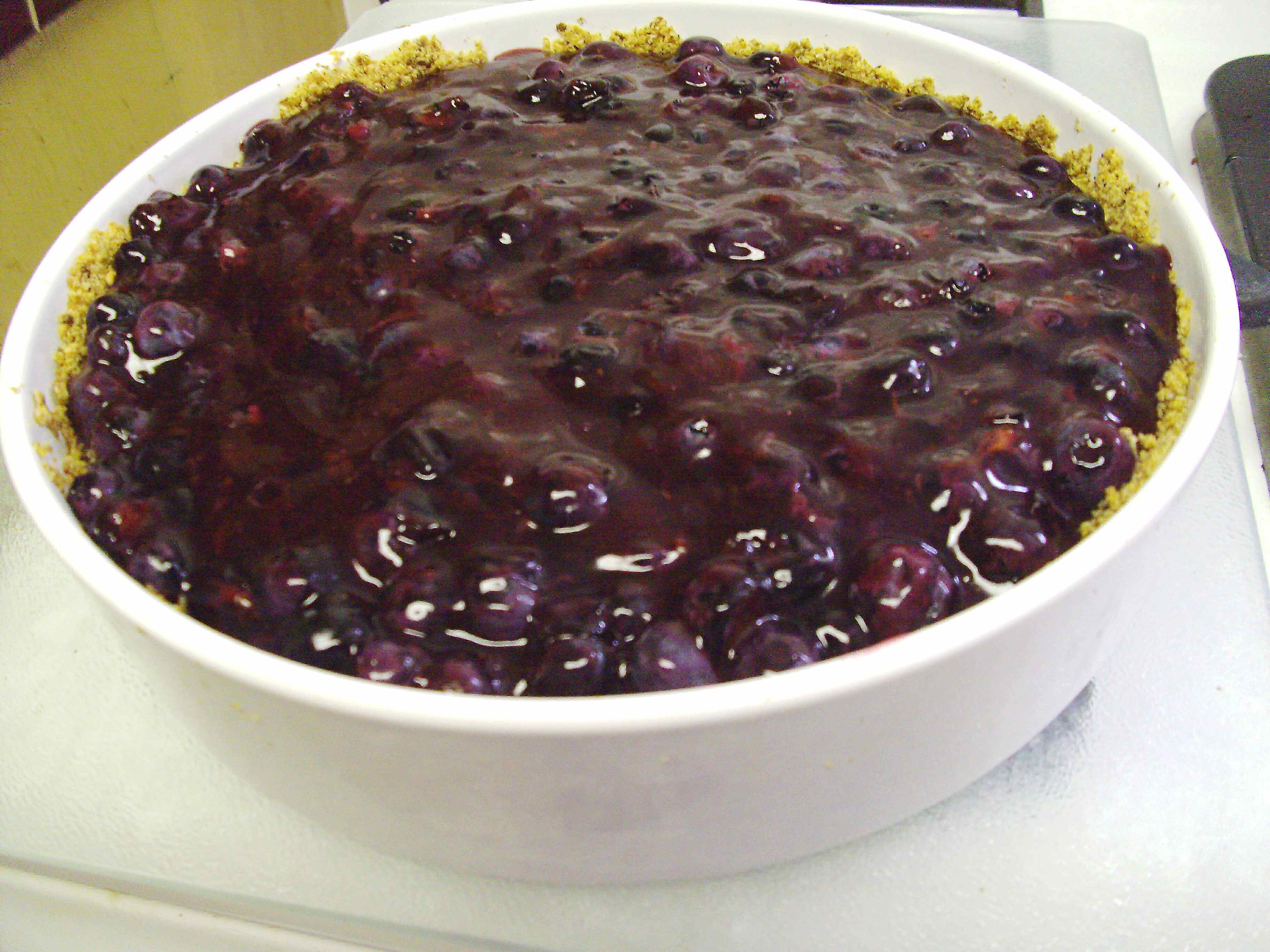
    raw blueberry pie with microwaveable filling and graham cracker crust

    This mostly-raw blueberry pie is a snap to make and very versatile--the filling microwaves in a few minutes, and you don't even have to bake the zippy gingered graham cracker crust--perfect for a hot Fourth of July and all summer long.

  • Recent Posts

  • Contents

  • Archives

  • Now Reading

  • See also my Book Reviews

  • Copyright 2008-2024Slow Food Fast. All writing and images on this blog unless otherwise attributed or set in quotes are the sole property of Slow Food Fast. Please contact DebbieN via the comments form for permissions before reprinting or reproducing any of the material on this blog.

  • ADS AND AFFILIATE LINKS

  • I may post affiliate links to books and movies that I personally review and recommend. Currently I favor Alibris and Vroman's, our terrific and venerable (now past the century mark!) independent bookstore in Pasadena. Or go to your local library--and make sure to support them with actual donations, not just overdue fines (ahem!), because your state probably has cut their budget and hours. Again.

  • In keeping with the disclaimer below, I DO NOT endorse, profit from, or recommend any medications, health treatments, commercial diet plans, supplements or any other such products.

  • DISCLAIMER

  • SlowFoodFast sometimes addresses general public health topics related to nutrition, heart disease, blood pressure, and diabetes. Because this is a blog with a personal point of view, my health and food politics entries often include my opinions on the trends I see, and I try to be as blatant as possible about that. None of these articles should be construed as specific medical advice for an individual case. I do try to keep to findings from well-vetted research sources and large, well-controlled studies, and I try not to sensationalize the science (though if they actually come up with a real cure for Type I diabetes in the next couple of years, I'm gonna be dancing in the streets with a hat that would put Carmen Miranda to shame. Consider yourself warned).

Persian-ish grill ideas for Purim
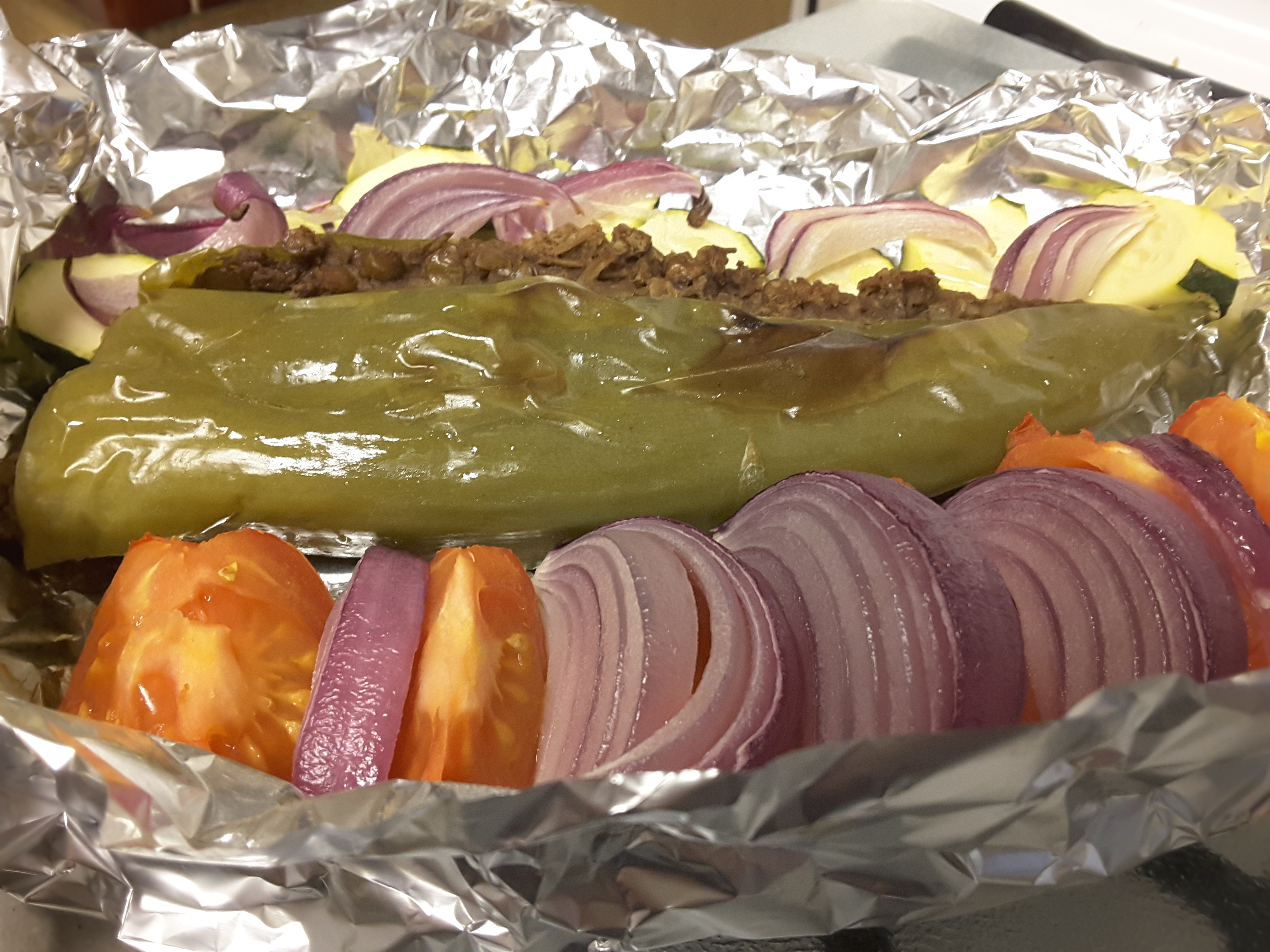
Lentil-stuffed Anaheim chile with zucchini, tomatoes and red onion in a Persian-style vegetarian platter grilled in the toaster oven.
Microwave-to-toaster-oven version

Last year our synagogue signed up for a catered Persian grill dinner (served takeout-style for pickup) from a restaurant on the West Side of LA, and this year they’re doing it again from a restaurant with kosher meat options. Last year, we weren’t sure so we went with a vegetarian option that turned out to be a little bleak–just grilled but dry unsauced vegetables, including some very-middle-American-style broccoli and babycut carrots that looked like they’d just been thrown in with the more traditional eggplant, pepper, zucchini, onion and tomato. The trays were filled out with huge heaps of bright-yellow basmati rice and a little tub of fesenjan sauce–toasted ground walnuts cooked down with grated onion and pomegranate molasses. No actual protein, though, so I pan-browned triangles of tofu to go with it. It was still all pretty bland, though, except for the charred tomato and pasilla pepper and onion.

Even though we’re going to have a meat version tonight–presumably better, I hope!–before the Megilla reading, the story of Queen Esther is very specific about one of her virtues. Unlike all the other girls who were hauled up to Ahashverosh’s palace for a year of preparation for a beauty contest (only, as with most, without a desirable prize). Most of the contestants dined on all the delicacies of the palace kitchen, but Esther refused any of the expensive meats and ate chickpeas instead. She didn’t tell anyone she was Jewish, but she didn’t eat the meat, claiming she was in mourning. It may have been a factor in why she was chosen as queen–she wasn’t being a glutton while the getting was good.

In Esther’s time, Ahashverosh had allowed his wicked vizier Haman to convince him to send out a decree allowing anyone to attack the Jews. But once Esther exposed Haman’s plot and her own Jewishness, he couldn’t cancel his own decree, so he sent out a second decree allowing the Jews to arm themselves in their own defense.

The celebration of Purim, while joyous and relieved, maybe a little exaggerated, is always mixed with acknowledgement of poverty and violence around us; this year most notably caused by the horror Putin has committed in Ukraine. The parallels are pretty harsh and very timely; there are always people like Haman and Ahashverosh willing to do harm or make excuses. So I have mixed feelings about meat vs. vegetarian for Purim, and about celebration in the midst of and despite the everpresent harsh realities.

The best I can do is to say that yes, especially now, we need to commemorate and to celebrate the triumph of good over evil–but without losing perspective or forgetting. May we have more people like Esther and Mordechai–be people more like them, people who step up. And in the meantime, remember to give tzedakah and g’milut hasadim–not charity, but the justice of providing for those in need. This is the season for that too.

Back to food and cooking:

One thing I’ve been thinking about since last Purim is how to make a somewhat better-tasting vegetarian Persian grill-style platter at home. I did like the restaurant’s grilled vegetables, just not the broccoli and carrot bits that were completely out of place or the tofu I made as a last-ditch effort.

If you have a microwave and a toaster oven or a nonstick frying pan with a lid, you can do something good and vegetarian fairly quickly and get some of the vibe without a lot of work. And grilling will improve winter tomatoes, onions, zucchini, (full-size, sliced) carrots, cauliflower, whatever you have where you are.

You can make a tray of quick-grilled vegetables as a side dish, or you can take the long, stuffable peppers and put in rice-and-tomato, as for dolmas (stuffed grape leaves), grillable white cheese like panela or queso fresco plus a sprinkle of nigella seed or thyme and some minced onion, or my personal and higher-protein/flavor choice, lentil hashu as for stuffed baby eggplants and mehshi basal (stuffed onions), which are Syrian Jewish, but adaptable and delicious and not too far off. The lentil and rice stuffing is flavored with allspice and cinnamon and it grills up nicely, especially in a nonstick pan with a bit of olive oil to create a light, crispy, char on the surface. It also makes light, delicate felafel-like fritters.

Continue reading

Microwaveable Matzah Balls–Yes We Can!

Microwave matzah ball in vegetarian not-chicken soup

Three years ago I tried out a couple of possibilities for making matzah balls in the microwave–mostly because I was cooking for just my husband and myself for the seder and because I hate waiting for a full stockpot to boil. Also just because. And it wasn’t a raving success–more like, “well…it was worth a try.” Or as I put it at the time, I try these things out so you don’t have to.

My conclusion then: you can’t microwave ordinary matzah balls the way you’d think, dolloping the mixture into boiling water and then heating with a lid, as I’d hoped. They’ll just start falling apart in the water and the ones that don’t will be awful and tough in the center and awful and gluey like undercooked oatmeal on the outsides, and in general not good and a complete waste of ingredients and your valuable effort.

At the time I also thought maybe I hadn’t used enough egg to make it work–because I only had one egg in the house for a cup of matzah meal, and the standard recipes for that amount called for two to four.

However, I discovered that a spinach-enhanced version would work okay, at least on a very small-batch basis, if I dolloped the mixture onto a plate and microwaved the dumplings that way, just to seal the surfaces and kind of steam them through to cook the egg and make them hold together, THEN put them in hot soup and let them sit a few minutes to absorb and fluff a little more. And…they were okay. Not fabulous. They still had a few corners on them.

But as a fairly dedicated microwave experimenter–I’m not quite up to claiming “maven” yet, that’s next week–that doesn’t really end the question for me, because I keep thinking, maybe I could possibly change something and make them work out after all? And wouldn’t that be cool? …I’m probably the only person I know who would answer “yes” on that, but too bad. Because, on take 3 1/2 or so, I finally think I’ve got it. And this time my husband actually agreed.

So picture me on Sunday afternoon, the first full day of Passover 5781 (aka 2021). Saturday evening we (meaning, mostly me) did manage to get all the kashering and cleaning and cooking done and ready for the first seder in reasonable time for the two of us, and we skipped soup and matzah balls because really, it was too much right then. Sunday, though, I decided I had time after lunch to make some not-chicken soup in the microwave and then–well, why not?–try a new tack on microwave matzah balls. Yet again.

This time I thought about those tough centers and decided what the matzah needed was a quick fluffing up before adding any other ingredients. I’m going to go out on a limb and say this idea should work decently for standard stovetop matzah balls as well. Might even let you get away with fewer eggs for the recipe and a little less time letting the mixture rest in the fridge.

So here I combined two tricks:

First, I poured boiling water on the matzah crumbs and let it all soak up for 15 minutes or so before adding the egg and oil and flavorings. Second, I used the same dollop-and-nuke-on-a-plate method I’d used last time Continue reading

A Quick Wish for a Better 5781

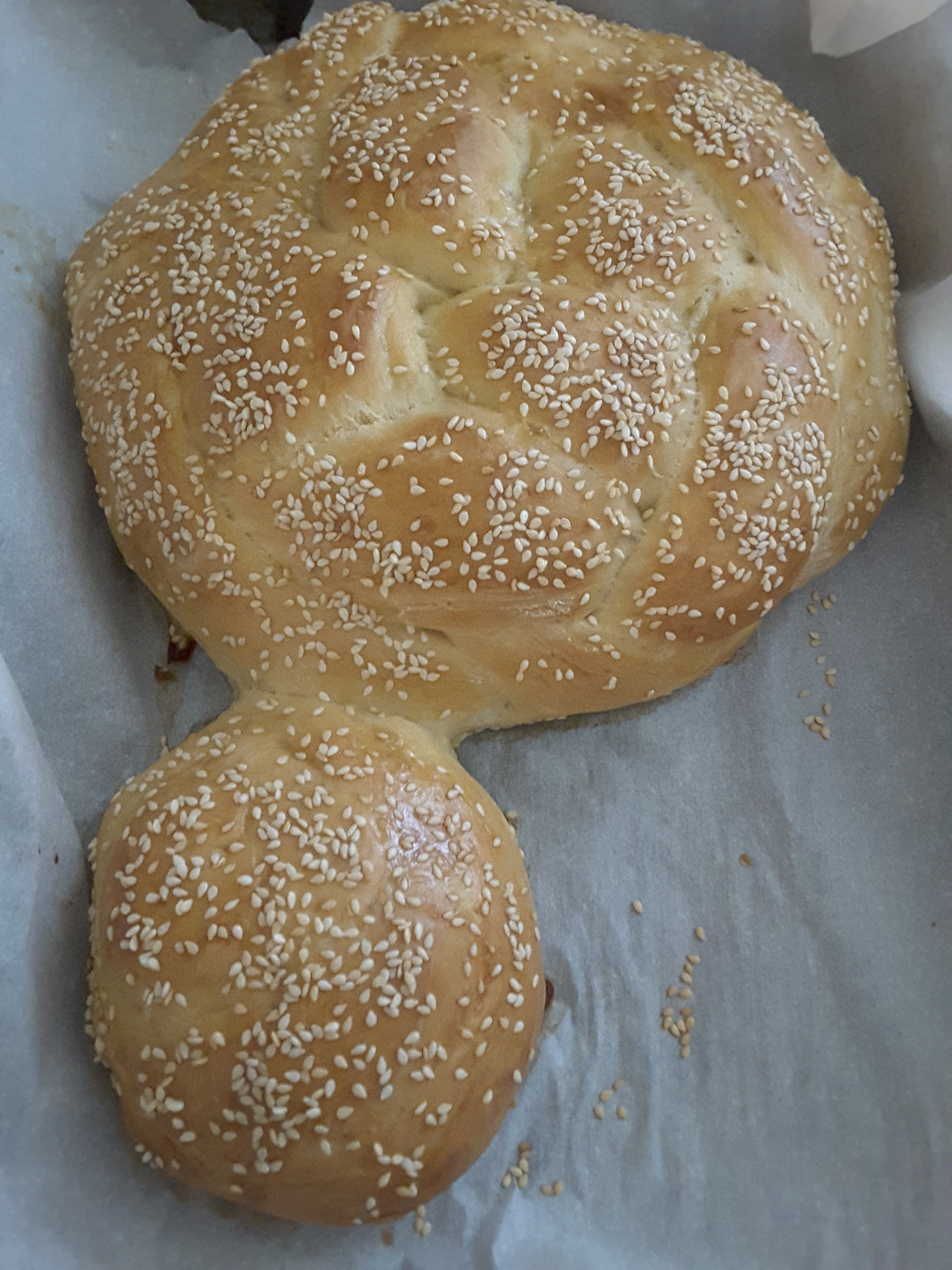
Round challahs, one large, one small 

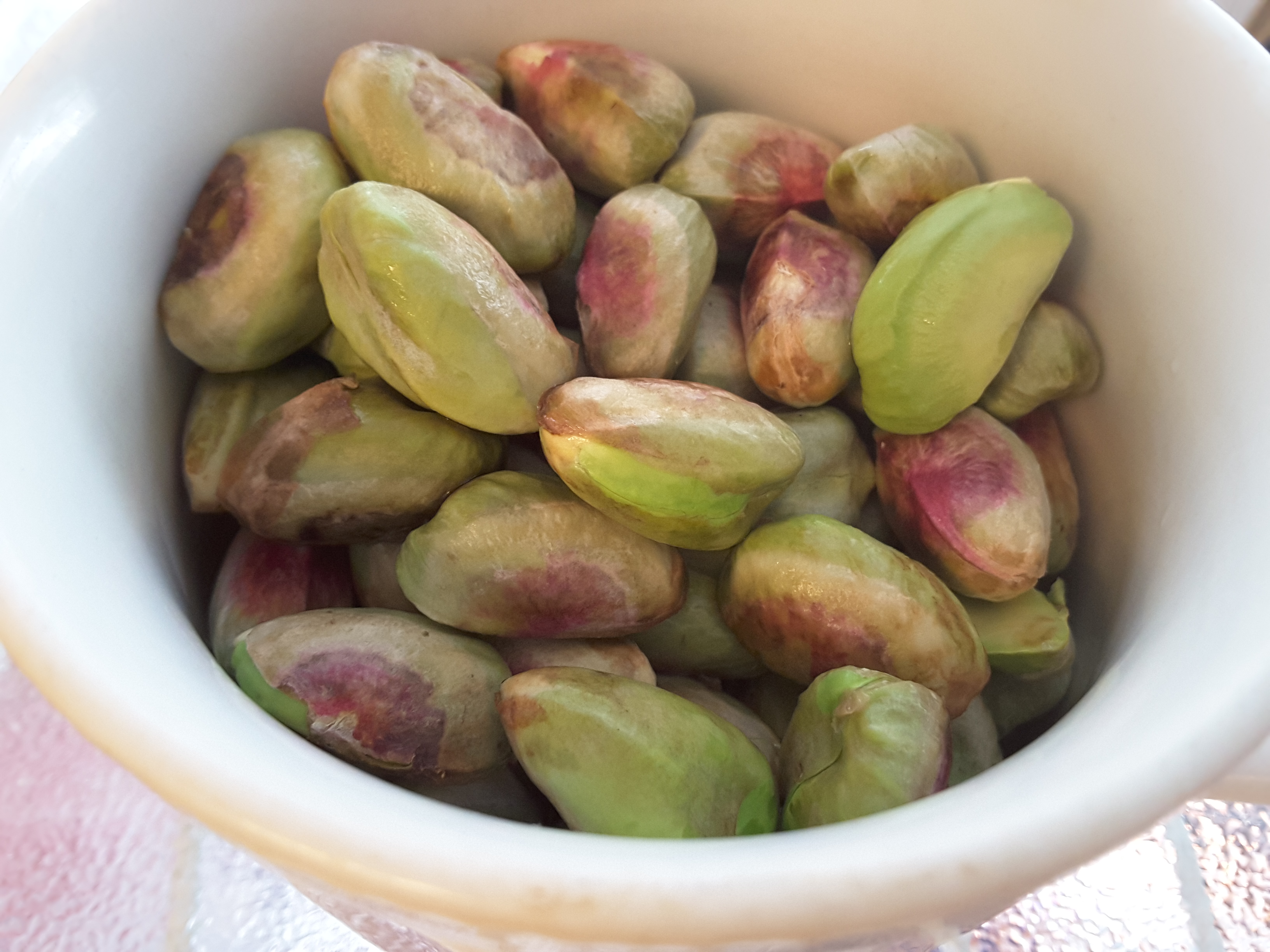
Most of the US is already at or past sunset for Yom Kippur, but it is still late afternoon here on the west coast. This morning I got up, fed the cat, made coffee, set up challah dough, watered the plants, and discovered that the two fresh pistachios I decided to try and root, after trying out a handful of these recently picked nuts with their soft green outer coat at my local Armenian corner grocery a week or so ago, had both sprouted over a couple of days in a bag with a damp paper towel, so I planted them. It was an immense joy.


Yesterday evening, out on a walk, I realized that the mystery plant that seems to be doing well among my peppers is in fact the product of one of the pomegranate seeds I tossed into some dirt in an empty yogurt container a few months ago and kept watering, even though I’d assumed nothing would germinate.

All these small things–when I look at them they offset a little of the hard uncertainties of daily life this year. At least for a moment or two at a time. It’s odd to think that if I take care of them I could end up with a pomegranate tree and a couple of pistachio trees.

Likewise with people.

Wednesday was my birthday, and I talked to four people I expected to–my family–and one person I didn’t expect to hear from, a friend from our congregation, who called to wish me happy, and we talked, and I asked her how she was doing. It would have been normal in a conversation with anyone else, but not with her.

She’s a care coordinator for other people, which often means “how are you doing?” is her question, not something other people ask her. “Really stressed out,” she told me. She, like me, has been reading the appalling headlines too often and is too worried about the upcoming election to be able to relax.

And we commiserated a little, and hopefully felt better and stronger afterward.

And we’re going to observe Yom Kippur in an hour or so, and we’re going to breathe in as much calm and remembrance as we can that our community is still here, in large part thanks to her work, and we’re going to put one foot in front of the other and take the chances we can to do better.

Take a moment and take a chance where you can on a small act of planting and growing generosity, kindness, optimism. It will sweeten the new year for at least moments at a time, and you never know but it may work better than you hope.

To a better 5781, with better health, peace, love, prosperity, justice and compassion for all of us who are feeling more than a little nuts at the moment.

cup of pistachios

Zwetchgenkuchen: a lighter holiday plum tart

Zwetchgenkuchen or plum pie with almond filling

In spite of the recent weather snarling Thanksgiving traffic a few weeks ago and the upcoming winter holidays this week (Oy! Chanukah starts tonight! gotta get candles!), we still have plums in the market in southern California even now that it’s late December. Which adds a strange twist to the dessert I was going to post about belatedly, because I realize that’s probably not true in the rest of the country, so what now?

I first meant to post this recipe for a svelter pastry way back in October, on the heels of the Jewish New Year, Rosh Hashanah, when plums are usually in season.

Zwetchgen, sometimes spelled zwetchken, or “quetches” in French, (could this possibly be the origin of the famed Yiddish word “kvetch”?–probably not, but it’s fun to think about it) are the elongated, blue-black Italian prune plums, which were in at my local Armenian corner grocery in September-October, along with the divine yellow-green sweet plums for eating raw. Unfortunately, most standard supermarket chains in the US don’t sell either fresh prunes or the yellow-green kind of plum in their produce sections, to say nothing of dinosaur plums (green and brown speckled outsides, variously pink and yellow insides, telltale dinosaur logo on the sticker) or Santa Rosa plums (pinkish-red outside, deep rose-pink insides), so it’s a good argument for seeking out your local mom-and-pop ethnic corner grocers wherever possible.

But my lightened-up method for a plum tart is still pretty adaptable to other fruits you probably do have–apples, pears, thickened berry jams or canned cherry filling, mincemeat,  or even, dare I suggest, canned pumpkin? (green tomatoes? even rarer than plums unless you garden, like my in-laws.)

So it’s not that you absolutely must have plums (only for a plum tart, it’s kind of required) nor that you should do the (nearly) unthinkable for a plum tart and use dried prunes somehow. Which, I promise, I am not doing here. Well, maybe they’d work in mincemeat, preferably a vegetarian version with no suet involved. Actually, someone back in the old days of the nursery rhyme probably was using prunes and it understandably fell out of favor when fresh fruits became available more widely during the winter months. Or when some bright young thing started selling premade mincemeat filling in jars…

This lightened-up European-style tart for a holiday or other party tastes good, makes the most of end-of-season fruit, and isn’t overwhelmingly rich or oversweetened. It’s got a thin, delicate crust, an almond filling, and tart, substantial wedges of fruit. The almond extract or amaretto (or you could use rum or brandy or kirsch, or orange liqueur, or orange blossom water if you’re going nonalcoholic) gives it something most American desserts these days sorely lack–not the alcohol, which quickly bakes out, but a depth and complexity of flavor that don’t depend on sugar or butter. Continue reading

Recipe recycling at the LA Times

Sign of the Times? Passover recipes from past years are apparently easier to reprint than to update–and that goes for the dates themselves. Passover actually starts this Monday night, March 29th, not–as this LA Times rehash would have it–April 8th.

Low-Carb Hamantaschen Without Artificial Sweeteners

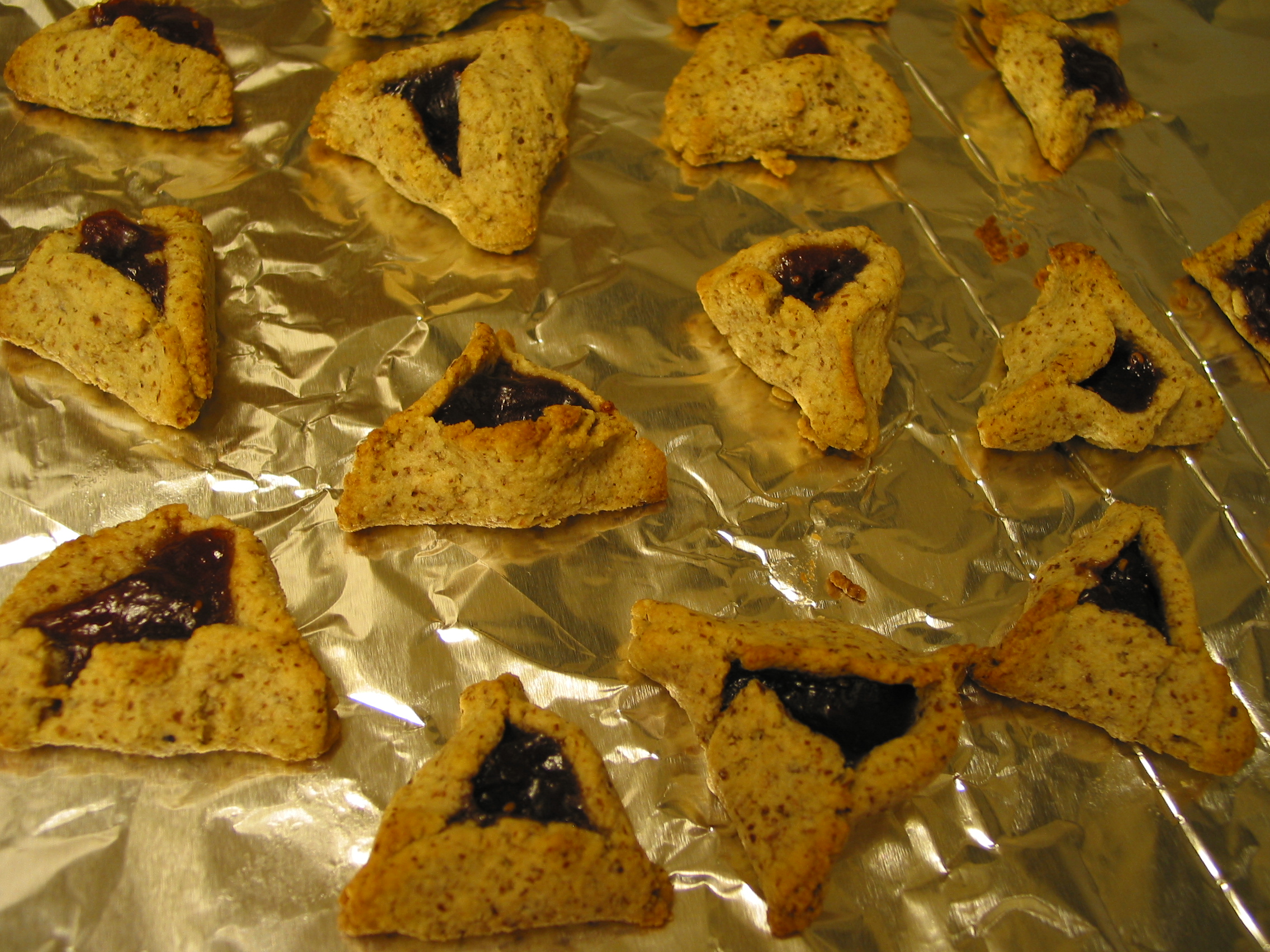
Almond meal-based low-carb hamantaschen

The first batch didn't roll out so easily, but these coin-sized minis tasted pretty good. The next batch rolled out thinner and held together better for a larger cookie with a delicate crust.

Baked goods are a big part of Jewish holidays at this time of year. Purim, being celebrated this weekend, is the last big baking bash before Passover, and hamantaschen (named for the hat, ears or purse of Haman, the villain of the story of Esther) are the cookie of choice. But with a diabetic kid in the house, the usual prospect of baking them takes on a bitter edge.

Hamantaschen–in fact, most cookies–have enough grams of carbohydrate that just two medium-sized cookies contain about half of what she’s supposed to have in any given large meal, twice what’s recommended for a snack, and they don’t have enough fiber or protein to slow down the sugars and avoid a spike in blood glucose. In short, not high-quality nutrition (not that we expect cookies to be). A grownup would have trouble dealing with the prospect of leaving them alone when everyone else gets to have them, but a kid faced with Purim celebrations at school or synagogue is bound for a certain degree of heartbreak.

It’s made me rethink our whole attitude toward things like Girl Scout cookies (this is also the season for that), chips, M&Ms, in fact any casual snack food that gets handed out innocently at school (our current woe–apparently my daughter’s teacher does this kind of thing at least weekly). The snack habit–anytime, anywhere, any or no reason–has become so ingrained in daily life we hardly think about whether it’s appropriate or not. Certainly the handouts are happening more and more frequently in class than I remember when I was a kid–did teachers even hand out treats back then? Not in my elementary school. It’s especially hard for a kid to “just say no” (and we already know how well that advice works in other contexts) when everyone else is taking a cookie or some M&Ms as a reward for answering a question (can they even keep their minds on the subject)? And even worse when it’s the teacher handing them out, because the teacher’s supposed to know whether it’s ok to eat or not.

Maybe we shouldn’t be handing these things out so casually or so often? Because while most people can handle surprise extras like these, they’re probably not all that good for anyone to eat indiscriminately at just any time of day. If they’re spiking a diabetic kid’s blood sugar, you can be sure they’re doing the same thing to your kid’s blood sugar too, only his or her body is responding with extra insulin to cover it. We get to see the results directly every couple of hours with our daughter–complete with sudden attacks of giddiness or tears if things peak and crash too quickly. But the same kind of thing happens to some degree to a lot of kids who aren’t diabetic, and they probably get reprimanded for it. Probably happens to a lot of adults, too.

Still, it’s the holiday, and total deprivation from treats is not really my aim today. So I’ve been trying to figure out a revised recipe for hamantaschen with a more manageable carb count, and preferably one without artificial sweeteners since my kid is still a kid. And neither of us wants it to taste like chalk. Very important.

I start most years with Joan Nathan’s cookie-dough hamantaschen recipe from The Jewish Holiday Kitchen because it’s the best dough I’ve ever tasted for these, even though it’s pareve (non-dairy, non-meat) and doesn’t have butter or cream cheese or the like. It’s not too sweet or too dry, and it doesn’t look or taste chalky or pasty like some of the dead-white offerings at the Purim carnivals. It tastes like a pretty good cookie, and it works really well for rolling out.

Looking at the carb count breakdown for that recipe, at about 12-15 g each, it might not be so bad to do regular hamantaschen, but my daughter would need to eat one or at most two with something protein or fiber, and she’d need insulin for it, so she couldn’t just grab one in between the planned meals. Kind of a pain, no doubt about it.

I was hoping for something closer to carb-free so she could eat hers with impunity when everyone else is eating theirs. This year I scanned the web for low-carb hamantaschen recipes and found only one Continue reading