• Enter your email address to subscribe to this blog and receive notifications of new posts by email.

    Join 241 other subscribers
  • Noshing on

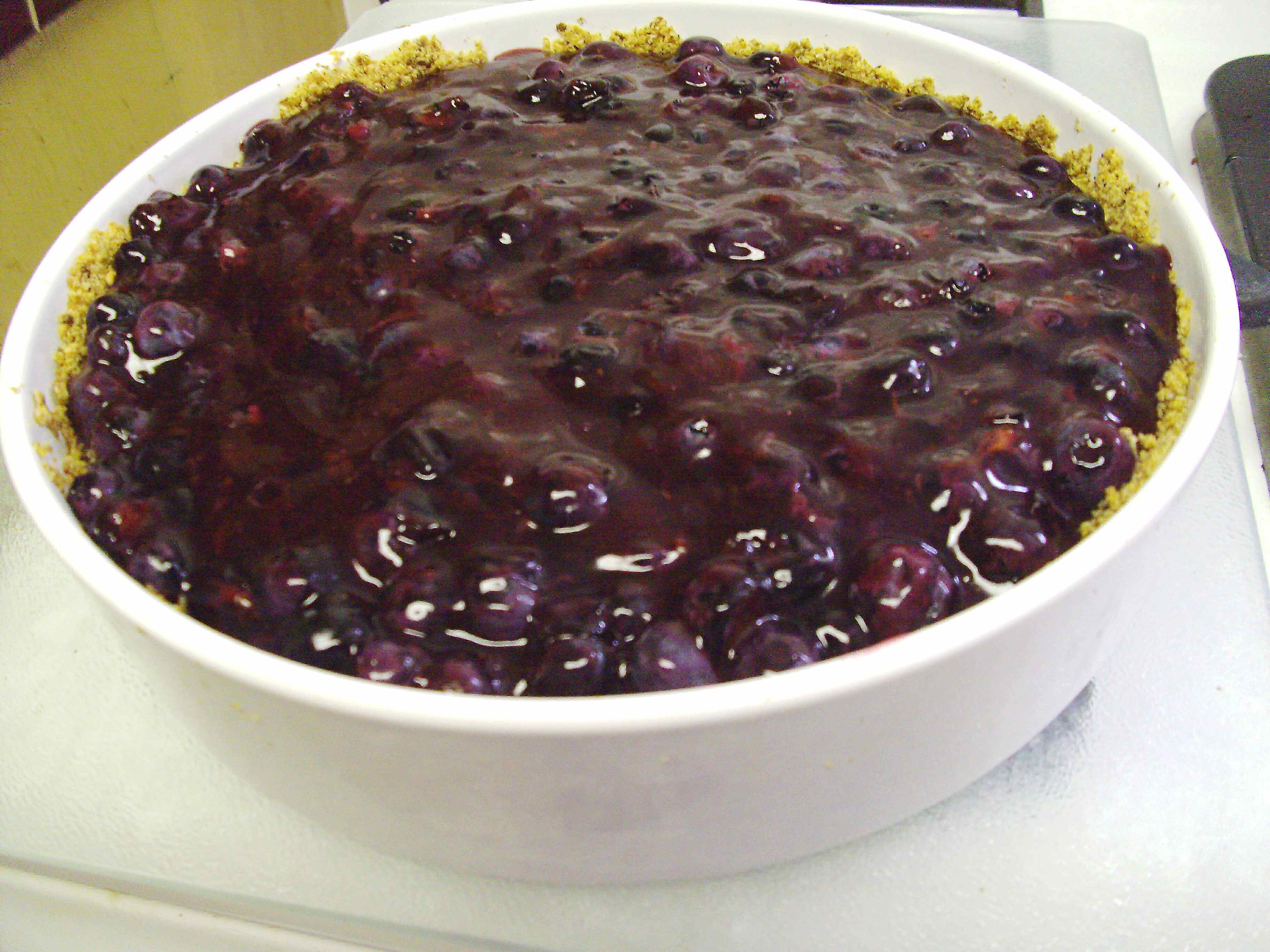
    raw blueberry pie with microwaveable filling and graham cracker crust

    This mostly-raw blueberry pie is a snap to make and very versatile--the filling microwaves in a few minutes, and you don't even have to bake the zippy gingered graham cracker crust--perfect for a hot Fourth of July and all summer long.

  • Recent Posts

  • Contents

  • Archives

  • Now Reading

  • See also my Book Reviews

  • Copyright 2008-2024Slow Food Fast. All writing and images on this blog unless otherwise attributed or set in quotes are the sole property of Slow Food Fast. Please contact DebbieN via the comments form for permissions before reprinting or reproducing any of the material on this blog.

  • ADS AND AFFILIATE LINKS

  • I may post affiliate links to books and movies that I personally review and recommend. Currently I favor Alibris and Vroman's, our terrific and venerable (now past the century mark!) independent bookstore in Pasadena. Or go to your local library--and make sure to support them with actual donations, not just overdue fines (ahem!), because your state probably has cut their budget and hours. Again.

  • In keeping with the disclaimer below, I DO NOT endorse, profit from, or recommend any medications, health treatments, commercial diet plans, supplements or any other such products.

  • DISCLAIMER

  • SlowFoodFast sometimes addresses general public health topics related to nutrition, heart disease, blood pressure, and diabetes. Because this is a blog with a personal point of view, my health and food politics entries often include my opinions on the trends I see, and I try to be as blatant as possible about that. None of these articles should be construed as specific medical advice for an individual case. I do try to keep to findings from well-vetted research sources and large, well-controlled studies, and I try not to sensationalize the science (though if they actually come up with a real cure for Type I diabetes in the next couple of years, I'm gonna be dancing in the streets with a hat that would put Carmen Miranda to shame. Consider yourself warned).

French Food with Jewish Roots (and vice versa)

Joan Nathan's "Quiches, Kugels, and Couscous" (Alfred Knopf, 2010)About…a month ago, already? Two? Oy! I decided my next serious food post was going to be a review of Joan Nathan’s current bookQuiches, Kugels, and Couscous: My Search for Jewish Cooking in France (Alfred Knopf, 2010). And I’ve been looking through this book for much of that time, trying to figure out what to say first and what I’d want to cook from it that I haven’t tried before.

An initial read attracted me very much: Nathan, who worked as an aide to Teddy Kollek back in the 1970s, when he was still the gregarious and widely-admired–in fact the last widely admired and liked–mayor of Jerusalem, came back to the States as interested in people as in food, and has balanced the two focuses in most of her cookbooks ever since.

In this book, she starts out by visiting her French cousins and branches out to meet all sorts of people–deli owners, a gefilte fish maven, Holocaust survivors and one of the farm women who sheltered some of them during the war, the new wave of North African Jews from Morocco to Egypt who arrived in France after the mass expulsion from Arab countries in the 1950s;  the Provençal Jews who trace their ancestry back to pre-Inquisition Spain and Portugal, the Alsatian Jews whose dishes, despite coming from the heart of the original Ashkenazi community, are not as familiar as I would have expected.

Throughout the book she’s collected personal stories of all kinds, visiting home cooks, restaurant chefs, purveyors of spices and other specialty items that Jews initiated and led the European trade for–particularly chocolate and coffee. And she has dug up a few surprises as well.

Paul Bocuse, for example, is widely considered the grand old man of French haute cuisine, so much so that a major international competition is named for him. Nathan discovered that he keeps one stockroom Continue reading

A Closer look at Einstein Bros. Bagels

A few weeks ago I bought a challah from Einstein Bros. Bagels, which had taken over from the Noah’s in my town sometime last fall. Noah’s had supplied my daughter’s school on Fridays and their challah was pretty good for store-bought–this tasted the same. I hadn’t been in the store since the takeover so I didn’t really know what to expect, but other than the name change outside, it looked the same and had more or less the same offerings as ever.

I’m not sure what prompted me to go online and look for their nutrition information sheet, but I wanted an idea of what was in the challah, so I looked. I couldn’t find it on the Einstein Bros. site, but there was a pointer to the Noah’s web site–still up after the takeover, apparently, and that had the challah listed. What I found for the challah itself wasn’t incredibly shocking or anything, ingredients more or less kosher, not too bad on any of the nutritional factors. In fact, it’s probably one of the best bets at our former Noah’s, although you have to order a couple days ahead for Friday morning pickup.

On the other hand, the bagels and other menu items really stood out for sodium–most were over 500 mg per bagel, and some of the “gourmet” varieties of bagels were in the 700-900 range, even without lox. A few sandwiches soared as high as 3500 mg sodium (more than a day’s worth even for today’s average intake, and about two days’ worth according to the CDC and AHA guidelines)–just for a sandwich. Anything with chicken on it was astronomical as well–above 1600. Which sounded like Denny’s or Chili’s to me.

I started to wonder just who designed the food and how “designed” it was. Were we talking mostly bagel joint, or were we talking fast food with a highly engineered, set-in-stone formulation? If I wanted to contact them to ask about lowering the sodium in their dishes, was there a real person I could talk to?

The Einstein’s web site doesn’t have a lot on it other than Flash bells and whistles–the site is extremely corporate as far as information goes. The only thing I found that seemed worth noting here is the management team, and even that–maybe it was the Flash, or maybe there was some programming in the web site, but after three management biographies it failed to load any others. I had to shut my browser, clear my cache, and try again.

What I found surprised me (I’m kind of naïve, I know it). Even with all the evidence to the contrary–my sister once did a comprehensive marketing survey of west coast bagelries and concluded none of them had the real, crackle-crusted thing, it was all just ring-shaped white bread–I still harbor a faint hope that if it’s a bagel shop, it must be Jewish. Especially since the founder of Noah’s is, and Einstein Bros.–well, what would you conclude? But you would be wrong. Continue reading

More things to fry in olive oil

Thanksgiving has barely ended and Hanukkah is already upon us–which means more food! This time with olive oil to commemorate the rededication of the Temple in Jerusalem after a war in which the Assyrian Greeks trashed and piggified it in hopes that we’d be so abashed we’d immediately convert and become a convenient tribute-paying way station for their marches around the edge of the Mediterranean to Carthage.

I know the official story credits Judah Maccabee, but really, it happened like this:

The Assyrian Greeks thought we’d be too frightened to complain when they marched through Israel, taking what they wanted and getting their muddy footprints everywhere. They hadn’t yet heard of chutzpah. They also hadn’t reckoned with a little-known secret force:  Jewish grandmothers. These bubbies could out-argue G-d. Weekly. And the lectures? …

“Carthage, schmarthage!” the grandma said. “Wipe your feet already, what are you, a Hannibal?”

Then she hefted a mighty frying pan at the intruders and that’s all she wrote.

So the real hero of this geschichte is clearly not Judah Maccabee, aka “The Hammer” — but Judith ha-Machvat, or “Judy with the Frying Pan Handy” — a woman who could really scare off the goniffs! And so in her memory, we fry up all kinds of goodies for Hanukkah and none of the calories stick to our hips at all. Really. It’s a miracle.

So…enough bubbe meises. Back to the present day.

Last night I made latkes without benefit of a food processor–after a slight kitchen drawer reorganization last spring, I forgot where I put the shredder disk. But for a smallish batch for the three of us–only two spuds and half an onion–it’s not so difficult to grate them by hand, as long as you use a fork to hold the stubs (of the potatoes, not your fingers, I hope) to avoid getting extra “proteins” in there…

The Obligatory Latkes (very basic, but tasty in a good way)–about 12 or so 2-3-inch latkes, enough for 3 people for supper, so scale up as needed

Carbs: 2 big potatoes weighed 480 g total on the food scale before peeling. An estimated 1/6th of the weight of nonsweet potatoes is carb–so about 80 g carb total for this recipe. A 4-latke serving would be about 20-25 g carb.

  • 2 big russet potatoes, scrubbed, peeled, shredded on large holes of grater/food processor blade
  • 1/2 medium onion, grated on fine holes into the same bowl OR chopped finely in the food processor BEFORE changing to the shredder blade and doing the potatoes on top of the onion
  • 2 eggs
  • spoonful of olive oil
  • 1-2 t. flour
  • pinch of salt
  • pinch of baking soda (which I completely forgot last night, so it’s optional)
  • olive or vegetable oil for frying

Grate the potatoes and onions by hand or food processor into a big bowl. The grated onions will help prevent discoloration in the potatoes. Take handfuls of the mixture and squeeze them nearly dry, and pour off most or all of the liquid that collected in the bottom of the bowl. Return the potatoes to the bowl, add the eggs, spoonful of olive oil, flour, salt and baking soda and stir until evenly mixed.

Heat several tablespoons of oil in a nonstick pan until shimmering and dollop soupspoonfuls of the latke mixture in, flattening them as they start to fry. Swirl the pan a little to get the oil touching each latke and maybe keep them from sticking to the pan. Wait until you see brown edges at the bottom of the latkes, then flip and fry the other side, swirling the oil a little or adding another spoonful in droplets where the pan seems to need it. You want these really brown and crisp on the outside, not pale yellow.

Drain on napkins or paper towels on a plate, and at the end, if no one’s snatched them as they cooked, you might want to reheat them all together in the pan or microwave them on the plate for half a minute on HIGH. Serve with applesauce and sour cream or labaneh or plain yogurt.

–  –  –  –  –

That’s the only recipe I’m giving here with set quantities–latkes are more like pancakes, everything below is like a stir-fry.

Non-Latke Options

Even with mechanical assistance in the form of a food processor, I’m a one-latke-night-per-year-is-enough kind of person. I want something other than potatoes if I’m going to be frying stuff in more than a spoonful or so of olive oil. Therefore I look for other maybe less starchy and more flavorful (one can always hope) things to fry:

Pre-nuked (microwaved) eggplant slices, fried in a couple of spoonfuls of olive oil after heating a little garlic and curry powder, maybe a dab of z’khug, for a few seconds first. Onion and red bell pepper are good in this mix too.

Marinated artichoke hearts, perhaps drained slightly and shaken in a plastic bag with a spoonful or so of flour or almond meal or chickpea flour and a little grated cheese and/or some oregano or thyme–no extra salt needed

Pre-nuked cauliflower, breaded as for the artichoke hearts

or–pre-nuked cauliflower, stirfried in a spoonful or so of olive oil with a dab of z’khug if you like things hot, with red bell peppers, onions, and another Continue reading

Technique: How to Squeeze an Eggplant

Long ago, I threatened to post the unlovely but effective method of peeling cooked eggplants that I learned the hard way, in a kibbutz kitchen. We used to make baba ghanouj routinely for a thousand members–something like 50 to 75 baked eggplants went into it each time, mixed in a stand mixer the size of a wheelbarrow with a base that was cemented into the floor. You can’t be fooling around with spoons and forks when you’re working on that scale. Instead, we cooled the eggplants in a huge colander and then started squeezing them out as though they were pastry bags or tubes of toothpaste.

It takes a bit of practice…to say the least. But each eggplant only takes about half a minute to empty into the colander, and once you get the method down, the skin stays together and is just about completely clean inside. Very effective. Not very dignified, though, unless you do it enough to get good at it.

However, since I have no vanity whatsoever, I finally took some pictures (not easy to shoot while actually squeezing the eggplants, so don’t expect photogenic–eggplant is only pretty raw…) and have steeled myself to walk you through it. Wear goggles and a hairnet the first time if you’re afraid of flying goop, or make your little sister do it first. And don’t forget to rinse your hands (and arms) well right afterward, because the juice is still a bit caustic and will make them itch after awhile. Anyway, the following is for if your little sister refuses to take the bait.  Click directly on any of the pictures if you want a closer view.

How to Squeeze an Eggplant

First, microwave your eggplant(s) (best if you’re only doing up to 3; any more and it’s worth roasting them for a whole hour in the oven at 400F). Scrub them well, cut off the cap (watch out for thorns!), rub or sprinkle a little salt on the damp skins, and set them to microwave 10 minutes on HIGH, until they’re soft and collapsed.

whole eggplant before microwaving for baba ghanouj

Whole eggplant prepped to microwave for baba ghanouj

Eggplant after microwaving

After microwaving 10 minutes, the eggplant has collapsed

Next, let the eggplant cool enough to handle–this is probably the most important part. Trying to squeeze out a scalding eggplant leads to explosions of scalding eggplant goop, plus the peel usually toughens a little as it cools, which makes ruptures a little less likely.

–Am I making it sound good yet? No?–hang in there.

Poking the eggplant

The all-important poke

Set the cooling eggplant cut-end-down in a colander over a bowl to drain off some of the juices. If you have the asbestos-like fingers for it, you can poke a hole in the cut end while it’s still hot and earn yourself untold macho points as long as you only wince after you’ve slunk off to the bathroom. Never let ’em see you cry. If you’re not that brash, you’ll have to poke a hole in the cut end once it cools. That’s the easy part.

Once the eggplant’s cooled enough to wrap your hands around it, it’s showtime. Keep the cut end facing down.

Grab the eggplant like a pastry bag, cut end down

Grab the eggplant like a pastry bag, cut end down

Cup your hands around the fat round end at the top and very gradually push in and downward, closing your hands over the top, Continue reading

Microwave Cheesecakes

Microwave cheesecakeThis week we celebrated Shavuot, the feast of first fruits and giving of the Torah at Mt. Sinai. Shavuot has only two solid traditions I can remember from childhood: studying all night (three ultra-dedicated guys from my congregation would hang out and do it for the rest of us, kind of like the Jewish Scholarship Marathon), and eating cheesecake. Which is a pretty good tradition, actually.

I go for the serious New York-style tall, lemon-tinged cheesecakes that are rich and just dry enough to have a fluffy crumb to them. The only one of these I ever made myself was the glorious one from (once again) Joan Nathan’s The Jewish Holiday Kitchen. It was huge, it was beautiful, it took two whole hours of baking with the oven on and off, and I was just barely smart enough to wrap it tight in a double layer of heavy-duty tinfoil  right before carrying it out to the car for a brunch setup. Because of course it took a nosedive onto the parking lot pavement–but the foil held up! And the cheesecake was only a little bashed! And we covered it pretty liberally in sour cherry jam, and everyone ate it happily, and no one kvetched. A miracle!

The story of how G-d gave the Torah law to the Jewish people on Mt. Sinai, is kind of hard to picture. Supposedly it was all so shockingly loud and bright people started to hear colors and see sounds (or else the lightning was so close it started to short out their neural circuits). But what is clear is that  everyone was so awed and shocked they stopped arguing, at least for a few minutes.

So of course it has everything to do with today’s topic, which is still cheesecake. It’s an established fact–feed cheesecake to your people and you’ll get a few minutes of blessed silence. It’s quicker and cheaper than group electroshock therapy, too, and it tastes better.

So I’d wanted to make a cheesecake for Shavuot, but not take two hours about it, especially in May in Los Angeles. Also, cheesecake is  a traditionally loaded food–one look and you can hear your gallbladder calling you.  But it’s a real challenge to make a decent-tasting, genuinely low-fat version that isn’t just “use neufchâtel and cut out 3 calories!” Or else hideously tough or gelatinous or watery or flavorless or grainy or otherwise weird.

Drained nonfat yogurt–no. Tough, tangy AND watery after baking. Ricotta–not bad, especially for Roman-style cheesecake, but bland and a bit grainy. Gelatin’s out for me because it’s not a kosher ingredient. Fat-free cream cheese–I’m just not a fan, it’s too salty and processed-tasting somehow. Not fresh. And on the web I’ve seen everything from tofu to tehina (sesame paste)–I can’t imagine, but to each his or her own.

Still, I think with the microwave I’ve got the time thing solved in a way that will work for a number of different versions. A while back I discovered you can take pretty much any standard New York-style cheesecake recipe (eggs, flour, cream- or other suitable cheese, vanilla, lemon juice), put it in a microwaveable baking dish, cover and nuke it through in a couple of minutes without ruining the texture. It’s probably better without a crust, but if you prebake the crust then pour the filling, cover, and nuke while it’s still hot, it might prevent sogginess.

The only versions that might be really troublesome would be ones with yogurt, which is usually too thin and watery even when drained, or else cottage cheese, which works in a conventional oven but not the microwave. For some strange reason cottage cheese curd liquefies into a buttermilk-like mess in the microwave rather than setting up. Frustrating. But ricotta works pretty well, cream cheese–of course, labaneh–astoundingly perfect, and even…nonfat powdered dry milk (NFPD) with buttermilk. Odd but true. So it will work with a range of adaptations from full-fat to ultra-lean, and the rest is up to your tastebuds. Continue reading

Not Gefilte

For most American Jews, gefilte fish is one of the standard, unchanging preludes to the actual dinner part of the Passover seder. And normally I have no problem with that, especially with hrein, or horseradish. By the time the recitation of the Haggadah and the explanation of the items on the seder plate are done, everyone is joking about (or egging on their kids to pipe up and ask) the Fifth Question: When do we EAT??? And gefilte fish is the first answer.

It’s worthwhile to be hungry enough for once to feel, rather than just nodding as someone tells you self-righteously, that such a modest dish, made with fresh fish in the days when most of our grandparents and great-grandparents were too poor to eat it often, can be something to look forward to.

Gefilte fish is basically an oversized quenelle of ground whitefish and pike, filled out with eggs, onion, and matzah meal to stretch it. Simmered in fish stock for a couple of hours with or without added sugar, cooled to let the broth gel, served room temperature or cold, with horseradish as contrast.

But since most of us don’t make our own gefilte fish at home anymore, it’s usually bland, salted (and sometimes sweetened) ovals of stuff pulled from a pricey store-bought jar–no longer what you’d consider fresh, and no longer economical. And it’s usually about twice as big as any normal/sane appetizer for a meal that’s going to include brisket, chopped liver, meatballs, eggs, chicken and/or turkey, and other big proteins.

Can it be made well fresh? Yes, actually, and a number of Jewish cookbooks–Joan Nathan’s among the leaders–tell you how. But do I want to cook it myself, or eat it any other time than at someone else’s seder? No. Flat out, no. Not only is it a two-hour-plus process, it’s a big chore. All for a mediocre, bland kind of fish dumpling.

The other problem this year is that my daughter is now diabetic, and for the first time I’m going to have to help her count carbs so we can give her the right amount of insulin for a seder meal that will probably last over two hours. It’s tricky enough to do that accurately for a restaurant meal–desserts, which come last and for which the menu isn’t usually even presented until you’ve already eaten the meal, are by far the hardest foods to estimate by sight.

But traditional Ashkenazi-style seder dishes like gefilte fish and matzah ball soup are stuffed full of surprise carbs too, and you can’t be sure how much they contain unless you’re the cook. And that’s not counting the mandated matzah and haroset. All you can say is, all that matzah meal really starts to add up. Will my daughter overrun her carb count before she ever gets to the meal itself, with a chance to risk it on (more matzah-filled) desserts?

If I cook some kind of fish during Pesach week, I want it to be fresh and without much in the way of carbs. Most of all, I want it to taste good. Actively good. Continue reading

Mastering Mandelhorns

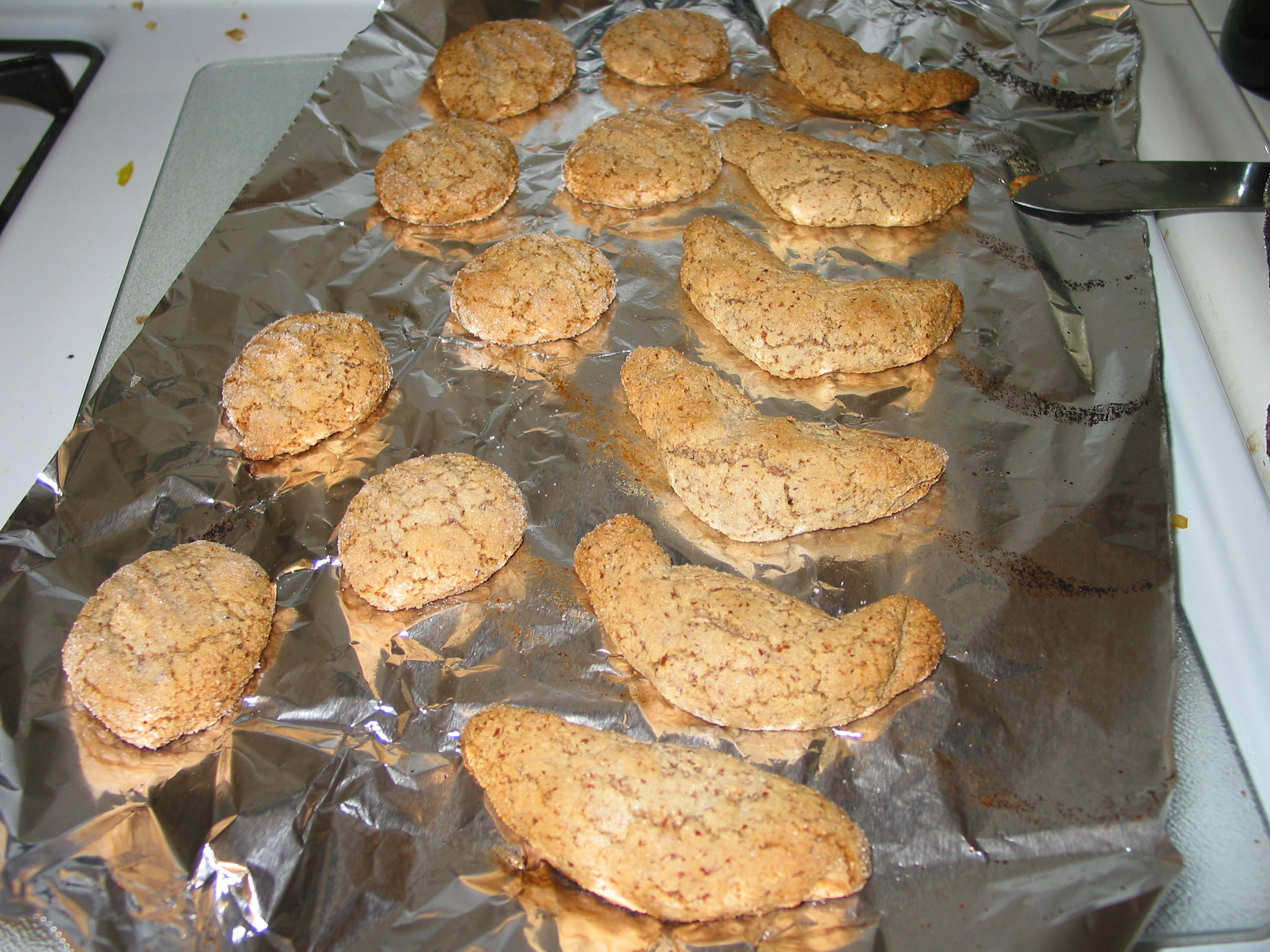
Almond horns and macaroons

Jewish and Greek bakeries often have big, chewy almond horns somewhere in the pastry case, sometimes with the ends dipped in dark chocolate, and whenever I can find them they’re what I home in on. Babka isn’t bad, nor is baklava, don’t get me wrong. I love them both. But neither of them comes anywhere close to mandelhorns in my world. And don’t get me started on mandelbrot–not the same thing at all. AT ALL. Even my great-aunt Tessie’s, which as I understood from my dad were the pinnacle of the form.

Almond macaroons and marzipan confections in general all have three main ingredients–almonds, sugar, and eggs–plus or minus almond extract, rosewater, orange blossom water, or lemon peel, depending on your era and country of origin. They’re very basic sweets that go back at least to medieval times and were made everywhere from the eastern edges of Persia (maybe in China too) to the western edges of Spain and Morocco. You can find recipes for them in The Form of Cury, Richard II’s chef’s cookbook from the late 1300s, and they’re mentioned in early Spanish literature as “Jewish pastries” dating from before the Inquisition.

For years I’ve tried with limited success to make almond macaroons. They always come out flat or hard with shiny bottoms (not that we didn’t eat them all anyway, but really). Over the years I must have collected more than a dozen variations–they’re always listed in the newspapers for Passover, since we traditionally ban baked goods made with flour and other grains during that holiday. Which is coming up.

Right before winter break, I wanted to try and make mandelhorns right for a change, so I could bring some up to my husband’s family. I went back to my cooking file with all the variations and actually looked at them carefully.

There are a couple of ways to make almond macaroons and almond horns right, and I’d been doing none of them. The first is to make an “Italian” or “Swiss” meringue Continue reading

A Year of Artichoke Hearts

“Top 10 Recipes” lists are a big thing at the new year, a way to look back and figure out which dishes made a hit and which ones were just so-so. But sometimes, after an entire year, the top-10 judging criteria can get a little distorted. How do dining section editors compare five quasi-Asian stir-fried noodle-and-greens dishes, most of them mysteriously pumped up with bacon crumbles (2009’s star ingredient), and decide all five really belong in the top 10 for the year?

In one of my early posts, I was thinking about toasted cheese sandwiches (grilled cheese, hard to believe, was a Top 100 Dishes entry for Bon Appétit at that point). At the end, I threw in a quick little recipe for marinated artichoke hearts done in a microwave as an antidote to all the middle-American boredom. Yesterday I ran across an artichoke and potato salad from the LA Times‘s 2009 top-10 list and realized my artichoke hearts would probably make it better. Because they make everything better, or almost.

Marinating your own artichoke hearts takes five minutes, is less expensive than buying a jar of prepared ones, tastes fresher, and has a short list of real ingredients. A ~12-oz batch lasts more than a week in the fridge, where it’s  ready to serve as a pick-me-up for sandwiches, pasta, fish, omelets, salads, and hot vegetable dishes. I use these artichoke hearts so often that whenever I get to my Trader Joe’s and they’ve run completely out of bags of plain frozen artichoke hearts in the freezer and won’t get any in for weeks, I feel horrible and deprived, like someone who’s just been told not to talk with her hands.

That puts it in MY top 10.

You don’t need more than a dash of salt in this recipe to make the artichoke hearts taste intense and bright. The fresh lemon juice and garlic do it for you, and something about the artichokes themselves makes the combination work. Continue reading