• Enter your email address to subscribe to this blog and receive notifications of new posts by email.

    Join 241 other subscribers
  • Noshing on

    raw blueberry pie with microwaveable filling and graham cracker crust

    This mostly-raw blueberry pie is a snap to make and very versatile--the filling microwaves in a few minutes, and you don't even have to bake the zippy gingered graham cracker crust--perfect for a hot Fourth of July and all summer long.

  • Recent Posts

  • Contents

  • Archives

  • Now Reading

  • See also my Book Reviews

  • Copyright 2008-2024Slow Food Fast. All writing and images on this blog unless otherwise attributed or set in quotes are the sole property of Slow Food Fast. Please contact DebbieN via the comments form for permissions before reprinting or reproducing any of the material on this blog.

  • ADS AND AFFILIATE LINKS

  • I may post affiliate links to books and movies that I personally review and recommend. Currently I favor Alibris and Vroman's, our terrific and venerable (now past the century mark!) independent bookstore in Pasadena. Or go to your local library--and make sure to support them with actual donations, not just overdue fines (ahem!), because your state probably has cut their budget and hours. Again.

  • In keeping with the disclaimer below, I DO NOT endorse, profit from, or recommend any medications, health treatments, commercial diet plans, supplements or any other such products.

  • DISCLAIMER

  • SlowFoodFast sometimes addresses general public health topics related to nutrition, heart disease, blood pressure, and diabetes. Because this is a blog with a personal point of view, my health and food politics entries often include my opinions on the trends I see, and I try to be as blatant as possible about that. None of these articles should be construed as specific medical advice for an individual case. I do try to keep to findings from well-vetted research sources and large, well-controlled studies, and I try not to sensationalize the science (though if they actually come up with a real cure for Type I diabetes in the next couple of years, I'm gonna be dancing in the streets with a hat that would put Carmen Miranda to shame. Consider yourself warned).

Purim: Poppyseed filling with a Persian-style twist

poppyseed filling with orange blossom water

Tonight is Purim, when we dress up in costume, make fun of dire villains and dull kings, cheer modest heroes and most of all praise a heroic woman, Esther, who risked everything to change the king’s addled mind and spare the Jews of the Persian empire.

In previous years, I’ve done the Hamantaschen thing–low carb, medium carb, all homemade, no pasty white horrors, praise of Joan Nathan’s basic recipe from her first cookbook…lots of non-Dayglo, non-candy fillings from figs, prunes, apricots, and so on…

Today I’m probably not going to get a chance to bake anything or even cook very much, because I decided to take a leaf out of Esther’s Megillah this year and read part of the fifth chapter, splitting it with my (much-wiser-than-Ahashverosh) husband. So about three days ago I decided I was going to go for it and learn the Purim cantillation (trope marks for chanting) system. Which takes more nerve than usual, because it’s tricky and somewhat deceptive, like the entire story. And it’s been almost two years, since my daughter’s bat mitzvah, since I’ve even chanted Torah. And, like I said, three days ago. Not brilliant.

Luckily there’s Youtube. And a number of synagogues post recordings by their hazzanim (cantors, male and female) for the cantillation marks and for the readings as a whole. Only there are so many versions for Purim! It’s a late holiday in our history, after a lot of us were living in the Persian empire, and the different melodies reflect our already dispersed community. One interesting version was by a Moroccan hazzan–his system actually had a couple of trope mark tunes that are nearly the same as ours for the regular weekly Torah and Haftarah readings. Maybe those are the oldest ones that everyone has more or less in common? Cool!

So–our daughter is chanting a few verses with her youth group for Chapter 7 tonight, and the director is bringing kosher Persian food from a restaurant on the West Side of LA, where the largest Iranian (and Iranian Jewish) community outside of Iran resides. I wish I were a kid tonight, for sure.

Still, in honor of the occasion and the roots, I did get around to making poppyseed filling for the hamantaschen I’ll make tomorrow.

I went to my local Armenian greengrocer yesterday morning for vegetables and picked up a new bag of poppyseeds, hoping they were fresh, really fresh enough to use. My previous latest bag in the freezer has puffed up suspiciously with air–suggests it’s no good and starting to release gases even though I didn’t open it before freezing, dammit.

I tasted the new poppyseeds raw–okay. But rancid sometimes only shows up when you toast them, so I poured a spoonful in a metal pan and swirled them around on the stove until the aroma came up. Then I test tasted those once they were cool enough. Still good, still lucky.

Poppyseed filling is quite an elaborate affair in my trusty 1984 spiralbound edition of Joan Nathan’s The Jewish Holiday Kitchen. Figs, apricot jam, brandy, egg whites? Oy. Ten or more ingredients. A production, and kind of expensive considering how many younger people don’t like poppyseed filling. Including my daughter, I’m sad to report (see below)…

But I do, which is the important thing, and my supermarket no longer carries those cans of Solo in the Jewish Foods section. So I decided it was fine to simplify. And while I was at it, to add a hidden Persian-style element or so for the occasion of Purim.

So this filling looks black…but holds the essence of early spring and orange blossom within it. And if anyone doubts that it’s completely effective in its ability to transform, at least temporarily, I should add that my daughter, who insisted she tells me every year she hates poppyseed filling with a hot hate, and that I never listen, took a tiny bite and looked surprised and pleased…at least for about five seconds, until the bitter toastiness of the poppyseeds came through like a bagel at rush hour, poor kid, and she pulled a Tom Hanks (from Big, the caviar scene). She even did the wiping-the-tongue-desperately-with-a-napkin bit. And no, I’m not sure I should be telling you this. Five seconds delay, though. From her, I’m gonna have to count that as a win. And it was pretty funny, another point to Purim.

Poppyseed Filling With a Persian Twist

  • 6 oz (172 g; it was the size of bag they sold) very fresh poppyseeds
  • 6 oz. sugar (again, 172 g, but anyway, the same amount as the poppyseeds)
  • 1/4 c (60 ml) water
  • juice of a lemon
  • orange part of the rind of an (organic, washed) orange or tangerine (in this case), grated or if that’s too much of a pain, shredded with a knife and ground in a coffee grinder or food processor with an additional spoonful or so of sugar
  • pinch each of ground cloves and cardamom (if you have it)
  • very tiny shake or grinding or pinch of nutmeg
  • up to another 1/2 c. water (see instructions and PS note at the bottom)
  • 1/2 t. vanilla
  • 1 t. orange blossom water (yes, this was my idea of the Persian twist, and it’s good, though probably it should have been rosewater for authenticity–I just wasn’t ready for that)

Taste-test the poppyseeds raw, then toast a spoonful in a dry steel saucepan on the stovetop until you start to smell their aroma. Cool and taste-test again before using to make sure there’s no funky, off, or rancid flavor to them.

ground poppyseeds

Then grind them a few pulses in a coffee grinder (in two batches) or in a food processor or blender.

In the steel saucepan, combine the sugar and water with a squeeze of lemon and let the sugar wet down all the way before turning on the burner to medium. Bring just to a slow simmer without stirring–the slurry should start to go clear as the sugar dissolves.

poppyseeds cooking in syrup

Add the ground poppyseeds and stir gently. It should be a thick dark-gray grainy mass. Keep the pot on a low heat so it bubbles gently but doesn’t spit for about 5 minutes, stirring occasionally but not hard or you might cause the syrup to seize. As it cooks add the lemon juice, spices, grated orange or tangerine rind and stir in, then [see the PS below] test-taste–if the seeds are still kind of hard, add 1/4 c. water, let simmer with a lid partway on for a few minutes, stir and do it again here until the seeds soften a bit and the raw-poppy edge is off. Add the vanilla and just before taking it off the heat, stir in the orange blossom water. Take a tiny bit and let it cool enough to taste and adjust any flavorings, then take off the heat and pour into a container to cool to room temperature. It will thicken further, especially after you put it in the fridge.

B’te’avon, bon appétit, and Chag HaPurim Same’ach!

PS…AKA, next-day “Do-over,” kind of. Because I wouldn’t want anyone to try this, be happy for a few minutes, and then kind of hate the result when they took a second taste. If it needs a fix, it needs a fix, and I felt this did…

The next day I took it out of the fridge for a taste test before deciding if I really wanted to bake…it was pretty grainy and the top was crusted sugar. I stirred it and realized the seeds were pretty hard still and kind of bitter–not rancid, just really raw-poppyseed. Very strong. I think I didn’t have enough liquid in the recipe compared with Joan Nathan’s, even without all the jams and things. She had “juice of an orange” in there somewhere next to the juice of a lemon, and I’d assumed it was mostly for flavor, but probably the extra liquid helped cook the poppyseeds too (hence, the “up to another 1/2 c. water” bit I’ve just added to the ingredients list).

Never one to look away from a challenge (oh yeah? I hear someone muttering sarcastically in the background)…I decided to reheat the filling in the microwave with some extra water and a lid for a minute or so and see if that would induce the poppy seeds to absorb some of the water and soften up a bit. I stirred in about 1/4 c. of water, which immediately went cloudy-white, kept stirring, and the filling thinned almost to pancake batter consistency. Put a lid on and heated 2-3 minutes in the microwave, let sit a few minutes to absorb. It was better as well as thicker, and a little of the poppyseed bitter edge was out as well. So I did it again with another 1/4 c. water, heated 2 minutes or so, let it sit again and it thickened back up but the seeds were definitely softer and a little more brown than black (although I admit it’s pretty hard to tell).

In any case, I’d do this the first time around while it’s still cooking on the stovetop. Add the extra water in bits after you’ve added the poppyseeds and spices, and before adding vanilla or orange blossom water (so you don’t evaporate them off). Expect to cook it down from about pancake batter looseness until it becomes very thick, a grainy paste. Then taste a little and feel to see if the seeds have softened and mellowed in flavor–add more water and cook longer or else do the microwave thing instead if you’re impatient, but I think it might only take maybe as much as 15-20 minutes on the stove rather than the 5 minutes I’d expected.

Safety: The only thing about heating syrups in the microwave (this is basically a syrup with seeds) is that they can get very, very hot. So 1. keep an eye on it while it’s heating and be ready to stop the microwave if it starts to boil over (this didn’t, either time, but you just don’t know) and 2. don’t use a plastic microwave container because the mixture could melt or scar plastics. Proper microwaveable ceramic or old-style borosilicate pyrex is ok if you still have some from 20 years ago or can find it in Europe and tote it home. (NOTE: “new Pyrex” that clanks and is made outside the US is made of soda lime glass and is not very heat-stable–see right sidebar warning).


OK, Fried PLUS Dairy for Chanukah

fried-panela-and-artichokes

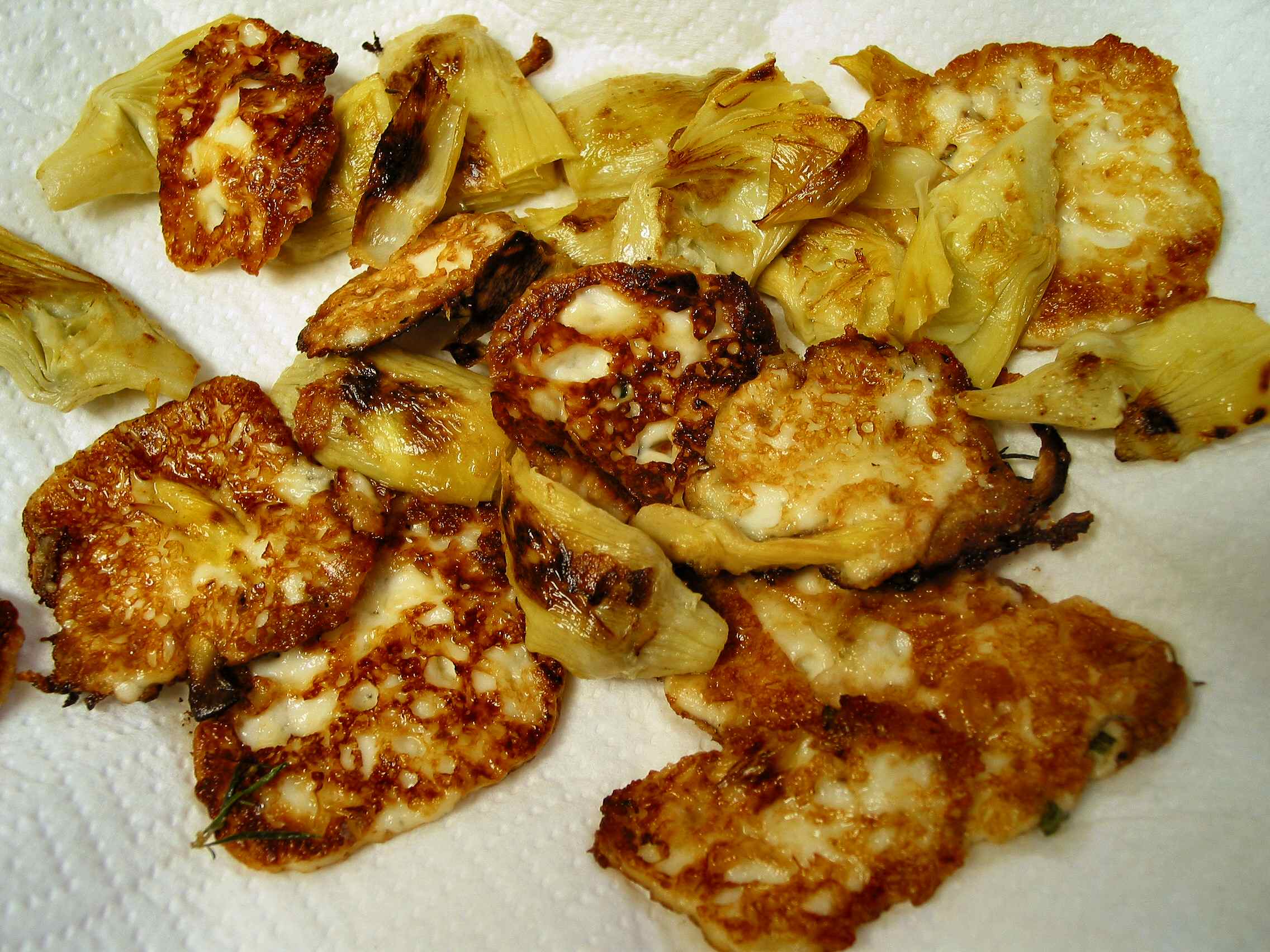
Another good version from a previous fry-up: slices of panela browned with marinated artichoke hearts (bonus: a hit of garlic and lemon flavor from the artichoke marinade, plus the lemon juice increases the browning)

Well…I figured out something quick to fry for the first night of Chanukah: slices of panela cheese, a white rubbery fresh cheese that’s almost exactly like halloumi. Only it’s Mexican rather than Greek, so it’s a locally abundant variety (along with queso fresco) and about half the price per pound here in Pasadena.

I decided to do something a little different with it though. While the spoonful of olive oil was heating in the nonstick (very important) pan, I pressed the slices of panela into about a tablespoon mixture (not shown in above photograph; we ate these too quickly to take a picture of any worth) of pre-toasted sesame seeds, crumbled oregano, sumac, a pinch of ground caraway, and Aleppo pepper–essentially za’atar mix, only without added salt. It didn’t stick incredibly well to the cheese but I was able to press it in on both sides long enough to get it into the pan.

When I started frying the cheese, some of the whey immediately bubbled out into the oil, but although the slices softened up and started melting a little, they mostly kept their shape and I was able to flip them with a wide spatula to fry the other side. Halloumi firms up again as it cools–a little flatter, but pretty tasty, especially with the za’atar mix I improvised. I served it on top of our salad, but in restaurants it goes by itself, with its own bed of greens, maybe a bit of chopped tomato and onion, or with bread and olive oil. It’s only a few minutes of work for something unusual and delicious.

Microwave tricks: 5-Minute Plum Jam for Fall

Italian prune or blue plums

These Italian prunes are some of the fresher, better-looking specimens from my greengrocer’s bin this week. But overripe plums work fine too.

Italian blue or prune plums are probably the last round of plums to appear at my local greengrocers for the year (well, until they start getting in carboys of plums and peaches from Chile). Prune plums aren’t much to look at–well, okay, they have a graceful enough elongated shape, but cut into one and you won’t be terribly impressed–the peel is thick and slightly bitter, the flesh is yellow-brownish, not very juicy, and a bit stickier and less brilliantly flavored than the red and black plums of summer, to say nothing of the gorgeous green and mottled dinosaur and Santa Rosa plums we can get here in LA. Many of the fresh prunes end up overripe and still untaken at the end of the day.

Which, I’ve discovered this week, is actually quite a shame. Because if you buy them early and firm, while there’s still a tint of reddish purple about them, they’re closer to regular plums–crisper, juicier and livelier tasting raw. Still not the ideal eating plum, but not bad.

And if you take the ones that are fully ripe and disappointing and bland and not too pretty, cut them up and microwave them, suddenly everything transforms. Italian prune plums make a gorgeous, rose-red, vibrantly flavored low-sugar jam. A lot like cranberry sauce in both color and flavor, but somehow a little mellower, with the bitter edge off, and a hint of spicy perfumed depth.

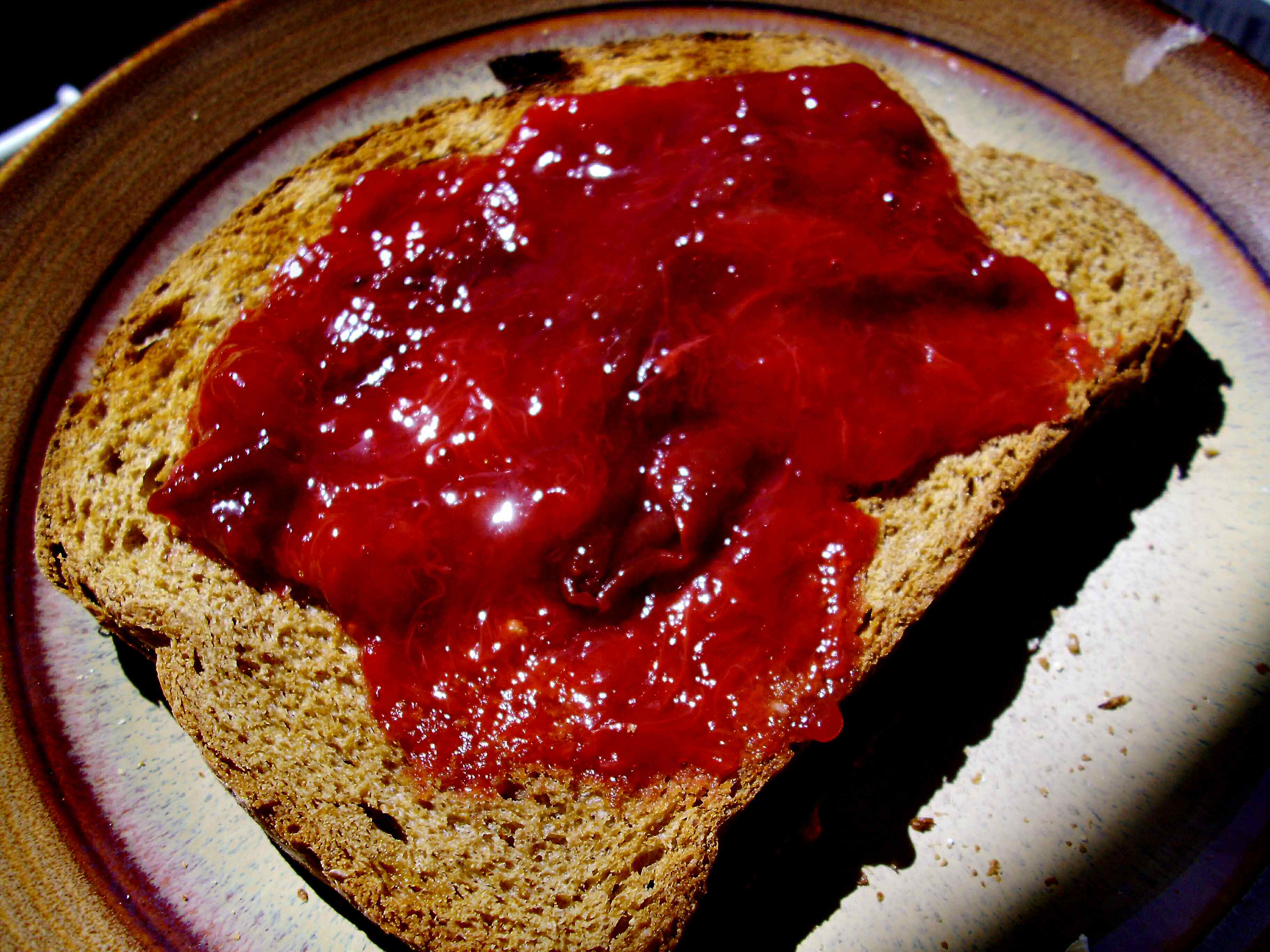
Microwave plum jam on wholewheat toast

Five minutes in the microwave, and everything changes.

Many stone fruits react this way to heat–sometimes sugar too, but mostly it’s the heat. Even very bland, mushy pale apricots seem to bloom into vibrant flavor and acidity when baked or simmered, and sour cherries go from slightly bitter and dull raw to world-famous classic pie filling with a strong almond aroma. I’ve rescued bland, spongy supermarket nectarines and peaches by microwaving them into fruit spreads with real flavor, but obviously good fruit makes even better jams and compotes. It’s just that when the fruit is good raw, I’d usually rather eat it raw, because the season is short.

The prune plums I bought this past week don’t provoke that dilemma of choice; they’re definitely better turned into a quick fruit spread, and maybe I’ll freeze a second batch for later. These plums would also make a great pie filling, like the zwetchgenkuchen that Joan Nathan first published as a traditional German Jewish dessert for Rosh Hashanah in The Jewish Holiday Kitchen. Baked conventionally, the quartered prune plums would probably hold their shape somewhat in the crust and look beautiful.

In the microwave, the plums quickly break down to a bubbling mass and gradually take on color from the peel–at first, bronze with a hint of pink, and after a minute or two the color spreads and deepens to cranberry red (as does the flavor). Sugar just to taste, a tiny squeeze of lemon, and a pinch each of clove and ginger balance out the tartness, and after a day in the fridge, the jam has mellowed and integrated beautifully.

The accents of brandy, cinnamon, nutmeg and lemon peel in Nathan’s recipe make me want to run back to the store and try it this instant, but after a week of baking challah for the high holidays and prospects for 100 degree temperatures yet again, I’m not sure today’s the day. Maybe for Sukkot, which starts later this week.

But the combination of plums with aromatic spices is right on, and if you’re adventurous you could always take this fruit spread one step further and add a small spoonful of brandy, a few shakes of cinnamon and an even tinier hint of nutmeg, even a little grated lemon peel. The simple version below is good on toast, delicious with Greek yogurt and plenty complex enough for me before or after the second cup of coffee.

However, the full-on dressed-up version would probably be a wonderful accent for goat cheese tartlets or a baked brie if you were doing swanky appetizers for a dinner party. I’d test-taste a small batch of the jam first just to make sure it wasn’t too rich with the brandy and nutmeg, because a little goes a long way, but otherwise, let ‘er rip. The plum-jam-with-cheese appetizers would also be an unexpectedly good accompaniment to mead, sherry or other apéritifs for fall.

5-Minute Microwave Plum Fruit Spread (makes about a cup)

  • 5-6 ripe Italian blue or prune plums (or any other plums), washed, pitted and cut up
  • 2-3 T sugar (or more to taste–I like mine less sweet, more fruit)
  • squeeze of lemon juice
  • pinch of cloves (maybe 1/8 t, probably a little less)
  • pinch of powdered ginger (a little less than 1/8 t)

Put all ingredients in a microwaveable ceramic bowl big enough to hold them with a couple of inches to spare, because the plum mixture will bubble up as it cooks. Remember to handle the edges of the bowl with a towel or oven mitt or something (folded paper sandwich bags also work okay in a pinch) because this will heat long enough for the bowl itself to get hot.

Microwave 1-2 minutes on HIGH (I have an 1100 W oven, so adjust times to whatever works for you if yours is older and lower power). The plums should be starting to break down and just starting to color pinkish. Stir the mixture and microwave another minute or so, stir again. If it’s not cooked as much as you think it should be, microwave another minute or so but be prepared to hit the stop button if you see it start to boil over. If it’s fully colored and broken down to a fruit spread, take a small spoonful, let it cool, and taste carefully. It will probably taste a lot like not-very-sweetened cranberry sauce. If it’s not sweet enough for you, add a little more sugar to taste, and maybe another squeeze of lemon, then let it cool all the way covered and refrigerate. It will thicken a little further and mellow overnight and taste more like plums, especially with the clove and ginger notes.

You can, obviously, also boil the ingredients a few minutes in a saucepan on the stovetop if you prefer. If you want it completely smooth, cool it and put it through a food mill or food processor.

This isn’t canned, so store it in the fridge for up to a week or freeze it for later. When you thaw it, taste it again–you might need to add another squeeze of lemon and/or reheat in the microwave just a minute or so to refresh it.

Stuffed cabbage in the microwave

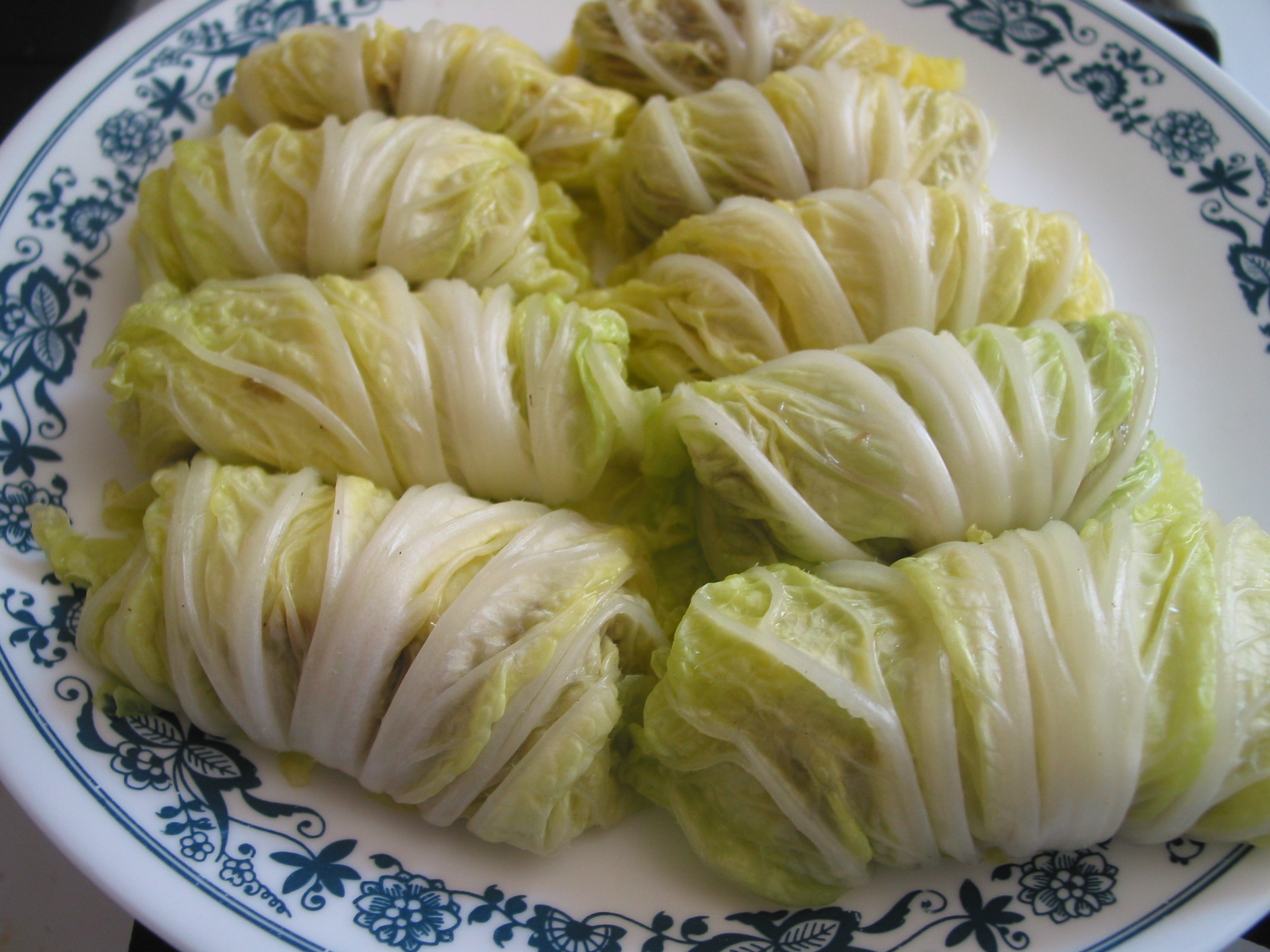
stuffed Nappa cabbage rolls-unsauced

I was originally going to call this post “Nappa 9-1-1” because it’s about salvaging a cabbage quickly and semi-artfully from the back of my fridge, but realized how bad that would be once I read the recent earthquake damage assessments up in the real city of Napa from the 6.0 earthquake a couple of weeks ago. Things are still kind of rough up there. The Napa Valley Vintners association have donated an impressive amount–$10M–and have instructions on how to donate to the local community disaster relief fund. You can find a number of local funds to donate to online at norcalwine.com.

I love bringing home a bag (or more) of produce from my local greengrocer each week–especially in the summer, when Fresno tomatoes are in and brilliant red, green beans are green and snappy, apricots and plums and pluots are spilling ripely out of the bins at under a dollar a pound, and herbs like purple basil and tarragon and mint and za’atar are 75 cents a bunch. You can’t help but feel like you’re going to be a great cook that day, just by cutting up a few vegetables and sprinkling on some oil and vinegar and strewing herbs (and feta or Alfonso olives) on top.

I always mean to use up all my vegetables before they start showing their age, but occasionally I get caught with something unintended at the back of the fridge. This week it was a Nappa cabbage, which is longer and less sulfurous (when lightly cooked) than the more traditional green and Savoy cabbages. A little closer to bok choy. So I peeled back the rusted layers, hoping that some of the inner leaves could be salvaged, at least, and I got fairly lucky.

But what to do with them? Chop and eat raw as a salad? Always an option. But I’d bought the cabbage in the first place to try out a quick microwave version of stuffed cabbage that would fulfill a couple of challenges I’d posed myself:

1. Vegetarian (not a big beef fan, personally)–I’m using the lentil/rice stuffing I developed for stuffed eggplants and onions  three years ago (has it already been that long???), because I actually made stuffed onions again last week and had some leftover stuffing in the fridge.

2. Microwaveable in a few minutes (to combat cooked cabbage stench and do it as more fresh-tasting than long-cooked)

3. Non-stinky, and not drowning in cloying sweet-and-sour tomato sauce (my two overwhelming childhood objections to holishkes)

4. Bridges the cultural/culinary gap between European and Syrian Jewish versions of stuffed cabbage by spicing the filling AND adding garlic and onions. It can be done, and should. And yet, I’m not stewing it to death (actually, that means overturning both Euro and Syrian traditional cooking methods in equal measures).

5. Fulfills the Prunes and Lentils Challenge, or at least hints at what’s possible, since today I had (gasp) no prunes left and had to resort to leftover tamarind sauce from the aforementioned batch of stuffed onions… close enough for folk music.

Stuffed cabbage rolls, as I’ve noted before, are popular throughout at least eastern Europe and Syria. Most versions contain meat–beef for Jews, beef or lamb for Arabs, some mixture of pork and beef for European Christians. But I’ve also seen some really beautiful-looking vegetarian ones in Nur Ilkin’s The Turkish Cookbook, and those were stuffed–of all things–with whole cooked chestnuts.

Cabbage lends itself to enveloping stuffings almost as well as grape leaves, and it’s easier to work with, cheaper, and (big bonus) unbrined.

In addition to meat or lentil fillings, you could try something like curry-spiced or Mexican-style beans and/or vegetables, a mu shu or samosa filling, whole cooked grains like brown rice or bulgur with or without dried cranberries or raisins and sunflower seeds or chopped nuts, maybe even fish (though I’m shying away from Joan Nathan’s recommendation for wrapping up gefilte fish and giving them the stuffed cabbage treatment). Perhaps for fish I’d want smoked (fake or real) whitefish salad. Or sausage–real or vegetarian, smoky and spicy.

It seems to me for sauces you could go well beyond sweet-and-sour traditional: a garlicky tomato sauce, a mustard vinaigrette, a smoky salsa with or without tamarind sauce, a chili-paste or z’khug-laden soy/molasses/vinegar/sesame oil dipping sauce with ginger and scallions, a polished herb and wine-type tomato sauce with prunes or mushrooms and onions, even (maybe definitely?) Korean or Thai peanut dipping sauce, especially if you stuffed your Nappa cabbage leaves with a combination of pressed tofu and/or omelet strips, spinach leaves, maybe some sprouts and shiitake mushrooms.

Whatever version you do, this can either be a quick path to dinner (use the big leaves and more filling per leaf) or to a platter of appetizers (using the small inner leaves).

Microwaving doesn’t develop every possible flavor (in the case of cabbage, I’m childish enough to say that’s a good thing), but it’s a quick way to play around with a classic at least on a trial basis. You could always do the huge foil-covered pan in the oven thing if you decide to scale up and go old-school.

Stuffed Vegetarian Cabbage Rolls

  • 1 head Nappa cabbage, washed and with the core cut out
  • 1 lb (2 cups, more or less) of (in this case) allspice/cinnamon-spiced lentil hashu (made w/cooked rice or bulgur, not uncooked) OR peppery lentil mititei-style sausage filling (substituting 1/3 c. cooked rice for the wheat gluten), or your choice of savory/spicy filling, preferably one that includes some garlic….
  • 1/2 c. sauce–in this case, 1/4 c. tamarind sauce plus a tablespoon of chipotle salsa and a few tablespoons of water. OR–just tamarind sauce, or just smoky salsa, or tamarind with a bit of tomato paste and a spoonful of sugar, or peanut dipping sauce, or dim sum dipping sauce, or Asian-type prune sauce, or prune and wine sauce with some tomato paste mixed in. Or mustard/garlic vinaigrette (as a dipping sauce, not necessarily to cook with)…YEESH! too many choices…


Microwaved cabbage leaves, ready for rolling

Microwaved cabbage leaves, ready for rolling

1. Separate the cabbage leaves, put in a microwave container, drizzle on a quarter-inch of water and put on a lid. Microwave 2-3 minutes until the leaves are just tender enough to roll without snapping the center.

rolling stuffed cabbage

Start the cabbage roll with the filling at the stem end

2. Drain the leaves and lay them out on a plate for stuffing and rolling. Put a tablespoon of fairly stiff filling an inch or so from the stem end of the leaf and pack it into a little sausage shape. Roll the stem end over the filling gently but as tightly as you can manage, then tuck the side frills of the leaf over the ends and continue rolling toward the top of the leaf. Place seam-side down in a microwave container or casserole. Roll up all the leaves and pack them into the container fairly tightly.

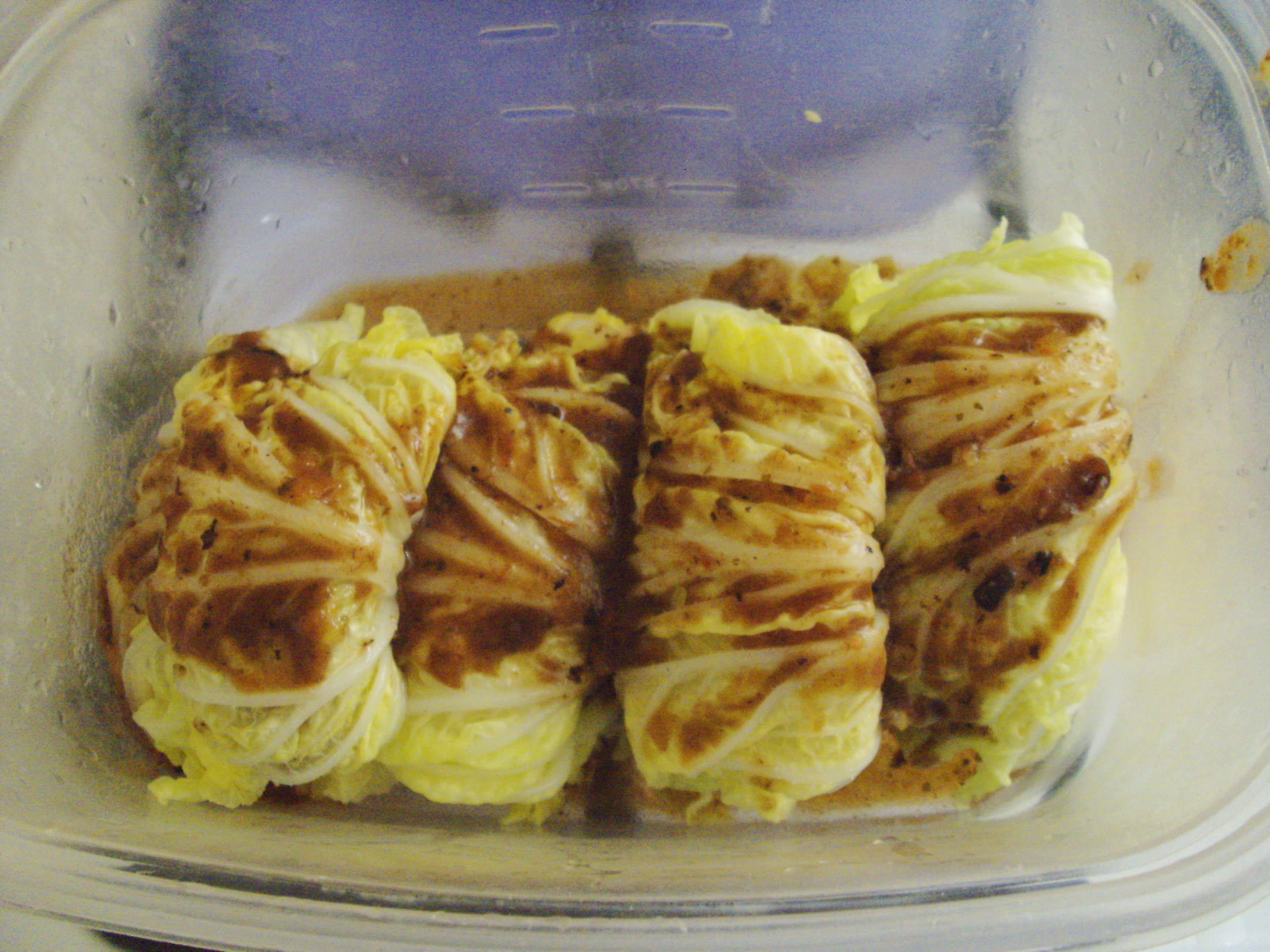
stuffed cabbage rolls with tamarind sauce

3. If the filling is completely cooked already (the rice in the lentil stuffing is not raw or par-cooked), just drizzle a bit of your sauce of choice over the stuffed cabbage rolls, maybe with a tiny drizzle of water in the bottom of the container. Put a lid on and microwave another 2-3 minutes or until just cooked through and steaming hot. If the flavor is still too raw or radishy for you, obviously you can cook it further, going a minute or so at a time, until it smells and tastes right to you.

Drain and serve with a little more sauce on the side.

Purim options

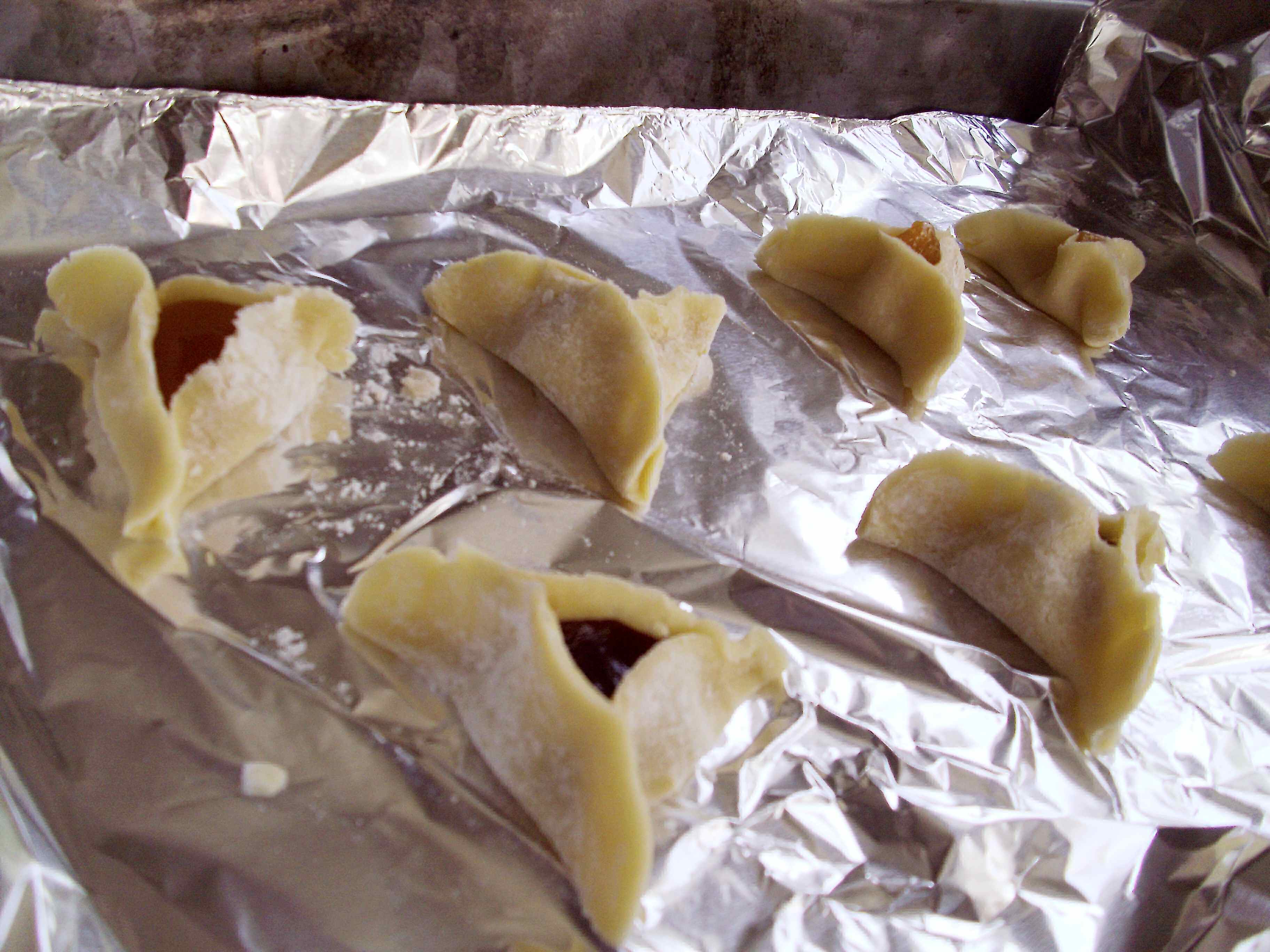
standard cookie-dough hamantaschen

Regular hamantaschen with prune lekvar

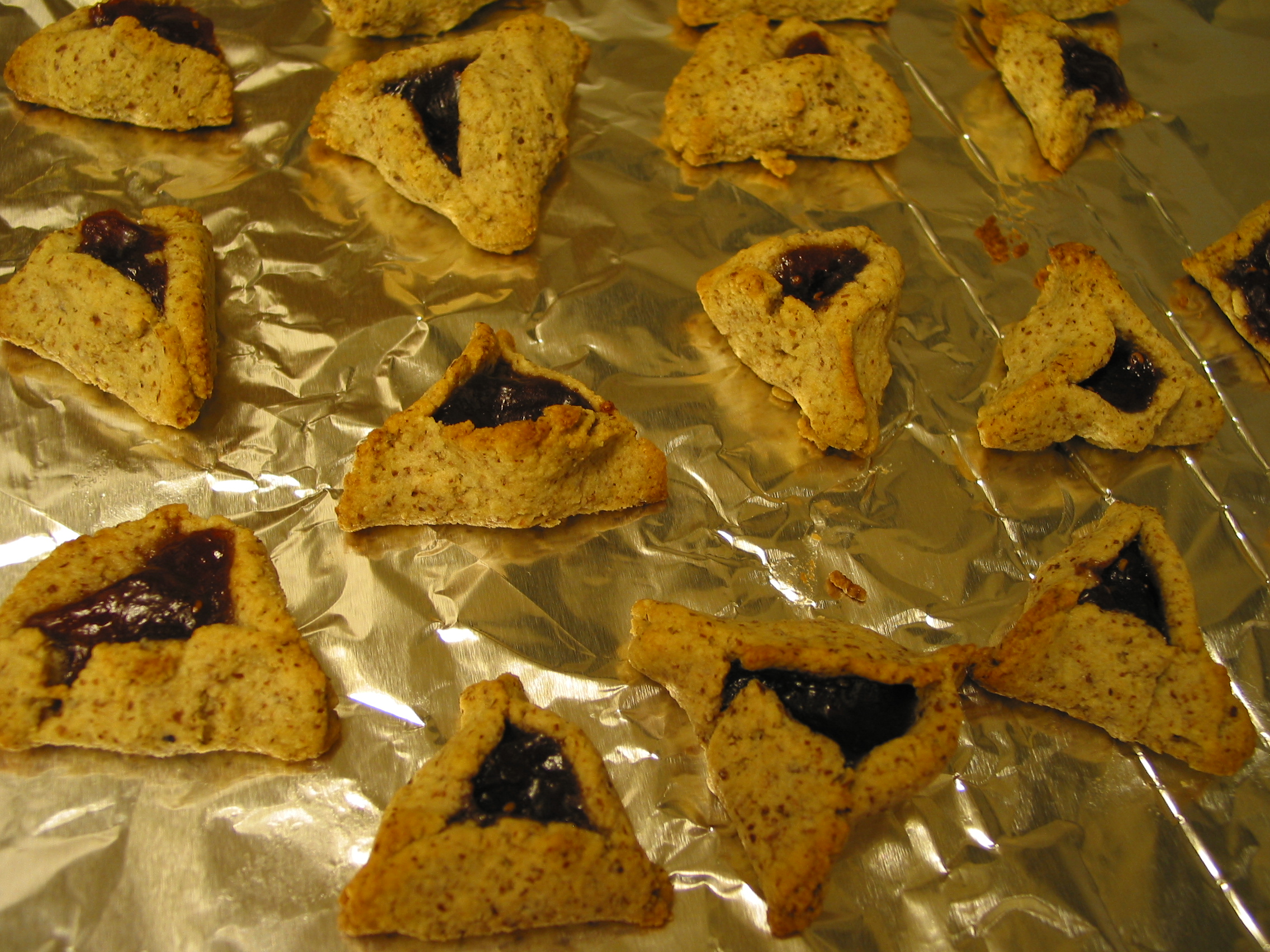
Almond meal-based low-carb hamantaschen

Almond meal-based low-carb hamantaschen

Purim is here tonight, a little late thanks to the “leap month” this year (drawbacks to a lunar holiday calendar) but none the worse for it–it’s over 80 degrees here, which means it’s almost time for Purim. Los Angeles is the only place I’ve ever been, including Israel, where people were slathering sunblock on their kids and gasping for water bottles at a Purim carnival well ahead of lining up for hamantaschen and games. It was 94 degrees that year. Fifteen years of this and I’m still not used to it.

Purim, of course, means manic baking, heat wave or no, because the adults’ reading of the Megillah (the Book of Esther) had…ummmm….last-minute planning and no one thought about hamantaschen as part of the refreshments until midweek. I think I’m the only one left in our  shul who still doesn’t care about having a fabulously original themed cocktail party for the adults afterward. Any kind of cocktail party is more drinking than I want to do, and I’m damned if I wanna dress up in full office battle array again after so many years sidestepping all the suits in my closet, just so I can fit in with the Mad Men theme. I’ve never even seen the show.

But I actually make hamantaschen at home once in a blue moon instead of schlepping over to the Valley to buy them from a kosher bakery.

So I did the stupid, crazy thing and volunteered. How many people? I asked–maybe 60. So I have SIX batches of dough sitting in my freezer relaxing. It took about half an hour, about 5 minutes apiece,  to do all the batches in the food processor, one after another and weighing out the ingredients so they’d be consistent. And yet…after all the excitement from two weeks ago, I’m just not all that geared up to roll it all out and bake it just this minute. Maybe when things cool down slightly–half an hour? Maybe?

Friday happens to have been Pi Day as well–and to my daughter, who was supposed to be my second-in-command for this delicate operation, and to her algebra teacher this morning, that meant Pie Day. They had about four different kinds of pie for all the math classes, and none of them had to calculate the areas or volumes of the wedges they sampled. My daughter, of course, was so elated that she ate two entire meals’ worth of carbohydrate in about fifteen minutes, and still came out with a pretty good blood glucose number an hour later–good on the calculated guesses, there–but at the cost of running through insulin that could have lasted her three or four more hours if she’d eaten an ordinary lunch. Teenagers! Mothers of teenagers!

Still, not to lose the spirit of things too much. It occurs to me that hamantaschen qualify as very small pies, only triangular. So we eventually started the process of inscribing a triangle inside a circle–240 times, if we can get through all the batches before showtime. Me, I’d settle for 3 or 4 batches and call it a week.

The raspberry jam filling–all that hard work for the first batch of rolling and filling–leaked all over the place. Too bad there isn’t still a vogue for vampire-everything; the first batch would have qualified! Too thin. You need a thick serious filling to stay in place during the baking.

So–time to nuke the prunes for lekvar and the figs for the heck of it (plus toast a small sampling of the poppyseeds in my freezer to see if they’re still okay to use for a filling, and to make sure I don’t pour in the bag of nigella seeds instead by mistake!). I rarely see these anymore, but I still believe in doing traditional fillings alongside the modern, newfangled apricot-jam-and-chocolate-chip ones. It’s true that if we keep skipping the prune filling, we might not turn into our own grandparents, and if we miss out on the poppy seed filling (known in Yiddish as mohn) we might pass the all-critical drug tests (à la Seinfeld) with no interferences, but then again we’d miss the ta’am, and what’s the joy of hamantaschen without a taste of the past?

Hamantaschen Recipes

Low-Carb Almond Meal-Based Hamantaschen

My version of Joan Nathan’s Hamantaschen, with four fillings: poppyseed, prune, apricot/chocolate, labaneh/cheesecake

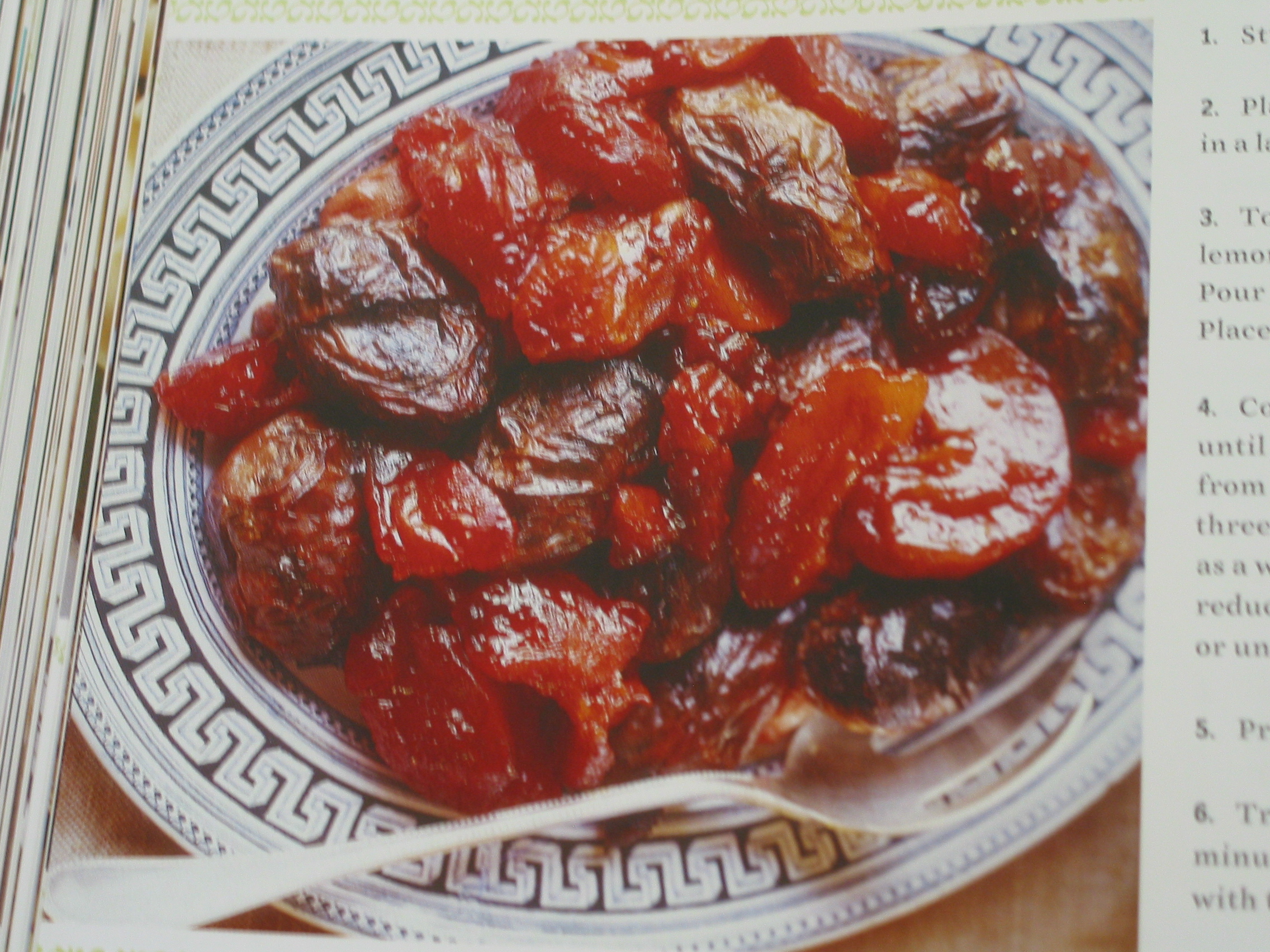
Microwaveable dried fig and dried apricot fillings (originally for fillo pastries, but still good for this, and a lot less drippy than jam)

However–if you are feeling “Mad Men”, you might think of reconfiguring the hamantaschen motif for cocktail party fare instead. I was thinking about this Thursday but figured it would be too weird. Then I saw an article about it yesterday in one of the big three newspaper cooking sections–dammit! scooped again! In any case, if you’re feeling a little avantgarde, you could do a batch of savory hamantaschen if you feel like it. Use rugelach, bureka or olive oil tart dough instead of the standard sweet dough. Roll it out fairly thin, and fill with feta or bleu cheese mixed with labne or very thick sour cream, plus a little onion and some thyme, maybe a pecan or two. Or something with very cooked-down mushrooms and onions (so they don’t get soggy). Or pesto and cheese. Or spinach with cheese and nutmeg and lemon rind. Or tapenade. Etc.

Chickpeas of all sorts and descriptions

Since Esther supposedly refused meat and ate only chickpeas, chickpea recipes are also more or less relevant to Purim. Mine are not particularly traditional–look up Iranian Jewish recipes elsewhere on the web.

Chickpea crêpes  These can be savory or sweet, and they don’t require eggs or milk

The “other” moussaka–eggplant and chickpea stew

Hummus from scratch (aka how to nuke dried chickpeas)

Fast Hummus made with chickpea flour (microwaved)

There’s also the possible “nahit”–fry chickpeas in olive oil, drain and sprinkle with salt and pepper.

Or a cold chickpea salad with mint, scallion, garlic, olive oil and lemon juice or vinegar.

Or channa masala dal, something like the red lentil dal but with chickpeas (and not mashed)

Post-Kiddush: our leftovers are better than yours

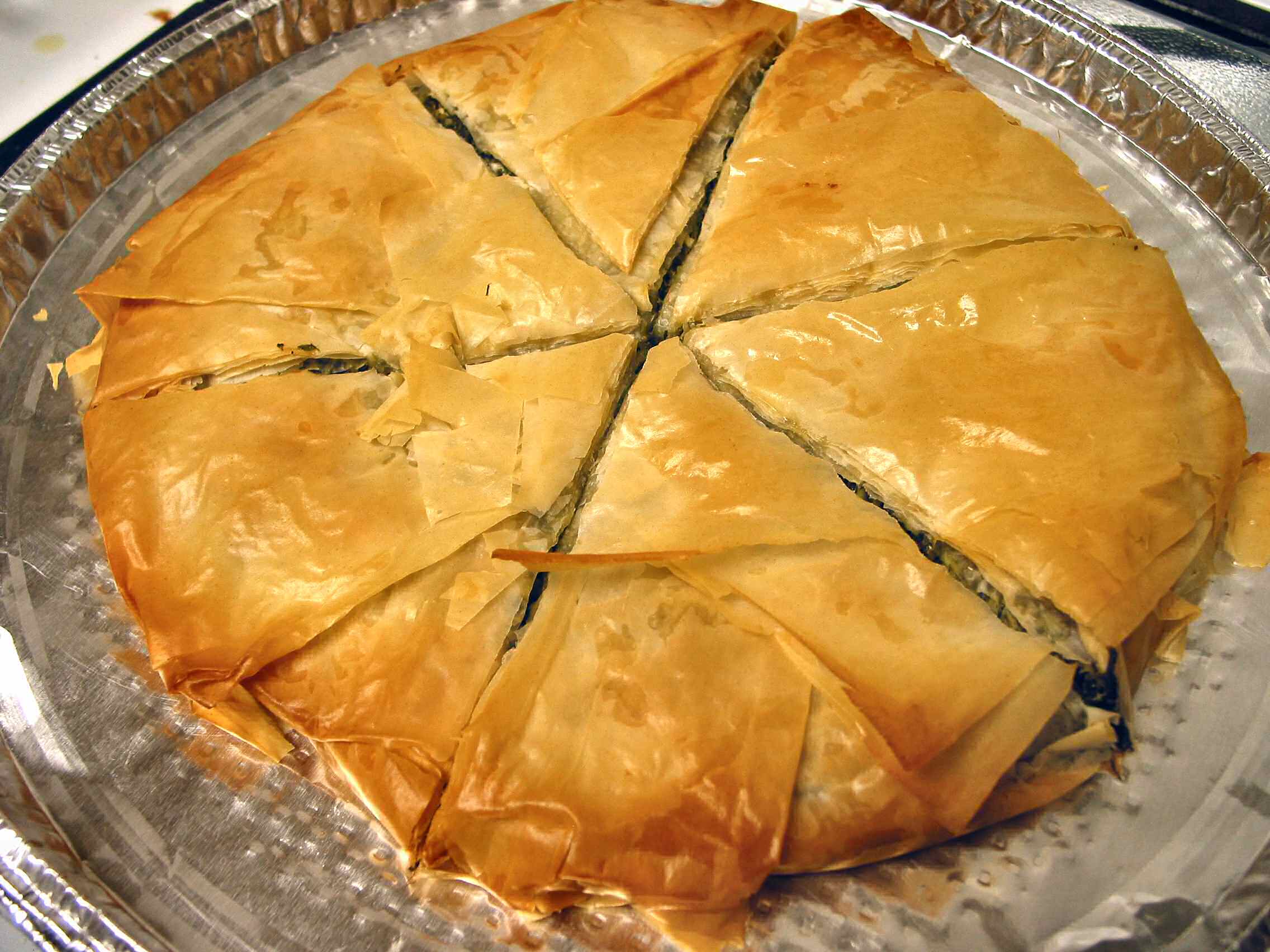
Round spare spanakopita just for us after the big kiddush

Round spare pinwheel-style spanakopita just for us at home. The big ones for the brunch had three pounds of spinach apiece (and were cut in small diamonds), but they still went together pretty fast–except for squeezing all that spinach dry…

This weekend I did it again–I made the kiddush, or in common speech a lunch buffet, for my congregation’s Saturday morning service. My husband kind of volunteered us for this week and because he doesn’t cook, most or all of the cooking, shopping, chopping and schlepping landed on my shoulders.

Last time he volunteered us, it was for our anniversary, and  I was ready to skip ahead to the divorce until I got over it, because it’s a lot of work to cook for 60 or so people who like to eat. And kibbitz. Especially when the 60 suddenly turns into 80-plus and having to use the synagogue kitchen with the more complicated and confusing rules on only a week’s notice. As they did this time…..

Soooo….a two-day hell of shopping and then marathon cooking-and-juggling in my little galley kitchen. The microwave got a serious workout. So did the food processor and the oven. Sometimes all at once. And it was raining hard for three days, so bringing things over to the synagogue kitchen as I went got a little tricky. I triple-wrapped the chocolate cake and stuck it in a USPS Priority Mail box so it wouldn’t get left out in the rain. Same idea for the spanakopita trays.

A few hints about cooking big and real for a synagogue brunch, learned the hard way by moi and passed on for your edification and safety (and sanity):

1. You can buy a 6-lb can  of chickpeas for massive half-gallon batches of hummus (Mid-East brand, maybe Goya as well). Cost? about $5. But–as I found out, and I’m glad no one was filming the process–industrial-sized can equals industrial-strength steel. A dinky hand-operated can opener is no match for such an item. I got just far enough to be able to pry open a kind of spout but there were tears and long-fluent-repetitive-all-throughout-the-house swearing sessions involved.

Still….

2. If you have a good corner greengrocer, you can buy quantities of eggplant for cheap–eleven or twelve eggplants made for a large tray of roast eggplant and onion slices (with garlic slivers and za’atar sprigs and olive oil) plus a large vat of baba ghanouj. Only the five eggplants I nuked for the baba ghanouj didn’t feel like cooperating fully when it was time to peel them. Might have been easier to peel first, then nuke, since it was all going into the food processor eventually. Next time…

3. Whole smoked whitefish for whitefish salad comes two ways–cold-smoked or hot-smoked. What’s the difference? I asked the counter guy at my favorite Armenian grocery. “Cold-smoked is a little less hard,” he said. So I bought it, thinking he meant the hot-smoked was tough as shoeleather and twice as chewy. I was wrong. Cold-smoked actually means the fish is smoked raw, like lox, only a little drier and tougher. But you don’t necessarily want to put it in whitefish salad that way. Man, it still had the scales on too. I couldn’t get it off the bones for love or money, and there were a lot of bones.

However, the microwave came to the rescue. I cut the fish in half and Continue reading

Little Green Footballs

…and Other Lessons from the Fillo Stratum

cheese and pesto triangles

Two or three weeks ago I got a frantic email from the assistant at my daughter’s Hebrew school: could I lead a cooking session for the 8th graders for an hour that Sunday?

Teens and preteens are not my specialty–I have a friend who’s really terrific with them; she’s an 8th grade and high school teacher and would rather deal with kids than write. I’m the other way around, and my own kid’s turning 13 very soon. Very soon.

Suffice it to say, my answer probably should have been, “Who me? Are you off your nut? Cook with preteens in only an hour?”

And then I thought–but wait. Fillo. It’s inexpensive (a big plus), it’s  easy enough to fold, it’s almost (if you squint) kind of a craft.  Like origami. Make some tasty and quick fillings for it (though no nuts–schools have gotten annoyingly leary of anything with nuts. How are you supposed to teach baklava? Eh? Eh???) and let the kids go to town, a couple of sheets of fillo apiece in the synagogue kitchen. An hour should do it, and it’s a cool, sophisticated food to know how to make–very different from the standard summer camp challah with blue or green food coloring.

So…I bought a couple of packets of fillo (about $2.69 for a roll of 20-24 sheets), a couple of pounds of loose-frozen spinach, an onion, some garlic, a bottle of olive oil and another bottle of canola oil (for the sweet fillings), a packet of dried apricots, a packet of dried figs, some farmer cheese (mistake, doesn’t taste that good; stick with ricotta) and some feta. And some dill and scallions I had at home. Also a lemon or two. I left the fillo in the fridge overnight to thaw slowly the way you’re supposed to, and not the way I usually do (i.e., take the thing out of the wrapper and let it sit an hour on the counter and then wonder why it cracks when I rush to unroll it).

I made the fillings the Sunday morning in a microwaver’s frenzy of immense efficiency:

  1.  Nuke a stick of unsalted butter in a bowl, pour it into a snaplock container.
  2. Thaw the spinach on a plate–4 minutes on HIGH. Take it out.
  3. Dump the dried apricots in a bowl with water to cover and a saucer on top–3 minutes. Meanwhile, start squeezing the spinach dry, and I mean dry, in handfuls over the sink. Nothing worse than soggy spanakopita. Except maybe soggy pizza.
  4. Take the apricots out, put in the bowl of figs with the stems cut off, some water and a lid, 3 minutes for them.
  5. Blend the apricots with a little sugar and water and lemon juice to make a thick paste. Get it out of the food processor and pack it in a disposable container with a lid.
  6. Do the same thing for the figs, only no sugar necessary.
  7. Rinse out the food processor, stick the scallions, wild thyme, fresh dill and basil in and chop them fine, drop in the spinach, a fat clove of minced garlic, and the feta. Pack that too.
  8. Grab all the bags with the goods and don’t forget the oils and the butter and the fillings and the extra feta and farmer’s cheese just in case there’s time to make some cheese-only filling there and somebody wants it. …

I hustled, I got to the synagogue kitchen on time, I set up stations around a stainless steel work table–foil sheets at each place, paper bowls with a dab of melted butter and a pour of oil, plastic baggies to go over everyone’s hands instead of pastry brushes, the carefully unrolled fillo under plastic wrap. The oven–on. The fillings–ready to rock. And then I waited. And waited.

An hour really would have been enough time for that class. But none of the kids showed up for the first 20 minutes because it was also the day the photographers were herding all the classes out into the basketball court area for graduation photos. So when they finally straggled in, all eight–and surprisingly, three of them were boys–I made them wash their hands and then set them to work.

The first thing I did was hand out individual sheets of fillo and pointed out that they were nearly as thin and tearable as tissue paper. They were all surprised when they saw it. None of the kids, who’d been cooking all year and who had attended a lot of bar and bat mitzvah celebrations, had seen fillo “in the raw”.

I got them started on spanakopita triangles–also known sometimes as bulemas (Greek root found here; you’ve heard of bulimia, right? Didn’t mention that connection, of course. You would never want to get into that with a batch of preteens. Don’t get too disturbed, though. The rough translation as used in Hebrew is “appetizers” or “things to gobble”. Of course, in Israel “bulmus” is also what they call anything like the American after-Thanksgiving shoppers’ frenzy or otherwise a run on the stock market…so much for appetites gone hog wild…)

I naturally thought fillo triangles would be a cinch for the boys especially–you do it the same way you fold a paper football and try not to get caught in class. Only with a little more butter and olive oil involved, and hopefully no punting in the kitchen, because I wasn’t gonna clean it up for them when the spanakopita went flying.

Here came the second generational surprise, though: none of the kids, not even the boys, had any idea how to fold a basic paper football! They’d never done it. Paper airplane? I asked desperately.  Continue reading

Stuffed onions in a hurry

Stuffed onions ready for steaming in the microwave

With a microwave and a frying pan, you can make stuffed vegetables like Mehshi Basal quickly, and they taste even better than with long roasting. These are just rolled and ready for a few minutes of steaming in the microwave.

Just after Rosh Hashanah I posted my first-ever attempt at an elaborate Syrian Jewish dish of sweet-and-sour stuffed eggplants with quince, and because I had more stuffing than I needed, I went for seconds with Aromas of Aleppo on the spot and tried out the Mehshi Basal, or stuffed onions with tamarind sauce, which was actually even better. It was easier to put together and I was patting myself on the back when we tasted the results.

Still, given that I was using a lentil stuffing in place of ground beef, I was a little dismayed at how long the traditional braising and roasting took to cook the onions all the way through–an hour and a half at least, and that was after stuffing them. A second attempt in November, this time exclusively with stuffed onions for a congregation brunch, did no better on time, and I came away thinking that roasting was an extremely inefficient way to cook these–might even have toughened them inadvertently.

Why, you have to ask, should I make such a big deal about stuffed onions–they’re a party trick, after all, not standard cooking. But we discovered we really liked them, and they’re a pretty good kind of party trick. They were a surprise hit at the brunch. If I hadn’t snuck myself one while setting up in the kitchen, I’d have missed out altogether.

Actually, I think they fascinated everyone as much for the magic trick as for the flavor. People who’d never tasted them before kept coming up to me–and even my daughter–to ask, “How do you get the filling into the onions???”

If they hadn’t been so time-consuming I could have made double the amount and they’d still have disappeared. Or I could throw them together easily just for us on the odd weeknight as a treat–but one with some iron and fiber in it–instead of the standard pasta or rice.

So in the time since, I’ve finally rethought the process and come up with something that requires no oven time and cuts the actual cooking after stuffing them down to about 20 minutes or so–as long as you already have some cooked lentils (microwaved to perfection in about 10 minutes of cooking time and 30-4o minutes of standing time) and tamarind sauce (or “mock tamarind” sauce, a 5-minute microwave-assisted blend of prunes and/or apricots with water and some lemon juice, plus-or-minus tomato paste, applesauce and other flourishes you don’t really need for this) to hand.

I know, you probably don’t have these things sitting around. But this recipe might change your mind. Lentils are good stuff even on their own, and the stuffing here is a knockout.

Even genuine tamarind sauce isn’t so bad anymore, assuming you don’t or can’t just buy a prepared concentrate. I’ve sped the process up from an hour-plus to a few minutes just by nuking it, pulsing in a food processor, and this time, neither filtering it quite so aggressively as I did back in September NOR bothering to boil the stuff down to a sticky residue. It’s so much less painful, and I think it even tastes better, with more of the fruit character left in. See my notes at the end of the post for how to do it the quickie way (in modest jam-jar quantities, not quarts).

Anyway, back to the stuffed onions. I’m actually proud of myself for this one, and I’ve tried it three times in a row so I can vouch for it–the last time, I put my daughter to work stuffing the onion layers, and she did a great job.

For this method all you need are a microwave oven, a frying pan and a food processor. Instead of boiling the onions for 20 minutes to separate the layers, you microwave them in a drizzle of water for 5. Instead of braising the stuffed Continue reading

Stuffed Eggplants with Quince, A Vegetarian Odyssey

Stuffed Eggplant with Quince and Stuffed Onion Rolls

I did it. It was 90+ degrees outside yesterday afternoon and felt a lot hotter inside when I started cranking the oven to try this dish right away rather than wait for the weekend, but I’m just no good with delayed gratification.

If I have the mini-eggplants and I have the quinces and I have the tamarind concentrate (homemade! two days ago! it’s practically crying out to be used already!) and I have the “hashu” filling for the vegetables sitting in the fridge smelling wonderful, then it just doesn’t matter that Rosh Hashanah dinner is in what, maybe 3 hours, and I still haven’t braided the challot, to say nothing of baked them. Obviously I’ve gotta try this extra-credit dish out RIGHT NOW.

Actually, I figured the house was going to be heating up anyway once I started baking the challot, so why not get it all over with at once?

There was a more serious reason to try it. Today in services I was still thinking about Dweck’s book and her recounting of her parents’ horror in 1947, when, about to return from a vacation in Europe, they learned the government back home had started massacring whole Jewish communities in reaction to the announcement that the UN had accepted Israel as a Jewish state.

The Syrian Jewish community fled wherever they could–just as my family did under the pogroms in the Ukraine back in the 1880s and 1920s. Dweck maintains that the reception the Syrian Jews got in the US from those of us who were already here was so aloof–they didn’t speak Yiddish, they didn’t look the same, they did a few things differently for kashrut and prayers–that her community kept to themselves ever after.

I can believe it, unfortunately–the period right after World War II and the Holocaust was one of paranoia and circling the wagons for American Ashkenazim.

Eastern and Western Jews had similar discomfort with each other in postwar Europe. Reading between the lines a little in Claudia Roden’s and Colette Rossant’s memoirs, the two, who had just lost everything, thought their new Ashkenazi neighbors were cold and inhospitable and indifferent to their exile; the Ashkenazi neighbors and relatives, meanwhile, thought the wealthy young Egyptian arrivals were horribly spoiled and indifferent to the European disaster they had just missed. Altogether, the Ashkenazi, Sephardi, and Mizrahi communities were in closer touch before World War I than they were after the 1940s.

I can only hope that now, 60 or 70 years on, we have more in common and more regard for each other, no matter where we came from. Israel’s great mix of cultures has been a good influence, even though it originated in hardship, and perhaps today we are in better shape to appreciate what we have in common than we have been for nearly a century.

When I look through Dweck’s family’s photos, I see so many people who look astonishingly like several members of my family–my dad and my sister especially. The dignified lady presiding at the seder table on the front cover is a shockingly exact adult version of a girl I knew from my synagogue’s youth group–it’s the sturdy mouth and chin and the set of the eyes, certainly, but also the irrepressibly thick and curly hair (the 1920s formal chignon has it all over my friend’s 1970s braids, which took her hours to corral her hair into). The formal photographs of families in the 1920s, all the daughters dressed beautifully but in the same fabric the mother is wearing, sailor suits on the boys, stern dignified expressions all–I’m pretty sure each of my grandmothers had at least one of those in her collection. The 1930s-era engagement portrait with pearls and bobbed hair–so modern! Pin it up next to the one of my dad’s parents, who married in 1939 and looked so incredibly naive and young then. The family gatherings at Pesach, grandma presiding over the white lace tablecloth and all the seated cousins glancing behind them at the camera from over their shoulders–there’s probably one or two with my mother as a toddler on someone’s lap in Brooklyn and another of her as a teen, whipping her glasses off and blinking myopically for the photo. It could be any of our families. It could have been us in Syria and Egypt and Turkey, it could have been them in the Ukraine or Germany or Poland. We none of us have entirely safe histories, and none of us are entirely separate.

In any case, Dweck’s book is important to me not only for capturing her community’s traditions, tastes and history but for reaching out to the rest of us and giving us a chance to share it, compare it with our own, and reconsider what it means to be part of the Jewish world now.

So–and this is not to trivialize but to explain, since we sometimes live and remember through food, especially at the holidays–it was a great time to try out a challenging dish (challenging for me, anyway) from her book and serve it last night to my family for Erev Rosh Hashanah. I cook from scratch, I cook a lot, but I’ve never really done  the legendary great-aunts-at-Pesach kind of slow cooking where everyone groans in pleasure and declares “nobody does it like this anymore” when they taste it. I’ve only once cooked a whole turkey, and I’ve rarely tried anything else that took more than an hour and a half to cook. It’s a transformative experience, one that teaches me a lot about my great-aunts and great-grandmothers, both in the shtetls with the wood-fueled pripitschoks and communal ovens, and here in America with modern kitchens and big lace-covered tables. Trying this long-cooked dish gave me the chance to experience both my family’s past celebrations and Dweck’s at the same time.

To my very great pleasure, her recipe worked the way it was supposed to on the first try and tasted like the effort was worth it, even though her instructions are pretty simple and brief. That’s a huge achievement.

So–if you’re ready for this, keep reading–otherwise, glance at the pictures and skip to the bottom…

The “Stuffed Eggplants with Quince” Experience

First of all, let me just say that I LOVE my local Armenian corner grocers for a lot of reasons, but the fact that they have all the ingredients for Dweck’s dishes (other than kosher meat, that is) is a big, big plus.

I would have tried microwaving–and I still will–instead of a 2-hour braise, but I wasn’t sure how it was supposed to taste, whether microwaving would cook the raw rice in the filling well enough, and how the sauce was supposed to interact with the stuffing and the eggplants. I knew from a previous hard-luck experience that quinces don’t do especially well (or even well at all) in the microwave and really need long stewing under conventional heat to get tender and turn bronzy pink and sweet. So all in all, I decided following the directions in Aromas of Aleppo might be the wiser course for a first try. Even though, from my usual 15-minutes-tops perspective on conventional-heat cooking, Poopa Dweck’s method is glacially, almost outrageously, slow.

Basically, you core the baby eggplants, stuff them with hashu (beef-and-rice filling, rice and tomatoes, or in my case lentils-and-rice), and layer them in a saucepan with quince slices. Then you dilute some tamarind concentrate and add a bit of sugar and salt, pour the sauce over the pan and heat for 10 minutes on the stove until the eggplants start to sweat, add water to come about 3/4 of the way up , simmer half an hour to reduce the liquid and cook the rice in the filling, then transfer to the oven to braise covered for about 40 minutes and then uncovered for another 30. It’s a lot like making brisket, actually.

Dweck gives two allspice-laden recipes for the filling, one for ground beef with rice, the other a rice-and-tomato filling that’s close to what I use for dolmas. I opted to follow the ground beef recipe but substitute an equal weight of cooked green lentils for the meat and add a little garlic. It would work, I was pretty sure, and in fact it turned out to be the best, most delicious part of this recipe–which, skipping to the punchline, was pretty terrific and worthwhile, even for the work Continue reading

The Birthday Project: New Year, New Food

I was born halfway between Rosh Hashanah and Yom Kippur, so on any given year, I could be stuck eating honeycake or none at all on my birthday. I think I’ve had maybe two actual birthday parties in my life. It’s a concept my daughter, born in June, doesn’t get.

But occasionally I luck out–and this year was one of the best. My husband asked what I wanted and I had a real answer–a cookbook I’ve been lusting after at the library and that costs only slightly more than my probable library fines if I don’t return it.

So this is it–feast your eyes, I’ll turn the pages:

Aromas of Aleppo by Poopa Dweck

And this is the project that sold me on it:

Stuffed Eggplant with Quince

Stuffed Eggplant with Quince

Poopa Dweck, a cousin by marriage to Claudia Roden, has edited the New York Syrian Jewish community’s version of a sisterhood cookbook (every synagogue in America’s sisterhood seems to have put out at least one of those) for something like 20 years, only people in her community actually used it frequently. My birthday gift is the 2007 culmination of Dweck’s experience, and it’s just a very beautiful cookbook to leaf through–visually but also for the possibility that when you try the dishes, they’re actually going to work.

It doesn’t take much reading for me to realize that despite the unfamiliarity of some of the flavors–allspice in meat stuffings, tamarind-based sauces–this is the best kind of traditional Jewish home cooking, the kind that has your favorite great-aunts outdoing each other for Pesach, Rosh Hashanah, and other big celebrations. So, somewhat exotic in flavoring but utterly familiar in spirit. (And actually, as I discovered in another Syrian Jewish cookbook, A Fistful of Lentils, by Jennifer Felicia Abadi, a few dishes, like stuffed cabbage with a sweet-and-sour sauce, and manti, a kind of ravioli, are pretty similar to Ashkenazi holishkes and kreplach.)

Like all Jewish great-aunt dishes for the holidays, this dish of stuffed eggplants and quinces comes with two required homework items: the beef and rice stuffing, and tamarind concentrate. The beef I’m not worried about–my first try on this is going to be vegetarian, because I’m not planning on heading out to the kosher butchers in the Valley. I can use a green lentil and rice filling that I already know will taste fine with those flavorings of allspice and cinnamon and onion. Maybe a hit of garlic too, and maybe a bit less salt than for the beef–as I discovered a few weeks ago, with the green lentil sausages, lentils don’t hide the salt flavor as much as beef might.

The other item, tamarind concentrate, turns out to be inexpensive but somewhat unlovely to make–though still something of an adventure. Especially for a blog called Slow Food Fast.

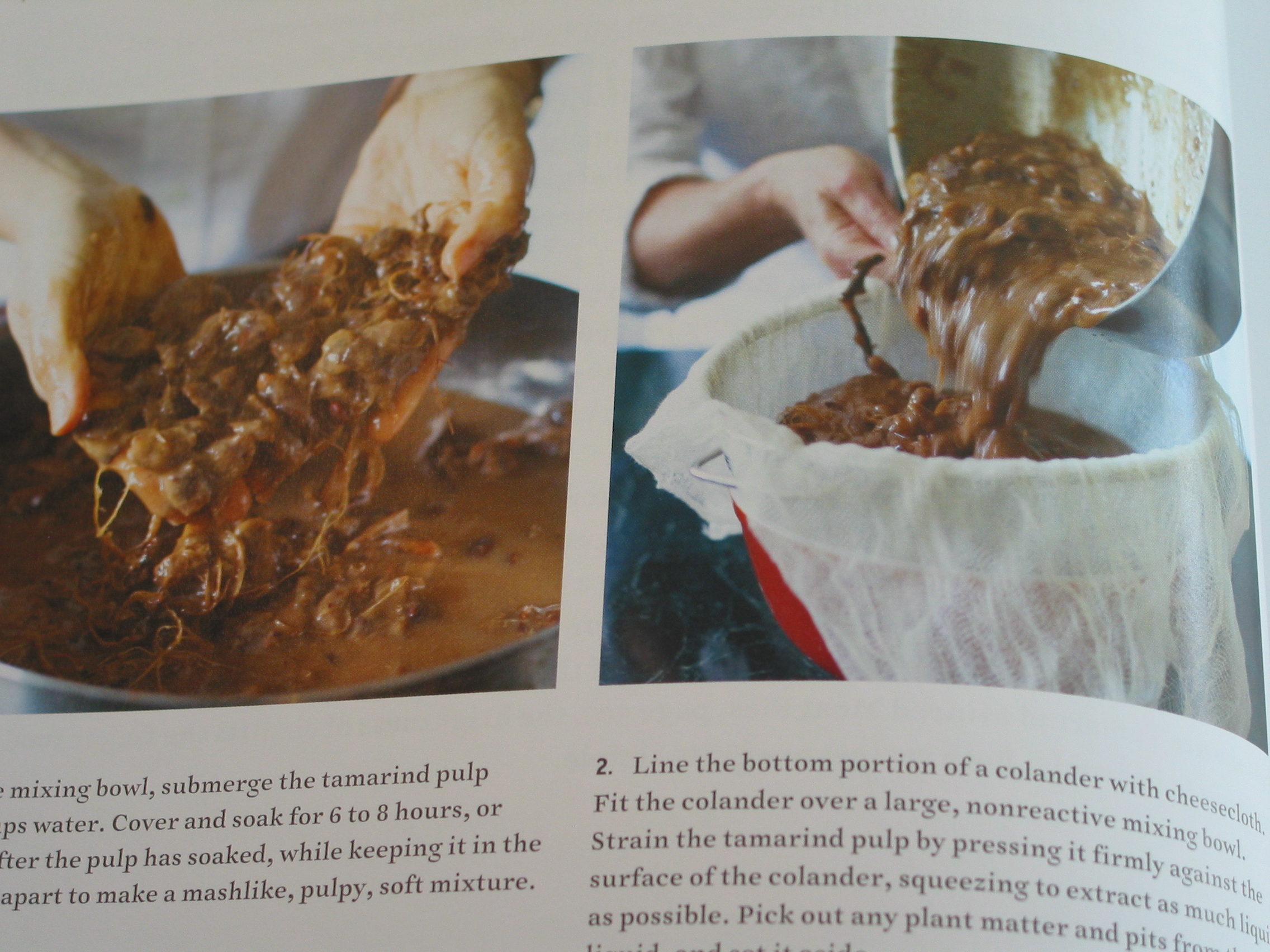
Here’s what’s on page 42 of Aromas of Aleppo for how to work the tamarind pulp into something that will give up its flavor to a sauce:

Poopa Dweck's Aromas of Aleppo--instructions for making tamarind concentrate

Working the tamarind pulp

Now, I’m not all that squeamish, but bleaaghhh. First ya gotta soak the stuff overnight, then ya gotta get in there and mish around–I dunno. I decided to speed it up where I could…

I thought about the little 1-lb. brick of pressed seedless tamarind pulp I’d bought from my Armenian greengrocers for this dish. It just seemed like a tougher version of dried prunes or apricots, which I usually soak up successfully enough in a few minutes by heating them with water in the microwave. Would it work here or would it ruin the flavor? I cut off a chunk, submerged it in water in a microwaveable bowl, and tried it.

Tamarind pulp rehydrated in the microwave

Five minutes of microwaving, covered, plus about 20 minutes sitting time–it was definitely done. And really, really incredibly tart, a surprise given tamarind’s distinctly plummy aroma. Success! But no wonder they call it “ouc” (pronounced OO-rgh, according to Dweck)–that was my immediate reaction when I tasted a tiny sip. It’s THAT sour. My second reaction was that I should probably say Shehekheyanu–the blessing for any new venture, especially for holidays and the first taste of a new fruit in the year.

I realized only afterward that I should have done the whole brick while I was at it–I was about to discover why Dweck calls for preparing three pounds of pulp at a time, not a couple of ounces.

Next step–squishing the pulp in the water to extract as much flavor as possible before filtering through cheesecloth and reextracting the pulp left behind in fresh water…no. Just no. I am not a cheesecloth girl–it never, never cuts neatly, even with Fiskars shears.

So, I was thinking, I have a microwave for a reason. I also decided I have a food processor for a reason, and this is definitely it. I stirred once with a fork first to make sure there really weren’t any pits in there, as advertised on the package front. Then I poured it all into the food processor, and gave it a whirl. That worked too. I seemed to be on a roll with the speed-it-up-immensely daydream.

Filtering the tamarind liquid

Filtration–I’ve used overlapping coffee filters in a colander whenever I make paneer in the microwave, and it worked pretty well here too–maybe better than Dweck’s photos, which show a cloudy filtrate coming through the cheesecloth. Mine was clear and amber–maybe too clear? Was it going to taste authentic without the silty stuff? I could only hope. It sure was sour, even dilute as it was. Continue reading