• Enter your email address to subscribe to this blog and receive notifications of new posts by email.

    Join 241 other subscribers
  • Noshing on

    raw blueberry pie with microwaveable filling and graham cracker crust

    This mostly-raw blueberry pie is a snap to make and very versatile--the filling microwaves in a few minutes, and you don't even have to bake the zippy gingered graham cracker crust--perfect for a hot Fourth of July and all summer long.

  • Recent Posts

  • Contents

  • Archives

  • Now Reading

  • See also my Book Reviews

  • Copyright 2008-2024Slow Food Fast. All writing and images on this blog unless otherwise attributed or set in quotes are the sole property of Slow Food Fast. Please contact DebbieN via the comments form for permissions before reprinting or reproducing any of the material on this blog.

  • ADS AND AFFILIATE LINKS

  • I may post affiliate links to books and movies that I personally review and recommend. Currently I favor Alibris and Vroman's, our terrific and venerable (now past the century mark!) independent bookstore in Pasadena. Or go to your local library--and make sure to support them with actual donations, not just overdue fines (ahem!), because your state probably has cut their budget and hours. Again.

  • In keeping with the disclaimer below, I DO NOT endorse, profit from, or recommend any medications, health treatments, commercial diet plans, supplements or any other such products.

  • DISCLAIMER

  • SlowFoodFast sometimes addresses general public health topics related to nutrition, heart disease, blood pressure, and diabetes. Because this is a blog with a personal point of view, my health and food politics entries often include my opinions on the trends I see, and I try to be as blatant as possible about that. None of these articles should be construed as specific medical advice for an individual case. I do try to keep to findings from well-vetted research sources and large, well-controlled studies, and I try not to sensationalize the science (though if they actually come up with a real cure for Type I diabetes in the next couple of years, I'm gonna be dancing in the streets with a hat that would put Carmen Miranda to shame. Consider yourself warned).

Last-minute Thanksgiving 2021

Good reasonably fast bread makes for a better cheese plate–so I tell myself…

I’m always, always late to the table, I know it. Yes, it is sort of too late to do much more than give you the link to my Slow Food Fast Thanksgiving guide from a few years ago plus the few new ones from last year, and recommend “Thanksgiving” in the search box if you’re stuck for microwaveable but good ideas.

Last year was the first on-our-own-but-Zooming-it Thanksgiving and this is our second, and Chanukah starts Sunday evening. Maybe I’ll have something exciting and original by then.

Despite all that, I do have a few things I’ve been meaning to share but haven’t had time to post. The past few months seem to have sped up on me because my daughter’s aiming to graduate early this year, and because I’ve been helping host the still mostly-online Jewish Book Festival for our region and that means interviewing authors–some really eminent ones–for our local Federation magazine and moderating online for two of the events. So my “skill set,” both technical and staging, has had to rev up in a big way…

But Thanksgiving…I am doing most or at least some of the same menu I put together for “just us” last year–artichokes in the microwave, wild rice pilaf, salmon, broccoli, salad, pumpkin pie, cranberry sauce, and maybe some mushroom caps. All of it is good and almost all, everything but the salad, is microwaveable at least for part of it, and there will be good leftovers for lunch this weekend. So–not much new.

The things I did last year that I didn’t manage to post include a relatively quick whole wheat olive-rosemary faux-sourdough bread, which came out really well and I’m doing again, and the cheese plate à deux that manages to be interesting without breaking the bank…

These things may not come in time for today, depending where you are and how impatient or well-stocked, but they could come in handy in the next few weeks.

Whole wheat rapid faux sourdough with mix-ins

I usually keep a bowl of dough in the fridge for things like pita and calzone and it lasts me about a week. I’ve done proper sourdough rye and kornbroyt with medium success, and a yogurt-based 3-hour “faux” sourdough that wasn’t too bad, but lately I’ve decided that I can get a decent mildly sourdough flavor simpler and nondairy by just stirring a capful of apple cider vinegar into the flour as I’m making a regular yeast dough.

For this whole wheat bread, I’m doing a smaller ball of dough than my usual salad bowl worth–I want it quicker and it’s really just for this, so. I took a chunk of the regular dough since I had some in the fridge, maybe a heaping tablespoon or so, softened and pulled it apart with a fork in half a cup of warm water, sprinkled on about a cup each of whole wheat and regular bread/AP flour, less than half a teaspoon of salt, and a small capful of cider vinegar, and started stirring. I heated up another half a coffee mug of water a few seconds in the microwave, just to “finger-warm,” and added just enough to the bowl to get it to make a reasonable dough, kneaded it until smooth, drizzled on olive oil, covered the bowl and set it in a colander over a stockpot filled with hot tap water–and put a lid over it to shut out light. Hopefully it’s rising as we speak.

Olive rosemary bread in progress, as of Thanksgiving 2020–from the outcome, I’d say at least double the olives and throw in some chopped walnuts as well to get a more generous, nicer-looking distribution.

You can go a couple of different ways with mix-ins. Last year I chopped some Greek olives and minced a sprig or two of rosemary from the bush in the backyard, and when the dough was risen, I rolled it out into a rectangle and sprinkled everything on, rolled it up, let it rise again covered for 40 minutes or so while I heated the oven to 420F, and then threw a mugful of water into the oven and baked the bread for about an hour–it was a bigger loaf than I’m doing today, so I expect this one to take less time.

This year I’ll probably do the same but throw in a few chopped walnuts and maybe hot-soaked raisins as well. You could do raisins instead of olives if you prefer, nuts or no nuts, or just rosemary and thyme or sage if you want an herb bread.

Cheese plate with slight microwave assist (because, of course…)

The Ralph’s/Kroger in my neighborhood put in a fancy cheese counter two years ago, trying to rival Whole Foods and more or less doing a decent job of it. The Ralph’s cheeses are all stocked by Murray’s, which is headquartered in (I think?) the Hudson Valley in New York.

Now, that of course doesn’t sound incredibly affordable and the regular prices aren’t terrible but they’re still $10-25 a pound, which is a lot. However, the cheese counter always has a few “under $5” baskets out to attract those of us who don’t have champagne budgets or big parties to stock but are still sort of cheese freakish.
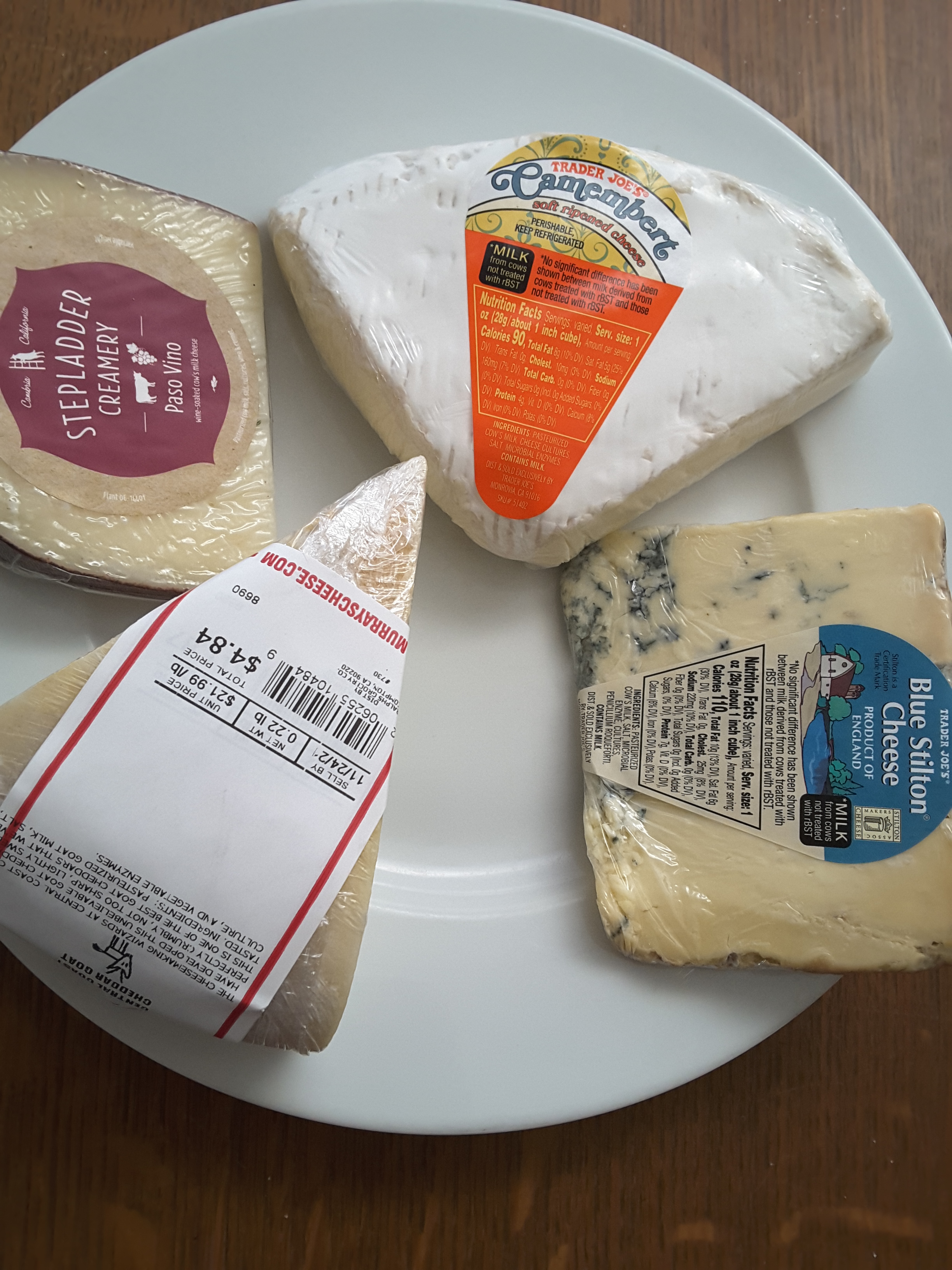
$20 cheese plate! Notes: 1. The Stepladder Creamery wedge, at $7, is the most expensive one here and full price; it’s still relatively inexpensive, wonderful and flavorful even in slivers, and produced by the dairy where my niece is a goat herd manager up near San Simeon. The other wedges are all over 5 ounces–the Ralph’s/Kroger/Murray’s Cheeses goat cheddar with vegetarian rennet at the lower left, contrary to what the upside down label says, is actually over 9 ounces, not the “0.22 lb” (3.5 oz) on the label. The full prices for the other two from Trader Joe’s: 3.60 for 5 ounces of stilton; 4.66 for 8 ounces of camembert, both vegetarian rennet.

And sometimes they’re actually big wedges, 6-8 ounces, that are nearing their sell-by date, or maybe they’re just not moving, so they discount and you can get a major bargain on things like Humboldt Fog or Cambozola, a stilton, or an aged goatsmilk cheddar or asiago-style cheese like Ewephoria. (Of course, occasionally you can find seriously discounted Limburger going for 75 cents a tightly-wrapped chunk, because they really, really want you to take it off their hands).

Continue reading

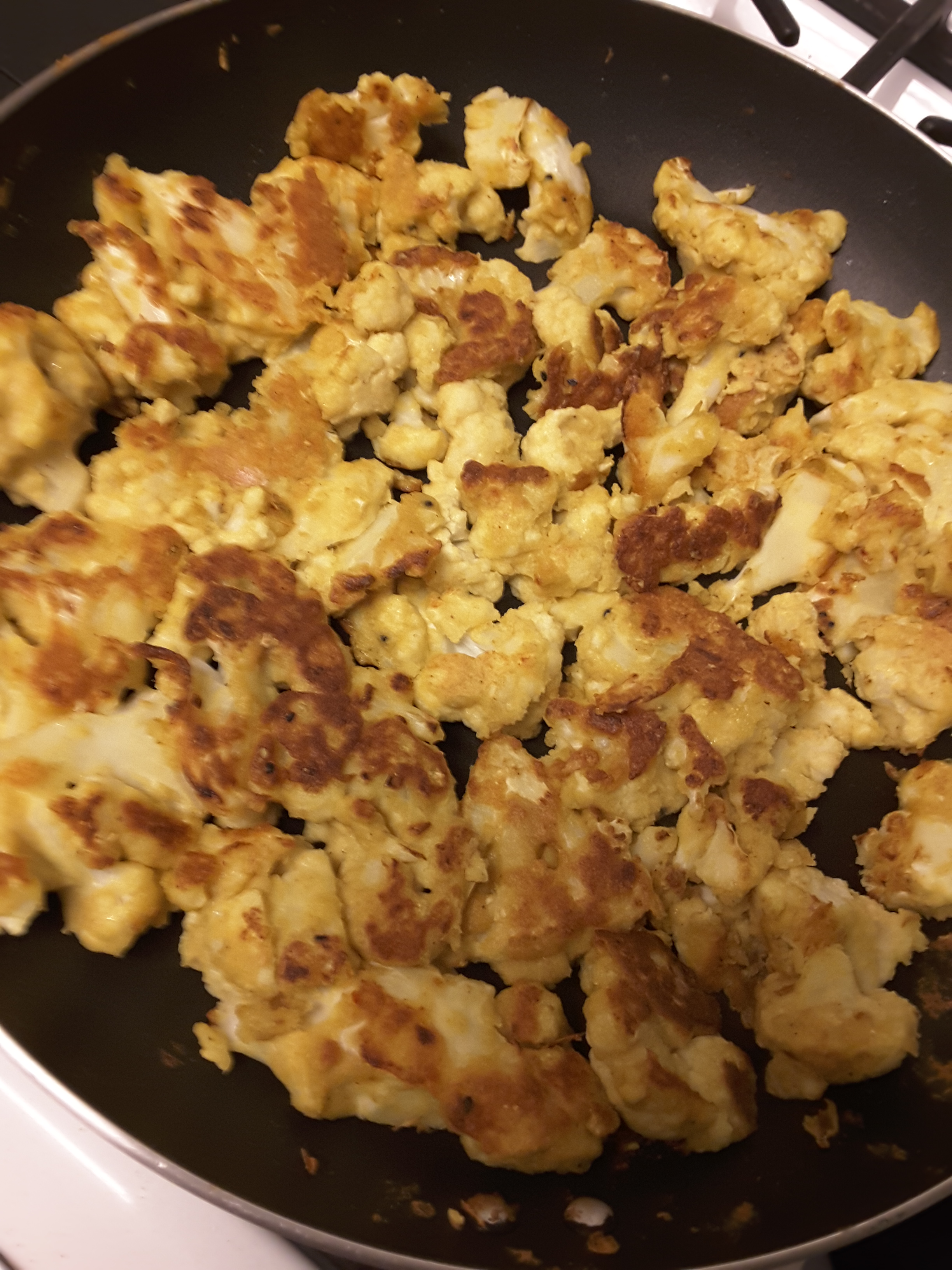
Cauliflower pakoras, lightened up

Cauliflower pakoras

Back at the beginning of Chanukah in mid-December, I was too busy to do much celebrating or posting. We were traveling more than usual and my daughter’s college application essays were still in rough shape and we were both a little panicked. My poor husband was working 13-hour days and trying to calm down the younger post-docs that this wasn’t ALWAYS how R&D goes–just sometimes. It’s the price you pay for doing rocket science.

And it was pretty hot and dry around Los Angeles–hence all those fires in the news. Makes it hard to feel safe breathing. Still, we did manage to celebrate modestly, even though the first night of Chanukah was during the nailbiter Alabama special election, whose results wouldn’t be in until after supper.

In any case, I’m posting this now because these are relatively quick and easy (and inexpensive) appetizers. They’re not super-svelte but not overloaded either, and they taste good, even after Chanukah is over (but please, make a fresh batch…)

I don’t do deep frying for Chanukah, particularly not with olive oil, which is expensive and wastes the oil and the calories (gotta save a few for the gelt–chocolate coins). And the cleanup. As my forebears did, I want to make a little olive oil last a longer time by using it sparingly with foods that deliver a slightly better svelte potential than potato latkes. Well–most of my forebears were more worried about getting enough food during the winter, not about eating too much, but let’s say my parents, who grew up in America with enough potatoes and enough oil to give you a gallbladder (and if that’s not a Jewish expression, I don’t know what is). In any case, frugality is warranted but so is enjoyment. How to balance the two?

I’m in love with gilded cauliflower–I think I’ve mentioned it a few (hundred) times. It’s quicker to prepare and probably even somewhat cheaper in salad bowl volumes than pasta or potato salad most of the year. Certainly more nutritious and sophisticated. And it contains garlic. I recently reinforced that view with my entire congregation when I brought a Sicilian (Roman? don’t exactly know) roasted cauliflower, pepper and artichoke salad to a brunch buffet after services. I was pleasantly surprised that by the end of the meal most of it was eaten and actually complimented on. I know, that’s not a true indicator in a lot of places, but Jews aren’t generally shy about telling each other what they really think, especially my congregation, and especially about food.

But I wasn’t totally in the mood for more of the same, even though I had about a third of a big head of cauliflower and some marinated artichokes left over from a frittata. Somewhere in the depths of my grains-and-beans drawer in the fridge (most people use it as a meat drawer; I use it to foil moths) I had stashed a bag of chickpea flour (Bob’s Red Mill; about $2-3 for a 16-ounce bag) because I thought I might make felafel (microwaved and pan-browned, still not deep-fried). But that seemed like a bit of work and kind of heavy.

When I went to pick up my daughter from school, I still hadn’t quite figured out how or what I was going to do quickly but semi-festively on a weeknight with homework and college applications looming. I knew I wasn’t even going to bother wrapping the presents I had for her and my husband, and I had to scrounge for enough candles to light the first night’s lights (note to self, get an extra box, one for next year).

As we passed a new Indian restaurant on the way home, though, it finally clicked.

“How about if I tried making some cauliflower pakoras?” I asked.

“That would be freaking delicious!”

OK, then. Continue reading

Surviving the holiday table

Yeah, yeah, I know. Last month every newspaper and online health magazine was brimming with handy top-10 tips to avoid stuffing yourself into a coma when you got over the river and through the woods to your in-laws’. Did it work? Did you try any of them? Was it even possible with the food available? MMMmmmph.

And…now we’ve started on the next round of holiday parties. And yes, I’m well aware, after last week’s “let the fools have their tartar sauce” tax subversion bill, that the tenor of my questions could equally apply to trickle-down economics, neocon “efficient” remote war management in Iraq and Afghanistan, “I am not a crook,” “too big to fail,” “No Collusion,” “FAKE NEWS,” and other fantasy favorites.

I don’t want to add to the burden of public speculation on the kinds of people who could genuinely fall for those slogans or excuse them in the face of the visible harm they do to all of us (okay, MOST of us. 99.9 percent of us). I’ve met some of these true believers, a few are actually friends, and they are otherwise decent, but really, stubbornly naïve is the kindest thing I can say. Tunnel vision, perhaps.

But back to holiday food–an even more fraught social topic. Because the same stubborn naïveté applies.

The trouble with most of the dutifully published top-10s for navigating party fare is how incredibly vague and trivial they are. They don’t give you a plate plan diagram like the ones for DASH/MyPlate balanced meals and the Idaho Plate™-style recommendations for Type II diabetes management. They don’t help you set a reasonable goal number for carb grams for the total meal including desserts and appetizers, and they don’t help you estimate anything or give you some sample sizes to go by.

Instead, they put the burden on you (or your kid) to select and use the fictitious ideal of self-control (more accurately known as “winging it”) in an environment that, to put it mildly, probably won’t support it. Oh, dear. JUST like the tax boondoggle.

There is also a big, big missing ingredient for most of these party suggestions: vegetables of worth. People don’t cook as much as they used to, chain restaurants and drive-thrus don’t really serve them, and the big food mags have almost dropped them from any party spread that isn’t for summer.

If there aren’t greens on the table, how do you fill half your plate with them as recommended by doctors and CDEs and RDs everywhere? If there’s one green vegetable dish and it’s breaded, panko’ed, crusted, dressed, nutted, topped, creamed or cream sauced, gratinéed, gravied, stuffed, sweetened, pancetta’ed, buttered or cheesed (I know, some of that litany is starting to sound a little obscene, as it should) to within an inch of its life, is it still worthwhile counting it as a green? Or is it actually mostly yet another starch with cheese, cream, butter, breadcrumbs, bacon bits and so on?

If you need to cover up any dish that thoroughly, it should tell you something pretty important about the recipe:

It is not exactly a taste explosion.*

Sorry, I WAS trying to get away from the obvious political metaphor, but it looks like it’s going to stick. (*And my thanks to the much-mourned Douglas Adams of The Hitchhiker’s Guide to the Galaxy series–and more specifically another of his books, Dirk Gently’s Holistic Detective Agency, for that line).

In any case, to survive the holidays and look good doing it, you need a winter holiday table that works better and tastes fresher and is actually lighter than the usual stuff and won’t leave you wishing for a sleigh to schlep your stomach home in after the party.

You need vegetabalia, ungunked. Some actual greens (or purples) on the table to lighten the load and redress the balance.

Actually, vegetabalia has always been a key part of classic dinner parties and it would be a shame to forget it, especially when you’re in the heart of winter. I don’t think I actually have ten ideas here, because as you may have seen in my previous attempts at top-10 lists, I tend to go a little overboard. Let’s see.

One way to do it without too much shock is to make the starch dishes a little smaller and the greens platters a little bigger and more numerous, colored, varied and–this is actually important, at least for a party–pretty.

Another is to add a green salad worthy of a celebration–keep it simple, elegant, just a couple of key and colorful ingredients that go together, not like something you scooped out of your local chain restaurant salad bar. See the big box of salad post for some inexpensive and winter-worthy vegetable selections that are easy to prep and store in the fridge for showtime and won’t look like “rabbit food.”

The third is to provide appetizers that are bigger on vegetabalia, ones that get beyond celery sticks, baby-cut carrots and bottled ranch dressing and are actually appetizing.

…Of course, the key element for avoiding idiots who take one look and say, “Oh. Rabbit food.” is not to invite them in the first place. The second strategy is surprise (in a good way, that is, not as in “celery with marshmallow fluff!”)

Good-looking vegetable appetizers that won’t bore people aren’t necessarily more expensive, especially if you buy bulk vegetables and wash and cut them up yourself. And some can actually be easier to make, and make look impressive, than lining up all those crackers and cheese slices neatly on a circular tray (my bane, I just don’t have the hostess/catering gene). The bonus: if you’re the host, you won’t have a load of crackers and cheese sitting around the house the next day, and you might have some fresh noshing vegetables left over, ready to grab and go.

Here are a couple of more specific (forgotten?) ways to make vegetabalia rock, cold and hot.

Crudités (#4)

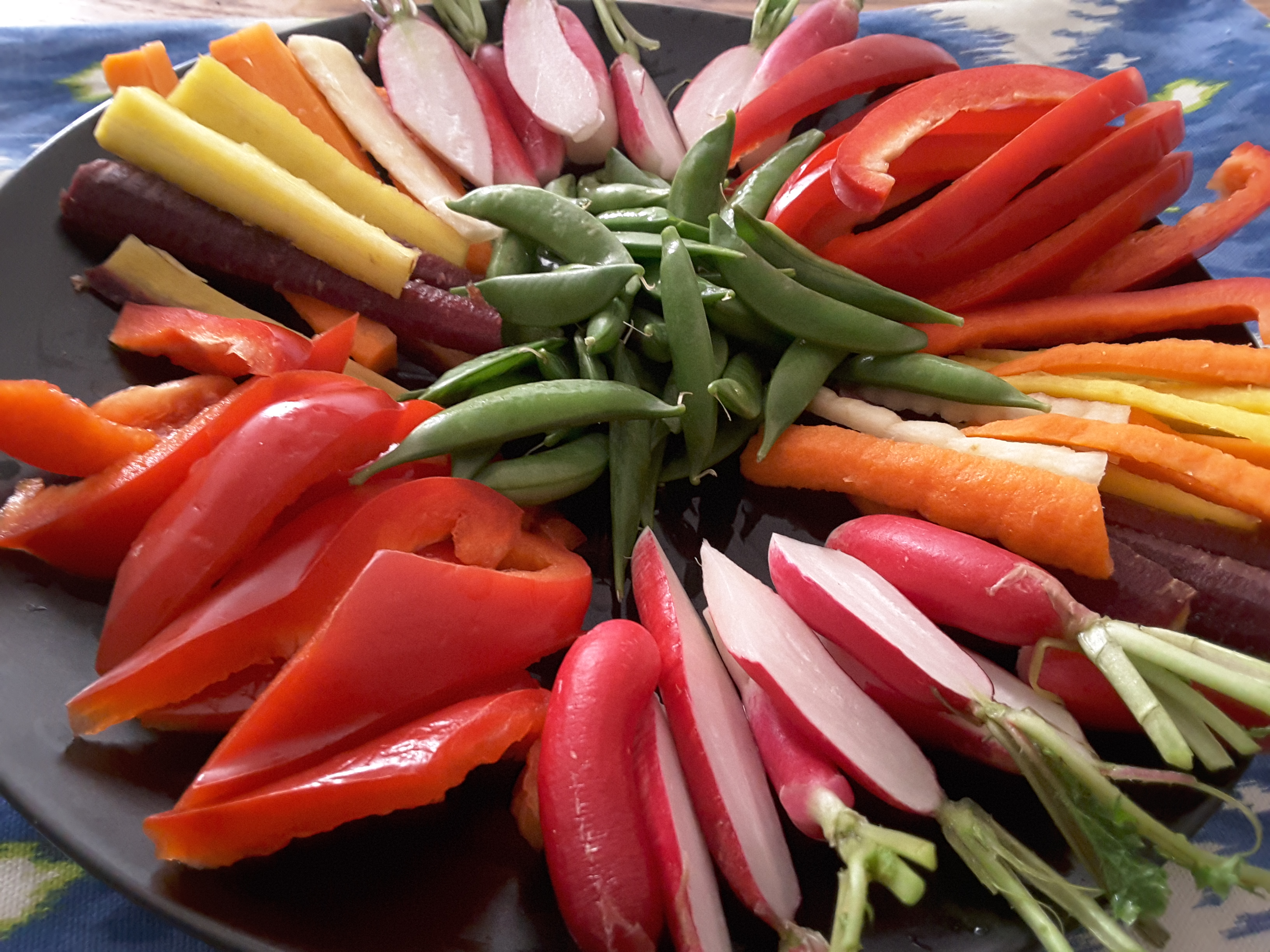
The “just wash and nosh” scheme for raw vegetables is pretty easy and can even be elegant for a raw vegetable tray. You don’t need fancy chef-school knife skills or fancy expensive knife sets to make the magic happen, either.

You don’t have to do a massive tray or a zillion different expensive designer raw vegetables–three or four types on a medium platter with some contrast and a good fresh dip make a nice party display. At between $1 and $5-6 (for heirloom, top-end stuff or for portobello mushrooms) per pound, most noshing vegetables are also cheaper than many chips-and-dips junk foods, designer breads, cheeses, sliced deli meats, and premade party platters of just about any kind.

Do get away from the tedious carrots-and-celery-sticks-and-ranch-dressing version, even if you are doing carrots and/or celery. Celery and carrots are still good, mind you, but you might want to grow them up a bit, cut them differently, add one or two less common dipping vegetables for variety and something fresher and more interesting than ranch dressing for a dip or spread.

Usually I’m against “fashion vegetables,” heirloom everything and bagged, prewashed/pretrimmed veg because of the price markup compared to bulk. But if you’ve got access to something a little extra in an unexpected color (purple is good, so is bright yellow), like purple cauliflower or multicolored peppers, you might want to go for it just once in limited amounts and mix them up with the regular vegetables.

And there are non-designer vegetables with enough mix of color and flavor to do the pretty at a slightly lower price point.

  • Regular globe radishes are pretty bright and crunchy and eye-catching and peppery–lop off the thin root and most of the stem; wash them really well to get out any sand and keep them whole or slice them in half lengthwise. If you have a local farmer’s market that doesn’t slap on chichi markups in the price per pound, or you happen to see a bunch of longer or otherwise eye-catching radishes for about the same price in the produce section of your grocery store, go for it.
  • Fancy variety pods like sugar snap peas and snow peas–even raw green beans–are a nice choice too. You can get bulk snap and snow peas for about $3/lb. at the Ralph’s/Kroger’s and fresh green beans are sometimes on sale between Thanksgiving and New Year’s for under $1/lb. but usually about $2/lb.
  • Trader Joe’s sells 2-lb. bags of multicolored full-sized organic carrots for about $2 at this writing. White, deep purple with a gold core, bright yellow…pretty dramatic and they mix up nicely with the cheaper orange ones without being a lot more expensive.
  • If you can get colored full-sized bell peppers, maybe get one or two, and choose colors other than green. Sliced lengthwise they go pretty far in brightening up a vegetable tray.

Continue reading

Celebration Update: “Mashup” Does Not Mean “More Potatoes”

Two or three Thanksgivings ago I railed (as I often do) at the lack of imaginative and good-looking (both aesthetically and nutritionally)  vegetarian offerings for Thanksgiving main dishes. I wasn’t having a whole lot of luck being impressed by what I saw in the newsstand food glam magazines, vegetarian and vegan cookbooks, food blogs, my local newspaper food section, or even the freezer section of my local Whole Foods. So I came up with a list of suggestions for vegetarian centerpiece dishes.

This year, we had the double-double challenge: Thanksgiving fell on the first day (though only the second evening) of Chanukah for the first time in over 100 years (1860s was the last time?) and won’t again for another 77,000 or so (well, some sources say there’ll be another Thanksgivukkah moment in about another 100 years and then the big schlep out to 77K. Either way, for most of us, this is “that moment”).

For me, mashing up Thanksgiving and Chanukah just this once gives us some ideas for rethinking the kneejerk popular way of celebrating the big important holidays in general. Maybe even exploring what’s so vital about holidays and family and clearing away some of the thoughtless excesses.

Chanukah came so early this year that we had nearly no chance at buying or making tons of presents before having to schlep ourselves up the I5 to my in-laws’, so none of us was expecting anything but silly socks, a paperback or so, and maybe a stop in Solvang for Danish marzipan-based sweets on the way back home. That’s all to the good–Chanukah was never really meant to be a “more presents all the time” kind of holiday, it’s about freedom of religion, freedom from outside oppression, and gratitude for the miracle of having enough resources to go around. Thanksgiving is about those things too.

Unlike most years, I didn’t find a two-page checklist that Martin Luther would be jealous of, listing all the acceptable giftees our daughter wanted, posted on the fridge. Partly that’s because we wouldn’t be home to see it, and partly because she already had her bat mitzvah in June and she’s old enough now to feel like it’s more than plenty in the way of gifts. Plus by now she knows me–I have a strong tendency to roll my eyes and cross most of the stuff off the list with the familiar yearly litany of:

“Library…library…library…library…not wearable at school or synagogue, so what’s left, the mirror?…we have an unusually skilled cat and I don’t really want to think about hamsters in that context, do you?…library…library…not until you practice piano…I know I promised you could get your ears pierced eventually…maybe next month…”

It’s just a matter of practice. And a willingness to channel Sylvia (one of my favorite cartoon characters,  by the great Nicole Hollander).

Anyway, I have no idea if any of my ideas the last time I riffed on vegetarian centerpiece dishes gave someone else ideas–I hope so–but recently I ran across a vegan cookbook with dishes that look like they’d be just right for a celebration. It’s too late to recommend for Thanksgiving or Chanukah, but maybe for Christmas and onward? Continue reading

Not Gefilte

For most American Jews, gefilte fish is one of the standard, unchanging preludes to the actual dinner part of the Passover seder. And normally I have no problem with that, especially with hrein, or horseradish. By the time the recitation of the Haggadah and the explanation of the items on the seder plate are done, everyone is joking about (or egging on their kids to pipe up and ask) the Fifth Question: When do we EAT??? And gefilte fish is the first answer.

It’s worthwhile to be hungry enough for once to feel, rather than just nodding as someone tells you self-righteously, that such a modest dish, made with fresh fish in the days when most of our grandparents and great-grandparents were too poor to eat it often, can be something to look forward to.

Gefilte fish is basically an oversized quenelle of ground whitefish and pike, filled out with eggs, onion, and matzah meal to stretch it. Simmered in fish stock for a couple of hours with or without added sugar, cooled to let the broth gel, served room temperature or cold, with horseradish as contrast.

But since most of us don’t make our own gefilte fish at home anymore, it’s usually bland, salted (and sometimes sweetened) ovals of stuff pulled from a pricey store-bought jar–no longer what you’d consider fresh, and no longer economical. And it’s usually about twice as big as any normal/sane appetizer for a meal that’s going to include brisket, chopped liver, meatballs, eggs, chicken and/or turkey, and other big proteins.

Can it be made well fresh? Yes, actually, and a number of Jewish cookbooks–Joan Nathan’s among the leaders–tell you how. But do I want to cook it myself, or eat it any other time than at someone else’s seder? No. Flat out, no. Not only is it a two-hour-plus process, it’s a big chore. All for a mediocre, bland kind of fish dumpling.

The other problem this year is that my daughter is now diabetic, and for the first time I’m going to have to help her count carbs so we can give her the right amount of insulin for a seder meal that will probably last over two hours. It’s tricky enough to do that accurately for a restaurant meal–desserts, which come last and for which the menu isn’t usually even presented until you’ve already eaten the meal, are by far the hardest foods to estimate by sight.

But traditional Ashkenazi-style seder dishes like gefilte fish and matzah ball soup are stuffed full of surprise carbs too, and you can’t be sure how much they contain unless you’re the cook. And that’s not counting the mandated matzah and haroset. All you can say is, all that matzah meal really starts to add up. Will my daughter overrun her carb count before she ever gets to the meal itself, with a chance to risk it on (more matzah-filled) desserts?

If I cook some kind of fish during Pesach week, I want it to be fresh and without much in the way of carbs. Most of all, I want it to taste good. Actively good. Continue reading

Recipe recycling at the LA Times

Sign of the Times? Passover recipes from past years are apparently easier to reprint than to update–and that goes for the dates themselves. Passover actually starts this Monday night, March 29th, not–as this LA Times rehash would have it–April 8th.

Impatient for Orange Peels

Microwave Candied Orange PeelTonight is the first night of Chanukah, or as the next generation spells it, Hanukkah, and instead of blogging about latkes, which I’m not making tonight, in favor of a congregational dinner (yay, no cooking, no dishes, no family kvetches), I decided to pick something else I like more. Like candied orange peel, which is outrageously expensive if you buy it at a candy store. Chocolate plus oranges is the flavor of Sabra liqueur, an Israeli elixir from the days of my childhood which I think is now out of production. Of course, so’s my childhood, or at least my first childhood…

But the standard recipe for candied orange peels goes something like: “Boil some water. Blanch the de-pithed orange peel strips from a couple of oranges for two minutes. Throw out the water and do it again. Then simmer the peels in 4 cups of sugar and 4 cups of water for an hour or two. Then drain them. Then toss them separately in a bowl with fresh, dry sugar to coat and spread them out on a cookie tray to dry for another couple of hours.”

In all, that’s about 4 or 5 hours. Oy! My inner second childhood is whining already.

Following up from my microwaved kumquat marmalade experiment, which worked beautifully, I decided I could probably do something similar to candy orange peels. The final result was not perfect-perfect by professional confectioners’ standards and I wouldn’t be surprised if Martha Stewart disapproved, but it looked okay to me, was done in 15 minutes from peeling oranges to dredging-and-drying, and the taste is not bad, not bad at all. Makes you wonder.

The oranges I picked were a bit bland and nonacidic, and tangerine or clementine would be a bit livelier if you can find organic ones, but this is what I had. And as I discovered, the flavor seems to improve as the peels sit after being dredged in sugar and dried. Continue reading