
• Enter your email address to subscribe to this blog and receive notifications of new posts by email.

    Join 241 other subscribers
  • Noshing on

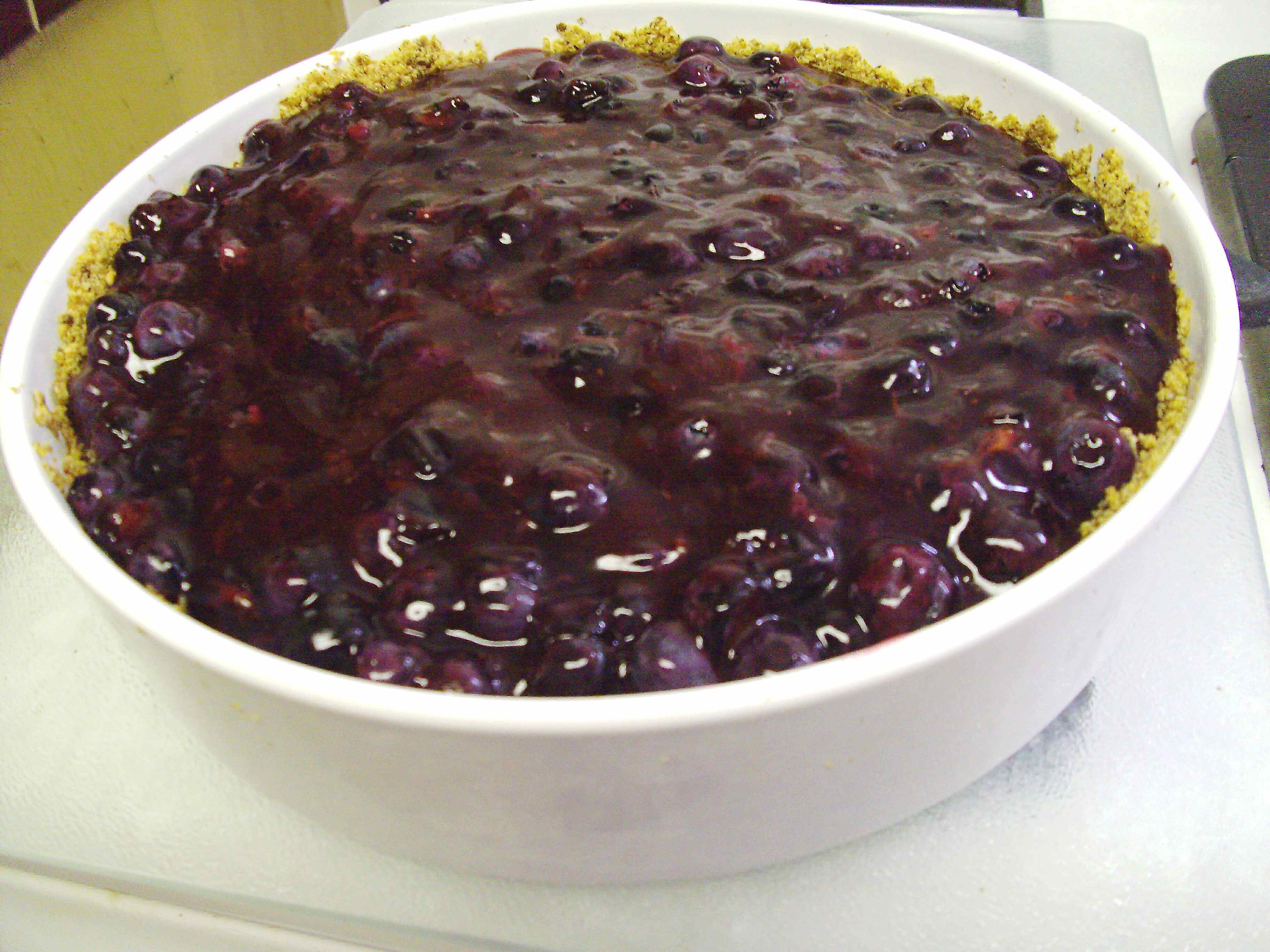
    raw blueberry pie with microwaveable filling and graham cracker crust

    This mostly-raw blueberry pie is a snap to make and very versatile--the filling microwaves in a few minutes, and you don't even have to bake the zippy gingered graham cracker crust--perfect for a hot Fourth of July and all summer long.

  • Recent Posts

  • Contents

  • Archives

  • Now Reading

  • See also my Book Reviews

  • Copyright 2008-2024Slow Food Fast. All writing and images on this blog unless otherwise attributed or set in quotes are the sole property of Slow Food Fast. Please contact DebbieN via the comments form for permissions before reprinting or reproducing any of the material on this blog.

  • ADS AND AFFILIATE LINKS

  • I may post affiliate links to books and movies that I personally review and recommend. Currently I favor Alibris and Vroman's, our terrific and venerable (now past the century mark!) independent bookstore in Pasadena. Or go to your local library--and make sure to support them with actual donations, not just overdue fines (ahem!), because your state probably has cut their budget and hours. Again.

  • In keeping with the disclaimer below, I DO NOT endorse, profit from, or recommend any medications, health treatments, commercial diet plans, supplements or any other such products.

  • DISCLAIMER

  • SlowFoodFast sometimes addresses general public health topics related to nutrition, heart disease, blood pressure, and diabetes. Because this is a blog with a personal point of view, my health and food politics entries often include my opinions on the trends I see, and I try to be as blatant as possible about that. None of these articles should be construed as specific medical advice for an individual case. I do try to keep to findings from well-vetted research sources and large, well-controlled studies, and I try not to sensationalize the science (though if they actually come up with a real cure for Type I diabetes in the next couple of years, I'm gonna be dancing in the streets with a hat that would put Carmen Miranda to shame. Consider yourself warned).

Purim: Poppyseed filling with a Persian-style twist

poppyseed filling with orange blossom water

Tonight is Purim, when we dress up in costume, make fun of dire villains and dull kings, cheer modest heroes and most of all praise a heroic woman, Esther, who risked everything to change the king’s addled mind and spare the Jews of the Persian empire.

In previous years, I’ve done the Hamantaschen thing–low carb, medium carb, all homemade, no pasty white horrors, praise of Joan Nathan’s basic recipe from her first cookbook…lots of non-Dayglo, non-candy fillings from figs, prunes, apricots, and so on…

Today I’m probably not going to get a chance to bake anything or even cook very much, because I decided to take a leaf out of Esther’s Megillah this year and read part of the fifth chapter, splitting it with my (much-wiser-than-Ahashverosh) husband. So about three days ago I decided I was going to go for it and learn the Purim cantillation (trope marks for chanting) system. Which takes more nerve than usual, because it’s tricky and somewhat deceptive, like the entire story. And it’s been almost two years, since my daughter’s bat mitzvah, since I’ve even chanted Torah. And, like I said, three days ago. Not brilliant.

Luckily there’s Youtube. And a number of synagogues post recordings by their hazzanim (cantors, male and female) for the cantillation marks and for the readings as a whole. Only there are so many versions for Purim! It’s a late holiday in our history, after a lot of us were living in the Persian empire, and the different melodies reflect our already dispersed community. One interesting version was by a Moroccan hazzan–his system actually had a couple of trope mark tunes that are nearly the same as ours for the regular weekly Torah and Haftarah readings. Maybe those are the oldest ones that everyone has more or less in common? Cool!

So–our daughter is chanting a few verses with her youth group for Chapter 7 tonight, and the director is bringing kosher Persian food from a restaurant on the West Side of LA, where the largest Iranian (and Iranian Jewish) community outside of Iran resides. I wish I were a kid tonight, for sure.

Still, in honor of the occasion and the roots, I did get around to making poppyseed filling for the hamantaschen I’ll make tomorrow.

I went to my local Armenian greengrocer yesterday morning for vegetables and picked up a new bag of poppyseeds, hoping they were fresh, really fresh enough to use. My previous latest bag in the freezer has puffed up suspiciously with air–suggests it’s no good and starting to release gases even though I didn’t open it before freezing, dammit.

I tasted the new poppyseeds raw–okay. But rancid sometimes only shows up when you toast them, so I poured a spoonful in a metal pan and swirled them around on the stove until the aroma came up. Then I test tasted those once they were cool enough. Still good, still lucky.

Poppyseed filling is quite an elaborate affair in my trusty 1984 spiralbound edition of Joan Nathan’s The Jewish Holiday Kitchen. Figs, apricot jam, brandy, egg whites? Oy. Ten or more ingredients. A production, and kind of expensive considering how many younger people don’t like poppyseed filling. Including my daughter, I’m sad to report (see below)…

But I do, which is the important thing, and my supermarket no longer carries those cans of Solo in the Jewish Foods section. So I decided it was fine to simplify. And while I was at it, to add a hidden Persian-style element or so for the occasion of Purim.

So this filling looks black…but holds the essence of early spring and orange blossom within it. And if anyone doubts that it’s completely effective in its ability to transform, at least temporarily, I should add that my daughter, who insisted she tells me every year she hates poppyseed filling with a hot hate, and that I never listen, took a tiny bite and looked surprised and pleased…at least for about five seconds, until the bitter toastiness of the poppyseeds came through like a bagel at rush hour, poor kid, and she pulled a Tom Hanks (from Big, the caviar scene). She even did the wiping-the-tongue-desperately-with-a-napkin bit. And no, I’m not sure I should be telling you this. Five seconds delay, though. From her, I’m gonna have to count that as a win. And it was pretty funny, another point to Purim.

Poppyseed Filling With a Persian Twist

  • 6 oz (172 g; it was the size of bag they sold) very fresh poppyseeds
  • 6 oz. sugar (again, 172 g, but anyway, the same amount as the poppyseeds)
  • 1/4 c (60 ml) water
  • juice of a lemon
  • orange part of the rind of an (organic, washed) orange or tangerine (in this case), grated or if that’s too much of a pain, shredded with a knife and ground in a coffee grinder or food processor with an additional spoonful or so of sugar
  • pinch each of ground cloves and cardamom (if you have it)
  • very tiny shake or grinding or pinch of nutmeg
  • up to another 1/2 c. water (see instructions and PS note at the bottom)
  • 1/2 t. vanilla
  • 1 t. orange blossom water (yes, this was my idea of the Persian twist, and it’s good, though probably it should have been rosewater for authenticity–I just wasn’t ready for that)

Taste-test the poppyseeds raw, then toast a spoonful in a dry steel saucepan on the stovetop until you start to smell their aroma. Cool and taste-test again before using to make sure there’s no funky, off, or rancid flavor to them.

ground poppyseeds

Then grind them a few pulses in a coffee grinder (in two batches) or in a food processor or blender.

In the steel saucepan, combine the sugar and water with a squeeze of lemon and let the sugar wet down all the way before turning on the burner to medium. Bring just to a slow simmer without stirring–the slurry should start to go clear as the sugar dissolves.

poppyseeds cooking in syrup

Add the ground poppyseeds and stir gently. It should be a thick dark-gray grainy mass. Keep the pot on a low heat so it bubbles gently but doesn’t spit for about 5 minutes, stirring occasionally but not hard or you might cause the syrup to seize. As it cooks add the lemon juice, spices, grated orange or tangerine rind and stir in, then [see the PS below] test-taste–if the seeds are still kind of hard, add 1/4 c. water, let simmer with a lid partway on for a few minutes, stir and do it again here until the seeds soften a bit and the raw-poppy edge is off. Add the vanilla and just before taking it off the heat, stir in the orange blossom water. Take a tiny bit and let it cool enough to taste and adjust any flavorings, then take off the heat and pour into a container to cool to room temperature. It will thicken further, especially after you put it in the fridge.

B’te’avon, bon appétit, and Chag HaPurim Same’ach!

PS…AKA, next-day “Do-over,” kind of. Because I wouldn’t want anyone to try this, be happy for a few minutes, and then kind of hate the result when they took a second taste. If it needs a fix, it needs a fix, and I felt this did…

The next day I took it out of the fridge for a taste test before deciding if I really wanted to bake…it was pretty grainy and the top was crusted sugar. I stirred it and realized the seeds were pretty hard still and kind of bitter–not rancid, just really raw-poppyseed. Very strong. I think I didn’t have enough liquid in the recipe compared with Joan Nathan’s, even without all the jams and things. She had “juice of an orange” in there somewhere next to the juice of a lemon, and I’d assumed it was mostly for flavor, but probably the extra liquid helped cook the poppyseeds too (hence, the “up to another 1/2 c. water” bit I’ve just added to the ingredients list).

Never one to look away from a challenge (oh yeah? I hear someone muttering sarcastically in the background)…I decided to reheat the filling in the microwave with some extra water and a lid for a minute or so and see if that would induce the poppy seeds to absorb some of the water and soften up a bit. I stirred in about 1/4 c. of water, which immediately went cloudy-white, kept stirring, and the filling thinned almost to pancake batter consistency. Put a lid on and heated 2-3 minutes in the microwave, let sit a few minutes to absorb. It was better as well as thicker, and a little of the poppyseed bitter edge was out as well. So I did it again with another 1/4 c. water, heated 2 minutes or so, let it sit again and it thickened back up but the seeds were definitely softer and a little more brown than black (although I admit it’s pretty hard to tell).

In any case, I’d do this the first time around while it’s still cooking on the stovetop. Add the extra water in bits after you’ve added the poppyseeds and spices, and before adding vanilla or orange blossom water (so you don’t evaporate them off). Expect to cook it down from about pancake batter looseness until it becomes very thick, a grainy paste. Then taste a little and feel to see if the seeds have softened and mellowed in flavor–add more water and cook longer or else do the microwave thing instead if you’re impatient, but I think it might only take maybe as much as 15-20 minutes on the stove rather than the 5 minutes I’d expected.

Safety: The only thing about heating syrups in the microwave (this is basically a syrup with seeds) is that they can get very, very hot. So 1. keep an eye on it while it’s heating and be ready to stop the microwave if it starts to boil over (this didn’t, either time, but you just don’t know) and 2. don’t use a plastic microwave container because the mixture could melt or scar plastics. Proper microwaveable ceramic or old-style borosilicate pyrex is ok if you still have some from 20 years ago or can find it in Europe and tote it home. (NOTE: “new Pyrex” that clanks and is made outside the US is made of soda lime glass and is not very heat-stable–see right sidebar warning).


Purim options

standard cookie-dough hamantaschen

Regular hamantaschen with prune lekvar

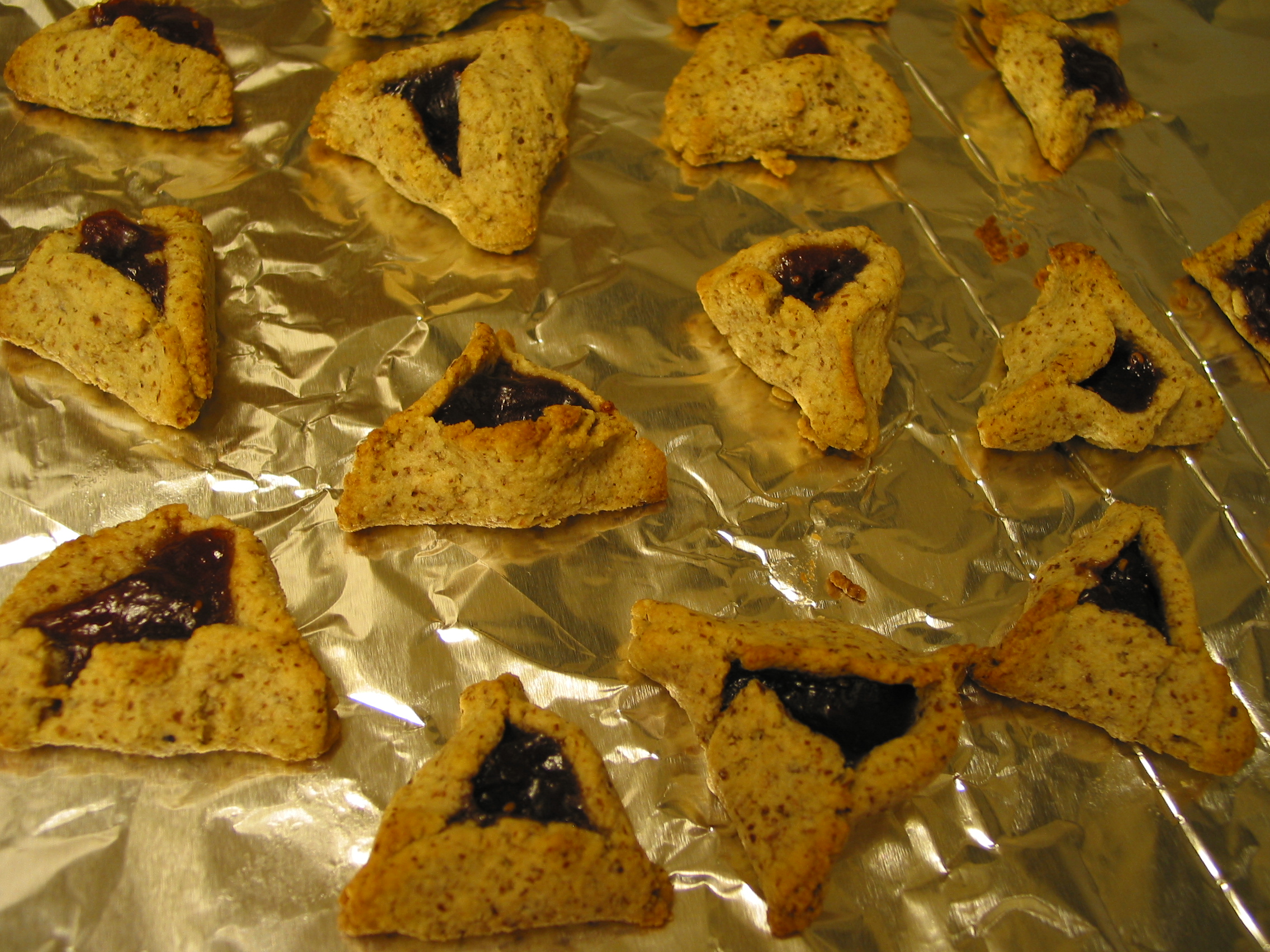
Almond meal-based low-carb hamantaschen

Almond meal-based low-carb hamantaschen

Purim is here tonight, a little late thanks to the “leap month” this year (drawbacks to a lunar holiday calendar) but none the worse for it–it’s over 80 degrees here, which means it’s almost time for Purim. Los Angeles is the only place I’ve ever been, including Israel, where people were slathering sunblock on their kids and gasping for water bottles at a Purim carnival well ahead of lining up for hamantaschen and games. It was 94 degrees that year. Fifteen years of this and I’m still not used to it.

Purim, of course, means manic baking, heat wave or no, because the adults’ reading of the Megillah (the Book of Esther) had…ummmm….last-minute planning and no one thought about hamantaschen as part of the refreshments until midweek. I think I’m the only one left in our  shul who still doesn’t care about having a fabulously original themed cocktail party for the adults afterward. Any kind of cocktail party is more drinking than I want to do, and I’m damned if I wanna dress up in full office battle array again after so many years sidestepping all the suits in my closet, just so I can fit in with the Mad Men theme. I’ve never even seen the show.

But I actually make hamantaschen at home once in a blue moon instead of schlepping over to the Valley to buy them from a kosher bakery.

So I did the stupid, crazy thing and volunteered. How many people? I asked–maybe 60. So I have SIX batches of dough sitting in my freezer relaxing. It took about half an hour, about 5 minutes apiece,  to do all the batches in the food processor, one after another and weighing out the ingredients so they’d be consistent. And yet…after all the excitement from two weeks ago, I’m just not all that geared up to roll it all out and bake it just this minute. Maybe when things cool down slightly–half an hour? Maybe?

Friday happens to have been Pi Day as well–and to my daughter, who was supposed to be my second-in-command for this delicate operation, and to her algebra teacher this morning, that meant Pie Day. They had about four different kinds of pie for all the math classes, and none of them had to calculate the areas or volumes of the wedges they sampled. My daughter, of course, was so elated that she ate two entire meals’ worth of carbohydrate in about fifteen minutes, and still came out with a pretty good blood glucose number an hour later–good on the calculated guesses, there–but at the cost of running through insulin that could have lasted her three or four more hours if she’d eaten an ordinary lunch. Teenagers! Mothers of teenagers!

Still, not to lose the spirit of things too much. It occurs to me that hamantaschen qualify as very small pies, only triangular. So we eventually started the process of inscribing a triangle inside a circle–240 times, if we can get through all the batches before showtime. Me, I’d settle for 3 or 4 batches and call it a week.

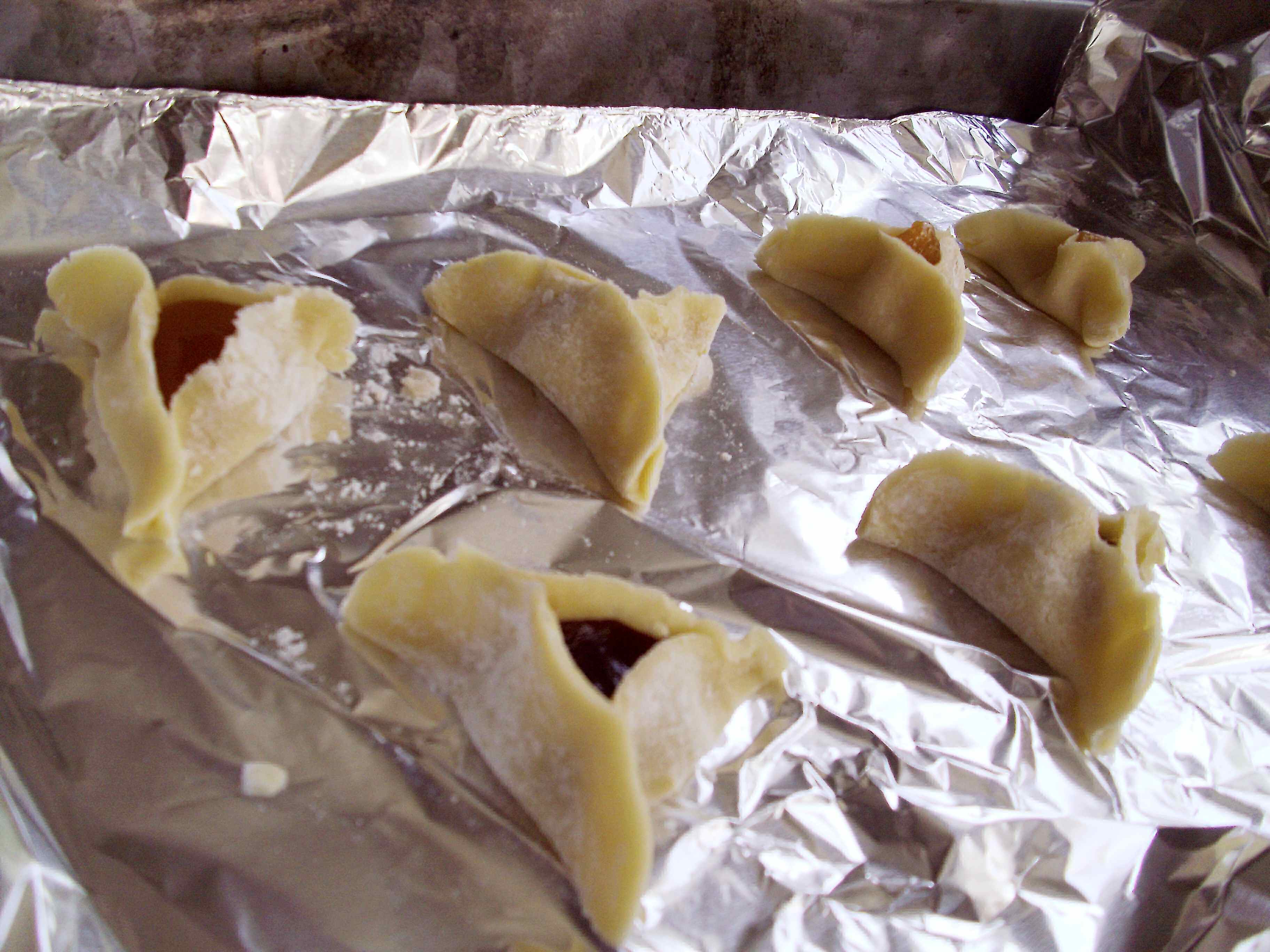
The raspberry jam filling–all that hard work for the first batch of rolling and filling–leaked all over the place. Too bad there isn’t still a vogue for vampire-everything; the first batch would have qualified! Too thin. You need a thick serious filling to stay in place during the baking.

So–time to nuke the prunes for lekvar and the figs for the heck of it (plus toast a small sampling of the poppyseeds in my freezer to see if they’re still okay to use for a filling, and to make sure I don’t pour in the bag of nigella seeds instead by mistake!). I rarely see these anymore, but I still believe in doing traditional fillings alongside the modern, newfangled apricot-jam-and-chocolate-chip ones. It’s true that if we keep skipping the prune filling, we might not turn into our own grandparents, and if we miss out on the poppy seed filling (known in Yiddish as mohn) we might pass the all-critical drug tests (à la Seinfeld) with no interferences, but then again we’d miss the ta’am, and what’s the joy of hamantaschen without a taste of the past?

Hamantaschen Recipes

Low-Carb Almond Meal-Based Hamantaschen

My version of Joan Nathan’s Hamantaschen, with four fillings: poppyseed, prune, apricot/chocolate, labaneh/cheesecake

Microwaveable dried fig and dried apricot fillings (originally for fillo pastries, but still good for this, and a lot less drippy than jam)

However–if you are feeling “Mad Men”, you might think of reconfiguring the hamantaschen motif for cocktail party fare instead. I was thinking about this Thursday but figured it would be too weird. Then I saw an article about it yesterday in one of the big three newspaper cooking sections–dammit! scooped again! In any case, if you’re feeling a little avantgarde, you could do a batch of savory hamantaschen if you feel like it. Use rugelach, bureka or olive oil tart dough instead of the standard sweet dough. Roll it out fairly thin, and fill with feta or bleu cheese mixed with labne or very thick sour cream, plus a little onion and some thyme, maybe a pecan or two. Or something with very cooked-down mushrooms and onions (so they don’t get soggy). Or pesto and cheese. Or spinach with cheese and nutmeg and lemon rind. Or tapenade. Etc.

Chickpeas of all sorts and descriptions

Since Esther supposedly refused meat and ate only chickpeas, chickpea recipes are also more or less relevant to Purim. Mine are not particularly traditional–look up Iranian Jewish recipes elsewhere on the web.

Chickpea crêpes  These can be savory or sweet, and they don’t require eggs or milk

The “other” moussaka–eggplant and chickpea stew

Hummus from scratch (aka how to nuke dried chickpeas)

Fast Hummus made with chickpea flour (microwaved)

There’s also the possible “nahit”–fry chickpeas in olive oil, drain and sprinkle with salt and pepper.

Or a cold chickpea salad with mint, scallion, garlic, olive oil and lemon juice or vinegar.

Or channa masala dal, something like the red lentil dal but with chickpeas (and not mashed)

Pinned for Purim!

Thanks to Yael Shuval for choosing my Low-Carb Hamantaschen for her board at Pinterest.com.

Three years ago I developed almond-meal based hamantaschen for my daughter, who had been diagnosed with Type I diabetes only a couple of weeks earlier and needed something that was low enough in carb that (at the time, anyway) she could actually have one or two when all the other kids were having theirs and without having to get an extra shot of insulin.

Almond meal has only about one-fourth as much carbohydrate per cup  as wheat flour, so it seemed like a good substitute. To our surprise, although the dough was a little finicky to work with, the hamantaschen came out tasting pretty good, and they were indeed pretty low carb, about 4-5 grams per mini-hamantaschen. Granted, they were also pretty small, but it was a symbolic triumph in the first few weeks and made us all feel like being diabetic wasn’t going to be the end of having fun.

Now that my daughter is on an insulin pump, getting an extra shot is no big deal, though in our experience the pitfall is that it’s now just a little too easy, especially for a preteen, to “eat anything you want, at any time, without thinking about it, as long as you program the insulin for it” which is one of the less responsible marketing messages in Medtronic’s brochure for teenagers (note: the pump itself is pretty good, but it still doesn’t mean you don’t have to be careful about what you’re eating). Those sour gummy heart candies the teacher handed out for snack earlier this week and left on my daughter’s desk, for instance….well, candy never seems like as much food as it really is, and I think my daughter gained a valuable lesson when she added up what she’d really eaten…she wouldn’t be the first one.

It’s always good to have a general plan in place for holiday eating so you don’t overdo the treats or eat an entire meal’s worth of carb in just a few cookies or candies or whatever…what can I say, we’re working on it.

Still. In the last year or two I’ve mostly gone back to making standard hamantaschen based on Joan Nathan’s classic cookie-dough recipe, which I like a lot and which looks and tastes much, much better than the dry, pasty-white horrors at the annual Purim carnival.

hamantaschen1

What I like about the standard flour-based recipe, other than that it tastes and looks good and is easy to work with, is that I can roll the dough out very thin and get crisp, delicate hamantaschen that are a decent cookie size but still hold together nicely and are not extravagantly carb-laden, particularly if the fillings are reasonable and you don’t eat ten at a time (the big challenge). They’re not as low-carb as the almond meal ones, but they still work out okay–about 7 grams apiece for a 1.5-2″ cookie. They taste good even made with pareve (nondairy) margarine instead of butter.

The LA-area idea of hamantaschen usually involves M&Ms, colored sprinkles, anything completely artificial. I bet gummy sour hearts (this afternoon’s culprit) would be a huge hit too. I don’t think they’ve heard of either prune or poppyseed out here in at least a generation.

Traditional fruit or nut fillings are a much more decent bet for carb, and they taste better (and look nicer too, because I’m not 6 years old and don’t insist on rainbow colors anymore). They’re also easy to make from scratch in a microwave or on the stove top so that you can decide how much sugar to put in them. Continue reading

Low-Carb Hamantaschen Without Artificial Sweeteners

Almond meal-based low-carb hamantaschen

The first batch didn't roll out so easily, but these coin-sized minis tasted pretty good. The next batch rolled out thinner and held together better for a larger cookie with a delicate crust.

Baked goods are a big part of Jewish holidays at this time of year. Purim, being celebrated this weekend, is the last big baking bash before Passover, and hamantaschen (named for the hat, ears or purse of Haman, the villain of the story of Esther) are the cookie of choice. But with a diabetic kid in the house, the usual prospect of baking them takes on a bitter edge.

Hamantaschen–in fact, most cookies–have enough grams of carbohydrate that just two medium-sized cookies contain about half of what she’s supposed to have in any given large meal, twice what’s recommended for a snack, and they don’t have enough fiber or protein to slow down the sugars and avoid a spike in blood glucose. In short, not high-quality nutrition (not that we expect cookies to be). A grownup would have trouble dealing with the prospect of leaving them alone when everyone else gets to have them, but a kid faced with Purim celebrations at school or synagogue is bound for a certain degree of heartbreak.

It’s made me rethink our whole attitude toward things like Girl Scout cookies (this is also the season for that), chips, M&Ms, in fact any casual snack food that gets handed out innocently at school (our current woe–apparently my daughter’s teacher does this kind of thing at least weekly). The snack habit–anytime, anywhere, any or no reason–has become so ingrained in daily life we hardly think about whether it’s appropriate or not. Certainly the handouts are happening more and more frequently in class than I remember when I was a kid–did teachers even hand out treats back then? Not in my elementary school. It’s especially hard for a kid to “just say no” (and we already know how well that advice works in other contexts) when everyone else is taking a cookie or some M&Ms as a reward for answering a question (can they even keep their minds on the subject)? And even worse when it’s the teacher handing them out, because the teacher’s supposed to know whether it’s ok to eat or not.

Maybe we shouldn’t be handing these things out so casually or so often? Because while most people can handle surprise extras like these, they’re probably not all that good for anyone to eat indiscriminately at just any time of day. If they’re spiking a diabetic kid’s blood sugar, you can be sure they’re doing the same thing to your kid’s blood sugar too, only his or her body is responding with extra insulin to cover it. We get to see the results directly every couple of hours with our daughter–complete with sudden attacks of giddiness or tears if things peak and crash too quickly. But the same kind of thing happens to some degree to a lot of kids who aren’t diabetic, and they probably get reprimanded for it. Probably happens to a lot of adults, too.

Still, it’s the holiday, and total deprivation from treats is not really my aim today. So I’ve been trying to figure out a revised recipe for hamantaschen with a more manageable carb count, and preferably one without artificial sweeteners since my kid is still a kid. And neither of us wants it to taste like chalk. Very important.

I start most years with Joan Nathan’s cookie-dough hamantaschen recipe from The Jewish Holiday Kitchen because it’s the best dough I’ve ever tasted for these, even though it’s pareve (non-dairy, non-meat) and doesn’t have butter or cream cheese or the like. It’s not too sweet or too dry, and it doesn’t look or taste chalky or pasty like some of the dead-white offerings at the Purim carnivals. It tastes like a pretty good cookie, and it works really well for rolling out.

Looking at the carb count breakdown for that recipe, at about 12-15 g each, it might not be so bad to do regular hamantaschen, but my daughter would need to eat one or at most two with something protein or fiber, and she’d need insulin for it, so she couldn’t just grab one in between the planned meals. Kind of a pain, no doubt about it.

I was hoping for something closer to carb-free so she could eat hers with impunity when everyone else is eating theirs. This year I scanned the web for low-carb hamantaschen recipes and found only one Continue reading