• Enter your email address to subscribe to this blog and receive notifications of new posts by email.

    Join 241 other subscribers
  • Noshing on

    raw blueberry pie with microwaveable filling and graham cracker crust

    This mostly-raw blueberry pie is a snap to make and very versatile--the filling microwaves in a few minutes, and you don't even have to bake the zippy gingered graham cracker crust--perfect for a hot Fourth of July and all summer long.

  • Recent Posts

  • Contents

  • Archives

  • Now Reading

  • See also my Book Reviews

  • Copyright 2008-2024Slow Food Fast. All writing and images on this blog unless otherwise attributed or set in quotes are the sole property of Slow Food Fast. Please contact DebbieN via the comments form for permissions before reprinting or reproducing any of the material on this blog.

  • ADS AND AFFILIATE LINKS

  • I may post affiliate links to books and movies that I personally review and recommend. Currently I favor Alibris and Vroman's, our terrific and venerable (now past the century mark!) independent bookstore in Pasadena. Or go to your local library--and make sure to support them with actual donations, not just overdue fines (ahem!), because your state probably has cut their budget and hours. Again.

  • In keeping with the disclaimer below, I DO NOT endorse, profit from, or recommend any medications, health treatments, commercial diet plans, supplements or any other such products.

  • DISCLAIMER

  • SlowFoodFast sometimes addresses general public health topics related to nutrition, heart disease, blood pressure, and diabetes. Because this is a blog with a personal point of view, my health and food politics entries often include my opinions on the trends I see, and I try to be as blatant as possible about that. None of these articles should be construed as specific medical advice for an individual case. I do try to keep to findings from well-vetted research sources and large, well-controlled studies, and I try not to sensationalize the science (though if they actually come up with a real cure for Type I diabetes in the next couple of years, I'm gonna be dancing in the streets with a hat that would put Carmen Miranda to shame. Consider yourself warned).

Oasis

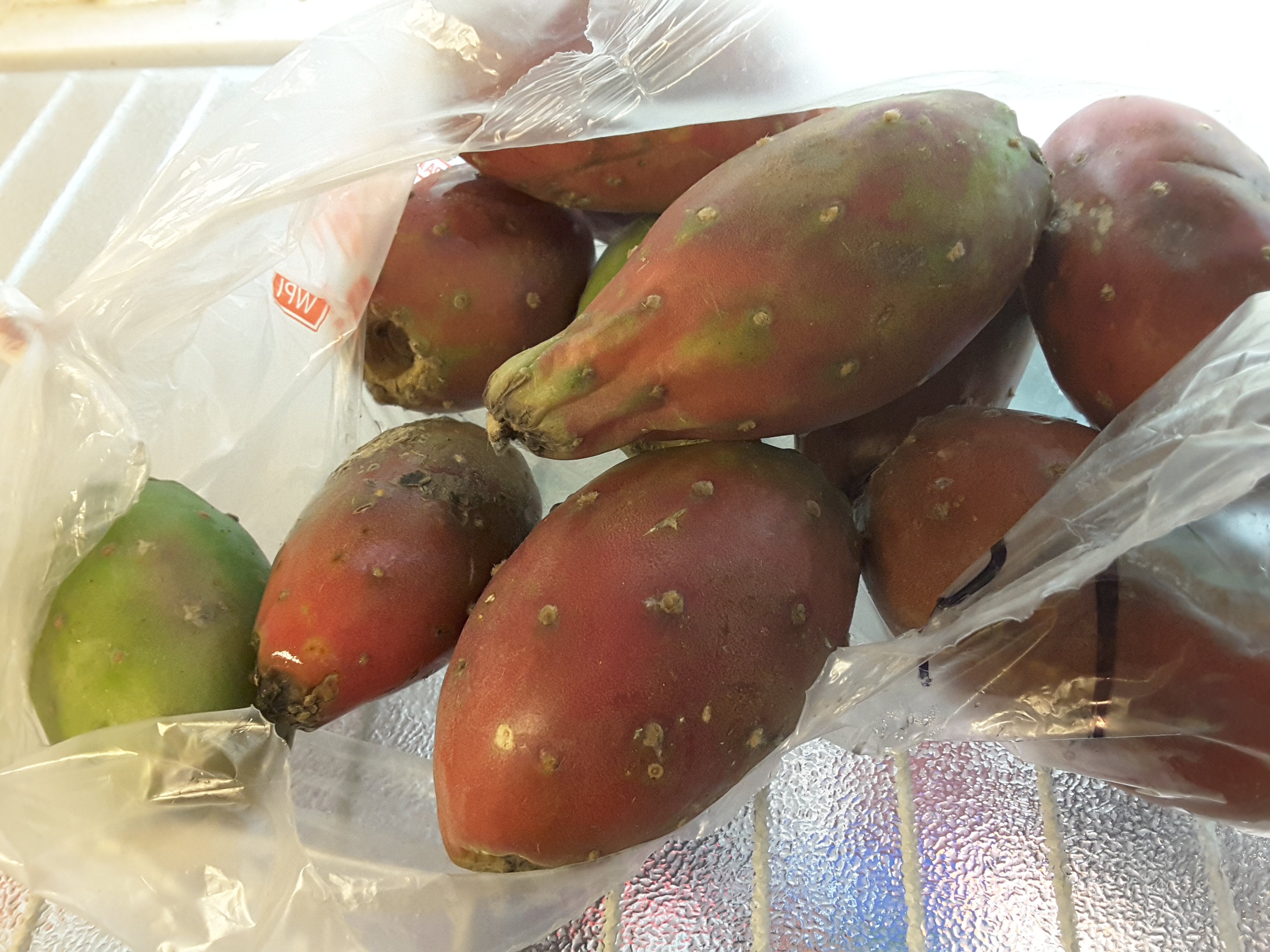
Cactus tunas (prickly pears) from the Armenian corner grocery

For the first time in the history of this blog, I’ve decided to delete a post. Last week I wrote about the nomination hearings for Judge Barrett, whom I definitely don’t want to see on the Supreme Court–not that I’m so thrilled by and large with any of the conservative justices already on the court.

I thought about that piece all week, though, and reconsidered, because every time I started to work on the next new post for things I was actually excited about, it bothered me to see it here, and I decided that meant something. I have voiced some fairly strong opinions in my time, here and elsewhere, and I generally stand by them in retrospect. One of my convictions, however, is that I don’t like signs that someone is cooking with bile, a chip on their shoulder, or is making blanket statements, and that includes myself. A difficult thing to balance because we live in the real world, and there’s a lot to be upset about right now.

As my daughter pointed out last week and as I’ve said myself to loved ones who wanted to dissect the headlines when I needed a break, we all have heard way too much to want to hear even more of it right now at the dinner table. We need an oasis of some kind. So I’ve reconsidered and decided it doesn’t need to be here.

SlowFoodFast is one of my own longer-lasting places of calm–well, usually calm, or at least calm-ish. Sometimes I have to remind myself of that, take a step back and a deep breath or two (with a mask on) and get on with things…because I’ve been waiting to spring a couple of ideas I’d rather have written about instead.

This is my place to rethink and experiment with cooking methods, share my ideas about getting more out of ordinary inexpensive ingredients and kitchen gadgets, explore unfamiliar techniques and foods, and generally do the grown-up equivalent of climbing a chair and sampling every jar or bottle in the spice cabinet just to see what they taste like (which, you are probably not surprised, I did pretty often as a kid. I never actually got caught, either, now that I think about it).

I’m still more or less that kid and the cabinet keeps getting taller and springing some interesting new items. As, for instance, cactus tunas (prickly pears), which are in at my local market and slightly ugly on the outside–often scarred or ashy-looking in spots. It wasn’t really obvious why there should be several bags of them in the last-chance bin because the fresh ones aren’t markedly different. And you’d think people would be grabbing them up. Here they are, spines trimmed off, no need to go out and harvest them yourself and take the risk of high-fiving any cacti.

When I saw the cactus tunas at the store, I remembered a story from last year in Atlas Obscura about a Sicilian liqueur, bright jewel-toned stuff, made from these cactus tunas steeped in strong alcohol plus sugar syrup and aged a bit as kind of a thick fruit brandy. Not that I was really going to put up a cactus cordial myself–I don’t really have the head for drink, and when I do, it has to prove its worth to me in a few sips. What if it were only kind of bland, like an alcohol/watermelon kind of thing?

But I still wanted a bag of them to take home. These are the kinds of fruits that grow on the paddle cacti the lonesome teenager in Cinema Paradiso cut to use for salad plates on his one picnic date with the elusive rich girl. Cue the music…

…It still took me a full week to dare to deal with them.

The tough leathery skins turn out to be no big deal, even the obviously blemished ones, as long as the spines are definitely off–some people recommend rubber gloves in case. You rinse the tunas and just peel them with a paring knife, and the skins slip off pretty easily. All of the ones in my bag were fine inside and unspoiled, no matter how blemished they were on the peel. Just inside the skins is a pale greenish-yellow-white layer–rather tart, like watermelon rind–and then the brilliant, multicolored fruit itself, also textured like watermelon, and with much the same kind of taste, maybe crossed with cucumber.

The fruit varies in color–one might be bright magenta, another a deep ruddy brick red, and some in the farmers’ markets are a sherbety pale orange, yellow or even honeydew green inside. My camera refused to believe what my eyes were seeing here in my kitchen or to give me an option partway between fluorescent and natural light, so the colors don’t really show up as bright in the picture as they actually are. Anyway, they’re pretty showy.

bowl of peeled cactus pears or "tunas"
Cactus tunas after peeling. The greenish layer is tart, like watermelon rind.
Continue reading

The CDC tries defining “powerhouse” veggies

carrotsareveryhealthytom-ABS“Carrots are very healthy!” “Mmmhm, very healthy, Tom. Good for your eyes. Vitamin A I think.” A six-year-old’s view of carrots and nutrition, courtesy of my daughter from several years ago, and (obviously) influenced by the best of the cartoon world…

The Centers for Disease Control seems to have taken up the nutrition density scoring gauntlet to rate high-value fruits and vegetables for their “powerhouse” value. A research paper in this month’s Preventing Chronic Disease journal derives a nutrient density formula that’s not a million miles away from the ANDI scoring scheme Whole Foods was touting a couple of summers ago. The author presents a table of 41 plain, raw and unadorned fruits and vegetables that made the cut by delivering more than 10 percent of your recommended daily value of a combo of 17 major nutrients for 100 grams of raw weight and/or (this part wasn’t quite as clear) 100 kcal worth of food.

The fact that the CDC is now publishing this kind of study lends nutrient density scoring more legitimacy than perhaps it really deserves.

On the plus side:

  • The author, Jennifer Noia of William Paterson University in New Jersey, is an actual trained nutrition researcher with a Ph.D. in the field.
  • She’s not making a pitch or selling special dietary supplements. Her stated goal is to help the CDC develop practical guidelines for public health reduction of cancers and cardiovascular disease by rating vegetables and fruits for their general nutrition-worthiness.
  • She doesn’t bias her formula in favor or disfavor of her favorite name-dropping superfoods or taboos, as Joel Fuhrman and the admirers who started the ANDI scoring empire did.
  • Avocado doesn’t score big; it’s not even included (too caloric for what it delivers).
  • Noia does not include trendy components with questionable or untested nutritional value, things like  selenium, antioxidants (unspecified groups of) and phytochemicals (unspecified groups of) among the 17 well-tested nutrients she counts in for the composite formula.

So far, so good.

But the specific method she derives is still kind of muddled, and the logic behind the nutrient density comparisons is too.

First, are we going for 100 grams or 100 kcal (also known outside the lab as “100 calories”) as the standard amount of each food for comparison? The article switches back and forth without clarifying and the formula does not normalize to one or the other as a uniform standard.

Second, how does that amount, whichever one is in use, compare with a likely normal serving of the specific fruit or vegetable? Arugula’s way up near the top for nutrient density–but if you ate 100 grams of it, or worse yet 100 calories’ worth, at a sitting, you’d be trying to eat an entire plateful or maybe several platefuls of it. Very bitter. Most people include a small handful, maybe a quarter cup per serving, in a mixed salad for interest, or (as I do) on a sandwich. With mustard or vinaigrette and some other veggies.

Same for watercress. And both are expensive per serving compared with romaine, bok choy, Chinese cabbage, turnip greens…parsley??? Who’s going to eat 100 grams OR 100 calories’ worth of parsley? Scallions? Maybe if you grill them, but then again, 100 grams? 100 calories?

The list is also a little arbitrary and incomplete in terms of what’s included. Green beans make no appearance on the list, for good or ill. Maybe it’s because they don’t deliver a ton of vitamins per se, even though they have some fiber and potassium and are low in calories. Mostly, though, they don’t happen to fit into one of the four broad categories (cruciferous, leafy greens, citrus, and yellow/orange) included in the selected list. That’s not a nutrition criterion, it’s a plant classification criterion, even though it is based on some generalizations that those four categories are the most nutrient-dense of the common vegetables and fruits. But at least the author acknowledges that limitation in her study and isn’t saying green beans have no worth in one’s diet.

Of what is included in the list, the rankings by nutrient density score are a bit counterintuitive. Broccoli and cauliflower are, perhaps disappointingly, rated a lot lower on the scale than watercress–in the 20-25  range, not the 100 (maximum score). So are carrots and tomatoes.

One of the reasons for this is, as Dr. Noia writes, “As some foods are excellent sources of a particular nutrient but contain few other nutrients, percent DVs were capped at 100 so that any one nutrient would not contribute unduly to the total score.”

So the scoring formula is purposely handicapped toward well-rounded performers. Is that realistic or meaningful? Some of the foods that scored lower within each of the four broad categories  may provide large amounts of one critical nutrient–vitamin C or A, or fiber, or potassium, or iron–but perhaps not loads of B vitamins or calcium.

Well–that’s the way it is. Very few single vegetables–and almost no fruits–deliver so many different nutrients at high density in an edible portion. It’s why we eat a variety of vegetables and fruits and don’t just gravitate toward one impossible or hard-to-eat-exclusively jack-of-all-trades food.

And that’s the major flaw in this approach to defining nutrient-worthiness through a catch-all formula. The author of this study, the ANDI Score folks, Dr. Fuhrman and countless others really are looking for a magic bean. They want “AND”, not “OR”, a vegetable or fruit that delivers everything by itself. Even if they think they’re making it simpler for the average consumer to get better nutrition advice, they’re working from a false premise.

Still, at least Dr. Noia isn’t overreaching as much as the commercial popularizers of “superfoods” schemes. She admits the list is limited, and that the formula she’s derived from previously validated major studies is still preliminary. The correlation between her nutrient density score and established nutrients with some cardiovascular disease and/or cancer-prevention effect is predictably high–well, there’s a lot of overlap to begin with, so what it really tells you isn’t a great deal.

But there is some value in looking at the list of what scored at least a 10 out of 100. What can you really learn from this list?

First, “Bitter is Better.” Sort of, anyway. You wouldn’t want to make a whole dish of arugula or watercress, but you might want to throw a good handful or so into your salad or sandwich or pasta.

Notably, though, “More Expensive and Trendy isn’t Necessarily More Nutritious.” Kale isn’t as high up on the list as ordinary unglamorous spinach or turnip greens, or even darker leafy lettuces–isn’t that interesting?

Third, “Green is Good.” Darker greens are closer to the top of the list, and even between broccoli and cauliflower there’s a slight pan-nutrient decrease, though it’s not meaningful enough to start shunning cauliflower. Which I happen to like nearly as much as broccoli, and sometimes in combination with it. And although brussels sprouts are marginally more nutritious than cauliflower, they’re also more of a pain to peel and trim, and there’s a lot more waste.

The real Green Effect here has to do with calories. You notice that none of the citrus or berry fruits are up in the top 10 in the list. Apples and bananas don’t make the list at all, and melon is right out. So are summer stone fruits. Even apricots, which have a fair amount of vitamin A. That’s because the greens on the list are very low-calorie, with almost no carbohydrate or sugar. And because the nutrient density scoring formula accounts for nutrients per 100 calories (at least sometimes, when there are countable calories involved), fruits are naturally going to score lower.

From the perspective of diabetes prevention and weight control, this is a reasonable way of looking at how we get critical vitamins and minerals. The common phrase “fruits and vegetables” leads people to assume that fruits should be thought of first when you shop, and vegetables are kind of an afterthought. But it’s obvious from this kind of scoring that fruits should be considered dessert rather than the major source of vitamins and minerals.

However–given that citrus fruits, berries and stone fruits deliver large doses of vitamins C and A respectively, plus potassium and vitamin E and fiber on occasion, they shouldn’t be shunned for not “doing it all” and doing it carb-free. We need some carbohydrates, and if you eat an orange, a half a grapefruit, or even a nectarine at breakfast instead of a piece of coffeecake, so much the better. Just notice that you’re also eating some carbohydrate in the form of fruit and don’t eat three at a time. Or dump sugar and butter on it and still think it’s righteous because it’s nominally fruit.

I think we can all handle that. Even without calling anything a superfood.

American Grown (Groan?)

I have mixed feelings about Michelle Obama’s forthcoming book, American Grown, which the Barnes & Noble web site describes as:

Now, in her first-ever book, American Grown, Mrs. Obama invites you inside the White House Kitchen Garden and shares its inspiring story, from the first planting to the latest harvest… Learn about her struggles and her joys as lettuce, corn, tomatoes, collards and kale, sweet potatoes and rhubarb flourished in the freshly tilled soil.  Get an unprecedented behind-the-scenes look at every season of the garden’s growth…  Try the unique recipes created by top White House chefs…  [read about a community] garden that devotes its entire harvest to those less fortunate, and other stories of communities that are transforming the lives and health of their citizens. With American Grown, Mrs. Obama tells the story of the White House Kitchen Garden, celebrates the bounty of our nation, and reminds us all of what we can grow together.

The book is due out –well, now, really, the end of May. But I’ll tell the truth here: I hate this description and I’m sorry she wrote the book just from the blurb. Really, this is the best they could do? It’s so colorless. It sounds like a bland, give-the-wife-a-project kind of capitulation written by the official White House handlers.

What I find most disheartening about the beige, friendly-sounding jacket blurb is the “About the Author” section, in which Obama is described as the First Lady of the United States and a mother of two daughters, and that in 2010 she started the Let’s Move program. These are all good things, and she’s done a lot with the program. But nowhere does it mention her career–now on hold for at least four years–as a lawyer, and a good one.

In terms of public relations, Obama has conducted her Let’s Move program more successfully than Hillary Clinton, who was also a skilled and high-power attorney, handled a much-embattled health care expansion plan in her eight years as First Lady. Clinton is thorny and opinionated and direct, and is only now learning to keep her moves as Secretary of State quiet rather than telegraphing all her punches–but she’s achieving a lot. Obama is a lot smoother and more immediately likeable–something the rightwingers got wrong from the start–and she’s full of common sense, people sense, and I keep hoping for big wins from her.

Obama’s charismatic and not easily ruffled, and she’s a fashion icon–you could see the newspapers focusing on that since it’s so much easier and picturable than a career full of sitdown negotiations with House Republicans and stacks of paper and emails. But both women have been in the awkward position of First Lady, competent people sidelined for significant numbers of years by their husbands’ presidencies, hemmed in by the public expectation that they’ll shrink themselves into June Cleaver-like roles.

The Lady Bountiful bit is homey, patriotic, old-fashioned and charming. But it’s also hideously condescending and weird as hell that in this day and age it’s seen as acceptable to shove a professional out of work and relegate her to homemaking, even if it’s on such a grand scale. Home gardening is what you do on your day off, when you’re out of work or retired. Even if you enjoy it and are great at it, which I’m not. The fact that I got no tomatoes until January this year says a few things. If we had to depend on what I can grow successfully, we’d starve.

So what I say is, if you’re gonna go First Lady, go big. For the press release, why not do it more like the blockbuster movie radio voiceovers?

[pulsing dark synth strains, standard gravelly yet unctuous baritone voiceover]

“IN A WORLD…where everything has stopped growing except the American waistline…comes a heroine for our times. Once a high-power attorney, now down on her luck and forced to smile at hostile crowds who want her husband to say something–anything–definite about the economy, Michelle Obama IS… The First Lady.

[patriotic/threatening military march starts to swell with a roll of the tympani]

With NOTHING MORE than a trowel, a packet of seeds, a groundskeeping staff of at least twenty, a fully-trained yet cooperative head chef and a large, green lawn, Michelle Obama is TAKING ON …. Corporate America. You’d better HOPE …

[tympani going crazy à la “2001: A Space Odyssey”]

…she WINS.”

See you at the movies!

Food as Barometer

The past week has seen a number of shock waves go through the food world.

Gourmet magazine’s announced closing yesterday is the latest and the one with the best PR. Gourmet‘s editor, Ruth Reichl, has turned what was once the flagship publication of foodie-ism into something more like Vogue for food–high-gloss, decorator restaurant food (the focus of her previous career) with recipes that ranged from routine to fanciful, from decadent but enticing to over-the-top, impractical, even wasteful and ridiculous, particularly in the last couple of years. A few memorable examples of the latter–lamb cooked with a stewing sauce that included something like a cup of whole coffee beans in an ingredient list some 20 or so items long, a chicken liver paté with a ton of added butter to simulate foie gras when that dish was outlawed in Chicago, and a chocolate and sesame butter tart with so many elaborate steps and so much extra fat in each layer–with nearly obvious clashes of flavor–you could practically choke.

Reichl, whose memoirs I have nonetheless enjoyed a great deal, seems to have been in on the official food world’s migration to recipe titles–and restaurant menu listings–so long they owe more to Proust, or perhaps Balzac, than to James Beard. Then again, Proust called madeleines madeleines, not “little ridged pure butter genoise microcakes with microplaned lime rind, baked in the shape of elongated shallow clamshells”. Goodness knows what today’s foodie superstar chefs would come up with for a title.

And yet Gourmet, with its glossy ads for show kitchens and olive oils and edible vacations in exotic locales, has tried to broaden readers’ ideas and ideals on occasion, and that’s Reichl’s influence too. If the cover one month showed coveted seating at a prestigious Paris restaurant, the tablecloth and glassware sternly hushed in preparation for the pre-theater crowd, or the cliffside view of an Italian trattoria table with a glass bowl in the foreground brimming voluptuously with prawns, greens, oysters and a coral-hued or purplish octopus, other issues sent staff into the mountainous inner reaches of China to report on the poverty and generosity of villagers there.

It’s hard to imagine how Reichl and her staff pictured reconciling the ultra-affluent with the world-conscious, and perhaps their attempts failed to convince either luxe advertisers or Condé Nast this year in particular. But I can see how Gourmet‘s underlying spirit of foodie-ism has led to the explosion of adventurous, hands-on food blogs of a younger working generation as they discover both real food and the desire to learn to cook it.

But Gourmet isn’t the most important food barometer, particularly because it represents a shrinking target audience at the top of the food chain, as it were. Rumbles farther down the scale have been quieter but with any luck perhaps one hopeful sign will be more lasting and more influential.

Last Thursday, the L.A. Times reported that the federal WIC  (Women, Infants and Children) food supplement program will now allow participants to spend their vouchers on fresh produce and whole grains. The allowance isn’t really big– $6/month per eligible child, $8 per pregnant woman or mother of a child under 5, and $10 per nursing mother, or about $14/month on average for a typical family, but it’s a start.

More promising is that the changes would push stores that want to accept WIC vouchers to stock fresh produce and whole grains. That might put at least modest quantities of decent foods within reach in lots of inner city neighborhoods, and it means farmers’ markets can also start qualifying to accept vouchers.

In the Los Angeles area and Orange County, the WIC program is especially important–out of more than 12 million people, something like 316,000 low-income people are enrolled in WIC. More than 8 million people are enrolled nationwide at a cost of slightly under $7 billion per year, with vouchers of about $60 total per family per month. Less than $1000 per family per year even counting the administrative costs of the program. It makes the Food Stamp program seem generous by comparison.

The new shift toward allowing fruits, vegetables, and whole grains under WIC isn’t adding anything to the total Congress allots–the cost for these vouchers has been taken from some of the dairy and juice allowance. But local WIC officers are still grateful and think it’ll make a big difference to their clients, some of whose children have never tasted fresh broccoli.

It’s a far cry from the fuss over the blight on homegrown heirloom tomatoes in the northeastern states this summer.

Spaghetti Squash Too Many Ways

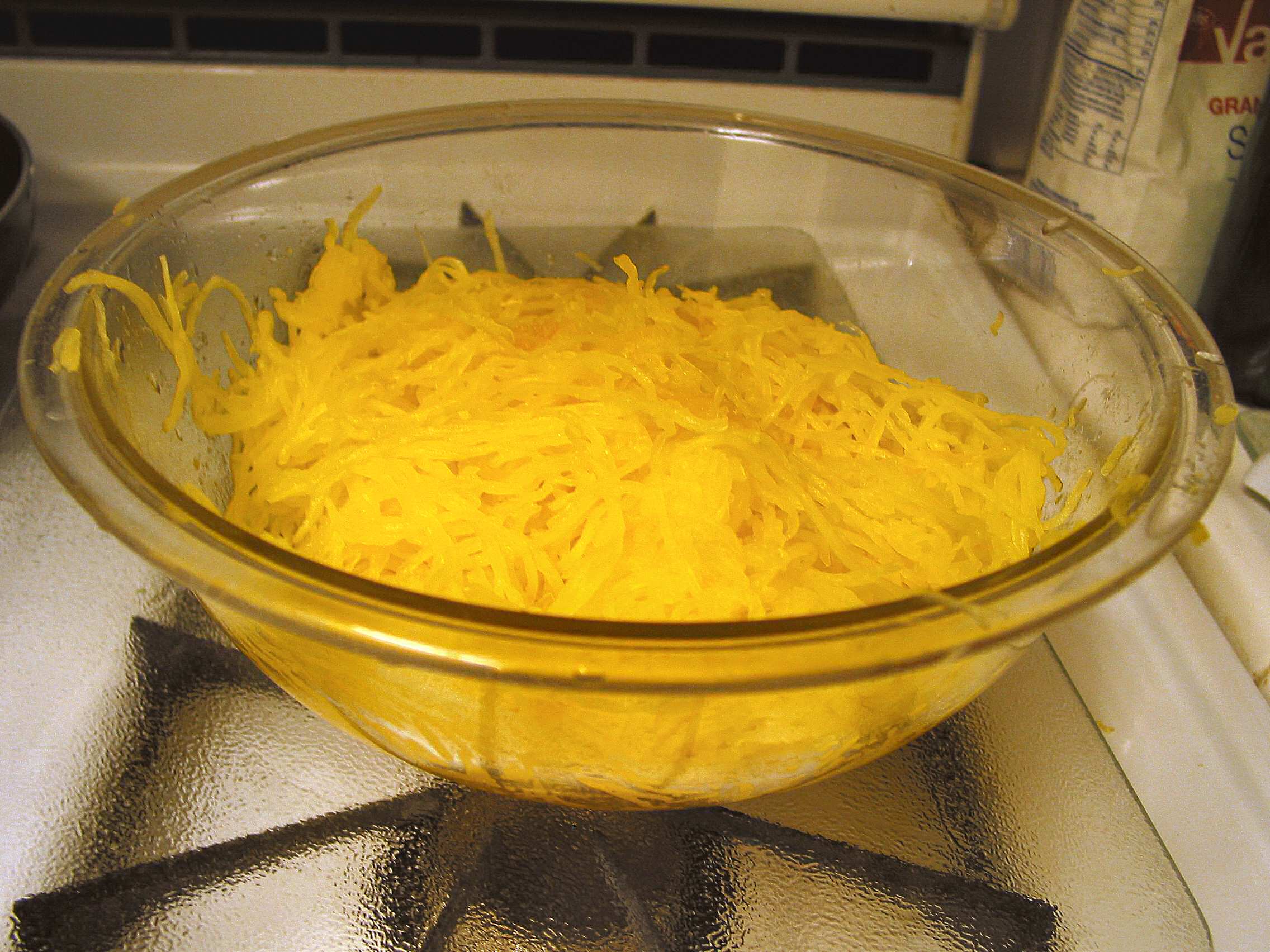
Just half of a microwaved spaghetti squash makes 5 or 6 cups

Just half of a microwaved spaghetti squash makes 5 or 6 cups!

This week my local Trader Joe’s had crates of beautiful–and hefty–spaghetti and butternut squash for less than $2 apiece–on the order of 30 to 50 cents/lb. So of course I got two of each and wobbled out of the store unsure which bag was pulling me down further. And then came the task of cooking them.

One spaghetti squash–a good-sized 5-6 lb. beast–will feed a lot more people than you’d think. It’s got some serious advantages over standard pasta: more fiber, no sodium, some vitamin A and potassium, perhaps fewer calories and carbohydrates per ounce. And it’s incredibly versatile. And you can cook it in the microwave in about 10 minutes rather than spend an hour baking it and heating up the house.

But there’s one big disadvantage–if you cook the whole thing, you have to eat the whole thing. Cooked spaghetti squash doesn’t hold up in the freezer–the strings go flat and shrivelly. And reheating too long can make it wilt as well. So can very acidic dressings.

So the choices are (for a small, moderately but only moderately tolerant family unit):

  • Cook half at a time and store the other half raw and wrapped in the fridge for a few days
  • Cook both halves, use one right away, and store the other half in the fridge for a few days, either wrapped in its shell or else scooped out into a container  (recommended)
  • Give the other half to a friend–but not too good a friend…
  • Cook it all and make it for a big potluck. Maybe people will think it’s innovative and exotic…depends on what you do with it (I don’t so much recommend marinara for this if you’re looking to impress–maybe a peanut-curry sauce or an Alfredo-style sauce with lemon peel, or something involving oyster mushrooms)
  • Cook it all and serve it a couple of different ways over the course of the week
  • Make a couple of the variations ones that taste good cold and eat the leftovers for lunch (recommended)

One important tip (learned the hard way):

The strands grow crosswise inside the spaghetti squash, not lengthwise. If you cut the squash in half the way you would a watermelon, you’ll be cutting the strands into shorter bits–not what you want. Cut the spaghetti squash in half across the middle of the SHORT side, NOT from the stem to the flower end.

If you have kids, let them count the seeds in each half of the squash–it’s a good lesson in plant survival strategies. My daughter and I counted about 80-90 seeds per half and decided to wash, dry and save them for her school’s garden. At this rate, they’ll have spaghetti squash for several years. Note of caution: out of 10 that we thought had been lost down the sink but actually got caught in the drainer, a full 9 germinated, so be careful what you wish for… even commercially grown, these things are very, very determined. But we’re not ready to name any of them “Audrey II”–yet. Continue reading