
• Enter your email address to subscribe to this blog and receive notifications of new posts by email.

    Join 241 other subscribers
  • Noshing on

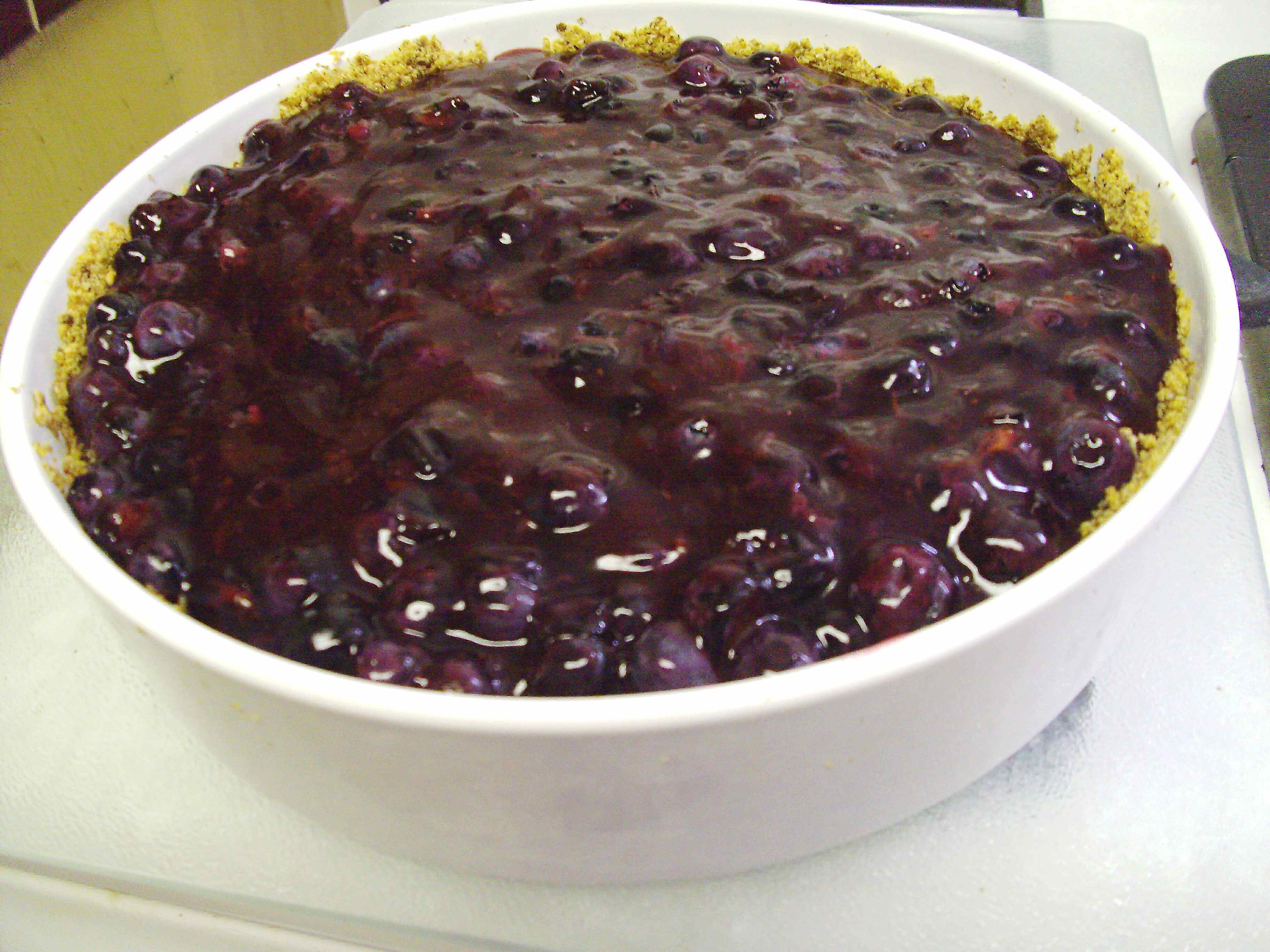
    raw blueberry pie with microwaveable filling and graham cracker crust

    This mostly-raw blueberry pie is a snap to make and very versatile--the filling microwaves in a few minutes, and you don't even have to bake the zippy gingered graham cracker crust--perfect for a hot Fourth of July and all summer long.

  • Recent Posts

  • Contents

  • Archives

  • Now Reading

  • See also my Book Reviews

  • Copyright 2008-2024Slow Food Fast. All writing and images on this blog unless otherwise attributed or set in quotes are the sole property of Slow Food Fast. Please contact DebbieN via the comments form for permissions before reprinting or reproducing any of the material on this blog.

  • ADS AND AFFILIATE LINKS

  • I may post affiliate links to books and movies that I personally review and recommend. Currently I favor Alibris and Vroman's, our terrific and venerable (now past the century mark!) independent bookstore in Pasadena. Or go to your local library--and make sure to support them with actual donations, not just overdue fines (ahem!), because your state probably has cut their budget and hours. Again.

  • In keeping with the disclaimer below, I DO NOT endorse, profit from, or recommend any medications, health treatments, commercial diet plans, supplements or any other such products.

  • DISCLAIMER

  • SlowFoodFast sometimes addresses general public health topics related to nutrition, heart disease, blood pressure, and diabetes. Because this is a blog with a personal point of view, my health and food politics entries often include my opinions on the trends I see, and I try to be as blatant as possible about that. None of these articles should be construed as specific medical advice for an individual case. I do try to keep to findings from well-vetted research sources and large, well-controlled studies, and I try not to sensationalize the science (though if they actually come up with a real cure for Type I diabetes in the next couple of years, I'm gonna be dancing in the streets with a hat that would put Carmen Miranda to shame. Consider yourself warned).

Wanted: cooler heads, warmer hearts

…and less inflammatory bloat.

Warning: This is kind of a long make-up post with 3-4 related recipes out of my experiments since April. They’ve been helpful and fairly fast for coping with hot weather and hot tempers, mostly my own.

It’s been a long spring and summer not posting and just trying to get through, and wondering what kind of food post could possibly make up for the mess we’ve seen unfolding in this country.

So my thinking has kept roiling around in the manner of the following rant (much cleaned up):

We have to do better. As a nation, as a people, as individuals and members of our communities, as responsible and worthwhile human beings.

The proof is in the pudding, they say. This is true of both government and cooking. Right now we’re learning the hard way that you get out of it what you put into it. So watch what you put into it, and don’t treat yourself or your country like a garbage can. Prepare to vote like it matters, and in the meantime contribute as best you can to your local public schools’ support organizations to get students in low-income families the food and tech they need during distance learning.

— — —

I can’t help but cook, and usually I like to experiment, but with my husband and daughter suddenly home 24/7 for the past half year (my kid just went back to university across the country), and with temperatures getting up to 100+ some days here, staying creative about food without a lot of excess shopping trips or extensive cooking has meant staying fairly simple and more about fresh produce than about artiness in the kitchen, and maybe just using more herbs–one of the few things I seem to be growing successfully in the backyard. We all could use some shoring up healthwise and flavorwise, with some trimming back after a stressful winter and spring. So I’ve been trying hard to make the veg and fresh fruit more prominent and easier to grab-and-go for self-made lunches, without any of us having to work too hard.

But I have been cooking, and some of it has been good, and a lot of it has been anti-bloat AND good, surprisingly enough.

And it has in fact worked, most impressively for our daughter before she went back east.

So this is worth passing on, especially now: forget the “stress-baking.” Go for basic vegetables and fruit. Seriously. It makes a difference, and it might help lower your health risk, and possibly your food expenses, as well. Maybe even help de-stress.

My daughter came home from university in March seriously stressed out from the shift to online and upended plans. She’d been suffering acid reflux badly enough to be on daily medication, and had to ask me for mild zucchini-type vegetables only for the first couple of weeks home, because tomatoes were too much, and so were the hot peppers she loves.

Being home with us during the shutdowns meant a lot less “student” food, aka greasy takeout with its oversized portions. More beans and lentils and fresh veg and fruit every day. More sleep, more water, more hanging out with friends online or by phone, more socially distanced walks to get a break from us parental units (yay!). By June, she was already in visibly better shape, needing less insulin per day to stay in range, had lost the “freshman 10” from last year without major effort, and possibly (probably?) as a result, she was able to stop taking the acid reflux meds. Just in time for Anaheim peppers and Fresno tomatoes. And Indian food.

(okay, back to food):

For my husband’s birthday this summer, I took requests and ordered celebratory takeout from our favorite restaurant, which has been in Pasadena for over 20 years and just keeps getting better. We’ve only done takeout anywhere a total of three times since the shutdowns, partly because it’s a splurge and partly because the logistics are more nerve-wracking now (were they wearing gloves? were you? do you wipe down the containers? should you nuke them?) You don’t want to know how it went on our first try back in April when the bad news was first ratcheting up. Not at all fun. I vowed to my still-beloveds afterward that we’d do it again and this time I’d be calmer, and just decide ahead how to handle the containers safely.

In any case, by my husband’s birthday, we’d finally got the hang of it enough for us, and there’s no denying that it was delicious. It also inspired a couple of microwave-friendly dishes I plan to pass on to my kid now that she’s back and cooking for herself. Two (well, three) of these dishes are hot, the other frozen, and all are cheap, fast, surprisingly easy and pretty good–they’re even fairly close to the dishes I was trying to imitate, but a bit lighter fat- and calorie-wise.

Which is good because today we’re in a massive heatwave in Southern California, and it’s so hot I decided to try hanging wet sheets out on an old clothesline I’ve never used. I think they were dry by the time I finished pinning them up 5 minutes later. I know I was.

Lightening up Makhni Paneer

Makhni paneer-style tofu with pumpkin sauce, plus added green beans and cooked chickpeas for a microwaveable next-day lunch. Or in this weather, just eat it cold.

One of the dishes we ordered from the All India was makhni paneer, which is cubes of fresh-pressed cheese submerged in a very rich tomato cream sauce. I’ve looked in a number of cookbooks and online–could be ghee and cream or full-fat yogurt in the sauce, could be coconut milk. Tasty but way, way, way too rich for my blood (cholesterol, that is). Way.

Still–the ideas started churning. The makhni paneer had a slight tang and a suggestion of sweet under all the obvious richness, and showcased the spices in a completely different way from the other dishes at the table.

How do you do that, but lighter, and possibly a little faster?

I love paneer but my daughter prefers tofu, at least for my home renditions of saag paneer. That actually fits a recent wave in US Indian communities of making heart-healthier substitutions–unsaturated vegetable oil for ghee, tofu instead of paneer, lower-fat yogurt where possible, and hopefully backing down a little on salt. Even the All India offers tofu as an alternative. So we obviously start there.

But the cream sauce is really the main challenge. The bhuna (browned-onion/spice flavor base) works fine with unsaturated vegetable oil instead of ghee. You can precook the chopped onion in the microwave for a minute or so to get it going a little faster when it hits the frying pan without the need for salt. But for the bulk of the sauce?

A large can of pumpkin sitting on the shelf for one of those just-in-case moments (why do we always seem to have them?) caught my eye, and it suddenly seemed right.

Pumpkin? right color, right substantial thickness, smooth, decent taste, likely to go well with everything else, easy to thin out just enough with milk or soymilk to get it a little more like the sauce I was going for, only without fat and with lots of vitamin A and fiber. Use enough of it to make a difference and it counts as a vegetable. Check.

Plus, I’d once used it successfully as the base for a fat- and egg-free eggnog back in my 20s, the early days of cooking for myself. Squashnog? That’s what I’d put in my little blank-book cookbook. Maybe it would work here too. Continue reading

Frozen sliced nectarines

frozen nectarine slices

This, forgive me, was the least bad of a selection of really lame post title attempts to figure out what the heck to call this–starting with “peach pops,” which is not just awful but misleading. And kitschy. “Peach pops” implies that you’ve blended some artificially flavored peach iced tea mix with some horrid oversweetened commercial sludge parading as yogurt and frozen it in a pool partyesque popsicle mold–each pop with its own color wand– and posed the result on a slab of watermelon or something. Kind of a Woman’s Day, Family Circle, Real Simple, etc., cover shot.

Anyone who knows me or has ever looked at the photos on this blog realizes I’m not naturally good at cute food, to say nothing of garnishes. Occasionally I try, but I’m definitely not neat. Worse, when it’s hot I’m [even more] cranky and self-righteous about looks not being everything. And even when it’s not broiling out I really detest all the condescending pinkness and tealness attendant on women’s homemaker magazine covers.

So this is not about peach pops. It’s about frozen sliced nectarines–real ones, even. And nothing but.

I’m all too aware that many readers are still suffering blah, spongy peaches this summer, and I still don’t have any good answers for you, other than the ones I came up with when I wrote the original post about it: pick only peaches that have a good smell and are not rock-hard when you buy them, try ripening them in a window for a couple of days, maybe in a paper bag, and if that doesn’t work, cut up the parts that are semi-okay and microwave them with some sugar and lemon juice and be willing to eat them cooked.

Here in Southern California, for a wonder, our US-grown peaches and nectarines are finally pretty decent. And decadent when fully ripe. Improbable as it would have seemed to me a few years ago, when I couldn’t get decent peaches or nectarines for love or money, I now have the opposite problem–too many all at once. It’s a problem I can happily deal with.

Freezing slices of nectarine, as the very uninspiring but at least unkitschy title implies, is probably too simple an idea to even consider a recipe. (See the photo above if you doubt me–this is not a glamorous-looking or stylish item as shown.) Granted, frozen bananas are pretty simple and they count as a recipe, especially if you stick a popsicle stick in them and cover them in chocolate. And then roll them in crushed roasted peanuts. Or coconut. Or pretzel dust. Or crushed peppermints. Or whatever.

But nectarines 1. don’t go with chocolate (per Alice Medrich in Bittersweet, and I agree) and 2. don’t have the classic shape for a popsicle-ish dessert the way bananas do. The best you can do if you’re eating nectarines frozen is probably to turn them into some kind of sorbet or granita, which might look prettier but  defeats the purpose of not fussing because it’s too hot outside.

So they won’t win James Beard awards, they won’t make the cover of your favorite foodie magazine. There’s no garnish unless you’re the garnish type, they don’t require a fancy blender or freezing mold (although you could…) and you don’t have to stick a popsicle stick or toothpick or anything into the slices–unless you want to. They just taste good. Is that enough justification for a food blog post? Not sure anymore. But I hope so.

It started in June, right before we were about to go east for a week and I had way too much produce in the fridge. I ended up throwing a lot of stuff in the freezer in microwave containers or ziplock bags and hoping for the best–bunches of herbs, a pound or so of blueberries, some lemons. And several nectarines, which I washed and sliced up first.

I’d never frozen fruit by itself before, and unfortunately at some point in my ambitious youth I had read how to do it properly, Continue reading

Pistachio madness two ways

(plus a handful of other frozen yogurt ideas)

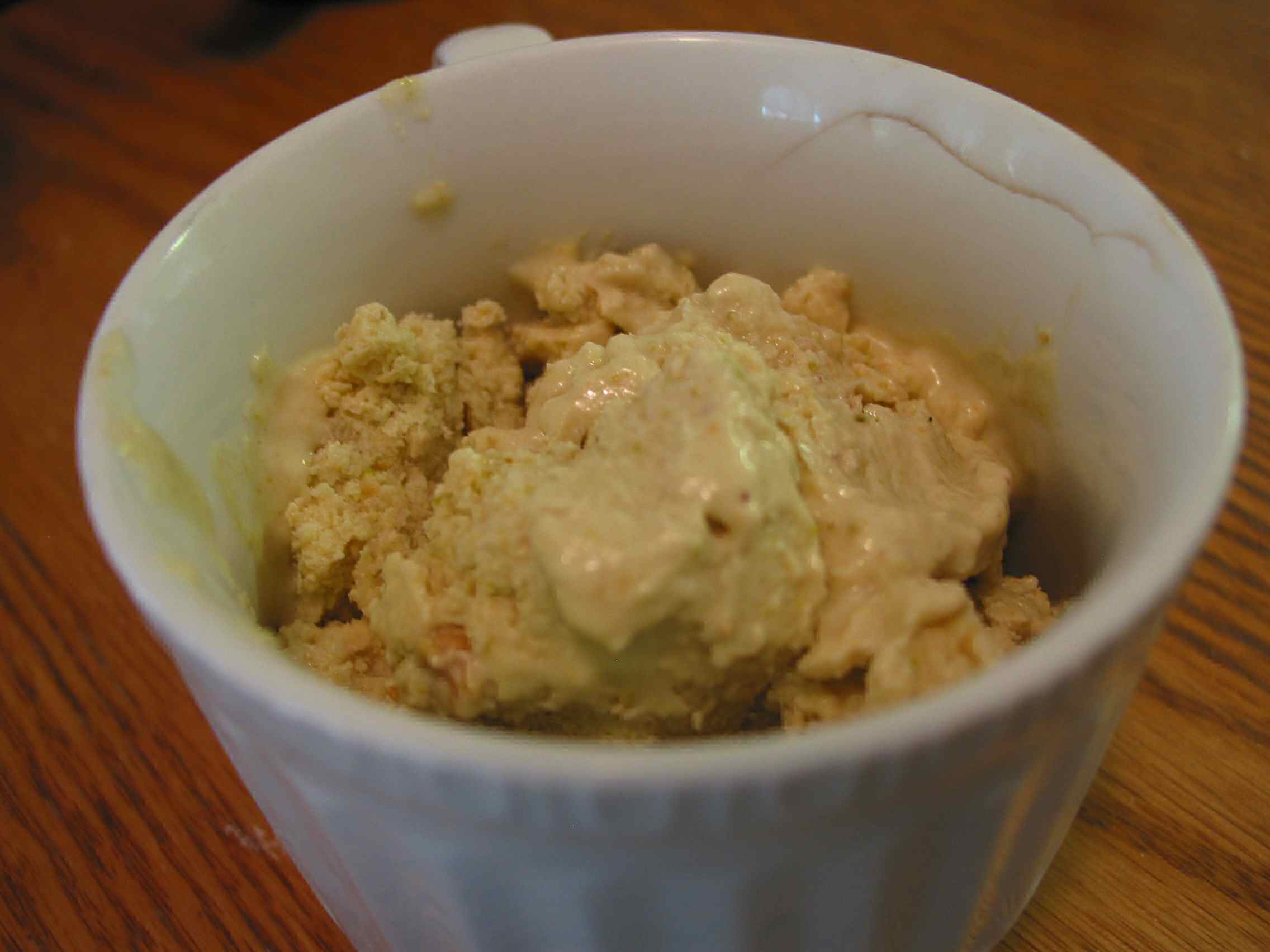
Homemade pistachio frozen yogurt, very low carb

It’s over 90 degrees most of the day in Pasadena, and I’ve gotten tired of looking at the limited selection of Dreyer’s (Edy’s east of the Rockies), Breyers, Haagen Daz, and Private Selection flavors with my daughter. It’s starting to get tedious, and they’ve dropped many of the classics for the cheapest possible quality candy-plus-ersatz-vanilla (note: their real vanillas are better). The forgotten classics were better-tasting, less dependent on goo and sweetened brown wax parading as chocolate or (if salted) peanut butter.

No supermarket ice cream brand in the non-superpremium range today offers rum raisin or pistachio worth considering anymore. It’s easy enough to doctor your own version with storebought vanilla ice cream and the aforementioned rum and raisins, but pistachio?

Pistachio used to be a standard ice cream flavor, didn’t it? Maybe I’m just getting old? Naah. Even in the ’70s when I was a kid, most of the “pistachio” ice cream around was already fake. I want the real thing, not the artificially green, mostly-vanilla-with-a-tinge-of-synthetic-almond kind.

And I want it low-fat for me and my husband and low-carb for my daughter (and us too, why not?) And I want it to taste delicious despite all that. Tall order? Actually, it’s easier than you’d think.

David Lebovitz has a Sicilian pistachio paste-based gelato in The Perfect Scoop, and he blogged about it a couple of years ago as well. He made it sound delicious, but also expensive and hard to find the ingredients for. Not that I’m against a trip to Sicily, except in July when it’s about as searing as LA (been there, done that, got the sunburn and the Fellini moments combined with heat exhaustion).

About the same time, a local gelateria owner in my area took much the same position on the utter superiority of Sicilian pistachios versus California ones for an interview in the LA Times. Which is lovely if you have a good source of Sicilian pistachios or pistachio paste at a decent price, but what if you don’t?

Most of the home-brew pistachio ice cream recipes I’ve seen in magazines, blogs and cookbooks call for adding significant amounts of heavy cream. Or else they involve large amounts of sugar. Or both. Yes, those recipes will give ice cream-like results, but they’re completely offtrack for what I need.

In my universe, good taste on a hot day shouldn’t mean losing your svelte, your cool or your wallet.

The nuts themselves are okay–pistachios, like most nuts and seeds, are very low carb and though high in calories from total fat, most of that is unsaturated. If I can keep the rest of the ingredients low fat and low carb and the stuff still tastes good, I’ll have it. Right?

So okay. I’ve been playing around with California pistachios and–not gelato, that requires making an egg-based custard and blending it with flavorings. Done it once or twice, and it worked, but it’s more work than I want to do most days. Or it used to be. Nowadays I’ve got the microwave moxie to make custard without so much work, but it’s still not what I want today. I want easy.

Frozen yogurt made with real yogurt is too tart to work with anything much but fruit unless you mix in some milk–and then it’s icier and freezes harder.

However, this summer I’ve been playing around with fat-free Greek yogurt as the base for a couple of different ices in small quantities. Greek yogurt varies a bit in nutritional stats from brand to brand, and it’s expensive, which is why I took so long to try it out. But the cheapest all-real (no gelatin) stuff–Trader Joe’s O% fat plain version–while still twice as expensive as the regular plain nonfat yogurt ($5 vs. $2.50 a quart), has considerably less carb, maybe only 7 grams of carb per cup as opposed to 17 for regular. And it has about twice the protein–22 grams per cup. It’s a lot thicker and less acidic, so I’m assuming they drained out a lot of the carb in the whey. And it makes really easy frozen yogurts that taste like something and aren’t overwhelmingly tart.

Just mix in your flavoring of choice (preferably not too watery) with some sugar, and you can still-freeze it within an hour or two. If you think the tang needs to be tamed further, a little milk mixed in works okay and it stays thick enough to freeze fairly gracefully.

The texture is never going to be like ice cream, not entirely. It still mixes up pretty hard and a little icy if you still-freeze it, but once you’ve got it thawed out to the point where you can dig out a serving, it tastes good and changes to a creamy texture as you eat it, something like khulfi. Higher-fat yogurt would break the iciness up a bit but would defeat my purpose of lowering the saturated fat to something I can handle.

And the heavy fats and sugars mask any delicate flavorings. Think Italian gelato (the real kind you get on the street in Florence, not the overpriced stuff you get in pints in the supermarket here) and you know that a lighter base allows you things like rose or ricotta or apricot or kiwi, or hazelnut, or four different highly refined grades of chocolate. If you want to taste anything delicate in your ice cream, you have to get the fats and sugars down enough not to overwhelm it.

Not that I’m entirely subtle. My favorite icier-textured frogurt for when it’s broiling out is mint–Greek yogurt, a couple of drops of mint extract, if that’s strong enough without tasting like postage stamps, and a tablespoon or so of sugar. Divvy it up into 2-4 paper cups or popsicle makers (small is okay for this), freeze. On a searingly hot day it’s pretty good, intensely flavored and refreshing, and its popsicle-style texture is fine with me.

For something like coffee frogurt, I really do want a creamier texture if I can get it. I finally figured I should just brew a little bit of triple-strength coffee so I can mix just a few spoonfuls into a cup of Greek yogurt, maybe with a few spoonfuls of milk, and still get strong enough flavor.

A spoonful or two of alcohol-based flavorings like rum, amaretto, even just vanilla extract can soften the hard-freeze effect, since the alcohol freezing point is lower than that for water.

Or you can add something protein or starch to the mix–egg custards and cornstarch are the usual route for gelati and standard commercial ice cream, but silken tofu and nonfat powdered dry milk also work to break up the ice crystals. Greek yogurt is providing most of the protein here and little water, and the carb is a lot less than for the powdered dry milk.

The last thing on my list, and it sounds either weird or completely obvious, is to add a fat–but I want something unsaturated. Oil? Yuck (though I have seen some olive oil ice creams flavored with basil or the like). But what about nut butters? Those, don’t laugh too hard, work pretty well and give the frozen yogurt a richness that feels like ice cream, only without big saturated fats or modifiers or xanthan gum or corn syrup solids or whatever. Plus they’re interesting flavors.

Halvah: I started with my trusty jar of tehina–sesame paste. It’s got almost all its fat in polyunsaturated form. A tablespoon in a cup of Greek yogurt, plus a tablespoon of sugar, stir, freeze, dig out a chunk–not so hard! And the flavor–kind of like frozen halvah. Very rich, though. Maybe I could get away with less tehina or more yogurt?

Chocolate halvah: I tried a chocolate version–also not bad–by adding two tablespoons of cocoa powder and an additional spoonful of sugar to the tehina/yogurt mix. Pretty good, but the tehina taste was definitely still there alongside the chocolate. Like chocolate marble halvah. You have to be a fan.

Peanut butter? Probably more Americans would like it than the tehina version. Go easy on the peanut butter; a good-tasting mix I once made with half a cup got way, way way too rich very quickly once it was frozen. Stick with a tablespoon or so per cup of yogurt. I’d use natural peanuts-only peanut butter, preferably the crunchy one, for the purest taste, limit the sugar and add a pinch of salt.

But really. I started out wanting pistachio, and that’s where I’m still going with this. Because I ended up with two, count ’em TWO, really good, really different variations on pistachio, and both of them were really easy, really low in saturated fat, and REALLY low-carb. And actively delicious, which is definitely the point.

California pistachios may not be the Sicilian ideal, but they taste pretty good for what they are.  TJ’s sells 8 oz of roasted unsalted ones for about 5 bucks. Not exactly cheap. Still, the shelling’s been done, and for a pint of finished frogurt, you only need an ounce of pistachios. Will that be enough to taste like something? Oh, yes. Continue reading