
• Enter your email address to subscribe to this blog and receive notifications of new posts by email.

    Join 241 other subscribers
  • Noshing on

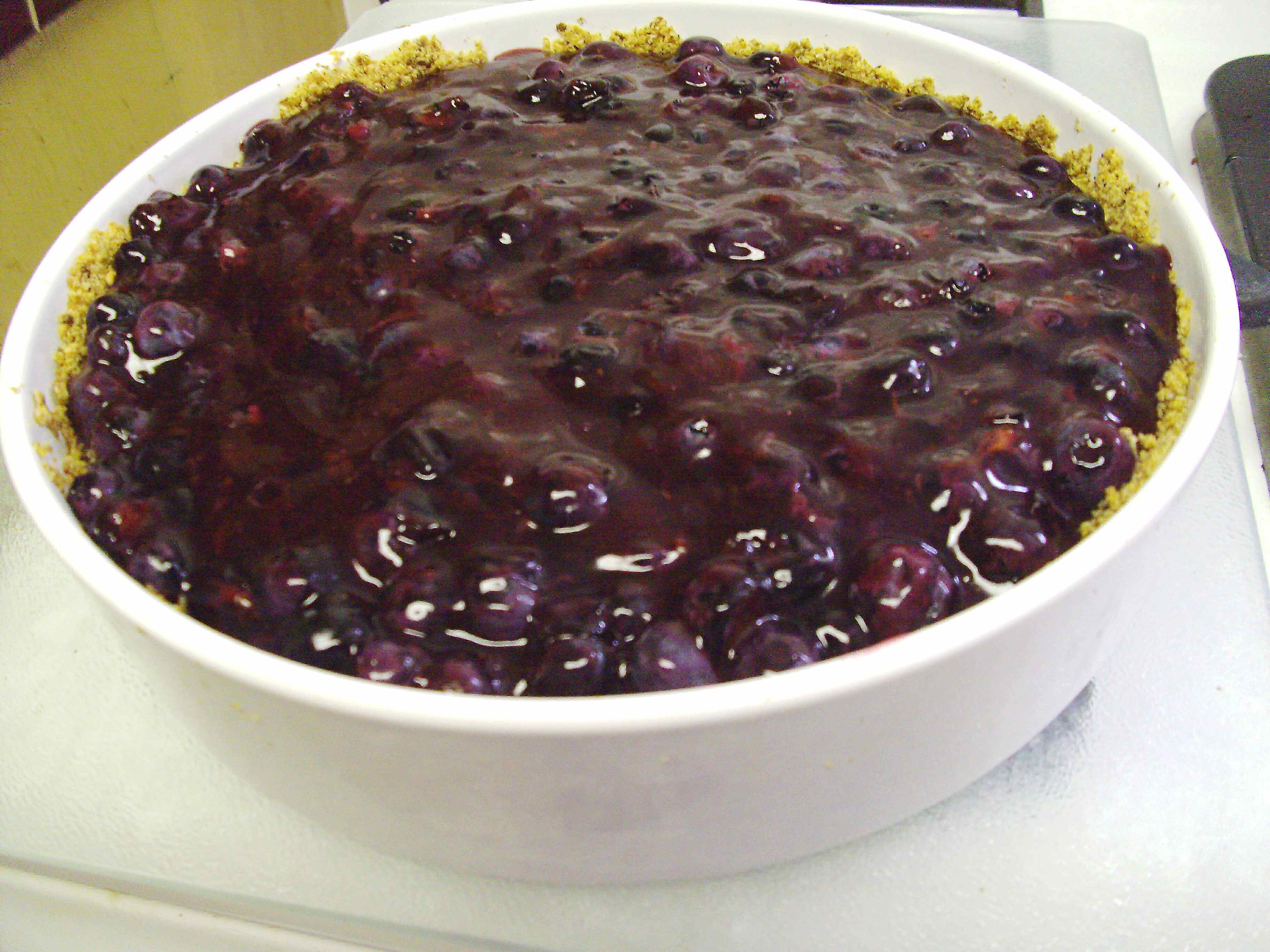
    raw blueberry pie with microwaveable filling and graham cracker crust

    This mostly-raw blueberry pie is a snap to make and very versatile--the filling microwaves in a few minutes, and you don't even have to bake the zippy gingered graham cracker crust--perfect for a hot Fourth of July and all summer long.

  • Recent Posts

  • Contents

  • Archives

  • Now Reading

  • See also my Book Reviews

  • Copyright 2008-2024Slow Food Fast. All writing and images on this blog unless otherwise attributed or set in quotes are the sole property of Slow Food Fast. Please contact DebbieN via the comments form for permissions before reprinting or reproducing any of the material on this blog.

  • ADS AND AFFILIATE LINKS

  • I may post affiliate links to books and movies that I personally review and recommend. Currently I favor Alibris and Vroman's, our terrific and venerable (now past the century mark!) independent bookstore in Pasadena. Or go to your local library--and make sure to support them with actual donations, not just overdue fines (ahem!), because your state probably has cut their budget and hours. Again.

  • In keeping with the disclaimer below, I DO NOT endorse, profit from, or recommend any medications, health treatments, commercial diet plans, supplements or any other such products.

  • DISCLAIMER

  • SlowFoodFast sometimes addresses general public health topics related to nutrition, heart disease, blood pressure, and diabetes. Because this is a blog with a personal point of view, my health and food politics entries often include my opinions on the trends I see, and I try to be as blatant as possible about that. None of these articles should be construed as specific medical advice for an individual case. I do try to keep to findings from well-vetted research sources and large, well-controlled studies, and I try not to sensationalize the science (though if they actually come up with a real cure for Type I diabetes in the next couple of years, I'm gonna be dancing in the streets with a hat that would put Carmen Miranda to shame. Consider yourself warned).

Raw Dough Carbs: Playing for Pizza, Calculating for Calzone

calzone

Calzone–one of my favorite Italian dishes–is extremely easy to make once you’ve got some basic pizza or bread dough risen and ready to shape. Flatten out individual rounds of dough, mix up a ricotta-based or roasted vegetable filling, fill and fold the dough over into half-moons, crimp the edges, brush with olive oil, and bake on a sheet in a hot oven until they’re puffed and golden. A satisfying but fairly light supper dish, especially if you have a good thick spicy tomato sauce to go with it and a salad on the side.

But even if you don’t, they’re a good consolation on a Sunday night for a kid with frustratingly advanced math homework the teacher didn’t quite prepare himself or the class for (11th-grade precalculus techniques popping up in a sheet of homework for 11-year-olds? The dangers of pulling your homework handouts from a math site on the internet. I keep reminding myself that he’s young yet). All I can say is, you know you’re in trouble when the heartburn is coming from the homework and not the food.

Grrrr. I’m almost over it. Anyway, here’s a much easier calculation trick that doesn’t require factorials…

The trick about making dinner from homemade dough is that the kid in question is diabetic and needs to know how many grams of carb she’s going to get in her calzone. Pizza, calzone, any kind of handmade entrée with dough plus noncarb ingredients, is tricky to calculate carbs for because you can’t easily tell by eye how much bread you’re getting in a serving. Check out any of the commercial pizza companies’ nutrition stats per slice–they’ll often state carbs as a range rather than a set value. How thick the dough is, how large the slice, etc, can really throw things off. Most people don’t need to know more precisely than “35-50 grams per slice”, but diabetics really do. Fifteen grams is a pretty big variation.

So how do you deal with it at home? If you’re making lasagne or stuffed shells or spanakopita, you can calculate the carb by counting the noodles or sheets of fillo dough you use and looking on the package nutrition label, then figuring a total carb count for the tray and dividing by the number of portions. A little tedious, but manageable.

Bread that’s already baked is also easy enough to calculate for–just weigh it out on a food scale in grams and figure 50 percent carb by weight. Most nonsweetened bread is pretty consistent, whatever density its texture. Weigh out a 70-gram piece of bread, and you’re usually looking at 35 grams of carb.

But for calzone or pizza you’re dealing with a bowl of wet dough to start, and once the dish is baked, it’s got lots of other stuff on or in it so you won’t be able to weigh it cooked and really know what carbs you’ve got. You need to test a portion of your raw dough, only raw dough is heavier than it will be once baked. Depending how wet the dough is, the proportion of carb could vary from a little less than half to a lot less.

Weighing a sample of raw dough to figure carbs after baking

Weighing a sample of raw dough to figure carbs after baking

The only thing to do is test a bit of dough by weighing it out raw, then reweighing it once it’s baked. Doing this in a conventional oven just for a single test ball of dough can be time-consuming unless you’re already heating it for the main event. Still, you want to get ahead with making the actual calzone so dinner will be sometime before midnight.

Enter the microwave. Yes, really. A nectarine-sized ball of dough, say 100 grams raw weight, will cook through lightly in 40-50 seconds in the microwave if you put it on a saucer and punch the “nuke” button. It’ll still be white and pale, but it’ll have risen fairly well to the size of a large dinner roll and won’t have gooey raw spots (you can check by breaking it open, just watch out for steam). Then just pop it in the toaster oven for about 5 minutes and it’s browned and baked through. When you reweigh it, you’ll know how much a 100-gram ball of your dough weighs cooked, and then figure 50 percent of that weight for carbs.

Aside: This nuke-and-toast scheme works pretty well for making a fast sandwich roll from a bowl of dough in the fridge. When I first came up with the idea, it was with great reluctance, because my only previous experience with microwaving bread had been the horrible, horrible mistake of Continue reading

Microwave Tricks: Melts and other Hot Sandwiches

Microwaving the cheese and eggplant while the bread is toasting makes homemade panini a lot quicker

Microwaving the cheese and eggplant while the bread is toasting makes homemade panini a lot quicker--though not necessarily neater

Last year for his birthday my Italophile in-laws gave my husband the ultimate kitchen gadget. Because they loved theirs so much, they gave him…a panini press. I gawked. My husband is almost famous for not cooking. At all.

In more than 20 years of life together, I’ve rarely seen him make an actual sandwich for himself–does shmear on a bagel half count? I’m sure he believes in his heart that he still remembers how to flip one piece of bread on top of the other and seal the deal, but I’ve yet to see evidence of an attempt. Even without grilling.

Somehow I don’t in my heart of hearts believe this panini press is going to be removed from the box and used. Not by my husband, and not by me. It’s not that we’ve never been to Italy or eaten actual panini (we have, on both counts). It’s not that we hate panini or toasted sandwiches in general (we actually like them quite a bit).

It’s that the free-standing real, authentic, Michael Chiarello-approved-and-branded panini press weighs even more than the professional-grade waffle iron my in-laws gave us 10 years ago (and which we’ve used a total of 10 times since, because it’s such a pain to clean). The panini press also takes 3-4 times as long to preheat before you actually get to make the panini. Somehow a grilled cheese sandwich of whatever nationality just shouldn’t take 45 minutes to make. Which it did, when my in-laws, with all the innocent gadget-happy enthusiasm of Toad and his motorcar in Wind in the Willows, brought theirs out to demonstrate.

As a cheese-and-toast fanatic of some standing, I have a few very specific criteria for my grilled cheese sandwiches, grinders, melts, etc., etc.:

1. They have to be substantial and taste good–classic or adventurous, they have to be worth eating. That means the bread, the cheese, and any other fillings under consideration.

2. The toasted bread must be crisp. It must not crush, mush, squash, crumble or absorb tons of cheese grease. It must stand up to the fillings.

3. The cheese must have body and flavor even when melted–it shouldn’t run away, sink into the bread, turn into a pile of salty but otherwise flavorless grease, swamp everything else on the plate, or become a rubber eraser.

4. The whole sandwich must not take longer than about 7 minutes to put together and toast.

Normally you’d say panini fit the bill for an ideal toasted cheese sandwich, and I’d agree–if I were eating out and didn’t have to put up with preheating the grill. If you’re running a corner grill in a touristy Italian city, you’ve got a hot press at the ready and you’re turning out panini by the score for large crowds of passersby, an individual panino probably doesn’t take more than 5-10 minutes. At home, though, all you want is your d–n sandwich. You don’t want to heat an expensive and cluttersome gadget 45 whole minutes just to get there.

You’d also say that the standard white-bread-and-Velveeta fried cheez sandwich was out of the running. You’d be right there as well. No exceptions or passes.

However, in my kitchen, with its limited counterspace and my dislike of extra washing-up, waiting, or fussing, I sometimes get impatient even with the toaster oven classics of good bread, good cheese, and foil underneath to catch the drips.

A quesadilla is obviously no trouble in the toaster oven. Practically designed for it. Neither, really, is a simple sandwich-bread-and-cheddar grilled cheese. But for anything more complicated, or any thicker, more substantial filling, sometimes melting the cheese is the longest part of waiting, and in the meantime you’ve either pretoasted the bread so it stays crisp (in which case it burns around the edges waiting for the cheese to melt) or else you didn’t pretoast the bread and it remains too soft underneath the cheese (and maybe absorbs some of the grease while it’s doing that). Sometimes the other filling ingredients–tomatoes or tomato sauce, mushrooms, lentils, artichoke hearts, etc.–make the bread soggy while you’re trying to melt the cheese on top. Sometimes they don’t cook all the way through.

Here, surprisingly, the microwave comes to my rescue, particularly with fillings that aren’t just cheese but rather cheese melted onto vegetables or sauce or lentils or tuna or some combination. Continue reading

Soupe à l’oignon gratinée (or not)

French onion soup without the gloppy gratin

Sometimes it pays to think out the recipes you read before you try them. For example…

I love and miss French onion soup from my pre-kosher days (that would be up to about age 19, long, long ago…) Can’t be helped, though–if you keep kosher, beef stock does not combine with Gruyère. And I’ve never actually tried making it at home before, because, if you go by a traditional, official kind of recipe like the one published in the LA Times below, it’s a 3-hour ordeal.

RECIPE: Soupe à l’oignon gratinée – Los Angeles Times.

Total time: 3 hours  Servings: 8  Note: Adapted from Comme Ca.

  • 8 large yellow onions, halved and sliced lengthwise into 1/4 -inch strips
  • 1/4 cup unsalted butter
  • Salt
  • 2 2/3 cups water, divided
  • 2/3 cup dry Sherry
  • 5 cups chicken broth (with as little sodium as possible)
  • 2 2/3 cups beef broth
  • 8 sprigs fresh thyme and one bay leaf, tied together
  • Fresh ground black pepper
  • 1 loaf French bread
  • 1 pound Gruyère, grated

Pretty onerous just on the ingredients (lot of salt in them thar vacuumpaks of stock), not to mention the bread. The Swiss cheese, oddly enough, is a lower-salt cheese than most, about 120-150 mg sodium per ounce as compared with, well, anything else at 180-210. It makes up for the lack of salt with a huge OD of saturated fat–and 2 ounces per person’s got to be a lot, really, just for melting on top of soup. It would be another matter if this were a legitimate fondue, or a sumptuous grilled cheese on really good toasted pain levain, and you were actually going to eat it all, but if I recall correctly, you aren’t.

Because I never had French onion soup at home, I never had to face the task of scrubbing baked-on cheese off the rims of the bowls afterward. Maybe 1/3 of what was sprinkled on ended up stuck like Swiss barnacles to the bowl, which seems like a waste, especially if you shell out for real Gruyère.  The rest turned into goop that sank to the bottom of the bowl and stretched up for yards on the spoon only to stick to the front of your teeth. Or blouse.

Plus at home there’s all the rooting around in the cabinets hoping your soup bowls are the kind that can survive the broiler and that your oven mitts (and guests) can Survive The Gruyère.

But the real cruncher here is time.

The LA Times instructions don’t even include the time it takes to sliver 8 very large onions, but you should, because it’s not trivial: 20-30 minutes, plus crying time. Heat the oven to 400 degrees (15-20 min, they also forgot this bit, but maybe while you’re crying over the onions). Stew onions with butter and 1/4 t salt in lidded casserole in the oven until the onions are softened and a light golden-brown, about 1.5 hrs, during which you’re supposed to stir every 15 minutes (!) Take the casserole out and cook further on the stove top until the onions are a deep golden-brown and just begin to stick to the bottom of the pot to form a crust (10 min? 15? 20? more?–from the experience below, I’d say at least 20, maybe even 30). Add half of the water and cook until the water has evaporated, about 8 minutes (so specific?). Add the sherry and keep stirring until it has evaporated, 3 to 5 minutes. Stir in the remaining water, broth and the thyme bundle, bring to simmer (5-10 min) and simmer 40 minutes (why 40? who knows?). Slice and toast the bread. Fill 8 oven-proof soup bowls, lay the toasts on top of the soup, sprinkle the grated Gruyère evenly over the tops and place the bowls under the broiler just until the cheese is bubbling and begins to brown in places (5 minutes?). Serve immediately.

TOTAL TIME: At least 3 hours, probably more like 3 1/2.

KLUTZ FACTOR: HIGH–lot of hot transfers of heavy casserole dish, finding and broiling ovenproof soup bowls, transferring to the table without spilling…not to mention serving “immediately”.

Then there’s…(you knew this was coming)

Nutrition per serving: 490 cal; 27 g protein; 36 g carb; 3 g fiber; 26 g fat (15 g sat); 78 mg. cholesterol; 808 mg. sodium.

Wow! Am I wrong in thinking that almost no soup should be this much of a labor of love, not to mention love handles? For this much time, fat and salt, I’d demand at LEAST grilled marinated lamb. Or a good runny camembert, a perfectly ripe pear, some excellent sourdough toast and a half-glass of something complex and interesting in the way of wine.

Maybe it’s as delicious as promised. But all those hours, all that stirring, not to mention all that fat and sodium and cholesterol, just for a bowl of onion soup and a slice of toast with melted cheese? Is it any wonder Lipton’s is popular?

Still…Can we do better with the onion soup itself? Maybe as in, vegetarian but still opulent, and furthermore without the heavy-duty time and calorie burden? Let’s try, anyway.

The first objections I have are eight huge onions and 8-10 cups of salted broth. Do I want to make anywhere near that much onion soup? Do I have that many takers in my house? Unfortunately not. One huge onion just for me, then. Maybe my husband and daughter, but only if it’s obviously fabulous. In which case, I won’t really want to share with them.

The main thing here is getting the flavor out of the onions–you want to caramelize them thoroughly and evenly without breaking down their aromaticity too badly. But I personally think baking them slowly in a big oven for an hour and a half just to start to do that is insane. Even if we’re talking about eight big onions.

My first attempt at shortening this recipe did not go badly, exactly, but it didn’t get me soupe à l’oignon either. Continue reading

Microwave tricks: Quiche in 15 minutes

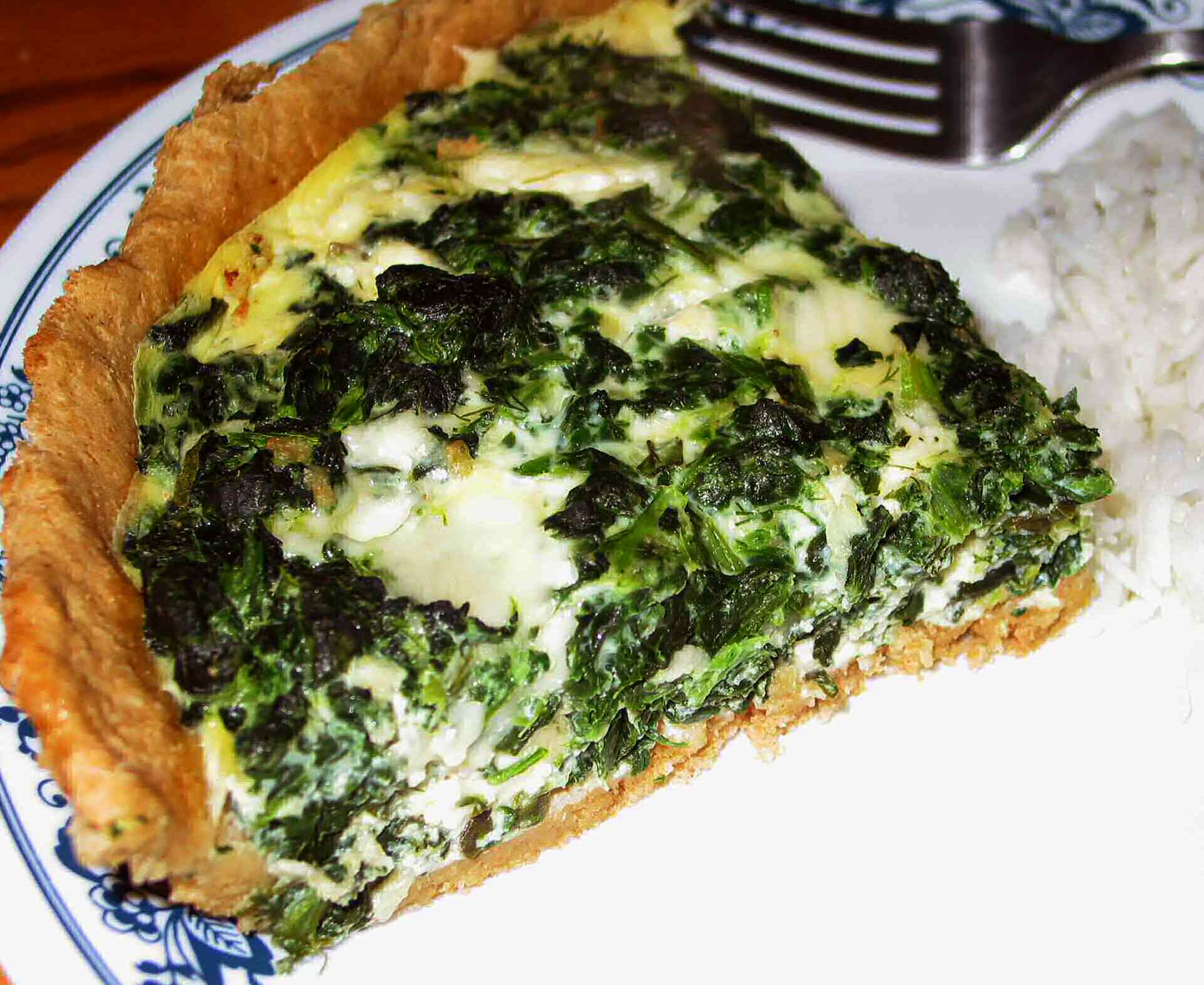
Spinach quiche in 15 minutesNo. Not kidding. Not even a little. This actually works, and comes out tasting much better than I ever expected. It rescued dinner last night, to tell you the truth.

I’ve made a lot of strange things with a microwave oven in my time. Honeycake, rice, taco chips (not recommended–it worked beautifully but I’m pretty sure that’s what shortened the life of my last microwave), pasta, dulce de leche, lasagne, baba ghanouj, beans, dolmas, flan, marmalade, rolls, even paneer from scratch. Sometimes I really need a quick method, sometimes I’m just fooling around to see what’s possible, but much of the time it actually works. Usually the first try is good enough that it’s worth either repeating as-is or fine-tuning to get it closer to what you want. This one I didn’t have to fiddle with at all–it just worked.

If you’ve got a reasonably modern microwave (1000 to 1200 W), a pyrex pie plate, a microwaveable dinner plate and the basic ingredients for quiche, you’re in business. All with real and very ordinary quiche ingredients, and no odd cooking methods other than the use of a microwave instead of a standard oven.

The olive-oil-based pie crust itself I made and parbaked in a regular oven for 10 minutes while I prepared the filling and custard. Continue reading

Adventures with Cheese

A year or so ago, I saw a show on PBS about how PR consultants test and choose keywords to influence public opinion on everything from political campaigns to new foods. Most memorable–other than the use of a statistics-wielding ad consultant for the Swiftboat smear campaign–was a French marketing expert in his late 60s who discussed the key difference he’d found in food attitude focus groups between Americans and French:

“In America,” he declared, “Cheese is dead. I can assure you of that.” The key positive words that arose in his group discussions about cheese were “sterile” and “safe”. That is, as long as the cheese was processed, uniform, free of visible mold, refrigerated, odor-free, pasteurized and–most important–wrapped in plastic so nothing could possibly escape, cheese was okay.

Otherwise, he said–you could hardly miss the sneer–Americans considered cheese unsafe. They–we–were culturally afraid of it.

In France, he maintained, “Cheese is alive.” The French focus groups brought out  words like culture, flavor, and the names of many, many specific types of regional cheeses that were their personal favorites. The French still buy much of their cheese at small local shops whose owners’ main job is to present their cheeses for sale at the optimum point of ripeness. The customers take home a wedge or small round of cheese and keep it on the counter or a dedicated shelf in the fridge, depending on the type, and they have their own fixed ideas and traditions for storing it so as not to ruin its flavor or texture–two words that did not really come up in the American discussions as much as “Velveeta”.

Are we Americans really that ignorant about cheese? The food my husband brought home from the aforementioned brunch included three or four stacks of precut sliced cheese–yellow-orange, whitish with an orange edge, and whitish again with tiny flecks of red and green throughout. Cheddar, muenster, and pepper jack? I looked at them, wondering were they real or processed–hard to say by looks alone, so I peeled off a corner of a slice on each of them to try them. They all tasted exactly alike. Although the one with the flecks was a little bit spicy, the basic flavor was Velveeta: salt, starch or gum, cooking oil. Something stale–maybe milk solids–but no culture, no tang, no fresh dairy flavor. There wasn’t even much of a smell. The French guy was right.

I started to toss the packets in the trash and my daughter asked why–so I let her taste them. “They’re not that bad,” she said. “They’re not that good,” I replied, and handed her a small chunk of sharp cheddar we had in the house for comparison. “Which would you rather eat?” ‘Nuff said.

I bring this up because I really do have a thing for cheese (damn my cholesterol-packin’ genes), but good artisan-type cheeses are often pretty expensive–$15 and up per pound–and the more affordable varieties of things like brie or gorgonzola usually lack something in the way of flavor, especially if they’re made in Canada or the U.S. Plus I have a thing for playing with my food.

For the last couple of years I’ve been playing around with the idea of taking a fresh cheese and culturing it further to get to something approaching the aged artisanal cheeses. We have lots of generic chèvre and feta and ricotta and so on these days–as well as increasingly easy-to-find inexpensive (but bland) brie and bleu cheeses made with cows’ milk. And that’s sometimes the problem: we don’t have a lot of goat’s or sheep’s milk available to ordinary consumers in the U.S., and the French-style cheeses we do have are kind of bland, maybe even oversterilized, even though as a former biochemist I’m a big fan of pasteurization, especially for any dairy that has scaled-up production. To that end, READ THE SAFETY NOTE AT THE BOTTOM OF THIS POST if you’re going to give this a try.  Continue reading